‘Free Press’? USAID Increases Funding to Pro-Kiev Media
By Daniel McAdams | Ron Paul Institute | May 3, 2014
In the name of a “free and independent media,” the US government through its Agency for International Development (USAID) has announced that it will dedicate an additional $1.25 million to subsidize the Ukrainian media in advance of the May 25th presidential election.
Through its multi-year “U-Media” project, USAID has been a major sponsor of the Ukrainian press. It goes without saying that the media outlets and organizations underwritten by the US government in Ukraine adhere closely to the US government’s foreign policy position in the country and region.
The infusion of more than a million dollars into US government-friendly media outlets and NGOs in Ukraine just weeks before the presidential election should be seen for what it is: direct external manipulation of the democratic process in Ukraine.
Nevertheless, the US interference is advertised as “supporting platforms for free and open communications.”
But USAID makes it clear which side this project is intended to support:
USAID is supporting the Government of Ukraine as it implements constitutional and electoral reforms that fulfill its stated goal of becoming a fully inclusive and economically stable democracy.
It is an attack on language itself for the US government to claim that the media it funds is “independent,” as that belies the meaning of the term. Nevertheless the State Department continues to waterboard the English language:
‘USAID supports a strong and independent media in Ukraine,’ said Paige Alexander, Assistant Administrator for the Bureau for Europe and Eurasia (E&E). ‘This additional funding will help to protect vulnerable journalists while also advancing press freedoms and democratic governance in Ukraine.’
At a time when US Secretary of State John Kerry and his State Department continues to attack the Russian-government funded station RT for being state supported, it should be instructive to witness the hundreds of pro-Washington media outlets that are funded by the US government overseas. It should be instructive to see the electoral processes that are manipulated by the US government’s cash infusion to the side it favors.
Pot. Kettle. Black.
Another NYT ‘Sort of’ Retraction on Ukraine
By Robert Parry | Consortium News | May 4, 2014
The New York Times, which has asserted for weeks that the Russian government is behind the unrest in Ukraine’s east, finally sent some reporters to the region to dig up the proof, but all they found were eastern Ukrainians upset by the coup regime in Kiev that replaced President Viktor Yanukovych.
The Times, which has been an unapologetic promoter of the “pro-democracy” uprising that ousted the democratically elected president through violent extra-constitutional means, has recently been promoting the “theme” that Ukrainians would be happy with their new unelected government if only the Russians weren’t “destabilizing eastern Ukraine.”
Times’ editors thought they had the goods two weeks ago with a front-page scoop featuring photographs supposedly proving the presence of Russian special forces troops. According to the Times, the photos “clearly” showed Russian special forces in Russia and then the same soldiers in eastern Ukraine.
However, only two days later, the scoop unraveled when it turned out that a key photo – supposedly showing a group of soldiers in Russia who later appeared in eastern Ukraine – was actually taken in Ukraine, destroying the premise of the entire story.
So, the Times belatedly dispatched reporters C.J. Chivers and Noah Sneider to Slovyansk in eastern Ukraine to talk with the militants who are opposing the coup regime in Kiev. To their credit, the two reporters actually seem to have recounted what they found, albeit with some of the anti-Russian bias that is now deeply embedded in the Western media narrative.
Noting that Moscow says the Ukrainian militants are not part of the Russian armed forces while “Western officials and the Ukrainian government insist that Russians have led, organized and equipped the fighters,” the reporters write:
“A deeper look at the 12th Company [of the People’s Militia] — during more than a week of visiting its checkpoints, interviewing its fighters and observing them in action against a Ukrainian military advance here on Friday — shows that in its case neither portrayal captures the full story.
“The rebels of the 12th Company appear to be Ukrainians but, like many in the region, have deep ties to and affinity for Russia. They are veterans of the Soviet, Ukrainian or Russian Armies, and some have families on the other side of the border. Theirs is a tangled mix of identities and loyalties.
“Further complicating the picture, while the fighters share a passionate distrust of Ukraine’s government and the Western powers that support it, they disagree among themselves about their ultimate goals. They argue about whether Ukraine should redistribute power via greater federalization or whether the region should be annexed by Russia, and they harbor different views about which side might claim Kiev, the capital, and even about where the border of a divided Ukraine might lie.”
Chuckling at Kiev
The Times reporters cited one unit leader named Yuri as chuckling “at the claims by officials in Kiev and the West that his operations had been guided by Russian military intelligence officers. There is no Russian master, he said. ‘We have no Muscovites here,’ he said. ‘I have experience enough.’ That experience, he and his fighters say, includes four years as a Soviet small-unit commander in Kandahar, Afghanistan, in the 1980s.
“The 119 fighters he said he leads, who appear to range in age from their 20s to their 50s, all speak of prior service in Soviet or Ukrainian infantry, airborne, special forces or air-defense units.”
The reporters also discovered mostly well-worn and dated weaponry, not the newer and more sophisticated equipment that is available to Russian forces.
“During the fighting on Friday, two of the fighters carried hunting shotguns, and the heaviest visible weapon was a sole rocket-propelled grenade,” Chivers and Sneider wrote. “Much of their stock was identical to the weapons seen in the hands of Ukrainian soldiers and Interior Ministry special forces troops at government positions outside the city. These included 9-millimeter Makarov pistols, Kalashnikov assault rifles and a few Dragunov sniper rifles, RPK light machine guns and portable antitank rockets, including some with production stamps from the 1980s and early 1990s.”
Other Western journalists, who have bothered to report from eastern Ukraine rather than just accept handouts from the U.S. Embassy in Kiev or the State Department in Washington, discovered a similar reality.
For instance, on April 17, Washington Post correspondent Anthony Faiola reported from Donetsk that many of the eastern Ukrainians whom he interviewed said the unrest in their region was driven by fear over “economic hardship” and the IMF austerity plan that will make their lives even harder.
“At a most dangerous and delicate time, just as it battles Moscow for hearts and minds across the east, the pro-Western government is set to initiate a shock therapy of economic measures to meet the demands of an emergency bailout from the International Monetary Fund,” Faiola reported.
But this on-the-ground reality of legitimate and understandable concerns among the eastern Ukrainians has been missing from the U.S. propaganda barrage, which has overwhelmed the mainstream press as thoroughly as a similar P.R. campaign did during the run-up to the Iraq War, if not more so. Official Washington’s “group think” now is all about blaming Russian President Vladimir Putin for the Ukraine crisis.
One of the more preposterous theories that I have heard from Washington punditry and officialdom is that Putin arranged the Ukraine chaos as part of a scheme to reclaim land lost after the collapse of the Soviet Union in 1991. Though this notion of Putin as the aggressor plotting to reassert Russian imperialism has become something of a “conventional wisdom,” it is fully unsupported by the facts.
To believe that Putin instigated the Ukraine crisis, you would have to believe that he organized the Maidan protests, that he built up the neo-Nazi militias that spearheaded the Feb. 22 coup, and that he intentionally overthrew his ally, Yanukovych, whom Putin seemed to be trying to save. Though this conspiracy theory is ludicrous, it is now widespread in Official Washington.
Caught Off-Guard
The reality was that Putin was caught off-guard by the events in Ukraine, in part, because he was preoccupied with the Sochi Winter Olympics and the threat that the games would be marred by a major terrorist attack. He spent a great deal of time in Sochi personally overseeing the security.
Meanwhile, the Maidan uprising was unfolding in Kiev, cheered on by U.S. Assistant Secretary of State for European Affairs Victoria Nuland and partly financed by American entities, such as the U.S.-funded National Endowment for Democracy, whose longtime president Carl Gershman deemed Ukraine “the biggest prize” in a Washington Post op-ed published in late September, months before the current crisis erupted.
Though many of the protesters from western Ukraine had legitimate grievances over the pervasive corruption in Ukrainian politics and the inordinate power of a handful of wealthy oligarchs, the final violent coup was carried out by well-trained neo-Nazi militias organized in 100-man brigades, known as “the hundreds.”
After the Feb. 22 putsch when Yanukovych and many of his officials were forced to flee for their lives, Putin began reacting to this deteriorating situation on Russia’s border. What he was doing was “crisis management,” not implementing some Machiavellian scheme that had long been contemplated.
But the demonization of Putin in the Western media has been so total that anyone who dares question the most extreme interpretations of his behavior is denounced as a “Putin apologist.” Indeed, any attempt to present a nuanced narrative of what has happened in Ukraine is dismissed as somehow promoting Russian imperialism or spreading Russian propaganda.
This oppressive “group think” has, in turn, made formulating any rational policy toward Russia and Ukraine politically impossible in Official Washington.
In this context of asking who’s the real propagandist, it’s worth looking back on another New York Times front-page story from mid-April by David M. Herszenhorn, who accused the Russian government of engaging in a propaganda war.
In the article entitled “Russia Is Quick To Bend Truth About Ukraine,” Herszenhorn mocked Russian Prime Minister Dmitri Medvedev for making a Facebook posting that “was bleak and full of dread,” including noting that “blood has been spilled in Ukraine again” and adding that “the threat of civil war looms.”
The Times article continued, “He [Medvedev] pleaded with Ukrainians to decide their own future ‘without usurpers, nationalists and bandits, without tanks or armored vehicles – and without secret visits by the C.I.A. director.’ And so began another day of bluster and hyperbole, of the misinformation, exaggerations, conspiracy theories, overheated rhetoric and, occasionally, outright lies about the political crisis in Ukraine that have emanated from the highest echelons of the Kremlin and reverberated on state-controlled Russian television, hour after hour, day after day, week after week.”
This argumentative “news” story spilled from the front page to the top half of an inside page, but Herszenhorn never managed to mention that there was nothing false in what Medvedev wrote. Indeed, as the bloodshed has grown worse and a civil war has become more apparent, you might say Medvedev was tragically prescient.
It was also the much-maligned Russian press that first reported the secret visit of CIA Director John Brennan to Kiev. Though the White House later confirmed that report, Herszenhorn cited Medvedev’s reference to it in the context of “misinformation” and “conspiracy theories.” Nowhere in the long article did the Times inform its readers that, yes, the CIA director did make a secret visit to Ukraine.
Perhaps, the Chivers-Sneider story about the backgrounds of the fighters in the People’s Militia of eastern Ukraine – what looks like another New York Times’ “sort of” retraction of its earlier claims – will give some pause to the U.S. propaganda stampede into another unnecessary war. [For more details, see Consortiumnews.com’s “Ukraine, Though the US ‘Looking Glass.’”]
~
Investigative reporter Robert Parry broke many of the Iran-Contra stories for The Associated Press and Newsweek in the 1980s. You can buy his new book, America’s Stolen Narrative, either in print here or as an e-book (from Amazon and barnesandnoble.com).
Dozens of FBI, CIA agents in Kiev ‘assisting Ukraine security’
RT | May 4, 2014
Numerous US agents are helping the coup-appointed government in Ukraine to “fight organized crime” in the south east of the country, the German newspaper Bild revealed.
According to the daily, the CIA and FBI are advising the government in Kiev on how to deal with the ‘fight against organized crime’ and stop the violence in the country’s restive eastern regions.
The group also helps to investigate alleged financial crimes and is trying to trace the money, which was reportedly taken abroad during Viktor Yanokovich’s presidency, the newspaper said.
The head of the CIA, John Brennan, visited Kiev in mid-April and met with the acting Prime Minister Arseniy Yatsenyuk and first Vice-President Vitaly Yarema to discuss a safer way to transfer US information to Ukraine.
Jen Psaki, spokeswomen for the United States Department of State, said that there was nothing to read into Brennan’s visit to Kiev, and that the head of the CIA did not offer support to the coup-appointed government in the country to help them conduct tactical operations within Ukraine.
However, following the visit the toppled President Viktor Yanukovich linked the CIA chief’s appearance in Kiev to the first stage of the new government’s crackdown in Slavyansk.
Brennan “sanctioned the use of weapons and provoked bloodshed,” Yanukovich said.
Bild’s reports comes as US President Barack Obama rules out that Washington will interfere in the situation in Ukraine.
“You’ve also seen suggestions or implications that somehow Americans are responsible for meddling inside Ukraine. I have to say that our only interest is for Ukraine to be able to make its own decisions. And the last thing we want is disorder and chaos in the center of Europe,” he said speaking in the White House after meeting the German Chancellor, Angela Merkel, just two days ago.
Radicals shooting at people in Odessa’s burning building caught on tape
RT | May 4, 2014
New video has emerged online which shows a man shooting at the windows of Odessa’s burning House of Trade Unions. At least 39 anti-government activists died in the flames on May 2 in the building besieged and set ablaze by radicals.
A man in the video is wearing a bulletproof vest and shoots several times in the direction of the burning House of Trade Unions.
Another video of the same man shows him speaking on the phone passionately arguing that he and his people are unarmed, while having to confront armed anti-government protesters. The man introduces himself as sotnik Mykola (“sotnik” is what Maidan group leaders in Kiev call themselves) He also says he was wounded in the leg by protesters, although he doesn’t look hurt in the footage.
Both the videos have gathered thousands of views on YouTube, stirring a wave of indignation at the man’s hypocrisy and his shooting at the people trapped inside the burning building.
Survivors of the fire say they had to barricade themselves inside the House of Trade Unions, to hide from an aggressive mob, which had torched their tent camp.
Radicals then began throwing Molotov cocktails at the Trade Unions building, setting it on fire. Witnesses say that those who managed to escape the fire, were severely beaten outside by the besiegers of the burning building.
“We couldn’t go down, we were seeing people from other floors being brought down and then those rioters down there attacked them like a pack of wolves,” a survivor of the fire, who was hiding on the roof of the building, told RT.
Afraid of falling into the hands of radicals, people didn’t leave the House of Trade Unions, where dozens eventually burnt alive, suffocated or jumped out of windows.
The Ukrainian Interior Ministry however offers a different version of events, saying the victims of the violent unrest started the fire themselves, when they began throwing Molotov cocktails from the upper floor.
Multiple videos of the incident, however, show Molotov cocktails flying from outside the building.
Several hundred people rallied overnight in Odessa outside the local police headquarters, demanding the release of the fire survivors who had been detained on May 2.
People claim around 60 survivors of the Trade Unions House are currently being held in jails. The rally participants told journalists that anti-government activists who managed to get out of the burning building were first beaten by nationalist militants outside and then detained by police.
Many of the rally participants were holding pictures of their relatives and friends, who have been missing since clashes broke out in Odessa two days ago.
Avoiding facts? MSM uncertain who is behind deadly Odessa blaze
RT | May 4, 2014
Despite clear evidence that the pro-Kiev radicals set Odessa’s House of Trade Unions ablaze on Friday killing dozens, the mainstream media is being ambiguous about the causes of the tragedy.
On Friday, Ukraine’s eastern town of Odessa saw brutal street battles between pro-autonomy activists and nationalist radicals which left 46 people dead. The majority of the victims died in the Trade Unions House that was set on fire by pro-Kiev radicals.
Very carefully worded commentary on the tragedy in Odessa came from the mainstream Western media, as if they were trying to avoid assigning the blame to those who actually set the building on fire. Their coverage of the event was heavily reliant on statements from Kiev that blamed the violence on pro-autonomy activists, as well as witness accounts given by the nationalist Right Sector members.
Based on their reports, it may seem that the House of Trade Unions just caught fire.
“At some stage yesterday – and it still unclear exactly how this started – but there were rival pro-Russian and pro-Ukrainian protests here. It led to fierce street clashes, which culminated in a huge fire in a building last night,” reported Sky News.
“Violence is escalating in Ukraine. Police in normally calm Odessa say a clash between pro-Russians and government supporters led to a fire that killed at least 31 people,” said a report by Fox News.
But the actual video footage from the scene of the incident clearly shows how pro-Kiev radicals are throwing Molotov cocktails into the Trade Unions House where pro-autonomy activists were trapped.
Asked by the Washington Post who had thrown Molotov cocktails, a pro-Ukrainian activist Diana Berg admitted “Our people — but now they are helping them to escape the building.”
The BBC website merely quoted the regional office of Ukraine’s Interior Ministry, writing that “it did not give details of how the blaze started,” stressing that “the exact sequence of events is still unclear.”
Reuters news agency reported that “a pro-Kiev march was ambushed, petrol bombs, stones, explosive devices were thrown, police soon lost control and the building was later set on fire.”
CNN covered the incident by stating that it was “unclear exactly what may have caused it [the fire].” Later, however, the channel acknowledged the fire was started by Kiev supporters throwing Molotov cocktails at the building.
The New York Times goes with the headline: ‘Ukraine Presses Pro-Russia Militants After Fighting Spreads to a Port City.’ The words “pro-Russian militants” could create the impression that those were not just ordinary people and anti-Kiev demonstrators trapped inside a burning building, but militants. And that kind of wording can almost justify the act of killing, notes RT’s Gayane Chichakyan.
The Guardian quotes a member of extreme-right nationalist group Right Sector as saying “The aim is to completely clear Odessa [of pro-Russians]… They are all paid Russian separatists.”
Such statements – be they from Right Sector, or the coup-imposed government – perpetuates a narrative that whoever opposes the Kiev authority and feels strong ties with Russia is simply a puppet of Moscow. And this narrative is just perfectly in line with how the US and European officials see the situation. They have firmly sided themselves with the authorities in Kiev and are ready to justify and defend whatever action Kiev takes against the protesters, says Chichakyan.
Ukrainian army attacks eastern towns of Mariupol, Konstantinovka
RT | May 3, 2014
The Ukrainian military has started an operation against pro-autonomy activists in the city of Mariupol, southeastern Ukraine, as well as the town of Konstantinovka, according to local self-defense activists.
The troops have moved into Mariupol and have surrounded an administrative building held by anti-government protesters.
There are a few hundred activists inside the building. They told RT that the army is warning them that if they do not leave the building in the coming minutes, they will be fired at and the building will be seized.
“I am in the center of the city, there are a lot of ambulances outside the local administration building, gunfire is being heard, armored vehicles have entered the city and are moving towards the center,” witness Tatyana told RT by phone. “People are going there as well, to prevent the soldiers form shooting. We are hoping they won’t shoot at civilians, though from what we’ve seen before, we are not sure anymore.”
Mikhail Krutko from the self-defense headquarters told Interfax news agency: “Residents are unarmed, they blocked roads in the city center, built up barricades from tires and other things not to let hardware pass. They set tires on fire.”
People on the ground told RT’s Paula Slier that there are 300-500 anti-Kiev protesters there and they are unarmed. There have so far been no reports of injuries.
A bank building has been set ablaze in Mariupol, local news website 0629 reported.
“There is no fatalities so far, but I can’t say anything about the number of injured. Right now police have returned from the scene, but people in dark uniforms can be seen in other parts of the city,” another witness named Dmitry told RT.
At the same time, a convoy of Ukrainian APCs has forced its way through self-defense checkpoints near the Donetsk Region town of Konstantinovka. Shots and alarm can be heard inside the city.
There are reports that at least two people have been killed, Paula Slier says. The TV building has reportedly been seized by the army and all transmissions are currently off-air, she adds.
Self-defense units earlier seized the security services headquarters in the town.
Ukraine’s acting interior minister, Arsen Avakov, has confirmed that a special operation is underway in the town of Konstantinovka, adding that several soldiers have been injured.
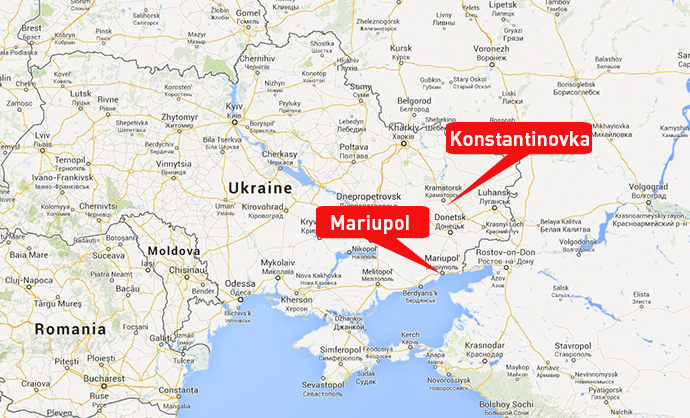
Image from maps.google.com
Menawhile National Security Council secretary Andrey Parubiy has said that Kiev is planning to begin special military operations in other regions of Ukraine after it completes its current operations in Slavyansk and Kramatorsk.
Over the past few days, Ukraine has stepped up its military operations in southeastern Ukraine against pro-autonomy activists. The main opposition strongholds include Kramatorsk, Slavyansk, Lugansk, and others.
In Lugansk, self-defense forces have declared a state of emergency and full mobilization amid Kiev’s punitive military operation in the region on Saturday.
At the same time, outraged residents of Kramatorsk have lashed out at troops entering the city’s streets. The Ukrainian military is currently occupying the city of Kramatorsk following an assault early on Saturday, a local self-defense unit said. Activists said that 10 people died in fighting overnight and two others were “killed by snipers.”
Meanwhile, clashes between pro-nationalist radicals and anti-Kiev activists have intensified. On Friday, more than 45 anti-Kiev protesters were killed in Odessa; some died in clashes, while others died from burns or suffocation after being trapped inside the House of Trade Unions building by the ultra-nationalist Right Sector group.
Will Ukraine Be NYT’s Waterloo?
By Robert Parry | Consortium News | May 3, 2014
For Americans interested in foreign policy, the New York Times has become the last U.S. newspaper to continue devoting substantial resources to covering the world. But the Times increasingly betrays its responsibility to deliver anything approaching honest journalism on overseas crises especially when Official Washington has a strong stake in the outcome.
The Times’ failures in the run-up to the disastrous Iraq War are, of course, well known, particularly the infamous “aluminum tube” story by Michael R. Gordon and Judith Miller. And, the Times has shown similar bias on the Syrian conflict, such as last year’s debunked Times’ “vector analysis” tracing a sarin-laden rocket back to a Syrian military base when the rocket had less than one-third the necessary range.
But the Times’ prejudice over the Ukraine crisis has reached new levels of extreme as the “newspaper of record” routinely carries water for the neocons and other hawks who still dominate the U.S. State Department. Everything that the Times writes about Ukraine is so polluted with propaganda that it requires a very strong filter, along with additives from more independent news sources, to get anything approaching an accurate understanding of events.
From the beginning of the crisis, the Times sided with the “pro-democracy” demonstrators in Kiev’s Maidan square as they sought to topple democratically elected President Viktor Yanukovych, who had rebuffed a set of Western demands that would have required Ukraine to swallow harsh austerity measures prescribed by the International Monetary Fund. Yanukovych opted for a more generous offer from Russia of a $15 billion loan with few strings attached.
Along with almost the entire U.S. mainstream media, the Times cheered on the violent overthrow of Yanukovych on Feb. 22 and downplayed the crucial role played by well-organized neo-Nazi militias that surged to the front of the Maidan protests in the final violent days. Then, with Yanukovych out and a new coup regime in, led by U.S. hand-picked Prime Minister Arseniy Yatsenyuk, the IMF austerity plan was promptly approved.
Since the early days of the coup, the Times has behaved as essentially a propaganda organ for the new regime in Kiev and for the State Department, pushing “themes” blaming Russia and President Vladimir Putin for the crisis. [For details, see Consortiumnews.com’s “Ukraine, Though the US ‘Looking Glass.’”]
In the Times’ haste to perform this function, there have been some notable journalistic embarrassments such as the Times’ front-page story touting photographs that supposedly showed Russian special forces in Russia and then the same soldiers in eastern Ukraine, allegedly proving that the popular resistance to the coup regime was simply clumsily disguised Russian aggression.
Any serious journalist would have recognized the holes in the story – since it wasn’t clear where the photos were taken or whether the blurry images were even the same people – but that didn’t bother the Times, which led with the scoop. However, only two days later, the scoop blew up when it turned out that a key photo – supposedly showing a group of soldiers in Russia who later appeared in eastern Ukraine – was actually taken in Ukraine, destroying the premise of the entire story.
Soldiering On
The Times, however, continued to soldier on with its bias, playing up stories that made Russia and the ethnic Russians of eastern Ukraine look bad and playing down anything that might make the post-coup regime in Kiev look bad.
On Saturday, for instance, the dominant story from Ukraine was the killing of more than 30 ethnic Russian protesters by fire and smoke inhalation in Ukraine’s southern port city of Odessa. They had taken refuge in a union building after a clash with a pro-Kiev mob which reportedly included right-wing thugs.
Even the neocon-dominated Washington Post led its Saturday editions with the story of “Dozens killed in Ukraine fighting” and described the fatal incident this way: “Friday evening, a pro-Ukrainian mob attacked a camp where the pro-Russian supporters had pitched tents, forcing them to flee to a nearby government building, a witness said. The mob then threw gasoline bombs into the building. Police said 31 people were killed when they choked on smoke or jumped out of windows.
“Asked who had thrown the Molotov cocktails, pro-Ukrainian activist Diana Berg said, ‘Our people – but now they are helping them [the survivors] escape the building.’”
By contrast, here is how the New York Times reported the event in its Saturday editions as part of a story by C.J. Chivers and Noah Sneider focused on the successes of the pro-coup armed forces in overrunning some eastern Ukrainian rebel positions.
“Violence also erupted Friday in the previously calmer port city of Odessa, on the Black Sea, where dozens of people died in a fire related to clashes that broke out between protesters holding a march for Ukrainian unity and pro-Russian activists. The fighting itself left four dead and 12 wounded, Ukraine’s Interior Ministry said. Ukrainian and Russian news media showed images of buildings and debris burning, fire bombs being thrown and men armed with pistols.”
Note how the Times evades placing any responsibility on the pro-coup mob for trying to burn the “pro-Russian activists” out of a building, an act that resulted in the highest single-day death toll since the actual coup which left more than 80 people dead from Feb. 20-22. From reading the Times, you wouldn’t know who had died in the building and who had set the fire.
Normally, I would simply attribute this deficient story to some reporters and editors having a bad day and not bothering to assemble relevant facts. However, when put in the context of the Times’ unrelenting bias in its coverage of the Ukraine crisis – how the Times hypes every fact (and even non-facts) that reflect negatively on the anti-coup side – you have to think that the Times is spinning its readers, again.
For those who write for the Times – and the many more people who read it – the question must be whether the Times is so committed to its prejudices here that the newspaper will risk whatever credibility it has left. The coup regime from Kiev may succeed in slaughtering many ethnic Russians in the rebellious east — as the Times signals its approval — but will this bloody offensive become a Waterloo for whatever’s left of the newspaper’s journalistic integrity?
~
Investigative reporter Robert Parry broke many of the Iran-Contra stories for The Associated Press and Newsweek in the 1980s. You can buy his new book, America’s Stolen Narrative, either in print here or as an e-book (from Amazon and barnesandnoble.com).
Evo’s Bolivia: Continuity and Change
By Linda C. Farthing and Benjamin H. Kohl
Out now. An accessible account of Evo Morales’s first six years in office, offering analysis of major issues as well as interviews with a wide variety of people, resulting in a valuable primer on Bolivia and Morales’s “process of change”.
In this compelling and comprehensive look at the rise of Evo Morales and Bolivia’s Movimiento al Socialismo (MAS), Linda Farthing and Benjamin Kohl offer a thoughtful evaluation of the transformations ushered in by the western hemisphere’s first contemporary indigenous president. Accessible to all readers, Evo’s Bolivia not only charts Evo’s rise to power but also offers a history of and context for the MAS revolution’s place in the rising “pink tide” of the political left. Farthing and Kohl examine the many social movements whose agendas have set the political climate in Bolivia and describe the difficult conditions the administration inherited. They evaluate the results of Evo’s policies by examining a variety of measures, including poverty; health care and education reform; natural resources and development; and women’s, indigenous, and minority rights. Weighing the positive with the negative, the authors offer a balanced assessment of the results and shortcomings of the first six.
312 Palestinians Kidnapped By Israeli Army In April
By Saed Bannoura | IMEMC News | May 2, 2014
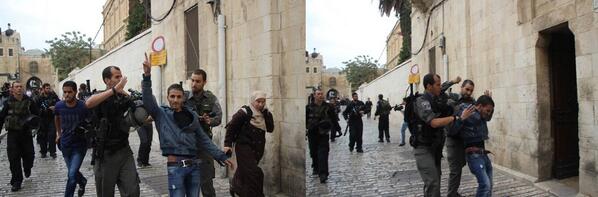
The Ahrar Center for Detainees Studies and Human Rights issued its monthly report, revealing that the Israeli army kidnapped 312 Palestinians in different parts of the occupied West Bank, occupied Jerusalem, and the besieged Gaza Strip.
Ahrar said the army carried out dozens of invasions into the occupied territories, kidnapping 312 Palestinians, mainly after breaking into their homes and properties, and violently searching them, causing excessive property damage.
Most of the arrests have been carried out in the Hebron District, as the soldiers kidnapped 94 Palestinians, followed by Jerusalem, 92, Nablus, 36, Bethlehem, 21, Jenin, 18, Ramallah, 16, Gaza Strip, 15 including 11 kidnapped near the border fence, Qalqilia, 10, Salfit, 7, Tulkarem, 2, and one in Tubas.
Ahrar added that the army kidnapped four Palestinian women in April, and released two of them later on.
Mariam Barghouthi, from Ramallah, and Samira al-‘Akel, from Hebron, are still imprisoned, while Tahani Abu Mayyala and Hanin Abu Aisha, from Hebron, were released.
“There are 21 Palestinian women who are still imprisoned by Israel,” Ahrar stated.
Head of the Ahrar Center, Fuad al-Khoffash, stated that April witnessed the beginning of one of the strongest hunger strikes by Administrative Detainees held with charge or trial, and that the detainees are determined to continue their strike.
Al-Khoffash added that the striking detainees are subject to constant attacks and harassment, in the attempt by authorities to force them to end their strike, while many have been moved into solitary confinement and are denied the right to family visits.
The US, Cuba and Terrorism
By Robert Fantina | CounterPunch | May 2, 2014
The United States State Department, in its infinite wisdom, has once again designated Cuba as a state sponsor of terrorism. The newest Country Report on Terrorism, issued on April 30, 2014, includes Cuba in a list of nations that “repeatedly provided support for acts of international terrorism”. The island country in the Caribbean has been so designated since 1982.One reads about the U.S. calling any other nation a ‘sponsor of terrorism’ in shocked disbelief. That the U.S., the greatest purveyor of terrorism on the planet, has the audacity to accuse any other nation of sponsoring terrorism is beyond all credibility.
Just since the beginning of the new millennium, the U.S. has unleashed horrific terrorism on the people of Iraq and Afghanistan, resulting in the deaths of at least hundreds of thousands of men, women and children, and the displacement of millions, and is currently sending drones to Yemen and other nations, ostensibly to kill ‘terrorists’, but resulting in the deaths of thousands of innocent people. Is this not terrorism?
And what of the U.S.’s continued and unwavering financial support of Israeli terrorism against the Palestinians? Not only does the U.S. finance that apartheid regime, it blocks any attempt by the international community to put a halt to it.
So 1982 is the year that the U.S. first decided that Cuba was a state sponsor of terrorism. This, despite U.S. antagonism toward that country since 1959, when the repressive and widely hated, U.S.-supported regime of Fulgencio Batista was overthrown by a popular resistance movement, led by the young leftist, Fidel Castro. At that time, the U.S. controlled 80% of Cuban utilities, 90% of its mines and cattle ranches, and nearly all of its oil refineries. No wonder Mr. Castro has incurred the wrath of the U.S. since then: when the American bottom line is threatened, no efforts are too great to protect it.
And what has the U.S., that shining beacon of peace, freedom and democracy, been doing on the world stage since 1982, when it first singled out Cuba as a terrorist state? It has either invaded, or covertly or overtly worked for the overthrow of the governments of the following countries, sometimes on multiple occasions, and sometimes constantly:
Cuba
Nicaragua
Angola
Philippines
Iraq
Iran
Venezuela
Palestine
Afghanistan
Somalia
Haiti
If one were to go back just to the middle of the twentieth century, these countries could be added to the list:
Syria
Guatemala
Tibet
Indonesia
Democratic Republic of the Congo
South Vietnam
Brazil
Ghana
Chile
Turkey
Poland
Korea
El Salvador
Grenada
And what of ‘enhanced interrogation techniques’, including waterboarding, which the United Nations and every civilized country in the world, except for the U.S., condemns? By any but U.S. standards, these are acts of terrorism.
And while we’re talking about Cuba, let’s not forget Guantanamo, the U.S.’s, Cuban-based torture chamber. And the U.S. policy of ‘extraordinary rendition’, the practice of kidnapping suspected terrorists and sending them to foreign countries where prohibitions against torture don’t exist, can only be seen as terrorism.
So while the U.S. wages war, tortures political prisoners, holds prisoners for years without any concept of due process, destabilizes democratically-elected governments which displease it, and finances governments with long records of the most shocking human rights abuses, it actually has the nerve to accuse another country of supporting terrorism.
The Cuban response to this designation is milder than one might expect. A statement from that country’s foreign ministry said that Cuba “… energetically rejects the manipulation of a matter as sensitive as international terrorism by turning it into an instrument of policy against Cuba and it demands that our country be definitively excluded from this spurious, unilateral and arbitrary list.”
So what are the specific reasons the U.S. has for continuing to designate Cuba a sponsor of terrorism? It hardly matters, considering the U.S.’s own ongoing, horrific terrorist activities around the globe, but let’s note them anyway.
* Past support for the Basque separatist group ETA (Euskadi Ta Askatasuna ( Basque Homeland and Freedom), and
* Support for Colombia’s FARC (Fuerzas Armadas Revolucionarias de Colombia (Revolutionary Armed Forces of Colombia) rebels.
Yet the report concedes that Cuban ties to ETA ‘have become more distant’, and it points out that Cuba is hosting talks between the Colombian government and the FARC in Havana.
There are, of course, opposing views for why the U.S. actually has so designated Cuba:
Said Mauricio Claver-Carone, of the U.S.-Cuba Democracy PAC, an influential lobby group in Washington: Cuba “fails to meet the statutory criteria for being removed” (whatever that is).
Alana Tummino, director of policy at the Americas Society/Council for the Americas in New York, had a different view: “Sadly, unless the State Department has more evidence than it’s providing, it appears that political motivations have once again driven this determination.”
Can there be any doubt that political motivations are, in fact, behind the U.S.’s continuation of a policy that makes no logical sense? For nearly sixty years, the U.S. has embargoed, boycotted, sanctioned, blockaded and invaded Cuba, all because of ongoing resentment against the takeover by the government by Cubans from the Americans. The electoral vote in Florida is usually vital in presidential elections, and the importance of the Cuban-American voting bloc, although diminishing, is still worth courting. So such considerations as human rights, justice and statesmanship have no role in policy-making, when the goal is always re-election.
One looks in vain for any substantive change to U.S. policy towards Cuba.
Robert Fantina’s latest book is Empire, Racism and Genocide: a History of US Foreign Policy (Red Dill Press).
Featured Video
Iran War Is Accelerating the End of US Dominance
or go to
Aletho News Archives – Video-Images
From the Archives
Why the UK, the EU and the US Gang-Up on Russia
By James Petras :: 03.20.2018
Introduction: For the greater part of a decade the US, the UK and the EU have been carrying out a campaign to undermine and overthrow the Russia government and in particular to oust President Putin. Fundamental issues are at stake including the real possibility of a nuclear war.
The most recent western propaganda campaign and one of the most virulent is the charge launched by the UK regime of Prime Minister Theresa May. The Brits have claimed that Russian secret agents conspired to poison a former Russian double-agent and his daughter in England, threatening the sovereignty and safety of the British people. No evidence has ever been presented. Instead the UK expelled Russian diplomats and demands harsher sanctions, to increase tensions. The UK and its US and EU patrons are moving toward a break in relations and a military build-up.
A number of fundamental questions arise regarding the origins and growing intensity of this anti-Russian animus.
Why do the Western regimes now feel Russia is a greater threat then in the past? Do they believe Russia is more vulnerable to Western threats or attacks? Why do the Western military leaders seek to undermine Russia’s defenses? Do the US economic elites believe it is possible to provoke an economic crisis and the demise of President Putin’s government? What is the strategic goal of Western policymakers? Why has the UK regime taken the lead in the anti-Russian crusade via the fake toxin accusations at this time?
This paper is directed at providing key elements to address these questions. … continue
Blog Roll
 Aletho News
- Pentagon Fast Tracks Iran War Ground Option
- Angela Lipps Spent 108 Days in Jail Because a Facial Recognition Algorithm Was Wrong
- Trump White House plagiarized Iran war manifesto from Israel-aligned think tank
- Western media whitewashes Israel’s attempted murder of British journalist in Lebanon
- Israel-linked arms facility set ablaze in EU
- IRAN: The Three Islands Unmaking American Unipolar Sea Power in the Persian Gulf
- Trump’s dispatch of Marine Expeditionary Unit signals desperation for any symbolic success
- Iran Proposes Creating Middle East Security Structure With All Regional States – President
- Iran’s weapons industry still churning out missiles despite war: IRGC
- Washington approves billions in new arms sales to Gulf states as concerns grow over stocks of air defenses
- If Americans Knew
- Meet the former fashion blogger and shady doctor behind the ‘30,000 dead’ Iran psy-op
- Vatican Secretary of State to Trump, Israel: End the war as soon as possible
- The Majority of Americans Believe War Against Iran Benefits Israel More Than US
- Efforts to shut down pro-Palestinian speech face series of setbacks in court
- What has Israel done to my brother?
- Eid without worship in Al Aqsa – Not a ceasefire Day 161
- Trump: Israel attacked Iranian gas field without US knowledge. No more such attacks!
- America’s friends must help extricate it from an unlawful war
- Democratic Nat’l Committee’s Kneejerk Backing of Israel Is Political and Moral Failure
- Major revelations from former counterterrorism chief Joe Kent’s extensive interview
- No Tricks Zone
- Energy Expert: Germany’s Nuclear Phaseout Was A “500 Billion Euro Mistake”
- New Research: South Australia’s Mid-Holocene Sea Surface Temperatures Were 4°C Warmer Than Today
- Storing Green Energy To Last Germany 10 Days Would Require A 60-Million Tonne Battery
- New Studies: UK Sea Levels Were 4 Meters Higher Than Today During The Mid-Holocene
- Destructive Green New Deal: German Energy And Metal Group Warns Of Drastic Crisis
- New Study Documents A 20-Year Pause In Arctic Sea Ice Decline – Driven By Internal Variability
- Wake-up Call: Survey Shows Majority Of Germans Now Favor Postponing Climate Targets!
- Televised! Leading German Political Candidate Tells Schoolchildren CO2 Makes Sun Hotter!
- New Study: A Century Warming Of 1.1°C Is ‘Commonplace’ And ‘Not Unusual’ During This Interglacial
- New Study: ‘Internal Noise’ And Volcanic Forcing Can Trigger 10-15°C Warming Within Decades
 Aletho News