CrossTalk: Reinventing NATO?
RT | September 8, 2014
A military alliance in search of an identity: For over two decades NATO has had branding issues. To justify its existence, it absolutely needs an enemy. In the wake of the Ukraine crisis, Russia now fits that bill.
CrossTalking with Mark Sleboda, Alexander Mercouris and Brian Becker.
Arms firms implicated in illegal US drone strikes ‘bought influence’ at NATO summit – Reprieve UK
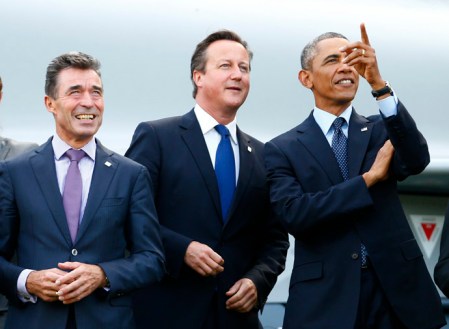
RT | September 8, 2014
Arms firms that provide core military components for drones deployed by the US to conduct covert strikes in violation of international law allegedly bought access to NATO’s summit in Wales last week, a British human rights charity says.
The defense companies concerned doled out up to £300,000 to ‘exhibit’ their military wares at the conference in Newport. Among the firms present were General Dynamics, Raytheon, Lockheed Martin and MBDA, according to a British government press release.
General Dynamics manufacture Hellfire missiles utilized in most US drone strikes, while Raytheon make the targeting system for the Reaper drone deployed by the CIA and other actors to conduct strikes across the globe. Lockheed Martin operates as a contractor to provide select support services for both the Reaper and Predator, and MBDA is a European company that manufactures the unmanned aerial vehicle (UAV) Brimstone – a variant of the Hellfire missile.
The US drone program has received widespread public criticism both at home and abroad. Critics say attacks carried out in foreign countries, including Yemen and Pakistan, are in violation of both international and US law.
Although US drone strikes have culminated in hundreds of civilian casualties, they are subject to little oversight, according to Reprieve. President Barack Obama has refused to formally acknowledge the program’s existence.
Reprieve’s Legal Director Kat Craig said it’s “deeply worrying” that a group of firms who potentially profit most from this breach of international law were able to buy access into an international global summit like NATO.
“It is unacceptable that the US’ drone campaign, and the UK’s support for it, has been allowed to remain in the shadows for so long”, he added.
“President Obama must be far more open about it – as must his European allies, especially the UK and Germany, about the support they provide.”
Craig suggested the drone manufacturers’ presence at NATO signaled their inherent capacity to buy political influence “behind closed doors,” highlighting the opaque, illicit and legally questionable nature of much of the global arms trade.
If new EU sanctions hit energy sector, Russia may close airspace – Medvedev
RT | September 8, 2014
Prime Minister Dmitry Medvedev has warned Russia may shut its air corridors to Western airlines if the next round of European sanctions hit Russian energy companies.
 “If there are sanctions related to the energy sector, or further restrictions on Russia’s financial sector, we will have to respond asymmetrically,” Medvedev said in an interview with the Vedomosti newspaper, published on Monday.
EU ministers will gather on Monday to discuss new sanctions against Russia and are rumored to be introduced on Tuesday. The prime minister promised a strong retaliation if the West slaps Russia with more sanctions.
“We could impose transport restrictions,” Medvedev said, adding, “We believe we have friendly relations with our partners, and foreign airlines of friendly countries are permitted to fly over Russia. However, we’ll have to respond to any restrictions imposed on us,” the prime minister said.
After sanctions hit Aeroflot’s low-cost subsidiary Dobrolet in late July, Medvedev discussed with ministers the possibility of limiting, of even completely blocking, European flights to Asia that overfly Russia.
“If Western carriers have to bypass our airspace, this could drive many struggling airlines into bankruptcy. This is not the way to go. We just hope our partners realize this at some point,” he told Vedomosti.
Flying over Russian airspace saves Western airlines headed to Asia at least 4 hours of flight time, which adds up to about $30,000 per flight.
Lufthansa said it could potentially lose more than €1 billion in three months if it does not use Russian airspace. Lufthansa, along with British Airways and Air France, are the largest EU airlines. US airlines currently don’t operate over Siberian airspace.
Many low-cost airlines have decided not to launch new routes to Russia, with the threat of sanctions possibly a factor. Last week Ryanair ditched plans to establish a Dublin-St. Petersburg route, and easyJet, another European-based airline, dropped its plans to develop a London-St. Petersburg service.
Medvedev didn’t specify whether the blocked airspace would also apply to cargo and delivery companies, such as UPS and FedEx.
EU sanctions, which will reportedly be introduced on Tuesday, will ban Russia’s three main oil companies- Rosneft, Gazprom Neft, and Transneft – from raising long-term (longer than 30 days) debt on European capital markets, according to the Wall Street Journal and the Financial Times.
Rosneft – Russia’s largest oil producer – was added to the US sanctions list on July 16 and was put on the EU list on July 29. Russia’s largest independent natural gas producer, Novatek, also was added to the blacklist in July, along with a ban on the export of hi-tech oil equipment needed in Arctic, deep sea, and shale extraction projects to Russia.
Gazprom Neft is the oil subsidiary of Russian gas giant Gazprom.
Transneft is Russia’s state-owned oil pipeline company that exports all of Rosneft’s crude oil, and 56 percent of Russia’s crude exports.
Sanctions likely won’t apply to privately-owned Russian oil groups such as Lukoil and Surgutneftegaz.
The EU will also reportedly follow America’s lead on banning the sale of weaponry from Russian companies that also supply the Russian military, the WSJ reported Sunday. On July 16, the US blacklisted several defense sector companies include Almaz-Antey Corporation, the Kalashnikov Concern and Instrument Design Bureau, as well as companies such as Izhmash, Basalt, and Uralvagonzavod.
“Sanctions are always a double-edged sword. Ultimately they end up backfiring and end up hurting those who are first to impose restrictions,” Medvedev said.
The EU has agreed on the new sanctions but said they could be delayed or even cancelled if Russia shows willingness to resolve the conflict in Ukraine.
On Friday Kiev introduced a ceasefire to calm fighting between the Ukrainian army and anti-government forces, but fighting and shelling continued in the country’s east.
127 Palestinians Detained in Past Week
IMEMC News & Agencies | September 7, 2014
 Israeli forces took at least 127 Palestinians across the occupied West Bank into custody, during the first week of September alone, according to recent statements by the Palestinian Prisoner’s Society (PPS).
PPS said, according to Ma’an news, that most detainees came from the Hebron district, where 28 Palestinians were taken by Israeli forces.
PPS further stated that 23 of the detainees were from the Jenin district, in the northern West Bank, 21 from Ramallah, 20 from Jerusalem, 12 from Bethlehem, eight from Tulkarem, six from Nablus, three from Qalqiliya, and six from the Tubas/Salfit district.
Israeli forces abducted 10 Palestinians overnight, on Saturday, seven of whom were taken from Hebron, with one from Bethlehem, and two from Beit Sira village, western Ramallah district.
More than 7,000 Palestinians are currently being held in Israeli prisons, including some 2,000 detained during the massive arrest campaigns which have taken place over the last three months.
See also — 08/31/14 PPS: 597 Palestinians Arrested During August
French President Hollande in Political Storm
teleSUR | September 6, 2014
 A survey released on Thursday by TNS Sofres revealed that Francois Hollande had just 13 percent support among the French population, as turmoil in his government continues.
Since popularity polls were begun in 1978, no French president has had such low popularity. […]
Hollande has been implementing austerity reforms, even though he was elected with the motto, “I have only one enemy: the world of finance.”
Last week, the whole cabinet resigned because the economy minister, Arnaud Montebourg, from the left faction of the governing socialist party, criticized this approach. The controversial Emmanuel Macron, a former director of the Rotschild Bank, was then chosen to replace him. … Full article
FARC accuses US, UK, Israel in Colombia war
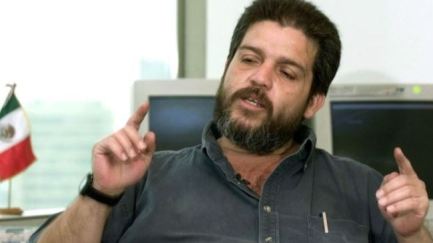
FARC negotiator Marcos Calarca
Press TV – September 7, 2014
The Revolutionary Armed Forces of Colombia (FARC) has accused the United States, the United Kingdom, and Israel of prolonging Colombia’s guerilla war.
FARC negotiator Marcos Calarca leveled the accusation on Saturday at a news conference ahead of another round of peace talks with a delegation of the Colombian government in the Cuban capital Havana.
He pointed to “the responsibility of the government of the United States, of companies involved in the business of war, various intelligence agencies, especially the British and Israeli, whose involvement throughout the conflict encouraged its continuation, escalation and intensification.”
The latest accusation against Israeli and British agencies is a new twist in the 28th round of peace talks in Havana.
He, however, said, “The FARC will acknowledge its responsibility where it concerns us, on the understanding that our military actions have had essentially political goals, derived from our political project to take power.”
The FARC is Latin America’s oldest insurgent group and has been fighting the government since 1964.
Bogota estimates that 600,000 people have been killed and more than 4.5 million others have been displaced due to the fighting.
The rebel organization is thought to have around 8,000 fighters operating across a large swathe of the eastern jungles of the Andean nation.
Desperate Drug War Beneficiaries Spread Marijuana Legalization Disinformation
Ron Paul Institute | September 6, 2014
While local and state governments continue moving forward with reducing and eliminating restrictions and penalties regarding marijuana, drug war beneficiaries are desperately responding by spreading disinformation. One such effort is the Rocky Mountain High-Intensity Drug Traffic Area August report “The Legalization of Marijuana in Colorado: The Impact.”
The report purports to be a balanced analysis of the effects of marijuana legalization in Colorado. In fact, the report is over 150 pages of deceptive pro-drug war propaganda.
One may wonder how much time and money the HIDTA spent on researching, writing, and producing the professional appearing report. Whatever the cost, the HIDTA people must figure it is a good investment of other people’s money.
While the Rocky Mountain HIDTA and its private and government allies spent hundreds or thousands of hours creating the agitprop, drug war writer Jacob Sullum had no trouble promptly rebutting a good portion of the report’s conclusions and exposing some of the rhetorical trickery that made the report particularly deceptive. Nonetheless, singers of prohibition praise from Cully Stimson of the Heritage Foundation to DARE enthusiastically promoted bite-size packets of the report’s disinformation.
As explained by the Office of National Drug Control Policy, 28 HIDTAs, including the Rocky Mountain HIDTA, assist United States, state, local, and tribal law enforcement agencies in fighting the drug war in areas that include 60 percent of the US population pursuant to the Anti-Drug Abuse Act of 1988. While a lot has changed in America since 1988, the US government’s drug war keeps going strong.
With more and more state and local governments moving away from prohibition of marijuana and this trend showing no signs of reversing, the HIDTA people, along with their connected police departments and other allied drug war beneficiaries, must be having some job security concerns. Drug war arrests, and marijuana arrests in particular, after all, help keep the police busy. US News and World Report writer Steven Nelson reports some of the Federal Bureau of Investigation war on drugs arrest statistics:
Data released Monday by the Federal Bureau of Investigation show there were an estimated 1,552,432 arrests for drug-related crimes in 2012 – a slight uptick from the 1,531,251 drug arrests in 2011. Marijuana offenses accounted for 48.3 percent of all drug arrests, a slight reduction from 49.5 percent in 2011, which itself was the highest rate since before 1995.
Most marijuana-related arrests were for possession of the drug. By mere possession, there was one marijuana arrest every 48 seconds in 2012. Including arrests for distribution, there was a pot-related arrest every 42 seconds, the same interval as in 2011.
HIDTAs (with their $238 million in ONDCP grants) and US, state, and local police (with their “policing for profit” through drug war asset seizures) are not the only groups that benefit from marijuana prohibition. There are many additional beneficiaries including prosecutors who push defendants who typically lack comparable legal resources along the guilty plea conveyor belt, private and public prisons that cage drug war convicts, treatment centers where people with no addiction problem whatsoever will opt to take part in court-mandated treatment as an alternative to being in prison, and arms manufacturers who have found new income in police militarization.
While it is important to counter deceptive propaganda with truth and logic, there is little reason to expect that the Rocky Mountain HIDTA report and other propaganda efforts will stop the general American trend toward greater respect for the right to grow, use, transport, buy, and sell marijuana. On marijuana, America it seems has turned a corner, with the country moving toward a patchwork quilt of marijuana laws that overall are much less prohibitionary and punitive than the laws have been over the last few decades of the war on drugs. People are seeing firsthand that very significant loosening of marijuana restrictions in parts of the country did not cause the sky to fall. Indeed, people are seeing that marijuana freedom, despite the prohibitionists’ dire warnings and continuing disinformation campaigns, is not dangerous.
With marijuana use coming out of the shadows of illegality, people are more and more recognizing that individuals who use marijuana, on occasion or regularly, are not so different from people who do not. Reality is overtaking hype.
Marijuana freedom is nothing to fear. Instead, as Ron Paul Institute Chairman and Founder Ron Paul says, freedom “brings people together, whether you are liberal or conservative or what, because people like to be in charge of their own life; they like to be in charge of their own money.” Despite the efforts of the Rocky Mountain HIDTA and its prohibitionist allies, Americans are rejecting the government and private drug war beneficiaries’ propaganda and experiencing the benefits of “live and let live” over “arrest, fine, and incarcerate.” Hopefully, this lesson will help create paths to greater respect for other freedoms as well.
Minsk ceasefire protocol: Ukraine to be decentralized, special status for Lugansk, Donetsk
RT | September 7, 2014
The OSCE has revealed the 12-point roadmap behind the September 5 truce signed in Minsk. It says that Ukraine must adopt a new law, allowing for a special status for Lugansk and Donetsk regions, and hold early elections there.
The document, titled ‘Protocol on the results of consultations of the Trilateral Contact Group’ and signed in Minsk on September 5, outlines what needs to be done for the ceasefire to stay in place.
“To decentralize power, including through the adoption by Ukraine of law ‘on provisional procedure for local government in parts of Donetsk and Lugansk regions (law on special status),’” states one of the provisions in the document.
Another point emphasizes that “early local elections” are to be held in light of the special status of both regions. The early elections must be held in accordance with the same proposed law, it says.
Kiev must then continue an “inclusive nationwide dialogue,” the document stresses.
The roadmap also implies an amnesty for anti-government forces in Donbass: “To adopt a law, prohibiting prosecution or punishment of people in relation to the events that took place in individual areas of Donetsk and Lugansk regions of Ukraine.”
At the same time, it notes that all “illegal military formations, military equipment, as well as militants and mercenaries” have to be withdrawn from Ukraine.
The Organization for Security and Co-operation in Europe (OSCE) published a copy of the protocol early on Sunday, with only a PDF document in Russian available so far.
During the meeting on September 5, Kiev officials and representatives of the two self-proclaimed republics in southeastern Ukraine have agreed to a ceasefire.
Some of the other provisions of the truce include monitoring of the ceasefire inside Ukraine and on the Russia-Ukraine border by international OSCE observers, the freeing of all prisoners of war, and the opening of humanitarian corridors.
A “safety zone” is to be created with the participation of the OSCE on the Russia-Ukraine border, the document says.
It also calls for measures to improve the dire humanitarian situation in eastern Ukraine, and urges in a separate point that a program for Donbass’ economic development is to be adopted.
Since the conflict significantly deteriorated in mid-April, 2,593 people have died in fighting in the east of the country, according to the UN’s latest data. More than 6,033 others have been wounded in the turmoil.
The number of internally displaced Ukrainians has reached 260,000, with another 814,000 finding refuge in Russia.
READ MORE: Kiev, E. Ukraine militia agree on ceasefire starting 1500 GMT Friday
Federal Court Blocks Release of Possible Torture Video
By Noel Brinkerhoff | AllGov | September 7, 2014
Efforts to expose videos and photos that documented torture at Guantánamo have been blocked by a federal appeals court in New York that sided with the Obama administration in its refusal to turn over the information.
The case centered on the treatment of Mohammed al-Qahtani, dubbed the 20th hijacker in the 9/11 attacks. Captured in 2001 and held at Guantánamo since then, al-Qahtani has been subjected to torture and other harsh treatment during his detention, according to his lawyers at the Center for Constitutional Rights (CCR).
CCR filed a Freedom of Information Act lawsuit to force the administration to release photos and videos depicting its client’s abuse at the U.S. prison in Cuba.
There are reportedly 58 videos in the possession of the Federal Bureau of Investigation, Kevin Gosztola wrote at Fire Dog Lake, which show Qahtani’s “activities in his cell and his interactions” with U.S. military personnel. Two videos allegedly depict “forced cell extractions” involving Qahtani that resulted in abusive or aggressive behavior on the part of his jailers.
But those recordings will not see the light of day anytime soon. The government successfully argued “with adequate specificity” that the footage and images “could logically and plausibly harm national security because these images are uniquely susceptible to use by anti-American extremists as propaganda to incite violence against United States interests domestically and abroad,” Judge José Cabranes wrote in the court’s opinion.
To Learn More:
Court: Releasing Images of Guantanamo Prisoner Would Incite Violence, Especially Since He Was Tortured (by Kevin Gosztola, Fire Dog Lake)
No Daylight for US Govt Photos, Video That May Show Gitmo Torture (by Nadia Prupis, Common Dreams)
Circuit Keeps Lid Closed on al-Qahtani Footage (by Adam Klasfeld, Courthouse News Service)
Center for Constitutional Rights v. Central Intelligence Agency (Second Circuit Court of Appeals)
Group Sues U.S. Government to Force Release of Only Known Remaining Torture Video (by Noel Brinkerhoff, AllGov)
Featured Video
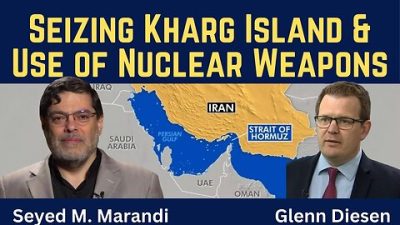
Marandi: Threat of Seizing Kharg Island & the Use of Nuclear Weapons
or go to
Aletho News Archives – Video-Images
Frlom the Archives
Provoking a Path to Persia
The Saban Center’s prescient paper on war with Iran
By Maidhc Ó Cathail | October 20, 2011
In June 2009, the Saban Center for Middle East Policy published “Which Path to Persia?—Options for a New American Strategy toward Iran.” Writing in a tone strikingly reminiscent of the Project for a New American Century’s infamous pre-9/11 paper “Rebuilding America’s Defenses,” the six co-authors noted that, “It seems highly unlikely that the United States would mount an invasion without any provocation or other buildup.” For a think tank specifically established by media mogul Haim Saban to protect Israel, this could prove to be a formidable obstacle impeding their desired march—of U.S. troops—to Tehran.
“In fact, if the United States were to decide that to garner greater international support, galvanize U.S. domestic support, and/or provide a legal justification for an invasion, it would be best to wait for an Iranian provocation, then the time frame for an invasion might stretch out indefinitely,” Saban’s think-tankers ruefully observed.
“With only one real exception, since the 1978 revolution, the Islamic Republic has never willingly provoked an American military response, although it certainly has taken actions that could have done so if Washington had been looking for a fight. Thus it is not impossible that Tehran might take some action that would justify an American invasion. And it is certainly the case that if Washington sought such a provocation, it could take actions that might make it more likely that Tehran would do so (although being too obvious about this could nullify the provocation). However, since it would be up to Iran to make the provocative move, which Iran has been wary of doing most times in the past, the United States would never know for sure when it would get the requisite Iranian provocation. In fact, it might never come at all.”
Seemingly undeterred by Iran’s frustrating unwillingness to provide the requisite provocation, the analysts continued to examine this option… continue
Blog Roll
 Aletho News
- Ukrainian Embassy in Beirut sheltering top Mossad agent
- Palestinian family displaced after settlers violently attack them in Humsa, Jordan Valley
- The EU never learns – except for the wrong lessons
- Iran attacks on UAE leaves RSF militia high and dry
- Hosting Washington’s war: Bahrain faces the consequences
- The US fell for its own Iran propaganda
- Seyed M. Marandi: Threat of Seizing Kharg Island & the Use of Nuclear Weapons
- Is there even an off ramp?
- Michael von der Schulenburg: Europe’s Self-Defeating Iran War Policy
- Sorry, The New Republic, Climate Change Isn’t Causing Somali Migration. Blame Civil Strife and Poverty.
- If Americans Knew
- ‘Of Course’: IDF Drops Case Against Soldiers Accused of Raping Palestinian Prisoner
- Don’t Fall for the Regime Change Talk. Israel Is ‘Mowing the Lawn’ in Iran
- Will Israel and the US wreck the Gulf States along with Iran?
- US so far burned through ‘years’ of munitions in Iran war: Report
- How the Israeli Tail Wags the American Dog
- Outdated intel likely led to deadly U.S. strike on Iranian elementary school, sources say
- Pentagon insider says high U.S official Douglas Feith reported to Netanyahu
- In fond memory of Walid Khalidi, the historian of Palestine
- 6 more Americans killed, as Israel ‘mows the lawn’ in Iran – Not a ceasefire Day 154
- Are we on the precipice of World War III?
- No Tricks Zone
- New Studies: UK Sea Levels Were 4 Meters Higher Than Today During The Mid-Holocene
- Destructive Green New Deal: German Energy And Metal Group Warns Of Drastic Crisis
- New Study Documents A 20-Year Pause In Arctic Sea Ice Decline – Driven By Internal Variability
- Wake-up Call: Survey Shows Majority Of Germans Now Favor Postponing Climate Targets!
- Televised! Leading German Political Candidate Tells Schoolchildren CO2 Makes Sun Hotter!
- New Study: A Century Warming Of 1.1°C Is ‘Commonplace’ And ‘Not Unusual’ During This Interglacial
- New Study: ‘Internal Noise’ And Volcanic Forcing Can Trigger 10-15°C Warming Within Decades
- Glaciers Worldwide Are Suddendly Surging, Experts Blame Warming!
- Surprising Discovery: Sahara Is Greening…Billions Of Trees Where Once Thought To Be Barren
- New Research Reaffirms Clouds, Aerosols, And Surface Solar Radiation Are ‘Driving The Climate System’
 Aletho News