Argentine president seeks to dissolve intelligence body
Press TV – January 27, 2015
Argentina’s president has described the country’s intelligence agency as a “national debt” and has announced plans to disband it.
President Cristina Fernandez de Kirchner made the remarks in a Monday TV address, saying she would prepare a draft legislation to set up an alternative body.
“I have prepared a bill to reform the intelligence service,” said Fernandez, insisting that she wanted the idea discussed at an urgent session of the nation’s Congress.
She further stated that her plan “is to dissolve the Intelligence Secretariat and create a Federal Intelligence Agency” and added that a new leadership for the intelligence agency should be picked by a president and confirmed by the South American country’s Senate.
Fernandez further argued that the intelligence services maintained the same structure they had during the US-backed military government that ended in 1983.
“Combating impunity has been a priority of my government,” she emphasized.
She made the decision following the mysterious death of prosecutor Alberto Nisman hours before he was reportedly due to testify against senior government authorities.
Nisman had been probing the bombing of a Jewish center in the Argentine capital Buenos Aires in 1994 which killed 85 people.
He was found dead on January 18 in his apartment in Buenos Aires.
Investigators initially said they believed he had committed suicide, but later clarified that homicide or “induced suicide” could not be ruled out.
President Fernandez has emphasized that she does not believe Nisman’s death was a suicide.
Israeli occupation forces close main entrance to al-Ram with concrete cubes
Ma’an – January 27, 2015
 JERUSALEM – Israeli forces on Tuesday morning placed huge concrete cubes in the middle of the main road at the entrance to the town of al-Ram in northern Jerusalem.
Mayor of al-Ram Ali Maslamani told Ma’an that Israeli forces arrived in the early morning hours and closed the northern entrance to the town with huge concrete cubes. The closure, he said, crippled the traffic at the busiest entrance to al-Ram.
The mayor added that his town is densely populated as it has about 60,000 residents the majority of whom use the northern entrance almost every day.
The northern entrance, says al-Maslamani, is the main exit to several other towns and villages.
“Closing the entrance will strangle the town more after it has been segregated by the separation wall,” added al-Maslamani.
He said that more than 100,000 people from neighboring areas visit the town every day to do shopping or visit banks and public service offices.
UNRWA Forced to Suspend Gaza Assistance Due to Lack of Funds

UNRWA Report | January 27, 2015
The United Nations Relief & Works Agency (UNRWA) has been forced to suspend its cash assistance programme in Gaza to tens of thousands of people for repairs to damaged and destroyed homes and for rental subsidies to the homeless.
Over 96,000 Palestine refugee family homes were damaged or destroyed during last summer’s conflict and the total funding required to address that need is USD 720 million. To date, UNRWA has received only USD 135 million in pledges, leaving a shortfall of USD 585 million. While some funds remain available to begin the reconstruction of totally destroyed homes, the Agency has exhausted all funding to support repairs and rental subsidies.
“UNRWA in Gaza has so far provided over USD 77 million to 66,000 Palestine refugee families to repair their home or find a temporary alternative”, said UNRWA’s Director in Gaza, Robert Turner. “This is a tremendous achievement; it is also wholly insufficient. It is easy to look at these numbers and lose sight of the fact that we are talking about thousands of families who continue to suffer through this cold winter with inadequate shelter. People are literally sleeping amongst the rubble, children have died of hypothermia. USD 5.4 billion was pledged at the Cairo conference last October and virtually none of it has reached Gaza. This is distressing and unacceptable.”
“It is unclear why this funding has not been forthcoming,” added Mr. Turner “but UNRWA has been a stabilizing factor in a very challenging political and security context and if we cannot continue the programme it will have grave consequences for affected communities in Gaza. People are desperate and the international community cannot even provide the bare minimum – for example a repaired home in winter –let alone a lifting of the blockade, access to markets or freedom of movement. We’ve said before quiet for quiet will not last, and now the quiet is at risk.”
UNRWA urgently requires USD 100 million in the first quarter of this year to allow families with minor damage to repair their homes and to provide ongoing rental subsidies, including to the thousands of families that left the UNRWA-run collective centers and found alternative rental accommodation. UNRWA is very concerned that if it cannot continue to provide the rental subsidy then large numbers may return to the collective centers, where almost 12,000 displaced Palestinians continue to seek shelter.
Christopher Gunness
Spokesperson, Director of Advocacy and Strategic Communications
UNRWA | Office of the Commissioner General | Jerusalem
Sayed Hasan Nasrallah denounces the repression in Bahrain
Hasan Nasrallah – January 9, 2015
Regarding this point, I want to say to our people especially in the border villages and to the Lebanese people that in confronting this danger the Lebanese are not incapable or weak and they don’t need anybody’s help. With our strength, army, people and resistance, just like we defeated the Israelis we will defeat the takfiris and anyone who thinks about harming the Lebanese and their dignity.
Let us be at peace knowing despite the snow and martyrs and burdens nothing of this can change anything regarding the will and determination of all of us especially the Freedom Fighters. When it comes to defending the people and its security and they did this and are ready to continue assuming this position till the end.
I call on everyone not to take part in this intimidation campaign and not to try to intimidate people: nobody can guarantee that no operation will take place here or there. This can happen in any country, whether France, Britain or Europe, all these countries are now in a state of emergency.
But regarding the risk of a large scale military operation – people haven’t been killed and this country is full of men and strong women there is no problem in this regard. God willing in confronting one of the biggest and strongest army in the world we were able to persevere and achieve victory so what can we say regarding these terrorists?
The final words I want to say – I do not want to take up to much of your time – of course, the issue of the region are extensive and important… The developments in Palestine, very dangerous developments in Palestine regarding the Palestinian people and al Quds and al Aqsa mosque, or the Gaza strip or the prisoners or the surrounding areas, Iraq, Yemen, Bahrain and other situations in these regions and the world. I don’t have time to discuss the regional situations but I will have an interview in the next few days where I will speak more extensively. Whoever would like to listen will listen….
In the remaining minutes, I find myself obliged to focus on the issue of Bahrain.
In the past few days the Bahraini authority arrested the secretary general of al Wifaq, Sheikh Ali Salman, may God preserve him. This was dangerous and the continuation of his arrest is also dangerous. In terms of its significance with regards to what can be said in condemnation we can’t say enough. But there is something we should focus on is that the Bahraini authorities have reached a dead end despite their efforts the past years.
The people of Bahrain who are demanding their legitimate rights and these rights cannot be debated. One of the most basic rights when everybody talks about democracy is that they have an elected parliament, and that the parliament that puts laws is elected. Having a parliament from which the government can appoint members to participate in drafting the laws of the political process is not enough.
What are these people demanding? They are saying we want an elected parliament which enjoys complete autonomy.
Number two, these people from day one have chosen peace in their movement, a peace movement. This distinguishes today, someone was speaking about Bahrain, but what about here or there. We’re talking about a country, in this country, its people from day one said, these are our natural logical rights, not just this, but of others, but this is one of the most important right.
And they chose a peaceful manner, they opened fire on them, but they didn’t return fire, they were killed on the street, but they didn’t respond by killing. It’s just not that they didn’t use weapons, or explosives or they didn’t bring in fighters or groups from the outside, even a knife , they didn’t use a knife.
And they insist on the peaceful nature of this movement, and this is what further cornered the Bahraini authorities. The leadership of the opposition, the clerical leadership and the political leadership all agree on the peaceful nature of the movement.
First and foremost Ayatollah Sheikh Issa Qassem May God preserve him and first and foremost, Al-Wefaq Association led by Sheikh Ali Salman may God preserve him.
We the Lebanese know that peaceful movements, abiding by the peaceful nature is very difficult, when someone is struck or when fire is opened he takes up arms and begins to open fire. If he has arms and if he doesn’t have arms, he goes and buys arms and begins to think day or night about those weapons.
But these people, their houses are attacked, their families are attacked, their clerics are in prison, their religious symbols are in prison, women, you know what happens in prison.
They were killed on the streets, but they didn’t resort to any form of violence, they continued to insist on protests and speeches and the peaceful means. There are maybe certain means which can be described as non-peaceful and violent but they didn’t resort to those means.
The Bahraini authorities always spoke about dialogue only as a way of talking not within a serious dialogue. But this opposition has always been ready for dialogue, the nature of its movement, the nature of its peaceful goals, in agreement with it reaching dialogue.
But the authority always ran away from dialogue and the result of dialogue.
The Bahraini authorities in the last two years, what did they hope for, they hoped that in the end people would get tired. They protested first day, second day, first month, first year, second year, third year…
We in Lebanon, we get tired from protests in two or three months. It’s enough, these protests don’t lead us anywhere, but we have people who have been protesting for years and for four years they have been striking.
And for four years they have been carrying out peaceful movements, this is a distinguished movement in this world. In all different places the movement derailed and became violent very quickly, in this place the movement did not become violent.
Not because there are no men in Bahrain, there are men in Bahrain, the people of Bahrain are known for their courage and for their enthusiasm. This is their history.
Not because no one can use weapons in Bahrain – here let me say so because Al-Khalifa family can’t put me in prison – not because no one can use weapons in Bahrain. Not because nobody can send arms to Bahrain or because there is no one can send fighters to Bahrain. Bahrain is just like any other country in the world, any country whatever be the measures weapons can be sent, fighters can be sent, anyone can sabotage it.
Small groups can sabotage a country. The main issue is that the will of the clerics and the political leadership and the people of Bahrain they are insisting on the peaceful dialogue.
They hoped that they would get tired, that hey would just lose their interest, but they didn’t, even though the world and the international community abandoned them. Those who supported the Arab Spring, when they get to Bahrain, they stopped, they outrageously described the situation as sectarian, however it’s not sectarian,
I don’t have the time to speak about the issue of Bahrain and what the people are subject to, I didn’t want to use this term but I will just this one time.
They have a project similar to the Zionist project, they have settlement activity in Bahrain, they have naturalization, whereby people come from all over the world. They are given citizenship, they are given jobs, they are given high salaries, security, respect, dignity. At the same time the original sons and citizens, the Bahrainis, whose fathers and grandfathers have been in that country, they are not given their basic rights. When they make political demands, their nationalities are taken away from them or they are imprisoned and efforts are being made day and night to change the identity of the Bahraini people.
There will come a day where the people of Bahrain are not of the original Bahraini people, it will be another nationality. Just as what the Zionists are doing in Palestine, whereby they want the day to come where the real inhabitants of Palestine will be the Jews all over the world. Isn’t this injustice?
These people are still committed to dialogue despite all of the betrayal so the Bahraini authorities found that the people didn’t get tired, they didn’t give up.
In the end the people will call on the leaders, on the clerics, we protested on the first, second, third and fourth year, okay, where have we reached? In the end, the political leaders say okay, but despite that the political leadership and the clerics insist on continuing on this path.
I take responsibility for what I say, I want my colleagues in Bahrain to listen, this is my opinion and stance on the issue. The Bahraini leadership have hoped that the Bahraini youth would be pushed towards carrying out violence, by their oppressive acts. Its in the interest of the Bahraini leadership for people to resort to violence because when the opposition is accused of carrying out acts of violence, then the leadership will come and speak about national security and will strike the opposition and its leadership and crush it, and therefore put an end to this opposition. The Bahraini leadership from the past four years tried to push the opposition in Bahrain towards an armed confrontation and it failed and once again.
Again I repeat one of the most important reasons behind the peaceful nature of this movement is its culture and leadership. Even if we have a leadership, the people have a different approach, the people have a different culture, a culture of quickly going to wars and fighting.
What can the leadership do in this case, bring about miracles, but the culture and leadership of this people allowed their peaceful nature to continue. How do we understand the arrest of Sheikh Ali Salman ? It happened because he is one of the religious symbols of the peaceful movement which insists on the peaceful nature of the movement.
And we might witness, and this something which everyone must pay attention to, all of the leaders who went to and insist on peaceful movement are being taken to prison.
In order to strike the peaceful movement and to crack the movement in general, what was the accusation made against Sheikh Ali Salman ? It was inciting for the committing acts of violence. Now if someone wants to make an accusation, make an accusation which is appropriate, which could be true. All Bahrainis know Sheikh Ali Salman. He is peaceful, peaceful till one loses their breath, even one accompanies with his peaceful movement, you’re too peaceful.This Sheikh, what is he accused of is that he incites people to resort to violence. Why? For the sake of toppling the regime.
Although you know the opposition, there is a debate, some people support toppling the regime, the Al Khalifa family and some in the opposition hold the stance of reform. An elected parliament, a government which is elected, as we hear from the opposition. Sheikh Ali belongs to the second group.
He didn’t speak about toppling the regime, nor did he incite to commit violence, this is an allegation which is a lie.
What the government of Bahrain will discover to what it is doing is an act of stupidity. It will not be able to put an end to this movement neither by arresting and imprisoning the former clerics and leaders nor by arresting or imprisoning Sheikh Ali Salman.
If they are able to arrest all of the Bahraini people, it’ll put a stop to the movements in the street, but they won’t be able to stop the movement in the prisons. People insist on continuing with movements behind bars and they also insist on the peaceful nature of the movement.
And I today express my solidarity and our support and from day one we stood in support of this peaceful popular movement and its logical goals and its civil manner.
We call for solidarity and explaining the significance, the meaning we call for pressures to be exerted on this tyrannical and oppressive government, in order for it to give them their rights, to the people to release all of the prisoners, first and foremost Sheikh Ali Salman.
On the other hand I stress and I support and we all support the call made by Sheikh Ali Salman from prison to insist on the peaceful nature of the movement. We must bear in mind that the Bahraini leadership wants by this arrest, by the former arrests, it wants to drag the Bahraini people to violence and armed confrontation.
This doesn’t serve the interests of Bahrain nor the people of Bahrain. Look at the countries of the region, look at all of them. When they resorted to arms in those countries, what was the result? What could be the result in any country?
Anyway I wanted to talk about this issue on this occasion and we pray to God that next year our nation is able to come out and pass these tests successfully and manages to confront these challenges by achieving true victory. We hope that the Nation will be able to overcome these difficult phases by unity, vigilance, and wisdom, by taking responsibility and also by overthrowing all of these plans and conspiracies from within the nation and from outside, which could have pushed the nation into abyss.
God bless you all, happy anniversary and peace, blessings and mercy be upon you all.
Translation : Electronic Resistance
Edition : http://sayed7asan.blogspot.fr
A logical and cogent suicide thesis for Alberto Nisman
IncaKolaNews | January 25, 2015
The latest we know, as of this Sunday morning, is that the day before his death and just before asking his work colleague Lagomarsino to lend him his pistol (the 100% confirmed weapon of death), Alberto Nisman also asked one of the police officers on protection duty around his apartment building to lend him his gun, which the officer refused to do. Nisman again used the same line, that he wanted one to carry in his car for a few days until he bought a gun for himself.
Which again nudges the evidence towards suicide, though I want to make plain as I did yesterday that there’s no proof of this yet and we’re talking possibles versus probables, not black versus white certainties. We shouldn’t discard any hypothesis yet. But as suicide now seems more likely than it did just a few days ago when the world was quick to shout and scream and accuse the CFK government of killing an enemy, consider this:
- There was some sort of emergency that got him to cut short his vacation with his daughter in Europe, hand over her charge to his ex-wife and bring him quickly back to Argentina in the days before his death.
- He was due to give evidence to support his accusations against the CFK government the day after his death, but his dossier had already been deposed and opened to authorities and judiciary (its contents are now being revealed, striptease-style, to the general public). As soon as it was available (three or four days before his death) there was immediate push back from both pro-government and (relatively) neutral bodies who spotted false information and obvious contradictions in his version of events. One that’s been widely reported is how Nisman claimed he had been given key evidence about supposed intelligence officers, but in fact (and in proven fact now) those people are not and have never been members of the intelligence services.
- So, let us imagine you have a less than perfect personal life. Let’s also imagine you’ve been working under great pressure, in terms of workload and of psychological pressure from government enemies, for two years on a case you think shows major corruption in your current government (up to and including the President of your country). Let’s imagine that things come to a head, you complete your work, you’re satisfied with your job done, you hand in this national-level important case file…and then suddenly the whole thing blows up in your face because one of the most basic elements on which you based your argument is shown, with very little room for error, to be false. That, ladies and gentlemen, is years of work down the drain.
- And on top of that, in one day’s time you have to go to the nation’s Congress, stand up and defend your case and reiterate your accusations when you already know that the ground has been taken from under your feet and when the opponents ask you about the contradictions, you’re going to flounder and fail in front of them. And your personal life is a mess.
Anyway, that’s the basic thesis for suicide here and I’m fully aware it doesn’t cover all angles. For example why is there no suicide note (as either one hasn’t been found as yet, or if it has we haven’t been told about it)? No idea, but as suicide of this type is a wholly selfish and egocentric act, people in that mental position feel no obligation to anyone else and there doesn’t have to be a note, not even to your most loved ones. I’m not saying the above is the answer to the whole thing, not at all. But it is addressed to those who say “he can’t have killed himself”. It’s a logical and cogent possibility, like it or not.
Illegal Occupation, the Elephant In The Room
The Origin of Modern Terror and Crumbling Western Values
By John Chuckman | Aletho News | January 26, 2015
Do you ever solve problems by ignoring them? Most of us would say that is not possible, yet that is precisely what western governments do in their efforts to counteract what is called “Islamic terror.” Yes, there are vast and costly efforts to suppress the symptoms of what western governments regard as a modern plague, including killing many people presumed to be infected with it, fomenting rebellion and destruction in places presumed to be prone to it, secretly returning to barbaric practices such as torture, things we thought had been left behind centuries ago, to fight it, and violating rights of their own citizens we thought were as firmly established as the need for food and shelter. Governments ignore, in all these destructive efforts, what in private they know very well is the origin of the problem.
Have Islamic radicals always existed? Yes, we have records through the history of British and French empire-building of strange and fearsome groups. It appears every large religion has a spectrum of believers, always including at one end of the spectrum extreme fundamentalists. They are not a new phenomenon anywhere, so why has one group of them, in the sands of the Middle East, become part of our everyday awareness?
It is also nothing new that young men become hot-blooded and disturbed over what they regard as attacks upon their kind. Western society’s record of crusades, religious wars, colonial wars, and revolts, all total likely having no equal in the histories of the world’s peoples, offers countless examples of young men being angered by this or that circumstance and joining up or running off to fight.
George Bush told us today’s terrorists hate our freedom and democratic values, but like virtually every utterance of George Bush, that one was fatuous, explaining nothing. Nevertheless, his is the explanation pounded into public consciousness because governments and the corporate press never stop repeating versions of it, the Charlie Hebdo affair and its theatrical posturing over free speech being only the latest. Theatrical? Yes, when we know perfectly well that most of those who marched at the front of the parade in Paris are anything but friends of free speech.
All backward peoples are uncomfortable with certain western values, that being the nature of backwardness, and backwardness is a defining characteristic of all fundamentalist religious groups – Hasidic or ultra-Orthodox Jews, Mennonites, Roman Catholic Cardinals, cloistered nuns, Sikhs, and many others – who typically choose modes of dress, rules to obey, and even foods to eat having little or no relationship with the contemporary world and science. Of course, that is their right so long as they are peaceful and law-abiding.
Any fundamentalist group, pushed by more powerful people from outside their community, is entirely capable of, and even prone to, violence, and all human beings are capable of violence when faced with abuse and injustice. Centuries of religious wars and terrors in Europe about such matters as how the Mass is celebrated prove the proposition and should be held as a warning, but they are forgotten by most, if they were ever known. The tendency towards violence continues today amongst many fundamentalist faiths. In so relatively small and seemingly homogeneous a society as Israel, there are regular attacks from ultra-Orthodox Jews against the country’s worldly citizens or against fair-minded rules about such pedestrian matters as women riding buses or walking on a street. The attacks become quite violent – punching, spitting, burning down homes, and killing sometimes – and all go against what we call western values, but because the scale is fairly small, and our press also has a constant protective bias concerning all things Israeli, these events rarely make our mainline news. They must be found on the Internet.
It took Western Europe literally centuries to leave behind such recurrent and violent themes as witches and the need to burn them alive, the Evil Eye, casting out demons, execution for differences of belief, and countless other stupidities which characterized whole societies and destroyed lives. And if you want to go still further back, go to the Old Testament, a collection of ancient writing packed with violence, superstition, prejudice, and just plain ignorance, which Christians and others even today regard as containing important truths for contemporary life. Human progress, at least in some matters, takes a very long time indeed.
Our world has more backward people than most of us can imagine. The news does not feature their extremes and savageries because it serves no political purpose. In Africa, for example, we find practices and beliefs utterly repellent to modern minds: the practice of senior village men raping young girls as an accepted right, the genital mutilation of 3 million girls annually (an African, not an Islamic, practice), the hunting down and butchering such “strange” people as albinos, their parts to be eaten as medicine, and many others. In India, a country well on its way to becoming modern yet one with a huge backward population, we have practices such as marrying off mere girls to old men rich enough to pay dowries to poor parents. At one stroke this enriches the parents and relieves them of the burden of a child, a female child too, always viewed less favorably. The practice generates a large population of widows when the old husbands of girls married at, say, twelve die. These women are then condemned to entire lives as widows, never allowed to remarry, required to dress and eat in certain ways, and basically shunned to live in squalid equivalents of old folks homes, living entirely meaningless lives. India also has the practice of “bride burning” where new brides who are deemed unacceptable for various reasons become the prey of the groom’s family, literally being burned alive. There are many other barbarities in that society too, including “honor killing” and young women who are made inmates in certain temples to serve as glorified prostitutes.
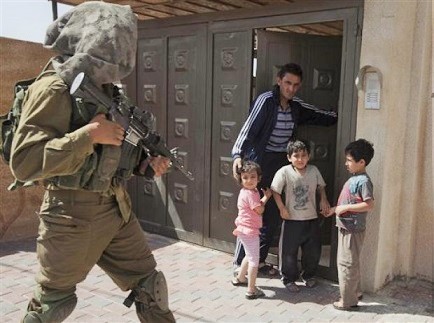
Our press assiduously avoids much of the world’s horrors as it focuses on “Islamic extremism,” and politics are the only explanation for the bias. The press theme of Islamic terror and indeed real incidents of terror grow from a reality always taken for granted, never debated, and certainly never criticised: the elephant in the room, as it were, is Israel’s illegal and agonizingly long occupation of the Palestinians.
It may be not be important to our press and governments that Israel holds millions as prisoners, crippling the lives of generation after generation, or that Israel periodically strikes out in every direction – Gaza, Lebanon, Syria, the West Bank – causing the deaths of many thousands, or that Israel is seen to bulldoze people’s homes and sacred monuments with complete impunity, but it very much matters to many millions of Muslims in the world, and some of them, fundamentalist men, strike out against it just as young men everywhere have sometimes struck out against keenly-felt hurts and injustice.
In western countries, under the hard influence of America, a country in turn under the hard influence of the world’s best organized and financed lobby, the Israel Lobby, we have come to regard Israel’s behavior as normal, but it is, of course, not normal, not in any detail. What is normal about holding several million people prisoner for half a century? What is normal about bulldozing homes and literally stealing the land upon which they stood? What is normal about declaring an honestly elected government as criminal and treating its people as though they were criminals? What is normal about limiting people’s opportunity to earn a living or to import some of the needs of life? What is normal about killing nearly a thousand children, as Israel has done just in Gaza, since 2008?
Pretending that Israel’s behavior is not the major cause of what screams from our headlines and news broadcasts has reached absurd levels. America has only vastly compounded the problem of Israel’s organized abuse of a people: it and its silent partners have destroyed Iraq, destroyed Libya, are working hard to destroy Syria, have seen to it that Egypt’s tens of millions again live under absolute government, ignore countless inequities and barbarities in secretly-helpful countries like Saudi Arabia, and carry out extra-judicial killings through much of the region. All of it is carried out on Israel’s behalf and with Israel’s cooperation. Can any reasonable person not see that this vast factory of death also manufactures countless grievances and vendettas? The stupidity is on a colossal scale, rooted in the notion that you can kill your way out of the terrible consequences of terrible policies.
In America, paid political shills (Newt Gingrich was one) have campaigned about there being no such thing as a Palestinian. Others (Dick Armey was one) have said that millions of Palestinians should be removed, all their land left conveniently to Israel. That last is an odd thing to say, isn’t it, considering there are supposed to be no such thing as Palestinians? And just what country would take millions of “non-existent” Palestinians? Obviously no politician with even pretence of integrity would say such things, and how can intelligent and successful people like America’s Jews take satisfaction in hearing politicians reciting such embarrassing scripts? But this is a good measure of the way intelligence and sound thinking are scorned in American politics. How can you achieve anything worth achieving without intelligence and sound thinking? You cannot, but that doesn’t stop American Presidents and Secretaries of State from carrying on the world’s longest-running dumb show, something called the “peace process.” The sombre, moose-like figure of John Kerry is photographed playacting at statesmanship while American-supplied arms just keep killing thousands of innocent people.
1.5 Million Lifted Out of Poverty in Ecuador under Correa
teleSUR | January 25, 2015
The Ecuadorean National Secretariat for Planning and Development announced on Friday that between the years 2007 and 2014, more than 1.5 million people have been lifted out of poverty in the South American country. These years coincide with the administration of Rafael Correa and the policies of what is known as the Citizen’s Revolution, which recently celebrated 8 years of government.
“The model of government has radically changed,” said Pabel Muñoz, the national secretary for planning and development. The government of Rafael Correa has also dramatically reduced inequality in the country, with the gap between the richest and poorest in the country shrinking. In 2007 the richest earned 42 times that of the poorest, while in 2014 that was reduced to only 22 times.
The 1.5 million lifted out of poverty represents a drop of 14 percent in the poverty rate in the country, with extreme poverty dropping 8 points from 16.5 percent to 8.6 percent.
“Ecuador is a successful country because while reducing poverty, it reduces the gap between the rich and the poor. It has allowed for an increase in consumption and has not registered drops in social indicators. Instead people have climbed the social ladder,” said Muñoz.
These figures were published by the National Secretariat for Planning and Development.
Ecuador has also seen the biggest decrease in the region in the Gini coefficient — a figure that measures inequality in a country — dropping from 0.55 in 2007 to 0.48 in 2012, whereas the rest of Latin America saw a drop from 0.52 to 0.50.
The country has also seen important progress in the field of education, with primary school attendance increasing from 92 percent in 2007 to 96 percent in 2014. There has also been an increase of approximately 1 million more Ecuadoreans enrolled in public education.
Ecuador is now a leader in public investment in the region. Whereas in 2006 social investment constituted the equivalent of 3.6 percent of GDP, social investment is now the equivalent of 11 percent of GDP.
“This is just an example of the achievements of our government, which have been made possible because we have put capital at the service of the people and not the other way around,” said Muñoz.
Why is Hollywood Rewarding Claire Danes and Mandy Patinkin for Glamorizing the CIA?
Legitimizing Torture, Lies and Killer Drones
By Dave Clennon | CounterPunch | January 25, 2015
The Screen Actors Guild has nominated Claire Danes of “Homeland” for its Best Actress Award. It has also nominated Danes, Mandy Patinkin and the rest of the “Homeland” cast for the Outstanding Ensemble Award.
The Hollywood Foreign Press Association nominated Danes for its Golden Globe Award. Danes did not win, but the nomination was a valuable honor for her, and for “Homeland.”
In addition, “Homeland” will be a strong candidate for Emmy nominations, in several categories (Best Drama, writer, director, etc.) in June.
“Homeland” dramatizes the actions of a fictional Central Intelligence Agency.
The CIA is pleased with the way it is portrayed on “Homeland.” The Agency invited the show’s cast and producers to come on a friendly visit to its headquarters in Virginia. CIA Director John Brennan gave actor Mandy Patinkin (Brennan’s fictional counterpart) a tour of his office. USA Today reported, “Patinkin … was struck by the CIA director’s sincerity. ‘I thought he had a wonderful heart,’ [Patinkin] said.”
Later, CIA officials attended a screening of “Homeland”‘s third season premiere at D.C.’s Corcoran Gallery of Art.
The C.I.A. likes “Homeland.”
“Homeland” likes the C.I.A.
The problem is that the C.I.A. has a long history of incompetence and, what is more disturbing, a long history of criminal activity.
I believe that most creative endeavors in film and television have a moral dimension.
Specifically, I believe there can be a powerful connection between real-world government criminality and the mass entertainment which we, the people, consume.
Well-crafted dramas can promote our tolerance of immoral behavior.

Actors physically embody the moral implications of the story they help to tell. For two years, beginning in 2001, I acted in a CBS series, “The Agency.” It showed glimpses of the darker side of the CIA, but each episode implied that the Agency’s morally questionable actions were necessary to safeguard the American people, and therefore, not immoral. Not evil. Taking money for spreading that lie plagued my conscience.
The greatest shame of my career was a fall 2002 episode which dramatized, convincingly, the proposition that Iraq’s Saddam Hussein was actively engaged in the development of nuclear weapons. The Bush Administration was warning Americans that the WMD “smoking-gun” could appear in the form of “a mushroom cloud.” And on “The Agency,” we were confirming Bush’s lies in the minds of viewers in at least 13 million households. Members of Congress were nervously contemplating a resolution giving Bush the power to invade Iraq, and more than 13 million of their constituents were seeing persuasive dramatic “proof” that an invasion was indeed necessary. That hour of television drama was one effective salvo in the larger propaganda war. We all know what followed. I’ll always regret that I didn’t have the courage to quit “The Agency.”
The dismissive cliché, “It’s just a TV show,” just isn’t true.
“Homeland” is more popular and highly esteemed than “The Agency” was. “Homeland” is produced by Howard Gordon and Alex Gansa. The show is a continuation of the flattering posture which they adopted toward the CIA, as producers of Fox’s “24.” Gordon and Gansa are masterful at playing on the audience’s post-9/11 paranoia. They employ outstanding skills to keep us in suspense, and our fears incline us to tolerate crimes we’d ordinarily find inexcusable.
As the recent Senate Intelligence Committee Report makes clear, one of the C.I.A.’s most atrocious crimes has been the routine torture of detainees. Kiefer Sutherland and the producers of “24” succeeded where Dick Cheney and Donald Rumsfeld struggled: they made torture morally acceptable in Bush’s America. And, thanks to the Senate Report, we now have some idea of how wantonly the C.I.A. exploited that popular tolerance.
In Gordon and Gansa’s new show, Claire Danes follows in Sutherland’s footsteps, as C.I.A. officer Carrie Mathison, and “Homeland” is even more openly friendly to the C.I.A. than “24” was.
“Homeland” makes a hero of Mathison who orders Predator drone attacks from her new post in Pakistan. It shows that she is guilty of the murder of innocents, but, in the end, “Homeland” justifies and condones the real-life CIA practice of murder-by-drone, and its horrific “collateral damage.” Despite her crimes, Danes’s Mathison remains sympathetic and admirable.
Under Barack Obama, the CIA has dramatically expanded its drone-homicide program, the perfect expression of malice and cowardice. Obama has revealed that “Homeland” is one of his favorite television shows.
It’s troubling to me that The Hollywood Foreign Press Association nominated Danes for a Golden Globe, and that the Screen Actors Guild, has nominated her and the cast of “Homeland,” including Patinkin, for SAG Actor Awards.
I can only express the hope that SAG and Emmy voters will consider the voice of their consciences, as well as their personal artistic standards, when they cast their ballots. Whatever their final conclusions may be, I hope they will allow the moral dimension to have a place in their own, private evaluations.
I myself would expect to be judged, not only on my performance in a project, but also on the moral values of the film or TV program in which I choose to exercise my skills. I received favorable reviews for my performances on “The Agency,” but the last thing I would have expected was any kind of award for the use of my craft in a deceitful project that condoned grievous crimes, including a catastrophic war of aggression.
The goodness or evil of a fictional character is not the issue. The moral stance of the movie or TV program is what matters. “Homeland”‘s Mandy Patinkin skillfully portrays a sympathetic and upright C.I.A. chief, Saul Berenson, who tries to discourage the misdeeds of his subordinates. Unfortunately, Patinkin’s Good Guy contributes to “Homeland”‘s false portrayal of the CIA as a benevolent, self-correcting institution.
I believe that writers, directors and actors all share responsibility for the world-view and the moral values a film or TV show promotes.
In my opinion, giving members of the “Homeland” cast a Screen Actors Guild Award would be tantamount to rewarding them, and their show, for promoting the C.I.A. and its criminal practices.
I do not advocate censorship. I just don’t think the legitimization of torture, disinformation, drone-killings, and other crimes should be rewarded.
Dave Clennon is a long-time actor and political agitator, probably best known for portraying the advertising mogul Miles Drentell on ABC’s thirtysomething. His more recent projects include: Syriana, Grey’s Anatomy, Prison Break, Weeds, and The Mentalist.
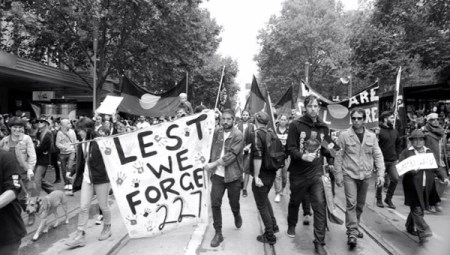
Protests Mark Australia’s Invasion Day
Invasion Day, Melbourne | Photo: Tim Dunn
teleSUR | January 26, 2015
In Melbourne, Australia on Sunday, around 800 people marched to mark Invasion day. Other protests, actions, and cultural events were also held around the country, while national and local governments organized formal celebrations of “Australia Day.”
On January 26, 1788, the first British fleet arrived on Australian coasts, marking the beginning of the invasion of that land, and the deliberate policies of genocide, slavery, child stealing, land stealing, and discrimination against the Indigenous peoples, as well as over 500 unpunished deaths in custody.
The Melbourne Invasion Day march this year marched to the official Australia Day march and pushed aside the barricades and occupied the space. Attendees reported that those at the official march “didn’t seam to know what to do.” Some members of the Invasion Day march chatted to those in the official march and explained the history behind the date. Some activists, according to GreenLeft Weekly, reported that there was some sympathy from those in the official march, who joined the Invasion Day march instead.
“No pride in genocide,” was one of the chants of the Invasion Day march.
“Today was the best Invasion Day protest I have ever been to. There was a real feeling of Aboriginal pride and resistance,” stated march participant and Socialist Alliance councilor, Sue Bolton.
Organizers of the Invasion Day march stated that the day “is a day of mourning for us Indigenous people, but its also a day to make our voices heard, to take a stand … to demonstrate our resistance to colonization and genocide. We have never ceded our sovereignty, and remain committed to the cause of decolonization.”
According to the ABC, in Sydney 10,000 people participated in the Yabun Festival, held to celebrate 40,000 years of Indigenous culture. In inner city Sydney, around 1,000 people marched for Indigenous land rights.
Australian private and mainstream media coverage has been biased against the Invasion Day marches. The Age headlined, “Aboriginal rights protest disrupts Australia Day Parade in Melbourne” while the Herald Sun said the marches had “interrupted” and “mar(ed)” events, but did not use the same language for official Australia Day events. Other media ignored the Indigenous rights marches.
Syria Opposition Groups Arrive in Moscow, Start Talks with Russian Officials
Al-Manar | January 26, 2015
Syrian opposition groups on Monday began four days of talks on how to end the near four-year conflict, with representatives of the Syrian government set to join them but the main exiled opposition alliance boycotting the event.
The closed-door talks opened as planned at 11 am Moscow time (0800 GMT), a Russian diplomatic source told RIA Novosti. The talks are set to run until Thursday.
“Around 25 (members of the Syrian opposition) have arrived. I think there will be up to 30,” Russian Deputy Foreign Minister Mikhail Bogdanov said.
But the western-backed exiled opposition alliance, the National Coalition, is not attending the Moscow talks although five of its members are there in a personal capacity along with members of opposition groups tolerated by the Damascus.
“Any talks should be held in a neutral country and overseen by the United Nations,” a source in the coalition said earlier.
The Syrian ambassador to the United Nations, Bashar Jaafari, will head the government team, which will join the talks on Wednesday, a Syrian newspaper reported.
Russian Foreign Minister Sergei Lavrov said last week he hoped there would be “chemistry” at the meetings that will help the UN envoy for Syria, Staffan de Mistura, organize a new peace conference to negotiate a way out of the crisis.
Lavrov may meet members of opposition groups on Wednesday “if there is a constructive mood”, Bogdanov said.
Two previous rounds of talks in Geneva ended without success.
North Sinai curfew extended by 3 months

North Sinai police station – Photo by Virginie Nguyen
By Omar Ryad | Mada Masr | January 25, 2015
The government has extended a curfew in North Sinai by three months, citing ongoing security concerns in the region.
The curfew was initially put in place for three months on October 25, after attacks on military checkpoints that killed more than 30 security personnel.
It was set to expire Sunday, but the Cabinet elected to extend it for an additional three months, Cabinet Spokesperson Hossam al-Qawish said during a telephone interview with private satellite channel CBC extra.
Qawish said that the ongoing unrest in the region convinced the government that the curfew and other security operations need to continue.
The curfew is now set to expire April 25.
It was originally imposed from 5 pm to 7 am each day, with anyone outside during curfew at risk of being shot or arrested. It has cut short working hours and transformed North Sinai’s cities into ghost towns.
In December, the hours were reduced in some parts of North Sinai to run from 7 pm to 6 am, after a meeting between President Abdel Fattah al-Sisi and tribal elders in Sinai.
However, area residents told a Mada Masr correspondent in Arish that the curfew still remains a significant hardship.
Forcing businesses to close early has pushed the city into a general state of recession and increased robbery and thuggery, area residents say.
Instead of keeping crime down, residents say the checkpoints that implement the curfew “only protect themselves,” in addition to increasing the numbers of random arrests.
Crimes against property are not the biggest problem, says Arish resident Abu Abdallah al-Tarabeen. “We can handle all of this if it is for the general wellbeing, but what we cannot stand are the large numbers of dead bodies, reaching around 50 bodies, left out for over two years in the isolated northern areas in Rafah and Sheikh Zuwayed,” he said, referring to a mass grave site in Arish.
A report released Saturday by the Ambulance Authority said that eleven bodies were buried around the grave site Tarabeen refers to, making it difficult for the authorities to process remains for burial or autopsies. According to Tarabeen, the 50 bodies were all killed by live ammunition in previous clashes.
Further inflaming tensions, on January 22 a family was shot minutes after the curfew was imposed at 7 pm.
Over the past months, soldiers have generally allowed a 30-minute grace period for employees, children and families to make their way home from the local market, but on that day, soldiers manning the checkpoint declared the grace period was no longer in effect and opened fire on civilians in the street.
One man was reportedly shot at while on the way home from buying wedding dresses for his three daughters. His wife and other relatives were also hit, and had to be transferred to intensive care.
The military has also evacuated and demolished homes in Rafah as part of a planned buffer zone along Egypt’s border with the Gaza Strip.
EU’s bailout program for Greece ‘dead’ – Syriza economist
RT | January 26, 2015
The bailout program, which the outgoing Greek government signed with the EU, is dead and will be renegotiated, Yiannis Milios, chief economy policy maker at the leftist anti-austerity party Syriza said after it won the country’s parliamentary election.
European Union Finance Ministers are scheduled to meet in Davos on Monday, but Milios said that Greece’s current finance minister, Gikas Hardouvelis, will attend the gathering only to “close pending cases of technical matters.”
“This program, which was agreed by Mr. Hardouvelis as representative of Mr. Samaras, is now dead,” he explained.
Syriza won over 36 percent of the vote on Sunday, forcing New Democracy – the party of Greek prime minister – Antonis Samaras, to settle for second with 28 percent.
Celebrating the victory, the party’s leader Alexis Tsipras announced to the cheering crowd that the era of ‘Troika’ debt inspectors is “over” for Greece.
“This is a historic victory of the Greek people. A new page has turned. It is a historic moment for the entire Europe. We turn a new page in our country. The Greek people take their future into their own hands,” Milios was also cited by ANA-MPA news agency.
The majority of Greek voters entered the election angry at the Samaras’s government for agreeing to the terms of 240 billion euro EU bailout, which included the severe cuts and tax hikes.
Syriza blamed austerity for deepening Greek recession, which pushed one third of the country’s population into poverty.
Before the vote, the leftist party’s leader, Alexis Tsipras, said that the terms of the bailout program must be renegotiated to give Greek economy more breathing space.
According to Milios, Syriza will form “the government of national salvation, is the government that will promote, defend and consolidate the interests of social majority but, at the same time, it is not just a message.”
Syriza has become the first anti-austerity party to form a government in Europe, with a Syriza economist saying that “it is the beginning of a major change for the entire” continent.
“Europe cannot continue with the deflation, recession, the rising unemployment and excessive debt. Greece leads the way, our country, our people are the pioneers of a huge change. We are all very emotional and happy,” he added.
READ MORE:
Greece’s anti-austerity Syriza party officially wins parliamentary elections
Featured Video
Prof. Ted Postol: US–Iran War? Israel’s Fatal Gamble
or go to
Aletho News Archives – Video-Images
From the Archives
Neocon Max Boot: Legal and illegal aliens need to enlist in the US army and die for Israel

By Jonas E. Alexis | Veterans Today | October 16, 2107
In 1973 Irving Kristol, the godfather of the Neoconservative movement, made a stunning statement which is still relevant to understanding the Israeli influence in US foreign policy. Kristol said:
“Senator McGovern is very sincere when he says that he will try to cut the military budget by 30%. And this is to drive a knife in the heart of Israel… Jews don’t like big military budgets. But it is now an interest of the Jews to have a large and powerful military establishment in the United States…
“American Jews who care about the survival of the state of Israel have to say, no, we don’t want to cut the military budget, it is important to keep that military budget big, so that we can defend Israel.”
Read the statement again very carefully. A big military budget, said Kristol, is only good for Israel, not America or much of the Western World. In other words, precious American soldiers who go to the Middle East to fight so-called terrorism are just working for Israel, not for America.
So, whenever the Neocons use words such as “democracy” or “freedom,” they are essentially conning decent Americans to support Israel’s perpetual wars. … continue
Blog Roll
 Aletho News
- Israel Pushing US Toward a Big and Damaging War With Iran – Ex-Pentagon Analyst
- Meet The Liberal Zionist And Ukraine War Supporter Advising AOC On Foreign Policy
- Buck Dancing for Zion: Kenya’s and Nigeria’s Growing Love Affair With Israel
- Israel installed, oversaw security system at Barak-Epstein residence in New York: Report
- ‘Britain’s Index of Repression’ documents 964 incidents of anti-Palestinian crackdown
- Prof. Ted Postol: US–Iran War? Israel’s Fatal Gamble
- UK prosecutors drop aggravated burglary charges against 24 Palestine Action activists
- Unidentified drone downed over Lebanon airbase, US forces block authorities from crash site
- Peeling Back the US Information Operation in Iran
- Israel ‘dictating terms’ to US – Turkish professor
- If Americans Knew
- The Lancet: Gaza death toll far higher than reported – Not a ceasefire Day 132
- Compliant aid: Who are the Israel-approved NGOs scaling up in Gaza?
- Why won’t Trump’s “Board of Peace” bring peace? – Not a ceasefire Day 131
- Help end the injustice against Shadi
- Israel’s Favorite American President
- Israel’s “Yellow Line” Is a Death Trap for Palestinians. We Drove Into It.
- Why Israel’s expanding occupation in Syria presents a critical legal test
- Gaza is not a natural disaster. It is the victim of genocide enabled by global inaction
- Netanyahu’s plan to “end” US aid to Israel is to give even more money under a different name
- Israel ceased firing on Gaza for just 15 days of the “ceasefire” – Not a ceasefire Day 130
- No Tricks Zone
- Coal Power Back In Trend As Globe Tries To Keep Pace With Growing Demand For Power
- New Study: A 4°C Warmer Beaufort Sea Had ‘No Sea Ice’ 11,700 – 8200 Years Ago
- Unfudging The Data: Dutch Meteorological Institute Reinstates Early 20th Centruy Heat Waves It Had Erased Earlier
- German Gas Crisis…Chancellor Merz Allegedly Bans Gas Debate Ahead of Elections!
- Pollen Reconstructions Show The Last Glacial’s Warming Events Were Global, 10x Greater Than Modern
- Germany’s Natural Gas Storage Level Dwindles To Just 28%… Increasingly Critical
- New Study Rebuts The Assumption That Anthropogenic CO2 Molecules Have ‘Special’ Properties
- Climate Scientist Who Predicted End Of “Heavy Frost And Snow” Now Refuses Media Inquiries
- Polar Bear Numbers Rising And Health Improving In Areas With The Most Rapid Sea Ice Decline
- One Reason Only For Germany’s Heating Gas Crisis: Its Hardcore-Dumbass Energy Policy
 Aletho News