The charade of Europe’s annual ‘threats’
By Jonathon Cook | The Blog from Nazareth | March 20, 2015
There is something deeply mendacious and cowardly about this ritual leaking by European diplomats of their annual report on Jerusalem. This year they’ve chosen to deposit the “confidential” report in the hands of the Guardian.
Obviously, the Europeans – and Americans – want this information about how angry they are with Israel disseminated as widely as possible in the wake of Netanyahu’s election win. “We’re mad and we’re not going to take it any more!” they shout – yet again, as they have done over the past four or five years.
As ever, the report is being described as “hard-hitting”; as ever, it threatens penalties against Israel; and as ever, it signifies nothing.
This is paltry theatre designed to persuade us – people with consciences – that our representatives care and that they are planning – at some point – to do something. But what it really indicates is that that something is going to amount to nothing more than empty threats. These are the same threats they have been making for more than a decade. And even were Europe actually to carry them out, they would have almost no impact on Israel.
Here’s what these “threats” consist of:
Known Jewish terrorists may face “restrictions” on entering Europe. (One would have hoped such “restrictions” were already in place.)
Europe may give its consumers more information about whether they are being misled into buying products from illegal settlements. (Such products should not even be available in Europe.)
And efforts will be made to “raise awareness” among European companies that it could be bad for business to be associated with the settlements. (And yet, according to free-market ideology, market forces ought to be enough to dissuade most companies from such associations – after all, they are supposed to want to maximise profits.)
In short, this list of potential “sanctions” is complete hot air. It’s zilch. And anyone claiming otherwise, including the Guardian, is simply conspiring in this diplomatic charade.
French gov preparing to outlaw ‘conspiracy theories’

By Brandon Martinez | Non-Aligned Media | March 20, 2015
In addition to its new law against ‘condoning terrorism,’ the French regime also plans to outlaw ‘conspiracy theories’ and prevent French citizens from accessing websites deemed conspiratorial.
On Jan. 27 France’s President Francois Hollande told a Jewish-Zionist audience at a Holocaust Memorial ceremony:
“We need to act [against the dissemination of conspiracy theories] at the European level, and even internationally, so that a legal framework can be defined, and so that Internet platforms that manage social networks are held to account and that sanctions be imposed for failure to enforce [censorship].”
As a first step in the crackdown on theories not consonant with government propaganda and lies, the French regime banned five websites.
Non-Aligned Media holds that the Ottawa shooting, the Sydney Siege, the Charlie Hebdo attack and the recent assault in Copenhagen were all staged-managed PR events designed to validate a government crackdown on terrorism-skeptics.
The British, Australian and Canadian governments have all forwarded similar pleas to silence skeptics of war on terror mythology and the official interpretations of 9/11, 7/7 and other false flag events which bear Israeli and Western fingerprints.
Britain’s David Cameron in particular equated 9/11 and 7/7 skeptics with ISIS terrorists during a speech at the United Nations.
After the October 22 Ottawa shooting in Canada, Sun News, a neocon Fox News clone outlet, dubbed the phrase ‘terrorist truthers’ to describe anyone not sufficiently sheep-like.
Copyright 2015 Non-Aligned Media
Wall Street Journal Gets the Numbers Wrong on Venezuelan Health Care Spending
By Mark Weisbrot | CEPR Americas Blog | March 20, 2015
I have sometimes noted that in the current “four legs good, two legs bad” discourse about Venezuela, journalists can write almost anything about the country and no one will question it – so long as it is something negative. On Saturday, March 13, the Wall Street Journal published this chart on its front page in the print edition, below, and claimed health care spending as a percent of economic output was “lower in Venezuela than in all other major economies in Latin America.” The chart shows Venezuela’s health care spending at 1.6 percent of GDP.

The chart and text don’t say it, but they are referring to public (i.e., government) spending on health care, which one can find by looking at the original data from the World Health Organization. When I read this, I thought, this can’t be true: The Venezuelan government spends about the same percentage of GDP on health care as Haiti? The lowest of 19 countries in the hemisphere? Less than some of the poorer countries in Sub-Saharan Africa? And these numbers are for 2012, when the economy was booming (5.7 percent real GDP growth), Venezuelan oil was at 103 dollars per barrel, and the government built more than 200,000 homes. They had no money for health care?
This should have set off some alarm bells at the WSJ, if any editors were paying attention. This number is not plausible because it is wrong. When the government of Hugo Chávez in Venezuela decided to make health care a priority after getting control over the national oil industry in 2003, it was unable to accomplish very much by going through the health ministry and the public hospitals – running into various bureaucratic and political obstacles. So it created Misión Barrio Adentro, a system of health clinics that served people in both urban and rural areas where many did not previously have access to health care.
The short story is that the numbers used by the WSJ apparently didn’t include most of Venezuela’s health care spending, since it has gone through the misiones. In 2012, the national oil company contributed $5.5 billion for Misión Barrio Adentro. Also, the government of Venezuela has an actual agreement with Cuba, which provides specifically for the supply medical care through Misión Barrio Adentro in exchange for 98,000 barrels of oil per day, which Venezuela has provided. The value of that oil in 2012 was $3.44 billion. The medical services include not only 40,000 doctors but also medical equipment, medicines, and other health care services.
If we add in these expenses, and use the IMF’s 2012 exchange rate to convert to domestic currency, this adds another 3 percent of GDP to the government’s health care spending.
This would bring Venezuela’s health care spending to 4.6 percent of GDP. In the above chart, that would move Venezuela from 19th to 7th place among the 19 countries shown. And this figure does not include all of Venezuela’s government health care spending.
(Note: the WSJ article also claims that “the share of state spending on health, at 6%” was also “lower in Venezuela than in all other major economies in Latin America.” This is also false, for the same reasons discussed above.)
When Do 43 Casualties in Latin America Matter?
The “Free Press” in Action
By NICK ALEXANDROV | CounterPunch | March 20, 2015
In Latin America last year, there were two events that each produced 43 casualties. Which elicited greater outrage?
For the U.S. media, it was the “violent crackdown” leaving “43 people dead” (NPR) in “an autocratic, despotic state” (New York Times ) run by “extremists” (Washington Post ). Surely these charges were leveled at Mexico, where 43 student activists were murdered in Iguala last September. In their forthcoming A Narco History, Carmen Boullosa and Mike Wallace describe how the victims, “packed into two pick-up trucks,” were driven to a desolate ravine. Over a dozen “died en route, apparently from asphyxiation,” and the rest “were shot, one after another,” around 2:00 a.m. The killers tossed the corpses into a gorge, torched them, and maintained the fire “through the night and into the following afternoon,” leaving only “ashes and bits of bone, which were then pulverized.”
Initial blame went to local forces—Iguala’s mayor and his wife, area police and drug gangs. But reporters Anabel Hernández and Steve Fisher, after reviewing thousands of pages of official documents, reached a different conclusion. Hernández explained “that the federal police and the federal government [were] also involved,” both “in the attack” and in “monitoring the students” the night of the slaughter. Fisher added that the Mexican government based its account of the massacre on testimonies of “witnesses who had been directly tortured.”
The Hernández-Fisher findings reflect broader problems plaguing the country. “Torture and ill-treatment in Mexico is out of control with a 600 per cent rise in the number of reported cases in the past decade,” Amnesty International warned last September, pointing to “a prevailing culture of tolerance and impunity.” The UN concurred this month, and “sharply rebuked Mexico for its widespread problem with torture, which it said implicates all levels of the security apparatus,” Jo Tuckman wrote in the Guardian.
Mexico’s president, Enrique Peña Nieto, has done his part to escalate state violence. He gave the orders, while governor of México State, for what Francisco Goldman calls “one of the most squalid instances of government brutality in recent years”—the May 2006 assault on the Atenco municipality. Some 3,500 state police rampaged against 300 flower vendors, peasants and their sympathizers, beating them until they blacked out and isolating women for special treatment. Amnesty International reported “23 cases of sexual violence during the operation,” including one woman a trio of policemen surrounded. “All three of them raped her with their fingers,” a witness recalled.
Peña Nieto responded by asserting “that the manuals of radical groups say that in the case of women [if they are arrested], they should say they’ve been raped.” Amnesty stumbled into a trap laid by attention-desperate women, in his opinion. Regarding Atenco, he stressed: “It was a decision that I made personally to reestablish order and peace, and I made it with the legitimate use of force that corresponds to the state.” Surely this is the “autocratic, despotic state” the New York Times criticized.
The paper’s archives lay bare its views—that Peña Nieto can “do a lot of good,” given his “big promises of change” and “commendable” economic agenda. The Washington Post’s Lally Weymouth interviewed Mexico’s president just before the Iguala bloodbath, dubbing him “a hero in the financial world.” A Post editorial praised his ability to summon the “courage” necessary to transform Mexico into “a model of how democracy can serve a developing country.” The Post clarified, with a straight face, that Peña Nieto displayed his bravery by ignoring “lackluster opinion polls” as he pushed through unpopular reforms—a truly “functional democracy,” without question. There was no serious censure of the Mexican president in these papers, in other words. The charges of despotism and extremism, quoted above, were in fact leveled at Venezuela—the site of the other episode last year resulting in 43 Latin American casualties.
But these demonstrations, from February until July, were dramatically different from the Mexican student incineration. What, in the NPR version, was “a violent crackdown last year against antigovernment protesters,” in fact—on planet Earth—was a mix of “pro- and anti-government protests” (Amnesty International) that “left 43 people dead in opposing camps” (Financial Times ). “There are deaths on both sides of the political spectrum,” Jake Johnston, a researcher with the Center for Economic and Policy Research, affirmed, noting that “members of Venezuelan security forces have been implicated and subsequently arrested for their involvement.” He added that several people were apparently “killed by crashing into barricades, from wires strung across streets by protesters and in some cases from having been shot trying to remove barricades.” Half a dozen National Guardsmen died.
In the wake of these demonstrations, the Post railed against “economically illiterate former bus driver” Nicolás Maduro, the Venezuelan president, for his “hard-fisted response to the unrest” and “violent repression.” The New York Times lamented his “government’s abuses”—which “are dangerous for the region and certainly warrant strong criticism from Latin American leaders”—while Obama, a year after the protests, declared Venezuela a national security threat. His March 9 executive order, William Neuman wrote in the Times, targets “any American assets belonging to seven Venezuelan law enforcement and military officials who it said were linked to human rights violations.”
Compare Obama’s condemnation of Maduro to his reaction to the Iguala murders. When asked, in mid-December, whether U.S. aid to Mexico should be conditioned on human rights, he emphasized that “the best thing we can do is to be a good partner”—since bloodshed there “does affect us,” after all. The Times followed up after Obama hosted the Mexican president at the White House on January 6, noting that “Mr. Peña Nieto’s visit to Washington came at a time of increased cooperation between the United States and Mexico.”
This cooperation has won some major victories over the decades. NAFTA shattered poor farming communities in Mexico, for example, while promoting deforestation, environmentally ruinous mining—and corporate profits. In 2007, U.S. official Thomas Shannon stated that “armoring NAFTA” is the goal of Washington’s security assistance, which “totaled $2.5 billion between FY2008 and FY2015,” the Congressional Research Service reported. The result is a death zone, with perhaps some 120,000 intentional killings during the Felipe Calderón presidency (2006-2012). Tijuana’s Zeta Magazine published a study claiming the slayings have actually increased under Peña Nieto, and the nightmare has deepened to the point where the murder rate “exceeds that of Iraq,” according to Molly Molloy.
None of these developments infuriated Washington like those in Venezuela, to be sure. After Chávez’s first decade in power, “the poverty rate ha[d] been cut by more than half” and “social spending per person more than tripled,” while unemployment and infant mortality declined, the Center for Economic and Policy Research determined. And the UN Economic Commission for Latin America and the Caribbean found, in May 2010, that Venezuela had the region’s most equal income distribution. In Mexico a year later, the Los Angeles Times noted, “poverty [was] steadily on the rise.” Throughout this period, Washington’s aims included “dividing Chavismo,” “protecting vital US business,” and “isolating Chavez internationally,” as former U.S. Ambassador to Venezuela William Brownfield outlined the strategy in 2006.
Reviewing this foreign policy record in light of recent Mexico and Venezuela coverage makes one thing obvious. There is, most definitely, a free press in the U.S.—it’s free to print whatever systematic distortions it likes, so long as these conform to Washington’s aims.
Nick Alexandrov lives in Washington, DC. He can be reached at: nicholas.alexandrov@gmail.com
Dutch dismiss reports alleging MH17 downed by Buk missile
RT | March 20, 2015
The Netherlands has denied reports that the Malaysia Airlines plane was downed by a Buk missile, killing all 298 passengers and crew last July.
The Dutch Safety Board (DSB), which is investigating the cause of the crash, responded to reports released earlier by Netherlands broadcaster RTL alleging that the flight MH17 was downed by a Russian-made anti-aircraft missile system.
“The investigation into the cause of the accident is in full progress and focuses on many more sources than only the shrapnel,” the DSB stated.
“Additional investigation material is welcome, but it is imperative that it can be indisputably shown that there is a relationship between the material and the downed aircraft,” the agency emphasized Thursday in a statement.
RTL claimed on Thursday that a metal fragment from the crash site of the plane allegedly matches a surface-to-air Buk rocket. The piece was recovered by a Dutch journalist from the village of Grabovo several months ago, close to where the plane was brought down last year.
Earlier this month Ukrainian media made a gaffe, misquoting Dutch investigators as having accused Russia of shooting down the Malaysian Airlines flight.
The potpourri of reports by Ukrainian media, including those by major outlets like TV channel TSN or Segodnya daily, all claimed that the Dutch team had already come to the conclusion it was a Russian Buk surface-to-air missile that shot down the Boeing airliner.
“I can say for sure they are not correct,” Dutch Public Prosecution Service (OM) spokesman Wim de Bruin told RT. “We are not yet ready to take any conclusion,” he pointed out.
On Thursday, Russia’s Foreign Minister Sergey Lavrov slammed a news report about witness statements, in which people claimed they had seen a rocket fired at the time of the crash.
“Attempts at distorting facts, enforcing theories as to what could have happened continue to exist, with some based on openly dirty intentions,” Lavrov told journalists. He remarked that a Reuters report on “new evidence on the downing of the Malaysian plane over Ukraine” from last week looked like the “respected agency” had published “a so-called stovepiping.”
Lavrov pointed out that some witnesses “contradict one another, and express things amusing for any specialist. For instance, some wiggling rocket, separating rocket stages, blue clouds of smoke.” He also stressed that information was provided by alleged eyewitnesses, who somehow managed to see the crash despite being 25km (15 miles) away from it, in cloudy weather.
RTL claims it had the shrapnel tested by international forensic experts, including defense analysts IHS Jane’s in London, who said it matched the explosive charge of a Buk.
Malaysia Airlines flight MH17, heading from Amsterdam to Kuala Lumpur, crashed over restive eastern Ukraine on July 17, 2014.
Kiev, along with some Western states, rushed to put the blame on eastern Ukraine militias and Russia.
A report on the official investigation published in September 2014 said the crash was a result of structural damage caused by a large number of high-energy objects that struck the Boeing from the outside. The report did not specify what the objects were, where they came from or who was responsible.
The Russian Defense Ministry meanwhile shared radar data pointing to other possibilities in the July tragedy, including an attack by a Ukrainian Sukhoi-25 fighter jet, which was said to have been tracking the passenger plane.
UK creates ‘political & economic reform’ fund for Eastern Europe to contain Russia
RT | March 20, 2015
Prime Minister David Cameron has announced the creation of a money pot specifically designed to aid Eastern European countries in tackling any future ‘aggression’ from Russia.
The “Good Governance Fund” is aimed at strengthening democratic institutions in areas that are wary of Russia’s influence. The fund will total £20 million ($30 million, €28 million) in 2015 and 2016.
It is broken down into £5 million for Ukraine, and continuing grants for Moldova, Georgia, Bosnia-Herzegovina and Serbia.
The announcement comes as leaders of the European Union agreed to extend the economic sanctions currently in place against Russia until the end of 2015, in a move to force Moscow to undertake a full ceasefire in eastern Ukraine.
The Minsk Agreement was reached in February after lengthy talks, but the truce has remained shaky. There have been reports of continuing skirmishes between Ukrainian forces and rebels.
EU leaders have criticized Russian President Vladimir Putin’s alleged “web of influence” across Europe after the reunification of Crimea in March 2014.
Earlier this month, the prime minister of Crimea said the former Ukrainian territory had returned to its historical homeland.
Russia has also formed an alliance with Cyprus, after Putin agreed a £1.8 billion loan for the country in return for the use of its docks for Russian military vessels.
Putin further created powerful western European allies following Marine Le Pens visit to Russia in the autumn. Russia has agreed to loan her party, the right-wing Front National, £6.5 million.
The Kremlin’s interests also extend to Greece, where Putin offered support to anti-austerity party Syriza when it campaigned for the country’s withdrawal from NATO two years ago.
When the party came to power in January, the Russian ambassador to Athens was one of the first to visit Prime Minister Alexis Tspiras.
The new fund is based on a Cold War program created by Margaret Thatcher in 1989.
At the time, her “Know-How-Fund” was used to help countries that had recently left the Soviet Union to develop, such as Hungary and Poland.
Russia denies it is providing rebels in Ukraine with arms and assistance.
The conflict has cost over 6,000 lives to date.
The Collapse of French Intellectual Diversity
France Now an Obedient, Cowardly Nation
By ANDRE VLTCHEK | CounterPunch | March 20, 2015
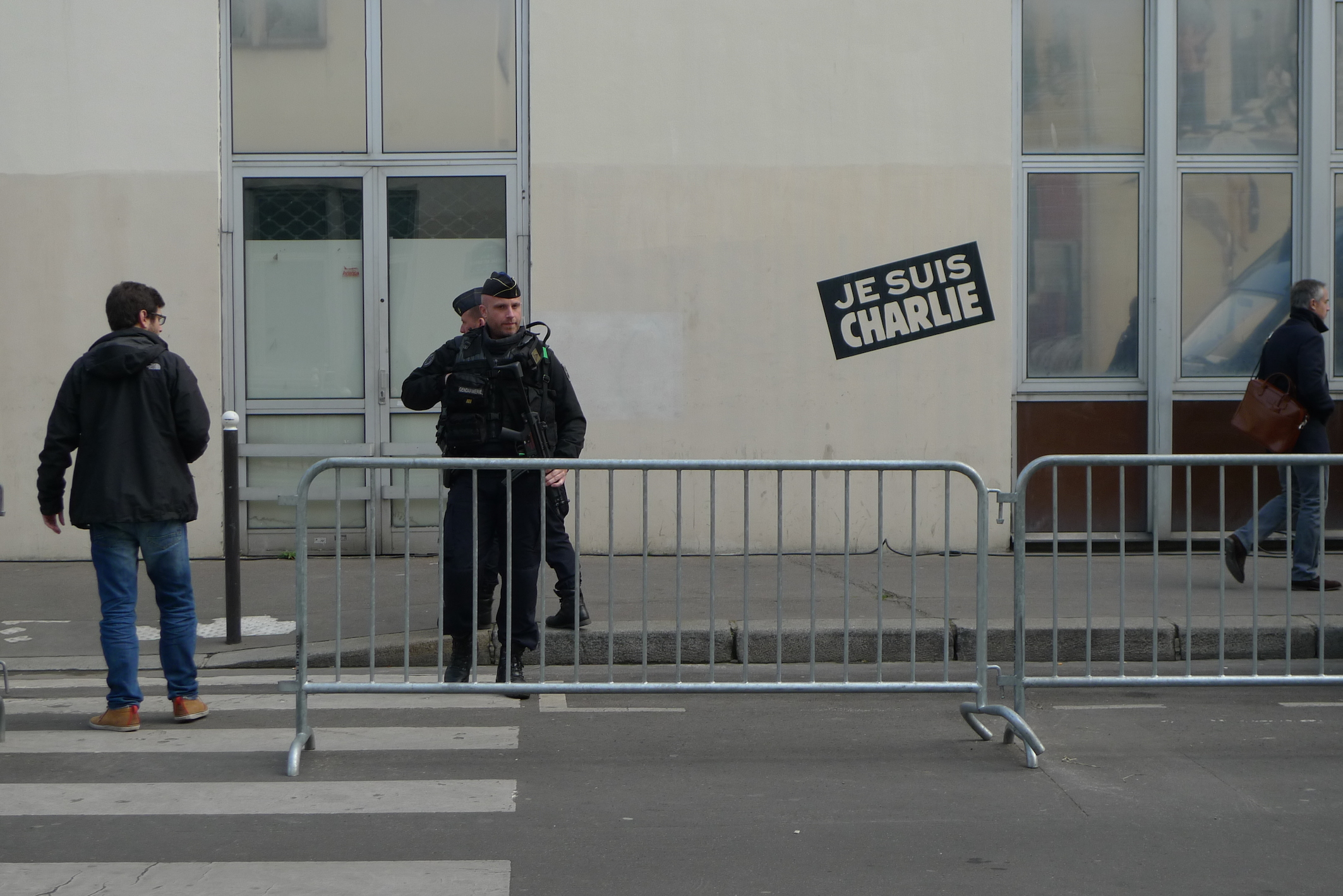
There are several machine gunners in front of the Charlie Hebdo building in Paris. These are cops, wearing bulletproof vests, carrying powerful weapons. They stare at occasional pedestrians in their special, revolting and highly intimidating way. Charlie Hedbo editors are well protected, some of them postmortem.
If you think that France is not as much a police state, as the UK or the US, think twice. Heavily armed military and police are visible at all train stations and many intersections, even at some narrow alleys. Internet providers are openly spying on their costumers. Mass media is self-censoring its reports. The regime’s propaganda is in “top gear”
But the people of France, at least the great majority of them, believe that they live in an ‘open and democratic society.’ If asked, they cannot prove it; they have no arguments. They are simply told that they are free, and so they believe it.
***
Employees of Charlie Hebdo go periodically out of the building for a smoke. I try to engage them in a conversation, but they reply in very short sentences only. They do their best to ignore me. Somehow, intuitively, they sense that I am not here to tell the official story.
I ask them why don’t they ever poke fun at the Western neo-colonialism, at the grotesque Western election system, or at the Western allies that are committing genocides all over the world: India, Israel, Indonesia, Rwanda, or Uganda? They impatiently dismiss me with their body language. Such thoughts are not encouraged, and most likely, they are not allowed. Even humorists and clowns in modern France know their place.
They soon let me know that I am asking too many questions. One of the employees simply looks, meaningfully, in the direction of armed cops. I get the message. I am not in the mood for a lengthy interrogation. I move on.
In the neighborhood, there are several sites carrying outpours of sympathy for the victims; 12 people who died during the January 2015 attack on the magazine. There are French flags and there are plastic white mice with Je Suis Charlie written on their bodies. One big poster proclaims: Je suis humain. Other banners read: “Islamic whores”, with red color correction, replacing Islamic with “terrorist” – Putain de terroristes.
There is plenty of graffiti written about freedom, all over the area. “Libre comme Charlie”, “Free like Charlie”!
A woman appears from the blue. She is very well dressed; she is elegant. She stands next to me for a few seconds. I realize that her body is shaking. She is crying.
“You’re a relative…?” I ask her, gently.
“No, no”, she replies. “We are all their relatives. We are all Charlie!”
She suddenly embraces me. I feel her wet face against my chest. I try to be sensitive. I hold her tight, this stranger – this unknown woman. Not because I want to, but because I feel that I have no other choice. Once I fulfill my civic obligation, I run away from the site.
***
Fifteen minutes walk from the Charlie Hebdo building, and there is the monumental National Picasso Museum, and dozens of art galleries. I make sure to visit at least 50 of them.
I want to know all about that freedom of expression that the French public is so righteously longing for and ‘defending’!
But what I see is endless pop. I see some broken window of a gallery and a sign: “You broke my art”. It is supposed to be an artwork itself.
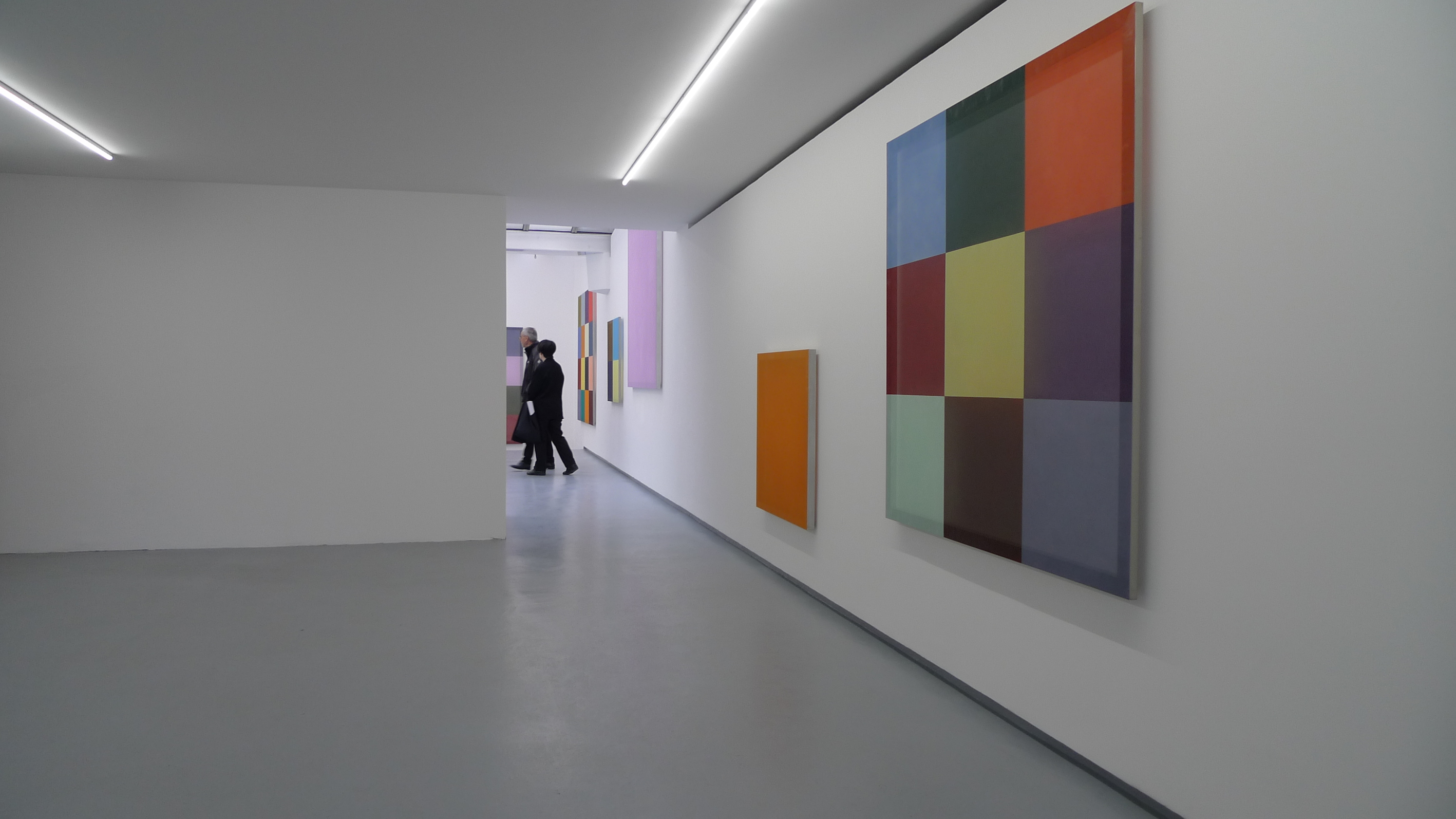
Galleries exhibit endless lines and squares, all imaginable shapes and colors.
In several galleries, I observe abstract, Pollock-style ‘art’.
I ask owners of the galleries, whether they know about some exhibitions that are concentrating on the plight of tens of thousands of homeless people who are barely surviving the harsh Parisian winter. Are there painters and photographers exposing monstrous slums under the highway and railroad bridges? And what about French military and intelligence adventures in Africa, those that are ruining millions of human lives? Are there artists who are fighting against France becoming one of the leading centers of the Empire?
I am given outraged looks, or disgusted looks. Some looks are clearly alarmed. Gallery owners have no clue what am I talking about.
At the Picasso Museum, the mood is clearly that of ‘institutionalism’. Here, one would never guess that Pablo Picasso was a Communist, and deeply engaged painter and sculptor. One after another, groups of German tourists consisting mainly of senior citizens are passing through well-marked halls, accompanied by tour guides.
I don’t feel anything here. This museum is not inspiring me, it is castrating! The longer I stay here, the more I feel that my revolutionary zeal is evaporating.
I dash to the office and summon a junior curator.
I tell her all that I think about this museum and about those commercial galleries that are surrounding it.
“Those millions who were marching and writing messages around Charlie Hedbo… What do they mean by ‘freedom’? There seems to be nothing ‘free’ in France, anymore. Media is controlled, and art has just became some sort of brainless pop.”
She has nothing to say. “I don’t know”, she finally replied. “Painters are painting what people want to buy.”
“Is that so?” I asked.
I mention “798” in Beijing, where hundreds of galleries are deeply political.
“In oppressed societies, art tends to be more engaged”, she says.
I tell her what I think. I tell her that to me, and to many creative people I met in China, Beijing feels much more free, much less brainwashed or oppressed, than Paris. She looks at me in horror, then with that typical European sarcasm. She thinks I am provoking, trying to be funny. I cannot mean what I say. It is clear, isn’t it, that French artists are superior, that Western culture is the greatest. Who could doubt it?
I give her my card. She refuses to give me her name.
I leave in disgust, as I recently left in disgust the Peggy Guggenheim Collection in Venice.
At one point I walk into a cafe, to drink a cup of coffee and a glass of mineral water.
A man and his enormous dog walk in. Both park at the bar, standing. A dog puts its front paws on the bar table. They both have a beer: the man from a glass, his dog from a saucer. A few minutes later, they pay and leave.
I scribble into my notepad: “In France, dogs are free to take their beer in cafes.”
***
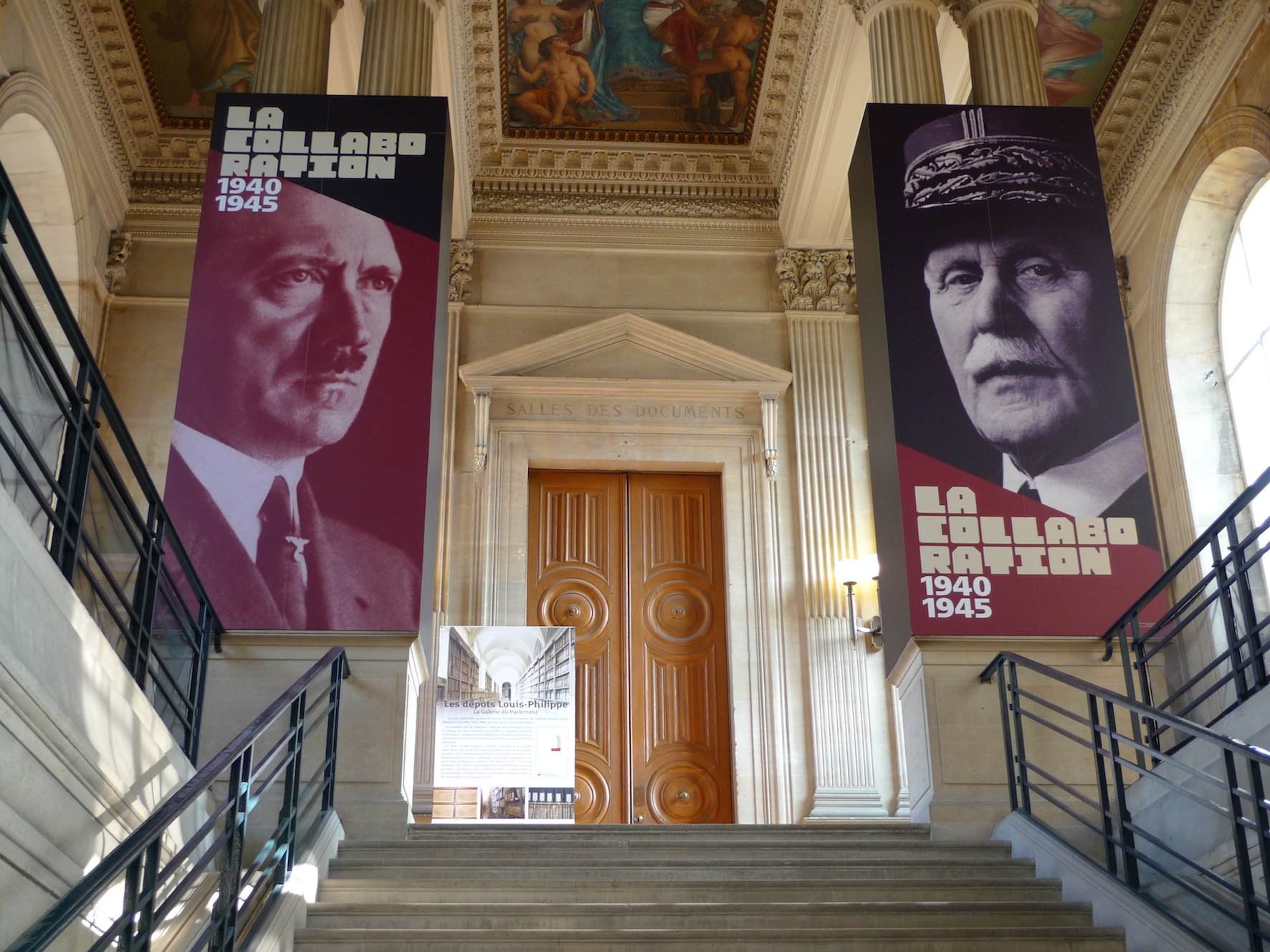
In the same neighborhood, I rediscover an enormous National Archive, a beautiful group of buildings with gardens and parks all around.
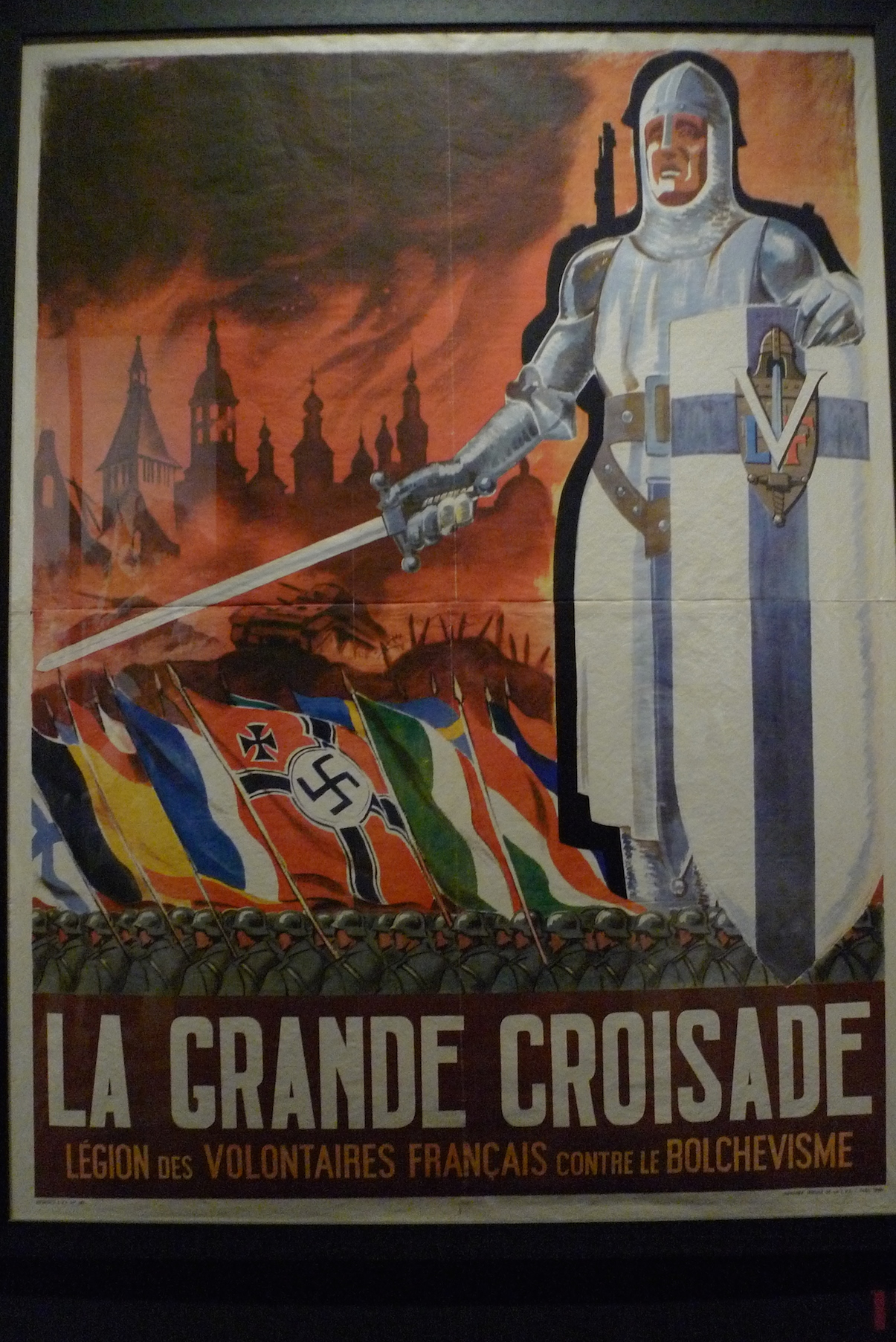
The place is holding a huge exhibition: on how France collaborated with the Nazi Germany during the WWII. The retrospect is grand and complete: with images and texts, with film showings.
For the first time in days, I am impressed. It all feels very familiar, intimately familiar!
***
At night I found myself in that enormous new Philharmonic, at the outskirts of Paris, near Porte de Pantin. I managed to smuggle myself to the invitation-only-opening of an enormous exhibition dedicated to French composer, conductor and writer – Pierre Boulez. That same Pierre Boulez who has been promoting, for ages, the idea of a public sector taking over French classic music scene!
Nobody protested at the exhibition, and I did not hear any jokes directed at Pierre Boulez. It was all brilliantly orchestrated. Great respect for the establishment cultural figure, for the cultural apparatchik!
I heard a technically brilliant concert of contemporary classical music, with new instruments being used.
But nowhere, in any of those tremendous spaces of the Philharmonic, did I hear any lament, any requiem, for the millions of people literally slaughtered by the Empire, of which France is now an inseparable part. No new symphonies or operas dedicated to the victims of Papua, Kashmir, Palestine, Libya, Mali, Somalia, the Democratic Republic of Congo, or Iraq.
My new friend, Francois Minaux, is writing an opera about the US carpet-bombing of the Plane of Jars, during the ‘Secret War’ conducted by the West against Laos. I am helping him with this enormous and noble project. But paradoxically (or logically?), Francoise is not living in France, but in the United States.
When I shared my thoughts with him, on Charlie Hebdo, and on freedom of expression in France, he summarized:
“It’s terrible. The art scene sucks. People are zombies. The mass reaction to the Charlie H attack is disgusting and depressing. ‘1984’ is happening but people are too blind to see it.”
A few hours later, I received an email in which Francoise reflected on his complex relationship with his native land, and its culture:
“Being French nowadays and being free to express yourself is impossible. Back in the early 2000’s, I could not accept the frame that culture would impose on its artists, and they could not accept my questioning and different approach to art making. They either spat on me or even worse, went mute. So, I left. You must travel outside of Europe and live and work outside, to feel the world.
I felt also that politically engaged works of art were not considered real art in Paris. There is this thing in France: any political engagement is seen either as propaganda or as advertisement. Back in the early 2000’s, we were supposed to make art for art’s sake. We were living under the glass dome of the conservatory. We were ‘protected by the government’.
They let us know that we should not talk about politics or religion in public. Maybe French secularism was a good idea but not to the present extent, when politics and religion became taboo. There is this climate of fear: our elders and teachers hardly discuss politics and religion. And so we didn’t know! Certain things are forbidden to be known in France.
Life in Paris became suffocating. Opinions were not expressed. We were not allowed to understand others. Live became boring: we had nothing substantial to talk about. And so we discussed greasy food and French wine. Economists describe the French economy as “austere”, but I would go further by saying that French behavior as well as French identity is austere. But the French people can’t see it because they now all think the same. They are trying so hard to stay French but they are forgetting, how the world has bled, so their French-ness could be preserved. Their culture was built from the blood flowing from the French colonies, and on the foundations of the modern-day French Empire.”
***
So where are those brave French minds now; people so many of us were admiring for their courage and integrity?
They were never ‘perfect’, and they erred, like all humans do, but they were often standing on the side of oppressed, they were calling for revolutions and some even for the end of colonialism. They were holding Western culture responsible for the horrors our planet has been facing for centuries.
Emile Zola and Victor Hugo, then later Sartre, Camus, Malraux, Beauvoir, Aragon…
What do we have now? Michel Houellebecq and his novels, full of insults against Islam, as well as of ‘tears of gratitude’ felt after each blowjob his characters get from their girlfriends.
The legacies of Houellebecq and Charlie are somehow similar. Is this the best France can do, these days? Is kicking what is on the ground, what was already destroyed by the West, what is humiliated and wrecked – called courage?
Are pink poodles on silver leashes, exhibited in local galleries, the essence of what is called the freedom of speech? Such stuff would pass any censorship board even in Indonesia, or Afghanistan! No need for the freedom of expression. It is cowardly and it is selfish – exactly what the Empire is promoting.
***
Christophe Joubert, a French documentary filmmaker, told me over a cup of coffee:
“First I was sad, when I heard about what happened to people at Charlie Hedbo. Then I got scared. Not of terrorism, but of the actions of the crowd. Everybody was indoctrinated: thinking the same way, acting the same way. Like Orwell and his 1984! More precisely, ‘the 8th day.”
“People in France know nothing about the world”, continues Christophe. “They believe what they are told by propagandist mass media”.
“I am not allowed to speak”, the Eritrean Ambassador to France, Hanna Simon, explained to me. “They invite me to some television show where they present a film criticizing my country. They speak openly, but when I try to respond, they shut me up.”
“I know nothing about what you are saying”, my good Asian friend replies, with sadness, after I tell him about the tremendous global rebellion taking place against the West, in Latin America, China, Russia, Africa… He is a highly educated man, working for the UNESCO. “You know, here we hear only one side; the official one.”
I am wondering whether, perhaps in 70 years from now, the National Archive will have another huge exhibition: one on France’s collaboration with neoliberalism, and on its direct involvement in building the global fascist regime controlled by the West.
But for now, as long as dogs can have a beer at the bar, fascism, imperialism and neoliberalism do not seem to matter.
Andre Vltchek is a philosopher, novelist, filmmaker and investigative journalist. He covered wars and conflicts in dozens of countries. His latest books are: “Exposing Lies Of The Empire” and “Fighting Against Western Imperialism”. Discussion with Noam Chomsky: On Western Terrorism. Point of No Return is his critically acclaimed political novel. Oceania – a book on Western imperialism in the South Pacific. His provocative book about Indonesia: “Indonesia – The Archipelago of Fear”. Andre is making films for teleSUR and Press TV. After living for many years in Latin America and Oceania, Vltchek presently resides and works in East Asia and the Middle East. He can be reached through his website or his Twitter.
Revealed: The CIA report used as pretext for Iraq invasion
RT | March 20, 2015
The document summarizing the CIA’s purported knowledge of Iraqi chemical, biological and nuclear weapons programs, produced in October 2002 and hidden from the public ever since, has finally been made public.
The CIA had previously released a heavily redacted version of the controversial National Intelligence Estimate (NIE) in 2004. Last year, transparency advocate John Greenwald made another FOIA request and received a declassified version of the document, which Vice News published this Thursday.
RAND Corporation, a government-connected think tank, also had access to the NIE. In a report published in December 2014, RAND analysts noted that the original CIA assessment contained many qualifiers about virtually everything, but as the document went up the chain of command, “the conclusions were treated increasingly definitely.”
Thus, even though the CIA offered guesses based on rumors from Iraqi exiles and unverifiable sources, Bush administration officials claimed with absolute certainty that Iraq was producing chemical and biological agents, and acquiring components for nuclear weapons.
Likewise, the Bush administration asserted a connection between Al-Qaeda and the government in Baghdad even though the CIA report noted that its information was based on “sources of varying reliability,” and that even if the relationship had existed, there was no indication Iraqi leader Saddam Hussein knew about it.
“As with much of the information on the overall relationship, details on training and support are second-hand,” the document, quoted by Vice News, said. “The presence of [Al-Qaeda]… militants in Iraq poses many questions. We do not know to what extent Baghdad may be actively complicit in this use of its territory for safehaven and transit.”
The NIE reveals much of the intelligence concerning allegations that Iraq gave Al-Qaeda instructions on using chemical and biological weapons came from interrogations of alleged terrorists, often under torture.
Last year’s Senate investigation into the CIA torture program revealed that the dubious charges all came from a single source, which the NIE names as Ibn al-Shaykh al-Libi (“The Libyan”). Al-Libi commanded the Khaldan training camp in Afghanistan, shut down by the Taliban before 9/11 because he refused to subordinate to Osama bin Laden. Who exactly tortured the information out of him remains redacted, but the Senate report noted that Al-Libi recanted his testimony after being turned over to the CIA in February 2003, saying he only told his torturers what they wanted to hear.
Paul Pillar, the former CIA analyst in charge of coordinating the assessment on Iraq and now a visiting professor at Georgetown University, told Vice News that the claims of alleged Iraqi biological weapons – such as the anthrax-laced envelopes sent to Senators Tom Daschle and Patrick Leahy a week after 9/11 – were based on such sources as Ahmad Chalabi, of the US-backed Iraqi National Congress.
“There was an insufficient critical skepticism about some of the source material,” Pillar said. “I think there should have been agnosticism expressed in the main judgments. It would have been a better paper if it were more carefully drafted in that sort of direction.”
Featured Video
American Military Failure in Afghanistan
or go to
Aletho News Archives – Video-Images
Frlom the Archives
The Fiction of the Jewish History in Palestine
By Hasan Afif El-Hasan | The Palestine Chronicle | April 8, 2011
Prime Minister Benjamin Netanyahu told NNC Pierce Morgan on March 18, 2011 that he might agree to a Palestinian state through negotiations. And he added, “We will make territorial concessions although it is very painful to do that in our ancestral land.” Netanyahu was not talking about Poland where his ancestors lived. He was talking about Palestine where generations of its indigenous population ancestors lived, cultivated the land and are buried.
By the end of the nineteenth century, Zionism created a new Jewish identity of blood and soil. To mobilize their followers and supporters and appeal to their emotions, the Zionists created myths. Zionism started as a tribal religion without god, but in order to fulfill its function as a unifying force, Zionism required external religious and race symbols, not inner content. Its leaders regarded metaphysical religious belief and purity of race as having value in itself. They created a divine paradisiacal state of merger with the gods. Despite his non-religious ideology, Herzl’s writings were replete with religious references. The Jews should settle in Palestine because, in his words, “the Temple will be visible from long distance, for it is only our ancient faith that has kept us together”.
The Zionists and their supporters have invested tremendous financial and scholarly resources to work within the Hebrew Bible historical narratives to affirm the links between the intrusive Zionist population and the ancient Israelite past, and by doing so assert the right of that population to the land. The political end-game shaped the investigation and the outcome. Tracing the roots of Israel’s ethnic state in biblical antiquity is effectively to silence the indigenous Palestinian claim to the past and therefore to the land. The Biblical scholarship employs a bewildering array of terms for the region: “the Holy Land”, “the Land of the Bible”, “Eretz Israel”, “the Land of Israel”, or “Judah and Samaria.” To the casual reader these names appear interchangeable, but they all imply connection to ancient Israel.
Biblical narratives or poems that cannot be supported by archeology and common sense are treated by the Zionists and their supporters as historical language. … continue
Blog Roll
 Aletho News
- CIA Assessment: The Resistance Cannot Be Crushed
- Hezbollah Returns: It Didn’t Start a War, It Is Ending One
- EU states seek ‘talks’ with Iran for access to Strait of Hormuz: Report
- Trump on Hormuz: “Others must take care of it” after US falters
- Who Is closer to collapse?
- A War that Backfired: Why the US-Israeli Campaign Is Strengthening Iran
- How Zionist Control Is Hurting US Interests
- Iran warns it may target US missile launch sites in UAE cities
- American Military Failure in Afghanistan
- Friendly Skies of Georgia: Are Israeli-Linked Drones Launching False Flags from Georgian Territory?
- If Americans Knew
- No let-up in attacks on Gaza as Israel takes on Iran, Lebanon – Not a ceasefire Day 155
- ‘Of Course’: IDF Drops Case Against Soldiers Accused of Raping Palestinian Prisoner
- Don’t Fall for the Regime Change Talk. Israel Is ‘Mowing the Lawn’ in Iran
- Will Israel and the US wreck the Gulf States along with Iran?
- US so far burned through ‘years’ of munitions in Iran war: Report
- How the Israeli Tail Wags the American Dog
- Outdated intel likely led to deadly U.S. strike on Iranian elementary school, sources say
- Pentagon insider says high U.S official Douglas Feith reported to Netanyahu
- In fond memory of Walid Khalidi, the historian of Palestine
- 6 more Americans killed, as Israel ‘mows the lawn’ in Iran – Not a ceasefire Day 154
- No Tricks Zone
- Storing Green Energy To Last Germany 10 Days Would Require A 60-Million Tonne Battery
- New Studies: UK Sea Levels Were 4 Meters Higher Than Today During The Mid-Holocene
- Destructive Green New Deal: German Energy And Metal Group Warns Of Drastic Crisis
- New Study Documents A 20-Year Pause In Arctic Sea Ice Decline – Driven By Internal Variability
- Wake-up Call: Survey Shows Majority Of Germans Now Favor Postponing Climate Targets!
- Televised! Leading German Political Candidate Tells Schoolchildren CO2 Makes Sun Hotter!
- New Study: A Century Warming Of 1.1°C Is ‘Commonplace’ And ‘Not Unusual’ During This Interglacial
- New Study: ‘Internal Noise’ And Volcanic Forcing Can Trigger 10-15°C Warming Within Decades
- Glaciers Worldwide Are Suddendly Surging, Experts Blame Warming!
- Surprising Discovery: Sahara Is Greening…Billions Of Trees Where Once Thought To Be Barren
 Aletho News