This is what “lack of evidence” looks like when Jewish settlers shoot Palestinians

File photo IMEMC
By Yossi Gurvitz | Yesh Din | May 3, 2015
We see how seriously the prosecution takes its role when we realize it closed a file for lack of evidence — without so much as noticing the evidence.
The location was Qusra, a village in the Shiloh Valley; the date, September 16, 2011. Fathallah Mahmoud Muhammad Abu Rhoda went out with his three sons to pick figs. A short while after reaching their land, they noticed about 10 Israeli civilians standing around their water hole. The Palestinians demanded the Israelis leave the place; the interlopers refused. The residents of Qusra — a village that has already proven it can defend itself against marauders — began heading to the area. An argument ensued, and according to Abu Rhoda’s testimony to the police, three of the settlers (who were armed) opened fire on the Palestinians. One bullet hit Abu Rhoda in the thigh.
Of the three, two were armed with rifles and the other with a handgun. From the police testimony, we see that the handgun’s owner also sicked a dog on the Palestinians. The complainants managed to photograph some of their attackers, among them the handgun owner.
Four days after the incident, Abu Rhoda filed a complaint with the police. Almost three years later, on August 6, 2014, the prosecution informed us that it closed the case for lack of evidence. After a series of 14 phone calls, we managed to photocopy the case file on December 15, 2014 — more than four months after the case was closed. However, it was immediately apparent some of the material was missing. We continued requesting it until February 2015.
From the evidence we finally received, it turns out that there is more than enough evidence to indict the handgun owner, E. As previously mentioned, E. was identified by the Palestinians victims, and they even supplied the police with photos of him at the scene, which clearly show him holding a handgun in one hand and the dog in the other. The police picked up cartridges from the scene, and a ballistic fingerprinting – which took place on September 27, 2011 – found that one of the cartridges came from a 9mm Glock pistol (the others were fired from rifles.) E. was summoned for an investigation, invoked his right to remain silent, but admitted he owned a Glock. The gun was duly turned over to the police, which sent it to a ballistic fingerprinting. In February 2012 the police expert reached the conclusion that there is a match between the cartridges fired from E.’s handgun and the those that were examined on September 27.
In total, the following evidence was marshaled against E.:
A. He was identified and photographed by the complainants.
B. His handgun was identified as the one fired during the incident.
Despite the evidence, the police recommended that the case against E. be closed due to — get this — lack of evidence. The recommendation was accepted by the prosecution. Embarrassingly, the prosecution admitted this to us only in January 2015 — 10 months after it closed the case for lack of evidence. Only as a result of our request for more case files did the prosecution learn about the September 2011 memorandum, which identified the type of handgun owned by E. That is, when the prosecution decided to close the case for lack of evidence, it was lacking a major piece of evidence.
What about the two other shooters? I’m glad you asked. The police chased one of the suspects into the Esh Kodesh outpost, even so much as detaining him after he fled. However, despite the fact that the suspect fled arrest and refused to identify himself, there is no indication in the material we received from the police that any investigative action was taken against him. There is, for instance, no sign that he was even interrogated or gave testimony; he was detained, and immediately released.
The third suspect managed to flee in a vehicle and reach Esh Kodesh. The police identified the owner of the vehicle as well as another person who was with him in the car during the chase. But, lo and behold, the police neither bothered to interrogate them nor attempt to identify the third shooter.
This is how the police and the prosecution treat a violent incident, in which three Israeli civilians open fire on Palestinians who are on their own land. In a case that contains such clear forensic evidence, they managed, with extraordinary negligence, not to notice it. And in the other cases? They simply do not investigate.
In the beginning of March, our attorney Anu Deuel Lusky (briskly aided by Moriyah Shlomot) appealed the decision, asking the prosecution to bring E. to trial and conduct further investigations that would lead to the capture of the other two suspects. To quote the appeal:
“This appeal, in both its parts, raises a harsh and heavy feeling that both the police and the prosecution betrayed their duties as bodies entrusted with maintaining law and order. The current situation – in which the lives, bodies and property of Palestinians, considered protected persons by international law, can be harmed with impunity, both as a result of settler violence and as a result of law enforcement entities standing aside, not making the minimal effort to bring lawbreakers to justice – is intolerable, and undermines the rule of law.”
One wonders what is left of the rule of law after it has been so brazenly undermined.
Protest over Zionist Police Brutality Turns Violent in Tel Aviv
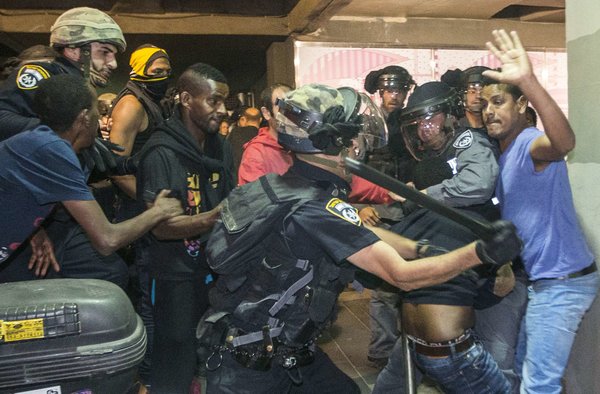
Al-Manar | May 4, 2015
A protest in Tel Aviv over police mistreatment of Ethiopian Jews turned violent Sunday, resulting in 57 officers being injured, according to the Zionist police.
Most of those injuries were minor, according to police, but one officer was described to be “moderately injured.” Police say 12 protestors were injured. The extent of those injuries is not known, according to CNN.
The planned demonstration by the Ethiopian Jewish community — incensed over a video gone viral that shows a uniformed IOF soldier of Ethiopian descent being assaulted by police — had been peaceful for hours before things took a violent turn.
Authorities employed horses, water cannons and smoke to disperse the crowd in Rabin Square, where demonstrators had been chanting slogans such as “a violent cop should be in jail.”
Forty-three protesters were arrested, according to Israeli police spokeswoman Luba Samri.
The videotaped episode from April 26 was a tipping point for Ethiopian Jews, some 125,000 strong, who say they have long felt like second-class citizens since arriving in two waves of mass immigration in the 1980s and early 1990s.
Prime Minister Benjamin Netanyahu released a statement saying that “all claims will be looked into but there is no place for violence and such disturbances.” Netanyahu will meet with Pakada on Monday, as well as with leaders in the Ethiopian community, according to the statement.
The Real Looting of Baltimore…

RenegadeEconomist | April 30, 2015
Why don’t we look at the root causes of the Baltimore riots…?
Poland approves joint force with Ukraine & Lithuania, calls on EU to spend more on defense
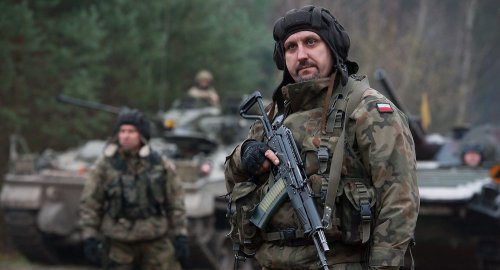
RT | May 4, 2015
Poland’s President Bronislaw Komorowski has signed a resolution approving the organization of a joint Lithuanian-Polish-Ukrainian brigade, whose creation has been in the works since 2007.
When brought to full operation in 2017, the brigade is set to constitute 4,500 servicemen. They will operate separately from the three countries’ respective militaries, but will take part in NATO exercises and missions. Preliminary drills are scheduled for later this year. The brigade will be stationed at its headquarters in Libulin, Poland. So far, it only houses 250 servicemen and 50 command staff contributed by the Polish military.
The joint force was discussed as far back as 2007, but the agreement to create it was signed by the three countries’ defense ministers in September 2014, in response to the Ukrainian crisis and what they call Russian aggression.
Creating the joint force is “part of a wider plan … to support Ukraine, among others, in the area of modernization,” President Bronislaw Komorowski said as cited by Reuters.
He also urged other European countries to spend more on defense. To that end, President Komorowski has suggested excluding defense spending from EU rules on budget deficit limits. This means that EU nations will be able to allocate more money to the military without fearing increased budget controls from Brussels. Komorowki’s offer comes at a time of heightened tensions with Russia.
Poland now has the fifth-strongest army in the EU, and has ambitious plans to modernize it, spending about $36 billion until 2022. However, the Polish government is unhappy about a lack of similar eagerness in some of the other European nations, the Rzeczpospolita newspaper reports.
While NATO is advising its member states to spend the maximum allowed of three percent of GDP on defense, most are spending far less: Germany allocates 1.2 percent of its GDP, the Netherlands 1.3 percent and Spain under 1 percent. France is the only Western European country that is boosting defense spending. However, some Eastern European nations are increasing their military expenses citing what they call Russian aggression. Lithuania, for instance, wants to allocate twice as much on defense as last year.
Following the Money: The New Anti-Semitism?

By Jim Lobe and Charles Davis | LobeLog | May 1, 2015
In the 1976 docudrama about the Watergate affair and the fall of Richard Nixon, All the President’s Men, Bob Woodward’s source at the FBI, Deep Throat, tells him to “follow the money.” To the Washington Post editorial board in 2015, doing just that is problematic—and probably anti-Semitic. Or at least that’s their charge in a piece published last Friday entitled, “Argentina’s President Resorts to Anti-Semitic Conspiracy Theories,” the Post opens by asking:
What do lobbyists at the American Israel Public Affairs Committee and the director of a Washington think tank have to do with hedge-fund manager Paul Singer and the Argentine prosecutor, Alberto Nisman, who died mysteriously in January? Well, according to Argentine President Cristina Fernandez de Kirchner, they are all part of a “global modus operandi” that “generates international political operations of any type, shape and color.”[Links added]
The Post’s problem is that Kirchner posted a “rant” on her website highlighting the fact that Paul Singer—whose hedge fund, Elliott Management, is seeking to force Argentina to repay the full amount of its defaulted debt—has contributed a whole lot of cash to the same neoconservative organizations in Washington that have been tarring the South American nation as a deadbeat ally of Iranian-backed terrorism. These same groups have also uncritically promoted the work of prosecutor Alberto Nisman, who in 2006 issued a highly controversial 900-page indictment charging seven senior Iranian officials with ordering the 1994 bombing of the Jewish community center in Buenos Aires, the Argentine Israelite Mutual Association (AMIA), that killed 85 people. Nisman died in his apartment from a bullet to the head January 18, the night before he was set to testify before the Argentine congress in support of new charges that Kirchner and her foreign minister, Hector Timerman, had conspired with Tehran to quash international arrest warrants against those same Iranians, including Supreme Leader Ayatollah Ali Khamenei and then President Ali Hashemi Rafsanjani, in exchange for a favorable trade agreement.
Making the Links
In 2013, Inter Press Service (IPS) ran a two-part feature by Charles (here and here) on the links between Singer and Nisman’s neoconservative fan club in the United States. The Argentine press and the president herself recently cited this work. The Post, however, plays dumb: “How do Singer, AIPAC and Mark Dubowitz of the Foundation for Defense of Democracies [FDD] come into this?” it asks.
Mr. Singer—or “the Vulture Lord,” as Ms. Kirchner called him—won a court battle on behalf of holders of Argentine debt last year; Ms. Kirchner chose to default rather than pay. Mr. Dubowitz’s think tank has published papers on Argentine-Iranian relations, while AIPAC has criticized the Obama administration’s preliminary nuclear deal with Iran. Confused?
Conspicuously and no doubt consciously missing from the Post’s retelling is the fourth sentence of Kirchner’s “rant”: “[Singer] contributed to the NGO Foundation for the Defense of Democracies (FDD), $3.6 million from 2008 to 2014.” By leaving this out, the Post is better able to pretend the only link between Singer and Dubowitz and Nisman is their Judaism.
Argentina, whose politics are reputedly as byzantine and Machiavellian as any country’s, does indeed have a history of anti-Semitism. Not only did it offer a refuge to fleeing Nazis after World War II, but the military junta that took power in 1976 included elements that extolled the Third Reich, as eloquently retold by perhaps the most famous survivor of the junta’s torture chambers, Jacobo Timerman (the foreign minister’s late father) in his 1981 book, Prisoner Without a Name, Cell Without a Number.
Kirchner may indeed have a political interest in claiming that an international conspiracy is defaming her government, but the evidence for such a conspiracy in this case is much stronger than the Post suggests. As noted above, millions of dollars have flowed from Singer’s pockets to the various neoconservative groups whose advocacy of confrontation with Iran has extended to attacking Argentina, in particular over its ties to the Islamic Republic.
Singer, who sits on the board of the hawkish Republican Jewish Coalition, turns out to be a generous funder of not only FDD, but AIPAC and the American Enterprise Institute (AEI), as well as a number of other right-wing groups and politicians that have stoked hostility toward Iran. In 2010, for example, his personal and family foundations contributed a combined $1 million to the American Israel Education Foundation, the fundraising wing of AIPAC and the sponsor of its congressional junkets to Israel. The $3.6 million he gave to FDD between 2008 and 2011, meanwhile, makes him the group’s second largest donor during those three years. So, it’s pretty clear that what ties AIPAC and FDD together is not only their anti-Iran efforts, but also Paul Singer’s largesse. And that’s the link Kirchner highlights but the Post leaves out.
Make no mistake: Singer and Elliott Management stand to make as much as $2 billion if they can collect full value on the debt they bought for pennies on the dollar after the country’s 2001 default. About 93 percent of Argentina’s bondholders agreed to accept a fraction of what they were originally owed (a fact the Post also conveniently omitted). But Singer—who has done this sort of thing before with other nations that have defaulted on their debt—sued in U.S. court to recover the full amount, a move the Kirchner government has fought every step of the way. The Obama administration and the International Monetary Fund, as well as most of Latin America and Washington’s closest European allies, have also sided with Argentina, viewing Singer’s actions as a threat to the international financial system.
The Iranian “Connection”
What has this got to do with Nisman, though? His allegations of Iranian direction in the 1994 bombing in Buenos Aires—and subsequent charges that the Kirchner government was trying to cover up that involvement so as to not undermine its growing economic relations with the Tehran—proved quite useful in another arena: the court of public and congressional opinion. According to IPS’s Gareth Porter, Nisman’s 2006 indictments were based virtually entirely on the testimony of a long-discredited former Iranian intelligence officer and several members of the cult-like Mujahedin-e Khalq (MEK), an Iranian opposition group that fought alongside Saddam Hussein’s forces in the Iran-Iraq war.
But the claims have undoubtedly been useful to Singer’s cause. “We do whatever we can to get our government and media’s attention focused on what a bad actor Argentina is,” Robert Raben, executive director of the American Task Force Argentina (ATFA) explained to The Huffington Post. ATFA, a group Singer helped create with other hold-out creditors in 2007, spent at least $3.8 million dollars over 5 years doing whatever it could to paint Argentina as a pariah, according to IPS. Connecting the Kirchner government to Iran has clearly furthered that purpose.
“Argentina and Iran: Shameful Allies” was the headline of one ATFA ad that ran in Washington newspapers back in June 2013 as the Obama administration was considering whether to file an amicus brief with the U.S. Supreme Court in Argentina’s favour. The ad featured adjoining photos of Kirchner and outgoing President Mahmoud Ahmadinejad connected by the question, “A Pact With the Devil?”
“What’s the TRUTH About Argentina’s Deal with Iran?” asked another very flashy full-page ad featuring unflattering photos of Kirchner and Hassan Rouhani published in the Post’s front section shortly thereafter. The ad included excerpts of letters denouncing the joint investigation from members of Congress, including Mark Kirk (R-IL) who received more than $95,000 from employees of Singer’s firm, Elliott Management, in the 2010 election. The signer of one letter urging the administration against siding with Argentina, former Rep. Michael Grimm (R-NY)—who after his re-election in 2014 pleaded guilty to federal tax evasion and resigned shortly thereafter—received $38,000 in campaign contributions from Elliott in 2012, nearly twice as much as his next largest donor.
Singer’s generosity also appears to have produced results in the think tank world, with Dubowitz’s FDD leading the way. In May 2013, as ATFA was running the Kirchner-Ahmadinejad ad, FDD release an English-language summary of a new “ground-breaking” report by Nisman detailing “Iran’s extensive terrorist network in Latin America.” (In an extended exchange with ProPublica here and here, Jim pointed out the summary’s many serious holes, leaps of logic, and other weaknesses.) The report triggered a flood of op-eds by FDD fellows and fellow-travellers at other neo-conservative organizations, as well as a series of hearings held by the House Homeland Security Subcommittee. According to FDD’s vice president, Toby Dershowitz, the report provided:
a virtual road map for how Iran’s long arm of terrorism can reach unsuspecting communities and that the AMIA attack was merely the canary in the coal mine. …The no-holds-barred, courageous report is a ‘must read’ for policy makers and law enforcement around the world and Nisman himself should be tapped for his guidance and profound understanding of Iran’s terrorism strategy.
Nisman’s death, on the eve of his testimony before the Argentine Congress about his charges against Kirchner and Timerman (since dismissed by two courts), produced another outpouring of articles by FDD fellows recalling the prosecutor’s tireless efforts to document Iran’s alleged involvement in the AMIA bombings and Kirchner’s purported courtship of Iran. Within a month, FDD announced the establishment of an “Alberto Nisman Award for Courage.” “We must pay careful attention to the detailed Iranian playbook he left behind and from it, heed important lessons in counter-terrorism and law enforcement,” Dershowitz said in the announcement. (For an interesting take on Nisman’s work, see “Why Nisman is No Hero in Argentine Bombing Case” by Argentine journalist Graciela Mochkofsky published last month in The Forward.)
Although FDD clearly lent itself with gusto to Singer’s efforts to tar Argentina and Kirchner with the Iranian brush, AIPAC has been more reserved. It has focused on the issue of Iranian terrorism in its own tireless drive to promote sanctions legislation and a policy of confrontation against the Islamic Republic. In 2010, however, the same year in which Singer and his foundation contributed $1 million to the premier pro-Israel lobby, Nisman was featured on a panel entitled, “Dangerous Liaisons: Iran’s Alliances With Rogue Regimes” at the group’s annual policy conference.
AEI Joins In
As for AEI, Singer would find it attractive not only for its pro-Israel hawkishness and long-standing hostility toward Iran and leftist governments everywhere, but also to its domestic agenda: a hands-off policy toward Wall Street. In other words, he may have had several reasons to give the group $1.1 million in 2009—its second-biggest donor that year—and another $1.2 million over the next two. Whatever his reasons, those who received those millions surely (and demonstrably) knew well enough not to upset their benefactor. And AEI fellow Roger Noriega, a former senior Bush administration official, has certainly pushed the Argentina-Iran/Nisman connection.
As Charles reported in 2013, Noriega has himself been paid at least $60,000 by Elliott Management since 2007—the same year AFTA was founded—to lobby on the issue of “Sovereign Debt Owed to a U.S. Company.” In 2011, he published an article on AEI’s website citing Nisman’s AMIA indictment and denouncing Iran’s offer to cooperate with Argentina in investigating the AMIA bombing as “shocking, in light of Tehran’s apparent complicity in that attack.” The article—“Argentina’s Secret Deal With Iran?”—cited secret documents suggesting that Tehran and Buenos Aires had recently renewed their cooperation on nuclear development as part of a deal “brokered and paid for” by Venezuela’s Hugo Chavez.
Two years later, Noriega and Jose Cardenas, a contributor to AEI’s “Venezuela-Iran Project,” co-authored a seven-page policy brief on AEI’s website entitled “Argentina’s Race to the Bottom,” which, among other things, charged that Kirchner’s government was “casting its lot with rogue governments like those in Venezuela and Iran.” Noting that two-way trade with Iran had grown from $339 million in 2002 to $18.1 billion in 2011, the article asserted:
…[T]he Kirchner government has been turning its back on its historical alliances and increasingly tilting its economic relationships toward countries of dubious international standing where rule of law is less of a concern.
And a week after FDD announced its Nisman Award for Courage, Noriega was back at it with an article headlined “Argentina’s Kirchner Reeling from Scandal.” The piece called for a “credible international investigation into Nisman’s case… to ensure that his 10-year search for the truth was not in vain and that justice is attained not only for his family but also for the victims of the 1994 AMIA bombing.” In a veiled reference to Singer’s quest, he wrote:
From ongoing battles with bondholders playing out in a New York courtroom to pressuring critical news outlets through threats and intimidation to failed attempts to jumpstart a flagging economy, the Kirchner administration cannot end soon enough for many Argentines. Candidates lining up to replace Kirchner in the October elections will likely position themselves as far away from the kirchnerista record as possible. A new administration will have ample opportunity – and likely significant public support – to chart a new economic course. That means reconciling with international financial institutions and markets, restoring trust among foreign investors, and rooting out corruption.
Perhaps Noriega is simply interested in tarring Argentina with the Iranian brush in keeping with his long-standing crusade against any Latin American government that defies Washington’s writ. But like others engaged in this campaign, he and his organization have been paid generously by a very wealthy individual with a clear financial stake in seeing that Argentina’s current government is excised from the community of respectable nations, at least until it pays what he thinks he is owed.
If the Post had “followed the money,” it perhaps would not have been so “confused” by the connections Kirchner highlighted between Singer and those who have attacked her government over its allegedly nefarious relations with Iran. Ignoring Deep Throat’s advice and acting as if that trail of money doesn’t exist allowed the paper to better roll out the powerful charge of anti-Semitism. In truth, it’s not the president of Argentina’s supposed bigotry that offends, though, but the powerful enemies she’s made (and how much they’re worth).
NATO & allies stage thousands-strong drills across Europe
RT | May 4, 2015
Three sets of military exercises kicked off in Europe on Monday, involving thousands of servicemen from a variety of NATO nations and their allies, amid a wave of similar action across the area.
Estonia is holding its largest-ever military drills. Named Siil-2015 (Hedgehog), the maneuvers involve about 13,000 personnel. The number includes about 7,000 reservists, along with members of the volunteer Estonian Defense League.
Siil-2015, scheduled to last until May 15, also involves forces from the US, the UK, Germany, Latvia, Lithuania, Belgium, Poland and the Netherlands. American troops, who are staying in Estonia as part of the massive training operation Atlantic Resolve, will bring four Abrams main battle tanks to the exercise. British, Belgian and German air defense units, as well as several NATO warplanes, will also take part.
The Lithuanian Army is holding its own maneuvers as part of the largest national drills called Zaibo Kirtis (Lightning Strike). The training involves over 3,000 troops. It is focused on joint action by the army and civilian authorities against so-called hybrid threats combining both military and non-military methods of fighting, according to Army Commander Major-General Jonas Vytautas Zukas.
In a statement cited by TASS, the major-general said: “The exercises will simulate situations when the Interior Ministry’s forces and resources are insufficient to neutralize various extreme situations unrelated to the direct repulsion of an imaginary enemy’s attack and the army should be involved.”
Lightning Strike will also be testing the country’s mobilization system and cyber security works, according to the Defense Ministry’s press release.
In Norway, NATO and its allies have gathered for annual anti-submarine exercises. About 5,000 servicemen from 10 NATO countries and Sweden are taking part. The drills, codenamed Dynamic Mongoose, involve simulated sub hunts utilizing surface vessels, aircraft and a variety of radar and sonar technologies. The US, Germany and Sweden are providing the submarines.
The two-week exercise follows reports of a suspected foreign underwater vessel off the coast of Finland, which prompted the use of depth charges to scare it off. In autumn last year, a similar scare triggered a week-long search in the sea near Stockholm, for what later turned out to be a civilian workboat. In the latter case, the finger of blame was unequivocally pointed at Russia, amid rising tensions over the Ukrainian conflict.
When speaking to the media about Dynamic Mongoose, NATO commanders avoided sending a message to any country in particular: “Obviously we’re aware of the incidents that have happened in some of our partner nations’ waters,” NATO Rear Admiral Brad Williamson said. “I think what it does is it focuses our efforts and our training here.”
Read more:
NATO ‘Tornado’ military drills in Estonia to use laser training system
Sweden confirms mystery ‘Russian sub’…was in fact a workboat
Winning a Nuclear War
The Prize: Extinction
By Bo Filter | Dissident Voice | May 4, 2015
Don’t expect the concept of extinction or omnicide to roll off the lips of nuclear warriors. Their brains focus on the win-ability of nuclear war to the exclusion of all other possibilities. Let’s take a minute to examine the myopic mindset of nuclear strategists and what we should be doing about it.
The story of nuclear weapons begins with the dropping of an atomic bomb named Little Boy on the city of Hiroshima, Japan on August 6, 1945. Since then, many authors have written and exposed this event as being more about starting a new war with our ally Russia than about ending WWII, more about continuing war so that the vast fortunes made by the US arms industry from WWII could continue indefinitely into the future.
Ever since Little Boy, the US has threatened Russia with nuclear bombs, and even had Russia ringed with nuclear weapons by 1951.1 Today the US is parading its nuclear arsenal in Ukraine along the Russian border in an unimaginable display of blatant aggression. Note that Russia is not posturing the same way by having Russian troops lined along the border of Canada or Mexico. The US claim that Russian aggression forces them to Russia’s doorstep with nuclear weapons is patently false. The Russian army remains in Russia, while the US military and its many mercenary armies are not only in Ukraine but run rampant across the planet.
Continuous aggressive nuclear posturing by the US over the years was memorialized in a military strategy called Escalation Dominance, wherein, rungs on a ladder of aggression escalate violence incrementally up the ladder until full domination is achieved. The principle of this stratagem was Dean Acheson, who laid out this plan in a now declassified top secret National Security Council Memorandum: NSCM-68, which was then received by President Harry S. Truman on April 14, 1950. It originated in the bowels of a secret meeting between the State Department and the Council on Foreign Relations in 1939 explicitly detailing the role of a US empire as a replacement for the British Empire.2
The Council was set up in 1921 as a bridgehead to bring America’s emerging power under the umbrella of the British throne. This had already been partially accomplished by modeling the Ivy League colleges after Cambridge. Imperial-minded professors were given free range to preach the gospel of privilege for an elite few. As Britain fell from the top position of colonial power, the aristocracy, although now in the back seat, remained in the lead limousine of a new arising phenomenon called globalization—turning the world into a singular vast colony for elite domination.
The Council produces an influential magazine called Foreign Affairs. Council director Isaiah Bowen wrote in 1942 that the US must secure areas “strategically necessary for world control.” Foreign Affairs editor Edwin Gay wrote, “When I think of the British Empire as our inheritance, I think simply of the natural right of succession.” America was on track to take over the world, country after country, in domino fashion. British imperialism reaching around the globe using American muscle would be distasteful to the American people, who thought they had escaped British influence through their revolution, so the creeping dominoes of world control had to be blamed on some other targeted enemy, still ally at the time, Russia.
Professors Michio Kaku and Daniel Axelrod summarized the new state of affairs:
The advent of atomic warfare gave a new twist to the plans to assume the mantle of the British Empire: just as the British used the battleship as an ultimate weapon of intervention, the US would use the atomic bomb. According to the Council’s study groups, naval superiority, which protected and expanded British investments around the world, would be replaced by atomic superiority. Gunboat Diplomacy would be replaced by Atomic Diplomacy. Pax Britannia would give way to Pax Americana.3
A US new world order was rising out of the crumbling British, French, and German colonial empires. Financial barons from Wall Street were eager to be the architects of this new world order. About 100 senior bankers and lawyers jelled into what was called the “old boys’ network or “national security establishment.”4 Like aristocracies of old, their enemy was any populist sharing of power. The people of America were to be left out, while the US Constitution was to be ignored or used only in limited cases to shore up the old boys grip on power.
The aristocracies of old Europe were now to be demoted to puppet dictators. For example, exiled White Russians and members of the Tsarist aristocracy who fled Russia after the Bolshevik Revolution would be allowed to set up a puppet government for Wall Street. Russia had to be dismembered to expose its vast resources to the new world order, the new internationalists.
Back home, Constitutionally-minded Republicans and Democrats were not keen on American expansionism, as imperialism emanating from any country is anathema to a global plurality of democracies. Non-interventionist Congressmen wanted the US to remain isolated, sovereign, and independent, leaving other countries to fend for themselves, choosing their own respective sovereign destinies in the spirit of freedom. This friction came to a head when a fistfight broke out in a Senate chamber between internationalist Dean Acheson and his arch-enemy, Senator Ken Wherry from Nebraska.
Acheson was an impeccable member of the Eastern Establishment, growing up as a member of the upper class. His father became an Anglican minister then bishop of Connecticut after serving as a British Army Officer. His family was steeped in the traditions and mores of British colonialism. His mother grew up in a wealthy banking family with business interests in England and Canada. As part of the old-boy network, he attended colleges like Groton and Yale, “where it was considered the birthright and perhaps even the duty of his social class to intervene in the affairs of other nations.”5
Acheson saw most Americans as his social inferior, including the low-class haberdasher from Missouri, President Truman. Acheson hated the right-wing Republican isolationists who opposed the interventionist policies of the Council. In his typical condescending manner, he called the isolationists “sub-humans” and “apes,”6 unenlightened by his own troglodytic tendencies of greed and selfish acquisitiveness through ruthless means.
Like Acheson, the Dulles brothers, John Foster and Allen, were sons of a well-to-do clergyman. As boys, they tagged along with their grandfather to conferences around the world that introduced them to international power politics. They, too, attended exclusive schools like Princeton, which were modeled after aristocrat-controlled Cambridge University in England. John Foster traveled extensively during WWII, making intimate friends with members of the British Colonial Office.
Lord Cranbourne argued that Britain could no longer run its Empire alone, and that US elites should join and help lead a new bigger British world empire. America supposedly had escaped the grip of the British Empire, only to have the likes of John Foster Dulles aspire to yoke Americans right back into the ranks of British servitude. No wonder there was a fistfight in the Senate chamber.
The Dulles brothers father, Allen Macy Dulles, reared his boys to embrace missionary Christianity. The world was to be led by a new imperial ministry and their weapon of choice for global domination was nuclear Escalation Dominance. Students at Groton even coined a name for it, muscular Christianity. The age-old “divine right of kings” seems to have changed only in faces and names. The new theological kings declare “onward Christian soldiers” with nuclear weapons at their side and an image of Armageddon as doable. President Reagan puzzled over the possibility of Armageddon, uncertain whether or not God was commanding him to destroy earth or to leave it in the hands of God.
Psychopathology in Aristocracy
Aristocrats commonly suffer from profound delusional thinking and Severe Narcissistic Personality. They live a seeming fairytale life style, floating above the normal mundane chores of life, like having to cook or clean, never having to wash dishes, clothes or toilets. Being raised like veal, as in a confined ideological world, lends itself to psychological anemia and disconnected thinking from reality, thus, setting the stage for delusional thinking. The unusual degree of pampering in their upbringing includes coaching them to believe that their station in life is above the masses, even elevated in some theocratic families to the status of demigod, born of and “chosen” by God to lead lower classes. By self-pronouncing, without question, that their power is derived by God, they need not defer to the people themselves. The masses are, in effect, irrelevant and completely disposable. History is rife with examples of the aristocracy amusing themselves with killing lower people, like in the Roman coliseums. Disconnection from reality causes some elites to become perplexed by the distaste of the masses being subjected to the cruelties of servitude.
In the nuclear age, profound consequences follow from a toxic brew of distorted, disconnected, and arrogant thinking. From secret minutes of the National Security Council, Allen Dulles repeatedly bewailed the ignorance of the American people, “who draw an ‘artificial’ distinction between nuclear and conventional weapons and cannot realize that atomic bombs should be treated like bullets.”7 By losing touch with the fire power difference of bullet that kills one person versus an atomic bomb, like Little Boy, that fell on Hiroshima and indiscriminately killed 100,000 plus civilians reveals a callous disrespect for life almost too incomprehensible to imagine.
In addition, the lust for power adds an aggravating element of addiction to the toxic mix of disassociation, as exemplified by Dulles. Pursuit of power can become so engrossing and self-absorbing as to preclude the outside world, disconnecting critical brain functions from life and consequences of intended actions, not unlike a drug addict, totally obsessed with a perceived need to rob and kill to acquire money for the next fix. Keep in mind too, that not all members of the very rich become psychopaths.
John Kenneth Galbraith grew up among the elite but didn’t lose his sanity. He often lamented, however, the fact of being hopelessly outnumbered by the others in the Council “who felt it was natural, proper, and even Christian to apply force against other nations.”8 Having self-declared demigod status, “Thou shalt not kill” was meant only for the lower-class masses. Being the indispensible exception, as part of the white mans’ burden, the son’s of theologians all too often become entrenched in the perceived higher missionary work of eradicating the world of nonbelievers.
Military Psychopathology
Adding another dimension to the toxic stew is the love of war, love of mass murder, which is so prevalent in military circles. John Hersey’s book: The War Lovers tells the story of how the fascination with annihilation drives men to obsess over death, like a moth flirting forward to test a candle’s flame.
Former US Attorney General Ramsey Clark warned:
The pitiful mentality and ethic that can tirelessly banter, threaten, and toy with omnicide cannot be permitted to wield such power… The obvious joy that men like Teller, Kaysen, LeMay, Rostow, Kissinger, Haig, Brzezinski, Allen, and Reagan reflect in wielding such power provides a clear warning of our peril.9
We certainly can add the names of Bush, Cheney, Wolfowitz, Perle, Netanyahu, and a slew of neoconservatives. While working in a Top Secret war room, I personally witnessed officers planning wars of untold destruction. If necrophilia exudes a tone, then the prevailing mood in that war room was necrophilia. The clear warning is that we have allowed civilization to drift into the hands of necrophiliacs.
General Patton said that war is the “cataclysmic ecstasy of violence.” Nazi torturers described an almost orgasmic fascination with killing—almost a feeling of omnipotence. One psychopath described to Dr. Helen Caldicott how, as a boy, he experienced feelings of ecstasy by piercing the belly of a frog with a stick and watching it squirm and burn to death as he roasted it over a fire.10
 These individuals are disconnected from humanity and reality, lost in pleasure seeking and intoxication with power, the power to destroy. The ultimate climax would be to destroy all life, creating a planetary-wide necropolis, as exemplified by the sinking of the gods into the sea, as the final climax in Wagner’s opera, Twilight of the Gods, which fascinated and held captive the mind of Adolf Hitler.
The general public finds it difficult to relate to this whole discussion of torture, narcissistic demigods, and necrophiliacs because the masses do not suffer the drama of these disturbed personalities. It takes one to know one, or you have to study psychopathology. Psychopaths flock together in the high echelons of power, out of view of the general populace. Therefore, the general public, out of ignorance, fails to conceive of remedies that could address such a strange disconnection from reality.
Keep in mind that psychopathology in war is not exclusive to other countries. As part of NATO, Canada plays a junior role in US gang murders around the planet. Nuclear threats to Russia and Iran are ongoing. This puts the Prime Minister’s office right in the thick of things, even escalating tensions in neighboring countries. Stephen Harper now claims that his administration can escape unharmed from bombing Syria and Libya, because (a) the US has world courts in a head lock, unable to prosecute him for war crimes, and (b) that victim countries cannot fight back because they lack the missiles required to shoot down Canadian fighter-bombers flying at high altitudes.
Of course, bombing little weak countries evokes mass casualties, mass murder. So Harper is claiming, in effect, that he can get away with a bloodbath scot-free. Does this evoke from you an image of a national hero personally bearing arms in a fight to stop a foreign invading army of Canada, or does it solicit more of an image of an emasculated leader who hides his cowardice behind the apron of a western gang murder force called NATO? Since none of the civilians he will have killed will ever have had the right to be tried for any crime, should he not personally go there to accuse, convict, condemn, then slay all these people with his own two hands in a spectacular showing of imperial just cause? You be the judge.
NATO consistently makes a patently false claim that bombing countries is done in order to free them. These countries are left in ruble. Churches, schools, hospitals, drinking water and food supplies are all destroyed in what NATO calls their responsibility to protect, the pretext they use to self-invite their bombing campaigns.
The real reason is stated behind closed doors, far away from the evening television news. The real goal is to further imperialism, to clear the land of all obstacles so that western corporations can access and take all the resources for free [more accurately, to be dominant over economic relations]. Dead people don’t complain or resist the taking of their lands. Psychopaths drive these wars of conquest.
These bombings constitute wars of aggression, what the UN now defines as the most egregious human behavior ever imagined. Yet, this is the current state of world affairs. For the record, US war-planners created and exploded the first atomic weapons over Japan in 1945. Their descendants have gone on to use tactical nuclear weapons in eight countries. No other country has used atomic or nuclear weapons on another country.11
The use of nuclear weapons has become so routine, that killing and poisoning the landscape of other countries has become part of an American nuclear culture. Imbued into the political landscape, nuclear weapons are never discussed in Congress, in Parliament, or the nightly news as weapons of mass destruction.
In fact, they are now claimed to be conventional weapons, you know, like rocks and spears. War-planners claim they are defensive weapons. Logically, this means that any number of them could be exploded over North-American soil to stop an incoming invasion. Can you imagine nuclear bombs going off all over the country in the name of protecting the land? I can’t. It’s just another example of disconnected, ignorant, and arrogant thinking.
Final Analysis: Sanity as a Path to Recovery
The most fundamental war facing humanity is the conflict between psychopathology and sanity. If we intend to survive, we need to begin a new mode of thinking. If we don’t we will continue to drift toward unparalleled catastrophe as Einstein warned us. We need to start educating ourselves about the causes and cures of wars. This new endeavor could be called warology. To some degree, each of you needs to become a warologist.

You need to understand that the role of Escalation Dominance in nuclear power politics, as carefully researched and explained by professors Kaku and Axlerod, is a move towards a state of total global domination and servitude. Seeking absolute power over other human beings is seeking the power of gods, the ultimate folly of an egocentric narcissistic personality, a self-anointed demigod that finds little room for other people on this earth except in the service of the narcissist’s pleasures.
Nuclear-war planners live in a world of make-believe, where they disconnect themselves from reality. They have to pretend that a god gives them the right to make and use hideous weapons of mass destruction. They have to pretend that the bomb dropped on Hiroshima did not produce mass destruction and ought not be of any more concern than a bullet. They have to pretend that evaporating people is part of a new normal. They have to pretend that shooting off nuclear weapons all over the world would be a permissible defensive posture. They have to pretend that by disallowing any media discussion of the use of nuclear weapons renders such weapons automatically safe for use. They have to pretend that nuclear weapons are not offensive weapons, which involves war crimes of the highest dimension.
The public is not trained to directly change the egomaniac delusions of the demigods, but it must not fall prey to collusion by accepting another set of delusional beliefs:
— that we are completely innocent and therefore free of all responsibility;
— that we are helpless;
— that our voices won’t count even if we do express ourselves;
— that public opinion is 100% ignored by the politicians;
— that any effort we put forward must show immediate results and rewards;
— that we can control nuclear war once it breaks out;
— that since an all-out nuclear war has not yet happened, it never will, so we can relax and ignore the problem.
You would likely scrub this last belief if you informed yourself of the many near misses we’ve had. For instance, in a single 18 month period, fail-safe mechanisms malfunctioned 151 times, and there were 32 broken arrow accidents between 1950-1980 alone.12
Sanity must come to power. To be sane, we have to live in the real world, not fantasy-land. Pretending that nuclear weapons are legitimate, legal, defensive weapons is insane. War-planners are insane, but what about the rest of us? Are we absolutely innocent? We must own our part.
We allow nuclear posturing to go on as if nothing has changed with the splitting of the atom. We look the other way. We, too, pretend that nuclear weapons are legal by virtue of our silence.
A thick blanket of nothingness hangs over the land: no media debate, too little rational-fear, too little rational-anger, considering the massive number of deaths thus far. If our collective-psyche is too numb to register fear, anger, and remedial action, then we need to question our own sanity. Is censoring a public debate in the media sufficient to make us numb and unwittingly insane? Well, we better start talking about it.
Sanity requires rational thought, rational discussion, and remedial action. Any one of the following: making, storing, transporting, using, or threatening to use nuclear weapons is an international war crime, yet collectively, we have not created the proper courts to enforce war crime statutes.
Independent war crimes tribunals already have been conducted, showing the world how proper legal proceedings are done, like the Kuala Lumpur War Crimes Tribunal and the International Tribunal on U.S./NATO War Crimes Against Yugoslavia. We, the people of the world, need to get behind the findings of these tribunals and push. This will take precious time that we can hardly spare. Meanwhile, the people of the world have a right to vote on the question of extinction, exactly where an all-out nuclear war is leading.
What to do right now
Would it not be logical for everyone in the world who has a computer to contact the White House with a clear message that nuclear war is not an option? Please don’t pretend that stopping nuclear war is the job of someone else, someone out there in fairyland.
We should not need to be told that having and raising children with a long bloodline loses all of its meaning and value when extinction arrives. Surely, a fight for the survival of posterity is something worth waging. St. Thomas Aquinas wrote: “No nation or individual, can be permitted to possess the power to destroy the world.”
The good news is that public opinion does have a dramatic effect on governments. Professors Kaku and Axlerod give ample examples of where, when, and how public opinion pulled nuclear policy makers back from triggering nuclear war.
Contact the White House. Keep contacting the President from time to time. Don’t expect a response, but they do count votes, pro and con, to every subject people raise and praise or complain about.
If you need to be energized, borrow a little psychological power from the movie, Network. You first have to get mad as hell. Get off your chairs, but I don’t want you to go to the window and shout out, “I’m mad as hell, and I’m not going to take it any more.”
Instead, I want you to go to your computers and type “The White House” into your web search window. When you get on site, click on “Contact US.” Find the blue box that says, “Submit comments online.” Click on it. Fill out the required information. In the comment window, I want you to type just three words, “No Nuclear War.” That’s it. Hit the send button.
If you then spread this message through social media, millions of people could flood the White House with a message too large in number for the President to ignore. This gives the President ammunition to show to the Pentagon warriors who are itching to conduct nuclear war. Be proud of yourselves. Tell your children and friends that you are at work on the right side of history.
- Caldicott, Dr. Helen. Missile Envy: The Arms Race and Nuclear War. 1984. William Morrow and Company, Inc. New York, 69.
- Kaku, Michio and Axlerod, Daniel. To Win a Nuclear War: The Pentagon’s Secret War Plans. 1987. Black Rose Books, Montreal-New York, 63.
- Kaku & Axelrod, 64.
- Kaku & Axelrod, 39.
- Kaku & Axelrod, 67.
- Kaku & Axelrod, 69.
- Kaku & Axelrod, 314.
- Kaku & Axelrod, 161.
- Kaku & Axelrod, viii.
- Caldicott, 296-297.
- Eight countries attacked with tactical nuclear weapons—one country with atomic bombs—all sponsored by the US government: Egypt by Israel in the 1973 Yom Kippur War; Iraq in 1991 US attack called Desert Storm; Yugoslavia during 1999 US continuous bombing raid of 78 days and nights; after 9/11: Afghanistan, Pakistan, North Africa, Libya, Syria.
- Caldicott, 17, 44.
~
Bo Filter is a social scientist, speaker, and author of The Cause of Wars and Aggression: Book 1.
USA FREEDOM Act: Just Another Word for Lost Liberty
By Ron Paul | May 3, 2015
Apologists for the National Security Agency (NSA) point to the arrest of David Coleman Headley as an example of how warrantless mass surveillance is necessary to catch terrorists. Headley played a major role in the 2008 Mumbai terrorist attack that killed 166 people.
While few would argue that bringing someone like Headley to justice is not a good thing, Headley’s case in no way justifies mass surveillance. For one thing, there is no “terrorist” exception in the Fourth Amendment. Saying a good end (capturing terrorists) justifies a bad means (mass surveillance) gives the government a blank check to violate our liberties.
Even if the Headley case somehow justified overturning the Fourth Amendment, it still would not justify mass surveillance and bulk data collection. This is because, according to an investigation by ProPublica, NSA surveillance played an insignificant role in catching Headley. One former counter-terrorism official said when he heard that NSA surveillance was responsible for Headley’s capture he “was trying to figure out how NSA played a role.”
The Headley case is not the only evidence that the PATRIOT Act and other post-9/11 sacrifices of our liberty have not increased our security. For example, the NSA’s claim that its surveillance programs thwarted 54 terrorist attacks has been widely discredited. Even the president’s Review Group on Intelligence and Communications Technologies found that mass surveillance and bulk data collection was “not essential to preventing attacks.”
According to the congressional Joint Inquiry into Intelligence Activities before and after the Terrorist Attacks of September 11, 2001 and the 9/11 Commission, the powers granted the NSA by the PATRIOT Act would not have prevented the 9/11 attacks. Many intelligence experts have pointed out that, by increasing the size of the haystack government agencies must look through, mass surveillance makes it harder to find the needle of legitimate threats.
Even though mass surveillance threatens our liberty, violates the Constitution, and does nothing to protect us from terrorism, many in Congress still cling to the fiction that the only way to ensure security is to give the government virtually unlimited spying powers. These supporters of the surveillance state are desperate to extend the provisions of the PATRIOT Act that are set to expire at the end of the month. They are particularly eager to preserve Section 215, which authorizes many of the most egregious violations of our liberties, including the NSA’s “metadata” program.
However, Edward Snowden’s revelations have galvanized opposition to the NSA’s ongoing violations of our liberties. This is why Congress will soon vote on the USA FREEDOM Act. This bill extends the expiring surveillance laws. It also contains some “reforms” that supposedly address all the legitimate concerns regarding mass surveillance.
However, a look at the USA FREEDOM Act’s details, as opposed to the press releases of its supporters, shows that the act leaves the government’s mass surveillance powers virtually untouched.
The USA FREEDOM Act has about as much to do with freedom as the PATRIOT Act had to do with patriotism. If Congress truly wanted to protect our liberties it would pass the Surveillance State Repeal Act, which repeals the PATRIOT Act. Congress should also reverse the interventionist foreign policy that increases the risk of terrorism by fostering resentment and hatred of Americans.
Fourteen years after the PATRIOT Act was rushed into law, it is clear that sacrificing liberty does little or nothing to preserve security. Instead of trying to fool the American people with phony reforms, Congress should repeal all laws that violate the Fourth Amendment, starting with the PATRIOT Act.
US-Saudi Led Blitzkrieg against Yemen is “An Ego Boost”
By Ahmad Barqawi | Global Research | May 3, 2015
“Slaughter Yemenis civilians, and win a free Bentley.” That pretty much sums up Saudi Arabia’s frivolous four-week military jamboree in Yemen otherwise known as Op “Decisive Storm”, if not its entire foreign (and now military) policy in the region; it may have been a “slip of the tweet” on the part of Saudi Prince Al Waleed Bin Talal, a Forbes top 100 billionaire who offered via his Twitter account to award Saudi fighter-jet pilots a fleet of 100 Bentley luxury cars, a bonus if you will, for their (bombing) services rendered; nonetheless it paints a vivid, albeit repulsive, picture of how politics are conducted in the oil-rich sheikhdoms of the Gulf: at the deviant whims of their Kings and Princes.
No wonder the Arab World is a complete mess of constant wars and conflicts; everything is subject to the often violent impulses of the ruling monarchies in the GCC club who now seem more than intent on leading the entire region, Kamikaze style, into a sectarian abyss with no foreseeable point of return; and Op Decisive storm, a codename that was shamelessly borrowed from America’s wars on the Arab World, was just that; a violent outburst that started, ended and now has even morphed into Op “Restoring Hope” at the mere sectarian fancies of Saudi Arabia with the helpless lot of Arab governments tagging along for the now routine trip of bombing yet another Arab country back to the stone age, and when you have a seemingly bottomless well of petrodollars, wield all the clout of mainstream media and a far-reaching religious authority; then forming a military coalition, especially one that is purely based on vicious sectarian grounds, is almost as easy as picking players for a football squad.
This is, in a nutshell, how the Saudi Government managed to crowbar eight countries into a military coalition comprising a mishmash of Gulf Cooperation Council members (sans Oman), Gulf Cooperation Council rejects (Jordan and Morocco) and Gulf Cooperation Council scroungers (Egypt and Sudan) to intervene in Yemen against a local political movement that just so happens to adhere to a religious sect that is often faintly (and inaccurately) traced back to Shia Islam. You could almost instantly smell the vile stench of oil and sectarianism all over Saudi Arabia’s latest, ongoing still, disastrous endeavor in Yemen.
The Saudis’ delusional sales pitch this time was that Iran (who else?) was about to take over Yemen via local militant “Shia” proxies attempting a coup against the “legitimate” government of outgoing/incoming/fleeing president Abed Rabbo Mansour Hadi (still holed up in Riyadh till now); therefore a military intervention with all (Sunni) guns blazing was in urgent order to safeguard “legitimacy” and maintain “stability” in an already impoverished and war-torn Yemen, and we know just how much the GCC club adores peace and stability in the region, its horrific portfolio of destabilization handiwork in Libya, Syria and Iraq is a bloody testament to that.
Of course legitimacy in this (Saudi) context refers to a flip-flopping, weakling of an interim president who, only with the help of Saudi money and support, managed to win a presidential election where he was actually the only candidate on the ballot, a president who outstayed both his tenuous welcome and his presidential term, resigned, fled to the port city of Aden, rescinded his resignation and declared himself president again only to flee once more, chased after by his people, into the waiting arms of the Saudis (perhaps better known to everyone else as his sole meal tickets) but of course not before demanding that his oil-rich patrons bomb his own country into smithereens because evidently that’s what “legitimate” presidents do, at least in the GCC’s book (of horrors).
Show me one of Saudi Arabia’s (many) lackeys in the region who didn’t ask for foreign military intervention into his own country, and I’ll show you Flying Pigs! The standard refrain of extending open invitations for foreign powers to wage devastating wars is strictly (and curiously) espoused by those whom the Saudi Kingdom considers (or designates) “legitimate representatives” of their people. From the Bahraini monarchy to the current Libyan government to the 14th of March alliance in Lebanon and the entirety of the Syrian opposition mismatched posses; not one of these handpicked Saudi puppets has missed an opportunity to ask, in fact beg, for the bombardment of his own country by a foreign government, as if it’s a mandatory rite of passage for those who wish to be on the Saudi payroll/leash and get the GCC’s stamp of approval. And this Abed Rabbo Mansour Hadi (none) character, whose return to power in Yemen was the only stated goal behind Saudi Arabia’s genocide in Yemen, is no different.
We’re told that the current blitzkrieg in Yemen is all about “restoring legitimacy”, but it’s near-impossible to take that claim seriously without bursting into an uncontrollable wave of laughter; none of the Saudi-led coalition members are exactly known for their democratic credentials, on the contrary; If you played a word-association game, the words “dictatorship”, “tyranny” and “authoritarianism” (or any random combination thereof) would elicit every single time the exact member list of the coalition currently bombing Yemen today into their warped versions of democratic rule and legitimacy.
In fact the war on Yemen is essentially nothing but an ego-boost for the Saudis in response to what’s perceived by the Kingdom as Iran’s growing influence in the region especially after an interim nuclear deal was signed with the west; a shot of (military) adrenaline for the oil-rich Kingdom to assert its political relevance and nothing beyond that at a time when its foreign policy is beginning to resemble a non-stop tragic-comedy of errors and blunders.
This ego-trip masquerading as a military operation has left, so far, more than a 1,000 Yemenis killed, countless others wounded and the wanton destruction of the country’s infrastructure; and although we’re thankfully spared the sight of Saudi-led coalition forces’ spokesman waffling around, trying in vain to finagle a military feat out of indiscriminately bombing civilian areas in Yemen in his daily briefings (or awkward rendezvous with his pro-war, GCC-funded media entourage); the war still goes on, given a new lease of life under a new codename; “Restoring Hope”, despite its “rosy” moniker which has tasteless PR written all over it, promises to be just as vicious and devastating as Decisive Storm if not more; now that free Bentleys are at stake here for outstanding achievements in criminality, I’m sure these hefty royal “incentives” will show in the destructive zeal the next time coalition pilots fly their sorties and drop their load of explosives on unsuspecting Yemenis.
We were told that Decisive Storm had “fulfilled its objectives”, according to a statement by Saudi Defense Ministry. What objectives? We don’t know; deposed Yemenis president is still in Riyadh and the Houthis along with the Yemenis army control much of the ground in Yemen, now unless the real objective was the step-by-step reenactment of Israel’s wars on the Gaza strip, in which case: mission accomplished indeed with flying colors (or overflowing blood of Yemenis!), the Saudis cannot claim any success whatsoever beyond reducing the country to debris and waste; a feat that was bizarrely celebrated in GCC-funded media as a “decisive blow” to Iranian influence in the region.
At the start of Operation Decisive Storm; then Saudi Ambassador to the U.S., current foreign minister, Adel Al-Jubeir said that the military operation was “…designed to protect the people of Yemen and its legitimate government from a takeover by a violent extremist militia”; protecting the people of Yemen… by bombing them into blind submission and a state of near-servitude, to keep the country an impoverished Saudi implantation and nothing more, I mean how dare the Yemenis even entertain the outrageous notion of self-determination when (Saudi) fate has ordained they be reduced to nothing more than an Oil-rich Kingdom’s backyard for gutter politics and inglorious exploits (or Achilles heel for that matter).
And no, in his statement; Ambassador Al Jubair was not referring to Al Qaida or the Islamic State militias which have been laying all manner of terror and destructive waste to Libya, Iraq and Syria with complete financial, logistical, political and ideological cover from the legitimacy-loving GCC folk, by “violent extremist militia”; Al Jubair was referring to the Ansarullah group; an indigenous Yemeni faction accused of being a mere tail for Iran, you know unlike the very independent Abed Rabbo Mansour Hadi, when in fact it does enjoy considerable political sway and popularity in Yemen.
Al Jubair also said that “all of Saudi Arabia’s allies were consulted before launching military operations in Yemen”. I’m guessing the consultations went something like this: the Saudis telling their allies to jump and everyone replying in unison, with a-cheese-eating-grin on their faces: “how high? … and please write those checks out to cash”.
And that’s the long version too.
“Coalition of the Willing…. to Get Paid from the GCC”
Only Pakistan, which the Saudis were hoping would join in the fun of leveling another impoverished Arab country into rubble; solely based on its “Sunni credentials” of course… and nuclear power, managed to bow out of this “coalition of the unwitting” escapade; thanks, ironically, to the only problem the Saudis can’t just fix or deal with no matter how much money they throw at it: Democracy… or a semblance thereof; when the Pakistani Parliament unanimously voted to remain neutral in the war on Yemen (i.e.: not to be a member of the GCC’s Suicide Squad parade).
There you can find a group of people with enough sense about them not to blindly follow the Saudis’ caprices into the Yemenis quagmire for a handful of cash and oil barrels, and heed instead the national interests of their own country first. Sadly this was not the case with the rest of coalition members whom are mostly made up of Arab governments posing as hired yes-men for Saudi Arabia (or yes-men posing as governments for that matter).
First we have Egypt; fresh out of an economic bash in Sharm Al Sheikh, which will sure keep Egypt locked in a tight GCC financial death grip for years to come, with billions of (petro) dollars dropping off his pockets; General Abdel Fattah al Sisi (“legitimate” President of Egypt, lest we forget, because this war is all about defending legitimacy against coup’d’etats) was the first in line to fully commit to Operation Decisive Storm, ground-troop-warts and all.
The man who sold himself to Egyptians as the Second Coming of President Jamal Abdel Nasser trampled all over Nasser’s legacy by fighting the Saudis’ dirty war in Yemen in an unholy alliance with the reactionaries of the Gulf (to paraphrase Nasser himself who’s probably rolling in his grave right about now).
Suddenly and at the flick of a (Saudi) switch; Egypt’s priorities were reshuffled beyond recognition or even the slightest bit of logic to best suit the GCC’s depraved interests in the region; the Houthis taking control of the Yemeni capital somehow became an existential threat to Cairo’s national security, trumping even threats coming from a terrorism-infested Sinai peninsula or over 1,000 km of open borders with the abyss of lawlessness and violence that is Libya today. And Bab Al Mandeb Strait in Yemen became the top priority for Sisi’s Egypt at a time when the land of the Nile faces potential drought and is threatened with the vanishing face of its landmark river, thanks to Ethiopia’s Renaissance Dam, along with another coalition member: Sudan.
Desperately wanting to prove that he too can wade in sectarian blood with the best of them; Sudanese President Omar al Bashir, probably lured by the promise of future-petrodollar-riches and the perfect opportunity to break his ICC-imposed isolation, stumbled over himself to heed Saudi Arabia’s call to (Sunni) arms and bomb some “infidel” Yemenis into god-forsaken oblivion (according to Sudanese state owned media). Never mind the embarrassing fact that the Sudanese “Air Force”, which is now dropping its load of bombs with a wanton exuberance on Yemeni civilians, stood completely idle and useless when Israel, on more than one occasion, practically used the entire country of Sudan as an open-field target practice for its fighter jets and F-16s under the pretext of targeting weapons’ depots and convoys destined for Palestinian Resistance factions in Gaza. Talk about priorities gone south.
It was only two years ago when the Saudis practically humiliated Sudanese President Omar Al Bashir when they blocked their own airspace to his plane as he was heading to… yes you guessed it, Iran to attend the inauguration of then newly elected president Rouhani, and now here is Al Bashir jumping into (criminal) action alongside the Saudis to bomb another Arab country into the throes of sectarian discord and potential partition.
Give that a moment’s thought and you might get a headache: Sudan, a country which itself is still reeling from a Western-sponsored partition scheme, is actively (and foolishly) participating in carving up yet another Arab country into two warring entities. There’s an almost Alice-in-Wonderland feel to it.
GCC hopefuls Jordan and Morocco of course happily tagged-along with the Saudis into yet another sectarian misadventure in what’s starting to look like a long drawn out series of auditions to join the GCC club which entail the two tiny monarchies to get down and dirty in the destruction of other Arab countries for the benefit (and amusement) of the Saudis; starting with Libya and Syria, and God knows where it’s going to go after Yemen; but you can be sure it’ll be under the spurious pretext of the “Shiite threat”,
And then you have the Arab League whose complete transformation from a schlocky, ineffectual entity into the proverbial make a wish foundation for the imperial West was epitomized in full shameless splendor in the unfortunate case of Yemen.
Gone are the days when the Arab League would grovel at the feet of NATO governments to intervene militarily somewhere in the Arab world or co-conspire with the West for yet another foreign invasion of one of its member states, now the Arab League, essentially nothing more than a mere echo chamber for the mercurial whims of the GCC nowadays, is finally taking matters into its own unreliable hands and summoning its American-made military might.
No time for niceties of the UNSC resolutions under the seventh chapter sort à la Libya or good-ol’ fashioned UN sanctions; Nah, the Arab League will no longer stoop to such pedestrian and banal methods, in the latest Arab League summit in Sharm Al Shaikh, the one which hastily rubber-stamped the Saudi war on Yemen, Arab leaders decided to resurrect a 65-year old near-dead defense pact and form a joint military force, which was about as thoughtful and welcome a notion as a fourth Netanyahu term, to counter… the Shiite threat in Yemen; kind of makes you yearn for the not-so-distant days when Arab Summits were all about vacuous, fig-leaf statements and “strong-worded” condemnations at best and public bickering and laughable finger-pointing at worst.
To put things into proper, albeit depressing perspective; neither Israel’s illegal occupation of Palestine nor America’s criminal invasion of Iraq has ever prompted Arab governments to even get near that defense pact; the GCC’s unhealthy obsession with Iran, bordering on hysteria, did.
Sectarianism is the New Black
“The Israel occupation of Palestine does not exist; it is a figment of our collective imagination. Iran is the enemy and Netanyahu and co. are allies.” that’s the only way we can reconcile ourselves with the bleak reality of the Arab world today which can be summed up in one word: Iranophopia… on Wahhabi steroids.
It’s quite telling when Netanyahu’s latest address to the Congress and the entirety of the last Arab league summit seem blurred into one big anti-Iran screed; Netanyahu could’ve made the same exact firebrand speech in Sharm Al Shaikh, steeped in anti-Iran buffoonery and short on intelligence, and it wouldn’t have seemed out of place or different… except for the number of standing ovations which I suspect would have been significantly higher than what he received from the jump-and-applaud-every-other-line U.S. Congress back in March.
So Iran… or Shiism (two interchangeable terms in GCC political discourse) is the enemy, evidently the alleged threat posed by Iran (and represented through the mere “presence” of Shiite indigenous communities in some Arab countries) supersedes the real existential threat posed by the Israeli expansionist project in Palestine (does anybody remember Palestine these days?) and beyond, notions like “Arab unity” and “Arab joint military pact”, which were constantly mocked by the monarchies of the Gulf as “wooden language” whenever they’re used in the context of the Palestine/Israel conflict, are now being used (and abused with a xenophobic fervor) by the GCC-camp only in relation to Iran.
So the GCC is perfectly fine with droves of illegal European settlers migrating all the way to Palestine, expelling Palestinians from their lands and squatting comfortably in their midst, but when it comes to indigenous Yemenis for instance, god forbid they “march towards the city of Aden”.
Pan-Arabism is for suckers; sectarianism is the new black in the Arab world… in the literal and most depressing sense of the word. The map of the Arab world has been reconfigured into areas of contending Saudi and (alleged) Iranian influence, and feuding mini-statelets laden with sectarian discord and internal bloodletting thanks only to Saudi Arabia’s growing and self-inflected paranoia against the “Shiite threat”.
Nothing makes sense in the Arab world unless put in a sectarian bracket; this is what more than ten years’ worth of a constant barrage of fear-mongering against Shiites has yielded so far; a trail of failed Arab states and conflict-ridden regions.
The Saudis (controlling the majority of media outlets in the Arab World along with the rest of the GCC) have managed to turn a minority religious sect, approximately one-fifth of the world’s Muslims if not less, into the new big bad boogeyman for the remaining majority of Muslims, and what started as laughable, clumsy attempts courtesy of the GCC at provoking friction among Muslims in the wake of Bush’s invasion of Iraq; is now a no-holds-barred sectarian confrontation engulfing the Arab world where everything from suicide bombings all the way up to F-16s goes, with Israel comfortably cheering from the sidelines, unencumbered in its occupation of Palestine, as both sides of the Sunni-Shiite divide tear each other to shreds.
Dangerous Parallels
Speaking of Israel; “the coalition of willing… to get paid from the GCC” is taking entire pages right out of the Israeli military’s own scorched-earth playbook by carpet-bombing civilian areas, vital infrastructure, schools, hospitals, factories, dairy plants, airports, one football stadium and, on at least two occasions, refugee camps, all the while imposing a no-fly-zone (we all know how the GCC is fond of those) coupled with a draconian siege reminiscent of that forgotten Israeli blockade on Gaza, which by the way, went totally unreferenced in the final statement of the latest gung-ho Arab Summit. Collective punishment is the name of the military campaign here, a strict “disciplinary” treatment delivered via extensive aerial bombardment to keep the Yemeni population in check and obediently toeing the Saudi line. I wonder where we have seen all of this before.
The parallels between Operation Decisive Storm/Restoring Hope and Israel’s own criminal wars on Gaza are ominously striking and equally horrid; the guilty-by-nonexistent-association doctrine, pioneered and espoused by Israel to justify its deliberate targeting of civilians by deeming all Palestinians in Gaza, including newborns and children, to be members of Hamas, was adopted with a demented zeal by the GCC in their own military misadventure in Yemen.
Thus all these ashen-faced victims of the coalition’s bombing campaign are militant “Shia Houthis”, and every charred skeleton, burned beyond recognition and crumbling in the arms of a shrieking loved one, is that of an Iranian agent’s, or so it’s reported in the callous sectarian coverage of Gulf-funded media which seem to fetishize the murder of Yemenis and the destruction of the country’s infrastructure with frenzied abandon, even the “courtesy” of at least shoving some of the nameless casualties of the air strikes under the euphemism of “Collateral Damage” is not extended to the Yemenis; just like it wasn’t extended to the Libyans when the city of Sirte was virtually flattened to the ground during Operation “Odyssey Dawn for Benghazi/Living Hell for the rest of the country”, these weren’t residential areas and universities that NATO was bombing back then we were told, but Gaddafi’s military command and control centers. In Yemen it’s Houthis’ training camps or “concentration centers”, whatever that means.
The deliberate de-Yemenization and even dehumanization of the victims of Operation Decisive Storm/Restoring Hope is practiced on a daily basis on Al Jazeera and Al Arabiya channels. Constantly referring to the victims of the bombing campaigns strictly as “Houthis”, prompting the viewer to think they’re an invasive alien breed and not indigenous people comprising almost 40% of the Yemeni population, while true Yeminis, according to the GCC, are those Hadi-supporters pathetically paraded all over Gulf-funded networks rallying in support of the Saudi airstrikes on their country.
Aljazeera Arabic TV talk-show host Faisal Al Qasem (known for his vulgar and trashy persona which makes Jerry Springer look like the paragon of classy journalism) summed up the entire sordid coverage of GCC funded media of the war on Yemen when he screamed at one of his guests; “look at the Houthis, just look at their faces… they don’t even look like us Arabs”.
Remember those leaflets with badly translated, “pseudo-apologetic” Arabic messages that the Israeli Army used to dump on Gazans before bombing the living daylights out of them with all manner of cluster ammunition and dime bombs? Well the same leaflets with the same exact clumsy messages are being dropped on Yemenis courtesy of the GCC’s coalition of the unwitting in another disgusting display of kinship verging on pathological idol-worship towards the IOF’s criminal tactics. Thus claims by Houthi rebels that the coalition is using White Phosphorous (Israel’s favorite weapon of choice) may not be that farfetched; the harrowing images trickling out of Yemen and shown on (few) Media outlets are proof positive that Yemen is being used as a test ground for GCC’s multi-billion dollar, American-made arsenal of death and destruction, including the use of internationally banned weapons.
The complete lack of subtlety in borrowing from the Israeli military’s book (of terrorism) and openly recycling its brand of criminality up to the smallest details against the Yemenis leaves no doubt that the alliance between the GCC and the Zionist entity has taken another gigantic leap forward into an all-hands-on-deck political, military and diplomatic integration.
The war on Yemen, like all wars waged on defenseless populations including Israel’s mass murdering sprees against Palestinians, is nothing but an ego boost, Decisive Storm/Restoring Hope was probably prompted by the Interim nuclear agreement Iran managed to strike with the West last month; I don’t even want to imagine how the Saudis will react if and when a full comprehensive deal is reached come June 30.
Lomborg, Ridley and Power to the People
The Lukewarmer’s Way | April 28, 2015
Bjorn Lomborg has been invited by the Australian government via the University of Western Australia to relocate the Copenhagen Consensus Center to the lucky country. I wish him well in his new surroundings.
News of this has revived the muttering and outright ranting about how Evil!!! Lomborg is. This is because the policy conclusions of the Consensus Centre (and Lomborg in his writings prior to the CC being established) shows that investing in renewable energy and other mitigation and adaptation measures regarding climate change is less effective at improving health and raising living standards in the developing world than other measures, such as insuring access to micro nutrients, suppressing and treating malaria, etc.
Obviously, Lomborg and the CC are right. Nicholas Stern estimates the cost of dealing with climate change at between 1% and 5% of global GDP. Providing micro nutrients for the poor costs pennies per person. The only real question is are healthy poor people more important than reducing CO2 emissions?
Although Stern and a few other economists argue that eliminating or reducing the threat of climate change for people in 2100 is more important than providing sustenance to today’s poor, not many agree, which is why the argument is rarely put in such stark terms.
However, the argument is clearest in discussions about provision of power to the poor. Those most alarmed about climate change wish to push the developing world into using renewable energy sources instead of the much cheaper and more available fossil fuels, especially coal. As Matt Ridley notes over at his blog, “In 2013 Ed Davey, the energy secretary, announced that British taxpayers will no longer fund coal-fired power stations in developing countries, and that he would put pressure on development banks to ensure that their funding policies rule out coal. (I declare a commercial interest in coal in Northumberland.)
In the same year the US passed a bill prohibiting the Overseas Private Investment Corporation — a federal agency responsible for underwriting American companies that invest in developing countries — from investing in energy projects that involve fossil fuels.”
This argument is not actually new–those of us who remember the Greenpeace thug who threatened skeptics saying “We know where you live and we be many while you be few” know that the subject under discussion was Greenpeace and the WWF’s efforts to stop World Bank funding for a coal plant in South Africa.
The average household income for someone with solar panels on their roof in the USA is $150,000. The capital costs of renewable energy make it unaffordable for Africa and India in most cases.
There are numerous exceptions, of course. In areas where it is expensive to extend the transmission grid to villages, Rural Electrification Programs using solar power have been used effectively since the 1980s. However, these don’t provide enough power to truly power a village–at most they provide radio and some lighting. These are hugely valuable and I support the expansion of such programs.
But they are insufficient for powering the light industry the region needs to truly improve their lot and they cannot power the refrigeration needed for improved health outcomes.
Lomborg is right that the poor of today need more concrete aid than they do emission reductions. Ridley is right to point out that coal fired power plants are what they are crying out for and would make possible the concrete aid that we all know they need.
And the manic Alarmists have forgotten that coal, bad as it is (I am no friend of coal), is a denser fuel than dung and firewood, emitting less than what it will replace. Obviously, because of the potential to provide more power to more people, emissions will rise as it saves lives, but dung burnt indoors kills millions and the relentless search for firewood denudes forests and exposes the women who undertake the daily search to threats of attack from animals and unscrupulous men.
The developing world has found an unlikely savior in China, who are well-pleased to help them build the infrastructure that Africa and Southern Asia need, want and are crying out for.
Because the argument is truly clear, alarmists are reduced to insinuations about Lomborg’s motives (does he really want to help the poor?) and the horror of his being offered a post in Australia, while Ridley is attacked because he used to serve on the board of a bank that went broke some years ago. Phoney arguments such as these keep the alarmists occupied, the water muddied and the Greens still dictating policy to western governments. Alarmists agonize over whether or not climate scientists should fly (coming to the conclusion that they should), but after sober reflection they call helping Africa a ‘serious and complex issue’.
Perhaps the clearest example of their hypocrisy is their accusation that people like “Lomborg and Ridley, if they were serious, would be encouraging dialogue, not trying to demonize” their opponents.
After ten years of a concerted effort by Greens to demonize Lomborg and Ridley, the very people who have demonized Lomborg and Ridley say they shouldn’t demonize their opponents. But Lomborg and Ridley do not. They don’t make attacks on people or even organizations. They just show quite clearly that stringent caps on emissions that are enforced first on the poor and loosely or not at all on the rich kill, sicken and immiserate the poor. It is the Greens that have vigorously pursued a policy of vicious and calculated demonization of those like Lomborg and Ridley.
At some point, future generations will have a different color code–and they will say that Greens have no right to advocate policies that trap Black and Brown people in poverty. They may use a different ‘G’ word to describe the net effects of what Greens are doing today.
There is a case to be made for saying the aggregate effect of Green policy in the developing world is perilously close to being complicit in genocide. At the very least they are showing an appalling indifference to the plight of people in the developing world. I wonder if the skeptics will mention that while they’re touring the Vatican?
China is doing more for the world’s poor than Greenpeace. Go figure.
Featured Video
American Military Failure in Afghanistan
or go to
Aletho News Archives – Video-Images
Frlom the Archives
The Fiction of the Jewish History in Palestine
By Hasan Afif El-Hasan | The Palestine Chronicle | April 8, 2011
Prime Minister Benjamin Netanyahu told NNC Pierce Morgan on March 18, 2011 that he might agree to a Palestinian state through negotiations. And he added, “We will make territorial concessions although it is very painful to do that in our ancestral land.” Netanyahu was not talking about Poland where his ancestors lived. He was talking about Palestine where generations of its indigenous population ancestors lived, cultivated the land and are buried.
By the end of the nineteenth century, Zionism created a new Jewish identity of blood and soil. To mobilize their followers and supporters and appeal to their emotions, the Zionists created myths. Zionism started as a tribal religion without god, but in order to fulfill its function as a unifying force, Zionism required external religious and race symbols, not inner content. Its leaders regarded metaphysical religious belief and purity of race as having value in itself. They created a divine paradisiacal state of merger with the gods. Despite his non-religious ideology, Herzl’s writings were replete with religious references. The Jews should settle in Palestine because, in his words, “the Temple will be visible from long distance, for it is only our ancient faith that has kept us together”.
The Zionists and their supporters have invested tremendous financial and scholarly resources to work within the Hebrew Bible historical narratives to affirm the links between the intrusive Zionist population and the ancient Israelite past, and by doing so assert the right of that population to the land. The political end-game shaped the investigation and the outcome. Tracing the roots of Israel’s ethnic state in biblical antiquity is effectively to silence the indigenous Palestinian claim to the past and therefore to the land. The Biblical scholarship employs a bewildering array of terms for the region: “the Holy Land”, “the Land of the Bible”, “Eretz Israel”, “the Land of Israel”, or “Judah and Samaria.” To the casual reader these names appear interchangeable, but they all imply connection to ancient Israel.
Biblical narratives or poems that cannot be supported by archeology and common sense are treated by the Zionists and their supporters as historical language. … continue
Blog Roll
 Aletho News
- CIA Assessment: The Resistance Cannot Be Crushed
- Hezbollah Returns: It Didn’t Start a War, It Is Ending One
- EU states seek ‘talks’ with Iran for access to Strait of Hormuz: Report
- Trump on Hormuz: “Others must take care of it” after US falters
- Who Is closer to collapse?
- A War that Backfired: Why the US-Israeli Campaign Is Strengthening Iran
- How Zionist Control Is Hurting US Interests
- Iran warns it may target US missile launch sites in UAE cities
- American Military Failure in Afghanistan
- Friendly Skies of Georgia: Are Israeli-Linked Drones Launching False Flags from Georgian Territory?
- If Americans Knew
- As US-Israel war on Iran rages, Gaza faces massive dust storm – Not a ceasefire Day 156
- No let-up in attacks on Gaza as Israel takes on Iran, Lebanon – Not a ceasefire Day 155
- ‘Of Course’: IDF Drops Case Against Soldiers Accused of Raping Palestinian Prisoner
- Don’t Fall for the Regime Change Talk. Israel Is ‘Mowing the Lawn’ in Iran
- Will Israel and the US wreck the Gulf States along with Iran?
- US so far burned through ‘years’ of munitions in Iran war: Report
- How the Israeli Tail Wags the American Dog
- Outdated intel likely led to deadly U.S. strike on Iranian elementary school, sources say
- Pentagon insider says high U.S official Douglas Feith reported to Netanyahu
- In fond memory of Walid Khalidi, the historian of Palestine
- No Tricks Zone
- Storing Green Energy To Last Germany 10 Days Would Require A 60-Million Tonne Battery
- New Studies: UK Sea Levels Were 4 Meters Higher Than Today During The Mid-Holocene
- Destructive Green New Deal: German Energy And Metal Group Warns Of Drastic Crisis
- New Study Documents A 20-Year Pause In Arctic Sea Ice Decline – Driven By Internal Variability
- Wake-up Call: Survey Shows Majority Of Germans Now Favor Postponing Climate Targets!
- Televised! Leading German Political Candidate Tells Schoolchildren CO2 Makes Sun Hotter!
- New Study: A Century Warming Of 1.1°C Is ‘Commonplace’ And ‘Not Unusual’ During This Interglacial
- New Study: ‘Internal Noise’ And Volcanic Forcing Can Trigger 10-15°C Warming Within Decades
- Glaciers Worldwide Are Suddendly Surging, Experts Blame Warming!
- Surprising Discovery: Sahara Is Greening…Billions Of Trees Where Once Thought To Be Barren
 Aletho News