Purge of Corbyn voters unmasks Labour
By Jonathon Cook | The Blog From Nazareth | August 27, 2015
The British political and media elite have been agreed on one thing this summer: the need to character-assassinate Jeremy Corbyn, the only half-decent politician (make that, human being) running for the Labour leadership.
If Corbyn wins, it would be the first time in living memory that the UK has had a Labour leader who is actually of the left. It is a prospect terrifying our supposedly liberal media, including the BBC and most of the Guardian’s senior staff, from Polly Toynbee to Jonathan Freedland.
Because all indications are that Corbyn will win in a fair fight, the caretaker Labour leadership is trying to stitch up the election to ensure he loses. Corbyn’s entry into the race has led to a tripling of Labour’s membership, as those who had grown disillusioned with Labour politics or joined the Greens consider returning to the Labour fold. You would think the Labour party would be cock-a-hoop. Think again.
The problem is that, if Labour admits Corbyn is actually harnessing massive support from the real left, it would also have to concede that long ago it departed from its roots, becoming just another wing of the neoliberal elite. And more significantly, it would also have to be prepared to contemplate changing course, opening itself up to the possibility that someone with social democratic convictions might again lead the party.
Neither is about to happen, so Labour is finding the flimsiest of excuses to purge itself of any voters it can identify as likely to back Corbyn in the leadership vote. Farcically, among those is Mark Serwotka, the leader of one of the UK’s biggest trade unions, after he said he would consider affiliating his PCS civil servants union with Labour if Corbyn wins.
Below is a great article from Kerry-anne Mendoza, another of those purged. She’s not a Tory mischief-maker or a Militant entryist. She’s an old-fashioned Labour supporter. Her mistake was to tweet her local Labour MP before the last election to say she would be voting Green after becoming fed up with the neoliberal takeover of Labour. That was the pretext to bar her from the coming leadership vote.
As she points out, she’s exactly the kind of voter the Labour party needs if it ever wants to form a government again. Instead she’s been cast out.
Notice also how the self-righteous New Labour elites characterise her – a long-standing Labour supporter who became disillusioned with the party – as an “infiltrator”. They were so sure of themselves they even included her in a list of people they had barred from the vote that they then issued to the media. The list ended up being published uncritically by the Guardian.
If despite all this, Corbyn does win, there can be no doubt it will be far from the end of the story. The Labour party establishment will make the job of leading the party impossible, and Corbyn will face an even more intense campaign to discredit him from all parts of the media.
If there is any consolation to be drawn from these events, it is this: the pervasive myth that Britain still enjoys pluralism in its politics and media may finally be unmasked.
iSideWhiff: Presidential Poll Site Gets Iran Deal Totally Wrong

By Nima Shirazi | Wide Asleep In America | August 27, 2015
You’ve probably heard of iSideWith.com; it’s the site with that helpful quiz that tells you which of the presidential candidates you most agree (and disagree) with on a range of political and social issues.
The efficacy of the quiz, however, requires the asking of questions based on accurate information. Unfortunately, the single Iran-related query in the poll and the accompanying explanatory information are rife with factual errors. These errors and misinformation undoubtedly shape the ways in which less-informed users understand the issue and how they will respond.
Here’s the Iran question:
Should the U.S. conduct targeted airstrikes on Iran’s nuclear weapons facilities?
The iStandWith poll, in its framing of the Iran question, repeats an egregious error. Iran does not have any “nuclear weapons facilities,” quite simply because – as affirmed by all American, European and Israeli intelligence communities and others for years now, including the International Atomic Energy Agency (IAEA) – Iran has no nuclear weapons program. All 16 U.S. intelligence agencies have collectively concurred since 2007 that, even if Iran had conducted research into nuclear weaponry in the past, this research (which is not itself prohibited under international law) ceased in 2003 and has not resumed. This assessment has been reaffirmed multiple times since.
Not only this, the Iranian leadership is judged time and again not to have even made a decision on whether to embark on a nuclear weapons program (unless, of course, you count the decades-long repetition by the Iranian government that they have indeed made such a decision: and that decision is to never build or acquire a nuclear weapon).
So iStandWith’s entire contention is faulty from the start. The U.S. can’t bomb Iran’s “nuclear weapons facilities” because they don’t actually exist. Such a flawed question is sure to elicit mistaken comprehension by respondents unfamiliar with these facts, who are led to believe that Iran is doing something it’s not actually doing at all.
For those less informed on this issue, however, iStandWith provides a brief primer for interested users. By clicking a “learn more” button, this paragraph of text is revealed:
In July 2015 the U.S. reached an accord with Iran to limit their ability to put uranium or plutonium in weapons. Iran agreed to turn one nuclear plant into a scientific research facility and shut another one down. Iran agreed to let the International Atomic Energy Agency inspect these sites. Critics argue that the deal gave too many concessions to the Iranians including a provision that gives them up to 24 days to grant inspectors access to their facilities. Proponents argue that the deal makes the possibility of Iran developing a nuclear weapon in the next 25 years extremely remote.
The first sentence – like the last – is reductive, speculative, and incomplete, but okay, fine. It’s the stuff in the middle that’s extremely problematic and, unfortunately, the mistakes compound rapidly.
iSideWith says: Iran agreed to turn one nuclear plant into a scientific research facility and shut another one down.
The facility at Fordow, which iStandWith describes as a “nuclear plant,” is actually a uranium enrichment facility, which, yes, Iran has agreed to convert into an international nuclear, physics, and technology research lab. The installed and operational centrifuges at Fordow will no longer enrich uranium, but will be used for experiments involving non-fissile material.
The other facility referenced above is the Arak heavy-water research reactor, which will not be “shut down,” as iStandWith claims. Actually, it is still under construction and, as such, has never been operational, so there’s nothing to “shut down.” The Arak reactor, far from being shuttered or dismantled under the agreement, will be reconfigured with international support and will operate under full safeguards as planned.
iSideWith says: Iran agreed to let the International Atomic Energy Agency inspect these sites.
The sites mentioned by iStandWith above – Fordow and Arak – have already been inspected regularly by the IAEA for years: Fordow since it was declared in 2009 and Arak since it was declared in 2002. They are fully-safeguarded facilities, under constant IAEA containment and surveillance. Inspections are not the result of the new deal. Many other sites related to Iran’s nuclear program are also routinely inspected and have been for years. All nuclear material remains under agency seal, containment and surveillance and no diversion of nuclear material to military purposes has ever been reported.
iSideWith says: Critics argue that the deal gave too many concessions to the Iranians including a provision that gives them up to 24 days to grant inspectors access to their facilities.
This is just all kinds of wrong. All of Iran’s declared nuclear facilities and sites (including hospitals that use radioisotopes to treat cancer patients) are already open and accessible to inspectors at all times. This is not a function of the agreement, this is standard practice under Iran’s safeguards protocol with the IAEA, in place since 1974. This constant and consistent access now includes, under the new deal, inspections and monitoring of all aspects of Iran’s nuclear supply chain, such as centrifuge workshops and uranium mines and mills. These kinds of non-nuclear facilities are not safeguarded anywhere else on Earth. Inspectors have daily access to all of these sites; no provision in the deal limits this. This fact alone is proof of the massive concessions Iran has agreed to to try and end this absurd decades-long charade.
(By the way, no other nation involved in these negotiations has relinquished any aspect of their own sovereignty, inalienable rights or self-determination to achieve this deal. The lifting of sanctions, designed specifically to force Iranian capitulation to American demands, the abrogation of internationally-recognized and guaranteed national nuclear rights, and exact suffering upon the Iranian people, is not a concession – it is the inevitable, and theoretically desired, result of successful diplomacy and voluntary Iranian compromise.)
The specific bone of contention mentioned by iSideWith – the so-called 24-day delay – is also completely misunderstood. For one, the claim has to do with undeclared sites where the IAEA may suspect Iran is conducted proscribed activities. Undeclared sites, such as military bases and research installations, are legally off-limits to inspectors. The seven parties to the deal – Britain, China, France, Germany, Russia, the United States and Iran – have attempted to square this circle through a reasonable review process.
Jeffrey Lewis, director of the East Asia Nonproliferation Program at the James Martin Center for Nonproliferation Studies, has explained that, rather than 24 days, “the IAEA will need to give only 24 hours’ notice before showing up at a suspicious site to take samples. Access could even be requested with as little as two hours’ notice, something that will be much more feasible now that Iran has agreed to let inspectors stay in-country for the long term. Iran is obligated to provide the IAEA access to all such sites…”
“What happens if Iran tries to stall and refuses to provide access, on whatever grounds?” Lewis continues, before laying out the parameters of the process:
There is a strict time limit on stalling. Iran must provide access within two weeks. If Iran refuses, the Joint Commission set up under the deal must decide within seven days whether to force access. Following a majority vote in the Joint Commission — where the United States and its allies constitute a majority bloc — Iran has three days to comply. If it doesn’t, it’s openly violating the deal, which would be grounds for the swift return of the international sanctions regime, known colloquially as the “snap back.”
This arrangement is much, much stronger than the normal safeguards agreement, which requires prompt access in theory but does not place time limits on dickering.
What opponents of the deal have done is add up all the time limits and claim that inspections will occur only after a 24-day pause. This is simply not true.
Unfortunately, the guys running iSideWith – Taylor Peck and Nick Boutelier – don’t seem to know any of this. But they should, especially since they’re claiming to be providing context upon which their users can make informed decisions about supporting an unprovoked and illegal military assault on a country of 80 million people.
It appears that iSideWith should first inform itself before siding with discredited allegations and base propaganda over clear facts. Without a doubt, the Iran poll question should be updated to reflect reality.
Fake report on ‘Russian soldier deaths’ in Ukraine sets media on fire
RT | August 27, 2015
A Forbes report on alleged Russian army casualties in Ukraine citing a dodgy Russian website has sparked a media and Twitter storm. Some said Russia had “finally slipped” with the leak on its troops in Ukraine; others were baffled by the “fake publication.”
A Forbes contributor, Paul Roderick Gregory, published an article on Wednesday citing a Russian web source called “Delovaya Zhizn” (translated as Business Life ), which was said to reveal “official figures on the number of Russian soldiers killed or made invalids in eastern Ukraine.”
The report, dated March 2015 and entitled “Increases in Pay for Military in 2015,” was altered, with the relevant information being removed, after the Forbes publication came out. However, the original copy was webcached by Google.
The cache shows that the website, which has articles on Russian finance, markets and leisure, claimed that the Russian government had paid monetary compensation to Russian soldiers who “took part in military actions in Eastern Ukraine.”
Without citing a source, the article claimed that as of February 1, more than 2,000 families of soldiers killed in Ukraine had received compensation of 3 million rubles (about $50,000) and those crippled during military action – a half million rubles (about $25,000). It added that another 3,200 soldiers wounded in battle had received compensation of 1,800 rubles for every day they were in the conflict zone.
The Forbes contributor accused “Russian censors” for “quickly removing the offending material.”
The Forbes report was picked up by Western media and independent journalists. The International Business Times reported that the Russian article had “accidentally published the leaked figures.”
An article by The Independent on Wednesday called Delovaya Zhizn a “respected news site in Russia,” and cited the head of the Russia and Eurasia Programme at Chatham House, James Nixey, who said that the report is a “nail in the coffin” in proving Russia is engaged in military action.
Another media outlet piling on was was Radio Free Europe/Radio Liberty (RFE/RL), which claimed it had received a response from some Anatoly Kravchenko from Delovaya Zhizn, who said the website had “received the casualty figures from relatives of dead servicemen as well as ‘insider information’ from the Russian Defense Ministry.” However, they added that the website’s representative had “declined to identify any specific sources.”
Western officials, including two former US ambassadors to Russia and to Ukraine and the US ambassador to OSCE, also retweeted the report.
The publication sparked a Twitter storm with some western journalists, researchers, analysts and think-tanks giving their full trust to the source.
However, at a certain point the media storm came to a halt. Bloomberg’s Leonid Bershidsky concluded that the initial Delovaya Zhizn report was fake, questioning the URL, Bs-life.ru, and exposing a grammatical error (“v Ukraine” instead of “na Ukraine”).
AP journalist Nataliya Vasilyeva pointed out the ease of spreading fake information on the web.
“The ease of spreading rumors in the digital world is astonishing,” she wrote.
“Two days of Western officials retweeting a Forbes report quoting a Ukrainian web-site quoting a non-existent Russia news web-site re Ukraine,” she added.
“The main problem here is, of course, where was the Forbes online editor when the story was published, why nobody bothered to check sources?”
Indeed, the Russian State media watchdog, Roscomnadzor, has four registered media sources of that name on its website. All of them are listed as print publications – newspapers or magazines. Electronic media is not mentioned.
The Delovaya Zhizn (bs-life.ru) website, however, does not contain any reference to a print edition or mail subscription. Moreover, it does not detail its staff, its owner or founder, or any relevant contact information except for an online reply form.
RT attempted to contact the publication by phone numbers collected through open sources on the web, but received no answer by phone – or via the online form.
This is not the sole example of unverified information related to the Ukrainian conflict appearing on the web. However, few such “leaks” make it to big media.
In one of the instances, US ambassador to Ukraine Geoffrey Pyatt was caught posting unverified images on his Twitter feed in September 2014. The photos, which he said showed US-Kiev military exercises in Ukraine, had already been published in July 2014 and in October 2013.
In another case in April, Pyatt claimed that Russia’s military was continuing to expand its presence in eastern Ukraine. As proof, he posted a picture of a Buk-M2 missile defense system that he said was stationed in Ukraine. However, it turned out to be a two-year-old photo from an air show near Moscow.
READ MORE:
Back to old tactics: US envoy tweets ‘Russian BUKs in Ukraine’ with pic of Moscow show
The conceits of consensus
By Judith Curry | Climate Etc. | August 27, 2015
Critiques, the 3%, and is 47 the new 97?
For background, see my previous post The 97% feud.
Cook et al. critiques
At the heart of the consensus controversy is the paper by Cook et al. (2013), which inferred a 97% consensus by classifying abstracts from published papers.The study was based on a search of broad academic literature using casual English terms like “global warming”, which missed many climate science papers but included lots of non-climate-science papers that mentioned climate change – social science papers, surveys of the general public, surveys of cooking stove use, the economics of a carbon tax, and scientific papers from non-climate science fields that studied impacts and mitigation.
The Cook et al. paper has been refuted in the published literature in an article by Richard Tol: Quantifying the consensus on anthropogenic global warming in the literature: A re-analysis (behind paywall). Summary points from the abstract:
A trend in composition is mistaken for a trend in endorsement. Reported results are inconsistent and biased. The sample is not representative and contains many irrelevant papers. Overall, data quality is low. Cook׳s validation test shows that the data are invalid. Data disclosure is incomplete so that key results cannot be reproduced or tested.
Social psychologist Jose Duarte has a series of blog posts that document the ludicrousness of the selection and categorization of papers by Cook et al., including citation of specific articles that they categorized as supporting the climate change consensus:
- Ignore climate consensus studies based on random people rating journal abstracts
- Cooking stove use, housing associations, white males and the 97%
From this analysis, Duarte concludes: ignore climate consensus studies based on random people rating journal article abstracts. I find it difficult to disagree with him on this.
The 3%
So, does all this leave you wondering what the 3% of papers not included in the consensus had to say? Well, wonder no more. There is a new paper out, published by Cook and colleagues:
Learning from mistakes
Rasmus Benestad, Dana Nuccitelli, Stephan Lewandowski, Katherine Hayhoe, Hans Olav Hygen, Rob van Dorland, John Cook
Abstract. Among papers stating a position on anthropogenic global warming (AGW), 97 % endorse AGW. What is happening with the 2 % of papers that reject AGW? We examine a selection of papers rejecting AGW. An analytical tool has been developed to replicate and test the results and methods used in these studies; our replication reveals a number of methodological flaws, and a pattern of common mistakes emerges that is not visible when looking at single isolated cases. Thus, real-life scientific disputes in some cases can be resolved, and we can learn from mistakes. A common denominator seems to be missing contextual information or ignoring information that does not fit the conclusions, be it other relevant work or related geophysical data. In many cases, shortcomings are due to insufficient model evaluation, leading to results that are not universally valid but rather are an artifact of a particular experimental setup. Other typical weaknesses include false dichotomies, inappropriate statistical methods, or basing conclusions on misconceived or incomplete physics. We also argue that science is never settled and that both mainstream and contrarian papers must be subject to sustained scrutiny. The merit of replication is highlighted and we discuss how the quality of the scientific literature may benefit from replication.
Published in Theoretical and Applied Climatology [link to full paper].
A look at the Supplementary Material shows that they considered credible skeptical papers (38 in total) – by Humlum, Scafetta, Solheim and others.
The gist of their analysis is that the authors were ‘outsiders’, not fully steeped in consensus lore and not referencing their preferred papers.
RealClimate has an entertaining post on the paper, Let’s learn from mistakes, where we learn that this paper was rejected by five journals before being published by Theoretical and Applied Climatology. I guess the real lesson from this paper is that you can get any kind of twaddle published, if you keep trying and submit it to different journals.
A consensus on what, exactly?
The consensus inferred from the Cook et al. analysis is a vague one indeed; exactly what are these scientists agreeing on? The ‘97% of the world’s climate scientists agree that humans are causing climate change’ is a fairly meaningless statement unless the relative amount (%) of human caused climate change is specified. Roy Spencer’s 2013 Senate testimony included the following statement:
“It should also be noted that the fact that I believe at least some of recent warming is human-caused places me in the 97% of researchers recently claimed to support the global warming consensus (actually, it’s 97% of the published papers, Cook et al., 2013). The 97% statement is therefore rather innocuous, since it probably includes all of the global warming “skeptics” I know of who are actively working in the field. Skeptics generally are skeptical of the view that recent warming is all human-caused, and/or that it is of a sufficient magnitude to warrant immediate action given the cost of energy policies to the poor. They do not claim humans have no impact on climate whatsoever.
The only credible way to ascertain whether scientists support the consensus on climate change is through surveys of climate scientists. This point is eloquently made in another post by Joe Duarte: The climate science consensus is 78-84%. Now I don’t agree with Duarte’s conclusion on that, but he makes some very salient points:
Tips for being a good science consumer and science writer. When you see an estimate of the climate science consensus:
- Make sure it’s a direct survey of climate scientists. Climate scientists have full speech faculties and reading comprehension. Anyone wishing to know their views can fruitfully ask them. Also, be alert to the inclusion of people outside of climate science.
- Make sure that the researchers are actual, qualified professionals. You would think you could take this for granted in a study published in a peer-reviewed journal, but sadly this is simply not the case when it comes to climate consensus research. They’ll publish anything with high estimates.
- Be wary of researchers who are political activists. Their conflicts of interest will be at least as strong as that of an oil company that had produced a consensus study – moral and ideological identity is incredibly powerful, and is often a larger concern than money.
- In general, do not trust methods that rest on intermediaries or interpreters, like people reviewing the climate science literature. Thus far, such work has been dominated by untrained amateurs motivated by political agendas.
- Be mindful of the exact questions asked. The wording of a survey is everything.
- Be cautious about papers published in climate science journals, or really in any journal that is not a survey research journal. Our experience with the ERL fraud illustrated that climate science journals may not be able to properly review consensus studies, since the methods (surveys or subjective coding of text) are outside their domains of expertise. The risk of junk science is even greater if the journal is run by political interests and is motivated to publish inflated estimates. For example, I would advise strong skepticism of anything published by Environmental Research Letters on the consensus – they’re run by political people like Kammen.
Is 47 the new 97?
The key question is to what extent climate scientists agree with key consensus statement of the IPCC:
“It is extremely likely {95%+ certainty} that more than half of the observed increase in global average surface temperature from 1951 to 2010 was caused by the anthropogenic increase in greenhouse gas concentrations and other anthropogenic forcings together. ”
Several surveys of climate scientists have addressed using survey questions that more or less address the issue of whether humans are the dominant cause of recent warming (discussed in the previous post by Duarte and summarized in my post The 97% feud).
The survey that I like the best is:
Verheggan et al. (2014) Scientists view about attribution of climate change. Environmental Science & Technology [link]
Recently, a more detailed report on the survey was made available [link]. Fabius Maximus has a fascinating post New study undercuts key IPCC finding (the text below draws liberally from this post). This survey examines agreement with the keynote statement of the IPCC AR5:
“It is extremely likely {95%+ certainty} that more than half of the observed increase in global average surface temperature from 1951 to 2010 was caused by the anthropogenic increase in greenhouse gas concentrations and other anthropogenic forcings together. ”
The survey examines both facets of the attribution statement – how much warming is caused by humans, and what is the confidence in that assessment.
In response to the question: What fraction of global warming since the mid 20th century can be attributed to human induced increases in atmospheric greenhouse gas concentrations? A total of 1,222 of 1,868 (64% of respondents) agreed with AR5 that the answer was over 50%. Excluding the 164 (8.8%) “I don’t know” respondents, yields 72% agree with the IPCC.

The second question is: “What confidence level would you ascribe to your estimate that the anthropogenic greenhouse gas warming is more than 50%?” Of the 1,222 respondents who said that the anthropogenic contribution was over 50%, 797 (65%) said it was 95%+ certain (which the IPCC defines as “virtually certain” or “extremely likely”).
 The 797 respondents who are highly confident that more than 50% of the warming is human caused) are 43% of all 1,868 respondents (47% excluding the “don’t know” group). Hence this survey finds that slightly less than half of climate scientists surveyed agree with the AR5 keynote statement in terms of confidence in the attribution statement.
Who’s opinion ‘counts’?
Surveys of actual climate scientists is a much better way to elicit the actual opinions of scientist on this issue. But surveys raise the issue as to exactly who are the experts on the issue of attribution of climate change? The Verheggan et al. study was criticized in a published comment by Duarte, in terms of the basis for selecting participants to respond to the survey:
“There is a deeper problem. Inclusion of mitigation and impacts papers – even from physical sciences or engineering – creates a structural bias that will inflate estimates of consensus, because these categories have no symmetric disconfirming counterparts. These researchers have simply imported a consensus in global warming. They then proceed to their area of expertise. [These papers] do not carry any data or epistemic information about climate change or its causes, and the authors are unlikely to be experts on the subject, since it is not their field.
Increased public interest in any topic will reliably draw scholars from various fields. However, their endorsement (or rejection) of human-caused warming does not represent knowledge or independent assessments. Their votes are not quanta of consnsensus, but simply artifacts of career choices, and the changing political climate. Their inclusion will artificially inflate sample sizes, and will likely bias the results.”
Roy Spencer also addresses this issue in his Senate testimony (cited above):
“(R)elatively few researchers in the world – probably not much more than a dozen – have researched how sensitive today’s climate system is based upon actual measurements. This is why popular surveys of climate scientists and their beliefs regarding global warming have little meaning: very few of them have actually worked on the details involved in determining exactly how much warming might result from anthropogenic greenhouse gas emissions.”
The number of real experts on the detection and attribution of climate change is small, only a fraction of the respondents to these surveys. I raised this same issue in the pre-Climate Etc. days in response to the Anderegg et al. paper, in a comment at Collide-a-Scape (referenced by Columbia Journalism Review ):
The scientific litmus test for the paper is the AR4 statement: “anthropogenic greenhouse gases have been responsible for “most” of the “unequivocal” warming of the Earth’s average global temperature over the second half of the 20th century”.
The climate experts with credibility in evaluating this statement are those scientists that are active in the area of detection and attribution. “Climate” scientists whose research areas is ecosystems, carbon cycle, economics, etc speak with no more authority on this subject than say Freeman Dyson.
I define the 20th century detection and attribution field to include those that create datasets, climate dynamicists that interpret the variability, radiative forcing, climate modeling, sensitivity analysis, feedback analysis. With this definition, 75% of the names on the list disappear. If you further eliminate people that create datasets but don’t interpret the datasets, you have less than 20% of the original list.
Apart from Anderegg’s classification of the likes of Freeman Dyson as not a ‘climate expert’ (since he didn’t have 20 peer reviewed publications that they classed as ‘climate papers’), they also did not include solar – climate experts such as Syun Akasofu (since apparently Akasofu’s solar papers do not count as ‘climate’).
But perhaps the most important point is that of the scientists who are skeptical of the IPCC consensus, a disproportionately large number of these skeptical scientists are experts on climate change detection/attribution. Think Spencer, Christy, Lindzen, etc. etc.
Bottom line: inflating the numbers of ‘climate scientists’ in such surveys attempts to hide that there is a serious scientific debate about the detection and attribution of recent warming, and that scientists who are skeptical of the IPCC consensus conclusion are disproportionately expert in the area of climate change detection and attribution.
Conceits of consensus
And finally, a fascinating article The conceits of ‘consensus’ in Halakhic rhetoric. Read the whole thing, it is superb. A few choice excerpts:
The distinguishing characteristic of these appeals to consensus is that the legitimacy or rejection of an opinion is not determined by intrinsic, objective, qualifiable criteria or its merits, but by its adoption by certain people. The primary premise of such arguments is that unanimity or a plurality of agreement among a given collective is halakhically binding on the Jewish population and cannot be further contested or subject to review.
Just as the appeal to consensus stresses people over logic, subsequent debate will also focus on the merits of individuals and their worthiness to be included or excluded from the conversation. This situation runs the risk of the ‘No True Scotsman’ fallacy whereby one excludes a contradictory opinion on the grounds that no one who could possibly hold such an opinion is worth consideration.
Debates over inclusion and exclusion for consensus are susceptible to social manipulations as well. Since these determinations imply a hierarchy or rank of some sort, attempts which disturb an existing order may be met with various forms of bullying or intimidation – either in terms of giving too much credit to one opinion or individual or not enough deference to another. Thus any consensus reached on this basis would not be not based out of genuine agreement, but fear of reprisals. The consensus of the collective may be similarly manipulated through implicit or overt marketing as a way to artificially besmirch or enhance someone’s reputation.
The next premise to consider is the correlation between consensus and correctness such that if most (or all) people believe something to be true, then by the value of its widespread acceptance and popularity, it must be correct. This is a well known logical fallacy known as argumentum ad populum, sometimes called the ‘bandwagon fallacy’. This should be familiar to anyone who has ever been admonished, “if all your friends would jump off a bridge would you follow?” It should also be obvious that at face value that Jews, especially Orthodox Jews, ought to reject this idea as a matter of principle.
Appeals to consensus are common and relatively simply to assert, but those who rely on consensus rarely if ever acknowledge, address, or defend, the assumptions inherent with the invoking of consensus as a source – if not the determinant – of practical Jewish law. As I will demonstrate, appeals to consensus are laden with problematic logical and halakhic assumptions such that while “consensus” may constitute one factor in determining a specific psak, it is not nearly the definitive halakhic criterion its proponents would like to believe.
Climatologist Dr. Tim Ball On 97% Consensus: “Completely False And Was Deliberately Manufactured”!
By P Gosselin | No Tricks Zone | August 24, 2015
Canadian climate scientist Dr. Tim Ball recently published a new book on climate science: The Deliberate Corruption of Climate Science. What follows later (below) is a short interview with Dr. Ball.
“Government propaganda” … “corrupt science”
In the book Ball writes that the failed predictions of the Intergovernmental Panel on Climate Change (IPCC), coupled with failed alarmist stories such as the complete loss of Arctic sea ice by 2013, are making the public increasingly skeptical of government propaganda about global warming. People were already skeptical because they knew weather forecasts, especially beyond forty-eight hours, were invariably wrong, and so today more people understand there is no substance to global warming claims and that it is based on corrupt science. Now they are asking: Who perpetrated the deception and could a small group of people deceive the world?
In his book The Deliberate Corruption of Climate Science Dr. Ball explains who did it and why.
Ball was among the earlier dissidents and as a result he became the target of media articles and false information promoted by a scurrilous website funded by a chairman of a large environmental foundation. He was a real threat because they couldn’t say he wasn’t qualified.
Dr. Ball has been the subject of three lawsuits from a lawyer operating in British Columbia. For the first one, he decided to avoid the expense of a challenge and so he withdrew what he had written. Then, within nine days, he received two more from the same lawyer suing for defamation because of harsh criticism he made of a climate scientist. At that point, he and his family decided they had to fight back.
As Ball carries on his legal battle he maintains that climate deception continues and that the public is paying a high price for completely unnecessary energy and economic policies based on the pseudoscience of the IPCC. Not to mention the social devastation of communities devastated by job losses.
“Their last effective chance”
Dr. Balls says the rhetoric and stream of misinformation increases as the perpetrators, now including the Pope, build up to their last effective chance to influence an increasingly skeptical world. When the Global Warming theme failed, they tried Climate Change. The Climate Change theme has failed, so now they are trying Climate Disruption as defined by President Obama’s science Czar, John Holdren—all to justify expensive government programs. The impetus for a global carbon tax and global governance represent the central theme of a climate conference scheduled for Paris in December 2015, the United Nations Climate Change Conference or COP21.
INTERVIEW
What follows are some questions that Dr. Ball kindly answered:
By what scientific reason do you think CO2’s role is far less?
Water vapor is 95% of the total greenhouse gases by volume, while CO2 is approximately 4%. The human portion is only 3.4% of the total CO2. They try to claim CO2 is more effective, but it’s a false claim called “climate sensitivity”. The number the IPCC use for sensitivity has constantly declined and will reach zero.
What factor has been the most responsible for the warming over the past 25 years?
The same factor as it has always been, changes in the sun. The IPCC dismiss the sun because they only look at variation in radiative output, but that is only one of three ways the Sun affects global climate.
What do you think the global temperature will do over the next few decades?
Decline. The major short-term control of global temperature is variation in the strength of the Sun’s magnetic field. As it varies it determines the amount of cosmic radiation reaching the Earth. The cosmic radiation creates clouds in the lower atmosphere and it, like a shutter in the greenhouse it determines the sunlight reaching the surface and therefore the temperature.
What do you think of the claimed “97% consensus”?
It is completely false and was deliberately manufactured by John Cook at the University of Queensland. There are more detailed analyses of the corruption but this is the best layman’s account. www.forbes.com/sites/alexepstein/.
On a scale of 1 to 10, how honest have the major climate institutes been with the public?
-10. If they knew what was wrong it is deliberate and criminal. If they didn’t know they are grossly incompetent.
Other comments by Dr. Ball:
The biggest problem for the public is they can’t believe that an apparent majority of scientists seem to support the IPCC science. The simple answer is, very few are familiar with the science. They, like most of the public, assume other scientists would not distort, manipulate, or do anything other than proper science. When scientists find out, they are shocked, as exemplified in German meteorologist Klaus-Eckert Puls’s comment:
“Ten years ago I simply parroted what the IPCC told us. One day I started checking the facts and data—first I started with a sense of doubt but then I became outraged when I discovered that much of what the IPCC and the media were telling us was sheer nonsense and was not even supported by any scientific facts and measurements. To this day I still feel shame that as a scientist I made presentations of their science without first checking it.”
No Longer a Conspiracy Theory, First State Legalizes Weaponized Drones for Cops
By Matt Agorist | The Free Thought Project | August 26, 2015
North Dakota — Nothing says “police state” quite like unmanned aerial vehicles patrolling the sky ready to deploy 80,000 volts to the nearest protester or dose entire crowds with chemical weapons.
The idea of weaponized drones has long been a dystopian, yet fictional idea. However, thanks to House Bill 1328, in North Dakota, this police state hell from above is now a horrid reality.
Thanks to a police union lobbyist, the idea of police using drones for “less than lethal” weapons is now written into North Dakota law.
According to the Daily Beast,
The bill’s stated intent was to require police to obtain a search warrant from a judge in order to use a drone to search for criminal evidence. In fact, the original draft of Rep. Rick Becker’s bill would have banned all weapons on police drones.
Then Bruce Burkett of North Dakota Peace Officer’s Association was allowed by the state house committee to amend HB 1328 and limit the prohibition only to lethal weapons. “Less than lethal” weapons like rubber bullets, pepper spray, tear gas, sound cannons, and Tasers are therefore permitted on police drones.
The term “less than lethal” is thrown around to make tasers, which have been responsible for hundreds of deaths since 2001, seem like they are okay to be deployed on infants.
The reality is that “less than lethal” weapons are only slightly less lethal than the real thing. Now that these weapons will be put on drones, entire new safety concerns arise, such as accuracy and the simple issue of a drone falling into a crowd.
After being duped by the police lobby into passing a bill allowing cops to equip drones with weapons, Rep Becker is worried. He spoke up about police deploying these weapons when they aren’t near the intended target.
“When you’re not on the ground, and you’re making decisions, you’re sort of separate,” Becker said. “Depersonalized.”
One need only look at the Middle East and the thousands of innocent women and children who’ve been slaughtered by US drones to imagine the grim reality of such legislation.
Law enforcement and their union lobbyists are assuring lawmakers that drones would only be used in non-criminal situations, like a missing person case or for photographing crime scenes. This begs the question of why they would need such ominous legislation if they say they’ll never use it?
According to Keith Lund of the Grand Forks Regional Economic Development Corporation, laws like this one are to combat restrictions in drone development to create jobs.
North Dakota has been hit hard by the oil bust, and more drones equal more jobs.
“It’s really all about the commercial development, which is where all of this is heading,” Lund replied. “If [a law] is somehow limiting commercial, law enforcement development… that is a negative in terms of companies looking and investing in opportunities in the state of North Dakota,” Lund said, according to the Daily Beast.
It’s not only weapons attached to drones that are raising issues in the state either. Police and their lobbyists are putting up a big fight to allow the use of drones for spying without a warrant.
“Requiring a search warrant for surveillance is ‘restricting development?’” asked Rep. Gary Paur, a Republican, at a hearing.
It seems that corporate and state collusion, at the expense of the people’s liberties, doesn’t even have to happen behind closed doors anymore.
Get ready, because if we know anything about the military-industrial complex, it’s that it spreads like a virus. It is only a matter of time before other slimeball politicians sell out civil liberties to prop up “Big Drone.”
Stunning poll results showing Ukrainians’ dissatisfied with government, economy and war
New Cold War | August 26, 2015
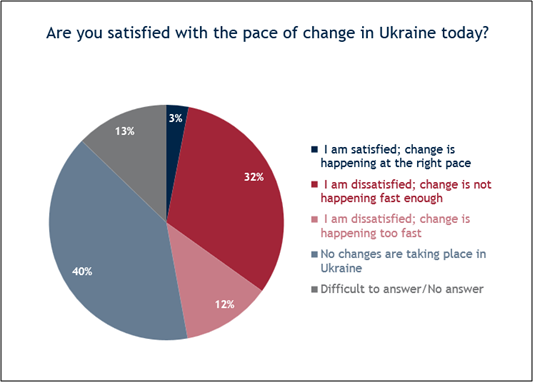
The International Republican Institute in the United States has published results of polling of attitudes of Ukrainians on the key issues facing the country. The polling was conducted in the latter two weeks of July 2015 by Rating Group Ukraine on behalf of the IRI.
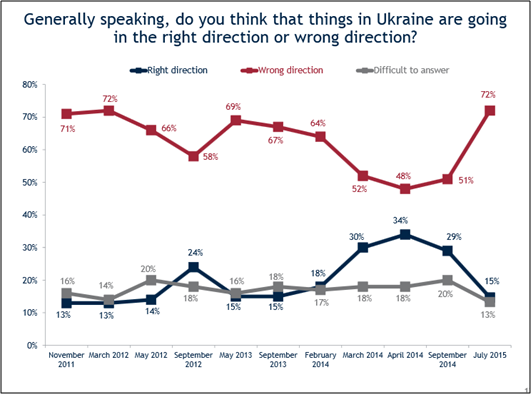 The poll provides more evidence of deepgoing and growing political dissatisfaction and alienation in Ukraine. Absolute or relative majorities of Ukrainians now express unfavorable views of all major government leaders and politicians from major parties in Ukraine.
The people of the rebel region of Donbas are not included in the poll, which means that the levels of dissatisfaction of Ukrainian residents are even higher than what is reported by the IRI.
The poll results are unlikely to be reported in Western mainstream media, even though the poll is commissioned and published by a right-wing U.S. institute. That’s because the results fly in the face of the “news” and editorial opinions peddled by Western media. It proves that media is lying to its readers and grossly misleading them when it inaccurately presents the war in eastern Ukraine as a virtuous war against an aggressive Russia that is supported by the majority of the Ukrainian people.
Media also chooses to be silent about the profound economic crisis that is wracking Ukraine as a result of the Kyiv regime’s turn to austerity association with the European Union, and about the massive human rights violations accompanying the civil war of the Kyiv regime against the people in the eastern and southern regions of the country. The IRI poll shows extremely high levels of dissatisfaction with the economic crisis and the war.
The poll will also be ignored by the Russophobes in the governments and mainstream political parties in the NATO member countries who decry “Russian aggression” and “Russian imperialism” in Ukraine, and by the many pseudo-lefts in the international arena who are acting as echo chambers of that messaging.
Similarly stunning results of polling of the Crimean people in late 2014 and early 2015 were ignored by the same constellation of forces. That polling showed extraordinarily high levels of satisfaction with the democratic decision of Crimeans in March 2014 to secede from Ukraine. The polls contradict the ongoing stories of Russian “annexation” of Crimea.
The 71-page report International Republican Institute polling report can be read here. Enclosed below are 11 selected charts from the poll:




US Committed to Playing Active Role in Transnistria Dispute Negotiations
Sputnik — 26.08.2015
Washington is committed to be fully engaged in the talks aimed at settling the Transnistria conflict, US Secretary of State John Kerry stated in a statement on Wednesday.
“You may be sure that America will remain unwavering in its support for Moldova’s sovereignty and territorial integrity and will continue to play an active role in the 5+2 negotiations aimed at peacefully resolving the Transnistria dispute,” Kerry said.
Kerry issued his statement on the occasion of Moldova’s National Day. The secretary stressed the US support for Moldova government’s efforts to undertake reforms.
Transnistria, a region with a predominantly Russian and Ukrainian population broke away from the Soviet republic of Moldova in 1990, fearing its government could seek reintegration with neighboring Romania. The initiative triggered Moldova’s offensive on the region in 1992, after which it lost control over the Dniester River’s left bank.
The region is now striving for international recognition, while Moldova offers Transnistria autonomy within a unitary state.
The 5+2 format negotiators include Russia, Moldova, Transnistria, Ukraine, the OSCE and observers from the European Union and the United States.
Bergen-Belsen Camp: The Suppressed Story
By Mark Weber | The Journal of Historical Review | May-June 1995
Fifty years ago, on April 15, 1945, British troops liberated the Bergen-Belsen concentration camp. The anniversary was widely remembered in official ceremonies and in newspaper articles that, as the following essay shows, distort the camp’s true history.
Largely because of the circumstances of its liberation, the relatively unimportant German concentration camp of Bergen-Belsen has become — along with Dachau and Buchenwald — an international symbol of German barbarism.
The British troops who liberated the Belsen camp three weeks before the end of the war were shocked and disgusted by the many unburied corpses and dying inmates they found there. Horrific photos and films of the camp’s emaciated corpses and mortally sick inmates were quickly circulated around the globe. Within weeks the British military occupation newspaper proclaimed: “The story of that greatest of all exhibitions of ‘man’s inhumanity to man’ which was Belsen Concentration Camp is known throughout the world.” (note 1)
Ghastly images recorded by Allied photographers at Belsen in mid-April 1945 and widely reproduced ever since have greatly contributed to the camp’s reputation as a notorious extermination center. In fact, the dead of Bergen-Belsen were, above all, unfortunate victims of war and its turmoil, not deliberate policy. It can even be argued that they were as much victims of Allied as of German measures.

Plan of the Bergen-Belsen camp
The Bergen-Belsen camp was located near Hannover in northwestern Germany on the site of a former army camp for wounded prisoners of war. In 1943 it was established as an internment camp (Aufenthaltslager) for European Jews who were to be exchanged for German citizens held by the Allies.
More than 9,000 Jews with citizenship papers or passports from Latin American countries, entry visas for Palestine, or other documents making them eligible for emigration, arrived in late 1943 and 1944 from Poland, France, Holland and other parts of Europe. During the final months of the war, several groups of these “exchange Jews” were transported from Axis-occupied Europe. German authorities transferred several hundred to neutral Switzerland, and at least one group of 222 Jewish detainees was transferred from Belsen (by way of neutral Turkey) to British-controlled Palestine. /2
Until late 1944 conditions were generally better than in other concentration camps. Marika Frank Abrams, a Jewish woman from Hungary, was transferred from Auschwitz in 1944. Years later she recalled her arrival at Belsen: “… We were each given two blankets and a dish. There was running water and latrines. We were given food that was edible and didn’t have to stand for hours to be counted. The conditions were so superior to Auschwitz we felt we were practically in a sanitarium.” /3
Inmates normally received three meals a day. Coffee and bread were served in the morning and evening, with cheese and sausage as available. The main mid-day meal consisted of one liter of vegetable stew. Families lived together. Otherwise, men and women were housed in separate barracks. /4
Children were also held there. There were some 500 Jewish children in Belsen’s “No. 1 Women’s Camp” section when British forces arrived. /5
During the final months of the war, tens of thousands of Jews were evacuated to Belsen from Auschwitz and other eastern camps threatened by the advancing Soviets. Belsen became severely overcrowded as the number of inmates increased from 15,000 in December 1944 to 42,000 at the beginning of March 1945, and more than 50,000 a month later. /6
Many of these Jewish prisoners had chosen to be evacuated westwards with their German captors rather than remain in eastern camps to await liberation by Soviet forces. /7
So catastrophic had conditions become during the final months of the war that about a third of the prisoners evacuated to Belsen in February and March 1945 perished during the journey and were dead on arrival. /8
As order broke down across Europe during those chaotic final months, regular deliveries of food and medicine to the camp stopped. Foraging trucks were sent to scrounge up whatever supplies of bread, potatoes and turnips were available in nearby towns. /9
Epidemic
Disease was kept under control by routinely disinfecting all new arrivals. But in early February 1945 a large transport of Hungarian Jews was admitted while the disinfection facility was out of order. As a result, typhus broke out and quickly spread beyond control. /10
Commandant Josef Kramer quarantined the camp in an effort to save lives, but SS camp administration headquarters in Berlin insisted that Belsen be kept open to receive still more Jewish evacuees arriving from the East. The death rate soon rose to 400 a day. /11
The worst killer was typhus, but typhoid fever and dysentery also claimed many lives. Aggravating the situation was a policy during the final months of transferring already sick inmates from other camps to Belsen, which was then officially designated a sick or convalescence camp (Krankenlager). The sick women of Auschwitz, for example, were transferred to Belsen in three groups in November-December 1944. /12
When SS chief Heinrich Himmler learned of the typhus outbreak at Bergen-Belsen, he immediately issued an order to all appropriate officials requiring that “all medical means necessary to combat the epidemic should be employed … There can be no question of skimping either with doctors or medical supplies.” However, the general breakdown of order that prevailed on Germany by this time made it impossible to implement the command. /13
‘Belsen Worst’
Violette Fintz, a Jewish woman who had been deported from the island of Rhodes to Auschwitz in mid-1944, and then to Dachau and, finally, in early 1945, to Belsen, later compared conditions in the different camps: /14
Belsen was in the beginning bearable and we had bunks to sleep on, and a small ration of soup and bread. But as the camp got fuller, our group and many others were given a barracks to hold about seven hundred lying on the floor without blankets and without food or anything. It was a pitiful scene as the camp was attacked by lice and most of the people had typhus and cholera … Many people talk about Auschwitz — it was a horrible camp. But Belsen, no words can describe it … From my experience and suffering, Belsen was the worst.
Belsen’s most famous inmate was doubtless Anne Frank, who had been evacuated from Auschwitz in late October 1944. She succumbed to typhus in March 1945, three or four weeks before liberation.
Kramer Reports a ‘Catastrophe’
In a March 1, 1945, letter to Gruppenführer (General) Richard Glücks, head of the SS camp administration agency, Commandant Kramer reported in detail on the catastrophic situation in the Bergen-Belsen, and pleaded for help: /15
If I had sufficient sleeping accommodation at my disposal, then the accommodation of the detainees who have already arrived and of those still to come would appear more possible. In addition to this question a spotted fever and typhus epidemic has now begun, which increases in extent every day. The daily mortality rate, which was still in the region of 60-70 at the beginning of February, has in the meantime attained a daily average of 250-300 and will increase still further in view of the conditions which at present prevail.
Supply. When I took over the camp, winter supplies for 1500 internees had been indented for; some had been received, but the greater part had not been delivered. This failure was due not only to difficulties of transport, but also to the fact that practically nothing is available in this area and all must be brought from outside the area …
For the last four days there has been no delivery [of food] from Hannover owing to interrupted communications, and I shall be compelled, if this state of affairs prevails till the end of the week, to fetch bread also by means of truck from Hannover. The trucks allotted to the local unit are in no way adequate for this work, and I am compelled to ask for at least three to four trucks and five to six trailers. When I once have here a means of towing then I can send out the trailers into the surrounding area … The supply question must, without fail, be cleared up in the next few days. I ask you, Gruppenführer, for an allocation of transport …
State of Health. The incidence of disease is very high here in proportion to the number of detainees. When you interviewed me on Dec. 1, 1944, at Oranienburg, you told me that Bergen-Belsen was to serve as a sick camp for all concentration camps in north Germany. The number of sick has greatly increased, particularly on account of the transports of detainees that have arrived from the East in recent times — these transports have sometimes spent eight or fourteen days in open trucks …
The fight against spotted fever is made extremely difficult by the lack of means of disinfection. Due to constant use, the hot-air delousing machine is now in bad working order and sometimes fails for several days …
A catastrophe is taking place for which no one wishes to assume responsibility … Gruppenführer, I can assure you that from this end everything will be done to overcome the present crisis …
I am now asking you for your assistance as it lies in your power. In addition to the above-mentioned points I need here, before everything, accommodation facilities, beds, blankets, eating utensils — all for about 20,000 internees … I implore your help in overcoming this situation.

Mass grave at Belsen camp, shortly after its liberation by British troops. Photographs such as this are widely reproduced as proof of a German policy of extermination. Contrary to Allied propaganda claims of the time, and Holocaust allegations in recent decades, though, these unfortunate prisoners were victims of typhus and starvation that were indirect consequences of the war – not of any deliberate policy. At least 14,000 Jews died in the camp following the British takeover.
Under such terrible conditions, Kramer did everything in his power to reduce suffering and prevent death among the inmates, even appealing to the hard-pressed German army. “I don’t know what else to do,” he told high-ranking army officers. “I have reached the limit. Masses of people are dying. The drinking water supply has broken down. A trainload of food was destroyed by low-flying [Allied] war planes. Something must be done immediately.” /16
Working together with both Commandant Kramer and chief inmate representative Kuestermeier, Colonel Hanns Schmidt responded by arranging for the local volunteer fire department to provide water. He also saw to it that food supplies were brought to the camp from abandoned rail cars. Schmidt later recalled that Kramer “did not at all impress one as a criminal type. He acted like an upright and rather honorable man. Neither did he strike me as someone with a guilty conscience. He worked with great dedication to improve conditions in the camp. For example, he rounded up horse drawn vehicles to bring food to the camp from rail cars that had been shot up.” /17
“I was swamped,” Kramer later explained to incredulous British military interrogators: /18
The camp was not really inefficient before you [British and American forces] crossed the Rhine. There was running water, regular meals of a kind — I had to accept what food I was given for the camp and distribute it the best way I could. But then they suddenly began to send me trainloads of new prisoners from all over Germany. It was impossible to cope with them. I appealed for more staff, more food. I was told that this was impossible. I had to carry on with what I had.
Then as a last straw the Allies bombed the electric plant that pumped our water. Loads of food were unable to reach the camp because of the Allied fighters. Then things really got out of hand. During the last six weeks I have been helpless. I did not even have sufficient staff to bury the dead, let alone segregate the sick … I tried to get medicines and food for the prisoners and I failed. I was swamped. I may have been hated, but I was doing my duty.
Kramer’s clear conscience is also suggested by the fact that he made no effort to save his life by fleeing, but instead calmly awaited the approaching British forces, naively confident of decent treatment. “When Belsen Camp was eventually taken over by the Allies,” he later stated, “I was quite satisfied that I had done all I possibly could under the circumstances to remedy the conditions in the camp.” /19
Negotiated Transfer
As British forces approached Bergen-Belsen, German authorities sought to turn over the camp to the British so that it would not become a combat zone. After some negotiation, it was peacefully transferred, with an agreement that “both British and German troops will make every effort to avoid battle in the area.” /20
A revealing account of the circumstances under which the British took control appeared in a 1945 issue of The Journal of the American Medical Association: /21
By negotiations between British and German officers, British troops took over from the SS and the Wehrmacht the task of guarding the vast concentration camp at Belsen, a few miles northwest of Celle, which contains 60,000 prisoners, many of them political. This has been done because typhus is rampant in the camp and it is vital that no prisoners be released until the infection is checked. The advancing British agreed to refrain from bombing or shelling the area of the camp, and the Germans agreed to leave behind an armed guard which would be allowed to return to their own lines a week after the British arrival.
The story of the negotiations is curious. Two German officers presented themselves before the British outposts and explained that there were 9,000 sick in the camp and that all sanitation had failed. They proposed that the British should occupy the camp at once, as the responsibility was international in the interests of health. In return for the delay caused by the truce the Germans offered to surrender intact the bridges over the river Aller. After brief consideration the British senior officer rejected the German proposals, saying it was necessary that the British should occupy an area of ten kilometers round the camp in order to be sure of keeping their troops and lines of communication away from the disease. The British eventually took over the camp.
Brutal Mistreatment
On April 15, 1945, Belsen’s commanders turned over the camp to British troops, who lost no time mistreating the SS camp personnel. The Germans were beaten with rifle butts, kicked, and stabbed with bayonets. Most were shot or worked to death. /22
British journalist Alan Moorehead described the treatment of some of the camp personnel shortly after the takeover: /23
As we approached the cells of the SS guards, the [British] sergeant’s language become ferocious. “We had had an interrogation this morning,” the captain said. ‘I’m afraid they are not a pretty sight.’ … The sergeant unbolted the first door and … strode into the cell, jabbing a metal spike in front of him. “Get up,” he shouted. “Get up. Get up, you dirty bastards.” There were half a dozen men lying or half lying on the floor. One or two were able to pull themselves erect at once. The man nearest me, his shirt and face spattered with blood, made two attempts before he got on to his knees and then gradually on to his feet. He stood with his arms stretched out in front of him, trembling violently.
“Come on. Get up,” the sergeant shouted [in the next cell]. The man was lying in his blood on the floor, a massive figure with a heavy head and bedraggled beard … “Why don’t you kill me?” he whispered. “Why don’t you kill me? I can’t stand it any more.” The same phrases dribbled out of his lips over and over again. “He’s been saying that all morning, the dirty bastard,” the sergeant said.

Josef Kramer in British captivity. After a military trial, the former Bergen-Belsen Commandant was put to death.
Commandant Kramer, who was vilified in the British and American press as “The Beast of Belsen” and “The Monster of Belsen,” was put on trial and then executed, along with chief physician Dr. Fritz Klein and other camp officials. At his trial, Kramer’s defense attorney, Major T.C.M. Winwood, predicted: “When the curtain finally rings down on this stage Josef Kramer will, in my submission, stand forth not as ‘The Beast of Belsen’ but as ‘The Scapegoat of Belsen’.” /24
In an “act of revenge,” the British liberators expelled the residents of the nearby town of Bergen, and then permitted camp inmates to loot the houses and buildings. Much of the town was also set on fire. /25
Postwar Deaths
There were some 55,000 to 60,000 prisoners in Bergen-Belsen when the British took control of the camp. The new administrators proved no more capable of mastering the chaos than the Germans had been, and some 14,000 Jewish inmates died at Belsen in the months following the British takeover. /26
Although still occasionally referred to as an “extermination camp” or “mass murder” center, the truth about Bergen-Belsen has been quietly acknowledged by scholars. /27 In his 1978 survey of German history, University of Erlangen professor Helmut Diwald wrote of /28
… The notorious Bergen-Belsen concentration camp where 50,000 inmates were supposedly murdered. Actually, about 7,000 inmates died during the period when the camp existed, from 1943 to 1945. Most of them died in the final months of the war as a result of disease and malnutrition — consequences of the bombings that had completely disrupted normal deliveries of medical supplies and food. The British commander who took control of the camp after the capitulation testified that crimes on a large scale had not taken place at Bergen-Belsen.
Martin Broszat, Director of the Institute for Contemporary History in Munich, wrote in 1976: /29
… In Bergen-Belsen, for example, thousands of corpses of Jewish prisoners were found by British soldiers on the day of liberation, which gave the impression that this was one of the notorious extermination camps. Actually, many Jews in Bergen-Belsen as well as in the satellite camps of Dachau died in the last weeks before the end of the war as a result of the quickly improvised retransfers and evacuations of Jewish workers from the still existing ghettos, work camps and concentration camps in the East (Auschwitz) …
Dr. Russell Barton, an English physician who spent a month in Bergen-Belsen after the war with the British Army, has also explained the reasons for the catastrophic conditions found there: /30
Most people attributed the conditions of the inmates to deliberate intention on the part of the Germans in general and the camp administrators in particular. Inmates were eager to cite examples of brutality and neglect, and visiting journalists from different countries interpreted the situation according to the needs of propaganda at home.
For example, one newspaper emphasized the wickedness of the “German masters” by remarking that some of the 10,000 unburied dead were naked. In fact, when the dead were taken from a hut and left in the open for burial, other prisoners would take their clothing from them …
German medical officers told me that it had been increasingly difficult to transport food to the camp for some months. Anything that moved on the autobahns was likely to be bombed …
I was surprised to find records, going back for two or three years, of large quantities of food cooked daily for distribution. I became convinced, contrary to popular opinion, that there had never been a policy of deliberate starvation. This was confirmed by the large numbers of well-fed inmates. Why then were so many people suffering from malnutrition?… The major reasons for the state of Belsen were disease, gross overcrowding by central authority, lack of law and order within the huts, and inadequate supplies of food, water and drugs.
In trying to assess the causes of the conditions found in Belsen one must be alerted to the tremendous visual display, ripe for purposes of propaganda, that masses of starved corpses presented.
Gas Chamber Myths
Some former inmates and a few historians have claimed that Jews were put to death in gas chambers at Bergen-Belsen. For example, an “authoritative” work published shortly after the end of the war, A History of World War II, informed readers: “In Belsen, [Commandant] Kramer kept an orchestra to play him Viennese music while he watched children torn from their mothers to be burned alive. Gas chambers disposed of thousands of persons daily.” /31

A protest meeting in the Bergen-Belsen camp, September 1947. For five years following the end of the war, British authorities maintained the camp as a “Displaced Persons” center. During this period it flourished as a major black market center. At this pro-Zionist gathering of 4,000 Jews, camp leader Joseph Rosensaft speaks against British policy in Palestine.
In Jews, God and History, Jewish historian Max Dimont wrote of gassings at Bergen-Belsen. /32 A semi-official work published in Poland in 1981 claimed that women and babies were “put to death in gas chambers” at Belsen. /33
In 1945 the Associated Press news agency reported: /34
In Lueneburg, Germany, a Jewish physician, testifying at the trial of 45 men and women for war crimes at the Belsen and Oswiecim [Auschwitz] concentration camps, said that 80,000 Jews, representing the entire ghetto of Lodz, Poland, had been gassed or burned to death in one night at the Belsen camp.
Five decades after the camp’s liberation, British army Captain Robert Daniell recalled seeing “the gas chambers” there. /35
Years after the war, Robert Spitz, a Hungarian Jew, remembered taking a shower at Belsen in February 1945: “… It was delightful. What I didn’t know then was that there were other showers in the same building where gas came out instead of water.” /36
Another former inmate, Moshe Peer, recalled a miraculous escape from death as an eleven-year-old in the camp. In a 1993 interview with a Canadian newspaper, the French-born Peer claimed that he “was sent to the [Belsen] camp gas chamber at least six times.” The newspaper account went on to relate: “Each time he survived, watching with horror as many of the women and children gassed with him collapsed and died. To this day, Peer doesn’t know how he was able to survive.” In an effort to explain the miracle, Peer mused: “Maybe children resist better, I don’t know.” (Although Peer claimed that “Bergen-Belsen was worse than Auschwitz,” he acknowledged that he and his younger brother and sister, who were deported to the camp in 1944, all somehow survived internment there.) /37
Such gas chamber tales are entirely fanciful. As early as 1960, historian Martin Broszat had publicly repudiated the Belsen gassing story. These days no reputable scholar supports it. /38
Exaggerated Death Estimates
Estimates of the number of people who died in Bergen-Belsen have ranged widely over the years. Many have been irresponsible exaggerations. Typical is a 1985 York Daily News report, which told readers that “probably 100,000 died at Bergen-Belsen.” /39 An official German government publication issued in 1990 declared that “more than 50,000 people had been murdered” in the Belsen camp under German control, and “an additional 13,000 died in the first weeks after liberation.” /40
Closer to the truth is the Encyclopaedia Judaica, which maintains that 37,000 perished in the camp before the British takeover, and another 14,000 afterwards. /41
Whatever the actual number of dead, Belsen’s victims were not “murdered,” and the camp was not an “extermination” center.
Black Market Center
From 1945 until 1950, when it was finally shut down, the British maintained Belsen as a camp for displaced European Jews. During this period it achieved new notoriety as a major European black market center. The “uncrowned king” of Belsen’s 10,000 Jews was Yossl (Josef) Rosensaft, who amassed tremendous profits from the illegal trading. Rosensaft had been interned in various camps, including Auschwitz, before arriving in Belsen in early April 1945. /42
British Lieutenant General Sir Frederick Morgan, chief of “displaced persons” operations in postwar Germany for the United Nations relief organization UNRRA recalled in his memoir that /43
under Zionist auspices there had been organized at Belsen a vast illegitimate trading organization with worldwide ramifications and dealing in a wide range of goods, principally precious metals and stones. A money market dealt with a wide range of currencies. Goods were being imported in cryptically marked containers consigned in UNRRA shipments to Jewish voluntary agencies …
Legacy
A kind of memorial center now draws many tourists annually to the camp site. Not surprisingly, Bergen’s 13,000 residents are not very pleased with their town’s infamous reputation. Citizens report being called “murderers” during visits to foreign countries. /44
In striking contrast to the widely-accepted image of Belsen, which is essentially a product of hateful wartime propaganda, is the suppressed, albeit grim, historical reality. In truth, the Bergen-Belsen story may be regarded as the Holocaust story in miniature.
Notes
- Walter Laqueur, The Terrible Secret: Suppression of the Truth about Hitler’s ‘Final Solution’ (Boston: Little Brown, 1980), p. 1.
- Testimony of Commandant Kramer in: Raymond Phillips, ed., Trial of Josef Kramer and Forty-Four Others (The Belsen Trial) (London: William Hodge, 1949), p. 160; “Bergen-Belsen,” Encyclopaedia Judaica (New York and Jerusalem: Macmillan and Keter, 1971), Vol. 4, p. 610. According to this source, one group of 136 of these “exchange Jews” was deported from Belsen during the war to neutral Switzerland, and another group of 222 was transferred to Palestine.; According to an Israeli newspaper report, a group of 222 “exchange” Jews reportedly left Bergen-Belsen on June 29, 1944, and, by way of Istanbul, arrived in Palestine on July 10. (Israel Nachrichten, quoted in: D. National-Zeitung, Munich, Sept. 23, 1994, p. 5)
- Sylvia Rothchild, ed., Voices from the Holocaust (New York: NAL, 1981), p. 190.
- Josef Kramer statement (1945) in: R. Phillips, Trial of Josef Kramer and Forty-Four Others, pp. 731-737. This is also in: Arthur Butz, The Hoax of the Twentieth Century (Newport Beach: Institute for Historical Review, 1993), pp. 272-274.
- R. Phillips, Trial of Josef Kramer and Forty-Four Others, pp. 19, 32, 33; Roman Hrabar, with Zofia Tokarz and J. E. Wilczur, The Fate of Polish Children During the Last War (Warsaw: Interpress, 1981), p. 76.
- Encyclopaedia Judaica, Vol. 4, p. 610; Gedenkbuch: Opfer der Verfolgung der Juden unter der nationsozialistischen Gewaltherrschaft (Koblenz: Bundesarchiv, 1986; 2 vols.), pp. 1761-1762.
- Testimony of Dr. Russell Barton, Feb. 7, 1985, in the first “Holocaust” trial of Ernst Zündel. Official trial transcript, pp. 2916-2917; See also Barton’s testimony during the second, 1988 Zündel trial in: Barbara Kulaszka, ed., Did Six Million Really Die? (Toronto: Samisdat, 1992), p. 175, and, Robert Lenski, The Holocaust on Trial: The Case of Ernst Zündel (Decatur, Ala.: Reporter Press, 1990), p. 159.
- Testimony of Commandant Kramer in: R. Phillips, Trial of Josef Kramer and Forty-Four Others, p. 162.
- Josef Kramer statement (1945) in: R. Phillips, ed., Trial of Josef Kramer and Forty-Four Others, pp. 731-737. Also in: A. Butz, The Hoax of the Twentieth Century, p. 274.
- Derrick Sington, Belsen Uncovered (London: 1946), pp. 117-118. Quoted in: A. Butz, The Hoax of the Twentieth Century, pp. 34-35; Gerald Reitlinger, The Final Solution (London: Sphere Books, pb., 1971), p. 504 (note).
- R. Phillips, ed., Trial of Josef Kramer and Forty-Four Others, pp. 152-153, 166-167, 734, 736; Tom Bower, Blind Eye to Murder (London: Granada, 1983), p. 224; Dr. Ernst von Briesen, “Was passierte in Bergen-Belsen wirklich?,” D. National-Zeitung (Munich), Jan. 13, 1984, pp. 4, 5, 8.
- G.Reitlinger, The Final Solution, p. 497 (and 638, n. 23).
- Andre Biss, A Million Jews to Save (New York: A.S. Barnes, 1975), pp. 242, 249-250; Felix Kersten, The Kersten Memoirs, 1940-1945 (New York: Macmillan, 1957), p. 276.
- Martin Gilbert, The Holocaust (New York: Holt, Rinehart and Winston, 1986), pp. 722, 785-786.
- R. Phillips, ed., Trial of Josef Kramer and Forty-Four Others, pp. 163-166.
- Signed report by retired Colonel (Oberst a.D.) Hanns Schmidt to Kurt Mehner and Lt. Colonel Bechtold, Braunschweig, March 3, 1981. Photocopy in author’s possession.
- Signed report by Hanns Schmidt to Kurt Mehner and Lt. Colonel Bechtold, March 3, 1981. Photocopy in author’s possession.
- Essay by Alan Moorehead, “Belsen,” in: Cyril Connolly, ed., The Golden Horizon (London: Weidenfeld and Nicolson, 1953), pp. 109-110.
- Josef Kramer statement (1945) in: R. Phillips, ed., Trial of Josef Kramer and Forty-Four Others, p. 737. Also quoted in: A. Butz, Hoax, p. 275; Essay by Alan Moorehead, “Belsen,” in: Cyril Connolly, ed., The Golden Horizon, pp. 109-110; Dr. Russell Barton, “Belsen,” History of the Second World War (Editor: Barrie Pitt, Copyright BPC publications, 1966), Part 109, 1975, p. 3025.
- R. Phillips, ed., Trial of Josef Kramer and Forty-Four Others, pp. 396-397.
- “Typhus Causes a Truce,” The Journal of the American Medical Association (Chicago), May 19, 1945, p. 220.
- Leonard O. Mosley, Report from Germany (1945). Quoted in: Montgomery Belgion, Victor’s Justice (Regnery, 1949), p. 80 (and p. 81); Time magazine, April 29, 1985, p. 21; See also essay by A. Moorehead, “Belsen,” in: Cyril Connolly, ed., The Golden Horizon (London: 1953), pp. 105-106.
- Essay by A. Moorehead, “Belsen,” in: Cyril Connolly, ed., The Golden Horizon, pp. 105-106.
- R. Phillips, ed., Trial of Josef Kramer and Forty-Four Others, p. 156.
- “Bergen-Belsen,” Der Spiegel (Hamburg), Nr. 30, 1985, pp. 71, 72.
- “Holocaust,” Encyclopaedia Judaica, Vol. 8, p. 859; M. Gilbert, The Holocaust (1986), pp. 793-795; See also: R. Phillips, ed., Trial of Josef Kramer and Forty-Four Others, pp. 20, 46-47; According to a 1992 Associated Press report, more than 60,000 prisoners were held in Belsen camp when it was liberated. Then, “in the first five days of liberation, 14,000 prisoners died and another 14,000 perished in the following weeks.” Graham Heathcote, AP from Tostock, England, “2 hours changed me for the rest of my life,” Orlando Sentinel (Florida), Dec. 20, 1992, p. A 29, and, “Journey into hell,” The Spokesman-Review (Spokane, Washington), Dec. 20, 1992.
- Time magazine, April 29, 1985, p. 21, referred to Belsen as a camp created for the “extermination” of “the Jewish people.”
- Helmut Diwald, Geschichte der Deutschen (Frankfurt: Propyläen, first ed., 1978), pp. 164-165.
- M. Broszat, “Zur Kritik der Publizistik des antisemitischen Rechtsextremismus,” Supplement B 19/76 of May 8, 1976, to the weekly newspaper Das Parlament (Bonn), p. 6. Revised from issue No. 2, 1976, of the Vierteljahrshefte für Zeitgeschichte (Munich).
- Dr. R. Barton, “Belsen,” History of the Second World War, Part 109, 1975, pp. 3025-3029; Barton confirmed this evaluation in testimony given in the 1985 and 1988 Toronto trials of German-Canadian publisher Ernst Zündel. On Barton’s testimony in the first, 1985 trial, see: “View of Belsen was propaganda, trial told,” The Globe and Mail (Toronto), Feb. 8, 1985, pp. M1, M5, and, “Disease killed Nazis’ prisoners, MD says,” Toronto Star, Feb. 8, 1985, p. A2; On Barton’s testimony in the second, 1988 Zündel trial, see: Barbara Kulaszka, ed., Did Six Million Really Die?, pp. 175-180, and, R. Lenski, The Holocaust on Trial (1990), pp. 157-160; Among his other positions after the war, Barton was superintendent and consultant psychiatrist at Severalls Hospital (Essex, England), and director of the Rochester Psychiatric Center (New York).
- Francis Trevelyan Miller, Litt.D., LLD, A History of World War II (Philadelphia: John C. Winston Co., 1945), p. 868.
- M. Dimont, Jews, God and History (New York: Signet/NAL, pb., 1962?), p. 383.
- R. Hrabar, et al, The Fate of Polish Children During the Last War (Warsaw: 1981), p. 76.
- The Associated Press News Annual: 1945, p. 404.
- M. Holland, “The horrors of Belsen,” Sunday Herald Sun (Melbourne, Australia), Jan. 22, 1995, p. 93; M. Holland, “Man who uncovered the horror of Belsen,” Sunday Times (Perth, W. Australia), Feb. 5, 1995, p. 2.
- S. Rothchild, ed., Voices From the Holocaust, p. 197.
- K. Seidman, “Surviving the horror,” The Gazette (Montreal, Canada), August 5, 1993. Facsimile reprint in: The Journal of Historical Review, Nov.-Dec. 1993, p. 24.
- Die Zeit (Hamburg), August 19, 1960, p. 16. (U.S. edition: August 26, 1960.) Facsimile and translation in The Journal of Historical Review, May-June 1993, p. 12.
- “Bergen-Belsen,” Daily News (New York), April 20, 1985, p. 3.
- “Ceremony Recalls Victims of Bergen-Belsen,” The Week in Germany (New York: German Information Center), April 27, 1990, p. 6; A figure of 50,000 is also given in Time magazine, April 29, 1985, p. 21; According to a stone memorial at the Belsen camp site, 30,000 Jews were “exterminated” there; A semi-official Polish account published in 1980 reported 48,000 Belsen “victims.” Czeslaw Pilichowski, No Time Limit for These Crimes (Warsaw: Interpress, 1980), pp. 154-155.
- “Bergen-Belsen,” Encyclopaedia Judaica (1971), vol. 4, pp. 610-612; Colonel Schmidt, the German officer who worked to alleviate conditions in Belsen during the final weeks and also arranged for the camp’s surrender to the British, estimated that “altogether about 8,000 people” died in the camp. (This figure may, however, only include victims of the final chaotic weeks under German control.) Source: Signed report by Oberst a.D. Hanns Schmidt to Kurt Mehner and Lt. Colonel Bechtold, Braunschweig, March 3, 1981. (Cited above.) Photocopy in author’s possession.
- L. Dawidowicz, “Belsen Remembered,” Commentary (New York: American Jewish Comm.), March 1966, pp. 84, 85; D. National-Zeitung (Munich), March 21, 1986, p. 4; M. Gilbert, The Holocaust, pp. 690, 793.
- F. Morgan, Peace and War (London: Hodder and Stoughton, 1961), p. 259.
- “Bergen-Belsen,” Der Spiegel, Nr. 30, 1985, pp. 71, 72.
From The Journal of Historical Review, May-June 1995 (Vol. 15, No. 3), pages 23-30.
Featured Video

Theodore Postol: Iran’s Missiles & Drones Were Underestimated
or go to
Aletho News Archives – Video-Images
From the Archives
Wars for Israel: A reminder of who’s giving the marching orders
By Damian Lataan | February 7, 2012
As the West prepares to march off to yet another war in the Middle East, we should perhaps remind ourselves of who is giving the West their marching orders.
In February 2003, just weeks before the US and their allies launched their attack on Iraq and her peoples, a delegation of US congressmen, together with the US Ambassador to the United Nations, John Bolton, a well known pro-Zionist and neoconservative war-hawk, were in Israel at the invitation of the Israeli government then led by Israeli Prime Minister Ariel Sharon.
Addressing the congressmen, Sharon told them ‘that Iran, Libya and Syria should be stripped of weapons of mass destruction after Iraq’. Later, Sharon told John Bolton ‘that Israel was concerned about the security threat posed by Iran, and stressed that it was important to deal with Iran even while American attention was focused on Iraq’. … continue
Blog Roll
 Aletho News
- Wave 90: IRGC strikes US-linked industrial sites in Gulf
- Iran Says US-Israeli Claims of Its Military Strength Are Wrong
- Trump’s April Fools’ Address to the nation
- The Most Important Bet You’ve Never Heard Of
- The killing of three Indonesian soldiers in Lebanon should remind Jakarta that Israel does not want peace
- Defeated and delusional: Netanyahu’s remarks reveal $80bn war failure, says analyst
- Iran’s friends are about to make life much more difficult for Israel and the US
- The war of liberation of the Arab and Islamic peoples expands across the Gulf
- Envoy warns UN on Trump’s threat to ‘obliterate’ Iran’s civilian infrastructure
- The Larak Corridor: Iran’s Rial Gate With No US, No Israel, and No Way Around
- If Americans Knew
- Gaza families reunite years after babies evacuated amid Israel’s war
- International Rescue Committee warns Gaza’s children face grave protection risks
- Iran’s Alleged 47-Year War on America: Debunking the 1,050 American Deaths Canard
- Israel wants US to bomb more of Iran’s civilian structures (113,000 is not enough) – Not a ceasefire Day 173
- Ann Coulter Rips Into Fox News for Iran War Coverage
- Joe Kent Urges Americans To Call White House and Congress To Object To Sending Troops Into Iran
- DNC Resolution to Reject AIPAC Funding Puts Democratic Leaders in the Hot Seat
- Swedish foundation to build 400 schools as over 650,000 Gaza children remain without education for 2 years
- Israeli army admits photshopping image of slain Lebanese journalist
- This is how Israel is systematically killing health workers under the cover of war in Lebanon
- No Tricks Zone
- New Study Finds Warming Saves Lives…Cold Temperatures 12 Times More Deadly Than Excess Heat
- German Science Blog Accuses PIK Climate Institute Of Hallucinating Climate Tipping Points
- Devastating Assessment Of Comirnaty Vaccine By Former Senior Pfizer Europe Toxicologist
- New Study: CO2 Is ‘Effectively Negligible’ As An Explanatory Climate Change Factor Since 2000
- Former Pfizer Toxicologist Dr. Helmut Sterz Tells Bundestag Hearing Pfizer Vaccine Should Have Never Been Approved
- Energy Expert: Germany’s Nuclear Phaseout Was A “500 Billion Euro Mistake”
- New Research: South Australia’s Mid-Holocene Sea Surface Temperatures Were 4°C Warmer Than Today
- Storing Green Energy To Last Germany 10 Days Would Require A 60-Million Tonne Battery
- New Studies: UK Sea Levels Were 4 Meters Higher Than Today During The Mid-Holocene
- Destructive Green New Deal: German Energy And Metal Group Warns Of Drastic Crisis
 Aletho News