Gaza: Reconstruction of 12,000 displaced families’ homes yet to begin
MEMO | February 9, 2016
Around 90,000 Palestinians remain displaced in the Gaza Strip, almost 18 months after the ceasefire that ended Israel’s ‘Operation Protective Edge’ offensive in 2014. Furthermore, the reconstruction or repair of homes of 74 percent of displaced families is yet to even start.
According to UN OCHA, living conditions for the more than 16,000 displaced families are characterised by “overcrowding, limited access to basic services, lack of privacy, tensions with host communities, risks due to unexploded ordnance and exposure to adverse weather.”
By the end of January 2016, only 15 percent of displaced families had been able to return to repaired or reconstructed homes. The repair and reconstruction of an additional 2,000 homes is ongoing, with many of these homes nearing completion.
Israel’s assault on the Gaza Strip in July-August 2014 destroyed 11,000 homes and severely damaged or rendered uninhabitable an additional 6,800 homes.
Intimidating military patrol of Palestinian market
International Solidarity Movement | February 9, 2016
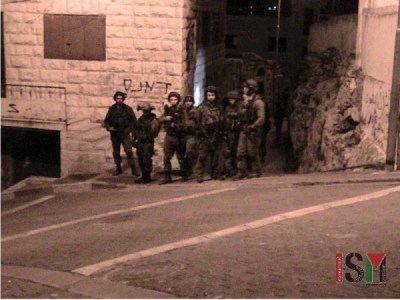
Hebron, Occupied Palestine – On Tuesday, February 9, Israeli forces patrolled the Palestinian market in occupied al-Khalil (Hebron), harassing and intimidating residents.

Israeli forces on their patrol through the Palestinian market
A group of soldiers marched through the souq, the main Palestinian market since the closure of Shuhada Street for Palestinians after the Ibrahimi mosque massacre in 1994. Any male adult or youth was stopped on their way to work and forced by the Israeli soldiers to lift up their shirts and trouser-pants, as well as throw their IDs on the ground. After throwing their IDs on the ground Israeli soldiers ordered the men to move back, so they could pick up the IDs from a ‘safe distance’. Most Palestinians were dismissed after this humiliating procedure, whereas some of them were detained for minutes or violently body-searched.

Violent body-search of Palestinian young man
International human rights defenders documenting the Israeli forces violations of basic human rights of Palestinians, were intimidated and harassed by the Israeli soldiers in an attempt to prevent them from documenting. Soldiers took photos of the internationals with their private phones held right in the volunteers faces and as an intmidation tactic ID-checked them.

Israeli forces taking photos of human rights defenders with their private phones
During the more than one hour patrol Israeli forces repeatedly pointed their assault rifles at the internationals as well as Palestinians.

Israeli soldier ‘ordering’ Palestinians to stop by pointing his gun
Not only adults were surprised and shocked by the sudden presence of heavily-armed soldiers right outside their houses, but also children on their way to school and work. Some children, scared by the soldiers, turned around right away after spotting the soldiers and ran back home instead of continuing their way to school or kindergarten. International human rights defenders walked several scared children past the soldiers so they could safely reach their schools and kindergarten.

Two school girls passing the heavily-armed patrol

A mother waiting with children for the school-bus right opposite a group of soldiers
Israel’s International Conspiracy
Nearly every western country has an Israel lobby
By Philip Giraldi • Unz Review • February 9, 2016
Swedish Foreign Minister Margot Wallstrom recently suggested an inquiry into a surge in Israel’s reported extra-judicial killing of Palestinian demonstrators after Prime Minister Benjamin Netanyahu called for a harsh response and told his police and soldiers that those opposed to the continued occupation of the West Bank were “terrorists.” Almost immediately, the Israeli government denounced Wallstrom as engaging in “political stupidity,” banning her from travel to Israel, while one newspaper close to the government suggested that she might be assassinated, as fellow Swede Count Folke Bernadotte was by Jewish militants in 1948, because anti-Semitism appears to be in the Swedish DNA.
All of that outrage and personal ridicule is pro forma for an Israeli government that reflexively smears and denigrates any and all critics, but the more interesting epilogue was the unanticipated discovery by the Swedish and international media that Wallstrom has not been paying the full rent on the subsidized government apartment that she occupies. The revelation follows a familiar pattern, where critics of Israel suddenly find themselves being discredited for something completely unrelated to the Middle East. President George H. W. Bush (the good Bush) suffered a similar come to Jesus moment in 1991 when he went on national television to denounce the pressure tactics of the Israel lobby. The Israeli government was demanding U.S. Treasury backed loans to construct illegal settlements. President Bush, who was running for reelection and far ahead in the opinion polls, suddenly was confronted by a well-funded and organized opposition raising doubts about him and his record. And President Bush was not reelected, presumably learning along the way that one does not trifle with the Israel Lobby, to be replaced by the enthusiastically Zionist Bill Clinton.
United Nations Secretary General Ban Ki-moon is also wondering about Israel’s alleged commitment to peace. On Tuesday he said “it was human nature to react to occupation,” following up with a comment on Wednesday regarding Israel’s “stifling” occupation of Palestine. Netanyahu reacted with his usual over the top rhetoric, stating that Ban “was encouraging terror.” One might also anticipate, as in the case of Wallstrom, a well-orchestrated media blitz questioning Ban’s motives or explaining how he has always been a closet anti-Semite. It is par for the course and fully expected when one criticizes Israel.
Indeed, it is a global phenomenon. Wherever one goes – Western Europe, Canada, Australia, New Zealand and the United States – there is a well-organized and funded lobby ready, willing and able to go to war to protect Israel. Most of the organizations involved take at least some direction from officials in Tel Aviv. Many of them even cooperate fully with the Israeli government, its parastatal organizations and faux-NGOs like the lawfare center Shurat HaDin. Their goal is to spread propaganda and influence the public in their respective countries of residence to either hew to the line coming out of Tel Aviv or to confuse the narrative and stifle debate when potential Israeli crimes are being discussed.
Israel’s diaspora allies are backed up by a formidable government organized machine that spews out disinformation and muddies the waters whenever critics surface. The Israeli Foreign Ministry has a corps of paid “volunteers” who monitor websites worldwide and take remedial action and there is a similar group working out of the Prime Minister’s office. That is why any negative story appearing in the U.S. about Israel is immediately inundated with pro-Israel comments, many of which make exactly the same coordinated points while exhibiting the same somewhat less than perfect English. On sites like Yahoo they are actually able to suppress unwelcome comments by flooding the site with “Dislike” responses. If a comment receives a large number of dislikes, it is automatically blocked or removed.
The sayanim, local Jews in their countries of residence, are essential to this process, having been alerted by emails from the Israeli Foreign Ministry about what to do and say. The reality is that Israel has lost the war of public opinion based on its own actions, which are becoming more and more repressive and even inhumane and so are difficult to explain. That means that the narrative has to be shifted by Israel’s friends through subterfuge and the corruption of the information process in each country. In some places the key media and political players who are engaged in the process can simply be bought. In other places they can be intimidated or pressured into taking positions that are neither in their own countries’ interests nor morally acceptable. In large countries like the United States, Britain and France a combination of friendly suasion and coercive elements often come together.
In all cases, the objective is the same: to repress or misrepresent any criticism of Israel and to block any initiatives that might be taken that would do damage either to the Israeli economy or to the country’s perceived standing in the world. In some countries Israel’s advocates work right out in the open and are highly successful in implementing policies that often remain largely hidden but that can be discerned as long as one knows what to look for.
Recent Israel Lobby activity in the United States has included legislation at state levels to make illegal divestment from Israel or to promote boycott of Israeli products. A trade pact with Europe will reportedly include language requiring the United States to take retaliatory action if any European country tries to boycott Israel, to include the West Bank settlements, which the empowering legislation regards as part of Israel proper.
Israel is also working to create a mechanism for global censorship of the internet to ban “incitement,” which clearly is a euphemism for material that is critical of its policies. Recently Facebook has begun to delete from its site any “hate speech” and “terrorism” related material but what has not been widely noted is that the apparent restrictions also have involved sites critical of Israel including Christians United for Peace.
Many prominent critics of the American Israel Political Action Committee (AIPAC) are unaware that AIPAC exists in various forms in a number of other countries. BICOM , the Britain Israel Communications and Research Centre, is located in London. The French equivalent is the Conseil Representatif des Institutions Juives de France (CRIF). In Canada there is a Center for Israel and Jewish Affairs (CIJA) , in Australia a Zionist Federation of Australia and in New Zealand a Zionist Federation of New Zealand .
While AIPAC is specifically focused on the U.S.-Israel relationship, its counterparts in Europe often deal with a whole range of issues that they define as Jewish, but protecting Israel is always part of their agenda, particularly for those groups that label themselves as Zionist. The political power and financial muscle of the groups gives them access to government far beyond the actual numbers of their supporters. In France this has led to the legislation of hate crimes that de facto exist to protect Jews that have also been interpreted as limitations on one’s ability to criticize Israel. In its most recent test, a French court declared that a peaceful protest promoting Boycott, Divestment and Sanctions (BDS) directed against Israel was illegal.
Many believe that France now has less free speech than any other European country. Recently, the alleged humor magazine Charlie Hebdo, ran a revolting cartoon showing the little Syrian boy Alan Kurdi who drowned in Turkey last summer as all grown up and sexually assaulting a woman in Germany. There was considerable outrage throughout the world but no sign that the French government will do anything to prosecute the magazines since it was Muslims who were being ridiculed. Charlie Hebdo frequently insults Muslims (and also Christians) but rarely lampoons Jews.
 In Britain, Jewish organizations uniquely are allowed to patrol heavily Jewish neighborhoods in police-like uniforms while driving police type vehicles and there have been reports of their threatening Muslims who enter the areas. Prime Minister David Cameron’s government, which is responsive to a Conservative Friends of Israel lobbying group, has also done its part to create official barriers to any spread of the BDS movement. It is proposing legislation that will enable it to overrule decisions by local government councils that seek to cut business or investment ties with Israel and, more particularly, Israeli settlements, under the pretext that such action interferes with the conduct of foreign affairs. The British government is also considering its own brand of hate speech legislation, banning from social media any commentary that is considered to be anti-Semitic, which will almost certainly extend to criticism of Israel.
Canada’s government has also threatened to use hate speech laws to block criticism of Israel and forbid BDS related activity. Australia meanwhile, has ceased referring to east Jerusalem as “occupied” and is apparently leaning towards similar “non-pejorative” language relating to the militarized occupation of the West Bank, preferring the neocon favored dodge “disputed.” New Zealand has proposed Israeli-Palestinian peace talks that specifically demand that participants “refrain from referring a situation… to the International Criminal Court,” which would effectively decriminalize war crimes committed by both sides during the two recent invasions of Gaza. As a United Nations investigation determined that Israel was disproportionately responsible for what did occur, the proposal eliminates accountability and is effectively a get out of jail free card for some Israeli government officials.
And so it goes. Criticize Israel and there will be a comeuppance by virtue of a highly developed international system that relies on government direction as well as volunteer supporters who are able to shape both the media message and the political response. Accepting that as a given, I suppose one should be proud of being called an anti-Semite every time the label is misapplied to stifle dissent, but it all sadly reflects a lowering of the discussion to a dirt level. This might just be because there is no justification for Israeli behavior. The fact is that in terms of systematic human rights violations Israel is something beyond an apartheid state, frequently engaging in open racism and, in the opinion of many observers, crimes against humanity. It is furthermore a persistent source of instability in the Middle East and even beyond.
Israel is a liability to the United States and to the European nations that it has successfully manipulated into acquiescence regarding its bad behavior. When AIPAC and its overseas clones act for Israel the host nations in which these organizations exist should recognize exactly what is taking place. … Full article
Iowa Peace Activist Facing Felony Charges for Breaking Northrup Grumman Windows

By Fran Quigley | Dissident Voice | February 9, 2016
Jessica Reznicek, 34, an Iowa peace activist, was arraigned yesterday and charged with two felonies for breaking three windows with a sledgehammer at the Northrup Grumman facility outside the Omaha Nebraska Strategic Air Command at Offut Air Force base. After her court appearance she was returned to the Sarpy County Jail where she has remained on $100,000 bond since her action on December 27. Reznicek, who has no plans to post a cash bond, is facing up to twenty years in prison if convicted on both counts. Her trial is set for May 24.
Writing from her jail cell, Reznicek, who has lived and worked at the Des Moines Catholic Worker for years, said she broke the windows as an act of conscience “in an effort to expose the details of the defense contracts currently held by Northrup Grumman with U.S. Strategic Air Command (STRATCOM) at Offutt Air Force Base. Over the years, billions of taxpayer dollars are pouring into the hands of these money-hungry, bomb-building, and computer geek space war criminals.”
Her letter continued, “Yes, glass did shatter. It shattered like the illusion that Northrop Grumman holds human life in any way in its best interest. It shattered like the illusion Iraq ever possessed weapons of mass destruction. It shattered like the illusion Iraqis were involved in 9/11. It shattered like the lie that perpetual war will ever bring peace. Glass shattered in the name of the hundreds of thousands of Iraqi lives taken when Northrop Grumman/STRATCOM’s direct bombs from space rained down upon them from space. I destroyed two windows and a door, yes! STRATCOM with its cooperate partner Northrop Grumman destroys life in the tens of thousands.”
“My intention was to be on the property and to do property destruction, that’s what I wanted to do,” Reznicek told a local television reporter via a jailhouse phone interview. “I didn’t want to hurt anybody. I didn’t want to scare anybody.”
Why Northrup Grumman? Northrup Grumman has been manufacturing weapons and weapon systems for profit for the US government for decades. Its primary customer is the US government which accounts for about 85 percent of its total sales every year. The massive corporation spends $10 to $20 million each year lobbying Congress according to the Center for Responsive Politics. In return it is one of the very top recipients of federal contracts year after year.
In October 2015 Northrup Grumman received the biggest prize of all, a $55 billion contract from the US to build 21 long range strike bombers. According to the Secretary of the Air Force, these bombers will “allow the Air Force to launch an airstrike from the continental US to anywhere in the world.”
USA Today included Northrup Grumman in its list of the ten companies profiting the most from war. The corporation recently reported it generated $2.6 billion in income and earned a profit of 12.9%. Its CEO makes more than $21 million a year. Board members are paid over $250,000 each per year and include several who passed through the revolving door of government like one high-ranking twenty year Democratic member of Congress, a General who was appointed by President Bush to be Chairman of the Joint Chiefs of Staff, and an Admiral who was Chief of Naval Operations under President Bush.
Even in jail, Reznicek remains hopeful. “I want to say now that I truly believe that the American people are done with war – done funding, killing and dying in U.S.-led wars and terrorism – and are ready to pave a path to peace.”
“I acted in accordance with my conscience and my spirit and that my property destruction was a useful form of nonviolent direct action. I do not stand in judgment of folks who feel uncomfortable using such methods. Nonetheless, I want to stand beside them, asking them to develop and apply their own means to expose the lies of Northrop Grumman & STRATCOM be it through education, research, writing letters, public discussions, public vigils, rallies and marches and yes, even civil disobedience.
“We all have our part to play. Here in the heartland of America we who seek peace must make efforts to dismantle the U.S. military dominance of space from the top down, by publicly and nonviolently resisting the joint Northrup Grumman and STRATCOM missions.
“This is why I acted. You do not have to act as radically or dramatically as I did, but please make a statement in your own way against government funded companies which focus on war and destruction.
“I’ll sit in jail for as long as I need to if it gets people talking.”
Fran Quigley is clinical professor and director of the Health and Human Rights Clinic at Indiana University McKinney School of Law.
UN initiative to protect schools in war zones vetoed by Britain
RT | February 9, 2016
Britain has refused to sign up to a UN agreement on protecting schools in wartime, which has been signed by 51 states, despite the fact it was drawn up by a former UK military officer.
The agreement was championed by the UN children’s fund UNICEF to protect schools from attack during conflicts. It aimed to set out a “safe schools declaration” and provide guidelines for military forces.
However, it was reported on Tuesday by the Telegraph newspaper that Foreign Secretary Phillip Hammond had effectively vetoed the move after having opposed it as head of two government departments.
Already signed by 51 nations, the initiative was developed in response to deadly attacks on schools in Syria and Yemen.
In a statement on Monday, Amnesty International senior crisis advisor Lama Fakih reported how schools were being targeted with deadly effect in Yemen, where a Sunni/Shia proxy war is currently being fought with Saudi and Iranian backing.
“The Saudi Arabia-led coalition launched a series of unlawful airstrikes on schools being used for educational – not for military – purposes, a flagrant violation of the laws of war,” she wrote.
“Schools are central to civilian life, they are meant to offer a safe space for children. Yemen’s young school pupils are being forced to pay the price for these attacks,” she added.
It was hoped Britain would be a leading voice in the campaign to protect schoolchildren and schools after the high-profile campaign against sexual violence in warzones led by Phillip Hammond’s predecessor William Hague and movie star Angelina Jolie.
But Britain, like the other permanent members of the UN Security Council, did not sign up.
It is rumored that the Ministry of Defence (MoD) and Foreign Office have been put off by fears of litigation given the volume of cases brought against the military for alleged crimes in the Iraq and Afghan occupations.
Initially it appears that of the three government departments whose support was needed only the MoD – then under Hammond – was resisting, while the Department for International Development (DFID) and Hague’s Foreign Office were supportive.
Hammond’s subsequent shift from defense to the Foreign Office is felt to have poisoned both the military and diplomatic ministries against the initiative, despite the fact the agreement was drawn up by a former British naval officer.
Steven Haines, who drew up the British military rulebook for the 2003 Iraq invasion, is now a professor of international law at the University of Greenwich.
He told the Telegraph of his disappointment at the government’s response to his proposals.
“The stumbling block was Philip Hammond at Defence,” he said.
“It’s very frustrating.
“There’s no way that I was going to draft something that would embarrass the British government.”
The declaration, which was launched in Norway in 2015, commits governments to six guidelines including one which prevents military forces for using from using active schools as military bases.
It was thought that if Britain signed up then its role as a trainer of foreign troops would help to engender respect for schools and schoolchildren among military forces globally.
A Foreign Office spokesman defended the move, telling the paper that while they “support the spirit of the initiative, we have concerns that the Guidelines do not mirror the exact language and content of International Humanitarian Law.
“Therefore the UK, along with several other countries, was not able to sign the Safe Schools Declaration in Oslo in May 2015,” the spokesman said.
Britain’s concern about future legal cases may spring from its controversial military support for regional ally Saudi Arabia in the Gulf theocracy’s war in Yemen.
That support has included both material backing, in the form of weapons and munitions traded by UK arms firms subject to government license, and the presence of British military personnel as advisors to the Saudi military.
The UK government maintains the military advisors are present in Saudi headquarters to ensure international law is followed.
French Media Uses Russian Footage to Show ‘Success’ of US Strikes in Syria
Sputnik – February 9, 2016
TV Channel France 2 showed footage of Russian airstrikes in Syria as the work of the US-led international coalition in a fight against Daesh (Islamic State).
While covering news from Syria and reporting about airstrikes against Daesh militants, France 2 showed footage first released by the Russian Defense Ministry.
According to Russian blogger Timofei Vasiliev, the news story said that Russian airstrikes hit civilian targets, as the Russians allegedly don’t use precision bombs, instead indiscriminately bombing everything in the area. Unlike the Russians, the French Air Force, which works as part of the US-led coalition, “successfully” bombed Daesh targets, France 2 said.
The French TV channel, however, couldn’t find any footage to prove their point, so it just used footage of Russian airstrikes to demonstrate the precision of Western missiles. No big deal, right?
First, the channel claimed the Russians were off target, while the Western coalition bombed the terrorists; then France 2 showed footage filmed by the Russian Air Force as the work of the US-led coalition. Awkward.
The use of the Russian Defense Ministry’s videos wasn’t a mistake as one might think, but a deliberate lie — the Russian text underneath the footage was deleted, while the video itself is identical to that of Russian airstrikes. Below are original footage provided by the Russian Defense Ministry:
A similar thing happened on November 19, 2015, when PBS NewsHour, a daily US-television news program, used the footage of Russian airstrikes in Syria, passing them off as US airstrikes.
Unlike the US-led airstrikes campaign, which doesn’t provide footage from their operations, the Russian Defense Ministry is always prompt to release video evidence showing what exactly happened to terrorists and how their operations unfolded. Instead of accusing the Russian Air Force of not being “precise” enough and not bombing Daesh, the Western-coalition should simply shoot its own videos. It can’t be that hard.
See also: US Media Shows Footage of Russian Airstrikes Passed Off as American
Merkel Wants to Deploy NATO Forces to Turkish Coast
Sputnik – February 9, 2016
German Chancellor Angela Merkel wants to send NATO troops to the Turkish coast in order to support Turkey in the fight against illegal trafficking. However, it is unclear whether the increased military presence is connected to the escalation of conflict in Syria, German newspaper Deutsche Wirtschafts Nachrichten (DWN) reported.
Germany and Turkey will seek NATO’s mobilization in the fight against illegal trafficking on the Aegean coast, the newspaper wrote.
At the meeting of NATO defense ministers this week, they are planning to discuss “the extent to which NATO can be helpful in monitoring the situation at the sea and support the work of Frontex and the Turkish Coast Guard,” Chancellor Angela Merkel said on Monday after consultations with her Turkish colleague Ahmet Davutoglu in Ankara.
Merkel also announced plans to carry out joint operations of German and Turkish police against “illegal border crossing” in Turkey. The operations will among others be aimed at examining how the work of the Turkish Coast Guard and the EU border agency Frontex can be better coordinated.
According to the newspaper, the real purpose of the new initiative and NATO’s stronger presence in the region, however, remains unclear.
The newspaper noted that Merkel has lately criticized Russia’s operation in northern Syria and blamed it for the emergence of a new wave of refugees. German Chancellor condemned the attacks of the Russian Air Force and the Syrian army near the city of Aleppo in unusually sharp words: “In recent days, we are not only alarmed, but also appalled at the human suffering for tens of thousands of people caused by bombings, primarily from the Russian side,” Merkel stated on Monday in Ankara after meeting with Turkish Prime Minister Ahmet Davutoglu.
Since the Syrian air campaign began last September, Russia has carried out thousands of sorties against terrorist targets, crippling Daesh’s infrastructure and eliminating numerous terrorists. Some Western media outlets have criticized Russia’s operations in Syria, claiming that the Russian Air Force strikes have resulted in the death of hundreds of peaceful civilians. However, these reports have not been confirmed by any actual evidence.
The Occupation Goes Missing from The NY Times
By Barbara Erickson | TimesWarp | February 8, 2016
 The occupation went missing from The New York Times this past week. Palestinians were there, as victims and attackers, but the brutal military regime that controls their lives made no appearance.
The newspaper had plenty to say about Israeli Jewish life, however: two lengthy stories about prayer space at the Western Wall and one discussing Zionism. Each of these stories ran over a thousand words.
Two shorter news articles reported that the murderers of a Palestinian teen had been sentenced to prison and that a knife attack left one Israeli police officer dead, but nothing in either of these provided the context crucial to understanding events in the occupied territories.
Meanwhile, as the Times obsesses over Israeli identity and attitudes, the occupation grinds on, producing news that appears elsewhere. At the top of the list were two major stories: A Palestinian prisoner was near death after passing his 75th day on hunger strike, and Israeli forces carried out a massive demolition of over 20 homes, rendering more than 100 Palestinians homeless in the dead of winter.
The ordeal of Mohammed al-Qeeq, a journalist held without trial since Nov. 21 of last year, drew the attention of Israeli and international media outlets, which recounted his legal appeals, protests on his behalf and an Israeli Supreme Court decision which “froze” his detention but confined him to a hospital. (Al-Qeeq refused the offer and continued his fast.)
Al-Qeeq’s hunger strike was deemed unfit to print in the Times, perhaps because it would touch on Israel’s use of administrative detention, which holds prisoners without trial. Readers are not to know that as of last December 660 Palestinians were held in this limbo, nor were they to be informed that a number of human rights groups have protested Israel’s unsavory use of the practice.
And then there is the matter of two impoverished villages in the South Hebron Hills of the West Bank, Khirbet Jenbah and Khirbet Al-Halawah, which were made even more destitute after Israeli army crews arrived last Tuesday and demolished 22 structures, displacing 110 people, including dozens of minors. The army also confiscated solar panels, which, like many of the homes, had been donated by aid organizations.
The military claimed that it destroyed Jenbah and Al-Halawah because they were located in a declared firing zone. The Israeli publication 972 Magazine, however, noted that “Jewish settlements within [the zone] have not been served with eviction orders.”
This was the largest mass demolition in a decade, and the plan to destroy villages within the firing zone has drawn international attention and a petition from world-renowned authors to spare the communities. None of this, however, was enough to draw the interest of the Times.
Instead, the Times considered it more urgent to examine the effects of a new prayer space at the Western Wall—not once, but twice—and to take a look at Zionism today. Villagers thrown out in the cold of winter and a prisoner on the brink of death took a back seat to these concerns.
The Times claims that it gives readers “the complete, unvarnished truth as best as we can learn it,” and it insists that the newspaper’s overriding goal is to “cover the news as impartially as possible.” Readers who never stray to other sources of information may actually believe this.
Neoconservatives have taken over US academic institutions: Scholar
Press TV – February 8, 2016
“Unfortunately today, these neoconservatives whose philosophy is that intellectuals should be in the service of tyrants who rule using big lies and mass murder, have taken over the academy and they don’t belong in the academy,” said Kevin Barrett, who has a Ph.D in Arab and Islamic studies and is one of America’s best-known critics of the so-called war on terror.
“Transparency and freedom are the ideals of the academy; because the neoconservatives reject these ideals, they have no business in the academy” Barrett told Press TV on Monday.
On Saturday, an American female professor at a Christian university who got in trouble after wearing the hijab and saying Muslims and Christians worship the same God has agreed to leave the school.
Wheaton College, located near Chicago, Illinois, and political science professor Larycia Hawkins have reached a confidential agreement in which they will “part ways,” the college said in a statement.
“This seems to be a very strange kind of phenomenon that a professor should not be allowed to teach at a university,” said Barret, who himself was fired from the University of Wisconsin for accusing the US government of being involved in the September 11, 2001 terrorist attacks.
“The whole idea is ludicrous but apparently not in Wheaton College, where Islamophobia appears to be mandatory,” he added. “Anyone who doesn’t hate Muslims with all their heart and soul apparently is not welcome to teach at Wheaton College.”
“It’s a disgrace and an outrage and travesty and anybody who cares about freedom in America should head straight to Chicago to protest, to go and occupy the offices of the administration [of Wheaton College] there.”
Netanyahu threatens legal action against Arab parliamentarians
MEMO | February 8, 2016
Benjamin Netanyahu revealed on Sunday that he will be discussing possible legal action against Arab members of the Knesset with the attorney general after they visited the families of Palestinians killed by Israel to discuss the release of their bodies for burial. The Israeli prime minister described the MKs as “terrorism advocates” whom he wishes to have removed from parliament.
“Members of the Knesset who go to comfort the families of terrorists who murdered Israelis do not deserve to be in the Israeli Knesset,” Netanyahu said on Thursday. “I have asked the Speaker of the Knesset to examine what steps can be taken against them.” On Sunday, he submitted a formal complaint to the Knesset Ethics Committee against Arab Joint List MKs Jamal Zahalka, Haneen Zoubi and Basil Ghattas, all members of the Balad bloc.
Also on Thursday, Knesset Speaker Yuli Edelstein said, “It is inconceivable that at a time when innocent citizens are being slaughtered on the streets of Israel, these MKs go to console the families of the murderers and with unbelievable insolence dare to bring the families’ demands to the government.” He pointed out that his call for Israelis to lodge complaints against the MKs was met with a broad response; 200 have been received.
The MKs in question responded forcefully to the criticism: “As soon as Netanyahu understood that there was no legal or criminal offence involved in our meeting, he tried to turn the empty hype into a political gain for himself by submitting a draft bill to remove the Arab minority’s political representatives.” The prime minister, they added, knows very well that the meeting was intended to discuss the release of the bodies.
Saudi invasion of Syria: The bluff that could ignite World War III
By Finian Cunningham | RT | February 7, 2016
The Saudi plan to send ground troops into Syria appears to be just a ruse. But this is precisely the kind of reckless saber-rattling that could ignite an all-out war, one that could embroil the United States and Russia.
Saudi rulers have reportedly amassed a 150,000-strong army to invade Syria on the alleged pretext “to fight against terrorism” and to defeat the so-called Islamic State (also known as ISIS/ISIL). Saudi officials told CNN that in addition to Saudi troops there are ground forces from Egypt, Turkey, Sudan, Morocco, Jordan, Qatar, Bahrain and the United Arab Emirates.
Syria’s Foreign Minister Walid al-Muallem gave a categorical response, saying the move would be seen as an act of aggression and that any invasion force regardless of its stated reasons for entering Syria will be sent back in “wooden coffins”.
Nevertheless, US President Barack Obama has welcomed the Saudi plan to intervene in Syria.
Obama’s Defense Secretary Ashton Carter is this week due to meet in Brussels with counterparts from the US-led so-called “anti-terror” coalition to make a decision on the whether to activate the Saudi plan. A Saudi military spokesman has already said that if the US-led coalition gives its consent then his country will proceed with the intervention.
In recent weeks, Carter and other senior US officials, including Vice President Joe Biden, have been calling for increased regional Arab military action against ISIS in Syria and Iraq. Carter and Biden have also said the US is prepared to send in its own ground troops en masse if the Geneva peace talks collapse.
Now, those talks appear to be floundering. So, does that mean that a large-scale invasion of US-led foreign armies in Syria is on the way?
Let’s step back a moment and assess what is really going on. The Saudi warning – or more accurately “threat” – of military intervention in Syria is not the first time that this has been adverted to. Back in mid-December, when Riyadh announced the formation of a 34-Islamic nation alliance to “fight terrorism”, the Saudis said that the military alliance reserved the right to invade any country where there was deemed to be a terror threat – including Syria.
Another factor is that the House of Saud is not pleased with US-led diplomatic efforts on Syria. US Secretary of State John Kerry’s bustling to organize the Geneva negotiations – supposedly to find a peace settlement to the five-year conflict – is seen by the Saudis as giving too many concessions to the Syrian government of President Bashar al-Assad and his foreign allies, Russia, Iran and Lebanon’s Hezbollah.
The Geneva talks – which came unstuck last week – can be arguably assessed as not a genuine internal Syria process to resolve the war – but rather they are a cynical political attempt by Washington and its allies to undermine the Syrian government for their long-held objective of regime change. The inclusion among the political opposition at Geneva of Al Qaeda-linked militants, Jaish al-Islam and Ahrar al-Sham, with Western backing, illustrates the ulterior purpose.
The Washington Post gave the game away when it reported at the weekend: “The Obama administration has found itself increasingly backed into a corner by Russian bombing in Syria that its diplomacy has so far appeared powerless to stop.”
In other words, the Geneva diplomacy, mounted in large part by Kerry, was really aimed at halting the blistering Russian aerial campaign. The four-month intervention ordered by Russian President Vladimir Putin has turned the tide of the entire Syrian war, allowing the Syrian Arab Army to win back strategically important terrain.
That the Russian military operations have not stopped, indeed have stepped up, has caused much consternation in Washington and its allies.
Russia and Syria can reasonably argue that the UN resolutions passed in November and December give them the prerogative to continue their campaign to defeat ISIS and all other Al Qaeda-linked terror groups. But it seems clear now that Kerry was counting on the Geneva talks as a way of stalling the Russian-Syrian assaults on the regime-change mercenaries.
Kerry told reporters over the weekend that he is making a last-gasp attempt to persuade Russia to call a ceasefire in Syria. Indicating the fraught nature of his discussions with Russian counterpart Sergei Lavrov, Kerry said: “The modalities of a ceasefire itself are also being discussed… But if it’s just talks for the sake of talks in order to continue the bombing, nobody is going to accept that, and we will know that in the course of the next days.”
Moscow last week was adamant that it would not stop its bombing operations until “all terrorists” in Syria have been defeated. Syria’s Foreign Minister al-Muallem reiterated this weekend that there would be no ceasefire while illegally armed groups remain in Syria.
What we can surmise is that because the US-led covert military means for regime change in Syria is being thwarted and at the same time the alternative political means for regime change are also not gaining any traction – due to Russia and Syria’s astuteness on the ulterior agenda – the Washington axis is now reacting out of frustration.
Part of this frustrated reaction are the threats from Saudi Arabia, Turkey and other regional regimes – with US tacit approval – to go-ahead with a direct military intervention.
In short, it’s a bluff aimed at pressuring Syria and Russia to accommodate the ceasefire demands, which in reality are to serve as a breathing space for the foreign-backed terrorist proxies.
From a military point of view, the Saudi troop invasion cannot be taken remotely serious as an effective deployment. We only have to look at how the Saudi regime has been battered in Yemen over the past 10 months – in the Arab region’s poorest country – to appreciate that the Saudis have not the capability of carrying out a campaign in Syria.
As American professor Colin Cavell noted to this author: “Saudi intervention in Syria will have as much success as its intervention in Yemen. History has clearly shown that mercenary forces will never fight external wars with any success or elan, and no Saudi soldier in his right mind truly supports the Saudi monarchy. Everyone in Saudi Arabia knows that the House of Saud has no legitimacy, is based solely on force and manipulation, propped up by the US and the UK, and – if it did not have so much money – is a joke, run by fools.”
Thus, while a military gambit is decidedly unrealistic, the real danger is that the Saudi rulers and their American patrons have become so unhinged from reality that they could miscalculate and go into Syria. That would be like a spark in a powder keg. It will be seen as an act of war on Syria and its allies, Russia, Iran and Hezbollah. The US would inevitably be drawn fully into the spiral of a world war.
History has illustrated that wars are often the result not of a single, willful decision – but instead as the result of an ever-quickening process of folly.
Syria is just one potential cataclysm.
Finian Cunningham (born 1963) has written extensively on international affairs, with articles published in several languages. Originally from Belfast, Northern Ireland, he is a Master’s graduate in Agricultural Chemistry and worked as a scientific editor for the Royal Society of Chemistry, Cambridge, England, before pursuing a career in newspaper journalism. For over 20 years he worked as an editor and writer in major news media organizations, including The Mirror, Irish Times and Independent. Now a freelance journalist based in East Africa, his columns appear on RT, Sputnik, Strategic Culture Foundation and Press TV.
Featured Video

Iran Is Not Our Enemy
or go to
Aletho News Archives – Video-Images
Book Excerpt
“Vaccines Do Not Cause Autism!” The Science is Settled. Right?
ICAN urges the IACC to actually study infant vaccines and autism
 By Aaron Siri | Injecting Freedom | March 16, 2026
On behalf of ICAN, we just sent a copy of chapter 11 of Vaccines, Amen to the newly appointed members of the federal Interagency Autism Coordinating Committee (IACC).
If you haven’t already read this chapter, you can read the whole thing in the attached letter. I trust that after you read it, you’ll see why the statement “vaccines do not cause autism” is a belief, not science!

IACC Public Comment Letter
1.53MB ∙ PDF file
Includes chapter 11 of Vaccines, Amen
Blog Roll
 Aletho News
- Russia condemns Israel’s attack near Bushehr plant, files complaint
- Russia Strongly Condemns Actions Aimed at Harming Health of Iranian Leadership – Kremlin
- Israeli Journalist Demands Tucker Carlson and Candace Owens Be Placed in WWII-Style Internment Camps
- No Liability, No Studies, No Accountability: The Vaccine System Aaron Siri Exposed in Federal Court
- No time for losers: Why the war meant to save Israel may destroy it
- Top US Counterterrorism Official Resigns in Protest of Operation Against Iran
- Just Get Out! Now!
- Unpacking glaring contradictions in US-Zionist justifications for war against Iran
- Iranian model of warfare bleeds US dry while Persian Gulf states watch and learn: Analyst
- IRGC orders ‘defeated’ US to evacuate industrial facilities in region
- If Americans Knew
- Trump’s counterterrorism chief, whose own wife was killed by ISIS, quits over Iran War saying Tehran posed ‘no imminent threat’
- Here’s what US could fund instead of Bibi’s war on Iran
- Israel Killed Over a Dozen Lebanese Paramedics in Three Days, Now Claiming That Ambulances Are “Hezbollah” Targets
- War on Iran: These are the heritage sites devastated by US and Israeli attacks
- Four news stories from Israeli media that illustrate Israeli “justice”
- CIA Prepares Criminal Referral of Tucker Carlson, as Israel and Its Loyalists Demand His Arrest
- Top US counterterror advisor resigns in protest of “war manufactured by Israel” – Not a ceasefire Day 157
- ‘I Liked the House’: When Israeli Soldiers Turn Palestinian Homes into Barracks
- ‘They Were All I Had’: Lebanese Father Buries Parents, 4 Daughters Killed by Israeli Bombing
- Israel and its supporters are causing attacks on Jewish institutions. Case in point: Michigan synagogue tragedy.
- No Tricks Zone
- New Research: South Australia’s Mid-Holocene Sea Surface Temperatures Were 4°C Warmer Than Today
- Storing Green Energy To Last Germany 10 Days Would Require A 60-Million Tonne Battery
- New Studies: UK Sea Levels Were 4 Meters Higher Than Today During The Mid-Holocene
- Destructive Green New Deal: German Energy And Metal Group Warns Of Drastic Crisis
- New Study Documents A 20-Year Pause In Arctic Sea Ice Decline – Driven By Internal Variability
- Wake-up Call: Survey Shows Majority Of Germans Now Favor Postponing Climate Targets!
- Televised! Leading German Political Candidate Tells Schoolchildren CO2 Makes Sun Hotter!
- New Study: A Century Warming Of 1.1°C Is ‘Commonplace’ And ‘Not Unusual’ During This Interglacial
- New Study: ‘Internal Noise’ And Volcanic Forcing Can Trigger 10-15°C Warming Within Decades
- Glaciers Worldwide Are Suddendly Surging, Experts Blame Warming!
 Aletho News