A Nuclear Story
By Karl Grossman | CounterPunch | February 1, 2016
The class action lawsuit—begun 20 years old—that charges Brookhaven National Laboratory (BNL) with contaminating neighborhoods adjacent to it will be moving ahead again in New York State Supreme Court this month.
Court action is scheduled for the last week in February. Since it was first brought in 1996, the lawsuit has gone back and forth between the State Supreme Court and the Appellate Division several times, as BNL has fought it.
In July the Appellate Division—the judicial panel over the Supreme Court in New York State —ruled the case can move towards trial. It declared that “the causes of action of the proposed intervenors are all based upon common theories of liability.” In other words, it stated that the plaintiffs could sue for damages.
But, outrageously, the radioactive contamination caused by BNL—documented in the 2008 book “Welcome to Shirley: A Memoir from an Atomic Town” and focused upon by the award-winning 2012 documentary “The Atomic States of America”—can no longer be part of the case.
The argument of lawyers for BNL lawyers was accepted by the Appellate Division which, as it put it in its July decision, ruled that “the nuclear radiation emitted by BNL did not exceed guidelines promulgated by the federal Nuclear Regulatory Commission.”
Further, the BNL radioactive pollution will not be allowed to be considered despite the federal government in recent years paying out millions of dollars to BNL employees in compensation for their getting cancer after exposure to radioactivity at BNL. In addition, families of those BNL workers who died from cancer after exposure to radioactivity have been paid.
The pay-outs to former workers and their families for cancer from BNL radioactive exposure—what neighbors of the lab are now being barred from litigating about—come under the federal government’s “Energy Employees Occupational Illness Compensation Program.”
Instead, the non-employee victims are now being limited in the class action lawsuit to suing for other BNL pollution, largely chemical.
The “Energy Employees Occupational Illness Compensation Program” covers not only BNL but the string of U.S. national nuclear laboratories including Los Alamos, Livermore, Oak Ridge labs, as well as federal nuclear facilities including its Savannah River Plant and Hanford.
According to a Power Point presentation given at BNL in 2012 by the U.S. Department of Labor, some $8.2 billion has been set aside under the program for pay-outs, with $111.7 million of that for exposure to radioactivity and consequent cancer at BNL
Joseph B. Frowiss, Sr., based in Rancho Santa Fe, California has been handling many of the cases involving former workers at BNL—and other government nuclear facilities—and their families. As he says on his website—“in the past seven years 1,800 of my clients have received over $300 million and hundreds more are in the pipeline…A diagnosis of one of 23 ‘specified’ cancers and typically 250 work days in a specified timeframe are the basic requirements.”
An “independent claims advocate,” Mr. Frowiss has run full-page advertisements in Long Island newspapers: “Brookhaven National Lab Employees With Cancer,” they are headed. They note that “BNL employees… are likely now eligible for lump sum tax free base awards of $150,000, possibly to $400,000, plus medical benefits.”
The case against BNL by non-employees who are now not being allowed the compensation of BNL employees and their families for exposure from BNL radioactivity originally specified damages caused by BNL radioactivity.
The suit is titled Ozarczuk v. Associated Universities, Inc.
Associated Universities is the entity that managed BNL, at first for the U.S. Atomic Energy Commission (AEC) which set BNL up in 1947 at Camp Upton, a former Army base on Long Island, to do atomic research and develop civilian uses of nuclear technology.
The AEC was eliminated in 1974 by Congress for having a conflict of interest with its mission of both regulating and at the same time promoting nuclear technology in the United States. Its regulatory function was given to a Nuclear Regulatory Commission (NRC) and promotional activities to a Department of Energy which took over operating BNL and the other federal nuclear labs and the other nuclear facilities.
The defendants in the action—Associated Universities—managed BNL from its start until 1998 when it was fired by the DOE because of widespread contamination at BNL and DOE’s determination that it was a bad overseer of BNL operations. The two nuclear reactors at BNL were found to have, for many years, been leaking radioactive tritium into the underground water table on which Long Island depends for its potable water supply.
Associated Universities—which continues with other activities for the federal government—includes Harvard, Yale, Princeton, Columbia, Cornell and Johns Hopkins Universities, University of Pennsylvania and University of Rochester and Massachusetts Institute of Technology. DOE replaced Associated Universities in running BNL with a partnership of Stony Brook University on Long Island and Battelle Memorial Institute of Ohio.
The lawsuit is named for Barbara Osarczuk who lived just outside the BNL boundary in North Shirley and developed breast and thyroid cancer that she attributes to BNL pollution.
The lawsuit charges that “actions of the defendant were grossly, recklessly and wantonly negligent and done with an utter disregard for the health, safety, well-being and rights of the plaintiffs.” It further accuses BNL of “failure to observe accepted industry standards in the use, storage and disposal of hazardous and toxic substances” and BNL itself of being “improperly located on top of an underground aquifer which supplies drinking water to [a] large number of persons.”
Initially brought by 21 families, the lawsuit now has 180 families as plaintiffs.
The attorneys representing them are led by two prominent lawyers, A. Craig Purcell of Stony Brook, Long Island, a former president of the Suffolk County Bar Association, and Richard J. Lippes of Buffalo who represented Lois Gibbs and the Love Canal Homeowners Association in landmark litigation. That lawsuit took on the massive contamination in the Love Canal neighborhood of Niagara Falls caused by the Hooker Chemical Company which resulted in widespread health impacts to residents of the area. It led in 1980 to the creation of the federal Superfund program to try clean up high-pollution sites in the United States.
Mr. Purcell said that after the many years of back-and-forth court rulings, the plaintiffs have the judicial go-ahead to sue for “loss of enjoyment of life, diminution of property values and the cost of hooking up to public water.”
Mr. Lippes said that “the lab was supposed to monitor anything escaping from it—and didn’t do it.” The attitude of BNL, he said, was that “every dollar spent for safety or on environmental issues was taking away from research.” The lawsuit “should have been resolved years ago, but there has been intransigence of lab administrators not wanting to be held responsible.”
BNL was designated a high-pollution Superfund site in 1989. The large amounts of radioactive tritium—H30 or radioactive water—were found to have been leaking from BNL’s High Flux Beam Reactor in 1997. That nuclear reactor was closed by the DOE and then a smaller reactor was found to be leaking tritium too and was shut down.
There are now no operating nuclear reactors at BNL.
Still, BNL remains closely connected to nuclear technology. In 2010, BNL set up a new Department of Nuclear Science and Technology with a multi-million dollar yearly budget.
BNL’s announcement at the time quoted Gerald Stokes, its associate director for Global and Regional Solutions, as saying: “BNL’s long involvement and considerable experience in nuclear energy make it a natural place to create such an organization.” On BNL’s website currently is a page headed, “Exploring Nuclear Technologies for Our Energy Future” which discusses the department.
Long Island environmental educator and activist Peter Maniscalco says: “The Brookhaven scientific culture still doesn’t understand the interrelationship between humans and the natural world and the lethal consequences their work in nuclear technology imposes on the population and environment of the world. They still don’t understand that nuclear power is a polluting, deadly technology.”
The book “Welcome to Shirley: A Memoir from an Atomic Town” by Kelly McMasters links widespread cancer in neighboring Shirley to radioactive releases from BNL. She taught in the Columbia University writing program and Graduate School of Journalism and is an assistant professor and director of publishing studies at Hofstra University on Long Island.
Her book tells of how the government sought a nuclear facility “built far from any heavily populated areas.” She writes that the AEC “and the scientists themselves could have taken a look around and realized the…homes and neighborhoods sprouting up around their compound were too close to chance the radioactive nature of the work they were conducting…But none of this happened.”
The book was short-listed by Oprah Winfrey. Her magazine, O, said of it: “A loving, affecting memoir of an American Eden turned toxic.”
“The Atomic States of America,” based on the book, received among its honors a special showing at the Sundance Film Festival. It got good reviews.
The review in Variety noted that Shirley “was in unhappy proximity” to BNL “around which skyrocketing cancer rates were written off as coincidence or an aberrant gene pool.” It noted the appearance in “The Atomic States of America” of Alec Baldwin, “a lifelong Long Islander,” who in the documentary calls BNL scientists “liars and worse.” The review said that “in following McMasters’ work, the film builds a convincing case about cancer and nukes,”
In the first book I wrote about nuclear technology, “Cover Up: What You Are Not Supposed to Know About Nuclear Power,” published in 1980, I reprinted pages from BNL’s safety manual as an example of dangers of radioactivity not being taken seriously at BNL.
The manual advised that people “can live with radiation.”
“Is Radiation Dangerous To You?” it starts. It tells BNL employees: “It can be; but need not be.” It states: “If you wear protective clothing, wash with soap and check your hands and feet with instruments, you are perfectly safe.”
Attorney Purcell said that a “conference date” for Ozarczuk v. Associated Universities, Inc. is scheduled for February 22 in New York State Supreme Court in Riverhead, Long Island and a “court date” for February 25.
Karl Grossman, professor of journalism at the State University of New York/College of New York, is the author of the book, The Wrong Stuff: The Space’s Program’s Nuclear Threat to Our Planet. Grossman is an associate of the media watch group Fairness and Accuracy in Reporting (FAIR). He is a contributor to Hopeless: Barack Obama and the Politics of Illusion.
Son of Argentine Indigenous Leader Charged for ‘Threats’
Activist Sergio Chorolque was hit with charges just days after his mother was ordered to remain behind bars

Human rights advocates that support Chorolque have alleged the charges are motivated by him and his mother’s activism. | Photo: Diario Veloz
teleSUR – January 31, 2016
The son of a prominent Argentine indigenous activist was charged Saturday on allegations his advocates say are politically motivated.
Sergio Chorolque is accused of issuing death threats to a municipal worker, and could face up to two years imprisonment.
Human rights advocates that support Chorolque have alleged the charges are motivated by his and his mother’s activism.
Chorolque’s mother Milagro Sala has already been described by some human rights activists as the first political prisoner of the new government of President Mauricio Macri.
The well-known indigenous leader, founder of the 70,000 member Tupac Amaru organization, was arrested on January 16 in the Jujuy on charges of inciting violence after protesting in a month-long sit in against Governor Gerardo Morales, who ordered her arrest.
A judge cleared Sala of those charges on Friday, but before she walked out of jail she was handed down a new set of accusations and ordered to stay behind bars while investigations into charges of “illicit association, fraud, and extortion” are launched at the request of the Jujuy government, local media reported.
As authorities peg various charges on the popular social leader, now one of Sala’s children has been charged with leveling death threats against a labor activist.
According to the conservative Argentine newspaper La Nacion, Morales has had a tense and “estranged” relationship with Sala for years. Morales has also had an antagonistic relationship with the social organizations and collectives with which Sala is aligned. Before her arrest, Sala was protesting in support of various organizations at risk of losing their legal status and social benefits after Morales threatened to suspend them via decree.
George Soros, Haim Saban give $12 million to Clinton campaign

Hillary Clinton has written a letter to Israeli-American billionaire Haim Saban (left), pledging to speak out publicly against the BDS campaign aimed at Israel
Press TV – February 1, 2016
American billionaire George Soros donated $6 million to a super-PAC financing US Democratic presidential frontrunner Hillary Clinton last month, a report says.
Soros has now provided a total of $7 million in this election cycle to Priorities USA Action, a super-PAC which raised $41 million on behalf of Clinton in 2015, according to the committee’s statement issued on Sunday.
The super-PAC raised $25.3 million during the last 6 months, and Soros’s contribution accounted for almost a quarter of its funding haul.
Haim Saban, an Israeli-American media tycoon, and his wife Cheryl have contributed a total of $5 million to Clinton’s super-PAC.
Clinton has written a letter to Saban, pledging to speak out publicly against the boycott, divestment and sanctions (BDS) campaign aimed at Israel.
Wealthy individuals, who are restricted by law from giving large amounts directly to candidates’ campaigns, donate to political action committees, commonly known as super-PACs.

American billionaire George Soros has contributed a total of $7 million to Hillary Clinton’s campaign so far
In the 2010 Citizens United case ruling, the US Supreme Court allowed unlimited independent spending by corporations in elections.
According to a study published by the New York Times, wealthy individuals and corporations have begun to replace powerless people as direct beneficiaries of the US political system and the Constitution.
Clinton is maintaining a slim lead over Senator Bernie Sanders in Iowa, according to a poll released on Saturday.
Clinton beat out rival Sanders in the Des Moines Register/Bloomberg poll. She has 45 percent support, with Sanders at 42 percent.
On Saturday, The New York Times endorsed Clinton for the 2016 Democratic nomination, a potential boost for the candidate two days before the Iowa caucuses.
Times editors wrote that they chose Clinton over her main rival, Vermont Senator Bernie Sanders, due to her experience and policy ideas.
The editorial board described Clinton as “one of the most broadly and deeply qualified presidential candidates in modern history.”
Sepur Zarco Trial: Guatemala Women Seek Justice for Sex Slavery
teleSUR – January 30, 2016
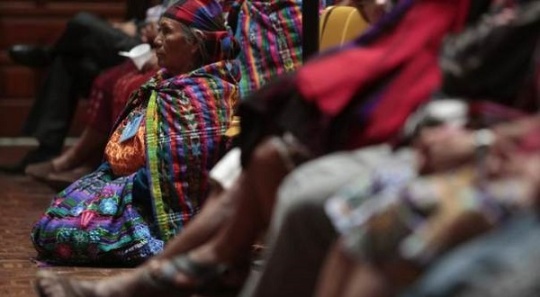
Fifteen Mayan women who were raped and forced to be sex slaves after their husbands were disappeared are demanding justice 30 years after the abuses.
Guatemala is about to launch a landmark trial against former military officers accused of committing sexual enslavement and forced disappearance during the most brutal years of the country’s 36-year civil war.
Here’s what you need to know about the historic trial that is scheduled to kick off Monday, Feb. 1.
1. Fifteen women were sexual and domestic slaves.
Guatemalan soldiers forcibly disappeared 15 men from an eastern Maya Q’eqchi’ village in 1982. It was one of the bloodiest years of Guatemala’s civil war, when dictator Efrain Rios Montt’s military regime was unleashing a scorched earth campaign targeting rural Mayans. After the army disappeared the men, they came back for their wives.
The women were raped and their belongings destroyed. They were taken captive and forced to live at the Sepur Zarco military base, where they were enslaved as domestic servants for the soldiers and systematically raped. The women were forced to labor in 12 hour “shifts,” an abhorrent system that lasted several months.
Though the enslaved shifts ended at the end of 1983, 11 of the 15 women were forced under military threat to stay at Sepur Zarco doing domestic chores for the soldiers for six years until the base closed in 1988. The other four women managed to flee to the mountains with their children where they endured painful hardship for years, including suffering the deaths of most of their children.
All of the women, now in their 70s and 80s, bear enormous physical and emotional trauma from the experience. They also faced stigma in their communities for the violence they endured, and did not share what had happened to them for 30 years, finally coming forward in 2011 to seek justice.
The trial accuses two defendants, former Sepur Zarco chief Esteelmer Reyes Giron and former regional military commissioner Heriberto Valdez Asij, of committing crimes against humanity, including sexual violence and sexual slavery, domestic violence, murder, and forced disappearance. They have been held in remand since 2014 awaiting the trial.
2. The Sepur Zarco case is an internationally historic trial.
The trial of two former military officers for crimes against humanity marks the first time in history that sexual slavery charges are prosecuted at the national level, in the country where the crimes were committed.
The more internationally high-profile case of sexual slavery during armed conflict, the case of Japan’s “comfort women,” was rejected by a Japanese court. Former comfort women subjected to sexual slavery during World War II put Japan on trial in a mock war crimes tribunal in Tokyo in 2000, but the case never officially went to court in the country.
Guatemala’s Sepur Zarco trial could set a new precedent for prosecuting sexual violence in the context of armed conflict, which rights defenders say is one of the most widespread yet under-recognized violations of human rights.
3. It is also a historic trial for Guatemala.
The Sepur Zarco trial marks the first that that Guatemala will consider a sexual violence case as an international crime, which could set a precedent for future trials.
The crime of sexual slavery has been recognized internationally since the early 1900s, when the 1907 Hague Convention prohibited rape and the use of prisoners of war as slaves. The 1926 Slavery Convention elaborated anti-slavery laws with a definition that applies to sexual slavery. The Rome Statute of the International Criminal Court, which came into force in 2002, specifically criminalized sexual slavery.
A standing definition of sexual slavery was detailed in the 1998 U.N. Special Rapporteur’s final report on contemporary forms of slavery, “Systematic Rape, Sexual Slavery, and Slavery-Like Practices During Armed Conflict,” also known as the McDougall Report.
The report defined sexual slavery as “the status or condition of a person over whom any or all of the powers attaching to the right of ownership are exercised, including sexual access through rape or other forms of sexual violence.” More simply put, the McDougall report explained: “Slavery, when combined with sexual violence, constitutes sexual slavery.”
The trial will consider the crimes committed as war crimes and crimes against humanity.
Rape was widespread during the civil war. The Sepur Zarco case has the potential to be a precedent-setting trial to break the cycle of impunity for sexual violence in Guatemala.
4. Rape was a concerted strategy in the civil war.
In 1999, three years after the peace accords were signed in Guatemala, the U.N.-backed Truth Commission investigating civil war atrocities found that rape was systematic and widespread during the conflict. According to the commission, “the rape of women, during torture or before being murdered, was a common practice aimed at destroying one of the most intimate and vulnerable aspects of the individual’s dignity.”
The Truth Commission also found that violence against women, include rape, torture, and murder, was often motivated by their political affiliations, social participation, and ideals, and often combined with other human rights abuses. The report attributed 93 percent of all recorded human rights violations to the state, 85 percent for which the army was responsible.
Despite the countless cases of sexual violence during the civil war, the Sepur Zarco case is the only one that has gone to trial in the country where impunity for war crimes has long remained the norm.
According to the Guatemalan organization Women Transforming the World, sexual violence continues to be inflicted on women by state security forces in conjunction with other human rights violations, such as forced displacement.
5. The victims in Sepur Zarco were targeted for defending their land.
Maya Q’eqchi’ communities in Guatemala have long suffered deep inequality, poverty, and precarious access to land. Before they were disappeared in 1982, the 15 husbands of the victims in the Sepur Zarco case were fighting for legal titles to defend the land they had lived and worked on for years. Because they were standing up for their land rights, they were despised by local large landowners, labeled as leftist insurgents, and made into targets to be silenced.
Land conflicts and unequal ownership are central to the history of Guatemala’s civil war. In 1954, a CIA-backed coup ousted the democratically elected president and reversed the fledgling agrarian reform program that aimed to expropriate idle lands from elite landowners and redistribute land to campesinos. The coup not only triggered more than three decades of civil war, but also helped to lock in one of the most unequal land distribution patterns in Latin America.
Rios Montt’s U.S.-backed bloodshed was nominally a campaign to crush leftist guerrilla uprisings in Guatemala, but in practice many poor Mayan campesinos were targeted as “insurgents” as the military protected the interests of elite landowners.
Photo credit – Reuters
UN says Turkey should investigate reports of rescuers being shot
Press TV – February 1, 2016
The UN High Commissioner for Human Rights has called on Ankara to investigate reports that a number of unarmed people trying to attend to the injured victims of clashes in Turkey’s southeast in late January were themselves shot at.
Ten people were injured when their group, which included two opposition politicians, came under fire while trying to help people injured in earlier clashes in the southeastern town of Cizre in Turkey’s mainly Kurdish southeast on January 20.
Zeid Ra’ad Al Hussein described as “extremely shocking” footage filmed of the incident, which purportedly shows what appear to be a man and woman holding white flags and pushing a cart – possibly carrying bodies – across a street before being shot.
“As they reach the other side, they are apparently cut down in a hail of gunfire,” Zeid said in a statement.
He also expressed concern that the cameraman, who was injured in the shooting, may face arrest under a “clampdown on media.”
Turkey has been engaged in a large-scale campaign against the outlawed Kurdistan Workers’ Party in its southern border region in the past few months. The Turkish military has also been conducting offensives against the positions of the group in northern Iraq.
The operations began in the wake of a deadly July bombing in the southern Turkish town of Suruc. More than 30 people died in the attack, which the Turkish government blamed on Daesh Takfiri terrorist group.
After the bombing, the PKK militants, who accused the government in Ankara of supporting Daesh, engaged in a series of supposed reprisal attacks against Turkish police and security forces, in turn prompting the Turkish military operations.
Featured Video

Iran Is Not Our Enemy
or go to
Aletho News Archives – Video-Images
Book Excerpt
“Vaccines Do Not Cause Autism!” The Science is Settled. Right?
ICAN urges the IACC to actually study infant vaccines and autism
 By Aaron Siri | Injecting Freedom | March 16, 2026
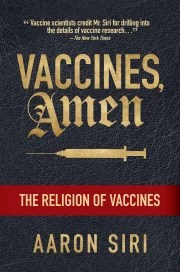
On behalf of ICAN, we just sent a copy of chapter 11 of Vaccines, Amen to the newly appointed members of the federal Interagency Autism Coordinating Committee (IACC).
If you haven’t already read this chapter, you can read the whole thing in the attached letter. I trust that after you read it, you’ll see why the statement “vaccines do not cause autism” is a belief, not science!

IACC Public Comment Letter
1.53MB ∙ PDF file
Includes chapter 11 of Vaccines, Amen
Blog Roll
 Aletho News
- Weapons makers cash in on Trump’s Iran war
- Why Trump’s anti-Iran naval coalition in Strait of Hormuz is doomed to fail
- IRGC says regional energy sites linked to US will be reduced to ashes
- Qatar condemns ‘dangerous’ Israeli attack on gas field
- Iran made ‘unexpectedly substantial’ offer during Geneva talks, US envoys ‘dragged’ Trump into war: Report
- Russia condemns Israel’s attack near Bushehr plant, files complaint
- Russia Strongly Condemns Actions Aimed at Harming Health of Iranian Leadership – Kremlin
- Israeli Journalist Demands Tucker Carlson and Candace Owens Be Placed in WWII-Style Internment Camps
- No Liability, No Studies, No Accountability: The Vaccine System Aaron Siri Exposed in Federal Court
- No time for losers: Why the war meant to save Israel may destroy it
- If Americans Knew
- Tucker Carlson says ‘neocons’ will try to destroy Joe Kent over resignation
- Lebanon death toll exceeds 900, another assassination in Iran, bombing in Gaza – Not a ceasefire Day 159
- Trump’s counterterrorism chief, whose own wife was killed by ISIS, quits over Iran War saying Tehran posed ‘no imminent threat’
- Here’s what US could fund instead of Bibi’s war on Iran
- Israel Killed Over a Dozen Lebanese Paramedics in Three Days, Now Claiming That Ambulances Are “Hezbollah” Targets
- War on Iran: These are the heritage sites devastated by US and Israeli attacks
- Four news stories from Israeli media that illustrate Israeli “justice”
- CIA Prepares Criminal Referral of Tucker Carlson, as Israel and Its Loyalists Demand His Arrest
- Top US counterterror advisor resigns in protest of “war manufactured by Israel” – Not a ceasefire Day 157
- ‘I Liked the House’: When Israeli Soldiers Turn Palestinian Homes into Barracks
- No Tricks Zone
- Energy Expert: Germany’s Nuclear Phaseout Was A “500 Billion Euro Mistake”
- New Research: South Australia’s Mid-Holocene Sea Surface Temperatures Were 4°C Warmer Than Today
- Storing Green Energy To Last Germany 10 Days Would Require A 60-Million Tonne Battery
- New Studies: UK Sea Levels Were 4 Meters Higher Than Today During The Mid-Holocene
- Destructive Green New Deal: German Energy And Metal Group Warns Of Drastic Crisis
- New Study Documents A 20-Year Pause In Arctic Sea Ice Decline – Driven By Internal Variability
- Wake-up Call: Survey Shows Majority Of Germans Now Favor Postponing Climate Targets!
- Televised! Leading German Political Candidate Tells Schoolchildren CO2 Makes Sun Hotter!
- New Study: A Century Warming Of 1.1°C Is ‘Commonplace’ And ‘Not Unusual’ During This Interglacial
- New Study: ‘Internal Noise’ And Volcanic Forcing Can Trigger 10-15°C Warming Within Decades
 Aletho News