Why It’s Dangerous to Conflate Hamas and Daesh
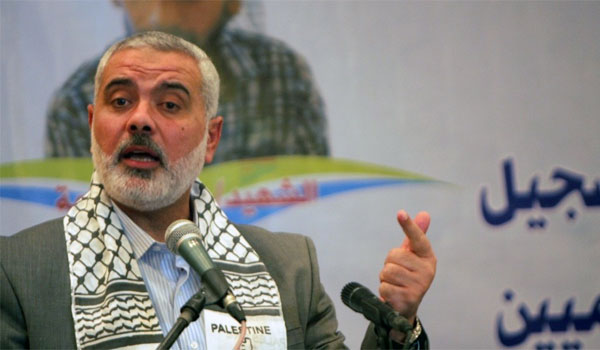
Hamas Prime Minister in Gaza, Ismail Haniyeh
By Belal Shobaki – Al-Shabaka: The Palestinian Policy Network – February 22, 2016
Overview
While Israel’s efforts to link Palestinian resistance to its military occupation to global terrorism are not new, it has expanded its propaganda to address Arab as well as Western audiences. By so doing, it is clearly seeking to exploit the global aversion to movements that have drifted towards extremism and terrorism while claiming to represent Islam. “Hamas is ISIS and ISIS is Hamas,” Israeli Prime Minister Benjamin Netanyahu declared at the United Nations in 2014. Yet better than anyone else, Netanyahu and the Israeli political establishment know that Hamas and Daesh are not related, as do those Arab regimes that also tar all Islamic movements with the same brush to serve their own ends. 1
Not only are Hamas and Daesh unrelated, they are bitter enemies, and Daesh has denounced Hamas as an apostate movement. Al-Shabaka Policy Analyst Belal Shobaki discusses the major ways in which Hamas differs from Daesh including its approach to jurisprudence; the position vis-a-vis the nature of the state; and relations with other religions. He makes the case that it is especially important for the Palestinian national movement to rebut the attempts to conflate Hamas with Daesh and points out the dangers of not doing so.
Serving Short-Term Political Gain
The conflation of Hamas with Daesh ignores reality on the ground. The political environment in Palestine is defined by the occupation, whereas the political environment in the Arab countries where Daesh emerged is defined by authoritarianism and repression as well as sectarian and religious conflicts, an ideal environment for the emergence of a radical ideology motivated by indiscriminate violence.
For Israel, however, the attempt to link the two may pay off regionally and internationally. Many Arabic media outlets have no qualms about referring to this terrorist organization as an “Islamic” State although it is anything but, while many Western media outlets embrace the Israeli conflation of Hamas and Daesh without scrutiny. Arab regimes are uninterested in defending the image of Hamas. Even the Palestinian Liberation Organization (PLO) does not seem concerned with defending Hamas’s international image given the political division between Fatah and Hamas.
Hamas is considered part of the Muslim Brotherhood, which is seen as a threat to authoritarian Arab regimes, particularly in the Arab Mashreq. Thus one way for Arab regimes to fight the Muslim Brotherhood is by claiming it shares common ground or is even synonymous with Daesh, as claimed by the Egyptian regime, and then using this as a justification for excluding the Muslim Brotherhood from participating in political life.
The rapid developments of the past five years in Egypt, the country that provides the only outlet for the Palestinian Gaza Strip, has pushed Hamas into its informal tunnels economy. The official Egyptian stance after Abdel Fattah Sisi’s coup against elected president Mohammad Morsi became tougher against the Gaza Strip, with claims that Hamas was cooperating with Jihadist groups in the Sinai, the same narrative promoted by Israel and its media. However, this narrative is flawed. It is too risky for Hamas to maintain a close relationship with Sinai jihadists, on the one hand, while cracking down on individuals embracing the same ideology in Gaza, on the other. Any links Hamas has established with those groups is limited to securing the needs of the enclave besieged by Israel and Egypt. This interaction is not motivated by a shared ideological identity or shared enmity towards the Egyptian regime. Indeed, Hamas has been eager to keep communication lines open with the Egyptian regime even when accusations conflating Hamas with Sinai’s Salafi Jihadi groups were made in the media. Hamas has also repeatedly said that it is keen on rebuilding the relationship with Egypt in order to ensure the legal flow of goods, services and individuals into Gaza.
It is important to refute this narrative concerning one of the largest Palestinian political movements: Excluding moderate Islamists from political life carries the danger of pushing Palestinian society towards radicalism, in which case both Fatah and Hamas will find themselves fighting takfiri groups. The ensuing discussion will demonstrate the real differences between Hamas and Daesh as well as the very real enmity between them.
Differences in Doctrine
Hamas positions itself as a centrist Islamic movement and an extension of the Muslim Brotherhood, with a rational jurisprudential authority, whereas Daesh adopts a text-based approach that deals with Islamic texts in isolation from their historical context and refuses to interpret them in line with current developments. Hence, for Daesh and other takfiri groups in general, movements like Hamas are secular and un-Islamic, since Hamas is primarily a resistance movement against the Israeli occupation and believes in a moderate Islamic authority. Moreover, Hamas does not take Islamic texts literally; it allows for ijtihad – interpretation and use of discretion. Some scholars have categorized these movements along a horizontal line with the right representing advocates of the text and the left representing advocates of reason. 2 Using this classification, the Muslim Brotherhood can be found a good way down the left of the line, while Daesh is on the far right.
Daesh characterizes Hamas and its discourse as deviant. Hamas for its part has condemned Daesh’s threats and considered these part of a smear campaign that extends beyond Palestine. When threats from Daesh and other takfiri groups materialized into action, Hamas no longer stopped at condemnations. Mahmoud al-Zahar, a prominent Hamas leader, declared “Daesh’s threats can be felt on the ground, and we are handling the situation from a security standpoint. Whoever commits a security offense shall be dealt with in accordance with the law, and whoever wants to debate intellectually shall be debated intellectually; we take this matter seriously”.
Hamas had in fact dealt decisively with a Daesh-like group. In August 2009, Abdul Latif Musa, leader of the “Jund Ansar Allah” (Soldiers of God’s Supporters) armed group, announced the creation of the Islamic Emirate in Gaza at the Ibn Taymiyyah Mosque. The group had previously been accused of destroying cafes and other venues in the Gaza Strip, pushing the Hamas government into a confrontation. Security forces, reinforced by the al-Qassam Brigades (Hamas’ military wing), encircled the Ibn Taymiyyah Mosque and, when Musa’s group refused to surrender, Hamas ended the emirate project in its infancy by killing the members of the group. Hamas was criticized for its use of violence but justified its actions by arguing that the violence that could have been perpetrated by such groups would have been much worse than that used to eradicate extremism in the Gaza Strip.
Daesh’s supporters in Gaza are far fewer than Hamas’s, mainly due to the fact that these groups have not historically contributed to resisting the occupation. Some polls suggest that 24% of Palestinians think positively of jihadist movements, but this percentage is exaggerated. When some Palestinians cheer for the jihadist groups’ hostility towards the US, it is not because they believe in these groups but rather because they see the US, with its infinite support for Israel, as being playing a destructive role.
Different Stances on Statehood
Hamas and Daesh differ in their view of the modern state, in both theory and practice. As noted above, Hamas has always allowed for ijtihad or discretion, evolving its thoughts and opinions. It is thus unfair to assess Hamas’s stance on the civil state and democracy based on the early literature of the mother movement, the Muslim Brotherhood. Hamas maintains that it has embraced new convictions in this regard and has come to fully accept democracy and the concept of the civil state. Indeed, the Muslim Brotherhood itself has evolved. Qatar-based Sheikh Yusuf al-Qaradawi, the jurisprudential authority of the Muslim Brotherhood at large, has stated on multiple occasions, including in his book “The State in Islam”, that the concept of the religious state does not exist in Islam. According to al-Qaradawi, Islam advocates for a civil state founded on respect for the people’s Islam-based opinion, and also founded on the principle of accountability and political pluralism. Although the discussion about the relationship between Islam and democracy predates the Muslim Brotherhood, it gained clarity after the 1950s, when numerous Islamic thinkers, including al-Qaradawi, the Tunisian leader and Ennahda co-founder Rached Ghannouchi and the Algerian philosopher Malek Bennabi, affirmed that Islam and democracy were not in contradiction with each other.
At the opposite end, the movement that Daesh represents rejects democracy in its entirety and considers it an apostate system of governance. Although some jihadist groups do not denounce Islamists who take part in the democratic process as apostates, they do consider their discretion flawed. Daesh views any expression of democracy such as elections as a manifestation of apostasy and any movement or individual taking part in elections as apostates. By contrast, the Muslim Brotherhood participated in elections from its earliest days, when its founder Hassan al-Banna decided to run in the Egyptian parliamentary elections that El-Wafd Party Government sought to hold in 1942. Although al-Banna could not run because the government rejected his candidacy, the Muslim Brotherhood has served in Arab parliaments and sometimes in the executive branch.
When Hamas decided not to participate in 1996 Palestinian Authority elections its position was based on a political and ideological stance towards the Oslo Accords. However, Hamas allowed its members to run in the elections as independents. When the circumstances changed and the 2005 Cairo Agreement became the governing framework for the PA elections instead of the Oslo Accords, Hamas decided to participate. It nominated many members in the movement and some independents to a Change and Reform list to run for the Legislative Council, winning the majority of votes.
By participating in the elections, Hamas has offered evidence that it is willing to function in a modern state and a democratic system. It has called for coalition governments inclusive of leftist and secular parties. Its government as well as its parliamentary list included women and its first government included Muslim and Christian ministers.
Daesh, on the other hand, has turned against all modern institutions in the areas under its control, refusing to recognize borders or national identity. It rules through chaotic and individual decisions. Although Daesh has been eager to use administrative terms derived from the Islamic tradition such as caliphate and shura (consultation), the essence of its governance contradicts the majority of unquestionable texts in the sources of Islamic legislation in many ways. For example, it does not abide by the conditions established in the Quran and sunna (the Prophet Mohammad’s teachings) to declare war or the protection of civilians and treatment of prisoners in wartime. Another example is its imposition of jizya (a tax that was levied on non-Muslim subjects), which is not supposed to be applied to the indigenous inhabitants even if they are non-Muslim. Moreover, it has attacked places of worship and assaulted the faithful in their homes, in clear violation of the Quran and sunna.
Daesh, to some extent, resembles hybrid regimes in the Third World that use modern and democratic vocabulary to describe their political process, even though they remain authoritarian in essence.
Polar Opposites in Treating the Other
The most significant difference between Hamas and Daesh is their position towards followers of other religions. During its formation, Hamas published a charter that used religious vocabulary to describe the conflict. Following severe criticism, Hamas effectively sidelined this Charter and no longer considers it an authoritative reference as some of its leaders have confirmed.
In his interview with The Jewish Daily Forward deputy head of the Hamas politburo Moussa Abu Marzouk confirmed that the Charter was marginal to the movement and not a source for its policies. He added that many members were talking about modifying it because several of Hamas’ present policies contradict it. Hamas’ politburo leaders abroad were not the only ones to disclaim the charter. Gaza-based Hamas leader Ghazi Hamad went even further in an interview with the Saudi Okaz newspaper in which he said the charter was subject to discussion and evaluation in opening up to the world. Sami Abu Zuhri, a young Hamas leader who was the movement’s spokesperson during the Second Intifada, urged in an interview with The Financial Times that focus be shifted away from the 1988 charter, and that Hamas be judged on the statements of its leaders.
Today, Hamas adopts the Quranic verse that reads: “Allah does not forbid you from those who do not fight you because of religion and do not expel you from your homes – from being righteous toward them and acting justly toward them. Indeed, Allah loves those who act justly.” This verse urges kindness and justice when dealing with people of other religions. Unlike Daesh, Hamas has applied this in practice. In addition to appointing Christian ministers to its cabinet, it has celebrated Christmas with Palestinian Christians by sending official delegations to visit during the feast. Meanwhile, Daesh has threatened the lives of those who celebrate Christmas across the world.
Some may argue that these steps are ways in which Hamas tries to beautify its authoritarian rule. However, there is little difference between Hamas’ rule and Fatah’s. The human rights violations committed by Gaza’s government cannot be considered an indication of Hamas’ resemblance to Daesh, but rather an indication of misgovernment. The political leadership of Hamas has spoken out against such practices on occasion, for example as those committed by the Ministry of the Interior under Fathi Hammad.
When some individuals were attacked by extremist groups in Gaza, Hamas and the government acted to ensure their safety and punish the aggressors, as in the case of British journalist Alan Johnston who was freed by Hamas from his radical captors and the killing of Italian solidarity activist Vittorio Arrigoni.
The movement’s position towards the Shiites is similar to that towards Christians. At a time when the Middle East is experiencing a media war between Shiites and Sunnis, Hamas refuses to denounce Shiites as apostates, and has interacted with them politically. When the relationship with Iran became strained during the Syrian crisis, the disagreement was political rather than doctrinal. Daesh, on the other hand, not only thinks of Shiites as apostates, but also all other Sunni groups that hold a different ideology, and believes they must be fought.
Even the two organizations’ treatment of the enemy differs. Hamas identifies the Israeli occupation as the enemy, while Daesh considers everyone else its enemy. Daesh has boasted of its numerous crimes against humanity in its treatment of its abductees and the civilians under its rule, including burning Jordanian pilot Muath al-Kasasbeh alive. It has attempted to legitimize its inhumane conduct by distorting or misinterpreting religious texts. Hamas paid its condolences to al-Kasasbeh’s family and condemned Daesh’s actions. Contrast Daesh’s brutality with Hamas’ treatment of the Israeli soldier Gilad Shalit during his captivity, as even the Jerusalem Post reports.
Moving Forward in Relations with Hamas
Both Hamas and Daesh are on the list of terrorist organizations in many countries, including the member states of the European Union and the United States. However, the listing of Hamas is clearly politically motivated: Unlike Daesh, Hamas has neither targeted nor called for targeting any entity other than the Israeli occupation. Hamas was added to the list of terrorist organizations following the events of September 11, 2001, even though it had nothing to do with this terrorist attack. The political nature of the position against Hamas is underscored by the fact that the General Court of the European Union issued a decision on December 17, 2014, urging the removal of Hamas from the list of terrorist organizations. The Court argued that the order to list Hamas in 2003 was based on media reports rather than solid evidence.
In addition, many European and American dignitaries that are known for their stance against terrorist organizations worldwide have met with Hamas leaders on more than one occasion. Those include European parliamentarians and former US president Jimmy Carter, who met with Ismail Haniyeh in Gaza in 2009 and Khalid Meshaal in Cairo in 2012.
The bottom line is that Israel’s attempt to exploit a chaotic Middle East by implicating Hamas as a terrorist group linked with Daesh is baseless. Hamas is ideologically, intellectually, jurisprudentially and politically different from Daesh. Media outlets that adopt the Israeli narrative hurt their professionalism and credibility.
Palestinian movements must not allow the disagreement with Hamas to justify the accusations that harm the Palestinian cause internationally and create tensions locally. Hamas must also realize that the differences between them and Daesh do not mean that its rule of Gaza is free of abuses and human rights violations, and must therefore revisit its conduct and be more careful in its political discourse. It should move beyond the approach of having one discourse for local consumption and another for global consumption since every word uttered by any Hamas leader is marketed abroad as a message from Hamas to the world.
When the Fatah-led Palestine Liberation Organization (PLO) and Arab regimes, especially in Egypt, do not oppose the efforts to link Hamas with Daesh – or, indeed, occasionally contribute to these efforts – they may “benefit” in the short-term by weakening Hamas as a political opponent. However, this carries the dangers of destabilizing Palestinian society in the medium and long-term. Excluding moderate Islamists could push Palestinian society towards radicalism, in which case both Fatah and Hamas will find themselves fighting takfiri groups.
Notes:
- ISIS: The Islamic State of Iraq and Syria. Daesh is the Arabic acronym for ISIS. Some commentators use ISIL: The Islamic State of Iraq and the Levant. The group itself began to use IS in 2014.
- Samir Suleiman, Islam, Demokratie und Moderene, Herzogenrath: Shaker Media, 2013, P 302. Tariq Ramadan, Muslimesin in Europa, Marburg: Medienreferat, 2001, p15.
Al-Shabaka Policy Member Belal Shobaki is assistant professor in the Department of Political Science at Hebron University, Palestine. He is a member of the American Political Studies Association. He has published on Political Islam and identity and is now working on a book on the Palestinian division. Shobaki is the former Editor-in-Chief of Alwaha Newspaper in Malaysia. He was also a Lecturer in the Department of Political Science at An-Najah National University and the Head of the studies Unit at the Palestinian Centre for Democracy and Studies.
Kuwaiti Embassy Advises Citizens to Leave Lebanon
Al-Manar – February 24, 2016
The Kuwaiti embassy in Beirut advised on Wednesday citizens to leave Lebanon unless it was necessary to stay, Kuwaiti News Agency (KUNA) reported.
In a statement, the embassy also called on the Kuwaitis tending to travel to Lebanon to re-consider their plans.
Saudi, UAE and Bahrain have already issued similar travel alerts without submitting clear evidence about any security threat over the Lebanese territories.
Docs Reveal That Turkish Officers Work With Daesh on Syrian Border
Sputnik – 24.02.2016
Despite Ankara’s declared commitment to fight Daesh, Turkey’s relations with the terrorist group are more complex. Documents recently released by the Cumhuriyet newspaper appear to show that Turkish officers on the border with Syria frequently communicated and worked with Daesh fighters.
The transcripts are said to be part of an ongoing investigation into several individuals and their ties to the terrorist group. They reportedly detail several phone conversations between unnamed Turkish officers and Mustafa Demir, a key Daesh operative in the border region.
“The transcripts and the documents in the investigation revealed that Demir received money… from smugglers at the border and cooperated with the officers as far as [border] crossings are concerned,” the Today’s Zaman newspaper quoted the daily as saying.
The documents also appear to indicate that Turkish officers met with Demir in the border region.
Demir is said to be linked to İlhami Balı, the 33-year-old Daesh leader, who is suspected of ordering the deadliest terrorist attack in Ankara’s history. The twin bombings last October left 102 people dead and more than 400 injured.
One of the transcripts translated into English by Today’s Zaman dates back to November 25, 2014. Demir asked an unnamed officer to arrange a meeting with a commander.
“Is it possible for you to arrange that I talk with the commander here, regarding the business here? What if we could establish a contact here as we helped you…” the Daesh fighter asked a Turkish officer. “Okay. If there are any needs [as far as your request is concerned], [tell them] to inform me here,” the officer responded.
In another conversation, a Turkish officer asked Demir to meet him and his comrades at a minefield. “We have stuff; come here from that side, the men are here… Come urgently; I’m in the mine [field] with a torch. Come running.”
“Okay, big brother, [I’m] coming,” Demir answered.The United States and other stakeholders have repeatedly urged Ankara to seal Turkey’s porous border with Syria, which Daesh, al-Nusra Front and other terrorist groups use to smuggle fighters, weapons and supplies in and out of Syria. The Turkish government has so far failed to deliver on the promise.
Access to unlimited supplies and recruits delivered to the Syrian battlefield through Turkey is largely seen as the key source of Daesh’s resilience and longevity. Ankara’s inability to secure the 60-mile border region has prompted many to question Erdogan’s true agenda with regard to the deadly Syrian conflict.
French Special Forces Waging ‘Secret War’ in Libya
teleSUR | February 24, 2016
French special forces and intelligence commandos are engaged in covert operations against Islamic State group militants in Libya in conjunction with the United States and Britain, the French newspaper Le Monde reported Wednesday.
It said President Francois Hollande had authorized “unofficial military action” by both an elite armed forces unit and the covert action service of the DGSE intelligence agency in the conflict-ridden North African state, which has two rival governments and largely ungoverned desert spaces.
What Le Monde called “France’s secret war in Libya” involved occasional targeted strikes against leaders of the ultra-radical Islamist group, prepared by discreet action on the ground, to try to slow its growth in Libya.
The defense ministry declined comment on the substance of Le Monde’s story, but a source close to Defence Minister Jean-Yves Le Drian said he had ordered an investigation into “breaches of national defense secrecy” to identify the sources of the report.
Hollande said that France was at war with the Islamic State group after it claimed responsibility for a wave of attacks on bars, restaurants, a concert hall and the national soccer stadium in Paris on Nov. 13 last year, killing 130 people.
The ministry has previously confirmed that French aircraft recently conducted reconnaissance flights over Libya, where France took a leading role in a 2011 NATO air campaign that helped rebels overthrow Moammar Gadhafi’s autocratic rule.
It has also confirmed that France has set up an advance military base in northern Niger on the border with Libya.
Le Monde said French intelligence had initiated a previous strike last November that killed an Iraqi known by the nom de guerre Abu Nabil who was the senior Islamic State group leader in Libya at the time.
Le Monde said specialist bloggers had reported sightings of French special forces in eastern Libya since mid-February.
It quoted a senior French defense official as saying: “The last thing to do would be to intervene in Libya. We must avoid any overt military engagement, but act discreetly.”
Sanders and Trump Are Too Establishment on Syria
By Sheldon Richman | Free Association | February 23, 2016
Marco Rubio and Hillary Clinton both want the U.S. government to set up a “safe zone” in Syria to care for refugees from the raging civil war. You may assess their judgment by noting that Secretary of State Clinton and Sen. Rubio also pushed for bombing and regime change in Libya, which was crucial in spreading bin Ladenite mayhem far and wide. And Rubio thinks knocking out the Sunni Islamic State would hurt Shi’ite Iran.
Ted Cruz does not call for a safe zone; he merely wants to bomb the Islamic State back to the stone age while arming the Kurds, whom the leadership of NATO member Turkey wants to destroy and the Sunni Arabs distrust. Cruz says the Kurds would be “our ground troops,” yet he does not rule out American troops as a last resort.
Where do the reputed anti-establishment candidates stand on the safe zone? Alas, Donald Trump favors it, and Bernie Sanders is ambiguous.
If this is disestablishmentarianism American-style, we are in bad shape.
“What I like is build a safe zone in Syria,” he said. “Build a big, beautiful safe zone, and you have whatever it is so people can live, and they’ll be happier. You keep ’em in Syria. You build a tremendous safe zone. It’ll cost you tremendously much less, much less, and they’ll be there and the weather’s the same.”
Like Cruz, Trump says he’d send U.S. ground forces “if need be,” but he also promises to “take the oil.” How would he do that without an extended stay for grounds troops.
What about Sanders? He is reported as opposing Clinton’s call for a safe zone, or a no-fly zone, but look at his precise wording from October: “I oppose, at this point, a unilateral American no-fly zone in Syria which could get us more deeply involved in that horrible civil war and lead to a never-ending U.S. entanglement in that region” (emphasis added).
I realize that candidates don’t like to close doors because reopening them later can look awkward. Still, that makes me nervous.
Sanders approves of President Obama’s bombing of the Islamic State in Syria and Iraq, and favors “supporting those in Syria trying to overthrow the brutal dictatorship of Bashar Assad” — which in reality means supporting bin Ladenites or worse. He has also said the Saudi regime should be pressured to fight the Islamic State: “This war is a battle for the soul of Islam and it’s going to have to be the Muslim countries who are stepping up. These are billionaire families all over that region. They’ve got to get their hands dirty. They’ve got to get their troops on the ground. They’ve got to win that war with our support.”
A Saudi-led effort, however, would be awkward, considering that the Saudis and their Gulf state partners enabled the rise of radical jihadism as part of an effort to make trouble for Iran and its ally Assad, their Shi’ite rivals. And let’s not forget that for a year the Saudis have practically been committing genocide, with Obama’s help, in Yemen. What’s with Sanders anyway?
“Why,” asks blogger Sam Husseini, “should a U.S. progressive be calling for more intervention by the Saudi monarchy? Really, we want Saudi troops in Syria and Iraq and Libya and who knows where else? You’d think that perhaps someone like Sanders would say that we have to break our decades-long backing of the corrupt Saudi regime — but no, he wants to dramatically accelerate it…. If the position of the most prominent ‘progressive’ on the national stage is for more Saudi intervention, what does that do to public understanding of the Mideast and dialogue between people in the U.S. and in Muslim countries?”
At least Sanders and Trump understand that George W. Bush’s Iraq war gave birth to the Islamic State, just as U.S. bombing and regime change in Libya and Obama and Clinton’s declaration of open season on Assad led to its expansion. What Sanders and Trump do not understand is that even the relatively limited involvement they favor would have a dynamic that could well lead a U.S. president to deploy ground troops to the quagmire both men say they want to avoid.
Argentine State Workers Join National Strike Against Macri
teleSUR – February 24, 2016
Argentine public sector workers will converge in front of the presidential palace Wednesday as part of a national strike to protest the policies of President Mauricio Macri.
Macri has fired approximately 10,000 state workers since the beginning of 2016, with even more layoffs expected in the coming months as government ministries continue to review contracts.
Wednesday’s national strike is being organized by the Association of State Workers, known as ATE, together with the Argentine Workers Union.
ATE President Hugo Godoy added that there would be marches and demonstrations in provincial capitals as well.
President Macri is ideologically disposed to reducing the public sector, arguing that private investment should be the source of new employment.
During an event where he announced the elimination of retention taxes on mining, Macri said the public sector employment generated during the previous five years, under the administration of his predecessor, was “unnecessary” and a product of “clientelism.”
Vice-President Gabriela Michetti has accused public sector workers of being “Kirchner militants,” referring to the supporters of the governments of the late Nestor Kirchner and his successor and wife, Cristina Fernandez de Kirchner.
Wednesday’s demonstrations will be an opportunity to observe the reaction of state security forces in light of a new security protocol implemented by the Macri government, which now allows police to break up protests.
Critics have said the security protocol opens the door to criminalization and repression of protest.
One in Three German Companies Intend to Hire Refugees in 2016-2017
Sputnik — 24.02.2016
At least 34 percent of surveyed German human resources directors intend to hire refugees this year or next year, Spiegel Online news website reported, citing a study conducted by the Ifo research center.
It was noted in the article that the number of people who were ready to hire asylum seekers had increased from about seven percent in the past two years.
Europe has been beset by a massive refugee crisis, with hundreds of thousands of undocumented migrants fleeing their home countries to escape violence and poverty. According to German Interior Ministry estimates, the country registered some 1.1 million refugees in 2015, nearly five times more than the number registered in 2014.
Radioactive Contamination from Nuclear Waste Site Spreads in Washington
EPA alarmed by uncontrolled exposure risk
Sputnik – 23.02.2016
In November 2015, workers began excavating concrete drums filled with high-level radioactive nuclear waste that had been discarded after uranium fuel fabrication work in the 1960s. The site of the excavation, now a burial ground, is in the notorious town of Hanford, in the state of Washington, near the public highway, and known to be one of the most radioactive areas in North America.
The workers at the burial ground detected specks of highly radioactive material at the site on November 16. With windy weather forecast for the following day, the workers aimed to contain the spread of contamination. The team applied a fixture called “rhino snot,” designed to keep radioactive specks from going airborne.
However, the winds that struck on November 17th were worse than predicted. Gusts to 120 km/h (75 mph), radioactive particulates mixed with airborne dust in the air of the town creating a scenario ripe for nervous and respiratory health danger. Notably, the aerosolized radioactive material, which has a 100 year half-life, can have compound carcinogenic impacts if particles become lodged in the alveoli, the small air sacs in the lungs.
The exposure, according to official reports from the Defense Nuclear Facilities Safety Board, predates a November 2015 incident when nearby residents were thought to have been exposed to radioactive particulates over a period beginning summer 2014.
Nonetheless, Bryan Foley, US Department of Energy (DoE) deputy project director for the site, reassured the public, saying that, “The workers and public were not at risk of exposure because of the spread of contamination.” The Washington State Department of Health echoed these assurances, stating that, to date, the spread of contaminated particulates is not a threat to the public, but that concerns persist of a later, more serious, spread of contamination due to the containment failure.
Environmental Protection Agency Hanford program manager, Dennis Faulk, took the DOE assurances to task, noting that, “the waste had high levels of radioactive isotopes.” Faulk questioned the diligence of DOE control measures, noting that high level waste, “does not bind well with grout.” The EPA has stated that the contamination “is a matter that is alarming and requires further investigation and discussion.”
The EPA has given the DoE six weeks to report on the contamination, the environmental factors that led to the event, and both preventative and remedial measures to limit public and environmental danger.
‘Don’t demonize Israel’: Canada passes anti-boycott motion
RT | February 23, 2016
Canada has passed a motion to condemn “any and all attempts” to promote the Boycott, Divestment and Sanctions (BDS) movement against Israel both at home and abroad.
The motion passed on Monday by a 229-51 vote, CIJ News reports. The bill was introduced by members of the Conservative Party and won support from Liberal Party members. The motion calls on the government to condemn attempts by Canadian organizations, groups, and individuals to promote the BDS movement, claiming it “promotes the demonization and delegitimization” of Israel.
BDS is a global grassroots movement that is trying to pressure Israel to “comply with international law and Palestinian rights” through the boycott of products and companies that profit from violating Palestinian rights. It also includes Israeli cultural and academic institutions.
Inspired by the successful BDS movement that aided in ending South African apartheid, its supporters believe the movement is the only way to push for a solution to the Palestinian-Israeli conflict.
Speaking after the vote, the National Council of Canada Arab Relations said, “At its core, the vote on the anti-BDS motion would go against the spirit of Freedom of Speech, a right enshrined in Canada’s Charter of Rights and Freedoms. Democratic governments do not ordinarily attempt to dictate the political views of their citizens. NCCAR Chair, Gabriel Fahel, reminds us that ‘freedom of speech and conscientious objections to buying products from countries that contravene international law are core values of a free and democratic society.’”
The CEO of the Center for Israel and Jewish Affairs, Shimon Fogel, however insisted that the boycott movement “does not contribute to peace and is not pro-Palestinian.”
“It is discrimination based on nationality, and it harms both Israelis and Palestinians alike by driving the two sides further apart. The BDS movement is a fringe movement and is outside genuine peace efforts,” Fogel said, as quoted by The Times of Israel.
Liberal Prime Minister Justin Trudeau is likely to continue former Prime Minister Stephen Harper’s close ties with Israel. He is against the BDS movement, and tweeted his opinion in March of last year.
Students at McGill University in Montreal passed a pro-BDS motion on Tuesday.
In 2014, Trudeau spoke out in favor of Israel’s right to defend itself during Operation Protective Edge, acknowledging the suffering of Israelis, but not that of the Palestinians, 2,200 of whom were killed during the 50 day conflict.
Israel has pushed back against BDS efforts, accusing its promoters of “anti-semitism.” AP recently revealed that the Israeli government had allotted $26 million for a covert cyberattack on the BDS movement, which would include “flooding the internet” with pro-Israel content and monitoring Muslim activists online.
Read more:
Is sea level rise accelerating?
By Judith Curry | Climate Etc. | February 23, 2016
Estimates of the rate of sea level rise are diverging.
For background on the topic of sea level rise, see these previous posts:
- Slowing sea level rise
- PDO, ENSO and sea level rise
- 20th century mean global sea level rise
- Sea level rise discussion thread
New PNAS papers
The current buzz surrounding sea level rise is associated with two papers just published in PNAS:
Temperature driven global sea level variability in the Common Era by Kopp et al. of Rutgers University, published in PNAS.
Future sea level rise constrained by observations and long-term commitment by Mengel et al., published in PNAS
From the phys.org summary:
Global sea level rose faster in the 20th century than in any of the 27 previous centuries, according to a Rutgers University-led study published today.
Moreover, without global warming, global sea level would have risen by less than half the observed 20th century increase and might even have fallen.Instead, global sea level rose by about 14 centimeters, or 5.5 inches, from 1900 to 2000. That’s a substantial increase, especially for vulnerable, low-lying coastal areas. “The 20th century rise was extraordinary in the context of the last three millennia – and the rise over the last two decades has been even faster,” said Robert Kopp, the lead author.
The study used a new statistical approach developed over the last two and a half years by Kopp, his postdoctoral associates Carling Hay and Eric Morrow, and Jerry Mitrovica, a professor at Harvard University.
Notably, the study found that global sea level declined by about 8 centimeters [3 inches] from 1000 to 1400, a period when the planet cooled by about 0.2 degrees Celsius [0.4 degrees Fahrenheit].
A statistical analysis can only be as good as the data it’s built upon. For this study, a team led by Andrew Kemp compiled a new database of geological sea-level indicators from marshes, coral atolls and archaeological sites that spanned the last 3,000 years.
The database included records from 24 locations around the world. The analysis also tapped 66 tide-gauge records from the last 300 years.
Kopp’s collaborators Klaus Bittermann and Stefan Rahmstorf at the Potsdam Institute for Climate Impact Research in Germany used the study’s global sea-level reconstruction to calculate how temperatures relate to the rate of sea-level change. Based on this relationship, the study found that, without global warming, 20th century global sea-level change would very likely have been between a decrease of 3 centimeters [1.2 inches] and a rise of 7 centimeters [2.8 inches].
A companion report finds that, without the global warming-induced component of sea-level rise, more than half of the 8,000 coastal nuisance floods observed at studied U.S. tide gauge sites since 1950 would not have occurred.
Stefan Rahmstorf has a RealClimate post discussing the new papers.
Additional media reports:
- NYTimes : Seas are rising at fastest rate in last 28 centuries
- SciAm : New data reveal stunning sea level rise
An interesting angle from the NYTimes article:
One of the authors of the new paper, Dr. Rahmstorf, had previously published estimates suggesting the sea could rise as much as five or six feet by 2100. But with the improved calculations from the new paper, his latest upper estimate is three to four feet.
That means Dr. Rahmstorf’s forecast is now more consistent with calculations issued in 2013 by the Intergovernmental Panel on Climate Change, a United Nations body that periodically reviews and summarizes climate research. That body found that continued high emissions might produce a rise in the sea of 1.7 to 3.2 feet over the 21st century.
Roger Pielke Jr tweets: Sans spin: Climate scientist known for being wrong admits error, reduces estimate of sea level rise by 50%. IPCC was right
NASA
Last August, NASA issued two new press releases: Warming Seas, Melting Ice Sheets and NASA Science Zeros in on Ocean Rise. How Much? How Soon? It seems that these press releases were triggered by a new interdisciplinary Sea Level Change Team. Excerpts:
For thousands of years, sea level has remained relatively stable and human communities have settled along the planet’s coastlines. But now Earth’s seas are rising. Globally, sea level has risen about eight inches since the beginning of the 20th century and more than two inches in the last 20 years alone.
All signs suggest that this rise is accelerating.
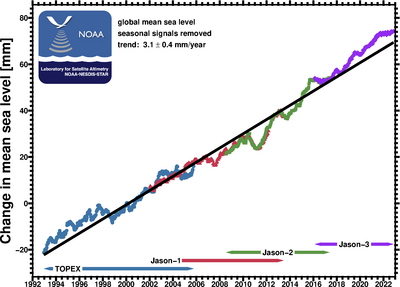
NASA has been recording the height of the ocean surface from space since 1992. That year, NASA and the French space agency, CNES, launched the first of a series of spaceborne altimeters that have been making continuous measurements ever since. The first instrument, Topex/Poseidon, and its successors, Jason-1 and -2, have recorded about 2.9 inches (7.4 centimeters) of rise in sea level averaged over the globe.
Ok, some simple arithmetic. 7.4 cm over a period of 23 years equals 3.2 mm/yr. No surprise – this is the number cited by the AR5 for satellite based sea level rise estimates.
“Given what we know now about how the ocean expands as it warms and how ice sheets and glaciers are adding water to the seas, it’s pretty certain we are locked into at least 3 feet of sea level rise, and probably more,” said Steve Nerem of the University of Colorado, Boulder, and lead of the Sea Level Change Team. “But we don’t know whether it will happen within a century or somewhat longer.”
Here is the last sea level rise plot from the NASA altimeters:
IPCC AR5
I don’t really see anything new here, but the new PNAS papers and the NASA press release serve to highlight an issue that has been nagging me.
The IPCC AR5 includes the following figure of sea level rise over the last century (Figure 3.14)

Figure 3.14 18-year trends of global mean sea level rise estimated at 1-year intervals. The time is the start date of the 18-year period, and the shading represents the 90% confidence. The estimate from satellite altimetry is also given, with the 90% confidence given as an error bar. [AR5 WGI Figure 3.14]
Global sea level has been rising for the past several thousand years, owing to the retreat of glaciers from the last ice age. The key issue is whether the rate of sea level rise is accelerating owing to anthropogenic global warming. It is seen from the figure above that the rate of sea level rise during 1930-1950 was comparable to, if not larger than, the value in recent years. The challenges to determining global sea level rise, particularly over the past 100 or 1000 years, are substantial.
Somehow, the IPCC AR5 drew this conclusion, in context of Figure 3.14:
“Since the early 1970’s, glacier mass loss and ocean thermal expansion from warming together explain about 75% of the observed global sea level rise (high confidence)”
Go figure.
Other recent papers
Other recent papers that I’ve collected on the topic:
Modeling sea-level change using errors-in-variable integrated Gaussian processes, by Cahill et al. (published in Journal of Applied Statistics )
“Our analysis of the global tide-gauge record shows that the rate of GMSL rise increased (accelerated) continuously from 1.13 mm/yr in 1880 AD to 1.92 mm/yr in 2009 AD.” While Cahill et all find an acceleration in sea level rise over the past century, their inferred rate of current sea level rise (< 2 mm/yr) is significantly lower than the value of 3.2 mm/yr derived from satellite altimetry measurements.
Robust reef growth in Indian Ocean kept up with sea level rise > 20X faster in past [link] …
New paper shows sea levels dropped along west coast of North & South America from 1993-2013 [link] …
Coastal planning should be based on proven sea level data, by Parker and Ollier
Highlights:
- The network of tide gauges provides the only information of value for costal planning.
- The worldwide naïve average of sea level is +0.24 mm/year with no acceleration.
- The climate models have crucial flaws making them useless.
- Planning schemes must only reflect the proven local and global historical data.
JC reflections
So, what to make of all this?
Sea level rise is the main ‘danger’ from human caused climate change (any increase in extreme weather events is hypothesized rather [than] demonstrated using historical data, with possible exception of heat waves in a few regions).
At a presentation that I made earlier this year to CEOs of small electric cooperatives, one participant was surprised by what I had to say about sea level rise – he hadn’t realized that there had been sea level rise prior to 1950. I.e., like ‘climate change’, all sea level rise has been sold as caused by humans.
Sea level has overall been rising for thousands of years; however, as the Kopp et al. paper points out, there have been century scale periods of lowering sea level in the recent millennia. It is not clear from my cursory reading as to whether meaningful decadal and multi-decadal variations in sea level can be discerned from their data.
The key issue is whether the sea level rise during the past 50 years reflect an acceleration in sea level rise. The IPCC figure 3.14 suggests that there is no acceleration, given the large rates of sea level rise in the first half of the 20th century. Until we have an understanding of variations in decadal and multi-decadal sea level rise, we can’t make a convincing argument as to acceleration.
With regards to coastal planning, I absolutely agree with the paper linked to above. Locations where sea level rise is a problem invariably have rates of sea level rise that are much greater than even the altimeter values of 3.2 mm/yr are caused by local geologic processes, land use, and or coastal/river engineering. Global values of sea level rise have essentially no use in coastal planning; rather they seem mainly relevant in terms of motivating ‘action’ on carbon mitigation policy.
Sea level will continue to rise, no matter what we do about CO2 emissions. We need creative solutions – one of my favorites remains the garbage solution.
Featured Video

Michael von der Schulenburg: Europe’s Self-Defeating Iran War Policy
or go to
Aletho News Archives – Video-Images
Frlom the Archives
Who Rules America?
The Power Elite in the Time of Trump
By James Petras | Axis of Logic | September 6, 2017
Introduction
In the last few months, several competing political, economic and military sectors – linked to distinct ideological and ethnic groups – have clearly emerged at the centers of power.
We can identify some of the key competing and interlocking directorates of the power elite:
- Free marketers, with the ubiquitous presence of the ‘Israel First’ crowd.
- National capitalists, linked to rightwing ideologues.
- Generals, linked to the national security and the Pentagon apparatus, as well as defense industry.
- Business elites, linked to global capital.
This essay attempts to define the power wielders and evaluate their range of power and its impact. … continue
Blog Roll
 Aletho News
- Michael von der Schulenburg: Europe’s Self-Defeating Iran War Policy
- Sorry, The New Republic, Climate Change Isn’t Causing Somali Migration. Blame Civil Strife and Poverty.
- Expert Guts Claims That HPV Vaccine Reduces Cancer Risk
- No evidence Russia sabotaged Baltic cables – Finnish intel
- The Strategic Folly of a (Serious) US Ground Invasion of Iran
- US-Israeli war of aggression on Iran meant to reshape region: Omani FM
- Iran Does Not Consider Israel Party to Talks to Need Mediators With It – Ambassador
- Macron’s aircraft carrier and warplanes to the Persian Gulf is a dangerous vanity project
- Meet The Ellisons: Zionists, Technocrats, Moguls
- US failures in Iran reveal Russia is key to South Korea’s strategic security
- If Americans Knew
- Are we on the precipice of World War III?
- ‘Catastrophic,’ Says UNICEF: 1,100+ Children Killed or Wounded in Mideast Since US-Israel Launched Iran War
- The Unbelievable Madness of Our War With Iran
- World Council of Churches calls on govts to hold Israel accountable for violations of intl law
- How to end the war on Iran that costs US taxpayers $1M per minute – Not a ceasefire Day 153
- Israeli strategic plans to “remake the Middle East” from the 1950s and since
- Honoring Gaza’s women who refused to let the world look away
- 97% of victims of war on Iran are Iranian, 98% of victims in war on Gaza are Gazans – Not a ceasefire Day 152
- Early Iran strikes cost $5.6 billion in munitions, Pentagon estimates
- Israel Decided the War, But Trump’s America Fights and Pays the Bill
- No Tricks Zone
- New Studies: UK Sea Levels Were 4 Meters Higher Than Today During The Mid-Holocene
- Destructive Green New Deal: German Energy And Metal Group Warns Of Drastic Crisis
- New Study Documents A 20-Year Pause In Arctic Sea Ice Decline – Driven By Internal Variability
- Wake-up Call: Survey Shows Majority Of Germans Now Favor Postponing Climate Targets!
- Televised! Leading German Political Candidate Tells Schoolchildren CO2 Makes Sun Hotter!
- New Study: A Century Warming Of 1.1°C Is ‘Commonplace’ And ‘Not Unusual’ During This Interglacial
- New Study: ‘Internal Noise’ And Volcanic Forcing Can Trigger 10-15°C Warming Within Decades
- Glaciers Worldwide Are Suddendly Surging, Experts Blame Warming!
- Surprising Discovery: Sahara Is Greening…Billions Of Trees Where Once Thought To Be Barren
- New Research Reaffirms Clouds, Aerosols, And Surface Solar Radiation Are ‘Driving The Climate System’
 Aletho News