Japanese media accuse govt of silencing criticism
RT | March 26, 2016
Senior Japanese journalists have denounced PM Shinzo Abe’s government for its recent clampdown on press freedom after the communications minister threatened to revoke their licenses for biased coverage last month.
Five Japanese journalists called a press conference to express their concerns over the government’s tightening grip on media.
“In Japan today, rather than the media watching the authorities, the government watches the media,” said Shuntaro Torigoe, a former news anchor on Japanese TV Asahi, adding that the Abe government “is most nervously checking what the media say, because what’s said on television affects his support ratings.”
Last month, Japan’s minister of internal affairs and communications, Sanae Takaichi, repeatedly warned broadcasters that they must produce “politically neutral” news coverage in compliance with the country’s broadcast law if they didn’t want to lose their licenses.
Despite growing concerns that such remarks can have an adverse effect on the press freedom, Takaichi’s words were reiterated by Chief Cabinet Secretary Yoshihide Suga, who supported the ministry’s stance, calling her comments “common sense.”
Following the remarks, Hiroko Kuniya, a prominent Japanese journalist, was ousted after 23 years of working as a popular primetime show host for public broadcaster NHK [Japan Broadcasting Corp]. After her last appearance on the show she commented on the departure by saying that “expressing things has gradually become difficult.”
Among other victims of the government`s crusade on media were veteran anchors Ichiro Furutachi, 61 (TV Asahi Corp), who stepped down last December and Shigetada Kishii, 71 (Tokyo Broadcasting System). Kishii announced he would leave the channel on March 31. He believes the broadcasters are being pressured by the government to sack outspoken anchors to stem the flow of criticism.
Last year, Kishii publicly opposed the government’s security policy legislation, which stipulates that Japan’s armed forces will be able to engage in the military operations overseas in defense of an ally, including the US, under attack. Despite being labeled “war legislation” by the public, it was approved by Abe’s government, triggering mass protests.
Article 174 of Japan’s broadcast law allows the minister of internal affairs to suspend operations of any station that fails to comply with the neutrality clause. However, media professionals didn’t see the minister’s words as a simple reminder, but rather a dangerous attempt of suppressing the media.
“It sounds as if the government can suspend the activities of broadcasters or remove newscasters just because they criticized the government,” said Soichiro Okuno, an MP for the Democratic Party of Japan.
“It was a remark that could even topple the government in a Western democracy,” wrote Akira Ikegami in a newspaper column last month.
Japan’s remilitarization has become the center topic of the national agenda under Abe’s government with many opposing the authorities’ efforts to broaden the mandate of Japan’s self-defense force and relocate a US military base on Okinawa. Nearly 30,000 people joined the mass rallies against the government’s plan to relocate the base, while hundreds of students marched through the streets of Tokyo protesting “war legislation” in February.
READ MORE: Up to 30,000 flock to Japan parliament to protest US base relocation in Okinawa
At the Intersection of Zionism and Social Justice
By Michael Howard | Dissident Voice | March 25, 2016
In her oily, cringe-inducing and totally predictable speech to AIPAC on March 21, Hillary Clinton argued that, since (according to her) “anti-Semitism is on the rise across the world… we must repudiate all efforts to malign, isolate and undermine Israel and the Jewish people.” In other words, we must do what we can to shut down any legitimate criticism of Israeli policy. A reliable means of doing so is to conflate said criticism with anti-Semitism and thus vilify the critic in question. This particular strategy has been perfected and institutionalized for decades, and was perhaps best deconstructed by Norman Finkelstein in “The Holocaust Industry.”
By dismissing BDS advocates as irrational, Jew-hating troublemakers, Hillary Clinton, the great bastion of liberalism and progress, makes common cause with the jingoist far right (where she actually belongs). But she also makes common cause with a good chunk of US academia, where criticism of Israel and its atrocities is often met with censorship and intimidation. In a comprehensive report on the subject, Palestine Legal details the extent of the suppression: “From January 2014 through June 2015, Palestine Legal interviewed hundreds of students, academics and community activists who reported being censored, punished, subjected to disciplinary proceedings, questioned, threatened, or falsely accused of anti-Semitism or supporting terrorism for their speech in support of Palestinian rights or criticism of Israeli policies.”
Needless to say, this is a gross violation of First Amendment rights, and it needs to be challenged at every opportunity. The university system is based on the principles of free inquiry and unfettered discourse; absent the open exchange of conflicting ideas and opinions, academia is essentially worthless. When certain viewpoints are institutionally favored, colleges cease to be places of learning and instead become places of indoctrination. Who could desire such a circumstance? Well, apart from authoritarians, fascists, religious fanatics (including Zionists) and Hillary Clinton, it’s becoming more and more apparent that “liberal” student activists do.
On college campuses across the country, students are mobilizing and protesting against institutionalized discrimination. Few on the left would argue that this is a negative development. After all, if nothing else these students are contesting authority—a noble and worthy exercise in itself. However, what do we say when fundamental democratic values like free speech are subordinated to an ideology? This is the precarious situation in which many student activists currently find themselves. It’s bizarre: presumably, the students protesting at places like Yale and the University of Missouri (to take two high-profile examples from last year) would stand with the BDS activists who are targeted and censored by pro-Israel forces. And yet these same students—exhibiting a degree of schizophrenia—would have their own ideological opponents treated in the same fashion.
Take a recent incident. At Emory College in Atlanta, some students used chalk to write “Trump 2016”—and other similarly anodyne messages—throughout the campus. Curiously (or perhaps not at this point), controversy erupted when a number of students declared that they felt physically threatened by the chalk drawings, which were considered by some to be acts of violence. “I thought we were having a KKK rally on campus,” one student reportedly told the Daily Beast. She “legitimately feared for [her] life.” Another student said that “some of us were expecting shootings” and thus “feared walking alone.” They demanded that the Emory administration identify the perpetrators, presumably so some sort of disciplinary action could take place—perhaps a public flogging. When the administration responded with a tepid defense of the anonymous chalkers’ right to free speech, the offended shifted their ire onto the college itself, for failing to provide an adequate safe space. All of which is par for the course by now.
So here we have a conflation of Donald Trump supporters with homicidal white supremacists; of political campaigning with physical violence. This is not dissimilar to the conflation of BDS with anti-Semitism, which plagues Palestinian rights activists everywhere. In fact, it’s closer to the profoundly stupid idea that all Muslims endorse terrorism—a notion that the offended students at Emory surely find abhorrent. There is one obvious distinction that must be made: the censorship of BDS on college campuses comes from the top, while the attempted censorship of Donald Trump supporters comes from the comparatively impotent student body. The former case is a much graver threat to free speech, but that is not an excuse to ignore the latter. Soon enough the student body will hold positions of authority.
ESP seems to be a trait common to advocates of censorship. For example, in a recent pro-Israel memo from the Regents of the University of California, it is contended that “opposition to Zionism often is expressed in ways that are not simply statements of disagreement over politics and policy, but also assertions of prejudice and intolerance toward Jewish people and culture.” Translation: the mind readers at the Regents of the University of California can tell when critics of Israel are actually rabid Jew-haters, and they will adjudicate such cases accordingly. Similarly, the would-be student censors use their clairvoyance to judge when an opinion they don’t like is motivated by race hatred or some other form of bigotry. Support for Donald Trump, as we have already seen, implies a desire to kill minorities. It is therefore no different from real physical violence.
What would happen if an entire college was founded on this line of thinking? A recent petition drawn up by some student activists at Western Washington University spells it out for us. The group calls themselves the Student Assembly for Power and Liberation, which is more than a little ominous-sounding. In their own words: “We are a growing group of students from a multitude of communities and disciplines around campus combatting the systemic oppression embedded within our society that is inevitably upheld through this institution, as it was created to uphold white supremacy at its core.”
Note the aggressively bureaucratic language (the grammar of which unravels throughout the petition). Prolixity of this sort is often employed by postmodernist academics—in whose tradition these students are working—for reasons that aren’t entirely clear. Noam Chomsky once argued that, in general, postmodernism “allows people to take a radical stance—more radical than thou—but to be completely dissociated from anything that’s happening, for many reasons. One reason is nobody can understand a word they’re saying. So they’re already dissociated. It’s kind of like a private lingo.”
Obviously, Michel Foucault these kids are not, but the postmodernist influence is plain to see. It’s like that smug kid in your Creative Writing workshop whose stories are all cheap Bukowski imitations. They don’t really have any idea what they’re doing, but they’re busting with self-satisfaction nevertheless.
What these students want, and what their petition is meant to facilitate, is the creation of a brand new college: the College of Power and Liberation. The function of this hypothetical college would be the “development of academic programs that are committed to social justice.” The first step in realizing this goal is “a cluster hire of ten tenure-track faculty to teach at the college.” Fair enough. However, there is something of a catch: “the Student Assembly for Power and Liberation will have direct input and decision-making power over the hiring of faculty for the college.”
That’s right—the professors at the College of Power and Liberation are to be hired by the students attending that college. The “power,” then, is to reside entirely in the hands of the student body. Naturally, they also reserve the right to take “disciplinary action” against “everyone in a teaching position within the university.” And it gets weirder. Demanded in part three of the petition is “the creation and implementation of a 15 persxn [sic] paid student committee, The Office for Social Transformation.”
The misspelling of “person” here is deliberate, as is the discontinuous misspelling of “history” (hxstory) later on. The implication is that these nouns are gendered (person, history) and thus microaggressive residue of an outmoded patriarchal system of thought. Therefore they have been changed. This, I suppose, is an example of the “de-colonial work” for which the College of Power needs “an annually dedicated revenue of $45,000.”
The Office for Social Transformation doesn’t just sound Orwellian—it quite literally is. Here is its express purpose: “to monitor, document, and archive all racist, anti-black, transphobic, cissexist, misogynistic, ablest, homophobic, islamophobic, xenophobic, anti-semitism [sic], and otherwise oppressive behavior on campus.” This oppressive behavior, the petition continues, is regularly found “in faculty curriculum.” By that I assume they mean curriculum including books with controversial subject matter, for instance the novels of James Baldwin and Mark Twain. So much for the English professors who wish to teach the “Adventures of Huckleberry Finn”—a terribly oppressive book.
The petition does not explicitly propose thought crime legislation, but it doesn’t rule it out either. One inevitably wonders about the criteria by which a person’s behavior is judged oppressive (i.e., punishable). For example, what becomes of the student or faculty member who is caught reading Kipling? Surely owning a copy of The Cantos is grounds for disciplinary action—Ezra Pound was a bona fide fascist. Hemingway was anti-Semitic and homophobic: it follows that The Sun Also Rises is beyond the pale. Tolstoy abused his wife, and so reading War and Peace implies an endorsement of misogyny.
Simone de Beauvoir once appealed to the censors of her time: “Must we burn [the Marquis de] Sade?” Indeed we must—and most others, for that matter.
Never fear, though: the College of Power and Liberation has a “three-strike disciplinary system that corresponds to citations that are processed.” Thank heavens for the three-strike disciplinary system, without which people might be fired and expelled unreasonably.
You get the picture. The mini despots comprising the so-called Student Assembly for Power and Liberation are concerned very much with Power and very little with Liberation. Their ultimate goal is to establish a totalitarian microcosm of a state, very far removed from reality, in which power and wealth is concentrated in the hands of a few self-righteous 20-somethings with delusions of grandeur. Because the First Amendment is overrated anyway.
The Holocaust Industry would be proud. And that’s what makes all of this so distressing. If so-called liberal student activists believe in censorship (and many of them evidently do), who can we rely on to challenge the unconstitutional suppression of BDS activism on college campuses? It necessarily devolves into a battle of hypocrites: the right rationalizes their brand of censorship while condemning the left’s, and vice versa. The reality is that both need to be condemned, because both represent explicit attacks on basic democratic principles. The crucial difference, I suppose, is that the Zionists (who know exactly what they’re doing) must be fought, while the overzealous students (who don’t) need merely to be educated. We can and should do both at once.
Michael Howard is a freelance writer from Buffalo, NY. He can be reached at mwhowie@yahoo.com .
Netanyahu’s links to French fraud mastermind exposed
Press TV – March 26, 2016
A report has exposed Israeli Prime Minister Benjamin Netanyahu’s shady relations with a French individual considered by French prosecutors as the “brain” behind one of the biggest frauds in history.
According to a recent report by French news website Mediapart, which was obtained by Israeli newspaper Haaretz, Netanyahu has had affiliations with French national Arnaud Mimran.
Mimran, along with his partners, is accused of stealing between 300 million to 1.6 billion euros in a fraud case commonly referred to in Europe as “the scam of the century.”
The report said that since the early 2000s, the Mimran family has loaned Netanyahu, then Israel’s finance minister, a spacious apartment on Avenue Victor Hugo, in the heart of Paris’ 16th Arrondissement.
Mimran is free on a bail of 100,000 euros after spending 10 months in jail awaiting indictment on charges including extortion in a different case.
The trial of Mimran, who denies all of the allegations against him, will begin in Paris on May 2.
Police are also probing his possible involvement in other cases, including the mysterious murder of his ex-wife’s billionaire father Claude Dray.
This week, Mediapart journalist Fabrice Arfi published the photograph of Mimran relaxing with Netanyahu on the French Riviera.
In a series of articles slated to be published over the coming weeks, whose details were shared with Haaretz, Mediapart will say that Mimran has benefited from wide-ranging connections that have delayed his trial until now.
The name of Netanyahu appears first among such connections as revealed by Mediapart.
“From the evidence I have collected it is clear the Mimran family regularly donated money to the Likud movement in France, and Arnaud Mimran took care to tirelessly cultivate this connection,” Arfi wrote in reference to the ruling and Netanyahu’s party in Israel.
Throughout 2000s, Mimran was suspected of many crimes. He was convicted of tax offenses in France in the late 1990s.
In 2000, three years before a vacation with Netanyahu in Monaco, he was investigated on suspicion of insider trading in the United States and agreed, together with his partners, to pay a fine of 1.2 million dollars.
According to the current indictment, Mimran and his partners stole at least 282 million euros from the European Union over the course of 10 months, from the summer of 2008 to the spring of 2009. He also accused of stealing 1.6 billion euros from the French republic’s coffers.
One of Mimran’s partners, who was arrested and will stand trial alongside Mimran, is Marco Mouly, a Tunisian Jew with a long history of misconduct.
How Western media largely ignored State Dept-Google-Al Jazeera plot against Assad
RT | March 26, 2016
The Western media has quietly ignored an unexpected collaboration between Washington, Google, and “independent” Al Jazeera aimed at helping to overthrow Syria’s Bashar Assad. Would they be as oblivious to a similar cozy “partnership” involving Russia?
Last Monday, WikiLeaks lifted the lid on a correspondence between Jared Cohen, the President of ‘Google Ideas,’ and then-Secretary of State Hillary Clinton’s staff in the summer of 2012. In his July 25, 2012 email to top State Department’s officials, Cohen pitched his about-to-be-launched “tool” to Clinton’s inner circle, asking it to “keep close hold” of it.
The leak revealing the project, which would seem to be an outrageous scandal to some, has actually been quite difficult to spot in the news. Since WikiLeaks released the latest batch of Clinton’s emails on March 21, a Google news search spits back about 30 web sources related to the story.
Of those, only two – The Independent and Daily Mail – could arguably be considered major mainstream media outlets. That means there were slim chances that the eye of an average newsreader would catch wind of the State Department’s teamwork with the US’ biggest tech giant, Google, and Arab media outlet Al Jazeera.
According to what Cohen wrote, it appears that Google’s innovative visualizer worked to “publicly track and map the defections in Syria and which parts of the government they are coming from.”
“Our logic behind this is that while many people are tracking the atrocities, nobody is visually representing and mapping the defections, which we believe are important in encouraging more to defect and giving confidence to the opposition,” he said.
Google also collaborated with Al Jazeera, which took primary ownership over the tool, because of “how hard” it was to get information out of Syria.
At the State Department, the idea was lauded and passed on to Clinton via her private email by deputy chief of staff Jake Sullivan as “a pretty cool idea.”
RT asked media expert Lionel why the revelations failed to receive much attention in the Western media.
“I don’t expect a reaction from Western media because Western media hasn’t even read this, has no idea about this,” Lionel told RT. “But can you imagine if the same set of facts were involved with the different countries, different corporations around the world depending upon your frame of reference. This would either be an outrage or ‘well, maybe this is a delightful and benign cooperation, an independent tech giant… and all for the common good of liberty’ and whatever. It depends upon your perspective.”
Another curious aspect is the fact that the WikiLeaks release directly involved Clinton’s email, which has been a hot topic tainting her presidential campaign for a year now. Clinton’s opponents as well as the US media have been taking nearly every opportunity to poke her for her “careless” misdeed – with the notable exception of this story.
The three parties in this collaboration did not end up together by chance, either.
Funded by the Qatari government, Al Jazeera portrays itself as “the first independent news channel in the Arab world” and “one of the world’s most influential news networks,” whose main goal is it to give “a global audience an alternative voice.”
Qatar has been largely supporting the rebels in the Syrian conflict, along with Washington and other anti-Assad powers that even mulled launching a direct military intervention on Syrian soil last October.
It turned out that Google’s Syrian Defector Tracking was a good fit for Al Jazeera. It even ended up winning the channel a prestigious Online Media Award for “Best technical innovation.”
“This is going to show you very fascinating aspects of the new warfare – how media, and corporations and various platforms are merging together. We are not sure who the military is, who is the government,” Lionel said.
He suggested that the State Department’s reluctance to release Clinton’s emails could be explained by the intention to hide “the conflation of allegedly private industry with the government.”
“We have this new world here. We have the government and we have the Pentagon, DAPRA and defense advanced research program agency, we have private industry, we have these various platforms. We have this new introduction of mercenary groups and private contacting teams. [But] our country [the US] has had a very strict barrier, Posse Comitatus, that separates private law enforcement from military,” Lionel said. “There have always been distinctions and barriers and jurisdiction alliance. In this new world, these barriers are being eliminated, dissolved.”
As Lionel says, the collaboration between Google and the US government only seems to be “innocent” if there is a bias towards “who you like… and the information that’s being propagated.”
When contacted by RT, Google declined to comment on the situation, yet did not hesitate to proudly stress Al Jazeera’s achievement.
“No comment, but pointing out that this data visualization project was very public, Al Jazeera won a journalism award for it,” the tech giant said in an email.
Given these circumstances, it would not hurt to wonder what the Western media’s reaction might have been if the same collaboration had occurred across the ocean and involved, let’s say, the Russian government, a well-known media outlet, and a Russian internet giant.
Since its inception in 2005, RT has often been labeled as anything ranging from a “Russian propaganda machine” to a “propaganda bullhorn” by high-profile Western officials and politicians.
“If RT wanted PR in American media, this is exactly the move it should make. You would never hear the end of that on American media,” Ted Rall, a political cartoonist and author, told RT. “You really don’t have a right to call anyone a propaganda if you yourself is doing the same thing.”
As for Al Jazeera’s prize winning tool, it appears to be currently defunct for unspecified reasons.
French Fury Explodes with Echoes of 1968
By Finian CUNNINGHAM – Strategic Culture Foundation – 26.03.2016
Riot police clashing with striking workers, students shutting down universities, teargas and cars torched in the streets – the mayhem this past week in France evoked memories of 1968, the tumultuous year when mass protests threatened to overthrow a French government back then.
The public fury last week in France boiled over into ugly scenes in several cities, with protests spreading across the country, fanning out from the capital Paris. The French public are furious. And they have right to be.
The uproar mounting over several months now is due to the government’s plan to overhaul the country’s comprehensive labor laws. The essential thrust is to re-write the laws in order to make private businesses and companies hire more workers – by making it easier for them to fire workers!
If that sounds contradictory, then it is a fitting epitome of this French government. President Francois Hollande and his ruling Socialist Party led by Prime Minister Manuel Valls claim, at the risk of sounding tautologous, to be «socialists».
Yet the supposed socialist government is embarking on a ruthless project to smash workers’ rights on behalf of capitalist enterprise.
This week premier Valls presented his so-called labor «reforms» to business representatives and to France’s powerful trade unions. Neither were pleased, with the business groups scoffing that the government had caved into public protests over their much-touted reforms, while unions claimed the proposed changes were still an unacceptable assault on workers.
Students and workers are now pushing ahead with even bigger protests, with more nationwide demonstrations reportedly planned over the coming weeks. It appears that Valls’ government has ignited a firestorm that it can no longer douse.
Valls’ economy minister, Emmanuel Macron, is the personification of the French government’s widely perceived betrayal, in the eyes of ordinary Socialist Party members and the wider public. Reports describe the 38-year-old rising star as being seen as «toxic» by many ordinary French. Macron is a former investment banker who worked at Rothschild before being drafted into government. Yes, that’s right, an investment banker for one of the world’s major capitalist enterprises is given the portfolio of economy minister in an avowedly socialist government. Eh, conflict of interest comes to mind.
It has been Macron’s ministerial brief to push through «business-friendly reforms». Speaking at the Davos summit earlier this year – the annual confab for global capitalists – Macron told his audience that France’s «bloated» labor laws would be stripped. He particularly mocked the country’s statutory limit of a 35-hour working week, vowing that company management would henceforth be allowed to set their own limits.
Macron has also talked about smashing other «glass ceilings», such as relatively strict rules against firing workers and onerous financial compensation for employees who claim they have been unfairly dismissed by bosses. Another target for Macron is to do away with collective bargaining by trade unions, and to permit firms to negotiate terms of pay and conditions with individual workers.
From the capitalists’ point of view – and evidently it is a view shared by premier Valls and his economy minister – the root problem for France’s sluggish growth and high unemployment is that workers have too many rights. By making it easier for private companies to fire workers or make their employees clock up longer hours – so the argument goes – the bosses will be inclined to take on more staff, which it is assumed will result in higher macroeconomic growth for the country.
France wants to follow the Anglo-American model. Britain and the US appear to have better economic performances than France and lower official unemployment rates. The US jobless rate is reported at around 5 per cent, whereas the French unemployment figure is 10 per cent, with the rate rising among youth to 25 per cent. But in Britain and the US, workers are notoriously stressed from much longer working weeks up to 48-60 hours. They also suffer from so-called «in-work poverty» from being underpaid, with less legal protections against hire-and-fire bosses and «zero-hours contracts».
In other words, Britain and the US are more nakedly capitalist models where workers are mere profit-making inputs to be cast aside when no longer required. Britain and the US may be sought after as destinations for unemployed migrants who are desperate for any form of income. But that is no endorsement from a humane viewpoint.
What we have here are fundamental questions of ideology and morality. Are workers and the rights they have won over centuries of labor struggles to be discarded like human chattel?
Compared with the Anglo-American model, France’s relatively more civilized culture for workers should be seen as a virtue to be staunchly defended, not sacrificed on the altar of insatiable profit-making.
Another fundamental ideological difference is that the French government is following the official British and American prejudice that scapegoats workers for low economic growth. In this logic, economic growth can only be revived by making workers toil harder and longer. The more insecure the workers are made to feel, then the harder they will work and the more bosses’ profits will be boosted.
This is a fallacious – not to say immoral – way of looking at contemporary economic conditions. Since the global economic crash in 2008, what needs to be understood is that the problem of low growth in France, Europe, and even the seemingly better UK and US, is not really an issue of worker productivity. It is a much bigger question about a fundamental, historic breakdown in the capitalist system. This is reflected in the record level of inequality between a tiny elite and the vast majority of society. Chronic poverty and austerity wages are why consumption and growth have become stagnant. The systematic injustice needs to abolished, not appeased.
The French government, as in so many other Western countries, has become nothing more than a lobby for the capitalists and their financial oligarchy. Bailouts for the bankers and bosses, but buckets of misery for the masses. What governments should be doing is defending the rights of the vast majority and pushing an agenda that radically redistributes justice in the form of much higher taxes on corporations and the rich, while bringing banks under public control. In a word, socialism is required, not more draconian capitalism.
It looks like the French population at large have finally run out of tolerance for the pseudo-socialists ruling in Paris. Shamelessly, this government is attacking basic rights and mocking touchstones of civility, such as a cap of 35 working hours per week. It truly is Orwellian when such a basic benchmark of human decency is blithely despised by those who claim to be «serving the people».
In a more rational society why shouldn’t workers’ hours be reduced to 25 hours and let the firms take on more staff to maintain output. Oh, it reduces profits and rich dividends for directors, they might say? Well, too bad, let the exploiters take a cut. Better still, let workers and the public take ownership of companies and banks.
One irony in French politics is that Manuel Valls and his de facto capitalist administration have become hysterical about the popular rise of Marine Le Pen’s National Front. Valls and others on the pseudo left deprecate Le Pen’s party as racist, extremist and even fascist. It is arguable that the National Front has gained popular support, as with other similar parties across Europe, precisely because of increasing economic insecurity among workers and society generally. That insecurity, in turn, feeds into anti-immigrant hostility among some sections who see their livelihoods threatened by foreigners.
Ironically, perhaps the biggest recruiting agency for the National Front in France is the pseudo-socialist government of Manuel Valls and his president Francois Hollande. These charlatans are not only attacking workers on behalf of private profit, they are fueling social strife, breakdown, hatred, xenophobia and, in its worst manifestation, fascism.
The danger of a fascist state is not hyperbole. France’s emergency laws deployed since the terror attacks last November in Paris forbid all public demonstrations – in the interest of «national security». As public protests over the coming weeks rightly and legitimately challenge the reactionary French government’s attack on workers, it is only a matter of time before riot-police squads begin to implement mass detention of these same demonstrators, under the pretext that they are threatening national security.
That raises a grim and not inconceivable scenario. French workers and students clubbed off the streets by armed police and thrown into prison without due legal process. Because they oppose an authoritarian government shredding their legal rights? No wonder echoes of 1968 are in the French air.
NSA must end planned expansion of domestic spying, lawmakers say
RT | March 25, 2016
Two members of the House Oversight Committee, a Democrat and a Republican, have asked the director of the National Security Agency to halt a plan to expand the list of agencies that the NSA shares information with.
Representatives Blake Farenthold (R-Texas) and Ted Lieu (D-California) wrote in a letter to NSA Director Michael Rogers on Monday that the reported plan would violate privacy protections in the Fourth Amendment, since domestic law enforcement wouldn’t need a warrant to use the data acquired from the agency.
“We are alarmed by press reports that state National Security Agency (NSA) data may soon routinely be used for domestic policing,” the two lawmakers wrote. “If media accounts are true, this radical policy shift by the NSA would be unconstitutional, and dangerous.”
Last month, the New York Times reported that the Obama administration was working with the NSA to create new protocols for sharing intercepted private communications with domestic law enforcement agencies, such as the FBI and the Drug Enforcement Agency (DEA).
Currently, the secretive spy agency says that its analysts remove certain personal information before giving it to other agencies. Under the new rules, however, domestic law enforcement would have access to the surveillance data without it being scrubbed of personally identifiable information.
The FBI currently has the ability to use phone-based data, but it must request the NSA’s permission to access information from digital communications. The planned loosening of these restrictions would have to be approved by Secretary of Defense Ashton Carter, Director of National Intelligence James Clapper and Attorney General Loretta Lynch.
“Our country has always drawn a line between our military and intelligence services, and domestic policing and spying,” the congressmen wrote. “We do not — and should not — use US Army Apache helicopters to quell domestic riots; Navy Seal teams to take down counterfeiting rings; or the NSA to conduct surveillance on domestic street gangs.”
The Obama administration has said it had leeway to change procedures for certain surveillance programs, thanks to executive order 12333, signed by President Ronald Reagan in 1981.
In 2015, Congress passed the USA Freedom Act, which curbed certain surveillance activities by ending bulk collection of phone records. Private telecom companies are now required to hold onto such information, so that it can be handed over to law enforcement if a warrant is obtained.
WaPo slams Trump on climate because nuke weapon explosion is ‘hypothetical’
Junk Science | March 23, 2016
“The problem with this response is that man-made climate change is real and happening now. The detonation of a nuclear bomb is a hypothetical.”
From the WaPo :

Third of Palestinian village left homeless by demolitions this year
Ma’an – March 25, 2016
NABLUS – Mass Israeli demolitions in the Jordan Valley village of Khirbet Tana have left more than a third of its Palestinian residents homeless since the beginning of the year, the UN said Friday.
The UN Office for the Coordination of Humanitarian Affairs (OCHA) said 87 of the village’s 250 residents, including 35 children, had lost their homes in three separate demolitions since January.
The demolitions are part of one of the most extensive demolition campaigns in the occupied West Bank in the last seven years, which has left a total of more than 650 Palestinians homeless in less than three months, more than half of whom were children, OCHA said.
“These demolitions generate a coercive environment, exacerbating residents’ risk of forcible transfer, prohibited by international humanitarian law,” the body said.
In Khribet Tana, 53 structures have been destroyed, including 22 homes, 19 animal shelters, six latrine units, five traditional ovens, and a water reservoir.
The UN body said 18 of these structures had been donated as humanitarian aid by the international community, the majority after demolitions were carried out earlier this year.
Half of all Israeli demolitions across the occupied West Bank this year have taken place in areas declared by Israel as “firing zones,” or restricted military areas, which OCHA said constitute nearly 20 percent of the occupied West Bank.
Khirbet Tana is located in “Firing Zone 904A,” in a part of the Jordan Valley that rights groups say Israel intends to fully annex.
Thousands of Bedouins, who have lived there for decades, face the threat of forced displacement, a threat that rights groups say has become more acute in recent years, particularly with large numbers of resident forced to flee during Israeli military training exercises.
Israel’s Civil Administration demolished all structures in Khirbet Tana in 2012, leaving 152 Palestinian residents homeless, including 64 children, according to Israeli rights groups B’Tselem.
That was the fifth wave of demolitions the village had faced since 2005.
Israel’s Coordination of Government Activities in the Territories previously told Ma’an the demolitions were carried out in the village because they were built illegally and were endangered due to their situation inside the firing zone.
However, OCHA noted two illegal Israeli settlement outposts — recently established and built in the same firing zone — where the Israeli authorities have not carried out any demolitions, despite issuing demolition orders.
Israeli settlers threaten Palestinian who filmed Hebron ‘execution’

Ma’an – March 25, 2016
HEBRON – Israeli settlers on Friday gathered outside the home of a human rights worker in Hebron to hurl abuse at him, a day after he captured on camera an Israeli soldier’s killing of a wounded Palestinian that has sparked international outcry. Imad Abu Shamsiya, a staff member with Israeli human rights group B’Tselem, told Ma’an after settlers threatened him: “I now fear for my life and the life of my family. I’m afraid they might attack my house and do me harm.”
He added that he fears the possibility of suffering the same fate as the Dawabsha family, who were killed in an arson attack committed by settlers last year in the village of Duma in the occupied West Bank.
Palestinian residents of Hebron Abed al-Fattah Yusri al-Sharif and Ramzi Aziz al-Qasrawi, both 21 years old, were shot down Thursday after allegedly stabbing and moderately wounding an Israeli soldier near a military checkpoint in Hebron’s Old City.
Shamsiya recorded rare video footage of an Israeli soldier shooting al-Sharif in the head at point-blank range in plain view of the medical team after he had already been shot at least once and left motionless on the ground.
The incident has brought a barrage of condemnations from the Israeli leadership and led Israel’s army to detain the soldier responsible and launch an investigation.
The release of the graphic video has called attention to what rights groups, international leaders, and Palestinian officials call a policy of “extrajudicial executions” by Israel against Palestinians, since a wave of unrest swept the occupied Palestinian territory and Israel last October.
UN Special Coordinator for the Middle East Peace Process Nickolay Mladenov said Friday he strongly condemned the apparent “extrajudicial execution” of al-Sharif.
“This was a gruesome, immoral, and unjust act that can only fuel more violence and escalate an already volatile situation,” Mladenov said.
Tel Rumeida — where Shamsiya’s house is located and the site of the Thursday’s incident — has been a flashpoint for tensions between Palestinians and Israeli settlers and military, and is near the illegal settlement of Beit Yishai.
Mistreatment of Palestinians in the Hebron area has been common since the city was divided in the 1990s after a US-born settler, Baruch Goldstein, massacred 29 Palestinians inside the Ibrahimi Mosque.
The majority of the city was placed under the jurisdiction of the Palestinian Authority, while the Old City and surrounding areas were placed under Israeli military control in a sector known as H2.
The area is home to 30,000 Palestinians and around 800 Israeli settlers who live under the protection of Israeli forces. Hebron residents frequently report attacks and harassment by the settlers carried out in the presence of the forces.
Another Israeli Execution in Cold Blood, Another Whitewash in The NY Times
By Barbara Erickson | TimesWarp | March 25, 2016
An Israeli soldier is caught on video murdering a helpless, wounded Palestinian as he lies on the street; the graphic scene makes headlines in Europe, the United States and beyond—with a notable exception: The New York Times.
In the newspaper of record we find a different focus. The video and its contents are not the news here; it is the reaction from the Israeli ‘Defense’ Forces that takes precedence over all.
In other words, the Times has chosen to emphasize Israeli spin over events on the ground, and so we have this headline above today’s story by Isabel Kershner: “Israeli Soldier Detained in Shooting of Palestinian.” It is all to convince us that this incident is a terrible aberration from accepted norms and will call forth a swift response.
Her article opens with reference to the IDF announcement that it had arrested the soldier accused of shooting the Palestinian, and it quickly adds that a military spokesman condemned the act as a “grave breach” of the corps’ values.
Kershner goes on to quote and paraphrase the IDF or Israeli officials no less than nine times in the course of a 900-word story. We have comments by the Israeli defense minister, a brigadier general, a lieutenant general, the lawyer representing the detained soldier and the army’s flak, Lt. Col. Peter Lerner.
She expends seven paragraphs on the IDF claims before allowing the other side to speak, and then she quotes from two representatives of human rights groups before returning the microphone to official apologists once again.
Take a look at the headlines and stories in, for instance, The Washington Post and the Los Angeles Times. Both these newspapers took the video itself as the news, with headlines, such as this from the Post: “Watch: Israeli soldier caught on video fatally shooting wounded Palestinian attacker.”
Both papers also include a disturbing quote caught on the video, a voice saying, “This terrorist is still alive, this dog.” The statement was made moments before the wounded man was shot, but Kershner omits it entirely from her story.
She also buys into the army claim that it had started its investigation before the video emerged and then “rocketed around the Internet.” This, however, does not jibe with her statement that the army’s original announcement of the incident was “routine,” a brief report that two assailants had been shot.
The army’s claims of outrage ring hollow in the face of the video evidence, which places the soldiers’ indifference at the killing of the wounded man on full display. They appear cheerful and callously unconcerned and allow local settlers to approach and take pictures of the body.
Kershner, however, characterizes this atmosphere as “a calm, secure scene.”
Readers can find a very different perspective in a brief blog post by Israeli-based journalist Jonathan Cook. In a piece titled, “Another routine execution by Israeli troops,” he writes that “two Israeli officers standing close by don’t bat an eyelid as the Palestinian man is murdered next to them. The soldier who executes the Palestinian even confers with another officer seconds before the deed, apparently getting permission.”
He concludes, “All of them seem to view this as standard operating procedure. And it is: in Israeli military parlance, it is called ‘confirming the kill.’”
Cook’s claim that the incident is far from an aberration has support from many rights groups, international monitoring organizations and even Israeli journalist Gideon Levy (see TimesWarp 1-20-16), and although Kershner mentions these briefly, she gives the weight of her story to the Israeli response.
The Times has almost totally ignored these accusations, and now it strives to convince us that the assassination was anything but routine even as the visual evidence shows otherwise. Readers who care to discover the actual story here can simply watch the scene unfold, a brief and chilling view of the Israeli army carrying out a normal day’s work.
Follow @TimesWarp on Twitter
UN Group Rejects US Sanctions Against Venezuela
teleSUR – March 24, 2016
The G77 and China affirmed their solidarity with Venezuela after President Barack Obama renewed an executive order classifying Venezuela as a threat.
The Group of 77 and China reiterated this week, “its rejection to the latest decision of the government of the United States of America to renew its unilateral sanctions against the government of the Bolivarian Republic of Venezuela.”
A March 3 executive order signed by President Obama renewed sanctions against Venezuela, referring to the South American state as “a national emergency with respect to the unusual and extraordinary threat to the national security and foreign policy of the United States posed by the situation in Venezuela.”
The G77 is the largest intergovernmental organization of developing countries in the United Nations, which “provides the means for the countries of the South to articulate and promote their collective economic interests and enhance their joint negotiating capacity on all major international economic issues within the United Nations system, and promote South-South cooperation for development,” according to their website.
The group represents the global South, and features many Latin American countries such as Cuba, Ecuador, Venezuela, Brazil and Bolivia. Other regions are represented by members, including the Middle East, Asia and Africa.
The statement goes on to say that the “G77 and China underlines the positive contribution of Venezuela to the strengthening of South-South cooperation, solidarity and friendship among all peoples and nations, with a view to promoting peace and development, conveying solidarity.”
It also demands the U.S. government “evaluate and implement alternatives for a dialogue” with Venezuela, “under the principle of respect to sovereignty and self-determination of the peoples. Therefore, it urges to repeal the aforementioned executive order.”
Venezuela Faces Outside Threats, Says Russian Foreign Minister
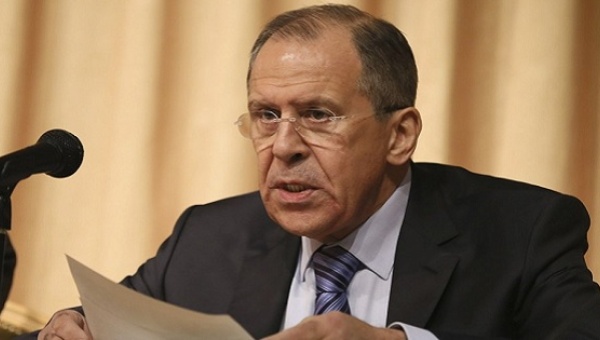
Russian Foreign Minister Lavrov reaffirms his country’s friendship with Venezuela. | Photo: PSUV
teleSUR – March 25, 2016
Russian Foreign Minister Sergei Lavrov said that his country has been closely following the situation in Venezuela and stressed that such is exacerbated by external interference.
“Venezuela is a friend country that they (opponents) are trying to destroy from outside,” Lavrov said Thursday during a meeting in Moscow with Venezuelan diplomats and Latin American students who are attending a course in diplomatic studies organized by the Russian Foreign Ministry.
At the meeting, the top diplomat explained the vision of Russia in Latin America and said he is pleased to see how Latin American countries have unanimously rejected coups led by right-wing opposition.
U.S. President Barack Obama issued an Executive Order March 9, 2015, declaring a “national emergency with respect to the unusual and extraordinary threat to the national security and foreign policy of the United States posed by the situation in Venezuela.” Obama then renewed that decree March 3, 2016, claiming that alleged conditions that prompted the first order had “not improved.”
All 33 members of the Community of Latin American and Caribbean States expressed their opposition to the U.S. government’s aggressive move and called for it to be reversed.
Featured Video

The 1964 Coup in Brazil
or go to
Aletho News Archives – Video-Images
Frlom the Archives
70 Neocons Petition Congress To Effectively Allow Israel To Say When The US Should Attack Iran
By Damian Lataan | January 10, 2014
Seventy senior Israeli-centric neoconservatives have written an open letter to Congress imploring them to do more to ensure Iran complies with the conditions of any agreement finally reached with the P5+1 over Iran’s nuclear program.
While the neocons are ostensibly asking Congress to ensure compliance, it is clear that their real aim is to convince members of Congress to support the bill currently passing through the Senate which calls for tighter sanctions against Iran in the event of any waywardness on Iran’s part.
The neocons are eager to see the bill currently passing through the Senate with enough support to make it veto-proof, not so much because they are concerned about Iran’s so-called nuclear weapons program – there’s still not a skerrick of hard evidence that Iran has a nuclear weapons program – but, rather, because embedded within the bill is this clause:
… if the Government of Israel is compelled to take military action in legitimate self-defense against Iran’s nuclear weapon program, the United States Government should stand with Israel and provide, in accordance with the law of the United States and the constitutional responsibility of Congress to authorize the use of military force, diplomatic, military, and economic support to the Government of Israel in its defense of its territory, people, and existence…
Essentially, the clause is an automatic trigger for the US to attack Iran at any time the Israelis choose to launch a first strike – regardless of whether President Obama is in favour or not.
Partial list… continue
Blog Roll
 Aletho News
- World cannot remain silent as US and Israel attack ‘heritage of humankind’: Iran
- Emirati billionaire rebukes US senator over call for Gulf states to join war with Iran
- Op. True Promise 4: Iran’s missile blitzkrieg dismantles US war machine in West Asia
- Aramco CEO warns ‘catastrophe’ imminent if Strait of Hormuz remains shut
- What If Iran Says No?
- Trump Threatens to ‘Hit’ Iran ‘Twenty Times Harder’ Over Strait of Hormuz Oil Flows
- Spare the hypocrisy: Baghaei slams Ursula’s support for US
- Iran War Supporters Invent a New and Absurd Justification: It Is All About China
- Corporate Media Go All Out To Support The US-Israeli War on Iran
- Trump press conference reveals a man who wants out of war
- If Americans Knew
- U.S. support for Israel continues to plummet, despite media’s best efforts
- Threats and missiles fly, death tolls soar in Iran, Lebanon, Gaza – Not a ceasefire Day 151
- Lebanon: Israel’s White Phosphorous Use Risks Civilian Harm
- Corporate Media Go All Out To Support The US-Israeli War On Iran
- US-Israel war on Iran is creating a steady growing number of amputees
- Israel planned this war on Iran for 40 years. Everything else is a smoke screen
- The wrong question about the war in Iran
- ‘Your Tax Dollars Being Used to Raise Your Gas Prices’: US-Israel Bomb Major Iranian Oil Depots
- ‘Bogus Evidence’: Former Nuclear Watchdog Head Debunks US Justification for Iran War
- EXPLAINER – Dimona: What to know about Israel’s nuclear site
- No Tricks Zone
- Wake-up Call: Survey Shows Majority Of Germans Now Favor Postponing Climate Targets!
- Televised! Leading German Political Candidate Tells Schoolchildren CO2 Makes Sun Hotter!
- New Study: A Century Warming Of 1.1°C Is ‘Commonplace’ And ‘Not Unusual’ During This Interglacial
- New Study: ‘Internal Noise’ And Volcanic Forcing Can Trigger 10-15°C Warming Within Decades
- Glaciers Worldwide Are Suddendly Surging, Experts Blame Warming!
- Surprising Discovery: Sahara Is Greening…Billions Of Trees Where Once Thought To Be Barren
- New Research Reaffirms Clouds, Aerosols, And Surface Solar Radiation Are ‘Driving The Climate System’
- Germany: Electric Car Catches Fire At Charging Station, Sets Off Local “Inferno”, Widespread Damage
- New Study: Canada’s New Brunswick Was 1°C Warmer Than Today During The Medieval Warm Period
- Coal Power Back In Trend As Globe Tries To Keep Pace With Growing Demand For Power
 Aletho News