Austrian President wants EU to examine ending anti-Russia sanctions
RT | April 6, 2016
The Austrian President Heinz Fischer says the EU has to find a way to lift sanctions against Russia.
“I always say that sanctions are disadvantageous for both sides,” Fischer said at Wednesday’s meeting with Russia’s State Duma Speaker Sergey Naryshkin. “It is important to find a way to lift them in the near future.”
He also said Austria is actively participating in EU’s discussions on the issue.
“Our position is that it’s necessary to consider all the opportunities to develop cooperation between Russia and the EU,” he added.
A few days ago Austrian business leader Christoph Leitl criticized anti-Russian sanctions, saying they had proved unsuccessful. Leitl said Russia with its raw materials and Europe with its expertise would complement each other perfectly.
At the moment, there’s no unity among the European Union for automatically prolonging the economic sanctions against Russia which are due to expire on July 31.
The Italian and Hungarian foreign ministers said last month that things can’t be taken for granted at this stage; the question of sanctions should be decided at the highest level and cannot be automatic. Meanwhile, the Baltic republics and Poland are demanding sanctions should continue as a response to what they describe as expansionist Russia.
EU sanctions against Russia were introduced in March 2014 after Crimea voted to separate from Ukraine and rejoin Russia.
READ MORE: Italy and Hungary against automatic renewal of anti-Russian sanctions
Pro-Israel lobby tells Prince Charles not to visit Iran
RT | April 6, 2016
Israel lobby group We Believe in Israel (WBII) is calling on Prince Charles to reconsider an upcoming visit to Iran, which it accuses of anti-Semitism.
The grassroots pro-Israel group started an online petition in response to reports the Prince of Wales is planning to visit Iran in autumn. The trip would be the first official visit of a UK royal to the Islamic Republic in over 40 years.
The Foreign Office and Clarence House are discussing a tour with Tehran, the Sunday Times reported last month.
The visit follows an international deal struck in 2015 after years of talks, which saw Western sanctions against Iran lifted in exchange for it abandoning its nuclear ambitions.
Prince Charles’ visit would mark a significant thaw in relations, and could lead to new trade ties.
WBII however has unequivocally called on the Foreign Office and Clarence House to abandon the plans.
“We do not consider it appropriate for a member of the Royal Family to visit Iran and give credibility to the Iranian regime,” the WBII petition reads.
WBII Director Luke Akehurst said he is “disturbed” by the prospect of a royal visit to Iran, noting the regime’s alleged ties to terror groups, its senior figures’ denial of the Holocaust and calls for the destruction of Israel.
“We find the proposed visit particularly strange as there has never been an official Royal visit to Israel, the only democracy in the region,” said Akehurst, the Jewish Chronicle reports.
In 2004, Prince Charles made an unofficial visit to the city of Bam in southeastern Iran in his capacity as president of the British Red Cross after an earthquake killed 40,000 people in the region.
Queen Elizabeth II paid the last official royal visit to Iran in 1974, five years before the Islamic Revolution deposed Shah Reza Pahlavi and installed a theocratic government.
Iran airlines have no need for Saudi airspace: Official
Press TV – April 6, 2016
An official in Iran’s government has downplayed a Saudi ban to keep Iranian airliners off Saudi Arabia’s skies, saying the country’s air carriers have no need for the KSA airspace.
Ebrahim Moradi, head of air traffic control of Iran Airports and Air Navigation Company (IAANC), told the official IRNA news agency on Tuesday that following the recent cut in bilateral diplomatic ties, no Iranian airline company has scheduled flights to Saudi cities.
Saudi Arabia severed diplomatic relations with Iran on January 3 following demonstrations held in front of the Saudi embassy in Tehran and its consulate in the northeastern city of Mashhad by angry protesters censuring the Al Saud regime for the execution of prominent Shia cleric Sheikh Nimr al-Nimr in Riyadh a day earlier.
Moradi pointed to the recent Saudi ban on Iran’s Mahan Air company, saying Riyadh’s decision will not impact the Iranian airline as the company currently operates no flights to African nations via the Persian Gulf Kingdom of Saudi Arabia (KSA).
Saudi Arabia’s General Authority of Civil Aviation (GACA) said Monday that Mahan Air was banned due to violations of local safety rules.
The GACA said in a statement that several violations related to airline safety had been committed by Mahan Air, “prompting the suspension of licenses granted to the company.”
“This decision comes in the context of the GACA (regarding) the safety of passengers and to preserve their lives,” Reuters reported.
Trade between Iran and Saudi Arabia has mostly been small and each year only Iranian pilgrims travel to the kingdom for the hajj pilgrimage.
Several countries, including Pakistan, Russia and China, have so far voiced readiness to mediate between Iran and Saudi Arabia to ease up their tensions.
UNSC resolution does not ban Su-30 fighter jet sales to Iran: Russia
Press TV – April 6, 2016
Russia has rejected a US claim that the sales of Sukhoi Su-30 fighter jets to Iran were prohibited under a United Nation Security Council resolution.
On Tuesday, the US Department of State Undersecretary for Political Affairs Thomas Shannon said Washington would use its veto power in the Security Council to block the possible sales of the fighter jets to Iran.
“The sale of Su-30 fighter aircraft is prohibited under UNSCR 2231 without the approval of the UN Security Council and we would block the approval of any sale of fighter aircraft under the restrictions,” Shannon said, referring to the UN resolution.
Head of the Russian Foreign Ministry’s department for non-proliferation and arms control, Mikhail Ulyanov, dismissed the claim.
“Such deliveries are not prohibited, they are allowed, and this follows from the text of the resolution,” the Interfax news agency quoted him as saying.
Resolution 2231, adopted by the Security Council on July 20, 2015, endorsed a nuclear agreement between Iran and the P5+1 group, comprising Russia, China, France, Britain, the US and Germany.
Shannon claimed that under the resolution, such weapon deliveries “require the submission of relevant notification to the Security Council and this notification’s endorsement by the Security Council.”
Ulyanov said Moscow has not forwarded such a notification to the Security Council so far.
Political analysts say Resolution 2231 does not prohibit Iran from buying fighter jets, and its language is not legally binding and cannot be enforced with punitive measures.
Su-30 is a multirole advanced fighter aircraft for all-weather, air-to-air and air-to-surface deep interdiction missions.
Iran and the P5+1 finalized the nuclear agreement, dubbed the Joint Comprehensive Plan of Action (JCPOA) in Vienna, Austria, in July last year. They started to implement the JCPOA on January 16, 2016.
On Tuesday, a senior Russian diplomat also said Moscow would begin the first shipment of its S-300 air defense missile systems to Iran in the coming days.
“I don’t know if this will happen today, but they (S-300 missiles) will be loaded (for shipment to Iran),” Interfax quoted Zamir Kabulov, a department chief at the Foreign Ministry, as saying.
Turkish President Calls to Strip ‘Terrorism Supporters’ of Citizenship
Sputnik — 05.04.2016
Turkey’s President Recep Tayyip Erdogan on Tuesday called for a debate on whether those who Ankara deems “terrorist supporters” should be stripped of Turkish citizenship, local media reported.
“We should consider all measures against supporters of terrorism, including stripping them of their citizenship,” Erdogan said, as quoted by the Daily Sabah newspaper.
The Turkish government has stepped up anti-terror efforts in the wake of suicide bombings that rocked its capital Ankara earlier this year. The attacks were claimed by pro-Kurdish militants in response to Turkey’s shelling of Kurdish positions in Syria.
Erdogan also brought up the issue of removing parliamentary immunity of members of the pro-Kurdish and pro-minority Peoples’ Democratic Party (HDP), which he said “should be taken care of immediately,” according to the outlet.
Ankara previously controversially labelled government critics as supporters of terrorism. In January, several academics were held for allegedly engaging in terrorism propaganda after they condemned the ongoing operation in Turkey’s Kurdish-dominated southeast that has killed over a hundred civilians since August.
US to block sale of Russian Su-30 aircraft to Iran: State Dept.
Press TV – April 5, 2016
The United States would use its veto power in the United Nations Security Council to block the sale of Russian Ru-30 fighter jets to Iran, the State Department says.
Department of State Under Secretary for Political Affairs Thomas Shannon made the announcement on Tuesday during a congressional hearing on Iran. “We would block the approval of fighter aircraft.”
Shannon told the Senate Foreign Relations Committee hearing that any such sale of fighter jets would have to be approved by the UN Security Council.
Su-30 is a multirole advanced fighter aircraft for all-weather, air-to-air and air-to-surface deep interdiction missions.
“The sale of Su-30 fighter aircraft is prohibited under UNSCR 2231 without the approval of the UN Security Council and we would block the approval of any sale of fighter aircraft under the restrictions,” Shannon said.
Shannon was referring to the UN Security Council Resolution 2231, adopted by the Security Council on July 20, 2015, which endorsed the nuclear agreement between Iran and the P5+1 group – Russia, China, France, Britain, the US and Germany.
The UN resolution calls upon Iran not to undertake any activity related to ballistic missiles designed to be capable of delivering nuclear weapons, including launches using such ballistic missile technology.
But according to diplomats, resolution 2231 does not prohibit Iran from buying fight jets, and the language of 2231 is not legally binding and cannot be enforced with punitive measures.
Iran and the P5+1 finalized the Joint Comprehensive Plan of Action (JCPOA) in Vienna, Austria, on July 14, 2015. They started to implement the JCPOA on January 16, 2016.
Under the agreement, limits are put on Iran’s nuclear activities in exchange for, among other things, the removal of all nuclear-related economic sanctions against the Islamic Republic.
NATO chief vows to make US allies ramp up defense bills citing ‘Russian aggression’
RT | April 5, 2016
Following a meeting with US President Obama, NATO Secretary-General Jens Stoltenberg lauded the block’s “biggest reinforcement since Cold War,” promising European members will step up defense spending, while listing an “assertive Russia” among the alliance’s chief threats.
While never mentioning the maker of the latest “obsolete NATO” remarks by name, on Monday both Barack Obama and Stoltenberg did their utmost to dismiss Donald Trump’s recent statements and defend the Cold War-era block’s supposedly crucial role in assuring the allies’ security.
Obama described NATO as “a linchpin, a cornerstone of US security policy,” while Stoltenberg said it was “important as ever,” while ramming home the story that NATO “has been able to adapt” to a “more dangerous world.” The comments were made after a bilateral meeting in Washington, DC scheduled to mark the 67th anniversary of NATO – the first such high-level talks since the Paris and Brussels attacks.
“Together, we are now implementing the biggest reinforcement through our collective defense since the end of the Cold War,” Stoltenberg said.
The challenges discussed at the meeting ranged from countering Islamic State (IS, formerly ISIS/ISIL) terrorism in Libya, Syria, and at home, and training security forces in Afghanistan for “pushing back against the Taliban,” to dealing with the European migrant crisis and helping resolve the conflict in eastern Ukrainian. However, the reinforcements in question boiled down to one perceived threat: containing “a more assertive Russia, responsible for aggressive actions in Ukraine.”
Indeed, Obama has backed quadrupling the budget of the so-called European Reassurance Initiative, as the Pentagon has announced a plan to deploy additional US Army troops and equipment in Eastern Europe in 2017, meaning that US military presence in Europe could soon amount to three fully operational army brigades.
“This is really a strong example of the Transatlantic bond, how the United States is important for the security of Europe,” claimed Stoltenberg.
The “reassurance” would come at a price, however, with US taxpayers potentially on the hook for the $3.4 billion requested by Obama from Congress, and the alliance’s chief now pushing European NATO member states to step up their commitment by coughing additional funding up for the block from their coffers.
“I will work together with all the NATO allies to make sure that they make good on the pledge they made together to increase defense spending. And this is about that we have to invest more in our security when tensions increases, and therefore we have to make sure that we do what we promised, and that is to invest more in defense in the following years.”
The US and NATO have been increasingly active in pushing for a stronger military presence in Europe, particularly in regions close to Russia’s border. They argue that this deployment is necessary to deter Moscow from making aggressive military moves.
Commenting on the latest developments to Izvestia daily, Russia’s permanent representative to NATO, Aleksandr Grushko, noted on Thursday that alliance’s new advances contradict the spirit of the international treaties on mutual relations and military activity, which state that the Western military bloc is not to permanently station additional forces near Russian borders. He added that the plan to deploy new armored units in Eastern Europe would lead to “a significant deterioration of the situation in the military sphere,” vowing a “totally asymmetrical” response from Russia.
“We are not passive observers, we consistently take all the military measures we consider necessary in order to counterbalance this reinforced presence that is not justified by anything,” Grushko said on Wednesday.
Meanwhile, US President Barack Obama told reporters on Monday that NATO is currently in contact with Russia with regard to resolving the crisis in Eastern Ukraine, but only in the form of consultations.
“NATO is consulting with Russia to reduce tensions and potential escalation,” the White House announced in a pool report. Obama then noted that both the US and NATO plan to further train and support the Ukrainian military in order to enhance its defense capabilities. “[US and NATO will] continue to be united in Ukraine in the wake of Russian incursions in the Ukrainian territory, [working in] a ‘train and assist’ fashion to help Ukraine develop its military capabilities defensively.”
“That does not mean we are not continuing to work with Russia to try and find a resolution to the problems in Ukraine. We think it’s important to maintain a dialogue with Russia and in a very transparent fashion indicate the firmness of our resolve to protect our values and our allies,” the pool report quoted Obama as saying.
The US has accused Moscow of military engagement in Ukraine, while Russia has repeatedly denied these claims. Kiev launched a military operation against militias in eastern Ukraine in April 2014 after they refused to recognize the new coup-installed government in Kiev. The confrontation has claimed over 9000 lives to date, according to UN estimates. Despite the second Minsk agreement of February 2015, which was aimed at suspending hostilities in the region and facilitating a political solution to the conflict, both sides occasionally breach the agreed upon ceasefire.
Iran Reaches Positive Net-of-Oil Trade Balance for First Time in 37 Years
Sputnik — 04.04.2016
Iranian exports excluding oil trade have exceeded imports for the first time in 37 years, Iranian President Hassan Rouhani said on Monday.
“The government has tried to step by step reduce dependence on oil revenues, and for the first time in the history of post-revolutionary Iran [after 1979], in 2015-2016, our export revenues exceeded import spending without taking into account oil trade,” Rouhani was quoted as saying by the IRINN broadcaster.
Rouhani added that Iran’s oil exports continue to grow, reaching two million barrels per day, and Iran will continue to seek to increase this figure.
Iran has been boosting its oil sales after a deal with the P5+1 group of world powers — including Russia, the United States, China, France and the United Kingdom plus Germany — in July to monitor and limit Tehran’s nuclear program in exchange for the easing of international sanctions.
In February, the head of the National Iranian Oil Company said that the country aims to raise its daily oil exports to 4.7 million barrels.
Why the Establishment Hates Trump
By John McMurtry | CounterPunch | April 5, 2016
On the face of it, Donald Trump is Reagan on steroids. His towering size, his nativist US supremacism, his down-home talk, and his reality-show confidence make him ideal for the role of bullying and big lies from the oval office. He is America come to meet itself in larger-than-life image to rejuvenate it as its pride slips away in third-world conditions and a multi-polar world.
While Trump’s narrative is that the American Dream seeks recovery again, the dominant media and political elite relentlessly denounce him as an implicit fascist and disastrous fake. Something deeper is afoot. An untapped historic resentment is boiling up from underneath which has long been unspeakable on the political stage. Trump has mined it and proposed a concrete solution always denied of his candidacy. From his promise to halve the Pentagon’s budget to getting the Congress off corporate-donation payrolls, the public money that the big corporate lobbies stand to lose from a Trump presidency are off the charts. But his attackers dare not recognize these explosive issues because they are all part of the problem.
The public money stakes may be bigger than the US corporate stakes behind the foreign wars the US state has initiated since 1991. The takeaway promised by Trump’s policies threaten almost every big lobby now in control of US government purse strings. It grounds in the military-industrial complex spending close to $2,000,000,000 a day for its endless new untested weapons and foreign wars both of which Trump opposes. But the cut-off of hundreds of billions of public giveaways to the Big Corps do not end here. They hit almost every wide-mouthed transnational corporate siphon into the US Treasury, taxpayers’ pockets and the working majority of America. Masses of American citizens increasingly without living wages and benefits and in increasing public squalor and insecurity are paying attention to what the political establishment and corporate media have long buried and continue to silence.
Trump has raised the great dispossession from impotence into the establishment’s face, and this is why he is a contagion on the American political scene. He is pervasively mocked, accused and slandered in non-stop public fireworks of ad hominem hits, but the counter-attacks never engage what Trump has set his sights on – the long stripping of America by
corporate globalization selecting for the limitless enrichment of the very rich living off an ever-growing take from public coffers and the impoverishment of America’s working people. A primal rage unites the political establishment across party lines, but they can’t say why. No defaming scorn and abuse is off limits, but Trump’s underlying betrayal of the ruling game remains unspeakable on the stage.
The electoral dynamite of all the Americans who have lost all their good blue-collar jobs, social benefits and public infrastructures is recognized only in class condescension. But the facts cannot be denied of a corporate globalization effectively stripping the lower middle classes and the public realm itself with no-one in Washington establishment saying a word against the greatest transfer of wealth to the 1% in history.
Trump may deserve back as bad he gives. But this understanding keeps our eyes on the ego-contest which is the standard spectacle to avoid the real issues. The personal attacks only tells us how deep the rupture has become between Trump’s campaign and the establishment on the issues kept out of sight. This is why the corporate politicians and media are almost as wound into one-way demonization of Trump as they are when they beat the drums of war against a designated Enemy abroad.
In the end, it may get to him – as when he tries to find angry millions again from onside with an evangelical trumpet of abortion-is-murder just before the primary in Wisconsin.
Trump is a shameless opportunist, no doubt. Yet we continue to revolve within an ad hominem circle until we go deeper than the establishment morality tale of the evil of the stigma object – the oldest propaganda trick in the book. The major money interests that are really at stake in the conflict between Trump and the political-economic establishment remain unconnected and blocked out. “Who will stop Trump’ is not only now asked across America, but the world’s media in China too. But nothing is less talked about than the globally powerful interests he has promised to rein back from the public troughs bleeding the country’s capacities to build for and to employ its people. On this topic, there is only silence or abusive distortion frothing from the mouth.
Joining the Dots of the Great Silence
Eventually people may ask why the establishment unanimously abhors Trump across party divisions which are otherwise unbridgeable. Even if he is a caricature of American privilege and self-promotion, who else could fight the corrupt corporate-state and media establishment? Who else could ever get public support from dispossessed masses and from inside the Republican Party base itself? Who else could take on the supra-dominant corporate interests of the war state, drug monopoly, health insurance racket, lobby-run foreign policy, off-shore tax evasion, and global trade with only corporate rights to profit taking jobs in the tens of millions from home workers, and still hold a large and right-wing voter base onside?
Conversely, what else than Trump’s threat to the corporate-state establishment can explain the unity of voice and venom against an American paragon of wealth and chupzpah? What else could motivate a cross-party and corporate media hate campaign where there is nothing else in common across the condemning voices? Only those citizens depending on the deep system corruptions he promises to reverse are really threatened by Trump’s candidacy. But how do these huge private interests go on getting away with a corporate-lobby state transferring every more public wealth and control to them at the expense of the American majority and their common interest when most people already dislike and are systemically exploited by them? They get away with it by no-one being able to do anything about it.
Trump represents a threat to these gargantuan public-trough interests that even the super clean and informed Ralph Nader candidacy for president never did. The corporate media and party machines just shut him down on the electoral stage so few even knew he was a presidential candidate. You can’t do that with Trump. That is the very big problem for the otherwise seamless political and media establishment who are all in on the fabulous payoffs of this corporate state game. Trump’s entire strategy is based on getting public attention, and he is a master at it, unbuyably rich, and the most watched person in America across the country and the world. He can’t be shut up. Personal stigmatization and attack without let-up are the only way to gag his policies and turn the tide against him at the same time.
Maybe it will work in the end. It’s how disastrous and bankrupting foreign aggressions and wars have been sold whatever the ruinous costs to the public paying for them.
Until Wisconsin
When you join the dots to Trump also preaching a policy revolt against the insatiable corporate jaws feeding on trillions of dollars of public budgets in Washington, the meaning becomes clear. But that connected meaning is blacked out. In its place, the corporate media and politicians present an egomaniac blowhard bordering on fascism who preaches hate, racism and sexism. But the silenced policies he advocates are more like jumping into a crocodile pit. He is on record saying he will cut the Pentagon’s budget “by 50%”. No winning politician has ever dared to take on the military-industrial complex, with even Eisenhower only naming it in his parting speech. Trump also says that the US “must be neutral, an honest broker” on the Israeli-Palestine conflict – as unspeakable as it gets in US politics. Big Pharma is also called out with “$400 billion to be saved by government negotiation of prices”. The even more powerful HMO’s are confronted by the possibility of a “one-payer system”, the devil incarnate in America’s corporate-welfare state.
Trump even challenges “the Enemy” cornerstone of US ideology when he says “wouldn’t it be nice to get along with Russia and China for a change?” Not very fascist of him. He was also open to nationalizing the Wall Street banks after 2008. None of this sees the light of day in the hate-Trump culture that been effectively mounted across even left-right divisions. Most of all, Trump rejects the whole misnamed “free trade” global system because it has “hollowed out the lives of American workers” with rights to corporations to move anywhere to get cheaper labour and import back into the US tariff-free. But again the connected meaning is repressed. That Trump also wants to get the US out of foreign wars at the same time, the other great pillar of corporate globalization, is the real danger to the transnational corporate state he has set in motion.
All these policies threaten only the ruling money interests of America that depend on the superpower public purse to extend their transnational monopolies and multiply their wealth. This is the real establishment interest that has so far evaded the glare of publicity and critique of the Donald Trump phenomenon, bigger now with Bernie Sanders than any political challenge to the US system since the 1960’s. Trump is certainly not a working-class hero. He is a pure capitalist, with all the furies of private interest and greed that capitalism selects for. But at this time he is a capitalist who is not rich from looting the public purse as the biggest annual cash flow, nor from exporting the costs of labor and taxes to foreign jurisdictions with subhuman standards that come back to the US as “necessary to compete”. Trump has initiated a long overdue recognition of parasite capitalism eating out the life capacities of the US itself.
 John McMurtry is a Fellow of the Royal Society of Canada. He is the author of the three-volume Philosophy and World Problems published by UNESCO’s Encyclopedia of Life Support Systems (EOLSS), and his most recent book is The Cancer Stage of Capitalism: from Crisis to Cure.
The Forces Behind the Attempted Coup in Brazil
By Mark Weisbrot | The Hill | April 5, 2016
If you are following the news of political turmoil in Brazil, it may be difficult to get a grasp of what is really going on. This often happens when there is an attempted coup in the Western Hemisphere, and especially when the U.S. government has an interest in the outcome. Usually the information about that interest, and often Washington’s role, is the first casualty of the conflict. (Twenty-first century examples include Paraguay in 2012, Haiti in 2011 and 2004, Honduras in 2009, Ecuador in 2010 and Venezuela in 2002.)
First, there is no doubt that this is a coup in progress. It is an attempt by Brazil’s traditional elite — which includes, as one of the most important players, most of the major media — to reverse the outcome of Brazil’s 2014 presidential elections. Exhibit A is the grounds on which they hope to impeach President Dilma Rousseff of the Workers’ Party (PT by its Portuguese initials). It has nothing to do with corruption, or any serious offense.
The charge is that the government used borrowed money in 2014 to maintain the appearance that the primary budget surplus was within its target. But this is something that other presidents had done, and is hardly a serious offense. A comparison: When the Republicans in the U.S. Congress threatened to shut down the government over the debt ceiling in 2013, the Obama administration used a number of accounting tricks to extend the deadline, and there was little controversy over this.
The charges against Lula are also dubious, even if they turn out to be true. Most importantly, the accusers have not shown any connection to the big “Lava Jato” (car wash) corruption scandal — or any other corruption. Lula is accused of owning some beachfront property, which he denies owning, that was renovated by a Brazilian construction company; and of receiving money from various corporations for speeches. Most importantly, however, these are things that took place after he left the presidency. Although Bernie Sanders has rightly made an issue of Hillary Clinton’s receipt of millions of dollars from corporations for speeches, it is not illegal in the U.S. — or Brazil.
The main judge investigating these cases, Sergio Moro, had to apologize to the Supreme Court for leaking to the press wiretapped conversations between Lula and Dilma, as well as between Lula and his attorney, and between his wife and their children. The detention of Lula for questioning, with advance leaks to the media and involving 200 police despite the fact that Lula had always voluntarily submitted to questioning, also left no doubt as to the political nature of the investigation.
If Moro had any evidence linking Dilma or Lula to actual corruption, it is likely that some of it would have been released by now, given that he has leaked personal and private wiretapped conversations just to embarrass them. Brazil’s anti-democratic, corrupt elite is trying to take the country back to its pre-democratic past, when the electorate could not interfere with their choice of leaders.
Unfortunately, that is not all that long ago: The dictatorship that lasted until 1985 was installed in a 1964 U.S.-backed coup, to which the current efforts bear some resemblance. About the U.S. role today: It is no secret that Washington would like to get rid of all of the left governments in the region. In President Obama’s trip to Argentina last week, and other public statements from U.S. officials, they made it clear how happy they were to welcome the new right-wing government there. They also reversed their policy, implemented against the prior, left government, of blocking loans to Argentina from international lenders like the Inter-American Development Bank and World Bank.
Of the coups mentioned above, evidence of the U.S. role is documented beyond a reasonable doubt in all of them except Ecuador, where there is no hard evidence. But since there has almost never been a coup in this hemisphere against a left government without some U.S. involvement, it is no wonder that many Ecuadoreans believe the U.S. was (and remains) involved there, too. And such speculation is not unreasonable in Brazil, where Washington intervened in 2005 in support of a legislative effort aimed at undermining the Workers’ Party government.
The massive spying on Brazil —and especially Petrobras — that Edward Snowden and Glenn Greenwald revealed in 2013, also points in this direction. It could be a coincidence that all this information about Petrobras was gathered by the U.S. government just prior to the scandals at the state-controlled oil company; or perhaps Washington shared some information with its allies in the Brazilian opposition. And there is no doubt that, like President Mauricio Macri in Argentina, the biggest players in this coup attempt — people like former presidential candidates José Serra and Aécio Neves — are U.S. government allies. Of course the PT government would not be in so much trouble today, even with the media leading the charge, if the economy – which shrank by an estimated 3.8 percent last year — were in better shape.
And that, unfortunately, is due mainly to their own mistakes; beginning at the end of 2010, they embarked on a series of spending cuts, interest rate increases, and other measures that stalled the economy, followed by even harsher austerity in 2015 that caused a deep recession with no end in sight. Unemployment has risen from a record low of 4.3 percent in December 2014 to 8.2 percent today. This didn’t have to happen; with more than $360 billion in foreign currency reserves, Brazil is not constrained by the balance of payments, and therefore could recover with expansionary macroeconomic policies.
Dilma and Lula are on the ropes and up against some powerful enemies, but it would be premature to count them out. They have faced tougher battles; unlike their adversaries and the big media companies that supported the dictatorship, they were imprisoned during its rule. If they can survive the current coup attempt, they will have a chance to fix the economy and return to their legacy — which is, after all, one of considerable economic and social progress.
Disgraceful BBC Panorama Propaganda Hides Grim Truth About Britain
By Craig Murray | April 5, 2016
Richard Bilton of the BBC today exposed himself as the most corrupt and bankrupt of state media shills – while pretending to be fronting an expose of corruption. There could not be a more perfect example of the western state and corporate media pretending to reveal the Panama leak data while actually engaging in pure misdirection.
In a BBC Panorama documentary entitled Tax Havens of the Rich and Powerful Exposed, they actually did precisely the opposite. The BBC related at length the stories of the money laundering companies of the Icelandic PM and Putin’s alleged cellist. The impression was definitely given and reinforced that these companies were in Panama.
Richard Bilton deliberately suppressed the information that all the companies involved were in fact not Panamanian but in the corrupt British colony of the British Virgin Islands. At no stage did Bilton even mention the British Virgin Islands.
Company documents were flashed momentarily on screen, in some cases for a split second, and against deliberately unclear backgrounds. There is no chance that 99.9% of viewers would notice they referred to British Virgin Islands companies. But instantly reading a glimpsed document is an essential skill for a career diplomat, and of course I happen to know immediately what BVI or Tortola mean on a document. So I have been back and got screenshots of those brief flashes.
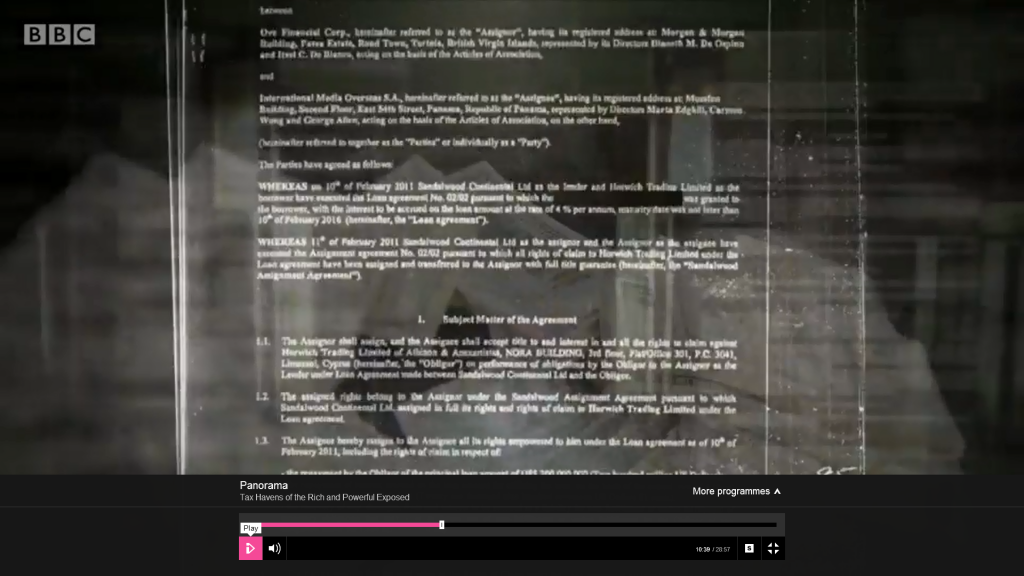
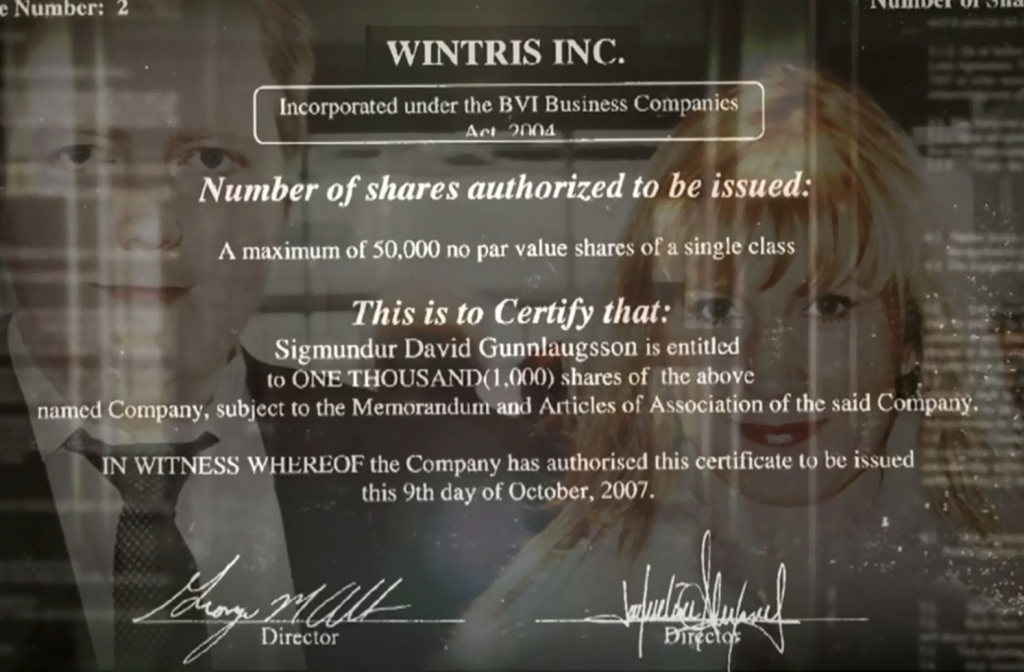
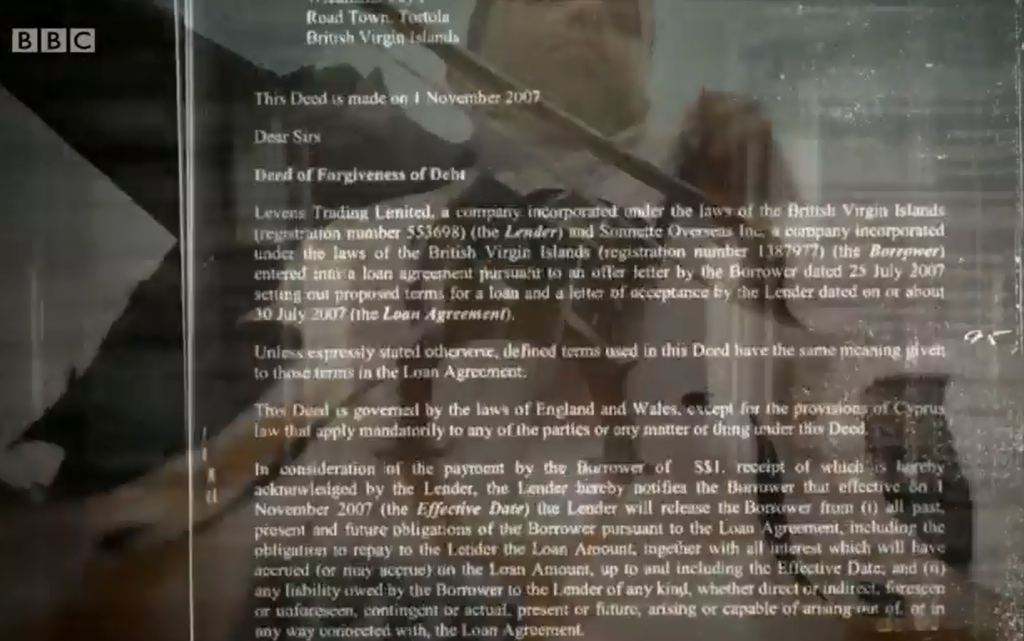
Is it not truly, truly, astonishing the British Virgin Islands were not even mentioned when the BBC broadcast their “investigation” of these documents?
In deliberately obscuring the key role of the British money-laundering base of British Virgin Islands in these transactions, the BBC have demonstrated precisely why the entire database has to be released to the scrutiny of the people, rather than being filtered by the dubious honesty of state and corporate journalists. The BBC targeting of two very low level British minions at the end of their programme does not alter this.
The BBC could also address why their Pacific Quay HQ in Glasgow is leased for £100 million from a hidden ownership company in the Cayman Islands.
Featured Video
The Source of America’s Wars – Kristol Clear
or go to
Aletho News Archives – Video-Images
From the Archives
Is Israel to blame for the Iraq War?
American Goy | March 10, 2008
I am so tired of this old canard that “Israel had nothing to do with USA’s war with Iraq – in fact, it officially advised America against it”.
Bullshit. … continue
Blog Roll
 Aletho News
- Israel’s priority lies in destroying chances of peace between Iran, US: Ex-UN nuclear chief
- Ceasefire for all or for none: Iran shuts Hormuz over Lebanon attacks
- Strait of Hormuz is Iran’s ‘nuclear weapon’ that forced US retreat: Medvedev
- Energy crisis will last for months – Kremlin envoy
- Europe’s quiet role in the war on Iran
- Forty days that shook the Empire: How Iran turned the tables on US and prevailed
- Netanyahu unilaterally declares Lebanon outside of ceasefire deal
- Israeli leaders: ‘Not a single goal’ achieved in war with Iran
- What on earth just happened? Trump, Iran, and the unlikely ceasefire
- Alberta Bill Would Fine Political Deepfakes $10,000 Without Satire Exemptions
- If Americans Knew
- Gazans face a triple crisis: severe shortages of water and bread, healthcare in tatters
- NY Times reports how Netanyahu took the US into Iran War
- A sigh of relief over Iran, but Gaza and Lebanon in dire straits – Daily Update
- Thousands dead and neighborhoods razed to the ground: Aid agencies fear southern Lebanon is becoming the new Gaza
- The war the US is fighting for Israel could cost trillions
- ‘Cigarette Burns, Nail Wounds’: Toddler Tortured in Gaza to Coerce Father
- Trump Says US Sent ‘a Lot of Guns’ to Protesters in Iran
- Israeli forces destroy 17 UN peacekeeper cameras in south Lebanon
- US-Israeli strikes ‘completely destroy’ synagogue in Tehran
- Archbishop for US Military Says Iran War Is Unjust Under Catholic Teaching
- No Tricks Zone
- An Inconvenient Tree: Uncovered In Alps… Europe Much Warmer Than Today 6000 Years Ago
- New Study Reports A 60% Slowdown In Greenland’s Ice Loss Rate In The Last Decade
- Low Intensity Tornado Wrecks Major Solar Farm, Creating A Potential Toxic Dump
- New Study Finds Warming Saves Lives…Cold Temperatures 12 Times More Deadly Than Excess Heat
- German Science Blog Accuses PIK Climate Institute Of Hallucinating Climate Tipping Points
- Devastating Assessment Of Comirnaty Vaccine By Former Senior Pfizer Europe Toxicologist
- New Study: CO2 Is ‘Effectively Negligible’ As An Explanatory Climate Change Factor Since 2000
- Former Pfizer Toxicologist Dr. Helmut Sterz Tells Bundestag Hearing Pfizer Vaccine Should Have Never Been Approved
- Energy Expert: Germany’s Nuclear Phaseout Was A “500 Billion Euro Mistake”
- New Research: South Australia’s Mid-Holocene Sea Surface Temperatures Were 4°C Warmer Than Today
 Aletho News