Are Al-Qaeda’s Lebanese Affiliates Opening a Lebanese Front in the Syrian War?
By Mahdi Darius Nazemroaya | Global Research | June 23, 2016
The US and its allies are working inside Lebanon to open a new front in the Syrian conflict. Lebanon has been sedated into a state of limbo by the lack of a government and the postponing of its parliamentary elections. Complicating matters, many institutional figures and military commanders have gone into retirement and the caretaker government is unable to replace them.
Hezbollah’s intervention into the Syrian conflict has given a boost to the Syrian government against the anti-government forces trying to overrun Syria.
This has turned the attention of the US and its allies onto Lebanon as a new arena of battle. Rockets are also being launched by anti-government forces from Syria, and even from inside Lebanon, against Hezbollah’s political strongholds and against Shia Muslim villages. The goal is to ignite the flames of sedition between Shiites and Sunnis inside Lebanon.
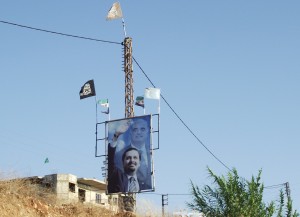
Photo Below: Picture of the Hariris adorned with the Future Party’s flag and Al-Qaeda and anti-government Syrian flags by their followers on the way to Sidon. (Photo by Mahdi Darius Nazemroaya)
Al-Qaeda in Lebanon
Al-Qaeda’s flag has been flying in Lebanon for years. Driving near the airport in Beirut or on the road to Sidon (Saida) you can see the Al-Qaeda flags flying in black. The same goes for Tripoli (Trablos) and some areas inside Beirut. Since the Syrian conflict you can see the Al-Qaeda flag flying next to the Syrian insurgent’s flag. The US and its allies have actually turned a blind eye to the support that the Future Party of Saad Hariri provides to Al-Qaeda. It is worth noting that the current head of the UN Secretariate’s Department of Political Affairs, Jeffrey Feltman, who was once the US ambassador to Lebanon before he was promoted in the US Department of State, also turned a blind eye to the support for Al-Qaeda by the Hariri family’s Future Party and its March 14 Alliance.
The Hariri family has had a long alliance with the takfiris and Al-Qaeda supporters. They have been political allies with groups in Lebanon that openly revere Osama bin Laden as a great leader. It was the Hariri family and members of their Future Party that also imported the fighters that would become Fatah Al-Islam into Lebanon. The exploitation of takfiri militias inside Lebanon by the Hariri family was intended to crush Hezbollah after Israel failed to do in 2006. Regionally, the same strategy involved the Hariri family’s Saudi patrons and George W. Bush’s administration, which were preparing and arming these militias as tools/weapons against Syria and Iran. The Hariris were furious when Seymour Hersh exposed them and had him publicly rebuked.
Months later Fatah Al-Islam would get out of control. Seymour Hersh would be vindicated. The Hariri-led March 14 Alliance would dishonestly try to blame Syria and the Palestinians for creating and supporting the group that they themselves had created. The fighting in Lebanon between the Lebanese military and Fatah Al-Islam foreshadowed the armies that were amassed for regime change in Libya and Syria by the US and its allies.
Tripoli and Sidon as Extensions of the Syrian Conflict
Lebanon’s second largest city, Tripoli, has seen intense fighting between the Alawite community of Lebanon, which is represented by the Arab Democratic Party, and the Hariri family’s takfiri allies. Hariri’s allies in Tripoli are open supporters of Al-Qaeda and the anti-government forces in Syria; they have smuggled weapons across the Lebanese-Syrian and sent large numbers of fighters into Syria to topple the government in Damascus. The Future Party has been involved in coordinating this also.
Lebanon’s third largest city, Sidon, has also been the scene of fighting and tensions between Ahmed Al-Assir, a Hariri ally, and Hezbollah’s supporters and allies. Al-Assir’s men have even tried to kill one of Sidon’s main Sunni Muslim clerics, Maher Hammoud, because he has constantly been working for Muslim and Lebanese unity and saying that there is an attempt to ignite a Shia-Sunni conflict in Lebanon and the broader region. A contingent from the Lebanese military has had stay in Sidon to keep the peace in the city.
Al-Assir’s men attacked and killed members of the Lebanese military in a village on the outskirts of Sidon for no apparent reason on June 23, 2013. This has ignited a battle in Sidon. Thick smoke from the city can be seen from a far distance. It has been reported that members of the anti-government forces from Syria have also joined them. The Lebanese military has deployed heavy weapons to fight Al-Assir’s group and to restore peace to the Lebanese city.
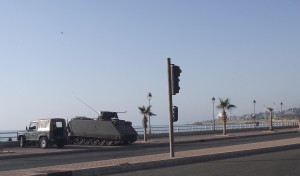
Photo Below: Lebanese Armed Forces checkpoint in Sidon. (Photo by Mahdi Darius Nazemroaya)
The Objective is to Force Hezbollah to Retreat in Syria by Targeting Lebanon
The Lebanese state is now being targeted. There have been an increasing number of attacks against the Lebanese military from the Syrian border since Hezbollah intervened in Syria. There were already attacks on Lebanon even before Hezbollah intervened in the Syrian conflict, but those were mostly intended to provoke Hezbollah.
Those targeting the Lebanese state are now taking advantage of the lack of a functioning government and the leaderless status of several national institutions to create a state of chaos in Lebanon. There have been attacks on both Shiite and Sunni villages in the Bekaa Valley and a cycle of violence has begun. It is clear that the objective is to turn Shiites and Sunnis against one another and the Lebanese military has understood this too. This is why Hezbollah has asked the Shiite clans in Bekaa to stay calm after they have been attacked. Protests have broken out in Lebanon too.
The violence in Sidon is part of a strategy. Al-Assir’s unprovoked attack against the Lebanese military is intended to mount pressure on the Lebanese state and exacerbate Shia-Sunni tensions.
Hezbollah refuses to get embroiled in a sectarian battle inside Lebanon. While the Amal Movement, the Shiite political party that is Hezbollah’s partner, has mobilized its militias and started manning the southern and eastern roads into Sidon, Hezbollah has kept calm. Amal’s media has also been reporting on the incident profusely and even in a sectarian fashion, but Hezbollah’s media have inversely been calm and said little.
Lebanon is being lit up with the aim of forcing Hezbollah to pullout from Syria by turning inwards to fight an internal battle. Essentially, Lebanon is now a second front in the Syrian conflict.
The US and Saudi Arabia have probably asked the Hariri family to prompt their Al-Qaeda affiliated clients to initiate violence in Lebanon and capitalize on the lack of a government and the weakened state of the Lebanese state.
Mahdi Darius Nazemroaya is a sociologist and Research Associate of the Centre for Research on Globalization (CRG). He is currently working out of Lebanon. He was in Sidon during the fighting and the deployment of the Lebanese military.
Copyright © Mahdi Darius Nazemroaya, Global Research, 2013
See also:
Saudi Arabia obstructing election of Lebanon president: Hezbollah
Turkey denies apology to Russia over downed jet
Press TV – June 28, 2016
Prime Minister Binali Yildirim says Turkey has only expressed regrets to Russia over a downed jet in Syria, denying reports of an apology.
Yidirim also reversed an earlier offer of compensation to Russia for shooting down one of Moscow’s military jets in November, Turkish media reported on Tuesday.
“Compensating Russia is not on the table, we have only expressed our regrets,” CNN-Turk cited him as saying, hours after he said Ankara was ready to offer compensation for the incident.
The Kremlin said on Monday that Turkish President Recep Tayyip Erdogan had apologized to Russian leader Vladimir Putin in a letter.
Erdogan’s spokesman confirmed the letter, but said the Turkish president had only expressed regret and asked the family of the pilot killed after the downing to “excuse us.”
The denial came just as the Kremlin said on Tuesday that President Putin will hold a phone conversation with Erdogan on Wednesday.
Kremlin spokesman Dmitry Peskov, however, told a conference call with journalists that Russia did not expect strained relations with Turkey would mend in a few days.
Putin has said an apology from Erdogan is the condition for repairing relations between the two countries, which were shattered when the Russian jet was shot down by Turkey at the Syrian border.
Ankara said it shot down the plane because it entered Turkish airspace, an allegation Moscow denies. The Russian pilot ejected from the plane but was killed by gunfire from militants on the ground in Syria as he parachuted down to earth.
Yildirim also told reporters in parliament that legal proceedings were underway against an individual allegedly responsible for the killing of the Russian pilot.
Moscow, which imposed economic sanctions on Ankara over the downed plane, had said that apart from official apologies it also wanted Turkey to pay compensation for the incident.
After writing to Putin to voice his regret over the incident, Erdogan said he now believed that Ankara would normalize relations with Moscow “rapidly” but the Kremlin advised caution on Tuesday.
“One should not think it possible to normalize everything within a few days, but work in this direction will continue,” Peskov said.
Europeans Contest US Anti-Russian Hype
By Joe Lauria | Consortium News | June 27, 2016
A significant crack has been unexpectedly opened in the wall of Europe’s disciplined obedience to the United States. I’m not only referring to the possible long-term consequences for U.S.-European relations in the wake of Britain’s decision to leave the European Union, but the unlikely blow against Washington’s information war on Moscow delivered by Germany’s foreign minister, Frank-Walter Steinmeier, who a week ago shockingly accused the North Atlantic Treaty Organization of “war-mongering” against Russia.
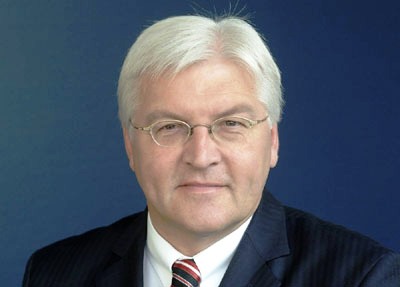
German FM Frank-Walter Steinmeier
Since the Bush administration’s twisting of events in the 2008 Russia-Georgia war, which the E.U. blamed on Georgia, Western populations have been subjected to the steady message that Russia is a “threat” to the West and is guilty of “aggression.” This reached a peak with the false narrative of events in Ukraine, in which blatant evidence of the West’s complicity in a violent coups d’état was omitted from corporate media accounts, while Russia’s assistance to eastern Ukrainians resisting the coup has been framed as a Russian “invasion.”
The disinformation campaign has reached the depths of popular culture, including the EuroVision song contest and sports doping scandals, to ensure widespread popular support for U.S. hostile intentions against Russia.
The Russian “aggression” narrative, based largely on lies of omission, has prepared the way for the U.S. to install a missile-shield in Romania with offensive capabilities and to stage significant NATO war games with 31,000 troops on Russia’s borders. For the first time in 75 years, German troops retraced the steps of the Nazi invasion of the Soviet Union.
U.S. Designs on Russia
The U.S. is eyeing a post-Putin Russia in which a Wall Street-friendly leader like Boris Yeltsin can be restored to reopen the country to Western exploitation. But Vladimir Putin is no Yeltsin and has proven a tough nut for the U.S. to crack. Washington’s modus operandi is to continually provoke and blame an opponent until it stands up for itself, as Putin’s Russia has done, then accuse it of “aggression” and attack in “self-defense.”
In this way, Washington builds popular support for its own version of events and resistance to the other side of the story. Unfortunately it is not a new trick in the U.S. playbook.
“The statesmen will invent cheap lies, putting the blame upon the nation that is attacked, and every man will be glad of those conscience-soothing falsities, and will diligently study them, and refuse to examine any refutations of them; and thus he will by and by convince himself the war is just, and will thank God for the better sleep he enjoys after this process of grotesque self-deception,” wrote Mark Twain.
So suddenly, after many years of an air-tight, anti-Russia campaign believed unquestioningly by hundreds of millions of Westerners, comes Steinmeier last week blurting out the most significant truth about Russia uttered by a Western official perhaps in decades.
“What we shouldn’t do now is inflame the situation further through saber-rattling and warmongering,” Steinmeier stunningly told Bild am Sontag newspaper. “Whoever believes that a symbolic tank parade on the alliance’s eastern border will bring security is mistaken.”
Instead Steinmeier called for dialogue with Moscow. “We are well-advised to not create pretexts to renew an old confrontation,” he said, saying it would be “fatal to search only for military solutions and a policy of deterrence.”
In keeping with the U.S. propaganda strategy, the U.S. corporate media virtually ignored the remarks, which should have been front-page news. The New York Times did not report Steinmeier’s statement, but two days later ran a Reuter’s story only online leading with the U.S. military’s rejection of his remarks.
NATO General: Russia is No Threat
Just a day after Steinmeier was quoted in Bild, General Petr Pavel, chairman of NATO’s military committee, dropped another bombshell. Pavel told a Brussels press conference flat out that Russia was not at a threat to the West.
“It is not the aim of NATO to create a military barrier against broad-scale Russian aggression, because such aggression is not on the agenda and no intelligence assessment suggests such a thing,” he said.
What? What happened to Russian “aggression” and the Russian “threat?” What is the meaning then of the fear of Russia pounded every day into the heads of Western citizens? Is it all a lie? Two extraordinary on-the-record admissions by two men, Steinmeier, the foreign minister of Europe’s most powerful nation, and an active NATO general in charge of the military committee, both revealing that what Western officials repeat every day is indeed a lie, a lie that may be acknowledged in private but would never before be mentioned in public.
Two years ago I was in a background briefing with a senior European ambassador at his country’s U.N. mission in New York and could hardly believe my ears when he said talk about Russia’s threat to Eastern Europe was “all hype” designed to give NATO “a reason to exist.” Yet this same ambassador in public Security Council meetings would viciously attack Russia.
But the hype is about more than just saving NATO. The fear campaign feeds the American and European military industries and most importantly puts pressure on the Russian government, which the U.S. wants overthrown.
Were these remarks made out of the exasperation of knowing all along that the Russian threat is hype? Were they made out of genuine concern that things could get out of hand under reckless and delusional leaders in Washington leading to a hot war with Russia?
Neither man has been disciplined for speaking out. Does this signal a change in official German thinking? Will German businessmen who deal with Russia and have opposed sanctions against Moscow over Ukraine, which were forced on Germany by the U.S., be listened to?
Were Steinmeier’s remarks a one-off act of rebellion, or is Germany indeed considering defying Washington on sanctions and regime change in Moscow? Is the German government finally going to act in Germany’s own interests? Such a move would spark a European defiance of the United States not seen since the days when Charles de Gaulle pulled France out of NATO in 1966 to preserve French independence.
The last time European governments broke with Washington on a major issue was the 2003 U.S.-led invasion of Iraq. Then France and Germany joined Russia on the U.N. Security Council in blocking the war’s authorization (although Britain supported it). But France and Germany then voted for a resolution several months later that essentially condoned the invasion.
It’s Up to the European Public
One has to ask whether a conditioned German public is ready to see through the lies about Russia. Last November, I flew from St. Petersburg to Berlin and discussed this very question with a number of well-educated Germans.
I had visited Russia for the first time since 1995, 20 years before to the month. Those were the days of the Yeltsin-Jeffery Sachs Russia, of the unbridled neoliberal capitalism of the Wall Street-oligarch alliance that plundered the country leaving millions of Russians destitute. Outside train stations I saw homeless encampments replete with campfires. Policemen were stopping motorists for bribes. I ran from two men intent on robbing me until I lost them in a Metro station. That’s the Russia the neocons in Washington and the knaves and buccaneers on Wall Street want to see again.
The Russia I saw in St. Petersburg and Moscow, 20 years later, was orderly and prosperous, as modern as any European city. It is a testament to Russia’s resistance to American attempts to restore its political and financial control. Russia is a capitalist country. But on its own terms. It is fully aware of American machinations to undermine it.
In Berlin I met several Germans, educated, liberal and completely aware, unlike most Americans, of how the United Sates has abused its post-World War II power. And yet when I asked them all why there are still U.S. military bases in Germany 70 years after the war and 25 years after the Cold War ended, and who the Americans were protecting them from, the universal answer was: Russia.
History shows European fears of Russia to be completely overblown. Germany and other Western powers have invaded Russia three times in the last two centuries: France in 1812, U.S., Britain and France in the 1918 Russian Civil War, and Germany again in 1941. Except for Imperial Russia’s incursion into East Prussia after war was declared on it in 1914, the reverse has never been true.
In his memoirs Harry Truman admitted that false fear of Russia was the “tragedy and shame of our time” during the Cold War that he had much to do with in part to revive the U.S. post-war economy with military spending. George Kennan, the State Department official who advised a non-military containment of the Soviet Union, conceded as early as 1947 that Soviet moves in Eastern Europe were defensive and constituted no threat. In the 1990s, Kennan also decried NATO’s expansion towards Russia’s borders.
With its vast natural resources, Russia has been the big prize for the West for centuries, and is still today in neocon-driven Washington. But Germany, especially, has benefited from trade with Russia and has no need to join the U.S. imperial project.
The British voters’ decision, days after Steinmeier’s extraordinary remark, could herald significant change in Europe, which may be approaching an historical junction in its relationship with the United States. Growing anti-E.U. sentiment has spread across the continent, including calls for similar referenda in several countries.
British voters evidently saw through the hype about the Russian “threat,” as a majority did not buy British Prime Minister David Cameron’s scare tactic ahead of the vote that Brexit would make it harder to “combat Russian aggression.”
Britain has been called Washington’s Trojan horse in the E.U. The thinking is that without Britain, the E.U. would be freer to chart its own course. But as Alexander Mercouris explained here, Obama bypasses London to call Merkel directly with his demands. Still, removing Britain’s voice from the E.U., though more crucially not from NATO, opens space for more independent voices in Europe to emerge.
“I worry that we will have less clout on our own,” former British Ambassador to the United States Peter Westmacott told The New York Times. “In the future, we won’t have as much influence on Europe’s response to Putin’s transgressions, Iran’s nuclear ambitions, or the E.U.’s foreign and security policy. … And we will be less able to ensure it is U.S.-friendly.”
But that could be a good thing. If German leaders conclude the United States is pushing Europe into a disastrous war with Russia, could we see a Charles de Gaulle moment in Berlin? Merkel doesn’t seem to have it in her. Three days after Steinmeier’s remarks, she told a news conference she favored increased German spending for NATO to counter Russian “threats.”
Instead it will require a revolt by an awakened citizenry against the E.U. and elected European governments that refuse to stand up to Washington, mostly because it benefits their own class interests, to the detriment of the majority.
The Future of the EU
European social democracy had been probably the best social and political system ever devised on earth, maybe the best that is humanly possible. Europe could have been a model for the world as a neutral power committed to social justice. As late as 1988, Jacques Delors, then president of the European Commission, promised the British Trades Union Congress that the E.U. would be a “social market.”
Instead the E.U. allowed itself to be sold out to unelected and unaccountable neoliberal technocrats now in charge in Brussels. European voters, perhaps not fully understanding the consequences, elected neoliberal national governments slavishly taking Washington’s foreign policy orders. But Brexit shows those voters are getting educated. Unity is a great ideal but E.U. leaders have refused to accept that it has to benefit all Europeans.
The E.U.’s Lisbon Treaty is the only constitution in the world that has neoliberal policies written into it. If it won’t reform — and the arrogance of the E.U.’s leaders tells us it won’t — it will be up to the people of Europe to diminish or dismantle the E.U. through additional referenda. That would give liberated European nations the chance to elect anti-neoliberal national governments, accountable to the voters, which can also chart foreign policies independent of Washington.
The danger is that the right-wing sentiment that has driven a large part of the anti-Establishment movements in Europe (and the U.S.) may elect governments that grow even closer to Washington and impose even harsher neoliberal policies.
That is a risk that may need to be taken in the hope that the anti-Establishment left and right can coalesce around shared interests to put an end to the elitist European project.
Joe Lauria is a veteran foreign-affairs journalist based at the U.N. since 1990. He has written for the Boston Globe, the London Daily Telegraph, the Johannesburg Star, the Montreal Gazette, the Wall Street Journal and other newspapers. He can be reached atjoelauria@gmail.com and followed on Twitter at @unjoe.
Saudi airstrikes leave 20 Yemeni civilians dead despite truce
Press TV – June 28, 2016
At least 20 civilians have been killed as Saudi warplanes bombed Yemen’s Ta’izz Province in violation of a UN-brokered ceasefire.
Saudi jets targeted a petrol bomb in Hayfan district of the southwestern province of Ta’izz early on Tuesday, leaving at least 20 civilians dead and 15 others injured, Yemen’s al-Masirah television reported.
Some Yemeni media outlets have put the number of those killed at 35.
The news comes hours after four terrorist bomb attacks hit military and security positions in Mukalla city of Hadhramaut Province, leaving 48 civilians dead and some 30 others injured.
Meanwhile, a Saudi air strike mistakenly hit a military convoy of pro-Riyadh militants in the strategic mountain of Hailan in Ma’rib Province on Monday night.
Five militants, including a commander, were killed and six others wounded in the air raid.
The Saudi attacks come despite UN-mediated talks in Kuwait between representatives of Yemen’s former President Abd Rabbuh Mansur Hadi and a delegation comprising of the Houthi Ansarullah movement and allies. A ceasefire agreement had been announced before the peace talks.
The Houthi delegation has warned that such blatant cases of truce violation could lead to a full collapse of the peace talks.
Saudi Arabia launched its military aggression against Yemen on March 26, 2015, in a bid to bring Hadi, a staunch ally of Riyadh, back to power and defeat the Ansarullah movement. More than 10,000 people have been killed since then.
Kuwait talks
Meanwhile, reports said Monday that Yemen’s warring parties plan to suspend the talks after failing to reach results.
Two negotiators representing Houthis and their allies, and one from the Hadi-delegation said the two sides on Monday were drafting a statement to declare that the negotiations will resume in mid-July following the Muslim holiday of Eid al-Fitr.
“The return to the talks is meant to save face after reaching a deadlock,” said one of the negotiators, who is also one of Hadi’s ministers.
The main bone of contention in the talks is reportedly a demand by the Hadi delegation for the Houthis to start disarming and withdrawing from the areas they have under control.
The Houthis took over state matters when Hadi resigned back in January 2015.
Houthis have rejected the call, saying they will only accept a deal on military and security issues after consensus is reached on the next president and a unity government in Yemen.
US destroyer gets dangerously close to Russian patrol boat in Mediterranean
RT | June 28, 2016
The US guided-missile destroyer Gravely breached international navigation safety rules by coming within dangerous proximity of the Yaroslav Mudry, a Russian frigate, in the eastern Mediterranean, the Russian Defense Ministry has said.
The USS Gravely approached the Yaroslav Mudry, a Russian frigate, on June 17, passing across her course at a “dangerous” distance of 180 meters (550ft), the Defense Ministry said in a statement on Tuesday.
The encounter occurred in international waters. The Yaroslav Mudry did not deviate from her course and refrained from engaging in dangerous maneuvering with the US warship, the ministry added.
According to the statement, the warship’s captain and crew violated the International Regulations for Preventing Collisions at Sea (COLREGS), which govern the conduct of two or more vessels when they meet at sea in order to prevent dangerous situations.
“The US sailors, in particular, neglected Rule 13, which stipulates that an overtaking vessel must keep out of the way of the vessel being overtaken,” the Defense Ministry said. It added that the USS Gravely had also violated Rule 15, which says that a vessel that has another vessel on the starboard side must yield and avoid crossing ahead of her.
The ministry also said the Pentagon should take note of such incidents rather than accuse the Russian Air Force and Navy of unprofessional conduct. “US sailors allow themselves to neglect key foundations of navigation safety without thinking of the consequences that dangerous maneuvering in a heavily trafficked maritime area might involve.”
The USS Gravely is an Arleigh Burke-class guided missile destroyer capable of carrying an Aegis missile defense system. She was commissioned in 2010 and sent to her first overseas deployment in the eastern Mediterranean three years later.
Yaroslav Mudry, a Russian-made Neustrashimy-class frigate, has seen service with the Russian Navy’s Baltic Fleet. She was spotted near Malta Earlier in June, reportedly heading to the eastern part of the Mediterranean to join Russia’s maritime task force off Syrian shores.
US to deploy Israeli missile system on Russian borders: General
Press TV – June 28, 2016
The US military has tested an Israeli short-range missile for possible use in its European network of missile systems to deter Russia, says a US Army general.
Major General Glenn Bramhall of the US Army’s Air and Missile Defense Command made the comments on Monday, as he visited the occupied Palestinian territories.
Bramhall said his units needed a reliable system to counter less powerful missile threats as a third tier beside the Army’s array of midrange Patriot and THAAD missile systems.
“Patriot and THAAD are great systems that do what they were designed to do. But I don’t think we would want to waste a Patriot or a THAAD missile on something that can be affected by something that’s lower cost and is actually designed for that job itself,” the general told Reuters.
For that purpose, he said the US military has test-launched a variant of the Israeli “Tamir” rocket which is incorporated to the Tel Aviv regime’s so-called Iron Dome missile system.
Jointly manufactured by American and Israeli firms, each Tamir battery, consisting of a radar unit, missile control unit, and several launchers, is worth $50 million, with each missile costing about $100,000.
“I think we are looking at something that is similar to Iron Dome. We have looked at the Tamir as a possible missile,” Bramhall said. He was due to inspect an Iron Dome unit on Tuesday.
Russian deterrence
Elsewhere in his remarks, the American general noted that the Israeli missile system is being considered mainly as a deterrent against what he called Russia’s military buildup in Europe.
“With all that is happening in Europe, especially the fact that Russia has really awakened itself and has really decided to rebuild its military and is really posing a threat, we are looking at how we can do the multi-tiered defense,” Bramhall said.
Military tensions between Russia and the US further heightened in May, when American and NATO officials activated a land-based missile system in Romania, despite Russia’s warning against US-led arms deployments near its borders.
The missiles’ activation marked the penultimate step in the completion of a missile shield, which Washington proposed nearly a decade ago.
Russian President Vladimir Putin strongly criticized the system’s deployment, vowing to neutralize any threats against his country’s security.
Canada Oil Sands Output to Grow 1Mln Barrels Per Day by 2025
Sputnik — 27.06.2016
Production from western Canada’s oil sands is expected to increase by 1 million barrels daily in the next decade above the current output of about 2.75 million barrels, as extraction becomes more cost-efficient, the global consulting firm IHS said in a report on Monday.
“IHS anticipates oil sands investors will focus their investments onto the most economic projects: expansions of existing facilities,” the report stated. “IHS expects that over 80 percent of future activity in our outlook will be underpinned by expansions of existing facilities.”
The report noted that the existing facilities are well understood, quicker to first oil and cheaper to construct.
“This all equates to less risk at a lower cost,” the report added.
A press release accompanying the report explained that a price of about $50 is required for oil-sands projects to break even.
Since 2012, the oil-sands region in the Canadian province of Alberta has increased from 1.75 million barrels per day to its present level of about 2.75 million barrels, according to the report.
Featured Video
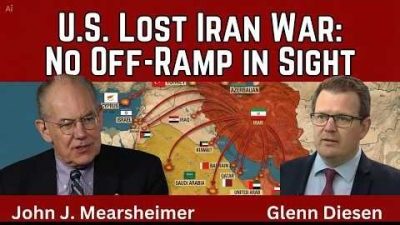
John Mearsheimer: US Already lost Iran war – No off-ramp in sight
or go to
Aletho News Archives – Video-Images
Frlom the Archives
70 Neocons Petition Congress To Effectively Allow Israel To Say When The US Should Attack Iran
By Damian Lataan | January 10, 2014
Seventy senior Israeli-centric neoconservatives have written an open letter to Congress imploring them to do more to ensure Iran complies with the conditions of any agreement finally reached with the P5+1 over Iran’s nuclear program.
While the neocons are ostensibly asking Congress to ensure compliance, it is clear that their real aim is to convince members of Congress to support the bill currently passing through the Senate which calls for tighter sanctions against Iran in the event of any waywardness on Iran’s part.
The neocons are eager to see the bill currently passing through the Senate with enough support to make it veto-proof, not so much because they are concerned about Iran’s so-called nuclear weapons program – there’s still not a skerrick of hard evidence that Iran has a nuclear weapons program – but, rather, because embedded within the bill is this clause:
… if the Government of Israel is compelled to take military action in legitimate self-defense against Iran’s nuclear weapon program, the United States Government should stand with Israel and provide, in accordance with the law of the United States and the constitutional responsibility of Congress to authorize the use of military force, diplomatic, military, and economic support to the Government of Israel in its defense of its territory, people, and existence…
Essentially, the clause is an automatic trigger for the US to attack Iran at any time the Israelis choose to launch a first strike – regardless of whether President Obama is in favour or not.
Partial list… continue
Blog Roll
 Aletho News
- ‘Heinous crime’: Iran denounces Israeli assassination of 4 Iranian diplomats in Lebanon
- John Mearsheimer: U.S. Already Lost Iran War – No Off-Ramp in Sight
- UK Parliament Plans ISP Blocking and Age Verification Powers
- World cannot remain silent as US and Israel attack ‘heritage of humankind’: Iran
- Emirati billionaire rebukes US senator over call for Gulf states to join war with Iran
- Op. True Promise 4: Iran’s missile blitzkrieg dismantles US war machine in West Asia
- Aramco CEO warns ‘catastrophe’ imminent if Strait of Hormuz remains shut
- What If Iran Says No?
- Trump Threatens to ‘Hit’ Iran ‘Twenty Times Harder’ Over Strait of Hormuz Oil Flows
- Spare the hypocrisy: Baghaei slams Ursula’s support for US
- If Americans Knew
- Israel Decided the War, But Trump’s America Fights and Pays the Bill
- Conscientious Objector Group: Phone ‘Ringing Off Hook’ As Huge Mobilization Underway
- U.S. support for Israel continues to plummet, despite media’s best efforts
- Threats and missiles fly, death tolls soar in Iran, Lebanon, Gaza – Not a ceasefire Day 151
- Lebanon: Israel’s White Phosphorous Use Risks Civilian Harm
- Corporate Media Go All Out To Support The US-Israeli War On Iran
- US-Israel war on Iran is creating a steady growing number of amputees
- Israel planned this war on Iran for 40 years. Everything else is a smoke screen
- The wrong question about the war in Iran
- ‘Your Tax Dollars Being Used to Raise Your Gas Prices’: US-Israel Bomb Major Iranian Oil Depots
- No Tricks Zone
- New Study Documents A 20-Year Pause In Arctic Sea Ice Decline – Driven By Internal Variability
- Wake-up Call: Survey Shows Majority Of Germans Now Favor Postponing Climate Targets!
- Televised! Leading German Political Candidate Tells Schoolchildren CO2 Makes Sun Hotter!
- New Study: A Century Warming Of 1.1°C Is ‘Commonplace’ And ‘Not Unusual’ During This Interglacial
- New Study: ‘Internal Noise’ And Volcanic Forcing Can Trigger 10-15°C Warming Within Decades
- Glaciers Worldwide Are Suddendly Surging, Experts Blame Warming!
- Surprising Discovery: Sahara Is Greening…Billions Of Trees Where Once Thought To Be Barren
- New Research Reaffirms Clouds, Aerosols, And Surface Solar Radiation Are ‘Driving The Climate System’
- Germany: Electric Car Catches Fire At Charging Station, Sets Off Local “Inferno”, Widespread Damage
- New Study: Canada’s New Brunswick Was 1°C Warmer Than Today During The Medieval Warm Period
 Aletho News