Western leaders support terror groups in Syria, get extremism at home – Assad
RT | July 10, 2016
Terrorist attacks, an unprecedented refugee influx and other problems with which Europe is struggling to cope are the result of wrong decisions made by European leaders, Syria’s president Bashar Assad told a European Parliament delegation.
“The situation in Syria and the whole region naturally affects Europe a lot due to its location and social ties. The problems Europe faces today of terrorism, extremism and waves of refugees are caused by some western leaders’ adoption of policies which do not serve their people,” Assad told the delegation headed by Javier Couso, Vice Chairman of the foreign affairs committee of the European Parliament, who had been visiting Damascus, Syrian state news agency SANA reported.
This is especially true “when those leaders give support and political cover to terrorist groups inside Syria,” the president added.
He stressed the role that the European Parliament should play in fixing the policies of some of European countries which had let terrorism evolve. Economic sanctions imposed against Damascus have impacted the Syrian people, who were forced to leave their homeland, Assad also said.
Couso noted that the delegation is planning to take steps that would help change western countries’ rhetoric and will call for the lifting of sanctions, which he described as “unfair”.
He promised to “inform the Europeans on the real state of affairs in Syria and on how people suffer from terrorism,” the report said.
Syria plunged into chaos in 2011, when public protests escalated into an armed uprising as foreign powers warned the Assad government against cracking down on the protest. As violence expanded, radical groups and criminal gangs hijacked the process, turning Syria into the bloodiest battle zone of the modern world.
Foreign nations opposing Damascus, including Turkey, Saudi Arabia, Jordan, the United States and the United Kingdom, have been providing various Syrian opposition groups with aid, saying that only by supporting armed groups trying to topple the Syrian government can the conflict be stopped.
The US and other western countries aided so-called ‘moderate rebels’ in Syria with weapons and training, saying this would help them defeat both the Syrian army and terrorist organizations, which capitalized on the turmoil in Syria. The effort led to some embarrassing moments, for instance when the initial training program for the moderates produced only a handful of fighters after months of recruiting.
Saudi Arabia and Qatar are among the key providers of Syrian rebel groups with military and financial assistance, including some powerful Islamist groups seeking to turn Syria into a country governed by the Sharia law.
Turkey, which was hit most among Syria’s neighbors by the refugee crisis, hosting almost two million asylum seekers, is among the vocal opponents of Damascus too. Critics accuse Ankara of turning a blind eye on rebel activities in its territory, including recruiting, arms shipments and getting medical assistance.
Jihadists from terrorist groups like Islamic State and Al-Nusra Front are among those benefiting from such policies. IS staged a number of bloody terrorist attacks in Turkey since its rise to power in Iraq and Syria, killing hundreds of people. The organization also claimed responsibility for several high-profile attacks in Europe and the US.
The European delegation arrived in Damascus on Saturday. The group visited refugee center in the Syrian capital and met soldiers undergoing treatment in the Hamish hospital.
Read more:
Jihadists that US kept off terror list attack UN humanitarian convoy in Syria – MoD
Al-Nusra Front in Syria gets daily weapons supplies from Turkey – Russian military
Western officials criticize Damascus in public but secretly deal in private not to upset US – Assad
Catastrophe Unmasked: Prescription for Addiction
By Nayvin Gordon, MD | CounterPunch | July 8, 2016
The “Opium Wars” were fought by the British Government to legalize their control of the opium trade to China in the mid 17th Century. Reports estimated that 25% of the Chinese people were addicted to opium by 1905. That same year in the US, heroin addiction had risen to alarming rates, and the US Congress passed a ban on opium. Another American heroin epidemic began again in 1967 in Chicago and New York, and then spread widely through the early 1980’s. The son of the US Attorney General, Robert Kennedy, died of a heroin overdose in New York City on April 24, 1984. Physicians in medical school were taught that opioids were dangerously addicting substances that should be used only for short term severe pain and terminal cancer.
Despite this teaching and the raging Heroin epidemic in America, a letter was published in the New England Journal of Medicine in 1980. The author reported that of the patients in their hospital who were treated with narcotics, less than one percent became addicted. In 1986 the journal Pain, reported on a study of only 38 patients who were treated with narcotics for several years. The authors concluded that there was little risk of addiction. There were no other significant addiction studies reported. Shortly after the study in Pain, one of the co-authors went on to head the American Pain Society. This organization was one of several similar nonprofit groups funded by the Pharmaceutical Industry like Purdue Pharma the producers of the narcotic Oxycontin.
These opioid producers also funded medical education programs and advocacy groups. Within a short time the pharmaceutical companies began an aggressive nationwide campaign to market opioids for long term non cancer pains such as back and neck pain. During the 1990’s the incidence of opioid misuse rose markedly, fueled by the number of opioid prescriptions written by many physicians and nurses. Where were the Food and Drug Administration (F.D.A.) and the American Medical Association (A.M.A.) when they were presented with blatant disregard for the truth about opioid addiction? What evidence did they demand before they abandoned 150 years of knowledge about the dangers of opioids? Where were the evidence based studies needed to refute what was known around the world about the risks of opioids?
As of February 2009, Dr Zee, writing in the Journal of Public Health, revealed that “we lack any large…rigorous prospective study addressing the issue of … addiction, during long term opioid use for chronic non cancer pain.”
The medical schools and physician training programs did not publicly denounce this unscientific pharmaceutical propaganda. Why? The F.D.A., the organization responsible for ensuring that prescription drug promotion is truthful, continued to authorize more and more forms of opioids over the years. Why? To this day, the F.D.A. and the A.M.A., have refused to demand mandatory education for opioid prescribers. Why? Furthermore, the Federation of State Medical Boards accepted money from pharmaceutical firms to produce prescribing guidelines. Why did physicians not sound the alarm to expose the fact that the pharmaceutical industry was establishing treatment guidelines for the medical profession?
Dr David A Kessler, the past commissioner of the F.D.A., from 1990-1997, the very years the epidemic was accelerating, stated in an article in the New York Times on May 7, 2016: “It has proved to be one of the biggest mistakes in modern medicine”. Doctors, regulators and drug makers “missed one fundamental: The more opioids prescribed, the more opioid abuse there will be.”
We beg to differ. This was no mistake. The reality is that physicians in the leadership of the F.D.A., A.M.A., and The Federation of State Medical Boards, willfully abandoned their scientific integrity and over 150 years of wisdom regarding the dangers of opioids. This was simply a catastrophic violation of their duty to “do no harm”.
In their complicity with the Pharmaceutical Companies, many physicians and nurses abandoned their responsibility to their patients by writing prescriptions for addiction. The consequences are now staring us in the face. Well over a hundred thousand people have overdosed and died, and there are now 3 million addicts as the epidemic continues to devastate families across the nation.
Let’s set the record straight.
Death toll from Kashmir clashes rises to 16
Press TV – July 10, 2016
Indian officials have updated the death toll from the ongoing unrest in the Himalayan state of Jammu and Kashmir, saying that 16 people are now confirmed dead following the clashes between protesters and riot police over the killing of a popular rebel leader.
One protester was shot dead on Sunday after riot police fired on infuriated and stone-hurling demonstrators, who defied a curfew aimed at suppressing the public uproar in the southern area of Pulwama, and six others succumbed to their wounds overnight, AP quoted an unnamed security official as saying.
A police officer also lost his life in the southern area of Anantnag, where angry demonstrators pushed his armored vehicle into a river.
Indian authorities have for the second day extended the curfew to the whole Kashmir valley, including the major city of Srinagar.
The clashes came after residents of Kashmir held a funeral for separatist Burhan Wani, the young leader of Hizbul Mujahideen (HM), who was killed on July 8 along with two other people during a brief gun battle with government forces.
During the past five years, Wani had become the iconic face of militancy in Kashmir, using social media to reach out to young people in the region.
Wani’s body was handed over to his family earlier on Saturday and the locals, who see the slain 22-year old as a hero, turned the mass funeral into a full-scale protest.
According to Indian police, anti-riot troops used live ammunition, pellet guns and tear gas to disperse the crowds and calm down the outrage. Authorities have also suspended mobile networks and the internet to prevent massive demonstrations.
Reports say that at least 200 people, including 90 government forces, were injured during the clashes.
The death of Wani sparked street protests across Kashmir throughout the night Friday. In a rare incident, mosques’ loudspeakers blared with “Azadi” (freedom from Indian rule) in most areas, including Srinagar, where people were ordered to remain indoors.
Major groups known for their resistance against Indian rule have declared three days of mourning.
Kashmir, a Himalayan region known for its beautiful landscapes, lies at the heart of more than 69 years of hostility between India and Pakistan. Both neighbors claim the region in full but have partial control over it. India controls two thirds of Kashmir while the remaining one third is under the Pakistani rule.
The neighbors agreed on a ceasefire in 2003, and launched a peace process the following year. Since then, there have been sporadic clashes, with both sides accusing the other of violating the ceasefire.
Thousands of people have been killed in the violence in Kashmir over the past two decades.
Fraud probe against Netanyahu to go public: Israeli official
Press TV – July 10, 2016
An Israeli official says the details of an investigation into allegations of large-scale money laundering by Prime Minister Benjamin Netanyahu will be made public soon.
The official, whose name was not mentioned in reports, said on Saturday that police believe that they have adequate evidence to make the probe public this week or early next week.
Some of the inquiry materials had originated in other, unrelated investigations, but they have now been linked to the money laundering case involving the Israeli prime minister.
The police and the attorney general’s office think it is untenable to keep the investigation secret anymore due to its sensitivity, he said, adding that a decision was made to make an official announcement about the case.
Police have so far prevented leaks to the media concerning the probe, but there were reports of people being summoned for questioning by the police’s anti-fraud unit.
Recently, Israeli media said the investigation against Netanyahu focuses on foreign funds he received after resuming office in 2009. The premier has dismissed the allegations.
Netanyahu is also implicated in a separate fraud case involving French tycoon Arnaud Mimran, who is said to have previously made unrelated donations to the Israeli premier.
Earlier this week, a French court convicted Mimran of fraud and sentenced him to eight years in prison and one million euros in fines in a 2008-2009 fraud case.
On Friday, Channel 10 reported that the latest police investigation into Netanyahu’s affairs involves suspicions of money laundering on a wide-scale.
The suspicion pertains to the alleged transfer of “large sums” to either Netanyahu or one of his family members and is not linked to campaign or political funding, it said.
The television said the investigation may require questioning abroad, but no investigators have yet been sent out of Israel.
Jewish and Zionist Influence at the BBC
By Karl Radl | Semitic Controversies | October 4, 2015
Jewish influence, or power if you like, in mainstream media is one of those pink elephants in the room that everyone at some level realizes, but which badly needs to be openly discussed. This is happening more and more today due to, to their infinite credit, the efforts of the anti-Zionist left, which has found itself stymied by this influence and has spent some time documenting it. (1)
In order to contribute broadly to this discussion I thought it would be appropriate to explore the influence that Jews, be they pro or anti-Zionist, have in British state broadcaster; the BBC. This is important because the BBC has long been viewed, although less so today, as a relatively impartial broadcaster around the world and has been the subject of the umbrage of many a Zionist over the years.
The fact that Jews, as a minuscule part of the population of the British Isles, have so many members of their community in positions of power and influence in a state broadcaster committed to journalistic impartiality is obviously extremely concerning to any individual in their right mind. After all Jews, like any other group, are always going to promote their interests or push their particular perspective as a group and as such will knowingly or not distort the narrative to favour their perspective and interests.
When we look at the Executive Board we find the following individuals: (2)
Tony Hall (Director General, BBC)
Helen Boaden (Director, Radio)
Danny Cohen (Director, Television)
James Harding (Director of News and Current Affairs)
James Purnell (Director, Strategy and Digital)
Annie Bulford (Managing Director, Finance and Operations)
Tim Davie (CEO, BBC Worldwide and Director, Global)
Simon Burke (Non-Executive Director)
Sir Howard Stringer (Non-Executive Director)
Dame Fiona Reynolds (Non-Executive Director)
Sir Nicholas Hytner (Non-Executive Director)
Alice Perkins (Non-Executive Director)
Dharmash Mistry (Non-Executive Director)
Of these thirteen executives; three are jewish.
The executives who have jewish backgrounds are Danny Cohen, (3) James Harding (4) and Sir Nicholas Hytner. (5) This seems superficially reasonable until we note that, according to the 2011 census, jews are 0.5% of the British population. (6) Comparatively those of Jewish origin are 23% of the membership of the Executive Board of the BBC.
When we compare that to Indians who are a similar minority group in the United Kingdom; we note that while in the 2011 census they made up 2.3% of the British population. (7) They only have one representative (Dharmash Mistry) on the Executive Board of the BBC.
Therefore we can see that jews are both significantly over-represented among the individuals who are members of the Executive Board as well in them of themselves. In addition to being significantly over-represented relative to more populous ethnic minority groups such as those of Indian origin.
This situation becomes more concerning when we note that James Harding, one of the Jewish members, has made it explicitly clear that, after making the British daily The Times newsroom pro-Israel, he wants to do precisely the same at the BBC. (8)
This obviously already a violation of the BBC’s neutrality, which is explicitly required in its periodically renewed charter, since Harding is explicitly setting out to modify the BBC’s relative objectivity to a partisan pro-Israel stance.
Naturally Harding claims it is ‘injecting balance’ into the BBC newsroom, but such verbiage is a common linguistic trick (9) and is explicitly how Israel projects ‘soft power’ to attempt to create a pro-Israeli narrative (i.e. Hasbara). (10)
Even more concerning is the backgrounds of some of the other non-Jewish members of the Executive Board.
James Purnell is the former Chairman of the pro-Israel lobby group ‘Labour Friends of Israel’. (11) This group explicitly exist to influence the members and policy making of the Labour Party in Britain and has a substantial membership among Labour party Members of Parliament. (12)
Combined with James Harding this is enough cause for serious concern about jewish and Zionist influence within the Executive Board of the BBC.
However Sir Howard Stringer also has a strong Zionist connection given that he was the honorary chairman of the ‘American Jewish Committee’, a powerful Jewish communal organization dedicated to promoting Zionism in the United States, in 2004. (13)
That he has not repudiated his pro-Zionist views since this time is suggestive of the fact that Sir Howard continues to support the objectives and methods of the ‘American Jewish Committee’.
While Sir Nicolas Hytner, a Jewish member of the Executive Board, has often abused his positions in the world of acting and theatre to oppose the BDS (Boycott Divest Sanctions) movement against Israel. (14)
It is unlikely that Sir Nicholas will act any differently while he is part of the BBC’s Executive Board than he has when he was at the National Theatre. Indeed he has given us absolutely no reason to think he will do an about face on his track record of running political interference on behalf of Israel.
Danny Cohen, a jewish member of the Executive Board, has also publicly endorsed the Zionist cause only a year ago. (15) Since he has not given us reason to think otherwise; we may be confident that he will continue in his support for Israel and the pro-Zionist narrative.
Once we take the political affiliations of the Executive Board of the BBC into account we can see that all three of the Jewish members are openly pro-Israel/pro-Zionist, while two of the non-Jewish members are also pro-Israel/pro-Zionist.
This takes the pro-Israel/pro-Zionist bloc in the BBC’s Executive Board to five members, while none of the other members have any known anti-Israel/anti-Zionist convictions.
This means that 38% of the BBC’s Executive Board is pro-Israel/pro-Zionist. When added to the fact that three of those five members (James Harding, James Purnell and Sir Nicholas Hytner) have a track record of political interference on behalf of Israel in organizations then it becomes even more sinister.
When we further note that Harding is in charge of the BBC’s newsroom it suggests that the narrative the BBC will produce going forward will be pro-Israel/pro-Zionist and not in any way neutral.
James Purnell’s role as the head of Strategy and Digital makes him an invaluable ally for Harding in manipulating the pro-Israel/pro-Zionist narrative in such a way as to promote it as the ‘wave of the future’ for the BBC.
Danny Cohen’s role as the head of television, the BBC’s most powerful arm, is even more subversive given that it is by news, documentary/factual and entertainment television programming that many people, in the United Kingdom and elsewhere, get their informational prism with which they view the world.
We get an absolutely intolerable situation where the neutral BBC has been/is being progressively hijacked by avowed pro-Israel/pro-Zionist activists with the stated aim of abusing its reputation for neutrality in order to promote Israel politically and neutralize dissenting views/unflattering coverage.
When we look at the next organizational layer down, the BBC’s Executive Team, we find the following individuals: (16)
Ken MacQuarrie (Director, BBC Scotland)
Rhodri Talfan Davies (Director, BBC Cymru Wales)
Peter Johnston (Director, BBC Northern Ireland)
Peter Salmon (Director, England)
Ralph Rivera (Director, BBC Digital)
Valerie Hughes-D’Aeth (Director, HR)
David Jordan (Director, Editorial Policy and Standards)
Philip Almond (Director, Marketing and Audiences)
Alan Yentob (Creative Director)
Francesca Unsworth (Director, BBC World Service Group)
Of the ten members of the Executive Team; one is Jewish.
The member of the Executive Team with a Jewish background is Alan Yentob. (17)
Peter Salmon is sometimes listed as being Jewish, (18) but while ‘Salmon’ could well be a contraction of the common Ashkenazi surname ‘Salomon’ there is no evidence I can find of such occurring here. Indeed ‘Salmon’ is a perfectly English surname to have (19) and without evidence to the contrary we can only assume that Peter Salmon is not Jewish.
While Yentob’s presence in the Executive Team takes the Jewish representation on it to 10%. The fact that it is only one individual that is Jewish suggests that the numbers alone here relative to the Jewish representation in the population of the British Isles (i.e. 0.5%) are in some-way reasonable (as you cannot get less than 10% of the membership of the Executive Team with representation).
It is worth noting however that the Indian population in the United Kingdom (i.e. 2.3%) are not represented at all, while no other ethnic or religious minorities are represented either.
This makes Yentob’s presence rather concerning given the general lack of diversity among the BBC’s Executive Team since Jews are a tiny minority even by ethnic minority standards and their having a voice on the Executive Team while no others do is inconsistent with the BBC’s fervent support for racial diversity and propagation of an anti-nativist narrative. (20)
We also need remember that there are internal politics in every organization and while Yentob seems rather innocuous as the ‘Creative Director’; he has recently openly boasted that he is very closely involved in the running of the BBC in general. (21)
Some would dismiss this as merely hot air, but we know that Yentob has long been tipped as a potential future Director-General of the BBC. (22) It was also Yentob who lead the charge against those BBC journalists who dared to doubt the BBC party line on the Jimmy Savile paedophile scandal and branded them ‘traitors’. (23)
One wonders why the BBC’s ‘Creative Director’ would get so closely involved in such things if he was not a significant political force within the BBC’s internal political world?
Contrast that with the fact that no other members of the BBC’s Executive Team have been named as behaving in a similar manner or censoring their own employees on said scandal and we can see that Yentob, in spite of being only one man, is a political force to be reckoned with within the world of organizational politics in the BBC.
Yentob is also quite active in the Jewish community (24) and is known to produce programming that lionizes said community. (25)
While I cannot link him directly to Zionist activity; given his background and lionization of the Iraqi Jews (who immigrated to Israel). It is reasonable to assume that, while not an open political partisan, Yentob is at least willing to allow a pro-Israel/pro-Zionist narrative on the BBC. Therefore while Jewish and Zionist influence in the BBC’s Executive Team is seemingly small; the fact that its only known representation is an obvious key political player in the BBC is suggestive that at the very least there would be no significant resistance to a pro-Israel/anti-Zionist, as opposed to a neutral, narrative from the Executive Team.
When we move on to the BBC’s editors and correspondents we find the following individuals listed: (26)
Mark Easton (Home [UK] Editor)
Bridget Kendall (Diplomatic Correspondent)
Andrew Harding (Africa Correspondent)
Carrie Gracie (China Editor)
Soutik Biswas (Delhi Correspondent)
Katya Adler (Europe Editor)
Anthony Zurcher (North American Reporter)
Robert Peston (Economics Editor)
Kamal Ahmed (Business Editor)
Mark D’Arcy (Parliamentary Correspondent)
Laura Kuenssberg (Political Editor)
James Landale (Deputy Political Editor)
Rory Cellan-Jones (Technology Editor)
David Lee (North American Technology Reporter)
David Shukman (Science Editor)
Jonathan Amos (Science Correspondent)
Nick Triggle (Health Correspondent)
Fergus Walsh (Medical Correspondent)
Hugh Pym (Health Editor)
Branwen Jeffreys (Education Editor)
Sean Coughlan (Education Correspondent)
Will Gompertz (Arts Editor)
Of these twenty-two editors and correspondents; six are Jewish.
Those with a Jewish background are: Katya Adler, (27) Robert Peston, (28), Laura Kuenssberg, (29), David Shukman, (30) Jonathan Amos and Will Gompertz. (31)
This means that the representation of Jews among the BBC editors and correspondents is currently running at a frankly frightening 27%. Compare this with their representation in the British population (0.5%) and it becomes obviously a matter of likely pro-Jewish/pro-Israel/pro-Zionist bias.
It is more difficult to prove sympathies (one way or another) with the BBC’s editor and correspondents than with the BBC’s Executive Board and Executive Team. Since editors and correspondents by the nature of their profession are very aware of the need to carefully manage any statements they make outside of a professional context as they are aware of how closely scrutinized they will be once they pass into the public domain.
However something of the pro-Jewish/pro-Israel/pro-Zionist views of some of the editors and correspondents can be gleaned from the fact that both David Shukman (32) and Will Gompertz (33) have abused their positions to insert an unbalanced historical narrative of Jewish suffering into the content they have produced for the BBC.
Meanwhile Rory Cellan-Jones, the non-Jewish Technology Editor, has been a major figure in the anti-BDS/pro-Israel movement since early 2007 (34) and has abused, like James Harding and Sir Nicholas Hytner have done in the past, his position as a BBC editor to give credence to his pro-Israel views (which was regarded as a significant contribution to the Zionist cause by the website ‘Totally Jewish’). (35)
Then we have Robert Peston, the Jewish Economics Editor, who believes that his Jewish heritage has provided him with superior genes compared to non-Jewish heritage. (36)
This clearly suggests that Peston holds to some form of Jewish nationalism (i.e. Zionism) given these, essentially, Jewish supremacist sentiments that necessarily label non-Jews as inferior beings when compared to Jews.
I would also be remiss if I didn’t mention that Laura Kuenssberg is a very recent appointment to the position of Political Editor; previously the position was held, for several years, by Nick Robinson. He is, like Kuenssberg, Jewish. (37)
Interestingly Kuenssberg was promoted to the position of political editor over Robinson’s non-Jewish deputy James Landale, (38) which suggests that Kuenssberg may have been promoted (she was formerly merely a guest blogger) (39) merely because she is Jewish and Landale is not.
I cannot prove it one way or the other, but the otherwise inexplicable appointment of Kuenssberg over Landale would then explicable.
Given all this information we can see there at least four of BBC’s editors and correspondents (David Shukman, Will Gompertz, Robert Peston and Rory Cellan-Jones) who are pro-Jewish/pro-Israel/pro-Zionist activists, while three others (Katya Adler, Laura Kuenssberg and Jonathan Amos) are likely to be such.
This then suggests that the pro-Jewish/pro-Israel/pro-Zionist narrative that seems to be part of James Harding’s overt plan for the BBC would find at least seven supporters out of the twenty-two current editors and correspondents at the BBC (i.e. 32% of all those concerned).
What we can see from the foregoing analysis is that the BBC has a disproportionate number of Jewish ethnic and non-Jewish pro-Zionist activists, particularly on its Executive Board and among its editors and correspondents to seriously impede the BBC charter’s requirement for neutrality.
In essence the bald way of putting it is that the BBC has been all but captured by Jewish ethic and non-Jewish pro-Zionist activists. We should therefore reasonably expect the BBC, a-la James Harding’s explicit plan, to become a particularly insidious weapon in the Israeli Hasbara arsenal.
References
(1) Notably Grant Smith, 2006, ‘Deadly Dogma: How Neoconservatives Broke the Law to Deceive America’, 1st Edition, Institute for Research: Middle East Policy: Washington D.C.; James Petras, 2007, ‘Rulers and Ruled in the US Empire: Bankers, Zionists, Militants’, 1st Edition, Clarity: Atlanta; James Petras, 2014, ‘The Politics of Empire: The US, Israel and the Middle East’, 1st Edition, Clarity: Atlanta
(2) http://www.bbc.co.uk/aboutthebbc/insidethebbc/managementstructure/seniormanagement/
(3) http://www.thejc.com/articles/interview-danny-cohen
(4) http://www.thejc.com/news/uk-news/94037/jewish-editor-the-times-resigns
(5) http://www.thejc.com/arts/theatre/59361/how-nicholas-hytner-made-national-a-jewish-theatre
(6) http://www.thejc.com/news/uk-news/94111/census-2011-the-jewish-breakdown
(7) https://en.wikipedia.org/wiki/British_Indian#Population
(8) http://www.thejc.com/community/community-life/47916/signs-the-times-jcc
(9) See: http://www.sott.net/signs/hasbara.pdf
(10) http://www.jpost.com/Opinion/Op-Ed-Contributors/Hasbara-public-diplomacy-and-propaganda-358211
(11) http://www.palestinecampaign.org/tony-hall-defends-new-bbc-appointees/
(12) http://www.sourcewatch.org/index.php?title=Labour_Friends_of_Israel#Membership_and_Funding
(13) http://www.jewishjournal.com/circuit/article/the_circuit_20040430
(14) http://www.theguardian.com/uk/2006/dec/15/israel.booksnews
(15) http://www.gilad.co.uk/writings/2014/12/22/redress-online-bbc-executive-danny-cohen-publicly-endorses-key-zionist-mantra
(16) http://www.bbc.co.uk/aboutthebbc/insidethebbc/managementstructure/seniormanagement/
(17) http://www.jewishrenaissance.org.uk/jr-outloud/94-iraqi-and-jewish-in-london-today.html
(18) For example: http://radioislam.org/islam/english/jewishp/gbmedia/update.htm
(19) http://www.surnamedb.com/Surname/Salmon
(20) http://biasedbbc.org/blog/category/anti-british/; http://whitegenocideproject.com/the-bbcs-white-problem/
(21) http://www.independent.co.uk/news/people/profiles/alan-yentob-im-more-involved-in-running-the-bbc-than-people-think-8349048.html
(22) http://www.independent.co.uk/arts-entertainment/profile-alan-yentob-the-insiders-extrovert-1096476.html ; http://www.theguardian.com/media/2010/jun/13/alan-yentob-bbc-creative-director-imagine
(23) http://www.telegraph.co.uk/news/bbc/11887548/Alan-Yentob-branded-BBC-journalists-traitors-over-Savile-expose.html
(24) For example: http://www.thejc.com/community/community-life/57205/bbc-yentob-gets-role-young-norwood
(25) For example: http://www.bbc.co.uk/mediacentre/proginfo/2011/48/the-last-jews-of-iraq.html and http://www.thejc.com/news/the-diary/yentobs-expensive-account
(26) Compiled through the BBC’s online news portal: http://www.bbc.co.uk/news
(27) http://cosmos.ucc.ie/cs1064/jabowen/IPSC/php/authors.php?auid=15280
(28) http://www.theguardian.com/business/2012/jan/29/business-economics-journalists-reporting-celebrities
(29) https://en.wikipedia.org/wiki/Ekkehard_von_Kuenssberg
(30) http://www.bbc.co.uk/news/magazine-18440223
(31) http://www.bbc.co.uk/news/entertainment-arts-18262621
(32) http://www.bbc.co.uk/news/magazine-18440223
(33) http://www.bbc.co.uk/news/entertainment-arts-18262621
(34) http://www.jta.org/2007/05/30/archive/a-prominent-british-television-journalist-started-a-blog
(35) http://archive.totallyjewish.com/news/nuj-drops-boycott
(36) http://www.theguardian.com/business/2012/jan/29/business-economics-journalists-reporting-celebrities
(37) http://www.theguardian.com/media/2009/sep/26/diane-abbott-interviews-nick-robinson
(38) http://blogs.spectator.co.uk/steerpike/2015/07/bbc-twitter-gaffe-is-laura-kuenssberg-the-new-political-editor/
(39) http://www.bbc.co.uk/blogs/nickrobinson/2009/06/a_call_for_deba.html ; http://www.bbc.co.uk/blogs/nickrobinson/2009/08/prospective_mps_selection.html
The Media Against Jeremy Corbyn
The British media has launched an unprecedented campaign of disinformation against Jeremy Corbyn
By Ronan Burtenshaw | Jacobin | July 9, 2016
The British media has never had much time for Jeremy Corbyn.
Within a week of his election as Labour Party leader in September, it was engaging in a campaign the Media Reform Coalition characterized as an attempt to “systematically undermine” his position. In an avalanche of negative coverage 60 percent of all articles which appeared in the mainstream press about Corbyn were negative with only 13 percent positive. The newsroom, ostensibly the objective arm of the media, had an even worse record: 62 percent negative with only 9 percent positive.
This sustained attack had itself followed a month of wildly misleading headlines about Corbyn and his policies in these same outlets. Concerns about sexual assaults on public transport were construed as campaigning for women-only trains. Advocacy for Keynesian fiscal and monetary policies was presented as a plan to “turn Britain into Zimbabwe.” An appeal to reconsider the foreign policy approach of the last decade was presented as an association with Putin’s Russia.
In the months which followed the attacks continued. Particularly egregious examples, such as the criticism of Corbyn for refusing to “bow deeply enough” while paying his respects on Remembrance Day, stick in the memory. But it is the insidious rather than the ridiculous which best characterizes the British media’s approach to Corbyn.
One example of this occurred in January when it was revealed that the BBC’s political editor Laura Kuenssberg had coordinated the resignation of a member of Corbyn’s shadow cabinet so that it would occur live on television. Planned for minutes before Corbyn was due to engage in Prime Minister’s Questions, it was a transparent attempt to inflict the maximum damage possible to his leadership.
The bias at Britain’s public broadcaster has become so blatant that it has drawn criticism from prominent former employees. Kuenssberg’s predecessor, Nick Robinson, described himself as “shocked” at the regularity of the attacks, and the former chair of the BBC Trust Sir Michael Lyons, made comments earlier this year condemning the “quite extraordinary attacks on the elected leader of the Labour Party.”
But perhaps the most extraordinary episode has been the accusations of antisemitism levelled at Corbyn and the Labour leadership in the run up to May’s local elections. As Jamie Stern-Weiner demonstrated in this excellent article in OpenDemocracy, “the chasm between the evidence and the sweeping condemnations which have appeared in the press is truly vast.”
In the week-long controversy only one allegation of antisemitism was made against an MP. The rest were based on social media comments made by eight junior party members in a party of hundreds of thousands. Some of these, as in the case of the dispute in Oxford, were even proven to be fabricated. Despite this, media headlines described Labour as a “cold house for Jews,” a “cesspit” and a “racist party.”
Coup Collaboration
The British media’s bias against Corbyn made it a useful weapon in the coup attempt against his leadership orchestrated by right-wing Labour MPs.
In the days after the Brexit vote forty-six MPs resigned from Corbyn’s shadow cabinet in forty-eight hours, spacing out their announcements to allow them to occur on an hourly basis live on air. The narrative for these resignations was set up in a BBC article on June 26th by Kuenssberg which accused Corbyn of having “deliberately sabotaged” the Remain campaign despite providing no evidence of such a plot.
This was to be only the beginning of the inaccuracies about Corbyn in the mainstream press.
On June 29, the Guardian reported that Thomas Piketty had resigned as an advisor to Corbyn citing his “weak” leadership of the Remain campaign. This prompted another economic advisor, Anne Pettifor, to release an email sent more than two weeks before the result from Piketty explaining that his resignation was due to “time commitments” and “making clear that I do support Jeremy and his attempt to bring Labour more to the left.”
The next day the Guardian caused a stir at the launch of a report into antisemitism in the Labour Party when it misquoted Corbyn as having compared Israel to ISIS. In fact, as it later had to admit in a correction, he had done no such thing.
This prompted the author of Labour’s antisemitism report, Shami Chakrabarti, to condemn the “deliberate misrepresentation” of Corbyn’s speech, while Daily Mirror journalist Kevin Maguire said that “facts, fairness, rationality and proportionality” had been “lost in a frenzy to destroy Corbyn.”
But it was too late — the controversy had already seen “ISIS Israel” trending on Twitter for most of the day.
On July 1, the Guardian again misreported a crucial detail in relation to Corbyn when it implied that John McDonnell, the shadow chancellor, had come out against freedom of movement after Brexit. This drew criticism from many on the Left before McDonnell had to step in to correct the record.
The next day the media had contrived another controversy relating to Corbyn, this time what the Telegraph described as a “furious confrontation” with a journalist at an anti-racism rally. Articles initially reported that Corbyn had “lunged” at a “female journalist.” However, when video of the incident was released, it became clear that he had simply turned around and said “if you want to arrange an interview speak to my press office. Thank you.” The journalist in question later came out to say that she had, in fact, not been “lunged at.”
Media Monopoly
It can be tempting, when examining the media’s response to Jeremy Corbyn, to be drawn to the ridiculous excess of the right-wing press when it criticizes his gardening skills or accuses him of eating noodles, but the problem in the British press runs much deeper than this.
The BBC’s willingness to offer its live broadcasting as a venue for transparent media manipulation by establishment Labour MPs are a timely reminder of its inability to be relied on as a public service broadcaster.
Even the traditionally left-wing media — not only the Guardian and Observer, but also the Daily Mirror — have been more than willing to join the chorus of voices calling for Corbyn to step down. This is not a response to the market but rather a political decision, as their own research demonstrates that their readerships do not agree with this editorial line.
At the time of writing there is not a single mainstream media outlet in Britain with an editorial line supporting Jeremy Corbyn’s leadership. This is despite the fact that, under Corbyn, Labour this week became the largest social-democratic party in the Western world with 600,000 members.
A representative media environment, even one that was responding to market pressures, could be expected to reflect this groundswell of support. But Britain does not have such an environment.
Around 70 percent of Britain’s newspapers are owned by just three companies: Rupert Murdoch’s News UK, the Daily Mail’s General Trust, and Trinity Mirror. In broadcast media over 80 percent of the national audience share goes to Murdoch or to the BBC. This concentration of media ownership allows for a tiny clique in Britain to effectively control the flow of information to 65 million people. Their power to do so is not held to any meaningful account, and their willingness to use their position to subvert the democratic will should not be doubted.
Jeremy Corbyn’s rise to the leadership of the Labour Party was an earthquake in politics which reflected a deep disillusionment in the political and economic system. His tenure in that position has been shaped by a media environment which is no less in need of such an earthquake.
James Petras: Imperialism Cannot Be Trusted to Abide by Its Agreements

Fars News Agency – July 9, 2016
Dr. James Petras who has been alongside three outstanding leaders of the world – Chile’s late Salvador Allende, Venezuela’s late Hugo Chavez and Greece’s late Andreas Papandreou – as an advisor warns that the United States and other imperialist powers should never be trusted.
The following is a transcript of a recorded interview with professor James Petras by Marwa Osman.
Q: How do you assess the influence of Zionism in setting the agenda for Western governments?
A: I think Zionism has become a very important influence on western, European and US diplomacy, particularly to the Middle East and in particular any questions relating to Israel’s foreign policy. In the US I think it is extremely important. Zionism has set the agenda for the US, it has helped elect officials, it has intimidated critics, it has received enormous funds from the US government and in general we can say that Israel dominates the US policy in the Middle East. The Zionists played a very important role in organizing the invasion of Iraq, they were involved with the war in Afghanistan, they are currently involved in the war inside of Syria, and they have deep positions within the state department and within the Pentagon. In the Pentagon, they have been very prominent in encouraging the US to escalate its wars and destroy the Muslim population in that region. In the treasury department, Israeli Zionists have been influential in imposing sanctions against Iran and I think the agreement was made between Iran and the US despite the pressure from the Zionists and they continue to harass any policy which would implement the Iran-US agreement, that is, what would facilitate trade and investment. So in general, England, France and the United States are very much influenced by Zionist policy regarding the Islamic countries and I think this is a major hindrance to any accommodation and understanding that would lessen the prospect of war and focus attention on the role that Israel plays along with Saudi Arabia as an enemy of the Islamic people and of the population as a whole.
Q: How do you think Zionists have managed to keep such an influence away from the public’s eye and basically away from the media?
A: I think that Zionist influence in the media is enormous. If you look at the major television networks bearing common that Zionists are in the leading positions like CBS, NBS, CNN, New York Times, Washington Post and the Wall Street Journal are very much controlled and influenced by owners and writers tied to Israeli interests. The Financial Times is also no exception to that and that has played a major role in influencing the public opinion and beyond that we have the fact that many Zionists have penetrated the government and they are simply a lobby pressuring the Congress and that plays a role also. Zionists contribute over 60% of the funding of the Democratic Party and about 35 to 40% of Republican Party funding so they influence the government directly and they influence the media and they influence the congress and the electoral process. All of this is accompanied by ferocious attacks on critics of Israel. We have seen many writers and academics who have lost jobs in medical and other professions who have criticized Israel and have been subject to harassment and some have even suffered violent threats against their lives and certainly against their employment.
Q: What are the highlights of your first hand observations during the years you served as an advisor to Andreas Papandreou? Have things changed for the better now?
A: Things are much worse now. When I was in the government back in 1982 till 1985, we implemented a policy much more balanced, criticizing the Israeli aggression against the Palestinians. We saw the Palestinian President at the time, Yasser Arafat, who visited Papandreou and they exchanged similar ideas on the Liberation of Palestine. Papandreou did not pursue his radical commitments that he made in the campaign but he did implement many reforms dealing with women’s rights, with expanding the health programs and the higher education programs. In other words he was an effective social reformer but he did not pursue the maximum agenda which was to withdraw from NATO and from the European Union although he threatened to but it was mainly a bluff. So one can say that in comparison to the current period, Papandreou was certainly much more of a reformer much more effective developing an independent foreign policy than the current governments of Greece. It’s a shame to say that Greece is going backwards rather than at least standing with the independent programs of the past.
Q: Why did the US decide to overthrow the government of President Salvador Allende? Can you depict the depth of US involvement in toppling Chilean government based on your own observations?
A: A number of things that I think are very crucial. One was when the Allende government was democratically elected it proceeded to nationalize the major industries like the copper industry, banks and some of the major industrial plants or turn them into worker represented institutions. So the first objective for Washington, particularly Henry Kissinger, was to undermine the independent economic policy of Chile. The second thing is that Chile served as a democratic alternative in Latin America, an independent foreign policy with good relationships with all of the progressive governments including Cuba and Washington did not want an example in Latin America of a democratically elected socialist government with an independent foreign policy with a critical stance on imperialist wars overseas including the war against China, the US support for the Shah etc. So I think Allende and the socialist government in Chile was overthrown through Washington’s direct involvement with financial aid, with pressures within the Chilean military to eliminate democratically oriented generals and also to pay for certain strikes particularly in the transport industry with the truck owners who were paid very substantial amounts by US CIA officials to paralyze the economy. I was an advisor to the government of Allende at the foreign ministry and I attempted to inform them on the role that Washington was playing in sabotaging the Chilean autonomy in the military. The problem was that the US had a great influence on the military and the military that was allied with the US was not purged and the democratic military officials eventually were ousted and that allowed the coup to move forward.
Q: Comparing the governance model of Allende with Chavez, you believe the reason for Chavez’ success was his structural renewal of the Venezuelan political system while Allende failed to meet its necessity. Do you think this is the reason behind the failure of the uprisings in some Arab countries, while the same fact served as a main factor for the victory of Iran’s 1979 Islamic Revolution?
A: I think both in the case of Imam Khomeini and Chavez, they moved very directly to eliminate the potential of the coup forces in the military. Imam Khomeini got rid of the generals and conspirators of the Shah within the military and therefore eliminated the possibility of intrigues and a military coup. Chavez did the same thing. When he was elected the first thing he did was to evoke a new constitutional assembly and a new constitution was formed and Chavez was very influential in the recruitment and promotion of democratically constitutionally oriented military officials so when Washington promoted the coup against Chavez it was defeated. They only captured a small minority of the military and unlike Allende who believed that the military was a democratic force not taking account of the long term ties to the United States under the previous right wing government. I think that the changes in the military and in the constitution were crucial to the advancement in Iran and Venezuela by making the military and civilian electoral processes work hand in hand. There are many other reasons for the failure of the uprisings in different Arab governments. They failed to mobilize the masses, they relied on simple maneuvers in parliament and elections. They didn’t attempt to organize an independent military that would be nationalistic anti-imperialist. Many of those so called progressive Arab governments were themselves very corrupt and thought they could make deals with the United Sates and I think ultimately fooled themselves and left their countries vulnerable to military coups, US interventions etc. It is hard to believe that if 1 million Arab fighters were recruited in Iraq, they couldn’t have prevented an invasion but Saddam Hussein was too much manipulated by Washington thinking that he could make deals with Washington against Iran and other adversaries with other Persian Gulf countries and he was wrong.
Q: How did you see the mindset of President Papandreou, President Salvador Allende of Chile, and President Hugo Chavez in their fight against US dictatorship?
A: Well I think Papandreou was committed to winning the vote and the only way to win the public vote was by taking public opinion. Greece had suffered a military dictatorship like the Shah of Iran. In the early 60s and late 70s Greece had been under right wing governments which hindered Greece’s independence in its foreign policy. They prejudiced Greece’s living standards and in that sense Papandreou was able to understand the dynamics of civil society and to win an election. Now the problem with Papandreou was that he thought he could work within the capitalist system, he thought he could modify capitalism to make it more responsive, he thought he could work with the European Union and NATO and bring them in a more progressive direction and so while he pursued reforms he misread the natures of the limitations imposed by the structure. So on the one hand he would take positions but would take right turns. So it was a very paradoxical situation; I know I used to visit Papandreou to advise him on policies and he would take notes on paper of what I would suggest as an independent anti-imperialist policy and I thought I was having a major influence but when I left the office his secretary told me that I was followed by the US ambassador, so he was playing both sides by using a lot of my advice and criticism on the one hand to make speeches in parliament and on the other hand make practical decisions aligned with his conferences with the US embassy. Now with Chavez, it was a much different story. Chavez was much more committed, honest and in tune with the people. I was in many meetings with President Chavez, I spoke with him in the Sorbonne in Paris where we shared a platform. He was very much committed to fighting imperialism and he was the only major president in the west that opposed the war on terrorism. He said it shouldn’t be a war on terrorism, it should be a war on poverty and misery that create violent confrontation. For opposing Washington’s policies in the Middle East he became a target. Now I think President Chavez was a brilliant political and social analyst but I think he made mistakes by depending too much on the oil industry and social programs when he should have diversified the economy by focusing on being less dependent on oil and more on developing Venezuela as a diversified economy and one that was capable of being more self-sufficient. Allende was a contradiction in the sense that he was very democratic, very socialist but had weak understanding of the military basis, of popular basis for sustaining the government. He believed that every government would respect democracy and of course he was very naive. Washington never paid any attention. They used democracy as a tool to destroy the government. They exploited the weaknesses of the electoral process, they destroyed the independent military and carried out the coup which led to about 15 years of dictatorship and a reversal in all the major changes in agriculture reform, national ownership of the media and resources etc. So I think one has to have a more comprehensive look. You cannot trust imperialism to abide by its agreements.
Q: Are there any interesting memories during the years as their advisor to recall?
A: A lot of it depends on the issues. I once went swimming with Papandreou and when we were swimming I saw that there were people in scuba suits and I asked him why these people were swimming around and he said these are my bodyguards because we received intelligence information that the Mossad may try to assassinate the President Papandreou while we were swimming. So I found that amusing that the president of a country engaged in a vacation with me and at the time took the concern and right to defend himself even under water. Now with President Chavez, I was very impressed by his capacity to not only to engage in serious discussions but also had a very bright kind of a touch with the people. When we finished a major meeting he met with different admirers and audiences and some of them were from his region of the country and President Chavez engaged in a song contest with some of them. I was amused by the fact that Chavez knew the popular songs that corresponded to the audience that attended him in the informal session. And finally with president Salvador Allende, I remember my first meeting with him and it was in the middle of the Vietnam war and I was part of the anti-war movement and I had just come from the United States and I asked President Allende if he could give a statement and he immediately sat down and taped a rousing speech in defense of the Vietnamese and against US imperialism. I was very respectful because he was at that time playing a leading role in the government and taking the time to engage in international solidarity with the American people’s struggle against the war. And clearly Allende distinguished between the progressive American people and the imperialist government in Washington.
Russia Pushes Back on NATO Expansion
By Natylie Baldwin | Consortium News | July 9, 2016
Can Russian President Vladimir Putin turn the tables on NATO and the European Union in the Balkan states that are not yet members of the Atlanticist project? According to Filip Kovacevic, a political science professor who specializes in Russia and Eastern Europe, Putin has a plan. Some details were provided in an exclusive report in May on the nascent project by Russia to counter NATO expansion into the remaining Balkan countries that have not yet been swept into the Western alliance.
The plan has its origins in the grassroots movement that arose in the aftermath of the first Cold War, which called for non-alignment and cooperation with both East and West. Kovacevic describes the movement as follows:
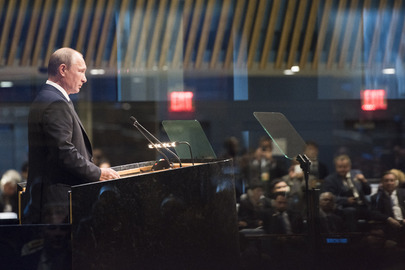
Putin addresses the UN, 09-28-15. (UN Photo)
Their members were generally young people who were enthusiastic, honest and genuinely committed to the public good, but were plagued by the lack of funding and faced with frequent media blackout and open discrimination. Nonetheless, their programs articulated the most promising and humane geopolitical vision for the Balkans. They conceptualized the Balkans as a territorial bridge between the West and the East rather than as the place of persistent confrontation, or the ‘line of fire’ as formulated by the U.S. Secretary of State John Kerry in 2015. They wanted the Balkans to become a force for peace and human dignity in the world. Their vision still remains the best option for the Balkans people.
This desire for non-alignment is understandable as a continuation of the policy of Tito’s Yugoslavia during the Cold War – the nation that several of the modern day Balkan states were a constituent part of. However, according to Kovacevic, these groups were easily overwhelmed, in terms of both financial and propaganda resources, in the 1990s by pro-NATO forces in the West.
In addition to providing resources to build up pro-NATO sentiment in the media and NGO sectors of these countries, financial resources and pressure was used to sway a large number of politicians to favor NATO membership, often in opposition to the general population’s views. Some of the unsavory forms of incentive or pressure include what amounts to blackmail and bribery, Kovacevic told me in an email interview:
This is a long-term process. In the U.S. intelligence community it is called ‘seeding.’ The intelligence scholar Roy Godson defines it as ‘identifying potential agents of influence’ at an early stage and then acting to advance their careers. This is typically done covertly, but there have been the historical examples of overt support. …
In the Balkans, the key role in the process of ‘seeding’ was accomplished by various institutes, conferences, retreats, grants, etc. For instance, I was told by a confidential source who participated in the same U.S.-NATO program, the long-time foreign minister and one-time prime minister of Montenegro, Igor Luksic, was a product of such a process. Luksic was chosen as a very young man to attend various conferences and retreats in Brussels and Washington and, after that, his political career really took off. All the while, he promoted the NATO agenda in Montenegro, even though this went against the will of the majority of the population.
Another example is Ranko Krivokapic who was the speaker of the Montenegrin Parliament for over a decade. He traveled on official business to the U.S. a few times every year and boasted to others that he had a lot of friends in the State Department and other institutions of the U.S. government. There are examples like these in Serbia, Macedonia, Croatia, etc. All over the Balkans.
There is also the fact the European Union has dovetailed its security arrangements to such an extent with NATO that new members are now virtually brought into the NATO structures by default. For example, Mahdi D. Nazemroaya, author of The Globalization of NATO, reports that the E.U.’s Security Strategy was absorbed into NATO during its annual summit in 2006. The emphasis of the summit was on securing energy resources with the goal of ‘co-managing the resources of the EU’s periphery from North Africa to the Caucuses.’ Also implied was the goal of redefining the E.U.’s security borders in synch with both Franco-German and Anglo-American economic and geopolitical interests.
Moreover, British Russia scholar Richard Sakwa, has pointed out that the security integration of the E.U. with NATO was further intensified with the ratification of the Treaty of Lisbon in 2007:
As for the comprehensive character, this is something that has been gaining in intensity in recent years as the foreign and security dimension of the E.U. has effectively merged with the Atlantic security community. The E.U.’s Common Foreign and Security Policy (CFSP) since the Treaty of Lisbon (the “Reform Treaty”) of 13 December 2007, which came into effect in 2009, is now in substance part of an Atlantic system. Acceding countries are now required to align their defense and security policy with that of NATO, resulting in the effective ‘militarization’ of the E.U.
At this point, the forces seeking a non-aligned bridge role for the Balkan states are still very much around, but have suffered marginalization due to lack of resources to take on the powerful and now entrenched pro-NATO political forces. However, with increasing discontent with the weak economic prospects in certain Balkan states, combined with increasing instability in the E.U., it is believed that there is an opening for growth of the movement.
Economic Conditions in the Balkans
The Balkan states comprise Romania, Bulgaria, Albania, Macedonia, Serbia, Kosovo, Montenegro, Bosnia-Herzegovina and Greece.
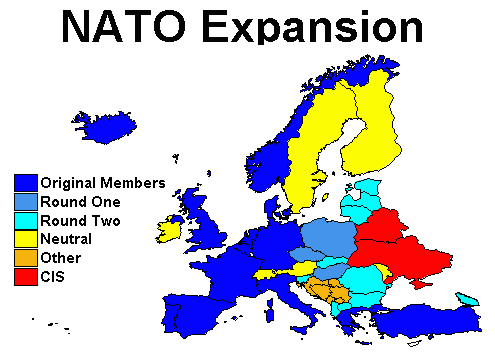
A map showing stages of NATO’s expansion. Dark blue showing original members; lighter blue the “round one” members; aqua the “round two” members; yellow represents neutral states; and brown and red otherwise aligned (including Ukraine, although that has changed since the 2014 U.S.-backed coup).
In 2007, Romania and Bulgaria became E.U. members (three years after joining NATO). Romania’s GDP has barely kept up with its 2008 rate and has a general unemployment rate of 6.4 percent, which sounds reasonable until you look at the youth unemployment rate of 21 percent, which doesn’t bode well.
Bulgaria, on the other hand, is not part of the Eurozone and has not adopted the euro as its currency. Its economic prospects since joining the E.U. have not been impressive either. In the midst of the financial crisis of 2009, its GDP contracted by 5.5 percent, with a current unemployment rate of 7 percent and youth unemployment at 17 percent. Bulgaria is also recognized as one of the union’s most corrupt countries.
Macedonia, Montenegro, Serbia, Kosovo, Bosnia-Herzegovina and Albania are all in the process of E.U. integration, with a supposed approval rate of 80-90 percent among the respective populations of these countries (except for Serbia), despite the virtual rape of Greece and the lackluster performance of Romania and Bulgaria.
It should be noted that all three Balkan nations that are actual E.U. members have higher emigration than immigration rates, another indication that accession to the E.U. doesn’t necessarily translate into a prosperous future for the average person, particularly the young.
There is also the instability highlighted by the British people’s vote to leave the E.U., spurred by disgust with austerity measures imposed by unaccountable bureaucrats in Brussels along with an influx of immigrants – one-third from these poorer E.U. nations – which adversely affect lower-wage natives.
Even if the E.U. had a better track record of effectiveness in terms of improving economic conditions for the masses, it would have a very tall order with some of the prospective Balkan states. Macedonia, for example, has an unemployment rate between 24 and 25 percent as of January 2016, although it has improved from the 2005 high of 37 percent. Despite this improvement, Macedonia still has one of the lowest GDPs in Europe and 72 percent of its citizens claimed they manage their household income only with “difficulty” or “great difficulty” in 2012.
Bosnia-Herzegovina is still feeling the effects of the war of 1992 to 1995 that included major physical destruction of infrastructure and the bottoming out of its GDP. It currently suffers an unemployment rate of 42-43 percent.
Kosovo, a state that owes its existence to a NATO intervention, has 33 percent unemployment, a high crime rate and increasing political violence due to ethnic tensions and a growing ultra-nationalist movement. The Council of Europe compared the government of Kosovo to a mafia state in a 2010 report which revealed trafficking in human organs as well as drugs and weapons throughout Eastern Europe, even implicating the then-prime minister in the operation.
Russia’s Opening
Kovacevic states that the Atlanticist project of E.U. austerity economics and the enabling of Washington’s destabilizing wars via NATO is starting to chip away at its popularity among Balkan populations. He also says Putin is prepared to take advantage of this opening and, since the outbreak of the Ukraine crisis, has turned his attention “to the Balkans with political force and funding not seen since the days of tsar Nicholas II.”
This attention has manifested in the Lovcen Declaration, which was signed on May 6, by members of Russia’s largest political party, United Russia, and the opposition Democratic People’s Party in Montenegro in the village of Njegusi. Kovacevic explains:
One of the most powerful political figures in Montenegro, the metropolitan Amfilohije, the chief bishop of the Serbian Orthodox Church in Montenegro, was present at the signing and gave his blessing. Though in the past Amfilohije has been known to support the authoritarian and pro-NATO prime minister Milo Djukanovic around the election time, he has always publicly opposed NATO membership and has given fiery speeches on its ‘evil nature’ to the point of accusing NATO for continuing Hitler’s anti-Slavic project.
Even more importantly, Amfilohije’s involvement with the Lovcen Declaration reveals one of the fundamental components of Putin’s overall geopolitical plan – the nurturing and intensification of the religious Christian Orthodox connection between the Russians and the Orthodox peoples of the Balkans. This includes not [only] the Serbs, Montenegrins and Macedonians, but also the Greeks and Bulgarians whose states are in NATO and whose religious ‘awakening’ can easily subvert NATO from the inside.
Criticism and minimization of the project have set the tone in Western media, to the extent that it has been covered at all, particularly in relation to utilizing an opposition party for significant influence. But Kovacevic argues that such a dismissive attitude is disingenuous:
[T]he very same method has been used by the U.S. and NATO intelligence services to control the governments of East-Central European states since the collapse of communism. Countless small parties with just a handful of parliamentary deputies were formed with the money coming from the various ‘black budgets’ with the task of entering the governing coalition and then steering the entire government in the direction charted by their foreign founders and mentors.
These parties have had minimal public legitimacy, but have made a great political impact with their ‘blackmail’ potential. As they also don’t cost very much, the CIA, the MI6, and the BND regularly create them for every new election cycle.
Now the Russians (primarily, the SVR and the GRU) are using the same rulebook for their own geopolitical interests. In addition, however, Putin’s grand design for the Balkans embodied in the ANS is also likely to prove durable not only because it builds on the traditional cultural and religious ties linking Russia and the Balkans, but also because it rides on the wave of the enormous present popular dissatisfaction with the neoliberal Atlanticist political and economic status quo.
The fact that this declaration was signed in Montenegro is most relevant due to the fact that the country has been officially invited to join NATO, whose subsequent membership is treated in the West as a fait accompli. However, accession requires consensus approval by all current NATO members – one member could veto the move before completion of the process as happened with Macedonia when Greece vetoed their membership aspirations in 2008 when an invitation was to be offered at the Bucharest Summit – as well as approval by the population of Montenegro.
Joining any alliance treaty is arguably something that affects national sovereignty, which requires a referendum as Kovacevic, who is Montenegrin, explains:
The corrupt government of Milo Djukanovic is trying to avoid a national referendum because it knows that it does not have a majority support for NATO. If given a choice, the people of Montenegro would reject the protocol. The Constitution requires a referendum for all matters that affect national sovereignty, but Djukanovic is arguing falsely that NATO membership leaves Montenegrin sovereignty intact.
Kovacevic predicts that a show-down over NATO membership could create instability in the country: “[I]f he [Djukanovic] tries to push this decision through the Parliament (which he no doubt will), wide-scale strikes and demonstrations may take place all over the country. Whoever is pushing Montenegro in NATO is dangerously destabilizing the country in mid-to-long term.
If that happens, Washington may find for the first time in recent memory that forcing instability on a smaller country may ultimately accrue benefits to another great power, helping to facilitate a shift in geopolitics that it didn’t bargain on. As Nazemroaya comments in his book:
The [NATO] alliance is increasingly being viewed as a geopolitical extension of America, an arm of the Pentagon, and a synonym for an evolving American Empire. … Ultimately, NATO is slated to become an institutionalized military force. … Nevertheless, for every action there is a reaction and NATO’s actions have given rise to opposing trends. The Atlantic Alliance is increasingly coming into contact with the zone of Eurasia that is in the process of emerging with its own ideas and alliance. What this will lead to next is the question of the century.
Natylie Baldwin is co-author of Ukraine: Zbig’s Grand Chessboard & How the West Was Checkmated, available from Tayen Lane Publishing. In October of 2015, she traveled to 6 cities in the Russian Federation and has written several articles based on her conversations and interviews with a cross-section of Russians.
Featured Video

Rewriting the risk? Inside the government’s vaccine safety messaging
or go to
Aletho News Archives – Video-Images
Book Review
“Davos Can Really Replace the UN”
Inside the book that maps the architecture behind global governance — from the Epstein files to the Pact for the Future
Lies are Unbekoming | April 1, 2026
On June 13, 2019, the United Nations and the World Economic Forum signed a partnership deal to “accelerate the implementation of the 2030 Agenda for Sustainable Development.” That same evening, WEF president Börge Brende — Norway’s former Foreign Minister — had dinner with Jeffrey Epstein at Epstein’s Manhattan townhouse. The Epstein files, released January 2026, contain an exchange between the two from the previous year. Epstein to Brende: “Davos can really replace the UN. C21, cyber, crypto . genetics… intl coordination.” Brende back to Epstein: “Exactly — we need a new global architecture. World Economic Forum (Davos) is uniquely positioned — public private.”
The next day, the UN General Assembly adopted the framework for restructuring global governance.
That sequence — the partnership signing, the Epstein dinner, the candid admission about replacing the UN with a public-private architecture, and then the formal adoption — opens Jacob Nordangård’s The Digital World Brain. Pages two and three. Footnoted to the UN resolution number, the Epstein files, and the General Assembly record.
I keep coming back to it because it captures what this book does that almost nothing else in the independent research space manages. I’ve followed Jacob’s work for years now and interviewed him about his research. Each book peels back another layer of the same institutional architecture, and each time I think he’s reached the limit of what can be documented, the next one goes further. Nordangård doesn’t speculate. He doesn’t editorialize much. He lays institutional actions next to each other in chronological order and lets the pattern announce itself. … continue
Blog Roll
 Aletho News
- How I fell foul of the BBC thought police
- The End of NATO
- 37 days of war on Iran cost US staggering $42bln, tracker shows
- Baghdad tells Asian refiners, traders to begin loading Iraqi crude amid Iranian exemption
- Under fire, Moscow and Tehran close ranks
- Iran, US receive Pakistan-mediated plan for ceasefire then final deal
- Iran submits demands for end to war as mediators scramble ahead of Trump deadline
- Iran Threatens Retaliatory Strike on Stargate AI Project in UAE
- US sent ‘a lot’ of arms to Iranian protesters – Trump
- Barak Ravid Launders Deception To Allow Trump To Back Off Of His Power Plant Threat – Again
- If Americans Knew
- U.N. experts demand Israel release prominent Gaza doctor after reports of ‘severe torture’
- Israel’s Latest Genocide Is Against the Shias of Lebanon. Why Is the World Silent?
- How Eliot Cohen’s influence over U.S. war-making paved the way for Trump’s war crimes in Iran
- Israelis don’t pay for the weapons we ‘sell’ to them — US taxpayers do
- While Distancing from AIPAC, Most 2028 Democratic Hopefuls Are Still Embracing Israel
- A brief history of the Israeli nuclear program, the open secret at the heart of the Iran war
- Israeli Settlers Killed a Palestinian Farmer on His Own Land, in Front of His Father. Yes, Again
- The US-Israeli War on Science is an Assault on our Future
- 100+ International Law Experts Say US Strikes on Iran Violate UN Charter, Could Be War Crimes
- ‘Vile, Horrifying, Evil’: Trump Threatens to Bomb Nation of 90 Million People ‘Back to the Stone Ages’
- No Tricks Zone
- An Inconvenient Tree: Uncovered In Alps… Europe Much Warmer Than Today 6000 Years Ago
- New Study Reports A 60% Slowdown In Greenland’s Ice Loss Rate In The Last Decade
- Low Intensity Tornado Wrecks Major Solar Farm, Creating A Potential Toxic Dump
- New Study Finds Warming Saves Lives…Cold Temperatures 12 Times More Deadly Than Excess Heat
- German Science Blog Accuses PIK Climate Institute Of Hallucinating Climate Tipping Points
- Devastating Assessment Of Comirnaty Vaccine By Former Senior Pfizer Europe Toxicologist
- New Study: CO2 Is ‘Effectively Negligible’ As An Explanatory Climate Change Factor Since 2000
- Former Pfizer Toxicologist Dr. Helmut Sterz Tells Bundestag Hearing Pfizer Vaccine Should Have Never Been Approved
- Energy Expert: Germany’s Nuclear Phaseout Was A “500 Billion Euro Mistake”
- New Research: South Australia’s Mid-Holocene Sea Surface Temperatures Were 4°C Warmer Than Today
 Aletho News