Pentagon conducts 20 airstrikes in Yemen, first since botched raid
Press TV – March 3, 2017
The Pentagon has carried out its first major military operation in Yemen since a botched raid in January that killed women and children as well as an American commando.
US forces conducted more than 20 airstrikes involving a mix of manned and unmanned aircraft early on Thursday, the Pentagon said.
Navy Captain Jeff Davis said the airstrikes targeted al-Qaeda in the Arabian Peninsula in three south-central provinces of Abyan, Shabwah and al-Bayda.
“The strikes will degrade the AQAP’s ability to coordinate external terror attacks and limit their ability to use territory seized from the legitimate government of Yemen as a safe space for terror plotting,” the Pentagon spokesman said.
The US military did not share a casualty estimate, but local officials said at least nine suspected al-Qaeda militants were killed.
Davis said the operation was coordinated with resigned president, Abd Rabbuh Mansur Hadi, a strong ally of Saudi Arabia that has been engaged in its own military campaign against Yemen.
Troops engage al-Qaeda on the ground
Military helicopters and drones launched a flurry of fresh airstrikes in Shabwah province early on Friday, witnesses said, according to Reuters.
The raids targeted the residence of Sa’ad Atef, an al-Qaeda leader, as well as other suspected militant positions in the area.
The unidentified aircraft, believed to be American, also deployed troops to the al-Saeed area of the southern province, who engaged suspected al-Qaeda militants on the ground for nearly half an hour.
The military operations came more than a month since a January 29 raid, the first of its kind authorized by President Donald Trump, in al-Bayda which residents said left as many as 25 civilians dead.
An ongoing investigation by the US Central Command has also determined that civilians, including possibly children, lost their lives during the botched raid.
The White House hailed the operation as a success, but critics said it was a failure since it resulted in the death of civilians and 36-year-old Navy SEAL Ryan Owens.
Three other Americans were also wounded in the Navy SEAL Team Six mission and a military aircraft worth $75 million was destroyed after it crash-landed at the raid site.
Trump blames generals for botched raid
President Trump has tried to distance himself from the raid by emphasizing that the operation had been in the works long before he took office. “This was a mission that was started before I got here,” he said in an interview with Fox News this week.
“This was something that, you know, they wanted to do. They came to see me and they explained what they wanted to do, the generals, who are very respected,” the president said. “And they lost Ryan.”
During his address to a joint session of Congress on Tuesday, Trump paid tribute to the fallen SEAL, and insisted that the operation yielded valuable intelligence that would “lead to many more victories in the future.”
Some US officials, however, have disputed that claim, saying the raid gathered little, if any, workable intelligence.
The United States conducts drone strikes in Yemen and several countries. Washington claims the airstrikes target members of al-Qaeda and other militants, but according to local officials and witnesses, civilians have been the victims of the attacks in many cases.
Al-Qaeda in Yemen has grown in weapons and number since the start of the Saudi military campaign in March 2015, which was launched to bring back Hadi to power and undermine the Houthi Ansarullah movement.
1 Year After Berta Caceres’ Murder, Activists Demand US Stop Funding Abusive Honduran State Forces
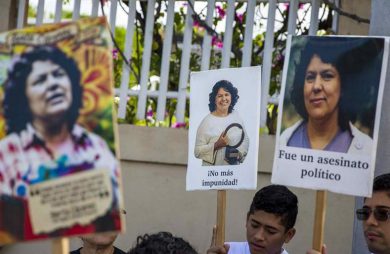
Photo: EFE
teleSUR | March 2, 2017
One year after the assassination of Honduran Indigenous leader Berta Caceres, human rights organizations and Indigenous communities continue to demand justice in the case, while the international branch of the struggle pressures to an end of U.S. funding for police and military forces accused of human rights abuses in the Central American country.
Caceres’ family sent a letter Thursday to U.S. Representative Norma Torres to ask for her support for the Berta Caceres Human Rights in Honduras Act, which was reintroduced the same day to the House of Representatives after stalling without adequate support since last year. The bill seeks the suspension of Washington’s security aid to Honduras until the country fulfills more rigorous human rights conditions — including an end to abuses by the police and military and justice in cases like Berta Caceres’ murder.
“It is increasingly clear that the government of Juan Orlando Hernandez is unwilling to act decisively to stop the killings of social activists in Honduras and to conduct honest and thorough investigations of killings and attacks,” Caceres’ family members state in the letter to Torres, urging her to “stand with” them and with Honduras. “In addition, the government has consistently failed to respect basic indigenous land rights, as it is required to do under its international treaty obligations.”
The original U.S. bill inspired by Caceres’ murder paints a grim picture of Honduras’ grave human rights situation, including the lack of justice in cases like Caceres’ murder. “Impunity remains a serious problem, with prosecution in cases of military and police officials charged with human rights violations moving too slowly or remaining inconclusive,” it states, adding that the U.S. State Department itself reported in 2015 problems of “corruption, intimidation, and institutional weakness of the justice system” in Honduras.
Caceres’ family addressed the letter to Torres to ramp up individual pressure for support of the bill. Torres, the first and only Central American in Congress and the founder of the bipartisan Central American Caucus, has faced criticism for aligning herself with the Honduran government, backing Washington’s controversial Alliance for Prosperity security aid package for Central America’s Northern Triangle and for refusing to support the Berta Caceres bill.
“We believe that your support for the Berta Caceres Human Rights Act will further strengthen your standing as an advocate for Central Americans and human rights, both in the U.S. and Honduras,” the family wrote in its letter to Torres, imploring her endorsement of the bill.
Caceres’ family also highlighted in the letter the involvement of active and former members of the military — including suspects trained at the infamous U.S. School of the Americas — in her murder, underlining the urgent need for more rigorous conditions on security aid to Honduran state forces. A former member of the military police in Honduras revealed to the Guardian that her name had been at the top of a “hit list” that a U.S.-trained unit received.
“A government that fails to protect its citizens and whose security forces are implicated in attacks and killings of activists should not be receiving security funding and training from the U.S. government,” the letter stressed, adding that Caceres’ murder is only one example among scores of assassinations, attacks and other forms of intimidation targeting activists in the country.
According to a recent report by the international rights organization Global Witness, 120 land and environmental defenders have been killed in Honduras since 2010 after an increase in state-sanctioned abuses in the wake of the 2009 U.S.-backed military coup.
Meanwhile, in Honduras, members of the organization that Caceres founded — the Civic Council of Popular and Indigenous Organizations of Honduras or COPINH — held a march Wednesday in the capital city Tegucigalpa demanding justice one year after her death.
They blasted Honduran authorities over the fact that, to this day, the motive for her assassination has not been identified and perpetrators in the killing not brought to justice. Demonstrators with banners shouted slogans demanding that authorities arrest the masterminds behind Caceres’ murder.
Caceres rose to international prominence for leading the Indigenous Lenca people in a struggle against a controversial hydroelectric dam project in the community of Rio Blanco that was put in motion without consent from local communities. She was also a key leader in the post-coup resistance movement that demanded a constituent assembly to rewrite the Honduran Constitution.
For her environmental and land defense work, she was awarded the prestigious 2015 Goldman Environmental Prize, while at the same time suffering dozens of death threats and other forms of harassment. Berta Caceres was shot dead just before midnight March 2, 2016, when gunmen stormed her house and attacked her.
Caceres’ family claim that the Honduran company behind the hydroelectric project she fought against, Desarrollos Energeticos or DESA, and the Honduran government hired contract killers to murder her and other activists.
Her family and fellow activists insists that her legacy will continue to inspire a movement for rights and justice.
In a statement ahead of the anniversary of her murder, Caceres’ COPINH reiterated calls for justice and an end to unwanted corporate projects on Indigenous land and vowed to forge on in the struggle that Caceres championed in the name of a “just society where life is respected.”
“One year after Berta’s murder, she continues teaching us that ideas cannot be killed and the processes of the people cannot be stopped,” the organization said. “May she continue to be present and our task continue with her legacy of resistance and struggle against injustice.”
RELATED:
Honduras Is the Deadliest Country for Environmental Activists
House bill would slash US lethal military aid to Ukraine by half
RT | March 3, 2017
Amid a recent spike in violence in eastern Ukraine, a new bill to be introduced in the US House of Representatives proposes dramatically cutting military aid to Kiev, including lethal weapons, as well as logistical and intelligence support.
Reducing military-related costs inherited from the Obama administration is said to be the bottom line of the new 2017 Defense Appropriations bill, according to the House Appropriations Committee’s press release published on Thursday. The bill is due to be heard in the House next week.
Among other cost-saving measures, the bill proposes allocating only $150 million for “training, equipment, lethal weapons of a defensive nature, logistics support, supplies and services, sustainment, and intelligence support to the military and national security forces of Ukraine.”
While still sizeable, the figure is only half that transferred to Ukraine by the US last year. Under the 2016 National Defense Authorization Act, the US paid out $300 million to assist Kiev “in defending itself against actions by Russia and Russian-backed separatists.”
Notably, the use of funds “to procure or transfer man-portable air defense systems” is prohibited in the 2017 bill.
Low-intensity violence in eastern Ukraine quickly escalated in early February after Ukrainian government forces shelled the town of Avdeevka, which lies just 10 kilometers from Donetsk. Tanks, heavy armor, artillery, and multiple-launch rocket systems were used in what Ukrainian Deputy Defense Minister Igor Pavlovsky called a “meter-by-meter, step-by-step” advance towards Donetsk.
Reports from the OSCE’s Special Monitoring Mission (SMM) also confirmed that heavy weapons, which have long been banned under the landmark Minsk agreement, had been moved closer to the disengagement line.
Kiev has blamed the escalation on the rebels, while the OSCE says both sides of the conflict have violated the truce. In its latest report on Wednesday, the SMM said it had recorded “more ceasefire violations in both Donetsk and Luhansk regions, including more than twice as many explosions compared with the previous reporting period.”
In a February interview with Ukrainian and Russian media outlets, including RT, Ukrainian President Viktor Yanukovich, who was toppled in the 2014 Euromaidan coup, said that Kiev’s crackdown on eastern Ukraine amounted to a declaration of war on its own people.
“Of course, everyone who took part in this decision must be held responsible. This is a crime against their own people,” Yanukovich said. “The current authorities did not make a single attempt to talk to the people, who were against the coup,” he argued, adding that, instead, Kiev simply “divided the country into winners and losers,” prompting the alienation of the eastern regions.
Despite the rising civilian death toll in eastern Ukraine, the US and its NATO allies have been actively integrating Kiev’s forces into Western military structures. US Army-run exercises dubbed ‘Rapid Trident’ have been held in western Ukraine annually since 2014, while Ukrainian soldiers are often seen at various NATO-led war games in the Baltics and eastern Europe.
Read more:
‘Jewish Power Never Sleeps’–Another Billboard Taken Down

Fig Trees and Vineyards | March 2, 2017
The following is an email sent out recently by Deir Yassin Remembered announcing the take-down of one of their billboards.
The taken-down DYR “America First” billboard, the Southern Poverty Law Centre and a quote from Elie Wiesel – what could they have in common? Henry Herskovitz tells us more:
Jewish Power Never Sleeps
Like Michigan rust on vehicles, Jewish Power remains relentless at getting its way. Just when Witness for Peace was to announce the installation of a local billboard – sponsored by sister organization Deir Yassin Remembered and carrying our message “America First, Not Israel” – we get “the call”. The billboard pictured was taken down by Adams Outdoor Advertising one week after installation, effectively terminating a three-month contract.
That’s how long it took for Jewish Power to pressure Adams’ executives into seeing things their way. The call came from General Manager Mike Cannon, who admitted to receiving phone calls asking that the billboard be taken down. Mike claimed he was not the one who made the decision, and provided the phone number of Vice President of Human Resources
Brian Grant to field my questions.Brian developed a mantra for the conversation we shared: “the decision to remove the billboard was a collective decision and was made because the message did not meet Adams’ company standards. We removed the billboard and refunded your money. And that’s all I can say.” Brian fell back on this mantra at least a half dozen times during our 20-minute discussion. And reminded me that, since a clause in the contract allowed Adams to terminate at any time, there was no “breach of contract”.
Q: What were the company standards?
A: [Brian was not going to go into that.]
Q: How do you square the fact that the message was initially approved by Adams?
A: It should not have been approved; due diligence was not applied.
Q: Who were the people complaining about the billboard?
A: [Would not answer that.]
Q: What were the organizations calling for the billboard to be taken down?
A: [See above.]
Q: Would the decision to pull the billboard have been the same had the message been simply America First?
A: Well, you’re asking a hypothetical.
Q: You mean Adams would NOT run a billboard saying America First?
A: [No answer.]And so it goes. By deception shall you make war. DYR and WfP lose the round; Jewish Power wins. We move on.
Ann Arbor placed on SPLC “Hate” Map
The Southern Poverty Law Center exercises its own brand of Jewish Power by placing Deir Yassin Remembered (and its satellite office in Ann Arbor) on its “hate” map. This information came to us, not by direct communication from the SPLC, but through an article appearing in the Rochester, NY Democrat and Chronicle, entitled: “Rochester area makes SPLC Hate Map”
Defining “hate” proves difficult. A friend asks if forming a group which hates “hate” groups is in itself a “hate” group? Hmmm. The only clear example of hate speech that has come across this writer’s desk belongs to Holocaust icon Elie Wiesel:
“Every Jew, somewhere in his being, should set apart a zone of hate — healthy, virile hate — for what the German personifies and for what persists in the German.”
Henry Herskovitz
Deir Yassin Remembered / Witnesses for Peace
Ekos Poll: Canada Should Support Israeli Sanctions Not Demonize Them
By Murray Dobbin | CounterPunch | March 3, 2017
Foreign policy is one of those areas of democratic governance that doesn’t often get on the public’s radar. But when it does it provides citizens with a kind of unsullied opportunity to apply their values. That is, unsullied by considerations of self-interest, we get to ask what is the right thing to do?
Governments, of course, aren’t quite as free to make such decisions given that they have so-called “national interests” to consider. But Canadians should be able to expect from their federal government that their foreign policy conforms closely to their values.
When it comes to Canada’s policy towards Israel the Trudeau government, aping its predecessor, is several country miles from reflecting Canadian values. That is the irrefutable conclusion of an Ekos poll whose partial results were released February 16th. A second batch of survey results released yesterday (all survey results can be found here: focussed on the issue of whether or not Canadians think it is appropriate to use sanctions and/or boycotts to pressure Israel to obey international law.
The results demolish conventional wisdom on this question. Respondents were asked – in the context of the UN Security Council denunciation of settlement building in the West Bank – “… do you believe that some sort of Canadian government sanctions on Israel would be reasonable?” Overall, 66% expressing an opinion answered yes. But that number is heavily skewed by Conservative supporters, 70% of whom reject sanctions on Israel. Openness to sanctions on Israel by supporters of other federal political parties ranged from 75% for Liberals to 94% for Bloc Quebecois supporters. Eighty-four percent of NDP supporters believed sanctions on Israel would be reasonable.
Levels of acceptance for the Palestinian call for a boycott of Israel was even higher with fully 78% of those with an opinion stating they believe the Palestinians’ call for a boycott is “reasonable.” Again, Conservative supporters expressed radically different views from respondents supporting other parties: 51% rejected a boycott. Supporters of other parties who were receptive to the Palestinian call for a boycott ranged from 88% for Liberal supporters to 94% for the Bloc Quebecois.
Flashback to February 2016, when Parliament adopted a Conservative motion (by a vote of 229-51) condemning Canadian individuals and organizations who promote the Palestinian call for a boycott. That shameful assault on freedom of expression was supported by the Trudeau government. Only the NDP and Bloc opposed it.
When asked if they supported the passing of this resolution a majority of respondents expressing an opinion – 53% – said no while half that that number, 26%, said yes. Only 20 % of Liberal supporters supported the resolution while 55% disagreed with it.
Most Canadians still have little idea of just how sycophantic the Trudeau Liberals are when it comes to support for the right-wing government of Benjamin Netanyahu, particularly when it comes to U.N. votes on Palestinian rights and Israel’s violations of international law.
The Trudeau government has cemented Canada’s reputation as an embarrassing outlier when it comes to UN votes on Israel. Since October, 2015 when it came to power, the Liberal government has voted against United Nations resolutions that were critical of Israel on over 25 occasions. In fact, it has never voted in favour of a U.N. resolution that is critical of Israel. Which illustrious democracies does Canada find itself allied with in these votes? Besides Israel and the US, it’s loyal benefactor, our fellow-travellers are normally Micronesia, Palau and the Marshall Islands. Most of these resolutions pass by a vote of 156 or 158 to six or eight (with our EU allies voting for or abstaining).
Some of the resolutions Canada actively opposed should shock Canadians. The Trudeau government opposed a U.N. resolution that reaffirmed “… the importance of Israel’s accession to the Treaty on the Non-Proliferation of Nuclear Weapons [NPT].” Another resolution, supporting “The right of the Palestinian people to self-determination…” was opposed by the Liberals as was a resolution that almost precisely reiterates the government’s official policy – that “Israeli settlements in the Occupied Palestinian Territory, including East Jerusalem…” are an obstacle to peace.
Last December the U.N. Security Council voted unanimously (with the US abstaining) to declare that Israeli settlements on territory intended for a Palestinian state were a “flagrant violation under international law and a major obstacle to the achievement of… peace” between Israel and Palestine. Canada remained absolutely silent as it was (effectively) when Israel passed its “land grab” law which retroactively legalises settler homes on private Palestinian land.
What could possibly justify Trudeau’s immoral and frankly irrational stance when it comes to promoting peace between Israel and the Palestinians? In determining its policy towards Israel the Trudeau government has three apparent motivations at play: defending Israel’s right to exist, tending to Canada’s specific national interests and reflecting Canadian values.
None of these shine any real light on Canada’s continued blanket support for the Netanyahu government. It is being increasingly argued by Israel’s friends that the trajectory of that country today is in fact the biggest threat to Israel’s existence: a one-party state that can be Jewish or democratic, but not both. Canada on its own has no compelling “national interests” in the Middle East – except as a yes man for the US Empire.
And lastly, Trudeau’s inexplicable stance is overwhelmingly at odds with Canadian values. Not only do large majorities see Israel in a negative light, they reject by 91% the notion that criticism of Israel is necessarily anti-Semitic as implied in the Commons resolution. Flying in the face of Trudeau’s cowardly denunciation of BDS supporters are 75% of his own party supporters who are open to sanctions and 88% who say the same of boycotts.
Justin Trudeau has a lot of explaining to do.
MURRAY DOBBIN, now living in Powell River, BC has been a journalist, broadcaster, author and social activist for over forty years. He now writes a bi-weekly column for the on-line journals the Tyee and rabble.ca. He can be reached at murraydobbin@shaw.ca
Christian Zionists Target US Aid to Palestinian Authority
By Richard Edmondson | Fig Trees and Vineyards | March 2, 2017
A few days ago, We Hold These Truths posted a podcast entitled “Christian Zionism is a War Based Religion,” which includes a discussion on the so-called “just war” theological doctrine often used by Christian leaders to justify their support for US wars.
I am referring, of course, to Christian leaders such as John Hagee, of Christians United for Israel, or CUFI.
Back in 2003, Hagee supported the US war in Iraq, and even later, after it became glaringly apparent there never had been any weapons of mass destruction and that Bush had lied about the war, he continued to be a vocal supporter of the US aggression.
“Christian Zionism is a war based, political religion wrapped around the notion that the modern state of Israel is a fulfillment of Biblical prophecy,” reads the podcast description put up by We Hold These Truths. You can go here to listen to the podcast. It’s a fairly interesting discussion.
I mention it because just today CUFI, which is the largest Christian Zionist organization in America, sent out an appeal to its email subscribers calling for an end to US financial aid to the Palestinian Authority. A friend of mine who is on their email list forwarded it to me.
What exactly has the PA done that has so upset the CUFI? You’ll read about it in the text of the email, which I reproduce below, but basically it comes down to support for the families of Palestinians who have been either killed or imprisoned by Israel–people the CUFI views as “terrorists.”
Of course, anyone who gets killed by an Israeli soldier automatically has to be labeled a “terrorist,” and there have been reports of soldiers planting knives on the bodies of their victims. Apparently this is of no concern to CUFI, however. It isn’t mentioned in their email.
The illegal settlements, the ongoing 50-year occupation of the West Bank, the targeting of residential buildings and hospitals in Israel’s periodic attacks upon Gaza–all these things, too, go unmentioned.
Another key point is that under international law people have a right to resist occupation. By this measure, attacks by Palestinians against Israeli soldiers are not acts of terrorism. To make the assertion that they are would be the equivalent of branding the founding fathers of America as terrorist leaders.
But perhaps the main thing to keep in mind is that this appeal is being made by an organization that supported the US war in Iraq, and which has yet to apologize or concede that the war was fought under false pretenses or that Christian support for it was a terrible mistake. Another thing you might also want to reflect upon, just as a matter of interest, is that the executive director of Christians United for Israel, David Brog, is not in fact a Christian–he is Jewish.
The CUFI communique includes the following graphic at the top of the email:

The text then reads as follows:
Dear _______,
Since September of 2015, the beginning of the so-called “stabbing intifada,” Palestinian terrorists have murdered more than 50 innocent people and wounded hundreds more.
The media often describes these terrorists as “lone wolves” completely disconnected from Mahmoud Abbas and his Palestinian Authority (PA). But the fact is that the Palestinian Authority makes generous lifetime payments to every Palestinian imprisoned for killing Israelis. And if the terrorist dies during his attack, his family receives these payments. This financial support for terrorism is actually required under legislation passed by the Palestinian legislature.
The United States provides the PA with approximately $300 million in aid each year. The PA makes approximately $300 million in payments to terrorists and their families every year. There is no way around this troubling reality: our taxpayer dollars are being used to fund terrorism. This must end!
Earlier this week, Sen. Lindsey Graham re-introduced a critical piece of legislation–the Taylor Force Act. Representatives Lamborn and Zeldin introduced similar legislation in the House of Representatives. This bill requires that we cut all U.S. aid to the PA until it stops funding terrorism.
This bill is named after Taylor Force, a West Point graduate who who survived tours of duty in Iraq and Afghanistan only to be murdered in Israel by a Palestinian terrorist.
Today we ask you to stand up for Taylor Force. We ask you to stand up for Israel. And we ask you to take a stand against terrorism.
Click here now to ask your members of Congress to co-sponsor the Taylor Force Act.
Help us end the PA’s Pay to Slay policy today!
Blessings to you and those you love,
Pastor John Hagee
National ChairmanDavid Brog
Director
The appeal ends with the following words written in large white letters on a red background:
“NO MONEY FOR MURDER”
While I am not a big fan of the PA, one thing that might be said in their favor is that they do not have a lobby in Washington to speak of, and that we have never fought a war on their behalf. I have my doubts as to whether this bill will be passed or signed into law, however. It is necessary for Israel to maintain the diplomatic pretense that Palestinians in the Occupied Territories exercise some measure of self-determination, no matter how small. It is the PA that provides this fig leaf. Take away the fig leaf and Israel stands exposed as an apartheid state for all the world to see. My guess is this is probably one of the only reasons aid to the PA was ever begun in the first place.
US Lawmakers Pass Resolution Demanding Trump Act on Venezuela
By Ryan Mallett-Outtrim | Venezuelanalysis | March 1, 2017
US Senators unanimously passed a resolution Wednesday urging President Donald Trump to take further action against Venezuelan officials.
The bill also expressed support for a controversial move by Organisation of American States (OAS) head Luis Almagro to invoke the Democratic Charter. If invoked, Venezuela would be suspended from the OAS. When Almagro first announced the move in 2016, he also demanded President Nicolas Maduro be “immediately” removed from office, prompting many Latin American leaders to accuse the OAS head of overreach.
Despite the controversy, the Senate bill called on Trump to “provide full support for OAS efforts in favour of constitutional and democratic solutions to the political impasse and to instruct federal agencies to hold officials of the Venezuelan government accountable for violations of US law and abuses of internationally recognised human rights.”
The bill will now head to the House of Representatives.
One of the main supporters of the bill, Senator Marco Rubio, thanked both Republicans and Democrats for supporting the move.
“I thank my Senate colleagues for supporting this bipartisan resolution calling for the government of Venezuela to respect the constitutional and democratic processes and release all political prisoners,” Rubio said in a statement.
The bill was co-sponsored by prominent Democrats including Senators Bob Menendez and Bill Nelson, along with Hillary Clinton’s 2016 presidential running mate Tim Kaine.
Venezuela has already been hit by numerous US sanctions. One of former president Barack Obama’s last acts in office was the renewal of an executive order in January, declaring Venezuela an “unusual and extraordinary threat” to national security.
The executive order wasn’t set to expire until March, though White House officials said Obama went ahead with renewal early to ensure a “a smooth transition” for the Trump administration.
Since then, the Trump administration has slapped Venezuelan Vice President Tareck El Aissami with sanctions, including a travel ban and an asset freeze targeting one of his alleged close confidants, the entrepreneur Samark Lopez. Both Aissami and Lopez have been accused of involvement in international drug trafficking. Aissami has denied the allegations, stating in February that he was the victim of anti-Venezuela hardliners in Washington “ “whose fundamental interest is to prevent Venezuela and the United States from restoring their political and diplomatic relations on the basis of mutual recognition and respect”.
“These interest groups not only lack any evidence to demonstrate the extremely serious accusations against me, but they also have built a false-positive case in order to criminalise –through me– the Government of the Bolivarian Republic of Venezuela, a country that is decidedly waging a war on transnational drug trafficking business,” he said.
Antarctic Record Temperature Con
By Paul Homewood | Not A Lot Of People Know That | March 2, 2017

https://twitter.com/greenpeace/status/837005520313679872
Today’s fake news story comes from Greenpeace.
The supposed record comes from Esperanza. As Jim Steele at WUWT points out, Esperanza is at the northern tip of the Antarctic peninsula, at a latitude of 63.4S, just about as far outside the Antarctic Circle as you could get.

And as WUWT also points out, the temperature was purely the product of a fohn wind.
The temperature of 63.5F was actually set in March 2015, but has only just been officially confirmed by the WMO. As the Capital Weather Gang at the Washington Post noted at the time, the previous record of 62.8F was also set at Esperanza as far back as 1961.
The implication now is that “balmy” temperatures of 63F are unheard of Antarctica, which is clearly nonsense.
And as we can see, monthly average temperatures in March 2015 were not in the least unusual. Indeed, the hottest March was in 1965.

https://data.giss.nasa.gov/cgi-bin/gistemp/show_station.cgi?id=301889630008&dt=1&ds=14
None of this information is mentioned by either Greenpeace, or media outlets such as MSN, who also carry the story.
But the really dishonest part is that photo of two poor penguins stranded at the top of a melting lump of snow.
As Joe has discovered, exactly the same photo appeared in December 2013, in an article by the International Science Times, which was about record cold temperatures in Antarctica. The picture is actually on Cape Denison, as the report makes clear:

When it’s late February and you’re complaining about the winter dragging endlessly on, take comfort in the fact that you’re not on the East Antarctic Plateau, where scientists have measured the coldest temperature on earth. At negative 135.8 degrees Fahrenheit, the August 10, 2010, temperature was “tens of degrees colder than anything ever seen in Alaska, Siberia or Greenland,” said Ted Scambos of the National Snow and Ice Data Center in Boulder, Colo., the group that made the discovery.
NATO’s scaremongering about ‘Russia threat’ to Baltic States ‘is all about money’
RT | March 2, 2017
The US security establishment is trying to justify its existence, says Daniel McAdams of the Ron Paul Peace Institute, commenting on a new report which lists how NATO can help the Baltic States counter Russian ‘hybrid warfare.’
The American global policy think-tank, the RAND Corporation, published a report that claims NATO should do more to counter the potential Russian threat and strengthen the Baltic countries’ forces. The US government-funded body issued a report titled “Hybrid Warfare in the Baltics: Threats and Potential Responses.”
The document raises concern over “Russian use of “hybrid warfare” best understood as covert or deniable activities, supported by conventional or nuclear forces, to influence the domestic politics of target countries.”
The author of the report, Andrew Radin claims “these tactics are of particular concern in the Baltic countries of Estonia and Latvia, which have significant Russian-speaking minorities.” He warns that there is concern Russia will seek to use these minorities to gain influence in the region, “use covert action to seize territory, use subversion to justify a conventional attack, or otherwise use deniable or covert means to gain influence in the Baltics and undermine the EU and NATO.”
RT discussed the report with McAdams and asked him why potential “Russian aggression” is in the spotlight again. Is there a real threat?
In his view, what we are seeing is just another example of the national security establishment in the US “having to justify its existence.”
“The report itself outlines many things that NATO has to do to help the Baltics. The Baltics are absolutely irrelevant to the security of NATO. Their only relevance is geographic. They are close to Russia. Therefore, NATO can hold exercises on Russia’s border to provoke Russia. As far as the Baltics, look at Latvia, for example, if it is so concerned about Russian warfare or hybrid warfare, why do they spend 0.9 percent of their GDP on defense? They are clearly not worried. It really is just a ploy to get more free things from NATO. And for NATO to keep itself alive after it should have been shut down,” McAdams said.
In his opinion, “hybrid warfare” – the report refers to – is a term used when there’s no evidence that Russia has done anything wrong.
It was hybrid warfare when Russia “invaded Ukraine.” And that is just because we didn’t see any Russian military in Ukraine. It was hybrid warfare with “the little green men” in Crimea. Well, those little green men in Crimea were already there legally as part of the leased base in Sevastopol. All of these things are made up, it’s part of NATO’s ongoing aggression toward Russia, provocation of Russia and it is desperate to keep itself alive, to keep its budgets rising,” the analyst said. “And sadly, unfortunately, we are seeing that the US president who was rightly critical of NATO, calling it outdated, said in his recent speech to Congress that he loves NATO and thinks it’s great. So, unfortunately, it looks like it is going to be propped up for a while longer. And yes, it is about money,” he added.
Trump Retreats on Detente with Russia
By Gilbert Doctorow | Consortium News | March 1, 2017
Donald Trump’s speech on Tuesday to a joint session of Congress was a reasonably well-crafted and well-delivered exercise in communicating his case to the nation. The President opened with a description of the flurry of executive orders in his first 30 days in office, implementing promises made during the electoral campaign.
He then went on to describe the contours of legislation that his administration will send to Congress, starting with the budget and its scrapping of the cap on military spending, which is to enjoy a 10 percent rise in appropriations while domestic and other government spending is slashed. Then there was a review of his plans to repeal and replace Obamacare and a preview of his proposals for cutting taxes and regulations with the goal of creating more well-paying jobs.
In an emotional highpoint, Trump drew attention to the widow of a Special Forces soldier killed in a raid inside Yemen. He also presented a more compassionate – less combative – tone, calling on Democrats and Republicans to put aside their differences and work together. His 60-minute address was interrupted 93 times by applause, often standing ovations from Republicans but also some applause from the Democratic side, too.
Trump seemed to bask in the enthusiastic show of support, although such State of the Union speeches typically draw the same sort of surface adulation, with the members from the party in power cheering robustly and those from the other side offering sparser shows of support. Still, the televised images contrasted with the portrayal from the mainstream U.S. news media of an embattled leader caught in a Watergate-like scandal over supposedly illicit contacts with Russia, a narrative Trump mistakenly fed with the hasty firing of National Security Adviser Michael Flynn on Feb. 13 during a media frenzy about Flynn talking with the Russian ambassador during the transition.
Flynn became the target of elements inside the U.S. government and the press who opposed Trump’s plans for détente with Russia. Those anti-détente forces are now flexing their muscles, with U.S. Ambassador to the United Nations Nikki Haley sounding much like her hawkish predecessor Samantha Power, insisting that the United States will not recognize Russia’s takeover of Crimea and then, this week, co-sponsoring a resolution in the U.N. Security Council condemning the Assad regime in Syria for allegedly using chemical weapons, a move that provoked angry protests and a veto from Russia’s envoy.
Meanwhile, Vice President Mike Pence, Secretary of State Rex Tillerson and Defense Secretary James Mattis carried messages to Europe reaffirming the U.S. commitment to NATO allies and blaming Russia for the failure of the Minsk Accords to resolve the crisis in Ukraine (although a major obstacle was created by the Ukrainian government when it insisted that ethnic Russian rebels in the Donbass region effectively surrender before other steps would be taken). The U.S. statements could have been delivered by neoconservative and liberal-interventionist diplomats from the past several U.S. administrations.
Only the last five minutes of Trump’s address to Congress dealt with foreign relations. And his own words were consonant with what his cabinet officers had been saying. Trump’s campaign opinions about NATO’s obsolescence had disappeared. Russia was not mentioned by name once in the speech, while America’s allies in NATO and in the Pacific were reassured that “America is ready to lead.” That statement was a rare instance when the entire congressional audience rose to its feet in applause.
Back on His Words
Those who had feared that Trump’s populism and “America First” rhetoric spelled isolationism were reassured that “Our foreign policy calls for a direct, robust and meaningful engagement with the world.”
In fact, in the entire speech, there were only a few lines toward the end that might give heart to those who hoped that Trump might pursue a dramatically new foreign policy that drew back from America’s vast network of military bases and the tendency to intervene in other countries’ affairs.
Though sounding not unlike boiler-plate language that Presidents George W. Bush and Barack Obama might have used, those words did contain the possible seeds of a less warlike strategy. Trump said: “America is willing to find new friends and to forge new partnerships where shared interests align. We want harmony and stability, not war and conflict. America is friends today with former enemies. We want peace, wherever peace can be found. America is friends today with former enemies. Some of our closest allies decades ago fought on the opposite side of these terrible, terrible wars.”
Depending on the strength of one’s powers of self-delusion, those last words might be construed as a hint: just wait, allow me to get my footing and establish my popularity in Congress and in the broad public and I will come back and deliver on my détente aspirations.
But it is an inescapable reality that the firing of Flynn and Trump’s retreat from his foreign policy intentions were precipitated by the powerful collusion between the intelligence services, particularly the CIA, and the mainstream media with a clear intent to either neuter Trump by forcing a policy reversal on Russia détente or remove him through some form of impeachment. The phoniness of the McCarthyite charges of Russian connections used to smear Trump and his entourage has been well explained in recent articles by Professor Stephen Cohen in The Nation and by Gareth Porter at Consortiumnews.com.
Those with a more conspiratorial turn of mind have long spoken of the Deep State, which ensures continuity of policy whatever the results of U.S. elections with this subterranean power residing largely in the intelligence services, especially the CIA and FBI, in the Pentagon, and in the State Department.
State is said to have been purged in its policy-making “seventh floor” during the week of Secretary Tillerson’s European travels. But the text that was placed before the inexperienced Ambassador Haley for delivery in the Security Council shows that not all the old actors have been sent packing. Any purge of the CIA and Pentagon has not even begun.
The ability of neocons and hardliners at the Pentagon to sabotage presidential policy was demonstrated last September when a promising collaboration between Secretary of State John Kerry and Russian Foreign Minister Sergey Lavrov over a cease-fire in Syria was torn to shreds by an “accidental” attack by U.S. and Allied fighter jets on a Syrian government outpost at Deir ez-Zor that killed nearly 100 Syrian soldiers.
If these recalcitrant Cold Warriors in America’s “power ministries” remain untouched, they will be in a position to create provocations at any time of their choosing to override Trump’s planned détente policies. To do so would be child’s play, given the close proximity of U.S. and Russian forces in Ukraine, in Syria, in the Baltic States, on the Baltic Sea and on the Black Sea.
Given the poor state of relations and the minimal trust between Russia and the U.S.-led West, any accident in these areas could quickly escalate. And then we might see the side of Donald Trump’s personality that his Democratic opponents warned us about, his short temper and alpha-male nature which could bring us into an armed clash the outcome of which is unforeseeable but surely not good.
There is another troubling issue for those who hoped Trump would rein in military spending to finance his promised domestic infrastructure investments. Instead, Trump has focused on expanding military spending even more, financed by cuts in domestic spending. There has not been a word to suggest he is considering restructuring the $600 billion military appropriations, for example by cutting the military bases abroad, which are configured to support precisely the global hegemony and American imperialism that he has denounced.
What is at issue is not only the tens of billions of dollars in savings that would come from slashing this overseas base structure but also removing an American presence from countries where it only serves to foster anti-Americanism and to embroil us either in defending hated regimes or intervening in regional conflicts where we have no vital interests.
Without restructuring and reducing the gargantuan network of foreign military bases, the U.S. will be condemned to a never-ending succession of wars abroad and the entire plan of investment in America is doomed to failure. These are not issues that allow for tactical retreats but rather must be addressed head-on. But who will explain this to a headstrong President with the fawning applause of Congress ringing in his ears?
Gilbert Doctorow is a Brussels-based political analyst. His latest book, Does Russia Have a Future? was published in August 2015.
‘UK curbing academic free speech on Israel’
Press TV – March 2, 2017
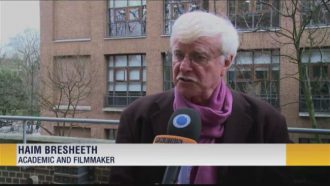 The British government is helping universities across the UK suppress the right to criticize Israel over its human rights violations in Palestine, says a Jewish professor, vowing to never give in to the pressure.
“They are trying to stop us talking about Palestinian rights, and about peace and we will just not shut up,” Dr. Haim Bresheeth, a Jewish academic and filmmaker, told Press TV on Wednesday.
“Unfortunately the government has helped the universities that want to shut up free speech by accepting a definition of anti-Semitism that makes anti-Semitism any criticism of Israel,” he added.
The scholar was referring to the International Holocaust Remembrance Alliance (IHRA)’s definition that was adopted by the government of Prime Minister Theresa May last year.
It was based on IHRA’s definition that the University of Exeter and the University of Central Lancashire (UCLan) cancelled an annual pro-Palestinian event on Monday, which was aimed at raising awareness about human rights violations in the occupied territories.
Following the move, some 250 academics at dozens of universities across the UK penned an open letter, condemning the Tory government’s attempts to curb their right to free speech by banning criticism of Israel.
The professors said in their letter that the government’s definition of anti-Semitism is too broad and can include any criticism of Israel with regards to its occupation of Palestinian lands.
“The government has ‘adopted’ the International Holocaust Remembrance Alliance definition of anti-Semitism, which can be and is being read as extending to criticism of Israel and support for Palestinian rights, an entirely separate issue, as prima facie evidence of anti-Semitism,” read the letter, sent to the Guardian.
“This definition seeks to conflate criticism of Israel with anti-Semitism,” the academics charged, accusing universities minister Jo Johnson of asking for the definition to be “disseminated” throughout the higher education system.
In his interview with Press TV, Bersheeth said the definition sought to protect “Zionism and Israel” from criticism.
“You can criticize and you should criticize every political institution that you wish,” he argued. “We are told now that Jews who criticize Israel like me are anti-Semitic. This is nonsense.”
Featured Video
American Military Failure in Afghanistan
or go to
Aletho News Archives – Video-Images
Frlom the Archives
The Fiction of the Jewish History in Palestine
By Hasan Afif El-Hasan | The Palestine Chronicle | April 8, 2011
Prime Minister Benjamin Netanyahu told NNC Pierce Morgan on March 18, 2011 that he might agree to a Palestinian state through negotiations. And he added, “We will make territorial concessions although it is very painful to do that in our ancestral land.” Netanyahu was not talking about Poland where his ancestors lived. He was talking about Palestine where generations of its indigenous population ancestors lived, cultivated the land and are buried.
By the end of the nineteenth century, Zionism created a new Jewish identity of blood and soil. To mobilize their followers and supporters and appeal to their emotions, the Zionists created myths. Zionism started as a tribal religion without god, but in order to fulfill its function as a unifying force, Zionism required external religious and race symbols, not inner content. Its leaders regarded metaphysical religious belief and purity of race as having value in itself. They created a divine paradisiacal state of merger with the gods. Despite his non-religious ideology, Herzl’s writings were replete with religious references. The Jews should settle in Palestine because, in his words, “the Temple will be visible from long distance, for it is only our ancient faith that has kept us together”.
The Zionists and their supporters have invested tremendous financial and scholarly resources to work within the Hebrew Bible historical narratives to affirm the links between the intrusive Zionist population and the ancient Israelite past, and by doing so assert the right of that population to the land. The political end-game shaped the investigation and the outcome. Tracing the roots of Israel’s ethnic state in biblical antiquity is effectively to silence the indigenous Palestinian claim to the past and therefore to the land. The Biblical scholarship employs a bewildering array of terms for the region: “the Holy Land”, “the Land of the Bible”, “Eretz Israel”, “the Land of Israel”, or “Judah and Samaria.” To the casual reader these names appear interchangeable, but they all imply connection to ancient Israel.
Biblical narratives or poems that cannot be supported by archeology and common sense are treated by the Zionists and their supporters as historical language. … continue
Blog Roll
 Aletho News
- Lawyers’ groups demand end to British military bases in Cyprus
- CIA Assessment: The Resistance Cannot Be Crushed
- Hezbollah Returns: It Didn’t Start a War, It Is Ending One
- EU states seek ‘talks’ with Iran for access to Strait of Hormuz: Report
- Trump on Hormuz: “Others must take care of it” after US falters
- Who Is closer to collapse?
- A War that Backfired: Why the US-Israeli Campaign Is Strengthening Iran
- How Zionist Control Is Hurting US Interests
- Iran warns it may target US missile launch sites in UAE cities
- American Military Failure in Afghanistan
- If Americans Knew
- As US-Israel war on Iran rages, Gaza faces massive dust storm – Not a ceasefire Day 156
- No let-up in attacks on Gaza as Israel takes on Iran, Lebanon – Not a ceasefire Day 155
- ‘Of Course’: IDF Drops Case Against Soldiers Accused of Raping Palestinian Prisoner
- Don’t Fall for the Regime Change Talk. Israel Is ‘Mowing the Lawn’ in Iran
- Will Israel and the US wreck the Gulf States along with Iran?
- US so far burned through ‘years’ of munitions in Iran war: Report
- How the Israeli Tail Wags the American Dog
- Outdated intel likely led to deadly U.S. strike on Iranian elementary school, sources say
- Pentagon insider says high U.S official Douglas Feith reported to Netanyahu
- In fond memory of Walid Khalidi, the historian of Palestine
- No Tricks Zone
- Storing Green Energy To Last Germany 10 Days Would Require A 60-Million Tonne Battery
- New Studies: UK Sea Levels Were 4 Meters Higher Than Today During The Mid-Holocene
- Destructive Green New Deal: German Energy And Metal Group Warns Of Drastic Crisis
- New Study Documents A 20-Year Pause In Arctic Sea Ice Decline – Driven By Internal Variability
- Wake-up Call: Survey Shows Majority Of Germans Now Favor Postponing Climate Targets!
- Televised! Leading German Political Candidate Tells Schoolchildren CO2 Makes Sun Hotter!
- New Study: A Century Warming Of 1.1°C Is ‘Commonplace’ And ‘Not Unusual’ During This Interglacial
- New Study: ‘Internal Noise’ And Volcanic Forcing Can Trigger 10-15°C Warming Within Decades
- Glaciers Worldwide Are Suddendly Surging, Experts Blame Warming!
- Surprising Discovery: Sahara Is Greening…Billions Of Trees Where Once Thought To Be Barren
 Aletho News