Kirkuk bell also tolls for US strategy in Syria
By M K Bhadrakumar | Indian Punchline | October 22, 2017
The rout of the Kurds in the northern Iraqi city of Kirkuk this week constitutes a major setback for the overall American strategies toward Iraq and Syria. The prospect of an unceremonious US retreat from Syria haunts the Trump administration in immediate terms, and it is all the more galling because Tehran is calibrating it.
Clearly, Iran has pushed the envelope, furious over US President Donald Trump’s provocative threats of sanctions against the Islamic Revolutionary Guards Corps (IRGC). Tehran had warned that US position in the entire Middle East will become increasingly untenable if Trump moved against the IRGC. The capture of Kirkuk by the Baghdad government was a de facto military operation by the Shi’ite militia known as the Hashd al-Shaabi, which was trained and equipped by the IRGC. The western reports suggest that the charismatic commander of the IRGC’s secretive Quds Force, General Qassem Soleimani personally masterminded the military operation – and even prepared the political ground for it.
The US had tried to prevail upon the Iraqi Prime Minister Haider al-Abadi not to move against the Kurds who were its allies. Kirkuk is estimated to hold at least 8000 million barrels of subterranean oil. The oil revenue is critical for the survival of any independent Kurdish state. Evidently, Abadi didn’t listen due to the emergent threat posed by the Kurds’ recent independence referendum. Equally, Iran wanted to finish off the spectre of an independent Kurdistan in the region spearheaded by Massoud Barzani (who enjoys the backing of US and Israel.)
Indeed, the defeat in Kirkuk destroys the Iraqi Kurds’ dream of an independent state and derails the longstanding US-Israeli project to create a base with strategic location. Equally, the liberation of Kirkuk, which is populated by the Kurds, Arabs and Turkmen by the Iran-supported Shi’te militia highlights the strategic convergence between Baghdad, Tehran and Ankara in preventing the creation of an independent Kurdistan in the region.
However, the defeat of Barzani in Kirkuk has far wider ramifications – for Iraq as well as the Syrian conflict, apart from the US’ influence in the Middle East as a whole. At its most obvious level, Iran is thwarting the US plans to balkanize Iraq. Iraq’s unity is no longer under serious threat. Control of the vast oil reserves in Kirkuk will also bolster the Iraqi economy. Baghdad can be expected to reassert its authority over the country. The federal government has taken over the border crossings with Turkey and Syria.
The US attempt in the coming period will be to woo Abadi and encourage him to whittle down Iran’s influence in Iraq. The US Secretary of State Rex Tillerson arrived in Riyadh on Saturday on a hastily arranged trip with the hope of getting Saudi King Salman to take a hand in persuading Abadi to keep Tehran’s influence on Iraq at bay and to mediate between Abadi and Barzani. The US and Saudi Arabia’s best hope lies in creating differences between Baghdad and Tehran by leveraging Abadi. But the chances of such a ploy working seem remote.
The fact that the US watched the defeat of the Kurds in Kirkuk passively tarnishes the overall American image, especially among Syrian Kurds. This casts shadows on the Syrian situation. The US has been routing the military supplies for Syrian Kurds in Raqqa via Erbil, Massoud’s stronghold (in the face of Turkey’s virulent opposition.) This supply route is no longer under Barzani’s control and the disruption will affect the US’ operations in Raqqa. The US-led Syrian Kurdish militia claims to have liberated Raqqa, but a real consolidation needs the decimation of the residual ISIS fighters present in the region and it may take months.
More importantly, a ‘trust deficit’ between Syrian Kurds and Washington at this juncture will be calamitous. Raqqa is Arab territory and the Kurdish militia’s supply lines are already overstretched. The disruption in American supplies means that it may now be a mater of time before Syrian Kurds seek some modus vivendi with the Syrian regime. If American military supplies dry up, Syrian Kurds will also come under pressure from Turkey in the swathe of northern Syria bordering Turkey, which form their traditional homelands. Turkey never liked a Kurdish entity taking shape across their border.
Interestingly, the commander of the Syrian Kurdish militia Sipan Hamo visited Moscow last weekend. The Russians indeed find themselves in an enviable position to drive a hard bargain over the Kurds’ sorrows. Russia is in a unique position to mediate between Syrian Kurds on one side and Ankara and Damascus on the other. But then, what is it that the Kurds can offer Russia in return? Last Thursday, Rosneft signed a big oil deal with Barzani’s government in northern Iraq. To be sure, the old Kurdish saying has some merit – ‘The Kurds have no friends but the mountains.’ (Guardian )
The main impact of last week’s dramatic events is that the US now has no conceivable reason to continue with a military intervention in eastern Syria. The likelihood is that Syrian Kurds will sooner or later hand over Raqqa also to the government forces. Clearly, the Syrian regime’s march to victory is from now onward relentless and irreversible. That is to say, the best-laid plans of the US and its regional allies to balkanize Syria have also gone awry.
Maybe, there will be a federal system in future Iraq and Syria. But last week’s events have ensured that the two countries’ territorial unity and integrity will no longer be under serious threat. Of course, that has also been at the core of the Iranian strategy.
Trump’s new Iran strategy ‘has no support in US’: Ex-congressional staffer
Press TV – October 22, 2017
US President Donald Trump’s new strategy on Iran has “no support inside the United States” other than by pro-war neoconservatives and the Israel lobby, says an American analyst.
“President Trump’s position on canceling the Iran deal, at least on the United States’ side, has no support in the United States either by the public, obviously by the Democratic Party; even it lacks support by members of the Republican Party,” Rodney Martin, radio host and former congressional staffer, said on Saturday.
“It only has support by the rabid pro-war neocons and by the rabid Zionist pro-Israel lobby and of course by Prime Minister [Benjamin] Netanyahu in Tel Aviv,” he added.
Trump announced last week that he would not continue certifying the 2015 nuclear deal with Iran dubbed the Joint Comprehensive Plan of Action (JCPOA).
The US president has come under widespread criticism at home and abroad, with America’s European allies reaffirming their commitment to the nuclear accord.
The majority of Americans also believe Trump should not pull the US out of the international agreement, according to a new poll.
Overall, two in three Americans oppose withdrawing from the JCPOA, a CNN poll has found. Eight in 10 Democrats and two in three Independents have the same opinion. Even in Trump’s own party, Republicans are evenly split, with 48 percent desiring to remain and 47 percent to withdraw.
Martin pointed to the Israeli influence over Trump’s decision regarding the Iran deal.
“We all know that Netanyahu took the atrocious step by coming to the United States and lobbying the US Congress against the deal,” he pointed out.
The analyst said Trump is “throwing Netanyahu a bone” by refusing to certify the JCPOA in order to compensate for his failure to deliver on his promise to move the US embassy to Jerusalem al-Quds.
Trump is “every bit as controlled by the Israeli lobby” as his predecessors, Martin said, adding, “so it doesn’t matter what the public and the experts believe, President Trump is going to do what this very small, dangerous cabal tells him to do.”
US Gets Increasingly Isolated Internationally
By Alex GORKA | Strategic Culture Foundation | 22.10.2017
Economic sanctions are an instrument of coercion used to make one state comply with another’s wishes. The United States is by far the largest implementer of economic sanctions in the world. It is virtually the only country that imposes unilateral sanctions, certainly the only one that does so with any regularity. The US has imposed more sanctions than the other countries/entities put together. Washington sees restrictions as a low-cost method to accomplish foreign policy goals, despite the fact that the measures affect common people. The policy damages international relations and backfires exacting a high price in terms of lost jobs and trade opportunities.
The US sanctions policy came under sharp criticism in the United Nations. Addressing the UN General Assembly on October 18, United Nations Human Rights Council’s Special Rapporteur Idriss Jazairy said “Damaging a country’s economy with sanctions usually leads to violations of the rights of ordinary people. Sanctions are disruptive for any State, and can have a particularly devastating impact on the citizens of developing countries when they impair the economy.” He expressed concern about sanctions which had an impact outside the territory being targeted. “It is well established that sanctions which apply to parties outside of the dispute are illegal, but sanctions which lead to human rights violations also create an obligation on the imposing state to take measures to repair the harm they have caused,” the expert noted.
Reporting on his visit to Russia in April, Jazairy said sanctions had not achieved the desired effect but had damaged others. “It appears that sanctions have not changed Russia’s position, but instead have caused economic losses for agricultural producers in both the EU and Russia,” he noted, adding “Serious, credible dialogue and negotiations are needed to resolve political issues, without creating additional harm for farmers.”
Jazairy urged the UN member states to adopt a Declaration on Unilateral Coercive Measures and the Rule of Law, which would set out shared principles on the use of sanctions and international law, renewing the call for a registry of sanctions, to bring greater transparency to the practice. “A registry would allow States, civil society and any other interested parties to know at all times what sanctions are in place, helping companies to conduct their businesses, and ensuring the sanctions meet human rights standards,” he said.
In his report (A/HRC/33/48) issued in September, the rapporteur urged the Human Rights Council and the UN General Assembly, through a solemn Declaration, to reaffirm “the right of victims to an effective remedy, including appropriate and effective financial compensation, in all situations where their human rights are affected by unilateral coercive measures.” The report also highlighted the importance of setting up a consolidated central register within the UN system of all the international sanctions in force, adding that these findings should be made public. This mechanism, which would enhance transparency and accountability, could draw on the model of the United Nations Register of Conventional Arms set up in 1991.
A new research by the Austrian Institute of Economic Research (WIFO) suggests the EU’s economic sanctions against Russia introduced three years ago have cost European countries billions of euros. The survey, which was conducted at the request of the European Parliament, and published on October 6, showed that the EU has lost €30bn due to sanctions.
Unilateral sanctions are increasingly ineffective in a more globalized economy. The United States has imposed many different sanctions against Russia but there are many more nations ready to boost economic cooperation with Moscow. The US has got a reputation for imposing economic sanctions liberally making other nations reluctant to do business with it. European leaders and much of the rest of the world view economic sanctions as counterproductive and generally favor them only in extraordinary circumstances, such as war. In July, France’s foreign ministry said new US penalties against Iran and Russia appeared at odds with international law due to their extra-territorial reach.
From a legal point of view, only the UN Security Council has the right to impose sanctions against a state. Unilateral coercive measures violate the spirit and letter of the UN Charter, in particular its preamble and Articles 1 and 2. The organization rests on the principle of equality of all its member states. A state can resort to sanctions for self-defense purposes but Russia did not attack the United States. Thus, the United States is destroying the integrity of international organizations and agreements to which it is a party.
For instance, the policy of sanctions runs counter to the WTO fundamental principle of trade free of discrimination, which envisages respect for market principles and honest competition. Parties should maintain government restraints on the movement of goods at a minimum, and if changed, the restraints should be reduced, not increased. The conditions of trade, including the level of tariffs and other, must be discussed and agreed on within a multilateral framework.
In theory, a state complaint procedure of the UN Human Rights committee could be launched according to Article 41 of the International Covenant on Civil and Political Rights – that way the UN would have to deal with the matter. The US has recently announced its intent to drop out from the United Nations Human Rights Council. This month it left UNESCO. No surprise as the idea to leave the United Nations has been floating in the US for some time. In January, 2017, Alabama congressman Mike Rogers sponsored the American Sovereignty Restoration Act of 2017, referred to the House, which calls to leave the United Nations. Utah state representative Don Bush, has claimed that many programs by the supranational entity have violated the US Constitution, such as the implementation of the International Court of Justice and the Law of the Sea Treaty, both of which the United States does not currently endorse. Much has been said in the United States about Russia’s international isolation. In practice, the United States, not Russia, is getting increasingly isolated internationally.
The War on Terror: The Plot to Rule the Middle East – A Book Review
Christopher Bollyn, 2017, 146 pages.
Review by David Brooks | American Herald Tribune | October 18, 2017
 Christopher Bollyn is that rarest of mediaticians, a real-live investigative journalist, formerly of the American Free Press, now altogether free, as befits a researcher-writer of irreducible integrity. For the last decade and a half, Bollyn has made September 11th and its murderous military aftermath his own special beat, going where few 9/11 analysts have dared to venture.
Bollyn’s great contention, expounded in scores of articles and two previous books (Solving 9/11: The Deception that Changed the World ), is that it was not Bin Laden and Al Qaeda who carried out the world’s greatest terror attack, but none other than Ben Netanyahu and El Mossad, so as to foment an endless war against Israel’s perceived enemies in the Middle East.
Even more than David Ray Griffin, the widely acknowledged dean of 9/11 studies, Bollyn deserves a Pulitzer Prize, for not only naming the unnamable, but for substantiating his charge in definitive, documented detail. Mazel tov to anyone who would lightly dismiss his case.
As for those who would single-handedly rebut Bollyn’s thesis with the knee-jerk cry of “anti-Semitism,” let them be forewarned that Bollyn gets serious back-up in a scathing introduction by Dr. Alan Sabrosky, a retired senior administrator at the U.S. Army War College (West Point), who went on record long ago that 9/11 was a Mossad operation. Sabrosky is Jewish himself.
That someone of Sabrosky’s stature and heritage has not yet been invited on network television to deliver his bombshell accusation is just one more proof of the media-wide clampdown on 9/11 truth. While Bollyn may be snubbed by the MSM merely for being a self-published non-entity, the only way for Zionist propagandists to deal with Sabrosky is to pretend that he doesn’t exist. Thus far it has worked.
It’s interesting to note that Sabrosky’s greatest scorn is not for the Israeli terrorist perpetrators, but for homegrown Israeli fifth-columnists, “the mostly Jewish Neo-conservatives, many of whom [are] dual Israeli citizens and all more or less openly professing “dual loyalty” to Israel and the United States – a form of political bigamy that is every bit as dishonest as marital bigamy, and which only thinly disguises the controlling allegiance all hold to Israel, their oaths notwithstanding.”
Bollyn expands on this point for the length of his book, claiming that the War on Terror has been a greater curse on the world than 9/11 itself, costing trillions of American dollars and millions of Muslim lives, with no end in sight. More damning is that all this was foreseen. What has come to pass is indeed the very fulfillment of an objective set out decades ago:
As I explain in my Solving 9/11 books, the false-flag terror of 9/11 was an Israeli idea from the beginning, first articulated by a former head of the Mossad in the 1970’s. At the same time that [Mossad chief] Isser Harel was predicting how Arab terrorists would attack the tallest towers in New York City, Benjamin Netanyahu was holding an international conference of Western leaders in Jerusalem (1979) to promote a global war against terrorism. Both concepts are products of Israeli strategic planners.
What a perp-line Bollyn brings before his readers, digging up well-hidden background information on every possible suspect, Israeli and American, in this criminal cause. A veritable A-list of dual nationals could be compiled just from the officials of recent presidential administrations. Each could be subpoenaed before a real 9/11 commission, rather than evade mention, as was ensured by dual national, Philip Zelikow, in the official whitewash “report.”
Questioning could start with Netanyahu’s long-time friend, Larry Silverstein, who obtained the World Trade Center just weeks beforehand, arranged for dubious, new security, and doubled the insurance. “Lucky Larry” is best known for being the fortuitous owner of WTC 7, which wasn’t hit by a plane, but still managed to collapse neatly in 6.5 seconds later that afternoon. That this staggering fact is still largely unknown sixteen years later speaks more cogently than any of Bollyn’s arguments to a deliberate media and government cover-up.
In some of his research, Bollyn acquits himself like archival historian, tracing certain 9/11 “strategic planners” back to “a small group of veteran Zionist criminals who have employed terrorism as a tool since the 1940s.” Talk about chickens coming home to roost! One of the shadier Zionist operatives is Netanyahu’s own father, Benzion, an American academic who co-hosted that fateful Jerusalem conference with his son, and whose influence upon him may not have stopped with his death at age 102.
Here’s another intriguing item gleaned from Bollyn’s inquiry: For those who remember the film or book, Charlie Wilson’s War, it turns out the celebrated Congressman who enlisted massive funding for anti-Western mujahideen “freedom fighters” in Afghanistan was a Zionist stooge:
Wilson’s Israeli handler was Zvi Rafiah, Mossad station chief in Washington, who had known Wilson since 1973 and who used his congressional office as if it were his own. As George Crile described in his book, Charlie Wilson’s War, “Rafiah had always acted as if he owned Wilson’s office. One of the staffers kept a list of the people he needed to lobby. He would use the phones, give projects to the staff, and call on Charlie to intervene whenever he needed him.”
Imagine gung-ho patriot, Tom Hanks, being played for a schmuck. The unwitting sabotage of more enlightened resistance to the Soviet occupation of Afghanistan led to a more deadly subterfuge—the formation of a perfect patsy for the pre-meditated crime of 9/11:
Thousands of non-Afghan fighters joined [the anti-Western militia] Hezb-i-Islami, including thousands of Arabs, known as Afghan Arabs. Osama bin Laden is the most famous of the Afghan Arabs. Having trained a cadre of 4,000 anti-Western Islamic fighters, Israeli military intelligence and C.I.A. had a database of names to populate the Islamic anti-Western antithesis needed for the War on Terror construct. This database was known as Al Qaeda.
It comes as no surprise to learn in the chapter “9/11 and the War in Syria” that the United States, Saudi Arabia, and Israel conjointly support the most savage of the anti-Western militias there. The only purpose of all these parties is to terrorize and destroy the country. This is not foreign policy, but state-sponsored sociopathy.
In the chapter titled “Who Makes the Terrorist Videos?” we learn that the person releasing most ISIS videos, which have duly invoked air strikes on Syria, happens to be an Israeli intelligence agent named Rita Katz, living in Bethesda, Maryland. How much more transparent can the Zionist psy-op known as the “War on Terror” get?
Most memorable image from Bollyn’s book: “The War on Terror and 9/11 are like two sides of a counterfeit coin. If the American public had a good understanding of the false-flag deception of 9/11, then the fraudulent nature of the wars fought in its name would be equally obvious.” Amen.
A brief review cannot do justice to the depth of research contained in Bollyn’s concise exposé. It is his attention to detail, instanced above, which undergirds every aspect of his overarching thesis of Zionist complicity, and provides substantive evidence to his book-lengthed “J’accuse!”
Attention must be paid—or else. As Bollyn observes, the magnitude of such a fraud as 9/11 can’t stay hidden forever. Too many people know already. Either the truth of 9/11 will prevail, or its perpetrators, who have nothing to lose, may arrange something far worse.
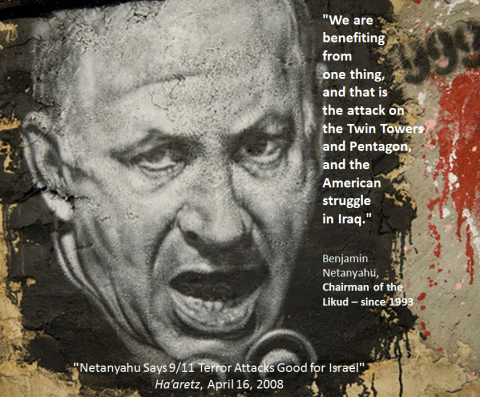 Bollyn is fully apprised of the danger in the combustible combination of the current leaders of Israel and the United States. It could be déjà vu over again: “Ronald Reagan and Menachem Begin led to the Israeli invasion of Lebanon in 1982, and George W. Bush and Ariel Sharon led to 9/11 and the War on Terror in 2001.” Foreboding abounds when President Trump calls Prime Minister Netanyahu a close, personal friend. Will the talented Mr. Netanyahu and the Artful Dealer of America arrange a mutually acceptable war? We may soon have our answer.
While it strains credulity to the breaking point, Bollyn’s most daringly original suggestion is that 9/11 and its propaganda-induced “War on Terror” can be traced in part to a consanguineous conspiracy—a family plot, if you will—conceived and crafted over many years by Netanyahu & Son, and abetted by select American traitors when all the pieces were at last in place. Should their guilt ever become known, the name “Netanyahu” will live in infamy. Move over, Macbeth!
It seems only fitting, then, to let 9/11 mastermind, Benjamin Netanyahu, have the penultimate word in this review. One can almost picture him winking to his future accomplices when he proclaimed decades earlier: “It is perfectly possible to determine who the terrorists are and who stands behind them. If governments have failed to do this, it is more often not for lack of knowledge, but for lack of courage and moral clarity.” (Terrorism: How the West Can Win, 1986)
If Netanyahu soon gets his way—and unleashes yet another false-flagged, media-hyped, Israeli-concocted “war on terror”—it will not be for lack of courage and moral clarity by people such as Christopher Bollyn. May the Lord preserve him and all other truth-tellers.
The war on RT: A childish crusade pushing a dangerous agenda
A new George Soros funded report calls guests on RT, ranging from Donald Trump to Bernie Sanders, “useful idiots”.
By Adam Garrie Adam Garrie | The Duran | October 21, 2017
A so-called NGO known as the European Values Think-Tank, has published a “report” blasting regular guests on RT as “useful idiots” who are helping “an instrument of hostile foreign influence”. The group, whose largest source of funding is George Soros, claims that RT’s goals include “undermining public confidence in the viability of liberal democracy”. Other epithets thrown at RT include calling the broadcaster, “a second-rate news network with an abysmal reputation and dubious audience numbers”, “the Russian propaganda machine” and a “disinformation tool”.
While European Values presents itself as an NGO, sources of funding for the group include the governments of the United States, United Kingdom and European Union. These state-funding sources mean that the Think-Thank is not an NGO (non governmental organisation), but rather, a body which has established financial ties to powerful governments, in addition to receiving most of its funds from George Soros and his Open Society body.
The report concludes with a list of the “useful idiots” in question, mainly drawn from US and European politicians and well known activists who have appeared on RT. The list is a not only incomplete but has some blindly inaccuracies. For example RT’s show “Politicking with Larry King”, a show hosted by the world famous former CNN host, is erroneously referred to as “Politicking with Larry David”. Larry David is of course a comedian known for his work with Jerry Seinfeld. Also, the list describes former British Member of Parliament George Galloway as the “former” host of Sputnik: Orbiting the World, even though Galloway continues to host his RT show.
The list of “useful idiots”, in spite of its incomplete nature, is still highly diverse. The list includes figures such as: Donald Trump(current US President), Ralph Nader (American consumer rights advocate and former left-wing Presidential candidate), Nigel Farage (member of EU Parliament and Brexit campaigner), Bill Richardson (former New Mexico governor and former Ambassador to the United Nations), Dr. Ron Paul (former US presidential candidate and libertarian author/thinker/host) Jill Stein (former left-wing US presidential candidate), Bernie Sanders (US senator, former US presidential candidate), Wesley Clark (former US general and one time Democratic presidential condenser), Sean Spicer (former White House Press Secretary), Hans Blix (former UN chief weapons inspector and former Swedish Foreign Minister), Keith Vaz (British politician and immigrants rights campaigner), Ann Widdecombe (British politician and social conservative activist), Gary Johnson (former US Presidential candidate for the Libertarian party), Pat Buchanan (former White House aid in the administrations and Richard Nixon and Ronald Reagan, former US presidential candidate), Robert Reich (former Clinton administration Labor Secretary, liberal activist), Lincoln Chafee (former US Senator and Rhode Island governor, known for leaving the Republican party and becoming a Democratic as his values become more liberal), Ken Livingstone (former left wing mayor of London), Jeremy Corbyn (current leader of the UK opposition Labour Party), YanisVaroufakis (former Greek finance minister), Marine Le Pen (former French presidential candidate), Romano Prodi (centrist/neo-liberal former Italian Prime Minister and former EU Commission President), Jessee Ventura (former governed of the US state of Minnesota) David Davis (Britain’s lead Brexit negotiator), Michael Flynn (highly decorated US General, former National Security Advisor)…
The list above is just a partial list taken from the anti-RT dossier produced by “European Values”. As is plainly evident, the list features well known names from the left, centre and right of US and European politics. It would be logically impossible for figures who have campaigned against one another and who hold a plethora of competing ideologies and political positions, to all be working uniformly in the name of a single agenda of any kind, “Russian” nor otherwise. The fact that not a single person on this list is Russian, is a further sign of the report’s flawed nature.
Furthermore, by calling such prominent figures “useful idiots” of the “Kremlin”, the report’s authors could possibly open itself to libel charges from the individuals who have been publicly disparaged in a grotesquely inaccurate manner.
The nature of the report which appears hastily compiled, with a mountain of factual inaccuracies and wild claims presented without evidence and without actually visiting any RT facilities or speaking with any RT employees or guests, is shambolic.
But more to the point, the report is deeply childish. In an age of the internet and satellite television, the average news consumer has more options than at any time in human history. It is possible to read media from Russia, the US, Japan, China, Australia, Nigeria, Egypt, Saudi Arabia, Syria, Qatar, Lithuania, Germany, France, Mexico, Poland, Chile and Canada… all while riding the bus.
If anything, the vast availability of a diverse amount of information, should de-mystify the fact-finding process and indeed for most people, this is what has happened.
The basic fact that all media outlets have an editorial line seems to be lost on the “report’s” authors and furthermore, they don’t quite seem to understand how RT contacts their gusts.
As someone who is a frequent guest on RT, I will explain the process. A producer from RT and occasionally an RT host will contact me either via email, social media messages, SMS or with a phone call. They’ll ask if I am available to comment on a given topic and a certain time. Once this is agreed upon and I arrive at the studio, I sit and wait to be called into the studio where I’m fitted with earpiece and mic and go on air. At no time has anyone at RT told me what the nature of my responses should be, no one has told me to omit stating certain beliefs that I am known to hold and at no time have I been given a list of questions prior to being interviewed by an RT employee.
Other individuals I have spoken to have told me, without prompting, that their experiences are exactly the same. Furthermore, speaking for myself, if anyone from any media outlet told me what to say or how to say it, not only would I not play along, but I would raise the issue angrily on social media at once and happily criticise such an organisation on any other media network that would hear me out. This is because, I take pride in my statements and anyone trying to tell me how to rephrase my views would in my mind, be insulting me in the gravest manner possible.
But while the nature, context and style of the Soros funded “report” is childish, the logical conclusion of the report is dangerous. The report is encouraging censorship of RT and ostensibly of the guests listed as “useful idiots”. Furthermore, the report is attempting to destroy the personal and professional credibility of RT guests in a manner that is at the very least, totally unethical.
This sort of censorship through character assassination and degradation, is dangerous. The authors and sponsors of the European Values Think-Tank ought to take a lesson from Russian media which is incredibly diverse in both the large private sector as well as the public sector. The radio station Echo of Moscow and the multi-lingual Moscow Times newspaper and website, are as liberal and critical of the Russian status quo as anything in Europe, sometimes more so.
These outlets (just to name two prominent ones) are allowed to operate freely and both have their audience who are not bullied by the Russian government into viewing alternative sources. If someone wants to listen to Echo of Moscow and only Echo of Moscow, no one in Russia is going to care. If only this open attitude was espoused by the authors from the European Values Think-Tank, then they would be showing signs of maturity that they clearly do not possess at this point in time.
As for my personal opinion, I believe RT is a good source of information and objectively, I have never seen a report on RT that is factually false, although I often disagree with various guests on RT. Of course, I agree with others. This is par for the course with any media outlet. If someone doesn’t want to watch RT, the good news is that no one is forcing you to do so.
But please, do not try to tell others not to watch RT, do not bully people into rejecting request for interviews from RT and above all, do not slander people on a personal level, just because you disagree with their opinions.
It’s hard to believe that such a thing needs to be said in the 21st century, but the regression of liberalism from a movement about ideas (whether one agrees with them or otherwise) into a movement about cutting off the ideas of others, is fundamentally an attempt to return to a dark age.
Netanyahu lobbies world powers to support Iraqi Kurds’ secession bid
Press TV – October 20, 2017
Israeli Prime Minister Benjamin Netanyahu is lobbying world powers to support the independence of the semi-autonomous Kurdistan region from the rest of the Iraqi territory, as Kurdish Peshmerga forces are losing ground to Iraqi army forces in the country’s oil-rich northern province of Kirkuk.
Israeli officials, requesting anonymity, said Netanyahu raised the Kurdish plans for independence with German Chancellor Angela Merkel last week, and with Russian President Vladimir Putin on Wednesday.
The 67-year-old Chairman of the Likud party also made a reference to the issue in his contacts with French authorities.
An Israeli official, who declined to be named, stated that the Tel Aviv regime has security interests in Kurdistan.
“This (territory) is a foothold. It’s a strategic place. It would be best if someone gave them weaponry, and whatever else, which we cannot give, obviously,” the official said without providing further detail.
Israel has maintained military, intelligence and business ties with Iraqi Kurds since 1960s.
“The issue at present is … to prevent an attack on the Kurds, extermination of the Kurds and any harm to them, their autonomy and region, something that Turkey and Iran and … other powers in Iraq and part of the Iraqi government want,” Israeli Intelligence Minister, Israel Katz, alleged in an interview with Tel Aviv radio station 102 FM on Friday.
“The prime minister is certainly engaging the United States, Russia, Germany and France to stop the Kurds from being harmed,” Katz said.
On Friday, Iraqi government forces wrested control of a strategic sub-district of Kirkuk province following clashes with Peshmerga forces.
“Iraqi Federal Police and Counter-Terrorism Service (CTS) forces, along with fighters from Popular Mobilization Units – commonly known by the name Hashd al-Sha’abi, have secured Kirkuk’s northern Altun Kupri sub-district,” the Iraqi Defense Ministry said in a statement.
Iraqi Army Captain Jabbar Hasan said Iraqi federal forces had given Peshmerga forces 24 hours to vacate their strongholds in Altunkopru, and withdraw to areas controlled by the Kurdistan Regional Government (KRG).
Peshmerga forces, however, had rejected the ultimatum, Hasan said.
The referendum on secession of the Kurdistan region was held on September 25 despite strong opposition from the central government in Baghdad, the international community, and Iraq’s neighboring countries, especially Turkey and Iran.
Following the vote, Baghdad imposed a ban on direct international flights to the Kurdish region and called for a halt to its independent crude oil sales.
On October 12, an Iraqi government spokesman said Baghdad had set a series of conditions that the KRG needed to meet before any talks on the resolution of the referendum crisis could start.
“The KRG must first commit to Iraq’s unity. The local authorities in the [Kurdistan] region… must accept the sovereign authority of the federal government on… oil exports, [as well as] security and border protection, including land and air entry points,” the unnamed Iraqi official added.
Iraqi Prime Minister Haider al-Abadi has already demanded the annulment of the referendum.
During a recent press conference in Paris, Abadi said his government did not seek confrontation with Iraqi Kurds, but reiterated Baghdad’s position that the vote was illegal and that problems should be solved within the framework of Iraq’s constitution.
US State Dept cautions Iraqi govt against troop advances in Kurdish territory
RT | October 20, 2017
The US State Department is advising Iraq’s federal authority to limit its military activity in the country’s Kurdish northern region, as it also calls for “all parties to cease all violence” in the wake of violence in the town of Altun Kupri.
On Friday, State Department spokeswoman Heather Nauert urged the Baghdad government to only make troop movements that were “coordinated with the Kurdistan Regional Government.”
This marks the most specific statement out of the State Department on the situation since Iraq regained control over the provincial capital Kirkuk on Monday, following a popular vote of 92 percent in favor of an independent Kurdistan late last month. Previously, the State Department has stuck to general calls for calm on all sides.
Nauert’s statement also declared that the disputed Kurdish areas remained disputed, despite Iraqi authorities crossing into the region.
“The reassertion of federal authority over disputed areas in no way changes their status – they remain disputed until their status is resolved in accordance with the Iraqi constitution,” the statement read.
According to security sources cited by Reuters, Iraqi troops gained control of the last district in Kirkuk on Friday, taking the oil-producing province from Kurdish Peshmerga fighters after three hours of hostilities.
Secretary of State Rex Tillerson has called the September 25 vote for Kurdish independence illegitimate, and said US policy rejects such unilateral moves.
This week, Kurdish Peshmerga fighters lost large swathes of territory held since 2014 or later, which had been gained during years of war against Islamic State fighters.
Washington’s economic war against Russian gas supplies to Europe unacceptable – Gerhard Schroeder
RT | October 20, 2017
The United States would like to weaken Russia’s energy cooperation with the European Union, said former German Chancellor Gerhard Schroeder, adding it’s unacceptable to create barriers to Russian gas deliveries to the German market.
“It’s wrong if the Americans and the European Union somehow resist each other on this issue. And still there are attempts to create some difficulties for this project [Nord Stream 2 gas pipeline – Ed.],” he told Rossiya 24 news channel.
According to Schroeder, “the fact the Americans will try entering the German market with the help of sanctions and to dominate with its liquefied shale gas is nothing but the signs of an economic war, and such war is unacceptable.”
Germany is interested in gas which it “will receive for sure and which will be cheaper than shale gas,” said Schroeder.
The ex-chancellor said German authorities were right to call the Nord Stream 2 gas pipeline purely an economic project which should not be politicized.
Last week, European Commissioner for Competition Margrethe Vestager said the EU has no legal means to stop the pipeline that will deliver natural gas from Russia to Germany.
The Nord Stream 2 pipeline will double the capacity of the existing Nord Stream pipeline, which goes under the Baltic Sea to Germany. The Gazprom-led project is opposed by the Baltic States and Poland.
During the EU summit on Friday, Polish Prime Minister Beata Szydlo described the Nord Stream 2 pipeline as a threat to European energy security.
Russian President Vladimir Putin said this week Moscow faces obstacles constructing the new route despite the fact that diversification of gas supplies is cost-effective, beneficial to Europe and serves to enhance the security of supplies.
The Kremlin has repeatedly said the pipeline is strictly about business, accusing the United States of trying to thwart the project, as it wants to export its own liquefied natural gas to Europe.
Featured Video
Pentagon insider says high US official Douglas Feith reported to Netanyahu
or go to
Aletho News Archives – Video-Images
Frlom the Archives
The Fiction of the Jewish History in Palestine
By Hasan Afif El-Hasan | The Palestine Chronicle | April 8, 2011
Prime Minister Benjamin Netanyahu told NNC Pierce Morgan on March 18, 2011 that he might agree to a Palestinian state through negotiations. And he added, “We will make territorial concessions although it is very painful to do that in our ancestral land.” Netanyahu was not talking about Poland where his ancestors lived. He was talking about Palestine where generations of its indigenous population ancestors lived, cultivated the land and are buried.
By the end of the nineteenth century, Zionism created a new Jewish identity of blood and soil. To mobilize their followers and supporters and appeal to their emotions, the Zionists created myths. Zionism started as a tribal religion without god, but in order to fulfill its function as a unifying force, Zionism required external religious and race symbols, not inner content. Its leaders regarded metaphysical religious belief and purity of race as having value in itself. They created a divine paradisiacal state of merger with the gods. Despite his non-religious ideology, Herzl’s writings were replete with religious references. The Jews should settle in Palestine because, in his words, “the Temple will be visible from long distance, for it is only our ancient faith that has kept us together”.
The Zionists and their supporters have invested tremendous financial and scholarly resources to work within the Hebrew Bible historical narratives to affirm the links between the intrusive Zionist population and the ancient Israelite past, and by doing so assert the right of that population to the land. The political end-game shaped the investigation and the outcome. Tracing the roots of Israel’s ethnic state in biblical antiquity is effectively to silence the indigenous Palestinian claim to the past and therefore to the land. The Biblical scholarship employs a bewildering array of terms for the region: “the Holy Land”, “the Land of the Bible”, “Eretz Israel”, “the Land of Israel”, or “Judah and Samaria.” To the casual reader these names appear interchangeable, but they all imply connection to ancient Israel.
Biblical narratives or poems that cannot be supported by archeology and common sense are treated by the Zionists and their supporters as historical language. … continue
Blog Roll
 Aletho News
- Pentagon insider says high US official Douglas Feith reported to Netanyahu
- The Sludging of Rural America
- Lawyers’ groups demand end to British military bases in Cyprus
- CIA Assessment: The Resistance Cannot Be Crushed
- Hezbollah Returns: It Didn’t Start a War, It Is Ending One
- EU states seek ‘talks’ with Iran for access to Strait of Hormuz: Report
- Trump on Hormuz: “Others must take care of it” after US falters
- Who Is closer to collapse?
- A War that Backfired: Why the US-Israeli Campaign Is Strengthening Iran
- How Zionist Control Is Hurting US Interests
- If Americans Knew
- As US-Israel war on Iran rages, Gaza faces massive dust storm – Not a ceasefire Day 156
- No let-up in attacks on Gaza as Israel takes on Iran, Lebanon – Not a ceasefire Day 155
- ‘Of Course’: IDF Drops Case Against Soldiers Accused of Raping Palestinian Prisoner
- Don’t Fall for the Regime Change Talk. Israel Is ‘Mowing the Lawn’ in Iran
- Will Israel and the US wreck the Gulf States along with Iran?
- US so far burned through ‘years’ of munitions in Iran war: Report
- How the Israeli Tail Wags the American Dog
- Outdated intel likely led to deadly U.S. strike on Iranian elementary school, sources say
- Pentagon insider says high U.S official Douglas Feith reported to Netanyahu
- In fond memory of Walid Khalidi, the historian of Palestine
- No Tricks Zone
- Storing Green Energy To Last Germany 10 Days Would Require A 60-Million Tonne Battery
- New Studies: UK Sea Levels Were 4 Meters Higher Than Today During The Mid-Holocene
- Destructive Green New Deal: German Energy And Metal Group Warns Of Drastic Crisis
- New Study Documents A 20-Year Pause In Arctic Sea Ice Decline – Driven By Internal Variability
- Wake-up Call: Survey Shows Majority Of Germans Now Favor Postponing Climate Targets!
- Televised! Leading German Political Candidate Tells Schoolchildren CO2 Makes Sun Hotter!
- New Study: A Century Warming Of 1.1°C Is ‘Commonplace’ And ‘Not Unusual’ During This Interglacial
- New Study: ‘Internal Noise’ And Volcanic Forcing Can Trigger 10-15°C Warming Within Decades
- Glaciers Worldwide Are Suddendly Surging, Experts Blame Warming!
- Surprising Discovery: Sahara Is Greening…Billions Of Trees Where Once Thought To Be Barren
 Aletho News