Syria and Iran Sign Defense Agreement: Defying Outside Pressure
By Peter KORZUN | Strategic Culture Foundation | 29.08.2018
Iranian Defense Minister Amir Hatami visited Damascus Aug. 26-27 in order to have a new military cooperation agreement signed. The move is evidently a response to US and Israeli demands to withdraw Iranian forces from Syria. No details have been provided about the document’s content but it’s logical to surmise it contains a list of mutual obligations in the event that the Iranian military is attacked in Syria.
The deal mentions Iran’s role in the reconstruction of Syria’s defense industry, thus ending any hopes that its military presence in that country will end. According to the Iranian defense chief, the “defense and technical agreement” provides for the continued “presence and participation” of Iran in Syria. He added that an agreement had been reached with Syria that Iran would have “presence, participation, and assistance” in the reconstruction and that “no third party will be influential in this issue.”
The agreement was signed just as the Russia-Turkey-Iran summit was announced, which is scheduled for Sept. 7 in Tehran. Such events normally require thorough preparations. The parties are expected to reach an agreement on further joint steps to achieve progress in Syria. It’s important to align their positions before the UN talks in Geneva, which are slated for Sept. 11-12. UN Special Envoy Staffan de Mistura has invited the “big three” to participate. They can come up with joint initiatives while the US has nothing to offer but its demands for Iran’s withdrawal. It risks being left out in the cold, while diplomatic efforts initiated by other states bear fruit.
This turn of events will hardly be welcome news for those who would like to stymie the peace efforts and impose their own conditions for reaching any settlement of the problem.
The need to end Iranian assistance to Lebanon’s Hezbollah was emphasized during last week’s visit of US National Security Adviser John Bolton to Israel. The parties did not declare war on Iran, but there is no way to stop the supplies from reaching Hezbollah in Lebanon without cutting off the land routes going through Syria. The US official insisted before the visit to Israel that the withdrawal of Iran’s forces from Syria is a prerequisite to any resolution of the conflict.
The US and its allies in Syria find it important to scuttle Syria’s plans to liberate the province of Idlib from the rebels. A false-flag chemical attack is expected to be staged soon, to create a pretext for military action. Once Syria and Iran are in the same boat, it makes no difference which of them is attacked first or where. There have been media reports that a large-scale military operation is in the works and can be expected in August or September.
There is no way to know what exactly Mr. Bolton discussed with the Israeli authorities during his visit to Jerusalem on Aug. 19 but the reports about the military activities at the US al-Shaddadi base in the Syrian province of al-Hasakah emerged soon afterward. The facility has been reported to have been updated to enable the landing and takeoff of heavy cargo aircraft. Ayn al-Arab (Kobani) has also been expanded. In August, shipments of ammunition and military hardware were delivered to several US-controlled facilities in Syria and Iraq. Radars have been transported to the SDF-controlled areas east of the Euphrates River.
Meanwhile, several thousand militants with heavy weaponry and armored vehicles in Syria’s Idlib province are getting ready to launch an offensive against government-controlled regions of Hama and Aleppo. The attack will be targeted at Syrian as well as Iranian and pro-Iranian forces that have been invited in by the Syrian government.
It looks like plans are underway to force Syria to plunge into turmoil once again. In reality, the combat actions have already started. The US and Israel conducted their first joint operation against the Iranian Revolutionary Guards Quds Force and the Iraqi Shiite Khata’ib Hezbollah, their allies, on Aug. 23 near Abu Kamal, which is situated on the highway between Syria and Iraq. President Trump has said so many times and on so many occasions that he wants the Americans to leave Syria but US foreign policy is known for its flip-flops. Whatever is said today may be forgotten tomorrow.
This time, Lebanon may become a new front. It’s widely believed that a war between Israel and Hezbollah is inevitable. In February, US and Israeli troops held an exercise to practice for a potential war with Hezbollah in Lebanon, a country that holds a military agreement with Russia. The offshore drilling contracts Lebanon has signed with other countries, without solving its border dispute with Israel, are spurring the war preparations.
Syria and Iran have defied pressure and demonstrated their resolution not to bow but to protect their right to make independent decisions. They are offering a challenge. If the defense agreement just signed between those two allies provokes a military conflict, it will most certainly spill over to other countries, such as Yemen, Lebanon, and Iraq. It would lead to a long, protracted, and costly war.
Seven detained Palestinian women activists from al-Khalil face Israeli persecution
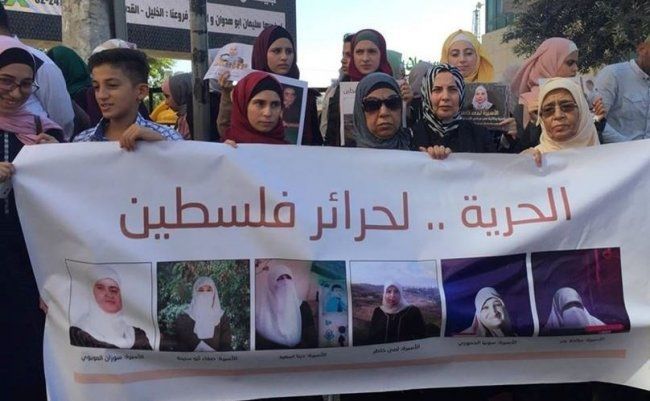
Photo: Protest demands release of Palestinian women prisoners. Via Wattan TV
Samidoun Palestinian Prisoner Solidarity Network – August 29, 2018
Seven Palestinian women from al-Khalil have been jailed by the Israeli occupation, with many held in intense, torturous interrogation for many weeks. The Israeli Shin Bet intelligence agency is now attempting to market these arrests in the media as an attack on “Hamas infrastructure” in al-Khalil in an attempt to justify the ongoing large-scale arrests targeting active Palestinian women in the city.
In addition to the main arrests targeting seven women, a number of other women were summoned to hours of interrogation before being released. Riyad al-Ashqar of the Palestinian Prisoners’ Center for Studies said that all of the women work in social services, public activities, media work or at home with their families and that none are involved in Hamas’ political or military work. He said that the Shin Bet’s claims are an attempt to create a state of fear and terror to suppress Palestinian women’s participation in activities against the crimes of the occupation or supporting the Palestinian resistance.
The campaign against Palestinian women in al-Khalil began with the arrest of City Council member Suzan Abdel-Karim Owawi, 40, on 5 June. She was subjected to extensive, harsh interrogation that was extended repeatedly during that time. In addition to her public service as an elected official, she is a social activist who works to support Palestinian prisoners; she is married and the mother of four children.
Safa Abu Hussein, 36, was arrested next after Israeli occupation forces invaded her home and took her to interrogation. Her detention has been extended four times.
Rawda Mohammed Abu Aisha, 53, was next to be seized by occupation forces; she was seized when she drove to a checkpoint in Bethlehem and taken to interrogation.
The occupation forces also arrested Dima Said al-Karmi, 38, the widow of Nashat al-Karmi, a Hamas activist killed by Israeli occupation forces and the mother of an 8-year-old daughter. She was taken to Ashkelon detention center and interrogated harshly and extensively and deprived of sleep. During her interrogation, she fainted on multiple occasions. Her detention has also been repeatedly extended.
Lama Khater, 42, is a Palestinian writer who was seized on 24 July by Israeli occupation forces after they invaded her family home. She was deprived of sleep, insulted and threatened by Israeli interrogators at the Ashkelon detention center. The mother of five children – the youngest only 2 – she is a political analyst and writer whose work is widely published on newspapers and websites.
Saida Badr, 55, is the wife of Palestinian Legislative Council (PLC) member Mohammed Badr, 61, who has spent many years in Israeli prison including a recent sentence in administrative detention, imprisonment without charge or trial.
Finally, Sonia Hamouri, 40, a university lecturer, was seized from her family home in al-Khalil on 14 August. A number of other women were also detained for several hours and interrogated.
The Israeli occupation is accusing the women of communicating information from Palestinians in exile to those inside occupied Palestine, especially activists in Hamas. They were also accused of doing social and charitable work in support of the movement by providing aid to the prisoners’ families.
Palestinian political parties and movements are labeled “illegal organizations” by the Israeli occupation, and thousands of Palestinians are jailed for allegedly supporting or belonging to these liberation movements. One of the most common charges against Palestinian prisoners is “membership in an illegal organization,” as participation in most major Palestinian political movements is criminalized by the colonial occupation.
These seven women are among a total of approximately 63 Palestinian women prisoners, including several held without charge or trial under administrative detention, such as parliamentarian Khalida Jarrar and student Fidaa Akhalil.
Israeli occupation bans Palestinian student from his university campus
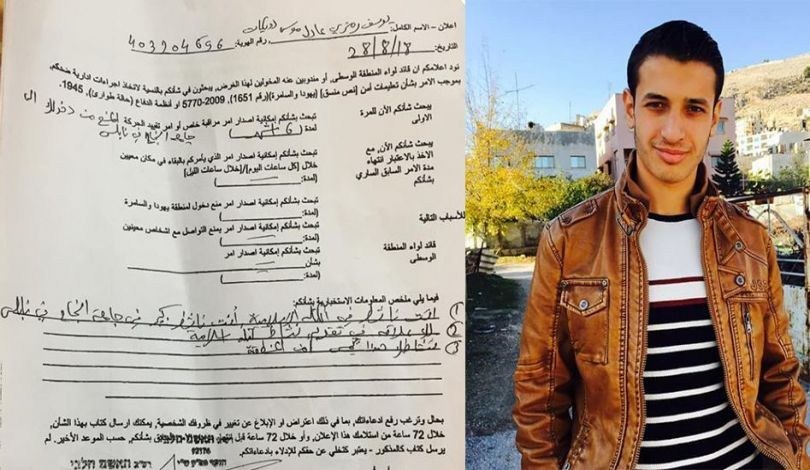
Photo: Yousef Dweikat and the order barring him from his university. Via Hadf News.
Samidoun Palestinian Prisoner Solidarity Network – August 29, 2018
Palestinian student Yousef Dweikat was banned from entering the campus of his university, An-Najah National University in occupied Nablus, on Tuesday, 28 August 2018. Dweikat, 20, a student at the Faculty of Engineering at the university and an activist with the Islamic Bloc student organization, was summoned to meet with Israeli occupation intelligence in the Salem military base.
When he presented himself, he was presented with an order barring him from his own university campus for the next six months. A Palestinian refugee who lives in Balata refugee camp, Dweikat, an electrical engineering student, is a former prisoner; he was arrested by Israeli occupation forces in March 2017 and jailed for six months for his involvement in student activities.
In an interview with Quds News, Dweikat called upon the university “to create solutions and alternatives so that this type of decision does not affect a larger number of university students.” He noted that the Israeli occupation had used a similar policy against university students in the 1980s and is now returning to those practices. Dweikat also said that his education was already delayed because of his previous detention and that he had already registered for the new year, paid his university fees and prepared to start the new semester. “My family and I are tense and frustrated. We do not know what we can do next to confront this unjust decision,” he said.
This is only the latest violation of the Palestinian right to education by the Israeli occupation. According to the Palestinian Ministry of Education, there are over 300 Palestinian university students imprisoned in Israeli jails. Each year, especially around the time of student council elections, universities face invasions and attacks on active students. Student leaders like Omar Kiswani, president of the Bir Zeit University student council, have been seized from campus in violent raids.
In addition, as the Palestinian Right to Enter campaign notes, international academics – including Palestinians born in exile with foreign passports – are routinely denied entry to Palestine by Israeli occupation forces at colonially controlled borders. By denying entry to scholars invited to teach, lecture or study at Palestinian universities, the Israeli occupation seeks to isolate Palestinian educators, scholars and students from their international peers.
These routine violations of Palestinian academic freedom – along with the racial exclusion of international students, particularly those identified as Arabs, Muslims or Palestinians – have added impetus to the ongoing call for academic boycott of Israeli institutions. The US Campaign for the Academic and Cultural Boycott of Israel is urging universities, students and faculty to take a pledge to boycott “study abroad” programs run by Israeli institutions, “We Will not Study in Israel Until Palestinians Can Return: Boycott Study Abroad in Israel!” Samidoun Palestinian Prisoner Solidarity Network is one of the endorsers of this call.
As many students head back to university around the world, solidarity with Palestinian students and scholars is particularly critical. These arrests and bans are an attempt to dismantle Palestinian students’ ability to learn, organize and uphold their identity, existence and struggle on campus. Samidoun Palestinian Prisoner Solidarity Network urges supporters of Palestine on campuses around the world to join the campaign to boycott Study Abroad, support the academic boycott of Israel and hold events and activities to highlight the violation of Palestinian rights to education, particularly the imprisonment of Palestinian students.
US Intel, Media Spread Fake Reports on Alleged Russian Election Meddling
Sputnik – 29.08.2018
WASHINGTON – US intelligence officials and the American mainstream media have been propagating false Russia meddling claims to undermine pro-Trump congressional candidates ahead of the midterm elections, analysts told Sputnik.
In particular, The New York Times reported on Friday, citing unnamed intelligence officials, that US sources in the Kremlin who had warned about Russian intervention in the US 2016 presidential election “had gone silent” and now the CIA is in the dark about Moscow’s plans vis-a-vis the upcoming congressional midterm elections.
In November, US voters go to the polls to elect lawmakers who will represent their respective states at the federal level. The midterm elections will determine whether Republicans maintain control of Congress and will be seen by many as a referendum on the sitting president’s performance.
US intelligence leaders, including Director of National Intelligence Dan Coats, without any evidence have been warning that Russia will likely interfere in the midterm elections. Coats and others have also claimed that Russia is waging an influence campaign via social media.
Former US Defense Department adviser Karen Kwiatkowski told Sputnik that she had doubts about the reliability of the New York Times report and intelligence community claims.
“Reading between the lines of this article, it seems as if politicized members of the US intelligence establishment — including people like Dan Coats — are hedging their bets,” she said.
Coats and his colleagues were getting on record their ‘concern’ about Russia interference in these upcoming elections in the event of an unexpected wave of support for President Donald Trump, Kwiatkowski explained.
The New York Times report, claiming that the United States had human sources inside the Kremlin appeared to be based on false assumptions and to be part of a wider strategy to try and convince US public opinion about a non-existent Russian plot to influence the elections, Kwiatkowski cautioned.
“In terms of this article, I suspect it is wrong in its assumptions, and is part of a larger domestic propaganda effort,” Kwiatkowski said.
Kwiatkowski pointed out the remarkable lack of evidence to support US allegations of Russia’s meddling in the 2018 midterm elections.
“The American intelligence apparatus is ‘concerned’ that the Russians are trying to pick and choose candidates in midterm elections — 435 Congressional elections and 33 plus Senate elections — but they don’t have any information about this activity that they ‘know’ is happening,” the former Pentagon aide said. “This isn’t how intelligence is done. It is however how agendas are pushed, and propaganda rejuvenated.”
Former CIA Director John Brennan, who was referred to in the New York Times article, lacked any credibility based on his documented record, Kwiatkowski noted.
“Brennan is an unreliable source, extremely biased, a known liar and he’s currently angrier than usual. With his clearance suspended, he may be receiving less information from his friends in the government, and maybe that’s what he is complaining about,” Kwiatkowski said.
Former Canadian diplomat Patrick Armstrong, who once served as a political official at Ottawa’s embassy in Moscow, told Sputnik that The New York Times report was written to try and sustain flagging interest and support the diminishing credibility of the fiction that Russia intervened in the 2016 US elections.
“The writers are trying to keep the conspiracy going in the hope that the Democrats will control the House and shut down all examination of what really happened,” Armstrong said.
Fake News
However, the fantasy that Russian involvement had cost the Democratic candidate Hillary Clinton the 2016 election was supported by no evidence whatsoever, Armstrong emphasized.
“This is nonsense on stilts and only can be twisted into a question if you believe — as New York Times consumers do as a matter of faith — that Russia ‘interfered’ in the first place,” Armstrong said.
No evidence has been produced other than the “fantasies” in the unsubstantiated dossier produced by former UK spy Christopher Steele.
The only plausible content in the New York Times story was the assertion that Moscow had expelled many of Washington’s intelligence assets in Russia, Armstrong observed.
Kwiatkowski pointed out that the real manipulation of US elections was done by countries that had a historically shared culture with the United States.
The UK’s MI6 and Israel’s Mossad, Kwiatkowski said, are far more active in US elections, at many levels, than the Russians could ever hope to be.
“It’s nice for The New York Times to be able not to talk about these risks — in part because Trump is not the candidate these two countries would prefer,” Kwiatkowski concluded.
In January 2017, a US intelligence community report that contained zero evidence claimed that Moscow tried to meddle in the US election process. Moscow has repeatedly denied interfering in US elections as such actions would run counter to the principles and practices of Russian foreign policy.
Social Media Giants Enter NATO Service
By Rick Rozoff | Ron Paul Institute | August 28, 2018
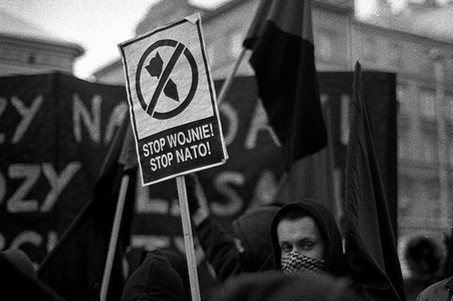
On August 22 Facebook and its CEO Mark Zuckerberg announced that they had arbitrarily removed 652 accounts, groups and pages allegedly linked to Russia and Iran for “coordinated inauthentic behavior,” by which we’re safe in assuming is meant political information inconvenient for the US power structure and its “Euro-Atlantic” elite allies in Europe and elsewhere.
The purpose pursued and the criteria employed are both explicitly political, focusing especially on federal elections. Facebook boasted of recent successes in this regard in France and Mexico.
There are historically-decisive Senate and Congressional elections this November 6th in the US.
At the beginning of this month several major conservative and libertarian Facebook, YouTube and other social media accounts were closed by the above and other parties in a heavy-handed, coordinated manner. The sites and individuals banned are ones that have urged cooperation between the US and Russia and warned against worsening political and potential military conflict between the world’s two major nuclear powers.
What connects the two unprecedented social media purges is an agreement reached in May of this year between Facebook and the Atlantic Council.
The Atlantic Council of the United States was established in 1961 by former Secretaries of State Dean Acheson and Christian Herter to bolster support for NATO. Atlantic Councils were set up in other member states for the same purpose, and at the present time they now number more than 40 in NATO and Partnership for Peace countries. The name is derivative of North Atlantic Council, the highest governing body of NATO.
Due to its efforts, NATO has grown from 16 to 29 members since the end of the Cold War and in addition has recruited at least forty military partners throughout the world. With Colombia joining its Partners Across the Globe program earlier this year, NATO now has members and partners on all inhabited continents.
The partnership between Facebook and the Atlantic Council was described by the Atlantic Council’s president and CEO Fred Kempe as follows:
This partnership will help our security, policy and product teams get real-time insights and updates on emerging threats and disinformation campaigns from around the world. It will also increase the number of ‘eyes and ears’ we have working to spot potential abuse on our service – enabling us to more effectively identify gaps in our systems, preempt obstacles, and ensure that Facebook plays a positive role during elections all around the world.
The collaboration, like NATO and Facebook themselves, are not only avowedly political but unabashedly global in scale.
In the interim Facebook has announced it’s hired “additional third-party reviewers” for the purpose advancing the aforesaid political censorship and furtherance of NATO’s international agenda.
Failing such methods, there are also those proposed by then-president presumptive Hillary Clinton two years ago: “As president, I will make it clear that the United States will treat cyberattacks just like any other attack. We will be ready with serious political, economic and military responses.”
How the Department of Homeland Security Created a Deceptive Tale of Russia Hacking US Voter Sites
By Gareth Porter | Consortium News | August 28, 2018
The narrative of Russian intelligence attacking state and local election boards and threatening the integrity of U.S. elections has achieved near-universal acceptance by media and political elites. And now it has been accepted by the Trump administration’s intelligence chief, Dan Coats, as well.
But the real story behind that narrative, recounted here for the first time, reveals that the Department of Homeland Security (DHS) created and nurtured an account that was grossly and deliberately deceptive.
DHS compiled an intelligence report suggesting hackers linked to the Russian government could have targeted voter-related websites in many states and then leaked a sensational story of Russian attacks on those sites without the qualifications that would have revealed a different story. When state election officials began asking questions, they discovered that the DHS claims were false and, in at least one case, laughable.
The National Security Agency and special counsel Robert Mueller’s investigating team have also claimed evidence that Russian military intelligence was behind election infrastructure hacking, but on closer examination, those claims turn out to be speculative and misleading as well. Mueller’s indictment of 12 GRU military intelligence officers does not cite any violations of U.S. election laws though it claims Russia interfered with the 2016 election.
A Sensational Story
On Sept. 29, 2016, a few weeks after the hacking of election-related websites in Illinois and Arizona, ABC News carried a sensational headline: “Russian Hackers Targeted Nearly Half of States’ Voter Registration Systems, Successfully Infiltrated 4.” The story itself reported that “more than 20 state election systems” had been hacked, and four states had been “breached” by hackers suspected of working for the Russian government. The story cited only sources “knowledgeable” about the matter, indicating that those who were pushing the story were eager to hide the institutional origins of the information.
Behind that sensational story was a federal agency seeking to establish its leadership within the national security state apparatus on cybersecurity, despite its limited resources for such responsibility. In late summer and fall 2016, the Department of Homeland Security was maneuvering politically to designate state and local voter registration databases and voting systems as “critical infrastructure.” Such a designation would make voter-related networks and websites under the protection a “priority sub-sector” in the DHS “National Infrastructure Protection Plan, which already included 16 such sub-sectors.
DHS Secretary Jeh Johnson and other senior DHS officials consulted with many state election officials in the hope of getting their approval for such a designation. Meanwhile, the DHS was finishing an intelligence report that would both highlight the Russian threat to U.S. election infrastructure and the role DHS could play in protecting it, thus creating political impetus to the designation. But several secretaries of state—the officials in charge of the election infrastructure in their state—strongly opposed the designation that Johnson wanted.
On Jan. 6, 2017—the same day three intelligence agencies released a joint “assessment” on Russian interference in the election—Johnson announced the designation anyway.
Media stories continued to reflect the official assumption that cyber attacks on state election websites were Russian-sponsored. Stunningly, The Wall Street Journal reported in December 2016 that DHS was itself behind hacking attempts of Georgia’s election database.
The facts surrounding the two actual breaches of state websites in Illinois and Arizona, as well as the broader context of cyberattacks on state websites, didn’t support that premise at all.
In July, Illinois discovered an intrusion into its voter registration website and the theft of personal information on as many as 200,000 registered voters. (The 2018 Mueller indictments of GRU officers would unaccountably put the figure at 500,000.) Significantly, however, the hackers only had copied the information and had left it unchanged in the database.
That was a crucial clue to the motive behind the hack. DHS Assistant Secretary for Cyber Security and Communications Andy Ozment told a Congressional committee in late September 2016 that the fact hackers hadn’t tampered with the voter data indicated that the aim of the theft was not to influence the electoral process. Instead, it was “possibly for the purpose of selling personal information.” Ozment was contradicting the line that already was being taken on the Illinois and Arizona hacks by the National Protection and Programs Directorate and other senior DHS officials.
In an interview with me last year, Ken Menzel, the legal adviser to the Illinois secretary of state, confirmed what Ozment had testified. “Hackers have been trying constantly to get into it since 2006,” Menzel said, adding that they had been probing every other official Illinois database with such personal data for vulnerabilities as well. “Every governmental database—driver’s licenses, health care, you name it—has people trying to get into it,” said Menzel.
In the other successful cyberattack on an electoral website, hackers had acquired the username and password for the voter database Arizona used during the summer, as Arizona Secretary of State Michele Reagan learned from the FBI. But the reason that it had become known, according to Reagan in an interview with Mother Jones, was that the login and password had shown up for sale on the dark web—the network of websites used by cyber criminals to sell stolen data and other illicit wares.
Furthermore, the FBI had told her that the effort to penetrate the database was the work of a “known hacker” whom the FBI had monitored “frequently” in the past. Thus, there were reasons to believe that both Illinois and Arizona hacking incidents were linked to criminal hackers seeking information they could sell for profit.
Meanwhile, the FBI was unable to come up with any theory about what Russia might have intended to do with voter registration data such as what was taken in the Illinois hack. When FBI Counterintelligence official Bill Priestap was asked in a June 2017 hearing how Moscow might use such data, his answer revealed that he had no clue: “They took the data to understand what it consisted of,” said the struggling Priestap, “so they can affect better understanding and plan accordingly in regards to possibly impacting future elections by knowing what is there and studying it.”
The inability to think of any plausible way for the Russian government to use such data explains why DHS and the intelligence community adopted the argument, as senior DHS officials Samuel Liles and Jeanette Manfra put it, that the hacks “could be intended or used to undermine public confidence in electoral processes and potentially the outcome.” But such a strategy could not have had any effect without a decision by DHS and the U.S. intelligence community to assert publicly that the intrusions and other scanning and probing were Russian operations, despite the absence of hard evidence. So DHS and other agencies were consciously sowing public doubts about U.S. elections that they were attributing to Russia.
DHS Reveals Its Self-Serving Methodology
In June 2017, Liles and Manfra testified to the Senate Intelligence Committee that an October 2016 DHS intelligence report had listed election systems in 21 states that were “potentially targeted by Russian government cyber actors.” They revealed that the sensational story leaked to the press in late September 2016 had been based on a draft of the DHS report. And more importantly, their use of the phrase “potentially targeted” showed that they were arguing only that the cyber incidents it listed were possible indications of a Russian attack on election infrastructure.
Furthermore, Liles and Manfra said the DHS report had “catalogued suspicious activity we observed on state government networks across the country,” which had been “largely based on suspected malicious tactics and infrastructure.” They were referring to a list of eight IP addresses an August 2016 FBI “flash alert” had obtained from the Illinois and Arizona intrusions, which DHS and FBI had not been able to attribute to the Russian government.

Manfra: No doubt it was the Russians. (C-SPAN)
The DHS officials recalled that the DHS began to “receive reports of cyber-enabled scanning and probing of election-related infrastructure in some states, some of which appeared to originate from servers operated by a Russian company.” Six of the eight IP addresses in the FBI alert were indeed traced to King Servers, owned by a young Russian living in Siberia. But as DHS cyber specialists knew well, the country of ownership of the server doesn’t prove anything about who was responsible for hacking: As cybersecurity expert Jeffrey Carr pointed out, the Russian hackers who coordinated the Russian attack on Georgian government websites in 2008 used a Texas-based company as the hosting provider.
The cybersecurity firm ThreatConnect noted in 2016 that one of the other two IP addresses had hosted a Russian criminal market for five months in 2015. But that was not a serious indicator, either. Private IP addresses are reassigned frequently by server companies, so there is not a necessary connection between users of the same IP address at different times.
The DHS methodology of selecting reports of cyber incidents involving election-related websites as “potentially targeted” by Russian government-sponsored hackers was based on no objective evidence whatever. The resulting list appears to have included any one of the eight addresses as well as any attack or “scan” on a public website that could be linked in any way to elections.
This methodology conveniently ignored the fact that criminal hackers were constantly trying to get access to every database in those same state, country and municipal systems. Not only for Illinois and Arizona officials, but state electoral officials.
In fact, 14 of the 21 states on the list experienced nothing more than the routine scanning that occurs every day, according to the Senate Intelligence Committee. Only six involved what was referred to as a “malicious access attempt,” meaning an effort to penetrate the site. One of them was in Ohio, where the attempt to find a weakness lasted less than a second and was considered by DHS’s internet security contractor a “non-event” at the time.
State Officials Force DHS to Tell the Truth
For a year, DHS did not inform the 21 states on its list that their election boards or other election-related sites had been attacked in a presumed Russian-sponsored operation. The excuse DHS officials cited was that it could not reveal such sensitive intelligence to state officials without security clearances. But the reluctance to reveal the details about each case was certainly related to the reasonable expectation that states would publicly challenge their claims, creating a potential serious embarrassment.
On Sept. 22, 2017, DHS notified 21 states about the cyber incidents that had been included in the October 2016 report. The public announcement of the notifications said DHS had notified each chief election officer of “any potential targeting we were aware of in their state leading up to the 2016 election.” The phrase “potential targeting” again telegraphed the broad and vague criterion DHS had adopted, but it was ignored in media stories.
But the notifications, which took the form of phone calls lasting only a few minutes, provided a minimum of information and failed to convey the significant qualification that DHS was only suggesting targeting as a possibility. “It was a couple of guys from DHS reading from a script,” recalled one state election official who asked not to be identified. “They said [our state] was targeted by Russian government cyber actors.”
A number of state election officials recognized that this information conflicted with what they knew. And if they complained, they got a more accurate picture from DHS. After Wisconsin Secretary of State Michael Haas demanded further clarification, he got an email response from a DHS official with a different account. “[B]ased on our external analysis,” the official wrote, “the WI [Wisconsin] IP address affected belongs to the WI Department of Workforce Development, not the Elections Commission.”
California Secretary of State Alex Padilla said DHS initially had notified his office “that Russian cyber actors ‘scanned’ California’s Internet-facing systems in 2016, including Secretary of State websites.” But under further questioning, DHS admitted to Padilla that what the hackers had targeted was the California Department of Technology’s network.
Texas Secretary of State Rolando Pablos and Oklahoma Election Board spokesman Byron Dean also denied that any state website with voter- or election-related information had been targeted, and Pablos demanded that DHS “correct its erroneous notification.”
Despite these embarrassing admissions, a statement issued by DHS spokesman Scott McConnell on Sept. 28, 2017 said the DHS “stood by” its assessment that 21 states “were the target of Russian government cyber actors seeking vulnerabilities and access to U.S. election infrastructure.” The statement retreated from the previous admission that the notifications involved “potential targeting,” but it also revealed for the first time that DHS had defined “targeting” very broadly indeed.
It said the category included “some cases” involving “direct scanning of targeted systems” but also cases in which “malicious actors scanned for vulnerabilities in networks that may be connected to those systems or have similar characteristics in order to gain information about how to later penetrate their target.”
It is true that hackers may scan one website in the hope of learning something that could be useful for penetrating another website, as cybersecurity expert Prof. Herbert S. Lin of Stanford University explained to me in an interview. But including any incident in which that motive was theoretical meant that any state website could be included on the DHS list, without any evidence it was related to a political motive.
Arizona’s further exchanges with DHS revealed just how far DHS had gone in exploiting that escape clause in order to add more states to its “targeted” list. Arizona Secretary of State Michele Reagan tweeted that DHS had informed her that “the Russian government targeted our voter registration systems in 2016.” After meeting with DHS officials in early October 2017, however, Reagan wrote in a blog post that DHS “could not confirm that any attempted Russian government hack occurred whatsoever to any election-related system in Arizona, much less the statewide voter registration database.”
What the DHS said in that meeting, as Reagan’s spokesman Matt Roberts recounted to me, is even more shocking. “When we pressed DHS on what exactly was actually targeted, they said it was the Phoenix public library’s computers system,” Roberts recalled.
In April 2018, a CBS News “60 Minutes” segment reported that the October 2016 DHS intelligence report had included the Russian government hacking of a “county database in Arizona.” Responding to that CBS report, an unidentified “senior Trump administration official” who was well-briefed on the DHS report told Reuters that “media reports” on the issue had sometimes “conflated criminal hacking with Russian government activity,” and that the cyberattack on the target in Arizona “was not perpetrated by the Russian government.”
NSA Finds a GRU Election Plot
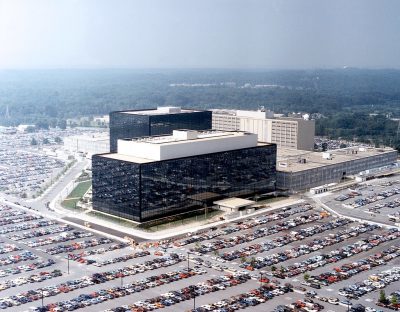
National Security Agency headquarters in Fort Meade, Md. (Wikimedia)
NSA intelligence analysts claimed in a May 2017 analysis to have documented an effort by Russian military intelligence (GRU) to hack into U.S. electoral institutions. In an intelligence analysis obtained by The Intercept and reported in June 2017, NSA analysts wrote that the GRU had sent a spear-phishing email—one with an attachment designed to look exactly like one from a trusted institution but that contains malware design to get control of the computer—to a vendor of voting machine technology in Florida. The hackers then designed a fake web page that looked like that of the vendor. They sent it to a list of 122 email addresses NSA believed to be local government organizations that probably were “involved in the management of voter registration systems.” The objective of the new spear-phishing campaign, the NSA suggested, was to get control of their computers through malware to carry out the exfiltration of voter-related data.
But the authors of The Intercept story failed to notice crucial details in the NSA report that should have tipped them off that the attribution of the spear-phishing campaign to the GRU was based merely on the analysts’ own judgment—and that their judgment was faulty.
The Intercept article included a color-coded chart from the original NSA report that provides crucial information missing from the text of the NSA analysis itself as well as The Intercept’s account. The chart clearly distinguishes between the elements of the NSA’s account of the alleged Russian scheme that were based on “Confirmed Information” (shown in green) and those that were based on “Analyst Judgment” (shown in yellow). The connection between the “operator” of the spear-phishing campaign the report describes and an unidentified entity confirmed to be under the authority of the GRU is shown as a yellow line, meaning that it is based on “Analyst Judgment” and labeled “probably.”
A major criterion for any attribution of a hacking incident is whether there are strong similarities to previous hacks identified with a specific actor. But the chart concedes that “several characteristics” of the campaign depicted in the report distinguish it from “another major GRU spear-phishing program,” the identity of which has been redacted from the report.
The NSA chart refers to evidence that the same operator also had launched spear-phishing campaigns on other web-based mail applications, including the Russian company “Mail.ru.” Those targets suggest that the actors were more likely Russian criminal hackers rather than Russian military intelligence.
Even more damaging to its case, the NSA reports that the same operator who had sent the spear-phishing emails also had sent a test email to the “American Samoa Election Office.” Criminal hackers could have been interested in personal information from the database associated with that office. But the idea that Russian military intelligence was planning to hack the voter rolls in American Samoa, an unincorporated U.S. territory with 56,000 inhabitants who can’t even vote in U.S. presidential elections, is plainly risible.
The Mueller Indictment’s Sleight of Hand
The Mueller indictment of GRU officers released on July 13 appeared at first reading to offer new evidence of Russian government responsibility for the hacking of Illinois and other state voter-related websites. A close analysis of the relevant paragraphs, however, confirms the lack of any real intelligence supporting that claim.
Mueller accused two GRU officers of working with unidentified “co-conspirators” on those hacks. But the only alleged evidence linking the GRU to the operators in the hacking incidents is the claim that a GRU official named Anatoly Kovalev and “co-conspirators” deleted search history related to the preparation for the hack after the FBI issued its alert on the hacking identifying the IP address associated with it in August 2016.
A careful reading of the relevant paragraphs shows that the claim is spurious. The first sentence in Paragraph 71 says that both Kovalev and his “co-conspirators” researched domains used by U.S. state boards of elections and other entities “for website vulnerabilities.” The second says Kovalev and “co-conspirators” had searched for “state political party email addresses, including filtered queries for email addresses listed on state Republican Party websites.”

Mueller: Don’t read the fine print. (The White House/Wikimedia)
Searching for website vulnerabilities would be evidence of intent to hack them, of course, but searching Republican Party websites for email addresses is hardly evidence of any hacking plan. And Paragraph 74 states that Kovalev “deleted his search history”—not the search histories of any “co-conspirator”—thus revealing that there were no joint searches and suggesting that the subject Kovalev had searched was Republican Party emails. So any deletion by Kovalev of his search history after the FBI alert would not be evidence of his involvement in the hacking of the Illinois election board website.
With this rhetorical misdirection unraveled, it becomes clear that the repetition in every paragraph of the section of the phrase “Kovalev and his co-conspirators” was aimed at giving the reader the impression the accusation is based on hard intelligence about possible collusion that doesn’t exist.
The Need for Critical Scrutiny of DHS Cyberattack Claims
The DHS campaign to establish its role as the protector of U.S. electoral institutions is not the only case in which that agency has used a devious means to sow fear of Russian cyberattacks. In December 2016, DHS and the FBI published a long list of IP addresses as indicators of possible Russian cyberattacks. But most of the addresses on the list had no connection with Russian intelligence, as former U.S. government cyber-warfare officer Rob Lee found on close examination.
When someone at the Burlington, Vt., Electric Company spotted one of those IP addresses on one of its computers, the company reported it to DHS. But instead of quietly investigating the address to verify that it was indeed an indicator of Russian intrusion, DHS immediately informed The Washington Post. The result was a sensational story that Russian hackers had penetrated the U.S. power grid. In fact, the IP address in question was merely Yahoo’s email server, as Rob Lee told me, and the computer had not even been connected to the power grid. The threat to the power grid was a tall tale created by a DHS official, which the Post had to embarrassingly retract.
Since May 2017, DHS, in partnership with the FBI, has begun an even more ambitious campaign to focus public attention on what it says are Russian “targeting” and “intrusions” into “major, high value assets that operate components of our Nation’s critical infrastructure”, including energy, nuclear, water, aviation and critical manufacturing sectors. Any evidence of such an intrusion must be taken seriously by the U.S. government and reported by news media. But in light of the DHS record on alleged threats to election infrastructure and the Burlington power grid, and its well-known ambition to assume leadership over cyber protection, the public interest demands that the news media examine DHS claims about Russian cyber threats far more critically than they have up to now.
Gareth Porter is an independent investigative journalist and winner of the 2012 Gellhorn Prize for journalism. His latest book is Manufactured Crisis: The Untold Story of the Iran Nuclear Scare.
Guns and Butter Banned and Removed from KPFA Radio
Guns and Butter | August 16, 2018
Dear Guns and Butter Supporters and Listeners,
Guns and Butter has been taken off the KPFA airwaves by the General Manager of the station.
I received on Wednesday, August 8th, before Guns and Butter would have aired on KPFA, the following email from the General Manager:
Bonnie,
KPFA will cease broadcasting “Guns and Butter” effective immediately.
We’ve received an avalanche of negative calls and emails from listeners about your uncritically airing of views by a holocaust denier, climate denial and casting the Parkland mass shooting survivors as crisis actors. As steward of our airways, we can’t defend this content to our listeners.
Sincerely,
Quincy McCoy Kevin Cartwright
General Manager Program Director
This was followed by removal of the entire KPFA broadcast archives of Guns and Butter, down the memory hole.
KPFA defines itself as “Free Speech Radio” and this reaction is a form of censorship. There was no discussion of these claims, nor any provision for due process or community involvement before these actions were taken.
Background
On July 24th, after registering unique premiums I had developed for the two-week KPFA Summer Fund Drive, I received an email from the pledge room informing me that Guns and Butter was pre-empted for the two-week fund drive. The show had never been pre-empted during fund drives, no reason was given, nor any prior notice.
On July 18th I received one other message from the station – the General Manager forwarded to me two email complaints from listeners, the day Guns and Butter aired The Impact of Zionist Influence in the U.S., a presentation by Alan Sabrosky as part of a panel, Zionism – Deconstructing the Power Paradigm, from an online conference. The GM wrote that he agreed with the criticism, that there was “nothing in the mission that agrees or allows unbalanced issue shows like this especially about a topic as sensitive as this.”
Response to Claims
“Holocaust Denial” Alan Sabrosky is a Jewish American war veteran and former Army War College Director at the Strategic Studies Institute. He did not claim that there was no persecution of Jewish people in fascist Germany. The focus of his talk was on present and future perils, specifically war with Iran. Airing his brief comments on WWII is apparently what has angered some people. There could be an equivalent number of people who appreciated those comments but did not choose to send an email about them.
“Climate Denial” (Whatever that means) Programming on Guns and Butter has covered climate disruption, climate extremes, etc. It has not flat out supported the theory that global warming is the future trend because there are other scientific phenomenon and influences on the climate that are being studied such as sun cycles, space weather and the weakening of the earth’s magnetosphere, among other factors, that should be considered.
“Crisis Actors” No one on the show claimed that Parkland student shooting survivors were crisis actors. What was pointed out was that it was suspicious that the student activist whose political narrative was picked up by the media was not even at the school during the shooting, but showed up right afterward.
About Guns and Butter
Guns and Butter is an educational program that provides a platform for opinions and analyses not heard in the mainstream media. The program is not necessarily about what I think or believe, nor does it constitute an endorsement of every thing said by a guest, but an opportunity for thought and discussion by listeners interested in differing points of view. In a time of extreme polarity in our country, open sharing of ideas is where we need to be.
Guns and Butter spearheaded deep analysis of the seminal event of the 21st Century – the crimes of September 11th that no other program on KPFA would deal with. I also produced many hours of original economic and financial programming with Dr. Michael Hudson, Dr. Michel Chossudovsky, Dr. Webster Tarpley, to name a few. You wouldn’t realize it now, but there wasn’t any other financial/economic programming on the station at the time. The geopolitical coverage on Guns and Butter has also been superb. The show has produced outstanding programming on a wide variety of complex and difficult subjects.
Guns and Butter was created by me and a fellow volunteer reporter in the KPFA Newsroom in 2001. It was approved for broadcast by a democratic vote of the KPFA Program Council that included community members. The program is fully edited and mixed for broadcast, and is a more than full-time stressful job to produce. It has aired for 17 years and has raised multiple hundreds of thousands of dollars for the station, which reflects very strong listener support. I have never received any support from the station.
An unprecedented attack on the 1st Amendment right of free speech is taking place generally. Alternative media on the Internet is being removed, not just from social media platforms, but websites themselves have come under denial of service attack. Youtube has for some time been eliminating channels. I have just learned that Word Press is taking down websites. Computer algorithms are clamping down on search engines for alternative news and has adversely affected many popular sites, including Global Research.
It seems that differing viewpoints are no longer allowed on KPFA’s airwaves and that listeners’ feelings are purportedly being protected by station management when it is information, facts and data that should be given the highest precedence by management, not opinions. It is always uncomfortable hearing something that one finds offensive or that threatens to break one out of one’s bubble, but it is an individual’s responsibility not the station’s to take care of one’s own feelings. And rather than management deciding what listeners should or should not hear because of managements’ own personal biases or pressure from special interest groups, listeners’ ability to think for themselves and make up their own minds should be respected and not be subject to censorship of ideas and unknown research from either the Right or the Left, especially when it comes to KPFA which should be guided by the Pacifica mission that includes the following:
To establish a Foundation organized and operated exclusively for educational purposes. ……… In radio broadcasting operations to engage in any activity that shall contribute to a lasting understanding between nations and between the individuals of all nations, races, creeds and colors; to gather and disseminate information on the causes of conflict between any and all of such groups; and through any and all means compatible with the purposes of this corporation to promote the study of political and economic problems and of the causes of religious, philosophical and racial antagonisms.
Guns and Butter is broadcast on WBAI in New York City every Wednesday at 9AM and is carried on many Pacifica Affiliates and will continue to be archived here on the Guns and Butter website.
We need your financial help to sustain our programming, most especially during this extremely difficult time of alternative media censorship, and we thank you for your support. Thank you to everyone who has signed up for monthly sustainable contributions, and to those of you who have made one-time donations. We cannot express enough our gratitude. As always, your donations are tax-deductible to the full extent of the law. Guns and Butter is a project of Inquiring Systems, a registered 501(c)(3) that has been providing non-profit status to socially responsible organizations since 1978.
US army accuses RT of ‘ridiculous misinformation’ over Syria, but not UN or NBC
FILE PHOTO. © Aboud Hamam / Reuters
RT | August 28, 2018
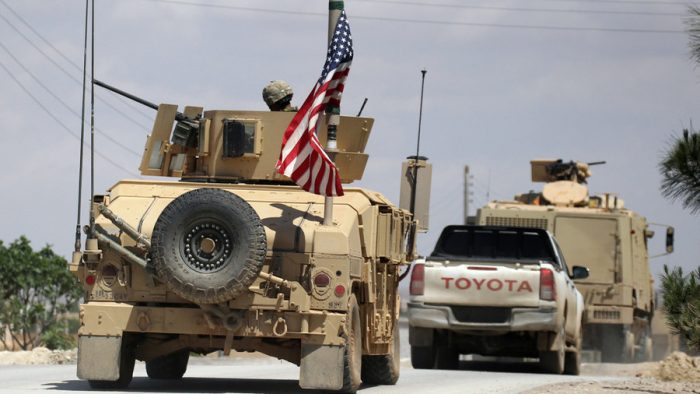
A US Army colonel has accused RT of ‘ridiculous misinformation’ for reporting a Russian government suggestion that Islamic State is operating inside a US-controlled zone in Syria, despite the UN and NBC reporting the same.
On Thursday, Russian Foreign Ministry spokesperson Maria Zakharova told journalists that Moscow has received information that armed members of Islamic State (IS, formerly ISIS) and the Al-Qaeda proxy group Jabhat al-Nusra had found shelter in the Rukban refugee camp, located in the southwest Al-Tanf region of Syria, and that the US knows the terrorists are there.
Don’t be distracted by ridiculous misinformation from @RT_com. The #Coalition is focused on #defeatISIS mission & we continue to work with @MaghaweirThowra to secure the #AlTanf region in southern #Syria. @CJTFOIR@oirdcomsshttps://t.co/8vcbh82CVD
— OIR Spokesman (@OIRSpox) August 26, 2018
Army Colonel Sean Ryan who is the spokesman for Operation Inherent Resolve (OIR), the snappy name for the US-led coalition against IS, took to the one battleground that really matters, Twitter. He accused RT of ‘ridiculous misinformation’. It’s not entirely clear which part of the report he believes is misinformation; the fact that the Foreign Ministry said the statement in the first place, that terrorists are operating in Rukban, or that the US knows all about it.
If he’s got a problem with the information coming from Russia’s Foreign Ministry, then he should direct his objections that way. It is generally accepted in the world of journalism that quoting the statement of a government official is not ‘misinformation’, it’s actually just reporting the news. Attempting to undermine good faith reporting, well that actually is ‘misinformation’.
More worrying would be if Colonel Ryan is saying the US actually knows nothing about terrorists operating in and around the Rukban refugee camp, because that would make the US military the only organisation in the region that hasn’t noticed. That’s even more concerning when you consider the stated US goal of being in Syria is to fight IS rebels.
For the benefit of Colonel Ryan, here are a few people who have noticed the slightly dodgy looking gun-toting terrorists who appear to be putting together cells under their noses.
NBC’s Bill Neely was given access to the area around the Rukban camp, but he reported that his Jordanian helicopter pilot refused to fly over it “for fear of being shot down by ISIS cells in the camp.”
The NBC report goes on to quote the commander of Jordan’s army in the area as saying “militants there have whole weapons systems … small arms, RPGs, anti-aircraft.” Brigadier General Sami Kafawin describes how the militants “consider the camp a safe haven. We consider it an imminent threat.”
Jordan is a US ally at the last time of checking, perhaps Colonel Ryan should phone someone up there.
Earlier this month, the UN named the Rukban refugee camp as being among hotspots ripe for the reemergence of IS. For the sake of Colonel Ryan, he can find a link to the UN report here.
The camp is close to the Jordanian border which was closed because of constant terrorist activity. It doesn’t take a genius to work out that terrorists working in such a remote region might see some opportunities in a nearby camp of 80,000 desperate people.
So, what’s really going on here? When a report from RT is branded misinformation by a US colonel who is responsible for less-than-transparent operations in a distant part of Syria, readers may be well advised to read the contents of that report, and future reports, very carefully. Serving military leaders are not well known for being open with information. However, it’s nice to see that Colonel Ryan is getting some of his news from RT.com.
Publicly criticising outlets like RT has nothing to do with pointing out misinformation, but everything to do with undermining different sources of information which are not singing to your tune.
RT has written to Colonel Ryan in an attempt to clarify his comments, but has not received a reply at the time of writing. It can’t be ruled out that he hasn’t noticed the email.
Read more:
The 10 Main Holes in the Official Narrative on the Salisbury Poisonings: #5 – The Feeding of the Ducks
By Rob Slane | The Blog Mire | August 27, 2018
In the previous piece, I began to focus on the official timeline of events on March 4th, as stated by The Metropolitan Police on 17th March, noting that there is a missing 4 hours in the morning, which investigators were very anxious to receive information on at the time, but which they have been conspicuously silent on since. Not only have they failed to update the timeline with information about the Skripals movements on the morning of 4th March, but they have failed to do so despite now having that information. How can I be sure they have it? Because both Sergei and Yulia Skripal have been awake and talking for months now.
But in this piece, I want to focus on something even more important. Something that is crucial for two reasons:
- Firstly, the Metropolitan Police do not mention it in their timeline, even though it absolutely did happen and is vital.
- Secondly, it completely demolishes the theory that the Skripals were poisoned by touching a nerve agent on the handle of Mr Skripal’s front door.
The incident in question is the duck feed. But before I come on to it, let’s just remind ourselves of the official timeline once more, so that we can then see where this incident fits in:
Saturday 3rd March
14.40hrs on Saturday 3 March: Yulia arrives at Heathrow Airport on a flight from Russia.
Sunday 4th March
09.15hrs on Sunday, 4 March: Sergei’s car is seen in the area of London Road, Churchill Way North and Wilton Road.
13.30hrs: Sergei’s car is seen being driven down Devizes Road, towards the town centre.
13:40hrs: Sergei and Yulia arrive in Sainsbury’s upper level car park at the Maltings. At some time after this, they go to the Bishops Mill Pub in the town centre.
14.20hrs: They dine at Zizzi Restaurant.
15:35hrs: They leave Zizzi Restaurant.
16.15hrs: Emergency services receive a report from a member of the public and police arrive at the scene within minutes, where they find Sergei and Yulia extremely ill on a park bench near the restaurant.
One of the things that is immediately obvious about this timeline is its astonishing vagueness in certain places. For instance, Mr Skripal’s car was apparently seen in three different areas — London Road, Churchill Way North and Wilton Road — at 9:15. Presumably it was seen on CCTV cameras in these locations, and presumably these cameras all have time and date stamps. In which case, why could the timeline not be more precise than suggesting that Mr Skripal’s car was at three locations at the same time?
But the vagueness of the time and location of the car in the morning really is small fry compared to the time and location given at 13:40hrs:
“Sergei and Yulia arrive in Sainsbury’s upper level car park at the Maltings. At some time after this, they go to the Bishops Mill Pub in the town centre.”
At some time after this? What exactly is that supposed to mean? Were there not CCTV cameras in The Maltings and in The Mill that could give a more precise timeline? The unnerving thing – given that this is one of the biggest and most important investigations Britain has ever seen – is that yes indeed there were. And yet what these cameras show has either been ignored in the timeline altogether, or incorporated into it in some sort of vague and nebulous way that – and I don’t know how else to process it – frankly looks very suspect.
I’ll come on to the bit about The Mill in the next piece, but before we get there, perhaps we can jog the memories of investigators by reminding them of a piece of CCTV footage that they certainly do have, which is time stamped, and which shows clearly where Sergei Skripal and Yulia were at a particular time.
After parking the car, at 1:40pm, the two of them were seen near the Avon Playground, in The Maltings, feeding ducks with some local boys. This was at 1:45pm and has been confirmed to me by one of the boys’ mothers, who was shown the CCTV footage by the police, which she said was really clear. She also confirmed to me that Mr Skripal was wearing jeans and a leather jacket, and that Yulia Skripal had a red bag.
The Metropolitan Police apparently don’t think the duck feeding incident important enough to include in their timeline, and so after the parking of the car, we are treated to the vague statement that, “at some time after this, they go to the Bishops Mill Pub.”
But it is incredibly important, for the following reason: it totally, completely and comprehensively debunks the idea that Mr Skripal was poisoned at his home, after his hand came into contact with a deadly nerve agent on the handle of his front door. Why?
BECAUSE HE HANDED BREAD TO THE BOYS, AND NONE OF THEM BECAME CONTAMINATED, THAT’S WHY!
Think about it. Zizzis has remained shut since the incident, because it was apparently contaminated, and the table that the Skripals ate their meal at “had to be destroyed” because of the apparently high concentration of nerve agent there. Likewise, The Mill has been closed ever since. And of course the bench too had to be destroyed, since it was apparently contaminated.
But these were all places visited by the Skripals AFTER the feeding of the ducks.
And so we are asked to believe the following preposterous notion: That Sergei and Yulia Skripal’s hands were contaminated with “military grade nerve agent” at the door of Mr Skripal’s house, so much so that certain places they visited on that afternoon had to undergo months of decontamination, and certain items they touched had to be destroyed.
And yet in between getting the nerve agent on their hands at the door, and the visits to those locations, Mr Skripal was seen on CCTV, at 1:45pm, handing bread to local boys to give to the ducks. With his contaminated hands, apparently. And one of those boys even ate a piece. And yet none of those boys managed to become contaminated the by the “military grade nerve agent” on Mr Skripal’s hands?
No amount of “they might have been wearing gloves” will do. Firstly, the temperature was actually quite warm (8-9 degrees) and so it’s unlikely that they were wearing gloves; secondly, who actually tears bread from a loaf whilst wearing gloves (probably nobody, is my guess); but thirdly, gloves apparently weren’t enough protection to prevent D.S. Bailey from becoming contaminated, allegedly at the door handle.
No, there is no way out of this. The duck feeding incident leaves the “nerve agent on the door handle” theory in tatters. If the duck feed happened – which it did – then the “Skripals becoming contaminated with nerve agent on the door handle” did not happen. To continue to believe that it did, in the light of Mr Skripal handing bread to boys, not one of whom became contaminated, is to cast off all reason and enter a twilight world of the absurd.
But it does at least explain why the incident doesn’t make it onto the timeline!
The 10 Main Holes in the Official Narrative on the Salisbury Poisonings: #1 – The Motive
The 10 Main Holes in the Official Narrative on the Salisbury Poisonings: #2 – The Intent
The 10 Main Holes in the Official Narrative on the Salisbury Poisonings: #3 – The Capability
The 10 Main Holes in the Official Narrative on the Salisbury Poisonings: #4 – The Missing Four Hours
The 10 Main Holes in the Official Narrative on the Salisbury Poisonings: #6 – The Meal and The Drink
Skripals – When the BBC Hide the Truth
By Craig Murray | August 27, 2018
On 8 July 2018 a lady named Kirsty Eccles asked what, in its enormous ramifications, historians may one day see as the most important Freedom of Information request ever made. The rest of this post requires extremely close and careful reading, and some thought, for you to understand that claim.
Dear British Broadcasting Corporation,
1: Why did BBC Newsnight correspondent Mark Urban keep secret from the licence payers that he had been having meetings with Sergei Skripal only last summer.
2: When did the BBC know this?
3: Please provide me with copies of all correspondence between yourselves and Mark Urban on the subject of Sergei Skripal.
Yours faithfully,
Kirsty Eccles
The ramifications of this little request are enormous as they cut right to the heart of the ramping up of the new Cold War, of the BBC’s propaganda collusion with the security services to that end, and of the concoction of fraudulent evidence in the Steele “dirty dossier”. This also of course casts a strong light on more plausible motives for an attack on the Skripals.
Which is why the BBC point blank refused to answer Kirsty’s request, stating that it was subject to the Freedom of Information exemption for “Journalism”.
10th July 2018
Dear Ms Eccles
Freedom of Information request – RFI20181319
Thank you for your request to the BBC of 8th July 2018, seeking the following information under the
Freedom of Information Act 2000:
1: Why did BBC Newsnight correspondent Mark Urban keep secret from the licence payers that he
had been having meetings with Sergei Skripal only last summer.
2: When did the BBC know this?
3: Please provide me with copies of all correspondence between yourselves and Mark Urban on the
subject of Sergei Skripal.
The information you have requested is excluded from the Act because it is held for the purposes of
‘journalism, art or literature.’ The BBC is therefore not obliged to provide this information to you. Part VI
of Schedule 1 to FOIA provides that information held by the BBC and the other public service broadcasters
is only covered by the Act if it is held for ‘purposes other than those of journalism, art or literature”. The
BBC is not required to supply information held for the purposes of creating the BBC’s output or
information that supports and is closely associated with these creative activities.
The BBC is of course being entirely tendentious here – “journalism” does not include the deliberate suppression of vital information from the public, particularly in order to facilitate the propagation of fake news on behalf of the security services. That black propaganda is precisely what the BBC is knowingly engaged in, and here trying hard to hide.
I have today attempted to contact Mark Urban at Newsnight by phone, with no success, and sent him this email:
To: mark.urban@bbc.co.uk
Dear Mark,
As you may know, I am a journalist working in alternative media, a member of the NUJ, as well as a former British Ambassador. I am researching the Skripal case.
I wish to ask you the following questions.
1) When the Skripals were first poisoned, it was the largest news story in the entire World and you were uniquely positioned having held several meetings with Sergei Skripal the previous year. Yet faced with what should have been a massive career break, you withheld that unique information on a major story from the public for four months. Why?
2) You were an officer in the Royal Tank Regiment together with Skripal’s MI6 handler, Pablo Miller, who also lived in Salisbury. Have you maintained friendship with Miller over the years and how often do you communicate?
3) When you met Skripal in Salisbury, was Miller present all or part of the time, or did you meet Miller separately?
4) Was the BBC aware of your meetings with Miller and/or Skripal at the time?
5) When, four months later, you told the world about your meetings with Skripal after the Rowley/Sturgess incident, you said you had met him to research a book. Yet the only forthcoming book by you advertised is on the Skripal attack. What was the subject of your discussions with Skripal?
6) Pablo Miller worked for Orbis Intelligence. Do you know if Miller contributed to the Christopher Steele dossier on Trump/Russia?
7) Did you discuss the Trump dossier with Skripal and/or Miller?
8) Do you know whether Skripal contributed to the Trump dossier?
9) In your Newsnight piece following the Rowley/Sturgess incident, you stated that security service sources had told you that Yulia Skripal’s telephone may have been bugged. Since January 2017, how many security service briefings or discussions have you had on any of the matter above.I look forward to hearing from you.
Craig Murray
I should very much welcome others also sending emails to Mark Urban to emphasise the public demand for an answer from the BBC to these vital questions. If you have time, write your own email, or if not copy and paste from mine.
To quote that great Scot John Paul Jones, “We have not yet begun to fight”.
US not ready for substantive dialogue with Russia on cybersecurity – Lavrov
RT | August 28, 2018
The US has not yet provided any evidence of ‘Russian hackers’ interfering in the 2016 presidential election, Russian Foreign Minister Sergey Lavrov said Tuesday.
“For the second year we have been proposing that a bilateral working group on cybersecurity should be created to discuss and remove mutual concerns, including those related to influence on electoral processes in [the US and Russia],” he told the Slovak newspaper Pravda.
However, Washington is avoiding a “professional exchange of views,” he said.
It is only surprising “how easily it was possible to put a discussion of this unfounded theme at the center of the intra-American socio-political discussion,” Lavrov noted.
Featured Video
No Threat Can Force Iran’s Surrender /Trita Parsi & Lt Cl Daniel Davis
or go to
Aletho News Archives – Video-Images
From the Archives
An Expert Military Analysis of War with China
Actually, None is Necessary
By Fred Reed • Unz Review • December 13, 2020
The Correlation of Armed Forces: U.S. goods and services trade with China totaled an estimated $634.8 billion in 2019. Exports were $163.0 billion; imports were $471.8 billion. The U.S. goods and services trade deficit with China was $308.8 billion in 2019. Trade in services with China (exports and imports) totaled an estimated $76.7 billion in 2019. Services exports were $56.5 billion; services imports were $20.1 billion. The U.S. services trade surplus with China was $36.4 billion in 2019.
There is talk within the Washingtoniat of a possible war with China. Steve Bannon, who apparently was dropped on his head as a child, actually favors such a war. We hear the usual shoo-the-boobs alarm about how the Chinese are doing something terrible and we must gird our loins and American values and show them what for, bow wow, woof. The danger is that the current game of who-blinks-first in Asian waters might actually provoke a shooting war. You know the kind of thing: One warship refuses to get out of the way of another, a collision ensues, some retard lieutenant who signed up on waivers opens fire, and we’re off and running. It is not a good idea to let children play with matches.
The said war is discussed either in emotional terms by idiots or in purely naval terms by those familiar with such things, so we hear of the First Island Chain and the Second Island Chain and whose missiles against the other’s missiles and so on. This would be appropriate if we were fighting World War Two again. Which we aren’t. Let’s take a quick-and-dirty look at how such a war might go.
To begin the war, America would overestimate itself and underestimate China. This is doctrine in the Pentagon. … continue
Blog Roll
 Aletho News
- Iran To Target Military Industrial-Tech Complex That Facilitated Gaza Genocide
- Collapsing Empire: The Resistance Disarms ‘Israel’
- Suicide Should Not Be a Government Service
- Rethinking America’s greatest threat: Iran vs. Israel-Firsters
- Iran accuses adversaries of false flags to strain Turkey ties
- Poland rules out sending Patriot missiles to US/Israel amid war on Iran
- Tehran approves new Hormuz plan with major restrictions
- No Threat Can Force Iran’s Surrender /Trita Parsi & Lt Cl Daniel Davis
- UK’s New Pandemic Plan Would Turn Big Tech Into a Mass Location Tracking Network
- Growing insecurity, soaring prices fuel protests in north as regime bans evacuation: Sources
- If Americans Knew
- Joe Kent Urges Americans To Call White House and Congress To Object To Sending Troops Into Iran
- DNC Resolution to Reject AIPAC Funding Puts Democratic Leaders in the Hot Seat
- Swedish foundation to build 400 schools as over 650,000 Gaza children remain without education for 2 years
- Israeli army admits photshopping image of slain Lebanese journalist
- This is how Israel is systematically killing health workers under the cover of war in Lebanon
- Carrying life under fire: Israeli invasion of Lebanon leaves pregnant women facing deadly risks
- Champagne all around for the new death penalty (for Palestinians) law – Not a ceasefire Day 172
- Why are Palestinian books struggling to be seen on Amazon?
- The Line Between Affinity and Conspiracy
- As Iran targets US military bases, will they be relocated to Israel? Not a ceasefire Day 171
- No Tricks Zone
- New Study Finds Warming Saves Lives…Cold Temperatures 12 Times More Deadly Than Excess Heat
- German Science Blog Accuses PIK Climate Institute Of Hallucinating Climate Tipping Points
- Devastating Assessment Of Comirnaty Vaccine By Former Senior Pfizer Europe Toxicologist
- New Study: CO2 Is ‘Effectively Negligible’ As An Explanatory Climate Change Factor Since 2000
- Former Pfizer Toxicologist Dr. Helmut Sterz Tells Bundestag Hearing Pfizer Vaccine Should Have Never Been Approved
- Energy Expert: Germany’s Nuclear Phaseout Was A “500 Billion Euro Mistake”
- New Research: South Australia’s Mid-Holocene Sea Surface Temperatures Were 4°C Warmer Than Today
- Storing Green Energy To Last Germany 10 Days Would Require A 60-Million Tonne Battery
- New Studies: UK Sea Levels Were 4 Meters Higher Than Today During The Mid-Holocene
- Destructive Green New Deal: German Energy And Metal Group Warns Of Drastic Crisis
 Aletho News