Alexander Solzhenitsyn’s Critical History of Jews in Russia – a Brief Comment from Ron Unz
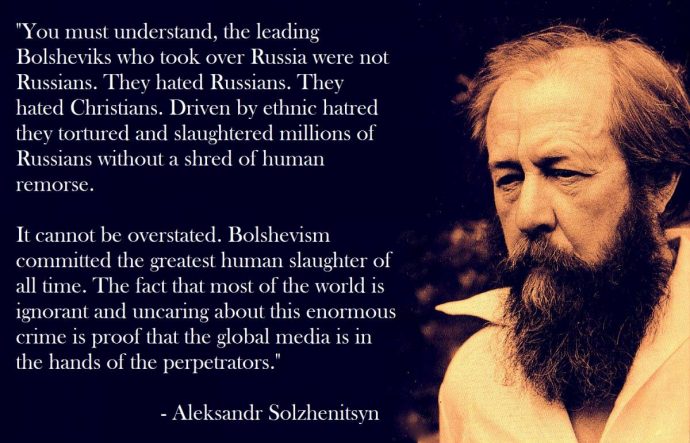
It is unlikely that this ‘quote’ is authentic, rather it reflect the opinion of the memer who created it, a view which has merit.
Russia Insider
This is an excerpt from a much longer article by Ron Unz originally entitled Oddities of the Jewish Religion, which we highly recommend.
We reproduce it here because there is so very little written about this important book, which debunks much of what was taught in the West in the 20th century about Russia.
Throughout most of my life, Nobel Laureate Alexander Solzhenitsyn was generally regarded as the greatest Russian literary figure of our modern era, and after reading all of his works, including The First Circle, Cancer Ward, and The Gulag Archipelago, I certainly concurred with this assertion, and eagerly absorbed Michael Scammel’s brilliant thousand page biography.
Although Russian himself, many of his closest friends were Jewish, but during the 1980s and 1990s, whispers of his supposed anti-Semitism began floating around, probably because he had sometimes hinted at the very prominent role of Jews in both financing and leading the Bolshevik Revolution, and afterward staffing the NKVD and administering the Gulag labor camps.
Late in his life, he wrote a massive two-volume history of the tangled relationship between Jews and Russians under the title Two Hundred Years Together, and although that work soon appeared in Russian, French, and German, nearly two decades later, no English translation has ever been authorized. His literary star seems also to have greatly waned in America since that time, and I only very rarely see his name mentioned these days in any of my regular newspapers.
Samizdat versions of major sections of his final work may easily be located on the Internet, and a few years ago Amazon temporarily sold a 750 page hard copy edition, which I ordered and lightly skimmed.
Everything seemed quite innocuous and factual, and nothing new jumped out at me, but perhaps the documentation of very heavy Jewish role in Communism was considered inappropriate for American audiences, as was the discussion of the extremely exploitative relationship between Jews and Slavic peasants in pre-revolutionary times, based on liquor-dealing and money-lending, which the Czars had often sought to mitigate.
When a ruling elite has limited connection to the population it controls, benevolent behavior is far less likely to occur, and those problems are magnified when that elite has a long tradition of ruthlessly extractive behavior. Enormous numbers of Russians suffered and died in the aftermath of the Bolshevik Revolution, and given the overwhelmingly Jewish composition of the top leadership during much of that period, it is hardly surprising that “anti-Semitism” was deemed a capital offense. Kevin MacDonald may have been the one who coined the term “hostile elite,” and discussed the unfortunate consequences when a country comes under such control.
After the collapse of the Soviet Union in 1991, reborn Russia soon fell under the overwhelming domination of a small group of Oligarchs, almost entirely of Jewish background, and a decade of total misery and impoverishment for the general Russian population soon followed. But once an actual Russian named Vladimir Putin regained control, these trends reversed and the lives of Russians have enormously improved since that time.
America’s media organs were overwhelmingly friendly toward Russia when it was under Jewish Oligarchic rule, while Putin has been demonized in the press more ferociously than any world leader since Hitler.
Indeed, our media pundits regularly identify Putin as “the new Hitler” and I actually think the analogy might be a reasonable one, but just not in the way they intend.
Extinction Rebellion – The Facts
Windows on the World | April 21, 2019
The corporate backed “protest” group Extinction Rebellion fully explained. The main protagonists in this organisation and their links to Agenda 2030, the UN Global Action Plan and template NGO’S are all explained in this fact filled show.
Do listen and look at the information presented in in these two WOTW shows about the ER cult. Listen and check out the info here
The full spectrum dominance of controlled opposition is explained in the show:
Extinction Rebellion – The Facts
Below are the emails between a member of the public who asked the inner core of Extinction Rebellion a few questions and the sinister responses and threats from their “Dragons”
The Dragons of Extinction Rebellion
The same type of “Dragons” were used in the Occupy power structure once it was under the control of George Soros they can be seen in The Puppet Masters of Occupy
Our previous shows on the ER cult gave a lot of information and context to this show. They are linked above, “Fake Protest Extinction Rebellion” and “Globalist Fake Revolution”. The articles on the website contain internal ER documents and screenshots.
Here is an informative article From OYE News
The structure of ER mirrors the George Soros backed takeover of Occupy with its command structure including “Dragons”who threaten and intimidate anyone who asks questions.
We also have e mail threats from the sinister so called “Dragons” who protect the inner core of ER personnel. This all mirrors previous globalist backed protests.
We also look at the organizations linked to ER and how there are hundreds and globally thousands of these NGO template organizations all using the same narratives, all backed by the big financial interests which are pushing the climate change agenda for profit and ultimately control of the world population and all natural resources. The change agents, social entrepreneurs, psychological nudging, Saul Alinsky rules which all appeared as part of David Cameron’s Big Society.
Gail Bradbrook is one of the founders of Extinction Rebellion along with Roger Hallam and George Barda. Their Company is Compassionate Revolution Ltd and the ER protests came through Rising Up an organisation linked to other template type NGO’s which claim to be “grassroots”.
Gail Bradbrook is a consultant at Citizens Online, her profile was removed from the company’s website before the London “protests” Here it is before it was removed.

On the subject of fake protest groups: Demos the Think Tank which influences all media in the UK and is connected to the security services and MI5 stated:
“The New Democracy will work with a combination of government open infiltration and citizen groups taking Direct Action.”
The show looks at the template NGO’s linked to this “protest” and how they are in line with aims of the UN Agenda 2030, its taxation, restrictions and Smart Cities agenda and everything Globalist.
The use of the world “grassroots” has been hijacked to mean “state controlled and agents of the UN, IMF and World Bank.”
Unlike the Fake Protests we receive no funding!
The US-NATO Alliance Has Georgia on Its Mind
By Brian Cloughley | Strategic Culture Foundation | April 29, 2019
Britain’s Daily Express newspaper is a bizarre publication that specialises in sensationalist raving. Some of its reports are weird beyond imagination, and it went even further than usual into fogs of delusion on April 21 when one of its headlines announced “World War 3: UK CONFRONTS Russia by sending warship to Black Sea.”
The vessel despatched on a “freedom of navigation manoeuvre” by the UK’s Royal Navy is HMS Echo, which cannot be described as a warship. It is “designed to carry out a wide range of survey work, including support to submarine and amphibious operations” and it carries a few cannon and machine guns, but it is difficult to see how it could confront anything more deadly than a prawn-boat. It is, however, part of the grand plan of the US-NATO military alliance which on April 4 “agreed a package of measures to improve NATO’s situational awareness in the Black Sea region and strengthen support for partners Georgia and Ukraine.”
HQ NATO much regrets that its encirclement of Russia does not yet include Georgia or Ukraine. The Brussels sub-office of the Pentagon is trying hard to formally enlist both countries and announced on March 26 that “Georgia is one of the Alliance’s closest partners. It aspires to join the Alliance. The country actively contributes to NATO-led operations and cooperates with the Allies and other partner countries in many other areas. Over time, a broad range of practical cooperation has developed between NATO and Georgia, which supports Georgia’s reform efforts and its goal of Euro-Atlantic integration.”
The day before NATO’s declaration the globe-trotting head of the organisation, Jens Stoltenberg, was in Georgia to attend military exercises. At a meeting with Prime Minister Mamuka Bakhtadze he declared it had been “clearly stated that Georgia will become a member of NATO” and “We will continue working together to prepare for Georgia’s NATO membership,” which was first mooted in 2008 but somehow has never come about.
Non-US NATO military spending totals $264 billion a year, four times that of Russia, and the US will splurge $750 billion next year, so Georgia’s 37,000 military personnel, ten Su-25 combat aircraft and military budget of $380 million are not going to make much of a contribution to NATO, but that’s not the point. What the US-NATO grouping wants is to deploy its armed forces even closer to Russia than at present. When Georgia joins, there will be an opportunity to base tanks, aircraft and missiles right up against the Russian border, as in the Baltic states.
The most interesting observation about Georgia by Radio Free Europe in its account of the Stoltenberg visit was that “The country of some 3.7 million people fought a brief war with Russia in August 2008, and Moscow’s continued military presence on the country’s territory adds to tensions in the region.”
It is never mentioned by the Pentagon, Brussels or the Western media that the “brief war” was entirely the fault of Georgia. Nor is it admitted that if Russia had wished to do so, it could have swept through and occupied the whole of Georgia in a few days without interference by NATO or anyone else.
The European Union decided to conduct an inquiry into the conflict, and in 2009 produced a report which, deep down in its 1,000 pages, states that Georgia initiated the war. This was not at all what the Western world wanted to be told, and the paper is full of observations intended to disguise or excuse Georgia’s military antics. The UK’s Independent online newspaper reported that “The first authoritative study of the war over South Ossetia has concluded that Georgia started the conflict with Russia with an attack that was in violation of international law,” but there are very few people in the Western Establishment who will admit that Georgia was to blame, and they steadfastly support Georgia’s foolhardy aggression.
The EU noted that “There were reportedly more than a hundred US military advisers in the Georgian armed forces when the conflict erupted in August 2008, and an even larger number of US specialists and advisors are thought to have been active in different branches of the Georgian power structures and administration. Considerable military support in terms of equipment and to some extent training was provided by a number of other countries led by Ukraine, the Czech Republic and Israel.” In other words, Georgia was considered a prime ally because it opposed Russia, and the US and its allies helped it prepare for its futile attack.
This is not surprising, given the speech by President George W Bush in Georgia’s capital, Tbilisi, in May 2005. The man who ordered the invasions of Afghanistan in 2001 and Iraq in 2003 was eloquent about Georgia’s military contribution to these disastrous conflicts, and observed that “last year, when terrorist violence in Iraq was escalating, Georgia showed her courage. You increased your troop commitment in Iraq fivefold. The Iraqi people are grateful and so are your American and coalition allies.” Indeed Washington is so grateful to the Georgian government for contributing to its wars (which involved the needless deaths of 32 Georgian soldiers in Afghanistan and five in Iraq), it provides generous aid packages, both civil and military.
A US Congressional Research Service Report of April 2019 notes that in this financial year Congress approved $89 million in civil aid and that in 2018 military aid was $40 million. These amounts don’t seem much at first glance, especially when compared to the mega-billions doled out to Afghanistan, Israel and Iraq — but given that its population is only 3.7 million, Georgia is doing very nicely.
In June 2018, the US Assistant Secretary of State for European and Eurasian Affairs said US policy is to “check Russian aggression,” including by “building up the means of self-defence for those states most directly threatened by Russia militarily: Ukraine and Georgia,” which repay US financial patronage not only by sacrificing their soldiers in Washington’s wars (18 Ukrainian soldiers were killed in Iraq), but in more intriguing ways, including in UN forums.
For obvious reasons it has long been thought by most countries that there should be international agreement to ban weapons in space, and a Russian-Chinese draft treaty proposing such legislation was submitted to the UN in February 2008. Washington refused to consider it, and when an amended version was presented at the UN’s First Committee in 2015 it was voted against by the US — along with its well-paid puppets, Israel, Georgia and Ukraine.
The US-NATO alliance is determined to encircle Russia more tightly, and Georgia wants to help it do so. Such provocative cooperation in these endeavours heightens tension between Georgia and Russia, which in the eyes of the western media serves to justify yet more NATO expansion. It is reminiscent of the 1930 song whose last verse is “Whoa, Georgia, Georgia, No peace, no peace I find; Just this old sweet song, Keeps Georgia on my mind…”
The BJP Proudly Compared India’s “Anti-Terror” Strikes To “Israel’s” And The US’
By Andrew Korybko | EurasiaFuture | 2019-04-29
One of the most bald-faced lies to ever become part of the Alt-Media Community’s dogma is that India is supposedly on the same side as Russia, China, and Iran in the New Cold War just because it preaches the high-sounding policy of “multi-alignment” and its Prime Minister warmly embraces Presidents Putin, Xi, and Rouhani on camera. The “politically correct” narrative is that the BJP has returned India to its past glory and that it’s therefore destined to play a central role in the emerging Multipolar World Order, but nothing could be further from the truth. The ruling party is actually vehemently pro-Western in both its geopolitical outlook and ideology, as proven by the fact that India has since clinched game-changing military-strategic partnerships with “Israel” and the US, two interconnected and important developments that its perception managers always dishonestly attempt to downplay in order to hoodwink Russia, China, and Iran for as long as they can until it’s no longer possible to deny this obvious reality.
India’s “Israeli” & American “Anti-Terrorism” Role Models
While there’s been a plethora of proof about this regularly emerging over the past three years already, the most recent incident might be an inflection point that makes it impossible for India to repair the self-inflicted damage to its international reputation. BJP President Amit Shah was stumping on the campaign trail during the ongoing month-long electoral process in his country when he decided that the best way to inspire his party’s base to go out and vote was to proudly compare India’s “anti-terror” strikes to “Israel’s” and the US’, proving once and for all that the ruling Hindutva ideologues have much more in common with Zionism and American Exceptionalism than with the principles that embody the emerging Multilpolar World Order. Speaking about the Bollywood-style “surgical strike” from February, he said that “India is only the third country after Israel and United States of America to have retaliated to terrorism in this brave manner”, which was an unambiguous endorsement of the aggressive actions carried out by India’s two newest military-strategic partners.
Spitting In The Face Of Every Palestinian, Syrian, & Iranian
It deserves to be pointed out that “Israel” describes its attacks against the Palestinians in the occupied Gaza Strip and West Bank as “anti-terrorist” strikes, which is the exact same terminology that it uses when claiming credit for its attacks against Iran and Hezbollah in Syria. As for the US, it’s carried out “anti-terrorist” strikes all across the so-called “Greater Middle East”, most notoriously in Syria, Yemen, Somalia, and Libya, all of which BJP President Shah regards as “retaliating to terrorism in a brave manner” regardless of the countless civilian casualties that America and “Israel” are responsible for with these attacks. Interestingly, India apparently doesn’t care about the message that it’s sending to Iran by celebrating “Israel’s” “anti-terrorist” strikes in Syria that have allegedly martyred many Iranian servicemen who were legally operating in the Arab Republic, but then again, all tact regarding the Indian-Iranian partnership is being thrown out the window after New Delhi decided to abide by Washington’s unilateral sanctions against the Islamic Republic.
Bringing Accountability To The Alt-Media Community
What’s most striking about all of this is that the BJP President thinks that comparing his country’s international aggression to “Israel’s” and the US’ will help the incumbent party win re-election, strongly suggesting that India’s current rulers understand just how Islamophobic and pro-American their base really is and that many of their supporters are ecstatic about New Delhi’s new military-strategic partnerships with Tel Aviv and Washington. If the majority of Indians were really as multipolar-inclined as their government’s perception managers would deceptively have the Alt-Media Community believe, then BJP President Shah wouldn’t have dared to say what he did during the ongoing heated election where the wrong word could doom his party’s re-election prospects, proving that he’s sincerely confident that playing the pro-Western, Islamophobic, unipolar card might end up being the key to the BJP’s success. This should give India’s die-hard supporters in the Alt-Media Community a reason to reconsider the dogma that they were indoctrinated to believe and begin bringing those who brainwashed them to account.
Israel lets settlers spend Passover at former outpost where Palestinian landowners remain excluded
MEMO | April 29, 2019
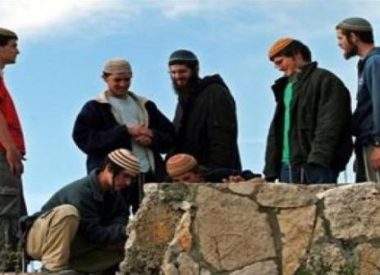 Israeli occupation authorities allowed settlers to celebrate Passover at the site of the former Amona outpost in the northern West Bank, despite the fact that the location is a closed military zone.
According to Haaretz, the site “became a recreation spot for Jewish settlers during the Passover holiday”, even though the Palestinians who own the land on the hill “are still not allowed access”.
The outpost was evacuated in 2017 on orders of the Israeli Supreme Court, who ruled it had been established on privately-owned Palestinian land.
As reported by Haaretz, shortly before the removal of settlers from Amona, “the army issued the order barring access to the site by civilians”, an order “now strictly enforced to keep Palestinian landowners from the nearby villages of Ein Yabrud and Silwad from farming their land at the site”.
The order has not been enforced, however, “when it comes to Jews, who are able to access the site fairly easily on a road from the nearby settlement of Ofra”.
“It’s clear that after years during which the state got used to conducting itself in cooperation with the settlers in stealing land in the West Bank, it’s hard to wean itself off,” Dror Etkes of settlement watchdog Kerem Navot told Haaretz.
A Palestinian petition to the Supreme Court demanding access to their land at the site is still pending.
For NYT, Israel Is Always Nearing ‘Apartheid,’ but Never Quite Gets There
By Gregory Shupak | FAIR | April 26, 2019
Following Benjamin Netanyahu’s re-election as Israeli prime minister earlier this month, the New York Times’ editorial board (4/11/19) wrote:
Under Mr. Netanyahu, Israel is on a trajectory to become what critics say will be an apartheid state like the former South Africa—a country in which Palestinians will eventually be a majority, but without the rights of citizens.
A harsh criticism? Actually, the paper has been saying that Israel/Palestine could “become” an apartheid state for the better part of two decades. It ran a piece in 2003 (1/29/03) arguing that
if Israel does not give up the territories, it will face a choice: relinquish either democracy or the ideal of a Jewish state. Granting Palestinians in the territories the right to vote would turn Israel into an Arab state with a Jewish minority. Not allowing them to vote would result in a form of permanent apartheid.
For almost 20 years, the paper has suggested that Israel/Palestine risks devolving into an apartheid state if it continues to rule over Palestinians in the territories—Gaza, the West Bank and East Jerusalem—who cannot choose their rulers. This population includes approximately 4.75 million occupied Palestinians—320,000 in East Jerusalem, 2.8 million in the rest of the West Bank and 1.8 million in besieged Gaza—to say nothing of the millions of Palestinian refugees who cannot return to their homes and participate in elections because the people who put on those elections won’t let them.
That situation has remained the same, not only for the period that the Times has been publishing material saying the arrangement might someday add up to apartheid, but since 1967. Yet the Times persists in characterizing Israeli apartheid as a hypothetical future development. The paper acknowledges that governing millions of Palestinians but denying them the vote is a form of apartheid, so there’s no justification for saying, after nearly 52 years of such disenfranchisement, that that will eventually constitute apartheid, but for some unspecified reason doesn’t yet at this point.
Tom Friedman’s Groundhog Day
New York Times columnist Thomas Friedman appears to be having a Groundhog Day experience: He keeps waking up, looking at Israel’s ethnocracy, and saying that if it continues to be apartheid, it will become apartheid. In 2002 (10/16/02), he commented:
If you think it is hard to defend Israel on campus today, imagine doing it in 2010, when the colonial settlers have so locked Israel into the territories it can rule them only by apartheid-like policies.
2010 came and went, and the “apartheid-like” conditions remained, but Friedman persisted in treating Israeli apartheid as a mere possibility, writing (2/1/11) of the 2011 protests in Egypt:
If Israelis tell themselves that Egypt’s unrest proves why Israel cannot make peace with the Palestinian Authority, then they will be talking themselves into becoming an apartheid state — they will be talking themselves into permanently absorbing the West Bank and thereby laying the seeds for an Arab majority ruled by a Jewish minority between the Mediterranean Sea and the Jordan River.
A year later (8/1/12), Friedman said:
It is in Israel’s overwhelming interest to test, test and have the US keep testing creative ideas for a two-state solution. That is what a real US friend would promise to do. Otherwise, Israel could be doomed to become a kind of apartheid South Africa.
Two years after that (2/11/14), Friedman said that “Israel by default could become some kind of apartheid-like state in permanent control over… 2.5 million Palestinians.” Even in this so-called criticism of Israel, Friedman does the state a favor by acting as though the West Bank Palestinians are the only ones disenfranchised by Israel, overlooking the refugees and Gaza, even as Israel continues to control the latter. (He also appears to leave out Palestinian Jerusalemites.)
Evidence for Already-Existing Apartheid
As Friedman and his paper kept predicting that Israel/Palestine could turn into an apartheid entity, evidence mounted that it is exactly that. For example, United Nations special rapporteur John Dugard found in 2007 that “elements of the [Israeli] occupation constitute forms of colonialism and of apartheid, which are contrary to international law.” He went on to say that at the checkpoints throughout the West Bank and surrounding Jerusalem,
a [Palestinian] person may be refused passage through a checkpoint for arguing with a soldier or explaining his documents…. Checkpoints and the poor quality of secondary roads Palestinians are obliged to use, in order to leave the main roads free for settler use, result in journeys that previously took 10 to 20 minutes taking 2 to 3 hours…. In apartheid South Africa, a similar system [was] designed to restrict the free movement of blacks —the notorious “pass laws.”
Another UN special rapporteur, Richard Falk, noted in 2010 that “among the salient apartheid features of the Israeli occupation” are “discriminatory arrangements for movement in the West Bank and to and from Jerusalem,” as well as
extensive burdening of Palestinian movement, including checkpoints applying differential limitations on Palestinians and on Israeli settlers, and onerous permit and identification requirements imposed only on Palestinians.
A March 2017 report by the UN Economic and Social Commission for Western Asia concluded that “Israel has established an apartheid regime that dominates the Palestinian people as a whole.”
That July, however, Friedman (7/12/17) continued to treat Israeli apartheid as something that might happen down the road, wishing that President Trump had admonished Netanyahu in a meeting between the two:
Bibi, you win every debate, but meanwhile every day the separation of Israel from the Palestinians grows less likely, putting Israel on a “slippery slope toward apartheid,” as former Israeli Prime Minister Ehud Barak recently warned.
Last September (9/19/18), Friedman was still worried about this supposedly theoretical scenario:
Without some dramatic advance, there is a real chance that whatever Palestinian governance exists will crumble, and Israel will have to take full responsibility for the health, education and welfare of the 2.5 million Palestinians in the West Bank. Israel would then have to decide whether to govern the West Bank with one legal authority or two, which would mean Israel would be choosing between bi-nationalism and apartheid, both disasters for a Jewish democracy.
Netanyahu, Friedman went on to say, has failed to offer “any new, or old, ideas on how to separate from the Palestinians to avoid the terrible choices of bi-nationalism and apartheid.”
Erasing Palestinians
Setting aside the troubling assertion that Israelis and Palestinians living as equals would be not only a “disaster,” but as bad a “disaster” as apartheid, Friedman ignored the fact that just two months earlier, the Knesset had passed the Nation State Law that defined Israel as the national homeland of the Jewish people. The law asserted that “the realization of the right to national self-determination in Israel is unique to the Jewish people,” even though 20 percent of the population living inside Israel is not Jewish; encouraged “the development of Jewish settlement” and vowed that the state will “promote its establishment and consolidation.” It declared that “the state’s language is Hebrew,” deprecating Arabic, the first language of roughly half the people under that state’s control.
The Nation State Law demonstrates that the bad faith, future tense descriptions of Israeli apartheid are overly narrow, in that they focus exclusively on the Palestinian territories that Israel has occupied since 1967. Yet on the Israeli-held side of the Green Line, Palestinians are systematically discriminated against.
It’s not only the occupation that make Israel/Palestine apartheid. It’s the Israeli state’s foundational principles and actions: driving two-thirds of the indigenous Palestinian population from their homes at its birth, subsequently making more than 2 million of them refugees, and then denying their right to return, despite its being mandated under international law.
Meanwhile, Jewish people anywhere on Earth are given the right to immigrate, because Israeli leaders want to maintain a demographic advantage. They pursue this goal—with decisive help from their sponsors in Washington—through their longstanding operational policy mantra: maximum land, minimum Arabs.
Not even three full days after the New York Times’ most recent brooding about how Israel might “become” an apartheid state, Israel’s Supreme Court approved the demolition of 500 Palestinian homes in Jerusalem. Is it apartheid yet?
Hamas slams UAE for inviting Israel to Dubai Expo
Palestine Information Center – April 28, 2019
GAZA – The Hamas Movement has strongly denounced the participation of Israel in the 2020 World Expo in the United Arab Emirates city of Dubai, describing it as a serious development.
In Twitter remarks, Hamas spokesman Sami Abu Zuhri urged UAE to backtrack on its decision to invite Israel to participate in the event.
Abu Zuhri said that allowing Israel to participate in Arab events would encourage it to persist in committing more crimes against the Palestinians and usurping the Arab nation’s rights, describing the UAE’s step as “a violation of the decisions taken during the Tunis summit.”
UAE invited Israel to the event despite not recognizing Israel as a state, which comes as another omen of strengthening ties between Tel Aviv and Arab Gulf countries spearheaded by Saudi Arabia among fears that these countries seek to liquidate the Palestinian cause through backing the US deal of the century.
For its part, Israeli premier Benjamin Netanyahu hailed UAE for inviting Israel to the event, describing the participation in the event as “another expression of Israel’s rising status in the world and the region.”
Israeli NGO Demands Israel Revoke BDS Founder’s Residency
teleSUR | April 28, 2019
The Israeli human rights group, Betzalmo, has called on Israel’s Attorney General and Minister of Interior to cancel BDS-founder Omar Al-Barghouti’s residency status, Arutz Sheva reported Sunday.
According to a letter that was dated for April 24, 2019, the Israeli NGO argued how it was possible that Barghouthi could be denied entry into the United States, but not in Israel, which is the country he is calling on the world to boycott.
“A recent law authorizes the Minister of the Interior, with the approval of the Attorney General, to revoke residency for anyone who harms state security or violates allegiance to the state, or endangers public peace,” Betzalmo stated. “Undoubtedly Barghouti’s leadership of the boycott movement against all citizens of the State of Israel severely harms the State of Israel and is a blatant breach of allegiance, as well as a threat to Israel’s security and defense by pushing for an arms embargo against Israel.”
The Israeli NGO said “in addition, the BDS movement collaborates with terrorist organizations, so there is undoubtedly an indirect link between Mr. Barghouti and terrorist organizations.”
Betzalmo CEO Shai Glick also released a statement in which he corroborated the claims in the letter that was dated for April 24.
“The State of Israel is a democratic and liberal state, but it must, in the name of democracy and liberalism, defend itself and its citizens. A determined struggle against the boycott constitutes true defense of the citizens of the State of Israel.” Glick said. “We cannot demand from our allies in the world to prevent the entry of a boycott activist and to prevent conferences of boycott organizations, while allowing those leading BDS activists residency in Israel, giving them State benefits and a platform. We are certain that the Interior Minister and the Attorney General will act with determination and immediately revoke Mr. Barghouti’s residency so he will be able to disseminate his toxic teaching only outside Israel.”
Barghouti was previously denied entry in to the United States, despite having the necessary documentation to enter the country.
The Boycott, Divestment and Sanctions movement (BDS) is a global campaign that has called for the economic boycott of Israel until it meets its “obligations under international law.”
Yellow vest protests hit Strasbourg in sign of trouble for EU
Press TV – April 28, 2019
The “yellow vest” protests in France have spread to Strasbourg, the seat of the European Parliament, on the 24th consecutive weekend of a revolt which shows no sign of abating.
Thousands gathered near European Union institutions late Saturday, with organizers hoping to make the protest international a month ahead of EU-wide parliamentary elections.
Police fired tear gas to push back protesters trying to march on the European Parliament building and eyewitness footage showed arrests being made.
Authorities had banned protests and barricaded the neighborhood where the parliament and other EU institutions are located.
Protests were held elsewhere across France, coming two days after President Emmanuel Macron outlined policy proposals including tax cuts worth around 5 billion euros in response to the revolt.
The Interior Ministry said around 23,600 protesters took part in rallies across the country, including Paris, Lyon, Bordeaux, Dijon and Toulouse.
The protests, named after motorists’ high-visibility yellow jackets, began in November over fuel tax increases but morphed into a nationwide movement against government policies.
The yellow vests coalition includes numerous anti-Europe protesters, many of whom are calling for a ‘Frexit’, which would see France leave the EU.
Thousands of police and soldiers are drafted into the French capital every Saturday, when there is regular fighting and fires being lit.
The situation is now so extreme that vast areas of Paris – including the district around the Elysee Palace – are shut off every weekend.
The trouble has extended to other major cities, including Bordeaux and Toulouse, where hundreds have been arrested, or injured by police weapons ranging from flash ball rubber bullets to batons.
Macron has pledged more money for rural areas, but he is still regularly described as a “President of the Rich” who is primarily interested in supporting big businesses.
He has already scrapped wealth taxes, and made it far easier for companies to hire and fire employees.
Macron had originally planned to deliver a reform speech to the nation a week ago, but it was postponed because of the fire at Notre Dame Cathedral in Paris.
Some 1 billion euros has now been pledged for the rebuilding of the medieval place of worship – prompting the yellow vests to ask why other funds cannot be found to deal with their own grievances.
Butina Case Creates ‘Pretty Dangerous Situation’ for All Foreign Nationals
Sputnik – April 27, 2019
On Friday, 30-year-old Russian national Maria Butina was sentenced in a US federal court to 18 months in prison for conspiring to act as a “foreign agent.” However, even though the government agreed with Butina’s case, it twisted her sentencing in such a way as to nullify her plea deal and give her more time behind bars.
Judge Tanya Chutkan gave Butina 18 months in a US prison for actions she said were “sophisticated and penetrated deep into political organizations,” threatening US national security. In practice, this means that Butina will serve another nine months, having been imprisoned since her July arrest.
The former American University grad student pleaded guilty last month to one count of conspiring to act as an unregistered foreign agent as part of a plea deal negotiated late last year. She sought immediate deportation to Russia following her sentencing, but the Daily Beast reported that won’t happen until her prison sentence is completed.
“She looked shocked the whole time,” Sputnik News analyst Nicole Roussell told Radio Sputnik’s Loud and Clear Friday, noting that most people, including Butina’s attorneys, expected her to be sentenced to time served and be expelled. “She’s served nine months, and a lot of that has been in solitary confinement. This is for someone who — as the judge noted — never had any [prior convictions], is clearly hard-working, intelligent, had 24 letters of character and recommendation on her record. The judge noted a ton of positive stuff about her during the sentencing hearing, so it was definitely a little bit of a shock to see that [the judge] went entirely with the side of the prosecution and gave the full 18 months, meaning she has nine more in prison.”
Butina spoke before the court Friday, saying, “My parents discovered my arrest on the morning news they watch in their rural house in a Siberian village,” she said. “I love them dearly, but I harmed them morally and financially. They are suffering from all of that. I destroyed my own life as well. I came to the United States not under any orders, but with hope, and now nothing remains but penitence.”
Butina’s charge stems from her political lobbying work with the National Rifle Association — work the government says required her to register under the Foreign Agents Registration Act (FARA), an obscure measure dating to the 1930s that’s been revived in recent years in the interests of prosecuting foreign nationals and repressing alternative news sources. Sputnik, as well as RT, Xinhua and CGTN, have all been required to register under FARA due to their associations with the governments of other countries.
However, Butina isn’t associated with the Russian government and didn’t act on its behalf. She noted in a February interview that she never attempted to conceal her actions because she didn’t believe she was doing anything wrong.
“Anyone who thinks that someone who wasn’t Russian would be in this situation is fooling themselves,” Butina’s lawyer, Robert Driscoll, told Roussell Friday.
Roussell recalled Judge Chutkan saying to Butina in the courtroom: “No doubt you have suffered greatly due to the national atmosphere, including salacious details proven to be untrue.”
“So she noted these things, and yet, went ahead and just agreed” with the prosecution, ignoring that those “salacious details” had been given to reporters by the prosecution, the most notorious of which was that she’d traded sex for information and political connections, Roussell said. Becker noted that such a charge would never be levied against a male suspect.
“I think it would apply very broadly to very large numbers of people,” Driscoll told reporters Friday. “The government’s theory that you act as an agent whenever you do anything for a foreign official — I think that is an extremely broad interpretation that can apply not only to people like Maria, but to other people. I think it’s something that should be looked at. I think anyone who is a foreign national in this country should be exceedingly concerned by the government’s position in this case and what they did here.”
“This is a little bit different than some of the cases we’ve seen,” Roussell told hosts Brian Becker and John Kiriakou. “When some of these FARA regulations started to be prosecuted, what, two years ago, we were all a little bit shocked — very shocked, actually — because this was a statute that had not really ever been regulated, hadn’t really been criminally prosecuted. But even when they started to prosecute those FARA charges, it was for people who… there was a real case against them, even if it was something that was clearly politically motivated.”
“In this case, she never lied; she never stole documents; she never funnelled money to the NRA; she cooperated; she was an extroverted student interested in political discourse,” Roussell noted.
“The irony of this case is, the government believed her,” Roussell said.
“When we look at the record, when we look at what was said, she wasn’t a spy. She was not an agent of the Russian government, in the sense of ‘secret agent.’ She was more of an agent in the sense of a principal agent,” Driscoll said, noting that “if I buy you some opera tickets, I’m your agent.”
“When we entered into the plea agreement, the understanding was that if she cooperated she would get a downward departure motion, but the government’s decision not to try to apply guideline, and then jack up a base offense level, essentially took away the departure motion with their left hand while offering it with their right,” Driscoll said. “So, the substantive effect of the departure motion was probably nil.”
In other words, while promising Butina it would decrease the amount of time she would be sentenced to serve, the federal government chose to charge her with a more serious crime, increasing the amount of time she could possibly serve and then applying the deal from there, resulting in more time in prison for Butina than before.
Roussell said the precedent set by the case has “far-reaching implications.”
“Maria could not have been prosecuted under civil FARA, which is the one that everyone knows about through [Paul] Manafort and other cases, because she had no knowledge of the statute,” Driscoll explained to Roussell. “In order to be criminally prosecuted under FARA, you need to have a willful violation.”
“So, because of her lack of knowledge, she ended up being charged with a more serious crime under the foreign agent statute. I think it’s an area that’s ripe for reform. If you take it seriously and literally, the government’s position in this case, and applied it to other circumstances, you really end up in a pretty dangerous situation. Not only for foreign nationals here, but I think for Americans abroad doing similar activities, I think would not be thrilled with this,” Driscoll explained.
Butina’s lawyer also noted that, while Judge Chutkan invoked special counsel Robert Mueller’s Russiagate investigation, his client was wholly unconnected to any events described in that report.
“She had nothing to do with the Mueller investigation. The Mueller team was aware of Maria, they were aware of this case, they interviewed her as part of her cooperation, and obviously she didn’t appear anywhere in the Mueller report. I found it curious that that was mentioned, that what she did was during the time of Russian election interference, it was alleged by the judge, when in fact, had she been involved in any of that, I would imagine that special counsel Mueller would have mentioned it somewhere in his 400 pages if she had anything to do with it,” Driscoll said. “But he did not.”
Featured Video

The 1964 Coup in Brazil
or go to
Aletho News Archives – Video-Images
Frlom the Archives
70 Neocons Petition Congress To Effectively Allow Israel To Say When The US Should Attack Iran
By Damian Lataan | January 10, 2014
Seventy senior Israeli-centric neoconservatives have written an open letter to Congress imploring them to do more to ensure Iran complies with the conditions of any agreement finally reached with the P5+1 over Iran’s nuclear program.
While the neocons are ostensibly asking Congress to ensure compliance, it is clear that their real aim is to convince members of Congress to support the bill currently passing through the Senate which calls for tighter sanctions against Iran in the event of any waywardness on Iran’s part.
The neocons are eager to see the bill currently passing through the Senate with enough support to make it veto-proof, not so much because they are concerned about Iran’s so-called nuclear weapons program – there’s still not a skerrick of hard evidence that Iran has a nuclear weapons program – but, rather, because embedded within the bill is this clause:
… if the Government of Israel is compelled to take military action in legitimate self-defense against Iran’s nuclear weapon program, the United States Government should stand with Israel and provide, in accordance with the law of the United States and the constitutional responsibility of Congress to authorize the use of military force, diplomatic, military, and economic support to the Government of Israel in its defense of its territory, people, and existence…
Essentially, the clause is an automatic trigger for the US to attack Iran at any time the Israelis choose to launch a first strike – regardless of whether President Obama is in favour or not.
Partial list… continue
Blog Roll
 Aletho News
- Aramco CEO warns ‘catastrophe’ imminent if Strait of Hormuz remains shut
- What If Iran Says No?
- Trump Threatens to ‘Hit’ Iran ‘Twenty Times Harder’ Over Strait of Hormuz Oil Flows
- Spare the hypocrisy: Baghaei slams Ursula’s support for US
- Iran War Supporters Invent a New and Absurd Justification: It Is All About China
- Corporate Media Go All Out To Support The US-Israeli War on Iran
- Trump press conference reveals a man who wants out of war
- When Tel Aviv decides, Washington fights
- Top official: Iran ready for a long war with US, no more diplomacy
- How Iran’s Toxic Rain Reveals US-Israel Discord
- If Americans Knew
- Threats and missiles fly, death tolls soar in Iran, Lebanon, Gaza – Not a ceasefire Day 151
- Lebanon: Israel’s White Phosphorous Use Risks Civilian Harm
- Corporate Media Go All Out To Support The US-Israeli War On Iran
- US-Israel war on Iran is creating a steady growing number of amputees
- Israel planned this war on Iran for 40 years. Everything else is a smoke screen
- The wrong question about the war in Iran
- ‘Your Tax Dollars Being Used to Raise Your Gas Prices’: US-Israel Bomb Major Iranian Oil Depots
- ‘Bogus Evidence’: Former Nuclear Watchdog Head Debunks US Justification for Iran War
- EXPLAINER – Dimona: What to know about Israel’s nuclear site
- Fires and toxic air in Iran (thanks, Israel) – Not a ceasefire Day 150
- No Tricks Zone
- Wake-up Call: Survey Shows Majority Of Germans Now Favor Postponing Climate Targets!
- Televised! Leading German Political Candidate Tells Schoolchildren CO2 Makes Sun Hotter!
- New Study: A Century Warming Of 1.1°C Is ‘Commonplace’ And ‘Not Unusual’ During This Interglacial
- New Study: ‘Internal Noise’ And Volcanic Forcing Can Trigger 10-15°C Warming Within Decades
- Glaciers Worldwide Are Suddendly Surging, Experts Blame Warming!
- Surprising Discovery: Sahara Is Greening…Billions Of Trees Where Once Thought To Be Barren
- New Research Reaffirms Clouds, Aerosols, And Surface Solar Radiation Are ‘Driving The Climate System’
- Germany: Electric Car Catches Fire At Charging Station, Sets Off Local “Inferno”, Widespread Damage
- New Study: Canada’s New Brunswick Was 1°C Warmer Than Today During The Medieval Warm Period
- Coal Power Back In Trend As Globe Tries To Keep Pace With Growing Demand For Power
 Aletho News