Hidden in Plain Sight: The Shocking Origins of the Jeffrey Epstein Case

A composite image shows from left to right, Lewis Rosenstiel, Jeffrey Epstein, and Roy Cohn. Graphic | Emma Fiala
By Whitney Webb | MintPress News | July 18, 2019
Despite his “sweetheart” deal and having seemingly evaded justice, billionaire sex offender Jeffrey Epstein was arrested earlier this month on federal charges for sex trafficking minors. Epstein’s arrest has again brought increased media attention to many of his famous friends, the current president among them.
Many questions have since been asked about how much Epstein’s famous friends knew of his activities and exactly what Epstein was up to. The latter arguably received the most attention after it was reported that Alex Acosta — who arranged Epstein’s “sweetheart” deal in 2008 and who recently resigned as Donald Trump’s Labor Secretary following Epstein’s arrest — claimed that the mysterious billionaire had worked for “intelligence.”
Other investigations have made it increasingly clear that Epstein was running a blackmail operation, as he had bugged the venues — whether at his New York mansion or Caribbean island getaway — with microphones and cameras to record the salacious interactions that transpired between his guests and the underage girls that Epstein exploited. Epstein appeared to have stored much of that blackmail in a safe on his private island.
Claims of Epstein’s links and his involvement in a sophisticated, well-funded sexual blackmail operation have, surprisingly, spurred few media outlets to examine the history of intelligence agencies both in the U.S. and abroad conducting similar sexual blackmail operations, many of which also involved underage prostitutes.
In the U.S. alone, the CIA operated numerous sexual blackmail operations throughout the country, employing prostitutes to target foreign diplomats in what the Washington Post once nicknamed the CIA’s “love traps.” If one goes even farther back into the U.S. historical record it becomes apparent that these tactics and their use against powerful political and influential figures significantly predate the CIA and even its precursor, the Office of Strategic Services (OSS). In fact, they were pioneered years earlier by none other than the American mafia.
In the course of this investigation, MintPress discovered that a handful of figures who were influential in American organized crime during and after Prohibition were directly engaged in sexual blackmail operations that they used for their own, often dark, purposes.
In Part I of this exclusive investigation, MintPress will examine how a mob-linked businessman with deep ties to notorious gangster Meyer Lansky developed close ties with the Federal Bureau of Investigation (FBI) while also running a sexual blackmail operation for decades, which later became a covert part of the anti-communist crusade of the 1950s led by Senator Joseph McCarthy (R-WI), himself known throughout Washington for having a habit of drunkenly groping underage teenaged girls.
Yet, it would be one of McCarthy’s closest aides who would take over the ring in later years, trafficking minors and expanding this sexual blackmail operation at the same time he expanded his own political influence, putting him in close contact with prominent figures including former President Ronald Reagan and a man who would later become president, Donald Trump.
As will be revealed in Part II, after his death, this blackmail operation continued under various successors in different cities and there is strong evidence that Jeffrey Epstein became one of them.
Samuel Bronfman and the Mob
The Prohibition Era in the United States is often used as an example of how banning recreational substances not only increases their popularity but also causes a boom in criminal activity. Indeed, it was Prohibition that greatly increased the strength of the American mafia, as the top crime lords of the day grew rich through the clandestine trade and sale of alcohol in addition to gambling and other activities.
It is through the bootlegging trade of the 1920s and the early 1930s that this story begins, as it brought together key figures whose successors and affiliates would eventually create a series of blackmail and sex trafficking rings that would give rise to the likes of Jeffrey Epstein, the “Lolita Express” and “Orgy Island.”
Samuel Bronfman never planned to become a major producer of liquor but true to his family’s last name, which means “brandy man” in Yiddish, he eventually began distributing alcohol as an extension of his family’s hotel business. During Canada’s Prohibition period, which was briefer than and preceded that of its southern neighbor, the Bronfman family business used loopholes to skirt the law and find technically legal ways to sell alcohol in the hotels and stores the family owned. The family relied on its connections with members of the American mafia to illegally smuggle alcohol from the United States.
Soon after Prohibition ended in Canada, it began in the United States and, by the time the flow of illegal alcohol had turned the other way, the Bronfmans – whose business ventures were then being led by Sam Bronfman and his brothers — were relatively late to an already flourishing bootlegging trade.
“We were late starters in the two most lucrative markets – on the high seas and across the Detroit River. What came out of the border trade in Saskatchewan was insignificant by comparison,” Bronfman once told Canadian journalist Terence Robertson, who was then writing a biography of Bronfman. Nonetheless, “this was when we started to make our real money,” Bronfman recounted. Robertson’s biography on Bronfman was never published, as he died under mysterious circumstances soon after warning his colleagues that he had uncovered unsavory information about the Bronfman family.
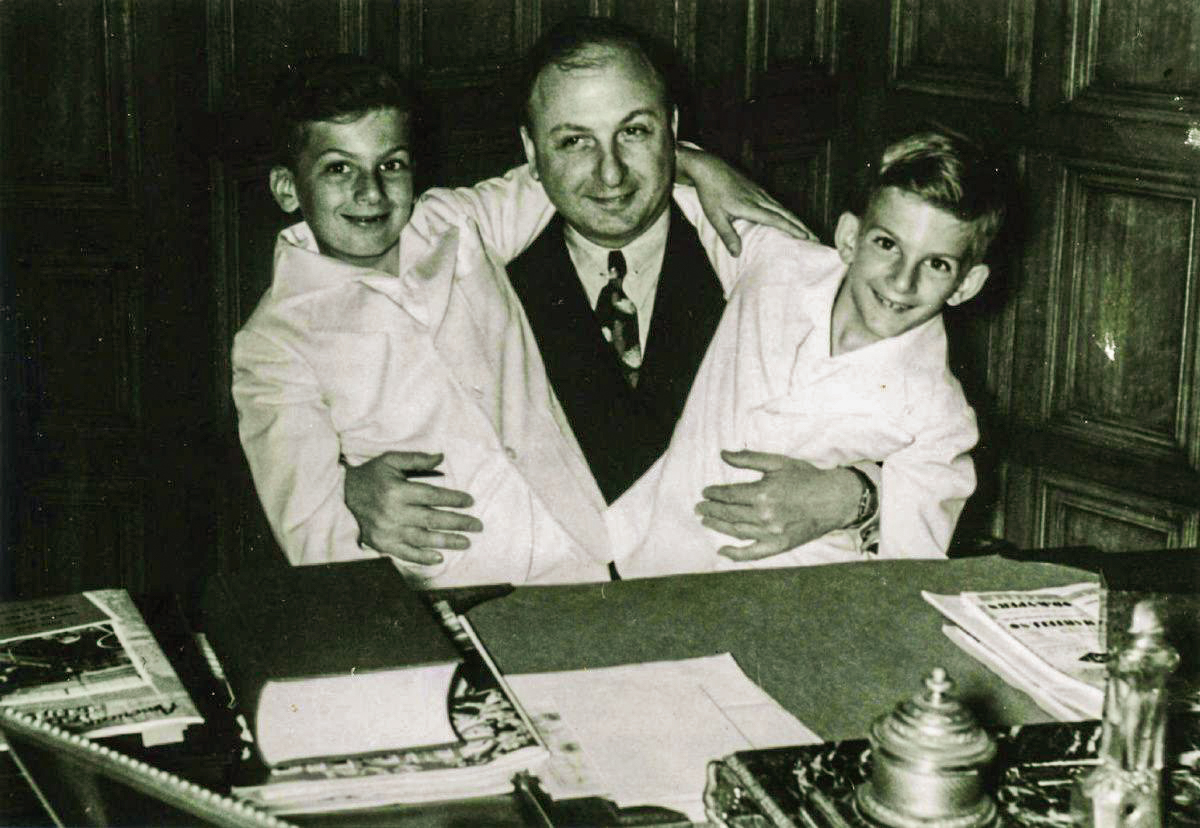
Samuel Bronfman pictured in 1937 with his sons Edgar and Charles
Key to Bronfman’s success during American Prohibition were the ties his family had cultivated with organized crime during Canada’s Prohibition, ties that led many prominent members of the mob in the United States to favor Bronfman as a business partner. Bronfman liquor was purchased in massive quantities by many crime lords who still live on in American legend, including Charles “Lucky” Luciano, Moe Dalitz, Abner “Longy” Zwillman and Meyer Lansky.
Most of Bronfman’s mob associates during Prohibition were members of what became known as the National Crime Syndicate, which a 1950s Senate investigative body known as the Kefauver Committee described as a confederation dominated by Italian-American and Jewish-American mobs. During that investigation, some of the biggest names in the American mafia named Bronfman as a central figure in their bootlegging operations. The widow of notorious American mob boss Meyer Lansky even recounted how Bronfman had thrown lavish dinner parties for her husband.
Years later, Samuel Bronfman’s children and grandchildren, their family’s ties to the criminal underworld intact, would later go on to associate closely with Leslie Wexner, allegedly the source of much of Epstein’s mysterious wealth, and other mob-linked “philanthropists,” and some would even manage their own sexual blackmail operations, including the recently busted blackmail-based “sex cult” NXIVM. The later generations of the Bronfman family, particularly Samuel Bronfman’s sons Edgar and Charles, will be discussed in greater detail in Part II of this report.
Lewis Rosenstiel’s dark secret
Crucial to Bronfman’s Prohibition-era bootlegging operations were two middlemen, one of whom was Lewis “Lew” Rosenstiel. Rosenstiel got his start working at his uncle’s distillery in Kentucky before Prohibition. Once the law banning alcohol was in force, Rosenstiel created the Schenley Products Company, which would later become one of the largest liquor companies in North America.
Though he was a high school drop-out and not particularly well-connected socially at the time, Rosenstiel happened to have a “chance” meeting with Winston Churchill in 1922 while on vacation in the French Riviera. According to the New York Times, Churchill “advised him [Rosenstiel] to prepare for the return of liquor sales in the United States.” Rosenstiel somehow managed to secure the funding of the elite and respected Wall Street firm Lehman Brothers to finance his purchase of shuttered distilleries.
Officially, Rosenstiel is said to have built his company and wealth after Prohibition, by following Churchill’s advice to prepare for Repeal. However, he was clearly involved in bootlegging operations and was even indicted for bootlegging in 1929, though he evaded conviction. Like Bronfman, Rosenstiel was close to organized crime, particularly members of the mostly Jewish-American and Italian-American mob alliance known as the National Crime Syndicate.
Subsequent New York state congressional investigations would allege that Rosenstiel “was part of a ‘consortium’ with underworld figures that bought liquor in Canada [from Samuel Bronfman]”, whose other members were “Meyer Lansky, the reputed organized crime leader; Joseph Fusco, an associate of late Chicago gangster Al Capone and Joseph Linsey, a Boston man Mr. Kelly [the congressional investigator testifying] identified as a convicted bootlegger.” Rosenstiel’s relationship with these men, particularly Lansky, would continue long after Prohibition and Samuel Bronfman, for his part, would also maintain his mob ties.
In addition to his friends in the mob, Rosenstiel also cultivated close ties with the FBI, developing a close relationship with longtime FBI Director J. Edgar Hoover and making Hoover’s right-hand man and longtime assistant at the FBI, Louis Nichols, the Vice President of his Schenley empire in 1957.
Despite their similar backgrounds as bootlegger barons turned “respectable” businessmen, Bronfman’s and Rosenstiel’s personalities were drastically different and their relationship was complicated, at best. One example of the dissimilarities between North America’s top liquor barons was how they treated their staff. Bronfman was not necessarily known for being a cruel boss, whereas Rosenstiel was known for his erratic and “monstrous” behavior towards employees as well as his unusual practice of bugging his offices in order to hear what employees said about him when he wasn’t present.
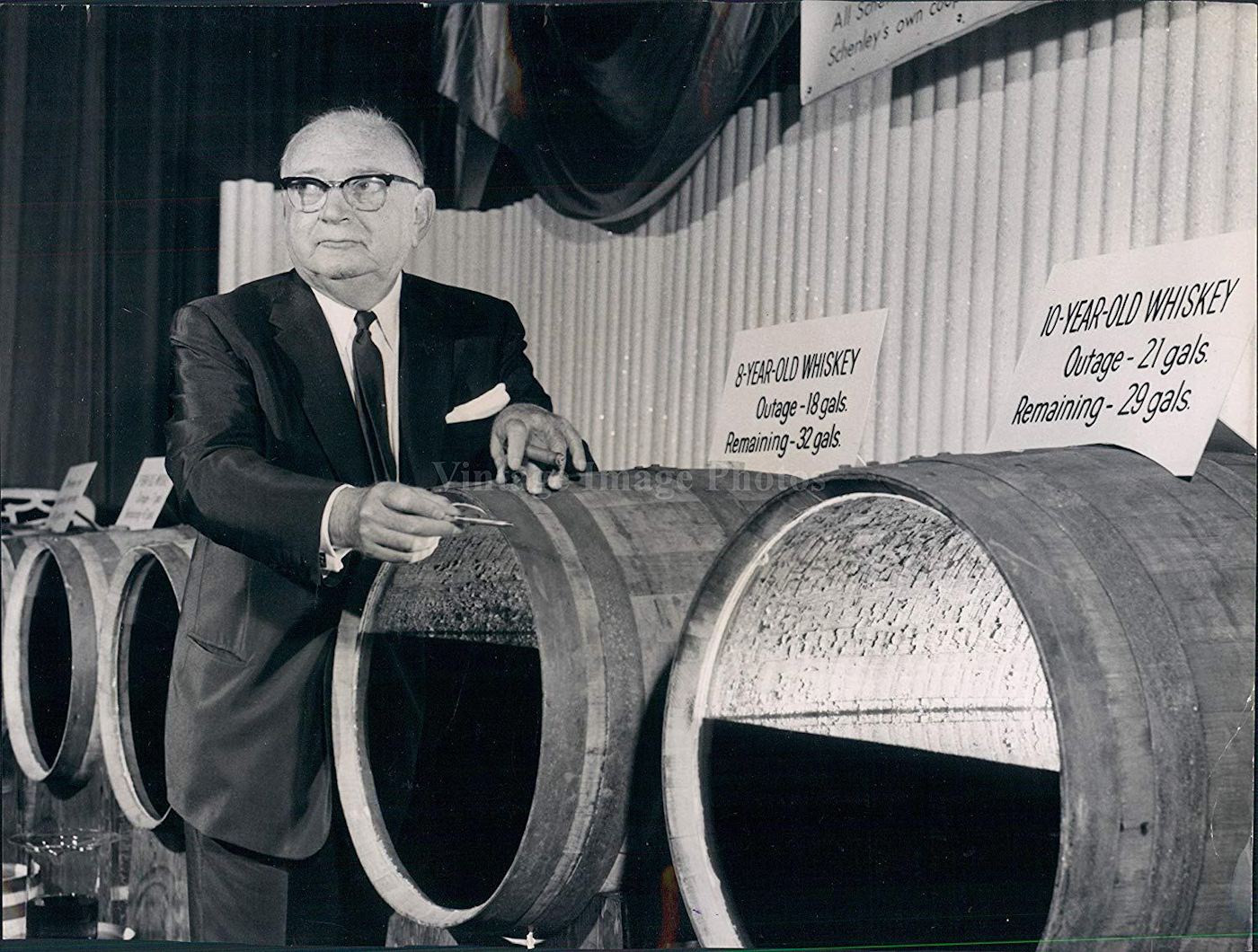
Rosenstiel was connected to both the FBI and to organized crime
Such differences between Bronfman and Rosenstiel were also reflected in their personal lives. While Bronfman married only once and was loyal to his wife, Rosenstiel was married five times and was known for his relatively closeted bisexual antics, a part of his life that was well-known to many of his close associates and employees.
Though for years there were only hints to this other side of the controversial businessman, details emerged years later during a divorce proceeding brought by Rosenstiel’s fourth wife, Susan Kaufman, that would back the claims. Kaufman alleged that Rosenstiel hosted extravagant parties that included “boy prostitutes” that her husband had hired “for the enjoyment” of certain guests, which included important government officials and prominent figures in America’s criminal underworld. Kaufman would later make the same claims under oath during the hearing of the New York’s State Joint Legislative Committee on Crime in the early 1970s.
Not only did Rosenstiel organize these parties, but he also made sure that their venues were bugged with microphones that recorded the antics of his high-profile guests. Those audio recordings, Kaufman alleged, were then kept for the purpose of blackmail. Though Kaufman’s claims are shocking, her testimony was deemed credible and held in high regard by the former chief counsel of the Crime Committee, New York Judge Edward McLaughlin, and committee investigator William Gallinaro and aspects of her testimony were later corroborated by two separate witnesses who were unknown to Kaufman.
These blackmail “parties” offer a window into an operation that would later become more sophisticated and grow dramatically in the 1950s under Rosenstiel’s “field commander” (a nickname given by Rosenstiel to an individual to be named shortly in this report). Many of the people connected to Rosenstiel’s “field commander” during the 70s and 80s have again found their names in the press following the recent arrest of Jeffrey Epstein.
The “Untouchable” Mobster
Bronfman and Rosenstiel became legendary in the North American liquor business, in part due to their fight for supremacy in the industry, which the New York Times described as often erupting “into bitter personal and corporate battles.” Despite their dueling in the corporate world, the one thing that united the two businessmen more than anything else was their close connection to American organized crime, particularly renowned mobster, Meyer Lansky.
Lansky is one of the most notorious gangsters in the history of American organized crime and is notable for being the only famous mobster that rose to notoriety in the 1920s that managed to die an old man and never serve a day in jail.
Lansky’s long life and ability to avoid prison time was largely the result of his close relationships to powerful businessmen like Bronfman and Rosenstiel (among many others), the Federal Bureau of Investigation (FBI) and the U.S. intelligence community as well as his role in establishing several blackmail and extortion rings which helped him keep the law at arm’s length. Indeed, when Lansky was finally charged with a crime in the 1970s, it was the Internal Revenue Service that brought the charges, not the FBI, and he was charged with and acquitted of tax evasion.
Lansky was remarkably close to both Bronfman and Rosenstiel. Bronfman regularly threw “lavish dinner parties” in Lansky’s honor both during and after Prohibition. These parties were remembered fondly by Lansky’s wife, and Lansky, in turn, did favors for Bronfman ranging from exclusive protection of his shipments during Prohibition to getting him tickets to coveted “fight of the century” boxing matches.
Rosenstiel also threw regular dinner parties honoring Lansky. Susan Kaufman, Rosenstiel’s ex-wife, claimed to have taken numerous pictures of her ex-husband and Lansky socializing and partying together, photos that were also seen by Mary Nichols of The Philadelphia Inquirer. In addition, Lansky, per Kaufman’s recollection, was one of the individuals that Rosenstiel sought to protect from legal scrutiny as part of his child prostitution and blackmail ring targeting high-ranking officials, and he was overheard saying that if the government “ever brings pressure against Lansky or any of us, we’ll use this [a specific recording taken at one of the “parties”] as blackmail.”
Lansky was known to address Rosenstiel as “Supreme Commander,” a title that would later be used to refer to Rosenstiel by another individual deeply connected to the mob and sexual blackmail operations, previously referred to in this report as Rosenstiel’s “Field Commander.”
Lansky also had close ties to the CIA and U.S. military intelligence. During World War II, Lansky –along with his associate Benjamin “Bugsy” Siegel — worked with Naval intelligence in what was codenamed “Operation Underworld,” an operation that the government denied for over 40 years.
Journalist and noted chronicler of CIA covert activities, Douglas Valentine, noted in his book The CIA as Organized Crime: How Illegal Operations Corrupt America and the World that the government’s cooperation with the mafia during World War II led to its expansion after the war and set the stage for its future collaboration with U.S. intelligence.
According to Valentine:
Top government officials were also aware that the government’s Faustian pact with the Mafia during World War II had allowed the hoods to insinuate themselves into mainstream America. In return for services rendered during the war, Mafia bosses were protected from prosecution for dozens of unsolved murders. […]
The Mafia was a huge problem in 1951 [when the Kefauver Committee was convened], equivalent to terrorism today. But it was also a protected branch of the CIA, which was co-opting criminal organizations around the world and using them in its secret war against the Soviets and Red Chinese. The Mafia had collaborated with Uncle Sam and had emerged from World War II energized and empowered. They controlled cities across the country.”
Indeed, the CIA forged ties with Lansky not long after its creation at the behest of CIA counterintelligence chief James J. Angleton. The CIA would later turn to the Lansky-linked mob in the early 1960s as part of its consistently fruitless quest to assassinate the Cuban leader, showing that the CIA maintained its contacts with Lansky-controlled elements of the mafia long after the initial meeting with Lansky took place.
The CIA also had close connections to associates of Lansky, such as Edward Moss, who did public relations work for Lansky and was said to be of “interest” to the CIA by the agency’s then-inspector general J.S. Earman. Harry “Happy” Meltzer was also another Lansky associate that was a CIA asset and the CIA asked Meltzer to join an assassination team in December 1960.
In addition to the CIA, Lansky was also connected to a foreign intelligence agency through Tibor Rosenbaum, an arms procurer and high-ranking official in Israel’s Mossad, whose bank – the International Credit Bank of Geneva – laundered much of Lansky’s ill-gotten gains and recycled it into legitimate American businesses.
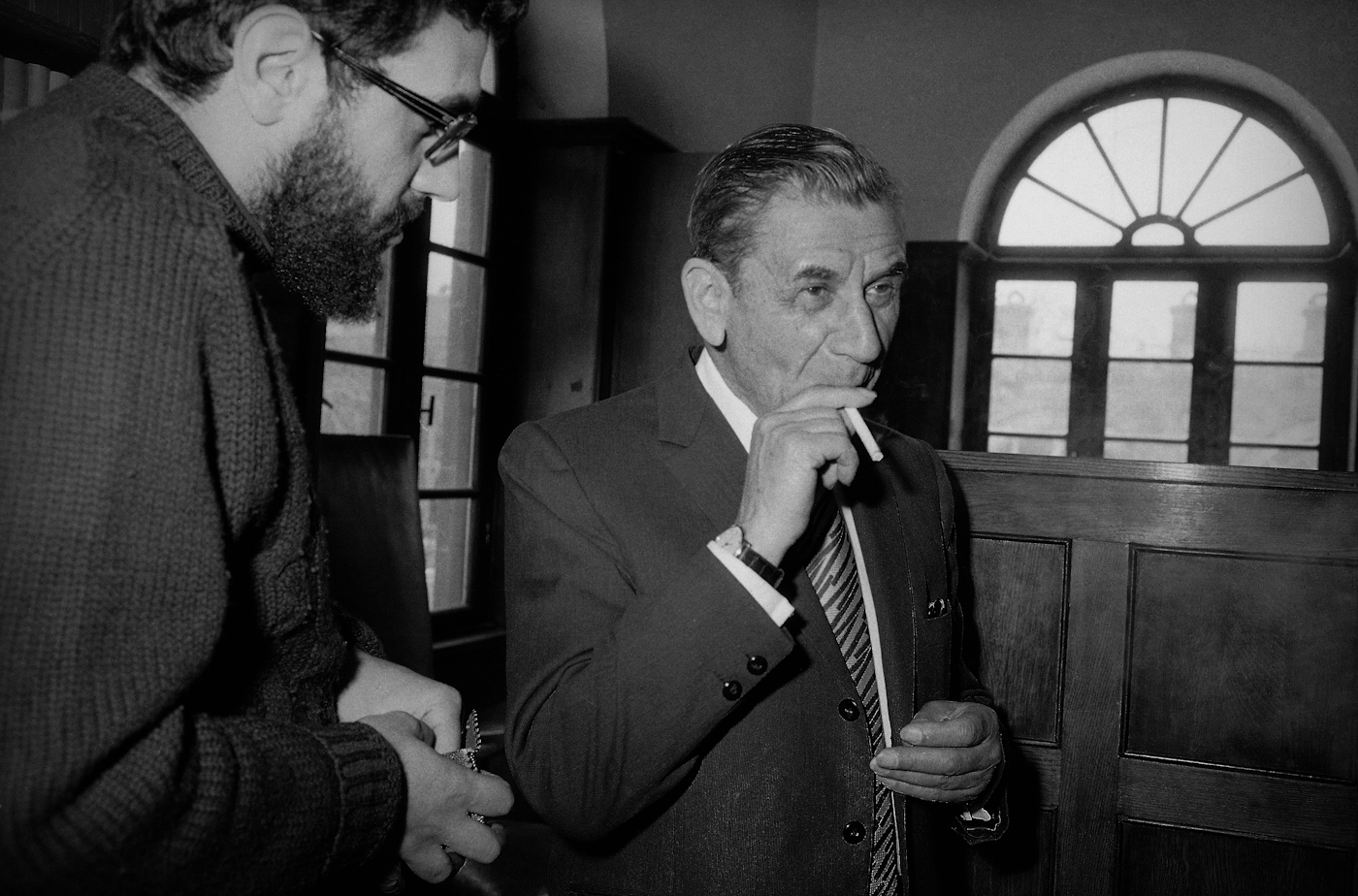
Lansky outside the High Court of Israel where he sought permission to emigrate in 1972. Photo | AP
Journalist Ed Reid, author of the Virginia Hill biography The Mistress and the Mafia, wrote that Lansky was attempting to entrap powerful people through sexual blackmail as far back as 1939. Reid contends that Lansky sent Ms. Hill to Mexico, where his West Coast connections had established a drug ring that later involved the OSS, the forerunner to the CIA, to seduce numerous “top politicians, army officers, diplomats and police officials.”
Eventually, Lansky was credited with obtaining compromising photos of FBI director J. Edgar Hoover sometime in the 1940s, which showed “Hoover in some kind of gay situation”, according to a former Lansky associate who also said that Lansky had often claimed, “I fixed that sonofabitch.” The photos showed Hoover engaged in sexual activity with his long-time friend, FBI deputy director Clyde Tolson.
At some point, these photos fell into the hands of CIA counterintelligence chief James J. Angleton, who later showed the photos to several other CIA officials, including John Weitz and Gordon Novel. Angleton was in charge of the CIA’s relationship with the FBI and Israel’s Mossad until he left the agency in 1972 and, as was recently mentioned, he was also in contact with Lansky.
Anthony Summers , former BBC journalist and author of Official and Confidential: The Secret Life of J. Edgar Hoover, has argued that it was not Lansky, but William Donovan, the director of the OSS, who obtained the original photos of Hoover and later shared them with Lansky.
Summers also stated that “To [gangster Frank] Costello and Lansky, the ability to corrupt politicians, policemen and judges was fundamental to Mafia operations. The way they found to deal with Hoover, according to several mob sources, involved his homosexuality.” This anecdote shows that Lanksy and the CIA maintained a covert relationship, which included, among other things, the sharing of blackmail material (i.e. “intelligence”).
It is also possible that Hoover was ensnared by the mob during one of Rosenstiel’s blackmail “parties,” at which Hoover sometimes found himself in attendance with prominent figures of the mafia. Hoover was said to have worn women’s clothing at the some of the events and Meyer Lansky’s wife later said that her husband had photos of the former FBI director in drag. Furthermore, Hoover is on record showing an unusual concern in the FBI’s handling of Rosenstiel’s criminal links as early as 1939, the same year that his close associate Lansky was actively orchestrating the sexual blackmail of powerful political figures.
The blackmail acquired on Hoover and the mob’s possession of the evidence has been cited as a major factor in Hoover’s decades-long denial that nationwide networks of organized crime were a serious issue. Hoover asserted that it was a decentralized, local issue and therefore outside of the bureau’s jurisdiction. By the time Hoover finally acknowledged the existence of national organized crime networks in 1963, it was so entrenched in the U.S. establishment that it was untouchable.
Congressional crime consultant Ralph Salerno told Summers in 1993 that Hoover’s willful ignorance of organized crime for most of his career as FBI director “allowed organized crime to grow very strong in economic and political terms, so that it became a much bigger threat to the wellbeing of this country than it would have been if it had been addressed much sooner.”
J. Edgar Hoover: Blackmail Victim?
Most records place the beginning of Hoover’s relationship with Rosenstiel in the 1950s, the same decade when Susan Kaufman reported that Hoover was attending Rosenstiel’s blackmail parties. Rosenstiel’s FBI file, obtained by Anthony Summers, cites the first Rosenstiel meeting as taking place in 1956, though Summers notes that there is evidence that they had met much earlier. After requesting the meeting, Rosenstiel was granted a personal face to face with the director in a matter of hours. The FBI file on Rosenstiel also reveals that the liquor baron heavily lobbied Hoover to aid his business interests.
During that time, the salacious details of Hoover’s sex life were already known to the U.S. intelligence community and to the mob, and Hoover was aware that they knew of his closeted sexuality and penchant for women’s clothing. Yet, Hoover apparently seemed to embrace the very type of sexual blackmail operation that had compromised his private life, given that he was seen at many of Rosenstiel’s “blackmail” parties in the 1950s and 1960s, including at venues such as Rosenstiel’s personal home and later at Manhattan’s Plaza Hotel. Hoover’s penchant for dressing in drag was also described by two witnesses who were not connected to Susan Kaufman.
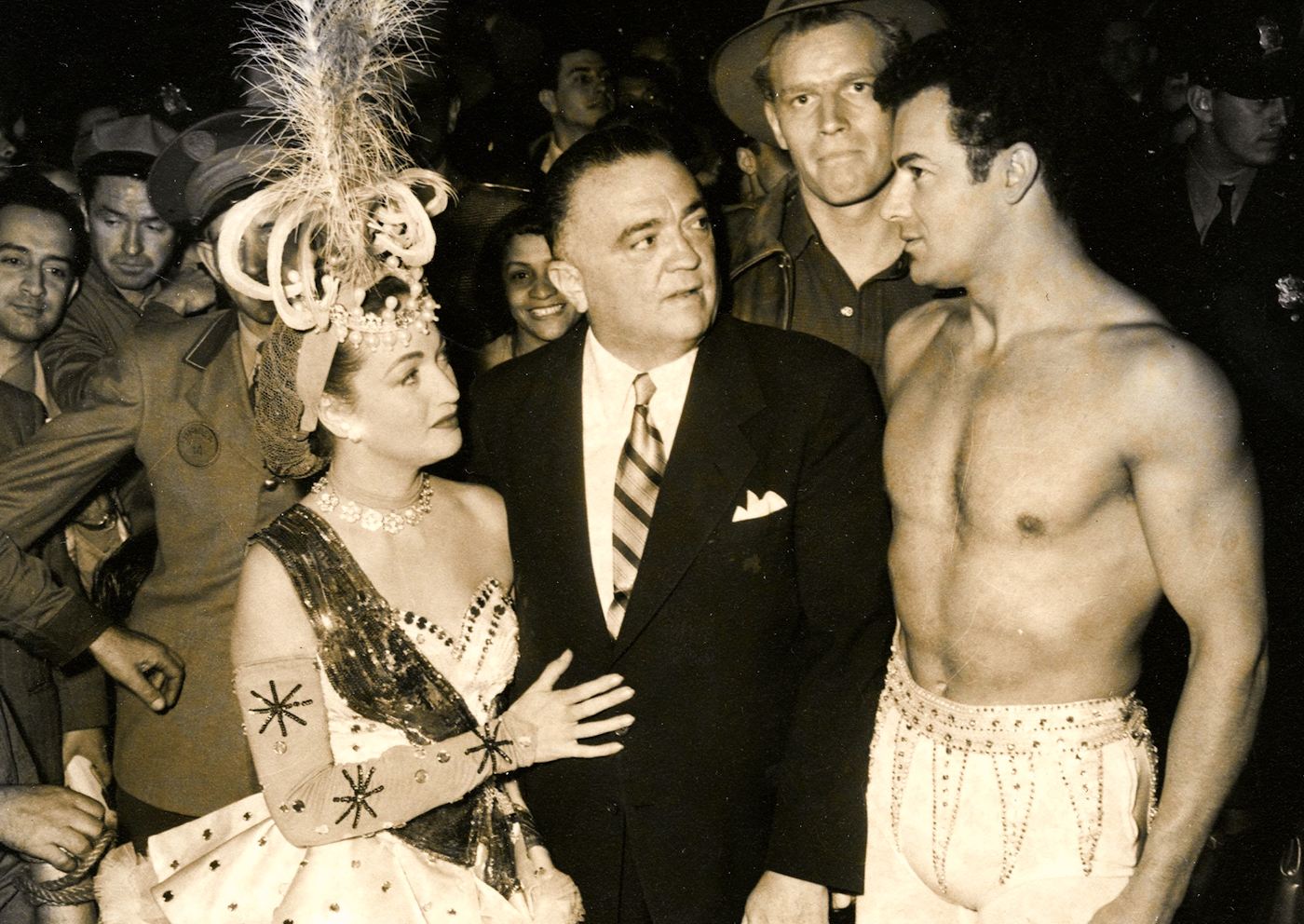
Hoover with Dorothy Lamour on the set of The Greatest Show on Earth in 1951
Soon after their first “official” meeting, the public relationship between the two men quickly flourished, with Hoover even sending Rosenstiel flowers when he fell ill. Summers reported that, in 1957, Rosenstiel was heard telling Hoover during a meeting, “your wish is my command.” Their relationship remained close and intimate throughout the 1960s and beyond.
Like Rosenstiel, Hoover was well-known for amassing blackmail on friend and foe alike. Hoover’s office contained “secret files” on numerous powerful people in Washington and beyond, files he used to gain favors and protect his status as FBI director for as long as he wished.
Hoover’s own propensity for blackmail suggests that he may have associated with Rosenstiel’s sexual blackmail operation more directly, given he already knew he was compromised and his involvement in the operation would have served as a means of procuring the blackmail he coveted for his own purposes. Indeed, if Hoover was merely being blackmailed and extorted by the Lansky-Rosenstiel connected mob, it is unlikely that he would have been so friendly to Rosenstiel, Lansky and the other mobsters at these gatherings and participated in them with such regularity.
According to journalist and author Burton Hersh, Hoover was also tied to Sherman Kaminsky, who ran a sexual blackmail operation in New York involving young male prostitutes. That operation was busted and investigated in 1966 extortion probe led by Manhattan District Attorney Frank Hogan, though the FBI quickly took over the investigation and photos of Hoover and Kaminsky together soon disappeared from the case file.
Hoover and Rosenstiel’s deep ties would continue to develop over the years, an example of which can be seen in Rosenstiel’s hiring of long-time Hoover aide Louis Nichols as the Vice President of his Schenley liquor empire and Rosenstiel’s donation of over $1 million to the J. Edgar Hoover Foundation, which Nichols also ran at the time.
There is also more than one documented occasion wherein Hoover attempted to use blackmail to protect Rosenstiel and his “field commander,” none other than the infamous Roy Cohn, the other key figure in Rosenstiel’s sexual blackmail operation involving minors.
The Making of a Monster
Decades after his death, Roy Cohn remains a controversial figure in large part because of his close, personal relationship with current U.S. President Donald Trump. Yet reports on Cohn, both in recent and in past years, often miss the mark in their characterization of the man who became closely associated with the Reagan White House, the CIA, the FBI, organized crime and, incidentally, many of the figures who would later surround Jeffrey Epstein.
To understand the true nature of the man, it is essential to examine his rise to power in the early 1950s, when at just 23 years old, he became a key figure in the high-profile trial of Soviet spies Ethel and Julius Rosenberg and later in the House Un-American Activities Committee (HUAC) led by Senator Joseph McCarthy.
Cohn’s dedication to anti-communist activities in the 1950s is allegedly what first endeared him to J. Edgar Hoover who he first met in 1952. During that meeting, as described by Hersh in Bobby and J. Edgar: The Historic Face-Off Between the Kennedys and J. Edgar Hoover That Transformed America, Hoover expressed admiration for Cohn’s aggressive and manipulative tactics and told Cohn to “call me directly” whenever he had information worth sharing. From that point on, Cohn and Hoover “traded favors, effusive compliments, gifts and elaborate private dinners. It quickly became ‘Roy’ and ‘Edgar.’” Hersh also describes Hoover as Cohn’s soon to be “consigliere.”
The date and circumstances around Cohn’s introduction to Rosenstiel is harder to come by. It is possible that the connection was made through Roy Cohn’s father, Albert Cohn, a prominent judge and an influential figure in the New York City Democratic Party apparatus then-run by Edward Flynn. It was later revealed that the Democratic organization dominated by Flynn and based in the Bronx had long-standing connections to organized crime, including associates of Meyer Lansky.
Regardless of how or when it began, the relationship between Cohn and Rosenstiel was close and was often likened to that of a father and son. They were said to frequently salute each other in public and remained close until Rosenstiel was near death, at which point Cohn attempted to trick his then-barely conscious and senile “friend” and client into naming him the executor and trustee of the liquor magnate’s estate, valued at $75 million (more than $334 million in today’s dollars).
LIFE magazine reported in 1969 that Cohn and Rosenstiel had for years referred to one another as “Field Commander” and “Supreme Commander,” respectively. Media references to these nicknames appear in other articles from the period.
Though LIFE and other outlets had interpreted this as merely an anecdote about the nicknames shared in jest between close friends, the fact that notorious crime lord Meyer Lansky also called Rosenstiel “Supreme Commander” and the fact that Cohn and Rosenstiel would later become intimately involved in the same pedophile sex ring, suggests that there may have been more to these “nicknames.” After all, the mob to which Rosenstiel was connected often used military-themed titles like “soldier” and “lieutenant” to differentiate the rank and importance of its members.
Once he had made his connection with Hoover, Cohn’s star began to rise even higher in Washington. Hoover’s recommendation of Cohn would become the deciding factor in his appointment as Sen. McCarthy’s general counsel over Robert Kennedy, a rival and bitter enemy of Cohn’s.
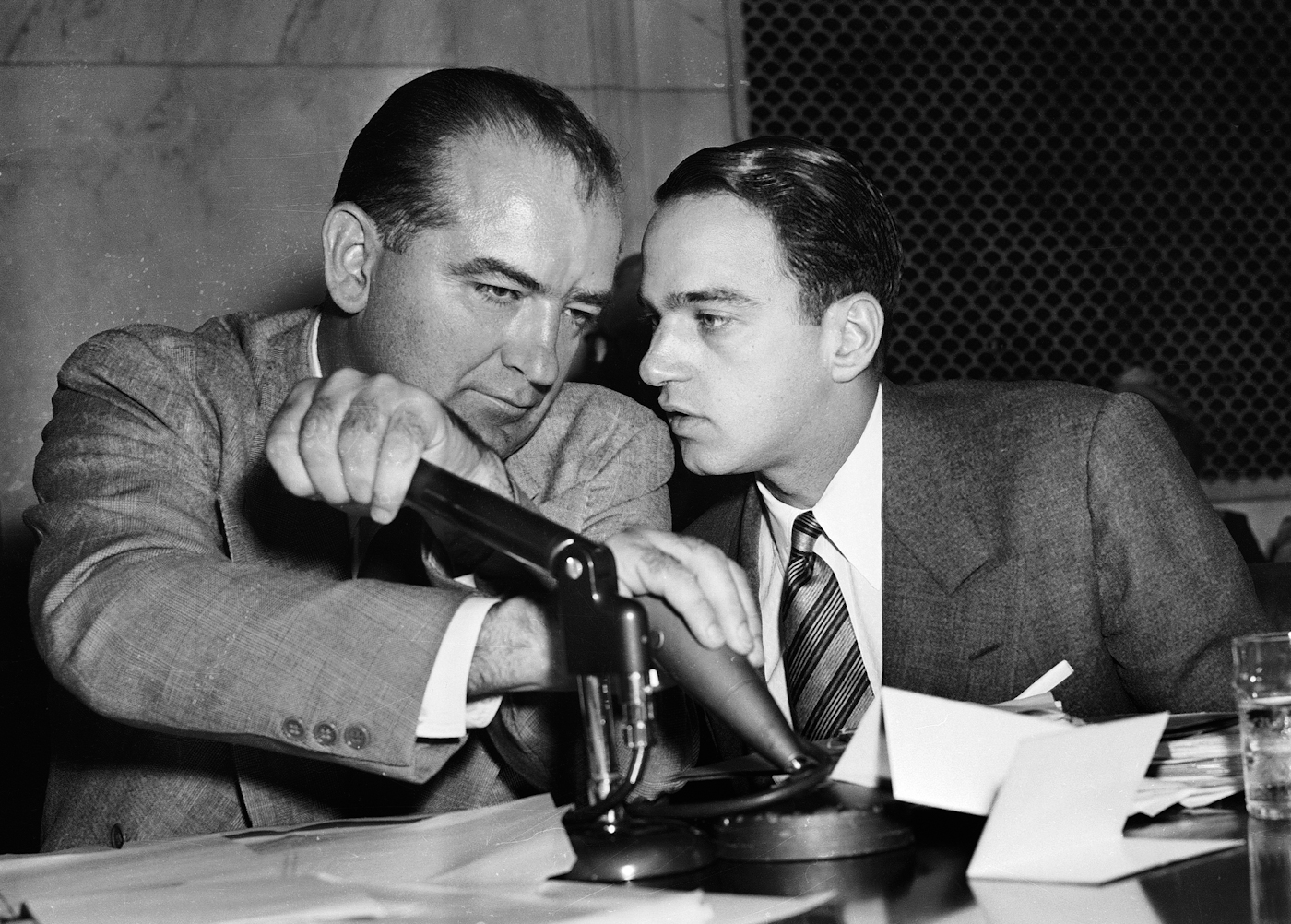
McCarthy covers the mic while having a whispered discussion with Cohn during a 1954 committee hearing. Photo | AP
Though Cohn was ruthless and seemingly untouchable as McCarthy’s counsel and helped the Senator destroy many careers during both the red and lavender scares, his antics in relation to his work on the committee would eventually lead to his downfall after he attempted to blackmail the Army in return for preferential treatment for committee consultant and Cohn’s rumored lover, David Schine.
After he was forced to leave McCarthy’s side due to the scandal, Cohn returned to New York to live with his mother and practice law. A few years later New York Judge David Peck, a long-time associate of former CIA director Alan Dulles, orchestrated Cohn’s hire to the New York law firm, Saxe, Bacon and O’Shea, which would later become Saxe, Bacon and Bolan after Tom Bolan, a friend of Cohn’s, became a partner in the firm. Upon his hire, Cohn brought the firm a slew of mafia-linked clients, including high-ranking members of the Gambino crime family, the Genovese crime family and, of course, Lewis Rosenstiel.
What happened in Suite 233?
The connections Roy Cohn built during the 1950s made him a well-known public figure and translated into great political influence which peaked during the presidency of Ronald Reagan. Yet, as Cohn built his public image, he was also developing a dark private life which would come to be dominated by the same blackmail pedophile racket that appears to have first begun with Lewis Rosenstiel.
One of the “blackmail” parties Susan Kaufman attended with her then-husband Lewis Rosenstiel was hosted by Cohn in 1958 at Manhattan’s Plaza Hotel, suite 233. Kaufman described Cohn’s suite as a “beautiful suite… all done in light blue.” She described being introduced to Hoover, who was in drag, by Cohn, who told her that Hoover’s name was “Mary” in a fit of barely concealed laughter. Kaufman testified that young underage boys were present and Kaufman claimed that Cohn, Hoover and her ex-husband engaged in sexual activity with these minors.
New York attorney John Klotz, tasked with investigating Cohn for a case well after Kaufman’s testimony, also found evidence of the “blue suite” at the Plaza Hotel and its role in a sex extortion ring after combing through local government documents and information gathered by private detectives. Klotz later told journalist and author Burton Hersh what he had learned:
Roy Cohn was providing protection. There were a bunch of pedophiles involved. That’s where Cohn got his power from — blackmail.”
Perhaps the most damning confirmation of Cohn’s activities in Suite 233 comes from statements made by Cohn himself to former NYPD detective and ex-head of the department’s Human-Trafficking and Vice-related Crimes division, James Rothstein. Rothstein later told John Decamp, a former Nebraska state senator who investigated a government-connected child sex ring based in Omaha, among other investigators, that Cohn had admitted to being part of a sexual blackmail operation targeting politicians with child prostitutes during a sit-down interview with the former detective.
Rothstein told John DeCamp the following about Roy Cohn:
Cohn’s job was to run the little boys. Say you had an admiral, a general, a congressman, who did not want to go along with the program. Cohn’s job was to set them up, then they would go along. Cohn told me that himself.”
Rothstein later told Paul David Collins, a former journalist turned researcher, that Cohn had also identified this sexual blackmail operation as being part of the anti-communist crusade of the time.
The fact that Cohn, per Rothstein’s recollection, stated that the child-sex blackmail ring was part of the government-sponsored anticommunist crusade suggests that elements of the government, including Hoover’s FBI, may have been connected at a much broader level than Hoover’s own personal involvement given that the FBI closely coordinated with McCarthy and Cohn for much of the red scare.
It is also worth noting that among Hoover’s many “secret” blackmail files was a sizeable dossier on Senator McCarthy, the contents of which strongly suggested that the Senator himself was interested in underage girls. According to journalist and author David Talbot, Hoover’s file on McCarthy was “filled with disturbing stories about McCarthy’s habit of drunkenly groping young girls’ breasts and buttocks. The stories were so widespread that they became ‘common knowledge’ in the capital, according to one FBI chronicler.”
Talbot, in his book The Devil’s Chessboard, also cites Walter Trohan, Washington Bureau Chief of the Chicago Tribune, as having personally witnessed McCarthy’s habit of molesting young women. “He just couldn’t keep his hands off young girls,” Trohan would later say. “Why the Communist opposition didn’t plant a minor on him and raise the cry of statutory rape, I don’t know.” Perhaps the answer lies in the fact that those “planting” minors on their political foes were McCarthy’s allies and close associates, not his enemies.
The question that necessarily arises from revelations regarding Cohn’s activities in Suite 233 is who else was Cohn “protecting” and servicing with underage prostitutes? One of them could very well have been one of Cohn’s close friends and clients, Cardinal Francis Spellman of the Archdiocese of New York, who was said to have been present at some of these parties Cohn hosted at the Plaza Hotel.
Spellman, one of the most powerful figures in the Catholic Church in North America who was sometimes referred to as “America’s Pope” was accused of not only condoning pedophilia in the Catholic church and ordaining known pedophiles including Cardinal Theodore “Uncle Teddy” McCarrick, but also engaging in it himself to such an extent that many New York area priests widely referred to him as “Mary.” Furthermore, J. Edgar Hoover was said to have a file detailing the Cardinal’s sex life, suggesting Spellman’s involvement in the ring and pedophile protection racket in which Cohn and Hoover were personally involved.
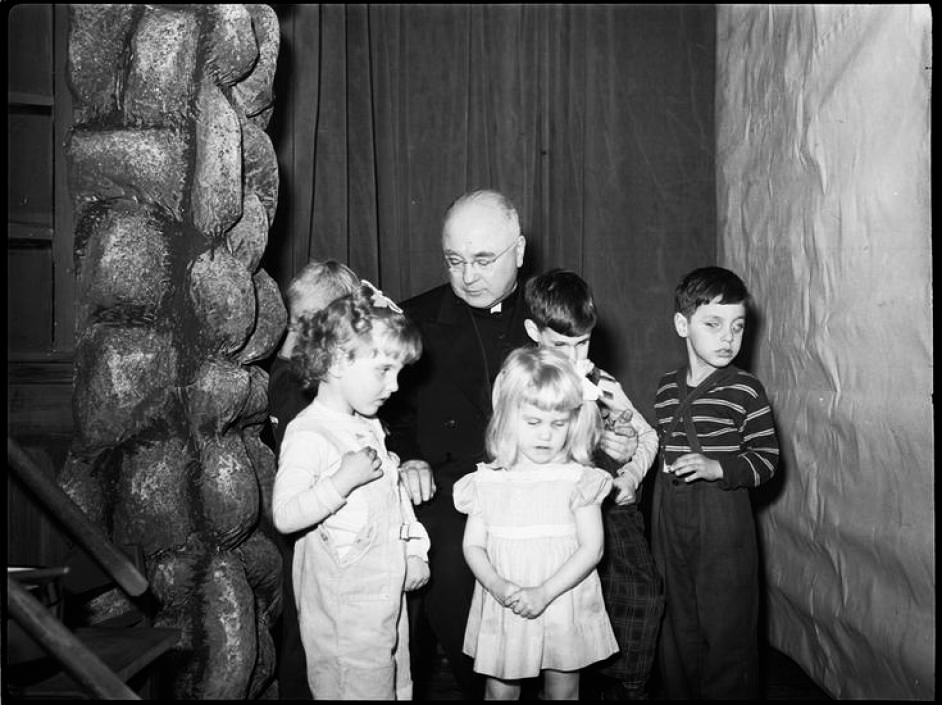
Cardinal Francis ‘Franny’ Spellman. Photo | Museum of the City of New York
People close to Cohn often remarked that he was frequently surrounded by groups of young boys, but seemed to think nothing of it. Similar off-handed comments about Epstein’s penchant for minors were made by those close to him prior to his arrest.
Controversial Republican political operative and “dirty trickster” Roger Stone, who — like Donald Trump — was also a protégé of Cohn, said the following about Cohn’s sex life during an interview with The New Yorker in 2008:
Roy was not gay. He was a man who liked having sex with men. Gays were weak, effeminate. He always seemed to have these young blond boys around. It just wasn’t discussed. He was interested in power and access.” (emphasis added)
Compare this quote from Stone to what Donald Trump, who was also close to Cohn, would later say about Jeffrey Epstein, with whom he was also closely associated:
I’ve known Jeff for 15 years. Terrific guy. He’s a lot of fun to be with. It is even said that he likes beautiful women as much as I do, and many of them are on the younger side. No doubt about it — Jeffrey enjoys his social life.” (emphasis added)
Though it is unknown how long the sex ring at the Plaza Hotel continued, and if it continued after Cohn’s death from AIDS in 1986, it is worth noting that Donald Trump purchased the Plaza Hotel in 1988. It would later be reported and confirmed by then-attendees that Trump “used to host parties in suites at the Plaza Hotel when he owned it, where young women and girls were introduced to older, richer men” and “illegal drugs and young women were passed around and used.”
Andy Lucchesi, a male model who had helped organize some of these Plaza Hotel parties for Trump said the following when asked about the age of the women present: “A lot of girls, 14, look 24. That’s as juicy as I can get. I never asked how old they were; I just partook. I did partake in activities that would be controversial, too.”
The Roy Cohn Machine
Roy Cohn was only at the beginning of his career when he waded his way into the underground sexual blackmail ring apparently led by Lewis Rosenstiel. Indeed, when Cohn first met Hoover, he was only 23 years old. Over the next three decades or so, before his death from AIDS-related complications in 1986 at the age of 56, Cohn built a well-oiled machine, largely through his close friendships with some of the country’s most influential figures.
Among Cohn’s friends were top media personalities like Barbara Walters, former CIA directors, Ronald Reagan and wife Nancy, media moguls Rupert Murdoch and Mort Zuckerman, numerous celebrities, prominent lawyers like Alan Dershowitz, top figures in the Catholic Church and leading Jewish organizations like B’nai B’rith and the World Jewish Congress. Many of the same names that surrounded Cohn until death in the late 1980s would later come to surround Jeffrey Epstein, with their names later appearing in Epstein’s now-infamous “little black book”.
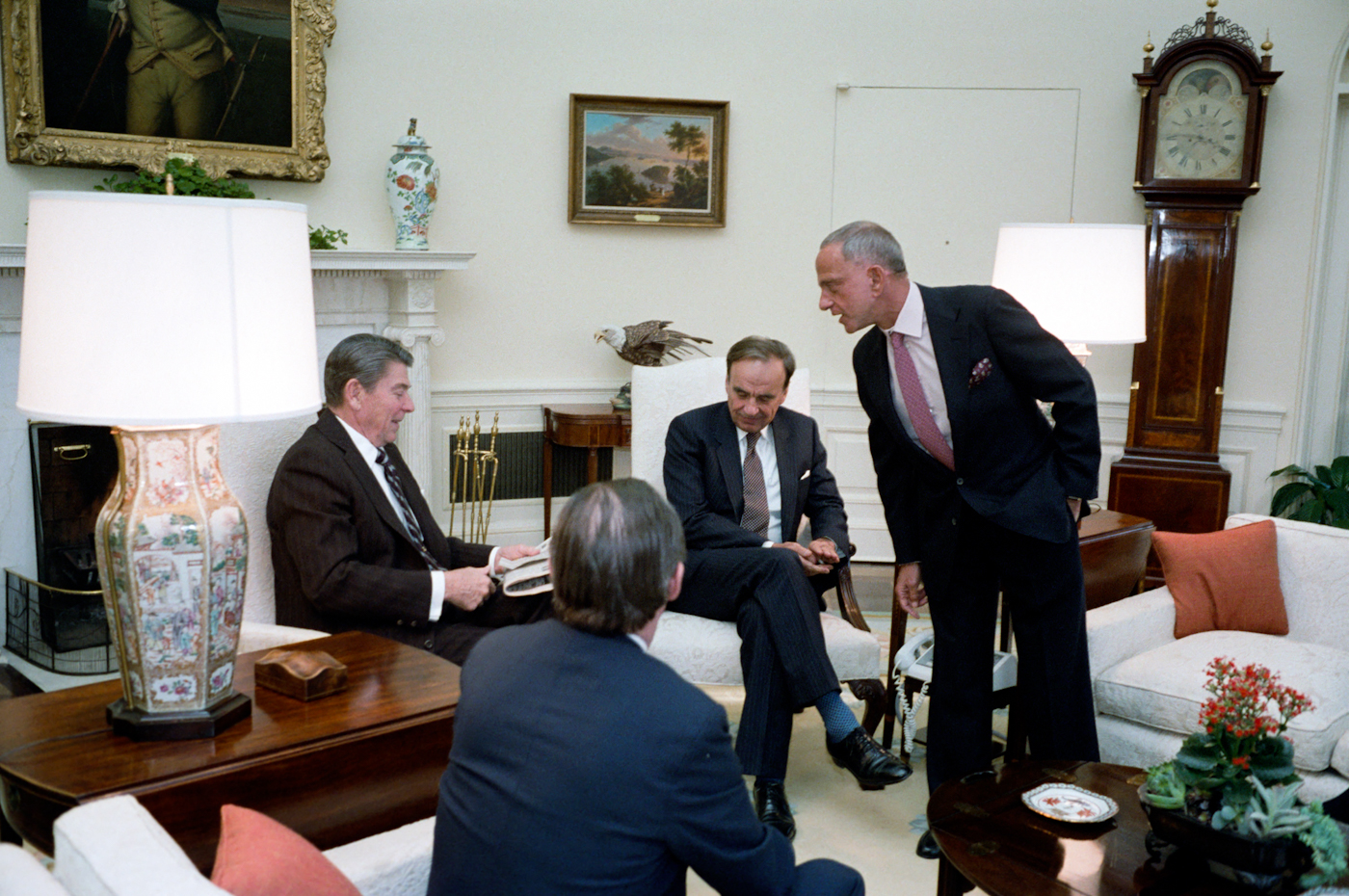
Reagan meets with Rupert Murdoch, U.S. Information Agency Director Charles Wick, and Roy Cohn in the Oval Office in 1983. Photo | Reagan presidential library
While President Trump is clearly connected to both Epstein and Cohn, Cohn’s network also extends to former President Bill Clinton, whose friend and longtime political advisor, Richard “Dirty Dick” Morris, was Cohn’s cousin and close associate. Morris was also close to Clinton’s former communications director, George Stephanopoulos, who is also associated with Jeffrey Epstein.
Yet, these were only Cohn’s connections to respectable members of the establishment. He was also known for his deep connections to the mob and gained prominence largely for his ability to connect key figures in the criminal underworld to respected influential figures acceptable to the public sphere. Ultimately, as New York attorney John Klotz stated, Cohn’s most powerful tool was blackmail, which he used against friend and foe, gangster or public official alike. How much of that blackmail he acquired through his sexual blackmail operation will likely never be known.
As Part II of this exclusive investigation will reveal, Cohn and Epstein, and the sexual blackmail operations they ran share many things in common, including not only many of the same famous friends and patrons, but also connections to intelligence agencies and consortiums of mob-linked businessmen, the modern-day equivalents of Samuel Bronfman and Lewis Rosenstiel who have since rebranded as “philanthropists.”
Part II will also reveal that Cohn’s operation was known to have successors, as revealed by a series of scandals in the early 1990s that have since been swept under the rug. The significant amount of overlap between Epstein’s and Cohn’s covert activities in sexual blackmail and their ties to many of the same powerful individuals and circles of influence strongly suggest that Epstein was one of Cohn’s successors.
As will be shown in the final installment of this report, Epstein is only the latest incarnation of a much older, more extensive and sophisticated operation that offers a frightening window into how deeply tied the U.S. government is to the modern-day equivalents of organized crime, making it a racket truly too big to fail.
Whitney Webb is a MintPress News journalist based in Chile. She has contributed to several independent media outlets including Global Research, EcoWatch, the Ron Paul Institute and 21st Century Wire, among others. She has made several radio and television appearances and is the 2019 winner of the Serena Shim Award for Uncompromised Integrity in Journalism.
US’ Greenblatt: ‘Israel is victim in conflict with Palestinians’
MEMO | July 18, 2019
The US Special Representative for International Negotiations, Jason Greenblatt, has said that Israel is the “victim” in its conflict with the Palestinians and that he “cannot think of single instances” when Israel made a mistake.
In an interview aired yesterday by US broadcaster PBS, Greenblatt was asked what responsibility Israel bears for its now 71-year-old conflict with the Palestinians. The US envoy replied:
I think that Israel is actually more the victim than the party that’s responsible. From the moment of its formation, they were attacked multiple times. They continue to be attacked with terrorism. So — I’m not sure I understand the premise of the question.
He added that he “cannot think of single instances” in which Israel made a mistake or overstepped its authority, saying: “I think that they’re trying their best to succeed. They have actually succeeded in many ways, especially economically, under very, very trying circumstances.”
Greenblatt also doubled down on previous comments in which he argued Israel’s illegal settlements should be referred to as “neighbourhoods and cities”, saying that the term “settlements” is “pejorative”.
On the occupied West Bank – where over 500 illegal settlements are located – and the besieged Gaza Strip, the envoy said: “I would argue that the land is disputed. It needs to be resolved in the context of direct negotiations between the parties. Calling it occupied territory does not help resolve the conflict.”
Under international law, both the West Bank and Gaza Strip remain classified as occupied territories.
Greenblatt’s comments are the latest in a series of controversial remarks that have drawn fierce criticism and rebuke of the US envoy.
Earlier this month, Greenblatt came under fire after criticising the Palestinian Authority (PA) for failing to provide adequate funds for a Palestinian child’s blood cancer medication. This came after Gaza-based Palestinian journalist Fathi Sabbah accused PA Prime Minister, Mohammad Shtayyeh, and Ahmed Abu Houli, a member of the executive committee of the Palestinian Liberation Organisation (PLO), of reneging on promises to assist with his daughter Rima’s treatment.
This prompted Greenblatt to write on Twitter: “Mr. Shtayyeh, how about keeping your word & paying for Rima’s treatment? The PA has the funds and it would be a wise and compassionate use of them. Mr. Sabbah, my thoughts are with you and your family. I pray Rima will have a full and speedy recovery.”
Twitter users – including Sabbah – were quick to point out the irony of Greenblatt blaming the PA for the family’s plight while ignoring Israel’s siege of the Gaza Strip, regular refusal to grant exit visas for medical treatment, and the US’ almost-unconditional support for Israel.
The US envoy – who is one of the chief architects of the US’ long-awaited “deal of the century” – has also made a number of provocative claims about Israel’s policy in the occupied West Bank.
In June, Greenblatt stood behind comments made by US Ambassador to Israel, David Friedman, in which the latter stated Israel has “the right” to annex parts of the occupied West Bank.
Friedman told the New York Times that “under certain circumstances, I think Israel has the right to retain some, but unlikely all, of the West Bank”, provoking international outcry and prompting the Palestinian Foreign Ministry to consider filing a complaint against the ambassador at the International Criminal Court (ICC).
Greenblatt backed Friedman’s stance, saying: “I will let David’s comments stand for themselves. I think he said them elegantly and I support his comments.” For his part, Friedman has also refused to back down, since claiming he does “not understand why this issue was faced with such criticism. There is no scenario in which Israel is leaving the whole West Bank.”
His comments have been interpreted as an effort to normalise discussion of Israel’s annexation of the West Bank, after Israeli Prime Minister Benjamin Netanyahu vowed ahead of the country’s April general election that he would annex the territory if he were re-elected.
Though the political elements of the “deal of the century” have not yet been unveiled, the plan is not expected to demand that Israel dismantle its West Bank settlements. Though the US has not yet changed its policy on annexation, the precedent set by President Donald Trump’s recognition of the occupied Syrian Golan Heights as Israeli could pave the way for a similar move in the West Bank.
Israel to Demolish Residential Buildings near Jerusalem
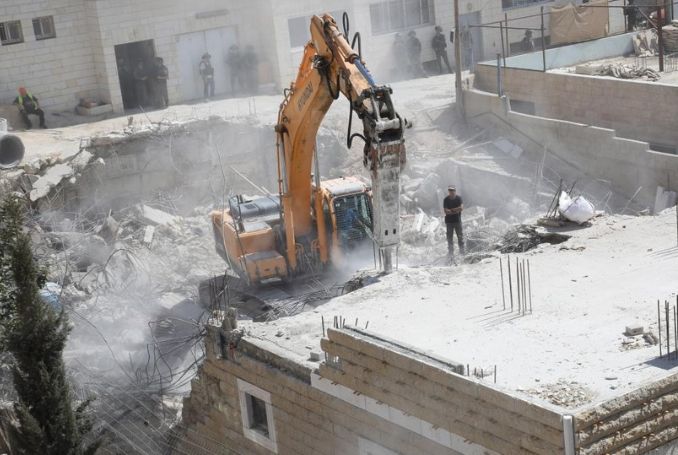
Palestine Chronicle | July 18, 2019
Israeli forces today took measurements of 16 Palestinian residential buildings slated for demolition in Wadi al-Hummus neighborhood, located on the edge of Sur Baher, southeast of the occupied city of Jerusalem.
Head of the Wadi al-Hummus Committee Hamada Hamada told WAFA that Israeli forces along with staff from the so-called Israeli municipality took measurements of the 16 buildings, which comprise of 100 apartments, in preparation to demolish them as was confirmed one of the owners Mohammed Abu Tair.
This step, Hamada explained, came after the period given by Israeli authorities to the owners to demolish their apartments on their own came to an end today, thus the demolition will be carried out at any moment.
The owners are expected to pay exorbitant demolition fees as the Israeli authorities will carry out the demolition.
The Israeli high court has recently approved the demolition of the buildings, thus upholding military allegations that the buildings are “close to the Annexation Wall” and “pose a security threat” due to their proximity to the illegal wall.
Palestinian appeals to demolition orders are frequently dismissed by Israeli courts, which are in fact complicit in perpetuating the Israeli policies of forcible transfer and ethnic cleansing of Palestinians.
The demolition is expected to have a disastrous effect on all other areas of the West Bank adjacent to Israel’s wall, putting these areas at a high risk of mass demolitions under security pretenses and putting the lives of Palestinians living in such areas at the risk of imminent forcible transfer.
If no CAATSA for Turkey, none for India either
By M. K. BHADRAKUMAR | Indian Punchline | July 18, 2019
President Trump’s statement on July 17 to block the sale of the advanced F-35 jet to Turkey and to remove Turkey altogether from the fighter jet programme marks an inflection point in the Turkish-American relations.
The development has profound implications for India as well, which is also procuring the S-400 Triumf anti-ballistic missile system from Russia.
Trump timed his decision on Turkey accepting the delivery of components of the Russian S-400 system last Friday. Washington is not holding back until the system has been fully delivered or deployed (in April next year, according to Turkey) or even for Turkish military personnel to receive training for Russia to operate the system. Washington estimates that it’s a done deal, a fait accompli.
Trump’s main argument is that S-400 is a “Russian intelligence collection platform that will be used to learn about its [F35] advanced capabilities.” He regretted that Turkey didn’t accept the US’s counteroffers “to meet its legitimate air defense needs” — specifically, its “multiple offers” on the Patriot system.
Trump brought the NATO into his argument, saying that the S-400 “undermines the commitments all NATO Allies made to each other to move away from Russian systems” and will have “detrimental impacts on Turkish interoperability with the Alliance”.
However, he went on to acknowledge Turkey’s record as a “longstanding and trusted partner and NATO Ally for over 65 years”, the great value Washington still attaches to its strategic relationship with Turkey, and the two countries’ relationship as NATO allies, which is “multi-layered, and not solely focused on the F-35.”
Trump concluded, “Our military-to-military relationship is strong, and we will continue to cooperate with Turkey extensively, mindful of constraints due to the presence of the S-400 system in Turkey.” Trump’s message is that this is the irreducible minimum he’s compelled to do under the circumstances. He eschewed any accusatory tone.
Importantly, Trump didn’t mention a word about sanctions under the legislation known as Countering America’s Adversaries Through Sanctions Act (2017) or CAATSA, which threatens third countries with sanctions over any “significant transactions” — defined as deals above $15 million — with Russian defense industry.
But then, it is useful to recall that even while signing the CAATSA into law in August 2017, Trump had stated that he believed the legislation was “seriously flawed — particularly because it encroaches on the executive branch’s authority to negotiate.” He said he’d implement it “in a manner consistent with the President’s constitutional authority to conduct foreign relations.”
So, Erdogan was right when he claimed after meeting Trump on the margins of the G20 in Osaka that the latter reassured him that there would be no sanctions. In Erdogan’s words, “We heard from him [Trump] that there won’t be anything like this [sanctions]. It is out of the question that such a thing takes place between two strategic allies. I believe it cannot happen.”
Indeed, Trump himself at a press conference in Osaka had refused to blame Turkey for its S-400 deal with Russia and instead flagged that Ankara was forced into the deal by the Obama administration. Trump added: “So what happens is we have a situation where Turkey is very good with us, very good, and we are now telling Turkey that because you have really been forced to buy another missile system, we’re not going to sell you the F-35 fighter jets?”
“It’s a very tough situation that they’re [Turkey] in, and it’s a very tough situation that we’ve been placed in, the United States. With all of that being said, we’re working through it, but it’s not really fair. Because they bought a Russian system, we’re not allowed to sell them billions of aircraft. It’s not a fair situation.”
To be sure, the CAATSA also gives Trump much discretion to waive sanctions on countries that buy Russian weapons. The waiver language was reportedly included to accommodate allies India and Vietnam. Now, isn’t Turkey an ally, too? But US Secretary of State Mike Pompeo told the Washington Post on Sunday he was confident the president would levy sanctions as CAATSA requires. “The law requires that there be sanctions and I’m confident that we will comply with the law and President Trump will comply with the law,” Pompeo said.
What explains Pompeo’s hawkish line on Turkey? Principally, in the Washington Beltway the Israeli lobby is hyperactive among think tankers, politicians, media people, etc. Under Erdogan, Turkey’s relations with Israel nosedived, as he openly began supporting the Hamas. Erdogan has likened Israel more than once to Nazi Germany, triggering hot exchanges with PM Benjamin Netanyahu. Israel has vowed to demonise Erdogan and take him down somehow.
Indeed, can India draw comfort from the above? Some tentative conclusions can be drawn. For a start, the crunch time comes by early 2021. The latest news from Moscow is that the issues concerning the mode of payments by India have been resolved and deliveries of S-400 Triumf missile systems are “planned to start after 2020 in accordance with the agreement.”
At any rate, there is nothing like an Indophobia prevalent in the US even if there are differences in the relationship. Trump will have a hard time imposing sanctions against India after being indulgent toward Turkey. The lawmakers are not going to cry for India’s blood if Trump grants a waiver. Basically, Trump has an aversion toward CAATSA, too.
The minions in his administration or the hangers-on in the think tanks (such as Ashley Tellis at the Carnegie, for example) periodically threaten India with CAATSA. But do they speak for Trump? (In fact, Erdogan said Trump told him in Osaka not to take them seriously.) Clearly, many of these minions who wave the Damocles’ sword at India have their own axe to grind, since they act as dalals for US arms manufacturers and keep hustling the Modi government to grant more arms deals to placate Trump. But in reality, for almost the same reasons that the US cannot do without its alliance with Turkey, India too is not easily replaceable in the US’ Indo-Pacific network of partnerships.
India has much to learn from Erdogan’s way of handling the issue. He stuck to his guns after carefully weighing that the S-400 ABM system’s induction boosts Turkish defence capability. He is even prepared to forgo the F-35. Analysts estimate that Turkey may simply turn elsewhere to procure weapons. Moscow has already indicated openness to selling its latest fighter jet, the Su-57 to Turkey.
The Turkish Foreign Ministry has warned that Washington’s decision on the F-35 jet will “irreparably damage relations” and that the unilateral move “neither complies with the spirit of alliance nor is it based on legitimate grounds.” The statement added, “It is unfair to remove Turkey, one of the main partners in the F-35 program.”
The cardinal lesson India can learn from Erdogan is that defending national interests will always come at a high price, especially when a superior power is involved. Turkey has a long history, situated on the outskirts of the western world, with searing experiences to recount through centuries. India too has a painful colonial history. (See an analysis by the European Council on Foreign Relations titled Unhappy anniversary: Turkey’s failed coup and the S-400.)
Iran and Hezbollah Stand Ready for War
By Jeremy Salt | American Herald Tribune | July 18, 2019
Individually or collectively the construct known as ‘the West’ has had its foot on the neck of the Middle East and North Africa for more than two centuries. Occasionally the foot has been lifted but never voluntarily, only when ‘the West’ was no longer capable of holding it in place. Examples are France’s unwilling retreats from Syria in 1946 and Algeria in 1962, and Britain’s final loss of control over Egypt following the failure of the ‘tripartite aggression’ of 1956, otherwise known as the Suez War.
When they came to Palestine the Zionists packaged themselves as standing on the ramparts of civilization against barbarism. As ‘Western civilization’ had always been spectacularly uncivilized in its treatment of black and brown people, the Zionists were standing on the ramparts of Western barbarism, not civilization.
An existential moment seems to be approaching in Middle Eastern history. The so-called West has dominated the region and North Africa since Napoleon landed a French army in Egypt in 1798. Since then, few countries that have escaped invasion, occupation, subversion and the overthrow of governments.
The record is seamless, continuing with the destruction of Iraq, Libya and Syria and the current confrontation with Iran. Ever-tightening sanctions imposed since the 1979 revolution are designed to implode the country from within, with military attack repeatedly threatened by the US and Israel.
Unless and until this long historical cycle of violence across the region is broken, the Middle East seems doomed to suffer its repetition endlessly. At this juncture of history, however, the West is not what it used to be and is no longer capable of imposing its will on the Middle East except at tremendous cost to itself.
The former imperial powers, Britain and France, are now no more than satraps of one power, the US, a single imperial power in noticeable decline. The costs of its wars alone have been enormous. Since 2001 it is estimated to have spent $5.6 trillion on wars in the Middle East and Afghanistan and on combatting ‘terrorism’ in other arenas.
This is money every American knows – and Donald Trump said in 2016 that he knew – is needed for urban redevelopment and the upgrading of broken infrastructure and inadequate social services across the country. Furthermore, there is no American public appetite for more wars in the Middle East.
Conversely, as imperial decline approaches the point of imperial exhaustion, the determination of the ‘axis of resistance’ is strengthening. It is now speaking back to the West and Israel in the same dominant language that the west has always used, which of course is the language of force. In the mainstream media, this will be called ‘defiance’ rather than what it is, which is the rising determination of the people of the Middle East to determine their own future and finally shake off the fetters of external domination. The message being sent forth by both Iran and Hezbollah is that if the collective West and/or Israel dare attack again they will be ready for them.
The message being sent forth by both Iran and Hezbollah is that if the collective West and/or Israel dare attack again they will be ready for them.
This is not empty talk. Hassan Nasrallah, Hezbollah’s Secretary-General, always means what he says and only says what he means. No-one follows his statements more closely and takes them more seriously than the Israeli military command. He is an enemy who has earned their respect.
In June Iran’s Revolutionary Guard shot down a $200 million RQ-4 high altitude drone, the biggest and most sophisticated in the US drone fleet. Although the US had only recently designated the Revolutionary Guard as a “foreign terrorist organization,” and although it claimed, falsely, that the drone had been flying over international waters, it did not retaliate. Trump claimed that he called an attack off when he learned that it would cause 150 civilian casualties. In fact, the real reason seems to have been that Iran passed on the message through a third party that if the US attacked it would immediately strike at US targets in the Gulf.
John Bolton and Benyamin Netanyahu have been pushing hard for war, against strong resistance within the US administration. If they succeed, Iran has warned that it will immediately close the Strait of Hormuz to all shipping and retaliate against US military bases and other targets in the gulf. Any war started in the gulf will quickly spread across the region, involving Israel. Conversely, any war started by Israel against Lebanon and Hezbollah will quickly spread to the gulf.
The effects will be felt around the world with an infinitely worse effect on the global economy than the energy crisis which followed the 1973 war, when Israel was caught napping in the occupied Sinai and would have lost the war but for Anwar Sadat’s betrayal of his Syrian wartime ally, Hafez al Assad and but for emergency arms shipments flown directly to Israel’s Sinai front by the US.
Hassan Nasrallah is showing such confidence that it has to be assumed that he knows something about Hezbollah’s weaponry that we don’t and Israel probably does not either. Very probably it is the capacity to seriously degrade Israel’s air power. This is an issue Iran and Hezbollah have been working on for decades, as it is the key to the outcome of any future war.
Hezbollah is far stronger now than it was when it humiliated Israel in 2006. It can fire enough missiles simultaneously to overwhelm Israel’s anti-missile systems. They can reach any corner of enemy territory. If Hezbollah is also capable of shooting down aircraft, Israel faces the prospect of starting another war it cannot win, with far worse consequences than it has ever faced in its history.
Israel has had one outstanding victory since 1948. This was in 1967 when it attacked Egypt and Syria, rendering their ground forces useless by destroying their air ccover before going on to occupy the Golan Heights and the rest of Palestine. It was this war that gave rise to the myth of Israeli invincibility, exploded only six years later when Egyptian forces crossed the Suez Canal and routed the occupying Israeli forces.
Israel’s 1982 war on Lebanon was more of an onslaught on a defenseless civilian population, a prelude to its massacres by air and artillery in Gaza. Close to 20,000 people, overwhelmingly civilians, were killed in Lebanon before it was over. Given the combination of airpower, artillery, armor and the number of ground troops (80,000 to 100,000) Israel simply swamped lightly-armed Palestinian and Syrian resistance.
Israel’s occupation of southern Lebanon lasted for more than two decades before being ended by Hezbollah in 2000. Since 1985 Hezbollah had vastly improved its capacities at all levels, including electronic warfare, enabling it to intercept Israeli communications and ambush and destroy even elite units. Unable to defeat Hezbollah and facing a rising tide of anti-war sentiment at home, the Israeli government finally decided to cut and run, virtually overnight.
Frustrated, Israel struck back in 2006, only to be thwarted again in an even more humiliating defeat. Its reserves were so poorly disciplined that commanders hesitated to send them into battle, but even elite forces such as the Golani Brigade were outfought by Hezbollah’s part-time soldiers. Even with total command of the air Israel proved incapable of seizing and holding territory only a few kilometers north of the armistice line. Thoughts of advancing across the Litani river and taking on the professional core of Hezbollah’s fighting forces had to be abandoned.
The US held the door open for Israel week after week, giving it the time it said it needed to finish off Hezbollah. Suffering one setback after another, however, Israel was not up to the task. After 34 days it had had enough and retreated, leaving behind the wreckage of dozens of armored vehicles, including the supposedly invulnerable Merkava tank, destroyed by Hezbollah’s Sagger anti-tank missiles. Hezbollah had also taken the war to sea, crippling an Israeli warship in an apparent missile strike.
The unpalatable truth for the Israeli military command was that its ground forces had been outsmarted and outfought along Hezbollah’s first line of defense in the south. Even with its air power Israel proved incapable of moving beyond this line.
In the years since 1982, as the weaknesses behind the myth of the ‘invincible’ Israeli armed forces have been gradually exposed, the enemies Israel has vowed so often to obliterate have been catching up, reaching the point of armed capacity where Nasrallah says Israel is too frightened to attack again.
He has mocked it for taking 13 years to discover tunnels Hezbollah had dug from Lebanon. In a recent interview with Al Manar television station, marking the 13th anniversary of the 2006 war, he taunted Israel by showing a map of all the strategic targets Hezbollah will hit along the coastal strip if Israel dares to go to war again. They include Ben-Gurion airport, petrochemical plants, arms depots and the ports of Tel Aviv and Ashdod (Palestinian Isdud).
Nasrallah referred to “game-changing” offensive weapons that could bring Israel to “the verge of vanishing.” They include drones and precision missiles but when asked whether Hezbollah also had anti-aircraft missiles he would not say, referring only to a policy of “constructive ambiguity.”
Hezbollah claims that it can reach any part of Israel with its missiles and is capable of inflicting massive destruction of civilian and military targets. A land invasion has also been planned, with Nasrallah saying Hezbollah has “several scenarios” for the penetration of Galilee by its forces.
Since 2006 Israel has repeatedly threatened to destroy Lebanon in the next war. The template would be Dahiyeh, the largely Shia suburb of Beirut, which Israel sought to obliterate from the air in 2006. Military, intelligence and political figures have all threatened that the next time around the ‘Dahiyeh strategy’ would be applied to the entire country. One Israeli ‘ defense official’ says that in the next war Lebanon will “experience” a level of destruction not seen since the Second World War. “ …. We will crush it and grind it to the ground.” (David Kenner, ‘Why Israel fears Iran’s presence in Syria,’ The Atlantic, July 22, 2018).
Nevertheless, behind the bluster and threats lies fear. No one but Hezbollah and perhaps Iran really knows the size and capacity of Hezbollah’s missile arsenal but US and Israeli estimates put the number at between 100,000-130,000. Hezbollah is capable of firing 1200-1500 missiles a day. In recent years Israel’s developing nightmare has been that these weapons would be launched in sufficient numbers and with sufficient accuracy to destroy civilian and military infrastructure and paralyze daily life. In fact, as Nasrallah’s confident remarks indicate, that point seems to have been reached.
Just as Hezbollah is ready for the next war so is Iran. The target of European subversion and intrigue since the 19th century, Iran has been threatened and punished with economic sanctions, assassination and subversion since it dared to take hold of its own future in 1979. Telegraphing their punches in advance, the US and Israel have repeatedly threatened it with obliteration.
The scholar Sayed Mohammad Marandi has written on Iran’s position in the face of these continuing threats (‘Iran faces US aggression and European hypocrisy but this time it’s ready,’ Middle East Eye, July 12, 2019). Basically, Iran has had enough. Writes Professor Marandi: ‘Repeated threats of nuclear holocaust and genocide by Israel’s Prime Minister Netanyahu and Trump are deeply embedded in western civilization’s centuries-old tradition of colonization, mass slaughter and moral absence.”
Given the west’s record “there is no reason to expect that a declining and desperate empire will conduct itself in a civilized manner today.” Iran’s preparations include the development of a formidable arsenal of missiles, the acquisition of weaponry needed to fight a sea war in the gulf and the construction of underground military facilities.
Retaliation by Iran would involve the destruction of oil and gas facilities as well as oil tankers and other shipping on both sides of the Strait of Hormuz. Finally, “western establishment politicians and pundits seem to thrill at sending nations back to the stone age. But be sure that if there is war, this time around Iran and its allies will make sure they come along for the ride.”
As Professor Marandi, as President Rouhani and Ayatollah Khamenei have all made clear, and as Nasrallah has made clear, these current targets of the west are prepared to fight back with all the weapons at their disposal. This is not a question of the Iranian government or Hezbollah merely being punished but being destroyed, at a time, however, that the West – as led by the US – has never been in a weaker position to impose its will without incurring incalculable military and economic costs to itself.
If John Bolton and Benyamin Netanyahu get the war they want, Iran and Hezbollah, knowing that the object is their destruction, will strike back with full force from day one. The devastation on both sides would be massive, with the possible use of nuclear weapons part of the picture. A climactic point seems to be approaching fast in the history of the Middle East.
Pandering to Christian Zionism: Trump Outreach on Display in Washington
By Philip Giraldi | Strategic Culture Foundation | July 18, 2019
In Washington on the weekend after the Fourth of July, Israel was praised and Iran was condemned in the strongest terms, with a bit of a call to arms thrown in to prepare the nation for an inevitable war. It might just seem like a normal work week in the nation’s capital, but this time around there was a difference. The rhetoric came from no less than five senior officials in the Trump Administration and the audience consisted of 5,000 cheering members from the Christian Zionist evangelical group called Christians United for Israel (CUFI).
Christian Zionism is not a religion per se, but rather a set of beliefs based on interpretations of specific parts of the Bible – notably the book of Revelations and parts of Ezekiel, Daniel, and Isaiah – that has made the return of the Jews to the Holy Land a precondition for the Second Coming of Christ. The belief that Israel is essential to the process has led to the fusion of Christianity with Zionism, hence the name of the movement. The political significance of this viewpoint is enormous, meaning that a large block of Christians promotes and votes for a non-reality based foreign policy based on a controversial interpretation of the Bible that it embraces with considerable passion.
It would be a mistake to dismiss CUFI as just another group of bible-thumpers whose brains have long since ceased to function when the subject is Israel. It claims to have seven million members and it serves as a mechanism for uniting evangelicals around the issue of Israel. Given its numbers alone and concentration is certain states, it therefore constitutes a formidable voting bloc that can be counted on to cast its ballots nearly 100% Republican, as long as the Republican in question is reliably pro-Israel. Beyond that, there are an estimated 60 million evangelical voters throughout the country and they will likely follow the lead of groups like CUFI and vote reflecting their religious beliefs, to include Trump’s highly visible support for the Jewish state.
Trump’s reelection campaign is reported to be already “… developing an aggressive, state-by-state plan to mobilize even more evangelical voters than supported him last time.” This will include, “voter registration drives at churches in battleground states such as Ohio, Nevada and Florida.” Without overwhelming evangelical support, Trump reelection in 2020 is unlikely, hence the dispatch of all available White House heavyweights to CUFI’s annual summit at the Washington Convention Center.
Though it is an organization that defines itself as Christian, CUFI makes no effort to support surviving Christian communities in the Middle East as most of them are hostile to Israel. The group also supports war against Iran as a precursor to total global conflict. Hagee has explained that “The United States must join Israel in a pre-emptive military strike against Iran to fulfill God’s plan for both Israel and the West… a biblically prophesied end-time confrontation with Iran, which will lead to the Rapture, Tribulation, and Second Coming of Christ.”
CUFI operates out of the Cornerstone Church in San Antonio Texas. It was founded at the church in 2006 and is headed by John Hagee, a leading evangelical who has been courted both by the Trump Administration and by Israel itself, which presented him with a a Lear business yet complete with a crew so he would be able to do his proselytizing in some comfort. He frequently appears at commemorations in Israel, is a regular at the annual AIPAC meeting and has been a guest at the White House. He was present at the Trump administration’s ceremony last year when it moved the US Embassy to Jerusalem and gave a speech. He has said that “there has never been a more pro-Israeli president than Donald Trump.”
Present at the CUFI summit were Vice President Mike Pence, Secretary of State Mike Pompeo, National Security Advisor John Bolton, US Ambassador to Israel David Friedman, and US negotiator in the Middle East Jason Greenblatt. Lest there be any confusion, the White House was represented by two Christian Zionists, two Jewish Zionists and John Bolton, who has been variously described. All five have been urging a military response against Iran for its alleged “aggression” in the Middle East. Israeli Prime Minister also addressed the conference via videolink, with his similar “analysis” of the Iranian threat. There were also a number of Republican Senators present, to include Ted Cruz, Marco Rubio, Roy Blunt and Tim Scott.
The speeches were all pretty much the same but perhaps the most suggestive was the 2,000 word plus exhortation delivered by Pompeo. His presentation was entitled “The US and Israel: a Friendship for Freedom.” He asked, in a speech full of religious metaphors and biblical references, his audience to “compare Israel’s reverence for liberty with the restrictions on religious freedom facing Christians and people of all faiths throughout the rest of the Middle East,” where “if a Muslim leaves Islam it is considered an apostasy, and it is punishable indeed by death.”
Pompeo was more interested in stirring up his audience than he was in historical fact. He said “In Iraq, Syria, and other countries in the region, the last remnants of ancient Christian communities are at near-extinction because of persecution from ISIS and other malign actors. And just one example: before 2003, there were an estimated 1.5 million Christians living in Iraq. Today, sadly, almost a quarter of a million.”
Pompeo, whose grasp of current events appears to be a bit shaky, did not mention two of the principal reasons that Christianity has been declining in the region. First and foremost is the Iraq War, started by the United States for no good reason, which unleashed forces that led to the destruction of religious minorities. Second, he did not note the constant punishment delivered by Israel on the Palestinians, which has led to the departure of many Christians in that community. Nor did he say anything about the reverse of the coin, Syria, where Christians are well integrated and protected by the al-Assad government which Pompeo and Bolton are seeking to destroy to benefit Israel.
The Secretary of State also delivered the expected pitch for four more years of Donald Trump, saying “But thank God. Thank God we have a leader in President Trump – an immovable friend of Israel. His commitment, his commitment – President Trump’s commitment is the strongest in history, and it’s been one of the best parts of my job to turn that commitment into real action.”
But it has to be Pompeo’s conclusion that perhaps should be regarded as a joke, though it appears that no one in the audience was laughing. He said “Our country is intended to do all it can, in cooperating with other nations, to help create peace and preserve peace [throughout] the world. It is given to defend the spiritual values – the moral code – against the vast forces of evil that seek to destroy them.”
It was a reiteration of Pompeo’s earlier “America is a force for good” speech delivered in Cairo in January. Nobody believed it then and nobody believes it now, given what has been actually occurring over the past 18 years. It would be interesting to know if Pompeo himself actually thinks it to be true. If he does, he should be selling hot dogs from a food truck rather than presiding as Secretary of State.
So, the bottom line is that the Trump Administration pandering to Hagee and company is shameful. Christian Zionist involvement in American politics on behalf of the Washington’s relationship with Israel does not serve any conceivable US national interests unless one assumes that Israel and the United States are essentially the same polity, which is unsustainable. On the contrary, the Christian Zionist politicizing has been a major element in supporting the generally obtuse US foreign policy in the Middle East region and vis-à-vis other Muslim countries, a policy that has contributed to at least four wars while making the world a more dangerous place for all Americans. Christian Zionist promoted foreign policy serves a particularly narrowly construed parochial interest that, ironically, is intended to do whatever it takes to bring about the end of the world, possibly a victory for gentlemen like Pastor John Hagee if his interpretation of the bible is correct, but undeniably a disaster for the rest of us.
Russia calls on US to store nuclear weapons only on its own territory
Press TV – July 18, 2019
Russia has called on the United States to keep its nuclear weapons only on its own territory, a day after a NATO report unwittingly revealed that Washington has stored some of its nuclear weapons in several European countries, including Turkey.
“Russia deploys and stores its nuclear weapons exclusively on its own territory. We call on the US and NATO to do the same,” said Mikhail Ulyanov, Russia’s permanent representative to international organizations in Vienna, including the International Atomic Energy Agency (IAEA), on Wednesday.
His comments came a day after The Washington Post said in a report that a recently released — and subsequently deleted — document published by a NATO committee had inadvertently revealed that the US stores 150 items of its tactical nuclear weapons in Belgium, Germany, Italy, the Netherlands, and Turkey.
The US-based daily said that it had seen “a copy of the document published Tuesday by Belgian newspaper De Morgen.”
The document, which is attributed to Canadian senator Joseph Day and written for the defense and security committee of the NATO Parliamentary Assembly, was titled “A New Era For Nuclear Deterrence? Modernization, Arms Control and Allied Nuclear Forces.”
“These bombs are stored at six US and European bases — Kleine Brogel in Belgium, Buchel in Germany, Aviano and Ghedi-Torre in Italy, Volkel in The Netherlands, and Incirlik in Turkey,” the document said.
The US unilaterally suspended the implementation of the Intermediate-Range Nuclear Forces Treaty (INF) with Russia earlier this year.
Moscow reciprocated later.
Under the treaty, both sides had been banned from creating ground-launched nuclear missiles with ranges from 500 to 5,500 kilometers. The pact also banned the sides from deploying short and intermediate-range, land-based missiles in Europe.
The US alleged that Russia’s new 9M729 missile was in violation of the INF and had to be dismantled.
Russia rebutted the claim in January by unveiling the missile and its key specifications, saying the missile’s maximum range was about 480 kilometers, well within what was allowed under the INF.
NDP Suppresses Palestinian Solidarity Again
By Yves Engler · July 17, 2019

Rana Zaman
One side is playing for keeps. They oust elected representatives and block members from voting on efforts to challenge a brutal occupation. On the other side, members defending a morally righteous cause twist themselves in knots to avoid directly criticizing nakedly authoritarian party leaders.
Recently, the NDP national office overturned the vote of party members in Dartmouth-Cole Harbour after they elected Rana Zaman to represent the riding in the upcoming federal election. Party ‘leaders’ excluded the Muslim woman of Pakistani heritage from running because she defended thousands of Palestinians mowed down by Israeli snipers during last year’s “Great March of Return” in the open-air Gaza prison. A prominent local activist, Zaman represented the party provincially in 2017.
In May the leadership of the Ontario NDP blocked a resolution on Palestinian rights from being debated at their biannual convention. According to party member Moe Alqasem, the resolution “was pushed to the very bottom of its list of resolutions on block 4” despite having “as many endorsements as the top resolution on that same list … The appeals committee refused to re-prioritize it on the list, a speech was given in favor of the re-prioritization and the room erupted into cheers and chants for a few minutes. The committee’s decision was next to be challenged on the main floor of the convention, but the chair ‘conveniently’ decided that we were behind on time. There were several attempts to amend the agenda or the order-of-the-day to allow for the membership to challenge the committee’s decision again, conveniently however the chair decided that it was not possible. The chair spent 20 minutes refusing us the opportunity to speak for 1 minute on the resolution. Knowing full well that the membership was supportive of Palestine. Later on during that convention, somehow the order-of-the-day was amended in favour of another resolution and the committee’s decision was challenged in front of the general membership. Several other rules were amended, the same privileges were not afforded to the Palestinians and the Palestine-Solidarity members within the party.”
Recently, the NDP hierarchy undermined former Toronto mayoral candidate Saron Gebresellassi’s bid to represent the party in Parkdale-High Park possibly because she signed an open letter calling on the NDP to withdraw from the Canada-Israel Interparliamentary Group. The national office took 141 days to vet her candidacy, giving her only 23 days to sign up new members to vote. Then a good number of the 400 members she registered were disenfranchised beforehand and at the riding association vote. At the centre of the sordid affair was Parkdale-High Park president Janet Solberg who was maybe the loudest anti-Palestinian at the NDP’s 2018 federal convention. According to Myles Hoenig, “Janet Solberg, sister of Stephen Lewis, leader of the Ontario NDP for most of the 70s who kicked out the leftist contingent known as The Waffle, played a leadership role in officiating this election. In a 3 way call to the candidates, she openly expressed her hostility to Saron by stating how she won’t support her.” A former Ontario NDP president, vice president and federal council member, Solberg pushed to suppress debate on the “Palestine Resolution: renewing the NDP’s commitment to peace and justice”, which was endorsed by more than two dozen riding associations before the federal convention. The motion mostly restated official Canadian policy, except that it called for “banning settlement products from Canadian markets, and using other forms of diplomatic and economic pressure to end the occupation.”
Six months after suppressing the Palestine Resolution, NDP foreign affairs critic Hélène Laverdière and party leader Jagmeet Singh participated in an unprecedented smear against one of Canada’s most effective advocates for Palestinian rights. After Dimitri Lascaris called on two Liberal MPs to denounce death threats made by B’nai B’rith supporters against a number of Liberal MPs and the Prime Minister, the Centre for Israel and Jewish Affairs called on MPs to attack him, prompting Laverdière to call Lascaris “anti-Semitic” while Singh inferred as much.
In the lead up to the 2015 federal election the NDP leadership ousted as many as eight individuals from running or contesting nominations to be candidates because they publicly defended Palestinian rights. The most high-profile individual blocked from seeking an NDP nomination was Paul Manly, a filmmaker and son of a former NDP MP. Manly recently delivered a blow to the NDP by winning the Nanaimo-Ladysmith byelection as a candidate for the Green Party.
In another Palestine-related development, four NDP MPs (quietly) withdrew from the Canada Israel Interparliamentary Group (CIIG). They did not do so because someone politely convinced them it was immoral to participate in a group promoting “greater friendship” with a belligerent, apartheid, state, but because they were directly challenged through an open letter signed by more than 200 prominent individuals, as well as other campaigning.
NDP MP Randall Garrison remains vice-chair of CIIG and a prominent anti-Palestinian voice within the party. Any NDP activist with an internationalist bone in their body should hope Victoria-area Palestine solidarity campaigners help defeat him in the October election. There must be a price to pay for egregious anti-Palestinianism. In a similar vein, individuals such as Solberg should be confronted on their anti-Palestinianism.
At the end of May I learned Jagmeet Singh was making a major announcement in Montréal. With a hastily drawn placard in my bag, I attended thinking of interrupting the event to decry NDP participation in CIIG and suppression of the 2018 Palestine Resolution. I hesitated for a series of reasons, notably a sense that disrupting a major announcement by the social democratic party was too extreme. I now regret not walking in front of the cameras to denounce NDP anti-Palestinianism at the launch of their climate plan. Unfortunately, this is the type of action required to force party leaders to have second thoughts about blithely ousting pro-Palestinian candidates and suppressing debate on resolutions opposing Palestinian subjugation. NDP leaders fear anti-Palestinian individuals and groups’ no holds barred brand of politics. They need to know the Palestine solidarity side is also prepared to ruffle feathers.
Enough of walking on egg shells. In Alqasem’s devastating report about the Ontario NDP suppressing discussion of a resolution upholding Palestinian rights he begins by letting the perpetrators off the hook. He writes, “the following is not an attack on the membership, the party or administrators within.” But, how can one not politically “attack” the NDP “administrators” who just suppressed internal democracy in order to enable the subjugation of a long-suffering people?
After the federal convention 18 months ago I wrote: “Over the next year NDPers who support Palestinian rights and care about party democracy should hound the leadership over their suppression of the Palestine Resolution. Every single elected representative, staffer, riding association executive and party activist needs to be prodded into deciding whether they side with Palestinian rights and party democracy or suppressing the Palestine Resolution and enabling ongoing Canadian complicity in Palestinian dispossession.” These words still ring true, even if they may trouble many pro-Palestinian elements within the party (recent developments should be added to the discussion, of course).
For those sympathetic to the Palestinian cause, but reluctant to openly challenge the party leadership, ask yourself these two questions:
Since polling reveals a higher percentage of Canadians support Palestinian rights than vote for the NDP federally, why won’t party officials allow a clear statement of support for Palestinian liberation?
Is there a point when explicitly antidemocratic behavior that contributes to Palestinian subjugation will no longer be tolerated in a party claiming the mantra of social justice?
It is time the NDP leadership listened to its membership.
Israel Gets $50 Million Contract to Supply Air Missile Defence Systems for Indian Warships
Sputnik – July 17, 2019
State-owned Israel Aerospace Industries (IAI) on Wednesday announced a $50 million deal to supply complementary MRSAM (medium-range surface-to-air missile) systems to the Indian Navy and the Mazagon Dock Shipbuilders. The Israeli firm will also supply compatible systems for the Air Defence Systems (ADS).
The Indian Navy will equip its major warships with MRSAM to defend against incoming anti-ship missiles.
“The deal involves a follow-up order for a range of maintenance and other services for various sub-systems of IAI’s advanced MRSAM ADS,” the company said, adding the contract is a “breakthrough as it advances us from system development and delivery to looking after the operational needs of our customers”.
The MRSAM is the successor to the Barak missile that currently equips many navy ships. The Barak missile, having a range of 10-15 km, can successfully engage current generations of anti-ship missiles such as the Harpoon and the Exocet. The long-range version of the missile was developed under an agreement signed between New Delhi and Tel Aviv in 2006. The upgraded version of the missile has a range of over 70 km.
The MRSAM is considered more manoeuvrable and is capable of engaging next-generation anti-ship missiles.
On 30 January 2019, the Israeli firm announced a $93 million contract with the Indian Navy and Cochin Shipyard Limited (CSL), to provide systems complementary to the MR-SAMs. Last year, it won $777 million in contracts to supply additional Barak-8 MRSAM systems to the navy.
India’s first indigenous aircraft carrier INS Vikrant will be equipped with Israeli missile defence systems.
The Barak-8 system was developed by IAI in collaboration with Israel’s MOD, India’s DRDO (Defence Research and Development Organization), the navies of both countries, IAI’s ELTA Group, RAFAEL and other industries in India and Israel.
Israel businessman working with army has his eye on Syria oil
MEMO | July 17, 2019
An American-Israeli businessman has been granted permission to export oil extracted from Kurdish areas under the control of Syria’s pro-Washington Democratic Forces. Arab news sources have cited Moti Kahana as the person charged with facilitating the sale of crude oil produced in oil fields controlled by the Kurds in eastern Syria to Israel.
Lebanese newspaper Al-Akhbar, which published the story said its claim was based on leaked documents. Kahana however has swiftly came out to reject the story but admitted to Israel Hayom that he has in fact tried to end Syrian oil sales to Iran. On his Facebook page, Kahana wrote that he opposes the Iranian presence in Syria, which he says belongs to the Syrian people.
The leaked Al-Akhbar document contained a letter from the joint president of the Executive Committee of the so-called Democratic Syria Council which is said to have authorised Kahana to represent the Council on all matters related to the sale of Syrian oil in areas controlled by Kurdish militias.
The United States has given strong backing to the Kurdish groups in its fight against Daesh forces, angering Turkey, which considers these militias a terrorist group.
Explaining his presence in Syria, Kahana told Israel Hayom: “It’s important for me to explain that I do not serve any side in this story because I have one goal – for Syria to be democratic, free and live in good neighbourliness with Israel. I don’t serve Israel, I am an American citizen, but everyone can benefit from this.”
His remarks to the Israeli daily did however suggest that Kahana at least sees himself as having a vital role in the export of Syrian oil if he hasn’t been granted permission already. “The moment the Trump administration gives its approval, we can begin to export this oil at fair prices, and to use it to build and defend democratic Syria, push Iran and ISIS [Daesh] out of the country and usher in progress and democracy,” said Kahana.
A profile of Kahana by the Israeli American Council describes him as “philanthropist who has donated considerable money and time providing support for the Syrian opposition.” It also says that he works in “tandem” with the Israeli army and in “recovering ancient Jewish artifacts, including Torah scrolls in danger of destruction, from synagogues in Syria.”
We all deserve an investigation into BBC Panorama’s propaganda
By Nasim Ahmed | MEMO | July 17, 2019
The British public were subjected to an hour of anti-Palestine propaganda by the BBC last week when it aired a Panorama programme on the “anti-Semitism” row within the Labour Party. The public service broadcaster appeared to be doing very little public service when it unleased what was, by any reasonable assessment, a media broadside taken straight from the disinformation rule book.
Received by the mainstream media as though it were the final say on the anti-Semitism row that has rocked the Labour Party since Jeremy Corbyn became leader in 2015, the public have been duped into submitting to the dominant narrative. The political party that was born out of a desire to fight inequality and headed now by a leader whose record of fighting for social justice and equality is second to none is, we are led to believe, institutionally anti-Semitic.
The main characters used to “prove” this thesis in Panorama dominate the who’s who of people in the anti-Palestine lobby groups in Britain. Such basic information was omitted because it did not serve the presenter’s agenda. By failing to disclose the clearly relevant affiliations of the individuals involved in the programme, including the fabricated claims of anti-Semitism by one of the so called whistle-blowers, the BBC has basically admitted that their connections to the Israeli Embassy in London and anti-Palestine lobby groups like BICOM and Labour Friends of Israel completely discredits the “evidence” put forward.
The BBC producers also ignored the fact that there are dozens of Jewish Labour members and Jewish groups that totally reject allegations of the kind made in the programme. None were interviewed by Panorama veteran John Ware, who is developing a track record of being anti-Palestine and very pro-Israel; hardly the neutral journalism that one would expect from the BBC. Nor did Ware point out that there are Jews among the Labour Party members suspended or expelled for alleged anti-Semitism.
It has been claimed that the programme had such disregard for the truth that it resorted to doctoring quotes in an attempt to drive its point home. It presented an email by Labour’s director of communications Seumas Milne, for example, which gave the impression that senior Labour officials were interfering in the party’s disciplinary process. The BBC version of Milne’s email was, “Something’s going wrong, and we’re muddling up political disputes with racism… I think going forward we need to review where and how we’re drawing the line.” The Labour Party has released the full email, which shows that Milne was responding to a request from a former Labour staff member for a view on a complaint. He was talking specifically about Jewish people being accused of anti-Semitism and the unedited text of his email is this: “Having identified the subject of the complaint as a ‘Jewish activist, the son of a Holocaust survivor’… if we’re more than very occasionally using disciplinary action against Jewish members for anti-Semitism, something’s going wrong and we’re muddling up political disputes with racism.” This gives a very different meaning to the one put out on Panorama.
One has to wonder if the BBC, like the members of the Jewish Labour Movement interviewed in the programme as “whistle-blowers”, thinks that Jews supportive of Labour and refuting allegations of anti-Semitism are “the wrong type of Jew”. Is it just a coincidence that members of the Jewish community ignored by the BBC are very critical of Israel and its brutal occupation of Palestine and those given a voice by the public broadcaster are strongly anti-Palestinian?
Perhaps the BBC’s most glaring omission and disservice to the viewing public was its abject failure to give any background to the “whistle-blowers” who also featured prominently in the 2017 Al Jazeera documentary on the pro-Israel lobby. The two hour documentary detailed how the Israeli Embassy provided covert assistance to supposedly independent groups within the Labour Party; how jobs at the embassy were being offered to groom young Labour activists; and how concerned the embassy was with removing not just Foreign Office Minister Sir Alan Duncan, but also Crispin Blunt MP, the chair of the Foreign Affairs Select Committee (both of whom are Conservative MPs), as well as Labour leader Corbyn.
Anti-Palestinian activists were captured on camera boasting about “taking down” British ministers; how easy it is to get most Conservative MPs to do the bidding of pro-Israel activists; and giving details of how they would write prepared questions for MPs to ask the Prime Minister in parliament. “If you do everything for them,” they explained, “it’s harder for them to say, ‘I don’t have the time, I won’t do it’.”
The four-part Al Jazeera documentary along with its US version marked a watershed moment in exposing the workings of the anti-Palestinian lobbies on both sides of the Atlantic. The Lobby – USA was made by Al Jazeera’s investigations unit, but ironically it was never broadcast by the Qatari channel, after a massive censorship push by the anti-Palestine lobby.
Unsurprisingly, despite their questionable activities being exposed on camera, anti-Palestinian groups cried foul by accusing Al Jazeera of anti-Semitism. Their complaint was investigated by Britain’s media regulator, Ofcom. In its lengthy ruling, Ofcom noted that the complaints received “raised a range of issues about the programme including that they were anti-Semitic and were not duly impartial.” Other complaints “considered that the programme was materially misleading.”
The latter allegation was dismissed by Ofcom without further investigation, following information received from Al Jazeera. With respect to the other complaints, it found that Al Jazeera was not in breach of the obligation to have “due impartiality”, and similarly rejected claims of anti-Semitism. A second attack on the programme was inevitable, and it seems that Panorama’s “shock and awe” tactic has provided such an opportunity, generating the kind of social panic required to silence legitimate opinions and dismiss counter-narratives as anti-Semitism and conspiracy theories.
The Jewish Chronicle was attuned to the public paralysis and did exactly that, launching into a full-on attack on Al Jazeera’s documentary by labelling anyone who defended Labour using facts uncovered in the programme as “conspiracy theorists” which, let’s admit it, is another way of saying that they are anti-Semitic. Panorama’s broadcast was timed perfectly for the community newspaper which, along with anti-Palestinian groups, has been waiting for the opportunity to discredit The Lobby. If the sort of revelations contained therein were made by anyone connected to Russia, or any other state for that matter, there would be calls for investigations into such open foreign interference in Britain’s democracy. It is significant that no such calls have ever been made in political circles for any investigations into Israel’s efforts — captured on camera, remember — to disrupt the British democratic process.
Why did John Ware and Panorama ignore the findings of the Al Jazeera documentary, especially given that it was vindicated by Ofcom? That’s a mystery. Viewers should have been told about the “whistle-blowers” and their backgrounds as well as their connections to the State of Israel and the anti-Palestine lobby. And that the allegations made against them by Al Jazeera were noted by the media regulator not to have been “made on the grounds that any of the particular individuals concerned were Jewish” and that “no claims were made relating to their faith”. Ofcom went on to say that it did not “consider that the [Al Jazeera] programme portrayed any negative stereotypes of Jewish people as controlling or seeking to control the media or governments.”
Ofcom concluded further: “Rather, it was our view that these individuals featured in the [Al Jazeera] programme in the context of its investigation into the alleged activities of a foreign state [the State of Israel acting through its UK Embassy] and their association with it.”
One is not a “conspiracy theorist” for citing evidence from a serious documentary vindicated by the media regulator to expose falsehoods in a BBC programme that one suspects would not survive the level of scrutiny placed on non-mainstream media organisations, including Al Jazeera. At the very least, the British public whose licence fees pay for the BBC — including up to 600,000 Labour Party members —have a right to know if the Corporation is indeed serving the public or simply peddling propaganda in the best interests of a foreign state rather than impartial journalism.
Featured Video
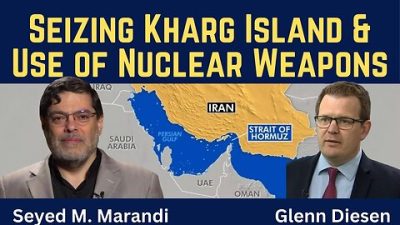
Marandi: Threat of Seizing Kharg Island & the Use of Nuclear Weapons
or go to
Aletho News Archives – Video-Images
Frlom the Archives
Provoking a Path to Persia
The Saban Center’s prescient paper on war with Iran
By Maidhc Ó Cathail | October 20, 2011
In June 2009, the Saban Center for Middle East Policy published “Which Path to Persia?—Options for a New American Strategy toward Iran.” Writing in a tone strikingly reminiscent of the Project for a New American Century’s infamous pre-9/11 paper “Rebuilding America’s Defenses,” the six co-authors noted that, “It seems highly unlikely that the United States would mount an invasion without any provocation or other buildup.” For a think tank specifically established by media mogul Haim Saban to protect Israel, this could prove to be a formidable obstacle impeding their desired march—of U.S. troops—to Tehran.
“In fact, if the United States were to decide that to garner greater international support, galvanize U.S. domestic support, and/or provide a legal justification for an invasion, it would be best to wait for an Iranian provocation, then the time frame for an invasion might stretch out indefinitely,” Saban’s think-tankers ruefully observed.
“With only one real exception, since the 1978 revolution, the Islamic Republic has never willingly provoked an American military response, although it certainly has taken actions that could have done so if Washington had been looking for a fight. Thus it is not impossible that Tehran might take some action that would justify an American invasion. And it is certainly the case that if Washington sought such a provocation, it could take actions that might make it more likely that Tehran would do so (although being too obvious about this could nullify the provocation). However, since it would be up to Iran to make the provocative move, which Iran has been wary of doing most times in the past, the United States would never know for sure when it would get the requisite Iranian provocation. In fact, it might never come at all.”
Seemingly undeterred by Iran’s frustrating unwillingness to provide the requisite provocation, the analysts continued to examine this option… continue
Blog Roll
 Aletho News
- Palestinian family displaced after settlers violently attack them in Humsa, Jordan Valley
- The EU never learns – except for the wrong lessons
- Iran attacks on UAE leaves RSF militia high and dry
- Hosting Washington’s war: Bahrain faces the consequences
- The US fell for its own Iran propaganda
- Seyed M. Marandi: Threat of Seizing Kharg Island & the Use of Nuclear Weapons
- Is there even an off ramp?
- Michael von der Schulenburg: Europe’s Self-Defeating Iran War Policy
- Sorry, The New Republic, Climate Change Isn’t Causing Somali Migration. Blame Civil Strife and Poverty.
- Expert Guts Claims That HPV Vaccine Reduces Cancer Risk
- If Americans Knew
- 6 more Americans killed, as Israel ‘mows the lawn’ in Iran – Not a ceasefire Day 154
- Are we on the precipice of World War III?
- ‘Catastrophic,’ Says UNICEF: 1,100+ Children Killed or Wounded in Mideast Since US-Israel Launched Iran War
- The Unbelievable Madness of Our War With Iran
- World Council of Churches calls on govts to hold Israel accountable for violations of intl law
- How to end the war on Iran that costs US taxpayers $1M per minute – Not a ceasefire Day 153
- Israeli strategic plans to “remake the Middle East” from the 1950s and since
- Honoring Gaza’s women who refused to let the world look away
- 97% of victims of war on Iran are Iranian, 98% of victims in war on Gaza are Gazans – Not a ceasefire Day 152
- Early Iran strikes cost $5.6 billion in munitions, Pentagon estimates
- No Tricks Zone
- New Studies: UK Sea Levels Were 4 Meters Higher Than Today During The Mid-Holocene
- Destructive Green New Deal: German Energy And Metal Group Warns Of Drastic Crisis
- New Study Documents A 20-Year Pause In Arctic Sea Ice Decline – Driven By Internal Variability
- Wake-up Call: Survey Shows Majority Of Germans Now Favor Postponing Climate Targets!
- Televised! Leading German Political Candidate Tells Schoolchildren CO2 Makes Sun Hotter!
- New Study: A Century Warming Of 1.1°C Is ‘Commonplace’ And ‘Not Unusual’ During This Interglacial
- New Study: ‘Internal Noise’ And Volcanic Forcing Can Trigger 10-15°C Warming Within Decades
- Glaciers Worldwide Are Suddendly Surging, Experts Blame Warming!
- Surprising Discovery: Sahara Is Greening…Billions Of Trees Where Once Thought To Be Barren
- New Research Reaffirms Clouds, Aerosols, And Surface Solar Radiation Are ‘Driving The Climate System’
 Aletho News