Russiagate all over again: Secret EU report blames Russia for coronavirus ‘confusion, panic and fear’
By Nebojsa Malic | RT | March 17, 2020
When all else fails, blame Russia. That seems to be the EU approach to deflecting blame from its response to the coronavirus pandemic, no doubt because it has worked so well for Democrats in the US or London in the Skripal affair.
As Brussels finally got around to locking down the EU borders on Tuesday, London’s Financial Times ran a ‘bombshell’ story blaming “Russian pro-Kremlin media” for a “significant disinformation campaign” to stoke “confusion, panic and fear” in the West and “aggravate the coronavirus pandemic crisis.”
This is based on a nine-page report by the strategic communications division of the European External Action Service, the EU’s de facto foreign ministry. The EEAS did not officially comment on the FT story.
First things first: “strategic communications” is bureaucrat-speak for public relations, meaning that this report – assuming it is authentic – was produced by the EEAS propaganda division. Secondly, it consists of generalities, cliches and tropes already worn out from four years of “Russiagate” hysteria in the US, down to these alleged efforts being “in line with the Kremlin’s broader strategy of attempting to subvert European societies from within by exploiting their vulnerabilities and divisions.”
It’s almost as if the PR flacks in Brussels plagiarized the work of James Comey, Jim Clapper and John Brennan from the infamous US “intelligence community assessment” blaming Russia for the 2016 election – down to segueing into a diatribe against RT instead of offering evidence.
Whether the EEAS report does so or not, the FT story takes just such a deceptive leap, going on about “Russian state-linked false personas and accounts” before abruptly bringing up the entirely unrelated subject of RT Spanish, whose number of social media shares recently put it “ahead of some big western media outlets.”
How dare they, as Greta Thunberg might say.
This isn’t the first attempt to blame Russia for “disinformation” about the pandemic. The US State Department bandied about one such conspiracy theory just last month. It seems to be the go-to tactic of Western propagandists to deflect criticism from their own governments, whether it’s Theresa May using the “highly likely” Skripal affair to distract from Brexit woes or the US establishment trying to leverage it against President Donald Trump via “Russiagate.” It doesn’t appear to matter that both ultimately failed to achieve their objectives; propaganda always doubles down.
Their insistence on conflating RT with the Russian government deserves a separate analysis, but suffice to say that various Western hacks just can’t seem to comprehend that a news organization will perforce cover a major news topic – which the covid-19 pandemic most certainly is, literally on the global level.
Those looking for “confusion, panic and fear” can find an abundance of them in the pronouncements of their own government officials and health experts, as well as mainstream Western news outlets.
There indeed is an epidemic of fake news about the coronavirus – witness the recent “marshall law” hoax in the US – but what the Eurospooks and FT either missed or chose to ignore is that it has targeted Russia too.
Completely ignoring their erstwhile rhetoric about universal values and global solutions, governments and media across the West are using the pandemic to settle internal political scores, while projecting blame on Moscow in order to deflect it from themselves.
Much like the coronavirus, hypocrisy apparently knows no bounds.
Nebojsa Malic is a Serbian-American journalist, blogger and translator, who wrote a regular column for Antiwar.com from 2000 to 2015, and is now senior writer at RT. Follow him on Twitter @NebojsaMalic
Sheldon Adelson keeps casinos open despite coronavirus danger
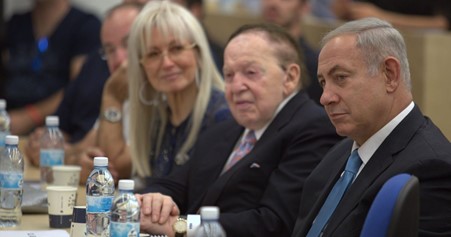
By Alison Weir | If Americans Knew | March 17, 2020
Bloomberg news reports that while other major Las Vegas casinos have closed to protect employees and the public from the coronavirus pandemic, Sheldon Adelson is keeping his casinos open.
According to Casino.org : “From the Strip to New England to the Midwest to California, commercial and tribal operators announced over the weekend they’d either voluntarily close casinos or do so to comply with state government orders barring large gatherings.”
On Monday President Trump called for Americans to avoid gatherings of more than 10 people, and the Nevada governor ordered schools and state offices to close.
Unlike governors elsewhere, the order did not include casinos, a powerful force in Nevada. However, the governor asked local governments to enforce a new Centers for Disease Control and Prevention guideline that all events with attendance above 50 be canceled or postponed.
Adelson’s billions used on behalf of Israel
Adelson is known for using his casino profits to obtain US policies beneficial for Israel by donating to American candidates for office. Adelson’s net worth is in the range of $37 billion.
In recent years, Adelson and his wife Miriam, an Israeli citizen, gave $205.83 million to Republican campaign efforts.
The Adelsons are credited with Trump’s decision to move the US Embassy to Jerusalem (after both Republican and Democratic presidents had long kept it in Tel Aviv), Trump’s decision to withdraw from the Iran nuclear deal, and the recent Trump-Kushner “peace plan.”
Adelson is a fervent advocate for Israel despite its long record of human rights violations and violations of U.S. laws, documented by Human Rights Watch, the Red Cross, Foreign Service Journal, and others.
He once infamously announced that he regretted serving in the U.S. army rather than the Israeli military.
Similarly, Miriam Adelson has said that her heart has always remained in Israel, but she got “stuck” in America after meeting Adelson.
In 2018 Trump bestowed the Presidential Medal of Freedom on the couple for their “philanthropic work.”
While the Adelsons have donated to medical research and programs addressing drug addiction (but apparently not gambling addiction, disastrous for many Americans), it appears that the bulk of their philanthropy involves Israel. Inside Philanthropy reports:
“The Adelson Family Foundation, one of Adelson’s philanthropic vehicles, is concerned with Jewish causes around the world. Adelson takes a decidedly pro-Israel stance, which is reflected in his and his wife Miriam’s philanthropy. The foundation supports charitable organizations located primarily in Israel and the United States, with funds going to Israel Advocacy and Defense, Israel Studies, Holocaust and Anti-Semitism Awareness, among others.
“Birthright Israel is a major grantee. The couple via their foundation have given tens of millions to the organization. Another youth outfit that the Adelsons have funded is B’nai B’rith Youth Organization. The Adelsons founded the Dr. Miriam and Sheldon G. Adelson Educational Campus in Las Vegas, “the only school in Nevada built on the Jewish ethos of community, service, innovation and discourse.” The school offers classes for students aged 18 months through 12th grade. Other education grantees include a mix of Israel and U.S. outfits, including American Friends of Ariel University, which supports Ariel University in Israel, and Rashi School in the Boston Area. Adelson funds a number of agencies that aim to shift policy and attitudes around Israel and the Jewish people, including Christians United for Israel, “an American pro-Israel Christian organization that defines itself as “a national grassroots movement focused on the support of Israel.” Sheldon and Miriam have also given millions to SpaceIL, an Israeli nonprofit founded by three young engineers at the end of 2010, answering the Google Lunar XPRIZE challenge.”
Trump had been scheduled to attend a fundraiser at the Adelsons’ Las Vegas mansion on Thursday, but called this off due to the pandemic. He had also been planning to address the Republican Jewish Coalition’s annual leadership meeting at Adelsons’ Sands’ Venetian casino resort.
Scheduled for Adelson’s Venetian and Palazzo resorts, the three-day meeting was expected to include numerous conservative politicians and leaders. Tickets began at $1,00 and were only available for current members of the RJC National Leadership. Adelson is on the RJC board.
The RJC announces that it “stands with Israel.” While the RJC states, “Hamas has sent hundreds of missiles from Gaza against Israeli civilians in recent days,” it fails to report that these mostly homemade rockets came after massive Israeli violence. Rockets from Gaza have killed about 29 Israelis in total, while Israeli airstrikes have killed over 3,500 Gazans.
Alison Weir is executive director of If Americans Knew, president of the Council for the National Interest, and author of Against Our Better Judgment: The Hidden History of How the U.S. Was Used to Create Israel.
Why has NATO Failed to Exploit Turk-Russia “Tensions” in Syria?
By Salman Rafi Sheikh – New Eastern Outlook – 17.03.2020
In any other sort of circumstances, the NATO countries from Europe and North America would have rushed to help Turkey fight the “Russian invaders” in Syria and accomplish their avowed mission. This, however, did not happen when Turkey and Russia came “eye ball to eye ball” in Syria over the question of the liberation and control of Syria’s Idlib province and the adjoining strategically important areas, including the M-4 highway. Tensions are already disappearing with a Turkey-Russia “deal”, paving the way for an eventual settlement of interests. The question, however, that begs attention here is: why could the NATO countries not change Turkey’s position in a way that would have re-established it as a NATO ally in Syria, pitched against the Russians, Syrians and the Iranians?
While the US did “offer” its support to Turkey, words could not be translated into action, even though a number of Western political pundits have been writing and speaking about the “fragility” of the Turkey-Russia alliance and the need for the West to win Turkey back. A number of reasons explain why this has not happened.
First of all, there is little doubt in that Turkey is an important regional player even for Russia. This explains why the Russians have, despite crisis after crisis, continued to manage their relations with Turkey through intensive diplomatic engagements, leaving no room for big and unbridgeable gaps to occur. The latest deal and the deals before the crisis reflect the strength of their diplomatic channels working at the highest possible levels.
However, notwithstanding the resilience of their bi-lateral ties, NATO’s lethargy is due largely to the crisis that NATO is itself facing from within.
On the one hand, the US and European members of the alliance are increasingly pushing for changes in different and opposing directions, and on the other hand, even Turkey itself is reluctant to project its policies in Syria as a NATO member. At the same time, the European members of the alliance are up in arms over Erdogan’s bold and cynical effort to pressure NATO to come to its aid by opening its border with Greece to Syrian refugees, thereby threatening a repeat of the 2015 refugee crisis. NATO, therefore, has no interest in coming to Turkey’s aid and help start a war that would ultimately come to bite them hard.
NATO countries, therefore, continue to think that delivering more humanitarian aid and financial support via the European Union for Syrian refugees already in Turkey is a better option that militarily committing to a war between Turkey and Syria/Russia, which will inevitably involve a massive inflow of refugees, causing both political and economic problems for them to handle. This, for them, is unnecessary and needs to be avoided.
It was perhaps this very reason in the first place which led NATO to discourage Turkey from starting its military operations in Syria in 2019. In fact, NATO countries cannot militarily help Turkey inside Syria even if Turkey really wanted them to.
The Article 5 of the NATO charter cannot be applied to the Syrian scenario. Whereas any NATO country can invoke Article 5, the actual application of this article is limited by the Article 6 which defines the ‘territorial scope’ of the Article 5. Among other areas, Article 6 defines Article 5’s ambit as including the territory of Turkey and the forces, vessels and aircraft of NATO members located in the Mediterranean Sea. But it crucially doesn’t cover attacks on Turkish forces on Syrian territory.
NATO countries would be morally obliged to help Turkey if only Turkey’s territory comes under attack from an offensive originating from within Syria. For this support to come, however, relations between NATO and Turkey need to be perfect, which has not been the case since the 2016 failed coup attempt.
At the same time, there is a strong realisation in NATO that Turkey has increasingly been acting as an ‘independent player’ in the region since at least 2016. It explains why Turkey chose to buy Russia’s S-400 system despite opposition from the NATO alliance.
This brings us to another aspect of why NATO has not ‘intervened’ in Syria on behalf of Turkey. Whereas Article 5, as mentioned earlier, does not apply to this situation, NATO has not always acted in strict accordance with its charter. For instance, it intervened in Libya even though it had no mandate for such an intervention, and no attack or direct threat was originating from Libya against any NATO countries. However, NATO still decided to intervene in Libya to topple the Col. Muammar Gaddafi regime. Why has NATO not done a similar thing in Syria even though the increasing Turkey-Russia “tensions” provided just the context for such an intervention.
The Russian military presence is certainly a factor, but an equally important factor is the “tension” that exists between Turkey and the rest of the NATO allies specifically, and within the alliance more generally, giving the US and European members of the alliance no material reasons to exploit the Russo-Turk “tensions” to their advantage.
Salman Rafi Sheikh is a research-analyst of International Relations and Pakistan’s foreign and domestic affairs.
US Military Accuses North Korea of Lying About Coronavirus Infection Rate of Zero
Sputnik – March 17, 2020
North Korea, whose contacts with the outside world remain limited even in a normal situation, was one of the first countries to introduce tough inspection and quarantine measures, canceling tourist visits, cutting off flights and rail travel and quarantining all workers coming home from abroad.
Nearly three months into the COVID-19 outbreak, North Korean health officials maintain that the country has zero cases of the virus.
The Korean Central News Agency reported last week that it there were no cases of COVID-19 in the country, but urged the public to remain vigilant. The agency reported that the country has enforced “strict, top-class anti-epidemic measures,” to intensify its coronavirus response, including the tightening of inspection and quarantine of imports from abroad. The measures are said to include comprehensive “inspection and disinfection of vehicles, vessels and goods,” and a 10-day quarantine of imports.
The World Health Organization too has indicated that it’s not aware of any cases of the virus in the self-isolating country, although the organization does plan to send equipment and supplies to help Pyongyang battle COVID-19. North Korea had previously asked the WHO for material assistance including disposable gowns, gloves and hazmat suits.
The popular Coronavirus Resource Center map run by Johns Hopkins’ University School of Medicine, which depends on credible sources including the WHO and the US Centers for Disease Control and Prevention, also reports zero cases for North Korea thus far.
However, US officials believe Pyongyang, which is required to report on any outbreak of contagious viruses as part of its WHO membership obligations, is lying.
Speaking to reporters last week, US Forces Korea commander Gen. Robert Abrams said the Pentagon was “fairly certain” that the country had coronavirus cases given the lack of noticeable military activity. According to the US commander, the North Korean military only recently restarted training following a month-long lockdown.
Keith Luse, executive director of the National Committee on North Korea, a Washington-based think tank, told Bloomberg that it “it’s hard to imagine that North Korea could dodge the COVID-19 bullet.”
Western media have similarly spread stories suggesting that the virus was quietly raging throughout the country, with one report by the US National Endowment for Democracy-sponsored Daily NK online newspaper claiming that as many as 200 soldiers had already died, and that another 4,000 people were in quarantine. These claims, citing anonymous sources, were never verified, but have been spread widely by English-language media.
North Korea, which is thought to have successfully weathered both the SARS and Ebola outbreaks in 2003 and 2014, became one of the first countries in the world to mount a nation-wide emergency response to COVID-19 amid rising infection rates in neighbouring China, South Korea and Japan.
These measures included a ban on all foreign tourists in late January, quarantine for travellers from China exhibiting potential symptoms of the virus in Sinuiju in the country’s west, and the declaration of a “state emergency” to deal with the epidemic on January 30, including the creation of a special ‘Central Emergency Anti-Epidemic Headquarters’.
North Korea’s presumed infection rate stands in sharp contrast to those of its neighbours, with China, where the virus originated, reporting over 81,000 cases, including some 218 cases in the North-Korea neighbouring regions of Liaoning and Jilin. South Korea has 8,320 confirmed cases. Japan has reported 833 cases. Russia, meanwhile, has 93 confirmed cases.
‘Reciprocal measures’: Beijing tells NYT, WSJ, WaPo journalists to hand in credentials as US-China media war rolls on
RT | March 17, 2020
China is pulling the press credentials of US journalists from outlets including the New York Times and the Washington Post whose passes expire in 2020, in the latest move of an ongoing tit-for-tat with America over media access.
In a statement about China’s “countermeasures against US suppression of Chinese media organizations in the United States,” Beijing announced that American reporters working for the NYT, Wall Street Journal, Voice of America, Time and the Washington Post whose credentials are due to expire by the end of this year must hand them over within 10 days.
These reporters will also not be allowed to work in China – including Hong Kong and Macau – in the future, and other US journalists will face new visa restrictions similar to those Washington recently introduced for Chinese reporters.
“In view of the US’ discriminatory restrictions on visas, administrative review, and interviews of Chinese journalists, China will take reciprocal measures against US journalists,” it added.
The back-and-forth expulsions of journalists started in February, when Chinese authorities gave three Wall Street Journalists five days to leave the country after Beijing objected to an opinion piece in the outlet calling China the “real sick man of Asia.” The paper refused to apologize for the piece.
Shortly afterwards, the US dramatically reduced the number of journalists it would permit to work for four Chinese state-owned media companies inside the US, cutting the number allowed from 160 to 100. They also reduced the length of time those permitted entry could remain in the US.
Beijing condemned the move as reflecting a “Cold War mindset” and warned of retaliation.
Corporate Media Condone Destruction of Venezuela’s Voting Machines
By Lucas Koerner | FAIR | March 14, 2020
The vast majority of Venezuela’s voting machines were incinerated on March 7 in a fire that engulfed the main warehouse of the National Electoral Council, or CNE, outside Caracas.
An unknown militant group styling itself the “Venezuelan Patriotic Front” claimed responsibility for the arson attack, which comes as the Maduro government and moderate opposition factions continue high-level negotiations to hold parliamentary elections in a bid to overcome the country’s current standoff.
Given Western journalists’ moral outrage over the dubious allegations of widespread “meddling” in the 2016 US presidential election, consistency would have mandated a similar response to such a brazen attack on Venezuela’s democracy.
Instead, corporate outlets followed the familiar script of blaming the victim, repeating the US State Department talking point that the Venezuelan electoral system is “rigged” (FAIR.org, 5/23/18) and floating outlandish conspiracy theories.
The Fiction of ‘Fraud’
After running through some of the details of the incident, Reuters (3/8/20) stated:
The South American country’s elections have come under heavy criticism since President Nicolás Maduro’s 2018 re-election was widely dismissed as rigged in his favor, leading dozens of governments around the world to disavow his government in 2019.
The BBC (3/9/20) likewise emphasized that Venezuela’s elections have been “beset by allegations of fraud… [and] vote-rigging.”
The not-so-subtle implication is that the burnt voting machines had previously served as an accessory to the “fraud” perpetrated by the Maduro government.
This is a particularly scandalous suggestion, given that Venezuela’s electoral system, unlike its US counterpart, is one of the most efficient and transparent in the world. Witnesses representing competing political parties—including the opposition—are present at polling stations and are required to sign off on the numerous, publicly available audits realized before, during and after the fully automated process. Indeed, Venezuela is the only country in the world that does an on-the-spot citizens’ audit after voting centers close, in which the electronic tallies of 53% of randomly selected voting machines are compared to the physical receipts printed by those machines and deposited by voters in a sealed box. In 2018, opposition parties representing Henri Falcon approved each and every one of the CNE’s 24 audits, even those carried out after their candidate cried fraud.
AFP (published in France24, 3/9/20), for its part, was more honest. In lieu of repeating the baseless fraud narrative, the agency observed that the CNE “has been the target of opposition criticism in every election,” before going on to quote the council’s president, Tibisay Lucena, denouncing the opposition’s record of electoral violence.
However, like Reuters and the BBC, AFP declined to inform readers that the opposition’s perennial fraud claims—in 2018 as well as in 2017, 2013, 2010 and on multiple other occasions —have been invariably bereft of substantive evidence.
Concealing Opposition Culpability
Embarrassingly, with the exception of the Daily Mail (3/10/20), virtually no corporate outlets have reported the crucial plot detail that a hard-right opposition group has claimed responsibility for the attack.
After suppressing this inconvenient fact, AP (published in the Washington Post, 3/9/20) went so far as to promote the opposition’s bizarre conspiracy theory that the fire was a false flag by the Maduro government, quoting no less than two opposition sources: a London-based financial consultant and self-proclaimed “interim president” Juan Guaidó.
Strangely, the reporter also repeats the narrative that the voting machines are an instrument in the Venezuelan government’s “quest to hold legislative elections this year that could help President Nicolás Maduro consolidate his power.”
It would seem that the reader is expected to believe that Maduro is attempting to convene constitutionally mandated legislative elections in order to “consolidate his power,” while at the same destroying the very means of holding those elections for some unknown reason.
Not only do AP and its counterparts omit anti-government militants’ self-declared responsibility for torching the machines, they also ignore the opposition’s very plausible motives for their destruction: The Venezuelan electoral system’s transparency has been an obstacle to the US-opposition strategy of delegitimizing all Chavista-won elections and paving the way for their coup efforts.
This would not be the first time that the Venezuelan right wing has attacked electoral infrastructure. During 2017 National Assembly elections, the opposition reportedly besieged 200 voting centers—a fact ignored by all corporate outlets, with the partial exception of AFP (3/9/20), which quoted a Venezuelan official’s denunciation of opposition electoral violence.
The hardline factions of Venezuela’s US-sponsored opposition have as recently as October (El Nacional, 10/22/19) called for an abandonment of the country’s state-of-the-art automated voting system—which combines rapid electronic transmission of results with the security of publicly audited physical receipts—in favor of more tamperable manual voting.
By omitting these crucial facts, corporate journalists slander Venezuela’s electoral system at the moment that it is under devastating assault. The pretense of earnest concern is easily pierced; their true function is to disseminate US imperial propaganda that Venezuela and its progressive regional allies are not democracies, and therefore legitimate targets for coups, economic warfare and/or military intervention (FAIR.org, 12/10/19, 2/12/20).
‘Russian troll firm’ says it has a $50bn grudge to settle with US after indictment dropped by DoJ
RT | March 17, 2020
A Russian firm that the DoJ failed to prosecute for “sowing discord” during the 2016 election aims to take its pound of flesh – or at least a hefty compensation for its tarnished reputation.
The February 2018 indictment of Concord Management & Consulting LLC, one of several issued by the team of Special Counsel Robert Mueller, was praised by the Russiagate crowds as a crucial step in uncovering the holy grail of Trump-Russia collusion. The case was dropped just weeks before going to trial, with prosecutors claiming that the firm’s defense strategy – demanding evidence that the company had waged ‘information warfare’ against America – posed a threat to US national security.
Concord had been “eager and aggressive in using the judicial system to gather information about how the United States detects and prevents foreign election interference,” the motion to dismiss said.
Protecting “sources and methods” is the cookie cutter explanation that the US intelligence community uses to justify evidence-free accusations. But it may not work this time; Concord CEO Yevgeny Prigozhin – dubbed ‘Putin’s chef’ by the Western media, says he didn’t consider the case closed with the charges dropped.
The DoJ’s decision proves that statements like “Prigozhin interfered in the US presidential election” were “lies and fiction,” he said in a statement. Concord will seek $50 billion in damages from the US government for “illegal persecution and sanctions,” he warned.
“I have found only two things positive in the biased US justice systems. One is attorney Eric Dubelier, who had the guts to fight against the American government and has secured a victory. The other is Special Counsel Robert Mueller, who had the courage to resign after realizing the kind of lawlessness he had been dragged into,” Prigozhin added.
Mueller resigned in May 2019 after his much-hyped probe ended with an anticlimactic report and criminal charges against 34 individuals and three entities, including Concord. The team that decided to call off the indictment against the company included two prosecutors who were part of Mueller’s investigation.
Meet Eli Rosenbaum, the Justice Department’s Nazi Hunter
American taxpayers still paying for World War 2

By Philip Giraldi • Unz Review • March 17, 2020
The New York Times is reporting somewhat ruefully that “The Mission to Hunt Nazis Has Become a Race Against Time.” The U.S. Government’s zeal in going after alleged former “Nazis” began in 1979 when the Office of Special Investigations (OSI) was established within the Justice Department. In 2002, OSI included 13 attorneys, almost all of whom were Jewish, backed up by 10 “historians.” In 2010 it merged with the Criminal Division’s Domestic Security Section to create a new unit, the current Human Rights and Special Prosecutions Section (HRSP).
HRSP engages in a range of enforcement activities, but one of its principal focuses is the arrest and repatriation of claimed human rights violators associated with the German concentration and prison camp system preceding and during the Second World War. In the cases of those individuals linked to the camps, the HRSP has reportedly pursued the cases with some urgency because “These people are old, and they’re dying,” suggesting that the pursuit of World War II’s possible surviving criminals is more about revenge than justice. The Times article describes it as a “race against natural life spans.”
The man in charge of ferreting out hidden Nazis is Eli Rosenbaum, highly educated in the usual places and a lawyer. Wikipedia describes him as an Israeli-American, the dual-bit, if true, presumably in spite of the fact that he holds a high-level and highly paid American government job, an all too common feature of officials who engage in so-called holocaust related issues. Rosenbaum has been seeking out what he describes as Nazis as what amounts to a full-time job since 1980, though he disdains descriptions of him as a Nazi hunter
The most recent victim of the Department of Justice’s HRSP and Rosenbaum is a 94 year-old man living in Tennessee named Friedrich Karl Berger, who was recently ordered by Memphis federal judge Rebecca Holt to be returned to Germany. Holt ruled that he was deportable under the 1978 Holtzman Amendment to the Immigration and Nationality Act due to his “willing service as an armed guard of prisoners at a concentration camp where persecution took place” which constituted rendering voluntary assistance to a Nazi-sponsored persecution.
Some facts regarding Berger’s involvement on World War II were presented by his defense and do not seem to have been disputed by the prosecution represented by Rosenbaum, who regretted that the passage of 75 years since 1945 means that Berger might be the last real live “Nazi” that he is able to punish.
Berger was drafted in 1943 when he was 17 years old, at the height of the war, and was enlisted in the navy. In 1945, he was seconded to the Neuengamme prison camp near Hamburg as a guard. Neuengamme was in fact a complex of as many as 80 camps and subcamps that were relatively low security. Berger was at a subcamp near Meppen. Jews, Poles, Russians, Danes, Dutch, Latvians, French, Italians and political opponents of the Nazis were imprisoned in the camps and it is believed that some of the prisoners, mostly Russians, were the victims of medical experiments or were gassed to death. Many prisoners also reportedly died from malnutrition and abuse as well as from actual starvation when the allies began to bomb the railroads and roads that provided food to the camps.
The camps were run by the SS, but the guards, which included women for women inmates, were drawn from a number of branches of the military services as well as from the police. Berger was therefore not SS even though the prosecution kept referring to Neuengamme as an SS camp, and he was not even armed except possibly for a brief period when the prisoners were being moved to the main camp near Hamburg as the war was ending. The prosecution claimed that the prisoners were forced to work outside digging defensive trenches during the winter of 1945 “to the point of exhaustion and death… Berger was part of the SS machinery of oppression that kept concentration camp prisoners in atrocious conditions of confinement.”
In fact, the largest loss of life of the Neuengamme prisoners took place when 9,000 of them were being evacuated in late April 1945 on the passenger liners Deutschland and Cap Arcona and two large commercial steamers the Thielbeck and Athen. The British bombed the ships, possibly thinking that they were full of fleeing government officials, killing at least 7,100 prisoners and crew.
In his justification for revoking citizenship and expatriating Berger, Rosenbaum claimed that the man had made two mistakes: “Mr. Berger made his choice to enlist in 1943 in the German military” and he then made another choice “not to request a transfer when he was assigned to a sub-camp overseeing prisoners…” Both claims are not completely credible as Berger was drafted and, as a low-ranking enlisted man being ordered to take up a position, he was hardly in control of where he was sent and what he would be called upon to do. If he had objected at that point in the war he might have been shot.
After the war Berger emigrated legally to Canada and then on to the United States in 1959. His entry into the country was completely legal and he eventually became a citizen, married and had children who are American citizens and settled down in a modest house in Oak Ridge Tennessee. He worked in a factory that made wire stripping machines. Acquaintances recall him as friendly and talkative, a kind man who took care of his sick wife until she died some years ago. One neighbor who knew him for 30 years described him as “proud to be living in the United States.”
The Times article illustrates what critics of the media have sometimes described as the “poisoned pen.” In the second paragraph of the article it describes Berger as one of many “under-the-radar Nazi collaborators.” It goes on to report on the “cases that played out over the years in the long shadow of World War II and the Holocaust, as collaborators were discovered and rooted out from often-cozy American existences that had normalized them and scrubbed them of their complicity.” The piece concludes with “Devora Fish, the director of education for the Tennessee Holocaust Commission, who opined that prosecutions like those of Mr. Berger help ensure that the sins of the past will not be forgotten. ‘Every time that somebody is brought to justice, even from 50 years ago or longer, that is a message to the world. Because we are not going to stop until everybody is brought to justice. Even if it’s something you did years ago, it will catch up to you.’” In another comment, Efraim Zuroff, a holocaust historian (sic) and currently the Simon Wiesenthal Center’s top Nazi hunter, praised the deportation of Berger, saying his age did not diminish his guilt, adding the usual spin of Jewish perpetual victimhood, and observing “Especially these days, when we see anti-Semitism on the rise and the rise of right-wing movements, this is a reminder that, if you commit such crimes, even many years later, you will be held accountable.”
How destroying the end of the life of a 94 year-old who was seventeen when he got caught up in a war that victimized him as much as millions of others provides justice is not completely clear, particularly as Berger was not a decision maker and was not personally linked to any mistreatment of anyone. Revenge is not justice but it is something that the United States government and the U.S. media promote relentlessly through the activity of taxpayer funded Rosenbaum and also the ridiculous bizarre State Department offices of Special Envoy to Monitor and Combat Antisemitism and the Special Envoy for Holocaust Issues.
And going after “Nazis” with such virulence ignores other war crimes like the fire bombings of Tokyo which killed 100,000 and Dresden where 25,000 died, mostly civilians. Or Hamburg itself, close to camp Neuengamme, where 35,000 died in a firestorm that destroyed the city and which was possibly witnessed by Berger. And then there are Hiroshima and Nagasaki, 2 million dead Vietnamese and more than a million dead Muslims since 9/11. Inevitably, he who controls the media controls the narrative while the winner in a war writes the history books and also decides who is guilty.
One also has to wonder about modern day war crimes and what Eli Rosenbaum would do about them. Israel has just killed its 10,000th Palestinian since 2000. In Gaza alone, Israeli snipers shooting unarmed demonstrating Arabs in the past year have killed more than 200 and injured 8,000. The favored sniper tactic has become shooting the Palestinians in their knees. One leading sniper boasts that on one day alone he shot forty-two knees, mostly of teenagers, crippling them for the rest of their lives. “I remember the knee in the crosshairs, bursting open” said another marksman. Will Eli Rosenbaum, once he runs out of potential victims and stops chasing “Nazis,” be representing the interests of those severely injured in Gaza to punish the Israeli war criminals and bring justice?
Philip M. Giraldi, Ph.D., is Executive Director of the Council for the National Interest, a 501(c)3 tax deductible educational foundation (Federal ID Number #52-1739023) that seeks a more interests-based U.S. foreign policy in the Middle East. Website is councilforthenationalinterest.org, address is P.O. Box 2157, Purcellville VA 20134 and its email is inform@cnionline.org.
DOJ drops charges against ‘Russian trolls’ after they dared demand evidence in US court
RT | March 17, 2020
The US is dropping the much-hyped indictment for ‘election meddling’ against a company supposedly behind the so-called Russian troll farm, closing the opening chapter of special counsel Robert Mueller’s Russiagate investigation.
Further pursuing the case against Concord Management & Consulting LLC, “promotes neither the interests of justice nor the nation’s security,” the Department of Justice wrote to the federal judge overseeing the case on Monday, in a motion to drop the charges.
DOJ lawyers cited “recent events and a change in the balance of the government’s proof due to a classification determination,” saying only that they submitted further details in a classified addendum.
Concord was one of the three companies – the Internet Research Agency is another – and 13 individuals charged in February 2018 with waging “information warfare against the United States of America” using social media.
The DOJ rationalizes the motion to dismiss by arguing that Concord is “a Russian company with no presence in the United States and no exposure to meaningful punishment in the event of a conviction.” That has always been the case, however. What really changed since the indictment was filed is the complete implosion of Mueller’s case, helped in part by Concord fighting the case in court.
The motion inadvertently reveals that Mueller’s prosecutors never intended the case against Concord, two other entities and 13 individuals to actually go to trial, otherwise they would have anticipated what ended up happening: Concord’s lawyers demanding discovery documents from the DOJ, which the US authorities say risks “exposure of law enforcement’s tools and techniques.”
Mueller’s team tried to fight the discovery proceedings by arguing in January 2019 that Concord was leaking them to “discredit” the investigation. Within two months, however, the investigation discredited itself, by having to admit there was no “collusion” between US President Donald Trump during the 2016 presidential election.
They still insisted that Russia had “meddled” in the election, but there too the case proved a problem. Concord successfully petitioned Judge Dabney L. Friedrich in May last year to rebuke the prosecutors for presenting their allegations as facts.
This is not to say that the DOJ is ready to disavow ‘Russiagate’ as a debunked conspiracy theory, however. Though the Concord case was dropped, the charges against the Internet Research Agency and the 13 Russian individuals were not. Given that none of them have a presence in the US, and have not dignified the indictment with a response, it is unclear how – if at all – the DOJ intends to proceed with the case.
Keeping it on the books may keep the flames of ‘Russiagate’ alive, though, which is very convenient for the media and others heavily invested in the narrative of Moscow somehow menacing US elections, despite not a shred of actual evidence being presented to back it up.
US-Led Coalition Closing Several Bases in Iraq Following Rocket Attacks – Reports
Sputnik – March 16, 2020
The US-led coalition against Daesh is departing from several of its smaller bases in Iraq after several recent rocket attacks against them, CNN reported on Monday citing a statement it obtained from the coalition.
“As a result of the success of Iraqi Security Forces in their fight against Daesh, the Coalition is re-positioning troops from a few smaller bases,” the coalition said as quoted by CNN. “These bases remain under Iraqi control and we will continue our advising partnership for the permanent defeat of Daesh from other Iraqi military bases.”
Earlier this month, two rocket attacks hit coalition troops near Baghdad, killing two American soldiers and a British servicewoman. It prompted massive strikes against the local Shia militants by the US-led coalition.
The attacks against the coalition forces came after the US had announced that it would move air and missile defence systems into Iraq to defend against ballistic missile and drone threats. Washington blamed the attacks on Iranian-backed militants but Tehran has rejected the accusations.
Iraq has warned the US and other foreign forces against using attacks on the coalition troops as a pretext for unauthorised military action in the country. The US command claimed they had consulted with Iraqi authorities about the “defensive” strikes but it was not clear if Baghdad had approved it.
Circle in the Darkness: Memoir of a World Watcher – Book Review
By Jim Miles | Palestine Chronicle | March 16, 2020
 (Circle in the Darkness – Memoir of a World Watcher. Diana Johnstone. Clarity Press, Atlanta Georgia. 2020)
Diana Johnstone has done a masterful job of writing her autobiography, Circle in the Darkness, that provides many details of her life, her early influences, and the various stages of her career throughout the second half of the Twentieth Century and the first part of Twenty-first.
It is a wild ride through various aspects of society, concentrating on the historical events of her era.
Much of what she writes is not news to those who do follow alternative news sites, but what is added is a strong personal perspective based on – not surprisingly – facts and truth, both from her own experiences in regions of concern and a wide arrange of conversations with both people of significant influence and those with no influence but feeling the impact of developments in their country.
The details Johnstone adds are a strong and valuable retort to mainstream media disinformation that has “moved farther and farther away from informing the public and nearer and nearer to instructing them in what they should think.”
Themes
One of three themes that impressed me and are developed throughout the book, the media takes a large hit. While discussing NATO crimes of the Balkan, she writes, “The journalist was no longer asked to dig for new information and provide fresh analysis, but to contribute to the “common narrative”” as originated by NATO and the media.
When discussing mass media and the Military Industrial Complex she writes, “those private interests coincide quite closely with those of the U.S. government, since the same economic powers are behind both.”
Relying on “open sources and thoughtful analysis of known facts” rather than “spook revelations” her work is significantly more accurate than the mainstream.
NATO and European unity cover another large thematic area. She discusses how NATO and the European Union actively promote the neoliberal order as conditioned by the U.S. and other global hegemonic financial powers against the best interests of their own people and against the best interests of many sovereign states in the world.
When discussing the idea of Joint Criminal Enterprise as argued by the U.S. in relation to Serbia (essentially all Serbs are guilty of war crimes) she reverses the argument with clear examples, and summarizes, “U.S. strategy basically boils down to the implicit or explicit threat to wipe out the whole nation it is attacking…. This war is not the result of a clever plan by some ragtag Balkan clan leaders. This war was deliberately planned and carried out by the real Joint Criminal Enterprise: NATO.”
The third theme was her development of ideas concerning the development of the “left”.
It has changed from operating with the best interests of the people in mind – anti-war, support for workers and societal infrastructures – to becoming a supporter of war and more interested in the distractions of identity politics, “The Left has evolved from a program to an attitude.”
Certainly, there is merit in people’s identity but it comes at the cost of no longer working against class structures that keep workers down and keep the rich getting richer.
Johnstone follows the developments in France to its present-day neoliberal U.S. supporting government of Macron and follows the developments in Sweden as it turned away from the left of Olaf Palme towards a strong non-NATO supporter of all NATO adventures.
A Host of other Ideas
Many other ideas are presented in Circle in the Darkness.
Israel is discussed directly only briefly but Zionism’s influence is related throughout. While discussing false flags, the USS Liberty attack is mentioned threading into the theme of the media as ”the mainstream media have persisted in ignoring what happened, even as evidence mounted that General Moshe Dayan personally ordered the attack.”
The relationship between the dropping of the gold standard and the introduction of the petrodollar is touched upon, a topic that is rare if ever in mainstream journalism. Again just touching on it she discusses the “debt trap” on a personal level when two local Minnesota farmers commit suicide after being enticed to overextend themselves into debt.
In general, however, this is Diana Johnstones’ story of the many people she meets and interviews, or argues with, debates with, or simply discusses the many issues of her career spent mostly within European journalism. That overlapped with her employment by the German Green party and how she watched it change from an anti-war truly green party to a pro-war neoliberal supporter of capitalism.
She continues to write as an independent journalist today, with her work published globally in several alternate news sites. While I am familiar with the same history background as Ms. Johnstone, I do not have the expertise of overseas experience, the philosophical background, and the wide range of contacts she has had available throughout her career.
Circle in the Darkness covers an amazing and productive lifetime and provides valuable insights and factual details in support of her views and reporting.
It is entertaining – not in the distractive sense but for the quality of the writing and her combination of anecdotal stories combined with researched ideas.
Thus it is a very strong informative work on our modern history, an important read to more clearly understand the machinations of the modern political-military scene.
– Jim Miles is a Canadian educator and a regular contributor/columnist of opinion pieces and book reviews to Palestine Chronicles. His interest in this topic stems originally from an environmental perspective, which encompasses the militarization and economic subjugation of the global community and its commodification by corporate governance and by the American government.
Featured Video

Meet The Ellisons: Zionists, Technocrats, Moguls
or go to
Aletho News Archives – Video-Images
Frlom the Archives
Who Rules America?
The Power Elite in the Time of Trump
By James Petras | Axis of Logic | September 6, 2017
Introduction
In the last few months, several competing political, economic and military sectors – linked to distinct ideological and ethnic groups – have clearly emerged at the centers of power.
We can identify some of the key competing and interlocking directorates of the power elite:
- Free marketers, with the ubiquitous presence of the ‘Israel First’ crowd.
- National capitalists, linked to rightwing ideologues.
- Generals, linked to the national security and the Pentagon apparatus, as well as defense industry.
- Business elites, linked to global capital.
This essay attempts to define the power wielders and evaluate their range of power and its impact. … continue
Blog Roll
 Aletho News
- The Strategic Folly of a (Serious) US Ground Invasion of Iran
- US-Israeli war of aggression on Iran meant to reshape region: Omani FM
- Iran Does Not Consider Israel Party to Talks to Need Mediators With It – Ambassador
- Macron’s aircraft carrier and warplanes to the Persian Gulf is a dangerous vanity project
- Meet The Ellisons: Zionists, Technocrats, Moguls
- US failures in Iran reveal Russia is key to South Korea’s strategic security
- ‘All ports in Persian Gulf will be legitimate targets if Iranian ports are attacked’
- 40 Years of Endless War, Data Point by Data Point
- Department of War Using Palantir AI to Pick Targets in Iran
- American bases do not protect – they attack the peoples of the Persian Gulf
- If Americans Knew
- The Unbelievable Madness of Our War With Iran
- World Council of Churches calls on govts to hold Israel accountable for violations of intl law
- How to end the war on Iran that costs US taxpayers $1M per minute – Not a ceasefire Day 153
- Israeli strategic plans to “remake the Middle East” from the 1950s and since
- Honoring Gaza’s women who refused to let the world look away
- 97% of victims of war on Iran are Iranian, 98% of victims in war on Gaza are Gazans – Not a ceasefire Day 152
- Early Iran strikes cost $5.6 billion in munitions, Pentagon estimates
- Israel Decided the War, But Trump’s America Fights and Pays the Bill
- Conscientious Objector Group: Phone ‘Ringing Off Hook’ As Huge Mobilization Underway
- U.S. support for Israel continues to plummet, despite media’s best efforts
- No Tricks Zone
- Destructive Green New Deal: German Energy And Metal Group Warns Of Drastic Crisis
- New Study Documents A 20-Year Pause In Arctic Sea Ice Decline – Driven By Internal Variability
- Wake-up Call: Survey Shows Majority Of Germans Now Favor Postponing Climate Targets!
- Televised! Leading German Political Candidate Tells Schoolchildren CO2 Makes Sun Hotter!
- New Study: A Century Warming Of 1.1°C Is ‘Commonplace’ And ‘Not Unusual’ During This Interglacial
- New Study: ‘Internal Noise’ And Volcanic Forcing Can Trigger 10-15°C Warming Within Decades
- Glaciers Worldwide Are Suddendly Surging, Experts Blame Warming!
- Surprising Discovery: Sahara Is Greening…Billions Of Trees Where Once Thought To Be Barren
- New Research Reaffirms Clouds, Aerosols, And Surface Solar Radiation Are ‘Driving The Climate System’
- Germany: Electric Car Catches Fire At Charging Station, Sets Off Local “Inferno”, Widespread Damage
 Aletho News