US CDC Director Robert Redfield Admitted that Coronavirus Deaths Have Been Miscategorized as Flu
By Larry Romanoff | Global Research | March 13, 2020
The US has been lying all along.
Robert Redfield, CDC director, testifying to Congress, today admitted that virus deaths have been miscategorised as the flu.
He also stated that the standard practice has been to first test people for the flu and, if the test is positive, they stop there. They don’t test for the coronavirus.
So Japan and Taiwan were correct. Many of the US deaths attributed to the flu were actually from the coronavirus.
One Senator asked Redfield if post-mortems were performed to learn the cause of death, and he stated that such were done, and they revealed mis-diagnoses.
The infections and deaths have been knowingly mis-categorised for months, and the CDC ‘strongly’ recommended that hospitals not test for the virus except as a last resort. It is not an accident that the US has no reliable tests. They don’t want to test. Blame everything on the flu.
And now all meetings and discussions on the virus are classified, and all public information must be first cleared through the White House.
Larry Romanoff is a retired management consultant and businessman. He has held senior executive positions in international consulting firms, and owned an international import-export business. He has been a visiting professor at Shanghai’s Fudan University, presenting case studies in international affairs to senior EMBA classes. Mr. Romanoff lives in Shanghai and is currently writing a series of ten books generally related to China and the West. He can be contacted at: 2186604556@qq.com.
‘Zionist’ Biden in His Own Words: ‘My Name is Joe Biden, and Everybody Knows I Love Israel’
By Ramzy Baroud | MEMO | March 14, 2020
“I am a Zionist. You don’t have to be a Jew to be a Zionist,” current Democratic Presidential candidate, Joe Biden, said in April 2007, soon before he was chosen to be Barack Obama’s running mate in the 2008 elections.
Biden is, of course, correct, because Zionism is a political movement that is rooted in 20th century nationalism and fascism. Its use of religious dogmas is prompted by political expediency, not spirituality or faith.
Unlike US President, Donald Trump, or Bernie Sanders, Biden’s only serious opponent in the Democratic primaries, Biden’s stand on Israel is rarely examined.
Trump has made his support for Israel the cornerstone of his foreign policy agenda since his inauguration into the White House in January 2017. The American President has basically transformed into Israel’s political genie, granting Tel Aviv all of its wishes in complete defiance of international law.
Sanders, on the other hand, came to represent the antithesis of Trump’s blind and reckless support for Israel. Himself Jewish, Sanders has promised to restore to the Palestinian people their rights and dignity, and to play a more even-handed role, thus ending decades of US unconditional support and bias in favor of Israel.
But where does Biden factor into all of this?
Below is a brief examination of Biden’s record on Palestine and Israel in recent years, with the hope that it gives the reader a glimpse of a man that many Democrats feel is the rational alternative to the political imbalances and extremism of the Trump administration.
August 1984: Palestinians and Arabs are to Blame
Biden’s pro-Israel legacy began much earlier than his stint as a vice-President or presidential candidate.
When Biden was only a Senator from Delaware, he spoke at the 1984 annual conference of ‘Herut Zionists of America’. Herut is the forerunner of Israel’s right-wing Likud party.
In his speech before the jubilant right-wing pro-Israel Zionist crowd, Biden derided the Palestine Liberation Organization (PLO) and Arab governments, for supposedly derailing peace in the Middle East.
Biden spoke of “three myths (that) propel U.S. policy in the Middle East” which, according to the American Senator, are, “the belief that Saudi Arabia can be a broker for peace, the belief that King Hussein (of Jordan) is ready to negotiate peace, and the belief that the Palestine Liberation Organization can deliver a consensus for peace.”
April 2007: ‘I am a Zionist’
Time only cemented Biden’s pro-Israel’s convictions, leading to his declaration in April 2007 that he is not a mere supporter of Israel – as has become the standard among US politicians – but is a Zionist himself.
In an interview with Shalom TV, and despite his insistence that he does not need to be Jewish to be a Zionist, Biden labored to make connections with the ‘Jewish State’, revealing that his son is married to a Jewish woman and that “he had participated in a Passover Seder at their house,” according to the Israeli Ynet News.
March 2013: ‘Qualitative Edge’
This commitment to Israel became better articulated when Biden took on greater political responsibilities as the US vice-president under Obama’s administration.
At a packed AIPAC conference in March 2013, Biden elaborated on his ideological Zionist beliefs and his president’s commitment to ‘the Jewish state of Israel’. He said:
“It was at that table that I learned that the only way to ensure that it could never happen again was the establishment and the existence of a secure, Jewish state of Israel. I remember my father, a Christian, being baffled at the debate taking place at the end of World War II ..” that any country could object to the founding of Israel on the ruins of the Palestinian homeland.
“That’s why we’ve worked so hard to make sure Israel keeps its qualitative edge in the midst of the Great Recession. I’ve served with eight Presidents of the United States of America, and I can assure you, unequivocally, no President has done as much to physically secure the State of Israel as President Barack Obama.”
December 2014: ‘Moral Obligation’
In one of the most fiercely pro-Israel speeches ever given by a top US official, Biden told the annual Saban Forum at the Brookings Institution in Washington on December 6, 2014, that, “If there weren’t an Israel, we would have to invent one”.
In his speech, Biden added a new component to the American understanding of its relationship with Israel, one that goes beyond political expediency or ideological connections; a commitment that is founded on “moral obligation”.
Biden said, “We always talk about Israel from this perspective, as if we’re doing (them) some favor. We are meeting a moral obligation. But it is so much more than a moral obligation. It is overwhelmingly in the self-interest of the United States of America to have a secure and democratic friend, a strategic partner like Israel. It is no favor. It is an obligation, but also a strategic necessity.”
April 2015: ‘I Love Israel’
“My name is Joe Biden, and everybody knows I love Israel,” Biden began his speech at the 67th Annual Israeli Independence Day Celebration held in Jerusalem in April 2015.
“Sometimes we drive each other crazy,” the US vice-president said in reference to disagreements between Israel and the US over Israeli Prime Minister, Benjamin Netanyahu’s refusal to halt construction of illegal Jewish settlements.
“But we love each other,” he added. “And we protect each other. As many of you heard me say before, were there no Israel, America would have to invent one. We’d have to invent one because … you protect our interests like we protect yours.”
July 2019: US Embassy Stays in Jerusalem
In response to a question by the news website, AXIOS, which was presented to the various Democratic party candidates, on whether a Democratic President would relocate the American embassy back to Tel Aviv, the Biden campaign answered:
“Vice President Biden would not move the American embassy back to Tel Aviv. But he would re-open our consulate in East Jerusalem to engage the Palestinians.”
October 2019: Support for Israel Unconditional
In an interview with the Wall Street Journal on October 31, 2019, Biden was asked whether he agrees with the position taken by his more progressive opponent, Bernie Sanders, regarding US financial support to Israel and Jewish settlement.
Sanders had said that, “if elected president he would leverage billions of dollars in U.S. military aid to Israel to push Jerusalem to change its policies toward the Palestinians,” The Hill news website reported.
Biden’s response was that, “… the idea that we would draw military assistance from Israel, on the condition that they change a specific policy, I find to be absolutely outrageous. No, I would not condition it, and I think it’s a gigantic mistake. And I hope some of my candidates who are running with me for the nomination — I hope they misspoke or they were taken out of context.”
March 2020: ‘Above Politics, Beyond Politics’
Biden’s fiery speech before the pro-Israel lobby group, AIPAC, at their annual conference in March 2020, was a mere continuation of a long legacy that is predicated on his country’s blind support for Israel.
Biden’s discourse on Israel – a mixture of confused ideological notions, religious ideas and political interests – culminated in a call for American support for Israel that is “above politics and beyond politics”.
“Israelis wake up every morning facing an existential threat from their neighbors’ rockets from Gaza, just like this past week .. That’s why I’ve always been adamant that Israel must be able to defend itself. It’s not just critical for Israeli security. I believe it’s critical for America’s security.”
Palestinians “need to end the rocket attacks from Gaza,” Biden also said. “They need to accept once and for all the reality and the right of a secure democratic and Jewish state of Israel in the Middle East.”
Iraq military demands foreign forces swiftly withdraw following US air raids
Press TV – March 14, 2020
The Iraqi military has called for an immediate withdrawal of all American and foreign troops from the country in accordance with a parliamentary resolution passed earlier this year, and in light of a string of airstrikes carried out by the United States against multiple locations of the Popular Mobilization Units (PMU), better known by the Arabic name Hashd al-Sha’abi.
On Saturday, the military asked all US-led forces to act within the resolution and pull out of Iraq.
Iraqi lawmakers unanimously approved a bill on January 5, demanding the withdrawal of all foreign military forces led by the United States from the country following the assassination of Lieutenant General Qassem Soleimani, the commander of the Quds Force of the Islamic Revolution Guards Corps, along with the deputy head of the PMU, Abu Mahdi al-Muhandis, and their companions in US airstrike authorized by President Donald Trump near Baghdad International Airport two days earlier.
Later on January 9, former Iraqi prime minister Adel Abdul-Mahdi called on the United States to dispatch a delegation to Baghdad tasked with formulating a mechanism for the move.
According to a statement released by his office at the time, Abdul-Mahdi “requested that delegates be sent to Iraq to set the mechanisms to implement the parliament’s decision for the secure withdrawal of (foreign) forces from Iraq” in a phone call with US Secretary of State Mike Pompeo.
The 78-year-old politician said that Iraq rejects violation of its sovereignty, particularly the US military’s violation of Iraqi airspace in the airstrike that assassinated General Soleimani, Muhandis and their companions.
Iraqi MP: We demand immediate withdrawal of US forces
Meanwhile, an Iraqi lawmaker from the Fatah (Conquest) alliance has called for the “immediate” pullout of American-led forces from the country through diplomatic means.
“Our fellow countrymen and women have become fully convinced that whatever has happened or happens in our country over the past 16 years is due to foreign interference in general, and the American interventions in particular in Iraq’s domestic affairs,” Ahmed al-Kinani said in a press release.
He added, “I would like to refer to repeated attacks on the sovereignty of Iraq by the occupying US forces, including the bombing of the headquarters of our security forces, army and the PMU, which led to their martyrdom and injury besides destruction of civilian facilities.”
“Such repeated attacks do not show that US forces have good intentions, and that they must leave our land as demanded by the government, the parliamentary resolution and the Iraqi nation, who took part in a million-march demonstration and called for their immediate departure,” Kinani pointed out.
‘Next Iraqi PM must be someone who can stop US recklessness’
Another Iraqi legislator lambasted US airstrikes as blatant violation of the Arab country’s sovereignty.
Nada Shaker Jawdat said that the country’s next prime minister must be someone who can firmly act against the US recklessness and its utter disdain for Iraq’s national sovereignty.
Attack on Camp Taji cannot serve as pretext for foreign ops: Baghdad
The Iraqi military also cautioned the US and other foreign forces on Saturday against taking any military action in Iraq without the government’s approval, emphasizing that recent missile strikes against the Camp Taji can’t serve as a pretext for unauthorized actions.
The military noted in a statement that 33 Katyusha rockets had been launched on the military base, which is located approximately 27 kilometers (17 miles) north of the capital Baghdad and houses US-led troops, and that the attack critically injured several Iraqi air defense servicemen.
The statement added that the military found seven rocket launchers and 24 unused rockets in the nearby Abu Izam area.
The Iraqi Interior Ministry’s Security Media Cell announced in a statement that “at 01:15 local time on Thursday (2215 Wednesday) an American aerial bombardment struck headquarters of Hashd al-Sha’abi, emergency regiments as well as commandos from the 19th Division of the army.”
The statement added that the airstrikes targeted positions in Jurf al-Nasr town, located about 60 kilometers southwest of the capital Baghdad, Musayyib town in the central province of Babil, the holy shrine city of Najaf as well as the ancient central city of Alexandria.
The US military did not estimate how many people in Iraq may have been killed in the strikes, which officials said were carried out by piloted aircraft.
US Defense Secretary Mark Esper, in a Pentagon statement detailing the strikes, cautioned that the United States was prepared to respond again, if needed.
“We will take any action necessary to protect our forces in Iraq and the region,” Esper said.
Separately, an Iraqi official said an airstrike had hit an airport under construction in Karbala, located about 100 kilometers (62 miles) southwest of Baghdad.
The official, speaking on condition of anonymity, told Arabic-language al-Sumaria television network on Friday that US military aircraft fired three missiles at the airport building, which is located in al-Haidariya district and near the border with neighboring Najaf province.
He added that the air raid killed a worker, and left great material damage at the site.
Meanwhile, CNN, quoting a US military official, reported that the airstrikes were carried out against five weapons storage facilities.
The early Friday US airstrikes were carried out about 24 hours after at least 18 PMU fighters were killed in air raids targeting an area southeast of the city of al-Bukamal in eastern Syria and near the border with Iraq.
That deadly attack was conducted hours after the US-led military coalition purportedly fighting the Daesh Takfiri terrorist group announced that three of its personnel – two Americans and one Briton – had been killed in a rocket attack on Iraq’s Taji military camp, located some 30 kilometers (18.6 miles) north of Baghdad.
Washington Post hypes fake news on coronavirus ‘burial pits’ in Iran
Press TV – March 14, 2020
The Washington Post has turned to publishing fake news about Iran’s response to the coronavirus outbreak, claiming that Iran has dug mass “burial pits” for victims of the disease and was covering the true number of deaths.
As countries across the world grapple with the COVID-19 outbreak, Iran’s struggle to contain the deadly disease has attracted more than usual attention from mainstream outlets in certain countries.
Despite numerous statements from World Health Organization officials praising Iran’s efforts against the outbreak, certain outlets have focused on erringly similar themes regarding Iran; that the country is in chaos, is mishandling the outbreak and that it’s “putting other countries at risk”.
The Washington Post has specifically published a string of exclusively conspiracy-minded and politicized reports about the coronavirus outbreak in Iran.
Its latest reports include headlines such as “Iran’s government is lying its way to a coronavirus catastrophe”, “Iran struggles to contain coronavirus outbreak, putting Middle East countries at risk” and “Coronavirus pummels Iran leadership as data show spread is far worse than reported”.
In its latest article on Iran – titled “Coronavirus burial pits so vast they’re visible from space” – the US daily claims satellite images showed newly-dug “trenches” the size of a “football field” to accommodate bodies of the coronavirus victims.
The satellite images purportedly illustrate a cemetery near Iran’s epicenter city of Qom. The paper proceeds to cite dubious reports and videos circulating over the internet about Iran covering up its coronavirus deaths.
The report concludes that the graves have been dug to “accommodate the rising number of virus victims in Qom”.
Many observers, however, have been quick to point out inconsistencies and flaws in the report, with some highlighting the unprofessional reporting used in the article; using hyped expressions such as “seen from space” to portray a false image of mass graves.
Observers have pointed that the overall length of the purported 100 yards of “burial pits” in the satellite images cannot accommodate more than about 75-100 graves, not significantly higher than the official death toll announced for the city.
Others have presented evidence showing that the vacant graves in the area are not specifically related to the coronavirus outbreak and that long rows of graves had been also dug long before the outbreak.
The dubious report, however, has circulated widely among social media accounts and various foreign-funded anti-Iran outlets, prompting Iranian officials to issue official statements on the matter.
Speaking with the Islamic Republic of Iran Broadcasting (IRIB), executive manager of Qom Municipality’s burial sites Seifoddin Mousavi said the graves had been planned before the outbreak as part of usual procedures in the cemetery.
He stressed that all the operations in the cemetery are taking place according to international protocols regarding burial sites.
On Friday, Kianoush Jahanpour, the head of the public relations and information center of the Iranian Ministry of Health, said that the new coronavirus has claimed 514 lives in the country.
More American Blunders in the Middle East: U.S. Envoys Embrace Terrorists Yet Again
By Philip Giraldi | American Herald Tribune | March 14, 2020
The spread of the coronavirus has meant that much of the other news about developments around the world has disappeared from the normal news cycle. The situation in Syria, which involves not only the government in Damascus but also Turkey, Russia, Iran and a remaining American force in part of the country has been proving increasingly unstable. Russian President Vladimir Putin has met face-to-face with Turkish President Recep Tayyip Erdogan to come up with a de-escalation plan that would avoid any head-to-head confrontation. An agreement was reached that included a cease fire, which most observers are describing as a surrender by Erdogan that accepted all Russian-Syrian army gains in the Idlib Province, but it remains to be seen what exactly will be sustainable. There have been subsequent reports that have included claims of the downing of two Syrian aircraft and several helicopters.
The United States for its part has been sending mixed messages to appeals from the Turks for support. Donald Trump has had an on and off again relationship with Erdogan and he has more-or-less approved the Turkish presence in the border areas and continues to endorse something like regime change in Damascus. Though it seems that at least for the moment the danger of a major armed conflict between Russia and Turkey has faded, many believe that more incidents are likely and could easily escalate.
And there is a truly dangerous connection in that Turkey and the United States are, of course, members of NATO. Under Article 5 of the NATO treaty, an attack on any one member is considered to be the same as an attack on all members and all members must respond by coming to the defense of the victim of the attack. Turkey has asked the United States for Patriot missiles to defend its troops on the ground in Syria. It has also called for NATO to enforce a no-fly zone in Idlib Province, air space that is currently controlled by Russia. Omer Celik, speaking for Erdogan’s Justice and Development Party, said that in his government’s view “The attack against Turkey is an attack against NATO. NATO should have been with Turkey, not starting today but from before these events.” Washington, for its part, has reportedly offered to provide Patriot batteries if the Turks do not deploy their recently purchased Russian built S-400 missiles. Trump has otherwise deferred to the Europeans for any direct assistance and NATO has not entertained seriously any no-fly commitment.
Under normal circumstances and in a normal world, the very idea that a member of a defensive alliance should be able to attack another country, as Turkey has done in Syria, and then demand assistance from other members of the alliance when the attacked country fights back would be a non-starter. But the problem with that kind of rational thinking is that NATO has long since ceased to be a defensive alliance. Both as an alliance and also acting through several of its member states, it has been actively involved in wars that have nothing to do with defense of Europe or of the Atlantic relationship with Washington. NATO troops are currently in Afghanistan and have also been in Iraq, Syria and Libya. Alliance members including the U.S. fought in Bosnia and Kosovo.
And there are the usual head cases on the American side also demanding action against Russia and Syria. Senator Marco Rubio of Florida tweeted that “The prospects of a direct military confrontation between Turkey & Russia in Syria are very high & increasing by the hour… [Erdogan] is on the right side here. Putin & Assad are responsible for this horrific humanitarian catastrophe.”
The American ambassador to NATO Kay Bailey Hutchison told reporters “This is a big development, and our alliance is with Turkey, it is not with Russia. We want Turkey to understand that we are the ones that they’ve been allied with.”
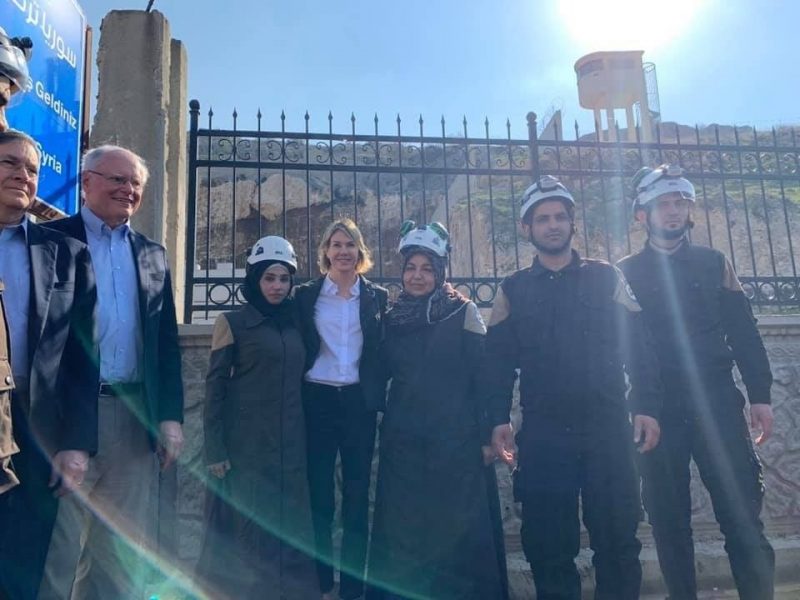
The United States has further complicated the game through a recent visit made by the entourages of two senior U.S. officials who visited Syria’s Idlib on March 3rd and pledged $108 million aid for Syrian civilians, hours after Turkey downed its second Syrian warplane in the province. Who exactly would receive the money and how it would be distributed was, inevitably, not immediately clear.
The two diplomats slipped over the border from Turkey with the connivance of Ankara and several Syrian “resistance” groups. They conspicuously met with the so-called White Helmets, a group that claims to be involved in nonpartisan humanitarian rescue missions but which really is affiliated with terrorists, most notably the Hayat Tahrir al-Sham (HTS), which is affiliated with al-Qaeda. HTS is the principal terrorist group operating in Idlib.
The group of American diplomats was headed by U.S. representative to the United Nations Kelly Craft, along with U.S. Special Envoy for Syria James Jeffrey. It was the first visit by American diplomats to Idlib. Craft announced that the aid package was for “the people of Syria in response to the ongoing crisis caused by Assad regime, Russian, and Iranian forces”. Jeffrey struck a more directly belligerent pose, saying that Washington would be providing ammunition in addition to the humanitarian assistance. “Turkey is a NATO ally. Much of the military uses American equipment. We will make sure that equipment is ready and usable.”
U.S. policy in Syria serves no American interest, but both Craft and Jeffrey are well known to be in the pocket of Israel. Craft, a big time GOP donor, who, in her fifteen months spent as Ambassador to Canada was remarkable for flying back to the U.S. from Ottawa 128 times, 70 of which were to her home in Kentucky. All on the government dime even though she is an extremely wealthy woman.
Craft left Canada when she replaced the arch Zionist Nikki Haley at the U.N. She emphasized in her confirmation hearing before the Senate Foreign Relations Committee that she would “fight against anti-Israel resolutions and actions by the U.N. and its affiliated agencies.” She also “made a case for America returning to a leading role at Turtle Bay [the U.N.] as a way of protecting Israel… Without U.S. leadership, our partners and allies would be vulnerable to bad actors at the U.N. This is particularly true in the case of Israel, which is the subject of unrelenting bias and hostility in U.N. venues. The United States will never accept such bias, and if confirmed I commit to seizing every opportunity to shine a light on this conduct, call it what it is, and demand that these outrageous practices finally come to an end.”
Jeffrey is even more the zealot. His full title is as United States Special Representative for Syria Engagement and the Special Envoy for the Global Coalition to Defeat ISIL. He is, generally speaking, a hardliner politically, closely aligned with Israel and regarding Iran as a hostile destabilizing force in the Middle East region. He was between 2013 and 2018 Philip Solondz distinguished fellow at the Washington Institute for Near East Policy (WINEP), a think tank that is a spin-off of the American Israel Public Affairs Committee (AIPAC). He is currently a WINEP “Outside Author” and go-to “expert.”
Professor John Mearsheimer of the University of Chicago and Stephen Walt, academic dean at Harvard University ‘s Kennedy School of Government, describe WINEP as “part of the core” of the Israel Lobby in the U.S. They examined the group on pages 175-6 in their groundbreaking book The Israel Lobby and US Foreign Policy and concluded as follows:
“Although WINEP plays down its links to Israel and claims that it provides a ‘balanced and realistic’ perspective on Middle East issues, this is not the case. In fact, WINEP is funded and run by individuals who are deeply committed to advancing Israel’s agenda … Many of its personnel are genuine scholars or experienced former officials, but they are hardly neutral observers on most Middle East issues and there is little diversity of views within WINEP’s ranks.”
Jeffrey set the tone for his term of office shortly after being appointed by President Trump back in August 2018 when he argued that the Syrian terrorists were “. . . not terrorists, but people fighting a civil war against a brutal dictator.” Jeffrey, who must have somehow missed a lot of the head chopping and rape going on, subsequently traveled to the Middle East and stopped off in Israel to meet Prime Minister Benjamin Netanyahu. It has been suggested that Jeffrey received his marching orders during the visit.
So, Trump bleats incessantly about how he wants to withdraw the U.S. from the senseless wars that it has been drawn into but at the same time his State Department sends two Zionist hardliners to Syria on a semi-secret mission to support a policy of regime change in Damascus while also providing aid that will inevitably fall into the pockets of an al-Qaeda linked terrorist group. And ammunition will also be forthcoming for the invading Turks to shoot Syrians, Russians and Iranians. If anyone is seriously interested in what is wrong with U.S. foreign policy, the activity of Craft and Jeffrey might serve as a decent case study on how not to do it. Unless, of course, the actual objective is to screw things up and involve the United States in quarrels that it could easily avoid.
Philip M. Giraldi is a former CIA counter-terrorism specialist and military intelligence officer who served nineteen years overseas in Turkey, Italy, Germany, and Spain. He was the CIA Chief of Base for the Barcelona Olympics in 1992 and was one of the first Americans to enter Afghanistan in December 2001. Phil is Executive Director of the Council for the National Interest, a Washington-based advocacy group that seeks to encourage and promote a U.S. foreign policy in the Middle East that is consistent with American values and interests.
Iraqi military confirms attack on Taji base, says it shouldn’t be pretext for foreign ops on its soil
RT | March 14, 2020
A military base in Iraq housing US troops has been targeted in a rocket attack that severely injured Iraqi soldiers, the nation’s military confirmed. It also warned that the strike does not warrant a retaliation by foreign powers.
As many as 33 Katyusha rockets have been launched at the Taji base north of the Iraqi capital, Baghdad. The strike left several Iraqi air defense soldiers “critically injured,” according to the military statement. It is unclear if any US personnel have been affected.
The military urged all foreign forces to implement the national parliament’s resolution, passed after the US killing of Iranian top general Qasem Soleimani, and withdraw troops from Iraq.
The incident comes two days after the US launched its own airstrikes against an Iranian-backed Shia militia in Iraq, which it blames for the previous assault on a base where Western forces are stationed. The attack claimed the lives of three soldiers, two American and one British.
The move sparked angry reaction in Baghdad, which said it would file a complaint to the UN Security Council over the issue while the targeted militia called it a violation of Iraq’s sovereignty.
Investigation finds Israel soldiers shot at Palestinians simply making a U-turn
![Israeli soldiers fire at Palestinians [Ahmad Talat/Anadolu Agency]](https://i0.wp.com/www.middleeastmonitor.com/wp-content/uploads/images/article_images/middle-east/Israeli-soliders-gather-and-aim-tear-gas-at-palestinian-protestors-in-west-bank-nablus.jpg?resize=1200%2C772&quality=85&strip=all&ssl=1)
Israeli soldiers fire at Palestinians [Ahmad Talat/Anadolu Agency]
MEMO | March 13, 2020
An investigation by Israeli newspaper Haaretz has revealed that Israeli soldiers opened fire on a Palestinian vehicle whose driver was simply making a U-turn, in what military officials described at the time as an attempted ‘car-ramming’ attack.
According to the paper, on 20 February, the Israeli army spokesperson reported that soldiers had shot at a Palestinian vehicle that accelerated toward them in Beitin village, “in what media reports described as a suspected car ramming attack”.
In fact, after obtaining two videos and interviewing the survivors and witnesses, Haaretz reported that Israeli occupation forces opened fire “as the driver was making a U-turn and hit a rock, and that the soldiers faced no life-threatening situation”.
On the night in question, four Palestinian teenagers from nearby Deir Dibwan were driving toward Beitin at 8.30pm, when “they saw a military jeep coming down the road in the opposite lane”.
Panicking “because the driver had no license, they did a U-turn to head back to Deir Dibwan but struck a rock on the side of the road”, Haaretz described. The Israeli soldiers then got out of the jeep, shooting into the air and then at the car.
One of the passengers, Mohammed Sarameh, was seriously injured and is awaiting further surgery. According to the paper, “his medical file says one bullet had struck him in the back and another hit his left thigh”, and that “he cannot move his limbs and has sustained many injuries in his abdomen”.
Haaretz noted that none of the youths in the car were “suspected of any attacks or attempted attacks” by Israeli authorities.
Moreover, “a look at the car shows that signs of bullet entries appear only on the back of the vehicle. If the soldiers shot while the car was careening toward them then such signs should have appeared on the front or sides of the vehicle.”
The army has also “changed its version of events about the incident,” Haaretz added. For this latest article, the Israeli military spokesperson merely acknowledged that “troops saw a car accelerating toward them and thought it was an attempted car ramming therefore they shot at the vehicle”.
US Intel Agencies Played Unsettling Role in Classified and “9/11-like” Coronavirus Response Plan
By Whitney Webb | MintPress News | March 13, 2020
As the COVID-19 coronavirus crisis comes to dominate headlines, little media attention has been given to the federal government’s decision to classify top-level meetings on domestic coronavirus response and lean heavily “behind the scenes” on U.S. intelligence and the Pentagon in planning for an allegedly imminent explosion of cases.
The classification of coronavirus planning meetings was first covered by Reuters, which noted that the decision to classify was “an unusual step that has restricted information and hampered the U.S. government’s response to the contagion.” Reuters further noted that the Secretary of the Department of Health and Human Services (HHS), Alex Azar, and his chief of staff had “resisted” the classification order, which was made in mid-January by the National Security Council (NSC), led by Robert O’Brien — a longtime friend and colleague of his predecessor John Bolton.
Following this order, HHS officials with the appropriate security clearances held meetings on coronavirus response at the department’s Sensitive Compartmentalized Information Facility (SCIF), which are facilities “usually reserved for intelligence and military operations” and — in HHS’ case — for responses to “biowarfare or chemical attacks.” Several officials who spoke to Reuters noted that the classification decision prevented key experts from participating in meetings and slowed down the ability of HHS and the agencies it oversees, including the Centers for Disease Control and Prevention (CDC), to respond to the crisis by limiting participation and information sharing.
It has since been speculated that the decision was made to prevent potential leaks of information by stifling participation and that aspects of the planned response would cause controversy if made public, especially given that the decision to classify government meetings on coronavirus response negatively impacted HHS’ ability to respond to the crisis.
After the classification decision was made public, a subsequent report in Politico revealed that not only is the National Security Council managing the federal government’s overall response but that they are doing so in close coordination with the U.S. intelligence community and the U.S. military. It states specifically that “NSC officials have been coordinating behind the scenes with the intelligence and defense communities to gauge the threat and prepare for the possibility that the U.S. government will have to respond to much bigger numbers—and soon.”
Little attention was given to the fact that the response to this apparently imminent jump in cases was being coordinated largely between elements of the national security state (i.e. the NSC, Pentagon, and intelligence), as opposed to civilian agencies or those focused on public health issues, and in a classified manner.
The Politico article also noted that the intelligence community is set to play a “key role” in a pandemic situation, but did not specify what the role would specifically entail. However, it did note that intelligence agencies would “almost certainly see an opportunity to exploit the crisis” given that international “epicenters of coronavirus [are] in high-priority counterintelligence targets like China and Iran.” It further added, citing former intelligence officials, that efforts would be made to recruit new human sources in those countries.
Politico cited the official explanation for intelligence’s interest in “exploiting the crisis” as merely being aimed at determining accurate statistics of coronavirus cases in “closed societies,” i.e. nations that do not readily cooperate or share intelligence with the U.S. government. Yet, Politico fails to note that Iran has long been targeted for CIA-driven U.S. regime change, specifically under the Trump administration, and that China had been fingered as the top threat to U.S. global hegemony by military officials well before the coronavirus outbreak.
A potential “9/11-like” response
The decision to classify government coronavirus preparations in mid-January, followed by the decision to coordinate the domestic response with the military and with intelligence deserves considerable scrutiny, particularly given that at least one federal agency, Customs and Border Patrol (CBP), will be given broad, sweeping powers and will work closely with unspecified intelligence “partners” as part of its response to a pandemics like COVID-19.
The CBP’s pandemic response document, obtained by The Nation, reveals that the CBP’s pandemic directive “allows the agency to actively surveil and detain individuals suspected of carrying the illness indefinitely.” The Nation further notes that the plan was drafted during the George W. Bush administration, but is the agency’s most recent pandemic response plan and remains in effect.
Though only CBP’s pandemic response plan has now been made public, those of other agencies are likely to be similar, particularly on their emphasis on surveillance, given past precedent following the September 11 attacks and other times of national panic. Notably, several recent media reports have likened coronavirus to 9/11 and broached the possibility of a “9/11-like” response to coronavirus, suggestions that should concern critics of the post-9/11 “Patriot Act” and other controversial laws, executive orders and policies that followed.
While the plans of the federal government remain classified, recent reports have revealed that the military and intelligence communities — now working with the NSC to develop the government’s coronavirus response — have anticipated a massive explosion in cases for weeks. U.S. military intelligence came to the conclusion over a month ago that coronavirus cases would reach “pandemic proportions” domestically by the end of March. That military intelligence agency, known as the National Center for Medical Intelligence (NCMI), coordinates closely with the National Security Agency (NSA) to conduct “medical SIGINT [signals intelligence].”
The coming government response, the agencies largely responsible for crafting it and its classified nature deserve public scrutiny now, particularly given the federal government’s tendency to not let “a serious crisis to go to waste,” as former President Obama’s then-chief of staff Rahm Emanuel infamously said during the 2008 financial crisis. Indeed, during a time of panic — over a pandemic and over a simultaneous major economic downturn — concern over government overreach is warranted, particularly now given the involvement of intelligence agencies and the classification of planning for an explosion of domestic cases that the government believes is only weeks away.
China does not rule out US role in coronavirus outbreak
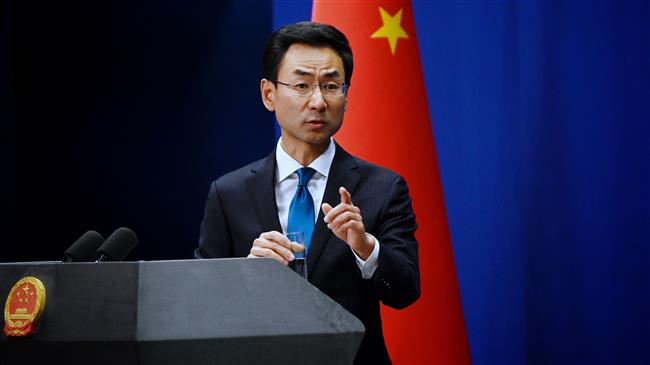
China’s Ministry of Foreign Affairs spokesman Geng Shuang (Photo by AFP )
Press TV – March 13, 2020
The Chinese Foreign Ministry has not ruled out the possibility that the United States was to blame for the spread of the new coronavirus in the Asian country.
Geng Shuang, the ministry spokesman, sidestepped questions on Friday about whether Beijing viewed Washington as responsible for the deadly virus outbreak in China, a day after another spokesman suggested the US army could have engineered it.
Speaking at a news conference in the Chinese capital, Geng refused to directly comment when asked whether his colleague Zhao Lijian’s comments were consistent with Beijing’s official stance on the virus.
“In fact, the international community, including people within the US, have different opinions about the origin of the virus,” Geng told reporters at the presser.
“As I have been saying for a few days, China has always seen this as a matter of science, and scientific and professional opinions must be heard.”
Geng went on to say, “You’re very interested to know if Zhao Lijian’s views represent the views of the Chinese government.”
“I believe that perhaps you would be better off first asking whether or not recent comments from a number of senior US officials attacking or smearing China represent the US government’s position.”

Chinese Foreign Ministry spokesman Zhao Lijian
In a strongly-worded tweet, written in English, Zhao blasted the US on Thursday for what he called lack of transparency in official reports regarding the coronavirus outbreak in the US.
He suggested that the US military might have brought the new coronavirus to the Chinese city of Wuhan, the birthplace of the current global pandemic.
“When did patient zero begin in US? How many people are infected? What are the names of the hospitals? It might be US army who brought the epidemic to Wuhan. Be transparent! Make public your data! US owe us an explanation!” Zhao wrote.
The Chinese government had been criticized by Western media and particularly by US officials for what was alleged to be a slow response to the outbreak and of not being sufficiently transparent.
Beijing has, however, been taking strict measures since the outbreak began, including locking down Wuhan, a city of roughly 11 million people, which appears to have paid off.
The COVID-19 disease, caused by the new coronavirus, emerged in the provincial capital of Hubei late last year and is currently affecting 131 countries and territories across the globe. It has so far infected over 137,000 people and killed more than 5,000 others.
The World Health Organization has declared the coronavirus outbreak a global pandemic.
Pompeo slams Iran’s ‘biological defense’ against Covid-19, sidesteps Khamenei’s ‘biological attack’ claims
RT | March 13, 2020
US Secretary of State Mike Pompeo has criticized Iran’s efforts at “biological defense” against Covid-19, but conspicuously avoided addressing Ayatollah Khamenei’s claim that the virus was a “biological attack.”
Khamenei all but accused the US of weaponizing coronavirus in a speech on Thursday, announcing the establishment of a military “Health and Treatment Base” to fight the disease. He declared that the facility “may also be regarded as a biological defense exercise… given the evidence that suggests the likelihood of this being a ‘biological attack.'”
Khamenei repeated the inflammatory claim in a series of tweets, echoing the words of Islamic Revolutionary Guard Corps chief Hossein Salami, who last week floated the “possibility” that coronavirus was the “product of a biological attack by America which initially spread to China and then to Iran and the rest of the world.”
But instead of responding to the cleric’s accusations, Pompeo merely chided him for not “telling the Iranian people the truth about the Wuhan virus when it spread to Iran from China” in a tweet on Friday, suggesting Tehran missed an opportunity for “the best biological defense” when it failed to curtail flights from Wuhan and “jailed those who spoke out.” He made no mention at all of the virus as a “biological attack” – American or otherwise.
Other Iranian officials have avoided openly accusing Washington of deploying the virus as a weapon, focusing instead on how US sanctions have contributed to the epidemic’s devastating effects. Foreign Minister Mohammad Javad Zarif slammed the Trump administration’s “medical terrorism” earlier this week, pointing out that artificially-induced shortages have put a major strain on hospitals’ resources. More than two dozen Iranian officials have fallen ill with the coronavirus in the weeks since it first surfaced in Iran in what appears to be an especially virulent form.
While the virus now known as Covid-19 first gained international attention in Wuhan, where it was thought to have originated in an open-air meat market, further research appears to disprove that hypothesis – opening the matter to speculation. And the Iranians are not alone in suggesting US responsibility for the epidemic, which has spread to 116 countries and killed over 5,000 people globally as of Friday.
Chinese Foreign Ministry spokesman Zhao Lijian came forward on Thursday to suggest that a US military delegation had brought the virus to Wuhan in October during the World Military Games, tweeting as his “proof” a video of the director of the US Centers for Disease Control admitting that some patients thought to have died of the flu later tested positive for the coronavirus.
Update on the OPCW’s investigation of the Douma incident
Paul McKeigue, David Miller, Piers Robinson
Members of Working Group on Syria, Propaganda and Media
- 1 Summary
- 2 Irregularities in the published reports of the Fact-Finding Mechanism
- 2.1 No comparison with epidemiology or toxicology of chlorine release incidents
- 2.2 Withholding of quantitative results of chemical analyses
- 2.3 Delay in initiating engineering / ballistics studies, inadequate reporting
- 2.4 Ignoring evidence of staging in images uploaded by opposition-linked media
- 2.5 Blending of witness interviews and exclusion of testimony that the hospital scene had been staged
- 2.6 Conduct of the investigation
- 3 What we now know about misconduct in the Douma investigation
- 3.1 Attempt to substitute a modified report for the original interim report
- 3.2 Suppression of quantitative lab results
- 3.3 Suppression of inconsistencies in the eyewitness testimony
- 3.4 Suppression of the consultation with medical experts in June 2018
- 3.5 Concealing the date and rationale for the decision not to proceed with exhumations
- 3.6 Attempt by US officials to influence the inspectors
- 3.7 Unreviewed report prepared by unknown authors presented as “the Report of the Fact-Finding Mechanism”
- 3.8 Suppression of the engineering assessment
- 3.9 The three external engineering/ballistics consultancies supposedly obtained by the FFM
- 4 The OPCW’s investigation into “Possible Breaches of Confidentiality”
- 5 The Investigation and Identification Team (IIT)
1 Summary
- As we noted in April 2019, there were defects in the published interim and final Reports of the Fact-Finding Mechanism on the Douma incident that indicated that evidence had been withheld or distorted.
- From comparing the original Interim Report drafted in June 2018, the modified report that was intended to be substituted for it, and the published Final Report, it is clear that this was not simply a divergence of opinions between experts. The misrepresentation of evidence in the published Final Report can reasonably be described as fraudulent. Specifically, the following points can be identified:
- Quantitative results on the levels of chlorinated organic compounds were suppressed. A false assertion about “high levels” of these compounds had been added to the modified report.
- An assessment based on the epidemiology of chlorine release incidents was omitted from the modified report and the Final Report.
- On-site assessments that the observations were incompatible with aerial delivery of the cylinders were omitted from the modified report and the Final Report.
- The testimony of opposition-linked witnesses interviewed in Turkey was rewritten in the Final Report so as to obscure inconsistencies about the distribution of bodies at Location 2 that would have cast doubt on the reliability of their testimony.
- The result of the consultation with medical experts in June 2018, indicating that the victims had not been killed by chlorine, was suppressed and omitted from the timeline of the investigation published in the Final Report.
- The internal engineering assessment was excluded from the published Final Report.
- In violation of Article VIII of the Chemical Weapons Convention, the Chief of Cabinet allowed US officials to attempt to influence the inspectors in July 2018.
- The evidence of fraud in the published report of the Douma investigation means that all other published reports from FFM Team Alpha, including the FFM reports on the alleged chlorine attacks in 2015 and the alleged sarin attack in Khan Sheikhoun in 2017, must also be disregarded as unreliable and possibly fraudulent.
- The OPCW’s report on 6 February 2020 of what was purported to be an investigation into the leak of the engineering assessment to the Working Group was used instead to smear two of the organization’s most experienced and highly-rated inspectors with false and misleading statements.
- It is now clear that the Director-General’s statements on 28 May and 6 June 2019 that the FFM had “examined, weighed and deliberated”, “considered” and “analysed” the engineering assessment were unequivocally false: the Team Leader and Head of the FFM had refused to accept the document in February 2019.
- The Douma investigation has been passed to the Identification and Inspection Team (IIT). A brief examination of the careers of the investigators and analysts appointed to the IIT shows that all four of them have serious conflicts of interest. This calls into question their ability to resist pressure to come up with the answers that the influential delegations of the US, UK and France want.
2 Irregularities in the published reports of the Fact-Finding Mechanism
In a briefing note posted on 11 April 2019, we drew attention to defects in the published FFM reports that indicated, to anyone who examined these reports closely, that evidence had been withheld or distorted. We review this material briefly before examining what new information has been provided by documents and briefings released from May 2019 onwards.
2.1 No comparison with epidemiology or toxicology of chlorine release incidents
The reports did not assess whether the alleged chemical attack was consistent with the epidemiology of chlorine release incidents, which typically have low case fatality rate.
The analysis of the images of victims stated that “this type of rapid collapse is indicative of an agent capable of quickly killing or immobilising” but did not explain how this opinion was compatible with release of chlorine from an intact gas cylinder on the balcony, or with the presence of foamy pulmonary edema that would take time to develop.
2.2 Withholding of quantitative results of chemical analyses
Quantitative results of lab analyses were withheld. The lack of concordance between labs suggested that chlorinated organic compounds were present only at trace levels, close to the lower limit of detection.
The reports did not make clear that trace levels of these compounds are ubiquitous in environments where industrial or household products are present.
The Final Report emphasized correctly that testing for exposure to chlorine depends on comparison with control samples, but inexplicably did not report results for the control samples that were taken.
Although molecular chlorine is not naturally present in the environment, chloride ions and many chlorinated organic derivatives exist in the natural background. For that reason it was important to gather control samples, wherever feasible, at locations not expected to have been exposed to chlorine gas.
In Table A9.3 two specimens are described as control samples:
- Control sample: debris 20 meters west of the building entry (level 0): 2018.04.21_1909_04
- Concrete dust scraping at pillar 51: 2018.05.01_1779_05
From the Evidence Reference Numbers listed in Table A5.1 we can deduce that these two control samples relate to Location 2 (numbers prefixed 2018.04.21_1909) and the hospital (numbers prefixed 2018.05.01 1779).
Results for these samples are not given.
This should have raised questions about the conduct of the investigation. If rigorous procedures had been followed, with control samples included in the same batches as putatively exposed samples and laboratory staff blinded to exposure status, the omission of control samples from analysis or reporting could only have been deliberate.
We emphasize that the issue here is not whether chlorine was released, but that the withholding of quantitative results and failure to report results on control samples is strong evidence of scientific misconduct.
2.3 Delay in initiating engineering / ballistics studies, inadequate reporting
Three engineering/ballistics consultations are mentioned in the final report: but the figures show screenshots from what appears to be only a single study using a software package for finite-element analysis, These are barely legible screenshots, not of the professional standard one would expect from experts preparing a report for an international agency. Figures 10 and A7.6 show a simulation of the impact at Location 4 with a cylinder without harness or valve, though the cylinder found on the bed had a harness and an intact valve. The barely legible graphs based on the simulation assume improbably low drop heights for a helicopter flying over defended territory. Figure 12 shows the cylinder at Location 4 bouncing off the floor at 2 m/s, which would not have allowed it to reach the bed more than 3 metres away.
There was no explanation for why, if the FFM had considered it necessary to obtain expert opinions on the possible trajectories of the cylinders found at Locations 2 and 4, they did not request on-site examinations while the FFM was deployed in Damascus in April/May, rather than six months later when inspection of the sites and cylinders was no longer possible.
2.4 Ignoring evidence of staging in images uploaded by opposition-linked media
An analysis of images uploaded on the night of 7 April showed that bodies had been rearranged between photo sessions: infants first shown separated from adults were subsequently placed on the bodies of adult women. The opposition cameramen attempted for the first few days to represent the cylinder at Location 4 as the cause of the deaths at Location 2.
2.5 Blending of witness interviews and exclusion of testimony that the hospital scene had been staged
Information obtained from interviews was summarized in the Final Report without any distinction between information obtained from witnesses in Damascus and those interviewed in Turkey (who would have been opposition supporters who had relocated to Idlib under the evacuation agreement), and without any effort to establish whether the presence of each witness at the scene was corroborated by other evidence. The report was written to make it appear as if the witnesses who reported that the hospital dousing scene had been staged were never formally interviewed by the FFM, downgrading their testimony to “other open-source video material”.
2.6 Conduct of the investigation
The Team Leader had left Damascus for unexplained “information gathering activities” in Turkey three days after arriving, before on-site inspections had begun. All evidence other than the lab results was withheld from the Interim Report released in July 2018, even though most of the evidence – witness interviews, one-site assessment of the cylinder and craters, analysis of uploaded images of victims – had already been collected. There was an unexplained delay in the investigation between June and September 2018. Both the interim and final reports were unsigned, though previous FFM reports had been signed by the Team Leader.
In summary, it was possible by April 2019 for anyone with a scientific grounding who read the published reports closely to infer, as we did, that something was wrong with the published reports of the FFM on the Douma incident. We listed most of the points above in our briefing note posted in April 2018, but missed one of the most interesting clues: that results on control samples were not reported even though these samples had been collected. From [reports] that a Russian proposal for all members of the FFM team to give a briefing on the Final Report had been voted down by the OPCW Executive Council on 14 March 2019, it was evident that there was dissent among members of the FFM team.
3 What we now know about misconduct in the Douma investigation
During 2019 more information about the Douma investigation reached the public domain. This began with the release of the engineering assessment in May 2019, continued with the briefing of a panel convened by the Courage Foundation in October 2019 and the release of more internal documents including the original draft of the interim report in December 2019, and finally the release of a written statement provided to the UN Security Council.
3.1 Attempt to substitute a modified report for the original interim report
We now know that the published Interim Report, which reported only lab results, was the result of a stand-off between the Team Leader Sami Barrek and the other inspectors. In June 2019 a secretly-prepared modified report had been substituted for the original interim report.
This original interim report had stated that “Although the cylinders might have been the sources of the suspected chemical release, there is insufficient evidence to affirm this”. The modified report asserted instead that there was “sufficient evidence at this time to determine that chlorine, or another reactive chlorine-containing chemical, was likely released from cylinders.” The section on the epidemiology of chlorine release incidents in the original interim report, which had noted that in such incidents most of those exposed manage to escape, was omitted from the modified report.
The original interim report had noted that preliminary observations on the cylinders and the impact sites raised doubts about the story that the cylinders had been dropped from the air:
The FFM team is unable to provide satisfactory explanations for the relatively moderate damage to the cylinders allegedly dropped from an unknown height, compared to the destruction caused to the rebar-reinforced concrete roofs. In the case of Location 4, how the cylinder ended up on the bed, given the point at which it allegedly penetrated the room, remains unclear. The team considers that further studies by specialists in metallurgy and structural engineering or mechanics are required to provide an authoritative assessment of the team’s observations.
In the modified report this passage was removed, and the question of “how the cylinder ended up on the bed” at Location 4 was replaced by assessing “the trajectory of the cylinder”, implicitly excluding the possibility of manual placement.
The team considers that further analysis would need to be conducted by suitable experts, possibly in metallurgy and structural or mechanical engineering, to provide an assessment of the trajectory of the cylinder, in addition to the damage caused to the bed, the roof and the cylinder itself.
3.2 Suppression of quantitative lab results
The modified report asserted that “high levels of various chlorinated organic derivatives” were present in organic samples. These chlorinated organic compounds were present mostly at levels of only a few parts per billion, not above the background levels that would be expected in an environment where industrial products were present. The quantitative results were withheld from the inspectors who had deployed to Damascus. The inspectors protested about the withholding of quantitative results, and were assured that they would be included in the interim report, only to find that they were withheld from the published version.
3.3 Suppression of inconsistencies in the eyewitness testimony
The original interim report clearly separated the eyewitness accounts obtained in Damascus from those obtained in Turkey (referred to as “Country X”). It also noted inconsistencies between the statements of witnesses that raised questions about their credibility:
There were variations (see table and footnotes below) in the numbers of bodies and their distribution throughout Location 2 as observed in video footage and photos, compared to the numbers provided by various witnesses who were interviewed. According to statements from witnesses, “many people they presumed dead, were lying on the floor of the basement”. The FFM did not obtain any video footage or photos of dead casualties lying in the basement of Location 2 or being removed from there.
The table showed that of seven witnesses who reported the distribution of bodies at Location 2, two reported bodies in basement only, one reported bodies at ground level and above only, and four reported bodies both in basement and above ground level. The videos had not shown any bodies in the basement.
3.4 Suppression of the consultation with medical experts in June 2018
It is now clear that the vague and contradictory account of expert opinions about the cause of death of the victims in the Final Report is explained by suppression of the consultation with medical experts that took place on 6 June 2018 at the Bundeswehr Research Institute for Protective Technologies and NBC Protection (WIS) in Munster. The “chief expert” can be identified as Colonel Dr Franz Worek, the leading medical expert on chemical defence in the Bundeswehr.
His argument, reconstructed from the original interim report written in June 2018 and the minutes written two months later, was as follows:
- Pulmonary edema is a delayed effect of “choking agents” such as chlorine which cause acute inhalation injury. If the victims of exposure to such an agent had had lived long enough for their airways to be filled with foamy edema fluid, they would have been able to escape and would not have collapsed “gathered in piles” on the spot.
- Massive exposure to chlorine can cause laryngospasm leading to immediate asphyxiation, but in this situation there would not be time for foamy pulmonary edema to develop
- Cholinesterase inhibitors (nerve agents) [or opiates, we would add] could have caused instant collapse and also rapid onset of pulmonary edema, but known agents were ruled out by the negative lab tests.
The OPCW participants agreed that the conclusions were clear: whatever killed the victims, it was not chlorine. This consultation does not appear in the timeline of the final Report of the Fact-Finding Mission: the first toxicology consultations are dated to September 2018.
3.5 Concealing the date and rationale for the decision not to proceed with exhumations
The original interim report recorded that plans for exhumations were halted when the first lab results were received on 22 May 2018:
When the analytical results of the first round of environmental and biological samples were received and no nerve agents or their degradation products were identified in either environmental or biological samples, the plans for exhumations were halted as the risk of not finding substantive evidence of the alleged attack was now considered high and proceeding with the exhumations presented a risk to benefit ratio that was no longer acceptable.
The Interim Report released on 6 July 2018 stated that the intention to exhume bodies from mass graves was “communicated to the Syrian Arab Republic in Note Verbale NV/ODG/214827/18” without indicating that plans for exhumation had been halted two months earlier. The Final Report omits the date and the rationale for the decision not to proceed with exhumations, and insinuates that the Syrian Arab Republic was responsible for delaying exhumations until they would no longer be informative:
The Syrian Arab Republic replied in Note Verbale No. 45 on 4 May 2018 and enumerated the conditions to be met in order to conduct the exhumation. With due consideration of the time elapsed since the alleged incident, the possibility was eventually not explored any further.
3.6 Attempt by US officials to influence the inspectors
In the first week of July 2018 all FFM team members were summoned by the Chief of Cabinet, Robert Fairweather, to a meeting with three US officials who asserted that their findings proved that there had been a chlorine attack. This attempt to influence the inspectors violated Article VIII Part D of the Chemical Weapons Convention, which stipulates that:
In the performance of their duties, the Director-General, the inspectors and the other members of the staff shall not seek or receive instructions from any Government or from any other source external to the Organization. They shall refrain from any action that might reflect on their positions as international officers responsible only to the Conference and the Executive Council.
Each State Party shall respect the exclusively international character of the responsibilities of the Director-General, the inspectors and the other members of the staff and not seek to influence them in the discharge of their responsibilities.
3.7 Unreviewed report prepared by unknown authors presented as “the Report of the Fact-Finding Mechanism”
FFM team members who had deployed to Douma were excluded from preparation of the final report, and were not even kept informed of its status or expected date of publication. No technical peer review of the final report was conducted. In particular the only organic chemist and the only chemical engineer on the team were excluded from drafting and reviewing the report. A briefing to States Parties was given on 5 March 2019 by Boban Cekovic, a former inspector who could not have contributed to the investigation before December 2018 when he rejoined the OPCW.
3.8 Suppression of the engineering assessment
It is now clear that the absence of an on-site engineering opinion in the Final Report is explained by deliberate suppression. Ian Henderson had been tasked with the Location and Munition (cylinder) study in the work plan issued by the Team Leader on 26 June 2018. He was excluded from external consultations held later that year. The Team Leader and the FFM Leader refused to accept Henderson’s engineering report on 26 February 2019. The Chief of Cabinet, Sebastien Braha, attempted to have all copies of the Engineering Assessment destroyed and also ordered that the log of the Document Registration Archive be altered to erase “all traces, if any, of [the document’s] delivery/storage/whatever in DRA”.
We have noted previously that the OPCW has come up with three contradictory explanations of why Ian Henderson’s Engineering Assessment was excluded from the Final Report of the FFM:
- 1E1: the document was “not part of any of the material produced by the FFM”.
- 2E2: the document was “analysed, it was part of the investigation” but rebutted by the reports of “three external experts commissioned by the FFM”.
- 3E3: the document “pointed at possible attribution which is outside of the mandate of the FFM” and Henderson was therefore advised to submit his assessment to the IIT.
Arias has on two occasions asserted that the Engineering Assessment was considered by the FFM. In a briefing on 28 May 2019 he stated that:
The document produced by this staff member pointed at possible attribution, which is outside of the mandate of the FFM with regard to the formulation of its findings. Therefore, I instructed that, beyond the copy that would exclusively be kept by the FFM, the staff member be advised to submit his assessment to the IIT, which he did, so that this document could later be used by the IIT. As is the case with all FFM investigations, the Secretariat encourages serious and professional debates within, so all views, analysis, information and opinions are considered. This is what the FFM did with the information included in the publicly disclosed document [the Engineering Assessment]; all available information was examined, weighed and deliberated.
In a panel discussion on 6 June 2019 Arias stated that
This information [the Engineering Assessment] was considered and it was analysed, it was part of the investigation and this information has already been given to the Investigation and Identification Team in charge of attributing responsibilities because this information you referred to is more focussing, is more targeted to to establish responsibility than to focus to the facts.
These statements by Arias are unequivocally false. Henderson’s statement to the UN Security Council makes clear that his Engineering Assessment was never considered by the FFM: the Team Leader and the head of the FFM had refused to accept it.
In Arias’s latest briefing, his widely ridiculed explanation 3E3 that the Engineering Assessment had been excluded from the FFM report because it “pointed at possible attribution” which was “outside the mandate of the FFM” was abandoned. Instead he reverted to explanation 1E1:
Inspector A’s assessment purports to be an official OPCW FFM report on the Douma incident. Instead it is a personal document created with incomplete information and without authorisation.
He conceded that “In the interest of transparency and completeness, Inspector A’s assessment has been transmitted to the IIT and will be examined by it in due course.”
3.9 The three external engineering/ballistics consultancies supposedly obtained by the FFM
The Final Report, without mentioning that an internal engineering assessment had been excluded, stated that engineering/ballistics assessments had been obtained from three external experts, and described the results of the assessments of the cylinder at Location 4 as follows:
The results of these assessments indicated that the shape of the aperture produced in the modulation matched the shape and damage observed by the team. The assessments further indicated that, after passing through the ceiling and impacting the floor at lower speed, the cylinder continued altered trajectory, until reaching the position in which it was found.
In the light of other irregularities in the Final Report, we may reasonably be suspicious of the Final Report’s assertion that reports from three independent experts supported the explanation that the cylinders at Locations 2 and 4 reached their positions as a result of being dropped from the air.
If these three assessments exist, and their conclusions were as described in the Final Report, it should have been straightforward to document this. We have been informed that one report was obtained from a European institute with expertise in impact engineering, and that this group assessed that it was “very unlikely” that the cylinder at Location 4 had reached its position as a result of being dropped from the sky.
At a press conference in The Hague on 12 July 2019, Alexander Shulgin, the Russian envoy to the OPCW, stated that:
We would like to review the reports of the three independent experts that made a conclusion that these canisters were dropped from high altitude. You are free not to name them. We already know the name of one of the experts and we highly doubt that they are indeed unbiased.
In an interview in November 2019, Shulgin expressed doubts about the existence of three reports: “The refusal of the Technical Secretariat to unveil the reports of these anonymous outside experts makes us question whether these reports ever existed.” He added that the expert whose name he knows “has a rather dubious reputation in terms of his impartiality, and he is anything but a specialist in ballistics”.
4 The OPCW’s investigation into “Possible Breaches of Confidentiality”
This investigation was originally set up to investigate the leak of the Engineering Assessment to the Working Group in May 2019. However the report of the investigation, the briefing from the Director-General, Fernando Arias, and the accompanying press release were used instead to smear two of the organization’s most experienced and highly-rated inspectors.
The smears include unequivocally false statements – for instance that Inspector A “was not a member of the FFM” – and misleading statements whose only purpose is to denigrate: for instance that Inspectors A and B were “rehired at a lower grade” without explaining that the P-5 grade had been merged with the P-4 grade.
One notably false assertion is that “The majority of the FFM’s work occurred after Inspector B’s separation, and during the last seven months of the FFM’s investigation (August 2018 through February 2019).”
The timeline in the published report shows that the additional information gathered during this period consisted only of interviews with an additional five witnesses in Turkey (October 2018), toxicology consultations (September-October 2018), engineering/ballistics reports purportedly obtained from three external experts (October-December 2018), and lab analyses of a second batch of samples (received February 2019).
Comparison of the original interim report with the Final Report shows that most of the text and figures in the Final Report had already been prepared by June 2018. The only substantive new material that appears in the Final Report consists of figures generated from one of these engineering consultations.
The delay from June 2018 to September 2018 in resuming the investigation is explicable by the necessity to wait until Inspector B had left the organization at the end of his contract.
The OPCW management’s denunciation of Inspectors A and B for “unauthorised disclosure of highly protected information to individuals who did not have a need to know such information.” is unintentionally revealing.
This makes clear that the preparation of the report of the FFM was organized like a covert operation, with information shared on the basis of “need to know”, rather than as a scientific investigation in which material is shared for internal review before submission for external peer review.
There was no basis for the engineering analysis of the Douma cylinders to be classified as “highly protected information”: it did not contain personal data, nor did it include confidential information provided by a State Party.
Syrian officials had told the inspectors who deployed to investigate the Douma incident that the information they gathered was not confidential as far as the Syrian Arab Republic was concerned.
The Verification Annex Part II of the Chemical Weapons Convention specifies in the section on reports that “Differing observations made by inspectors may be attached to the report” and that “The provisions of this Part shall apply to all inspections conducted pursuant to this Convention”. In accordance with this provision, the template for reporting “Other Chemical Production Facility” inspections includes a section for “Differing observations made by inspectors”, implying that the report is not complete unless this section is filled in.
This clause can thus be read as guaranteeing a right to attach “differing observations” that has been denied to inspectors in the Fact-Finding Mission.
5 The Investigation and Identification Team (IIT)
The remit “to identify the perpetrators of the use of chemical weapons in the Syrian Arab Republic”, adopted by the Conference of the States Parties on 27 June 2018 was assigned to an Investigation and Identification Team (IIT). On 28 June 2019 the IIT published a list of nine incidents, including the Douma incident, on which it would focus its investigative work:
- Three alleged chlorine attacks in 2014: Al-Tamanah 12 April, Kafr-Zita 18 April, Al-Tamanah 18 April examined in the Third Report of the FFM then led by Malik Ellahi.
- An alleged attack in Marea on 1 September 2015, examined in an FFM report that confirmed that victims had been exposed to sulfur mustard. This incident has been widely attributed to ISIS .
- Two alleged chemical attacks in Ltamenah on 24 and 25 March 2017, examined in the Report on Alleged incidents in Ltamenah, released 13 June 2018. This unsigned report concluded that sarin on 24 March and chlorine on 25 March were “very likely used”.
- An alleged chemical attack in Ltamenah on 30 March 2017, examined in a separate report
- An alleged chemcial attack in Saraqib on 4 February 2018. An unsigned report concluded chlorine was “likely used”, but was unable to explain the presence of sarin breakdown products in the environment and in wipes from the chlorine cylinder.
- The Douma incident of 7 April 2018.
In the light of the evidence of fraud in FFM Team Alpha’s report on the Douma incident, all earlier reports from this team, including their reports on the incidents above, should now be considered unreliable. In an earlier briefing note we noted irregularities in the Fact-Finding Mission’s investigations of these earlier incidents.
5.1 Alleged chlorine attacks in 2014
We noted that information for the FFM’s investigation of the alleged chlorine attacks in April to May 2014 was provided by the CBRN Task Force set up by Hamish de Bretton-Gordon, who revealed also that during 2013 he had been undertaking covert activities for an agency that can only have been MI6.
Videos of an alleged impact site in Talmenes, provided by de Bretton-Gordon to the FFM, were later examined for the Joint Investigative Mechanism by a forensic expert, who identified “inconsistencies” that were unmistakable evidence of staging. This calls into question all other evidence from the CBRN Task Force.
5.2 Alleged chemical attacks in Ltamenah in 2017 and Saraqib in 2018
We discussed the anomalous findings of the FFM report on the alleged incident in Ltamenah on 24 March 2017, from which there were no contemporaneous reports but samples purportedly recovered from the alleged impact site after a long delay were reported to contain intact sarin.
Another commentator has noted anomalies in the published report of the FFM on the alleged incident in Ltamenah on 30 March 2017: no explanation was given for the detection of sarin in samples of gravel provided by the White Helmets that were purportedly recovered from a “crater” containing no munition fragments some 200 metres south of the alleged impact point.
In the report on the alleged incident in Saraqib on 4 February 2018, where the alleged munition was a chlorine cylinder and the FFM determined that “chlorine, released from cylinders through mechanical impact, was likely used as a chemical weapon”, no explanation was given for the positive tests for sarin breakdown products in environmental samples from this cylinder.
5.3 Management and staffing of the IIT
As we have noted previously, the director, Santiago Oñate, is employed as a consultant and cannot be a line manager. This implies that the staff of the IIT report to the Chief of Cabinet.
For reports of investigations to be credible, a requirement in science and in legal proceedings is that the names of the investigators are disclosed so that possible conflicts of interest can be examined and so that these investigators have to put their reputations on the line as guarantors of the report that bears their names.
The names of the two investigators and two analysts hired for the IIT have not been publicly disclosed. A brief examination of their careers shows that all four of them have serious conflicts of interest.
Of the two investigators, one is an employee of the Canadian security service and foreign ministry, and the other is an employee of the Netherlands Ministry of Justice. Of the two analysts, one is a former NATO intelligence officer and the other is the spouse of a consultant to the Netherlands Ministry of the Interior.
In noting these conflicts of interest we are not casting doubt on the personal integrity of these individuals, but we are calling into question whether the IIT can produce an impartial report if – as is to be expected – its team is under pressure to come up with a result that will vindicate the governments of France, UK and the US.
It has been reported to us that other individuals, whose independence is even more doubtful, have been brought in to help prepare the report.
OPCW staff members who have information about misconduct or fraud in investigations of alleged chemical attacks are welcome to contact us. For those who are under pressure to collude with or cover up such misconduct, we can arrange expert legal advice. As always, we guarantee to protect the identities of our sources. Emails from a ProtonMail address to wgspm@protonmail.com are secure.
Featured Video

Michael von der Schulenburg: Europe’s Self-Defeating Iran War Policy
or go to
Aletho News Archives – Video-Images
Frlom the Archives
Provoking a Path to Persia
The Saban Center’s prescient paper on war with Iran
By Maidhc Ó Cathail | October 20, 2011
In June 2009, the Saban Center for Middle East Policy published “Which Path to Persia?—Options for a New American Strategy toward Iran.” Writing in a tone strikingly reminiscent of the Project for a New American Century’s infamous pre-9/11 paper “Rebuilding America’s Defenses,” the six co-authors noted that, “It seems highly unlikely that the United States would mount an invasion without any provocation or other buildup.” For a think tank specifically established by media mogul Haim Saban to protect Israel, this could prove to be a formidable obstacle impeding their desired march—of U.S. troops—to Tehran.
“In fact, if the United States were to decide that to garner greater international support, galvanize U.S. domestic support, and/or provide a legal justification for an invasion, it would be best to wait for an Iranian provocation, then the time frame for an invasion might stretch out indefinitely,” Saban’s think-tankers ruefully observed.
“With only one real exception, since the 1978 revolution, the Islamic Republic has never willingly provoked an American military response, although it certainly has taken actions that could have done so if Washington had been looking for a fight. Thus it is not impossible that Tehran might take some action that would justify an American invasion. And it is certainly the case that if Washington sought such a provocation, it could take actions that might make it more likely that Tehran would do so (although being too obvious about this could nullify the provocation). However, since it would be up to Iran to make the provocative move, which Iran has been wary of doing most times in the past, the United States would never know for sure when it would get the requisite Iranian provocation. In fact, it might never come at all.”
Seemingly undeterred by Iran’s frustrating unwillingness to provide the requisite provocation, the analysts continued to examine this option… continue
Blog Roll
 Aletho News
- Iran attacks on UAE leaves RSF militia high and dry
- Hosting Washington’s war: Bahrain faces the consequences
- The US fell for its own Iran propaganda
- Seyed M. Marandi: Threat of Seizing Kharg Island & the Use of Nuclear Weapons
- Is there even an off ramp?
- Michael von der Schulenburg: Europe’s Self-Defeating Iran War Policy
- Sorry, The New Republic, Climate Change Isn’t Causing Somali Migration. Blame Civil Strife and Poverty.
- Expert Guts Claims That HPV Vaccine Reduces Cancer Risk
- No evidence Russia sabotaged Baltic cables – Finnish intel
- The Strategic Folly of a (Serious) US Ground Invasion of Iran
- If Americans Knew
- 6 more Americans killed, as Israel ‘mows the lawn’ in Iran – Not a ceasefire Day 154
- Are we on the precipice of World War III?
- ‘Catastrophic,’ Says UNICEF: 1,100+ Children Killed or Wounded in Mideast Since US-Israel Launched Iran War
- The Unbelievable Madness of Our War With Iran
- World Council of Churches calls on govts to hold Israel accountable for violations of intl law
- How to end the war on Iran that costs US taxpayers $1M per minute – Not a ceasefire Day 153
- Israeli strategic plans to “remake the Middle East” from the 1950s and since
- Honoring Gaza’s women who refused to let the world look away
- 97% of victims of war on Iran are Iranian, 98% of victims in war on Gaza are Gazans – Not a ceasefire Day 152
- Early Iran strikes cost $5.6 billion in munitions, Pentagon estimates
- No Tricks Zone
- New Studies: UK Sea Levels Were 4 Meters Higher Than Today During The Mid-Holocene
- Destructive Green New Deal: German Energy And Metal Group Warns Of Drastic Crisis
- New Study Documents A 20-Year Pause In Arctic Sea Ice Decline – Driven By Internal Variability
- Wake-up Call: Survey Shows Majority Of Germans Now Favor Postponing Climate Targets!
- Televised! Leading German Political Candidate Tells Schoolchildren CO2 Makes Sun Hotter!
- New Study: A Century Warming Of 1.1°C Is ‘Commonplace’ And ‘Not Unusual’ During This Interglacial
- New Study: ‘Internal Noise’ And Volcanic Forcing Can Trigger 10-15°C Warming Within Decades
- Glaciers Worldwide Are Suddendly Surging, Experts Blame Warming!
- Surprising Discovery: Sahara Is Greening…Billions Of Trees Where Once Thought To Be Barren
- New Research Reaffirms Clouds, Aerosols, And Surface Solar Radiation Are ‘Driving The Climate System’
 Aletho News