Building Immunity to Viral Pandemics
By David Macilwain | American Herald Tribune | August 27, 2020
We are facing two viral pandemics in 2020 which are oddly related yet profoundly different – the pandemic of a novel Coronavirus, and the extraordinarily contagious virus of disinformation, falsehoods, and bad science about that pandemic, itself being shared and spread in countries around the globe.
Such a metaphor may be misleading, but also instructive, and possibly leading us to solutions to both pandemics by thinking about them in a different way. Consider two examples; the “lock-down trap” and the “media echo-chamber”.
The lock-down trap is epitomised by the current situation in Melbourne, Australia, where the whole population of five million people is half way through a six-week long “stage 4” lock-down, with a night-time curfew policed by soldiers and enforced with severe on the spot fines. While the introduction of this lock-down might appear to have been justified by the “second wave” outbreak of infections, the origins of that outbreak in an escape from quarantine hotels means that the punishment for government incompetence is being served by the victims. Those victims also include the casualties of COVID, who are almost entirely in insufficiently protected aged care homes, of which an astonishing number were somehow infected.
There are few overt signs of revolt at this injustice, but the repressive conditions are creating a near-hysterical interest in vaccines – presented and seen as the only true way out of the domestic prison. To say this is being exploited by government and commercial interests might be going beyond the evidence, but the situation is certainly “exploitable”. While the media and the public are jumping the gun as even challenge trials are still some way off – at least in the candidate vaccines being considered here – discussion has already turned to the question of mandatory vaccination.
Enter the disinformation pandemic! Unlike the measures taken under state of emergency powers to arrest the progress of the Coronavirus epidemic, the epidemic of disinformation and false ideas going viral is mostly doing so at the hands of the credulous public, albeit echoing the “talking points” or “dog whistles” of health advisors and government ministers.
Rather like the man in “1984” denounced by his own daughter for “thought crime” but who didn’t know he was guilty of it – the “credulous” public truly believe the ideas they have been fed, as if they were their own. So many times people will say to me, as if they’d discovered some gem of knowledge the authorities were loath to admit to – “I heard that some people are suffering strange conditions long after they’ve had the infection, even though they had few symptoms at the time”.
What they didn’t hear, because the authorities really were loath to admit to it, was that “nearly all people” suffered only mild symptoms, with many not even knowing they had it, and henceforth becoming immune. Instead they heard, from various experts and advisors, that “COVID mightn’t produce immunity”, or “young people spread the disease even though they are asymptomatic”, along with many other myths and half-truths and downright lies, like those about Hydroxychloroquine.
And there are more to come, particularly on vaccines. To the Western world’s horror, Russia has developed a very promising vaccine quickly and without fuss, which is already in its final stages of approval and is expected to be both effective and safe. This is not just “Russian propaganda” – which only really exists in the minds of Western media and their captive audience these days. Russia has many of the world’s best scientists and a long history of relevant research, not compromised by excessive commercial interests. Russia’s vaccine is based on a simple formula which can be rapidly developed to suit new types and strains of virus, as described here in detail. As the article points out, the Western world simply doesn’t want to know about the excellent credentials of Russia’s vaccine or admit that it may be more promising than their own. And with the new resurgence of suspicions about things in vials coming from Russia following the “Navalnychok” stunt, we won’t be competing with the twenty countries who’ve already put in orders.
But there is some even more significant and striking news that is likely sending shivers through the boardrooms of favoured Western pharmaceutical companies – the apparent prospect of herd immunity amongst India’s 1.4 Billion people. In a discovery described as “shocking news” by our media, antibody testing in New Delhi had discovered that 29% of the population of 20 million appeared to have been infected with CV19, giving a total of around 6 million cases instead of the 150,000 odd positive test results for the city. Other cities in India showed similar levels of antibodies following a huge testing program of 220,000 people across the whole country.
Even more astonishing, and I would say exciting, was the discovery that in some poor slum areas of cities up to 57% of people tested positive for antibodies, which is approaching “herd immunity” levels. The implications of this were not discussed by the “shocked” reporter in New Delhi, beyond noting that the death toll from Coronavirus would be far lower in relation to infection rate than previously thought, but then concluding that many deaths must be going uncounted. That is possible, but there is another explanation which is more positive – that the widespread use of hydroxychloroquine, and in fact its recommendation by the chief health body in India, has resulted in a far lower death to infection ratio than in countries where it has not been used or has been banned.
The drug has been used for decades in India as a prophylactic against malaria, so is readily available and very well understood and accepted as one of the safest drugs in existence. Consequently its protective effect against infection with the novel Coronavirus was soon noticed, as well as its ability to lessen the depth and duration of infection. While HCQ’s lethal effect on the virus is now incontrovertibly established, a small but well-planned trial of its possible prophylactic effect provided a highly significant finding.
In a survey of 106 Indian health care workers over a fixed period beginning in March, of which half had been taking HCQ, it was observed that twenty developed the infection in the control group, while only four did so in those taking the HCQ prophylactic – representing an 80% cut in infection rate. This research has a special significance for the current outbreak in Melbourne for two reasons. As with so many countries around the world, healthcare workers have been disproportionately affected, and infected by the virus. This is put down to their greater exposure and also failure of protective equipment, both of which may be inevitable, but the invariable response makes the situation worse, often inducing a breakdown in the hospital system thanks to quarantining of infected staff as well as all their contacts.
In Melbourne this knee-jerk response of forcing all staff and contacts into quarantine led to a disaster in aged-care homes, where replacement staff failed to attend to residents’ needs or prevent the spread of infection, and mortality was likely far greater. As it was, infection appears to have initially spread to these centres through staff, who often work in several homes and through labour hire companies, and have not received proper instruction in infection control. They are however mostly conscientious and hard-working – and underpaid – so cannot take any of the blame.
The second point of significance of the Indian trial is that the high infection rate of health workers in Victoria could have been far lower had Hydroxychloroquine been taken prophylactically, and for those who became infected, would have reduced the time they were unable to work. It is more than ironic that while HCQ has been effectively banned in Australia, either by direct prohibition of use for CV19 or by a constant stream of negative comment from health authorities, researchers and media, there is still a trial ongoing in Melbourne of HCQ as a prophylactic treatment in health workers.
When this trial started back in June, I considered it just another attempt to show that HCQ was no use, because there was practically no Coronavirus infection persisting in Australia. Participants would take 200mgs a day or a placebo for four months, when it would be shown that HCQ had no useful effect as none of either group was likely to have been infected!
But how things have changed! Now some 2700 healthcare workers have been infected in Victoria’s “second wave”, out of a total number of positive cases around 16,000. The “COVID Shield” trial at Melbourne’s Walter and Eliza Hall Institute planned to recruit 2,200 health workers for their study, and unlike many HCQ trials that were abandoned following the fraudulent Lancet study and WHO’s temporary halt on research, the trial is continuing, and due to finish in September. Even at this late stage, an early examination of the results is clearly called for; given that the Indian study was published on June 22nd, one could argue that the failure to examine the early results was negligent, as chance would suggest that tens or hundreds of those involved in the trial would be working at infected sites in Melbourne and there would soon be a clear indication whether HCQ has a useful protective effect.
Demonstrating this prophylactic effect would have obliged authorities to recommend and make it available for all health workers, and ultimately saved many lives, particularly of those for whom normal hospital service has been suspended for months. It’s very hard to see a good reason why this shouldn’t have happened, though it’s too easy to see a bad one. It’s also worth noting (from personal communication) that the drug has been widely used by healthcare workers in South Africa, helping them to deal with the most serious epidemic of Coronavirus in Africa.
But as with signs of developing resistance and immunity, this cheap and effective drug cure is not in the interests of those who seem to be in control of both pandemics, whoever they are. By recruiting willing media to hide the elephant from view, and well-paid scientists to claim it doesn’t exist, their control has become totalitarian.
Pro-Israel Kamala Harris pledges not to condition US aid to Israel on human rights
MEMO | August 27, 2020
Senator Kamala Harris, the Democratic nominee for vice president, has eased the concerns of pro-Israel Jewish donors to her party, by pledging not to condition aid to Israel on its human rights record if Joe Biden is elected President.
“Joe has made it clear he will not tie security assistance to any political decisions that Israel makes, and I couldn’t agree more,” Harris is reported saying in a virtual event held with Jewish donors by the Jerusalem Post.
“As vice president, Joe Biden helped ensure unwavering support for Israel’s security,” she continued. “During the Obama-Biden administration, he was a key advocate in securing support for life-saving technologies, which I have seen.”
Vowing to put Israel first, Harris added: “I pledge to you the Biden-Harris administration will sustain our unbreakable commitment to Israel’s security, including the unprecedented military and intelligence cooperation pioneered during the Obama-Biden administration and the guarantee that Israel will always maintain its qualitative military edge.”
The threat of conditioning aid to Israel was suggested by a number of Democrat lawmakers. In July the likes of Alexandria Ocasio-Cortez and Bernie Sanders signed a letter calling for the $3.8 billion annual aid given to Israel to be made conditional on the Zionist state ending its violation of Palestinian human rights.
Venezuelan Special Forces Agents Arrested for Extrajudicial Killings
By Manuela Solé | Venezuelanalysis | August 26, 2020
Mérida – Four agents of the Bolivarian National Police’s Special Action Forces (FAES) have been arrested after the extrajudicial executions of two journalists in Cabimas, Zulia State.
Venezuela’s Attorney General Tarek William Saab informed on Tuesday that FAES officers Jose Contreras and Nestor Olano, who have been charged with premeditated murder, as well as supervisors Freddy Deroy and Deivid Guerrero were in custody.
Four other officers involved in the Friday, August 21 operation reportedly fled after arrest warrants were issued. Public attorney Jackbe Galban was removed from her post and arrested for allegedly collaborating in their escape.
Andres Eloy Nieves Zacarias and Victor Manuel Torres Guerra, 33 and 29 years-old, respectively, were assassinated in a FAES raid on Guacamaya TV, a community media outlet in Zulia State where they worked.
Saab referred to the event as “embarrassing” and decried that FAES agents tried to cover up the extrajudicial killings as an armed confrontation.
“For me, these are infiltrated officers who need to be singled out so this never happens again in a police body,” the attorney general told reporters.
The events were initially investigated by a FAES commission that traveled to Cabimas to take statements from each of the officers participating in the operation.
Saab’s office reported that examinations and autopsy logs showed that the victims were below their shooters, on their knees or sitting, which confirmed the execution hypothesis.
The FAES agents were also accused of stealing the TV station’s equipment after the executions.
Interior Minister Nestor Reverol called the procedure an “irregular act” and appointed a multidisciplinary team to carry out an investigation.
“In any situation that constitutes a deviation from the established procedures and protocols, we will be ruthless in the enforcement of the law,” read the official statement issued by the Interior Ministry.
The executions, as well as FAES attempts to present the victims as criminals to the media, have been condemned from various sectors. Several popular and community media outlets, militants of the youth fraction of the United Socialist Party of Venezuela and the Francisco de Miranda Front all released communiques, while a hashtag #JusticiaParaAndresYVictor (“Justice for Andres and Victor”) became a trend on social media.
The Inter American Press Society and the International Press Institute likewise made public their condemnation, calling on Venezuelan authorities to thoroughly investigate the killings.
The founder of Guacamaya TV, Franklin Torres, who is also the father of Victor Torres, said that the two journalists were dragged out of the offices by the FAES and ‘vilely murdered’. He went on to claim that the information released about the murder was false and that the weapons allegedly found at headquarters were planted by FAES agents.
“For our murdered kids, we will not rest until justice is served,” read a statement released by the Torres family on Wednesday. The relatives praised the quick response of the Attorney General’s office and demanded a thorough investigation up the Bolivarian National Police’s chain of command.
Nieves and Torres were described by those who knew them as honest workers who were deeply involved with their community. Nieves was also a member of the Francisco de Miranda Front. Tributes painted him as a dedicated Chavista who stood up for just causes and a popular member of the community media scene in Venezuela.
Popular movements have recognized authorities’ response in this case, but the reported increase in heavy handed police tactics and the FAES in particular have been subjects of intense debate. Chavista human rights collective Surgentes launched a campaign in November 2019 to denounce a growing number of police extrajudicial killings in popular neighborhoods and bring back a debate on police reform initiated by former President Hugo Chávez.
Edited and with additional reporting by Ricardo Vaz from Mérida.
Cuba Advocates Denuclearization in United Nations Meeting

teleSUR | August 26, 2020
The Deputy Permanent Representative of Cuba to the United Nations Ana Rodriguez Wednesday reaffirmed her country’s commitment to denuclearization and advocated for a world free of nuclear weapons.
She stressed that it is disconcerting how some countries persist in their drive to modernize atomic arsenals and develop new types of nuclear weapons amid the COVID-19 pandemic.
Rodriguez also pointed out that it is impossible to think about a world free of nuclear weapons when the United States violates both the Comprehensive Nuclear-Test-Ban Treaty (CTBT) and the Nuclear Non-Proliferation Treaty (NPT).
The Cuban ambassador recalled that the U.S. has withdrawn from several international agreements on disarmament and arms limitation such as the Intermediate-Range Nuclear Forces Treaty (INF) and the Joint Comprehensive Plan of Action (JCPOA).
She also mentioned that Cuba supports an effective and total ban on all kinds of nuclear tests. Her government also advocates the closure and dismantling of all facilities used for such purposes.
Rodriguez pointed out that the spending great amounts of money to develop nuclear weapons is unacceptable as international cooperation to face global health problems is needed.
Currently, there are approximately 13,400 nuclear weapons in the world, 3,720 of which are deployed and 1,800 are on high operational alert.
Let’s Talk U.S. Foreign Policy: It Is the Root Cause of Many Evils
By Philip Giraldi | Strategic Culture Foundation | August 27, 2020
As the United States sinks deeper into a multi-faceted global crisis that no politician seems able or even willing to address, one hears more and more often demands for radical change in who runs the country and to what end. Of course, Donald J. Trump offered such a dramatic shift in priorities four years ago, but he has been unable to deliver due to his own inability to execute and the ill-conceived machinations of those whom he has chosen as advisers. The Democrats for their part are offering little beyond a repeat of their 2016 pander to grievance groups in an effort to cobble together an unassailable majority based on buying off the party’s various constituencies.
But there is one area where change could come dramatically if either party were actually motivated to do something that would truly benefit the American people, and that is in the area of foreign and national security policy where the president has considerable power to set priorities and redirect both the State and Defense Departments. Unfortunately, foreign and national security policy is almost never discussed during the presidential campaigns and this time would already appear to be no exception. That means that the one thing that is a constant amidst all the smoke and mirrors is the continued bellicosity of both parties on the world stage.
The Republicans are apparently eager to “democratize” Latin America while the Democrats in particular are wedded to the “foreign interference” angle to explain their loss in 2016, with Hillary Clinton predictably advising in her Democratic National Convention speech that the public should “Vote to make sure we — not a foreign adversary — choose our president.” Indeed, the tendency to create and then demonize “foreign conspiracies” is generally supported by the establishment and its parasitical media, since it enables the billionaire oligarchs who really run the country to grow fatter while also avoiding any blame for the declining fortunes of most of the American people.
The Democrats are currently taking pains to recall the so-called “Russian interference” in 2016, and are expecting or possibly even hoping for more of the same this year. Tying Trump to Russian President Vladimir Putin is obviously perceived as a game winner, even though the just-completed investigations into the events of 2016 are at best ambiguous. Early prognostications by journalist-pundits in the foreign interference sweepstakes indicate that both China and Iran will be supporting Joe Biden while Russia wants to continue with Trump. No one bothers to explain how those countries will express their preferences or what kind of impact they could possibly have.
One thing that is certain is that both parties will continue their deference to Israel which in turn means hostility towards Iran and its few friends worldwide. The U.S. media has not reported the almost daily bombings of Syria and Gaza by Israel and even largely failed to cover how two weeks ago the United States Navy seized four Greek flagged oil tankers transporting more than a million gallons of fuel to economic basket case Venezuela, a country which is in its sad condition due to sanctions and other “maximum pressure” at the hands of Washington. The fuel was seized based on unilaterally imposed U.S. sanctions on Iranian sale or export of its own petroleum products, a move intended to strangle the Iranian economy and bring about an uprising of the Iranian people. Such a move used to be called piracy.
To be sure, the Democrats have indicated that they will rejoin the Joint Comprehensive Plan of Action (JCPOA), which Trump withdrew from under orders from top donor Sheldon Adelson in 2017, one of his first acts in office. The JCPOA is intended to monitor and restrain any possible efforts by Iran to enrich uranium to develop a nuclear weapon, which one might assume is in the U.S. interest, but one should make no mistake in thinking that re-entering the agreement signifies any softening towards Iran. Joe Biden and Kamala Harris are owned lock, stock and barrel by the Israel Lobby, which is pretty much true of most politicians from both major parties in Washington. Iran is Israel’s target and even lacking any threat to the U.S. so it will remain the American enemy of choice.
America’s efforts to demonize and punish Iran, ineptly stage managed by Secretary of State Mike Pompeo, frequently lead into the Twilight Zone. On August 17th, the United States suffered what has to be described as a humiliating defeat in the United Nations Security Council. As the Washington Post reported it, “The United States asked the council to approve an extension of the 13-year-old embargo on arms trade with Iran — something that matters greatly to Israel and U.S. Arab allies, and which most of the democratic world favors. Yet only one member of the 15-member council, the Dominican Republic, sided with Washington. Russia and China opposed the motion, while 11 countries — including Britain, France and Germany — abstained. The vote could open the way for Iran to obtain Chinese and Russian arms — for example, missiles it could employ against Israel, the UAE or U.S. ships in the Persian Gulf.”
Note particularly the reliably Zionist Post’s “newspeak” version in describing both the issue and the vote. It states that “most of the democratic world favors” an embargo on selling arms to Iran but then describes how “11 countries – including Britain, France and Germany – abstained.” And, of course, the potential threat to Israel is front and center as the reason for the embargo, an apartheid state that has nuclear weapons developed in secret after stealing both the uranium and triggers from the United States. One might also note that Iran is a signatory to the Nuclear Non-Proliferation Treaty (NPT), which Israel is not, and its nuclear related research facilities are fully open to inspection by the International Atomic Energy Agency (IAEA).
After the rebuff, Trump subsequently moved on to phase two in its attack on Iran by invoking a so-called “snap-back” provision of the JCPOA that empowers any of the signatories to the agreement to unilaterally call for renewal of the international sanctions that isolated Iran prior to 2015, when the plan of action was signed by the U.S., Britain, China, France, Germany and Russia, along with the European Union. The U.S. claimed that Iran has been cheating on its enrichment program and also that the accord’s authority is rooted in an accompanying Security Council resolution, which means that Washington can at will address the issue before that body.
Bear in mind that the U.S., though an original signatory, withdrew from the agreement, and any attempt to restore U.N. sanctions through an admittedly sleazy maneuver would be resisted by nearly all the other members of the Security Council, which is precisely what did take place last Thursday, with the Europeans producing a joint letter emphasizing that Washington has no standing on the issue as it is no longer party to the arrangement. Pompeo responded by saying that the Europeans “chose to side with the ayatollahs.”
Secretary of State Mike Pompeo, presumably supported by the president, has been angered by the Security Council’s failure to support him on either extending the arms embargo or re-imposing general sanctions, though he is probably eternally grateful for the fortitude demonstrated by the plucky little Dominican Republic. On both meetings with the Security Council Pompeo complained, using his standard line, saying that “We can’t allow the world’s biggest state sponsor of terrorism to buy and sell weapons. I mean, that’s just nuts.”
The next step by the White House was a unilateral proposal submitted in writing by the U.S. to reimpose a full range of economic sanctions on Iran in thirty days. That can only be blocked by a Security Council resolution which Washington can veto, meaning that America will again be going it alone in its not-so-secret war against Iran, further isolating the U.S. in world fora and again demonstrating that the Trump Administration has few friends anywhere in this fight but Israel and its newfound Arab associates in the Gulf. It also means that the re-imposed sanctions are unlikely to be actively enforced by anyone that matters, further suggesting that the U.S. might resort to secondary sanctions, as it has done in the past, on those who do not comply, a formula for chaos.
Well, it should seem obvious that we Americans can’t afford a foreign and national security policy that pits the United States against the rest of the world in situations where the U.S. is not actually directly threatened and does not even have a vital interest. Over the next two months, perhaps we will see some serious discussion of America’s place in the world or perhaps not. If 2016 is anything to go by, we are more likely to see a number of bromides tossed out without any real meaning behind them. We are still waiting for troops reductions and the ending of useless wars promised by Trump. We are still waiting for Hillary to concede that Russia didn’t defeat her. She did it all by herself.
The age of disputed presidencies – is democracy in crisis?
By Uriel Araujo | August 27, 2020
In 1378, it was not clear who the true Pope was. Depending on whom one asked, it was either Clement VII, nowadays listed as an Antipope in the Catholic Encyclopedia, or Urban VI. This was a time of crisis in Western Europe, often referred to as the “Western Schism”.
Likewise today, in the realm of secular politics, we currently have or recently had disputed or contested presidencies – in varying degrees – in many countries. In fact, Venezuela – where Guaidó and the country’s president Maduro are each recognized by a number of countries – is far from the being the only such case in Latin America.
For instance, in Peru, on October 2019, both Vizcarra and Araós claimed to be the legitimate president. In Honduras, Hernández election was contested, amid allegations of narco connections. Even in Colombia, Petro (2018 election runner up) and his party no longer recognize Duque’s presidency, who has also been accused of narco links and of tampering with ballots. In Brazil, Ms. Roussef’s 2016 deposition was perceived by many as an “institutional coup”. The current Brazilian president Bolsonaro, in his turn, also faces accusations of vote fraud through the use of Whatsapp “fake news”.
There are disputed presidencies or leaderships right now in Belarus, Guinea-Bissau, Malawi, Mali (which is under a military coup) and other countries. In the US, Trump’s 2016 election was also hotly contested (there were even wild accusations of “Russian interference”) and many journalists and experts are now writing that the new US election – amid the coronavirus outbreak and other crisis – may not be “swiftly accepted”. Antifa demonstrations are spreading across the country and are becoming increasingly violent.
All such legitimacy disputes are not just narrative wars amongst political rivals – it rather seems that in many parts of the world, the election process itself and democracy are losing credibility. It could turn into a war of models. If the contemporary and rather globalized democratic model is in crisis – and it would appear so – then, what are the alternatives?
The very specific notion of “Democracy” as necessarily including free speech, a multi-party system, alternance in power, a secular state and a Montesquieu’s trias politica separation of powers – with an often bicameral legislature – is of course quite Western in terms of its history and the values underlying it. In Western discourse today, the notion of democracy sometimes gets even more exclusive, sometimes including only societies which recognize gay marriage and do not criminalize abortion.
The United States is often taken as an (unexamined) “standard-bearer” for the entire world. The truth is that political forms and models are not so clearly differentiable but actually are rather intermingled. Thus, the current British monarch, for example, is officially the Defender of the Church of England and, as such, appoints Bishops and Archbishops – and no one dares to call it a “theocracy”. The US president, in his turn, in his authority to conduct war, has the power to maintain anyone under indefinite detention (without due process of law) according to attorney John Yoo (of so called Torture Memos) – and no one calls it a dictatorship. Clearly, labeling one as “non-democratic” is also a weapon of political discourse.
As for alternative models, a few years ago, notions of “Bolivarian” direct democracy were on the rise in South America. Furthermore, Bolivia’s 2010 law acknowledged the rights of Pachamama (Mother Earth) as a collective subject of public interest. The current Bolivian de facto president, Ms. Jeanine Áñez (President Morales was deposed in what many described as a coup), is currently working to undermine such notions as well as the notion of Bolivia as a Plurinational State – as defined by its 2009 Constitution.
So, right now, the left too (and its Bolivarian and indigenist alternatives) has been largely discredited amongst a large part of the population in South America. This has opened the door for the rise of a new kind of right-wing “populism” – which has little regard for current institutions. For instance, according to recent polls, 34% of the Brazilian population would support closing down (abolishing) the Parliament and 32% support doing the same to the Supreme Court. The COVID-19 pandemic could also be paving the way for “authoritarianism” in Europe and the US, according to several political scientists. The new populism is on the rise in Europe too.
In many parts of the world, a large part of society seems to care more about employment and security than abstract notions of the rule of law. If current political regimes fail to provide safety and to economically include the people they rule, dissatisfaction is sure to follow. And in the economically fragile post-COVID-19 world, this could get ugly.
Is it about time to reinvent democracy? Some new forms of it could arise, better suited for their cultural and regional contexts. In the meantime, a lot of instability may ensue (with economic and security consequences), especially in Latin America but in other parts of the world too – perhaps in Europe and the US as well.
Uriel Araujo is a researcher with a focus on international and ethnic conflicts.
Turkey reboots Arab Spring with Palestinian resistance
By M. K. BHADRAKUMAR | Indian Punchline | August 26, 2020
Turkey has made its first move on the regional chessboard after the recent deal between the UAE and Israel, when on August 22, President Recep Erdogan received in Istanbul a high-level delegation of the Palestinian resistance group Hamas, including its leader Ismail Haniyeh and deputy leader Saleh al-Arouri.
Also present at the meeting held behind closed doors at Istanbul’s Vahdettin Palace were the head of Turkey’s intelligence service, Hakan Fidan and two key aides of Erdogan — the communications director Fahrettin Altun and the presidential spokesman, Ibrahim Kalin.
The symbolism of the event is profound. The US state department has designated Ismail Haniyeh and Saleh al-Arouri as terrorists and has placed a $5 million bounty on their heads. And, of course, Turkey’s links with Hamas has been a sore point with Israel and it strained the traditionally close relations between the two countries to near breaking point in the recent decade.
Meanwhile, Hamas is an offshoot of the Muslim Brotherhood with which Turkey’s ruling Islamist party has ideological affinity but which the Emirati regime regards as existential enemy.
To be sure, Erdogan has made a calculated move after reading the tea leaves that one of the objectives behind the US-sponsored deal between the UAE and Israel is the creation of a new regional order even as American retrenchment from the region may have already begun in the Middle East.
Erdogan estimates that the main target of the UAE-Israel deal is Turkey. He had spotted the UAE as an active participant in the US-led failed coup attempt in 2016 aimed at overthrowing his government. He is also acutely conscious that the US, Israel and the UAE are aligned with the separatist Kurdish groups.
Turkey and the UAE are promoting opposite sides in the Libyan conflict and recently, the UAE has begun cozying up to Greece against the backdrop of rising tensions between Greece and Turkey in the Eastern Mediterranean. (UAE fighter jets are currently participating in a training exercise in Greece.)
The US State Department has lashed out at Erdogan for his meeting with Hamas leaders. But within hours, Ankara hit back. In a furious rejoinder, the Turkish Foreign Ministry rebuked Washington for questioning the legitimacy of Hamas, “which has come to power in Gaza through democratic elections and which constitutes an important reality of the region.”
Alluding to the US policies, the Turkish statement went on to say, “Moreover, a country which openly supports the PKK, that features on their list of terrorist organisations and hosts the ringleader of the FETO (group led by Islamist preacher Fetullah Gulen) has no right whatsoever to say anything to third countries on this subject.”
Lamenting that the US “has isolated itself from the realities of our region,” the Turkish statement urged the US to change course and “sincerely work towards the resolution of the Israeli-Palestinian conflict on the basis of international law, justice and equity by pursuing balanced policies, instead of using its power and influence in the region to serve the interests of Israel rather exclusively.”
To be sure, Erdogan has a game plan in defiantly flaunting his relationship with Hamas at this juncture. In the Turkish reckoning, the UAE-Israel agreement, with US backing, aims to create new facts on the ground in the Middle East, which takes the form of unimpeded telecoms, travel and recognition between Israel and its richest Gulf neighbours, but completely bypassing the Palestinian problem and blithely assuming that it is a matter of time before the Palestinian leadership would wave the white flag of surrender.
On the contrary, Turkey shares the assessment of most independent regional observers (and perceptive western analysts) that the Palestinians who have held out for seven decades are in no mood to surrender abandoning their political rights. Indeed, the Palestinian popular resistance is showing no signs of fatigue. The Palestinian leaders have used very strong language to condemn the UAE regime. The wave of anger is fuelled by a deep sense of betrayal by prince Mohammed bin Zayed.
This anger is prompting Fatah and Hamas, who have been bitter rivals since the 2007 civil war in Gaza, to close ranks and discuss the need for joint political action. Mahmud Abbas who was unwilling to accept any partners in the governance of Palestine is today open to working with Hamas. Last week, Jibril Rajoub, general secretary of Fatah, shared a platform with Saleh Arouri, deputy head of Hamas, signalling that the rapprochement is gaining momentum.
If the Emirati calculation was to promote exiled Palestinian leader Mohammed Dahlan (who lives in Abu Dhabi) as the next Palestinian President in a near future with the backing of Arab states and Israel, that project has crash-landed. Dahlan can no longer exploit the rivalry between Fatah and Hamas. The effigies of Dahlan and Emirati crown prince bin Zayed were burned side by side in Ramallah last week.
Turkey senses a potential breakthrough in regional politics insofar as the Arab population at large shares the anger and resentment of the Palestinian people at the betrayal by bin Zayed. According to the Arab Opinion Index conducted by the Arab Center for Research and Policy Studies in Doha, if 84 percent of Arab opinion had opposed any diplomatic recognition of Israel in 2011, that has since increased to 87 percent by 2018.
In this turbulent regional milieu, Erdogan hopes to bring about a fusion between the Arab world’s sympathy and support for the demands of the Palestinians for sovereignty and their own search for democracy and liberation from their autocratic rulers. This has been his dream project all along — creation of a New Middle East that gets rid of the medieval oligarchies and replaces them with representative rule based on democratic principles and empowerment of the people.
In the downstream of the Emirati ruler’s deal with Israel, Erdogan strides like a Colossus on the Arab street and his meeting with the leadership of Hamas in Istanbul proclaims a common struggle against the despots and oligarchs who suppress democracy and have exercised cruel tyranny over their people across the region. In Erdogan’s calculus, bin Zayed’s contempt for Arab democracy and Netanyahu’s trampling of Palestinian rights are two sides of the same coin.
Erdogan visualises that the UAE-Israel agreement is built on sand and it is bound to crumble under the weight of the latent contradictions that are bound to surge in the wake of the expected decline in the US’ regional influence and prestige and amidst the birth pangs of the new-post-oil economy in the regional states.
Has Israel bitten off more than it could chew? David Hearst, editor-in-chief of the Middle East Eye wrote last week, “Whereas before, Israeli leaders could pretend to be bystanders to the turmoil of dictatorship in the Arab world, this (accord with UAE) now ties the Jewish state to maintaining the autocracy and repression around it. They cannot pretend to be the victims of a “tough neighbourhood”. They are its main pillar. This accord is virtual reality. It will be blown away by a new popular revolt not just in Palestine but across the Arab world. This revolt may already have started.”
Israel military plants booby trap explosives near Palestinian village
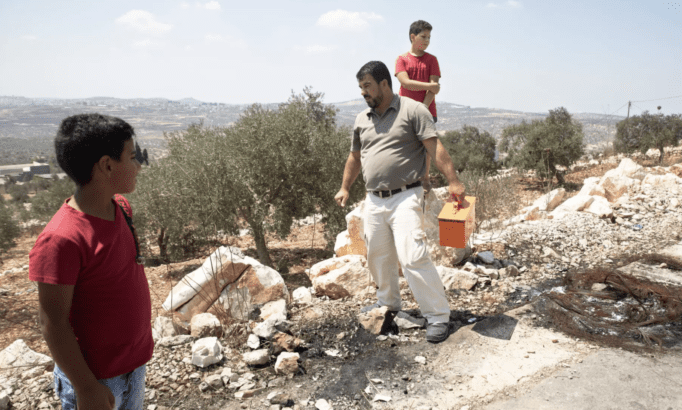
Mamoun Shtaiwi with a crate of stun grenades (C) with the child who found an explosive device (L) in Qaddum, August 25, 2020.
By Kathryn Shihadah | If Americans Knew | August 26, 2020
Ha’aretz reports that a Palestinian child discovered a box full of explosives near his home last week. It was one of at least three such boxes placed there by Israeli soldiers as a “deterrent.”
Last Wednesday night, Israeli soldiers entered the West Bank village of Qaddum around midnight to plant the explosives in the area, which sees a large amount of foot traffic. They were set to explode when touched, and camouflaged with stones and scraps of cloth.
The next day, a seven-year-old boy saw one of the boxes. He explained later, “I wanted to pick it up and play with it.” But his mother and other relatives were suspicious. They picked it up and shook it; it exploded, wounding one of them.
They found another similar box nearby and detonated it from a distance.
Another village resident reports finding a sign nearby, in Hebrew, reading, “Keep away or die; danger of death.”
The Israel Defense Forces (IDF) admitted to placing the stun grenades, adding that they were planted as a deterrent in an area where “violent riots have regularly occurred for years.”
The military spokesman maintained that, “after it was discovered that this could lead to injuries, forces worked to remove them from the area.” An investigation has been opened.
It is against international law to place armed explosives in a civilian area.
Residents of the village also noticed that a Palestinian flag in the area had been removed.
Qaddum’s claim to fame
 In recent months, videos have recorded an Israeli military bulldozer facing off against protesters; Israeli soldiers slashing tires of cars owned by Palestinians, and throwing tear gas canisters into a Palestinian home; they have also intentionally shot holes in water tanks (water is scarce for many Palestinians in the West Bank). Residents of Qaddum have been holding weekly demonstrations for nine years, protesting the closure of a main road, which had been closed to accommodate the expansion of a nearby settlement. The village has frequently made the news.
Reports of Israeli forces injuring Palestinian protesters are also numerous.
Most alarming of all is the story of nine-year-old Abdul Rahman Yasser Shteiwi, who was shot in the head during a protest last year. The bullet shattered into at least 100 pieces. The IDF at first denied using live ammunition, but it was later proven that they did, and were responsible for Abdul Rahman’s injury.
Another boy, age fifteen, was shot in the head by an Israeli soldier in January on a Thursday, when there was no protest. Experts say the shooter was only a few yards away. The IDF delayed the car taking him to the hospital for 25 minutes.
Kathryn Shihadah is staff writer for If Americans Knew. She also writes for MintPress News and blogs at Palestine Home.
CNN & Fox cut Rand Paul’s anti-war speech at RNC as he calls out Biden for backing wars in M. East, Serbia
RT | August 26, 2020
Senator Rand Paul’s (R-Kentucky) speech at the Republican National Convention was butchered by major cable networks, with CNN cutting it completely and Fox replacing the anti-war part with an interview.
Senator Paul, who frequently crossed swords with Donald Trump when both were vying to become the Republican presidential candidate in the 2016 race, admitted during his speech that he did not always agree with the president, but said that Trump’s desire to put an end to the “endless wars” far outweighs their differences.
“I’m supporting President Trump because he believes as I do, that a strong America cannot fight endless wars, we must not leave our blood and treasure in the Middle East quagmire,” Paul said.
Calling Trump “the first president in a generation to seek to end war rather than to start one,” Paul went on to attack what he called the “disastrous record of Joe Biden,” pointing out that as a senator, Biden voted to give then-President George W. Bush the authority to use force in Iraq.
“I fear Biden will choose war again. He supported the war in Serbia, Syria, Libya. Joe Biden will continue to spill our blood and treasure.”
Paul’s anti-war message, however, did not reach CNN viewers, with the cable network instead airing an interview with CNN political contributor and host Van Jones.
Fox News, which snubbed most of the first night of the convention, opting for its usual programming instead, replaced parts of Paul’s speech with host Tucker Carlson interviewing Donald Trump Jr. live on air.
MSNBC also interspersed Paul’s speech with insights from host Rachel Maddow, who attempted to fact-check Paul on his claim that Trump was “bringing our heroes home.”
Maddow claimed that the total number of personnel deployed overseas has even grown under Trump’s watch, although Paul appeared to refer primarily to deployments in hot spots in the conflict-ridden Middle East.
After he became the Democratic presidential candidate, Biden called his Iraq vote in October 2002 a “mistake,” arguing that by siding with the hawks, he wanted, not to launch a war, but rather “to prevent the war from happening.” Biden insists that, by untying Bush’s hands, he believed the administration would have been able to put more pressure on the UN Security Council and late Iraqi leader Saddam Hussein.
Despite being a strong advocate for the US bombing campaign in Yugoslavia in 1999, Biden also extended his condolences to the victims of the raids while visiting Belgrade, Serbia in August 2016.
US Sanctions Russian Defence Ministry Research Institute That Worked on COVID-19 Vaccine
Sputnik – 26.08.2020
The United States has added five Russian research institutes to its sanctions lists, including the Defence Ministry’s Research Institute, which was involved in work on the COVID-19 vaccine, the United States Department of Commerce statement says.
The US has gone as far as to claim that the listed institutions are working on chemical and biological weapons.
Listing by the US Department of Commerce means that the US authorities impose restrictions on the export, re-export and transfer of goods in accordance with the existing regulations to individuals and organisations that are deemed to pose risks to US national security and foreign policy interests.
Besides the 48th Central Scientific Research Institute, the US has sanctioned the Russian Defence Ministry’s 33rd Central Research and Testing Institute and the State Research Institute of Organic Chemistry and Technology.
According to official information, the 33rd Central Research and Testing Institute is a leading institution in the field of radiation, chemical and biological protection.
The Russian COVID-19 vaccine, dubbed Sputnik V, was developed by the Moscow-based Gamaleya Research Institute and the Russian Defence Ministry and officially registered by the Russian government on 11 August.
The Russian Ministry of Health said that Sputnik V had undergone all the necessary checks and had been proven to be capable of building immunity against the virus.
Despite the fact that the Russian Ministry of Health claimed that Sputnik V had undergone all the necessary checks and had been proven to be capable of building immunity against the virus, Western countries and mainstream media rushed to claim that the vaccine was unsafe and ineffective.
Russian Health Minister Mikhail Murashko stated that all the foreign criticism was provoked by the fear of fair competition and slammed the accusations as unfounded.
Last week, the Gamaleya Institute and the Russian Direct Investment Fund (RDIF), which has donated over $54 million towards coronavirus research, released information about the methodology of the vaccine. The data includes scientific publications on the history of vaccines based on the approach used in Sputnik V, clinical trials, the technological platform and the proven safety of this method.
Featured Video

The Most Important Bet You’ve Never Heard Of
or go to
Aletho News Archives – Video-Images
From the Archives
The Occupied Mentality Syndrome
Saudi Arabia on the American chessboard – Part 2
By B. J. Sabri | American Herald Tribune | April 19, 2016
Since the Korean War, but particularly since the Iranian Revolution of 1979 until today, the United States has been steadily escalating its military presence in the Persian Gulf. Taking advantage of many colossal events of the past 36 years, [1] the hyper-empire has institutionalized its massive presence on land and sea, and expanded its objectives to include the unambiguous physical control of the area, as well as the clear understanding that local Arab governments should abide by them. The pretext is always the same: in “defense” of the national interests and security of the United States. From observing how the United States has been interacting with the governments of the region, and by judging from the size of its expeditionary force, we could reach a basic conclusion. The United States is occupying, de facto, the entire Arabian Peninsula. (Yemen, devastated by Saudi and American jets is yet to be conquered. Oman? Britain returned not as colonial ruler but as a soft occupying power.)
Under this articulation, Saudi Arabia, Qatar, Kuwait, and the United Arab Emirates are virtually occupied countries. If we compare this type of occupation to the mandate and protectorate regimes of the past, the results might be identical—the nations affected by it lose sovereignty. When Arab governments comply with the objectives of a foreign power that station military forces on their national milieu, then that power controls them in multiple ways including how they react to policy deliberations and what decisions they intend to take on specific issues. A good method to verify the concept of effective occupation is this: take notice of what the United States says and wants, and then compare it to what the gulf rulers do in response. (I shall discuss this detail at some point in the upcoming parts.)
If the presence of US forces or other means of political pressure are a factor in Saudi Arabia’s interventionist Arab wars, then we need to debate this issue. However, from the history of resistance to colonialism, we learnt: if a powerful state imposes its order on a nation by military means or other forms of coercion, and if this nation does not resist that imposition, then a mental subordination to the powerful state will ensue. This is especially true in the case of Saudi Arabia. One single event, 9/11, has transformed it from a US “ally” into an instant political hostage of the American Empire. … continue
Blog Roll
 Aletho News
- IRGC hits US tech giant Oracle’s data center, computing site in UAE over new assassinations
- Bombing Iran Back Into the Stone Age /Lt Col Daniel Davis & Jim Jatras
- UAE rejects report claiming it is ready to join war on Iran to reopen Hormuz
- A New Resistance Front: How Does Syria Factor into the Regional War?
- Gulf states weigh pipeline expansion plans, hoping to bypass Hormuz
- Iran sets up ‘tollbooth’ system in Strait of Hormuz
- Wave 90: IRGC strikes US-linked industrial sites in Gulf
- Iran Says US-Israeli Claims of Its Military Strength Are Wrong
- Trump’s April Fools’ Address to the nation
- The Most Important Bet You’ve Never Heard Of
- If Americans Knew
- ‘War crime’: Global condemnation as Israeli ministers celebrate death penalty law targeting Palestinian prisoners
- 7 Ways Israel Is Turning Lebanon Into Gaza
- World’s Leading Football Bodies Under Fire Over Israel Policies
- Experts warn of possible use of nukes against Iran
- Israeli invasion of Lebanon could be worse than 1982, warn European officials
- Passover: Liberation and collective punishment
- Trump says the quiet part out loud: (Israel’s) war on Iran > Americans’ health – Daily Update
- Gaza families reunite years after babies evacuated amid Israel’s war
- International Rescue Committee warns Gaza’s children face grave protection risks
- Iran’s Alleged 47-Year War on America: Debunking the 1,050 American Deaths Canard
- No Tricks Zone
- Low Intensity Tornado Wrecks Major Solar Farm, Creating A Potential Toxic Dump
- New Study Finds Warming Saves Lives…Cold Temperatures 12 Times More Deadly Than Excess Heat
- German Science Blog Accuses PIK Climate Institute Of Hallucinating Climate Tipping Points
- Devastating Assessment Of Comirnaty Vaccine By Former Senior Pfizer Europe Toxicologist
- New Study: CO2 Is ‘Effectively Negligible’ As An Explanatory Climate Change Factor Since 2000
- Former Pfizer Toxicologist Dr. Helmut Sterz Tells Bundestag Hearing Pfizer Vaccine Should Have Never Been Approved
- Energy Expert: Germany’s Nuclear Phaseout Was A “500 Billion Euro Mistake”
- New Research: South Australia’s Mid-Holocene Sea Surface Temperatures Were 4°C Warmer Than Today
- Storing Green Energy To Last Germany 10 Days Would Require A 60-Million Tonne Battery
- New Studies: UK Sea Levels Were 4 Meters Higher Than Today During The Mid-Holocene
 Aletho News