Journal Nature: COVID lockdowns are key to begin ‘personal carbon allowances’
Restrictions on individuals… that were unthinkable only 1 year before’ have us ‘more prepared to accept tracking & limitations’ to ‘achieve a safer climate’
Nature Sustainability |
Authors argue COVID restrictions, smart meters & tracking apps can be used as a stepping stone for a personal carbon allowance:
Journal article urges for “the need for a low-carbon recovery from the COVID-19 crisis” by using “personal carbon allowances (PCAs).”
“A PCA scheme would entail all adults receiving an equal, tradable carbon allowance that reduces over time in line with national targets… encompassing individuals’ carbon emissions relating to travel, space heating, water heating and electricity.” …
“Allowances were envisioned to be deducted from the personal budget with every payment for transport fuel, home-heating fuels and electricity bills. People in shortage would be able to purchase additional units in the personal carbon market from those with excess to sell. New, more ambitious PCA proposals include economy-wide emissions, encompassing food, services and consumption-related carbon emissions, for example.”
In particular, during the COVID-19 pandemic, restrictions on individuals for the sake of public health, and forms of individual accountability and responsibility that were unthinkable only one year before, have been adopted by millions of people. People may be more prepared to accept the tracking and limitations related to PCAs to achieve a safer climate and the many other benefits (for example, reduced air pollution and improved public health) associated with addressing the climate crisis.Sustainable Development Goals (SDGs)
Other lessons that could be drawn relate to the public acceptance in some countries of additional surveillance and control in exchange for greater safety… Recent studies show how COVID-19 contact-tracing apps were successfully implemented with mandatory schemes in several East Asian countries, such as China, Taiwan and South Korea… Recent advances in smarter home and transport options make it possible to easily track and manage a large share of individuals’ emissions. Evidence from the roll-out of smart meters and informative displays can be used to design feedback that is highly effective in engaging individuals to reduce their energy-related emissions… In terms of implementation platforms, while in the 2000s carbon allowances were expected to be managed by a card, in the 2020s high ownership would make smartphones the preferred option for accounting and trading (while providing alternative options for the few without smartphones).
The State That Doesn’t Care If You Live Or Die

By Tom Woods | Principia Scientific | September 3, 2021
Ask the average person in whatever country you choose what his chances of hospitalization with or death from COVID are and the answers will shock you. Nearly everyone you speak to is completely uninformed.
Naturally it is impossible to make rational decisions amidst this degree of ignorance.
Now is as good a time as any for some perspective.
The survival rate for people in the 0-19 age group is 99.997 percent. For 20-29 it’s 99.986 percent. You can find all the figures in the graphic below.
The data come from a recent paper by Stanford’s Cathrine Axfors and John Ioannidis, “Infection fatality rate of COVID-19 in community-dwelling populations with emphasis on the elderly: An overview.” Here’s how it breaks down:

A person under 50 is therefore at greater risk of death from drowning, choking on food, sunstroke, or from a sharp object.
This is not to say that we’re not dealing with a nasty virus for some people who contract it. But do you think the average person has any idea that the numbers for survival are this high?
In the UK, the Daily Mail just published an article called, “Is it time to stop obsessing over Covid figures? Statistics reveal virus is NOT the biggest killer — with heart disease, dementia and cancer each claiming four times as many lives in an average week last month.”
“Even before the rollout of the vaccine,” the article notes, “fewer than one per cent of people who caught Covid died. Now, scientists say that figure is ten times smaller.”
They included this graphic, for perspective:

Much as I welcome this, it’s pretty rich for the British press (or indeed any press) to publish an article and a chart like that, though, scratching their heads as to why people are obsessed about COVID, when they themselves are directly responsible for the misinformation that brought about that obsession.
Remember when the Washington Post called Iowa the “state that doesn’t care if you live or die” when that state removed its COVID restrictions? That was seven months ago.
Here’s the chart. Think we’re going to hear any apologies, or any “gee, I guess I don’t understand this virus as well as I thought,” or…?

That’s enough perspective for one day.
Japan Outraged Over US Release of Toxic Water in Okinawa
By Ilya Tsukanov – Sputnik – 04.09.2021
In April, Japan’s neighbours expressed outrage in over Tokyo’s plans to release 1.23 million tonnes of contaminated wastewater from a storage facility at destroyed Fukushima Daiichi Nuclear Power Plant into the Pacific Ocean. Japanese authorities have insisted that the wastewater is safe, but environmental groups have contested such claims.
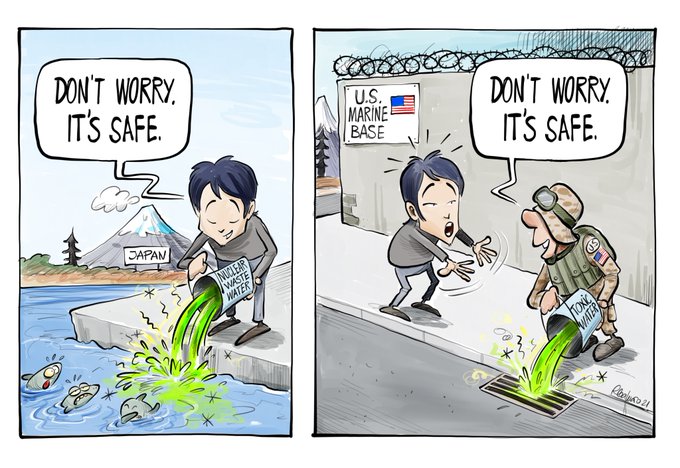
China Global Television Network (CGTN), a Beijing-based English-language TV news service, has poked fun at Japanese authorities over the apparent hypocrisy shown by Tokyo when it comes to the dumping of hazardous wastewater.
In recent weeks, Japanese media, government officials and environmental activists have been up in arms over plans by US forces in Okinawa to dump potentially dangerous chemicals into the local sewage system.
The scandal began to gather steam in June, when the Pentagon reported the leakage of water containing toxic materials from a US Army storage facility in Uruma and other locations across the strategically situated islands. In July, the US military informed Okinawa authorities of plans to release treated but potentially hazardous wastewater to prevent the danger of another leak.
The US military insisted that the wastewater was treated to Japanese government standards and safe to drink, and began dumping it into the local sewage system on 26 August. The water was known to contain trace concentrations of organofluorine compounds, including perfluorooctanesulfonic acid and perfluorooctanoic acid. Scientific studies have indicated that these chemicals can affect the health of wildlife, with the potential to cause reduced immunoglobulin levels and brain asymmetry in offspring, and to result in increased risk of chronic kidney disease and other ailments among humans. The chemicals’ resistance to natural breakup and tendency to accumulate in organisms have led them to be dubbed “forever chemicals.” Japan banned the production of the acids in 2010, and established strict guidelines on safe levels of the substances of less than 50 nanograms per liter of water last year.
The US military informed Japanese authorities of their plans to dump the chemical-laced water less than an hour before starting, and insisted that their wastewater contained less than 2.7 nanograms of the acids.
Okinawa authorities had asked for an immediate halt to the dumping, but the US military apparently ignored their protest, releasing at least 64,000 liters of the potentially toxic wastewater into the sewage system, with the water then dumped into the ocean due to the system’s inability to treat it. Before proceeding with the dump, US forces turned down a local company’s offer to treat the water, deeming it prohibitively expensive.
At a news conference organized on the day the water was dumped, Okinawa Governor Denny Tamaki expressed outrage over the release of the contaminated water. “I feel strong outrage that the US military unilaterally dumped the water even while they knew that discussions were proceeding between Japan and the United States on how to handle the contaminated water,” he said.
Last week, Japan’s national authorities formally intervened, with Environment Minister Shinjiro Koizumi issuing a strong protest and saying that US Marines’ decision to dump the water was “extremely regrettable.”
“Local residents are feeling very anxious,” Koizumi complained, while promising to work with the relevant ministries and Okinawa authorities “to ensure this is handled in an appropriate manner, as well as reconfirm the details with the United States.”
In a separate statement, Defence Minister Nobuo Kishi said that he had asked US forces to please stop dumping any more contaminated water.
Environment Ministry and Defence Ministry officials visited Okinawa this past week to discuss the problem, offering a rare public apology to Masanori Matsugawa, the mayor of Ginowan, Okinawa, the city potentially most heavily affected by the dumping. “We extend our deepest apology,” Makoto Ikeda, the head of the Defence Ministry’s environmental policy division told Matsugawa. “We also consider it extremely regrettable that the water was dumped so suddenly,” he added.
Chinese Media: ‘What goes around comes around’
China’s CGTN poked fun at the Japanese government over the calamity on Saturday, tweeting a political cartoon showing a Japanese man nonchalantly dumping nuclear wastewater from the Fukushima nuclear plant into the ocean, and then complaining as a Marine is pictured dumping hazardous water into Okinawa’s sewage system.
No Animal Studies for the Vaccines
By Martin Armstrong | ArmstrongEconomics | September 2, 2021
I find it extremely unbelievable that nobody will investigate this entire scam for what it is. The people behind the vaccines should be dragged in to testify what is going on. Moderna has admitted it took them only 2 days to create the vaccine. In Texas, they are trying to launch a criminal investigation. The FDA is no longer trustworthy, for the normal time to get anything approved is 12 years. What has been released in less than one year with no animal studies? There has been NO TESTING to determine side effects on pregnancy, fertility, or lactation.
It is just stunning that we have politicians REFUSING to look at anything, probably because they are too busy counting their bribes. The White House said under NO condition would they ever fire Fauci, meaning under NO condition will they investigate anyone.
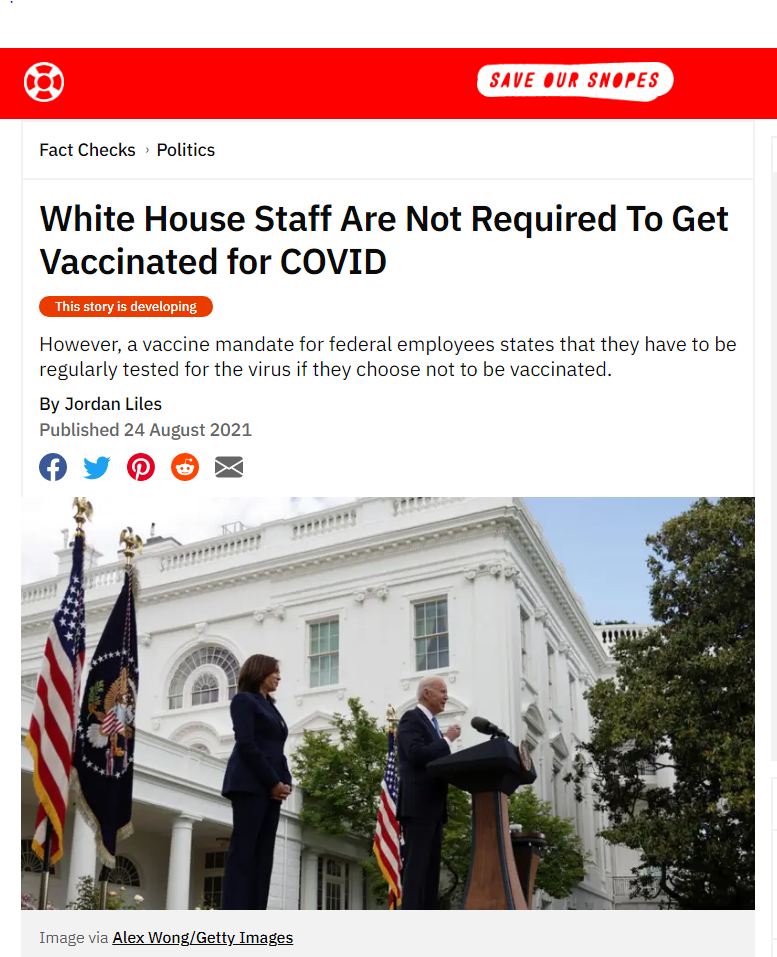
Meanwhile, even the notorious corrupt Snopes had to admit this is TRUE. Despite demanding everyone gets vaccinated, the White House said its own staff DOES NOT need to be vaccinated provided they are routinely checked. So why is the White House the entire exception? Even the military is demanding 100% compliance. Meanwhile, the White House has demanded everyone else receive vaccinations or lose their job.
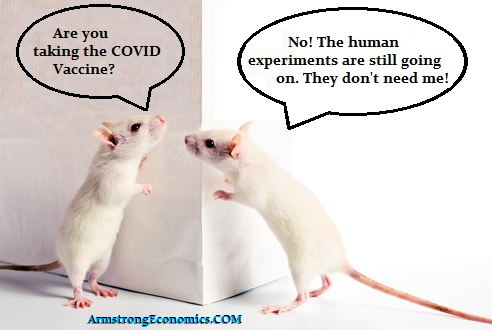
The fact that they have skipped animal trials is very disturbing. When the government is part of the conspiracy against the public, we will NEVER know the truth about anything. Jack Dorsey has been especially protective of the narrative. Nobody is allowed to question the government no matter what.
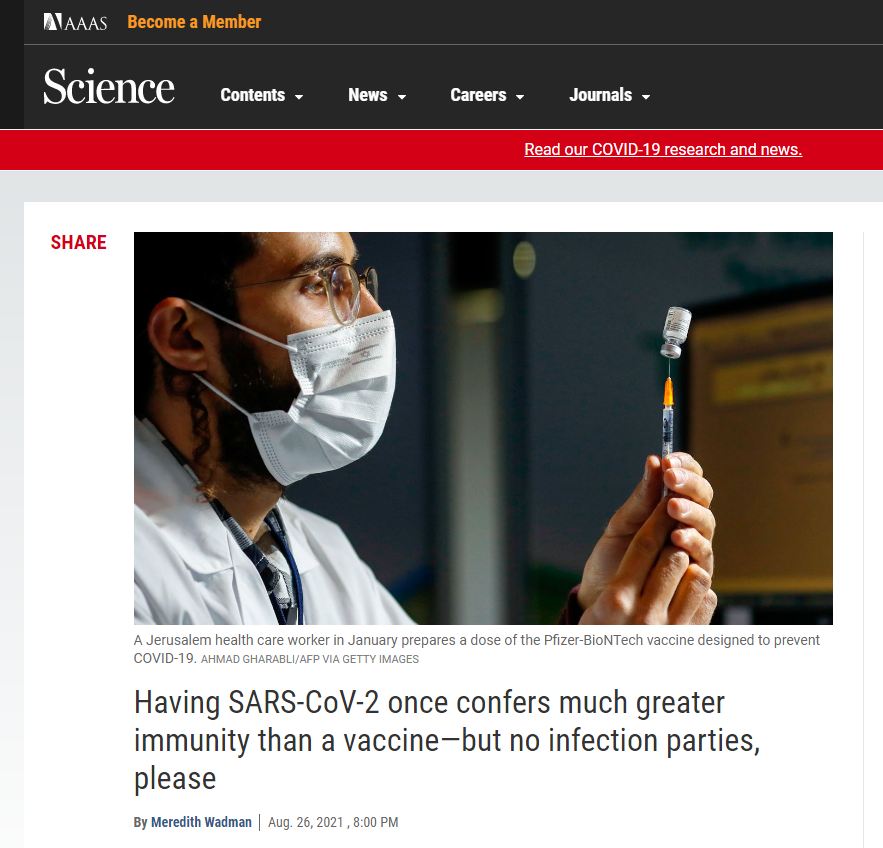
Then there are studies revealing that natural immunity to COVID is 13 times better than the vaccines. They try to bury such studies, and they also try to ensure that they are not peer-reviewed in order to discredit them. The Science journalist Alex Berenson was permanently suspended from Twitter one day after his tweets that reported an Israeli study that making this finding that natural immunity from a prior Covid-19 infection is 13 times more effective than vaccines against the delta variant. Twitter is now acting against the very basis of free speech, which is threatening people’s lives. I would love to see Twitter taken down, for they are clearly now responsible for the deaths of many people from vaccine injuries.

To show that this is one giant cover-up, OSHA has instructed employers NOT TO REPORT vaccine injuries suffered by employees if they only “recommend” the shots. Many employers with more than 10 employees are required to keep a record of serious work-related injuries and illnesses. Nobody should volunteer to be vaccinated to satisfy an employer, for you will not be covered for any injury or loss of pay, and you could be fired for not showing up to work for a period of time. However, if employers mandate vaccines to work, then the vaccine injuries should become subject to reporting, lawsuits, and workman’s comp claims.
Why Testing Your Immunity to COVID-19 Is Important
By Dr. Joseph Mercola | September 4, 2021
Antibody testing is the gold standard for determining immunity, says immunologist and physician Dr. Hooman Noorchashm. Yet, the CDC and FDA are actively deterring people from testing their immunity. Why?
In May 2021 the FDA issued an advisory discouraging Americans from testing the status of their antibody immunity to COVID-19, Noorchashm wrote in an editorial on his blog. “Those who are adequately immune to COVID-19 are rarely, if ever, getting reinfected — regardless of whether this immunity comes from vaccination or from a natural infection,” Noorchashm said.
Meanwhile, “those who are NOT immune to SARS-CoV-2 are susceptible to being infected,” he said. He surmises that to end the pandemic upward of 90% of the population need to become immune.
As far as testing for immunity, according to Noorchashm, the FDA advisory prevents people from obtaining critical information necessary to protect themselves during the pandemic. “ … by not encouraging liberal COVID-19 antibody testing, especially in fully vaccinated Americans, the FDA and CDC are preventing vaccinated, but inadequately immune, persons from finding out that they remain susceptible to infection,” he wrote.
Citing his own experience as a physician, he said “patients who hesitate to undergo vaccination are far more likely to do so when they are confronted with a negative antibody test demonstrating they are susceptible.”
SOURCES:
Ivermectin Metaanalysis
By Meryl Nass, MD | September 3, 2021
Tess Lawrie’s group’s metaanalysis of ivermectin research papers, published in June, has received a great deal of positive attention. It was, as expected, carefully done. The authors graded the quality of the papers they reviewed.
The abstract noted:
“Therapeutic Advances: Meta-analysis of 15 trials found that ivermectin reduced risk of death compared with no ivermectin (average risk ratio 0.38, 95% confidence interval 0.19–0.73; n 5 2438; I2 5 49%; moderate-certainty evidence)…” This means that using only evidence of moderately good quality (high quality is often hard to come by, especially using observational data), if 100 people sick enough with Covid to die are given ivermectin, only 38 will die, and 62% will be saved.
“Low-certainty evidence found that ivermectin prophylaxis reduced COVID-19 infection by an average 86% (95% confidence interval 79%–91%).”
More doctors are using the drug. More patients are hearing about it. I have been getting more calls from patients who want to know about it. The NY Times said pharmacists are filling 88,000 scripts a week now.
Covid death rates, compared to the number of cases diagnosed, are way down compared to 2020 and last winter. While the NYT says there are 100,000 Covid patients in hospital now, only 1,500 are dying daily, or 1.5%, a much lower percentage than previous waves.
This is probably due to lower virulence of current variants, some benefit from vaccination, less use of ventilators and more use fo effective therapeutics.
And so now the CDC is coming down hard and many pharmacist have decided to stop filling the scripts in the past week. More on this in my next post.
CDC: Teens Injected with COVID Shots have 7.5 X More Deaths, 15 X More Disabilities, 44 X More Hospitalizations than All FDA Approved Vaccines in 2021
By Brian Shilhavy | Health Impact News | September 3, 2021
The CDC did another data dump into their Vaccine Adverse Event Reporting System (VAERS) database today. As of August 27, 2021 there have been 13,911 deaths, 2,933,377 injury symptoms, 18,098 permanent disabilities, 76,160 ER visits, 56,912 hospitalizations, and 14,327 life threatening events recorded following experimental COVID-19 “vaccinations.”

Source.
There have now been more than twice as many deaths recorded following COVID-19 shots during the past 9 months since the COVID-19 shots were given emergency use authorization, than deaths recorded following ALL vaccines for the past 30 years.
From January 1, 1991 to November 30, 2020, the last month before the COVID shots were given emergency use authorization, there were only a total of 6,068 deaths recorded (mostly infant babies) following ALL vaccines. (Source.)
And yet, the CDC continues to push everyone to get a COVID-19 shot.
There have also now been 1,490 recorded fetal deaths following COVID-19 injections of pregnant women.
By way of contrast, I performed the same search in the VAERS database for fetal deaths due to the flu shots, and for 2021 so far there are ZERO. For last year, 2020, there were 16 fetal deaths following flu shots. (Source.)
And yet, the CDC continues to recommend that pregnant women get a COVID-19 shot.

As I reported yesterday, the COVID-19 shots seem to be killing and crippling teenagers in record numbers.
I expanded the search today to include the new data that just came out today, and to include age 12 through age 19.
The search returned the following results for this age group following COVID-19 shots: 30 deaths, 173 permanent disabilities, 3575 ER visits, 1603 hospitalizations, and 316 life threatening events. (Source. Note that the search separates 12-17 year olds, and 17-44 year olds, although we only searched through age 19, so you need to add the two tables together to get the numbers in the graph above.)
Next, I searched the exact same age group, for the same time period (December 2020 through the most recent data dump today), and excluded COVID-19 shots but included every other vaccine listed. They include these vaccines:
- 6VAX-F
- ADEN
- ADEN_4_7
- ANTH
- BCG
- CEE
- CHOL
- DF
- DPIPV
- DPP
- DT
- DTAP
- DTAPH
- DTAPHEPBIP
- DTAPIPV
- DTAPIPVHIB
- DTIPV
- DTOX
- DTP
- DTPHEP
- DTPHIB
- DTPIHI
- DTPIPV
- DTPPHIB
- EBZR
- FLU(H1N1)
- FLU3
- FLU4
- FLUA3
- FLUA4
- FLUC3
- FLUC4
- FLUN(H1N1)
- FLUN3
- FLUN4
- FLUR3
- FLUR4
- FLUX
- FLUX(H1N1)
- H5N1
- HBHEPB
- HBPV
- HEP
- HEPA
- HEPAB
- HEPATYP
- HIBV
- HPV2
- HPV4
- HPV9
- HPVX
- IPV
- JEV
- JEV1
- JEVX
- LYME
- MEA
- MEN
- MENB
- MENHIB
- MER
- MM
- MMR
- MMRV
- MNC
- MNQ
- MNQHIB
- MU
- MUR
- OPV
- PER
- PLAGUE
- PNC
- PNC10
- PNC13
- PPV
- RAB
- RUB
- RV
- RV1
- RV5
- RVX
- SMALL
- SSEV
- TBE
- TD
- TDAP
- TDAPIPV
- TTOX
- TYP
- UNK
- VARCEL
- VARZOS
- YF
These are ALL the vaccines listed in VAERS, minus the 3 COVID shots. Some of them are no longer in use, and many of these teenagers do not get.
But this list DOES represent every other vaccine teenagers get, and we know that pre-COVID the largest amounts of deaths and injuries followed the Gardasil HPV vaccines, and the yearly flu shots for this age group.
So from all these vaccines that include every non-COVID shot that teenagers have received this year so far, there have been 4 deaths, 11 permanent disabilities, 78 ER visits, 36 hospitalizations, and 13 life threatening events during the same time period as the COVID-19 shots were administered. (Source. Note that the search separates 12-17 year olds, and 17-44 year olds, although we only searched through age 19, so you need to add the two tables together to get the numbers in the graph above.)
This means that COVID-19 shots given to our teenagers have 7.5 X more deaths, 15 X more disabilities, and 44 X more hospitalizations than all other FDA-approved vaccines COMBINED that these teenagers are receiving.
I also did a search for ALL cases of “thrombosis” (blood clots), for both COVID shots and for all other vaccines, and cases of blood clots were 28 times higher among teens injected with COVID-19 (source) than for teens injected with all other vaccines during the same time period (source.)
Someone from the pro-vaccine crowd might try to explain this all away by saying that many more teens have been injected with COVID-19 shots than other vaccines, but if they make that claim, make sure they prove it with real statistics, because I don’t believe that is possible.
We know, for example, that 12 to 15-year-olds did not start receiving COVID-19 shots until May this year.
Also, flu shots actually increased last year, which would have included the month of December which these reports cover, and flu shot sales would have been strong in the winter months beginning this year.
And sales of Merck’s Gardasil were up 44% during the first quarter of this year, 2021. (Source.) Gardasil is a two-dose or three-dose vaccine.
According to the CDC immunization schedule, this age group also gets the Tdap and Meningococcal (two doses) vaccines.
So a teenager in this age group that is following the CDC immunization schedule could be getting 6 other injections, in addition to a one-dose or two-dose COVID-19 injection.
These COVID-19 shots are having a devastating effect on our teenagers, and yet not only does the CDC and FDA continue to promote them for teenagers, they are set to approve the COVID-19 shots for infant and children next.
Lawmakers pave way for $1.2 trillion in new military spending over next 10 years
By Andrew Lautz | Responsible Statecraft | September 2, 2021
Reporters, lobbyists, activists, Biden administration officials and, of course, lawmakers and their staffs spent countless hours and an ocean of ink on the negotiations for and passage of a recent bipartisan infrastructure bill totaling around $1 trillion. Casual observers probably won’t hear as much, though, about two votes — one in the Senate and one in the House — that could pave the way for Congress to spend a whopping $1.2 trillion additional dollars on the military, above current projections, over the next decades. Here’s how.
These pages recently covered the Senate Armed Services Committee’s successful effort to add $25 billion in taxpayer-funded slush to the annual defense budget bill. Democrats and Republicans joined hands to fatten up the defense bill by 3.5 percent, with Sen. Elizabeth Warren (D-MA) casting the lone dissenting vote. That increase was just endorsed by the House Armed Services Committee (HASC) on Wednesday.
Lawmakers approved, again on a widespread and bipartisan basis, an amendment by the committee’s ranking Republican, Mike Rogers of Alabama, to add $23.9 billion to the House version of the defense bill. Rogers proudly noted that his amendment would provide for a five-percent increase over the defense budget topline enacted in the previous fiscal year. And that’s where the $1.2 trillion comes in.
Defense hawks in Congress have made no secret that they would like to see up to 5 percent growth in the defense budget each and every year. Rogers has said it. His Senate counterpart, Jim Inhofe (R-OK), has also said it. What few budget or military watchdogs have done is explain the compounding effects of 5 percent annual boosts to the defense budget.
Boosting the defense budget 5 percent each year over the next 10 fiscal years would leave the U.S. with a whopping $1.2 trillion defense budget by the end of the decade, heading into fiscal year (FY) 2031. Compare that 5 percent boost each year to what the nonpartisan Congressional Budget Office currently projects defense spending will be over the next 10 years (as of their most recent July 2021 estimate), and the delta (the difference between a 5 percent annual boost and current budget projections) over 10 years is astounding.
The difference is small in the upcoming fiscal year, FY 2022 — $778 billion if defense hawks get their 5 percent boost, versus $763 billion projected by the CBO. But the differences compound over time, exceeding a $100-billion delta in four years (FY 2026) and a $200-billion delta in eight years (FY 2030). By the end of the decade, FY 2031, the difference between the defense hawks’ ideal budget and the CBO projection is $253 billion — almost as much as was spent on the March 2020 $1,200 stimulus checks, to cite just one comparison.
Add it up over 10 years, and the defense hawks would have us spend $1,244,600,390,000 — that’s more than $1.2 trillion — more on defense than current projections. Unfortunately, the bipartisan votes in the Senate and House for a 5 percent defense budget increase in FY 2022 made this chilling possibility much more realistic.
It would be one thing if the defense hawks were proposing robust spending cuts — or tax increases, if that’s a particular lawmaker’s fancy -— to offset this additional $1.2 trillion in spending. But they are not. Rogers made no attempt to pay for his proposed $25 billion boost, nor did Senate Republicans who introduced their amendment on the Senate committee. And Democrats share plenty of the blame for eagerly supporting these amendments and allowing them to pass with wide bipartisan margins.
There are a number of ways to look at this $1.2-trillion budget-busting boost, depending on one’s political persuasions and policy preferences. Fiscal hawks will see another $1.2 trillion added to the record-high debt and deficit levels, high even by the COVID era’s historic standards. Progressives will argue that this $1.2 trillion could be spent on more pressing challenges like climate change and pandemic response. Regardless of where advocates and activists come down, this much is clear: a $1.2-trillion hike to the defense budget, without any corresponding offsets, comes at a significant cost to taxpayers.
It would be another thing if Rogers’ $23.9-billion push was devoted to urgent, emergency needs in the military. But in fact, billions of dollars are going toward the procurement of new ships, warplanes, and other weaponry that there is a questionable urgency for. Nearly a quarter of a billion dollars will go to the highly-troubled F-35 program. More than $3.6 billion will be earmarked for just four new warships for the Navy, whose shipyards are already overburdened and underperforming, while another $567 million is directed toward requiring the Navy to accelerate its production of Virginia-class submarines (whose program, by the way, has suffered from cost overruns and delays). More than $6.5 billion will be spread around on military construction projects across 14 states, the District of Columbia, and Poland. Maryland (16 projects earmarked), Florida (12), and New Mexico (11) appear to be winners.
And, like Santa Claus on Christmas Eve, another $3 billion in the Rogers amendment will go toward fulfilling 69 “wish list” requests from the service branches and combatant commands. Fiscal and military watchdogs have sharply criticized this practice, warning that lawmakers will abuse these annual “wish lists” and gum up the defense budget — which is exactly what the House and Senate committees have done.
A skeptic could claim that it’s “just” $25 billion this year, a drop in the bucket compared to the government’s trillions of dollars in COVID spending. But if the defense hawks get what they want, it will add up to $1.2 trillion over the next decade alone. That may not get the flashy headlines of an infrastructure bill, but it’ll have an even bigger impact on taxpayers’ pocketbooks.
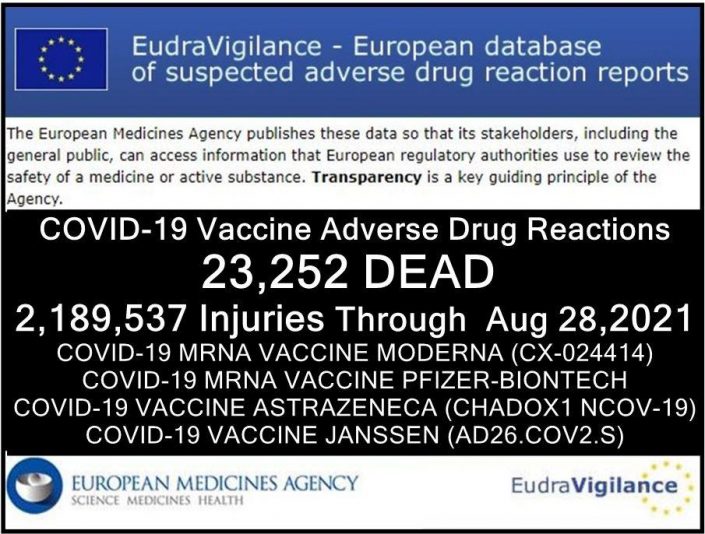
23,252 Deaths 2,189,537 Injured Following COVID Shots: EU Database of Adverse Reactions
By Brian Shilhavy | Health Impact News | September 3, 2021
The European Union database of suspected drug reaction reports is EudraVigilance, and they are now reporting 23,252 fatalities, and 2,189,537 injuries, following COVID-19 injections.
A Health Impact News subscriber from Europe reminded us that this database maintained at EudraVigilance is only for countries in Europe who are part of the European Union (EU), which comprises 27 countries.
The total number of countries in Europe is much higher, almost twice as many, numbering around 50. (There are some differences of opinion as to which countries are technically part of Europe.)
So as high as these numbers are, they do NOT reflect all of Europe. The actual number in Europe who are reported dead or injured following COVID-19 shots would be much higher than what we are reporting here.
The EudraVigilance database reports that through August 28, 2021 there are 23,252 deaths and 2,189,537 injuries reported following injections of four experimental COVID-19 shots:
- COVID-19 MRNA VACCINE MODERNA (CX-024414)
- COVID-19 MRNA VACCINE PFIZER-BIONTECH
- COVID-19 VACCINE ASTRAZENECA (CHADOX1 NCOV-19)
- COVID-19 VACCINE JANSSEN (AD26.COV2.S)
From the total of injuries recorded, almost half of them (1,076,917) are serious injuries.
“Seriousness provides information on the suspected undesirable effect; it can be classified as ‘serious’ if it corresponds to a medical occurrence that results in death, is life-threatening, requires inpatient hospitalisation, results in another medically important condition, or prolongation of existing hospitalisation, results in persistent or significant disability or incapacity, or is a congenital anomaly/birth defect.”
A Health Impact News subscriber in Europe ran the reports for each of the four COVID-19 shots we are including here. It is a lot of work to tabulate each reaction with injuries and fatalities, since there is no place on the EudraVigilance system we have found that tabulates all the results.
Since we have started publishing this, others from Europe have also calculated the numbers and confirmed the totals.*
Here is the summary data through August 28, 2021.
Total reactions for the mRNA vaccine Tozinameran (code BNT162b2,Comirnaty) from BioNTech/ Pfizer: 11,266 deaths and 900,032 injuries to 28/08/2021
- 24,626 Blood and lymphatic system disorders incl. 152 deaths
- 24,450 Cardiac disorders incl. 1,683 deaths
- 236 Congenital, familial and genetic disorders incl. 19 deaths
- 11,949 Ear and labyrinth disorders incl. 8 deaths
- 641 Endocrine disorders incl. 5 deaths
- 14,081 Eye disorders incl. 27 deaths
- 80,253 Gastrointestinal disorders incl. 478 deaths
- 236,236 General disorders and administration site conditions incl. 3,176 deaths
- 1,001 Hepatobiliary disorders incl. 53 deaths
- 9,767 Immune system disorders incl. 62 deaths
- 30,314 Infections and infestations incl. 1,101 deaths
- 11,643 Injury, poisoning and procedural complications incl. 173 deaths
- 22,593 Investigations incl. 360 deaths
- 6,702 Metabolism and nutrition disorders incl. 201 deaths
- 119,503 Musculoskeletal and connective tissue disorders incl. 142 deaths
- 702 Neoplasms benign, malignant and unspecified (incl cysts and polyps) incl. 60 deaths
- 159,148 Nervous system disorders incl. 1,242 deaths
- 1,057 Pregnancy, puerperium and perinatal conditions incl. 33 deaths
- 158 Product issues incl. 1 death
- 16,281 Psychiatric disorders incl. 150 deaths
- 3,070 Renal and urinary disorders incl. 187 deaths
- 14,312 Reproductive system and breast disorders incl. 3 deaths
- 40,048 Respiratory, thoracic and mediastinal disorders incl. 1,330 deaths
- 43,727 Skin and subcutaneous tissue disorders incl. 99 deaths
- 1,605 Social circumstances incl. 14 deaths
- 770 Surgical and medical procedures incl. 30 deaths
- 25,159 Vascular disorders incl. 477 deaths
Total reactions for the mRNA vaccine mRNA-1273(CX-024414) from Moderna: 6,029 deaths and 254,648 injuries to 28/08/2021
- 4,952 Blood and lymphatic system disorders incl. 56 deaths
- 7,573 Cardiac disorders incl. 646 deaths
- 103 Congenital, familial and genetic disorders incl. 1 death
- 3,189 Ear and labyrinth disorders
- 202 Endocrine disorders incl. 2 deaths
- 3,970 Eye disorders incl. 14 deaths
- 22,184 Gastrointestinal disorders incl. 222 deaths
- 68,484 General disorders and administration site conditions incl. 2364 deaths
- 425 Hepatobiliary disorders incl. 24 deaths
- 2,159 Immune system disorders incl. 11 deaths
- 7,591 Infections and infestations incl. 385 deaths
- 5,540 Injury, poisoning and procedural complications incl. 113 deaths
- 5,006 Investigations incl. 115 deaths
- 2,478 Metabolism and nutrition disorders incl. 136 deaths
- 31,975 Musculoskeletal and connective tissue disorders incl. 121 deaths
- 311 Neoplasms benign, malignant and unspecified (incl cysts and polyps) incl. 35 deaths
- 45,022 Nervous system disorders incl. 609 deaths
- 497 Pregnancy, puerperium and perinatal conditions incl. 5 deaths
- 51 Product issues
- 4,940 Psychiatric disorders incl. 105 deaths
- 1,510 Renal and urinary disorders incl. 103 deaths
- 2,685 Reproductive system and breast disorders incl. 3 deaths
- 11,165 Respiratory, thoracic and mediastinal disorders incl. 582 deaths
- 13,810 Skin and subcutaneous tissue disorders incl. 51 deaths
- 1,093 Social circumstances incl. 25 deaths
- 827 Surgical and medical procedures incl. 67 deaths
- 6,906 Vascular disorders incl. 234 deaths
Total reactions for the vaccine AZD1222/VAXZEVRIA (CHADOX1 NCOV-19) from Oxford/ AstraZeneca: 4,991 deaths and 965,095 injuries to 28/08/2021
- 11,578 Blood and lymphatic system disorders incl. 203 deaths
- 16,203 Cardiac disorders incl. 583 deaths
- 152 Congenital familial and genetic disorders incl. 4 deaths
- 11,275 Ear and labyrinth disorders
- 489 Endocrine disorders incl. 4 deaths
- 17,011 Eye disorders incl. 20 deaths
- 94,956 Gastrointestinal disorders incl. 252 deaths
- 253,946 General disorders and administration site conditions incl. 1,220 deaths
- 812 Hepatobiliary disorders incl. 48 deaths
- 3,901 Immune system disorders incl. 22 deaths
- 24,029 Infections and infestations incl. 316 deaths
- 10,935 Injury poisoning and procedural complications incl. 139 deaths
- 21,159 Investigations incl. 110 deaths
- 11,489 Metabolism and nutrition disorders incl. 67 deaths
- 146,103 Musculoskeletal and connective tissue disorders incl. 69 deaths
- 498 Neoplasms benign malignant and unspecified (incl cysts and polyps) incl. 15 deaths
- 201,405 Nervous system disorders incl. 793 deaths
- 420 Pregnancy puerperium and perinatal conditions incl. 10 deaths
- 152 Product issues incl. 1 death
- 18,212 Psychiatric disorders incl. 43 deaths
- 3,545 Renal and urinary disorders incl. 46 deaths
- 12,688 Reproductive system and breast disorders incl. 1 death
- 33,846 Respiratory thoracic and mediastinal disorders incl. 602 deaths
- 44,417 Skin and subcutaneous tissue disorders incl. 35 deaths
- 1,253 Social circumstances incl. 6 deaths
- 1,099 Surgical and medical procedures incl. 21 deaths
- 23,522 Vascular disorders incl. 361 deaths
Total reactions for the COVID-19 vaccine JANSSEN (AD26.COV2.S) from Johnson & Johnson: 966 deaths and 69 762 injuries to 28/08/2021
- 644 Blood and lymphatic system disorders incl. 27 deaths
- 1,108 Cardiac disorders incl. 110 deaths
- 25 Congenital, familial and genetic disorders
- 485 Ear and labyrinth disorders
- 37 Endocrine disorders incl. 1 death
- 931 Eye disorders incl. 4 deaths
- 6,462 Gastrointestinal disorders incl. 44 deaths
- 18,312 General disorders and administration site conditions incl. 239 deaths
- 90 Hepatobiliary disorders incl. 8 deaths
- 283 Immune system disorders incl. 7 deaths
- 1,471 Infections and infestations incl. 47 deaths
- 645 Injury, poisoning and procedural complications incl. 12 deaths
- 3,683 Investigations incl. 62 deaths
- 392 Metabolism and nutrition disorders incl. 19 deaths
- 11,232 Musculoskeletal and connective tissue disorders incl. 22 deaths
- 30 Neoplasms benign, malignant and unspecified (incl cysts and polyps) incl. 2 deaths
- 14,569 Nervous system disorders incl. 118 deaths
- 25 Pregnancy, puerperium and perinatal conditions incl. 1 death
- 18 Product issues
- 905 Psychiatric disorders incl. 10 deaths
- 254 Renal and urinary disorders incl. 9 deaths
- 629 Reproductive system and breast disorders incl. 3 deaths
- 2,411 Respiratory, thoracic and mediastinal disorders incl. 84 deaths
- 2,138 Skin and subcutaneous tissue disorders incl. 4 deaths
- 192 Social circumstances incl. 3 deaths
- 522 Surgical and medical procedures incl. 35 deaths
- 2,269 Vascular disorders incl. 95 deaths

*These totals are estimates based on reports submitted to EudraVigilance. Totals may be much higher based on percentage of adverse reactions that are reported. Some of these reports may also be reported to the individual country’s adverse reaction databases, such as the U.S. VAERS database and the UK Yellow Card system. The fatalities are grouped by symptoms, and some fatalities may have resulted from multiple symptoms.
More COVID Shots on the Way
In spite of all these recorded injuries and deaths, most countries around the world are now preparing to roll out a 3rd Pfizer “booster” shot, as well as authorizing the COVID shots for young children, under the age of 12.
While the alleged COVID-19 “virus” has almost NO impact on deaths among young people, tragically, we cannot say the same for these experimental shots.
Featured Video

Iran Is Not Our Enemy
or go to
Aletho News Archives – Video-Images
Frlom the Archives
The 52 Major Jewish American Organizations and Israel Celebrate Passover with the Slaughter of 25 Muslim, Christian and Secular Palestinians
By James Petras • Unz Review • April 8, 2018
Introduction
As of April 7, nearly three thousand unarmed Christian, Muslim and secular Palestinians have been wounded, over three dozen are in critical condition and at least twenty-five unarmed protestors, including children have been assassinated by hundreds of Israeli snipers and heavily armed troops shooting tank shells into crowds of civilians protesting their decades of incarceration by the racist Israeli state.
The Israeli government praised the ‘restraint and morality’ of the IDF, as did the fifty-two Major Jewish American Organizations (MJAO) who largely control the US Congress. These grotesque massacres began during the Christian Holy Week on Good Friday and Easter, coinciding with the Jewish Passover. The self-righteous officials of the MJAO and their relatives and friends broke matzos at joyful Seders as the blood of Palestinians soaked into ground at the fence containing the largest open-air prison camp in history, Gaza.
While tribal loyalties bonded the Israeli and Jewish American leaders, the politicians of the Western oligarchic electoral regimes refrained from criticizing the shocking display of brute force and even defended Israel’s cold blood mass killings of Palestinian civilians in their Gaza prison.
This paper will discuss and analyze the reasons for Israel’s willing Western accomplices and the centrality of its fifth column in the United States. … continue
Blog Roll
 Aletho News
- Israeli Journalist Demands Tucker Carlson and Candace Owens Be Placed in WWII-Style Internment Camps
- No Liability, No Studies, No Accountability: The Vaccine System Aaron Siri Exposed in Federal Court
- No time for losers: Why the war meant to save Israel may destroy it
- Top US Counterterrorism Official Resigns in Protest of Operation Against Iran
- Just Get Out! Now!
- Unpacking glaring contradictions in US-Zionist justifications for war against Iran
- Iranian model of warfare bleeds US dry while Persian Gulf states watch and learn: Analyst
- IRGC orders ‘defeated’ US to evacuate industrial facilities in region
- Hegseth’s call for ‘no mercy’ to Iranians deemed war crime
- Iran War Exposes Limits of US Military Power – Journalist
- If Americans Knew
- Trump’s counterterrorism chief, whose own wife was killed by ISIS, quits over Iran War saying Tehran posed ‘no imminent threat’
- Here’s what US could fund instead of Bibi’s war on Iran
- Israel Killed Over a Dozen Lebanese Paramedics in Three Days, Now Claiming That Ambulances Are “Hezbollah” Targets
- War on Iran: These are the heritage sites devastated by US and Israeli attacks
- Four news stories from Israeli media that illustrate Israeli “justice”
- CIA Prepares Criminal Referral of Tucker Carlson, as Israel and Its Loyalists Demand His Arrest
- Top US counterterror advisor resigns in protest of “war manufactured by Israel” – Not a ceasefire Day 157
- ‘I Liked the House’: When Israeli Soldiers Turn Palestinian Homes into Barracks
- ‘They Were All I Had’: Lebanese Father Buries Parents, 4 Daughters Killed by Israeli Bombing
- Israel and its supporters are causing attacks on Jewish institutions. Case in point: Michigan synagogue tragedy.
- No Tricks Zone
- New Research: South Australia’s Mid-Holocene Sea Surface Temperatures Were 4°C Warmer Than Today
- Storing Green Energy To Last Germany 10 Days Would Require A 60-Million Tonne Battery
- New Studies: UK Sea Levels Were 4 Meters Higher Than Today During The Mid-Holocene
- Destructive Green New Deal: German Energy And Metal Group Warns Of Drastic Crisis
- New Study Documents A 20-Year Pause In Arctic Sea Ice Decline – Driven By Internal Variability
- Wake-up Call: Survey Shows Majority Of Germans Now Favor Postponing Climate Targets!
- Televised! Leading German Political Candidate Tells Schoolchildren CO2 Makes Sun Hotter!
- New Study: A Century Warming Of 1.1°C Is ‘Commonplace’ And ‘Not Unusual’ During This Interglacial
- New Study: ‘Internal Noise’ And Volcanic Forcing Can Trigger 10-15°C Warming Within Decades
- Glaciers Worldwide Are Suddendly Surging, Experts Blame Warming!
 Aletho News