Prime Minister Narendra Modi’s call with Russian President Vladimir Putin on Friday marks a new stage in the bilateral relationship between the two time-tested friends, both contextually and from a long-term perspective.
The media may find it alluring to link Modi’s call to Ukraine developments despite the Indian and Russian readouts (here and here) making it clear that Russian-Indian bilateral relations dominated the conversation.
Nonetheless, it is very significant that Modi was not deterred by the fact that although this is not an era for wars, the Ukraine conflict in all probability will only escalate, and there is a greater likelihood than ever before that Russia may be compelled to seek a total military victory, as the US is leaving it with no option by doggedly blocking all avenues for a realistic settlement and is furtively climbing the escalation ladder.
Without doubt, the Biden Administration’s reported decision to deploy Patriot missile in Ukraine is a major escalation. Moscow has warned of “consequences.” Again, Moscow has confirmed that the US planned, masterminded and equipped Ukraine with the military capability to attack deep inside Russian territory — hundreds of kilometres, in fact — including against the base at Engels where Russia’s nuclear-capable strategic bombers are stationed. The two superpowers never before targeted each other’s nuclear assets.
So, there is no question that Modi’s initiative at this point in time to discuss “the high level of bilateral cooperation that has been developing on the basis of the Russian-Indian privileged strategic partnership,” including in key areas of energy, trade and investments, defence & security cooperation, conveys a huge message in itself.
It quietly underscores a medium and long term perspective on the Russian-Indian relationship that goes far beyond the vicissitudes of the Ukraine conflict. Put differently, India will not allow its long-standing ties with Russia to be held hostage to Western sanctions.
For India, the reorientation of Russian economic diplomacy toward the Asian region presents huge business opportunities. Who would have thought nine months ago that Russia was going to be the largest supplier of oil to India, leapfrogging Iraq, Saudi Arabia and the US? According to Reuters, India purchased about 40% of all export volumes of Russian Urals grade oil transported by sea in November, when European countries accounted for 25%, Turkey 15% and China 5%.
The figures speak for themselves: in November, while Russia supplied 909,000.4 barrels of crude oil to India per day, the corresponding figures were for Iraq (861,000.4), Saudi Arabia (570,000.9), and the US (405,000.5) Suffice it to say that when Modi upfront listed energy as his talking point with Putin, it reconfirms that India is giving a wide berth to the G7’s hare-brained scheme to impose a price cap on Russian oil exports.
But all good things have a flip side. As the volume of India-Russia trade shoots up — with Russia emerging as India’s seventh largest trading partner, rising from 25th place — the imbalance in the bilateral trade is also widening, as Moscow prioritises India (and China) as preferred trading partners.
EAM Jaishankar’s recent Moscow visit focused on a list of 500 items that Russia would be keen to source from India. Importantly, this is also about a supply chain for the Russian industry / economy. Jaishankar reportedly gave an interim reply of India’s readiness to start supplying spare parts necessary for airplanes, cars and trains.
Some Russian experts have talked about India as a potentially significant “trans-shipment” state for Russia’s “parallel imports” — that is, Russia can buy not only Indian goods from India but also products from third countries.
Meanwhile, turning away from the European market, Russia also seeks business opportunities for its export basket that includes mineral products, precious metals and products made from them, aluminium and other non-ferrous metals, electric machines, vehicles, pharmaceutical, chemical, rubber products, etc.
Clearly, there are systemic issues to be addressed such as transportation logistics; payment mechanism, collateral sanctions. However, for the near term, all eyes are on the Russian oil exports to India in the time of the G7 price cap.
The Russian government daily Rossyiskaya Gazeta reported on Tuesday, “It is expected that Russia, in response to the price ceiling, will adopt an official ban on selling oil under contracts where the “ceiling” will be mentioned or the marginal price for our oil will be indicated.” That is, Moscow will insist on an embargo on supplies basically restricted to the G7 and Australia.
China and India arenot affected, as they haven’t joined the price cap. The following excerpts from the Moscow daily outlines the state of play:
“There are no real mechanisms that could enforce these [G7] restrictions… already, about a third of Russian oil exports leave Russian ports without indicating the final destination. That is, a so-called “grey trade zone” is growing before our eyes, which allows traders to purchase Russian raw materials without the risk of falling under secondary sanctions… discount [ie., fair prices] allows the Asia-Pacific countries, primarily China and India, to increase purchases of Russian raw materials.”
The fascinating part is that not only is the so-called “grey zone” expanding steadily but alongside, other suppliers have begun to adjust to the prices of Russian oil in the Asia-Pacific region — that is, to the real equilibrium prices or discounted prices. Curiously, even Western countries are in a position to receive relatively inexpensive Russian oil through third parties.
The bottom line is that the Biden administration’s goal was not to limit the volume of Russian oil exports but focused on the revenues of the Russian budget from oil production and the world oil market. Rissyiskaya Gazeta concludes: “In fact, so far what is happening does not contradict either our aspirations or the desires of the United States.” [See my article Race for Russian oil begins, The Tribune, Nov. 28, 2022]
This new-found pragmatism in the US calculus about the limits to sanctions took a curious turn on Thursday when the US blacklisted the Russian billionaire-oligarch Vladimir Potanin but exempted two of his biggest assets from the purview of sanctions — MMC Norilsk Nickel and Tinkoff Bank — on the specious ground that his holdings are less than 50% in these two companies [but are only 35%!]
Why so? Because, MMC’s share in the world market of high-grade nickel is 17%, palladium 38%, platinum 10%, rhodium 7%, copper and cobalt 2% each; and, sanctioning the Russian company could sharply aggravate the world market for non-ferrous metals and can hurt US manufacturers.
Clearly, the law of diminishing returns is at work in the continued weaponisation of sanctions against Russia. Indian business and industry should pay close attention to Modi’s far-sighted initiative on Friday.
The market may have been too quick to dismiss the impact of European oil price cap on Russian oil.
Assuming that the latest G-7 attempt to limit Russian oil revenues were one big nothingburger – after all, the US itself admitted that the goal of the price cap was not so much to cripple Putin’s Treasury as to maintain a more stable flow of oil – the market quickly ignored the potential of lower Russian output as it continued to sell oil into year end amid fears there won’t be enough demand to offset stable supply.
But in yet another case of poetic justice-cum-Murphy’s law, Europe’s exercise in virtue signalling optics is about to backfire and achieve precisely what it was meant to achieve, if only for virtuous public consumption.
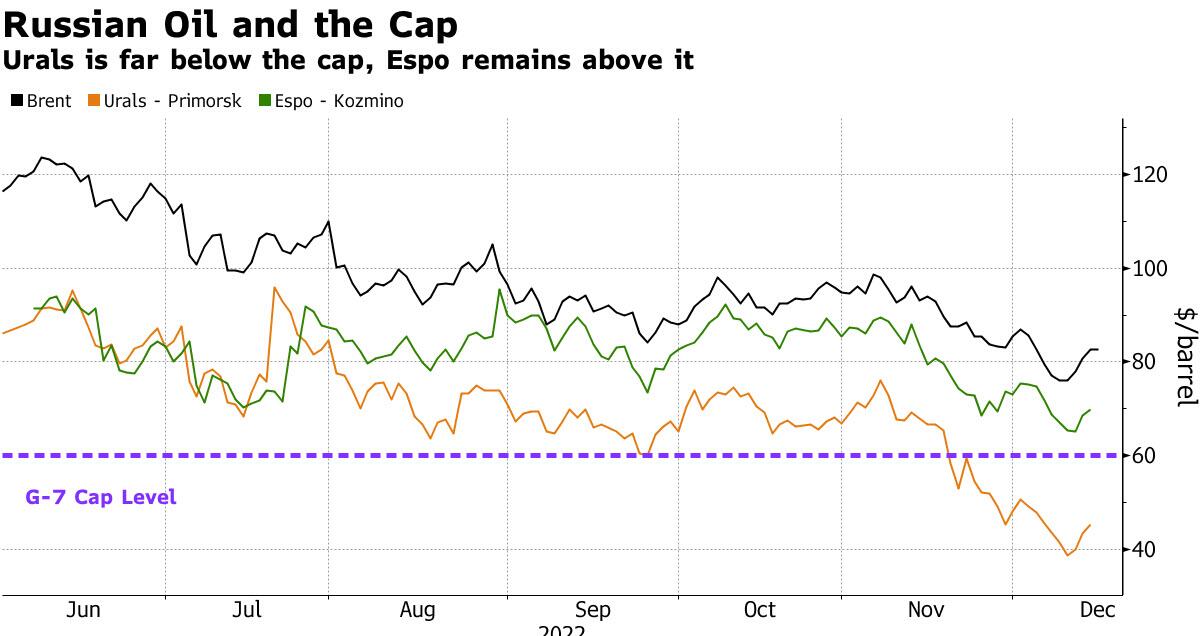
According to Bloomberg, there are signs that oil tanker companies are avoiding sending their ships to collect crude from a key Russian port in Asia following the G-7 sanctions targeting Moscow’s petroleum revenues. As has been duly documented here previously, since Dec. 5, buyers of Russian oil have only been allowed to access industry standard insurance and an array of trade-critical services if they pay $60 a barrel or less. But shipments of the key ESPO grade from the Asian port of Kozmino are about $10 above that, meaning they need to make alternative arrangements.
Since the cap began, ESPO (which stands for Eastern Siberia–Pacific Ocean, the initials of a pipeline that takes the oil from east Siberia to the Pacific) has seen loadings cut in half from a month earlier, tanker tracking compiled by Bloomberg show. By contrast Urals, a much larger grade exported from western Russia, is flowing freely to customers in Asia — aided by the fact it fell far below the $60 threshold a few weeks before it was introduced.
However, amid the latest sanctions which set the $60 price cutoff, tankers are shying away from the Asian grade, and in the 10 days since the measures began, 4.4 million barrels have been loaded onto tankers at Kozmino, Bloomberg calculates. In the same period a month earlier, there were 8.8 million barrels loaded.
While it is too soon to say if the observed drop in ESPO flows reflects something structural, weather conditions haven’t been particularly bad and there doesn’t appear to be many candidate ships in place to collect cargoes in the coming few weeks. That said, tanker tracking data is always volatile, depending on the timings of loadings, and the comings and goings of individual tankers.
Shipbrokers and traders contacted by Bloomberg also said that said there are signs that ESPO sellers are struggling to secure tankers for cargoes purchased at more than $60 a barrel. At least two large and well-known shipowners, China Cosco Shipping Corp. and Greece-based Avin International Ltd. have stepped back from moving ESPO crude since Dec. 5, according to shipbrokers. Emails sent to both companies weren’t answered.
Their absence has taken at least five tankers out of the regular pool of ships that move the grade, they said. That leaves charterers to work with smaller independent owners who’re still willing to handle the trade. If charterers continue to face headwinds with the booking of tankers, flows could be impeded, they said. ESPO and Sokol, another grade that’s exported from eastern Russia, currently trade above the $60 a barrel threshold that gives access to insurance and G-7 services.
With Urals grade Russian oil trading well below the price cap, and last fetching about $45/bbl, shipbrokers said tanker bookings for Russia’s flagship crude from western ports are proceeding more normally. Tanker tracking also suggests no obvious disruption to flows of the grade.
Of course, all of this is just a snapshot in time: once oil prices spike, as they will after the year-end selling is over, it is virtually assured that all Russian oil grades will be priced above $60, even with the deep discount to spot. At that point, traders will be watching closely to see if Russian crude exports can be maintained and how Moscow will respond if supplies do get disrupted.
As noted previously, the irony behind all this is that the stability of Russian exports is crucial as the US and rest of G-7 work on ensuring security of global oil supplies ahead of the Northern hemisphere winter while simultaneously attempting to deprive the Kremlin of funding for its war in Ukraine. A sharp loss of output could backfire on the west if it boosts wider oil prices and reignites inflation. And while the price cap wasn’t really supposed to be a price cap, it just may end up being one with Russian oil exports suddenly cut off, sending all “non-Russian” oil prices explosively higher, and sparking a new energy crisis some time in early 2023.
As for Russian product just sitting there, about half the ESPO cargoes scheduled for loading in the rest of this month have yet to secure tankers, according to shipbrokers. That is slower than usual, and they attributing it to the smaller pool of willing tankers operated by a smaller number of owners. It’s possible that tankers which previously handled oil from sanctioned regimes such as Iran and Venezuela – the so-called dark fleet – would be booked, shipbrokers said.
The U.K. Net Zero Carbon policy (UK NZC) is a Government policy offered as a solution to a problem that involves a range of academic disciplines. As well as being complex, the science of anthropogenic carbon-based global warming is controversial. Although some climate scientists insist that it is ‘settled’, there are many dissenters, as an internet search or a trip to a good bookshop will confirm.
The multi-disciplinary nature of climate science coupled with differing views among experts makes it almost impossible for a layman to follow the arguments, let alone assess the evidence and come to an informed opinion.Despite these apparent difficulties, I’ll argue that it is possible to establish a simple framework that can clarify complex questions – in this case, “How likely is it that UK NZC will be an effective response to global warming? – without requiring specialist knowledge. I also show how the approach can be used to identify, measure and illustrate differences of opinion.
Start from a small number of statements that make up the Net Zero commitment.
The Earth must actually be warming.
The warming must pose a genuine and serious threat to life on Earth.
The warming must be man-made. Specifically, it must be caused by excess carbon dioxide in the atmosphere arising from human activity.
The U.K.’s NZC policy must bring about a meaningful global reduction of atmospheric carbon. That is, it must either make a significant reduction in its own right, or it must set an example that persuades other countries to reduce their own carbon emissions, to a degree sufficient to stop the warming.
For UK NZC to be effective, statements 1-4 must all be correct. If any one of them is false, the policy will fail, either because it doesn’t lead to sufficient carbon reduction, or because the policy wasn’t necessary in the first place.
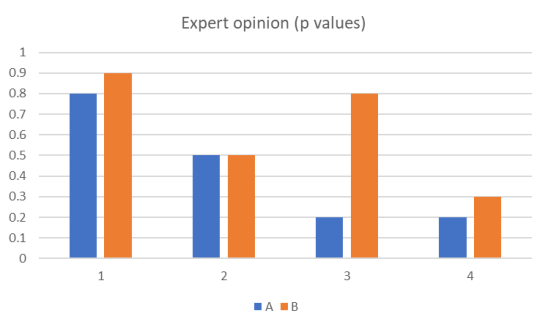
The next step is to define a view (with respect to statements 1-4) as a set of probabilities p1, p2, p3, p4, which represent the respective degrees of belief placed in those statements. For example, the view of a particular climate scientist, Expert A, might be expressed as:
(p1, p2, p3, p4)= (0.8, 0.5, 0.2, 0.2), which means that Expert A is:
80% sure that statement 1 – the Earth is warming – is true;
50% sure that the warming is life-threatening (statement 2);
20% sure that statement 3 is correct – warming is the result of human activity;
20% sure that UK NZC will bring about a meaningful global reduction of atmospheric carbon one way or another.
Expert A rates the likelihood of all four statements being correct, i.e., UK NZC being effective, as:
If the view of a second expert, Expert B, with respect to statements 1-4, is:
(q1, q2, q3, q4) = (0.9, 0.5, 0.8, 0.3)
then a comparison with Expert A’s view shows that:
Expert B has a stronger overall belief than Expert A that UK NZC will be effective (Q=q1 × q2 × q3 × q4 = 0.9 × 0.5 × 0.8 × 0.2 = 0.108, versus P=0.016;
Both A and B agree that the Earth is warming (p1=0.8; q1=0.9);
Both of them are equally unsure whether that poses a significant threat to life on Earth (p2=0.5; q2=0.5);
They differ on the cause of the warming. Expert A doubts that it is man-made, whereas Expert B believes strongly that it is (p3=0.2; q3=0.8);
Both experts are fairly sceptical that UK NZC will lead to a significant reduction in global atmospheric carbon (p4=0.2; q4=0.3).
Neither expert is all that confident that UK NZC will achieve its aims, with Expert A being particularly pessimistic, seeing the likelihood as just 1.6% compared to 10.8% for Expert B. The main reason is that both of them are doubtful that unilateral U.K. action will have much influence on the choices of other countries.
The chart below represents the view of each expert on each requirement, and highlights statement 3, the one area of significant disagreement.
Summary:
Defining a viewwith respect to a set of statements in terms of the respective degrees of confidence associated with each individual statement provides a convenient means of summarising, comparing and illustrating a variety of opinions on the subject to which the statements refer. It also serves as a natural starting point for a cost-benefit analysis of any proposed action.
It isn’t necessary to be an expert (in this case on climate science) to make a reasonable assessment of the conditions that must apply if an argument or an assertion (such as “There is no alternative to UK NZC”) is to be persuasive.
It isn’t too much to expect someone – expert or otherwise – who advocates a particular course of action to be able to give rough estimates of the likelihood that the conditions essential to the success of that action will be met.
Long chains of necessary conditions lead quickly to low probabilities of overall success. The longer the set of plausible conditions that must hold if an assertion is to be true, the less likely the truth of that assertion. With 15 independent requirements, each of which has a 95% probability of success, for example, the probability of overall success is less than 50%. Complex policy issues like those associated with climate change typically have many requirements and much uncertainty.
First we were placed under virtual house arrest. Now we are being frozen by soaring fuel bills and energy supply shortages in those same homes. Coming next, we are to be starved. All in pursuit of one of the Net Zero cults: Covid or carbon emissions. Too bleak a picture? We have only to look across the North Sea to one of our nearest neighbours, the Netherlands.
Surprisingly for such a small country (it is only about twice the size of Wales), the Netherlands is the second largest food exporter in the world, second only to the United States. It is Europe’s largest meat exporter. Four million cows, 13 million pigs and 104 million chickens are reared annually. It provides vegetables to many of its Western European neighbours.
One would assume this success story would be widely cherished, especially in an era of increasing food insecurity and shortages, with other key sources such as Ukraine under serious threat due to the continuing conflict there.
Remarkably, and many would say sinisterly, the polar opposite is the case. The supposed crime of the Dutch farmers? They have fallen foul of the ‘Zero Carbon’ fixation of the Climate Change Cultists who control so much of the current political and economic agenda.
One of that agenda’s chief targets is agriculture, particularly the use of nitrogen. The Dutch are at the top of the tree for nitrogen use per hectare of cultivated land, at nearly twice the European average.
The European Commission has given strict guidelines to EU member states to reduce their use of nitrogen. To comply with this the Dutch Government introduced laws to enforce a reduction of 50 per cent in nitrogen emissions by 2030. Such draconian targets can only come with draconian enforcement measures.
Dutch farming is being strangled through an assortment of regulations, including new flood prevention regulations, bizarrely given the success of the Dutch in preventing flooding over the centuries despite the fact that large parts of the country are below sea level, having been reclaimed from the sea.
Perhaps worst of all, one of the Government’s new laws bans the children of farmers from inheriting the farm when their parents retire or die. Once a farmer stops farming, their entire family becomes banned from farming in the Netherlands again. A whole way of life plus decades, sometimes even centuries, of experience is being gratuitously thrown away.
Where regulation fails, mandatory purchasing of land by the state is feared to be the next step as farmers have so far shown little interest in selling any of their land. Around 300,000 hectares of farmland is earmarked to be converted into nature conservation areas between now and 2040. More than 1,000 farms face forcible closure.
Nor is it just the Dutch Government that the farmers are battling. A panoply of NGOs are on the case too, using the courts to pursue any part of the government at national or provincial level deemed to be faltering in enforcing these objectives.
Those of us in the UK, long weary of seeing how political charities and activist lawyers run rings round attempts to enforce curbs on immigration, will be familiar with the process.
It’s worth pointing out too that, despite Brexit, Northern Ireland still has to implement these same EU directives as part of the Northern Ireland protocol. Thanks for that one, Theresa May, Boris Johnson and Rishi Sunak. So while today it is Dutch farming under siege from its own government, tomorrow it will be farming in Northern Ireland that is compelled to go through the same pain.
Interestingly, no one has yet stepped forward with a credible plan for how these vital lost sources of food are going to be replaced. The Dutch Government hopes that it will come from artificially created meat from laboratories and is investing in this technology, though how it can be sufficiently scaled up remains to be seen. Given what is already widely known about the harmful effects of eating too many processed foods instead of natural foods, such as the triggering of obesity and potential heart disease, it has to be asked whether this is a desirable course, or indeed what the further health implications for users may be.
Some would say the whole agenda is a straight forward grab by bad actors intent on taking control of the world’s food resources, for whom Net Zero objectives provide a convenient camouflage for their own lust for power, control and yet more wealth than they already have. The usual suspects certainly spring to mind.
Others argue that out-of-control digital technocrats are so conditioned to assuming they can control anything, however complex, that they can’t accept that some things remain beyond human control, such as airborne viruses and the climate.
Each failure to learn that simple lesson is leading to ever more intensive efforts to achieve that control, control that must be achieved at all costs. Either way, vicious cycles of more authoritarianism, human misery arising from absurd and seriously harmful measures, plus more setbacks in failing to reach unobtainable goals lie ahead. Unless we can shake off the grip of these technocrats on our societies and the political institutions in thrall to them, the prospect of starving to death will become our grim reality in an increasingly tyrannical world.
A quarter of British adults are struggling to keep warm in their homes as they cut back on energy use in the face of soaring costs, according to a new survey by the Office for National Statistics (ONS).
The report, which was published on Thursday, shows that 23% of adults were occasionally, hardly ever, or never able to keep comfortably warm in their living room over the past two weeks.
The ONS data indicated that 63% of adults were using less gas and electricity because of increases in the cost of living, and 96% of those adults were using less heating.
When asked about the measures they were taking to keep warm this winter, 82% of respondents said they were using more clothing or blankets, 46% were only heating rooms they use, 31% were using hot-water bottles or microwave warmers, while 27% were going to bed earlier.
Other measures included cutting back on the use of tumble dryers and washing machines, as well as bathing or showering less.
According to the ONS, many households have already cut back on their energy usage, with 34% of the polled adults saying that reducing heating has negatively affected their health or wellbeing as a result.
The ONS research on the “impact of winter pressures” also found that 16% of adults are worried their food will run out before they have money to buy more, and 19% have cut back on their portion size. The study showed 17% are eating food which is past its use-by date.
The survey of nearly 5,000 British households comes as the nation’s inflation hit 10.7% in November, which is slightly down from the 11.1% in the previous month but still well above the 2% rate targeted by the Bank of England.
The White House announced “blockbuster” jobs growth in the second quarter earlier this year, allegedly reaching the highest levels in the last 40 years with the US economy adding 390,000 jobs in May alone. However, new data suggests that the figures were a spoof as the job market really stagnated.
The “record-high” Q2 employment surge reported by the Biden admin was overestimated by a million, according to the Philadelphia Federal Reserve Bank. This means that the actual job growth was “essentially flat”, reaching an astonishingly modest 10,500.
The research indicated that employment changes from March through June 2022 were “significantly different” in 33 states and DC compared with Current Employment Statistics (CES) estimates by the Bureau of Labor Statistics (BLS).
“In the aggregate, 10,500 net new jobs were added during the period rather than the 1,121,500 jobs estimated by the sum of the states; the US CES estimated net growth of 1,047,000 jobs for the period,” the Fed said.
Among other problems, the release noted actual payroll jobs decline in Delaware and New Jersey, while earlier CES estimates suggested there was a firm upward trend. According to the new data, Delaware lost 4.1% of jobs in Q2 despite a previously reported 4.5% growth, while jobs in NJ fell 1.2% and not the allegedly 3.4% growth.
In the meantime, jobs in the Keystone state ran a flat line – new data on Pennsylvania shows zero growth (while CES previously reported a 2.9% boost).
The report has already prompted reactions of outrage: Florida Senator Rick Scott accused the Biden administration of lying and requested an immediate meeting with the Bureau of Labor Statistics chief to get to the truth.
Florida Governor Ron DeSantis recently hosted a roundtable forum of experts challenging the science coming from federal public health agencies surrounding the COVID-19 vaccine. Surgeon General, Joseph Ladapo announced the creation of the state’s new Public Health Integrity Committee, and Gov. Desantis announced he is requesting a grand jury investigation of vaccine-makers. Will other states follow?
The attempt to remask the public has started. And it’s rapidly moved past COVID as a reason to know of any basic respiratory illnesses. But does science justify it? Jefferey and Del break down the latest PR push surrounding masking.
The European Union released its ninth round of anti-Russian sanctions earlier Thursday, with the latest batch placing bans on the exports of drone engines, investments within the mining sector and implementing prohibitions on ads and public opinion polling services, among other penalties.
The European Union’s ninth round of sanctions targeted RT and its parent company Ano TV-Novosti, it has been detailed.
The designation has prompted Brussels to seize the funds and assets of those belonging to RT in Europe over its allegations that the non-profit parent firm and RT work to “spread propaganda and disinformation.”
The block further claimed in its announcement that the organization was considered to be “involved in undermining the territorial integrity, sovereignty and independence of Ukraine.”
Also detailed in the Thursday announcement was the suspension of licenses for media outlets NTV/NTV Mir, Rossiya 1, REN TV and Pervyi Kanal.
“These outlets are under the permanent direct or indirect control of the leadership of the Russian Federation and have been used by latter for its continuous and concerted disinformation and war propaganda actions, which legitimise Russia’s aggression and undermine support for Ukraine,” a statement reads, noting that the EU decision was “in line with the Charter of Fundamental Rights.”
George Szamuely, a senior research fellow at the Global Policy Institute, spoke to the development with RT, underscoring that the move was a “great shame” and simply the product of “EU and US hypocrisy.”
“It means that Europeans won’t get to hear the other side of the story,” Szamuely said of the ongoing western narrative being pushed in regards to Russia’s special military operation. “Now is the most imporant time to hear the other side.”
“What they call disinformation is information they don’t like… it’s a perspective that they want to deny to the European public,” he stressed, adding that he did not believe western journalists would condemn the EU move as “they’re much too busy getting indignant about a handful of journalists getting suspended by Twitter.”
As for a tenth sanctions package, a source told Sputnik that no EU member state has made any proposals on the matter, but that a future sanctions batch would likely focus on “closing loopholes of the current sanction packages.”
As I sat down to write a report of Conservative MP Andrew Bridgen’s remarkable speech in Parliament this week to an all-but-empty chamber, I lighted upon this email from TCW reader Michael Carr:
‘It’s not often (never these days) that you can put the words “brave” and “UK MP” in the same sentence. But have we just witnessed one brave MP speaking out about the unprecedented human harm done by the mRNA Covid vaccine, and his call to have it halted immediately? It seems that MP Andrew Bridgen is just such a guy.
‘Notice the virtually empty chamber when he brings this subject up. Cowardly MPs decided they didn’t even want to be present when Andrew delivered his scathing attack on what the political, medical and mainstream media establishment had pushed (or kept silent) over the last two and a half years.’
I couldn’t have expressed it better. But what was the response? Despite the empty chamber did this remarkable speech prompt the MSM into reporting him and the great unspoken issue of the year, vaccine injury? The tragedy is that it did not. Bridgen’s calls for an immediate halt to the Covid vaccines have been, to date, ignored by all newspapers bar the Express. And their report, couched in terms of Bridgen’s ‘use of’ Parliamentary privilege to make ‘a bombshell allegation’ that a senior member of the British Heart Foundation had covered up a report showing ‘the mRNA Covid vaccine increases inflammation of the heart arteries’, was not exactly on point.
It shifted the focus from the main thrust of his adjournment debate which he intended to highlight the important issue of Covid vaccine harms, and his belief, unlike that of most of his colleagues, that the debate about vaccine harms should be based on data rather than fear.
It was in anticipation of media queries that Bridgen, the Conservative member for North West Leicestershire, forwarded in advance a comprehensive list of the data on which his speech is drawn to the mainstream media. No one can say he had not done his homework. It is just a crying shame – a disgrace, in fact – that no journalists bothered to do theirs. I know because I was sent by his office an extensive and comprehensive list of references. These included the government’s own evidence of serious adverse reactions affecting nearly half a million people; evidence showing that in the past vaccines have been completely withdrawn from use for a much lower incidence of serious harm – for example, the swine flu vaccine was withdrawn in 1976 for causing Guillain Barré syndrome in 1 in 100,000 adults and in 1999 the rotavirus vaccine was withdrawn for causing a form of bowel obstruction in children affecting 1 in 10,000; reference to the 25 per cent increase in heart attack and cardiac arrest calls in 16-to-39-year-olds in Israel associated with the first and second doses of vaccine and not associated with Covid infection, findings replicated in Florida; and to UK reports of an extra 14,000 out-of-hospital cardiac arrests in 2021 compared with 2020 following the vaccine rollout.
In conclusion he said: ‘As the data clearly shows to anyone who wants to look at it, the mRNA vaccines are not safe, not effective and not necessary. I implore the Government to halt their use immediately. As I have demonstrated and as the data clearly shows, the Government’s current policy on the mRNA vaccines is on the wrong side of medical ethics, it is on the wrong side of scientific data, and ultimately it will be on the wrong side of history.’
His speech was remarkable, not because his oratory was remarkable but because his bravery and independence of mind was. He is one of those rare amongst men and even rarer amongst MPs, a man with moral courage. To stand out as one man against the crowd, in defiance of received wisdom and judgment, is the most difficult thing any human being is called on to do. Andrew Bridgen did it.
You can watch the full speech or the snippet below. Please note the supportive intervention by one of the two other MPs to have clearly stuck his head above the parapet on this all-important issue, Danny Kruger (Conservative, Devizes); the other being that great warrior for truth Sir Christopher Chope (Conservative, Christchurch).
Melting ice caps will enable China’s military forces to “reach into the Atlantic”, the Chief of the Defence Staff has warned.
At an address on Wednesday, Admiral Sir Tony Radakin urged people to consider what effect climate change would have on the security of the nation.
In his annual Royal United Services Institute address, Sir Tony said: “We also need to consider the melting of the ice caps in the coming decades, which will: unleash a difficult new competition for minerals and resources; halve the time it takes for shipping to travel between Asia and Europe; and surely China’s military forces will start to reach into the Atlantic?”
The High North becoming more open and accessible due to melting ice caps has been worrying military figures for some time.
As the former first sea lord, Sir Tony previously warned that, as the transit time between Europe and Asia inevitably shortens, so too can the West expect to see China sailing its “growing navy” through the shorter route.
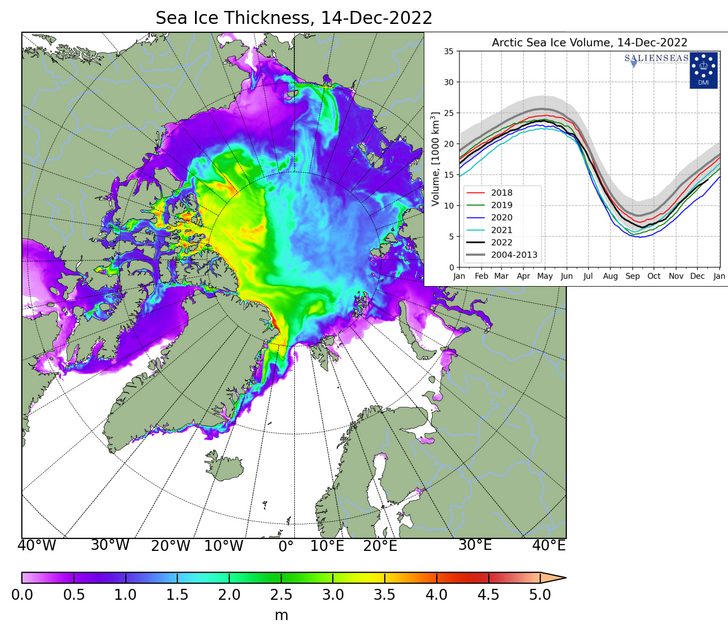
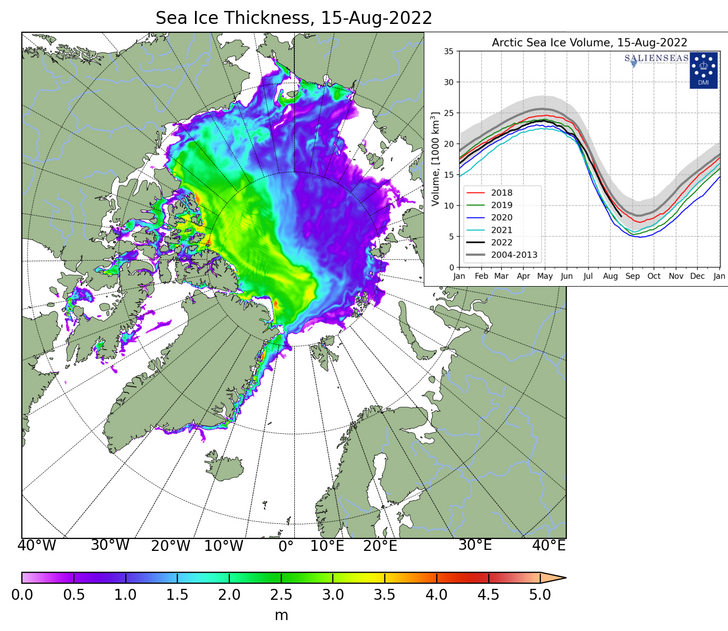
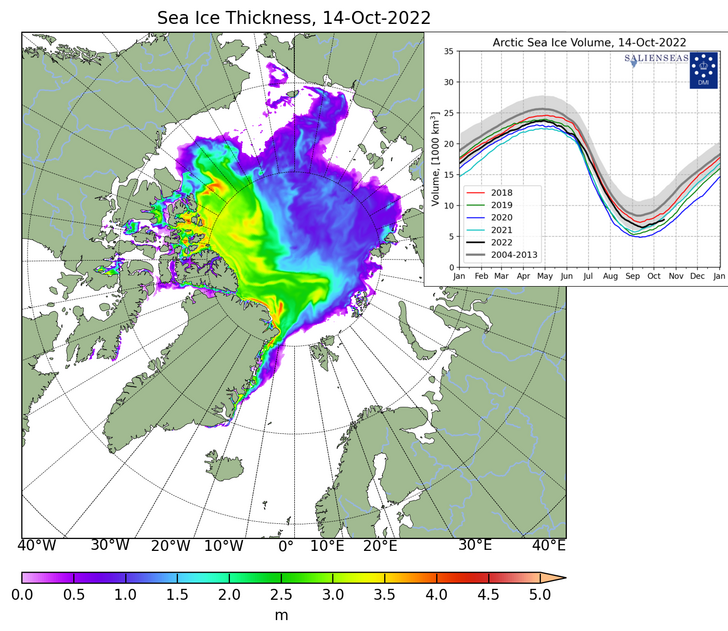
Chinese ships may be able to sail through the Northeast Passage for a couple of weeks weeks in summer, but would have a job getting back home again through two meter ice:
In fact this year the Passage was still blocked as late as mid August, and was blocked again by October.
And none of this is going to change for one very good reason. By autumn the sun in the Arctic is already going down over the horizon. And without the sun, the sea quickly refreezes.
It is absurd to believe that China or any other country would send its navy out into the Arctic Ocean in these circumstances.
Which leads to the question why Tony Radakin is making a fool of himself. The only conclusion I can come to is that he is under orders to play the climate card, so as to scare the public.
The latest sign Americans will one day be eating insects is that a top bug producer announced Tuesday major expansion plans in North America.
French insect producer Ÿnsect signed two agreements to expand production facilities in the US and Mexico in 2023. The company “entered an accelerated phase of international development with the signing of a memorandum of understanding with Ardent Mills for an industrial facility in the United States and the signing of a joint development agreement with Corporativo Kosmos in Mexico.”
Ÿnsect’s development plans include 10-15 insect farms worldwide by the end of the decade that can meet the feeding demand of hundreds of millions of people, if not more. The producer of bugs uses highly-automated vertical farms to raise Buffalo and Molitor mealworms to create insect protein.
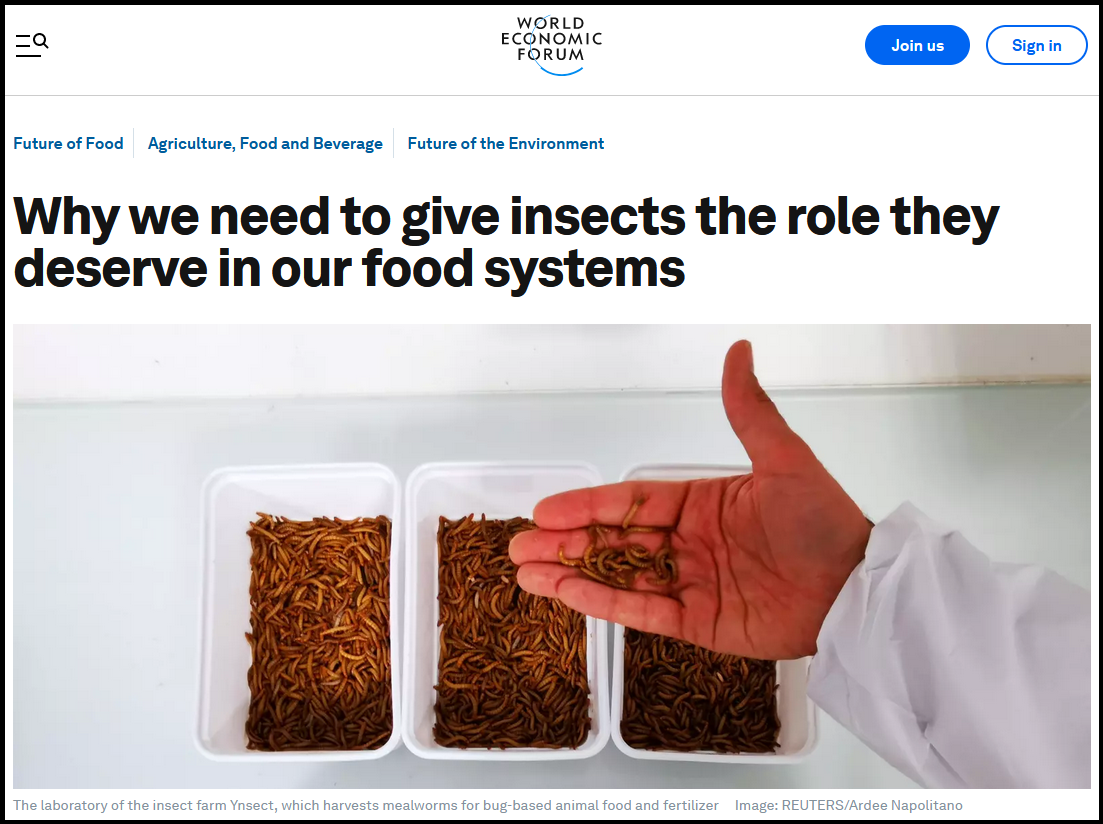
Many Americans have already been conditioned for the brave new world, one pushed by the World Economic Forum of a so-called ‘sustainable’ future where you’ll eat insects…
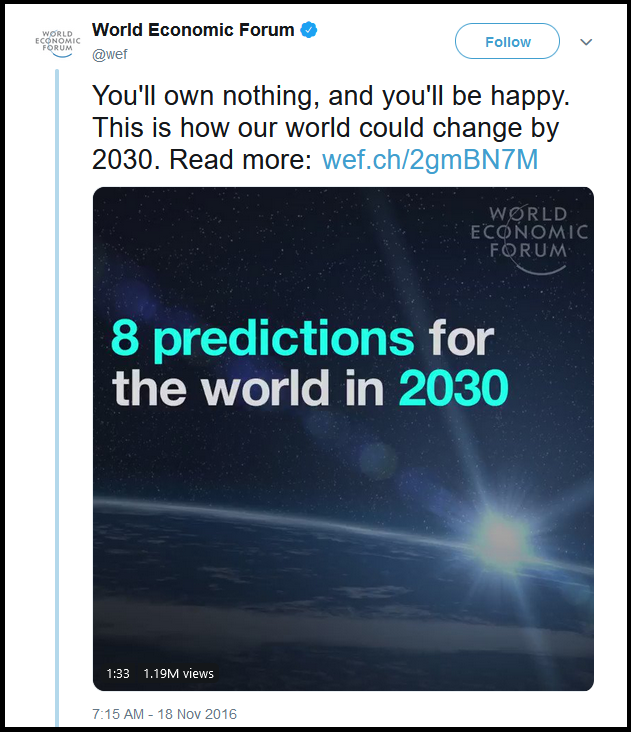
… and also own nothing.
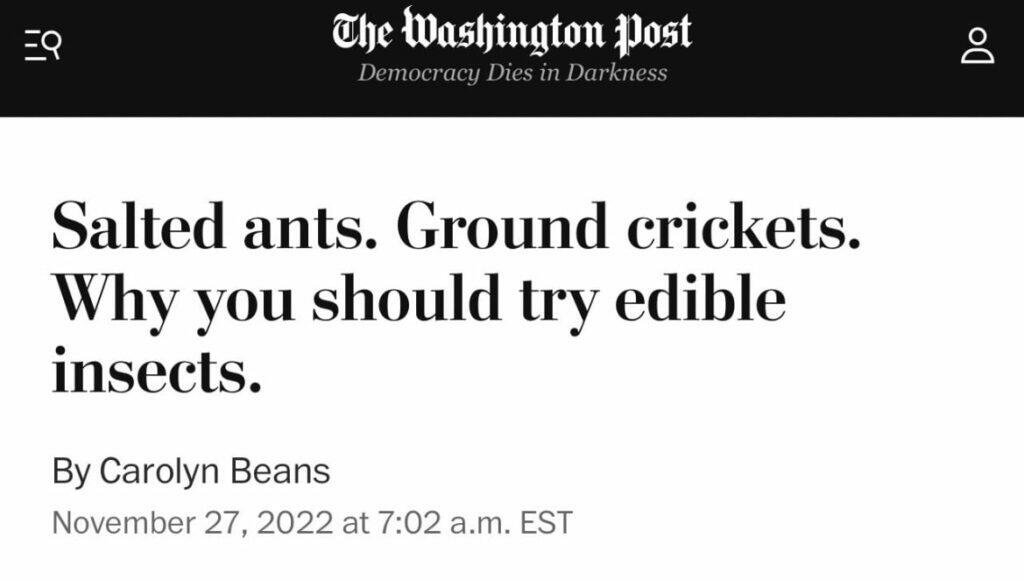
Some of the latest conditioning to eat bugs was an article published in Jeff Bezos-owned The Washington Post.
Which brings us to the WEF’s warning earlier this year about an impending food crisis kicked off by the war in Ukraine.
In the medium term, it highlights the need to transform our food system, using more green energy. We should also be encouraging more sustainable diets, which contain fewer grain fed animal products; and regenerative agricultural practices, which improve soil health and the efficiency of nutrient use by the crop. -WEF
So… eat bugs and be happy about owning nothing are the global elites’ blueprint for 2030 society.
With the UN and other interests already interfering in Africa’s energy development, Joe Biden announced at the US-Africa Business Forum a plan for American taxpayers to shell out at least $8 billion to shut down effective coal fired energy plants in South Africa so they can be replaced with far less effective and far less efficient green energy alternatives.
In other words, the goal of climate change cultists is to use $8 billion of America’s money to diminish South African infrastructure.
The green energy scam continues despite the fact that European nations are now admitting they need more oil and coal based energy, not green tech, after the loss of Russian natural gas resources.
The American taxpayer is now carrying the weight of $94 billion in 2022 for so called “clean energy” initiatives in other nations around the world.
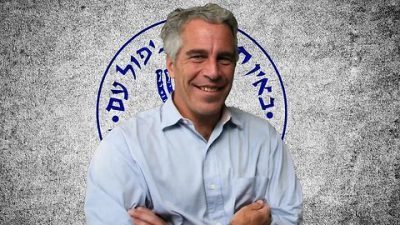
BY WHITNEY WEBB | UNLIMITED HANGOUT | JUNE 10, 2022
This short excerpt from Whitney Webb’s upcoming book “One Nation Under Blackmail” examines an obscure media profile of Leslie Wexner, Jeffrey Epstein’s mentor, from the 1980s that contains disconcerting revelations about Wexner’s personality and his inner world. … continue
This site is provided as a research and reference tool. Although we make every reasonable effort to ensure that the information and data provided at this site are useful, accurate, and current, we cannot guarantee that the information and data provided here will be error-free. By using this site, you assume all responsibility for and risk arising from your use of and reliance upon the contents of this site.
This site and the information available through it do not, and are not intended to constitute legal advice. Should you require legal advice, you should consult your own attorney.
Nothing within this site or linked to by this site constitutes investment advice or medical advice.
Materials accessible from or added to this site by third parties, such as comments posted, are strictly the responsibility of the third party who added such materials or made them accessible and we neither endorse nor undertake to control, monitor, edit or assume responsibility for any such third-party material.
The posting of stories, commentaries, reports, documents and links (embedded or otherwise) on this site does not in any way, shape or form, implied or otherwise, necessarily express or suggest endorsement or support of any of such posted material or parts therein.
The word “alleged” is deemed to occur before the word “fraud.” Since the rule of law still applies. To peasants, at least.
Fair Use
This site contains copyrighted material the use of which has not always been specifically authorized by the copyright owner. We are making such material available in our efforts to advance understanding of environmental, political, human rights, economic, democracy, scientific, and social justice issues, etc. We believe this constitutes a ‘fair use’ of any such copyrighted material as provided for in section 107 of the US Copyright Law. In accordance with Title 17 U.S.C. Section 107, the material on this site is distributed without profit to those who have expressed a prior interest in receiving the included information for research and educational purposes. For more info go to: http://www.law.cornell.edu/uscode/17/107.shtml. If you wish to use copyrighted material from this site for purposes of your own that go beyond ‘fair use’, you must obtain permission from the copyright owner.
DMCA Contact
This is information for anyone that wishes to challenge our “fair use” of copyrighted material.
If you are a legal copyright holder or a designated agent for such and you believe that content residing on or accessible through our website infringes a copyright and falls outside the boundaries of “Fair Use”, please send a notice of infringement by contacting atheonews@gmail.com.
We will respond and take necessary action immediately.
If notice is given of an alleged copyright violation we will act expeditiously to remove or disable access to the material(s) in question.
All 3rd party material posted on this website is copyright the respective owners / authors. Aletho News makes no claim of copyright on such material.




 Aletho News