Turkey reaches NATO deal with Finland and Sweden

Samizdat | June 28, 2022
Turkey will support inviting Finland and Sweden into NATO at the alliance’s upcoming summit in Spain, Finnish President Sauli Niinisto announced on Tuesday after a meeting with his Turkish counterpart Recep Tayyip Erdogan and Swedish Prime Minister Magdalena Andersson.
The three countries signed a memorandum of understanding at the meeting, organized with the support of NATO Secretary General Jens Stoltenberg.
“The concrete steps for our accession to NATO will be agreed among NATO allies over the next two days, but that decision is now imminent,” said Niinisto. “I am pleased that this stage on Finland’s journey towards NATO membership has been completed.”
According to Turkey, Finland and Sweden pledged to “condemn terrorism in all its forms” and end their support for organizations Ankara has designated as terrorist – including the Kurdish groups PKK and YPG, as well as the movement led by the exiled cleric Fetullah Gulen, which the Turkish government refers to as “FETO.”
“Turkey got what it wanted,” Erdogan said in a statement after the deal was announced.
Speaking at a press conference after the meeting, Stoltenberg said that Finland and Sweden will become observers in NATO at the upcoming summit. He added that the memorandum includes provisions on fighting terrorism and arms exports, including adopting stricter national legislation.
Finland and Sweden imposed an arms embargo against Turkey in 2019, over Ankara’s intervention in Syria. Turkey also reportedly demanded that Stockholm and Helsinki shut down the offices and ban the publications belonging to FETO, freeze the assets related to groups it has designated as terrorists, and even ban them from demonstrating in public.
Ankara’s opposition threatened to derail NATO’s plan to invite Sweden and Finland at the summit in Madrid which began on Tuesday. The two traditionally neutral Scandinavian countries declared their desire to join the US-led alliance in April, citing the current conflict in Ukraine.
Kremlin: Russia’s offensive to end as soon as Ukraine forces lay down weapons
Press TV – June 28, 2022
The Kremlin says Russia will halt its months-long military offensive in neighboring Ukraine as soon as Ukrainian forces surrender.
Kremlin spokesman Dmitry Peskov told reporters on Tuesday that hostilities in Ukraine could end “before the end of today” if Kiev orders the nationalists to lay down their weapons and Moscow’s demands are met.
“The Ukrainian side can end all this before the end of today; an order is necessary for the nationalist units to lay down their weapons, an order is necessary for the Ukrainian military to lay down their weapons; and they must fulfill all Russia’s demands. Then everything will be over before the day ends,” Peskov said.
“Everything else are just speculations of the Ukrainian head of state,” he added. “We are guided by the statements of our President Vladimir Putin that the special military operation is going according to plan and achieving its goals.”
Asked whether the Russian side had any approximate timeframe for the end of the offensive in Ukraine, the Kremlin spokesman responded in the negative.
Peskov made the comment while reacting to Ukrainian President Vladimir Zelensky’s remark that he would like to end the hostilities before the end of the year.
Zelensky urged world powers on Monday to do their utmost to help end Russia’s offensive before the cold season, also saying that the time was not ripe for holding talks with Russia as Kiev was seeking to consolidate its positions.
In a statement on Monday, the Group of Seven (G7) countries expressed full support for Ukraine in the conflict with Russia, pledging to further tighten sanctions on Moscow.
Addressing G7 leaders at their summit in the Bavarian Alps via video link, the Ukrainian president called for arms supplies and air defenses to gain the upper hand in the conflict.
Since the start of Russia’s military strikes on February 24, the US and its Western allies have been imposing sanctions against Moscow. More than four months after the Kremlin launched its offensive against Ukraine, Russian troops have taken control of nearly the entire Donbass region, focusing their military attention on northeastern Ukraine.
In a separate development on Tuesday, G7 leaders in a statement denounced Russia’s offensive as “illegal and unjustifiable.”
“We, the leaders of the Group of Seven … were joined by the leaders of Argentina, India, Indonesia, Senegal and South Africa, as well as Ukraine,” they said in their draft final statement. “We re-emphasize our condemnation of Russia’s illegal and unjustifiable war of aggression against Ukraine.”
The G7 leaders also agreed to explore imposing a ban on transporting Russian oil that had been sold above a certain price, ramping up pressure on Moscow over the soaring global inflation and energy shortages fueled by the country’s offensive in Ukraine.
German Chancellor Olaf Scholz said an oil price cap would ratchet up the existing Western pressure on Russia, stressing that the sanctions would stay until Moscow accepted failure in Ukraine.
“There is only one way out: for Putin to accept that his plans in Ukraine will not succeed,” Scholz told a closing news conference at the three-day G7 summit, adding that the aim of the ban was to tie financial services, insurance, and the shipping of oil cargoes to a price ceiling. “We invite all like-minded countries to consider joining us in our actions.”
The International Energy Agency announced in its June monthly report that the revenues from Russian oil export had soared in May even as volumes had fallen.
The Kremlin said on Tuesday that Russian gas giant Gazprom could seek to change the terms of its delivery contracts if Western governments implemented a price cap on Russian gas.
Israel Reportedly Seeks US Go-Ahead to Provide Arab Gulf States With Laser Weaponry
Bennett expressed hope that the system would come online by 2023

Samizdat – 28.06.2022
Last week, Israel’s defense minister announced that Tel Aviv was working on a ‘Middle East Air Defense Alliance’ with Arab governments, but provided no details. On Sunday, US media reported that Washington brokered a secret meeting in the spring of top Israeli and Arab military officials to discuss regional air defense coordination against Iran.
Israeli officials are planning to ask US President Joe Biden for his formal blessing to provide an Iron Beam laser-based air defense system to Gulf Arab states including the United Arab Emirates and possibly Saudi Arabia, Israel’s Channel 12 has reported.
The unsourced Hebrew-language report, cited by the Times of Israel, indicated the delivery of the system to the Gulf countries would assist with the US-led push to ramp up air defense cooperation between Tel Aviv and a loose regional coalition including Egypt, Jordan, Bahrain, the UAE, Saudi Arabia and Qatar.
The Jewish State does not have formal diplomatic relations with the latter two country, and Riyadh has repeatedly stated that it would not establish formal ties with Israel until the Palestinian question and the creation of a Palestinian state was settled.
On Sunday, the Wall Street Journal reported, citing US and Middle Eastern sources, that the Pentagon had organized a hush-hush meeting in Sharm El Sheikh, Egypt in March to discuss ways to improve air defense cooperation against Iranian ballistic missiles and drones. The meeting was said to have been chaired by then-US Central Command chief Frank McKenzie, and attended by top military commanders from Israel and the Arab countries who were invited.
Israeli Defense Minister Benny Gantz, who announced the formation of a regional anti-Iranian air defense alliance last week, appeared to signal the veracity of WSJ’s reporting on Monday, saying Israel was “building” a “wide partnership with additional countries in the region to ensure a secure, stable and prosperous Middle East,” and that “among other things, this also includes aerial defense.”
“We will strengthen this, as a stable Middle East is an international, regional and Israeli interest of the highest order,” Gantz said.
Iran’s military also appeared to issue an indirect response to WSJ’s report, with Armed Forces Chief of Staff Mohammad Bagheri warning Monday that Tehran “will not tolerate” the threats posed by Israel and its cooperation with CENTCOM, and “will definitely react to them.”
Israel has long touted the purported advanced capabilities of its so-called ‘Iron Beam’ laser-based air defense system, a prototype of which was unveiled last year. Earlier this month, Prime Minister Naftali Bennett said the “game-changer” weapon would shift the balance in Israel’s favor, with the estimated $2 in electricity required per burst to intercept enemy rockets just a drop in the bucket compared to the tens of thousands of dollars a rocket might cost. Bennett expressed hope that the system would come online by 2023.
Last week, Breaking Defense reported that Israel would ask Biden for more money for Iron Beam’s development, on top of the $3.3 billion in annual US subsidies already received by the Israeli military and defense establishment. The outlet’s sources indicated that Israel will likely ask the US president to shell out about $300 million in additional cash.
“The relations between the US and Israel are solid. The issues that will be on the table during the visit are of utmost importance to both the US and Israel. I’m confident that the talks will be fruitful to both sides,” a senior defense source told the outlet.
During his trip to the Middle East next month, Biden is expected to tour an Israeli airbase and get a firsthand look at the prototype laser weapons being developed by Israeli defense giants Rafael and Elbit Systems.
Lasers for use against aircraft, missiles, drones, ships, and ground equipment have been on the drawing board of weapons developers since the Cold War, with engineers spending decades mulling over the prospects of replacing conventional missile and shell projectiles with the futuristic beam pulse. But energy-directed weapons have long faced what have previously been deemed unsolvable issues, such as the immense amounts of power required to operate them, as well as interaction between combat lasers and natural phenomena such as rain, fog, smog or dust, all of which dissipates their strength.
Last month, US weapons maker Raytheon reported that its own laser weapon, fitted aboard an Army Stryker vehicle, had successfully downed incoming mortar rounds in testing.
Why G7’s Program for Developing Countries is Still No Match for China’s Belt & Road
Samizdat – 28.06.2022
The G7 on 26 June re-launched its previous Build Back Better World program to provide infrastructure funds to poor and developing nations under a new name, the Global Investment and Infrastructure Partnership. The project aims to compete with China’s Belt and Road Initiative kicked off by Beijing in 2013.
The Build Back Better World (B3W) program was pompously announced by the club of seven developed nations to counter China’s Belt and Road at the G7 Summit in Cornwall in July 2021. However, little had been heard of the G7’s endeavor since then. In June 2022, the Group of Seven decided to breathe new life into the project.
“So far, America has failed to build momentum on its plan to Build Back a Better World,” says Francesco Sisci, a Beijing-based China expert, author, and columnist. “However, with this new G7 plan, which includes other countries, this momentum could start to be built. It is a question mark. Nobody is sure until things are realized. But you cannot just underestimate and dismiss this plan, because there is a large commitment of many countries with a large economy and this plan could make big sense.”
The G7’s grand design envisages laying a secure sub-sea telecommunications cable that will connect Singapore to France through Egypt and the Horn of Africa; creating a COVID-19 vaccine plant in Senegal; expanding solar projects in Angola, including solar mini-grids and home power grids; and establishing an innovative modular nuclear reactor plant in Romania, among other issues.
The US president pledged to mobilize $200 billion in investments in global infrastructure projects over the next five years. The overall investment, including G7 member states and private capital, is expected to reach $600 billion.
“With two competing plans – size matters, at the end of the day,” says Sisci. “That is, China may be able to immediately finalize a lot of money in a short time in a number of projects. The G7 countries could be slower, but eventually they could build up momentum and they could channel much more money much more effectively, perhaps, in a much larger number of projects which could stifle Chinese projects.”
Sisci suggests that the club of developed capitalist countries “may end up being more effective in many ways [than China], a smaller non-capitalist country.”
“China, but also Russia, by far, don’t have the size, the gravitas to oppose even a divided G7, which is coming together because of this opposition to China or Russia-driven projects,” he notes.
G7 Economic & Geopolitical Hurdles
However, some other observers express skepticism over the ability of the US and G7 to implement the project given record-high inflation and cost of living crisis currently engulfing the states. The US, British and European central banks are struggling to tame skyrocketing inflation by raising interest rates to reduce demand, which is prompting recession fears.
“Washington claims they are going to be sending over $200 billion. But where’s the money coming from and how is it going to be really used?” asks Thomas W. Pauken II, the author of “US vs China: From Trade War to Reciprocal Deal,” a consultant on Asia-Pacific affairs and a geopolitical commentator.
He notes that previously the US Senate voted Biden’s landmark Build Back Better initiative down, and for good reason, as Republican congressmen feared that the Democratic administration’s spending spree would fan inflation and increase an already bloated national debt.
Pauken also expresses bewilderment over the G7’s apparent readiness to embark on the bold international project at a time when the group is involved in the Ukraine crisis with the UK trying to keep the military conflict dragging on. “I mean, it’s laughable that they have to think about [competing with] China at this time when they’re on the brink of a major war in Europe,” the commentator remarks.
Meanwhile, the G7’s Global Investment and Infrastructure Partnership cannot be regarded so far as a viable alternative to the Beijing-led Belt and Road Initiative that has been implemented for slightly less than a decade, according to Pauken.
“First of all, [the G7] actually need[s] to make these projects work,” says the geopolitical commentator. “Other than that solar plant in Angola, I don’t see any of these initiatives really working.”
In particular, China invested almost $59.5 billion in its comprehensive infrastructure project in 2021 alone. When it comes to crucial elements of the project, the West appears to be lagging behind. While the G7 is still considering building a subsea cable linking Europe and Southeast Asia, China kicked off its Digital Silk Road (DSR) almost seven years ago. The DSR’s backbone is the Pakistan and East Africa Connecting Europe (PEACE), a 9,300 mile long subsea cable network meant to tie Asia, Africa, and Europe together. The network is designed to transmit over 16Tbps per fibre pair with its Mediterranean section going from Egypt to France having already been laid.
Are Emerging Economies Interested in the G7 Agenda?
There is yet another problem as to how to make these Western projects attractive for Global South nations, the Asia Pacific expert continues. In particular, the G7 has been pushing ahead with a climate change agenda and the plan to cut carbon emissions, which is not relevant for the majority of third-world states which are still reliant on cheaper and more reliable fossil fuels and coal plants, he notes.
“You also have to deal with auditing issues as well as the so-called climate change consultants who go on the ground and on site,” he says. “You have to prove that those infrastructure projects are not causing much of a carbon footprint. But most of the major infrastructure does require a big carbon footprint, especially in the emerging markets, because they don’t have the same equipment or they don’t have the same standards or labor laws as they would have in Western Europe or the US.”
Many emerging economies, including African countries, are beginning to have a growing frustration with the US and Europe, according to Pauken. The reality is that Africans and many of the emerging markets want to focus on economic stuff, he notes. However, when the US officials come in, they’re talking about climate change or gender equity, and this is not as interesting to developing nations, the commentator emphasizes.
“[Developing nations] want help on improving their agricultural production levels and boosting their energy capacity, which the Russians and the Chinese have been doing,” Pauken notes.
Given all of the above, it is unlikely that the G7’s Global Investment and Infrastructure Partnership initiative is going to actually happen, argues the geopolitical commentator.
“They’re rebranding a failed policy, thinking it might work by using new names and new mergers. Last time it was separate between the EU and separate between the US and they somehow think that if you combine the two failed projects into one, that this will somehow succeed. That’s not going to work in the real world,” Pauken concludes.
Zionist Regime Unable to Defend Itself: IRGC Chief
Al-Manar | June 28, 2022
The commander of the Islamic Revolution Guards Corps cautioned Islamic countries’ governments to avoid relying upon the Zionist regime, which is unable to even protect itself.
In a meeting with Chairman of the Joint Chiefs of Staff Committee of Pakistan General Nadeem Raza in Tehran, Major General Hossein Salami slammed the Zionist regime as the enemy of the Islamic world and humanity.
The IRGC commander also warned regional rulers of the bitter consequences of normalization of ties with the “child murdering Zionists”, saying the US, the main supporter of the Israeli regime, is basically the enemy of Islam.
“The question is that while the Zionist regime cannot even defend itself and is a regime absolutely without any policy, how would certain Islamic countries rely on it to ensure their security or safeguard their economy? There is no logic behind it,” Major General Salami added.
He further pointed to the awful results of the presence of American forces in the Islamic world, including the great seditions, long civil wars, destruction of houses, displacement of people, insecurity, poverty and underdevelopment.
“When we look at Afghanistan, we notice the harmful and irreparable effects of American interference,” the general added, noting that the neighboring countries, including Pakistan, suffer from the consequences of destructive US interference in Afghanistan.
He also highlighted the integrated security of Iran and Pakistan, stressing the need for closer cooperation between Tehran and Islamabad in all fields, especially in protecting the security of the common border and fighting against terrorism.
For his part, the Pakistani general pointed to the commonalities between the Pakistani and Iranian nations, decried divisions within the Muslim world as a result of the US and Western plots, and noted that Americans withdrew from Afghanistan after twenty years without managing to establish security in that country.
General Nadeem Raza also emphasized the necessity of intelligence and operational cooperation with Iran in protecting the security of the joint border.
Biden Goes to the Middle East
BY PHILIP GIRALDI • UNZ REVIEW • JUNE 28, 2022
The White House has confirmed that President Joe Biden will travel to the Middle East in mid-July. He intends to visit Israel, the Palestinian Authority and Saudi Arabia. The trip will be used to address outstanding bilateral and multilateral issues, including convincing the Saudis to pump more oil to bring down fuel prices. Among the key topics to be discussed will be the alleged Iran threat, a possible security alliance between Israel and Gulf states backed by Washington, the status of the US Consulate General in Jerusalem, and the future of the Palestinian Authority.
Biden has agreed to a controversial meeting with Saudi Crown Prince Mohammad bin Salman, in which he will ask the Kingdom to agree to “normalize” relations with Israel in addition to increasing its oil exports. There has also been considerable pressure on Biden to seek a commitment from the Prince to take steps to improve human rights in his country, but the subject is not likely to come up as it is Biden who is seeking concessions from the Saudis. The Prince, for his part, ordered the October 2018 killing of US resident and Washington Post journalist Jamal Khashoggi in Istanbul. Khashoggi had been highly critical of the Saudi monarchy, particularly regarding its human rights record. Some in Congress and the media have described the private meeting as inappropriate given that fact.
Indeed, pumping more oil aside, the trip is largely about doing many things to help Israel, which is expected to produce favorable reporting in the US media preceding the November mid-term election. Biden even described the trip as being “for Israel” and that loud sucking noise you hear is his repeated pledges of loyalty to the Jewish state. He has described himself as a “Zionist” and has enthused “My commitment to Israel is known and engraved in rock.” Lest there be any confusion in spite of all that, the White House statement regarding the trip also made very clear that the president will “reinforce the United States’ iron-clad commitment to Israel’s security and prosperity.” That means that Israel will not be pressured over its appalling human rights record, worse even than Saudi Arabia’s, to include the recent assassination of Palestinian-American journalist Shireen Abu Akleh. On the contrary, Biden is bearing gifts to reward the Israelis for being such great friends, including a proposal that increases US financial and logistical support for the Jewish state’s air and missile defense systems, which are already largely funded by Washington.
Other aspects reflecting the Israeli dominance of US-Mideast foreign policy include Biden’s convincing the Saudis and also representatives of the Gulf States to step up their efforts to actively counter what is being described as “threats from Iran.” It is being suggested that this might include a security arrangement, not quite an alliance, but a commitment by many of Iran’s neighbors to act jointly if the Islamic Republic threatens anyone in the region. The arrangement would have to include Saudi Arabia, the Gulf States and Israel, backed up by the US military presence in Kuwait, Bahrain and Qatar. Israel is also demanding a Plan B response proposal if Iran and Washington fail to restart the stalled Joint Comprehensive Plan of Action (JCPOA) nuclear monitoring program. Washington, under pressure from Israel, now appears to be reluctant to make the concessions that would reestablish the original plan and the Israeli government is seeking a commitment by the president to use force, if necessary, when Iran crosses an agreed upon “red line” by enriching uranium until it produces enough fissile material to put together a nuclear weapon. Of course, there is a trick to the demand as Israel claims that Iran already has enough enriched uranium to create one or more bombs.
Israel nourishes regional imperatives that might tempt it to steer the discussions in a direction that would be very favorable to itself at the expense of other US interests in the region. Israel’s leaders regularly boast about their ability to manipulate the American government. They might stage or manage an incident that takes place during the Biden visit to shift perceptions of the status quo in the Middle East. As Israel has demonstrated that at its most extreme it has little regard for American lives or property, one should not be surprised if something odd were to happen. Many credible observers credit the Israeli intelligence services with a whole series of attacks on American targets, possibly even including arranging the assassination of John F. Kennedy and instigating 9/11. And then there are also the Lavon Affair in 1954 which involved the bombing of US government buildings in Egypt, and the attack on the USS Liberty in 1967 which killed 34 American sailors. To be sure, Israel can be ruthless and its security services are very effective at assassinations and false flag attacks.
Israel wants very much to have two developments emerge from the Biden visit. First is to effectively eliminate Iran as a potential threat by degrading its military and preventing any moves to go nuclear and second is to delegitimize the Palestinians as negotiating partners for some kind of two-state solution, which Biden claims to support even though Israelis routinely and generically refer to the Arabs as “terrorists.” To prevent blowback coming from any direct moves to confront the Iranians and Palestinians, Israel would also prefer to have the United States take the lead and do the heavy lifting. To accomplish that, it is first necessary to change Washington’s assessment of the threats in the Middle East, and that just might be doable by arranging something spectacular while the president in the region, like a bombing, or an act of sabotage or even creating what appears to be a terrorist attack. If done properly, whatever occurs would have false flag Iranian and/or Palestinian fingerprints all over it.
To be sure, America’s Secret Service will do a thorough job to protect the president and his entourage, but the Israelis would be operating on their own turf or in their own backyard and would be able to run rings around them. They would also have intimate knowledge of exactly what is being done to protect the American party.
I am not at all suggesting that the Israelis would resort to lethal violence against a group of traveling top level American officials, but I am merely examining what might happen if Prime Minister Naftali Bennett’s government were to get a bit adventurous in an attempt to change the playing field. Bear in mind that Bennett’s government is in trouble. It lost a confidence vote and has called for new elections to be held on October 25th, which could mean a return to power of the truly ghastly Benjamin Netanyahu. What would be better than to stage an international crisis of some kind to rally the Israeli people behind the current government? That would be in addition to creating a mechanism for dealing effectively with the Iranians and Palestinians, which would be very popular among Israeli voters, if an election were to occur.
So, Joe Biden is heading into a crap shoot in the Middle East. Israel will be squeezing him hard and might even do something stupid, while the Saudis have little incentive to give the American president what he wants. The Palestinians meanwhile will wind up abandoned by everyone, once again. But one thing that is for sure is that when Joe returns the spin on how it was a fabulously successful trip will fill the newspapers and airwaves. And then everyone will sit back and hold their breath to see if that ploy has worked. Come November we will know.
Philip M. Giraldi, Ph.D., is Executive Director of the Council for the National Interest, a 501(c)3 tax deductible educational foundation (Federal ID Number #52-1739023) that seeks a more interests-based U.S. foreign policy in the Middle East. Website is councilforthenationalinterest.org, address is P.O. Box 2157, Purcellville VA 20134 and its email is inform@cnionline.org.
Macron reveals if Saudis and UAE can rapidly ramp up oil output
Samizdat – June 28, 2022
Oil-rich countries Saudi Arabia and the UAE cannot radically increase crude production anytime soon, French President Emmanuel Macron was overheard saying to his US counterpart Joe Biden on Monday.
The leaders were contemplating how to curb Russia’s oil revenue without triggering more energy price increases.
The brief conversation between Macron and Biden was filmed by reporters on the sidelines of the Group of Seven (G7) summit in southern Germany.
Macron told his US counterpart that he had a call with Emirati leader Sheikh Mohammed bin Zayed Al Nahyan. “He told me two things. ‘I’m at a maximum [production capacity]’. This is what he claims,” Macron said.
The French president continued: “And then he said [the] Saudis can increase by 150 [thousands barrels per day]. Maybe a little bit more, but they don’t have huge capacities before six months’ time.”
Emirati Energy Minister Suhail Al Mazroui clarified on Twitter that “the UAE is producing near to our maximum production capacity based on its current OPEC+ production baseline” of 3.168 million barrels per day. He said the Gulf state would stay “committed” to the same baseline until the end of the year.
Western countries have been looking for ways to curb Russia’s revenue from the oil trade, all while trying to avoid further energy price hikes at home. Saudi Arabia and the UAE were seen as nations with spare capacity to boost oil production in order to reduce prices, according to Reuters.
Netherlands Energy Minister warns of gas crisis domino effect
Samizdat – June 28, 2022
A gas crisis in any one EU country would provoke a domino effect and quickly spread throughout the bloc, according to Dutch Climate and Energy Minister Rob Jetten.
“It’s good if some member states can fill their gas storages by November 1, but if other countries fail to reach 80% – particularly big countries like Germany – then you have to be aware that this will be a domino effect for the whole of Europe,” Jetten told Politico magazine on Tuesday.
The minister noted that in the event of a cessation of Russian gas supply, the Netherlands “will stand with neighboring countries.”
Meanwhile, Jetten stressed that tapping the Groningen gas field, once one of Europe’s largest fields and the continent’s major source of gas for decades, would be an option of last resort. In 2019, the Dutch government announced that the giant field in the northeastern part of the country would be shuttered by October 2022 to limit seismic risks in the region, with gas only to be extracted thereafter in the event of extreme weather or unforeseen circumstances.
Last week, the nation lifted all restrictions on coal-fired power stations to reduce natural gas consumption, while making an “urgent appeal” to businesses to save as much energy as possible ahead of the winter season. Jetten plans to present a plan this week on building two nuclear power plants in the country.
Nepal’s rebuff of SPP is major failure in US attempts to expand influence in South Asia
By Paul Antonopoulos | June 28, 2022
The Nepalese government has refused to cooperate with the United States in security matters via the State Partnership Program (SPP). Kathmandu made the decision to not promote the SPP ahead of a visit to Washington by Prime Minister Sher Bahadur Deuba in mid-July, where he will be accompanied by senior military officials, including Nepal’s army chief of staff, General Prabhu Ram Sharma. Nepal effectively does not want to ruin the delicate balance it has between China and India, the two giants that the country is sandwiched between, by adding the US into the geopolitical equation.
The Kathmandu Post noted that Deuba’s administration has come under intense pressure due to disagreements with Washington over Nepal’s participation in the SPP. At the same time, not only the Nepal Communist Party, the country’s main opposition party, but also the Nepali Congress Party, led by the prime minister himself, has voiced opposition to this type of cooperation with the US.
It is recalled that commander of the US Army in the Pacific, General Charles Flynn, made a four-day visit to Nepal in early June. The arrival of an American general put the opposition on high alert, fearing the development of military ties between Nepal and the US.
At the time, Giriraj Mani Pokhrel, a former education minister and member of the country’s parliament representing the Nepal Community Party, asked the government to inform parliament of the objectives and agenda of its military contacts with the US. Shortly afterwards, Interior Minister Bal Krishna Khand said that the government had no intention of signing an SPP agreement during the prime minister’s upcoming visit to Washington.
Officially, the partnership program regulates the exchange with the US National Guard and their responses to natural disasters, such as earthquakes, floods and wildfires. Critics in Nepal, however, believe that the US could interfere in internal affairs under the guise of the SPP, arguing that participating in the program is tantamount to Nepal signing off on the US’ Indo-Pacific Strategy.
By the ruling government and the opposition being in unison on this matter, Washington has failed in its attempt to expand its strategic presence in South Asia. Kathmandu’s decision was largely due to foreign policy factors, with the Nepalese government not wanting to damage relations with China or India.
It must be noted that both Beijing and New Delhi yield significant influence on Nepalese politics and economics. However, only China was open in welcoming Nepal’s decision and its non-aligned foreign policy. Chinese Foreign Ministry spokesman Wang Wenbin “commended” Kathmandu’s decision on June 23 and assured that China will always support Nepal in defending its sovereignty, independence and territorial integrity.
From the Chinese perspective, Nepal avoided a trap that the US could have set in the hope of dragging the landlocked country into a confrontation with one of its two neighbours. Effectively, the Nepalese government prevented any attempts at being pushed into confrontation with China by blocking the possibility of Nepalese territory being used.
And although it may appear that New Delhi would have welcomed closer cooperation between Nepal and the US considering China’s claims over parts of Indian territory and their participation in QUAD, the Indian Army’s exclusive and unique relationship with their Nepali counterpart would have been weakened by the SPP.
According to sources quoted by Indian media, New Delhi was not in favor of Nepal’s participation in the SPP, believing that it would unsettle the traditional relationship between the Indian and Nepali militaries.
The US Embassy in Nepal denies that the SPP has ulterior motives, writing on its website that: “The State Partnership Program is not and has not ever been a security or military alliance. The United States is not seeking a military alliance with Nepal.”
However, the SPP is administered by the National Guard Bureau, which means it is guided by Washington’s foreign policy goals. As the National Guard admits on its own website: “Through SPP, the National Guard conducts military-to-military engagements in support of defense security goals but also leverages whole-of-society relationships and capabilities to facilitate broader interagency and corollary engagements spanning military, government, economic and social spheres.”
This essentially makes the SPP another American trojan horse to penetrate the political, economic and social orders of countries to advance foreign policy goals under the guise of humanitarian engagement. With Nepal’s two main political parties unified in opposing participation in the SPP, and with both Beijing and New Delhi supporting Kathmandu’s decision, it represents a major failure in the US’ attempts to extend its influence in South Asia and the borders of Tibet.
Paul Antonopoulos is an independent geopolitical analyst.
Russia comments on alleged mall strike in Ukraine
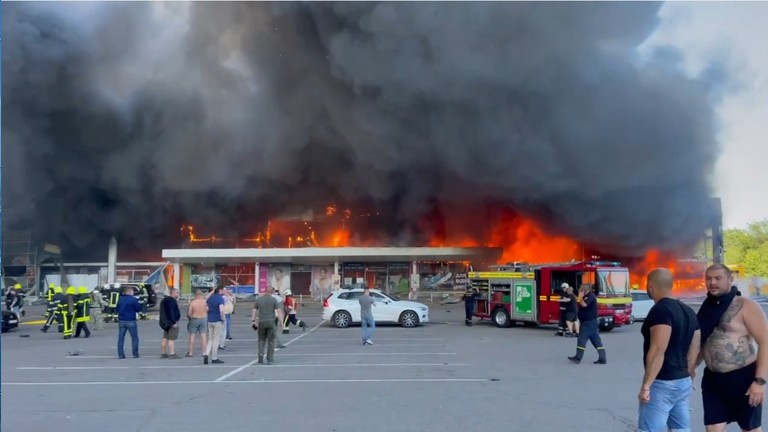
Fire at the Amstor shopping center in Kremenchug. Screenshot from footage published by Volodymyr Zelensky.
Samizdat | June 28, 2022
The Russian military has confirmed an airstrike on the Ukrainian city of Kremenchug on Monday, but claimed it targeted a stockpile of Western weapons. The detonation caused damage to a nearby non-functioning shopping mall, Tuesday’s report said. Kiev had claimed that Russia attacked the shopping center, killing and injuring many civilians.
The Russian Defense Ministry said the location of the arms stockpile was near the Kredmash factory. The Amstor Mall, where a fire was reported by Ukrainian sources on Monday, is right next to it. The military claimed that the Western munitions detonated and caused a fire at the facility, which was no longer operating.
Ukrainian officials claim that the mall was packed with people at the moment Russia allegedly attacked it. However, video showed that the car park outside was almost empty.
According to the latest casualty report, 18 people were killed and 59 injured in the incident, with 25 of the wounded taken to the hospital for treatment.
Ukrainian President Volodymyr Zelensky described the incident in Kremenchug as “one of the most blatant terrorist attacks in European history.” He stated that the site posed no threat to the Russian military and had no strategic value.
Kremenchug is a city in central Ukraine around 250km southeast from Kiev. The Russian military had previously attacked a major oil refinery in the city, denying the Ukrainian military fuel for their vehicles.
FDA ATTEMPTS TO “FLU SHOT” FUTURE COVID VACCINES
The Highwire with Del Bigtree | June 24, 2022
Public comment is needed NOW to stop the FDA from considering bypassing their already fractured process of Covid vaccine safety and efficacy testing to ‘Flu shot’ future Covid vaccines and boosters.
Make your comment before the hearing, June 27th, to stop the agency allowing plug and play updates to these mRNA shots lacking proper clinical trials.
Uvalde Mother Who Rushed Into the Besieged School to Save Her Children Says Police Are Harassing Her

© AP Photo / Eric Gay
Samizdat – 27.06.2022
On May 24, Salvador Ramos entered Robb Elementary School in Uvalde, TX, with an assault-style rifle. He murdered 19 children and two teachers. Law enforcement waited 77 minutes before confronting Ramos, leading to intense criticism.
The mother who rushed into Robb Elementary School in Uvalde, TX, to save her children while a gunman rampaged and police stood by, now says she is being harassed by law enforcement.
Angeli Rose Gomez rushed to the school that her two young boys attend the moment she heard there was an active shooter. While police waited outside, gunshots and the screams of children could be heard by the growing crowd of concerned parents.
Police waited 77 minutes after their arrival before confronting and eventually killing the shooter. During that time, Gomez and other parents pleaded with law enforcement to save their children. Gomez was eventually cuffed by police, who told her to cooperate and calm down. She eventually convinced the police to uncuff her and then she ran to the school, hopping a fence and running to the door window of her eldest son’s classroom. She was eventually able to get him and the other students in the class out, but her youngest child was still inside.
Ignoring the danger to her safety and the threats of law enforcement, she then frantically searched the school for her other child, eventually finding and freeing him. 19 third and fourth graders, along with two teachers, were killed in the shooting.
Gomez, who says cops tackled parents trying to do the same thing as her, became a national sensation after telling her story, but now she says law enforcement officers are harassing her and her family.
“The other night we were exercising and we had a cop parked at the corner like, flickering us with his headlights,” she told the local Fox affiliate. The situation has gotten so bad that Gomez has sent her boys away so they don’t have to witness the harassment. “Just so my sons don’t feel like they have to watch cops passing by, stopping, parking.”
Gomez also recently attended a Uvalde city council meeting, where she and other community members held signs demanding that School District Police Chief Pete Arredondo be fired. On Wednesday, Arredondo was placed on administrative leave, but that is not enough for Gomez and others in the Uvalde community; they want Arredondo gone permanently and without pay.
Earlier this year, Arredondo was elected to the Uvalde city council. He was sworn in days after the shooting in a ceremony that was closed to the public. Since that time, Arredondo missed his first two council meetings and his request for a leave of absence was denied. If Arredondo misses another meeting, the council could vote to remove him.
As for Gomez, she says her next plan is to sue the city. She has retained the services of attorney Mark Di Carlo, who says he is representing 15 parents in Uvalde. The lawsuit has not yet been filed and Di Carlo says he wants to wait until they gather as much evidence as possible before bringing it to court.
“The fact that [Arredondo] wasn’t fired immediately based upon whatever it is, hours of video, from testimonies such as Angeli’s, is an indication that there is some sort of what, corruption or wrong-doing,” Carlo explained.
Featured Video
Matt Bracken: US Plans Massive MOAB Strike on Iran?
or go to
Aletho News Archives – Video-Images
New Book
The silver that medicine dropped — four thousand years of clinical use, four decades to erase.
Colloidal Silver — First Edition, 2026, Paperback
Lies are Unbekoming | October 16, 2026
Silver was medicine. Not alternative medicine. Not folk medicine. Medicine. In surgery. In obstetrics. In the burn ward. In water treatment. In the household medicine chest. Every physician before 1938 knew this.
By the 1870s, silver nitrate was standard in surgical wound care across the leading hospitals of Britain, Germany, and the United States. Colloidal silver preparations — Collargol, Argyrol, Protargol — entered European and American practice through the 1890s and early 1900s and became standard antiseptics in military field medicine. By the time Fleming grew his first penicillin mould in 1928, silver was the first-line antimicrobial of the Western pharmacopoeia. The Lancet and the British Medical Journal carried the clinical reports in volume. The practice ran continuously through the Victorian era, the Edwardian era, the First World War, the interwar period. By 1980, almost all of it was gone.
What has not been treated at book length, until now, is how a four-thousand-year clinical record disappeared from mainstream medicine within four decades of the Flexner Report — and what the honest account of silver looks like once that record is reassembled.
Colloidal Silver reconstructs the pre-1938 record from The Lancet, the British Medical Journal, and the primary literature of the era; recovers Robert Becker’s bioelectric framework from the regeneration research the pharmaceutical model buried; and places silver inside a practical terrain-paradigm guide to its current place — in water, on the body, inside the body, and in the chronic conditions where antibiotics have failed. … continue
Blog Roll
 Aletho News
- Spanish firm sells Latvia vehicles equipped with Israeli tech despite arms embargo
- Saudi Arabia under fire… Yemen is burning down the House of Saud
- Israeli Spy Pollard stole the files, today’s it’s delivered through official channels
- Why Iran Didn’t Walk Away
- US arms supplied to Ukraine found in war-torn Sudan – Moscow
- The silver that medicine dropped — four thousand years of clinical use, four decades to erase.
- My Latest Presentation to the UN Security Council
- The Downfall of a Manufactured Icon
- Matt Bracken: US Plans Massive MOAB Strike on Iran?
- Russia accuses France of ‘piracy’ over tanker seizure
- If Americans Knew
- Tucker Carlson exposes Israeli Lies about the Oct 7th attack, Charlie Kirk, and the U.S.
- Israel has detained thousands of Palestinian children since Oct 7th – over half spent time in solitary, many uncharged
- Israeli Analysis: Is Netanyahu Planning an ‘October Surprise’ Attack Before Israel’s Election?
- Israeli settlers brutally attack Palestinians and Washington Post female photographer, 65
- Words Have Changed, Occupation Continues: The Reality of the Gaza Ceasefire
- Gaza’s child amputees are growing faster than their prosthetics allow
- Israel keeps Palestinians struggling just to survive–Daily Update
- Israeli firm used online ads to run vast spy operation, researchers say
- No, the world zionist movement is not an antisemitic conspiracy theory
- Hundreds of IDF investigations into killings still have no public outcome, BBC Verify finds
- No Tricks Zone
- New Study Suggests Large Regions Of The Pacific Ocean Have Been Cooling For The Last 80 Years
- Germany’s Green Energy Debacle: High Energy Costs Force Kahla Porzellan to Close After 182 Years!
- New Study: 50 Years Of The Most Aggressive ‘Net Zero’ Policies Can Only Affect The Global Climate By 0.03°C
- US September “Heat” Was No Record…Many Records Set Decades Ago
- Latest European Green Energy Debacle; Portugal’s Largest Flagship Solar Park Insolvent!
- Green Energy Debacle: German Expert Professor Fritz Vahrenholt Warns Of Severe Economic And Social Consequences
- Two More Paleo Reconstructions Affirm Meters-Higher Sea Levels Across Ireland, Brazil 7000-6000 Years Ago
- New Study: Earth And Venus Surface Warmth Largely Explained By Convection And Lapse Rate, Not CO2 Or Radiation
- 2025 Nature Paper Claiming Worsening Global Drought Gets RETRACTED …Heavily Flawed
- New Study: ‘Global Drought Shows No Detectable Recent Acceleration Under Climate Warming’

