Disquiet at Davos and the Unsaid Fear of Failure – The First Shoots of a U.S. Ukraine Shift

By Alastair Crooke | Strategic Culture Foundation | May 30, 2022
Klaus Schwab, passionate for Ukraine, essentially configured the World Economic Forum (WEF) to showcase Zelensky and to leverage the argument that Russia should be kicked out of the civilised world. Schwab’s target was the assembled crème de la crème of the world’s business leaders assembled there. Zelensky pitched big: “We want more sanctions and more weapons”; “All trade with the aggressor should be stopped”; “All foreign business should leave Russia so that your brands are not associated with war crimes”, he said. Sanctions must be all encompassing; values must matter.
Disquiet ran through the Davos set: The WEF is high-octane globalist, right? Yet this Schwab line suggests a de-coupling ‘on stilts’. It precisely reverses interconnectedness. Plus, the western generals in charge are saying that this conflict may last not just years, but decades. What will this signify for their markets in parts of the world that refuse action against Russia, the moneymen were wondering?
It is unlikely that this whiff of disorientation is what Schwab had intended. Perhaps the latter was more aligned with Soros’ later intervention that a quick victory over Russia was needed to save the ‘Open Society’ and civilisation itself – and that this was intended as the WEF 2022 message.
The Davos ‘greater disquiet’ emerged however, from an unexpected quarter. Just before the WEF began, the NY Times had run a piece from the editorial team urging Zelensky to negotiate with Russia. It argued that such engagement implied making painful territorial sacrifices. The piece attracted indignant and angry push-back in Europe and the West, possibly because – albeit couched as advice to Kiev – its target was evidently Washington and London (the arch belligerents).
Eric Cantor, a former whip in the U.S. House of Representatives (a legislator well versed on Iran sanctions), also at Davos, questioned whether the West would be able to maintain a united front in pursuit of such maximalist aims as Zelensky and his Military Intelligence Chief have demanded. “We may not get the next vote”, Cantor opined (in wake of the $40 bn vote ostensibly earmarked for Ukraine).
Cantor said excluding Russia entirely would require secondary sanctions against other countries. This would place the West into a head on clash with China, India, and the almost 60 states which had refused to back a UN resolution denouncing Russia’s invasion. He warned that the U.S. may be in danger of overplaying its hand.
Then spoke the redoubtable Henry Kissinger, also at Davos. He warned the West to stop trying to inflict a crushing defeat on Russian forces in Ukraine, saying that such would have disastrous consequences for the long-term stability of Europe. He said it would be fatal for the West to get swept along in the mood of the moment and forget the proper place of Russia in the European balance of power.
Dr Kissinger said the war must not be allowed to drag on and came close to calling on the West to instruct Ukraine to accept terms that fall very far short of its current war aims: “Negotiations need to begin in the next two months, before it creates upheavals and tensions that will not be easily overcome”.
What is going on here? In a nutshell, we are seeing the first inklings of fractures appearing in the U.S. stance on Ukraine. The fissures in Europe are already very plain, both on sanctions and mission aims. But Cantor’s comment that “we may not get the next vote” needs further unpacking.
In an earlier piece, I argued that Senator JD Vance’s win in the Ohio primaries for a Senate seat could be telling. His candidature was backed by Trump, who later issued an ‘End the war’ call. Now the key tell-tale is Republican Senator Josh Hawley – ambitious and known to have leadership aspirations.
Early in the Ukraine war, Senator Hawley was calling Zelensky, lauding him highly and egging him on. But then he pivoted. Hawley subsequently blasted the $40 billion in proposed aid to Ukraine, after voting ‘no’ on the procedural vote to move forward with the aid package “as not being in America’s interests”.
At first, as some may recall, there were 6 House votes against the bill – then 60. And in the Senate, first there were zero then there were 11 votes. The Bill was rushed through as vote managers were concerned that the vote could crumble further.
What is going on? Well, the Republican ‘populist’ current, never enamoured at foreign aid, was shocked at the $ 40 billion for Ukraine when the U.S. lacked baby milk, (and itself had to rely on foreign baby milk aid). This political current is becoming more significant and having more impact as a result of a structural shift. Political candidates, and now even some U.S. think-tanks are turning to crowd-funding as a principal source of finance – moving away from the ‘established’ donors. Thus, the broad ‘anti-foreign entanglement’ sentiment is gaining heft.
Of course, the $40 billion is not all going to Ukraine. Not at all. According to the details of the Bill, the bulk will go to the Pentagon (for equipment already supplied by the U.S. and its allies). And a big chunk will go to the State Department, to fund all sorts of ‘helpful’ non-state actors and NGOs – i.e. it is a deep state budget with Ukraine packaging. The six billion allocated directly for new arms to Ukraine in fact comprises both training and weapons, so much of that will end in the pockets of states such as UK and Germany, giving ‘out of theatre’ training to Ukrainians in their own, or in neighbouring countries’ territory.
Eric Cantor, and other Americans at WEF may frame their disquiet over western objectives in ‘polite company’ as simply articulating their uncertainties over America’s grand strategy – whether the U.S. is trying to punish Russia for its aggression, or whether the goal is a subtler use of policy that gives the Kremlin a ‘route out of sanctions’, were it to changes course. But behind the narrative lies a darker fear. The unsaid fear of failure.
What does this mean? It means that the West’s ultimate war aims in Ukraine have so far been able to stay opaque and undefined, the details swept aside in the mood of the moment.
Paradoxically, this opacity has been preserved despite the public failure of the West’s first statement of aims – which was that the seizure of Russia’ offshore foreign reserves; the Russian bank expulsions from SWIFT; the sanctioning of the Central Bank; and the broadside of sanctions would, in and of itself alone, turn the rouble to rubble; cause a run on the domestic banking system; collapse the Russian economy; and provoke a political crisis that Putin might not survive.
In short, ‘victory’ would be quick – if not immediate. We know this, because U.S. officials and the French Finance Minister, Bruno Le Maire bragged about it publicly.
So confident in a quick financial-war success were these western officials that there seemed little need to invest deep strategic reflection on the aims or the course of the secondary Ukrainian military thrust. After all, a Russia already economically collapsed, with its currency ruined and its morale broken, would likely put up little or no fight as the Ukrainian army swept across Donbas and into Crimea.
Well, the sanctions have proved a bust and Russia’s currency and oil revenues are bountiful.
And now, western politicians are being warned in the media, and by their own military, that Russia is ‘close to a major victory’ in Donbas.
This is the unspoken fear disquieting Davos attendees – fear of another débacle, following that of Afghanistan. One made all the worse as the ‘war’ on Russia boomerangs into an economic collapse in Europe, and with NATO’s eight-year investment in building-up a successful proxy-army to NATO standards turning to dust.
This is what Kissinger’s comments – decoded – urge: ‘Don’t procrastinate’; get a quick deal (even an unfavourable one), but one that can be dressed up, and somehow spun as a ‘win’. But don’t wait, and let events lead the U.S. into yet another unmistakeable, undeniable débacle.
This is still ‘under the kitchen table talk’ in the U.S. for now, as the power of a narrative, invested with so much emotion, and bolstered by unprecedented info-war peer-pressure has masked such thoughts from public expression. Fractures nonetheless are beginning to be apparent. Something stirs – and Europe inevitably will follow wherever America leads. But for now, the hawks remain firmly in ‘the chair’ (in the U.S., in London, Poland, the EU Commission and in Kiev).
The big question, however, is why Moscow would take such a ‘way out’ (even if it was offered it). A compromise deal would be seen there as simply Kiev given the chance to regroup, and to try again.
Five killed by Ukrainian shelling of schools and residential buildings – Donetsk authorities
Samizdat | May 30, 2022
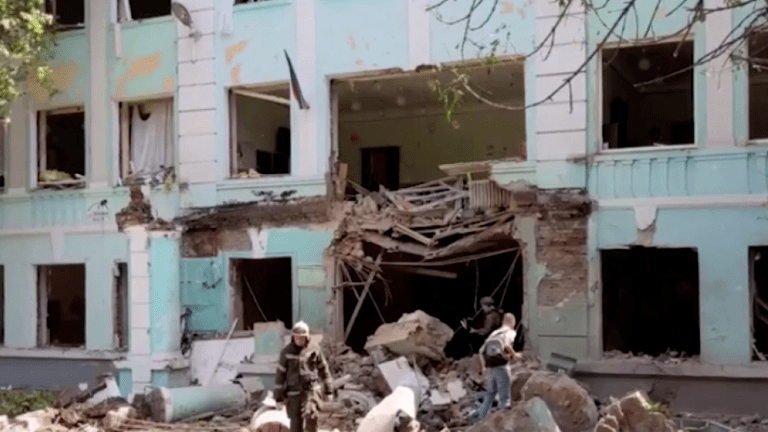
Ukrainian shelling of Donetsk has left at least five people dead, and 18 others injured, local authorities of the Donetsk People’s Republic (DPR) said on Monday. According to local officials, a teenage girl is among the fatalities. The strikes damaged several civilian facilities in the city, including schools and residential buildings.
Preliminary reports allege that US-supplied artillery may have been used in the attacks. In one home, two 14-year-old girls were hurt, Mayor Aleksey Kulemzin said. One of them died while the other one was taken to hospital.
Three civilians were killed, and a dozen others injured at two schools, the mayor claimed. Two people were in serious condition, he added.
The headmistress of one of the schools, Olga Rachinskaya, told the media that many of the teachers “were lacerated with shrapnel”. She said the two workers who were killed were elderly.
“This is just an ordinary school. There is nothing military here, nothing,” she said. Luckily, Donetsk schools teach remotely, so students were not in the classrooms when the shells hit, according to the educator.
The DPR defense HQ said Ukrainian troops fired at least two Smerch rockets armed with cluster munitions and also used 155mm artillery in the shelling.
On Monday, Mayor Kulemzin speculated that the Ukrainian troops may have used US-supplied 155mm M777 howitzers in the assault. “This is heavy weaponry, most likely the American delivery,” he told Russian television when describing the attacks. He claimed some of the shell fragments discovered on the ground had markings in English.
The US and its allies have reportedly supplied about 100 towed artillery guns to Ukraine, ramping up their military aid with heavier kinds of weapons. Kiev may soon receive US-made multiple launch rocket systems too, adding them to the weapons from Soviet stockpiles that it currently possesses, according to media reports.
Commenting on the news coming from Donetsk on Monday, Kremlin spokesman Dmitry Peskov said Ukrainian attacks on civilian infrastructure in DPR were “outrageous.”
“This is exactly what our warriors are fighting against. To make such things stop,” he said, branding the perpetrators “neo-Nazis”.
Russia attacked Ukraine state in late February, following its failure to implement the terms of the Minsk agreements, first signed in 2014, and Moscow’s eventual recognition of the Donbass republics of Donetsk and Lugansk. The German- and French-brokered protocols were designed to give the breakaway regions special status within the Ukrainian state.
The Kremlin has since demanded that Ukraine officially declare itself a neutral country that will never join the US-led NATO military bloc. Kiev insists the Russian offensive was completely unprovoked and has denied claims it was planning to retake the two republics by force.
Irina Slav: “From arrogance to insanity: the EU path”

By Robert Bradley Jr. | Master Resource | May 26, 2022
Irina Slav is a voice speaking truth to power. Her posts and opinion pieces at OilPrice.com deserve reading and study.
One of her recent posts called out the perilous double-down-on-failure approach of the EU (and UK) on energy policy. It says much about the sorry state of energy thinking that environmentalists greenwash and complain about energy companies greenwashing. Climate alarmists/forced energy transformationists treat good news as bad in their religious compunction to rail against modern living and prosperity.
Her article follows.
The feeling of being right about something should be a pleasant one. Unless you’re right about something rather unpleasant. I tend to have the latter kind of experiences and the latest instance was this week, when media reported that the EU was planning to substantially facilitate the construction of more wind and solar farms, to the point of removing the requirement for an environmental impact assessment for projects.
This unleashed a flood of images that to some might be illustrations of our species’ progress but to me are images of environmental devastation. In case anyone thinks I’m being melodramatic, here’s a fact: you can’t build solar installations just anywhere. Land needs to be cleared and flattened for them, including forests, should they happen to be in the way. Same for wind mills but on a much, I believe, smaller scale.
Of course, the EU has tied its pants with the stipulation that only projects proposed for designated “go-to” areas will be spared the trouble of environmental impact assessments. It’s a completely worthless stipulation, however, since governments would rush to designate go-to area after go-to area whether out of a genuine if misplaced belief that renewables will save the world or pure, primal greed.
Here’s an FT quote I instantly fell in love with: ““Lengthy and complex administrative procedures are a key barrier for investments in renewables and their related infrastructure,” according to the draft. The plans could “result in the occasional killing or disturbance of birds and other protected species”, it added.”
It might also result in the disturbance of agricultural land and sensitive ecosystems because all ecosystems are sensitive and if you really get going building gigawatts of solar power, you will disturb them because, quite simply, everywhere is an ecosystem. And this plan comes from the same EU that has been fining Bulgaria (with reason, I’m sure and I’m not being sarcastic for a change) for violating environmental protection regulations.
So, the EU has since last September been suffering the consequences of a too fast buildout in renewable capacity, rooted in the arrogant assumption that it only takes a few million solar panels and wind turbines to save the planet from the effects of centuries of human activity.
Now, the bloc plans to accelerate this buildout even more because, of course, it never acknowledged the role that too-fast buildout had on its energy troubles. On the contrary, the overwhelming sentiment appears to be that European countries are not building wind and solar capacity fast enough.
The EU will also accelerate the acceleration even further because now Brussels has set its sights on completely quitting all sorts of fossil fuel imports from Russia by 2027. This would cost the bloc the modest sum of 195 billion euro, or 32.5 billion euro per year until 2027, on top of all other investments in renewable energy. The goal: to source 45% of its energy from renewable installations by 2030. Given the track record of wind and solar, this is, of course, totally feasible.
Meanwhile, European economies are panting under growing inflation weight, dumped on them by the same people who are now urging the accelerated ramp-up of wind and solar. At a time when all commodity prices are soaring. At a time of various material and equipment shortages.
Doing the same thing and expecting different results has been said to be the definition of insanity and the EU is acting like an excellent example of this definition. It refuses to acknowledge that the results of its actions in energy so far have been less than positive, so to speak. Except on the level of emissions. Those are falling, so that’s a win for the EU narrative (and for our lungs, if we’re talking about fine particulate matter). On the security and affordability front, however, things couldn’t be different-er.
In the UK, the FT reported this week, some households are being forced to take out loans in order to be able to pay their electricity bills. Meanwhile, the government is raising its 2030 renewable capacity target to 50 GW for offshore wind alone while Chancellor Sunak is berating the oil industry for not investing enough at home. As one reader would say, this reads like a soap opera script, and a bad one, at that.
The UK is not the EU but the energy policies of the two are remarkably identical. In the EU, as in the UK, member states are providing direct financial support to their citizens and businesses to help them cope with higher electricity prices. Those would be the same prices that are high precisely because of these governments’ energy policies. And even with that help, a lot of people are struggling with their bills.
At the same time, these same governments are providing direct financial support to wind and solar developers, while charging their citizens extra for the renewable power in their supply mix (Note: This is an extrapolation, based on the existence of renewable power surcharges in Bulgaria and Germany.). And they are planning to build more of the renewable power capacity that citizens pay more for the privilege of using to heat their homes and cook their food.
In other words, EU governments are paying aid to their citizens for excessive electricity prices while at the same time charging these same citizens more for the renewable electricity they want to produce more of. The aid will end, sooner rather than later. The surcharges are not going anywhere.
The outlook for European energy prices meanwhile remains quite grim. According to economists polled by the Wall Street Journal, energy prices in the EU will remain high and even rise further in the coming months thanks to Western sanctions on Russia that are reducing the availability of Russian oil for Europe.
The sanctions have also started reducing the availability of gas for Europe, first because of Poland’s and Bulgaria’s refusal to pay in rubles for gas deliveries and as of this week because the Ukraine decided to move the entry point of Russian gas into the country from one place to another, because the first one is controlled by Russian forces.
Gazprom said that was technologically impossible (for capacity reasons), so the Ukraine is turning the tap — which is one of the taps for Europe — off. According to the Ukrainian side, that channel accounts for a third of all Russian gas transited through the Ukraine to Europe. For context, in 2021, the total amount of Russian gas shipped to Europe via its eastern neighbour totalled 41.6 billion cu m.
Soon after this, Moscow sanctioned a host of Gazprom subsidiaries in Europe, cutting off their access to gas, in response to EU sanctions. Gas prices jumped further, as usual, and Brussels’ resolve to shake off the hydrocarbon chains tying it to Russia probably hardened. We might be about to hear about another revision of renewable targets for 2030, with the appropriate price tag, of course.
In all fairness, in this particular context of energy insecurity, the argument for local energy production from whatever you have handy, be it coal, nuclear, or wind and solar, makes a lot of sense. In fact, the “local supply = energy security” argument has always been the strongest pragmatic one in favour of wind and solar.
The problem is in details such as costs, energy density and, as always, reliability. But nobody in Brussels and national capitals seems to care about petty details. The political EU is firmly in “Whatever it takes” mode and we’re all footing the bill.
The “green energy world” is in a pickle. Only government intervention and deficit spending is holding the artificial boom afloat. And just imagine all of the good things that the same dedication of resources could have created if they had gone for goods and services that consumers wanted. That is a story for another day.
MIT Weighs In On Energy Storage
By Francis Menton | Manhattan Contrarian | May 26, 2022
As I’ve been pointing out now for a couple of years, the obvious gap in the plans of our betters for a carbon-free “net zero” energy future is the problem of massive-scale energy storage. How exactly is New York City (for example) going to provide its citizens with power for a long and dark full-week period in the winter, with calm winds, long nights, and overcast days, after everyone has been required to change over to electric heat and electric cars — and all the electricity is supposed to come from the wind and sun, which are neither blowing nor shining for these extended periods? Can someone please calculate how much energy storage will be needed to cover a worst-case solar/wind drought, what it will consist of, how long it has to last, how much it will cost, and whether it is economically feasible? Nearly all descriptions by advocates of the supposed path to “net zero” — including the ambitious plans of the states of New York and California — completely gloss over this issue and/or deal with it in a way demonstrating total incompetence and failure to comprehend the problem.
And then suddenly appeared in my inbox a couple of weeks ago a large Report with the title “The Future of Energy Storage: An Interdisciplinary MIT Study.” MIT — that’s America’s premier university for matters of science and technology. The Report is 378 pages long, full of lots of detail, charts and graphs, mathematical equations, and technical jargon. It lists as authors some 18 members of the MIT faculty. Surely, if anyone can address this “net zero” energy storage problem competently, these will be the people.
Sorry. This is a product of modern American academia. MIT is as extreme left as any of them.
Having now spent about a week trying to wade through this morass, I am not impressed. The Report is an exercise by genius would-be central planners concocting enormously complex models that just happen to come to the results that the authors are hoping for, while at the same time they avoid ever directly addressing the critical question, namely what is the plan to get through that worst case sun/wind drought. Implicit in every page of the Report is that it is an advocacy document for the proposition that the U.S. should embark full speed ahead on crash “net zero” plans for our multi-tens-of-trillions-of-dollars economy without ever doing any kind of demonstration project to show it can work on any scale no matter how small.
You start to get an idea where this is going at the very beginning, when you come on page romanette v to a list of members of an “Advisory Committee” that appears to have given direction to the project. Members include John Podesta of the Center for American Progress, someone from the Environmental Defense Fund, an “Alternative Energy Research” guy from the Bank of America, an ex-World Bank guy (the World Bank being an organization dedicated to keeping poor countries from having access to energy that works), an environmental bureaucrat from the Massachusetts state government, several people from other alternative energy investors and environmental advocacy groups, and so forth. Clearly, this Report had to come to a pre-determined conclusion that energy storage issues do not pose any major impediment to net zero ambitions.
This being a product of left-wing academia, you can expect the usual touching faith in the ability of the federal government to solve all problems, no matter how intractable, by the magic of spending money out of the infinite federal pile. Thus, early in the Executive Summary, we find a recognition that the only battery storage technology currently being deployed in large amounts in commercial applications — namely Lithium Ion — cannot provide backup for periods longer than about 12 hours:
Li-ion batteries will continue to be a leading technology for EVs and for short-duration storage, but their storage capacity costs are unlikely to fall low enough to enable widespread adoption for long-duration (> 12 hours) electricity system applications.
OK then, what is the technology that will step up for the periods of a week or two that may need to be covered in a world without fossil fuels. From page xv:
To enable economical long-duration energy storage (> 12 hours), the DOE should support research, development, and demonstration to advance alternative electrochemical storage technologies that rely on earth-abundant materials. Cost, lifetime, and manufacturing scale requirements for long-duration energy storage favor the exploration of novel electro-chemical technologies, such as redox-flow and metal-air batteries that use inexpensive charge-storage materials and battery designs that are better suited for long-duration applications. (Emphasis in original).
The feds will “support research” into “novel technologies,” of course using the infinite money pile, and the technology will magically appear. And what exactly is the technology that will then emerge to rescue us? They have no idea:
While several novel electrochemical technologies have shown promise, remaining knowledge gaps with respect to key scientific, engineering, and manufacturing challenges suggest high value for concerted government support. Innovation in these technologies is being actively pursued in other countries, notably China.
You’ve got to hate those “knowledge gaps,” but clearly all that is needed to fill them is enough federal funding. And you can’t let those Chinese beat us!
Well, how about just using that ubiquitous element hydrogen, easily available through the electrolysis of water? They discuss that too:
[H]ydrogen produced via electrolysis can serve as a low-carbon fuel for industry as well as for electricity generation during periods when VRE [variable renewable energy] generation is low. . . . We support the effort that the DOE is leading to create a national strategy that addresses hydrogen production, transportation, and storage. In particular, the ability of existing natural gas transmission pipelines to carry hydrogen without suffering embrittlement, either at reduced pressures or if hydrogen is blended with natural gas or other compounds, remains an open question that deserves government-supported study by the DOE and the U.S. Department of Transportation.
Funny that private investors aren’t putting any real money into this “hydrogen economy” thing. That’s because to get hydrogen out of water is extremely costly, and once you have it, it is inferior to natural gas in every way as a source of energy for the people. It’s less dense, more dangerous, and more difficult to transport and store. But again, throw in some of the infinite pile of federal money and it will all magically work.
Many of the charts and graphs are very complicated and technical, but if you spend some time with them, you start to realize that they are an insult to your intelligence. I’ll give you just one of my favorites, this one from page 191. Here we are considering what the electricity generation system will look like for two regions, the Northeast (New York and New England) and Texas, in various low and no-carbon scenarios. The cutoffs of 0g, 5g, 10g and No Limit at the left refer to how much carbon emissions are allowed per kWh of electricity generated.
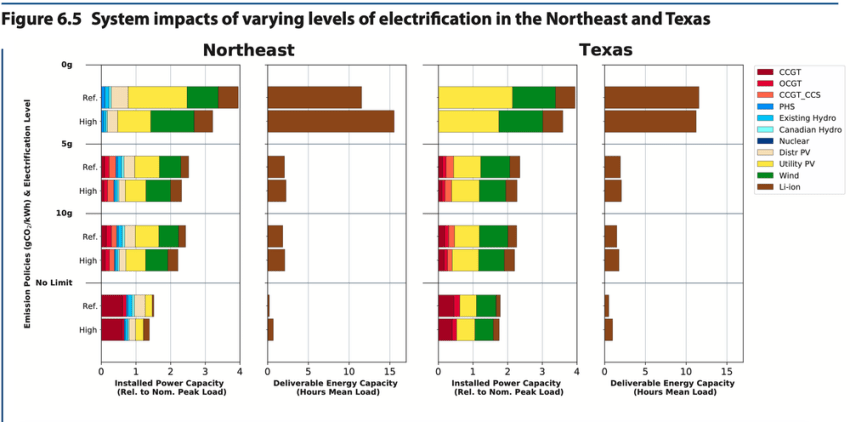
Thus at the top right we see what a zero-carbon scenario will look like for Texas. Supposedly, with about a 3 to 4 times overbuild of a system having only wind and solar generation, then we will only need battery storage for about 50% of capacity and about 11 hours duration. Really? Does anybody remember February 2021? Texas’s wind and solar generators produced at less than 10% capacity for days on end. Can a three times overbuild of wind capacity and 12 hours of battery storage solve that? The answer is no. Not even close. And you could get a wind/solar drought of a full week. If you have no fossil fuel backup, you had better have enough storage to cover that.
And if you take some time to study this chart (not saying that I would recommend that) you can find multiple other equally implausible assertions.
Bottom line: I’m not trusting anybody’s so-called “model” to prove that this gigantic energy transformation is going to work. Show me the demonstration project that actually works.
They won’t. Indeed, there is not even an attempt to put such a thing together, even as we hurtle down the road to “net zero” without any idea how it is going to work.
Lavrov: Recent Sanctions Unlikely to Be Lifted, This Is What US Is Telling Allies Behind Closed Doors
Samizdat | May 29, 2022
Russian Foreign Minister Sergey Lavrov says that the latest Western sanctions against Russia were prepared long ago and are unlikely to be lifted.
“The speed with which they were introduced and their volume indicate that they were not created overnight, they were being prepared for quite a while. It is unlikely that these sanctions will be lifted,” Lavrov said in an interview with French broadcaster TF1.
“At least, the US, not publicly but during contacts with its allies, says that when all this [the crisis in Ukraine] is over the sanctions will remain anyway,” Lavrov added.
Lavrov noted that in the wake of these revelations, it’s clear the West’s main priority isn’t defending the Ukrainian regime, which he described as a mere “bargaining chip,” but about curbing Russia’s development. According to the diplomat, the US considers Russia an obstacle to its goal of establishing a unipolar world – a vision “which Washington proclaimed with the submissive consent of Europe.”
According to him, the West was also indifferent to the fact that Ukraine publicly refused to comply with the UN Security Council resolution urging the implementation of the Minsk Accords signed by France and Germany.
At the same time, Lavrov noted that liberating Donbass remains a top priority.
Russia launched a military operation last month with the stated goal of putting an end to war crimes committed by Ukrainian troops against civilians during an eight-year offensive against Donbass. President Vladimir Putin said that for eight years, people in Donbass have been subjected to what he called a “genocide” by the Kiev regime.
Africa objects to US proposal on controversial IHR amendments
Meanwhile India discovers irregularities in WHO financial audit
By Shabnam Palesa Mohamed | Take Back Power | May 27, 2022
Africa Day, 25 May, has made an impact. In a rare show of African power and solidarity, several African member states objected to proposed International Health Regulations amendments, discussed at the World Health Assembly 75 this week – a move many believe might shake up the World Health Organization’s dominance.
A well placed source shared: “The resolution on IHR amendments was not passed at the WHA, as African countries were concerned that there was inadequate consultation amongst member states, and the process was being rushed. Botswana read the statement on behalf of the 47 AFRO members and I was personally present.”
According to Reuters, “if Africa continues to withhold support, it could block one of the only concrete reforms expected from the meeting, fraying hopes that members will unite on reforms to strengthen the U.N. health agency’s rules as it seeks a central role for itself in global health policy.”
The IHR seeks to define and detail WHO members’ obligations around public health emergencies and other health matters. The United States government proposed 13 controversial IHR amendments, which give the WHO DG Tedros unilateral power to declare actual or potential health emergencies and expect a response in 48 hours.
The draft proposal yet to be formally decided also aims to change article 59 of the IHR, and would accelerate the implementation of future amendments.
Bear in mind, a few countries at the WHA submitted draft resolutions to the IHR, which would need, at least according to the WHO process, four months to be considered. These countries are Australia, Bosnia and Herzegovina, Colombia, European Union and its Member States, Japan, Monaco, Republic of Korea, United Kingdom of Great Britain, Northern Ireland and the United States of America.
The African #WHA75 delegation expressed reservations about these IHR amendments, saying all reforms should be tackled together as part of a “holistic package” at a later stage.
“The African region shares the view that the process should not be fast tracked…,” Moses Keetile, deputy permanent secretary in Botswana’s health ministry, told the assembly on Tuesday on behalf of the Africa region.
“We find that they are going too quickly and these sorts of reforms can’t be rushed through,” said a concerned African delegate in Geneva. The U.S. mission in Geneva did not respond to a Reuters request for comment.
BRIMI emerges: Brazil, Russia, Iran, Malaysia and India
Brazil and Russia form part of the BRICS initiative with Brazil, Russia, India, China and South Africa. Iran and Malaysia are reported to have also expressed reservations to the proposed IHR amendments, while Russia and Brazil seem set to make big moves on international health policies, or possibly even exit the WHO. Meanwhile, India raised audit concerns on irregularities with WHO financials.
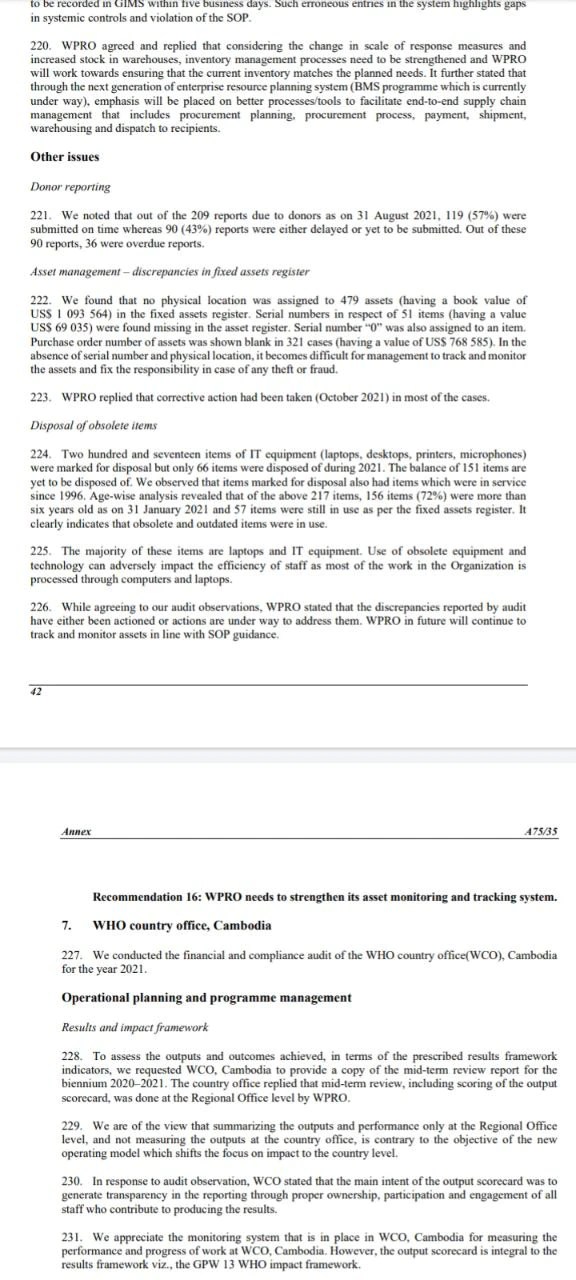
A civil society World Health Assembly monitor shared “Just for your interest, from the external audit done by India team, who yesterday during the financial comittee stated that they feel very disappointed that their audit has been ignored by WHO.”
Time line, duplication, and waste of funding resources
The IHR amendments discussions are parallel to talks on a potential new pandemic treaty (#PandemicAccord) , raising concerns over duplication and waste of funding handed to the WHO.
Given the trajectory, it appears that both the IHR amendments and the new pandemic accord, if successful, will converge on the world in 2024, unless countries decide to curtail the WHO’s power and take charge of their health.
This 2024 date was highlighted in the working group on IHR amendments: “Delegates welcomed the final report of the Working Group on strengthening WHO preparedness and response to health emergencies which, among other things, proposed a process for taking forward potential amendments to the IHR (2005). They agreed to continue the group, with a revised mandate and name (the “Working Group on IHR amendments” (WGIHR)) to work exclusively on consideration of proposed IHR amendments. Member States also requested the Director-General to convene an IHR Review Committee to make technical recommendations on the proposed amendments that may be submitted. The Working Group will propose a package of targeted amendments for consideration by the Seventy-seventh Health Assembly.”
“Several developing countries have said that the WHO has too many platforms for negotiation, and it is simply not manageable,” said Nithin Ramakrishnan, consultant for the Third World Network.
US senators start to push back on WHO overreach
According to the Daily Caller
Republican senator Ron Johnson … introduced legislation Thursday that would push back against the World Health Organization’s (WHO) overreach and ensure the Senate has power over its pandemic treaty.
The Daily Caller first obtained the legislation, titled the No WHO Pandemic Preparedness Treaty Without Senate Approval Act, which was spearheaded by Johnson and has 15 cosponsors. The bill mentions the WHO creating an intergovernmental negotiating body (INB) and, if passed, would require any agreement produced by the INB to be submitted to the Senate as a treaty in an effort to provide more transparency on the administration.
The lawmakers believe they need to start fighting to prevent the WHO from creating an INB.
“The World Health Organization, along with our federal health agencies, failed miserably in its response to COVID-19. Its failure should not be rewarded with a new international treaty that would increase its power at the expense of American sovereignty. What the WHO does need is greater accountability and transparency,” Johnson told the Daily Caller prior to officially introducing the legislation.
“This bill makes clear to the Biden administration that any new WHO pandemic agreement must be deemed a treaty and submitted to the Senate for ratification. The sovereignty of the United States is not negotiable,” Johnson continued.
Also in the US, Senator Sen. Rick Scott, R-Fla., is introducing legislation aimed at curtailing the power of the World Health Organization (WHO). This is welcome but ironic, as the amendments were proposed by the US Department of Health and Human Services. The bill, introduced Thursday, would prevent U.S. officials from being bound to orders or Republican directives given by the WHO or it’s branches. “In addition, it would require U.S. officials to oppose changes to the WHO charter until the House and the Senate agree to adopt the change in a joint resolution of Congress.”
Fact checkers spinning denial of sovereignty threat
Meanwhile, there is a clear spin attempt from establishment media against opposition to the IHR amendments and the WHO in general. A FactCheck article states “The World Health Organization can make recommendations after the declaration of a global emergency, but it has no control over any nation’s decisions. Yet conservatives in the U.S. falsely claim that amendments proposed by the Biden administration to existing global health regulations, and a new WHO pandemic treaty, will threaten U.S. sovereignty.”
It is not clear whether the writer fully understands the implications of the proposed IHR amendments, a new #PandemicAccord, sanctions for non-compliance, or the clear erosion of personal autonomy, national sovereignty, and democratic values.
The WHO and the IHR were spotlighted at the World Council for Health’s successful Better Way Conference, and a video presentation by WHO expert Dr Astrid Stuckelberger will soon be released. Dr Stuckelberger reminded the audience that the WHO is a small part of a much bigger UN/WEF machine.
Two years after the disastrous mismanagement of Coronavirus, it’s time the world thinks about and acts on a better way for health than giving power away to the WHO, which ignores its own standards on necessity, reasonableness, and proportionality.
That time is now. KeNako.
German Farmers Set To Lose Up to 3 Million Tonnes of Harvest Due to EU Ukraine-Related Sanctions
Samizdat – 29.05.2022
The European Union is currently working on a new wave of sanctions that might further limit fertiliser imports from Russia and Belarus despite the looming agricultural crisis that may affect millions.
German farmers are sounding the alarm over a potential contraction in their output and further price increases this year caused by the EU’s sanctions against Russia and Belarus, Deutsche Wirtschafts Nachrichten has reported.
EU sanctions imposed in the context of Russia’s special military operation in Ukraine limit fertiliser imports, namely potassium chloride and potash fertilisers, which many European farmers rely upon.
German farmers expect that this year’s output may be 3 million tonnes less than previous years as a result of current measures. The fertiliser shortage will hit grain crops particularly heavily as countries already fear shortages in their global supplies due to the conflict in Ukraine and difficulties in maritime trading routes.
Another aftermath of the EU’s Ukraine-related sanctions targeting fertilisers may be the growth of consumer food prices, the German news outlet warned. In 2021, Europe imported 4.6 million tonnes of a total 13 million of fertilisers from Belarus and Russia. With shipments from these countries limited by April’s sanctions package, the supply shortage is set to raise already high fertiliser prices – and as such consumer prices – even more, farmers warned.
Boosting local fertiliser production in the EU and elsewhere in hopes of reducing prices is also scheduled to confront challenges posed by western sanctions, as manufacturing requires large power consumption and cheap energy sources, both areas which have been impacted by the Ukraine-related measures.
Despite these difficulties, EU countries continue to seek to do away with Russian gas even amid prospects of surging energy prices and unemployment. For his part, Germany’s Minister of Labour and Social Affairs Hubertus Heil has gone on the record as stating that an immediate ban on Russian gas will lead to a notable reduction of jobs in Germany. Heil has called to avoid such an outcome.
EU countries are currently discussing their sixth package of sanctions against Russia and Belarus. With many member-states already experiencing negative economic results from earlier packages, the EU is struggling to negotiate conditions on banning or limiting oil imports from Russia due to the opposition of several countries within the bloc. The new sanctions package also reportedly includes proposals on further limiting fertiliser imports from Russian and Belarusian chemical companies, even as the threat of global hunger and the lack of grain and crops looms.
CDC study purporting to find substantial protective effects for school mask mandates fails to replicate
eugyppius – May 29, 2022
Last year, the CDC published a paper comparing Pediatric COVID-19 Cases in Counties With and Without School Mask Requirements. The authors looked at data from 520 United States counties, concluding that “Counties without school mask requirements experienced larger increases in … case rates … compared with counties that had school mask requirements.” Corona astrologers and face diaper fetishists everywhere have used the findings to argue for forcing healthy children who are at no risk to wear fasks masks for multiple hours each school day.
More county-level data on American infection rates and mask mandates has since become available, and two Toronto scientists have taken the opportunity to replicate the study, looking now at 1,832 counties. In a turn of events that will surprise nobody, they find that the larger dataset shows that mask mandates actually do zero, and that prior findings were almost surely an illusion.
Here are masked vs. unmasked case rates, using a smaller data pool similar to that from the CDC study:

Week 0 is the week of school reopening after the summer holidays.
Yes, the maskless counties seem to do worse! Yet the Toronto authors point out that the original CDC study only considered infection rates through the second week after schools reopened, which turned out to be “exactly the peak of school case numbers for [their] sample of counties.” This obscured the fact “that cases quickly declined in later weeks and did so faster in counties without mask mandates.” Even the smaller sample used by the CDC study, in other words, showed no difference in masked vs. unmasked counties by the six-week mark.
The replication, with a much bigger dataset, meanwhile, showed that maskless counties never led infections at all:
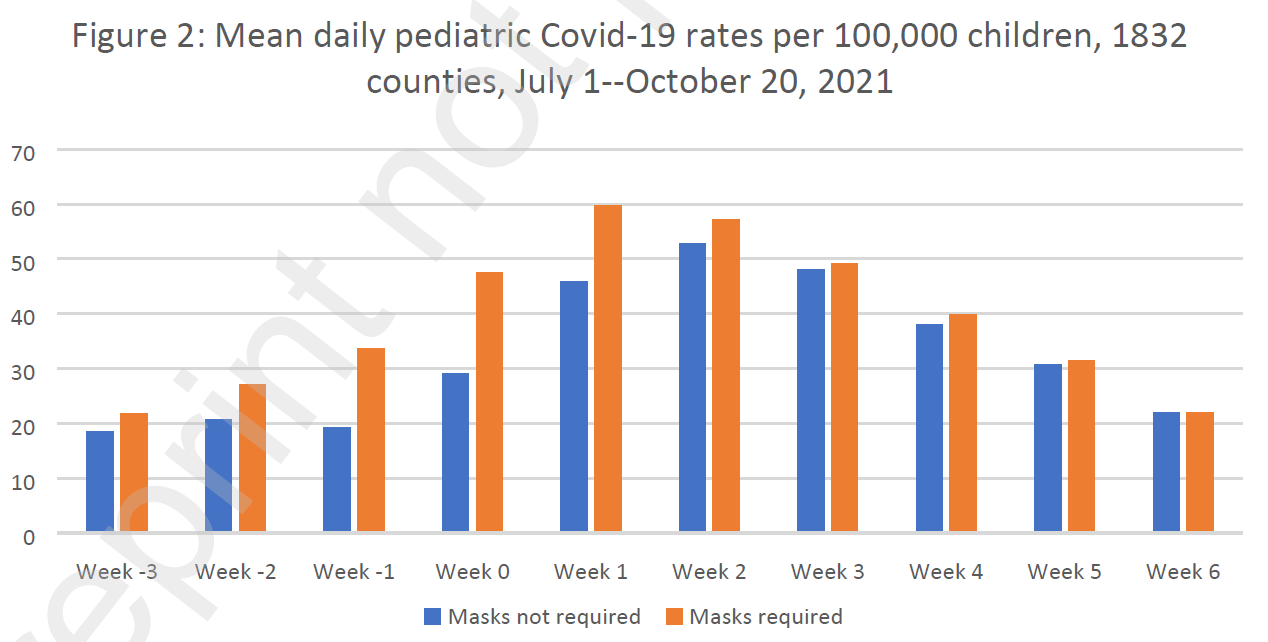
Note that, in the larger sample, the maskless start out with lower rates of infections and catch up; in the smaller sample, they started out with higher rates which collapsed more quickly.
The authors note that the CDC study, by ending their analysis on 4 September 2021, effectively excluded counties with a school-start date after 14 August, which entailed an oversampling of southern states. I’ll fill in the blanks here: Counties in the American south tend to have fewer school mask requirements, and also to experience late summer infection spikes related to high temperatures and extensive reliance on climatisation.
Although masks have become the most clearly discredited measure deployed against SARS-2 (which is saying something), they just won’t go away. Even in places that have lifted all Corona restrictions, a great many people continue to mask in public, and it seems likely that many countries – Germany among them – will retain vestigial mask requirements indefinitely, probably for years. Masking is a totally unsupported superstitious practice that does nothing against viral infection, and yet for precisely this reason, no amount of evidence will ever convince the maskers to stop.
FDA announces updated schedule for the June meetings regarding five pivotal vaccine decisions
Who needs data when you’ve got regulatory capture?
By Toby Rogers | May 29, 2022
I. The June FDA meetings
This week the Washington Post copied and pasted from a Pfizer press release to announce yet another scientific miracle(TM) that will completely fail in practice. In the process WaPo also got some quotes from the FDA who have now nailed down the schedule for the 4 meetings in June in which they intend to assemble the final pieces for Pharma’s permanent dominance over the American people.
The new schedule is as follows:
June 7, Novavax
June 14, Moderna in kids 6 to 17 years old
June 15, Moderna in kids 6 months to 5 years AND Pfizer in kids 6 months to 4 years
June 28, “Future Framework” (the plan to skip clinical trials in perpetuity)
There is a lot to parse in the WaPo’s brief article.
Contrary to the breathless headline, they still don’t have any data.
Pfizer and BioNTech said the 80 percent efficacy finding was preliminary and based on 10 cases of Covid-19 in the study population as of the end of April. Once 21 cases have occurred, the companies will conduct a more formal analysis of efficacy… Pfizer and BioNTech said they plan to finish filing data with the FDA this week — and warned that the efficacy number was fluid because results are still arriving.
Let’s recap how we got here:
🚩 The Pfizer clinical trial in kids under 5 failed in December 2021.
🚩 So Pfizer added a third dose and that trial also apparently failed in February (which is why Pfizer was forced to withdraw its application on February 10).
🚩 Now Pfizer is describing a jerry-rigged trial of a third dose in 1,678 kids ages 6 months to four years old. Pfizer did not disclose how the kids were divided between the treatment and control group so it is impossible to run our own calculations on efficacy. Out of that sample, 10 developed Covid — although it is not clear how the 10 were distributed between the treatment and control group. (I suppose some quant on Twitter will figure out how to work backwards from Pfizer’s claims to calculate the numbers in each of these categories but needless to say, this is not the proper way to do science.) Of course Pfizer also failed to describe the contents of the “placebo.”
How exactly will Pfizer double the number of Covid-19 cases in the clinical trial in the next month given that 74.2% of kids already had natural immunity in February which means that nearly 100% of children likely have natural immunity by now?
Also, is the FDA seriously considering basing national policy, that impacts 18 million children, by relying a study with only 10 cases? It appears that the FDA is not even pretending to care about science anymore.
What little data they have will be based on antibodies in the blood, not health outcomes in the real world. That’s strange because the members of the FDA’s Vaccines and Related Biological Products Advisory Committee unanimously acknowledged on April 6 that there are “no correlates of protection” in connection with Covid-19 shots (this means that there are no valid proxy measures, such as antibody counts, that can determine whether someone who has received this shot is immune to the virus or not.)
WaPo continues:
While the adult trials recruited tens of thousands of volunteers and waited to see if vaccinated people were better protected, the children’s vaccine trials were primarily designed to measure immune responses using blood tests.
No they were not “primarily designed to measure immune responses using blood tests.” The studies were intentionally undersized to hide harms from the shots in addition to other tricks that they use to skew the results (such as kicking you out of the trial if you call 911 or go the the emergency room). But when one shrinks the sample size, surprise! it becomes impossible to detect actual health benefits from the shots (the signal would have been tiny if at all, but when one uses a sample that small then any positive signal can also disappear into statistical insignificance.)
II. The bigger picture
Tony Fauci and the NIAID funded the creation of a chimera virus that escaped a bioweapons lab and killed 6.3 million people worldwide.
Public health authorities have blocked access to safe and effective prophylaxis and early treatment throughout the pandemic in order to create the market for Covid-19 vaccines.
Covid-19 shots skipped essential safety steps (e.g. challenge trials in animals) and were rushed to market with no long term data.
In practice the mRNA shots suppress immune function for 6 weeks after the first shot, provide about two months worth of protection against coronavirus, then efficacy wanes quickly and becomes negative after six months. Meanwhile, these shots cause more side effects than any vaccine ever invented.
Popular support for the current regime has collapsed. More people have died of Covid under Mr. I Believe the Science(TM) than under Orange Man Bad. Only hypochondriacs in blue states seek out additional doses. Meanwhile Sudden Adult Death Syndrome stalks the true believers. In the past 48 hours alone actor Ray Liotta, Andy Fletcher of Depeche Mode, British drummer Alan White (from the band YES), and comedian Phil Butler were all likely killed by Covid-19 shots. It’s impossible to hide all of the bodies at this point.
The FDA seems to know that their window is closing to implement the Final Solution. So they are rushing to put the finishing touches on their plans to inject this toxic junk into the littlest kids in America. The FDA knows that these shots cannot pass proper regulatory review so they’ve developed a plan to rig the process in favor of Pharma in perpetuity. On June 28, the FDA’s “expert advisory committee” will vote on a “Future Framework” whereby all future (reformulated) Covid-19 shots will automatically be deemed “safe and effective(TM)” without any additional clinical trials, on the theory that they are “biologically similar” to existing Covid-19 shots.
What this means is that by fall, the Covid-19 shots that they will be injecting into Americans of all ages will have a new formula that skipped clinical trials altogether.
Injecting people with genetically modified mRNA that skipped clinical trials is genocide. It’s slower than the Nazi Final Solution. But it’s genocide all the same. Indeed the slower pace of the FDA Final Solution (5% to 15% increase in all cause mortality every year) might be even more lethal in the long run. It’s sinister in that they are intentionally building in plausible deniability (‘the FDA said it was safe’) to help the medical establishment feel virtuous while participating in genocide.
I’ll just conclude by saying: be careful what you wish for FDA. The tide has already turned. The American people know exactly what you are doing. We have the receipts. It will be relatively easy to secure a conviction at Nuremberg 2.0 — we literally have you on video committing crimes against humanity. As a reminder, the courts have determined that “I was just following orders” is not a valid defense.
Featured Video

Lebanese man tells RT how Israeli strike killed his bride
or go to
Aletho News Archives – Video-Images
From the Archives
No Proof MMR Vaccine Is ‘Safer’ than Measles, Mumps or Rubella Infection, Physician Group Says
By Suzanne Burdick, Ph.D. | The Defender | January 14, 2025
The risk of permanent disability or death from the MMR vaccine may be greater than the risk posed by measles, mumps or rubella infection because large enough vaccine safety studies haven’t been done, according to a collection of new documents released by Physicians for Informed Consent (PIC).
The collection includes disease information statements for measles, mumps and rubella, and a vaccine risk statement for the MMR vaccine.
According to the Mayo Clinic, measles is a viral infection typically accompanied by a skin rash, fever, cough, runny nose, sore throat, inflamed eyes and tiny white spots on the inner cheek.
Mumps and rubella also are viral infections. According to PIC, all three viral infections typically resolve on their own with proper rest and hydration in almost all cases.
Dr. Shira Miller, PIC’s founder and president, told The Defender, “The main takeaway is that the MMR vaccine has not been proven safer than measles, mumps and rubella.”
PIC is a nonprofit that delivers data to doctors and the public so they can “evaluate the data on infectious diseases and vaccines objectively, and voluntarily engage in informed decision-making about vaccination.”
Miller explained that the MMR vaccine clinical trials didn’t include enough subjects to be able to prove that the risk of permanent disability or death from the vaccine is less than the risk of permanent disability or death from measles, mumps or rubella. … continue
Blog Roll
 Aletho News
- Babies Whose Mothers Drank Fluoridated Water During Pregnancy Scored Lower in Problem-Solving
- Vaccination Data on Amish Children Screened for 2010 Autism Study Was Never Made Public
- CNAS Wonk Proposes Bombing China’s Artificial Intelligence
- Eight Arab and Muslim states reject Israeli displacement plans for Gaza
- Israel’s Game
- Lebanese man tells RT how Israeli strike killed his bride
- On deadly sectarianism pushed on Syria and elsewhere by NGOs and media
- Is America preparing a tactical nuke for Iran?
- “We Are Being Drawn Into a War We Don’t Want to Fight”: What Jordan’s Alliance with Washington Is Costing It
- Trump Slaughters Wedding Guests, Zelenskyy Threatens Airliners
- If Americans Knew
- Israeli settlers are a menace across West Bank – Daily Update
- US rejects Israel’s plan to ethnically cleanse Gaza: Daily Update
- ‘What About Gaza’s Amputees?’ Adidas Under Fire Over Israeli Soldier’s Disability-Inclusive Shoe Ad
- ‘They Keep Beating Me’: Dr. Hussam Abu Safiya Gives New Testimony from Israeli Prison
- Palestinian American returns to besieged West Bank home but Israeli settlers remain
- US House passes bill penalizing universities that participate in boycott of Israel
- Israeli Defense Minister Ben Gvir posts Palestinians on conveyor belts to detention camps. The world is silent
- “Board of Peace” Billionaire Backs AIPAC Fund Targeting Pro-Palestine Candidates
- What do you do when you can’t hear the bombs? Being deaf during the Gaza genocide.
- Ben Gvir: After Gaza genocide, we ethnically cleanse the rest – Daily Update
- No Tricks Zone
- Climate Extremists Target, Attack Large-Scale Power Grid Infrastructure In Germany!
- New Study: Antarctic Ice Melt Has Contributed Less Than 1 Centimeter To Sea Level Rise In The Last 30 Years
- Fear Of Debate: Alarmist German Climate Scientist Calls On Mainstream Media To Discredit Skeptic Voices
- End-Of-August Arctic Sea Ice Extent Hasn’t Fallen In 20 Years, Official Data Show!
- News-Making Nepal Region Has Had As-Warm Or Warmer Periods Than The 2000s In The 1600s, 1700s, 1800s
- 2025 Study: ‘There Exists No Unequivocal Experimental Evidence For The CO2 Greenhouse Effect’
- 2026 Atlantic Cyclone Energy Index Running At 85% Below Normal!
- New Research Shows Soil Respiration And Temperature Drive CO2 Change, Not Humans
- Comparison Of Two German Weather Forecasts: From 25 Years Ago And From Today
- Veteran Swiss Meteorologist On Germany’s Recent Heat Wave: “You’re A Really Crazy Country”
 Aletho News