The Lancet reports on Human Rights failures during the COVID-19 pandemic. Is the tide turning? Think again.
The Naked Emperor’s Newsletter | November 24, 2022
When I first read the title of an article in The Lancet last week, I thought, this might be interesting, some acknowledgement about how bad lockdowns and mandates were. The title ‘Human rights and the COVID-19 pandemic: a retrospective and prospective analysis’ made me read on.
Maybe, I shouldn’t have been so naïve and maybe I should have looked at who the authors were first but I read on anyway.
I was still hopeful during the summary.
When the history of the COVID-19 pandemic is written, the failure of many states to live up to their human rights obligations should be a central narrative.
Which states will they talk about? The UK? America? I’d put money on Canada, Australia and New Zealand.
Since then, COVID-19’s effects have been profoundly unequal, both nationally and globally. These inequalities have emphatically highlighted how far countries are from meeting the supreme human rights command of non-discrimination, from achieving the highest attainable standard of health that is equally the right of all people everywhere, and from taking the human rights obligation of international assistance and cooperation seriously.
Rubbing my hands together, I scrolled on, expecting to see scathing criticism of citizens being locked at home and how Covid mandates were completely unjust.
We propose embedding human rights and equity within a transformed global health architecture as the necessary response to COVID-19’s rights violations. This means vastly more funding from high-income countries to support low-income and middle-income countries in rights-based recoveries, plus implementing measures to ensure equitable distribution of COVID-19 medical technologies.
We also emphasise structured approaches to funding and equitable distribution going forward, which includes embedding human rights into a new pandemic treaty. Above all, new legal instruments and mechanisms, from a right to health treaty to a fund for civil society right to health advocacy, are required so that the narratives of future health emergencies—and people’s daily lives—are ones of equality and human rights.
Oh, here we go – high-income countries imposing their views on low-income countries. Distribution of mRNA vaccines and a new pandemic treaty.
Deflated, I finally checked the authors. The lead author works for the WHO and many of the other authors championed vaccine passports.
Realising this isn’t going to be the article I thought it was going to be, I skipped to the conclusion.
Equity demands treating health as a global public good and creating new legal instruments grounded in rights and equity. A reimagined, strengthened global health architecture, with human rights as its foundation, would be a fitting monument to the tens of millions who have died and suffered grievously—and would better prepare the world to address climate change, antimicrobial resistance, and other global threats. Furthermore, it would enable a swift, effective response the next time a novel or emerging infection threatens the globe—honouring the dignity of each of us.
I’ve seen that language before. “Equity demands”, “global public good”, “grounded in rights and equity”, “human rights as its foundation”. And whilst it all sounds lovely, it never ends well and the only human rights that are respected are those belonging to the humans that agree with what is being proposed.
You don’t want a pandemic treaty, forced vaccinations and mandates? Think of the tens of millions who have died and suffered grievously, you monster. Think of climate change, you devil in disguise. This is being done to honour the dignity of each of us. Well, not your dignity, you don’t agree with us, you stay locked in the quarantine camp thinking about the lovely dignity you could have if you did agree with us.
It was a struggle but I forced myself to read the rest of the article.
Many authoritarian regimes and populist leaders, however, have disregarded science, and have imposed harsh restrictions on human freedoms
One again, my hopes were raised. Maybe there is a small section on lockdowns etc. I saw the letters U.S.A. Maybe it will discuss how it is ridiculous that unvaccinated people still can’t travel there. Nope, it criticised the USA for opposing risk-mitigation measures such as business closures and mask or vaccine mandates.
It continued to get worse.
Public health officials have not always followed the science. The Public Health Agency of Sweden chose to allow a large portion of the country’s population to become infected, aiming to achieve herd immunity through eschewing basic scientific guidance of physical distancing and mask-wearing. This course was so fundamentally unsuccessful in protecting people’s health that it was beyond the discretion permissible under the right to health. By the end of 2020, Sweden’s mortality rate was ten times that of its neighbours, four-times higher than Denmark’s, and higher than in most European countries.
I agree with much of this section to a large extent, impacts of COVID-19 does disproportionately affect people with little money due to a plethora of risk factors. But so does any disease. And by locking people up, making them unhealthier and poorer, you only exacerbate this inequality.
But carry on with the virtual signalling and keep blaming it on systemic racism. Or Covid racism, I’m not quite sure. Either way, by not investigating why certain races disproportionately filled critical care units meant that more ethnic minorities carried on dying. Congratulations, by trying not to be racist, you actually ended up being racist.
Service disruptions were responsible for an estimated 47,000 additional malaria deaths in 2020 compared with 2019, and 100,000 additional tuberculosis deaths. 121 (93%) of 130 countries reported mental health service disruptions, as depression and anxiety levels greatly increased. By 2022, more than 200 million additional people faced acute hunger compared with in 2019, while COVID-19 forced nearly 80 million people into extreme poverty.
One word – Lockdowns.
Governments exercised vast emergency health powers, including business closures, cordon sanitaire, and full lockdowns, which are warranted only if supported by science, and are necessary, proportionate, and non-discriminatory.
So lockdowns are warranted if supported by science. Still no acknowledgement of the terrible harms they have caused.
authoritarian leaders have used the pandemic as an excuse to violate human rights, including suppressing information, punishing whistleblowers, arresting and detaining opponents and citizen journalists, and undermining democratic rights
I recognise all of those things having happened in many Western countries but are they mentioned? Of course not. China, Tanzania, Egypt, Russia, Pakistan, Madagascar, Bangladesh, Venezuela, Cayman Islands, Burundi, India, Hungary, Malaysia, Zambia, El Salvador, Thailand, Kazakhstan, Morocco, Ethiopia and Uganda all get a mention but nothing about the US, UK, Australia, Canada or New Zealand.
France and Greece get a brief mention. Maybe they haven’t been sending enough funding to the WHO recently.
And there we have it. Now we know exactly where this article has come from!
A new rights-based national and global governance for the right to health would respond to the daily health emergency of health inequities that COVID-19 revealed and reinforced. Future governance, and the mechanisms that underpin it, must ensure equitable and effective responses to health emergencies by embedding the right to health, accountability, participation, and equity in global and national policies and international responses.
A new right-based global governance. Where have we heard that before? Nothing to see here. It all sounds completely reasonable and not sinister or dystopian at all.
These people don’t have a clue. That don’t recognise the harms they have caused and they wouldn’t recognise a human right if it jabbed them in the arm.
But they are calling the shots and they want global governance based around the greater good. Not enough countries did as they were told during this pandemic, so next time they want a structure in place that means your democratically elected leaders can’t decide if lockdowns are appropriate or not, the whole world will be locking down together.
Don’t get in the way of the greater good because if you do, you aren’t good and that means we can lock you up. Nobody likes not-good people and everyone will cheer your incarceration because it will keep them safe.
If these recommendations are allowed to go ahead, not only is it dangerous but also stupid. Never again will we know if a certain measure was the correct one to take or if a vaccine or treatment has a particular side effect because everybody in every country will have to do the same thing.
Biden endorses G20 Declaration to censor “disinformation”
By Christina Maas | Reclaim The Net | November 24, 2022
During the summit held in Bali, Indonesia, the G20 Leaders signed a declaration endorsing the censorship of “disinformation.” The Biden administration endorsed the declaration by publishing it on the White House website.
The G20 Bali Leaders’ Declaration mainly focused on climate change, including Sustainable Development Goals (SGDs). However, the leaders have linked SDGs with online censorship.
Section 24 of the declaration says there is a need to censor online disinformation.
“The COVID-19 pandemic has accelerated the transformation of the digital ecosystem and digital economy,” the section began. “We recognize the importance of digital transformation in reaching the SDGs.”
It adds that for there to be “trust in the digital economy,” they should “create an enabling, inclusive, open, fair and non-discriminatory digital economy that fosters the application of new technologies, allows businesses and entrepreneurs to thrive, and protects and empowers consumers.”
The G20 leaders believe there is a need to censor “false” information for digital infrastructure to thrive: “We acknowledge the importance to counter disinformation campaigns, cyber threats, online abuse, and ensuring security in connectivity infrastructure.”
The White House endorsing a declaration that calls for more censorship is not surprising considering it is the subject of the lawsuit filed by Missouri’s and Louisiana’s Attorneys General alleging collusion between the government and social media companies to censor viewpoints surrounding Covid and more.
US concessions to Palestine always work in Israel’s favour

Joe Biden and Mahmoud Abbas in Bethlehem, West Bank on July 15, 2022. [Palestinian Presidency – Anadolu Agency]
By Ramona Wadi | MEMO | November 24, 2022
Further proof of US President Joe Biden reneging on his electoral promises with regard to Palestine is the ongoing refusal to reopen the US Consulate in occupied Jerusalem for use by Palestinians, and opting instead for creating a new role of Special Representative for Palestinian Affairs, which has been given to Hady Amr. Amr served as deputy assistant secretary of state for Israeli and Palestinian Affairs, and is known mostly for insisting that Israel devises ways to strengthen the Palestinian Authority; for Israel’s benefit, of course.
Equally clear is that PA Leader Mahmoud Abbas is acquiescing to US demands, despite his lamentations that the Biden administration is also employing the waiting tactic, which has stalled Palestinians’ political trajectory for decades. The PA’s delight at Biden’s election win was just a brief interlude; it soon became clear that his predecessor Donald Trump’s legacy would not be rescinded, apart from the US decision to allocate some financial support for Palestinian humanitarian needs.
According to Axios quoting an unnamed US State Department official, “The Washington-based Special Representative for Palestinian Affairs will engage closely with the Palestinians and their leadership and, together with Ambassador [Thomas] Nides and his team, continue to engage with Israel on Palestinian-related issues.”
While Israeli media is describing the move as an upgrade of US-Palestinian relations, diplomatic engagement between the US and the PA remains one that prioritises colonial collaboration, given that despite promises to bring the US back to the fold of international consensus regarding the two-state compromise, Washington remains tied to Trump’s political legacy. The international community has also aligned itself with the Abraham Accords, since the plans mirror mainstream engagement with Israel. The PA, on the other hand, simply bleats its opposition and backs down before accepting concessions in return for its subjugation.
Amr will be working under Barbara Leaf, the US Assistant Secretary for Near Eastern Affairs who, last September, stated that improving economic conditions in the occupied West Bank was crucial to “sustain improvement in security conditions.” Israel’s security, that is. Diplomatic relations with the PA, as far as the US is concerned, are only valid as long as it means that security coordination will remain “sacred”, as Abbas puts it. Outside of the security coordination parameters, the PA is a main player that only exists as an entity that fails to take political steps against Israel’s colonial expansion.
The US has stated repeatedly its purported commitment to reopen its consulate in Jerusalem, yet appointing Amr as special representative is another indication that the Palestinian request will go unheeded for the time being. Hence the creation of a role that purportedly champions Palestinian affairs and diplomatic relations with Washington. Yet another “concession” to Palestine that works in Israel’s favour.
Former US Special Envoy for Israeli-Palestinian Negotiations, and former Ambassador to Israel, Martyn Indyk described the US move as “a signal to the Palestinians of their importance”. Yet, the US does things differently with Israel. It doesn’t offer concessions to Israel; it offers military, financial and economic support, while Palestinians remain tethered to a humanitarian project that only serves Israel’s expansionist plans and interests. Importance does not necessarily have a positive connotation. In this case, the Palestinians’ “importance” is not directed towards their political rights, but the means through which Israel and the US can further their diplomatic engagement behind a facade that generates less criticism and fewer allegations of American bias towards the colonial-occupation state.
Is the war in Ukraine about “autocracy against democracy”?
By Noah Carl | November 24, 2022
For the past eight months, Western leaders have emphasised that Russia’s invasion of Ukraine is war against democracy, and by supporting Ukraine we are defending that form of government and the values it represents.
In a speech on 26 March calling for America’s allies to stand with Ukraine, President Biden referred to the “the great battle for freedom: a battle between democracy and autocracy”. He went to say that “in the perennial struggle for democracy and freedom, Ukraine and its people are on the frontlines”, adding that “their brave resistance is part of a larger fight for essential democratic principles”.
The EU Comission President Ursula von der Leyen characterised Russia’s invasion as a “war on our values” that is about “autocracy against democracy”. And two prime ministers ago, Boris Johnson argued the financial cost of supporting Ukraine is a “price worth paying for democracy and freedom”.
Fine words, but there’s one big problem: Ukraine isn’t particularly democratic. (Stephen Wertheim has already made this point in The Atlantic, but it bears repeating.) Two months before his “great battle for freedom” speech, Biden himself stated that Ukraine was unlikely to join NATO in the near future “based on much more work they have to do in terms of democracy”.
So on the one hand, we can’t let Ukraine into NATO because they’re not a democracy. But on the other, we can’t make concessions to Russia to end the war because this is a war against democracy!
Why is the UN Commissioner For Human Rights Trying to Suppress Free Speech on Twitter?
BY DR DAVID MCGROGAN | THE DAILY SCEPTIC | NOVEMBER 22, 2022
While there has been a great deal of hullabaloo concerning Elon Musk’s takeover of Twitter, one would probably not have expected senior officials at the United Nations to find it necessary to have their say on the matter. Yet on November 5th Volker Türk, the new UN High Commissioner for Human Rights, did indeed weigh-in, sending an open letter to Mr. Musk to express his “concern and apprehension” about Twitter’s role in the “digital public square”. He urged Musk to make sure human rights would be “central to the management of Twitter”, and to “address harms” associated with the platform, and also took the time for a bit of finger-wagging at Twitter’s new CEO for sacking Twitter’s human rights team (no, I had no idea it had one either).
The letter was almost certainly only sent so that Türk, who assumed office in mid-October and is a comparative unknown (some UN insiders were apparently hoping for Michelle Obama or Angela Merkel), can get a bit of recognition. But it is instructive nonetheless in giving stark expression to the awkward position which human rights advocates have found themselves adopting when it comes to one of the most salient issues of the day – the regulation of speech online and particularly the subjects of disinformation and misinformation.
This happens in the course of two short paragraphs. Starting off, Türk is keen to emphasise the importance of protecting free speech. Twitter, he notes, is being pressed by governments to take down content or use upload filters, and he urges it in clear terms to “stand up for the rights to privacy and free expression to the full [sic] extent possible under relevant laws”. So, on the one hand, he adopts a strong position against censorship, implying that speech should only be restricted online where it would cross the border into illegality.
Yet on the other hand, in the very next breath, he declares that “free speech is not a free pass” and that the “viral spread of harmful disinformation…results in real world harms”. Therefore, in his view, Twitter must take responsibility to “avoid amplifying content” that results in harms to people’s rights – whether or not, by implication, it is technically legal. Hence, for example, scepticism about the efficacy of vaccines, legally expressed, ought nonetheless to be supressed given the impact it might have on the right to health.
This can only be described as cakeism. For Türk, it is apparently desirable both to protect freedom of expression to the fullest extent possible under the law, and yet also to restrict lawful speech where it might result in ‘harms’. It is easy to see the appeal in the abstract of the idea that these positions can be reconciled, and Türk indeed concludes his letter by suggesting that “our shared human rights offer a unifying way forward”. But it is difficult to see from its content how this could be so. Does Türk believe that freedom of speech should be protected insofar as it is possible to do so? Or does he believe lawful speech should be suppressed to prevent harm? He can believe in one, but he surely cannot coherently believe in both.
The wider point is that human rights advocates like Türk have rather lost faith in their own model. For decades, it has been orthodox human rights doctrine that all human rights are, in UN-speak, “indivisible and interdependent”. The rights to freedom of expression, freedom of association, non-discrimination, health, food, housing, education, and so on, all support one another and, indeed, cannot properly be enjoyed without the others. It is therefore not only possible to secure (say) freedom of expression and the right to health – they actually bolster each other.
The rationale for this can be readily understood: if freedom of expression is secure, then people will have access to the full range of information and opinion available on any given topic, and therefore policymakers, healthcare providers, doctors and patients will be able to make better health-related decisions than they would otherwise. There is therefore a direct link between securing freedom of speech and the right to health. (And conversely, of course, securing the right to health means increasing opportunities for people to express themselves freely – one will find it much easier to actively participate in public discourse if one is in good health than not.) What is true in this example is true across the round, and the orthodox position in the UN human rights system has long been that these mutually-supportive linkages can be found throughout the human rights corpus.
This is not, however, the position that Türk adopts in his letter. To reiterate, for the new High Commissioner, freedom of expression and the right to health are not in fact “indivisible and interdependent”, but incommensurate. If people are able to express themselves freely, they will circulate dangerous disinformation about vaccines, and harm will result. Freedom of expression does not reinforce the right to health; it undermines it.
Türk is no loose cannon. As short as his letter to Musk is, it essentially summarises the position adopted in a recent report to the UN General Assembly by the Secretary-General himself. This report manages somehow to express a robust defence of the “right to hold opinions without interference” and an insistence that “free communication of information and ideas about public and political issues… is essential”, while at the same time advocating for state intervention to prevent the spread of inaccurate information concerning “public health, electoral processes or national security” and the demonetisation of legal-but-harmful content. The same schizophrenic attitude is adopted as in Türk’s letter, but the message is clear enough: while it is necessary to pay lip service to the importance of freedom of expression, the system as a whole now disavows the “indivisible and interdependent” doctrine, and instead sees freedom of expression as being potentially antagonistic to other rights.
What are we to make of this? The clue is in the types of harmful inaccurate information that both Türk and the Secretary-General identify as particularly dangerous and hence warranting state suppression – i.e., those implicating public health, electoral processes and national security. It is no accident that these subjects map pretty closely to the issues that are of greatest concern to the global bien pensant class in which these figures are so firmly entrenched – Covid vaccines, ‘election denialism’, and Russian disinformation. And it is not really a great surprise that when the chips are down and the consensus within that class is that oppositional views on those topics represent a genuine threat, the UN High Commissioner for Human Rights and Secretary-General suddenly find that freedom of expression is not so “indivisible and interdependent” with respect to other rights at all. Indeed, it is to be sacrificed where those particular concerns are raised. Human beings, as we know, can be remarkably flexible on points of principle when peer pressure is applied – even, it turns out, senior human rights lawyers and UN Secretary-Generals.
More broadly, if one were being especially cynical, one might say that this is further evidence supporting the long-term criticism of the international human rights system – that it is essentially a forum for pharisaical expressions of right-on opinions which vary in accordance with whatever the ‘current thing’ is. This would not be entirely fair – the UN human rights organs do very important work – but it is sometimes easy to see how this view proliferates. Türk’s letter is suggestive not so much of a commitment to the letter of human rights law, but rather only to the contemporary concerns of a particular elite constituency. This in turn indicates that the UN human rights apparatus as a whole is geared more toward addressing the anxieties of that constituency than it is towards standing up for human rights across the board. Is it any wonder, then, that ordinary people generally take a sceptical view about human rights in the round?
Dr. David McGrogan is Associate Professor of Law at Northumbria Law School.
The Colorado gay club shooting is being used to shut down debate on child sexualization
Blaming ‘Libs of TikTok’ for a deranged murderer’s actions is shameless politicization
By Robert Bridge | RT | November 23, 2022
Almost as repugnant as the deadly attacks that are occurring with alarming frequency in the United States is the speed with which certain individuals rush to politicize them. The Club Q massacre in Colorado Springs, which left five dead and 18 injured, was certainly no exception.
The Democrats’ reaction kicked off with predictable calls for gun control. In this particular tragedy, however, the killer, 22-year-old Andersen Lee Aldrich, should never have been allowed to buy a gun in the first place. Moreover, he should have been high on the FBI’s ‘person of interest’ radar.
A year-and-a-half before Aldrich went on his deadly shooting spree, this troubled young man (who, according to court documents, has now started to identify as non-binary and use the pronouns them/they) threatened his family with a homemade bomb, forcing neighbors to evacuate while police talked him into surrendering. Yet, despite this, the district attorney of Colorado, Michael J. Allen, not only refused to press charges, but did not impose Colorado’s red-flag laws, which would have prevented Aldrich from purchasing a firearm. Had the Democratic-run state of Colorado enforced its own laws, five people might still be alive today.
Perhaps sensing the weakness of their anti-gun position, the Democrats rushed to politicize the tragedy by blaming conservative figures for instigating the violence.
Democratic Representative Alexandria Ocasio-Cortez chastised her Republican colleague Representative Lauren Boebert in the wake of the tragedy for “elevating anti LGBT+ hate rhetoric and anti-trans lies,” while MSNBC reporter Brandy Zadrozny took aim at a popular Twitter account for merely pointing out what is becoming increasingly clear to many Americans.
“Online… this Libs of TikTok account, which feeds larger media like Fox News stories, what has happened is the demonization of LGBTQ people, calling them ‘groomers’ and ‘pedophiles,’” remarked Zadrozny. “This type of thing, whether it’s motive or not, what we know is that it’s just another reason why LGBTQ people are scared.”
Yet the goal of voices like Libs of TikTok, which uses actual progressive sources, is not “the demonization of LGBTQ people,” as Zadrozny argues, but rather to shine a spotlight on an issue that many millions of people view as a serious problem. A recent poll showed that 57% of Americans support a ban on teaching young children about sexual orientation and transgender issues in public schools.
Meanwhile, it does not require much digging to see that the sexualization of children is really happening. Consider a recent advertising campaign by the famous fashion house, Balenciaga.
The photo shoot features a very young girl holding a teddy bear that is dressed up in a bondage outfit. Another picture in the series displays a Balenciaga bag on top of a sheaf of documents, one of which appears to reference the 2002 US Supreme Court case “Ashcroft vs Free Speech Coalition,” which struck down some provisions in an anti-child pornography law. The paper wasn’t featured prominently, but it’s hard to imagine it ended up there by accident.
Although the left would like people to ignore it, it stands to reason that these highly suggestive images could inspire acts of violence against children, albeit of a different kind from those witnessed at the Colorado Springs gay club. The only way to address these very real threats to children is to speak openly about them.
Youth today are being exposed to a slew of complex ideas and actions – from questioning their ‘true’ gender, to watching drag queens perform at the local gay club. Having been subjected to such radical concepts at the most impressionable age, an increasing number of young people eventually make the fateful decision to have a sex-change operation.
It is only natural that millions of Americans will want to make their opinions heard on these topics that could have life-long consequences for their children. They should be able to do so without facing accusations of being accomplices to murders carried out by deranged individuals. But as far as the left is concerned, anyone who speaks out against the sexualization of children will be responsible for getting more people killed, just like we saw at Club Q.
Robert Bridge is an American writer and journalist. He is the author of ‘Midnight in the American Empire,’ How Corporations and Their Political Servants are Destroying the American Dream.
The Road to Fascism: For a Critique of the Global Biosecurity State
A New Book by Simon Elmer
OffGuardian | November 24, 2022
With the lifting of the thousands of regulations by which our lives were ruled for two long years there has been an understandable desire to believe that the coronavirus ‘crisis’ is over and we will return to something like an albeit new normal.
But as new crises have sprung up to take its place — war in the Ukraine, the so-called ‘cost of living crisis’ and the return of the environmental crisis — it’s increasingly difficult not to look back on ‘lockdown’ as the first campaign in a war that has not been declared by any government but is no less real for that.
The willingness of our governments to use the forces of the state against their own populations on the justification of protecting us from ourselves signals a new level of authoritarianism — and something like the return of fascism — to the governmental, juridical and cultural forms of the formerly neoliberal democracies of the West, and one of the aims of this book is to examine the validity of this thesis.
Its purpose in doing so, however, is not to contribute to an academic debate about the meaning of the term ‘fascism’, but rather to interrogate how and why the general and widespread moral collapse in the West over the past two-and-a-half years has been effected with such rapidity and ease, and to examine to what ends that collapse is being used.
The more deliberate is the immiseration of the populations of Western democracies, the clearer it becomes that the war started by COVID-19 is not between nation states but a civil war waged against our institutions of democratic governance and the division of powers between executive, legislature and judiciary.
Insofar as these institutions and this division are being dismantled and replaced by the rule of international technocracies that, under the cloak of the ‘pandemic’, have assumed increasing power over our lives since March 2020, this war represents a revolution in Western capitalism from the neoliberalism under which we have lived for the past forty years.
Where it is heading with ever greater speed and finality, and which The Road to Fascism sets out to demonstrate, is the new totalitarianism of the Global Biosecurity State.
Simon Elmer is the founder of Architects for Social Housing (ASH), you can follow them on twitter. The Road to Fascism was published by ASH on 28 September, and is available in hardback, paperback and e-book. Click on the link for purchase options, the contents page and preface. Excerpts have been published in The Daily Sceptic and The Exposé; and you can hear Simon discussing his book in an interview on The Delingpod.
The collapse of FTX is an embarrassment for globalists
By Lucy Wyatt | TCW Defending Freedom | November 23, 2022
The spectacular crash of FTX, discussed in TCW yesterday, is developing into a scandal of epic proportions. On Friday November 11 FTX filed for bankruptcy, owing in excess of $3.1billion to more than a million customers, including major institutional investors such as BlackRock and Sequoia Capital. After a brief two and half years of trading, FTX’s rise and fall has left many with more questions than answers. Not least because the scandal is revealing more than just a loss of money, exposing much that the globalists might prefer to remain hidden.
There are two schools of thought. One is that FTX, the world’s second biggest crypto exchange, was run by youthful MIT graduates who got out of their depth. The second is that FTX may have been set up as a scam from the beginning. Without doubt, FTX had the fingerprints of the globalists all over it. It was once heavily promoted by the World Economic Forum, with its own page on their website describing FTX as a ‘cryptocurrency exchange built by traders, for traders’ and its founder regularly attended Davos gatherings. The key question that needs answering is cui bono, who benefited from FTX’s activities? Knowing that might give some clue as to its purpose.
Certainly, in respect of the age of those running the company, FTX was ideal. Globalists have a penchant for youth (vide WEF’s Young Global Leaders programme). Having the young nominally run things is a useful ploy. They attract other young who then form armies of ‘wokeists’ to play the role of useful idiots, as we see in Extinction Rebellion or Just Stop Oil. Youthfulness also creates its own tyranny in the sense that it cannot be challenged without appearing to stand in the way of ‘progress’. Thus the adults in the room become so overawed by the presence of these wunderkind that they forget to ask the obvious questions, such as ‘how much help did you have to get started?’
In the case of the Swedish doom goblin, we are supposed to believe that she spontaneously started skolstrejk för klimatet. Yet curiously she has moments when she appeared incapable of answering questions about climate without a script.
Back in the USA, Mark Zuckerberg apparently built Facebook on the back of some Harvard campus networking in 2004, even though coincidentally the Pentagon had begun work on something similar called Lifelog. Facebook, of course, has the great advantage in terms of collecting data that its users voluntarily provide so much detail. This summer, as if to emphasise the close ties with intelligence services, Zuckerberg confessed to Joe Rogan that Facebook had followed FBI guidance over the Hunter Biden laptop affair and in effect ‘shadow banned’ the story. Even before that, the shine had come off Zuckerberg as his holding company Meta has continued to lose value; now 11,000 employees have been sacked.
Then we have FTX’s Sam Bankman-Fried (aka SBF or as some are calling him ‘less bankman; more fried’ and even ‘Sam Bankster Fraud’), the 30-year-old founder of the crypto exchange.
SBF ticked a lot of boxes for the globalists. He was part of the ‘Effective Altruism‘ movement which claims to be about ‘doing good better’. Which meant that he could use some of his $16billion net worth on not-for-profit charities dear to the globalists focused on planet-saving projects. In July 2021 he set up the FTX Foundation which spawned a number of initiatives such as research into stopping future pandemics; FTX Climate, a fund for research into climate change; the FTX Future Fund with areas of interest such as Artificial Intelligence and the risks from bioweapons, and FTX Community, concerned with poverty, animal welfare and community outreach. All good philanthropic stuff, the sort that globalists like.
Institutional investors were reassured by SBF’s collaboration with Congress to develop regulation for the crypto sphere. With such high moral standards and lots of virtue-signalling – saving the planet, working to improve regulation around crypto, hanging out with Tony Blair and Bill Clinton, what could possibly go wrong?
Unfortunately for investors, as bankruptcy proceedings are currently revealing, SBF and his colleagues were involved in an unethical and fraudulent operation. Little did investors realise that SBF was in effect running a Ponzi scheme which secretly reallocated client funds out of FTX into Alameda Research, SBF’s trading company, as collateral to cover risky trades. Because there was no oversight (FTX lacked a board of governance) and no one asked hard questions, FTX ran out of liquidity and became insolvent.
It could be said that SBF’s absence of moral boundaries was reflected in his unconventional lifestyle living in the Bahamas in a polyamorous set-up with several of his colleagues. His supposed girlfriend who was running Alameda Research, Caroline Ellison, is on record describing it as being like an ‘imperial Chinese harem’. He also had no problem being a slush fund for the Democrat Party, being the second largest donor after George Soros; or being involved in financing Ukraine. FTX helped the Ukraine government to set up a crypto donations website, ‘Aid for Ukraine‘, which has led to accusations of US tax money sent to Ukraine being cycled back to the US via FTX.
Those who believe that FTX was a deliberate scam from the start point to SBF’s work with Congress as the main reason for FTX’s creation. It suited those who regard the decentralised nature of crypto as a threat to centralised financial controls to have a Trojan Horse insider who could work to undermine the crypto space. Even crashing FTX helps their cause as now all crypto is tarred with the Ponzi accusation and, having lost money, institutional investors will stay away from the space. At the end of the day, these are all power games. SBF may well have been a victim of larger forces. He served his purpose and had his fun in the sun.
Meanwhile we should all be more wary of wunderkinder. Not least the World Economic Forum, which has deleted FTX from its website and doesn’t seem keen to discuss the matter further. I wonder why?
Covid-19 Vaccines in Pregnancy
How much do we really know about safety?
Health Advisory & Recovery Team | November 20, 2022
There are gaps in our knowledge about the risk from covid infection in pregnancy but even larger gaps regarding the risks of vaccination. What we do know, however, is that there have always been very good reasons to be cautious of giving medication in pregnancy.
How risky is SARS-CoV-2 infection during pregnancy?
Early in the pandemic, the fear was raised that Covid-19 was more severe during pregnancy. This would not be surprising, as that is true for any infection. There are several reasons for this. The immune system is relatively down-regulated in pregnancy (vital so that the mother does not reject the developing fetus which of course is 50% genetically ‘non-self’) making women more susceptible to infections. It is known that some viral infections, such as rubella and cytomegalovirus cause fetal abnormalities if caught early in pregnancy. In late pregnancy, respiratory infections are likely to be more problematic, as the diaphragm may be splinted by the growing uterus, making breathing shallower. Also any febrile illness may tip the mother into preterm labour. And finally there was the concern that passage of the virus across the placenta could infect the baby, as may be seen in untreated HIV infection.
Thus, there were good theoretical reasons to be concerned. On the other hand, Covid-19 severity was known to be highly related to older age groups and serious comorbidities whereas the majority of pregnant women will be young and healthy. In all, nine pregnant women died with Covid-19 between March and December 2020 from a total of 683,191 births that year. SARS-CoV-2 infections with the recent omicron variants are known to be much milder, including during pregnancy.
One problem with quantifying the risk of Covdi-19 in pregnancy arises from the routine testing – thus anyone admitted for obstetric reasons was tested and so hospitalisations in pregnancy will have all been counted as pregnant covid admissions where in reality many were admissions for pregnancy complications at a time of high SARS-CoV-2 prevalence.
Finally, the evidence that vaccination has reduced risk from covid in pregnant women is lacking.
What do we know about covid vaccine safety in pregnancy?
The honest answer to this is ‘very little’. All the randomised clinical trials have specifically excluded pregnant women. Indeed, participants in the trials had to affirm that they were not trying to become pregnant and that if sexually active they would take contraceptive precautions. These rules were also applied to potential fathers and an obligation to inform the trial investigators should pregnancy occur. Invariably, some participants in the trials did become pregnant but full information on the outcomes is not available.
It was known that Pfizer’s animal studies showed the lipid nanoparticles were detectable in the ovaries (see Table 4-2). Moreover, SARS-CoV-2 spike glycoprotein was found to share similarities with 27 human proteins that relate to egg production (oogenesis), uterine receptivity and placentation. It is also known that the pregnancy studies in rats involved a higher rate of pregnancy losses and fetal anomalies in the vaccine than the placebo arm, despite which, these limited studies were reported as showing no concerns. See this analysis of recently released Pfizer data.
A detailed open letter to the president of the RCOG highlights the lack of information and some worrying signals of potential harm. One such signal is the increase in neonatal deaths in Scotland. It has already been concluded that these deaths were not related to Covid-19 itself but, like the excess deaths in the whole population, the officials and the MSM are ‘baffled’. Oddly, no-one has looked at the effect of vaccination beyond 28 days. Public Health Scotland declared there was no “plausible link” to vaccination to justify investigation, adding, “the outcomes of such analysis, whilst being uninformative for public health decision making, had the potential to be used to harm vaccine confidence at this critical time.” Indeed, Professor Sarah Stock, expert in maternal and fetal medicine at the University of Edinburgh, commented in May 2022: “The numbers are really troubling, and I don’t think we know the reasons why yet” but “stressed the Covid vaccine, which studies have consistently shown to be safe in pregnancy, was not a factor”. Professor Richard Ennos, also from Edinburgh University, has written challenging her logic.
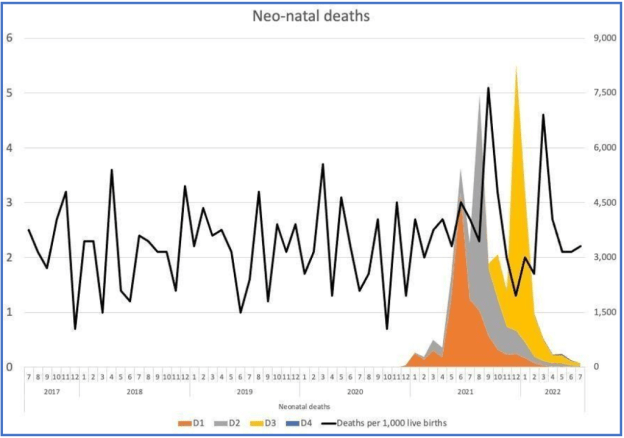
Figure 1: Scottish data on neonatal death rate per 1,000 live births per month (left axis) and doses given to pregnant women (right axis).
An inquiry has been launched in September 2022, but is likely to take 6-9 months – the temporal link to the vaccines would at least suggest a much more urgent need for investigation.
It is not only in the UK that concerns have been raised. Australia has had an extraordinary fall in live birth rate in the last two months of 2021 (2022 figures are not yet available). The results are so extreme that it must surely be some sort of reporting error. But Germany and Sweden have also seen a sharp drop in fertility rates in recent months which have been analysed here, looking a Covid-19 infections, unemployment rates and vaccination rates.
A hugely concerning peer-reviewed preprint has been published showing reduction in stem-cells from umbilical cord samples after Covid-19 infection but much more marked effects following vaccination. The paper has been reviewed here. These cells are an integral part of the newborn infants developing immune system.
Historical pharmaceutical catastrophes and cautions
The most widely known example of severe harm resulting from a drug used in pregnancy is Thalidomide. Launched in 1953 as a tranquiliser, the drug company was taken over the following year and it was relaunched in 1958 as an anti-sickness medication, despite undergoing no specific testing in pregnancy. Over the next 3 years, over 10,000 babies were born with severe limb defects and some also deaf or blind and many thousands are thought to have died. Women had trusted the authorities that all safety checks had been carried out, but sadly irreversible and catastrophic harm resulted before the drug was eventually withdrawn. It was the Thalidomide scandal which led to the setting up of the UK Yellow Card system.
The prescribing of diethylstilbestrol to pregnant women resulted in harm to female fetuses, which only became apparent when the exposed girls themselves reached adulthood. It took 30 years before the late cancer risks were fully recognised and the use of diethylstilboestrol in pregnancy was stopped. Similarly, sodium valproate, an effective anticonvulsant, when given in pregnancy can cause ‘fetal valproate syndrome’, with severe effects on cognitive function. Its teratogenic potential was known from animal studies prior to its launch in 1972, yet even as recently as 2020, women were still not fully informed. It is noteworthy that a BMJ letter in 1981 sounding caution came from a group in Finland – the same country who first noted narcolepsy in children following Pandemrix vaccination. The shortcomings of our healthcare system, described as “disjointed, siloed, unresponsive and defensive” are evident in the Cumberlege Review published July 2020 – ‘First Do No Harm’.
It is against this background that the British National Formulary has strict cautions on prescribing in pregnancy, stating:
“Drugs can have harmful effects on the embryo or fetus at any time during pregnancy. … Drugs should be prescribed in pregnancy only if the expected benefit to the mother is thought to be greater than the risk to the fetus, and all drugs should be avoided if possible during the first trimester. During the second and third trimesters drugs can affect the growth or functional development of the fetus, or they can have toxic effects on fetal tissues.”
“Not all the damaging effects of intrauterine exposure to drugs are obvious at birth, some may only manifest later in life. Such late-onset effects include malignancy, e.g. adenocarcinoma of the vagina after puberty in females exposed to diethylstilbestrol in the womb, and adverse effects on intellectual, social, and functional development.”
Most vitally the BNF reminds us, “Absence of information does not imply safety.”
We can only hope that in the case of the Covid-19 vaccines, this does not turn out to be prophetic.
New Fauci emails show Drosten, other Corona astrologers debating whether and how to address lab origin hypothesis
Drosten: “Didn’t we congregate to challenge a certain theory, and if we could, drop it?”
eugyppius – a plague chronicle – November 23, 2022
In February 2020, virologists were beginning to worry that discussion about the origins of SARS-2 was getting out of hand. Four of them – Edward Holmes, Kristian Andersen, Andrew Rambaut and Robert Garry – decided to write a short statement on the matter, in the hopes of regaining control of the debate. Jeremy Farrar, chairman of the international vaccination cabal known as the Wellcome Trust, coordinated their work and sent a draft to various virological villains, among them Anthony Fauci and Christian Drosten, for comment. A later version of the statement appeared in Nature a month later as “The proximal origin of SARS-CoV-2”.
New emails discussing the genesis of this statement came to light yesterday, as a result of another successful FOIA request for Anthony Fauci’s emails, and it contains some interesting moments.
The draft statement itself (at p. 67 here) is mostly unremarkable and not all that different from the Nature piece. It insists, in bold on the first page, that “Analysis of the virus genome sequences clearly demonstrates that the virus is not a laboratory construct or experimentally manipulated virus.” At least some of its authors, though, especially Edward Holmes, were willing to entertain the lab leak hypothesis, and the consequence was this paragraph considering the possibility that SARS-2 had been enhanced by repeated passage in cell cultures or animals:
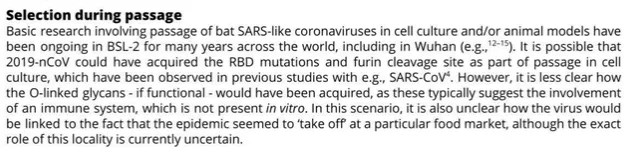
Christian Drosten, after reading the draft, complained immediately that he thought he and his colleagues had already agreed “to challenge a certain theory, and if we could, drop it”:
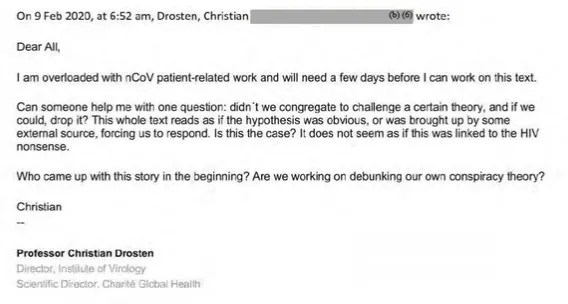
From this we learn, first, that Drosten had been party to prior discussions among his colleagues, where they had discussed messaging strategies relating to “a certain theory”; and, second, that Drosten apparently had no real understanding of the reasoning behind or the case for laboratory origins, and this as late as 9 February.
Edward Holmes (who Farrar elsewhere says is leaning “60-40” for the laboratory origins of SARS-2) has to bring him up to date:
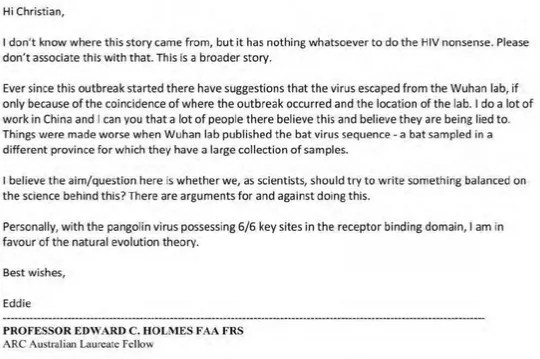
Jeremy Farrar also chimes in:

Then Holmes’s co-author, Kristian Andersen (who has since become a hardcore if disingenuous natural origins advocate), contributes these very interesting remarks:
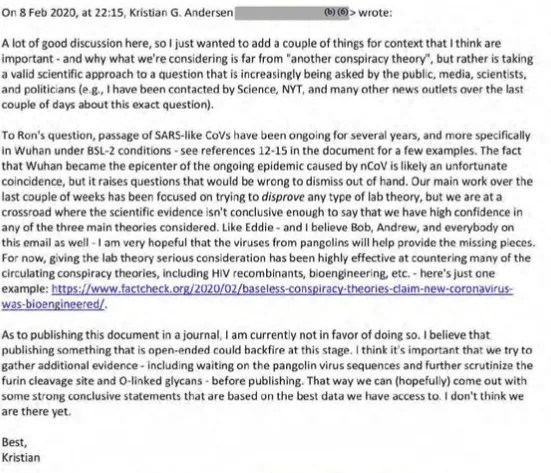
Among other things, it’s telling to see how eager all these virologists were for those fishy pangolin sequences, which Chinese scientists released just as discussions of laboratory origins were gaining ground.
There’s surely more lurking in this email dump, but I have (alas, alas) a conference coming up, and thereafter it’ll take me a few days to get through it.
Fauci Grilled Under Oath in Social Media Censorship Case
By Michael Nevradakis, Ph.D. | The Defender | November 23, 2022
Dr. Anthony Fauci today faced questions from Attorneys General Eric Schmitt (Missouri) and Jeff Landry (Louisiana) in their lawsuit against the federal government for allegedly colluding with Big Tech platforms to censor content critical of COVID-19 vaccines and countermeasures.
Fauci sat for a deposition one day after the 5th U.S. Circuit Court of Appeals temporarily halted the depositions of three other Biden administration officials.
In a statement released Tuesday in advance of Fauci’s deposition, Schmitt said:
“Tomorrow, along with my colleague from Louisiana, my Office and I will depose Dr. Anthony Fauci in our lawsuit against the Biden Administration for allegedly colluding with social media companies to censor freedom of speech.
“Since we filed our landmark lawsuit, we have uncovered documents and discovery that show clear coordination between the Biden Administration and social media companies on censoring speech, but we’re not done yet. We plan to get answers on behalf of the American people. Stay tuned.”
The statement also quoted Jeff Landry:
“We all deserve to know how involved Dr. Fauci was in the censorship of the American people during the COVID pandemic; tomorrow, I hope to find out.
“And I will continue fighting for the truth as it relates to Big Government colluding with Big Tech to stifle free speech.”
Schmitt and Landry sued President Biden, Fauci and others on May 5. New Civil Liberties Alliance, a nonprofit group representing outspoken critics of COVID-19 vaccines and countermeasures, including Drs. Jayanta Bhattacharya, Martin Kulldorff, Aaron Kheriaty and also Jill Hines, joined the lawsuit in August, as did Jim Hoft, founder and editor-in-chief of The Gateway Pundit.
According to the complaint, government officials colluded with and coerced Big Tech and social media platforms to “suppress disfavored speakers, viewpoints and content” relating to COVID-19.
Several officials named in the suit, including former White House press secretary Jen Psaki, argued they shouldn’t be required to be deposed, but a federal judge on Monday denied a request to quash Psaki’s subpoena.
The same judge, U.S. District Judge Terry Doughty, on Oct. 21 ordered Fauci and other government officials to provide depositions under oath.
In addition to Fauci and Psaki, other government officials slated to be deposed include:
- FBI Supervisory Special Agent Elvis Chan
- Carol Crawford, chief of the Centers for Disease Control and Prevention’s Digital Media Branch
- Cybersecurity and Infrastructure Security Agency Director Jen Easterly
- White House Director of Digital Strategy Rob Flaherty
- Daniel Kimmage, an official at the State Department’s Global Engagement Center
- U.S. Surgeon General Dr. Vivek Murthy
Two lower-level officials were listed as alternates: Lauren Protentis of the Cybersecurity and Infrastructure Security Agency in place of Easterly, and former White House COVID-19 adviser Andrew Slavitt in place of Flaherty.
A previous ruling had forced the above-named individuals to provide written testimony.
Judge rejects ‘self-serving blanket denials’
In his Oct. 21 ruling, Judge Doughty agreed with the plaintiffs that Fauci’s prior “self-serving blanket denials” regarding his role in censoring certain types of content and viewpoints on social media could not be taken at face value, necessitating a deposition.
Fauci challenged the order to sit for a deposition, arguing the communications in question are protected by executive privilege. But Judge Doughty ordered Fauci to turn over the documents within 21 days and to answer the plaintiffs’ questions in full.
Landry and Schmitt filed a request for depositions Oct. 10. In a statement released at the time by Schmitt, he said:
“After finding documentation of a collusive relationship between the Biden administration and social media companies to censor free speech, we immediately filed a motion to get these officials under oath.
“It is high time we shine a light on this censorship enterprise and force these officials to come clean to the American people, and this ruling will allow us to do just that. We’ll keep pressing for the truth.”
Depositions of three Biden administration officials on hold
In an order issued Monday, the New Orleans-based 5th Circuit temporarily halted the scheduled depositions of Easterly, Flaherty and Murthy.
According to Politico, the three-judge panel unanimously found Judge Doughty had erred in approving the depositions without first examining whether there were “other means” of obtaining the information the plaintiffs are seeking.
The court sent the case back to Doughty for further review. According to the order:
“Thus, before any of the depositions may go forward, the district court must analyze whether the information sought can be obtained through less intrusive, alternative means, such as further written discovery or depositions of lower-ranking officials.
“Written findings as to the availability and sufficiency of alternatives need to be entered.”
In a statement provided to The Defender by Landry’s office, Landry said, “These developments do not change my pursuit of the truth. We respect the court’s decision and will continue in the discovery phase of this case.”
Thursday’s court order came after lawyers for the government argued the plaintiffs should not have the ability to depose the three officials in question, on the basis that they are high-ranking government officials, and that the depositions would “unavoidably distract” them from “their important and time-sensitive duties,” which would “cause irreparable harm.”
However, the federal government’s motion for a partial stay of Judge Doughty’s deposition order was denied. The Nov. 21 order stated, “We make no ruling on the petition … at this time.”
Easterly, Flaherty and Murthy were scheduled to be deposed in early December.
On Wednesday Judge Doughty, in a separate ruling, ordered Psaki to sit for a deposition and rejected an attempt to shield FBI Agent Chan from answering questions under oath.
Plaintiffs in the case argued that none of the officials were “high-ranking,” and Judge Doughty agreed, finding that the “burdens” the officials would face as a result of sitting for depositions were outweighed by the necessity of gathering more information regarding the allegations in question prior to ruling on a motion for a preliminary injunction.
According to the 5th Circuit’s order:
“It is not enough, as the district court found, that these officials may have ‘personal knowledge’ about certain communications.
“That knowledge may be shared widely or have only marginal importance in comparison to the ‘potential burden’ imposed on the deponent.”
According to the court, the government already produced “extensive written discovery.” The government claims that these documents do not reveal any violations of the First Amendment, while the plaintiffs claim otherwise.
Politico also reported that the 5th Circuit asked Judge Doughty to consider ruling on the overall viability of the lawsuit before allowing the depositions to proceed.
The 5th Circuit said Judge Doughty should have not issued a ruling regarding the depositions until the courts decided on the government’s motion to dismiss — even though that motion was withdrawn after plaintiffs filed an amended complaint and the government has not filed a new motion to dismiss.
According to Politico, the 5th Circuit’s order is not final: Judge Doughty may still decide, based on a newly clarified analysis, that depositions of Easterly, Flaherty and Murthy are needed.
Politico also reported that the 5th Circuit’s order may strengthen efforts by Psaki and the U.S. Department of Justice (DOJ) to halt her deposition.
At a recent hearing, Psaki’s lawyers claimed there is no evidence she had met or had been in contact with any social media executives regarding purported “misinformation,” although she did express critical remarks about social media platforms during White House press briefings.
In his Nov. 21 order, Judge Doughty rejected that claim, writing:
“Despite the fact that Psaki is a former high-ranking official, the potential burden upon Psaki was outweighed by the need to determine whether free speech had been suppressed.”
Previously, a federal judge in Virginia rejected the arguments made by Psaki and the DOJ, including that sitting for a deposition would place an “undue burden” on her, taking her away from her family and her new job at MSNBC for several days.
Magistrate Judge Ivan Davis of the U.S. District Court for the Eastern District of Virginia passed the issue to Judge Doughty. Davis dismissed Psaki’s claims, arguing that Psaki and the DOJ were attempting an “end-run” around the deposition order.
Judge Doughty previously found “that Plaintiffs have proven that Jennifer Psaki has personal knowledge about the issue concerning censorship across social media as it related to COVID-19 and ancillary issues of COVID-19.”
“Psaki has made a number of statements that are relevant to the Government’s involvement in a number of social-media platforms’ efforts to censor its users across the board for sharing information related to COVID-19,” Judge Doughty added. “Any burden on Psaki is outweighed by the need to determine whether free speech has been suppressed.”
Michael Nevradakis, Ph.D., based in Athens, Greece, is a senior reporter for The Defender and part of the rotation of hosts for CHD.TV’s “Good Morning CHD.”
This article was originally published by The Defender — Children’s Health Defense’s News & Views Website under Creative Commons license CC BY-NC-ND 4.0. Please consider subscribing to The Defender or donating to Children’s Health Defense.
Featured Video

The Sordid History of the CIA – Part 2
or go to
Aletho News Archives – Video-Images
From the Archives
Rabbi Shmuel Eliyahu: Leave No Palestinian or Arab Alive

By Jonas E. Alexis | Veterans Today | July 23, 2017
Israeli Rabbi Shmuel Eliyahu seems to have picked up where the late Rabbi Ovadiah Yosef left off. The Israeli army, Eliyahu said, must slaughter the Palestinians “and leave no one alive.” The Palestinians, the good rabbi continued, must be “destroyed and crushed in order to end violence.” Here is Eliyahu’s algorithm:
“If they don’t stop after we kill 100, then we must kill 1,000. And if they do not stop after 1,000, then we must kill 10,000. If they still don’t stop we must kill 100,000, even a million.”
There is more to this “logic” than meets the eye and ear. Eliyahu even postulated that the Israeli army ought not to get involved in arresting Palestinians because “If you leave him alive, there is a fear that he will be released and kill other people. We must eradicate this evil from within our midst.”
You may say that this is just an isolated case. No Israeli official believes that, right? … continue
Blog Roll
Recent Comments


 Aletho News
- Jeffrey Epstein’s sinister shadow over West Asia
- The Sordid History of the CIA – Part 2
- French FM under fire over ‘false’ claims about UN rapporteur
- Israel Wants ISIS-Linked Militias To Control Rafah Crossing — The New Order in Gaza
- ISIS never left Syria, it just changed uniforms
- Why ARE the US and Israel Obsessed With Eliminating Iran’s Ballistic Missiles?
- Kremlin comments on EU ‘myopia’ over dialogue with Russia
- Russia more adapted to contemporary military technology than NATO
- Germany puts caveat on more missiles for Ukraine
- UK High Court rules Palestine Action ban unlawful
- If Americans Knew
- Noor’s short life of unimaginable suffering
- Israel Destroyed Gaza’s Hospitals. Now It’s Banning Doctors Without Borders.
- Is Spite of What Zionists Say, It’s a Good Thing to Criticize Governments
- Palestinian mother, daughter recount strip searches, harsh conditions in Israeli detention
- Israel used weapons in Gaza that made thousands of Palestinians evaporate
- ADL’s Stats Twist Israel’s Critics Into Antisemites
- Why Is the World Silent When the Gaza Genocide Is Not Over?
- In Gaza: 8,000 bodies under rubble, 3,000 missing – Not a ceasefire Day 126
- AZAPAC, the new PAC opposing Israeli domination of U.S policies
- Haim Saban: Billionaire for Israel
- No Tricks Zone
- German Gas Crisis…Chancellor Merz Allegedly Bans Gas Debate Ahead of Elections!
- Pollen Reconstructions Show The Last Glacial’s Warming Events Were Global, 10x Greater Than Modern
- Germany’s Natural Gas Storage Level Dwindles To Just 28%… Increasingly Critical
- New Study Rebuts The Assumption That Anthropogenic CO2 Molecules Have ‘Special’ Properties
- Climate Scientist Who Predicted End Of “Heavy Frost And Snow” Now Refuses Media Inquiries
- Polar Bear Numbers Rising And Health Improving In Areas With The Most Rapid Sea Ice Decline
- One Reason Only For Germany’s Heating Gas Crisis: Its Hardcore-Dumbass Energy Policy
- 130 Years Later: The CO2 Greenhouse Effect Is Still Only An Imaginary-World Thought Experiment
- New Study Affirms Rising CO2’s Greening Impact Across India – A Region With No Net Warming In 75 Years
- Germany’s Natural Gas Crisis Escalates … One Storage Site Near Empty …Government Silent
 Aletho News