ARE THE KIDS OK?
The video, created by VSRF, that Twitter does not want you to watch.
BY IZABELLA KAMINSKA | THE DAILY SCEPTIC | OCTOBER 9, 2022
With the stock prices of both Credit Suisse and Deutsche Bank under pressure, many in the financial field are becoming concerned the world could be facing a renewed financial crisis. But this time around events could play out very differently. It might not even be banks that pose the greatest financial risk to consumers. It could be payment providers like PayPal.
The really big difference between 2007 and 2022 is that bank runs no longer look like the image above, they look like this:

That’s what I was faced with when I tried to transfer £500 from my PayPal account to a regular bank account. On Sunday morning the same message was still occurring. A quick scan of social media proved I was not alone.
“Boycott PayPal” was also trending on Twitter.
So what might the error message indicate about the business?
Here’s what we know so far.
In the last 48 hours a sneaky amendment to PayPal’s acceptable use policy widely captured the public’s attention. Free speech advocates had spotted that customers agreeing to the update would be allowing a sum of $2,500 to be lifted from their accounts if PayPal ever found them guilty of “sending, posting, or publication of any messages, content, or materials” that “promote misinformation” or “present a risk to user safety or wellbeing”.
When word got out, those already concerned about the company’s draconian turn started shutting their accounts and urging others to do the same on social media.
For some, the action proved the final straw.
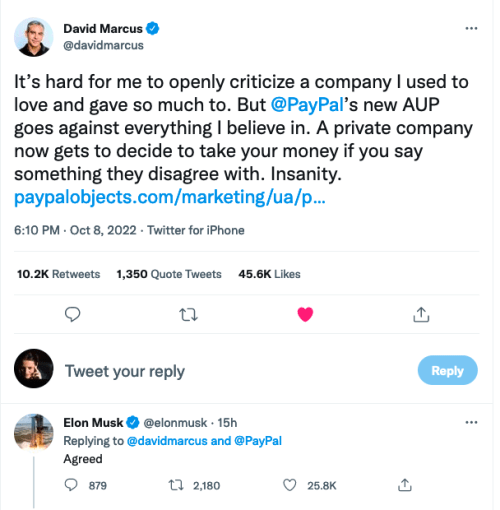
On Saturday evening U.K. time, PayPal’s former president David Marcus distanced himself very clearly from the action. Elon Musk, whose pathway to billionairehood started in 2000 when his company X.com was merged with Peter Thiel’s Confinity to create the PayPal of today, later tweeted that he agreed.
Readers of the Daily Sceptic and members of the Free Speech Union (such as myself) will already know that over the past few months PayPal has been on a whirlwind tour of shutting down the accounts of platforms and media sites it has deemed guilty of spreading misinformation. In many instances, those affected, such as the Daily Sceptic, were not even consulted ahead of the fact and had little idea of what specific text, post or media had violated PayPal terms.
So why exactly would PayPal descend to this level of reputational self-harm?
It’s hard to know for sure, but chances are the decision rests on pressures PayPal itself is facing with respect to its legal duty to enforce Know-Your-Customer (KYC) and Anti-Money Laundering (AML) rules. If I was to take an educated bet, it’s the counterterrorism section of the rulebook that is most relevant.
These days it’s hard to imagine that banks weren’t always responsible for screening transactions and making judgements about their legitimacy. But until the Financial Action Task Force (FATF) was formed in 1989 with a view to combatting money laundering, banks only really cared about screening credit risk. It wasn’t until 2001 and the 9/11 attacks on the Twin Towers (and the introduction of the Patriot Act) that the scope of banks’ responsibilities in this field was expanded to include combatting the financing of terrorism too.
Tackling terrorist financing and criminality was easy enough when everyone was on the same page about what constituted terrorism or financial crime. But one man’s freedom fighter is another man’s terrorist. And in an increasingly polarised world, it’s become harder for ordinary bank employees to differentiate free-speech critical of authority from radicalising terrorist content, such as that distributed by Isis on social media to recruit new members.
It wasn’t the job they were hired to do.
Three factors have muddied the waters further.
The first is the scale of penalties directed at banks found in breach of AML/KYC regulation. The fear of being slammed with fines has made banks and payment providers like PayPal hugely risk-averse and inclined to err on the side of caution when facing any ambiguity. If something even whiffs of misinformation, from their point of view it’s better to shut it down than to run the risk of getting a fine.
Second, is a lack of resources. Human arbitration is costly, and screening activities would be unaffordable if they were to be done by living, breathing individuals. This is why banks and payment providers like PayPal have invested huge sums of money in cost-saving screening technology to detect illegal transactions both actively and preemptively. The problem here is that most of these tools, known as suptech or regtech, are algorithmically applied with limited human oversight. That means it’s mostly artificial rather than human intelligence deciding who gets to stay on a platform and who gets frozen out. As yet, robots are not well known for their sense of nuance, empathy or capacity to process ambiguity. How they decide what they decide is a black-box interpretation of the inputs they’ve been programmed with.
The third issue is the structure of the KYC/AML policing system itself. Since the scale of the task is so enormous, it goes beyond the scope and capacity of any existing government agency. Knowing this, governments, very similar to how they managed the enforcement of lockdown policy, realised it would be more cost-efficient to outsource the policing of their own rules to the banks and payment companies directly. But this is a strategically coercive dynamic. If payment companies don’t fall in line, they risk having their licences removed and their businesses shut down. Non-compliance is therefore not an option. PayPal isn’t perfect, but the pressure it is facing is very similar to the pressure pubs, restaurants and supermarkets faced under Covid. The structural problem here, as with the retail sector during Covid, is those payment companies are not legislative specialists. They take for granted that the governments know what they are doing and that the rules they are setting are human rights compatible and in line with the laws of the land. Nor do the payment companies have the capacity to investigate the rights and wrongs of every case. This is a job for the legal system, which is already excessively costly to access for most ordinary individuals.
This in itself is a huge blind spot for the financial system. There’s a very strong case to be made that the way democratic governments have gone about enforcing AML legislation is not compatible with human rights at all. The enshrined right of habeas corpus might even be under threat. The FATF has itself belatedly realised this. Back in October 2021, it noted in a “stock-take on the unintended consequences of the FATF standards” that (my emphasis):
Situations have arisen in the course of FATF evaluations concerning the interaction between the FATF Recommendations on combating TF (particularly R.5 and R.6) and due process and procedural rights (e.g. to legal representation, fair trial, and to challenge designations, etc.), which have been considered on a case-by-case approach as they arise in specific country contexts. In addition, the FATF has also been made aware of instances of the misapplication of the FATF Standards, which are allegedly introduced by jurisdictions to address AML/CFT deficiencies identified through the FATF’s mutual evaluation or ICRG process, potentially as an excuse measures with another motivation. This information often comes as a result of stakeholder input or when the attention of the FATF or its members is drawn to a particular issue, such as when another international body is reviewing legislation or actions are taken by national authorities. Analysis in the stocktake has therefore focused on the due process and procedural rights issues most often arising in evaluations or feedback.
The stock-take identified the following factors as key examples of where misapplication of FATF standards had affected due process and procedural rights:
Readers can hopefully see the issue.
The entire regulatory system since 2008 has focused on ensuring that the 24-hour payment banking infrastructure we have become used to will never face the risk of going down again.
Put bluntly, the style of service disruption currently being experienced at PayPal is something major banking and payment institutions are not supposed to be able to get away with. At least not for long. So yes, it does feel like a big deal.
For the most part, the practice of shuttering access through website maintenance, downtime or error messages is more commonly seen at cryptocurrency platforms during extreme bitcoin selloffs. Closing access to people’s accounts or pretending to do website maintenance often gives operators the time to raise the liquidity they need by slowing redemptions. But it’s far from a transparent or honourable policy.
For PayPal to have triggered a run on itself because it was merely following government orders is not just unfortunate, it is careless. But it also speaks of a deeper problem at the heart of the anti-money laundering regulatory structure. The entire system we have created may no longer be fit for purpose. Consider, for example, that despite many billions of dollars spent on FATF compliance, a company like Wirecard, whose business model in retrospect looks to have been based on fraud as a service (FAAS), could so easily rise to the top of the German stock market. Nor has any of the regulation been successful at combatting the type of electronic financial fraud (mostly based on phishing attacks or social engineering) that impacts users every day.
We need to seriously ask if the benefits outweigh the collateral damage also being incurred.
But while PayPal might not be entirely responsible for its own actions on the KYC/AML front, its business model may be more vulnerable to this sort of fallout than most people appreciate. The culpability for that lies with PayPal exclusively.
A key revenue generator for the group has always been the interest revenue it absorbs from all the customer balances it holds. (You may not have realised it, but if you have any significant sums in a PayPal account, you won’t be collecting interest on them.) A large outflow of deposits could easily inhibit the company’s ability to raise this income and harm its overall revenue-generating capability. (You don’t have to hold balances at PayPal to use it.)
More critical for PayPal at this juncture will be its inability as a payments company to access the central bank lender-of-last-resort backstop. That means if the group is genuinely facing challenges meeting transfer and redemption requests, it will only be able to turn to wholesale liquidity markets to make up the difference. The degree to which customer balances are locked up in harder-to-liquidate securities or bonds will largely determine its success here. Frustratingly for PayPal, in the current illiquid bond market, there’s a good chance that selling these quickly and without a loss could be challenging. The alternative path for PayPal will be to use these securities as collateral for temporary loans. But the expense here is potentially open-ended if there are no obliging counterparts. That may (or may not) be why the company is currently restricting transfers.
Before rushing to conclusions, it’s important to stress the company still has recourse to liquidity from fully-funded (in fact over-collateralised) entities. We may not know the makeup of that liquidity, but solvency is unlikely to be an issue over the longer term. The biggest problem facing users today will be uncertainty over how quickly they can transfer funds out of the PayPal ecosystem.
What I can say is that in the modern digital age, bank runs will be different. We may even long for the days when tellers transparently shut up shop when the vaults ran dry. At least it was clear what was going on. These days, on the other hand, it will become ever harder to differentiate a bank run from a maintenance issue on a website. Such matters will be shrouded in plausible deniability and uncertainty. Suffice it to say, corporate communication departments will always err towards disinformation of their own sort, that any such outage is nothing out of the ordinary.
Even more concerning is that in the event of a run, customers will no longer be able to tell if those with better connections aren’t unfairly cutting ahead of them in the redemption queue. Virtual queues may seem technologically efficient, but there’s no transparency to them at all.
That’s why if you’re caught out by any of these policies you already don’t stand a chance of getting your account back unless you have existing connections to the management or a platform of your own. None of this is progressive or encouraging.
Izabella Kaminska is the Editor of the Blind Spot, a financial news media service focused on the news everyone else is missing.
PayPal was not contacted for this piece, which is based on the opinions of the author.

Samizdat | October 9, 2022
The Transgender Health Clinic at Tennessee’s Vanderbilt University Medical Center has “paused” gender surgeries for patients under the age of 18, according to a letter sent by the institution’s chief health system officer, C. Wright Pinson, to a state representative on Friday.
In the letter, which Republican Rep. Jason Zachary posted to Twitter, Wright explains that the clinic is pausing “gender-affirmation surgeries on patients under 18” due to the publication of new standard-of-care guidelines last month by the World Professional Association of Transgender Health (WPATH), citing the need to conduct an internal clinical review and consult a wide array of experts. The review could take “several months,” he added.
While Wright pointed to the new guidelines as Vanderbilt’s reason for “pausing” the controversial procedures, his message was framed as a response to the letter Zachary and other state Republican leaders had written to the medical center last month demanding a moratorium on providing gender surgeries to minors. Zachary hailed it as a victory, tweeting his appreciation to Vanderbilt for addressing the party’s “deep concerns.”
The state politicians had decried the university’s pediatric gender clinic’s practices as “nothing less than abuse.” They also demanded all its affiliates honor so-called conscientious objectors – medical professionals who refuse to perform “certain medical procedures” because of their religious beliefs.
The university official addressed both issues in his response, reassuring Zachary that Vanderbilt was compliant with Tennessee law – including legislation banning hormone treatment for pre-pubertal children. Of an average of five gender-affirming surgeries per year on patients under 18 that Vanderbilt doctors had performed since opening the Transgender Health Clinic in 2018, none were genital procedures, and all patients were over 16 and had parental consent, he insisted. Additionally, none of the surgeries were paid for by government funds, and the revenue from gender surgeries constituted an “immaterial percentage” of the center’s profits.
Vanderbilt is not the only pediatric gender clinic to back away from some of its more controversial practices. The Harvard-affiliated Boston Children’s Hospital has struggled to conceal its own history of performing gender surgeries on minors, claiming to only operate on patients over 18 despite a peer-reviewed paper revealing it has performed 65 gender-affirming surgeries on teens as young as 15 since January 2017.
Tennessee, which adopted the ban on pre-pubertal hormone treatment last year, is one of several states attempting to crack down on practitioners that offer irreversible medical procedures such as hormone treatment and “gender-affirming” surgery to minors, sometimes without parental knowledge or consent. Texas, Arkansas, Alabama, and Arizona have also adopted legal measures restricting such treatments.
BY CHRIS MORRISON | THE DAILY SCEPTIC | OCTOBER 8, 2022
A major survey into the accuracy of climate models has found that almost all the past temperature forecasts between 1980-2021 were excessive compared with accurate satellite measurements. The findings were recently published by Professor Nicola Scafetta, a physicist from the University of Naples. He attributes the inaccuracies to a limited understanding of Equilibrium Climate Sensitivity (ECS), the number of degrees centigrade the Earth’s temperature will rise with a doubling of carbon dioxide.
Scientists have spent decades trying to find an accurate ECS number, to no avail. Current estimates range from 0.5°C to around 6-7°C. Without knowing this vital figure, the so-called ‘settled’ science narrative around human-caused climate change remains a largely political invention, not a credible scientific proposition. Professor Scafetta has conducted extensive work into climate models and is a long-time critic of their results and forecasts. In a previous work, he said many of the climate models should be “dismissed and not used by policymakers”. Along with around 250 professors, he is a signatory to the World Climate Declaration which states there is no climate emergency and also notes climate models are “not remotely plausible as global tools”.
Scafetta’s latest work grouped 38 major climate models into low, medium and high ECS values, ranging between 1.8°C and 5.7°C. He found that models in the medium and high category “ran hot” in over 95% and 97% of cases respectively. The lower models were said to have done better when compared to global warming calculated for the period by the major surface datasets of 0.52-0.58°C. But the UAH satellite data showed warming up to 30% less during this period, suggesting even the low warming models produced “excessive warming” from 1980-2021.
According to Scafetta, these results show that the ECS figure could be as low as 1.2-2°C. Particular concern is expressed about surface temperature records that “appear to be severely affected by non-climatic warming biases”. Scafetta concludes that surface-based temperature records are likely to be affected by warming biases, such as the urban heat island effect due to expanding urban development, and subject to natural oscillations that are not reproduced by climate models. He concludes: “The global warming expected for the next few decades may be even more moderate than predicted by the low ECS-GCMs [Global Circulation Models], and could easily fall within a safe temperature range where climate adaptation policies will suffice.”
Scafetta’s work is vital in providing a realistic insight into the dominant role played by climate models in promoting the command-and-control Net Zero political agenda. Many of the constantly promoted climate thermogeddon scares use forecasts based on high ECS values. The higher values are behind every statement from bureaucrats, politicians, green activists and journalists that we are heading for a 2-3°C increase in global temperature in the near future. In the absence of any definitive ECS figure, these predictions are guesses.
In fact, once the ECS figure falls to around 1°C, it is moving into margin of error territory. However, many scientists have more or less given up trying to calculate ECS, since measuring the non-linear atmosphere is proving as difficult as it ever was. The atmosphere is a chaotic system with many powerful influences reacting unpredictably with each other. The huge heat transfers that obviously have a considerable part to play in climate are far from completely understood. Recent suggestions that modellers can ‘attribute’ single event weather events to human-caused climate change are unprovable, and little more than figments of over-active, agenda-driven imaginations. Furthermore, it is possible that carbon dioxide becomes ‘saturated’ beyond certain levels and its effect as a warming gas rapidly declines.
What we do know is that over the last 20 years, global warming has started to run out of steam. The latest September UAH satellite data, considered in some scientific circles as the most accurate measurement we have, show the current standstill has been extended to eight years. But whereas satellite data are common and invaluable in many geographical fields, these temperature results are less welcome. It is not hard to see why. Scafetta calculates that the results since the start of recordings around 1980 are 30% below surface temperature datasets. As it happens, the two adjustments since 2013 by the U.K.’s Met Office to its HadCRUT global surface temperature record have increased recent warming by a similar amount. Similar upward adjustments are to be found in the other major global datasets. A previous temperature pause from about 1998-2010 is no longer visible in these records.
Claims of ‘record’ heat years and ever higher temperatures are taken exclusively from the surface records. The satellite record is largely ignored. There are even attempts to cancel the inconvenient figures, with Google AdSense recently ‘demonetising’ the site of Dr. Roy Spencer, the Principal Research Scientist at the University of Alabama in Huntsville, one of the main compilers of the UAH satellite record. The record, of course, that is a vital part of Professor Scafetta’s work investigating the accuracy of climate models.
From most loved, to most hated… audiences are drowning out Green Party speakers at campaign rallies.
By P Gosselin – No Tricks Zone – October 8, 2022
The German Greens, who are partners with the SPD socialists in Germany’s government, are sinking dramatically in the public opinion polls as it becomes clear Green Party leader and Economics Minister Robert Habeck is driving the country’s economy into the ground at a dizzying speed.
Habeck, who currently also serves as Vice Chancellor, recently stunned millions of TV viewers when he appeared not to understand what bankruptcy is. Now as tomorrow’s state elections approach in Lower Saxony, the Green Party officials are scrambling to keep Habeck from doing more damage.
Blackout News reports that the Greens are “hiding” Habeck from the public in order to control the damage, and so far he has “had only one campaign appearance”. For that one particular appearance, “the audience had to stay outside, for security reasons” and “exclusively to selected members of his party.”
“In the polls, Robert Habeck has already experienced a significant plunge in the popularity of German politicians in recent days. So it’s no wonder that the Greens are literally hiding their once most popular politician ahead of the election in Lower Saxony,” reports Blackout News.
Desperate to find new sources of energy now that the Russian supply of natural gas has been halted, Habeck has angered his party base by extending the operating life for two nuclear power plants and putting lignite-fired power plants back on line.
In Göttingen, Habeck spoke at an election rally, but only in only in front of hand-picked audience after the police had completely sealed off the event.
Just a day earlier his party comrade Annalena Baerbock was “drowned out” by demonstrators. “Already at the beginning of her speech there was a deafening concert of whistles so that Baerbock could hardly be understood,” reports Blackout News. “In addition, there were shouts such as: ‘Baerbock must go’, ‘war-mongers’, ‘get lost’ and ‘impoverishment and war thanks to the Greens’, and ‘whoever votes Green, votes for war’.”
The mainstream media however, did not report on this.
Once the darlings of politics, the German Greens have seen their popularity plummet spectacularly over the recent weeks as Germany’s economy crashes due to excruciating energy shortages and price inflation.
“Therefore, on October 3, the Minister of Economics spoke only to a few dozen hand-picked party members and a few selected journalists,” according to Blackout News.
The Highwire with Del Bigtree | October 7, 2022
The video, created by VSRF, that Twitter does not want you to watch.
By Michael Nevradakis, Ph.D. | The Defender | October 7, 2022
In what pharmaceutical industry publication Fierce Pharma called “a troubling sign of the times,” the Biden administration this week purchased $290 million in anti-radiation drugs.
In an Oct. 4 press release, the U.S. Department of Health and Human Services’ (HHS) Administration for Strategic Preparedness and Response (ASPR) announced the purchase of Nplate, a drug used to treat acute radiation syndrome.
ASPR — the federal agency tasked with preparing for disasters and public health emergencies — said the purchase was made “as part of long-standing, ongoing efforts to be better prepared to save lives following radiological and nuclear emergencies.”
HHS did not clarify why it bolstered the government’s Nplate stockpile, other than describing it as “part of our ongoing work for preparedness and radiological security.”
Officials downplayed any connection to the Russia-Ukraine conflict, adding that the purchase “was not accelerated by the situation in Ukraine.”
However, two days after the announcement, amid growing tensions related to the conflict between Russia and Ukraine, President Biden said the risk of nuclear “Armageddon” is at its highest since the Cuban Missile Crisis in 1962.
The U.S. government in recent months has made several moves signaling a growing level of nuclear preparedness.
For instance, in late September, the Intelligence Advanced Research Projects Activity launched a new program, — Targeted Evaluation of Ionizing Radiation Exposure — which will investigate methods to detect low doses of ionizing radiation.
According to The Register, the investigation will work to “build a new understanding of the effects of low-dose radiation” through the use of technologies such as artificial intelligence, machine learning, biomarker discovery and analytical biography.
The Ohio State University, the University of Washington, Areté Associates and Signature Science received grants to conduct the research over a three-and-a-half year period. The research will occur at Lawrence Berkeley National Laboratory, Los Alamos National Lab and the Armed Forces Radiobiology Research Institute.
Earlier this summer, New York City authorities raised eyebrows with the release of a 90-second nuclear preparedness public service announcement (PSA), which the New York Times described as “bizarre” and as “well watched,” but “not well received.”
At the time, NPR reported that New York City’s emergency management department “wants residents to be prepared if [a nuclear attack] does occur,” but that the PSA left many of the city’s residents “confused.”
Outside the U.S., countries neighboring Ukraine, such as Poland, reportedly began distributing iodine tablets in response to the threat of nuclear fallout related to the Russia-Ukraine conflict as a result of shelling around the Zaporizhzhia nuclear power plant in Ukraine.
Developed under Project BioShield, with funding from numerous government agencies
Nplate is the trade name for the drug romiplostim, approved by the U.S. Food and Drug Administration (FDA) in January 2021 for the treatment of blood cell injuries that result from acute radiation syndrome.
The drug is an artificial protein that promotes the production of platelets — or blood-clotting cells — in the human body.
The drug first received FDA approval in 2008, for the treatment of immune thrombocytopenia, an autoimmune disorder that causes serious bleeding.
Amgen, the drug’s manufacturer, developed Nplate in conjunction with the Biomedical Advanced Research and Development Authority, or BARDA, under the auspices of Project BioShield, signed into law in July 2004 by then-president George W. Bush.
Project BioShield, which incentivizes private companies to develop vaccines and countermeasures for biological, chemical, nuclear and radiological threats, provided funding for the latest $290 million purchase by the HHS.
BARDA — another arm of HHS — garnered attention in recent years for its extensive deals with COVID-19 vaccine manufacturers and for its promotion of COVID-19 countermeasures.
In 2020, BARDA promised Moderna up to $483 million to “shepherd” its COVID-19 vaccine through the FDA approval process.
The National Institute of Allergy and Infectious Diseases (NIAID) — headed by Dr. Anthony Fauci — also contributed to the development of Nplate.
For instance, during an April 2018 oversight hearing of the House Appropriations Subcommittee on Labor, Health and Human Services, and Education, Fauci described NIAID’s involvement in the development and promotion of “radiation/nuclear countermeasure candidates,” including Nplate, for FDA approval under the Animal Rule.
According to the FDA, Animal Rule regulations “allow for the approval of drugs and licensure of biological products when human efficacy studies are not ethical and field trials to study the effectiveness of drugs or biological products are not feasible.”
In the case of Nplate, drugs.com states that the effectiveness of the drug for the purposes of treating radiation exposure “was only studied in animals, because it could not be studied in people.”
Also according to drugs.com, Nplate also is associated with several serious potential side effects, including the increased risk of a blood clot or stroke, an increased risk of developing blood cancers and “harmful effects on your bone marrow that may result in serious blood cell disorders.”
The site states that it is “unknown” if Nplate will cause harm to unborn babies.
Amgen, based in Thousand Oaks, California, describes itself as “A worldwide pioneer in biotechnology.”
The company’s board of directors includes members from The Aerospace Corporation, the David H. Koch Institute for Integrative Cancer Research, Northrop Grumman, Phillips 66, the University of California and Walmart.
The newly purchased stockpile will remain in vendor-controlled inventory, HHS said.
Michael Nevradakis, Ph.D., is an independent journalist and researcher based in Athens, Greece.
This article was originally published by The Defender — Children’s Health Defense’s News & Views Website under Creative Commons license CC BY-NC-ND 4.0. Please consider subscribing to The Defender or donating to Children’s Health Defense.
By Suzanne Burdick, Ph.D. | The Defender | October 6, 2022
Two doctors on Tuesday became the first to file a federal lawsuit to stop a new California law that subjects the state’s doctors to discipline, including the suspension of their medical licenses, for sharing “misinformation” or “disinformation” about COVID-19 with their patients.
Dr. Mark McDonald, a Los Angeles psychiatrist, and Dr. Jeff Barke, an Orange County primary care physician and founding member of America’s Frontline Doctors, filed the complaint in the U.S. District Court for the Central District of California.
The lawsuit names 12 members of the Medical Board of California and California Attorney General Robert Bonta.
The plaintiffs also filed papers seeking a preliminary injunction to protect their free speech rights as the case unfolds.
Barke told The Defender :
“[This new law] puts patients at risk. Requiring physicians to consider the state’s narrative when making a medical decision, is bad medicine and dangerous. Consensus in science only occurs when dissenting opinions are censored.”
Commenting on the lawsuit, Mary Holland, president and general counsel for Children’s Health Defense, said, “California’s new law is a clear violation of the First Amendment. It’s startling that the legislature and the governor would even attempt to pass such legislation.”
Holland added:
“Censoring information about health never leads to health, but it certainly can and has led to medical catastrophes. I look forward to courts striking this law down.”
The Los Angeles Times today reported that some doctors fear California’s new law “could do more harm than good.”
“What was misinformation one day is the current scientific thinking another day,” Dr. Eric Widera, a professor of medicine at the University of California San Francisco, told LA Times.
Liberty Justice Center, a national nonprofit law firm dedicated to protecting Americans’ constitutional rights, is representing McDonald and Barke.
Daniel Suhr, managing attorney at the center, said, “We rely on our doctors to give us their best medical advice, yet the State of California is stopping doctors from doing just that. That’s not just wrong, it’s unconstitutional.”
He added, “Doctors enjoy the same free speech rights as other Americans. The State of California cannot define a so-called scientific consensus on an issue and then punish anyone who dares challenge it.”
Law is ‘at odds with the scientific method itself’
California Assembly Bill 2098 (AB 2098), signed into law Sept. 30 by Gov. Gavin Newsom, defines “misinformation” as “false information that is contradicted by contemporary scientific consensus contrary to the standard of care” and “disinformation” as “misinformation that the licensee deliberately disseminated with malicious intent or an intent to mislead.”
Newsom said the law applies only to physicians’ speech with patients during discussions directly related to COVID-19 treatment.
But Drs. McDonald and Barke allege AB 2098 violates the First Amendment, imposes “government-approved orthodoxy” and “is at odds with the scientific method itself.”
The lawsuit states:
“Disagreement is integral to the progress of medical science, a value that cannot be served by using the power of the state to punish those who dissent from the official line.
“This is particularly objectionable in the context of a new disease like COVID-19, about which consensus opinions and official guidance have regularly adjusted as new information is learned.
“At the beginning of the pandemic, public health authorities insisted that the public not wear masks, arguing they would provide little benefit and should be reserved for front-line medical professionals — that was soon replaced with broadly mandated mask wearing for much of the population.
“Schools were closed in the face of the fear that the disease would spread among children too young to adhere to quarantine procedures — but it turned out that the young were at the least risk, and that such closures may well have been harmful to their development.
“Reasonable minds disagreed then, and continue to disagree now, about any number of such topics, but the search for truth cannot be furthered by a government edict imposing orthodoxy from above, punishing those who disagree with the loss of their profession and their livelihood.”
The lawsuit also alleges that AB 2098 “intrudes into the privacy of the doctor-patient relationship” by “replacing the medical judgment of the government for that of the licensed professional and chilling the speech of those who dissent from the official view.”
The plaintiffs asked that the court “enjoin enforcement of AB 2098 and leave these important matters to the marketplace of ideas.”
AB 2098 was introduced in mid-February by California Assemblymember Evan Low — one of seven Democratic lawmakers who in January formed the Vaccine Work Group to develop legislation promoting the use of COVID-19 vaccines while “battling misinformation.”
The American Medical Association (AMA), which strongly supports the bill, hopes other states will follow suit in “ensuring that licensing boards have the authority to take disciplinary action against health professionals for spreading health-related disinformation,” according to a new policy adopted at its mid-June annual meeting aimed at addressing public health “disinformation.”
The AMA’s adopted policy expanded on prior efforts and called for the organization to work with “health professional societies and other relevant organizations to implement a comprehensive strategy to address health-related disinformation disseminated by health professionals.”
Language in the bill points out that the Federation of State Medical Boards (FSMB) has warned that physicians who spread misinformation or disinformation “risk losing their medical license, and … have a duty to provide their patients with accurate, science-based information.”
The FSMB, as previously reported by The Defender, takes money from Big Pharma and has a history of challenging and attacking non-pharmaceutical medical approaches used by integrative doctors as falling outside the “standard of care” as they define it.
“If this period has taught us anything,” McDonald said, “it is that the scientific and medical environments are constantly evolving, as new information and studies confirm or reject prior policies.
He added:
“Doctors need the freedom to explore alternatives and share opinions that challenge the scientific consensus — that is inherent in the nature of the scientific enterprise.
“California cannot insert itself into the physician-patient relationship to impose its views on doctors and end all debate on these important questions.”
Suzanne Burdick, Ph.D., is a reporter and researcher for The Defender based in Fairfield, Iowa. She holds a Ph.D. in Communication Studies from the University of Texas at Austin (2021), and a master’s degree in communication and leadership from Gonzaga University (2015). Her scholarship has been published in Health Communication. She has taught at various academic institutions in the United States and is fluent in Spanish.
This article was originally published by The Defender — Children’s Health Defense’s News & Views Website under Creative Commons license CC BY-NC-ND 4.0. Please consider subscribing to The Defender or donating to Children’s Health Defense.
By Cindy Harper | Reclaim The Net | October 8, 2022
The FBI and Cybersecurity and Infrastructure Security Agency (CISA) have put out a warning about foreign actors pushing 2022 midterm election “misinformation,” encouraging people to flag “disinformation” to social media platforms.
“If appropriate, make use of in-platform tools offered by social media companies for reporting elections related disinformation,” the report, released by CISA reads.
We obtained a copy of the report for you here.
The FBI has warned about election-related disinformation being promoted by operatives for the Chinese and Russian governments ahead of the midterm elections in November.
The disinformation involves amplifying conversations that Americans are already having on social media, not creating new content, an official from the FBI’s Foreign Influence Task Force told the press.
The FBI is currently being sued for withholding records of communications with Facebook about the Hunter Biden laptop story during the last presidential election.
In an appearance on Joe Rogan’s podcast in August, Meta CEO Mark Zuckerberg said that before the 2020 election, the FBI warned Facebook about Russian propaganda.
“The background here is that the FBI came to us – some folks on our team – and was like, ‘Hey, just so you know, you should be on high alert. We thought there was a lot of Russian propaganda in the 2016 election, we have it on notice that basically there’s about to be some kind of dump that’s similar to that,’” he said.
The FBI did not explicitly mention the laptop story but Facebook thought the story fit the pattern that the federal agency described and decided to limit the reach of the story.
The Russian influence operations are, according to the report, more substantial compared to China. However, China has been accused of “Russian-style influence activities” by leveraging the political divisions in the US. The FBI official noted that Facebook recently deleted accounts allegedly created by Chinese operatives that shared memes mocking Senator Marco Rubio (R-FL) and President Joe Biden.
An official from the FBI’s Cyber Division said no hacking campaigns are targeting the midterms. However, the bureau is “concerned that malicious actors could seek to spread or amplify false or exaggerated claims of compromises to election infrastructure. The official added that “It’s important for all Americans to understand that claims of cyber compromises will not prevent them from being able to vote.”
By Robert Inlakesh | Samizdat | October 8, 2022
Israel has announced its readiness for war with Lebanon, as the ongoing US-mediated maritime border demarcation talks head towards a dead end. The issue, however, is not just causing dispute between Beirut and Tel Aviv, but also becoming more prevalent within Israeli politics as it heads into another round of general elections.
On Thursday, Israeli Prime Minister Yair Lapid rejected Lebanese amendments to a US-proposed maritime border demarcation agreement. The previous day, Israeli officials had reportedly been briefed on the deal, which was the cause of much optimism, with an unnamed source telling Axios news that Lapid “made it clear that Israel will not compromise on its security and economic interests, even if that means that there will be no agreement soon.”
Later on Wednesday, Israeli Defense Minister Benny Gantz ordered the military establishment to prepare for an armed confrontation with Lebanon. A four-hour cabinet meeting, which was said to have been attended by major Israeli security establishment figures, was then concluded with a public announcement that the prime minister and defense minister had been granted permission to strike Lebanon without further cabinet approval.
Why are Lebanon and Israel on the verge of war?
In early June, a ship owned by the gas company Energean arrived at the resource-rich Karish field in the Eastern Mediterranean to begin preparations for natural gas production for Israel. Lebanese President Michel Aoun condemned the arrival, warning Tel Aviv against taking any further “aggressive action.” The Karish field, as well as the nearby Qana field, have for years been central to on-off US-mediated negotiations between Lebanon and Israel. The two nations have still not come to any agreement on the demarcation of their maritime borders, with Beirut seeing Karish and Qana as vital to reviving its collapsing economy.
While Lebanon maintains, due to legal arguments put forth in previous negotiations, that the entire area is to be considered ‘disputed waters,’ Israel has maintained that all of the Karish field and the majority of the Qana field are within its own ‘Exclusive Economic Zone’. The Lebanese political and military party Hezbollah, which claims to have 100,000 battle-ready troops at its disposal, then weighed in on the debate, vowing to protect Lebanon’s rights to its oil and gas.
Secretary General of Lebanese Hezbollah Seyyed Hassan Nasrallah declared that if no maritime border deal were reached and Lebanon is not able to secure its rights, then military action will be taken. Nasrallah vowed that the new reality would be “If we can’t have our resources, nobody can.” Hezbollah’s red line is Israeli extraction from the Karish field before any agreement is signed – if this happens, the group has threatened to strike not only Tel Aviv’s infrastructure at site, but every other Israeli oil and gas facility in the Mediterranean.
Israel has since responded with threats of its own, which have ranged from a vow to eliminate the entire densely populated Beirut suburb that serves as Hezbollah’s stronghold, to Benny Gantz’s recent warning that the whole of Lebanon would “pay a heavy price” for any military action by Hezbollah. Now that the negotiations have reached a “make or break” point, there are significant fears that military action will be taken, either by Israel or Hezbollah.
Empty threats?
The most recent threats issued by the military and political leadership in Tel Aviv have caused panic among Israelis living near the Lebanese border. However, there is a significant possibility that the rhetoric is aimed at a domestic audience. Israel will enter into a new round of national elections in November and the demarcation of maritime borders has recently been weaponized against the current Israeli leadership, causing ministers to act in order to save face.
Israeli opposition leader and former long-time prime minister Benjamin Netanyahu began to lash out at interim-PM Yair Lapid back in September, releasing a video in which he claimed that Lapid had “totally folded in the face of Nasrallah’s threats” and that Hezbollah had forced him to delay extraction from the Karish field. Netanyahu has continued to heavily criticize his political opponents’ handling of the demarcation-line issue, with similar claims that Israel is backing down over the threats issued by Lebanese Hezbollah.
Netanyahu’s words ring true in that Lapid has clearly been forced to take the issue of demarcation of maritime borders very seriously and has conceded on positions held by Tel Aviv in the past. In addition to this, the extraction of gas from the Karish field has also been delayed, as Energean, which owns the rights to extract from the site, was initially prepared to begin operations in late September and has so far refrained from doing so. However, had Netanyahu remained as PM, he would hardly have had any other choice but to do the same.
The threats made by Hezbollah are very serious, and the group apparently has the capacity to follow through with them and destroy all of Israel’s oil and gas facilities. At this time, however, the Israeli far-right camp headed by Netanyahu is blaming the situation on Lapid’s weak governance, saying he is prepared to give away territory that belongs to Israel. For this reason, it is likely that Yair Lapid will attempt to delay extraction of gas from the Karish field in order to sideline the issue until after the elections.
The necessity of a deal for Lebanon
Lebanon sees the Karish and Qana issue as integral to its survival. Some UN experts put the percentage of Lebanese living in poverty at around 80%, while the country endures round-the-clock blackouts, a rising crime rate, and civil instability. Some people have even been spotted searching for food in garbage bins, as well as fighting over loaves of bread at bakeries. Getting its hands on a possible multi-billion-dollar oil and gas field is a matter of life or death for Beirut – but not for Tel Aviv, which enjoys far more economic stability.
The US mediator in the Lebanon-Israel talks, Amos Hochstein, gave an interview to the American owned al-Hurra TV in June, laughing when asked about the prospect of trading the Karish field for Qana. Months later, after Hezbollah upped its threats and the group’s leader, Nasrallah, stated that the Lebanese people would not be laughed at, this issue has become a rather grave one. The US, which has a clear pro-Israeli bias, is now being forced to take the talks much more seriously.
Earlier this year, as the European Union looked for alternative gas suppliers, a deal was inked between Tel Aviv and Brussels, under which Israel would send gas through pipelines to Europe via Egypt. This has encouraged Tel Aviv to announce its plans to double its gas output, and the Karish field is key to achieving this.
The Qana field, however, has not yet been explored and will take time to develop. Despite this, one of the key reasons for Israel’s rejection of the Lebanese proposal is that Beirut refuses to pay Tel Aviv royalties for the gas it would extract from the Qana field should it be handed to Lebanon. Beirut cannot commit itself to such an agreement, because this would mean normalizing ties with the Tel Aviv regime, which still occupies Shebaa farms – an area that Lebanon claims as its rightful territory.
Whether war happens will now boil down to whether bickering between Israeli political parties and individual officials will cause Tel Aviv to adopt a belligerent approach and push forward with gas production in the disputed fields before an agreement is reached. If it does, there can be little doubt that Hezbollah will open fire if its red line is crossed. Israel’s stake in the matter is additional energy revenues, while for Lebanon it is potentially a matter of life or death. Neither side wants war, but one has much to gain and the other has everything to lose.
Robert Inlakesh is a political analyst, journalist and documentary filmmaker currently based in London, UK. He has reported from and lived in the Palestinian territories and currently works with Quds News.
The Cradle | October 8, 2022
Saudi Arabia’s Minister of State, Adel al-Jubeir, rejected claims that the kingdom is behind soaring gas prices in the US, citing instead insufficient refinery production and asserting that the Gulf country does not politicize oil.
“With due respect, the reason you have high prices in the United States is because you have a refining shortage that has been in existence for more than 20 years… You haven’t built refineries in decades,” Jubeir said during an interview on Fox News on 7 October.
“Oil is not a weapon… It’s not a fighter plane. It’s not a tank. You can’t shoot it. You can’t do anything with it. We look at oil as a commodity and we look at oil as important to the global economy in which we have a huge stake. The idea that Saudi Arabia would do this to harm the U.S. or to be in any way politically involved is absolutely not correct at all,” the Saudi official added.
The minister made the claim that the issue on oil production has “been taken out of context by perhaps commentators and analysts,” while assuring that Riyadh is “committed to ensuring stability in the oil markets to the benefit of consumers and producers.”
Following the decision by OPEC+ to cut production output levels by two million barrels per day (bpd), Washington fired back strongly at it’s Gulf partners, with White House Press Secretary Karine Jean-Pierre accusing them on 5 October of “aligning with Russia.”
For weeks before the cut, the US had been lobbying OPEC+ and pressuring it against making the decision, sources told media, as US officials “tried to position the situation as ‘us versus Russia.’”
Saudi officials reportedly told their US counterparts that Washington should boost its own production if it wanted more oil on the market.
Tensions have escalated further between Saudi Arabia and the US in the wake of the production cut, with Secretary of State Antony Blinken saying on 6 October that Washington is reviewing various options regarding its relationship with the kingdom.
Samizdat | October 8, 2022
Road traffic on the Crimean Bridge, which was damaged by a truck explosion earlier on Saturday, has partly resumed, and trains are expected to start moving later in the evening.
“The movement of vehicles along the Crimean Bridge has resumed. At the moment, traffic is open to cars and buses with a full inspection procedure,” the head of the Republic of Crimea, Sergey Aksyonov, announced on Telegram.
Truck drivers are advised to use the Kerch ferry crossing, he added.
Russia’s Transport Ministry said that road traffic was reopened on the bridge, with one lane available for traffic, alternating in both directions.
Following an initial assessment of the damage to the bridge’s railway, the ministry said the “organization of the movement of the first trains will be ensured by 20:00 Moscow time.”
Earlier on Saturday, Russia’s Investigative Committee said the explosion of a truck on the bridge caused seven fuel tanks of a train heading towards Crimea to ignite. Three people are believed to have died as a result of the incident.
The All-Russian Union of Insurers has estimated the damage done to the bridge at 200-500 million rubles ($3.2 to 8 million).
Kiev, despite top officials celebrating the blast, stopped short of claiming responsibility. Nevertheless, Estonian Foreign Minister Urmas Reinsalu congratulated the “Ukrainian special operations units who are believed to be behind this operation.”
Since the launch of Russia’s military operation in Ukraine in late February, various Ukrainian officials have vowed to attack the Crimean Bridge. Kiev views the peninsula as its own territory which was illegally “annexed,” in spite of the fact that the region voted overwhelmingly to reunite with Russia following the 2014 Maidan coup in Kiev.
or go to
Aletho News Archives – Video-Images
Reknowned economist M. Shahid Alam offers this excellent critique of Noam Chomsky’s defective analysis of the relative influence of Oil versus the Israel lobby over US foreign policy: … continue
 Aletho News If Americans Knew No Tricks Zone
