Firefox removes Yandex search, will auto-switch affected users to Google
By Rick Findlay | Reclaim The Net | March 15, 2022
Mozilla has pushed a new release of its Firefox browser with one notable change; it will no longer have Yandex, the Russian search engine, and Mail.ru as options.
“Yandex and Mail.ru have been removed as optional search providers in the drop-down search menu in Firefox,” Mozilla said.
“If you previously installed a customized version of Firefox with Yandex or Mail.ru, offered through partner distribution channels, this release removes those customizations, including add-ons and default bookmarks. Where applicable, your browser will revert to default settings, as offered by Mozilla.
“All other releases of Firefox remain unaffected by the change.”
Users affected by the changes will have their search engine automatically switched to the Google default – by which Google allegedly pays Mozilla hundreds of millions of dollars for the privilege.
“After careful consideration, we are suspending the use of Yandex Search in Firefox due to credible reports of search results displaying a prevalence of state-sponsored content, which is contrary to the principles of Mozilla,” a Mozilla spokesperson said.
“This means for the time being Yandex Search will not be the default search experience (or a default search option) for users in Russia, Belarus, Kazakhstan, and Turkey. In the meantime, we are pointing people to Google.com.”
Russian forces double down to complete operation
BY M. K. BHADRAKUMAR | INDIAN PUNCHLINE | MARCH 15, 2022
After substantially degrading Ukraine’s military capabilities, Russia is poised to escalate the special operation leading to the victory lap. Moscow has given signals in this direction.
The most significant signal came from the Kremlin spokesmen Dmitry Medvedev, who said on Monday, “Russia has a sufficient potential for conducting the special military operation in Ukraine. The operation is proceeding in accordance with the original plan and will be completed on time and in full.”
As I had written more than once previously, Russian military strategy is on course, contrary to what the hyped up western disinformation has conveyed, namely, that the special operation has “failed”. Peskov hinted that there is no question of stopping the operation prematurely. He spoke amidst western calls for “ceasefire.”
Peskov disclosed that President Vladimir Putin had specifically ordered the armed forces to refrain from an immediate assault on the cities, including Kiev, so as to prevent heavy civilian casualty. The operation, therefore, took into account the ground reality that the extremist Neo-Nazi groups had deployed weapons in densely-populated residential areas.
This meant that the tactic narrowed down to “working with modern high-precision weapons, hitting only military and information infrastructure facilities.” Clearly, this also explained the slow pace and low intensity of the operations interspersed with lulls in the fighting and the tactic of encircling large settlements instead of attacking them frontally.
However, Peskov said, now that the large settlements have been surrounded, the military forces “do not exclude” taking Ukrainian cities under their “full control.” By the way, Defense Ministry Spokesman Igor Konashenkov said on Sunday, “Overall, 3,736 facilities of Ukrainian military infrastructure have been disabled, 100 aircraft and 139 UAVs were destroyed, as well as 1,234 tanks and other armoured vehicles, 122 multiple-launch rocket systems, 452 weapons of field artillery and mortars, and 1,013 units of special military hardware.
Peskov of course denied the western propaganda reports, also denied by Beijing, that Moscow requested Chinese military assistance. Considering that the US-led coalition of 177,194 troops backed by massive airpower took over forty days to take Iraq in 2003, Russians have drawn up a brilliant strategy.
Even Russia’s worst detractors in the West would admit that the Russian force level in Ukraine is much less and also that Saddam Hussein’s army was systematically degraded by the US through a period of one decade before the invasion took place in 2003.
From the Ukrainian perspective, the really hard part is just about to begin. The southern port city of Mariupol cannot hold out any longer. Practically all fire emplacements the neo-Nazis had created in Mariupol’s suburbs have been destroyed. Russian special forces have eliminated the neo-Nazis’ main forces entrenched in the residential areas of the city’s perimeters.
The fall of Mariupol will be a turning point. It will release the Russian forces to drive on to Zaporizhya City and Dnipro, the lynchpin on the Dnieper river that controls the southern approaches to Kiev. Equally, Russian attacks from Kherson toward Mykolayiv may resume in the south with a view to surround Odessa, the jewel in the crown on the Black Sea coast.
Meanwhile, the western mercenaries got a taste of what is to come during the pre-dawn cruise missile attack Sunday at a Ukrainian military base less than 20 kms from the Polish border. (Russian account said 180 foreign mercenaries were killed.
The Russian MOD spokesman Maj-Gen. Konashenkov said later, “We know all locations of foreign mercenaries in Ukraine. More surgical strikes will continue to be delivered against them.” The western countries, especially the US, which embarked on this misadventure to despatch mercenaries, may have second thoughts.
Suffice to say, all this adds up as a growing realisation in the Western capitals, including Washington, that the Russian operation can no longer be thwarted and is destined to run its course. This is evident from the latest remarks by French President Emmanuel Macron on French TV on Monday:
“Europe cannot be safe if it doesn’t engage in a dialogue with Russia. This is our history, our geography. Therefore I intend to talk with President Putin in the upcoming hours… It is necessary to prepare conditions for peace now already, because the war will end when everybody sits down at the table and time will come to determine who is ready to promise what. Therefore, in order to be ready, we must get ready now already.”
Succinctly put, Macron is looking ahead at the scenario after the Russian operations conclude “when everybody sits down at the table… to determine who is ready to promise what.” Significantly, Macron was speaking a few hours after a phone call from the US president Joe Biden.
Even more significantly, Bloomberg has reported that the US National Security Advisor Jake Sullivan has sought a call with his Russian counterpart Nikolai Patrushev, one of Putin’s closest political associates in the Kremlin. This is the first such high-level contact by Washington since the Russian operation began on February 24.
China, US keep dialogue, but ‘no respect, no cooperation’
By Yang Sheng, Wan Lin and Wang Wenwen – Global Times – March 14, 2022
China’s top diplomat Yang Jiechi met US National Security Advisor Jake Sullivan in the Italian capital of Rome Monday to exchange views on China-US relations and other international and regional issues of common concern.
Chinese analysts said the US wants to use the Rome meeting to further pressure China to serve its sanctions against Russia, but China won’t be misguided, and they slammed Washington for its arrogance in bossing other countries to unconditionally follow its strategy while showing no respect to the core interests of others.
However, the differences won’t allow the world’s No.1 and No.2 economies to cut off channels of communication, since there are many issues on which the two sides share common concerns. Experts said the scheduled Yang-Sullivan meeting, nearly four months after the virtual summit was held between the top leaders of the two countries, demonstrated that the China-US high-ranking communication mechanism is stably running and is a positive sign to the world at such a turbulent time.
The key issue of this meeting is to implement the important consensus reached by the Chinese and US heads of state in their virtual summit in November last year, Zhao Lijian, spokesperson of the Chinese Foreign Ministry, announced on Sunday.
China and the US arranged the meeting between Yang, a member of the Political Bureau of the Communist Party of China (CPC) Central Committee and director of the Office of the Foreign Affairs Commission of the CPC Central Committee, and Sullivan at the end of last year. Both sides have been in communication on the meeting and set the date and time, said Zhao.
The White House said in a statement on Sunday that the two sides will discuss ongoing efforts to manage the competition between the two countries and discuss the impact of the Russia-Ukraine conflict on regional and global security.
Monday’s meeting was not one that was urgently set up in response to an emergency, it had been planned long ago by the two sides according to their own schedules, Diao Daming, associate professor at the Renmin University of China in Beijing, told the Global Times on Sunday.
According to the statement from the White House, Sullivan will also meet with Luigi Mattiolo, diplomatic advisor to the Italian Prime Minister.
Diao said one important part of the discussion will address whether the consensus reached by the leaders of China and the US in their November 2021 meeting has been fulfilled and how the next step will be implemented.
“The stably sustained high-ranking communication between China and the US, the two major powers whose relations have long affected the overall development of the world, will send positive signals to the world at this time,” said Diao.
Chinese experts said the most important consensus reached by the two leaders in November 2021 is to reconfirm the US stance on supporting the one-China principle and opposing Taiwan secessionism, as this is the foundation of bilateral ties. But what the US has done indicates it will continue to be duplicitous, so based on this fact, it’s unlikely that there will be a major breakthrough to bring ties back on normal track despite the two sides maintaining dialogue.
Yang and Sullivan met in Zurich in October 2021, during which both parties had a “comprehensive and in-depth” exchange of views on China-US relations as well as international and regional issues of common concern.
Lü Xiang, a research fellow at the Chinese Academy of Social Sciences, said that the issue of common concern for both China and the US now is the conflict between Russia and Ukraine. He highlighted that the key to this issue is the strategic confrontation between Russia and the US, or NATO.
With a potentially tense conflict between Russia and the US, it is critical for the US to understand China’s position, and China also wants to know how the US will play the game under the current situation, Lü noted.
The US might expect China to be a mediator with Russia, but the US should not try to create discord between China and Russia even if it is not capable of doing so, the expert said.
The US should calm down and take a more reasonable view of bilateral relations and the global order, and it should reconsider its approaches toward both China and Russia and learn that pressure, sanctions and provocations won’t solve any problems, but only make the US suffer more, Chinese experts said.
Apart from the Russia-Ukraine conflict, other hot topics concerning regional or international relations, such as climate change, the Korean Peninsula issue and the Iran nuclear deal, could also be discussed in Monday’s meeting, according to Diao.
No respect, no cooperation
According to CNN, Sullivan said on Sunday that Russia is concerned about China’s support after the West launched sanctions against Moscow.
“We also are watching closely to see the extent to which China actually does provide any form of support, material support or economic support, to Russia. It is a concern of ours. And we have communicated to Beijing that we will not stand by and allow any country to compensate Russia for its losses from the economic sanctions,” Sullivan said.
Li Haidong, a professor at the Institute of International Relations of China Foreign Affairs University, told the Global Times, “Obviously, the US is expecting China to do unconditionally what it says or it will punish China as well. This is totally opposite to the principles of mutual respect, peaceful coexistence and win-win cooperation.”
The three principles were laid out by the Chinese side at the virtual summit between the two heads of state last year.
If the US keeps dealing with China in this way, the dialogue will be pointless and meaningless, and there is no chance that Washington will get what it wants from China, said Li, noting that this would be a tragedy of US diplomacy, and “we hope the US won’t mess up its ties with China like it did with Russia. It has made a huge mistake in dealing with Russia, and it’s making mistakes in dealing with China.”
Both China and Russia are aware of the US attempt to split them, but both sides have confidence and calmness to make the strategic partnership withstand the instigation from Washington, said analysts.
Timofei Bordachev, program director of the Moscow-based Valdai Club, told the Global Times on Monday, “A high level of trust exists between Chinese and Russian leadership. What is most important is not the efforts of the US, but how the present relationship between China and Russia fits the development goals of both nations, which do not require competition between them.”
The US is trying to force the international community to stand with it, and will not give any room for any other countries to remain neutral or stay away from joining Western sanctions and condemn Russia, just as China, India, Turkey, Israel and South Africa are doing, observers said.
These countries have their own reasons for refusing to follow Western sanctions, as they make diplomatic decisions independently based on their own interests, their understanding of the issue and fairness in international relations, rather than just simply following the US or Russia, said experts.
Observers also noted that these countries are the ones that can really contribute to mediating the conflict, as only those that are truly neutral will be accepted by the warring parties to be mediators, while the US can only worsen the situation through sanctions and supplying weapons.
China accuses US of disinformation
RT | March 15, 2022
In response to Western media reports that Moscow requested military aid from Beijing to conduct its operation in Ukraine, the Ministry of Foreign Affairs of China has accused US officials of spreading disinformation with sinister intent.
“The United States has been spreading false information against China on the Ukraine issue recently, with sinister intentions,” Foreign Ministry spokesperson Zhao Lijian said on Monday, answering a foreign reporter’s question on whether China will assist Russia with arms.
“China’s position on the Ukraine issue is consistent and clear, and we have always played a constructive role in persuading peace and promoting talks,” he added. Zhao also called on the belligerent parties to exercise restraint and de-escalate tensions rather than fueling them, while insisting that all countries should push for a diplomatic solution.
On Sunday, the Financial Times reported that Moscow asked China “for equipment and other kinds of unspecified military assistance” to support its military operation in Ukraine. The report added that the White House was concerned “Beijing may undermine western efforts to help Ukrainian forces defend their country” if it chooses to grant the alleged request.
Earlier, Washington threatened to shut down Chinese chip manufacturers if Beijing assists Moscow in overriding US sanctions.
Kremlin spokesperson Dmitry Peskov said that Russia has sufficient military resources to conduct the operation in Ukraine without requesting aid from other countries.
“Newspapers write a lot these days. You shouldn’t take it as a primary source. Russia has an independent potential to continue the operation, as we said, it is developing according to plan and will be completed on time and in full,” he stated.
The US and its EU allies have imposed unprecedented sanctions on Moscow in response to the military operation in Ukraine. Russia announced its decision in late February, following a seven-year standoff over Kiev’s failure to implement the terms of the Minsk agreements, and Moscow’s eventual recognition of the Donbass republics in Donetsk and Lugansk. The German- and French-brokered protocols were designed to regularize the status of the two regions within the Ukrainian state.
Moscow has now demanded that Ukraine officially declare itself a neutral country that will never join NATO. Kiev insists the Russian offensive was completely unprovoked and has denied claims it was planning to retake the two republics by force.
Moscow reveals whether US sanctions would harm Iran deal
RT | March 15, 2022
Russian Foreign Minister Sergey Lavrov said on Tuesday that Moscow has received written assurances from the US that Ukraine-related sanctions won’t hinder its ability to trade with Iran under the terms of a new nuclear agreement. “We received written guarantees. They are included in the text of the agreement itself on the resumption of the Joint Comprehensive Plan of Action on the Iranian nuclear program,” Lavrov told reporters in Moscow.
The ‘Joint Comprehensive Plan of Action’, or JCPOA, is the official title of the 2015 Iran nuclear deal. Signed by Iran and the US, UK, Russia, France, Germany, China and the EU the deal promised Iran sanctions relief in exchange for a halt to its nuclear program. Former US President Donald Trump unilaterally withdrew from the deal in 2018, claiming that Iran was breaching its obligations, and negotiators have been meeting in Vienna, Austria and attempting to hammer out a new deal for nearly a year now.
An unnamed US official told the Wall Street Journal on Sunday that the US was not prepared to ease any Ukraine-related sanctions to save the deal, and would be open to negotiating a “replica of the JCPOA” without Russian involvement if Moscow insisted on exemptions being made.
Commenting on the reports, Lavrov suggested that Washington itself is still not ready to support the deal, and pointed out that, according to his Iranian counterpart, the problem with the agreement is in the US’ “exorbitant demands.”
Appearing beside Lavrov on Tuesday, Iranian Foreign Minister Hossein Amir-Abdollahian said that there is no link between the conflict in Ukraine and the talks in Vienna.
The Iranians have repeatedly insisted that Russia remain a part of any deal.
The Vienna negotiations have been paused since last week, but an Iranian Foreign Ministry spokesman said on Monday that they should resume shortly, when they will enter their “final, crucial steps.” Lavrov told reporters on Tuesday that he believes these talks are on the home stretch, and called on the US to “return to the legal framework of this nuclear deal” and lift “the illegal sanctions the US has imposed to hurt not only Iran and its people, but a number of other countries.”
Whither US Oil Production?
By Paul Homewood | Not A Lot Of People Know That | March 13, 2022
This single chart from the US EIA explains just why oil prices are shooting up there:

https://www.eia.gov/petroleum/production/
The oil boom initiated by Trump saw crude oil output increase by a half between 2016 and 2019.
Output naturally collapsed in early 2020 as a result of the pandemic, which affected both supply and demand. But since then output has only slowly recovered, and is still 9% below 2019 levels.
It is worth pointing out that demand in 2021 was still not back to 2019 levels. Assuming it recovers this year, it is likely to put further upward pressure on prices, unless production increases as well.
To put the numbers into perspective, the US produces a sixth of the world’s crude oil. The increase in US output between 2016 and 2019 was 205 million tonnes, and represents 5% of global output.
Small changes in supply have a disproportionate effect on international oil prices, because demand is so inelastic. An extra 5% on world production would have a significant impact on prices.
Oil price hikes hit poor countries the hardest
By Vijay Jayaraj | American Thinker | March 13, 2022
The fighting in Ukraine has intensified with Russian forces showing no signs of retreating and residents are fleeing cities.
What does this have to do with the lives of billions of people living far away from the war? Oil price increases.
The conflict has caused an increase in international oil prices, which have now crossed $130 per barrel, a 13-year high. As a result, gas prices at pumps across the globe are set to rise even further.
Being the largest consumers of automobile fuels, motorists in the U.S. and Europe are feeling significant economic pain. However, the situation is far more serious for populations of developing countries who have a much smaller buffer against life-threatening deprivation.
Take Nigeria, for example, the largest economy in Africa with $514 billion GDP. Neither the size of the economy nor the presence of crude reservoirs was sufficient to protect the country from the price shock. Nigerians already were grappling with a month-long fuel shortage due to quality-related import restrictions. While government subsidies soften the effect on users of gasoline, there is no such support for diesel.
Diesel is selling for 625 naira per liter in Lagos and Abuja, 30 percent higher than two weeks ago. Diesel prices are expected to touch 650 soon and are disrupting everyday lives. Nigeria is infamous for its energy poverty, with only 40 percent of the country’s 193 million population having access to electricity. The rising fuel costs will force many more millions into energy poverty.
In the neighboring West African country of Ghana, which is a net exporter of oil, fuel prices have risen dramatically in the first quarter and are affecting all kinds of businesses. For a country that is already in an ongoing economic crisis caused by debt distress, rising gasoline and diesel prices have become a nightmare.
Though Ghana exports high-quality crude, it has inadequate refinery capacity to convert domestic oil into finished petroleum products. Like Nigeria, it depends on imports of refined products. Currently, 80 percent of all finished petroleum products are imported. Inflation rates will be driven up by fuel prices that may increase by 6 percent, sending households into further chaos in what was originally supposed to be the fastest growing major economy in Africa.
In Asia, less-developed economies that were caught up with the decade-long green movement failed to invest in fossil-fuel technology and now face extraordinary import bills due to the rise in international crude prices.
Last month, Thailand’s inflation rose to its highest level in 13 years at 5.28 percent. Speaking to Al Jazeera, the chairman of the Thai National Shippers Council said: “The geopolitical situation, global inflation, the pandemic – Thailand still has a high number of cases – and freight costs are still very high. All of that is certain to damage our growth.”
Neighboring Philippines is in murky waters as well, with gasoline prices set to rise by 11 Phillipine pesos and eventually increase by a further 20 pesos by the end of March. A record high of 100 pesos per liter for gasoline will send small businesses and households into great distress.
In the abstract, the victims of higher energy prices are economic growth and the long-running fight against poverty, which translates into harder lives for billions of people struggling to fend off malnutrition and disease.
A simple solution would be to reverse anti-fossil fuel policies that cause shortages and to make the well-being of citizens the first priority.
Vijay Jayaraj is a Research Associate at the CO2 Coalition, Arlington, Va., and holds a Master’s degree in environmental sciences from the University of East Anglia, England. He resides in Bengaluru, India.
DHS increases efforts to identify “misinformation” and “conspiracy theories” on social media
By Dan Frieth | Reclaim The Net | March 14, 2022
Last Spring, Secretary of Homeland Security Alejandro Mayorkas ordered an internal review to identify how to best detect, prevent, and respond to threats related to domestic violent extremism within the department.
A component of this was based on online activity. “DVE [domestic violent extremist] attackers often radicalize independently by consuming violent extremist material online and mobilize without direction from a violent extremist organization, making detection and disruption difficult,” the unclassified initial report stated.
The report (obtained here) said that extremists, “exploit a variety of popular social media platforms, smaller websites with targeted audiences, and encrypted chat applications to recruit new adherents, plan and rally support for in-person actions, and disseminate materials that contribute to radicalization and mobilization to violence.”
One of the recommendations is to increase “efforts to better identify and evaluate mis- dis- and mal-information (MDM) with a homeland security nexus, including false or misleading conspiracy theories spread on social media and other online platforms that endorse violence.”
While not directly stated, it was inferred that the DHS was in some way monitoring online activity. Obviously, some privacy and free speech concerns were raised.
And now, this month, the DHS has released a report with the findings of the review.
We obtained a copy of the report for you here.
“Every day, the more than 250,000 dedicated public servants at DHS work to ensure the safety and security of communities across our country. To ensure we are able to continue executing our critical mission with honor and integrity, we will not tolerate hateful acts or violent extremist activity within our Department,” said Mayorkas.
“The findings of this internal review highlight key steps that our Department will continue to take with urgency to better prevent, detect, and respond to potential internal threats related to domestic violent extremism, and protect the integrity of our mission.”
The report stated its previous report had highlighted that topics such as allegations of fraud in the 2020 election and “conspiracy theories” around Covid-19 would be worth focusing on, adding that the initial report last Spring said that these topics “will almost certainly spur some [domestic violent extremists] [sic] to try to engage in violence this year.”
Much of the focus of the DHS has been internal. Among the recommendations is the creation of a department-wide system for investigating and reporting cases related to internal domestic violent extremism.
The report states that the DHS should, when vetting personnel, “explore expanding the use of publicly available information, including social media… to identify or investigate potential violent extremist activity within the DHS workforce.”
It adds, “Studies and pilots have suggested that certain online activity may represent behavior of potential concern to national security and could be useful in assessing an individual’s trustworthiness, judgment, or reliability.”
The document further adds that the “DHS must continue to examine the use of social media and other PAEI [Publicly Available Electronic Information], including within the scope of personnel security vetting, to enhance the Department’s security posture in preventing and detecting violent extremist activity.”
The report also pays lip service to civil liberties, adding that it’s “critical that any study or implementation of social media monitoring is pursued deliberately to protect the privacy, civil rights, and civil liberties of all individuals,” – but doesn’t say how this can be achieved.
The department has already started implementing the recommendations, including updating its employees’ training modules.
ARE WE DOING MORE HARM THAN GOOD?
The Highwire with Del Bigtree | March 10, 2022
Dr. Peter A. McCullough joins Del in studio for a dive into the science of vaccinating for Covid, vaccinating your children for Covid, and the risks and benefits. Is the risk worth the benefit? Are we doing more harm than good?
Biden Faces Backlash for Venezuela Talks as Caracas Demands Recognition
Venezuelan Foreign Minister Félix Plasencia argued the US needs to recognize Maduro and lift sanctions before oil shipments can restart

Venezuelan Foreign Minister Félix Plasencia participates in the Antalya Diplomacy Forum in Turkey. (@plasenciafelixr / Twitter)
By José Luis Granados Ceja – Venezuelanalysis – March 14, 2022
The Biden administration faced strong bipartisan criticism over recent direct talks with the Venezuelan government.
News outlets reported that in light of criticism from hardline sympathizers of the Venezuelan opposition, the Biden administration had suspended its direct talks with the Venezuelan government but that a deal to lift some US sanctions in exchange for restarting oil sales to the US was still on the table.
Washington recently ordered the suspension of Russian oil imports, leaving the US desperate to find other sources of crude as rising energy prices threaten to create a domestic crisis for the Democrats ahead of midterm elections in November.
Despite the lack of diplomatic relations stemming from the US’ refusal to recognize the results of the 2018 presidential election, Caracas and Washington have maintained back-channel communications. These talks led to the first direct exchange between the US and Venezuelan governments in years, which came at Washington’s request.
News of the encounter was met with a vehement condemnation from both Republican politicians such as Senator Marco Rubio and fellow Democrats such as Florida’s Debbie Wasserman Schultz, a longtime supporter of the Venezuelan opposition.
Rubio, one the most vocal champions of Venezuela’s self-declared “interim president’ Juan Guaidó, has gone on the offensive to try to preemptively stop any deal and introduced legislation to ban the import of oil from Venezuela and Iran.
Various politicians from Florida sent a letter to Biden criticizing the administration’s decision to hold direct talks with Maduro. Florida’s large Cuban and Venezuelan population and status as a “swing state” in US elections has led politicians to cater their foreign policy toward Latin America in the interest of pleasing this comparatively small constituency.
However, skyrocketing energy costs inside the US as a result of global geopolitical situation in light of the Russian military operation in Ukraine and the subsequent ban of Russian oil imports have put the Maduro government in Venezuela, which counts on the world’s largest oil reserves, in a more favorable bargaining position.
Until recent developments, the Biden White House had largely maintained its predecessor’s “maximum pressure” policy aimed at ousting Maduro, though the Financial Times reported that the administration had already been considering a change in strategy.
White House spokeswoman Jen Psaki tried to downplay the March 5 meeting that counted on the presence of Venezuelan President Nicolás Maduro and Vice President Delcy Rodríguez as well as Biden Latin America adviser Juan González.
The direct talks led to the release of US citizens Gustavo Cardenas and Jorge Fernández on Tuesday, however US State Department spokesman Ned Price denied their release was tied to a deal regarding Venezuelan oil.
For his part, Maduro called the engagement “respectful, cordial and very diplomatic” and said that the US had committed to a follow-up meeting.
The direct talks with the Venezuelan leader have undermined the US’ strategy in Venezuela and its support for Juan Guaidó, who the Biden administration insists they still recognize as “interim president.”
With Guaidó’s position under increased scrutiny, the opposition has come to rely on the US almost exclusively for its legitimacy. Senator Rubio recently admitted that a deal would mean the opposition would be “finished”.
Guaidó was not part of the talks and reportedly only learned of the high-level meeting between the US and Venezuelan governments the day of the meeting.
Sources in Venezuela’s opposition told the Miami Herald that the potential deal would involve granting a special license to Chevron to ramp up activities in Venezuela. Chevron has previously lobbied the US State Department for a rollback of sanctions against Venezuela.
Caracas demands recognition, sanctions relief
Venezuelan officials have likewise commented on the possibility of restarting the oil trade with the US, with Foreign Minister Félix Plasencia stating that any deal to supply oil would be contingent on Washington and Brussels recognizing Nicolás Maduro as president.
“We have a 100-year oil business relationship with the United States. We have not taken them out of the business, they left in order to impose coercive measures. Now they want to return. Fine, if they accept that the only and legitimate government of Venezuela is the one led by President Nicolás Maduro, then US and European oil companies would be welcome,” said Plasencia at the Antalya Diplomacy Forum held this past weekend in Turkey.
Plasencia added that a “respectful relationship” would also require the lifting of coercive measures that deepened the country’s economic crisis.
EU High Commissioner for Foreign Affairs Josep Borrell held a bilateral meeting with Plasencia on the margins of the forum that both described as “good,” with Borrell’s team indicating a willingness on the part of the European bloc to normalize relations and lift sanctions.
Venezuela, home to the world’s largest oil reserves, had a steady crude production of around 1.9 million barrels per day (bpd) and exported approximately 500,000 bpd to US markets until sanctions targeted the sector and crippled production.
The Venezuelan oil industry has lately shown signs of improvement with Plasencia stating that the country could produce up to 2 million barrels per day by the end of the year thanks to the assistance of “reliable partners, such as Russia, China and Iran.”
The recent diplomatic summit also saw Plasencia and Vice President Delcy Rodríguez both meet with a Russian delegation led by Foreign Minister Sergei Lavrov.
“We held a meeting with our good friend Sergei Lavrov. We reviewed our bilateral strategic relations and the complex international scenario,” Rodriguez said via Twitter.
The March 5 high-level meeting between the US and Venezuela was likewise driven by Washington’s efforts to isolate Russian President Vladimir Putin from his allies in Latin America. US officials were reportedly seeking a public condemnation of Russia’s incursion into Ukraine by Maduro. Caracas has called for a “peaceful resolution” to the ongoing crisis but has stopped short of criticizing the Russian military operation.
The Venezuelan leader spoke directly by phone with Putin, with the Russian Ministry of Foreign Affairs reporting that the Venezuelan president expressed his “firm support” for Russia and condemned destabilization efforts by the US and NATO.
Edited by Ricardo Vaz in Caracas.
Weathering the global storm: Why neutrality is not an option for Palestinians
By Ramzy Baroud | MEMO | March 14, 2022
A new global geopolitical game is in formation, and the Middle East, as is often the case, will be directly impacted by it in terms of possible new alliances and resulting power paradigms. While it is too early to fully appreciate the impact of the ongoing Russia-Ukraine war on the region, it is obvious that some countries are placed in relatively comfortable positions in terms of leveraging their strong economies, strategic location and political influence. Others, especially non-state actors, like the Palestinians, are in an unenviable position.
Despite repeated calls on the Palestinian Authority by the US Biden Administration and some EU countries to condemn Russia following its military intervention in Ukraine on 24 February, the PA has refrained from doing so. Analyst Hani Al-Masri was quoted in Axios as saying that the Palestinian leadership understands that condemning Russia “means that the Palestinians would lose a major ally and supporter of their political positions.” Indeed, joining the anti-Russia western chorus would further isolate an already isolated Palestine, desperate for allies who are capable of balancing out the pro-Israel agenda at US-controlled international institutions, like the UN Security Council.
Following the collapse of the Soviet Union and the dismantling of its Eastern Bloc in the late 1980s, Russia was allowed to play a role, however minor, in the US political agenda in Palestine and Israel. It participated, as a co-sponsor, in the Madrid peace talks in 1991, and in the 1993 Oslo accords. Since then a Russian representative took part in every major agreement related to the ‘peace process,’ to the extent that Russia was one of the main parties in the so-called Middle East Quartet which, in 2016, purportedly attempted to negotiate a political breakthrough between the Israeli government and the Palestinian leadership.
Despite the permanent presence of Russia at the Palestine-Israel political table, Moscow has played a subordinate position. It was Washington that largely determined the momentum, time, place and even the outcomes of the ‘peace talks’. Considering Washington’s strong support for Tel Aviv, Palestinians remained occupied and oppressed, while Israel’s colonial settlement enterprises grew exponentially in terms of size, population and economic power.
Palestinians, however, continued to see Moscow as an ally. Within the largely defunct Quartet – which, aside from Russia, includes the US, the European Union and the United Nations – Russia is the only party that, from a Palestinian viewpoint, was trustworthy. However, considering the US near complete hegemony on international decision-making, through its UN vetoes, massive funding of the Israeli military and relentless pressure on the Palestinians, Russia’s role proved ultimately immaterial, if not symbolic.
There were exceptions to this rule. In recent years, Russia has attempted to challenge its traditional role in the peace process as a supporting political actor, by offering to mediate, not just between Israel and the PA, but also between Palestinian political groups, Hamas and Fatah. Using the political space that presented itself following the Trump Administration’s cutting of funds to the PA in February 2019, Moscow drew even closer to the Palestinian leadership.
A more independent Russian position in Palestine and Israel has been taking shape for years. In February 2017, for example, Russia hosted a national dialogue conference between Palestinian rivals. Though the Moscow conference did not lead to anything substantive, it allowed Russia to challenge its old position in Palestine, and the US’ proclaimed role as an ‘honest peace broker.’
Wary of Russia’s infringement on its political territory in the Middle East, US President Joe Biden was quick to restore his government’s funding of the PA in April 2021. The American President, however, did not reverse some of the major US concessions to Israel made by the Trump Administration, including the recognition of Jerusalem, contrary to international law, as Israel’s capital. Moreover, under Israeli pressure, the US is yet to restore its Consulate in East Jerusalem, which was shut down by Trump in 2019. The Consulate served the role of Washington’s diplomatic mission in Palestine.
Washington’s significance to Palestinians, at present, is confined to financial support. Concurrently, the US continues to serve the role of Israel’s main benefactor financially, militarily, politically and diplomatically.
While Palestinian groups, whether Islamists or socialists, have repeatedly called on the PA to liberate itself from its near-total dependency on Washington, the Palestinian leadership refused. For the PA, defying the US in the current geopolitical order is a form of political suicide.
But the Middle East has been rapidly changing. The US political divestment from the region in recent years has allowed other political actors, like China and Russia, to slowly immerse themselves as political, military and economic alternatives and partners.
The Russian and Chinese influence can now be felt across the Middle East. However, their impact on the balances of power in the Palestine-Israel issue, in particular, remains largely minimal. Despite its strategic ‘pivot to Asia‘ in 2012, Washington remained entrenched behind Israel, because American support for Israel is no longer a matter of foreign policy priorities, but an internal American issue involving both parties, powerful pro-Israel lobby and pressure groups, and a massive rightwing, Christian constituency across the US.
Palestinians – people, leadership and political parties – have little trust or faith in Washington. In fact, much of the political discord among Palestinians is directly linked to this very issue. Alas, walking away from the US camp requires a strong political will that the PA does not possess.
Since the rise of the US as the world’s only superpower over three decades ago, the Palestinian leadership reoriented itself entirely to be part of the ‘new world order’. The Palestinian people, however, gained little from their leadership’s strategic choice. To the contrary, since then the Palestinian cause suffered numerous losses – factionalism and disunity at home, and a confused regional and international political outlook, thus the haemorrhaging of Palestine’s historic allies, including many African, Asian and South American countries.
The Russia-Ukraine war, however, is placing the Palestinians before one of their greatest foreign policy challenges since the collapse of the Soviet Union. For Palestinians, neutrality is not an option since the latter is a privilege that can only be obtained by those who can navigate global polarisation using their own political leverage. The Palestinian leadership, thanks to its selfish choices and lack of a collective strategy, has no such leverage.
Common sense dictates that Palestinians must develop a unified front to cope with the massive changes underway in the world, changes that will eventually yield a whole new geopolitical reality.
The Palestinians cannot afford to stand aside and pretend that they will magically be able to weather the storm.
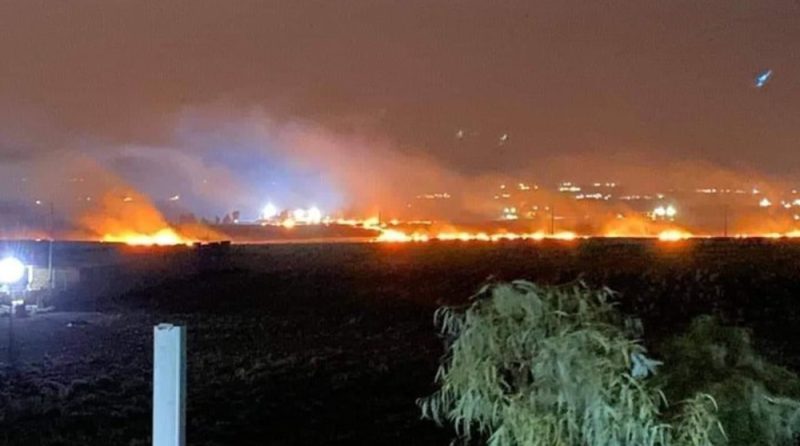
Missile strike on Mossad centers in northern Iraq aimed at defending Iran’s security: Ambassador
Press TV – March 14, 2022
The Iranian ambassador to Iraq says the latest missile strike by the Islamic Revolution Guards Corps (IRGC) on secret bases of the Israeli Mossad spy agency in the semi-autonomous Kurdistan region was strictly necessary, as operations against Iran’s security were being plotted and orchestrated there.
Iraj Masjedi made the remarks while addressing an international conference in Iraq’s holy city of Karbala on Monday.
The Iranian diplomat said Israeli operatives used the Iraqi Kurdistan region to plot and launch operations against Iran’s security, emphasizing that Iranian officials had time and again warned the Kurdistan Regional Government (KRG)’s authorities against their activities, but to no avail.
Masjedi highlighted that the missile attack was carried out in order to safeguard Iran’s security, “and was neither intended to violate Iraq’s sovereignty nor was meant to insult the Arab country and its nation.”
“We expect you to force Israelis out of Iraqi soil and get rid of them,” Masjedi addressed Kurdish officials, adding, “However, if they are not expelled, will we stand by with our hands tied behind us to [allow them] carry out operations against our security? Definitely not.”
The Iranian ambassador emphasized that the attack was aimed at Israel’s training centers and did not target the United States or the Iraqi government.
“Some media outlets have asserted that we targeted the US consulate. I’m surprised by such allegations. It is true that a conflict has been going on between us and the United States for forty years, but the recent operation was not against them. It was an operation against an Israeli base, where plots against our security were being hatched,” Masjedi said.
A dozen ballistic missiles hit secret Mossad bases in the northern Iraqi city of Erbil, reportedly leaving several Israeli operatives dead.
Citing security sources, Iraq’s Sabereen News reported that two Mossad training centers were targeted by ballistic missiles in the early hours of Sunday.
Al-Mayadeen television news network said a Mossad base on the Masif-Saladin Street in Erbil was “fully razed to the ground and a number of Israeli mercenaries were killed or injured.”
In a statement issued earlier on Sunday, the IRGC indicated that the operation was in response to an Israeli airstrike on the Syrian capital of Damascus last Monday, in which two IRGC officers were killed. The IRGC identified the two slain officers as colonels Ehsan Karbalaipour and Morteza Saeidnejad, warning that Israel would “pay for this crime.”
Featured Video
Prof. Ted Postol: Iran Already Achieved Nuclear Deterrence Against Israel
or go to
Aletho News Archives – Video-Images
From the Archives
How the occupied mentality syndrome works
Saudi Arabia on the American chessboard – Part 3
By B. J. Sabri | American Herald Tribune | June 27, 2016
Read part 2: “The occupied mentality Syndrome“
Previously I argued whether Saudi Arabia’s repeated involvements in U.S. interventions and wars stem from free national will or in response to a specific condition. For starters, in Saudi Arabia there is no national will. In Saudi Arabia, the national will is the will of the Al Saud clan. Still, when a major Arab state allies itself with a superpower that committed unspeakable crimes against humanity in almost every Arab country, then something is wrong. This fact alone should compel us to examine the U.S.-Saudi relation for one exceptional reason. As a result of the U.S.-Saudi wars, hundreds of thousands of people in Afghanistan, Iraq, Iran, Libya, Syria, Yemen, and Somalia have lost their lives. Millions became displaced in their own homelands. And millions more rendered refugees.
Attributing the Saudi policies to the bonds of “partnership” with the U.S. is frivolous. There are no bonds between these two thugs except those of business, military deals, secret plots, and wars. Proving this point, bonds such as these have no space for the American and Saudi peoples to share significant cultural or societal exchanges. If partnership is not the reason for the Saudi contribution to the U.S. strategy of empire and imperialism, then another reason must exist.
This leads to three possibilities. … continue
Blog Roll
 Aletho News
- “Davos Can Really Replace the UN”
- NIAID/NIH and USDA Fund Bioengineered Chimeric Influenza Viruses Built Using Pandemic H1N1 Components: Journal ‘Science Advances’
- Hezbollah hits Israeli warship off Lebanon’s coast, sets it aflame
- Iran slams US strikes on B1 bridge, Mahshahr petrochemical plants as ‘blatant acts of state terrorism’
- In letter to UN chief, Araghchi warns of dire consequences of US-Israeli attacks on Iran’s nuclear facilities
- Why the CIA conspiracy to invade Iran with Kurdish militias failed
- Why Are Upbeat US Claims About Mission to Rescue Pilot ‘Highly Questionable’?
- Aircraft destroyed during US ‘rescue’ of downed F-15 pilot cost more than $100 million each
- Washington University removes professor who condemned US-Israeli war on Iran
- Russia Warns of Retaliation as UK Authorizes Seizure of Vessels
- If Americans Knew
- In Iran, Israel-US take aim at “reason, research, and freedom of thought” – Daily Update
- US loses planes over Iran, Israel downgrades Lebanon war goals – Daily Update
- Israel Is Blocking Palestinians from Easter at Church Where Jesus Resurrected
- Plot to assassinate Palestinian activist follows harassment campaign promoted by Zionist groups and elected officials
- Prominent New York synagogue hosts presentation on why U.S. Jews should support the ethnic cleansing of Gaza
- Tapper vs. Piker: Is the CNN Anchor Auditioning for David Ellison?
- Shouldn’t Democrats Be Able to Condemn Genocide?
- Israel-US kill negotiators, destroy civilian structures, but Iran’s military capabilities still largely intact – Daily Update
- ‘War crime’: Global condemnation as Israeli ministers celebrate death penalty law targeting Palestinian prisoners
- 7 Ways Israel Is Turning Lebanon Into Gaza
- No Tricks Zone
- An Inconvenient Tree: Uncovered In Alps… Europe Much Warmer Than Today 6000 Years Ago
- New Study Reports A 60% Slowdown In Greenland’s Ice Loss Rate In The Last Decade
- Low Intensity Tornado Wrecks Major Solar Farm, Creating A Potential Toxic Dump
- New Study Finds Warming Saves Lives…Cold Temperatures 12 Times More Deadly Than Excess Heat
- German Science Blog Accuses PIK Climate Institute Of Hallucinating Climate Tipping Points
- Devastating Assessment Of Comirnaty Vaccine By Former Senior Pfizer Europe Toxicologist
- New Study: CO2 Is ‘Effectively Negligible’ As An Explanatory Climate Change Factor Since 2000
- Former Pfizer Toxicologist Dr. Helmut Sterz Tells Bundestag Hearing Pfizer Vaccine Should Have Never Been Approved
- Energy Expert: Germany’s Nuclear Phaseout Was A “500 Billion Euro Mistake”
- New Research: South Australia’s Mid-Holocene Sea Surface Temperatures Were 4°C Warmer Than Today
 Aletho News