Biden mobilizes US military industry to arm Ukraine
Samizdat | April 13, 2022
US President Joe Biden is looking to mobilize the military industry and send another $750 million worth of the Pentagon’s own weapons stockpile to Ukraine, according to new reports citing anonymous officials in Washington. This is on top of the $1.7 billion worth of goods sent to Kiev courtesy of American taxpayers since the conflict escalated on February 24.
So far the US “lethal” aid has consisted mainly of Javelin anti-tank missiles and Stinger portable anti-air systems.
Now Biden is preparing to escalate the aid to include heavy artillery and other systems, worth three-quarters of a billion or so, Reuters reported on Tuesday citing two US officials. The official announcement could come within a day or two, the agency added.
Biden wouldn’t need congressional authorization for this, either, as it would be done under a Presidential Drawdown Authority (PDA), which authorizes transfer from current US military stocks in response to an emergency.
This would put the amount of US military aid to Kiev at over $2.4 billion since Russia sent troops into Ukraine on February 24, when added to the White House’s own figures made public last week.
The US has sent more than 1,400 Stingers and 5,000 Javelins to Ukraine already, Financial Times (FT) reported on Tuesday citing the Pentagon. This amounts to a third of the US stock of Javelins and a quarter of its Stingers, estimated the Center for Strategic and International Studies (CSIS), a Washington think-tank. At current production rates, it will take 3-4 years to restock on Javelins and at least five for the Stingers.
Production levels will be one of the topics at the meeting between the Pentagon officials and top eight US weapons manufacturers, which both Reuters and FT said is scheduled for Wednesday. Raytheon, Boeing, Lockheed Martin, Northrop Grumman, General Dynamics and L3 Harris Technologies are expected in attendance.
Kiev has reached out to US allies far and wide – from its NATO neighbors all the way to South Korea – asking for airplanes, tanks and artillery in particular. On Saturday, German Defense Minister Christine Lambrecht said that Berlin could not afford to send any more weapons without depleting its own stocks too much. By Monday, however, the Rheinmetall conglomerate said it could refurbish some obsolete Leopard 1 tanks and send them east.
Last week, Slovakia announced it would send its only battery of S-300 air defense systems to Ukraine, and get US-made “Patriots” to replace them. On Monday, the Russian Defense Ministry claimed that the battery had been obliterated in a cruise missile strike against a hangar in Dnepropetrovsk, a city Ukrainians call Dnipro, the day before.
Lawmakers reject amendment to prevent monitoring of unvaccinated
By Christina Maas | Reclaim The Net | April 12, 2022
All Democrats in the House Judiciary Committee voted against an amendment that could have protected the unvaccinated from being tracked.
The Domestic Terrorism Prevention Act of 2021 gives federal agencies like the FBI, DOJ, and DHS the authority to “analyze and monitor” activities of domestic terrorism and “take steps to prevent domestic terrorism.”
The current administration’s program for tackling domestic terrorism includes monitoring the spread of misinformation and conspiracy theories online.
In February, the DHS released a memo that pays attention to those who claim election fraud in 2020’s presidential race and those who spread “misinformation” about COVID-19.
“There is widespread online proliferation of false or misleading narratives regarding unsubstantiated widespread election fraud and COVID-19,” the DHS memo read.
“Grievances associated with these themes inspired violent extremist attacks during 2021.”
“COVID-19 mitigation measures – particularly COVID-19 vaccine and mask mandates – have been used by domestic violent extremists to justify violence since 2020 and could continue to inspire these extremists to target government, healthcare, and academic institutions that they associate with those measures.”
Following the release of the memo, Republican Rep. Andy Biggs proposed an amendment to the act to protect unvaccinated Americans from being tracked.
“None of the funds authorized to be appropriated in this Act shall be used to monitor, analyze, investigate or prosecute any individual solely because that individual declined the administration of a vaccine to COVID-19 or expressed opposition to such administration,” Biggs’ proposed amendment read.
According to a tweet by Republican Rep. Thomas Massie, every Democrat in the House Judiciary Committee voted against the proposed amendment.
“Due to a troubling DHS bulletin, @RepAndyBiggsAZ offered an amendment to prevent the targeting of Americans due to their views on COVID vax,” Massie wrote.
“Every Dem. voted against his amdt!”
Ukrainian opposition leader arrested, Zelensky shares photo of rival in handcuffs
Samizdat | April 12, 2022
Ukrainian President Volodymyr Zelensky expressed his delight on Tuesday after Kiev’s successor to the Soviet-era KGB arrested the country’s most prominent opposition leader.
The President shared a photo of his handcuffed rival Viktor Medvedchuk on social media, with the caption: “A special operation was carried out by the SBU. Well done! Details to follow.”
Medvedchuk heads the second largest party in the national parliament, the “Opposition Platform – For Life.” He was previously placed under house arrest, last year, as part of Zelensky’s clampdown on dissent, which was granted tacit approval by the regime’s Western supporters.
Formed in 1991, to replace the KGB, the SBU is Ukraine’s main intelligence and security agency.
Medvedchuk, who opposed the 2014 Kiev Maidan, and believes the country’s Western turn to be detrimental to Ukraine’s interests, has led his party since 2018. He previously served as Chief of Staff to former President Leonid Kuchma, in the early 2000s.
Some Western commentators have labelled him as Vladimir Putin’s “closest ally in Ukraine.” However, the Russian President has described Medvechuk as a “Ukrainian nationalist.”
In 2019, Opposition Platform – For Life won 13% of the vote in a parliamentary election, making it the country’s largest opposition faction. Last year, polls showed that it had passed Zelensky’s Servant of the People as the most popular party in the state.
That seemed to prompt a crackdown by Zelensky, who closed media outlets associated with Medvedchuk. Soon after, the politician was arrested on politically motivated “treason” charges.
Medvedchuk has rejected accusations of being “pro-Russian,” insisting his party represents millions of ordinary Ukrainians. In February 2021, he accused Zelensky of seeking to establish a dictatorship in Ukraine and suppress the legally elected opposition.
Authorities in Kiev also charged Zelensky’s predecessor Petro Poroshenko with treason, back in December 2021 – on the same charge as Medvedchuk: illegally buying coal from the breakaway regions of Donetsk and Lugansk and thus “financing terrorism.” Poroshenko made a big deal out of publicly returning to Ukraine in January, and a Kiev court refused to jail him.
Unlike Medvedchuk, Poroshenko has substantial support in the West.
The US and its allies have sought to justify their support for Ukraine by saying Zelensky is a democrat fighting for freedom, and have presented Russia’s actions towards Kiev as motivated by a fear of democracy.
Moscow sent troops into Ukraine on February 24, following a seven-year standoff over Kiev’s failure to implement the terms of the Minsk agreements and end the conflict with the breakaway regions of Donetsk and Lugansk. Russia ended up recognizing the two as independent states, at which point they asked for military aid.
Russia demands that Ukraine officially declare itself a neutral country that will never join the US-led NATO military bloc. Kiev insists the Russian offensive was completely unprovoked and has denied claims it was planning to retake the two Donbass republics by force.
Palestine’s widening geography of resistance: Why Israel cannot defeat the Palestinians
By Ramzy Baroud | MEMO | April 12, 2022
There is a reason why Israel is insistent on linking the series of attacks carried out by Palestinians recently to a specific location, namely the Jenin refugee camp in the northern West Bank. By doing so, the embattled Naftali Bennett’s government can simply order another deadly military operation in Jenin to reassure its citizens that the situation is under control.
Indeed, on 9 April, the Israeli army had stormed the Jenin refugee camp, killing a Palestinian and wounding ten others. However, Israel’s problem is much bigger than Jenin.
If we examine the events starting with the 22 March stabbing attack in the southern city of Beersheba (Bir Al Saba’) – which resulted in the death of four – and ending with the killing of three Israelis in Tel Aviv – including two army officers – we will reach an obvious conclusion: these attacks must have been, to some extent, coordinated.
Spontaneous Palestinian retaliation to the violence of the Israeli occupation rarely follows this pattern in terms of timing or style. All the attacks, with the exception of Beersheba, were carried out using firearms. The shooters, as indicated by the amateur videos of some of the events and statements by Israeli eyewitnesses, were well-trained and were acting with great composure.
An example was the 27 March Hadera event, carried out by two cousins, Ayman and Ibrahim Ighbariah, from the Arab town of Umm Al-Fahm, inside Israel. Israeli media reported of the unmistakable skills of the attackers, armed with weapons that, according to the Israeli news agency, Tazpit Press Service, cost more than $30,000.
Unlike Palestinian attacks carried out during the Second Palestinian Intifada (2000-05) in response to Israeli violence in the occupied territories, the latest attacks are generally more pinpointed, seek police and military personnel and clearly aimed at shaking Israel’s false sense of security and undermining the country’s intelligence services. In the Bnei Brak attack, on 29 March, for example, an Israeli woman who was at the scene told reporters that “the militant asked us to move away from the place because he did not want to target women or children.”
While Israeli intelligence reports have recently warned of a “wave of terrorism” ahead of the holy month of Ramadan, they clearly had little conception of what type of violence, or where and how Palestinians would strike.
Following the Beersheba attack, Israeli officials referred to Daesh’s responsibility, a convenient claim considering that Daesh had also claimed responsibility. This theory was quickly marginalised, as it became obvious that the other Palestinian attackers had other political affiliations or, as in the Bnei Brak case, no known affiliation at all.
The confusion and misinformation continued for days. Shortly after the Tel Aviv attack, Israeli media, citing official sources, spoke of two attackers, alleging that one was trapped in a nearby building. This was untrue as there was only one attacker and he was killed, though hours later in a different city.
A number of Palestinian workers were quickly rounded up in Tel Aviv on suspicion of being the attackers simply because they looked Arab, evidence of the chaotic Israeli approach. Indeed, following each event, total mayhem ensued, with large mobs of armed Israelis taking to the streets looking for anyone with Arab features to apprehend or to beat senseless.
Israeli officials contributed to the frenzy, with far-right politicians, such as the extremist, Itamar Ben Gvir, leading hordes of other extremists in rampages in occupied Jerusalem.
Instead of urging calm and displaying confidence, the country’s own Prime Minister called, on 30 March, on ordinary Israelis to arm themselves. “Whoever has a gun license, this is the time to carry it,” he said in a video statement. However, if Israel’s solution to any form of Palestinian resistance was more guns, Palestinians would have been pacified long ago.
To placate angry Israelis, the Israeli military raided the city and refugee camp of Jenin on many occasions, each time leaving several dead and wounded Palestinians behind, including many civilians. They include the child, Imad Hashash, 15, killed on 24 August while filming the invasion on his mobile phone. The exact same scenario played out on 9 April.
However, it was an exercise in futility, as it was Israeli violence in Jenin throughout the years that led to the armed resistance that continues to emanate from the camp. Palestinians, whether in Jenin or elsewhere, fight back because they are denied basic human rights, have no political horizon, live in extreme poverty, have no true leadership and feel abandoned by the so-called international community.
The Palestinian Authority of Mahmoud Abbas seems to be entirely removed from the masses. Statements by Abbas reflect his detachment from the reality of Israeli violence, military occupation and apartheid throughout Palestine. True to form, Abbas quickly condemned the Tel Aviv attack, as he did the previous ones, making the same reference every time regarding the need to maintain “stability” and to prevent “further deterioration of the situation”, according to the official Wafa news agency.
What stability is Abbas referring to, when Palestinian suffering has been compounded by growing settler violence, illegal settlement expansion, land theft, and, thanks to recent international events, food insecurity as well?
Israeli officials and media are, once again, conveniently placing the blame largely on Jenin, a tiny stretch of an overpopulated area. By doing so, Israel wants to give the impression that the new phenomenon of Palestinian retaliatory attacks is confined to a single place, one that is adjacent to the Israeli border and can be easily ‘dealt with’.
An Israeli military operation in the camp may serve Bennett’s political agenda, convey a sense of strength, and win back some in his disenchanted political constituency. But it is all a temporary fix. Attacking Jenin now will make no difference in the long run. After all, the camp rose from the ashes of its near-total destruction by the Israeli military in April 2002.
The renewed Palestinian attacks speak of a much wider geography: Naqab, Umm Al Fahm, the West Bank. The seeds of this territorial connectivity are linked to the Israeli war of last May and the subsequent Palestinian rebellion, which erupted in every part of Palestine, including Palestinian communities inside Israel.
Israel’s problem is its insistence on providing short-term military solutions to a long-term problem, itself resulting from these very ‘military solutions’. If Israel continues to subjugate the Palestinian people under the current system of military occupation and deepening apartheid, Palestinians will surely continue to respond until their oppressive reality is changed. No amount of Israeli violence can alter this truth.
Enemies Seeking to Sow Discord between Iran Afghanistan: Iranian Minister
Al-Manar – April 12, 2022
Iranian Interior Minister Ahmad Vahidi stated that the recent attacks against diplomatic missions in in Herat and Kabul have aimed at sowing discord between Iran and Afghanistan.
Vahidi described the recent events as the enemies’ plan seeking to make a schism between Iran and Afghanistan, saying that the “Iranians have always been a good host for Afghan refugees, and the actions of some people in Herat and Kabul have aimed at sowing discord between the two nations,” Vahidi said as quoted by Mehr news agency.
The attacks are part of enemies’ plan seeking to make a schism between Iran and Afghanistan, he added.
The Iranian minister also called on Afghan officials to be vigilant and take care of such issues.
In recent weeks, unverified videos purporting to show Afghan refugees being mistreated in Iran have been published on social media, angering many Afghans.
On Monday, crowds of Afghan people gathered in front of Iran’s embassy in Kabul and its consulate general in Herat, throwing stones at the buildings and damaging the security cameras.
Searching for War Criminals
They are nearer than you think

BY PHILIP GIRALDI • UNZ REVIEW • APRIL 12, 2022
The United States is now insisting that Russian President Vladimir Putin should be put on trial for “war crimes” committed in Ukraine. As Putin is still insisting that he will attend the upcoming G20 summit in November on the island of Bali, Indonesia, it will be a great opportunity to have US Marshalls snatch him from the stage and whisk him off to a federal courthouse in Virginia for justice to be served. Or a form of justice anyway, since the United States has no actual jurisdiction over where Putin’s alleged crimes might have taken place and it will be impossible to prove that he actually ordered anyone to carry out so-called “crimes against humanity.” We’ll see how it all works out.
Indeed, there is no other phrase that has been more misunderstood and generally abused of late than “war crimes” or “war criminals.” It belongs with several other labels, including “weapons of mass destruction” and “crimes against humanity” that are used to indicate an adversary has crossed a red line and is so deplorable that anything that is done to him either during actual fighting or in the aftermath is completely acceptable. Going back to Greek and Roman times it has always been understood that even in wartime there are certain activities that are unacceptable, but the attempted definition and codification of “war crimes” as a concept is largely a twentieth century creation used to inflict additional punishment on the losers after the fighting is over. The Treaty of Versailles that ended the First World War punished Germany far beyond what most would consider reasonable, largely because the victorious powers were able to do so without any consequences until the next war began. Likewise, the linked concepts of war crimes and crimes against humanity came largely out of the post-Second World War Nuremberg Trials, which shaped the legal arguments around alleged German behavior, not that of the allies.
The Second World War certainly included atrocities of various kinds on both sides, but the Anglo-American deliberate bombing of German cities has to stand out as particularly disproportionate. Forty-two thousand mostly civilians died in Hamburg in the 1943 firebombing and the bombing of Dresden in 1945, at a point when Germany was on the verge of defeat, was remarkable in that the city was not a military target and was full of refugees from the east. At least 200,000 civilians died. Judge Andrew Napolitano has suggested that the greatest war crime in history, if one makes a case based on unnecessary human suffering, was President Harry Truman’s nuclear bombing of Hiroshima and Nagasaki, which almost certainly killed more than 200,000 mostly civilians, when Japan was preparing to surrender. As Truman was on the side that won the war and controlled the prosecution process, there were no legal consequences or punishment relating to his decision, though critics since 1945 have sometimes decried the first use of nuclear weapons.
If killing civilians unnecessarily is the standard definition of a war crime, then America’s most recent five presidents have been war criminals. In other words, historically speaking, accusations of war crimes, which have no real meaning in law and are both infinitely elastic and subject to interpretation, have often depended on which side of the fence one is standing on when the war ends. And it gets more complicated than that, given the politics of what is sometimes referred to as the rules based international order, which in theory arose from the ashes of World War Two. The new world order was US-centric from the start, with the United Nations (UN) situated in New York City, the World Bank in Washington, and the dollar as the world’s reserve currency. At the UN, American primacy was reinforced through the creation of a Security Council, which alone has the power to authorize military action against a rogue state. The Security Council had five permanent members, each of whom was armed with a veto, meaning that no effective action against them could ever take place no matter what they had done. And so it has played out, with the US plus China, Russia, Britain and France being effectively immune from censure authorizing military action by the United Nations.
It is of particular interest to observe that the International Criminal Court (ICC) in the Hague was set up to deal with “war crimes and crimes against humanity” that were otherwise ignored. Neither the US, nor the Russians nor the Israelis recognize the authority of the court and the US has stated that no ICC investigator will be allowed entry into the United States. Given that, it becomes possible to witness how the whole farce of war crimes and other violations of the new world order have played out in practice.
Currently the US and its allies are waging economic warfare on Russia without an actual declaration of war, to include an avalanche of sanctions plus completely illegal confiscations of the property of Russian citizens. It is also blocking Moscow from the use of the international monetary conventions and systems that it has had access to. The clearly stated intention is to destroy the Russian economy due to Russia having been charged by the US government with the commission of what it is calling war crimes in its invasion of Ukraine. Vladimir Putin argues in turn that Ukraine’s apparent intention to join NATO, which is a hostile military alliance directed against Russia, is a direct threat to his country and is already manifesting itself in military action undertaken against breakaway parts of Ukraine which are largely inhabited by Russian speakers and ethnics.
There are other issues, but those are the most important. It should also be noted that the issues themselves were at least somewhat negotiable prior to the outbreak of fighting, which Putin sought to do but Joe Biden and NATO were not interested. So ultimately the war, from a third-party point of view, is pitting a Russian vital interest against what really amounts to no genuine interest at all for NATO and the US, apart from goading the Russian bear and removing its government as a way to prevent against any change in the international order.
Since objective reality has no place in United States foreign policy, it is interesting to look at how the US sees itself and how it regards other countries that are doing what Russia is doing or worse. When it comes to its own self-perception, America’s so-called leaders believe that their global leadership role is one by right and they can do no wrong by virtue of a quality referred to as “American exceptionalism.” That is of course a mythical attribute created to permit the United States to get away with mass murder and regime change without any consequences.
A principal beneficiary of American financial and political largesse is, of course, Israel, which consists not only of people “chosen” by Yahweh but also by the media, the United States Senate, House of Representatives and the White House. A comparison of what Russia is doing that is being condemned by Washington versus what both what the US and Israel have been able to get away with might be considered to be in order.
Russia has invaded Ukraine after months of warnings that the status quo was untenable in national security terms, largely due to intentionally fruitless negotiations with stonewalling United States representatives and NATO. Israel, widely acknowledged to be an apartheid state, is currently bombing Syria on an almost daily basis, unnoticed by the US media and the Biden Administration. It in the past has attacked all its neighbors, including the renowned Seven Days War in June 1967 which was a surprise attack staged against Egypt, Syria and Jordan. Subsequent to that war, Israel occupied nearly all of what had been Palestine. It also seized the Golan Heights belonging to Syria and has recently received consent from Washington to illegally annex Arab East Jerusalem as a part of Israel, making the whole of the city Israel’s capital. The Golan Heights have also recently been annexed with Washington’s approval and there are 700,000 heavily armed and violent Jewish settlers now sitting in 261 settlements on stolen Palestinian land on the West Bank.
And what has the United States and its allies done to dissuade Israel? Well, nothing. One rule for Israel and the US and another quite different Washington dictated “rules based” system for everyone else, most particularly if one is Russian. In fact, the more belligerently Israel behaves, the more it gets in terms of US taxpayer money and made-in-USA weapons. Israel has also been the favored destination for traveling congress-critters of late because it is an election year and Jewish donors are being hotly pursued. Recently, a large group of Democrats was departing just before former Vice President Mike Pence arrived in Tel Aviv on Miriam Adelson’s private jet so he could kiss Prime Minister Naftali Bennett’s ring and also spend some quality time with Benjamin Netanyahu.
Ironically, while Joe Biden was turning the screws on Russia, the Congress was showering gifts on Israel above and beyond the billions of dollars in “aid” that the wealthy Jewish state already receives. Alison Weir of IfAmericansKnew has examined the recently signed pork laden 2022 federal government spending bill and has identified numerous line-item instances of money going directly to Israel or in support of causes that benefit Israel in some fashion. She estimates that Israel’s economy, which is able to support both free medical care and higher education, now benefits to the tune of $22 million per day from the United States taxpayer, for a total of $8 billion per year, and the number might actually be much higher. And there are other sources of income indirectly funded by the US Treasury, most notably the ability of Israel-focused charities to contribute tax exempt money to Israeli foundations and groups. Many of the “charities” are essentially fraudulent, funding the illegal settlements, domestic terrorism and other anti-Palestinian activities. Every artifice is used by some Jewish groups and billionaire donors to keep the US dollars flowing to Israel while no one of any significance in the federal government complains about the double standard when one compares Israel to Russia. And the Zionist controlled media are completely silent.
The hypocrisy that pervades United States foreign policy is difficult to ignore, but Washington has successfully manipulated its financial instruments to keep its remaining friends and allies in line. Whether that will survive the inevitable pushback coming from Russia, China and a number of non-aligned nations remains to be seen. At a minimum, the Cold War alignment that was broken in 1991 and which seems to again be taking shape around the Ukraine issue appears to have exceeded its expiry date. Ukraine might indeed wind up doing severe damage to the Russian economy, but it seems plausible that it will also bring with it the long overdue demise of American hegemonistic fantasies and NATO.
Philip M. Giraldi, Ph.D., is Executive Director of the Council for the National Interest, a 501(c)3 tax deductible educational foundation (Federal ID Number #52-1739023) that seeks a more interests-based U.S. foreign policy in the Middle East. Website is councilforthenationalinterest.org, address is P.O. Box 2157, Purcellville VA 20134 and its email is inform@cnionline.org.
Pentagon warns India of China threat
Samizdat | April 12, 2022
US Secretary of Defense Lloyd Austin hosted his Indian counterpart, Rajnath Singh, on Monday, calling for closer military ties between the countries and warning of security threats posed by China and Russia.
“We’re meeting at a critical moment in the US-India defense partnership,” Austin told Singh as Monday’s talks began. He added that Washington and New Delhi both believe in a “free and open Indo-Pacific” underpinned by respect for national sovereignty and the rule of law, but “we’re facing urgent and mounting challenges to this shared vision.”
Beijing is undermining security in the region by building “dual-use infrastructure” along its border with India and making unlawful territorial claims in the South China Sea, Austin said. “The United States stands with India in defending their sovereign interests,” he pledged.
Austin argued that like China, Russia is trying to “change the status quo by force,” adding, “Russia’s invasion of Ukraine and the humanitarian devastation that it has created are blatant attempts to undermine the international order that is grounded in the rules and the principles that we share.”
The US defense chief said that as the world’s largest democracy, India is “central to this rules-based order,” and he called for collaboration with “like-minded partners.” Those ties may include co-development of weapons.
Austin and Singh followed their talks by holding a so-called 2+2 meeting with US Secretary of State Anthony Blinken and Indian Minister of External Affairs Subrahmanyam Jaishankar. “This is a momentous moment in global affairs, and I think as a result, this partnership is even more consequential and more vital,” Blinken said.
However, the partnership has been strained in recent weeks amid efforts by the US and its Western allies to punish and isolate Russia over the Ukraine conflict. Late last month, a top US national security official warned India that there will be “consequences” for countries that try to “circumvent” Washington’s sanctions campaign against Moscow.
“We are keen for all countries, especially our allies and partners, not to create mechanisms that prop up the ruble and that attempt to undermine the dollar-based financial system,” deputy national security advisor Daleep Singh told reporters during his visit to New Delhi on March 31.
President Joe Biden’s top economic advisor, Brian Deese, reiterated those concerns last week, saying Washington had warned India that it would face significant and long-term costs if it aligned strategically with Russia. “There are certainly areas where we have been disappointed by both China and India’s decisions, in the context of the invasion,” he said.
India has declined to impose sanctions against Russia and has ramped up purchases of Russian oil. Indian and Russian officials also have discussed a ruble-rupee payment mechanism for trade between the countries, bypassing the dollar and the euro.
Another source of tension between Washington and New Delhi is India’s historic reliance on Russian-made weapons. India has ordered five S-400 anti-aircraft systems from Russia – in defiance of a warning from the US against the $5.5 billion deal – and it reportedly has an option to purchase more of the surface-to-air missiles.
Austin told US lawmakers last week that it’s not in India’s best interests to continue buying Russian weaponry, and the Pentagon is working with New Delhi to reduce its reliance on Moscow.
NATO Sanctions and the Coming Global Diesel Fuel Disaster
By F. William Engdahl – New Eastern Outlook – 11.04.2022
Amid the ongoing global inflation crisis, NATO heads of state and mainstream media repeat a mantra that high energy prices are a direct result of Putin’s actions in Ukraine since end of February. The reality is that it is the western sanctions that are responsible. Those sanctions including cutting SWIFT interbank access for key Russian banks and some of the most severe sanctions ever imposed, are hardly having an impact on the military actions in Ukraine. What many overlook is the fact that they are increasingly impacting the economies of the West, especially the EU and USA. A closer look at the state of the global supply of diesel fuel is alarming. But Western sanctions planners at the US Treasury and the EU know fully well what they are doing. And it bodes ill for the world economy.
While most of us rarely think about diesel fuel as anything other than a pollutant, in fact it is essential to the entire world economy in a way few energy sources are. The director general of Fuels Europe, part of the European Petroleum Refiners Association, stated recently, “… there is a clear link between diesel and GDP, because almost everything that goes into and out of a factory goes using diesel.”
At the end of the first week of Russia’s military action in Ukraine, with no sanctions yet specific to Russia’s diesel fuel exports, the European diesel price was already at a thirty-year high. It had nothing to do with war. It had to do with the draconian global covid lockdowns since March 2020 and the simultaneous dis-investment by Wall Street and global financial firms in oil and gas companies, so-called Green Agenda or ESG. Almost on day one of Russian troop actions in Ukraine, two of the world’s largest oil companies, BP and Shell, both British, stopped deliveries of diesel fuel to Germany claiming fear of supply shortages. Russia supplied some 60 to 70% of all EU diesel before the Ukraine war.
In 2020 Russia was the world’s second largest exporter of diesel fuel behind USA, shipping more than 1 million barrels daily. Most of it, some 70%, went to the EU and Turkey. France was the largest importer, followed by Germany and UK. In France some 76% of all road vehicles—cars, trucks—use diesel. The EU diesel demand is far higher than in the US as most cars also use the more economical and efficient diesel fuel. In the first week of April the EU Commission President Ursula von der Leyen proudly announced new sanctions against Russian energy that would begin with a ban on coal. The EU is the largest importer of Russian coal. Oil and gas she said would follow at a later date. That foolish move will merely boost costs of energy, already at record highs, for most of the EU, as it will force oil and gas prices far higher.
At the beginning of the Ukraine crisis global stocks of diesel fuel were already the lowest since 2008 as the covid lockdowns had done major damage to the demand-supply situation of oil and gas production. Now the stage is set for an unprecedented crisis in diesel. The consequences will be staggering for the world economy.
Diesel Moves World Trade
Diesel engines have the highest engine efficiency of conventional motors. They are based on the principle of compression developed in 1897 by Rudolf Diesel. Because of their greater efficiency and greater mileage per gallon, diesel fuels almost all freight truck motors. It fuels most all farm equipment from tractors to harvesting machines. It is widely used in the EU, almost 50% for auto fuel as it is far more fuel efficient than gasoline engines. It is used in most all heavy mining machines such as Caterpillar earth movers. It is used in construction equipment. Diesel engines have replaced steam engines on all non-electrified railroads in the world, especially freight trains. Diesel is used in some electric power generation and in most all heavy military vehicles.
A global shortage in diesel fuel, temporary or longer-term, is therefore a catastrophic event. Goods cannot be moved from container ports to inland destinations. Without diesel fuel trucks cannot deliver food to the supermarket, or anything else for that matter. The entire supply chain is frozen. And there is no possibility to substitute gasoline in a diesel engine without ruining the engine.
Until the ill-conceived global covid lockdowns of industry and transportation that began in March 2020, the demand and supply of diesel fuel was well balanced. The sudden lockdowns however collapsed diesel demand for truck transport, autos, construction, even farming. Unprofitable refineries were closed. Capacity declined. Now as world production returns to a semblance of pre-covid normal, diesel reserve stocks worldwide are dangerously low, especially in the EU which is the world’s largest diesel consumer, but also the USA.
Rationing?
At the start of this year world diesel stocks were already dangerously low and that drove prices sky-high. As of February, 2022 before impact of the Ukraine war, diesel and related stocks in the US were 21% below the pre-covid seasonal average. In the EU stocks were 8% or 35 million barrels below the pre-covid average level. In Singapore, the Asian hub stocks were 32% below normal. Combined all three regions’ diesel stocks were alarmingly low, some 110 million barrels below the same point last year.
Between January 2021 and January 2022 EU diesel fuel prices had almost doubled, and that, before the Ukraine sanctions. There were several reasons, but primary was the soaring price of crude oil and supply disruptions owing to global covid lockdowns and the subsequent resumption of world trade flows. To add to the problem, in early March the Chinese central government imposed a ban on its exports of diesel fuel, to “ensure energy security” amid Western sanctions on Russia. Add to that the recent Biden administration ban on imports of all Russian oil and gas, which in 2021 included an estimated 20% of all Russian heavy oil exports. At the same time the EU in its ever-ideological wisdom, is finalizing a ban on imports of Russian coal with bans on Russian crude oil, diesel fuel and gas reportedly to follow.
On April 4 average price per liter of diesel in Germany was €2.10. On December 27, 2021 it was €1.50, a rise of 40% in weeks. Following the unprecedented USA and EU sanctions against Russia following the Ukraine military campaign after February 24, more and more Western oil companies and oil traders are refusing to handle Russian crude oil or diesel fuel for fear of reprisals. This is certain to escalate so long as fighting in Ukraine continues.
The CEO of the Rotterdam-based Vitol, the world’s largest independent energy trading company, warned on March 27 that rationing of diesel fuel in the coming months globally was increasingly likely. He noted, “Europe imports about half of its diesel from Russia and about half of its diesel from the Middle East. That systemic shortfall of diesel is there.”
On April 7, David McWilliams, a leading Irish economist formerly with the Irish national bank, sounded an alarming note. “Not only is oil going up, diesel is going up and there’s a real threat diesel will run out in Western Europe over the course of the next two or three weeks, or maybe before that… We import a significant amount of our diesel, it comes from two refineries in the UK where it’s first processed. Those refineries do not have any crude at the moment. So we are basically running the economy on a day-to-day, hour-to-hour basis.” He added: ‘We have not just an oil crisis, we have an energy crisis the likes of which we haven’t seen in 50 years.” According to him the reason diesel stocks are so low is that the EU countries found it far cheaper to outsource oil and diesel to Russia with its huge supply.
The situation in the USA is not better. For political reasons the true state of the diesel fuel crisis is reportedly being downplayed by the Biden administration and the EU. Inflation is already at 40 year highs in the US. What the unfolding global diesel fuel crisis will mean, barring a major turnaround, is a dramatic impact on all forms of truck and auto transportation, farming, mining and the like. It will spell catastrophe for an already failing world economy. Yet governments like the German “Ampel” (traffic light) coalition, with their insane Zero Carbon agenda, and their plans to phase out oil, coal and gas, or the Biden cabal, privately see the exploding energy prices as further argument to abandon hydrocarbons like oil for unreliable, costly wind and solar. The real industrial interconnected global economy is not like a game of lego toys. It is highly complex and finely tuned.That fine tuning is being systematically destroyed, and all evidence is that it is deliberate. Welcome to the Davos Great Reset eugenics agenda.
UK censorship bill will impact small, independent media outlets while giving large media outlets a pass
By Tom Parker | Reclaim The Net | April 11, 2022
The UK government is currently pushing a sweeping online censorship bill, the Online Safety Bill, which will force tech giants to censor content based on the vague, subjective term “harm.”
One of the government’s main arguments when attempting to defend these controversial censorship requirements has been that “news content will be completely exempt from any regulation under the Bill.” However, the rules that govern these exemptions are written in a way that favors large media outlets and makes it difficult for small, independent outlets to qualify.
For starters, the state-funded media outlets the BBC and Sianel Pedwar Cymru (S4C) automatically qualify as “recognised news publishers” – the standard that determines whether a publisher is exempt from the bill’s regulations.
Other outlets need to either hold a license under the Broadcasting Act 1990 or 1996 or meet numerous conditions which include “publishing news-related material that is created by different persons,” having a registered office or business address in the UK, making the name and address of the outlet’s owner public, being subject to a standards code and editorial control, and having a complaints procedure.
Obtaining a license under the Broadcasting Act 1990 or 1996 creates additional costs for small outlets, such as the £2,500 ($3,300) license application fee and the minimum annual license fee of £1,000, ($1,320). It also gives Ofcom the power to decide which outlets can get a license.
The provision for news-related materials from non-license holders to be created by “different persons” also prevents individual journalists from qualifying as recognized news publishers. Furthermore, the requirement for non-license holders to make their name and address public shuts out anonymous or pseudonymous publishers from these recognized news publisher exemptions.
Additionally, these non-license holder conditions create additional compliance burdens which disproportionately impact smaller news outlets with fewer staff and resources.
The disproportionate impact this censorship bill has on small, independent media outlets is just one of the many areas of concern. The bill also includes proposals that will jail people whose posts cause “psychological harm” with “no reasonable excuse,” tasks Big Tech with deciding when something is “illegal” or “fraudulent,” and more.
…..
You can get a full overview of all the free speech and privacy threats posed by the Online Safety Bill here.
You can see a full copy of the full Online Safety Bill here.
The bill is currently making its way through Parliament and you can track its progress here.
Twitter is questioned over Hunter Biden laptop story censorship
By Christina Maas | Reclaim The Net | April 11, 2022
In October 2020, just before the election, the New York Post published a story about Hunter Biden’s potentially corrupt dealings when his father, Joe Biden, was vice president. The story was based on damning emails obtained from a laptop Hunter left at a repair shop in Delaware.
Twitter censored the story over the “origins of the material” and suspended the New York Post’s account for two weeks. The online platforms also prevented users from sharing the story.
A few weeks ago, The New York Times confirmed the authenticity of what the New York Post called the “laptop from hell.”
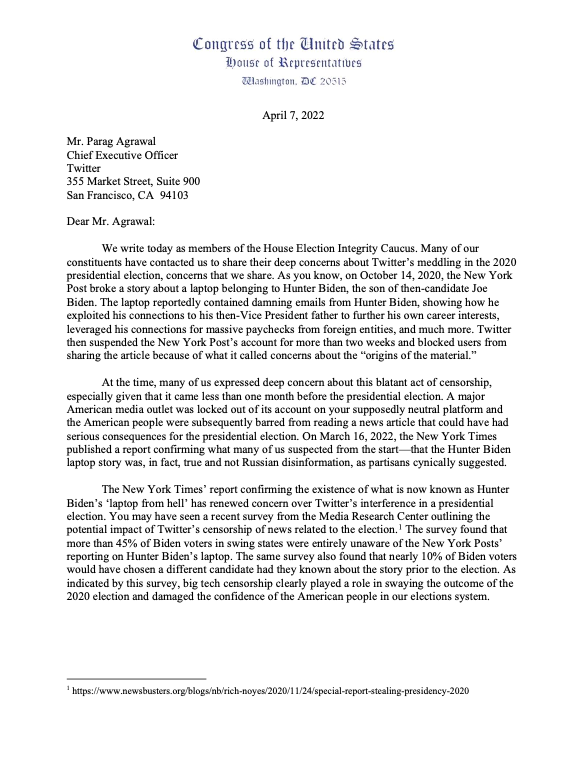
Now, Republican members of the House Election Integrity Caucus, led by Rep. Claudia Tenney, in a letter addressed to Twitter CEO Parag Agrawal, are asking for answers about the censorship of the story.
“Big Tech oligarchs have grown far too powerful, censoring free speech that challenges their preferred narrative and their handpicked politicians,” Tenney told FOX Business. “In 2020, this reached a new low.”
“Twitter’s actions to silence the New York Post and others undoubtedly swayed the outcome of the presidential election. The free flow of information is key to a healthy democracy and to free and fair elections. Congress must be unequivocal in its response and hold Big Tech accountable.”
The Republicans want Twitter to “provide answers to the American people.” They also want Congress to “break up big tech, take an axe to Section 230, and ensure Silicon Valley elites can no longer interfere in our elections.”
They argue that the laptop contained damning emails that could have worked in President Trump’s favor.
“The laptop reportedly contained damning emails from Hunter Biden, showing how he exploited his connections to his then-vice president father to further his own career interests, leveraged his connections for massive paychecks from foreign entities, and much more,” the lawmakers wrote.
“Twitter then suspended the New York Post’s account for more than two weeks and blocked users from sharing the article because of what it called concerns about the ‘origins of the material.”
They added that the suspension prevented people from “reading a news article that could have had serious consequences for the presidential election.”
The New York Times confirming the authenticity of the laptop has “renewed concern over Twitter’s interference in a presidential election,” according to the lawmakers.
In the letter, the legislators demand answers to several questions from Agrawal, including who “made the decision to censor the New York Post’s story on Hunter Biden’s ‘laptop from hell.’” They also want to know if Twitter collaborated “with any individuals directly or indirectly involved with the Biden campaign” when it censored the story.
Featured Video

Chinese jet fuel and the myth of energy independence
or go to
Aletho News Archives – Video-Images
Book Review
Former Insiders Criticize Iran Policy as U.S. Hegemony
By GARETH PORTER | CounterPunch | February 27, 2013
“Going to Tehran” arguably represents the most important work on the subject of U.S.-Iran relations to be published thus far.
Flynt Leverett and Hillary Mann Leverett tackle not only U.S. policy toward Iran but the broader context of Middle East policy with a systematic analytical perspective informed by personal experience, as well as very extensive documentation.
More importantly, however, their exposé required a degree of courage that may be unparalleled in the writing of former U.S. national security officials about issues on which they worked. They have chosen not just to criticise U.S. policy toward Iran but to analyse that policy as a problem of U.S. hegemony. … continue
Blog Roll
 Aletho News
- What is fueling unrest across the EU?
- Why no power can undermine Iran’s eternal dominance over the Strait of Hormuz
- Is The War Against Iran Over?
- Iran war will leave long-term ‘scar’ on Wall Street, investors warn
- How Iran decimated US power projection in West Asia: Military lessons of 40-day war
- Iran’s report details US-Israeli war crimes in targeting schools, hospitals, livelihoods
- NATO’s Slow Fracture: How Trump’s Iran War Exposed the Instrument of Hegemony
- Chinese jet fuel and the myth of energy independence
- Ukraine Sea Drone Fired From Libya Hit Russian Tanker in Mediterranean
- IRGC: Iranian forces launched no attacks during ceasefire hours
- If Americans Knew
- Military aid to Israel emerges as the latest political litmus test for Democrats
- The only Palestinian children’s rights organization closes following years-long Israeli campaign against it
- ‘I Can’t Forget the Smell’: Lebanese Reel After Israel Kills Over 300 in Single Day
- DNC Shoots Down Resolutions Calling Out AIPAC and Limiting Arms to Israel
- TCN: Is Israel Blackmailing President Trump?
- Israel killed at least 303 Lebanese yesterday – who were they? Daily Update
- Amnesty: Urgent – Protect Lebanese civilians from brutal escalation in Israeli attacks
- Is The War Against Iran Over?
- Inside the Israeli army’s propaganda wing
- Hundreds of Gaza Amputees Stranded in Legal Limbo
- No Tricks Zone
- An Inconvenient Tree: Uncovered In Alps… Europe Much Warmer Than Today 6000 Years Ago
- New Study Reports A 60% Slowdown In Greenland’s Ice Loss Rate In The Last Decade
- Low Intensity Tornado Wrecks Major Solar Farm, Creating A Potential Toxic Dump
- New Study Finds Warming Saves Lives…Cold Temperatures 12 Times More Deadly Than Excess Heat
- German Science Blog Accuses PIK Climate Institute Of Hallucinating Climate Tipping Points
- Devastating Assessment Of Comirnaty Vaccine By Former Senior Pfizer Europe Toxicologist
- New Study: CO2 Is ‘Effectively Negligible’ As An Explanatory Climate Change Factor Since 2000
- Former Pfizer Toxicologist Dr. Helmut Sterz Tells Bundestag Hearing Pfizer Vaccine Should Have Never Been Approved
- Energy Expert: Germany’s Nuclear Phaseout Was A “500 Billion Euro Mistake”
- New Research: South Australia’s Mid-Holocene Sea Surface Temperatures Were 4°C Warmer Than Today
 Aletho News