Moscow says when ‘frozen’ dialogue with US may be resumed
Samizdat | April 30, 2022
The dialogue on strategic stability between Russia and the US may only resume after all the goals of Moscow’s military operation in Ukraine are achieved, a high-ranking Russian diplomat has said.
“As of today, there’s no use talking about any prospects for negotiations on strategic stability with the US,” Vladimir Yermakov, who heads the Department for Non-Proliferation and Arms Control at Russia’s Foreign Ministry, pointed out on Saturday.
“This dialogue is formally ‘frozen’ by the American side,” he said, adding that Washington’s moves concerning the matter “are being pointed in the complete opposite direction” than those of Moscow.
The sides will likely be able to return to “a substantive conversation about the prospects of resuming a full-fledged Russian-American negotiation process on the strategic agenda only after the implementation of all the tasks of the special military operation in Ukraine,” Yermakov added.
The US actively supports Ukraine in the conflict with Russia, providing Kiev with funds and weapons to continue fighting.
Washington has committed $4.3 billion to Kiev’s military since 2021, Pentagon spokesperson John Kirby said on Friday, also revealing that the US has begun training Ukrainian troops in Germany and elsewhere in Europe.
Earlier this week, US Defense Secretary Lloyd Austin openly acknowledged that, by helping Ukraine, Washinton was trying to see “Russia weakened to the degree that it can’t do the kinds of things that it has done in invading Ukraine.”
Moscow and Washington last discussed strategic stability in Europe, which includes nuclear nonproliferation, during talks in Geneva in mid-January, just over a month before the breakout of the Ukrainian conflict.
According to sources, the Russian delegation “’spoon-fed’ its proposals for a stable continent” to the Americans to avoid any misunderstandings, with the key point being curbing NATO’s eastward expansion. However, the negotiations brought no results.
Russia sent troops into Ukraine on February 24, following Kiev’s failure to implement the terms of the Minsk agreements, first signed in 2014, and Moscow’s eventual recognition of the Donbass republics of Donetsk and Lugansk. The German- and French-brokered Minsk Protocol was designed to give the breakaway regions special status within the Ukrainian state.
The Kremlin has since demanded that Ukraine officially declare itself a neutral country that will never join NATO. Kiev insists the Russian offensive was completely unprovoked and has denied claims it was planning to retake the two republics by force.
The Aggressors Accuse Russia of ‘Blackmail’ for Defending its Currency, Energy Wealth, and Even Its Existential Security
Strategic Culture Foundation | April 29, 2022
The United States and its NATO and European Union allies have imposed unprecedented economic sanctions on Russia that amount to economic warfare. This warfare has been going on, discernibly, since the CIA-backed coup in Ukraine in 2014 on the back of allegations of Russian wrongdoing, for example, the alleged annexation of Crimea. It’s the logic of a poacher posing as the gamekeeper.
For eight years, the U.S.-led economic war against Russia has been pursued without relent. The self-professed “exceptional nation” presumes the privileged, exclusive use of economic terrorism against others who do not bend the knee. In hock to its Washington master, the European Union has imposed round after round of restrictions on trade with Russia in full compliance with American orders. The European compliance to self-inflict damage is astounding especially given that the U.S. economy is not as reliant on Russia as the EU’s and therefore has not been impacted as badly, at least not directly. But the presumed American “free lunch” is beginning to change, as our columnist Declan Hayes cogently surveyed this week.
Now that the proxy war against Russia has escalated into “Total War” – the historically sinister phrase used by France’s economy minister Bruno Le Maire – the full nefarious scope of the Western objective has become even more explicit. The U.S. and its NATO partners want to achieve the complete collapse of the Russian economy leading to regime change in Moscow. The eruption of violence in Ukraine following Russia’s military intervention on February 24 is but the opportunity to ramp up the U.S.-led war campaign against Russia.
The explicitly stated objective of cutting off Russia’s vital energy trade and the theft of the country’s foreign monetary reserves can only be interpreted as part of a wider imperial plan to crush the Russian nation, subjugate it and conquer its vast natural wealth.
Eight years of NATO-backed military aggression by the Neo-fascist Kiev regime against Russian-speaking populations has gone hand-in-hand with the installation of U.S. strategic weapons across Europe, including Dark Eagle hypersonic missiles in Germany and biological weapons of mass destruction in Ukraine. The military threat to Russia has been in tandem with the relentless economic warfare from sanctions. In addition, there is the intransigence by the U.S. and its NATO partners to engage with Moscow in resolving security concerns through diplomacy. All of this culminated in the present war in Ukraine. The concerted and rapid imposition of further draconian sanctions on the Russian economy from the blockade on virtually its entire banking system as well as the extreme censorship of Russian international media – all of that indicates that the U.S. and its partners were already on a war footing and ready to escalate hostilities.
In this context, ominously, Ukraine is resembling Bosnia-Herzegovina and the pre-World War One assassination of Archduke Franz Ferdinand as a fatal flashpoint.
The reckless flooding of weapons into Ukraine over recent weeks by the United States, NATO, and the European Union is also proof of a premeditated pent-up war agenda. This week, U.S. President Joe Biden is calling for his Congress to release $33 billion in “emergency aid” for Ukraine to “defend against Russian aggression”. This represents a tenfold increase in the record military support that the Biden administration has already plowed into the Kiev regime. This is tantamount to stoking a powder-keg.
The ludicrous, bitter laugh about this is that when Russia seeks to defend itself and Russian-speaking people, then Moscow is accused of “aggression”.
The latest twist in this Western duplicity and rank hypocrisy comes with the accusations that Russia is using “blackmail” by warning it will cut off its prodigious gas supplies to Europe. Moscow has simply and reasonably demanded that all European importers must henceforth pay for their gas supplies in the Russian currency, the ruble, as opposed to dollars or euros. The move was prompted in part because the Western countries had seized Russia’s foreign reserves and have banned most Russian banks from the international payment system. In other words, it is they who have politicized their currencies as weapons. So what is Russia supposed to do? Give away its vast natural gas wealth for free? To countries that are waging an economic war and increasingly a military proxy war against it?
This week, Russia’s state-owned energy industry Gazprom announced it was suspending the supply of gas to Poland and Bulgaria. The two EU and NATO member states had bluntly refused to pay for their vital energy needs in Russian currency. In that case, Russia has the right to withhold the selling of its commodity.
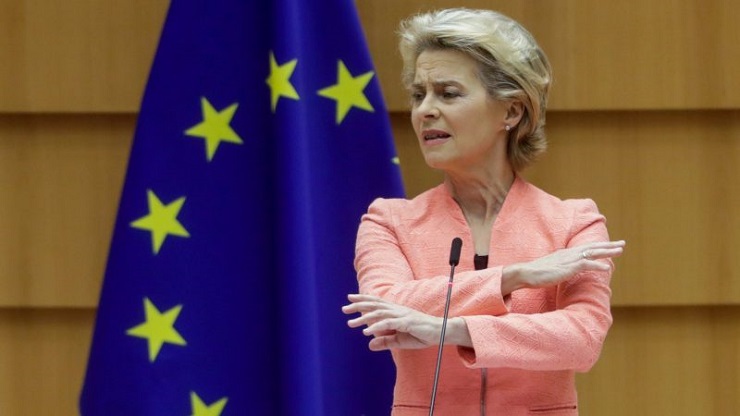
The move to mandate payment for gas in ruble was an essential counter-measure that has succeeded in defending the Russian currency and economy from collapse. That collapse was being deliberately orchestrated by Western sanctions aimed at strangling Russia. And yet when Russia acts to defend its vital existential interests it is accused of using “blackmail”. One of the shrill voices was that of European Commission President Ursula von der Leyen. The former German defense minister is a rabid Russophobe. Her logic of accusing Russia of wrongdoing is like a Third Reich minister lambasting the Warsaw Ghetto uprising as an insolent insurrection.
Von der Leyen and her elite, unelected Brussels bureaucracy are calling for all EU members to refuse payments to Russia. They are effectively endorsing the theft of Russia’s wealth. Their arrogance is not surprising. But that arrogance is leading to rebellion across Europe from the economic damage and unbearable cost-of-living crisis hitting the majority of the EU’s 500 million population. Bulgarian and Polish workers are demanding their governments resume trade with Russia to prevent a crash to their livelihoods.
A further mockery in this absurd scenario is that anti-Russia hawks in the United States and Europe have been vociferously jeering for all energy and other trade with Russia to be cancelled. Of course, this mania is all about propping up U.S. capitalism, hegemony over Europe, the weapons industry, and the transatlantic feeding trough for effete European lackeys.
Then, when Russia cuts off the energy supplies because of non-payment, there is an uproar about Moscow “weaponizing trade”.
The Western accusations of economic blackmail are analogous to perverse claims of military blackmail. The criminally reckless aggression that the United States and its NATO partners have pursued against Russia has escalated into war in Ukraine. As a British government minister demonstrated this week, the NATO powers are now directing their proxy Kiev regime to launch attacks on Russian territory. Yet when Russia warns of the dangerous risks of world war veering into a nuclear conflagration, the Western powers and their dutiful media turn around and accuse Russia of using “nuclear blackmail”.
America and Europe’s dubious political “leadership” is exposing itself as delusional, duplicitous, and criminally insane. They are insanely willing to push the world into a catastrophic war. And when Russia stands up to their madness, it is accused of being a reprobate.
In a funny sort of way, such farcical Western leadership is good. For it only further exposes how utterly unhinged and corrupt the Western elite rulers are in the eyes of their increasingly restive, angry populations.
It is Western callous, sociopathic leaders who are the ones blackmailing their own citizens and indeed the rest of the world. Their ultimatum is: destroy Russia or we will destroy everything. This is the mindset of totalitarianism.
The Western public’s enemy is not Russia, and it’s not China nor Iran, Syria, Venezuela, North Korea, Cuba, or some other designated foreign foe. All our enemy is the Western system of U.S.-led imperialism, its capitalist elite, and their political flunkies like Joe Biden and Ursula von der Leyen.
FDA Approved Remdesivir for 28 day old babies
By Meryl Nass, MD | April 30, 2022
Remdesivir is an IV drug. Therefore, for the past 2 years it was almost exclusively used in hospitalized patients, not outpatients.
Royalties go to Gilead, but a portion go the the NIAID, Tony Fauci’s agency and to the US Army, which assisted with its development.
Remdesivir received an early EUA (May 1, 2020) and then a very early license (October 22, 2020) despite a paucity of evidence that it actually was helpful in the hospital setting. A variety of problems can arise secondary its use, including liver inflammation, renal insufficiency and renal failure. Here is a list of articles revealing its kidney toxicity:
https://pubmed.ncbi.nlm.nih.gov/33340409/
WHO recommended against the drug on November 20, 2020.
Few if any other countries used it for COVID apart from the US. A large European trial in adults found no benefit. The investigators felt 3 deaths were due to remdesivir (0.7% of subjects who received it.)
https://www.thelancet.com/journals/laninf/article/PIIS1473-3099(21)00485-0/fulltext
However, on April 22, 2022 the WHO recommended the drug for a new use: early outpatient therapy in patients at high risk of a poor COVID outcome:
https://www.who.int/news-room/feature-stories/detail/who-recommends-against-the-use-of-remdesivir-in-covid-19-patients
Monoclonal antibodies are only effective at the beginning of illness, as they fight the virus. After about ten days, there is no more live virus and then a later phase of the disease occurs, due to an overactive immune response. Antiviral drugs do not work during the second stage, but immune modulators do. Steroids and ivermectin are effective therapies at this stage.
Outpatient infusion centers were set up to provide monoclonal antibodies to patients at the start of COVID to those who were at high risk of a bad outcome. But now the centers are shuttered as none of them work against current COVID variants. Outpatient infusions will now be available for remdesivir, which is an antiviral drug, as a replacement.
So a new way to use remdesivir has been developed: early, when it might actually work. WHO says it does. Was WHO bought off or will it actually have a positive impact? Who knows yet?
The vast majority of COVID patients are not hospitalized until they are in the second stage of illness, which is when remdesivir, HCQ and other antivirals are not very effective, since there is no more live virus. (HCQ has some immunomodulatory actions which may explain its mild benefit at this late stage.)
The US government, which has made a series of ineffective and harmful recommendations regarding the response to COVID, has just added another harmful recommendation to the list.
The FDA just licensed Remdesivir for children as young as one month old. Both hospitalized children and outpatients may receive it. The drug might work in outpatients, but the vast majority of children have a very low risk of dying from COVID. If 7 deaths per thousand result from the drug, as the European investigators thought in the study of adults cited above, it is possible it will harm or kill more children than it saves.
Shouldn’t the FDA have waited longer to see what early outpatient treatment did for older ages? Very little has been published on children and remdesivir. FDA said very little about the approval.
When we look at the press release issued by Gilead, we learn the approval was based on an open label, single arm trial in 53 children, 3 of whom died (6% of these children died). 72% had an adverse event, and 21% had a serious adverse event.
https://investors.gilead.com/news-releases/news-release-details/vekluryr-remdesivir-first-and-only-approved-treatment-pediatric
I heard that some nurses refer to the drug as “Run, death is near.”
Based on the paucity of information FDA released with its Remdesivir approval, it appears that FDA knows very little about the drug’s benefit in children, and our children will be the guinea pigs. If we let them.
US weapons supply to Ukraine prepped in January
© Congress.gov/screenshot
Samizdat | April 29, 2022
A scheme to send US weapons to Ukraine, using the “lend-lease” formula pioneered during WWII to skirt neutrality laws, was officially approved by Congress this week. However, it was put together all the way back in January – more than a month before Moscow recognized the Donbass republics as independent and sent troops into Ukraine.
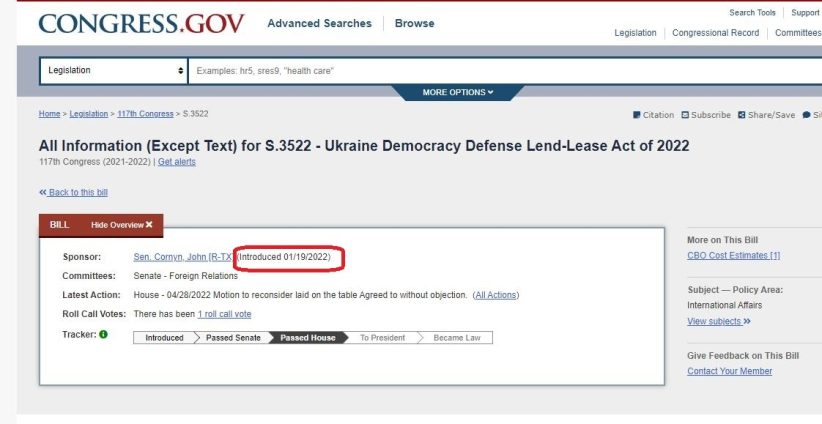
Republican Senator John Cornyn introduced the Ukraine Democracy Defense Lend-Lease Act, also known as S.3522, on January 19, 2022. This is according to the official Congress.gov page for the bill. On the same date, it was co-sponsored by senators Benjamin Cardin, Jeanne Shaheen and Roger Wicker.
Senators Richard Blumenthal and Lindsey Graham endorsed it the very next day, January 20. Other endorsements trickled in over the following weeks, with a total of 14 senators on board by February 9, again according to Congress.gov.
Russia did not recognize the independence of Donetsk and Lugansk until February 21. The “special military operation” to demilitarize Ukraine began on what was already February 24 in Washington.
Oddly enough, the Senate Foreign Relations Committee only took up Cornyn’s proposal on April 6. It was approved unanimously, proposed on the floor by Majority Leader Chuck Schumer and adopted by voice vote – whereupon it sat in limbo for weeks while the Democrat-dominated House was on vacation. On Thursday, after an hour of pro-forma debate, the House approved it in a 417-10 vote. Every single Democrat voted in favor, while all 10 dissenters were Republicans.
Supporters and critics alike have made much of the proposal, named after a WWII-era scheme to bypass neutrality laws limiting US arms exports. President Franklin Delano Roosevelt concocted lend-lease in March 1941, months before the US entered WWII, to send billions of dollars worth of weapons to Britain, and later the Soviet Union and other countries.
Cornyn’s bill, by contrast, suspends two existing US laws to make it easier for the White House to ship all sorts of weapons to Ukraine. It eliminates the five-year limitation on the program duration, suggesting the US hopes the conflict goes on for a long time – but also conditions the aid on Ukraine eventually repaying the “lease” or returning the gear if in working condition.
Cornyn has so far not revealed what might have motivated him to introduce the scheme to “protect civilian populations in Ukraine from Russian military invasion” before any military operations began.
The motivations of his first co-sponsor, Cardin, are more obvious. He is the architect of a series of anti-Russian laws, starting with the 2012 Magnitsky Act, the 2016 Global Magnitsky Act, and the 2017 CAATSA law, which tied the hands of the Trump administration in dealing with Russia.
In January 2018, at the height of the “Russiagate” craze, Cardin published a report he commissioned from the Democratic staff on the Senate Foreign Relations Committee, accusing Russia of an “assault” on “democratic and transatlantic institutions and alliances,” using “disinformation, cyberattacks, military invasions, alleged political assassinations, threats to energy security, election interference, and other subversive tactics.”
Russia attacked the neighboring state in late February, following Ukraine’s failure to implement the terms of the Minsk agreements, first signed in 2014, and Moscow’s eventual recognition of the Donbass republics of Donetsk and Lugansk. The German- and French-brokered protocols were designed to give the breakaway regions special status within the Ukrainian state.
The Kremlin has since demanded that Ukraine officially declare itself a neutral country that will never join the US-led NATO military bloc. Kiev insists the Russian offensive was completely unprovoked and has denied claims it was planning to retake the two republics by force.
1.2 Million Reports of Injuries After COVID Vaccines, VAERS Data Show
By Megan Redshaw – The Defender – April 29, 2022
The Centers for Disease Control and Prevention (CDC) today released new data showing a total of 1,247,131 reports of adverse events following COVID-19 vaccines were submitted between Dec. 14, 2020, and April 22, 2022, to the Vaccine Adverse Event Reporting System (VAERS). VAERS is the primary government-funded system for reporting adverse vaccine reactions in the U.S.
The data included a total of 27,532 reports of deaths — an increase of 183 over the previous week — and 224,766 serious injuries, including deaths, during the same time period — up 1,930 compared with the previous week.
Excluding “foreign reports” to VAERS, 810,171 adverse events, including 12,672 deaths and 80,743 serious injuries, were reported in the U.S. between Dec. 14, 2020, and April 22, 2022.
Foreign reports are reports foreign subsidiaries send to U.S. vaccine manufacturers. Under U.S. Food and Drug Administration (FDA) regulations, if a manufacturer is notified of a foreign case report that describes an event that is both serious and does not appear on the product’s labeling, the manufacturer is required to submit the report to VAERS.
Of the 12,672 U.S. deaths reported as of April 22, 16% occurred within 24 hours of vaccination, 20% occurred within 48 hours of vaccination and 59% occurred in people who experienced an onset of symptoms within 48 hours of being vaccinated.
In the U.S., 572 million COVID-19 vaccine doses had been administered as of April 23, including 338 million doses of Pfizer, 215 million doses of Moderna and 19 million doses of Johnson & Johnson (J&J).
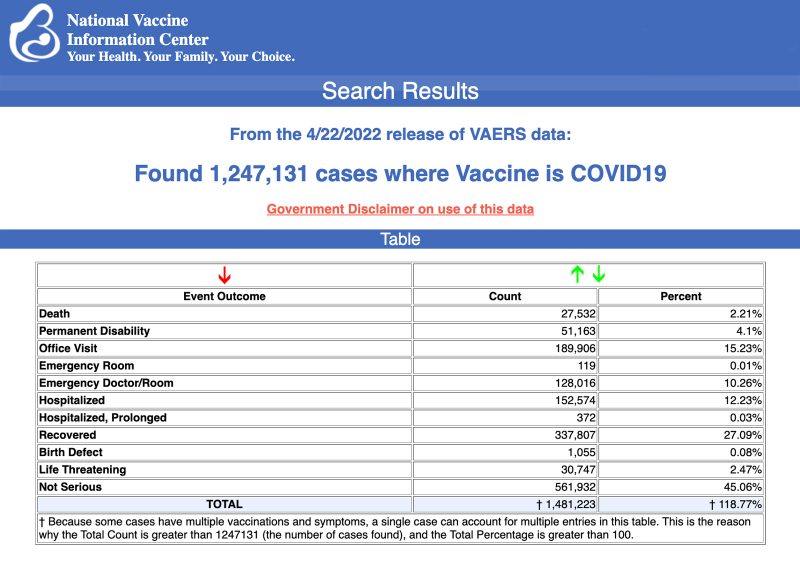
Every Friday, VAERS publishes vaccine injury reports received as of a specified date. Reports submitted to VAERS require further investigation before a causal relationship can be confirmed.
Historically, VAERS has been shown to report only 1% of actual vaccine adverse events.
U.S. VAERS data from Dec. 14, 2020, to April 22, 2022, for 5- to 11-year-olds show:
- 10,348 adverse events, including 256 rated as serious and 5 reported deaths.
- 19 reports of myocarditis and pericarditis (heart inflammation).
The CDC uses a narrowed case definition of “myocarditis,” which excludes cases of cardiac arrest, ischemic strokes and deaths due to heart problems that occur before one has the chance to go to the emergency department.The Defender has noticed over previous weeks that several reports of myocarditis and pericarditis have been removed by the CDC from the VAERS system in this age group. No explanation was provided. - 42 reports of blood clotting disorders.
U.S. VAERS data from Dec. 14, 2020, to April 22, 2022, for 12- to 17-year-olds show:
- 31,455 adverse events, including 1,803 rated as serious and 44 reported deaths. The most recent reported death involves a 14-year-old girl from Tennessee (VAERS I.D. 2238618) who died after receiving her second dose of Pfizer’s COVID-19 vaccine. According to the VAERS report, the girl had a previous history of cancer but was hospitalized 29 days after receiving her second dose of Pfizer with severe COVID-19 and COVID pneumonia. She became “critically ill,” developed respiratory failure and bradycardia and later died.
- 65 reports of anaphylaxis among 12- to 17-year-olds where the reaction was life-threatening, required treatment or resulted in death — with 96% of cases attributed to Pfizer’s vaccine.
- 649 reports of myocarditis and pericarditis — two fewer than last week — with 637 cases attributed to Pfizer’s vaccine.
- 165 reports of blood clotting disorders — 1 fewer than last week — with all cases attributed to Pfizer.
U.S. VAERS data from Dec. 14, 2020, to April 22, 2022, for all age groups combined, show:
- 20% of deaths were related to cardiac disorders.
- 54% of those who died were male, 41% were female and the remaining death reports did not include the gender of the deceased.
- The average age of death was 73.
- As of April 22, 5,460 pregnant women reported adverse events related to COVID-19 vaccines, including 1,709 reports of miscarriage or premature birth.
- Of the 3,630 cases of Bell’s Palsy reported — three fewer than last week — 51% were attributed to Pfizer vaccinations, 40% to Moderna and 8% to J&J.
- 870 reports of Guillain-Barré syndrome, with 42% of cases attributed to Pfizer, 30% to Moderna and 28% to J&J.
- 2,343 reports of anaphylaxis — 12 fewer reports than last week — where the reaction was life-threatening, required treatment or resulted in death.
- 1,678 reports of myocardial infarction.
- 13,826 reports of blood-clotting disorders in the U.S. Of those, 6,199 reports were attributed to Pfizer, 4,925 reports to Moderna and 2,661 reports to J&J.
- 4,152 cases of myocarditis and pericarditis with 2,544 cases attributed to Pfizer’s, 1,415 cases to Moderna’s and 181 cases to J&J’s COVID-19 vaccine.
Megan Redshaw is a staff attorney for Children’s Health Defense and a reporter for The Defender.
© 2022 Children’s Health Defense, Inc. This work is reproduced and distributed with the permission of Children’s Health Defense, Inc. Want to learn more from Children’s Health Defense? Sign up for free news and updates from Robert F. Kennedy, Jr. and the Children’s Health Defense. Your donation will help to support us in our efforts.
D.C. Schools Can’t Vaccinate Kids 11 and Up Without Parents’ Consent Until Lawsuits Settled
The Defender | April 28, 2022
A preliminary injunction prohibiting the mayor of the District of Columbia, the D.C. Department of Health and D.C. public schools from enforcing the D.C. Minor Consent for Vaccination Amendment Act of 2020 (D.C. Minor Consent Act) will remain in place after the defendants declined to file an appeal within the required 30-day period.
The preliminary injunction reverts D.C. to the standard age of consent of 18, at least until the conclusion of the case.
The injunction stemmed from two lawsuits filed against the D.C. Minor Consent Act, which allows children 11 and older to consent to vaccinations without their parents’ knowledge or consent.
The law, passed on Dec. 17, 2020, specifically targets children whose parents filed religious exemptions for their children.
“This is a significant legal victory,” said Rolf Hazlehurst, senior staff attorney for Children’s Health Defense (CHD). “But the legal battle is by no means over.”
D.C. is the legal testing ground for mandatory vaccinations, according to Hazlehurst, which makes this a “high-stakes” battle.
“The defendants and other states are twisting and distorting the ‘mature minor’ doctrine to push the limits of government overreach at the expense of parental rights,” Hazlehurst said. “They will not abandon this tactic or their assault upon our children or parental rights.”
The two lawsuits challenging the D.C. Minor Consent Act include one filed by CHD and the Parental Rights Foundation and a second brought by Informed Consent Action Network.
Both lawsuits sought a preliminary injunction to immediately prohibit D.C. schools and public health officials from enforcing the law until the lawsuits are concluded.
During oral arguments on March 3, Hazlehurst argued the D.C. Minor Consent Act violates the Supremacy Clause of the U.S. Constitution because it contains multiple provisions that strip away the meager protections guaranteed to parents under the National Childhood Vaccine Injury Act of 1986.
Hazlehurst also argued the law violates the right to freedom of religion guaranteed by the First Amendment to the U.S. Constitution.
Hazlehurst told the court the mayor of D.C. created a “pressure-cooker environment,” enticing and psychologically manipulating minor children to defy their parents and take vaccinations against their parents’ will.
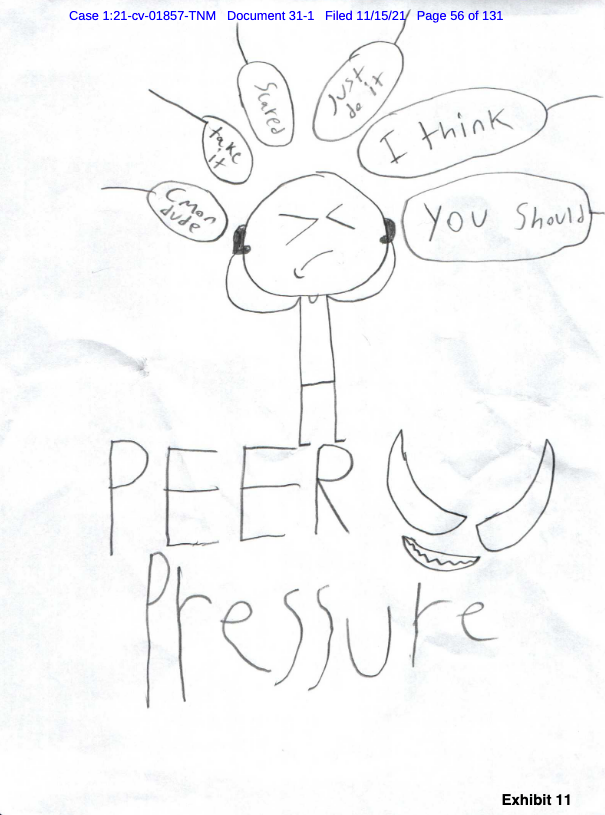
To make his point, Hazlehurst relied on a drawing, “Peer Pressure,” by a child of one of the plaintiffs. The drawing depicts the dilemma children face at school when they don’t want to get the COVID-19 vaccine.
On March 18, the U.S. District Court for the District of Columbia ordered the preliminary injunction.
In obtaining the preliminary injunction, the plaintiffs overcame a high legal hurdle that the “threatened injury must be certainly impending” as established by the U.S. Supreme Court precedent Clapper v. Amnesty Int’l, Hazlehurst said.
The court also ruled the plaintiffs in both lawsuits have legal standing based on preemption because the D.C. Minor Consent Act conflicts with the National Childhood Vaccine Injury Act.
In CHD’s case, U.S. District Judge Trevor N. McFadden made the additional finding that the plaintiffs have standing based upon the fact that they are likely to succeed on the merits that the law violates the free exercise of religion clause in the First Amendment.
“This preliminary injunction is part of ongoing litigation in an extremely important national precedent-setting case,” said Hazlehurst. “The rights of parents to decide what is best for their children’s health is at stake. Government can’t be allowed to make such decisions for minor children.”
The D.C. Minor Consent Act contains several provisions designed to deceive parents by hiding the fact that their children have been vaccinated against their parental judgment, authority or religious convictions.
The law requires healthcare providers to falsify records by leaving the child’s school vaccination records blank.
It also allows doctors to bill parents’ insurance companies for vaccines administered to children against their parents’ written directive. However, insurance companies may not send parents of those children an explanation of benefits.
Another Scientist Who Publicly Dismissed Lab Leak Gave It Credence in Private Email
By Noah Carl | The Daily Sceptic | April 27, 2022
When it comes to the lab leak theory of Covid origins, there’s a lot of inconsistency between what scientists have announced in public and what they’ve revealed in private.
First, there was Professor Kristian Andersen, an American virologist. Writing to Anthony Fauci on 1st February 2020, he said of the virus that “some of the features (potentially) look engineered”, adding that he and several colleagues “all find the genome inconsistent with expectations from evolutionary theory”.
Mere weeks later, Andersen co-authored a paper stating, “we do not believe that any type of laboratory-based scenario is plausible”.
Next, there was Professor Jeremy Farrar, head of the UK’s Wellcome Trust. He wrote in his book Spike that he initially believed there was a 50% chance the virus had leaked from a lab, and that other scientists to whom he’d spoke had put the percentage even higher.
Yet Farrar signed the infamous Lancet letter, which referred to claims that “COVID-19 does not have a natural origin” as “conspiracy theories”.
A new freedom of information request, made by the group U.S. Right to Know, has revealed that another author of the Lancet letter gave credence to the lab leak in a private email. Professor Charles Calisher, an American epidemiologist, said he did not see how “anyone could definitively state that the virus could not possibly have come from that lab”.

Interestingly, Calisher’s email was sent one month after the Lancet letter’s publication, which means he either changed his mind or was not expressing his true beliefs when he co-signed the letter.
According to a March 2021 article in the MIT Technology Review, Calisher said the “conspiracy-theory phrase” was “over the top”. However, the article doesn’t make clear whether Calisher believed this at the time he co-signed the letter, or whether he subsequently came to believe it.
In any case, calling the lab leak a “conspiracy theory” is a pretty strong statement. So if Calisher did change his mind about it, he could have let the public know – for example, by removing his name from the letter, or clarifying his position in some other public forum.
What’s more, in September of 2021, Calisher told The Telegraph that “the letter never intended to suggest that Covid might not have a natural origin, rather that there was insufficient data.” But this doesn’t make sense.
If the letter’s purposes was merely to suggest “there was insufficient data”, it wouldn’t have used the phrase “conspiracy theory”, or else it would have dismissed both the natural origin and the lab leak as “conspiracy theories”. For example, it might have said, ‘We stand together to strongly condemn unfounded speculation about the origin of COVID-19’.
There’s much about the official narrative on the lab leak that doesn’t add up. The public has a right to know why so many scientists made blatantly unscientific claims that contradict their private correspondence.
60 countries sign declaration that commits to bolstering “resilience to disinformation and misinformation”
By Tom Parker | Reclaim The Net | April 29, 2022
The United States (US) and 60 partner countries, including the United Kingdom (UK), Canada, Australia, and members of the European Union (EU), have signed a sweeping “Declaration for the Future of the Internet” which commits to bolstering “resilience to disinformation and misinformation” and somehow upholding free speech rights while also censoring “harmful” content.
The White House framed the declaration as something that supports freedom and privacy by focusing on its commitments to protect human rights, the free flow of information, and privacy. The EU put out similar talking points and claimed that those who signed the declaration support a future internet that’s open, free, global, interoperable, reliable, and secure.
However, the commitments in the declaration are vague and often conflicting. For example, the declaration makes multiple commitments to upholding freedom of expression yet also commits to bolstering “resilience to disinformation and misinformation.” It also contains the seemingly contradictory commitment of ensuring “the right to freedom of expression” is protected when governments and platforms censor content that they deem to be harmful.
Furthermore, many of the governments that signed this declaration are currently pushing sweeping online censorship laws or openly supporting online censorship.
For example, just a few days ago, the Biden administration called for private companies to censor online “misinformation” – the latest of many similar calls. The EU also recently passed its Digital Services Act (DSA) which contains requirements to censor “hate speech” and “misinformation.”
Some government officials, including Canadian Minister of Innovation, Science, and Industry François-Philippe Champagne and UK Digital, Culture, Media, and Sport (DCMS) Secretary of State Nadine Dorries, even mentioned their country’s online censorship laws during the live launch of this Declaration for the Future of the Internet.
“The vision outlined in this declaration aligns very well with the many initiatives we are working on here in Canada, including our Digital Charter,” Champagne said.
Canada’s Digital Charter was launched in 2019 and threatens platforms with “meaningful financial consequences” if they fail to fight online “hate” and “disinformation.”
“I am enormously encouraged to see online safety is a key principle of that declaration,” Dorries said. “As the UK’s Digital Secretary, doing more to protect people online is one of my main priorities – and last month, I was proud to introduce a groundbreaking Online Safety Bill to the UK Parliament that will make the internet safer for everyone.”
The UK’s Online Safety Bill will give the government sweeping censorship powers, censor some “legal but harmful” content, and criminalize “harmful” and “false” communications.
Like the commitments to freedom of expression, the declaration’s commitments to privacy are also being made by governments that engage in or allow mass surveillance.
For example, the EU is allowing the linking of face recognition databases to create a mega surveillance system. The Federal Bureau of Investigation (FBI) recently boosted its social media surveillance technology. And the outgoing London Metropolitan police commissioner recently congratulated herself on extending the surveillance state.
While the current signatories of this declaration are governments, the White House plans to work with “the private sector, international organizations, the technical community, academia and civil society, and other relevant stakeholders worldwide to promote, foster, and achieve” the “shared vision” of this Declaration for the Future of the Internet.
Big Tech companies such as Facebook and Google have already welcomed this declaration.
“It’s great to see countries coming together today to launch the Declaration for the Future of the Internet (DFI),” Google’s Vice President, Government Affairs & Public Policy, Karan Bhatia, wrote in a blog post. “We are committed to partnering with governments and civil society through the Declaration to disrupt disinformation campaigns and foreign malign activity, while ensuring people around the world are able to access trustworthy information.”
Google and its video-sharing platform YouTube have used the term misinformation to justify the mass censorship of content. Additionally, Bhatia’s commitment to ensuring access to “trustworthy information” echoes YouTube’s commitment to boosting “authoritative sources” – a practice that creates a huge disparity between mainstream media outlets and independent creators and results in mainstream media outlets being artificially boosted by as much as 20x.
“This Declaration is an important signal from some of the world’s leading democracies,” Nick Clegg, the President of Global Affairs at Facebook’s parent company Meta, tweeted. “The only way to preserve and enhance the best of the open internet, prevent it from fragmenting further and protect human rights in the digital space is by working together.”
While Clegg’s statement focuses on the open internet and protecting human rights, Meta also mass censors content on its platforms and plans to continue this censorship in its metaverse.
And despite the declaration’s commitment to privacy, both Google and Meta’s businesses rely heavily on surveilling users to serve targeted ads.
The current list of countries that have endorsed this Declaration for the Future of the Internet includes Albania, Andorra, Argentina, Australia, Austria, Belgium, Bulgaria, Cabo Verde, Canada, Colombia, Costa Rica, Croatia, Cyprus, Czech Republic, Denmark, Dominican Republic, Estonia, the European Commission, Finland, France, Georgia, Germany, Greece, Hungary, Iceland, Ireland, Israel, Italy, Jamaica, Japan, Kenya, Kosovo, Latvia, Lithuania, Luxembourg, Maldives, Malta, Marshall Islands, Micronesia, Moldova, Montenegro, Netherlands, New Zealand, Niger, North Macedonia, Palau, Peru, Poland, Portugal, Romania, Senegal, Serbia, Slovakia, Slovenia, Spain, Sweden, Taiwan, Trinidad and Tobago, the United Kingdom, the United States, Ukraine, and Uruguay.
The declaration isn’t legally binding but is intended to be used as a “reference for public policy makers, as well as citizens, businesses, and civil society organizations.” The signatories also intend to translate its principles into “concrete policies and actions; and, work together to promote this vision globally.”
We obtained a copy of the Declaration for the Future of the Internet for you here.
The EU’s Digital Services Act is the next big threat to free speech

By Didi Rankovic | Reclaim The Net | April 29, 2022
Authorities across the world continue to use the Ukrainian crisis as the backdrop against which to pass, in some cases unprecedented in the way they restrict or censor free speech, legislation regulating the digital industry.
These trends are nothing new, but the current massive global crisis presents an excellent excuse to introduce draconian measures with little or no scrutiny or opposition. And so, in the EU, the Digital Services Act just got “enriched” by a new law that will allow the bloc to declare a state of emergency – on the internet.
The law, referred to as a “crisis mechanism” is a part of the Act and got ushered into existence last Saturday.
A state of emergency normally gives governments extraordinary powers and suspends normal laws and regulation in order to preserve lives and property – something that has thus far been used in case of war or natural disaster, i.e., those events affecting a country’s physical security, economy, etc.
But now the 27 EU countries will be able to do the same in imposing extraordinary control on all key, public-facing elements of the web: social platforms, search engines, and e-commerce sites.
A good chunk of these three categories means this is not about the usual emergency measures in a time of crisis – they also concern freedom of speech, which is where things get very complicated. What critical voices who manage to find their way into corporate media seem to be admitting is legislation like this can bring harmful outcomes, but they’re also trying to normalize it.
Daphne Keller of Stanford’s Cyber Policy Center has been quoted as telling Wired, “It looks like the war in Ukraine created a political opportunity for advocates of tighter restrictions to push their agenda. That’s pretty normal politics, if bad law.”
But many others, whose voices cannot these days be heard in the mainstream, will argue that this is also an example of “bad politics”: in Europe, that part of the world that has given birth to democracy and always strives, though does not always succeed, at implementing its tenets, sneakily passing extreme regulation almost literally “under cover of the night” (reports say that the vote on the new EU law took place “in the early hours of Saturday”) could highly likely backfire, down the road.
For the moment, the EU seems happy to explain its latest attempt at dipping its toe in the authoritarianism pond by saying that forcing tech companies to silence or completely censor information should be considered as not controversial, if a crisis is taking place, whether that concerns public security or – a health threat. Yes, the Covid panic, and its possible future (re)apparitions in European societies and economies, has also been factored in, when deciding to draft and then approve the new law.
With issues sensitive as this, every word counts – but the definition of what constitutes a “threat” big enough to invoke these massive new powers is predictably murky and bureaucratic.
Members of a European Parliament (EP) grouping called the European People’s Party (EPP), said only that when the EU Commission decides, “very large” platforms will have to “limit any urgent threat on their platforms.”
There’s more. “All measures under the crisis mechanism will be limited in time and accompanied by safeguards for fundamental rights,” European Commission spokesperson Johannes Bahrke promised.
These statements mean everything and nothing, and that’s exactly what they’re designed to do.
There’s other news revealing a bid to centralize power in the EU, now a very diffuse, and at times confused organization. Thus European Commission head Ursula von der Leyen will be given the power to enforce the new rules, bypassing a previous system where countries like Ireland, that have the most to lose if Big Tech is pushed out of Europe, had a voice.
It’s of interest to note that Big Tech has been playing along pretty well so far, making this latest legislative push somewhat unclear. Both during the Covid and Ukraine war events, these large corporations have been heeding political messages and catering to political needs, basically to a fault.
Reports suggest that now, the bureaucrats in Brussels may just want to make their jobs simpler. Instead of having to go to the sanctions regime and relying on Big Tech to obey – like they did when they blocked Russian media outlets like RT and Sputnik – they will now have a whole new law that enforces all this in one fell swoop.
This is happening as Big Tech – both the from the West, like Google, Facebook, and Amazon, and from the East, like TikTok, are yet to make any comment.
And now it’s up to EU member countries to approve the law and allow the “crisis mechanism” to kick into gear.
US dusts off WWII scheme to arm Ukraine
Samizdat | April 28, 2022
The US House of Representatives has approved a bill that would remove several constraints on sending weapons to Ukraine amid the ongoing Russian offensive. Adopted by the Senate earlier this month, the “Ukraine Democracy Defense Lend-Lease Act” revives the program Washington used to send military equipment to belligerents in WWII while officially staying neutral.
The final vote on Thursday afternoon was 417-10, with three members not voting. All of the Democrats voted in favor, while all of the ten members opposed were Republicans.
Introduced by Senator John Cornyn (R-Texas), the bill was passed by the Senate on April 6, but the Democrat-dominated House adjourned for a two-week Easter recess before taking it up.
It authorizes the White House to “lend or lease defense articles” to Ukraine or any “Eastern European countries impacted by the Russian Federation’s invasion of Ukraine to help bolster those countries’ defense capabilities and protect their civilian populations from potential invasion or ongoing aggression.”
Cornyn’s bill does not create a new program, but rather makes it easier for President Joe Biden to send weapons to Kiev by suspending limitations imposed by two existing laws, one of which caps the length of the aid at five years.
However, the whole thing is conditioned on Ukraine having to pay for the “return of and reimbursement and repayment for defense articles loaned or leased” to it. Kiev’s ability to make such payments is questionable, since the Ukrainian government is currently asking the US and the EU for $7 billion per month just to keep paying salaries and pensions.
The lend-lease bill is separate from the ongoing US effort to send Kiev weapons from the Pentagon stockpiles. Biden has already blown through almost $3.5 billion authorized by Congress for the purpose, and is seeking more funding. However, it risks being held up if the Democrats insist on bundling it with their Covid-19 funding plan, as Republicans have warned they would only support a stand-alone bill.
“We don’t have the mechanism yet,” White House press secretary Jen Psaki told reporters on Tuesday.
The original lend-lease was enacted by President Franklin Delano Roosevelt in March 1941 – nine months before the US entered WWII – and amounted to $50.1 billion (980 billion in 2022 dollars) by September 1945, when the program ended. Most of the weapons and equipment went to the UK ($31.4 billion) with a $11.3 billion share going to the Soviet Union and another $7.4 billion to other countries. In theory, the aid was supposed to be repaid or returned, but the US accepted the lease of military bases abroad instead.
Biden’s Mammoth $33BN Ukraine Package Includes Help With Wartime Propaganda
By Tyler Durden | Zero Hedge | April 28, 2022
Politico’s Christopher Miller noted earlier that the record-smashing $33 billion spending package that the White House is proposing for Ukraine actually “dwarfs the annual defense budgets of most nations.” To which we naturally asked: how many billions of dollars does it take to turn a ‘proxy’ war into a ‘direct conflict’?
For starters it’s clear that such a massive amount of taxpayer money means that Washington clearly doesn’t expect that the war will end anytime soon, as multiple US defense and intelligence officials have recently testified. In fact General Mark Milley, the chair of the Joint Chiefs of Staff, told the House Armed Services Committee during the first week of this month that he sees this as a “very protracted conflict” to come that will be “at least measured in years.”
Biden in his Thursday rollout remarks described that the new aid package “begins the transition to longer-term security assistance.” But interestingly as part of this assistance, a key area that the US will fund is what’s essentially information warfare…
Independent journalist and media commentator Michael Tracey has pointed out…
White House fact-sheet says part of the mammoth $33 billion spending package it’s requesting for Ukraine will be to “support independent media.” Because nothing screams “independent” like being directly funded by the US Government as part of its “information warfare” initiative.
Of course, going back to at least 2014 the US government has funded such Ukraine initiatives as “citizen journalism” to push back against ‘Russian influence’ in the country.
As WikiLeaks has documented long ago, there was similarly heavy State Department and US intelligence funding of “independent” and “opposition” media in Syria in the lead-up to and during the decade-long war to try and overthrow Assad.
But this marks a huge expansion of the United States much more directly assisting Ukraine in its media and wartime propaganda efforts. The White House fact sheet detailing the scope of the security aid package spells out in a bullet point:
- Counter Russian disinformation and propaganda narratives, promote accountability for Russian human rights violation, and support activists, journalists, and independent media to defend freedom of expression.
This as “freedom of expression” is often suppressed at home, ironically enough especially targeting independent media outlets.
Also of little comfort to the US taxpayer in terms of a potential eventual path to WW3 between two nuclear armed powers is this section under a header titled Help Ukraine Defend Itself Over the Long-Term…
- A stronger NATO security posture through support for U.S. troop deployments on NATO territory, including transportation of U.S. personnel and equipment, temporary duty, special pay, airlift, weapons system sustainment, and medical support.
Ultimately this means hundreds of millions will go toward propping up “independent media” which will actually in truth be US-state funded pro-NATO information efforts.
Featured Video

Laith Marouf: Hezbollah’s position on US-Iran ceasefire
or go to
Aletho News Archives – Video-Images
From the Archives
The Dirty Little Secret behind the “Global Terrorism Index”
The Omission of Israeli Terrorism in the Occupied Palestinian Territories
By Karin Brothers | Global Research | December 6, 2014
… The Israeli settlements — all of which are illegal – have been identified as a major impediment to peace. The refusal of a major “global” terrorism report to name the Israeli settlers as one of the groups most responsible for terrorism not only misrepresents a major source of regional violence but exposes the Global Terrorism Index as a propaganda tool that supports a U.S. agenda.
In recent years, governments have been attempting to thwart terrorism by blocking supportive fund-raising. When it comes to Israeli settlements, however, the US and Canada actually encourage fund-raising by giving organizations (such as Christian Friends of Israeli Communities (CFOIC) and the Jewish National Fund) financial support in the form of donor tax-deductions.
Charities which provide funds for the Israeli settlements should be regarded as terror-financing organizations. They should not only lose their tax-deductible status, but they should be banned because they support the violation of international humanitarian law. The terror-financing laws that are being strictly enforced for Muslim charities should be applied to Christian and Jewish charities as well. … Read full article
Blog Roll
 Aletho News
- The ‘Opposition Party’ Has Done Nothing to Stop the Iran War and Much to Goad Trump Into Continuing It
- Moscow backs Tehran on status of Lebanon in US-Iran deal
- How UK Regulator Ofcom Quietly Bypassed International Law to Police American Speech
- The Black Cube Files: How Former Mossad Operatives Flipped a Nation
- Laith Marouf: Hezbollah’s position on US-Iran ceasefire: What you’re not being told
- Israel’s priority lies in destroying chances of peace between Iran, US: Ex-UN nuclear chief
- Ceasefire for all or for none: Iran shuts Hormuz over Lebanon attacks
- Strait of Hormuz is Iran’s ‘nuclear weapon’ that forced US retreat: Medvedev
- Energy crisis will last for months – Kremlin envoy
- Europe’s quiet role in the war on Iran
- If Americans Knew
- This is ceasefire? Israel’s biggest massacre yet in Lebanon, another journalist killed in Gaza – Daily Update
- Tucker Carlson on Israel: This Is the Behavior of an Ally? Really?
- Gazans face a triple crisis: severe shortages of water and bread, healthcare in tatters
- NY Times reports how Netanyahu took the US into Iran War
- A sigh of relief over Iran, but Gaza and Lebanon in dire straits – Daily Update
- Thousands dead and neighborhoods razed to the ground: Aid agencies fear southern Lebanon is becoming the new Gaza
- The war the US is fighting for Israel could cost trillions
- ‘Cigarette Burns, Nail Wounds’: Toddler Tortured in Gaza to Coerce Father
- Trump Says US Sent ‘a Lot of Guns’ to Protesters in Iran
- Israeli forces destroy 17 UN peacekeeper cameras in south Lebanon
- No Tricks Zone
- An Inconvenient Tree: Uncovered In Alps… Europe Much Warmer Than Today 6000 Years Ago
- New Study Reports A 60% Slowdown In Greenland’s Ice Loss Rate In The Last Decade
- Low Intensity Tornado Wrecks Major Solar Farm, Creating A Potential Toxic Dump
- New Study Finds Warming Saves Lives…Cold Temperatures 12 Times More Deadly Than Excess Heat
- German Science Blog Accuses PIK Climate Institute Of Hallucinating Climate Tipping Points
- Devastating Assessment Of Comirnaty Vaccine By Former Senior Pfizer Europe Toxicologist
- New Study: CO2 Is ‘Effectively Negligible’ As An Explanatory Climate Change Factor Since 2000
- Former Pfizer Toxicologist Dr. Helmut Sterz Tells Bundestag Hearing Pfizer Vaccine Should Have Never Been Approved
- Energy Expert: Germany’s Nuclear Phaseout Was A “500 Billion Euro Mistake”
- New Research: South Australia’s Mid-Holocene Sea Surface Temperatures Were 4°C Warmer Than Today
 Aletho News