Twitter locks Dr. Meryl Nass twice for linking to academic articles and explaining them
Meryl Nass, MD | April 8, 2022
|
|||||||||||||||||||||||||||||||||||
|



|
|||||||||||||||||||||||||||||||||||
|
Increase in heart attacks since June in both England and Scotland
The Naked Emperor’s Newsletter | April 7, 2022
In my recent article on heart attacks in youngsters I focussed on the Scottish data. I have since looked at the English data and it follows a similar pattern.
The UK Health Security Agency (UKHSA) produce a weekly Ambulance Syndromic Surveillance System Bulletin for England. Page 8 looks at Cardiac or respiratory arrest, specifically the daily number of cardiac or respiratory arrest ambulance service calls.

Similar to the Scottish data, during mid 2021 the 7 day average closely followed the black dotted baseline. However, from June it began to rise and stayed higher than average until December. Since February 2022 it has taken off again and is currently much higher than the baseline.
This is data for all ages and as we saw with the Scottish data, when broken down by age, the figures were much worse for the younger age groups. It would be interesting to see this English data also broken down by age.
China explains why it stood up for Russia
Samizdat | April 8, 2022
China has explained its decision to vote against the UN General Assembly resolution to suspend Russia from the Human Rights Council, calling Moscow’s exclusion politically motivated and slamming the resolution as lacking transparency.
“We oppose the politicization and instrumentalization of human rights issues, the practice of selective double standards and confrontation on human rights issues, and the use of human rights issues to put pressure on other countries,” Chinese Foreign Ministry Spokesperson Zhao Lijian told journalists on Friday.
He added that the drafting process of the resolution was neither open nor transparent and suggested that its adoption would only “add fuel to the fire” by intensifying tensions among the parties and aggravating divisions inside the UN.
The resolution was adopted on Thursday with 93 nations voting in favor, 24 against, and 58 abstaining. Following the vote, Russia declared that it had already decided to leave the Council before the end of its term.
Russia’s deputy permanent representative at the UN, Gennady Kuzmin, described the resolution as “an illegitimate and politically motivated step designed as a demonstrative punishment of a sovereign UN member state that is carrying out independent internal and external policies.”
In explaining Russia’s decision to quit the UN body, he declared that the Human Rights Council was “monopolized by a single group of states that exploits the mechanism to achieve their opportunistic goals.” He added that “Russia’s true commitment to protecting and promoting human rights does not let us remain part of [this] international mechanism.”
The initiative to exclude Moscow from the Council originated in Washington. In late March, a bipartisan group of American senators called on the US ambassador to the UN, Linda Thomas-Greenfield, to introduce the resolution. The US cited alleged Russian human rights violations in Ukraine as justification for the move.
Since the launch of its military operation in Ukraine on February 24, Moscow has repeatedly denied such allegations, claiming that it seeks to minimize casualties and only attack military targets as part of its stated goal of demilitarizing the country.
Ukraine War Frenzy Proves: It’s Still John McCain’s GOP
By Michael Tracey | April 7, 2022
“The senator from Kentucky is now working for Vladimir Putin,” fumed John McCain back in March 2017. His target: Rand Paul, who had committed the unforgivable offense of momentarily delaying the latest round of NATO expansion. Montenegro, a tiny country in southeastern Europe that most Americans have never heard of, was about to join the sprawling military alliance — and McCain was determined to see the final ratification ritual proceed with as little debate as possible. So he hurled the time-honored “working for Putin” accusation, and sure enough, Paul quickly withdrew his minor procedural objection. The glorious ascension of Montenegro to NATO membership status was thereby assured.
Since that episode, a lot has transpired regarding the public perception of McCain. He delighted liberals by feuding regularly with Donald Trump — even going so far as to denounce Trump for engaging in “disgraceful” and “pathetic” flattery of Putin. “No prior president has ever abased himself more abjectly before a tyrant,” McCain raged. He undermined Congressional Republicans’ legislative agenda during the brief window in Trump’s presidency when the party had unified control of government — famously delivering a dramatic thumbs-down gesture to derail GOP hopes of repealing Obamacare, as a chagrined Mitch McConnell watched powerlessly on.
McCain had returned to his most natural state. After annoying Democrats by running against Barack Obama in the 2008 election, and being surly about his defeat for some time afterwards, he had once again resumed playing the “maverick” role he so relished — reviled by “his own side,” and loved by the “other side.” His death in 2018 brought forth the most effusive display of state-sanctioned grief that any US political figure had received since Ronald Reagan died in 2004, with all the universal media adulation that entails. Trump’s exclusion from the funeral proceedings, at McCain’s posthumous direction, was just the icing on the cake.
But nowadays, if you bring up McCain in certain GOP circles, it will often be claimed that his influence has mercifully dissipated. The Republican Party experienced a bonafide ideological upheaval under Trump, they’ll say, and the McCain worldview — defined mainly by his unwavering commitment to a hyper-interventionist US foreign policy — has since fallen starkly out of favor. (Back when opposing interventionist foreign policy was still considered something of a “progressive” virtue, Mother Jones would routinely mock McCain by merely counting up the comically large number of countries he’d expressed a desire to attack. Did you know McCain once wanted to impose a No Fly Zone in Sudan?)
By “conservative opinion elites,” I refer roughly to the kind of people who write for obscure magazines with obscure funding sources, earnestly enjoy Think Tank social hours, and incessantly convene panels to discuss “the future of conservatism.” These types have a particular incentive to believe that McCain’s foreign policy paradigm has really been purged from the party. They’re deeply invested in the idea that the GOP underwent a genuine transformation in the past decade or so — discarding the outmoded “neocon” dogmas associated with the reign of George W. Bush, and embracing the hardened, nationalist realism associated with Donald Trump.
For a particular kind of ambitious professional conservative, this is a very flattering theory. Because if true, it means the GOP old guard is being slowly but surely displaced, and all kinds of new, innovative ideas are in the offing. Ideally with lots of ambiguous sinecures, TV gigs, and consultant opportunities attached. There’s just one problem though: when it comes to the issue area that always animated McCain the most — which was without a doubt foreign policy — recent events demonstrate that his influence is far from buried. On the contrary, it couldn’t be more alive and well. The year might be 2022, and he might have been physically dead for a while. But it’s still John McCain’s GOP.
A common fallacy heard among conservative opinion-makers who might wish to disassociate from McCain goes something like this: yes, there’s a contingent of the Republican Party that stubbornly hews to McCain-like foreign policy dogma, but it’s really only a limited handful of wackadoodles like Lindsey Graham. In other words, “the neocons” are a small, dwindling faction of the party, and aren’t representative of the typical Republican elected official or rank-and-file voter, who tend to be increasingly skeptical of US interventionism.
That’s a clever little exercise in self-rationalization, but also a bunch of baloney. On the one hand, it’s true that Graham is a… unique figure in various respects. He’s the person currently in elected office who had the closest political and personal association with McCain. Alongside their former cherished colleague, Joe Lieberman, these “three amigos” bonded over a shared, impassioned commitment to omni-directional foreign policy belligerence. (Right on cue, Lieberman was rolled out of semi-retirement last month to demand a “No Fly Zone.”)

But while Graham occasionally blurts out something uniquely insane, such as his tweeted call for the assassination of Putin — he’s far from some kind of wild outlier. In fact, his foreign policy views are comfortably ensconced in the mainstream of the GOP, notwithstanding the popular conceit that “MAGA” has supplanted “neocon” as the party’s dominant sensibility. Because if Graham is the closest living incarnation of the traditional McCain worldview, then perhaps that worldview isn’t nearly as incompatible with “MAGA” as some may want to think.
Recall: even as McCain and Trump brawled over what was essentially a clash of personalities, Graham successfully insinuated himself as one of Trump’s most trusted confidants — regularly hitting the golf links with him, and advising him on key policy matters. This has continued even into Trump’s post-presidency, with Graham operating as one of the most ardent advocates of another Trump run in 2024. “I think he’s the best person in the Republican Party to take up the cause in 2024,” Graham exuberantly told Fox News in January. “I expect him to run… I’ll take bets if anybody wants to bet. I’ll give odds.”
Do you really think Graham would be staking out this position if he viewed Trump’s foreign policy outlook as antithetical to his own?
If there’s some kind of enormous ideological conflict between Trump and Graham — who, remember, proudly carries on the McCain mantle — it has not been at all evident for a long time. It would also be weird to characterize Graham as some kind of aberrational nuisance within the GOP, considering that Graham raked in a record-shattering amount of donations for a GOP Senate candidate during his 2020 re-election campaign in South Carolina. And he accomplished this mostly by utilizing conservative media and direct-mailing lists to hammer home the pledge that he would serve in office as an unflinchingly loyal backer of Trump.
For a vivid illustration of persistent McCain/Graham influence as it relates to current events, take a look at this video that recently resurfaced from December 2016, featuring the esteemed Senatorial pals on a trip to Ukraine. Joined in wonderfully “bipartisan” fashion by Amy Klobuchar, the trio delivered a searing address to a unit of Ukrainian soldiers. If you haven’t seen the video, please do watch, because it confirms the extent to which a vocal faction of the US establishment — with McCain and Graham at the forefront — had invested ideologically and militarily in the cause of Ukraine, and by extension the cause of defeating Russia. Graham proclaims to the assembled soldiers: “Your fight is our fight. 2017 will be the year of offense. All of us will go back to Washington, and we will push the case against Russia.” McCain similarly declared, “I am convinced you will win. And we will do everything we can to provide you with what you need to win.”
While in 2016 the cause of arming Ukraine to defeat Russia on the battlefield was a somewhat more marginal preoccupation, today it’s been sanctified as virtually unshakable consensus in both parties. Funneling weapons to Ukraine was once seen as cranky McCain’s pet cause, a fixation that stemmed from his peculiarly hyper-interventionist worldview. Now, whether the US should be waging a proxy war against Russia in Ukraine is barely even considered a debatable proposition: just another McCain priority eventually consecrated as mainstream orthodoxy. “It’s bringing Congress together in a way, frankly, I haven’t seen in my 12 years,” Chris Coons, the Democratic senator from Delaware and Biden advisor, reverentially told the New York Times. “You’d have to go back to 9/11 to see such a unified commitment.” McCain is no doubt smiling down from the heavens at this great outbreak of “unification.” Because it’s proof of his enduring legacy; with his worldview and geopolitical objectives having arguably become more widely adopted than ever before.
But the coalescence of McCain-like consensus didn’t start with Russia’s invasion in February 2022. For one thing, Graham was proven right when he prophesied that 2017 would be the “year of offense” — because that was the year he, McCain, and other hawks successfully lobbied Trump to sign off on transfers of lethal weapons to Ukraine. Whatever personality conflict existed between McCain and Trump, the actual policy portfolio enacted by Trump vis-a-vis Russia wasn’t all that different from what McCain’s might’ve been. Indeed, when Trump announced the weapons transfers, McCain showered him with praise. And when Trump abrogated the INF Treaty, he was fulfilling another longtime McCain goal.
Listening to Republican politicians comment on Ukraine policy today, you can almost close your eyes and hear McCain’s irascible voice. For an example of how the McCain worldview is far from limited to so-called “neocons,” but instead a feature of entirely mainstream GOP thinking, consider the recent activities of Sen. Rick Scott (R-FL). If there’s any apt descriptor for Scott, it’s that he’s basically a conventional Republican. Not some kind of overly-ideological “neocon,” but rather a business guy who made a huge fortune defrauding Medicare, somehow leveraged that into becoming Governor of Florida, and is now in the US Senate. He also appears to have higher ambitions, as evidenced by his position running the National Republican Senatorial Committee — the campaign wing of the Senate GOP caucus. Scott isn’t especially bright, but he’s more or less able to articulate the standard bromides aimed squarely at the median Republican, and is thus capable of formulating strategy on behalf of the party for the upcoming midterm elections. He also released a manifesto outlining his bold vision for conservatism, which among other things includes that all Americans be made to pay income tax regardless of their income bracket.
The point is, Scott is situating himself at the center of the party in service of some future gambit, may be to challenge Mitch McConnell for GOP Leader (which Trump has encouraged) or maybe even to launch his own presidential campaign at some point, which I’m sure would be a barrel of laughs.
So what is Rick Scott’s big proposal on the Ukraine issue? You guessed it: demanding a No Fly Zone, or short of that, demanding the US send fighter jets into Ukraine. This is apparently the position that Scott calculates will resonate most potently with the prototypical GOP donor and voter. Again, Scott isn’t intrinsically some sort of deeply ideological McCain-Graham foreign policy fanatic. Yet, he’s espousing views that could have been directly pilfered from the McCain-Graham school of thought — just because that school of thought is so thoroughly mainstream within the GOP, whatever superficial animosities some party members may still harbor against McCain.
Part of this owes to standard partisan reflex. Desperately seeking some angle of attack against Biden in relation to Ukraine, Republicans have settled on denouncing him for not escalating the US proxy war aggressively enough. It’s incredibly easy to imagine the ghost of McCain making the exact same criticisms as, say, Ted Cruz is making at the moment. Days after Biden committed the threshold-crossing act of calling for regime change in Russia — thereby announcing that the policy of the US is to depose Putin — Cruz went on Newsmax and complained that Biden’s “approach to every enemy of America is weakness and appeasement.” Only in a McCain-inflected universe does it make even the faintest sense for a president orchestrating a giant weapons-funneling operation, and waging a proxy war of unprecedented scale — which continues intensifying by the day — to be accused of “appeasement.” But it’s clearly still McCain’s world that the GOP is living in. That was always McCain’s tack: his problem with any given US intervention was of course never the intervention itself, but rather that it wasn’t going far enough, and if you weren’t willing to go as far as he wanted, you were some sort of abject appeaser.
On the subject of Ukraine, this pattern gets repeated over and over by GOP chieftains. Biden proposes the biggest Pentagon budget in US history, and right on cue, Mitch McConnell denounces it as somehow “soft” on Russia and “far-left.” Biden announces yet another massive tranche of missiles, grenades, and heavy artillery being dispatched to Ukraine, and Kevin McCarthy, the House Minority Leader, immediately ridicules him for not giving Ukraine fighter jets. “Provide them the planes where they can create a No Fly Zone,” McCarthy demanded in a March 16 press conference. (It’s unclear whether McCarthy is satisfied with Biden’s latest decision to send tanks.)
Though it is now common to characterize Russia as committing “genocide” since footage emerged in the past several days purporting to show Russian attacks on Ukrainian civilians, Steve Scalise, the House Republican Whip, led the charge in making that designation weeks ago. “There’s nothing less than genocide going on in Ukraine,” he alleged during that same March 16 press conference, alongside McCarthy. Scalise had been so profoundly moved by Zelensky’s expertly-crafted Zoom address to Congress earlier in the day that he was compelled to issue the “genocide” allegation immediately thereafter. (No word on what independent investigative mission Scalise carried out in order to ascertain the relevant facts.)
Biden may have caused a stir when he condemned Putin as a “war criminal” — thus confirming a complete lack of interest in facilitating any kind of negotiated settlement to the conflict — but first out of the gate in making this accusation was Elise Stefanik, the New York GOP Congresswoman who serves as the chair of the House Republican Conference. Initially viewed as a “moderate,” Stefanik gamely generated big attention in recent years as a bombastic defender of Trump, raising a ton of money in the process. “As a new mom, it is heart-wrenching to watch the video that President Zelensky just played in terms of the bombing of maternity wards,” Stefanik weepily inveighed, also during the March 16 press conference with McCarthy and Scalise. “Make no mistake, there will be consequences on the global stage for Vladimir Putin, who is a war criminal and a thug,” she cried. The pattern is clear: all throughout the run-up to the invasion and ever since, it’s generally been the GOP which employs the most extreme rhetoric and makes the most extreme policy demands, with Biden eventually coming around not long afterwards. In taking this tack, Republicans could hardly pay a more fitting tribute to McCain.
Joni Ernst, the GOP Senator from Iowa, recently debuted a new criticism: apparently, the Biden Administration hasn’t been forthcoming enough about the weapons it’s transferring to Ukraine. But don’t be silly: seeking actual transparency on behalf of the American public is the farthest thing from Ernst’s mind. She totally supports the Biden Administration’s secrecy — she just wants to make sure that the US is dumping what she regards as a sufficient quantity of weapons. “Certainly, we do need to keep it secret, what is being transferred,” Ernst clarified during an appearance on Fox. “And that’s why we’ve asked to have those numbers provided to us in a classified setting.” Explaining the ultimate objective for these efforts, Ernst might as well have been paying direct homage to McCain: “We want to make sure that [Ukrainians] win this war, and they can win this war,” she roared.
But the biggest blow dealt to those conservative opinion elites — the guys who cling to the conceit that the GOP has really and truly changed its foreign policy orientation — comes in the form of Josh Hawley, one of their great hopes for a supposed convention-defying thinker willing to buck party consensus. Because when push comes to shove, it turns out Hawley is just another McCain mini-me.
A central venue for the recurring attempt to “re-imagine conservatism,” or something to that effect, is currently this outfit called “National Conservatism” (NatCon for short) which hosts occasional conferences. I actually attended one in Orlando last October out of morbid curiosity, and the big tell that maybe soaring intellectual heights would not be achieved there was the organizers’ decision to anoint Dave Rubin as a featured speaker. In all honesty, I have never once heard Dave Rubin utter anything resembling an original thought — but there he was, at the podium, sharing his keen insights on behalf of this exciting new GOP faction.
The three GOP elected officials chosen by NatCon to exemplify a re-invigorated “national conservatism” — presumably one which departed from the legacy of old fogies like McCain — were Hawley, Cruz, and Marco Rubio. Few would be surprised that Rubio soon thereafter turned around and started beating the standard war drums. And Cruz will just do whatever best positions him to win the GOP presidential nomination at some point. But Hawley in particular is often touted as a sort of tribune for the emerging “heterodox” wing of the GOP, alienated from the tired ideological construct that weds together military intervention and free markets. Yet, all three NatCon speakers joined the majority of their Senate GOP colleagues in signing a letter last month to demand that Joe Biden send fighter jets into Ukraine — exactly the kind of escalation you’d think these enlightened “NatCons” would be eager to reject. (Surprise! The letter was organized by Lindsey Graham.)
While there are some NatCon types who really do go against the grain, ultimately the larger enterprise functions as an attempt by the same old GOP establishment forces to perpetually re-brand themselves. Kind of like the Tea Party in the early 2010s, which was initially painted as some sort of revolutionary force, but immediately got subsumed into the Republican National Committee and conservative infotainment complex. The NatCon movement’s three elected standard-bearers behaving exactly as McCain would have wanted them to is good evidence that there really has not been any profound break from the past.
Just look at the latest super-serious “Policy Brief” issued by the Heritage Foundation — still the in-house “Think Tank” of official Washington, DC movement conservatism. It’s basically a litany of generic interventionist prescriptions for how the US can “do much more” to ensure Ukraine’s battlefield victory. Suggestions include facilitating “the free and unrestricted transfer of weapons, munitions, and other supplies to the Ukrainians, including a continuous flow of intelligence” — which just translates to an endorsement of the Biden Administration’s status quo, except a degree or two more aggressive. If there really is this wave of insidious anti-interventionism that we’re always being warned is on the brink of taking over the GOP, nowhere is it evident at the GOP’s most influential Think Tank, the place dopey members of Congress — most of whom barely ever thought about the concept of Ukraine before February 2022 — go to receive their talking points.
Then there’s conservative media, which has returned triumphantly to its 2003 heyday as a reliable organ for pro-war agitprop. Republican “id” Sean Hannity is predictably leading the charge. One day he’s calling on NATO to bomb a Russian convoy in Ukraine; the next he’s having a friendly on-air chat with Sean Penn of all people, discussing their mutual support for sending in fighter jets. Meanwhile, in order to keep up the facade that the GOP is somehow nefariously pro-Putin, the non-conservative media continuously seeks out the handful of marginal exceptions who ultimately have no real influence at all on the priorities of the party. (Yes, I’m aware that Tucker Carlson exists, as I appear on his show occasionally. But to whatever extent he’s skeptical of US intervention in Ukraine, this is not reflected in the behavior of the mainline GOP.)
Which brings us to Donald Trump himself. To the degree that Trump appears to have any criticisms of Biden Administration policy in relation to Ukraine, it consists of the retrospective counter-factual whereby Trump claims Putin never would’ve invaded on his watch. Which is possible, but unprovable. With the invasion having happened, though, Trump now assails Biden for “allowing” Putin “to get away with this travesty and assault on humanity.” In a speech shortly after the invasion, Trump insinuated that the US should be threatening to “blow him to pieces” — i.e., threatening nuclear retaliation.
“No president was ever as tough on Russia as I was,” Trump declared on February 28. Those convinced he was compromised by Putin in some sort of extravagant collusion plot never seem to have noticed, but many of the key US actions which precipitated the invasion were committed under Trump: the most obvious being the successful McCain-Graham lobbying effort to get him to start sending Ukraine lethal weaponry. Trump still brags about the decision to this day, stating, “We also gave a lot of the javelins that you’re hearing so much about, we gave those javelins when President Obama was giving sheets and pillows and I guess blankets. That didn’t help too much. But we gave javelins, and a lot of them too, and I guess that’s helping a lot.”
Well, maybe it would’ve been a smarter idea to stick with the blankets. At least if the goal was to avert war. Because for years, Putin warned that these kinds of US weapons shipments were going to drastically heighten tensions. In his speech announcing the invasion, Putin couldn’t have been more explicit about one of his primary motivations to launch the war: “Any further expansion of the North Atlantic alliance’s infrastructure or the ongoing efforts to gain a military foothold of the Ukrainian territory are unacceptable for us.”
It was under Trump that Ukraine was elevated to “Enhanced Opportunities Partner” status within NATO — exactly the sort of military-infrastructural encroachment that Putin denounced. Trump also happens to be the one who formally effectuated the accession of Montenegro into NATO, which McCain had fulminated against Rand Paul for temporarily impeding, as well as the subsequent accession of North Macedonia — thereby continuing the process of NATO expansion which Putin also angrily cites as a central reason for the invasion. When Putin reproaches the US/NATO “military machine” for expanding so much that it is now “approaching our very border” — that’s a process which culminated under Trump!
Even as Democrats screamed that Trump was somehow surreptitiously governing on Putin’s behalf, what he was really doing was enacting a McCain-like policy agenda that cratered US-Russia relations — a trend which proceeded apace under Biden. While the media obsessed over their delusional theory that Trump was collusively enabling Putin, the real issue was always that his Administration did everything in its policy capacity to fray the US-Russia relationship. Hence the diplomatic impasse on bitter display right now.
Oh and by the way, half of the hawks that are constantly on TV demanding more confrontational action against Russia — including Mike Pompeo, H.R. McMaster, Fiona Hill, Kurt Volker, and of course uber-hawk John Bolton — were all hired by Trump.
Unsurprisingly, this McCain-inspired frenzy engulfing Republican elected officials and conservative media is also reflected in the sentiments of rank-and-file GOP voters. During the Trump years, it was Democrats who led the way in declaring Russia a top “enemy,” convinced as they were that Putin had “interfered” in the 2016 election to malevolently install Trump in power. Today, according to recent polling, Republicans now match or surpass Democrats in their antipathy for Russia.
“Crises” such as the one currently underway are always clarifying. One thing they can do is peel back a veneer. And in the case of the GOP, when that veneer is peeled back — beneath all the bogus rhetorical conceits and phony re-branding exercises — what’s revealed is the smiling, satisfied visage of John McCain. Still getting his way in the afterlife.
Serbia says it was blackmailed over UN vote
Samizdat | April 8, 2022
Serbian President Aleksandar Vucic has said that his country has been pressured under the threat of sanctions to back Russia’s suspension from the UN Human Rights Council.
Belgrade has close historical ties with Moscow but joined other Western nations this week in a vote against Russia in response to its ongoing military campaign in Ukraine. “Our initial decision was to abstain, but then we were subjected to countless and difficult pressure,” Vucic told RTS TV on Thursday.
“They said – do you know that a decision is being made whether Serbia will be exempted from the package of sanctions on [Russian] oil, and whether it will be able to import oil after May 15?” the president said. He compared the possible effect of sanctions on Serbia to “a nuclear strike.”
Unlike the EU, Serbia has not imposed any sanctions on Moscow. “The Republic of Serbia believes that it’s not in its vital political and economic interests to impose sanctions on any country,” Vucic said, while stressing that he wants to maintain good relations with the European bloc, as well as with Russia.
Belgrade previously said that getting cut off from Russian energy would damage its economy. On Friday, Serbian media outlets quoted its sources in Brussels as saying that Serbia will be exempt from possible sanctions on Russian oil and gas.
At the same time, Blic newspaper quoted EU spokesman Peter Stano as saying that the bloc expects Belgrade to follow its restrictions on Russia or impose its own sanctions on Moscow.
On Thursday, the UN General Assembly voted to suspend Russia from the organization’s human rights panel. Serbia was among the 93 member states that backed the suspension.
The EU banned the imports of Russian coal, but has so far stopped short of banning the imports of oil and gas. European Council President Charles Michel, however, said on Wednesday that the bloc will need sanctions on Russian oil and gas “sooner or later.”
Landmines and disinformation for me, but not for thee
By Kelley Beaucar Vlahos | Responsible Statecraft | April 8, 2022
Two stories snuck below the radar this week: the U.S. admitted to deploying what up until now has been deplorable and downright wretched “disinformation” in the Ukraine crisis. Furthermore, the Chairman of the Joint Chiefs boasted about the effective use of landmines against the Russians — a week after headlines conflated their use by the Russians with civilian atrocities.
First, the disinfo. This week the leading lights of our mainstream media sat on a stage and lectured Americans in front of a banner reading “Disinformation and the Erosion of Democracy.” They must’ve been too busy to give this stunner from NBC News the treatment it deserves:
It was an attention-grabbing assertion that made headlines around the world: U.S. officials said they had indications suggesting Russia might be preparing to use chemical agents in Ukraine.
President Joe Biden later said it publicly. But three U.S. officials told NBC News this week there is no evidence Russia has brought any chemical weapons near Ukraine. They said the U.S. released the information to deter Russia from using the banned munitions.
It’s one of a string of examples of the Biden administration’s breaking with recent precedent by deploying declassified intelligence as part of an information war against Russia. The administration has done so even when the intelligence wasn’t rock solid, officials said, to keep Russian President Vladimir Putin off balance. …
…“It doesn’t have to be solid intelligence when we talk about it,” a U.S. official said. “It’s more important to get out ahead of them — Putin specifically — before they do something. It’s preventative. We don’t always want to wait until the intelligence is 100 percent certainty that they are going to do something. We want to get out ahead to stop them.”
Headlined as a “break from the past” — truly? — the piece is actually a glowing tribute to the administration’s gambit to throw Putin off his game. The only break from the past here is near-past. Aside from the self-serving gasbaggery coming from the aforementioned stage at the University of Chicago this week, the mainstream media has been screeching about disinformation in a sort of trance-like mantra for more than four years. Most recently it has been used to smear critics of a more escalatory policy in Ukraine. Now, according to this NBC News report, it is:
“the most amazing display of intelligence as an instrument of state power that I have seen or that I’ve heard of since the Cuban Missile Crisis,” said Tim Weiner, the author of a 2006 history of the CIA and 2020’s “The Folly and the Glory,” a look at the U.S.-Russia rivalry over decades. “It has certainly blunted and defused the disinformation weaponry of the Kremlin.”
Get it? The U.S. must use “good” disinformation to combat the “bad” disinformation by the Russians. Just like we engage in “good” military invasions (Iraq, Libya) to overthrow the “bad” guys (Hussein, Qaddafi).
Which brings us to landmines. The U.S. never signed the international ban on landmines, which have a pesky habit of lying around for decades after wars and blowing civilians’ limbs off. We know this. But as always, the Americans want it both ways, pointing to their “desperate” use by bad guys, like the Russians, as akin to atrocities. Like these headlines last week, here and here.
But then it turns out the Ukrainians are using them too, but their use is “effective” and “strategic” and important to the mission. Here’s Joint Chiefs Chair, Gen. Mark Milley, testifying yesterday.
“Land mines are being effectively used by the Ukrainian forces to shape the avenues of approach by Russian armored forces, which puts them into engagement areas and makes them vulnerable to the 60,000 anti-tank weapons systems that we’re providing to the Ukrainians,” Milley said. “That’s one of the reasons why you see column after column of Russian vehicles that are destroyed.”
This reminds us of course of the incident earlier in the invasion when Linda Greenfield, our UN ambassador, tried to rip the Russians for what appeared to be cluster munitions in their convoys marching toward Kyiv. Her statement had to be edited, however, because the U.S. still has such weapons — which too leave little bomblets behind that tend to kill and main unsuspecting civilians — in its own arsenal.
Like the contradictions in Greenfield’s story, Milley’s will no doubt be met by mainstream crickets, too. These threads just don’t fit the proscribed narrative, which at its worst, promulgates a “fine for me, but not for thee” hypocrisy.
Russia comments on details of deadly missile strike in Kramatorsk
Samizdat | April 8, 2022
The Tochka U ballistic missile, which reportedly killed dozens of civilians in the Ukrainian city of Kramatorsk on Friday, came from a town under the control of Ukrainian forces, the Russian Defense Ministry claims.
The missile came from the town of Dobropole, around 45km southwest of the city, Moscow stated.
The deadly strike hit the main train station in Kramatorsk when an estimated 4,000 people were waiting for evacuation trains there. The latest casualty count by the city administration said 39 people were killed in the incident and 87 were injured.
Kramatorsk is a city in the northern part of the Donetsk region, and is claimed by the Donetsk People’s Republic as part of its territory. When hostilities broke out in eastern Ukraine in the wake of the 2014 Maidan coup, the city remained under Kiev’s control.
Kiev accused Russia of hitting the station, claiming civilians were targeted deliberately with the intent to kill. President Volodymyr Zelensky said it serves as the latest example that Russia is “evil that knows no boundaries.”
Initial claims from Ukrainian officials said an Iskander missile was used, but images of a Tochka U tail part taken at the scene later flooded social media. Kramatorsk Mayor Aleksandr Goncharenko said missile debris was found 40 meters from where most of the damage was done.
The Russian Defense Ministry denied any responsibility for the attack. It said that Ukrainian troops must have targeted the station to disrupt the evacuation and keep civilians in the city so that they could be used as human shields during an upcoming fight for it.
The ministry claimed that Kiev is the only party in the Ukraine conflict that uses outdated Soviet-made Tochka U missiles. It said that pro-Ukraine accounts on social media claim that Russia has them as well, but the images presented as evidence were taken in Belarus, which does have some Tochka U systems in its arsenal.
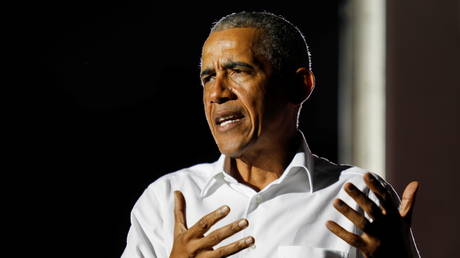
Obama suggests Big Tech algorithms need to be regulated over “misinformation” problem
By Tom Parker | Reclaim The Net | April 8, 2022
Former US President Barack Obama railed against social media platforms for supposedly prompting “white supremacists, insurrectionists, misogynist behavior, bullying behavior,” accused these platforms of undermining democracy, and called for them to be regulated during Wednesday’s “Disinformation and Erosion of Democracy” conference.
At the conference, Obama described himself as “close to a First Amendment absolutist” who believes that you “deal with bad speech with good speech.”
“We don’t want to be policing… everything that’s said on the internet,” Obama added.
However, when it came to speech that Obama deems to be “misinformation” or “disinformation,” he didn’t propose more speech as a solution.
Instead, he framed the weaponization of “information, disinformation, misinformation” as one of the things that he’s “most concerned about” and something that he “underestimated the degree to which democracies were as vulnerable to.”
Obama also claimed that social media product design “monetizes anger, resentment, conflict, division, and, in some cases, makes people very vulnerable” and “can lead to violence.”
“If you are… a woman, if you are a person of color, if you are a trans person right now in certain parts of this country, what’s said matters,” Obama said. “What you now have is…these product designs that are… in a non-transparent way, that we don’t have much insight to, a series of editorial choices are essentially being made that undermine our democracy and oftentimes, when combined with any kind of ethnonationalism misogyny or racism, can be fatal.”
Additionally, the former President invoked the January 6 Capitol riot and complained that social media platforms “have some insight into what’s more likely to prompt white supremacists, insurrectionists, misogynist behavior, bullying behavior” but haven’t been forthcoming about their product designs.
Obama’s proposed solution to his complaints about misinformation and social media is to regulate social media algorithms and subject these platforms to federal inspections.
“I think it is reasonable for us as a society to have a debate and then put in place a combination of regulatory measures and industry norms that leave intact the opportunity for these platforms that make money but say to them that… there’s certain practices you engage in that… we don’t think are good for our society and we’re gonna discourage,” Obama said.
He continued by arguing that “a democracy can rightly expect” social media platforms to share their insights with the public and be subject to a level of scrutiny from federal inspectors that is similar to the safety standards and inspections imposed on producers of meat, cars, and toasters.
Interestingly, when Obama was asked to provide examples of misinformation and disinformation during the conference, his stance varied wildly depending on how these examples affected him.
He branded the first example that he provided, media speculation about his birthplace, as agenda-driven promotion of “a clearly false fact.”
Yet when he provided the second example, the media’s accusations that he’d shared false information and lied about the Affordable (sic) Care Act, Obama admitted that what he’d said was “technically” false but justified it by claiming that “the basic principle I’d laid out, I meant and was true.”
This isn’t the first time Obama has pushed for government oversight of Big Tech. In 2020, the former President called for regulations that curb “crazy lies and conspiracy theories.”
Google Censorship! Now Your Private Email Is Under Threat!
By William Bowles | THE NEW DARK AGE | April 7, 2022
This is the latest outrage inflicted on our right to access information and it goes one step further in the war on freedom of expression!
Previously, intercepts like the one below, only happened when you clicked on a link in your Browser but Google have taken censorship onto an entirely new level. Google now intercepts your PRIVATE EMAIL, allegedly to protect you against phishing and other online scams.
This is how it works:
The email in question arrives in your Inbox and looks normal until you click on it to open it when this message appears, replacing the content of the email!

There are two live links in the offending message, one asks you to report the ‘offending’ site by saying “This isn’t a web forgery…”
Clicking on the link: ‘This isn’t a web forgery…” takes you to the page below:

You can submit a report, either for or against. Once you have submitted the report, you are presented with the following page:

If you reply, which I did, cursing the bastards for interfering with my right to information. ‘Google Safe Browsing’ [sic] but not safe from Google! The algorithm even intercepts mail from Google!
If you click on the link, “Ignore this warning”, the message disappears and the original Email message is revealed but Google have another trick up their sleeve, as any links in the message, DON’T WORK! There is however, a workaround as the actual link is there it just doesn’t work! If you can, copy the link and paste it directly into your browser (Windows and Macs use a different method to reveal the link) and you’ll get to the site in question.
This is insidious censorship masquerading as protecting the user and it reveals the true nature of Google because it means that Google is not only scanning your PRIVATE EMAIL for ‘questionable’ links but of course, for ‘questionable’ content, which means Google is actually reading the contents of your formally, private Email!
Given the ubiquitous nature of Google’s role in ALL electronic communications, short of returning to actual, physical letters, I’m not sure what can be done about this outrage but at least let’s make the world aware that this kind of outrageous interception of our communications is going on. Frankly it’s the final nail in coffin of any kind of democratic control over communications.
Russia, Iran hold major economic forum to expand ties
Press TV – April 7, 2022
Russia has hosted a major economic forum attended by a large Iranian delegation as the two countries seek to expand their trade and economic cooperation.
Iran’s official IRNA news agency said in a Thursday report that representatives from more than 300 Russian businesses and companies had attended the gathering held earlier in the day at the conference hall of the Chamber of Commerce and Industry of the Russian Federation (TPPRF) in Moscow.
An Iranian economic delegation attended the meeting which authorities said was aimed at studying new capacities for economic and trade cooperation between Iran and Russia, said the report.
It said that more than 53 Iranian private businesses were represented in the forum where TPPRF President Sergey Katyrin highlighted the importance of the close cooperation between Iran and Russia in light of the current political and economic circumstances in the region.
Russia has been facing a raft of economic sanctions from the US and European countries since it started a military operation in Ukraine in February.
The sanctions are much similar to a series of bans imposed on Iran by the United States since 2018 when Washington pulled out of an international deal on Iran’s nuclear program and started a campaign of maximum economic pressure on Tehran.
Iran decided to increase its trade ties with Russia since US sanctions were imposed through signing an agreement with the Russia-led EAEU bloc of Eurasian economies.
Trade ties between Iran and Russia exceeded $4 billion in value terms over the Iranian calendar year to March. However, the two countries have insisted the figure could more than double because of new geopolitical situation in the region.
“The goal of the Islamic Republic of Iran is to increase our trade turnover to at least $10 billion in the short-term,” Iranian deputy trade minister Alireza Peymanpak said on Wednesday while addressing Iranian and Russian delegates in Moscow.
Putting Big Bad Pharma Back on Trial in the COVID-19 Era
They keep telling us to “trust the science.” But who paid for it?

Photo credit: Massimo Giachetti
By Rebecca Strong – February 16, 2022
After graduating from Columbia University with a chemical engineering degree, my grandfather went on to work for Pfizer for almost two decades, culminating his career as the company’s Global Director of New Products. I was rather proud of this fact growing up — it felt as if this father figure, who raised me for several years during my childhood, had somehow played a role in saving lives. But in recent years, my perspective on Pfizer — and other companies in its class — has shifted. Blame it on the insidious big pharma corruption laid bare by whistleblowers in recent years. Blame it on the endless string of big pharma lawsuits revealing fraud, deception, and cover-ups. Blame it on the fact that I witnessed some of their most profitable drugs ruin the lives of those I love most. All I know is, that pride I once felt has been overshadowed by a sticky skepticism I just can’t seem to shake.
In 1973, my grandpa and his colleagues celebrated as Pfizer crossed a milestone: the one-billion-dollar sales mark. These days, Pfizer rakes in $81 billion a year, making it the 28th most valuable company in the world. Johnson & Johnson ranks 15th, with $93.77 billion. To put things into perspective, that makes said companies wealthier than most countries in the world. And thanks to those astronomical profit margins, the Pharmaceuticals and Health Products industry is able to spend more on lobbying than any other industry in America.
While big pharma lobbying can take several different forms, these companies tend to target their contributions to senior legislators in Congress — you know, the ones they need to keep in their corner, because they have the power to draft healthcare laws. Pfizer has outspent its peers in six of the last eight election cycles, coughing up almost $9.7 million. During the 2016 election, pharmaceutical companies gave more than $7 million to 97 senators at an average of $75,000 per member. They also contributed $6.3 million to president Joe Biden’s 2020 campaign. The question is: what did big pharma get in return?
ALEC’s Off-the-Record Sway
To truly grasp big pharma’s power, you need to understand how The American Legislative Exchange Council (ALEC) works. ALEC, which was founded in 1973 by conservative activists working on Ronald Reagan’s campaign, is a super secretive pay-to-play operation where corporate lobbyists — including in the pharma sector — hold confidential meetings about “model” bills. A large portionof these bills is eventually approved and become law.
A rundown of ALEC’s greatest hits will tell you everything you need to know about the council’s motives and priorities. In 1995, ALEC promoted a bill that restricts consumers’ rights to sue for damages resulting from taking a particular medication. They also endorsed the Statute of Limitation Reduction Act, which put a time limit on when someone could sue after a medication-induced injury or death. Over the years, ALEC has promoted many other pharma-friendly bills that would: weaken FDA oversight of new drugs and therapies, limit FDA authority over drug advertising, and oppose regulations on financial incentives for doctors to prescribe specific drugs. But what makes these ALEC collaborations feel particularly problematic is that there’s little transparency — all of this happens behind closed doors. Congressional leaders and other committee members involved in ALEC aren’t required to publish any records of their meetings and other communications with pharma lobbyists, and the roster of ALEC members is completely confidential. All we know is that in 2020, more than two-thirds of Congress — 72 senators and 302 House of Representatives members — cashed a campaign check from a pharma company.
Big Pharma Funding Research
The public typically relies on an endorsement from government agencies to help them decide whether or not a new drug, vaccine, or medical device is safe and effective. And those agencies, like the FDA, count on clinical research. As already established, big pharma is notorious for getting its hooks into influential government officials. Here’s another sobering truth: The majority of scientific research is paid for by — wait for it — the pharmaceutical companies.
When the New England Journal of Medicine (NEJM) published 73 studies of new drugs over the course of a single year, they found that a staggering 82% of them had been funded by the pharmaceutical company selling the product, 68% had authors who were employees of that company, and 50% had lead researchers who accepted money from a drug company. According to 2013 research conducted at the University of Arizona College of Law, even when pharma companies aren’t directly funding the research, company stockholders, consultants, directors, and officers are almost always involved in conducting them. A 2017 report by the peer-reviewed journal The BMJ also showed that about half of medical journal editors receive payments from drug companies, with the average payment per editor hovering around $28,000. But these statistics are only accurate if researchers and editors are transparent about payments from pharma. And a 2022 investigative analysis of two of the most influential medical journals found that 81% of study authors failed to disclose millions in payments from drug companies, as they’re required to do.
Unfortunately, this trend shows no sign of slowing down. The number of clinical trials funded by the pharmaceutical industry has been climbing every year since 2006, according to a John Hopkins University report, while independent studies have been harder to find. And there are some serious consequences to these conflicts of interest. Take Avandia, for instance, a diabetes drug produced by GlaxoSmithCline (GSK). Avandia was eventually linked to a dramatically increased risk of heart attacks and heart failure. And a BMJ report revealed that almost 90% of scientists who initially wrote glowing articles about Avandia had financial ties to GSK.
But here’s the unnerving part: if the pharmaceutical industry is successfully biasing the science, then that means the physicians who rely on the science are biased in their prescribing decisions.
Where the lines get really blurry is with “ghostwriting.” Big pharma execs know citizens are way more likely to trust a report written by a board-certified doctor than one of their representatives. That’s why they pay physicians to list their names as authors — even though the MDs had little to no involvement in the research, and the report was actually written by the drug company. This practice started in the ’50s and ’60s when tobacco execs were clamoring to prove that cigarettes didn’t cause cancer (spoiler alert: they do!), so they commissioned doctors to slap their name on papers undermining the risks of smoking.
It’s still a pretty common tactic today: more than one in 10 articles published in the NEJM was co-written by a ghostwriter. While a very small percentage of medical journals have clear policies against ghostwriting, it’s still technically legal —despite the fact that the consequences can be deadly.
Case in point: in the late ’90s and early 2000s, Merck paid for 73 ghostwritten articles to play up the benefits of its arthritis drug Vioxx. It was later revealed that Merck failed to report all of the heart attacks experienced by trial participants. In fact, a study published in the NEJM revealed that an estimated 160,000 Americans experienced heart attacks or strokes from taking Vioxx. That research was conducted by Dr. David Graham, Associate Director of the FDA’s Office of Drug Safety, who understandably concluded the drug was not safe. But the FDA’s Office of New Drugs, which not only was responsible for initially approving Vioxx but also regulating it, tried to sweep his findings under the rug.
“I was pressured to change my conclusions and recommendations, and basically threatened that if I did not change them, I would not be permitted to present the paper at the conference,” he wrote in his 2004 U.S. Senate testimony on Vioxx. “One Drug Safety manager recommended that I should be barred from presenting the poster at the meeting.”
Eventually, the FDA issued a public health advisory about Vioxx and Merck withdrew this product. But it was a little late for repercussions — 38,000 of those Vioxx-takers who suffered heart attacks had already died. Graham called this a “profound regulatory failure,” adding that scientific standards the FDA apply to drug safety “guarantee that unsafe and deadly drugs will remain on the U.S. market.”
This should come as no surprise, but research has also repeatedly shown that a paper written by a pharmaceutical company is more likely to emphasize the benefits of a drug, vaccine, or device while downplaying the dangers. (If you want to understand more about this practice, a former ghostwriter outlines all the ethical reasons why she quit this job in a PLOS Medicine report.) While adverse drug effects appear in 95% of clinical research, only 46% of published reports disclose them. Of course, all of this often ends up misleading doctors into thinking a drug is safer than it actually is.
Big Pharma Influence On Doctors
Pharmaceutical companies aren’t just paying medical journal editors and authors to make their products look good, either. There’s a long, sordid history of pharmaceutical companies incentivizing doctors to prescribe their products through financial rewards. For instance, Pfizer and AstraZeneca doled out a combined $100 million to doctors in 2018, with some earning anywhere from $6 million to $29 million in a year. And research has shown this strategy works: when doctors accept these gifts and payments, they’re significantly more likely to prescribe those companies’ drugs. Novartis comes to mind — the company famously spent over $100 million paying for doctors’ extravagant meals, golf outings, and more, all while also providing a generous kickback program that made them richer every time they prescribed certain blood pressure and diabetes meds.
Side note: the Open Payments portal contains a nifty little database where you can find out if any of your own doctors received money from drug companies. Knowing that my mother was put on a laundry list of meds after a near-fatal car accident, I was curious — so I did a quick search for her providers. While her PCP only banked a modest amount from Pfizer and AstraZeneca, her previous psychiatrist — who prescribed a cocktail of contraindicated medications without treating her in person — collected quadruple-digit payments from pharmaceutical companies. And her pain care specialist, who prescribed her jaw-dropping doses of opioid pain medication for more than 20 years (far longer than the 5-day safety guideline), was raking in thousands from Purdue Pharma, AKA the opioid crisis’ kingpin.
Purdue is now infamous for its wildly aggressive OxyContin campaign in the ’90s. At the time, the company billed it as a non-addictive wonder drug for pain sufferers. Internal emails show Pursue sales representatives were instructed to “sell, sell, sell” OxyContin, and the more they were able to push, the more they were rewarded with promotions and bonuses. With the stakes so high, these reps stopped at nothing to get doctors on board — even going so far as to send boxes of doughnuts spelling out “OxyContin” to unconvinced physicians. Purdue had stumbled upon the perfect system for generating tons of profit — off of other people’s pain.
Documentation later proved that not only was Purdue aware it was highly addictive and that many people were abusing it, but that they also encouraged doctors to continue prescribing increasingly higher doses of it (and sent them on lavish luxury vacations for some motivation). In testimony to Congress, Purdue exec Paul Goldenheim played dumb about OxyContin addiction and overdose rates, but emails that were later exposed showed that he requested his colleagues remove all mentions of addiction from their correspondence about the drug. Even after it was proven in court that Purdue fraudulently marketed OxyContin while concealing its addictive nature, no one from the company spent a single day behind bars. Instead, the company got a slap on the wrist and a $600 million fine for a misdemeanor, the equivalent of a speeding ticket compared to the $9 billion they made off OxyContin up until 2006. Meanwhile, thanks to Purdue’s recklessness, more than 247,000 people died from prescription opioid overdoses between 1999 and 2009. And that’s not even factoring in all the people who died of heroin overdoses once OxyContin was no longer attainable to them. The NIH reports that 80% of people who use heroin started by misusing prescription opioids.
Former sales rep Carol Panara told me in an interview that when she looks back on her time at Purdue, it all feels like a “bad dream.” Panara started working for Purdue in 2008, one year after the company pled guilty to “misbranding” charges for OxyContin. At this point, Purdue was “regrouping and expanding,” says Panara, and to that end, had developed a clever new approach for making money off OxyContin: sales reps were now targeting general practitioners and family doctors, rather than just pain management specialists. On top of that, Purdue soon introduced three new strengths for OxyContin: 15, 30, and 60 milligrams, creating smaller increments Panara believes were aimed at making doctors feel more comfortable increasing their patients’ dosages. According to Panara, there were internal company rankings for sales reps based on the number of prescriptions for each OxyContin dosing strength in their territory.
“They were sneaky about it,” she said. “Their plan was to go in and sell these doctors on the idea of starting with 10 milligrams, which is very low, knowing full well that once they get started down that path — that’s all they need. Because eventually, they’re going to build a tolerance and need a higher dose.”
Occasionally, doctors expressed concerns about a patient becoming addicted, but Purdue had already developed a way around that. Sales reps like Panara were taught to reassure those doctors that someone in pain might experience addiction-like symptoms called “pseudoaddiction,” but that didn’t mean they were truly addicted. There is no scientific evidence whatsoever to support that this concept is legit, of course. But the most disturbing part? Reps were trained to tell doctors that “pseudoaddiction” signaled the patient’s pain wasn’t being managed well enough, and the solution was simply to prescribe a higher dose of OxyContin.
Panara finally quit Purdue in 2013. One of the breaking points was when two pharmacies in her territory were robbed at gunpoint specifically for OxyContin. In 2020, Purdue pled guilty to three criminal charges in an $8.3 billion deal, but the company is now under court protection after filing for bankruptcy. Despite all the damage that’s been done, the FDA’s policies for approving opioids remain essentially unchanged.
Purdue probably wouldn’t have been able to pull this off if it weren’t for an FDA examiner named Curtis Wright, and his assistant Douglas Kramer. While Purdue was pursuing Wright’s stamp of approval on OxyContin, Wright took an outright sketchy approach to their application, instructing the company to mail documents to his home office rather than the FDA, and enlisting Purdue employees to help him review trials about the safety of the drug. The Food, Drug, and Cosmetic Act requires that the FDA have access to at least two randomized controlled trials before deeming a drug as safe and effective, but in the case of OxyContin, it got approved with data from just one measly two-week study — in osteoarthritis patients, no less.
When both Wright and Kramer left the FDA, they went on to work for none other than (drumroll, please) Purdue, with Wright earning three times his FDA salary. By the way — this is just one example of the FDA’s notoriously incestuous relationship with big pharma, often referred to as “the revolving door”. In fact, a 2018 Science report revealed that 11 out of 16 FDA reviewers ended up at the same companies they had been regulating products for.
While doing an independent investigation, “Empire of Pain” author and New Yorker columnist Patrick Radden Keefe tried to gain access to documentation of Wright’s communications with Purdue during the OxyContin approval process.
“The FDA came back and said, ‘Oh, it’s the weirdest thing, but we don’t have anything. It’s all either been lost or destroyed,’” Keefe told Fortune in an interview. “But it’s not just the FDA. It’s Congress, it’s the Department of Justice, it’s big parts of the medical establishment … the sheer amount of money involved, I think, has meant that a lot of the checks that should be in place in society to not just achieve justice, but also to protect us as consumers, were not there because they had been co-opted.”
Big pharma may be to blame for creating the opioids that caused this public health catastrophe, but the FDA deserves just as much scrutiny — because its countless failures also played a part in enabling it. And many of those more recent fails happened under the supervision of Dr. Janet Woodcock. Woodcock was named FDA’s acting commissioner mere hours after Joe Biden was inaugurated as president. She would have been a logical choice, being an FDA vet of 35 years, but then again it’s impossible to forget that she played a starring role in the FDA’s perpetuating the opioid epidemic. She’s also known for overruling her own scientific advisors when they vote against approving a drug. Not only did Woodcock approve OxyContin for children as young as 11 years old, but she also gave the green light to several other highly controversial extended-release opioid pain drugs without sufficient evidence of safety or efficacy. One of those was Zohydro: in 2011, the FDA’s advisory committee voted 11:2 against approving it due to safety concerns about inappropriate use, but Woodcock went ahead and pushed it through, anyway. Under Woodcock’s supervision, the FDA also approved Opana, which is twice as powerful as OxyContin — only to then beg the drug maker to take it off the market 10 years later due to “abuse and manipulation.” And then there was Dsuvia, a potent painkiller 1,000 times stronger than morphine and 10 times more powerful than fentanyl. According to a head of one of the FDA’s advisory committees, the U.S. military had helped to develop this particular drug, and Woodcock said there was “pressure from the Pentagon” to push it through approvals. The FBI, members of congress, public health advocates, and patient safety experts alike called this decision into question, pointing out that with hundreds of opioids already on the market there’s no need for another — particularly one that comes with such high risks.
Most recently, Woodcock served as the therapeutics lead for Operation Warp Speed, overseeing COVID-19 vaccine development.
To be continued…
Rebecca Strong is a Boston-based freelance health and wellness writer currently contributing to Insider, Health magazine, Healthline, Eat This Not That, and more.
Featured Video

Deception – Submarines against Olof Palme
or go to
Aletho News Archives – Video-Images
From the Archives
Woolsey Fire started at Santa Susana Field Lab — where “radioactive materials released were never accurately measured”
By John Laforge | CounterPunch | November 30, 2018
In my Nov. 16 column, I reported on potential radiation risks posed by California’s Woolsey wildfire having burned over parts or all of the Santa Susana Field Laboratory—south of Simi Valley, Calif., 30 miles outside Los Angeles—site of at least four partial or total nuclear reactor meltdowns.
The field laboratory operated 10 experimental reactors and conducted rocket engine tests. In his 2014 book Atomic Accidents, researcher James Mahaffey writes, “The cores in four experimental reactors on site … melted.” Reactor core melts always result in the release of large amounts of radioactive gases and particles. Clean up of the deeply contaminated site has not been conducted in spite of a 2010 agreement.
Los Angeles’s KABC-7 TV reported Nov. 13 that the Santa Susana lab site “appears to be the origin of the Woolsey Fire” which has torched over 96,000 acres. Southern Calif. Public Radio said, “According to Cal Fire, the Woolsey Fire started on the afternoon of Thursday, Nov. 8 … on the Santa Susana site.” … continue
Blog Roll
 Aletho News
- Between war and industrial breakdown: The US-Israeli attrition crisis
- Pressure builds on Iran to ‘drop’ Lebanon ceasefire demand as Islamabad talks hang in balance
- In another clash report, US denies agreement to release Iran’s assets
- What is fueling unrest across the EU?
- Why no power can undermine Iran’s eternal dominance over the Strait of Hormuz
- Is The War Against Iran Over?
- Iran war will leave long-term ‘scar’ on Wall Street, investors warn
- How Iran decimated US power projection in West Asia: Military lessons of 40-day war
- Iran’s report details US-Israeli war crimes in targeting schools, hospitals, livelihoods
- NATO’s Slow Fracture: How Trump’s Iran War Exposed the Instrument of Hegemony
- If Americans Knew
- After killing 350+, Israel still has a “score to settle” with Lebanon before ceasefire – Daily Update
- Military aid to Israel emerges as the latest political litmus test for Democrats
- The only Palestinian children’s rights organization closes following years-long Israeli campaign against it
- ‘I Can’t Forget the Smell’: Lebanese Reel After Israel Kills Over 300 in Single Day
- DNC Shoots Down Resolutions Calling Out AIPAC and Limiting Arms to Israel
- TCN: Is Israel Blackmailing President Trump?
- Israel killed at least 303 Lebanese yesterday – who were they? Daily Update
- Amnesty: Urgent – Protect Lebanese civilians from brutal escalation in Israeli attacks
- Is The War Against Iran Over?
- Inside the Israeli army’s propaganda wing
- No Tricks Zone
- New Study: No Linear Warming Or Glacier Retreat Along Northern Antarctic Peninsula Since 1980s
- An Inconvenient Tree: Uncovered In Alps… Europe Much Warmer Than Today 6000 Years Ago
- New Study Reports A 60% Slowdown In Greenland’s Ice Loss Rate In The Last Decade
- Low Intensity Tornado Wrecks Major Solar Farm, Creating A Potential Toxic Dump
- New Study Finds Warming Saves Lives…Cold Temperatures 12 Times More Deadly Than Excess Heat
- German Science Blog Accuses PIK Climate Institute Of Hallucinating Climate Tipping Points
- Devastating Assessment Of Comirnaty Vaccine By Former Senior Pfizer Europe Toxicologist
- New Study: CO2 Is ‘Effectively Negligible’ As An Explanatory Climate Change Factor Since 2000
- Former Pfizer Toxicologist Dr. Helmut Sterz Tells Bundestag Hearing Pfizer Vaccine Should Have Never Been Approved
- Energy Expert: Germany’s Nuclear Phaseout Was A “500 Billion Euro Mistake”
 Aletho News