20 states threaten legal action over DHS disinformation board
By Dan Frieth | Reclaim The Net | May 6, 2022
Attorneys General from 20 conservative states are threatening legal action against the Department of Homeland Security’s newly formed Disinformation Governance Board, which they said will have a chilling effect on freedom of expression and described as “un-American.”
Virginia’s AG Jason Miyares and 19 other attorneys general sent a letter to Alejandro Mayorkas, the Homeland Security Secretary, demanding the dissolution of the Disinformation Governance Board.
We obtained a copy of the letter for you here.
“This is an unacceptable and downright alarming encroachment on every citizen’s right to express his or her opinions, engage in political debate, and disagree with the government,” the attorneys general wrote.
The Republicans are taking issue with the timing of the new board, as it comes after it was revealed that the White House was flagging posts on behalf of social media platforms. Additionally, it comes just after Tesla CEO Elon Musk, a self-described free speech absolutist, made a bid for Twitter.
“Suddenly, just as Elon Musk prepares to acquire Twitter with the stated purpose of correcting the platform’s censorship of free speech, you announce the creation of the Disinformation Governance Board. As the Biden Administration apparently loses a critical ally in its campaign to suppress speech it deems “problematic,” you have created a new government body to continue that work within the federal government,” the letter says.
“The contemporaneous occurrence of these two events is hard to explain away as mere coincidence. It instead raises troubling questions about the extent of the Biden Administration’s practice of coordinating with private-sector companies to suppress disfavored speech.”
The Republicans also expressed concern about the leader of the board, Nina Jankowicz, noting that she is “often in error but never in doubt.” She claimed the Hunter Biden laptop story was Russian propaganda, a theory that has since been proven wrong.
The attorneys general argue the board is illegal because there is “no statutory authority” supporting its creation.
“Unless you turn back now and disband this Orwellian Disinformation Governance Board immediately, the undersigned will have no choice but to consider judicial remedies to protect the rights of their citizens,” the letter concludes.
Missouri and Louisiana Attorneys General sue Biden over Big Tech ‘collusion’
Samizdat | May 6, 2022
Attorneys General from two Republican-led US states, Missouri and Louisiana, have filed a lawsuit against the Biden administration, Fox News reported on Thursday. The states are accusing high-ranking officials, including President Joe Biden, of having “pressured and colluded” with social media companies to censor and suppress information on a number of big stories over the past two years.
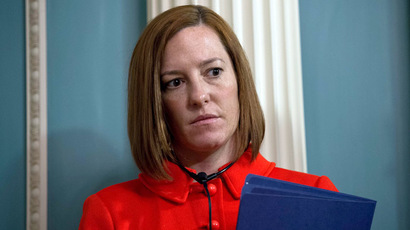
Among the officials named as defendants are White House Press Secretary Jen Psaki and the President’s Chief Medical Advisor Dr. Anthony Fauci. They, and others, are accused of exerting undue pressure on, or working together, with a number of Big Tech companies such as Meta, Twitter and YouTube to suppress information regarding the Hunter Biden laptop controversy, the origins of Covid-19, and security concerns associated with mail-in voting during the pandemic.
Missouri Attorney General Eric Schmitt and Louisiana Attorney General Jeff Landry claim the Biden Administration has been doing so “under the guise of combating misinformation.”
The lawsuit, filed on Thursday in the U.S. District Court for the Western District of Louisiana, describes the administration’s supposed efforts to hush up certain information as “one of its greatest assaults by federal government officials in the Nation’s history” on Americans’ constitutional right to free speech.
The filing goes on to claim that “Having threatened and cajoled social-media platforms for years to censor viewpoints and speakers disfavored by the Left, senior government officials in the Executive Branch have moved into a phase of open collusion with social-media companies to suppress disfavored speakers, viewpoints, and content on social-media platforms under the Orwellian guise of halting so-called ‘disinformation,’ ‘misinformation,’ and ‘malinformation’.”
In an exclusive statement to Fox News Digital, Missouri Attorney General Eric Schmitt explained the decision to file the lawsuit by saying that he would “not stand idly by while the Biden Administration attempts to trample on the First Amendment rights of Missourians and Americans.”
His colleague from the state of Louisiana, Jeff Landry, went so far as to characterize Big Tech as an “extension of Biden’s Big Government,” which is busy “suppressing truth and demonizing those who think differently.” Landry compared Joe Biden to Joseph Stalin over the president’s policies that allegedly aim to “censor free speech and propagandize the masses.” The Attorney General said the lawsuit was seeking to “ensure the rule of law and prevent the government from unconstitutional banning, chilling, and stifling of speech.”
Among the cases brought up in the filing are Twitter’s decision to disable the sharing of a 2020 New York Post story revolving around the contents of Hunter Biden’s laptop that was recovered from a repair shop in Delaware. The report was later found to be accurate by the Washington Post and the New York Times, the two Attorneys General pointed out.
In a separate instance, Facebook supposedly censored posts suggesting that Covid-19 may have accidentally leaked from a laboratory in Wuhan, China. The Attorneys General claim that it was Anthony Fauci who orchestrated an effort to “discredit” the narrative while “exchanging emails with Mark Zuckerberg, the CEO of Facebook, regarding the control and dissemination of Covid-19 information.” The campaign only began to wind down after more media outlets started reporting on the viability of the theory, the lawsuit alleges.
In addition, according to the filing, YouTube effectively censored Republican Senator Rand Paul and Florida Governor Ron DeSantis for calling into question the effectiveness of wearing cloth masks during the Covid pandemic.
Another major case where “social-media platforms aggressively censored” speech, as Schmitt and Landry allege, was the run-up to the November 2020 presidential race. The Attorneys General claim that Donald Trump’s concerns regarding the security of mail-in voting were stifled by Big Tech at the time. Trump’s tweets were flagged, with a notice directing users to the facts surrounding the practice.
As further proof that the Biden administration has been exerting undue pressure on social media platforms to suppress free speech, the filing mentions Surgeon General Vivek Murthy’s statement back in June 2021, where he said “we expect more from our technology companies… We’re asking them to monitor misinformation more closely.” Moreover, the latest launch of the new DHS disinformation board just goes to show that the current US political leadership is intent on ramping up its “campaign of censorship,” the Attorneys General warn.
Fox News, which covered the lawsuit filing, reached out to Meta, Twitter, YouTube as well as the White House for comment, but apparently none of them have replied so far.
US bragging about its direct involvement in Ukraine may lead to uncontrollable escalation
By Drago Bosnic | May 6, 2022
On May 4, the New York Times published a highly controversial article openly bragging about how the United States has been providing critical intelligence about the location and movement of Russian troops, which has allowed Ukrainians to target them. The publication also claims that “many Russian generals have died in action in the Ukraine as a result,” citing senior US officials. However, this is hardly news, since the US and NATO have been doing it since day one of the special military operation in Ukraine. The Russian military has been warning the political West about this issue. And yet, the US and NATO aren’t only ignoring the warnings, but are also openly bragging about their actions which are contributing to the death of Russian military personnel in Ukraine as we speak.
The claim that “many Russian generals have died” is questionable at best, but it does show the US and NATO’s determination, whose involvement is key to prolonging the conflict. An epidemic of fake news about alleged injuries or even murder of Russian High Command officers has become the mainstay, even among the once-respected Western media. According to these news outlets, Russian Defense Minister Sergei Shoigu has so far survived at least two heart attacks “due to bad performance and high casualties of the Russian military” and even “Putin’s order to shoot the Defense Minister for his failures in Ukraine”.
These claims are not just outright lies, but simply ridiculous. However, they expose the mainstream media in the US and other NATO countries as an inalienable part of the military and (geo)political structure. Their reporting is designed not just to demoralize the opponent, but also to boost public morale, galvanize it and push for more support for a potential war with the targeted country or even a group of countries. This is exacerbating the already high tensions between the political West on one side and Russia and its allies on the other.
When the special military operation started, the US and NATO at least claimed their non-involvement, even though everyone knew they were involved. But the very statement they weren’t sent a message that NATO will not escalate tensions. However, this report has now changed that. By admitting effectively direct involvement in the conflict, the US and NATO are opening the door for further escalation, which most certainly will not be appreciated by Russia, whose leadership has already given strong statements regarding this issue.
The intelligence sharing is part of “a stepped-up flow” in US assistance that includes heavier weapons and billions in military supplies, demonstrating how quickly the “early American restraint” on support for Ukraine has shifted as the war enters a new stage, the NYT reported. This is further proof that the US is not interested in de-escalation. On the contrary, the latest “lethal aid” package President Biden announced is said to be $33 billion, a truly staggering sum, orders of magnitude greater than Ukraine’s annual military budget.
“The administration has sought to keep much of the battlefield intelligence secret, out of fear it will be seen as an escalation and provoke President Vladimir V. Putin of Russia into a wider war. American officials would not describe how they have acquired information on Russian troop headquarters, for fear of endangering their methods of collection. But throughout the war, the U.S. intelligence agencies have used a variety of sources, including classified and commercial satellites, to trace Russian troop movements,” the NYT report added.
This statement alone should trigger alarm across the globe. The admission that the US military and intelligence services are using commercial satellites in their operations sets a dangerous precedent which further blurs the line between civilians and the military. This comes at a time when companies such as SpaceX are accused of using their products and services, most notably the Starlink satellites, to help the Ukrainian military target Russian and DLNR units. It’s clear the US is mobilizing all of its assets in an attempt to weaken Russia. In fact, this is exactly what US Defense Secretary Lloyd Austin openly stated. He went so far as to say that “we want to see Russia weakened to the degree it cannot do the kinds of things that it has done in invading Ukraine.”
However, there are still moments when the Pentagon and State Department are giving vague and even contradictory statements regarding this issue. When asked about the intelligence being provided to the Ukrainian side, Pentagon spokesman John Kirby said that “we will not speak to the details of that information.” But he acknowledged that the US provides Ukraine with intelligence information. After the NYT article was published, Adrienne Watson, a National Security Council spokeswoman, said that the battlefield intelligence was not provided to the Ukrainians “with the intent to kill Russian generals.”
“Not all the strikes have been carried out with American intelligence. A strike over the weekend at a location in eastern Ukraine where Gen. Valery Gerasimov, Russia’s highest-ranking uniformed officer, had visited was not aided by American intelligence, according to multiple U.S. officials. The United States prohibits itself from providing intelligence about the most senior Russian leaders,” the official said.
This statement clearly refers to the reports that the Chief of Russian General Staff, General Gerasimov was allegedly wounded in a Ukrainian strike during a visit to the frontline units. Again, this shows an almost schizophrenic nature of statements coming from US officials. First, they are bragging about the “decisive role” of their intelligence support to Ukrainians, but as soon as reports of Russian High Command officers being injured surface, they are quick to announce how this support might not be “as decisive as previously thought”.
This just goes to show how dangerous US involvement in Ukraine is. Even though we know the statements about Gerasimov are false, an obvious question arises, what if it were to happen? What if he or any other Russian High Command officer were injured in Ukraine? Does the US truly believe they could just say “it wasn’t our intelligence” in an attempt to control the level of escalation which could plunge all of us into a world-ending conflict?
Drago Bosnic is an independent geopolitical and military analyst.
US’ coercive diplomacy with Saudi Arabia
BY M. K. BHADRAKUMAR | INDIAN PUNCHLINE | MAY 6, 2022
Some three weeks after the reported meeting of the CIA chief William Burns with the Crown Prince of Saudi Arabia Prince Mohammed bin Sultan, the OPEC+ ministerial held a videoconference on Thursday.
The OPEC+ meet drew satisfaction that “continuing oil market fundamentals and the consensus on the outlook pointed to a balanced market.” The press release issued in Vienna says the ministerial “further noted the continuing effects of geopolitical factors and issues related to the ongoing pandemic” and decided that the OPEC+ sticks to the monthly production adjustment mechanism agreed in July last year “to adjust upward the monthly overall production by 0.432 million barrels/day for the month of June 2022.”
As per the former publisher of the Journal Karen Elliott House, Burns came to Saudi Arabia for a “mating dance” with Prince Mohammad — namely, the Prince must cooperate on a new oil-for-security strategy to “increase production to save European nations from energy shortages.”
Burns’ visit to the Kingdom took place just ahead of the 5th round of Saudi-Iranian normalisation talks in Baghdad between the Saudi intelligence chief and the deputy head of Iran’s Supreme National Security Council. The Iraqi Prime Minister Mustafa al-Kadhemi who was acting as mediator and attended the latest round of talks told the state media last week, “Our brothers in Saudi Arabia and Iran approach the dialogue with a big responsibility as demanded by the current regional situation. We are convinced that reconciliation is near.”
Nournews, affiliated to Iran’s Supreme National Security Council, also reported on April 24 that the fifth round of talks on a possible détente was “constructive” and the negotiators managed “to draw a clearer picture” of how to resume bilateral relations, and, “given the constructive bilateral dialogue so far, there is a possibility of a meeting between the Iranian and Saudi top diplomats in the near future.”
Burns’ mission couldn’t have been indifferent toward the Saudis’ reconciliation track with Tehran. With the outcome of the JCPOA talks in Vienna uncertain, Iran’s close ties with Russia and China remains a major worry for Washington. And with Tehran’s stubborn refusal to trim its regional policies to suit US regional strategies, Washington has fallen back on the default option to resuscitate the anti-Iran front of its regional allies. The US hopes that Saudi Arabia will come on board the Abraham Accords.
Meanwhile, the issue of oil prices has returned to the centre stage. Indeed, high oil prices mean high income for Russia. Russia’s sales of oil and natural gas far exceeded initial forecasts for 2021 as a result of skyrocketing prices, accounting for 36% of the country’s total budget. The revenues exceeded initial plans by 51.3%, totalling $119 billion. The Biden administration’s best-laid plans to cripple the Russian economy are unravelling. Equally, high oil price is also a domestic issue for Biden. Above all, unless Europe finds other oil sources, it will continue buying Russian oil.
However, Prince Mohammad has a different agenda. He is likely to rule Saudi Arabia for many decades—half a century if he lives to 86, his father’s age. And the Prince has been remarkably successful in creating a “power base”. His lifestyle changes have been a smashing hit with Saudis 35 and under—70% of the Kingdom’s citizens — and his ambition to transform Saudi Arabia into a modern technological leader ignites the imagination of the youth.
Clearly, his refusal to punish Russia and his gesture to place the princely amount of $2bn in a new, untested investment fund started by Trump’s son-in-law Jared Kushner speak for themselves. Prince Mohammed would have his own reasons too, starting with Biden’s contemptuous reference to Saudi Arabia as a “Pariah” state and refusal to deal in person.
The Prince hit back recently by declining to take a call from Joe Biden. Besides, the US’ restrictions on arms sales; insufficient response to attacks on Saudi Arabia by Houthi forces; publication of a report into the 2018 murder of Jamal Khashoggi — all these are in play here.
Even if the administration is able to get Congressional approval for new security guarantees for Saudi Arabia (which is rather problematic), Prince Mohammad may not be swayed, since at the end of the day, high oil prices boost Saudi budget too.
The paradox is, both Saudi Arabia and Russia are stakeholders in OPEC+ as is evident from the explicit warning to the EU by OPEC Secretary General Mohammad Barkindo last month that it would be impossible to replace more than 7 million barrels per day of Russian oil and other liquids exports potentially lost due to current or future sanctions or voluntary actions.
In such a torrential stream where crosscurrents are foaming and weltering, what probably unnerves the Biden Administration most could be the talk that Chinese President Xi Jinping may be planning to visit Saudi Arabia, amidst persistent reports recently that Riyadh and Beijing are in talks to price some of the Gulf nation’s oil sales in yuan rather than dollars, which would indeed mark a profound shift for the oil market and help advance China’s efforts to convince more countries and international investors to transact in its currency.
The Saudi explanation for the shift to the yuan is that the kingdom could use part of new currency revenues to pay Chinese contractors involved in mega projects within the kingdom domestically, which would reduce the risks associated with the capital controls Beijing imposes on its currency. But, for Washington, that means certain sensitive Saudi-China transactions in yuan do not appear in the rearview mirror of the SWIFT messaging infrastructure, making transaction monitoring unviable.
There are persistent US reports that with Chinese support, Saudi Arabia may be constructing a new uranium processing facility near Al Ula to enhance its pursuit of nuclear technology. Saudi Arabia’s generous $8 billion in financial support for Pakistan, unveiled this week, will almost certainly raise hiccups in Washington.
Saudi Arabia is a central pillar of China’s Belt and Road infrastructure initiative and ranks in the top three countries globally for Chinese construction projects, according to the China Global Investment Tracker, run by the American Enterprise Institute. Suffice to say, the CIA chief’s call could not have been for a friendly chat with Prince Mohammad.
‘Don’t patronize us’ over Ukraine, India tells Netherlands
Samizdat | May 6, 2022
India’s Permanent Representative to the United Nations, TS Tirumurti, has accused the Netherlands of “patronizing” his country after the Dutch ambassador to the UK publicly scolded New Delhi for abstaining on UN General Assembly resolutions on the war in Ukraine.
“Kindly don’t patronise us, Ambassador. We know what to do,” Tirumurti wrote in a tweet to Dutch envoy Karel van Oosterom on Thursday.
Tirumurti’s tweet came in response to van Oosterom’s (now-deleted) warning that India “should not have abstained” from votes pertaining to Russia and the war in Ukraine and that it should “respect the UN Charter.”
Despite repeated calls and pressure to join the West in isolating Russia over the Ukraine war, New Delhi has been reluctant to cut ties with Moscow.
India has abstained on multiple votes and resolutions at the UN General Assembly this year, including a vote moved by the US in April to suspend Russia from the UN Human Rights Council over accusations of the killing of civilians.
India also abstained from a vote brought by Ukraine and its backers in March, condemning Russia over the humanitarian situation in the country, saying then that the focus should be on the cessation of hostilities.
In a statement delivered Wednesday at the UN Security Council meeting on Ukraine, Tirumurti reiterated India’s position that “pursuing the path of dialogue and diplomacy” is the “only way out” of the crisis.
“India remains on the side of peace and therefore believes that there will be no winning side in this conflict and, while those impacted by this conflict will continue to suffer, diplomacy will be a lasting casualty,” he said.
The South Asian nation has a strong trading relationship with Russia, receiving arms from Moscow in previous agreements between the two sides. It even deemed the current situation an opportunity to broaden cooperation. The country boosted oil purchases from Russia recently, despite pressure from Washington.
European Commission’s plan to ban Russian oil imports receives backlash
By Paul Antonopoulos | May 6, 2022
The European Union announced on May 4 their intention to ban Russian oil imports within six months and refined products by the end of the year as part of their latest round of economic sanctions against Moscow. According to Oil Price, a barrel surged to over $110 for Brent and $108 for West Texas Intermediate following the European Commission’s announcement. Therefore, banning Russian oil imports is not only a rather arduous task, but the cost of this decision will be high.
“In the short term it might leave Russian revenues high while implying negative consequences for the EU and the global economy in terms of higher prices – not to mention retaliation risks [by Russia] on natural gas supplies,” Brussels-based economic think tank Bruegel warned following the European Commission’s announcement. However, an EU diplomat told EURACTIV on condition of anonymity that “Politically, Europe cannot afford not adopting the sixth package [of economic sanctions].”
The EU will be once again be divided as its rare instance of geopolitical posturing is being challenged by the economic interests of individual member states. Hungary and Slovakia oppose the European Commission’s proposal despite being given until the end of 2023 to phase out Russian oil. At the same time, Bulgaria and Czechia have also asked to be given such an extension.
Sources have said Greece raised objections to another proposal to ban all shipping companies that are EU-owned or have European interests from transferring Russian oil into Europe or elsewhere, something of major importance since the Mediterranean country has the largest mercantile fleet in the world. Although Athens deeply supports all of the EU’s hostile actions against Russia, such as the expulsion of diplomats, imposition of sanctions and even the sending of weapons to Ukraine that could have ended up in the hands of the Azov Battalion that has persecuted the Greek minority, threatening the profits of Greek oligarchs provokes one of the rare instances of opposition from Greece’s ruling New Democracy party.
New Democracy is traditionally the pro-US/neo-liberal party of Greece that has served the interests of the country’s oligarchs, or softly known as magnates or tycoons, particularly the shipowners. Consider that 71% of Greeks in a poll said Greece’s position in the Ukraine War should be neutral, something that was categorically ignored by the Greek government as it strongly backed Ukraine instead. However, the moment that the profits of shipowners are threatened, and not over the past few months as citizens have dealt with rising energy and food costs, Athens voiced its first concern against the EU’s anti-Russia sanctions.
Theoretically, although Russian oil can be phased out of most of the EU within six months, it will none-the-less be a very difficult task, especially when taking into account the fact that there is currently an energy shortage. In addition, the imposition of such a policy could lead to a build-up of shocks in the EU economy.
The Russian economy will naturally be affected as it will be deprived of a major market. But of higher concern, for European citizens at least, is the realization of the effects that anti-Russia sanctions has even on their own daily lives. And whilst Europeans suffer from rising energy and food costs, Asia could very much become Gazprom’s main export market in five to seven years.
Although this does not offset the loss of the EU as an oil market, shifting most exports to much friendlier Asian markets will lessen the effects of Western sanctions, even if this shift could take several years. Although the problem is the supply price and the development of the corresponding gas transport infrastructure, including in countries like China, it is recalled that Russian President Vladimir Putin made a directive to the government to submit a plan by June 1 on how to build related infrastructure. The directive requested a proposal for a large-scale development of a gas pipeline system in Eastern Siberia, aimed at directing the flow of gas exports to the Chinese market.
China currently consumes about 350 billion cubic meters of gas per year, while the majority of the energy balance (about 70%) remains coal. Demand for gas in China is expected to grow to 450-480 billion cubic meters by 2025 and in the next 10 years, as coal is phased out, perhaps even nearly one trillion cubic meters of gas per year.
Currently, Russian gas supplies to China arrive through the “Power of Siberia” pipeline. Deliveries along this route began at the end of 2019 and in 2020 reached 4.1 billion cubic meters. It is expected that the annual supply volume will gradually increase until it reaches its capacity of 38 billion cubic meters in 2025. Taking into account the new agreement signed in February, the total gas capacity supplied to China via the Far Eastern pipeline could reach 48 billion cubic meters per year.
In this way, although Russia will be hurt in the short term by losing the European market for its oil, this action will only propel the flow of Russian energy eastward to an Asia that is continuously increasing its demand. Equally of interest is that Europe persistently promises that sanctions against Russia cannot hurt European citizens in equal measure, but weaning off Russian oil within a six-month period will only increase the likelihood of such an outcome.
Paul Antonopoulos is an independent geopolitical analyst.
Israel provoking Palestine factions with actions in Al-Aqsa Mosque

MEMO | May 5, 2022
Israeli occupation authorities provoked Palestinian factions after allowing Jewish settlers to storm Al-Aqsa Mosque, statements issued yesterday said.
The Israeli government decided to allow Jewish settlers to storm Al-Aqsa Mosque today.
Hamas said: “Allowing Israeli settlers to storm Al-Aqsa Mosque is playing with fire and this could drag the region into a new escalation.”
“We renew our call for the Palestinian people to travel to Al-Aqsa Mosque and be on high alert in Jerusalem in order to defend their identity, religion and first Qibla.”
According to Hamas, “the Israeli occupation must know that all attempts aimed at dividing Al-Aqsa Mosque or Judaising Muslim holy sites will not pass and will not achieve its malicious goals.”
Meanwhile, spokesman of the Islamic Jihad in the West Bank, Tariq Izzedine, said: “The continuation of Israeli violations against Al-Aqsa Mosque is a violation of Palestinian redlines that needs an urgent movement to stop it.”
Fatah called on Palestinians to gather in Al-Aqsa Mosque today to thwart a “planned provocative Israeli plan to raise the Israeli flag and sing the Israeli anthem at the Palestinian holy site.”
Hamas hails Palestinian worshipers’ heroism
Palestine Information Center – May 5, 2022
 GAZA – Hamas Movement’s spokesman Hazem Qassem hailed the Palestinian worshipers’ heroism in confronting Israeli attacks on al-Aqsa Mosque on Thursday morning.
Israeli authorities are witnessing a state of confusion and panic in face of the Palestinian strong determination, he stressed.
Al-Aqsa Mosque was and will remain a pure Islamic and Arabic shrine, he added.
Earlier Thursday, dozens of Palestinian worshipers were injured after Israeli police forces violently stormed al-Aqsa Mosque in Occupied Jerusalem to clear the area for Jewish settlers’ break-ins that had been paused for the Muslim holidays.
The police forces fired rubber-coated bullets and teargas bombs, injuring dozens of Palestinians. At least 12 live-shot injuries were reported.
Ten worshipers were detained during the attack, including a French Muslim woman.
Three Israelis killed, others injured in stabbing incident
Palestine Information Center – May 5, 2022
OCCUPIED JERUSALEM – Three Israelis were killed while others were wounded in a stabbing incident in Elad area to the east of Tel Aviv on Thursday night.
Hebrew media reported that a number of those injured were in very serious conditions.
Preliminary reports indicated that the attacker used an axe and a knife in his attack before withdrawing from the area.
The Elad municipality asked citizens to remain indoors as the Israeli police forces set up barriers and launched a large-scale manhunt searching for the attacker with the help of choppers.
Taxpayer funding for media backfires
Taxpayers’ Union NZ | May 6, 2022
This week we released the results of a new scientific poll confirming what we have long suspected: New Zealanders don’t trust Government-funded media outlets to hold the Government to account.
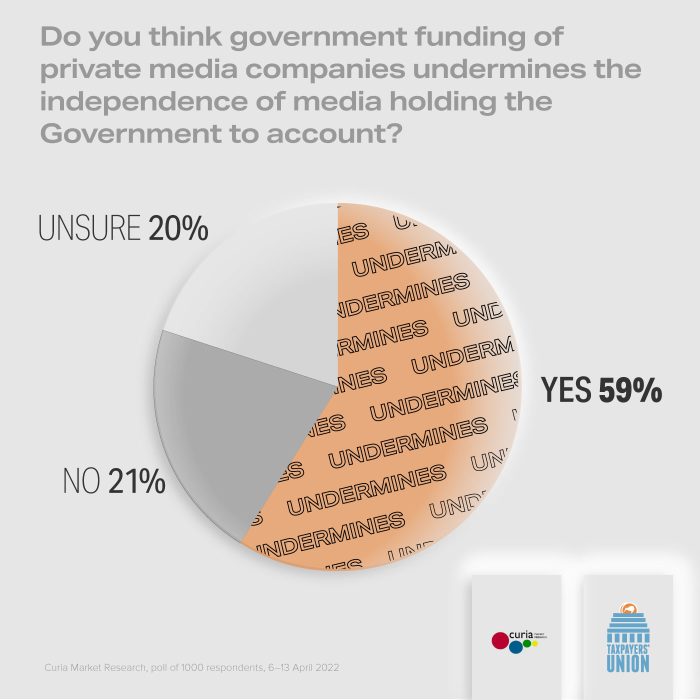
Payments from the likes of the $55 million “Public Interest Journalism” Fund present a clear conflict of interest to media outlets like Stuff and the NZ Herald, who now have millions of dollars at stake in electing a government that protects their funding.
Whenever we challenge media bosses on this they always insist that their company is immune from editorial influence. But they can no longer deny that the decision to accept funding has eroded readers’ trust.
One day after the poll’s publication, the media outlets failed an obvious test: not one of the outlets to have received PIJF funding has covered the results of the poll.
The poll has however been covered by The Platform – a new outlet with a policy of not accepting taxpayer money. Graham Adams’s article explains how funding recipients are pressured into skewing their coverage of Treaty/co-governance issues.
For the record, we are tracking all payments from the Public Interest Journalism Fund on our website. Click here to find out who got taxpayer money.
We’re calling on media outlets to salvage their credibility by repaying taxpayer funding, and declining any future payments.
Click here to sign the petition calling for the media to Pay Back the $55 Million.
The Return to the Good Old Days of Ignoring CDC Recommendations

By Adam Dick | Ron Paul Institute | May 5, 2022
It has been two weeks since a United States district court struck down President Joe Biden’s mandate, imposed through the Centers for Disease Control and Prevention (CDC), that people wear masks when traveling via public transportation, or by taxi or ride-share service, as well as when at related locations, such as airports. After the court decision, most transportation companies and locations have been quick to make clear that people are free to leave their faces uncovered. Many people have been very happy to do just that.
The CDC, however, has not given up on hectoring people to “wear your mask.” On Tuesday, the CDC released a “media statement” titled “CDC Recommendation for Masks and Travel.” Starting off, the media statement declares that the CDC “recommends that everyone aged 2 and older – including passengers and workers – properly wear a well-fitting mask or respirator over the nose and mouth in indoor areas of public transportation (such as airplanes, trains, etc.) and transportation hubs (such as airports, stations, etc.).” Further, the CDC states that it encourages “operators of public transportation and transportation hubs to support mask wearing by all people, including employees.”
Fortunately, the response of many individuals and businesses to this advice ranges from “whatever” to “leave me alone.” More and more people have gotten over inflated fear of coronavirus that never posed a threat of major sickness or death to most people. People have also progressively become aware of the absurdity and destructiveness of forced business closures, “social distancing,” ubiquitous coronavirus testing, experimental coronavirus “vaccines,” mask mandates, and other pseudoscience actions the CDC has pushed since 2020.
America is largely back to the good old days of most people ignoring for the most part when government “public health officials” and people in the media relate CDC guidance that people do this or that. Plus, given the horrid track record of the CDC through the coronavirus scare, more people are now aware of the charade of CDC guidance than ever before. Instead of just ignoring CDC recommendations, many more people than before will feel the urge to research the recommendations and publicly challenge the recommendations when they are found wanting. There should now hopefully also be much more steadfast resistance from the start to any new effort to morph recommendations from the CDC or other so-called health experts into mandates.
Still, the CDC’s media statement this week and the US government hanging on to other coronavirus crackdown measures, including coronavirus shots and testing mandates, to the extent the measures have not been struck down by courts, show that the threat of grand scale tyranny in the name of countering a new purported health crisis remains. In addition, some state and local governments are both holding on to the remnants of coronavirus tyranny and remaining ready to jump back into much more expansive action suppressing freedom in the name of public health.
People must remain vigilant. People must spread the message that the lesson from the coronavirus crackdown is that government violations of individual rights in the name of advancing public health objectives or countering the new disease of the day must be resisted resolutely and vociferously.
People should also keep in mind that, in a variety of circumstances, doctors and other people working the medical field may provide advice that is grounded in the CDC’s priorities and runs counter to the best medical course.
The lure of evil remains strong. To ensure that respect for freedom regained from the coronavirus crackdown tyrants does not fade away, people must remain on guard against and adamantly refuse to accept new encroachment efforts. To keep what has been regained of the good old days, and even expand upon it, people must take action, starting with saying “no” to the health authoritarians at the CDC and elsewhere.
Copyright © 2022 by RonPaul Institute.
Featured Video

Rewriting the risk? Inside the government’s vaccine safety messaging
or go to
Aletho News Archives – Video-Images
Book Review
“Davos Can Really Replace the UN”
Inside the book that maps the architecture behind global governance — from the Epstein files to the Pact for the Future
Lies are Unbekoming | April 1, 2026
On June 13, 2019, the United Nations and the World Economic Forum signed a partnership deal to “accelerate the implementation of the 2030 Agenda for Sustainable Development.” That same evening, WEF president Börge Brende — Norway’s former Foreign Minister — had dinner with Jeffrey Epstein at Epstein’s Manhattan townhouse. The Epstein files, released January 2026, contain an exchange between the two from the previous year. Epstein to Brende: “Davos can really replace the UN. C21, cyber, crypto . genetics… intl coordination.” Brende back to Epstein: “Exactly — we need a new global architecture. World Economic Forum (Davos) is uniquely positioned — public private.”
The next day, the UN General Assembly adopted the framework for restructuring global governance.
That sequence — the partnership signing, the Epstein dinner, the candid admission about replacing the UN with a public-private architecture, and then the formal adoption — opens Jacob Nordangård’s The Digital World Brain. Pages two and three. Footnoted to the UN resolution number, the Epstein files, and the General Assembly record.
I keep coming back to it because it captures what this book does that almost nothing else in the independent research space manages. I’ve followed Jacob’s work for years now and interviewed him about his research. Each book peels back another layer of the same institutional architecture, and each time I think he’s reached the limit of what can be documented, the next one goes further. Nordangård doesn’t speculate. He doesn’t editorialize much. He lays institutional actions next to each other in chronological order and lets the pattern announce itself. … continue
Blog Roll
 Aletho News
- How I fell foul of the BBC thought police
- The End of NATO
- 37 days of war on Iran cost US staggering $42bln, tracker shows
- Baghdad tells Asian refiners, traders to begin loading Iraqi crude amid Iranian exemption
- Under fire, Moscow and Tehran close ranks
- Iran, US receive Pakistan-mediated plan for ceasefire then final deal
- Iran submits demands for end to war as mediators scramble ahead of Trump deadline
- Iran Threatens Retaliatory Strike on Stargate AI Project in UAE
- US sent ‘a lot’ of arms to Iranian protesters – Trump
- Barak Ravid Launders Deception To Allow Trump To Back Off Of His Power Plant Threat – Again
- If Americans Knew
- U.N. experts demand Israel release prominent Gaza doctor after reports of ‘severe torture’
- Israel’s Latest Genocide Is Against the Shias of Lebanon. Why Is the World Silent?
- How Eliot Cohen’s influence over U.S. war-making paved the way for Trump’s war crimes in Iran
- Israelis don’t pay for the weapons we ‘sell’ to them — US taxpayers do
- While Distancing from AIPAC, Most 2028 Democratic Hopefuls Are Still Embracing Israel
- A brief history of the Israeli nuclear program, the open secret at the heart of the Iran war
- Israeli Settlers Killed a Palestinian Farmer on His Own Land, in Front of His Father. Yes, Again
- The US-Israeli War on Science is an Assault on our Future
- 100+ International Law Experts Say US Strikes on Iran Violate UN Charter, Could Be War Crimes
- ‘Vile, Horrifying, Evil’: Trump Threatens to Bomb Nation of 90 Million People ‘Back to the Stone Ages’
- No Tricks Zone
- An Inconvenient Tree: Uncovered In Alps… Europe Much Warmer Than Today 6000 Years Ago
- New Study Reports A 60% Slowdown In Greenland’s Ice Loss Rate In The Last Decade
- Low Intensity Tornado Wrecks Major Solar Farm, Creating A Potential Toxic Dump
- New Study Finds Warming Saves Lives…Cold Temperatures 12 Times More Deadly Than Excess Heat
- German Science Blog Accuses PIK Climate Institute Of Hallucinating Climate Tipping Points
- Devastating Assessment Of Comirnaty Vaccine By Former Senior Pfizer Europe Toxicologist
- New Study: CO2 Is ‘Effectively Negligible’ As An Explanatory Climate Change Factor Since 2000
- Former Pfizer Toxicologist Dr. Helmut Sterz Tells Bundestag Hearing Pfizer Vaccine Should Have Never Been Approved
- Energy Expert: Germany’s Nuclear Phaseout Was A “500 Billion Euro Mistake”
- New Research: South Australia’s Mid-Holocene Sea Surface Temperatures Were 4°C Warmer Than Today
 Aletho News