Iran Needs Lifting of Sanctions, Guarantees From US to Revive Nuclear Deal, Raisi Says
Samizdat – September 16, 2022
Tehran needs the removal of sanctions and guarantees from Washington to restore the nuclear deal, also known as the Joint Comprehensive Plan of Action (JCPOA), Iranian President Ebrahim Raisi said.
“Removal of sanctions should be accompanied with the resolution of safeguards. There are some political and baseless accusations against Islamic Republic of Iran when it comes to safeguard issues,” Raisi told the Al Jazeera broadcaster on the sidelines of the Shanghai Cooperation Organization (SCO) summit in the Uzbek city of Samarkand.
The president noted that it is necessary to finalize these safeguard issues but it is not yet time to have face-to-face talks with the United States as Washington’s sincerity is questionable, according to Al Jazeera.
“Regarding the guarantees, if we have the trustworthy guarantees, and we have the lasting removal of the sanctions, not temporary removal of sanctions, and if there is a lasting solution for the safeguard issues, for sure it is possible to reach agreement,” Raisi added.
The JCPOA deal was sealed in 2015 by China, France, Germany, Iran, Russia, the United Kingdom, and the United States, as well as the European Union. Former US President Donald Trump unilaterally withdrew from the deal in 2018 and reimposed sanctions on Tehran.
Talks between Iran and the global powers to revive the deal and end US sanctions on Iranian oil exports have gained momentum recently. On August 31, Borrell said that an agreement to revive the 2015 nuclear deal will hopefully be reached in the next few days.
On September 2, Iranian Foreign Ministry spokesman Nasser Kanaani said that Tehran sent a “constructive” response to Washington’s proposals on the revival of the JCPOA, while a State Department spokesperson said the US had received Tehran’s response but described it as “not constructive.”
Germany to send more weapons to Ukraine despite Russia’s objection
Press TV – September 15, 2022
Germany has vowed to deliver two more rocket launchers to Ukraine despite Russia’s warning against sending weapons to Kiev.
Since Moscow launched a special military operation in eastern Ukraine in February, western countries have provided an abundance of weapons to Kiev, with Germany being a main supplier of arms.
“We have decided to deliver two more MARS II multiple rocket launchers including 200 rockets to Ukraine,” Germany’s Defense Minister Christine Lambrecht said on Thursday.
Berlin also aims to send Kiev heavily armored military MRAP infantry mobility vehicles, Lambrecht said at a Bundeswehr (armed forces) conference.
“On top of this, we will send 50 Dingo armored personnel carriers to Ukraine.”
Furthermore, Berlin would send 40 Marder IFVs to Greece in exchange for Athens delivery of 40 of its Soviet-built BMP-1 IFVs to Ukraine.
Alongside Germany, the United States and other NATO members have been sending weapons to Ukraine.
Ursula von der Leyen, Germany’s former Defense Minister, who is currently the President of the European Commission, insisted later on Thursday that European capitals should also provide the Kiev forces with battle tanks so they can better fight the Russian forces aiming to demilitarize the Donbas region of Ukraine.
Meanwhile, Russia on Thursday warned that if the United States and its allies supply Ukraine with longer-range missiles, it will cross a “red line”.
Russian Foreign Ministry spokeswoman Maria Zakharova said Russia reserves the right to defend its territory and if Washington decides to supply longer-range missiles to Kiev, then it will be crossing a red line.
Russia began its operation on February 24 in Ukraine’ Donbas region which is made up of the Donetsk and Luhansk self-proclaimed republics.
The Green New Deal in Europe is quickly turning into a House of Horrors
By P Gosselin | No Tricks Zone | September 16, 2022
One excellent site with all the late latest energy crisis developments in Germany and Europe is Blackout News. Here are some of the more notable headlines of the past week:
Europe’s largest aluminum plant cuts production by 22% due to energy costs
Deindustrialization
Europe’s largest aluminum smelter, Aluminum Dunkerque Industries France, will cut production by 22% due to rising electricity prices, thus putting the industry’s existence at risk and increasing Europe’s dependency on foreign suppliers.
High energy prices: Municipal utilities running into payment difficulties
Struggling utilities
German municipal utilities, who supply gas and power to their communities, are running into liquidity problems as suppliers of electricity and gas demand large sums as security guarantees before deliveries. Around 200 of the 900 German municipal utilities are affected.
The municipal utilities also “have to reckon with payment defaults by their customers on an unprecedented scale. Consumers have to cope with price increases of over 50% in some cases, which many will not be able to cope with”
Eight to 15% of consumers are expected to not to be able to pay.
It’s a serious danger signal because if they get into trouble, an economic crisis is usually not far away.
Exploding energy costs: economists sound the alarm
Hostile business environment in Germany
The German economy is reeling from exploding energy costs as insolvencies escalate and even once robust companies collapse. A number of industrial companies have imposed production stops or drastically reduced production – because of the skyrocketing energy costs. BDI industry association president Siegfried Russwurm warns that the spiraling energy prices are driving companies away.
In the latest BDI survey, 90% of all companies are severely challenged by the sharp rise in energy and raw material prices. In February 2022, the figure was just 23%.
France plans rolling blackouts this coming winter
Extreme power shortages in France
France normally generates a good 70 percent of its electricity from nuclear power plants but its power supply is massively at risk as 24 of the 56 reactors are off the grid due to repairs and maintenance. The country is now planning rolling blackouts should there be corresponding supply problems.
French utility RTE reports “it is clear that the country will not be able to produce enough electricity during the winter months unless consumers drastically reduce their power consumption.” As a result, the utility expects there may be rolling blackouts during the winter.
==========================
If this keeps up, Europe might quickly turn into a continent of starving and freezing beggars. Watch for Europe to be looking at a new Enabling Act.
Willkommen and bienvenue! Welcome to the Green New Deal!
Rockefeller Foundation, Nonprofits Spending Millions on Behavioral Psychology Research to ‘Nudge’ More People to Get COVID Vaccines
By Michael Nevradakis, Ph.D. | The Defender | September 13, 2022
The Rockefeller Foundation, the National Science Foundation (an “independent” agency of the U.S. government) and other nonprofits are pouring millions of dollars into a research initiative “to increase uptake of COVID-19 vaccines and other recommended public health measures by countering mis- and disinformation.”
In conjunction with the Social Science Research Council (SSRC), the Rockefeller Foundation last month announced $7.2 million in funding for the Mercury Project, initially launched in November 2021, under the slogan, “Together, we can build a healthier information environment.”
The funds will support 12 teams of researchers in 17 countries who will conduct studies on “ambitious, applied social and behavioral science to combat the growing global threat posed by low COVID-19 vaccination rates and public health mis- and disinformation,” the Rockefeller Foundation said.
The Rockefeller Foundation and the SSRC claim the aim of the Mercury Project, whose name is derived from the ancient Roman god of messages and communication, is to bolster public health and safety.
However, some critics described the project as one based on “propaganda” aimed at “nudging” the unvaccinated to get vaccinated.
Creating ‘behavioral change’ by targeting schoolchildren and specific socio-economic groups
Behavioral change lies at the heart of the Mercury Project, which will issue three-year research grants to estimate “the causal impacts of mis- and disinformation on online and offline outcomes in the context of the COVID-19 pandemic,” including “differential impacts across socio-demographic groups.”
The research will include “interventions that target the producers or the consumers of mis- and disinformation, or that increase confidence in reliable information.”
Some of the “interventions” proffered by the Rockefeller Foundation include “literacy training for secondary school students” to “help students identify COVID-19 vaccine misinformation,” “equipping trusted messengers with communication strategies to increase COVID-19 vaccination demand” and “using social networks to share tailored, community-developed messaging to increase COVID-19 vaccination demand.”
This information will, according to the Rockefeller Foundation, “provide evidence about what works — and doesn’t — in specific places and for specific groups to increase COVID-19 vaccination take-up.”
But according to ZeroHedge, the research groups funded by the Mercury Project “are operating with the intent to tailor vaccination narratives to fit different ethnic and political backgrounds, looking for the key to the gates of each cultural kingdom and convincing them to take the jab.”
The project uses “ambiguous language and mission statements” to at least partially conceal the project’s main purpose of “using behavioral psychology and mass psychology elements to understand the global resistance to the recent COVID compliance efforts,” ZeroHedge reported.
‘Fabricating effective COVID propaganda’ a ‘money train’ for behavioral researchers and psychologists
In November 2021, the Mercury Project received an initial $7.5 million in seed funding from entities including the Rockefeller Foundation, the Robert Wood Johnson Foundation, Craig Newmark Philanthropies and the Alfred P. Sloan Foundation to apply “the principles of large-scale, team-based science to the problem of vaccination demand” over a three-year period.
As of August 2022, these entities have funded the Mercury Project to the tune of $10.25 million.
In June, the project received $20 million from the National Science Foundation to study “interventions to increase COVID-19 vaccination demand and other positive health behaviors.”
The SSRC’s latest call for proposals, under the aegis of the Mercury Project, received nearly 200 submissions.
The accepted proposals come from researchers in countries including the U.S., Canada, Côte d’Ivoire, England, France, Ghana, Haiti, Kenya, India, Malawi, Mexico, Sierra Leone, Spain, Rwanda and Tanzania.
U.S.-based researchers represent institutions including Carnegie Mellon, Columbia, Duke, Harvard, MIT, New York University, Rutgers, St. Augustine University, Stanford, UC Berkeley, University of Southern California, the University of Chicago, the University of Pennsylvania, the University of Michigan, Vanderbilt and Yale.
The titles of some of the projects most recently funded by the Mercury Project include:
- “A tough call: Impacts of mobile technology on Covid-19 (mis)information and protective behavior decision-making.”
- “Boosting boosters at scale: A megastudy to increase vaccination at scale.”
- “Building a better toolkit (for fighting misinformation): Large collaborative project to compare misinformation interventions.”
- “Harnessing influencers to counter misinformation: Scalable solutions in the Global South.”
- “Targeting health misinformation networks: Network-transforming interventions for reducing the spread of health misinformation online.”
Arguing in favor of the importance of the project’s research, Anna Harvey, president of the SSRC, stated:
“With COVID-19 prevalent and rapidly evolving everywhere, there is a pressing need to identify interventions with the potential to increase vaccination take-up.
“Vaccines are only effective if they become vaccinations; vaccines are a scientific marvel but their potential is unfulfilled if they are left on the shelf.”
Describing the Mercury Project’s grantees, Dr. Bruce Gellin, the Rockefeller Foundation’s chief of global public health strategy, said:
“This initial cohort’s ideas exemplify the creativity and vision behind the Mercury Project. They go far beyond quick fixes, with the goal of identifying robust, cost-effective, and meaningful solutions that can be widely adopted and scaled.
“We hope that more, better, and science-based knowledge about what we need to do will lead to increased uptake of reliable information — and serve as a powerful counter to the effects of misinformation and disinformation on vaccine demand.”
Heather Lanthorn, the Mercury Project’s program director, highlighted the importance of leveraging communication toward achieving public health objectives:
“The viral, vaccine, and information environments are all rapidly evolving–but that doesn’t mean it is impossible to make progress towards more effective and equitable responses.
“By funding projects on the ground around the world, this work will help us understand what works where, and why, and identify new ways to harness the power of connection and communication to advance public health goals.”
ZeroHedge, however, countered that behind all the rhetoric, the focus of the Mercury Project, is “propaganda, propaganda and propaganda,” and “the very basis of the existence of the Mercury Project presupposes that individuals cannot be trusted to make up their own minds about the information they are exposed to.”
The expectation is that individuals “must be molded to accept the mainstream narrative,” ZeroHedge said, while presupposing that “mainstream or establishment information is always trustworthy and unbiased.”
“Fabricating effective COVID propaganda is becoming a money train for the small groups of behavioral researchers and psychologists that jump onboard,” ZeroHedge added.
GAVI: 200 global ‘nudge units’ specialize in applying behavioral science to everyday life
The field of behavioral science — and a concept known as “nudging” — figured prominently during the years of the COVID-19 pandemic and were heavily utilized by governments and public health officials throughout the world to justify often stringent restrictions and countermeasures.
Nudging was defined in a bestselling 2008 book by economist Richard H. Thaler and legal scholar Cass R. Sunstein — “Nudge: Improving Decisions About Health, Wealth, and Happiness” — as something that “alters people’s behavior in a predictable way without forbidding any options or significantly changing their economic incentives.”
Thaler and Sunstein presented nudging as a technocratic solution for tricky policy issues involving a perceived need to encourage, in a “voluntary manner,” policies or measures that would otherwise be unpopular.
Their work drew from a 1974 paper by two Israeli psychologists, Daniel Kahneman and Amos Tversky, which, as explained by an article published by GAVI-The Vaccine Alliance, “pioneered the study of mental shortcuts that humans rely on to make decisions, known as heuristics.”
As previously reported by The Defender, the Rockefeller Foundation is also a partner and board member and donor to GAVI, alongside the WEF, the Bill & Melinda Gates Foundation and the Johns Hopkins Bloomberg School of Public Health, which hosted Event 201, which simulated the spread of a coronavirus just prior to the actual COVID-19 pandemic.
In 2010, the U.K. government established the Behavioural Insights Team, initially within the government’s Cabinet Office, before it was spun off as a private company in 2014. A year later, U.S. President Barack Obama issued an executive order to promote the utilization of behavioral science in federal policymaking.
According to GAVI, “globally, there are now more than 200 teams, or nudge units, that specialize in applying behavioral science to everyday life.”
COVID-19, and the response to it, was no exception. HRW Healthcare’s Tony Jiang described nudges as “a set of policy tools which utilize psychological insights to attempt to motivate people to adopt certain desired actions/behaviours, without having to enforce strict laws, bans, or punishments,” and as a means to “motivate people into making responsible decisions, while preserving individual liberty.”
According to Jiang, “at the beginning of the pandemic, to encourage COVID-safe behaviours, behavioural nudges were the preferred policy by governments in the UK, USA, and Australia.”
According to Jay Van Bavel, associate professor of psychology at New York University, “as COVID-19 infections grew exponentially in 2020, behavioral scientists wanted to help. Nudges presented a possible route to controlling the virus, particularly in the absence of vaccines and evidence-based treatments.”
Van Bavel, along with Sunstein and 40 other researchers, in 2020 published a paper in Nature presenting ways in which behavioral science and nudging could contribute to efforts to combat COVID-19, including through fostering increased trust in government and fighting “conspiracy theories.”
As explained by GAVI, “as scientists learned more about how the coronavirus spread … governments knew what they wanted their citizens to do, but they still had to think carefully about how to encourage people to change their behavior. That’s where nudges could help.”
This was evidenced, for instance, in a March 14, 2020, U.K. government document published approximately two weeks before the U.K. government imposed a nationwide lockdown.
The document presented the role that would be played by the Scientific Advisory Group for Emergencies in advising the U.K. government’s response.
The document referenced the 2009-10 swine flu pandemic and the advice the advisory group received at the time from a subgroup known as the Scientific Pandemic Influenza Group on Behaviour and Communications. This group was reconvened on Feb. 13, 2020, with an exclusive focus on behavioral psychology.
According to the document, the group was “asked to provide advice aimed at anticipating and helping people adhere to interventions that are recommended by medical or epidemiological experts,” concluding that the U.K. government should “provide clear and transparent reasons for the different strategies that might be taken.”
The group advised the U.K. government that “in order to increase confidence in, and adherence to, the interventions should provide clear and transparent reasons for the strategies that have and have not been selected … and conduct rapid research into how best to help people adhere to the recommendations” whilst suggesting “behaviours that reduce risk.”
Other studies in the 2020-2021 period also highlighted the potential role nudging and behavioral psychology could play in relation to COVID-19.
For instance, a 2021 study showed that sending text messages to patients before scheduled primary care visits increased flu vaccinations by 5%, while another 2021 study found that the same strategy boosted COVID-19 vaccination appointments by 6% and actual vaccinations by 3.6%.
Still another 2021 study, also published in Nature, found that “behavioural nudges increase COVID-19 vaccinations,” arguing that “overcoming vaccine hesitancy … requires effective communication strategies” and finding that “inducing feelings of ownership over vaccines” can help bring about an increase in vaccine uptake.
The National Science Foundation offered grants of $200,000 for research in this field, while the SSRC also issued a call for proposals, receiving 1,300 applications even though it had sufficient funding for only 62.
However, as the pandemic progressed and as vaccination figures eventually plateaued, the strategy of nudging began to be called into question.
Dena Gromet, executive director of the Behavior Change for Good Initiative at the University of Pennsylvania, said nudging is effective only if individuals are already inclined to perform the action that they are being reminded or encouraged to perform.
Nudging, as a result, was supplanted by vaccine mandates.
Indeed, such “sterner measures” were advocated by Richard Thaler, one of the creators of the concept of nudging. In an August 2021 New York Times op-ed, Thaler called for stricter measures for the unvaccinated, including vaccine passports and isolation — measures which he described as “pushes and shoves” instead of nudges.
Two studies performed by researchers at King’s College London also cast doubt on the effectiveness of nudging to change behaviors and attitudes in relation to COVID-19.
Notably, the dedicated COVID-19 page on the website of the Behavioral Insights Team, which had played such a key role in advising the U.K. government on its COVID-19-related countermeasures early in the pandemic, has not featured a new posting since April 28, 2021.
However, some believe there still remains a role for nudging as the world enters a “new phase” of the COVID-19 pandemic. Tony Jiang argued that “as mandates relax, a greater reliance on individual compliance is required if we are to prevent mass-outbreaks in the future.”
“This makes the role of nudges and behavioural science ever more crucial,” he said, suggesting that going forward, nudges can be utilized to encourage mask-wearing, vaccinations and boosters.
Jiang proffered suggestions such as personalized masks that “can be more fashionable,” and for vaccinations, the potential role of “defaults,” where “people are automatically enrolled to receive a booster and must deliberately cancel the scheduled appointment if they do not wish to receive it.”
Michael Nevradakis, Ph.D., is an independent journalist and researcher based in Athens, Greece.
This article was originally published by The Defender — Children’s Health Defense’s News & Views Website under Creative Commons license CC BY-NC-ND 4.0. Please consider subscribing to The Defender or donating to Children’s Health Defense.
Iran given roadmap for joining Russia and China in major bloc
Samizdat | September 15, 2022
Iran has signed a memorandum paving the way to transition from its current observer status to full membership of the Shanghai Cooperation Organization (SCO).
The Middle-Eastern nation, which the US has long sought to undermine with diplomatic isolation and economic sanctions, made a formal step on Thursday to become the ninth member of the organization. Among the SCO’s heavyweights are Russia and China, two major powers that are on Washington’s list of geopolitical opponents.
The SCO was created in 2001 as an intragovernmental forum aimed at fostering trust and developing economic and humanitarian ties in Asia.
It currently has eight permanent members: China, India, Kazakhstan, Kyrgyzstan, Russia, Pakistan, Tajikistan, and Uzbekistan. The last is currently hosting the annual summit of the leaders of the member states in the city of Samarkand.
Iran has been an SCO observer since 2005. Its delegation to the summit is headed by President Ebrahim Raisi, who met with senior Uzbek officials on Wednesday.
The memorandum, which spells the commitments that Tehran will undertake to become an SCO member, was signed by Iranian Foreign Minister Hossein Amir-Abdollahian and SCO Secretary-General Zhang Ming, the host country’s foreign ministry reported.
Yury Ushakov, a foreign affairs advisor to Russian President Vladimir Putin, said earlier this week that Iran could qualify for being upgraded to full membership before next year’s SCO summit in India.
Uzbek President Shavkat Mirziyoyev touted this year’s event as a turning point for the organization. He cited the rapidly growing interest of nations in closer involvement with the SCO and said that it served as an example of how a “deep crisis of trust at the global level” can be overcome by parties willing to do so. He also stressed the scale of the group, which accounts for roughly half of the world’s population and a quarter of global GDP.
Belarus, also an SCO observer, is set to start the formal process for full membership this year. Egypt and Qatar formally joined the organization as dialogue partners on Wednesday. Saudi Arabia is scheduled to do the same, while Bahrain, Kuwait, the UAE, Myanmar, and the Maldives are expected to begin their respective paths to receiving the same status.
Half of Americans think US will lose superpower status within ten years
Many think “American democracy” is turning into a dictatorship
By Drago Bosnic | September 15, 2022
For over three decades, the United States of America has been chest-thumping about being the world’s “sole remaining superpower.” Some in the US establishment have even claimed that the US has become the world’s first “hyperpower.” And indeed, in the immediate aftermath of the Soviet dismantlement, the US-led political West seemed unbeatable, unilaterally starting wars across the globe, all under various pretexts such as “humanitarianism” and the much-touted “War on Terror.” The US and NATO used both of these excuses to invade dozens of other countries, be it former Yugoslavia, Iraq, Afghanistan, Syria, Libya, etc. The US military seemed unstoppable and able to overcome any opponent, oftentimes by using air power only, with minimal ground engagements, at least until it got bogged down, which in itself was very useful for the ever-profit-hungry Military Industrial Complex.
Although many in the US establishment seemed convinced this will be a perpetual state of affairs, luckily for the world, the last decade proved the power of the belligerent thalassocracy is waning. While the Pentagon could count on hundreds of thousands of battle-ready soldiers during most of the 1990s and early 2000s, in recent years, there has been a significant drop in young Americans’ interest to go die or get maimed for life in one of America’s many pointless invasions and general aggression against the world. Even though the Pentagon found other ways to continue with its imperialist belligerence, primarily through an exponential increase in the use of unmanned combat systems around the globe, indiscriminately targeting civilians under the ever-convenient pretext of the “War on Terror,” most Americans have become aware of the fact that the US power (albeit still significant) is fading away faster than anyone would’ve expected just a decade ago.
A new poll conducted by the YouGov/Economist is the latest proof of this public opinion shift. The project polled Americans about the probability of various “dire political scenarios“ and found that 50% of the US population considers that America will lose its global superpower status within a decade. The poll also found that nearly half (47%) of Americans think that a “total economic collapse“ is inevitable.
“Among 15 potential future scenarios involving instability or political violence, the one that most Americans consider likely in the next decade is that the U.S. ceases to be a global superpower (50% say this), followed by a total collapse of the U.S. economy (47%). Each of the 15 dire scenarios is considered somewhat or very likely in the next decade by at least 20% of Americans. […] 37% of Americans say [a civil war] is at least somewhat likely to occur,“ the YouGov poll found.
The most surprising aspect of the poll must be the staggering nearly 40% of US citizens who consider civil war “at least somewhat likely.“ With a population of approximately 330 million people and being among the world’s most armed nations, such a prospect seems rather terrifying. However, it’s hardly surprising, especially given the sheer level of polarization of the US society, regardless if it’s based on race, religion, sex/gender, identity, ideology or any other parameter which the parties and various interest groups in the US are trying to exploit and use for political, financial and power gain.
“[…] After an end to the U.S.’s global-superpower status and economic collapse, the next scenario is that the U.S. will cease to be a democracy (39%). Democrats believe the U.S. will become a fascist dictatorship (31%), while Republicans think it will be a communist one (21%). Two-thirds of Republicans (65%) believe that total economic collapse is at least somewhat likely, compared to only 38% of Democrats. Around half of Republicans (48%) say it’s likely that the government will confiscate citizens’ firearms; only 17% of Democrats say this. Republicans are also more likely than Democrats to believe there will be a total breakdown of law and order (49% vs. 31%),“ according to the poll.
Although it’s expected to see a larger number of Republicans being more pessimistic about the country’s future under a Democrat president and government, the percentage of Democrats who aren’t particularly optimistic is quite telling. It’s more than clear that many DNC voters themselves are unsatisfied with the policies of the current US government.
“[…] In terms of the possibility of a civil war, Republicans are likelier to believe there will be one between members of each party (45% vs. 35%) or between people from red and blue states (36% vs. 30%). Democrats are slightly more likely to believe there will be a war between the poor and rich (37% vs. 25%) or between cities and rural areas (23% vs. 20%). Democrats and Republicans are equally likely (31%) to expect a civil war between racial groups,“ the poll concluded.
Although the opinions vary significantly based on the ideological/party background, the very fact so many Americans think the US is turning into a dictatorship and that a civil war is a likely scenario speaks volumes of the unflattering state of the much-touted “American democracy” which has often been used as yet another pretext for America’s war against the world.
Drago Bosnic independent geopolitical and military analyst.
Confessions of a reformed Remainer
By John Roberts | TCW Defending Freedom | September 13, 2022
There have been calls for those who championed lockdown to apologise or at least admit they were wrong – to accept the overwhelming evidence that the imprisonment of pretty much the entire population did far more harm than good. With few exceptions that hasn’t happened.
Well, I have a confession to make. I was a committed Europhile. My name is John and I loved the EU. I voted Remain in the referendum and was upset and dismayed when the result came through. Actually I was beside myself. I really could not understand how so many people could be antagonistic to something that I thought was such a force for good.
Surely, I reasoned, a closer union of European peoples would help change our centuries-long habit of killing each other. I have always enjoyed travelling around Europe, experiencing the various cultures and at the same time been proud of our common European heritage. To be able to explore in this way with relatively little bureaucracy, and perhaps eventually without currency exchanges, was to my mind wonderful. I also thought that Britain’s membership would be a bulwark to French and German domination, which some of the smaller EU countries hoped would be the case. Then there was the frequent banner-waving for freedom, democracy and human rights. What’s that you say? How could I have been so naive? Perhaps you might say something less polite. Anyway, I’m not going to argue; maybe I was too idealistic. I knew there was corruption and stupidity but there is in most governments and although I didn’t think the EU was benign I didn’t think it was evil either. Now I delight when I hear of the EU in difficulty, not because I wish ill on the people but because of the discomfort it would cause the globalist bureaucrats. I would be happy for the Union to break up.
What changed me? The last two and half years. Through the so-called pandemic nearly all countries have become increasingly authoritarian, ours included. Most countries in the EU took the biscuit with longer and stricter lockdowns and draconian vaccine mandates. Piers Morgan may have called for the unvaccinated to be made to suffer but it never really happened here except perhaps through the actions of our ‘friends’ and family members and, of course, care workers in England who were sacked for not taking the jab, too low on the social scale to worry about.
In countries such as Italy, France, Germany and others the vaccine mandates were forced through with fascistic brutality, applauded and encouraged by the EU. Travel and restaurant bans were commonplace; an apartheid reminiscent of Germany in the late 1930s. Many states in Europe suffered greatly from one kind of dictatorship or another in the last century so you would have thought that their leaders might have found imposing vaccine mandates on their populations difficult – but not so. Despite some ministers and officials here, drunk on dictatorial power, wanting to go full-on China, they never quite managed it. What happened here was bad enough but never as bad as much of Europe.
I would like to say that the marches, the resistance that rose through the internet and the thousands of nurses and other health professionals who refused to be intimidated, albeit too late to stop the care workers from being sacked, were the reasons for this, but I think there is more to it. There were plenty of examples of resistance and indeed solidarity between the vaxxed and unvaxxed in EU countries but the jackboots marched onward. There has now been a move away from the health apartheid but that’s because in the real world the vaccines have been shown to be useless at preventing spread; the majority of the vaccinated know this because they and their friends and families have caught the virus, sometimes more than once. In such circumstances even avid watchers of mainstream propaganda will spot the insanity of compulsory vaccination.
The last couple of years have shown that the EU is a piece of the globalist jigsaw puzzle and a large one at that, and it hasn’t just been hijacked as some countries have – its founders were going in that direction right from the start. It is obvious to me that the orchestrated pandemic with its lockdowns and vaccine mandates was part of that age-old weapon of tyrants: fear. Fear so that we will ask the globalist elites to protect us from disease and climate change. In return we have only to give up our culture, our national sovereignty and eventually our families. This is how I see the EU now; I was late coming to the party.
My estrangement from the EU led to a growing warmth towards my country. For all its faults and frustrations I believe the ideals of liberty are more deeply ingrained here than in many places. I wonder if those of our politicians who are closet tyrants realised they couldn’t impose an EU-style authoritarianism on us. I find it ironic that the French national motto is: ‘Liberty, Equality, Fraternity’. We don’t have a national motto; we have the monarch’s ‘Dieu et Mon Droit’: My God and my Right. Nothing about liberty there or equality either, decidedly autocratic, yet I would suggest that the British have been much less inclined to accept dictatorial government than the French. We are known to be a polite and placid people and we have not had the violent revolutions that our continental neighbours have suffered. We like order but not perhaps in the way the Germans do, not forced on to us from above but that which grew over the centuries from the ordinary people.
Denmark ends COVID jab for people under 50
By Rachel Emmanuel | The Counter Signal | September 14, 2022
Denmark has ended the COVID-19 vaccine for most people under 50, the Danish Health Authority said yesterday.
Denmark had already discontinued COVID-19 shots for nearly everyone under 18.
According to health officials, the purpose of vaccines is to prevent severe illness, hospitalization and death.
“Therefore, people at the highest risk of of becoming severely ill will be offered booster vaccination,” the Danish Health Authority says.
“The purpose of vaccination is not to prevent infection with covid-19, and people under 50 are therefore currently not being offered booster vaccination.”
The statement goes on to say that people under 50 are generally not at high risk of becoming severely ill from COVID.
“In addition, younger people aged under 50 are well protected against becoming severely ill from covid-19, as a very large number of them have already been vaccinated and have previously been infected with covid-19, and there is consequently good immunity among this
Under the new regulations, Danes under 50 will only be inoculated if they at high risk of becoming severely ill from COVID-19. This includes those with an impaired immune system, people working in healthcare and those working with seniors.
The ban comes even while Denmark expects “a large wave of [Covid] infection” in the next few months, according to independent journalist Alex Berenson.
Berenson reports that Denmark did not explicitly say the risks of mRNA jabs now outweigh their benefits for healthy people under 50, but that view “is implicit in the announcement.”
“In other words, the health authority is not stopping shots because Covid has ended. It now believes most people are better off getting the coronavirus than taking more mRNA,” he wrote.
The announcement comes as other countries make similar steps to limit COVID-19 vaccine access.
The UK has banned doctors from giving the COVID-19 vaccine to children under 12, saying kids don’t need it and they likely already have natural immunity.
The UK government also released a report stating that pregnant and breastfeeding women should under no circumstance get the Pfizer COVID vaccine due to a lack of trial data on the vaccine’s effect on reproductive health.
In Canada, health authorities continue to encourage parents to vaccinate their babies and kids, even while the former Chair of National Advisory Committee on Immunization (NACI) admitted last month that COVID is less deadly to kids than the flu.
Prime Minister Justin Trudeau recently said he might impose more COVID restrictions this winter unless 80-90% of the population gets “up-to-date” vaccinations.
To be fully vaccinated in Canada previously meant having two doses of a Health Canada-approved vaccine. The Canadian federal government is now applying pressure for citizens to get regular COVID-19 boosters.
In September, NACI announced that Canadians might consider getting a vaccine every 90 days.
The elite are building Megalopolis, where the plebs will eat insects
By Lucy Wyatt | TCW Defending Freedom | September 14, 2022
We are at war in Europe. But not with Russia. The enemy does not have boots on the ground, tanks, machine guns or bombs; we cannot see it.
It is a devious, insidious many-headed hydra shaping our lives, aided by those who are meant to represent us. A critical battle line has opened up against this amorphous enemy in the heart of Europe. In the Netherlands.
Brave Dutch farmers have mobilised their tractors, their slurry tankers and their bales of straw; they have taken to the streets to protest, as we first reported here and they have not let up.
After a tumultuous summer of protests by farmers over so called ‘pollution’ regulations – the Dutch government’s edict that will require farmers to curb their nitrogen emissions by up to 70 per cent in the next eight years – the Dutch agriculture minister, Henk Staghouwer, has resigned after only nine months in office telling reporters that he wasn’t the right person for the job. Indeed.
We would do well to pay attention. They are protesting on our behalf. They are taking on what’s been aptly described as ‘a corporatised “sustainability” agenda crafted by a billionaire-backed “green” elite with no popular constituency’.
Invisible institutions such as the World Economic Forum, the Bill and Melinda Gates Foundation, the Rockefeller Foundation, as well as a bevy of transnational corporations, are key ‘stakeholders’ in this closely-knit network. These are the unelected figures who are influencing government policy in supposedly sovereign states across the globe.
The Dutch government plans to spend 25billion euros expropriating 11,200 farms – allegedly to cut nitrogen emissions in half by 2030. This will mean the loss of 20 per cent of farms, while another 33 per cent will be forced to scale back and reduce livestock.
The madness of these cuts comes at a time of global food and fertiliser shortages, when Holland is the second-largest food exporter after the US. It now risks following Sri Lanka in becoming a major importer as opposed to an exporter of food.
As well as the timing, what makes Dutch farmers so suspicious is that the curb on nitrogen emissions falls disproportionately on farming, when industry and transport are also major polluters. There is however a logic to this if the specific motive for this appropriation of their land and livelihood is the Tristatecity.
The Tristatecity is a ‘smart city’ project which began to emerge as a concept in 2015. It is the vision of Peter Savelberg, a Dutch consultant, to create a giant megalopolis from Holland through Belgium to the Ruhr in Germany, incorporating 30million to 45million people.
How in this carbon-conscious age could such a project have survived the eco piety of the environment zealots? It is hardly obvious how building skyscrapers and covering large areas in concrete can be more sustainable than farmland, but the project boasts that it supports all of the United Nations sustainability goals.
Of course it does – on paper. It is also keen to promote agritech, centred on the region of Brabant, which includes vertical farming (eg hydroponics). It is possibly no coincidence that, according to the Financial Times, the Belgian government has also begun buying up farmland, allegedly to avoid the Dutch ‘crisis’. In other words, the Tristatecity is a classic World Economic Forum ‘fourth Industrial Revolution’ concept.
Peter Savelberg is backed by the Dutch employers’ organisation VNO-NCW, pension funds and property developers. They believe that Tristatecity, with its 45million inhabitants, would be able to better compete for investment and talent with other global megacities, particularly those in China. And so, inevitably, the Tristatecity needs Dutch farmland for housing.
Meanwhile, the inhabitants of the Tristatecity will presumably live on bugs – because there would be less farmland to produce food for them. Hence the need for vertical farming. There would be little other industry for them to work in, because the fossil fuels needed for industry to function are drying up.
Germany is already experiencing signs of de-industrialisation as Russian gas disappears and the dried-up Rhine ironically prevents the movement of coal. Zero carbon is becoming a reality.
Despite a growing pushback against the UN’s ‘sustainable development’ programme Agenda 2030, against WEF and the Great Reset, the Dutch government, among others spurred on perhaps by the recent UN High-Level Forum in which the Netherlands participated this summer, has resorted to using so-called ‘climate change’ and ‘nature protection’ virtue-signalling as the devious and specious excuse for acquiring the land needed to implement its goals.
It is noticeable that the marketing hype around Tristatecity itself has gone quiet (only a few hundred follow its Facebook page), and the project has felt the need to issue a public statement claiming that it has no connection with nitrogen reduction programmes.
Here in the UK, we may have avoided the fate of the Dutch farmers for the time being, although our government’s financial incentive for farmers to leave their farms was on offer up till August 11. There is still a need for vigilance.
While Welsh schools are encouraging children to eat bugs, France has become the innovation nation for insect production and hosts the world’s largest insect farms.
A start-up called Ynsect has raised 224million dollars from investors – including Hollywood star Robert Downey Junior’s FootPrint Coalition – to build its second insect farm in Amiens in northern France.
The company breeds mealworms that produce proteins for livestock, pet food and fertilisers. The ‘40-metre tall plant spread over 40,000 square metres’ was promised by CEO and co-founder Antoine Hubert to be ‘the highest vertical farm in the world and the first carbon-negative vertical farm in the world’.
We are still under attack from the many-headed hydra in other ways. Gaslighting takes many forms. One recent example was the granting of the top prize at the Chelsea Flower Show to a garden whose central feature was beaver-chewed wood and not flowers – as though untouched nature trumped cultivation and creation.
In June, we only narrowly missed the loss of 700,000 acres of farmland when the budget for ‘landscape recovery’ (aka ‘rewilding’) was slashed from £800million to £50million.
This war is not over and we should support our European allies as we did in the Second World War.
Recommended viewing is Jordan Peterson’s apocalyptic warning on what ‘sustainability’ really means and Michael Yon’s programme from July, when he was embedded with the Dutch farmers.
Their fight is our fight. ‘Useless eaters’ unite. Pitchforks at the ready.
Climate Emergency Not Supported by Data, Say Four Leading Italian Scientists
BY CHRIS MORRISON | THE DAILY SCEPTIC | SEPTEMBER 14, 2022
Four leading Italian scientists have undertaken a major review of historical climate trends and concluded that a ‘climate emergency’ is not supported by the data. Reviewing data from a wide range of weather phenomena, they say the climate crisis that many say we are currently experiencing “is not evident yet”. The scientists suggest that rather than burdening our children with the anxiety of a climate emergency, we should allow them to face various problems such as energy, food and health with a more “objective and constructive spirit” and not waste limited resources on “costly and ineffective solutions”.
During the course of their recent work, the scientists found that rainfall intensity and frequency was stationary in many parts of the world. Tropical hurricanes and cyclones showed little change over the long term, and the same is true of U.S. tornadoes. Other meteorological categories including natural disasters, floods, droughts and ecosystem productivity showed no “clear positive trend of extreme events”. Regarding ecosystems, the scientists noted a considerable “greening” of global plant biomass in recent decades caused by higher levels of carbon dioxide in the atmosphere. Satellite data show “greening” trends over most of the planet, increasing food yields and pushing back of deserts.
The four scientists are all highly qualified and include physics adjunct professor Gianluca Alimonti, agrometeorologist Luigi Mariani and physics professors Franco Prodi and Renato Angelo Ricci. The last two physicists are signatories to the rapidly growing “World Climate Declaration”. This petition states that there is no climate emergency and calls for climate science to be more scientific. It also calls for a freeing from the “naïve belief in immature climate models”. In future, it says, “climate research must give significantly more emphasis to empirical science”.
‘Extreme’ weather events attributed by climate models – somehow – to humans changing the climate, are now the main staple of the climate alarmist industry. As the Daily Sceptic reported on Monday, Sir David Attenborough used a U.K. Met Office model forecast in Frozen Planet II to claim that summer Arctic sea ice could all be gone within 12 years. But the likelihood of hardy swimming galas over the North Pole by 2035 seems somewhat remote, not least because Arctic sea ice has been growing in many summers since 2012. According to a recent report from the U.S.-based National Snow and Ice Data Center, at the end of August, “sea ice extent is likely to remain higher than in recent years”.
Hurricane and cyclones are favourite scares that are frequently drummed up by green alarmists. It is unsurprising why they focus on these storms, since the scientists note that historically around 60% of all economic damage caused by global disasters is the consequence of U.S. hurricanes. On May 27th, the Met Office predicted that the 2022 Atlantic hurricane season, which runs from June to November, would “most likely” be above average, with a “likelihood” of 18 named tropical storms including nine hurricanes and four major hurricanes. In fact, the current Atlantic hurricane season has had its slowest start for 30 years. At the end of August there have been no hurricanes, and only three named storms, none of which produced winds of 74mph or higher.
In fact there is plenty of evidence that hurricane and cyclone intensity and frequency has changed little over the recent historical record. “To date, global observations do not show any significant trends in both the number and the energy accumulated by hurricanes,” note the Italian scientists. The two graphs below demonstrate this.
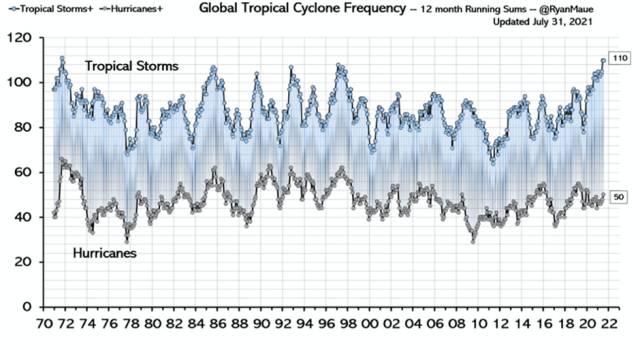
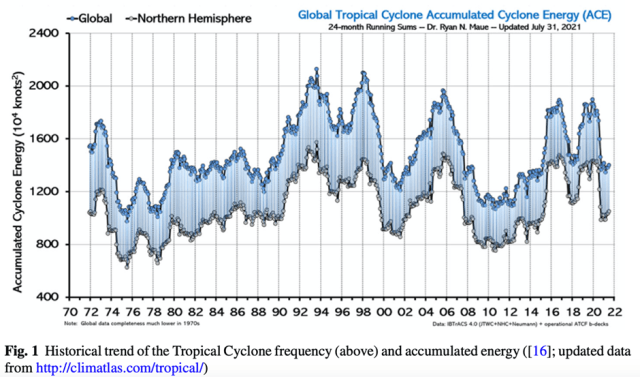
The IPCC has reported that hurricanes have increased strongly in the North Atlantic since 1878, but the scientists note that observations were relatively low during the first decades of the 20th century. After adjusting for lack of observational capacities in the past, there is a nominal upward trend. This trend, they explain, “is not significantly distinguishable from zero”.
The scientists accept that there has been a recent increase in heatwaves, which they attribute to the 1°C rise in global temperatures, although they note global heatwave intensity trends “are not significant”. They also note an increase in global rainfall, although an increase in extreme precipitation is observed only in a limited number of weather stations. Corresponding evidence for increases in flooding remains elusive, they say, “and a long list of studies shows little or no evidence of increased flood magnitudes, with some studies finding more evidence of decreases than increases”. So far as drought is concerned, the scientists note the AR5 finding of the IPCC that “conclusions regarding global drought trends increasing since the 1970s are no longer supported”. Several studies are said to show no increase in the main indices regarding global droughts.
In fact, a slightly warmer and wetter planet and a little extra CO2 seem to have done wonders for global crop yields. For the period 1961-2019, maize, rice, soyabean and wheat global average yields are reported to have grown every year by 3.3%, 2.4%, 2.6% and 3.8% respectively.
Well-researched, fact-driven, credible scientific papers such as this are crucial in the battle to stop green activists and rentiers having a free run to catastrophise every bad weather event in the interest of promoting a command-and-control Net Zero agenda. Attempting to attribute single weather events to humans burning fossil fuels is the product of feverish imaginations and garbage in, garbage out climate models. Rational, evidence-based science should be promoted at every opportunity.
Chris Morrison is the Daily Sceptic’s Environment Editor.
Featured Video

The Most Important Bet You’ve Never Heard Of
or go to
Aletho News Archives – Video-Images
From the Archives
Wars for Israel: A reminder of who’s giving the marching orders
By Damian Lataan | February 7, 2012
As the West prepares to march off to yet another war in the Middle East, we should perhaps remind ourselves of who is giving the West their marching orders.
In February 2003, just weeks before the US and their allies launched their attack on Iraq and her peoples, a delegation of US congressmen, together with the US Ambassador to the United Nations, John Bolton, a well known pro-Zionist and neoconservative war-hawk, were in Israel at the invitation of the Israeli government then led by Israeli Prime Minister Ariel Sharon.
Addressing the congressmen, Sharon told them ‘that Iran, Libya and Syria should be stripped of weapons of mass destruction after Iraq’. Later, Sharon told John Bolton ‘that Israel was concerned about the security threat posed by Iran, and stressed that it was important to deal with Iran even while American attention was focused on Iraq’. … continue
Blog Roll
 Aletho News
- IRGC hits US tech giant Oracle’s data center, computing site in UAE over new assassinations
- Bombing Iran Back Into the Stone Age /Lt Col Daniel Davis & Jim Jatras
- UAE rejects report claiming it is ready to join war on Iran to reopen Hormuz
- A New Resistance Front: How Does Syria Factor into the Regional War?
- Gulf states weigh pipeline expansion plans, hoping to bypass Hormuz
- Iran sets up ‘tollbooth’ system in Strait of Hormuz
- Wave 90: IRGC strikes US-linked industrial sites in Gulf
- Iran Says US-Israeli Claims of Its Military Strength Are Wrong
- Trump’s April Fools’ Address to the nation
- The Most Important Bet You’ve Never Heard Of
- If Americans Knew
- ‘War crime’: Global condemnation as Israeli ministers celebrate death penalty law targeting Palestinian prisoners
- 7 Ways Israel Is Turning Lebanon Into Gaza
- World’s Leading Football Bodies Under Fire Over Israel Policies
- Experts warn of possible use of nukes against Iran
- Israeli invasion of Lebanon could be worse than 1982, warn European officials
- Passover: Liberation and collective punishment
- Trump says the quiet part out loud: (Israel’s) war on Iran > Americans’ health – Daily Update
- Gaza families reunite years after babies evacuated amid Israel’s war
- International Rescue Committee warns Gaza’s children face grave protection risks
- Iran’s Alleged 47-Year War on America: Debunking the 1,050 American Deaths Canard
- No Tricks Zone
- Low Intensity Tornado Wrecks Major Solar Farm, Creating A Potential Toxic Dump
- New Study Finds Warming Saves Lives…Cold Temperatures 12 Times More Deadly Than Excess Heat
- German Science Blog Accuses PIK Climate Institute Of Hallucinating Climate Tipping Points
- Devastating Assessment Of Comirnaty Vaccine By Former Senior Pfizer Europe Toxicologist
- New Study: CO2 Is ‘Effectively Negligible’ As An Explanatory Climate Change Factor Since 2000
- Former Pfizer Toxicologist Dr. Helmut Sterz Tells Bundestag Hearing Pfizer Vaccine Should Have Never Been Approved
- Energy Expert: Germany’s Nuclear Phaseout Was A “500 Billion Euro Mistake”
- New Research: South Australia’s Mid-Holocene Sea Surface Temperatures Were 4°C Warmer Than Today
- Storing Green Energy To Last Germany 10 Days Would Require A 60-Million Tonne Battery
- New Studies: UK Sea Levels Were 4 Meters Higher Than Today During The Mid-Holocene
 Aletho News