England: Social worker fired over social media posts wins case
By Christina Maas | Reclaim The Net | October 25, 2022
Social Work England dropped the case against Rachel Meade, a social worker and member of the Free Speech Union (FSU), who was suspended over posts on her personal Facebook page.
A complaint about the posts was filed by Sport England’s Diversity Champion Aedan Wolton. That single complaint resulted in the suspension of Meade from her social worker position at the Westminster City Council.
Meade’s ‘crime’ was sharing links to articles covering transgender issues and petitions and blog posts on the national debate about if it is right for people to self-identify their gender. The case lasted for almost two years.
Meade told the Daily Mail that the “last two years have been nothing short of an Orwellian nightmare for me and my family.”
“My apparent crime was to share some news articles and petitions about the self-ID gender debate to fewer than 50 friends on Facebook. I found myself wrongly accused of holding abhorrent transphobic views,” she added.
Her lawyer, Shazia Khan, said Social Work England violated Meade’s freedom of speech and asked for an apology to Meade. The organization refused to apologize.
Will Ursula von der Leyen be forced to resign, and will her deeds be investigated?
By Vladimir Danilov – New Eastern Outlook – 28.10.2022
Europe has been rocked by large-scale protests over the last few weeks, and many politicians and media organizations in the EU see this as a reflection of public dissatisfaction with the policies of the European Commission and especially its head, Ursula von der Leyen. The main concern is the rising cost of living, the rapid increase in energy and food prices, and the anti-Russian policies of the European Commission, which have led to an energy and economic crisis that is affecting not only Europe but many other countries who have committed themselves to a close relationship with Europe.
Always keen to show her unwavering support for Washington and London, in her speech at the inaugural summit of the European Political Community, the President of the European Commission extended a warm welcome to Liz Truss – despite the fact that no-one other than Ursula von der Leyen considers the former British premier’s policies to be a success. As the Daily Express notes, the speech was greeted with an uncomfortable silence.
Internet users in the EU have criticized Ursula von der Leyen’s most recent promises to help the Kiev regime “as long as is necessary” and provide Ukraine with billions upon billions of Euros in credit. Her statements have been attacked on social media as ignoring the interests and wishes of EU citizens, and users have called for her resignation.
Writing on Twitter, the French politician Florian Filippo criticized her call for regular subsidies for Ukraine: “Ursula is completely crazy! Lock her up!”
In an interview with Le journal du Dimanche, the former French president Nicolas Sarkozy has accused the European Commission of lacking the authority to make decisions on arms purchases. As he explained, the European Commission is an administrative body, and it is unclear on what basis Ursula von der Leyen considers that she has the authority to speak up on matters relating to foreign policy or arms purchases. Just a few days after the beginning of Russia’s special operation in Ukraine, the President of the European Commission announced that the EU would finance “the purchase and delivery of arms and other military equipment” to Ukraine. Europeans are continually hearing about the need to provide the Kiev regime with billions of euros from EU coffers to buy arms, and they blame Ursula von der Leyen. Nicolas Sarkozy alleges that the EU’s policy in relation to Ukraine was too dependent on “escalation, irritation and thoughtless actions.”
The Israeli television channel i24news and the former Socialist candidate for the French presidency (in the 2007 elections) Ségolène Royal have also recently criticized Ursula von der Leyen’s stance. Ségolène Royal claims that instead of helping Russia to stop the war, the President of the European Commission is lobbying on behalf of the USA’s Ukraine policy and has effectively become a NATO and Pentagon press secretary.
In addition to the criticism’s of her policies, Ursula von der Leyen has also found herself at the center of corruption scandals in recent months. Especially since the beginning of the European public prosecutor’s investigation into EU purchases of COVID-19 vaccines. Public attention in relation to the scandal has centered on the role played by the President of the European Commission, who, as even Dmitry Medvedev, deputy chairman of Russia’s Security Council noted on October 20, “went all out and purchased 4.6 billion(!) COVID-19 vaccine doses from Pfizer pharmaceuticals at a cost of 71 billion (!) euros.” “That is 10 vaccine doses for every EU citizen,” he added.
According to the journal Politico, Ursula von der Leyen has admitted to exchanging text messages with Pfizer CEO Albert Bourla while the EU was negotiating the vaccine purchase contract. Two EU supervisory bodies have already accused her of wrongdoing in relation to the purchase, criticizing the Commission for refusing to provide the documents required for the investigation into the matter to proceed further.
However, the Pfizer purchase is not the first scandal that Ursula von der Leyen has found herself involved in. There was another scandal three years ago, when, shortly after a call from the EU elite to “make the process of electing the EU leadership more democratic,” the members of various different political groupings complained that at the beginning of 2019 the heads of the main EU bodies were selected in closed meetings “under cover of night.” The presidency of the European Commission did not go to the leader of the group winning the most votes in the May 2019 elections, but was instead “handed to” Ursula von der Leyen, as Donald Tusk, evidently satisfied that he had done his duty, informed journalists at the end of a two-week EU summit.
This political backroom deal in which the position was clearly reserved for Ursula von der Leyen took place at a time when the EU was supposedly undergoing a “democratic reform.” Since 2014 the so-called leading candidate procedure has been in effect, for the purpose of selecting a new President of the European Commission. Among other requirements, the procedure requires that the candidates from Europe-wide parties who won the largest numbers of votes in European Parliament elections should be given priority when selecting the President of the European Commission.
The reservation of the post for Ursula von der Leyen, the then German Minister of Defense, was highly controversial at the time, even in her native Germany, both among politicians and within the expert community. For example, Markus Söder, at the time head of the Christian Democratic Union, described his views to the DPA press Agency as follows: “Manfred Weber would have been a legitimate President of the European Commission, his election would have been democratic. It is a pity that democracy failed, and the winner was chosen in a behind-the-scenes deal.” The heads of the Social Democratic Party of Germany (SPD)-led coalition, in government at the time, also opposed her nomination to the most senior post in the EU. “The decision to award the presidency of the European Commission to the Minister of Defense undoes all the efforts that have been made to strengthen democracy in Europe, take into account citizens’ interests and support the role of the European Parliament,” the SPD leaders claimed in a statement.
Significantly, at the time Ursula von der Leyen did not even take part in the election campaign, did not stand as a candidate in the European elections, and was probably most known for her anti-Russian position and her unquestioning support for Washington. It was most likely that support that played the key role in bringing about her nomination as President of the European Commission.
So, one may ask, what did Ursula von der Leyen do to achieve the honor of being given the post she now occupies? She is the daughter of Ernst Albrecht, a high-ranking politician in the Christian Democratic Union (CDU), and between 1988 and 1992 she worked as an assistant doctor in the gynecological department of Hanover Medical School. However, in 2016 Hanover Medical School checked her doctoral thesis for plagiarism, and noted its “obvious shortcomings.”
Having raised seven children, she is often informally referred to in her native country as “the mother of Germany.” Her political career began in 1990, when she joined Angela Merkel’s CDU, and in 2005 she was appointed to her first ministerial post, as Minister of Family Affairs and Youth in the Merkel administration. In 2009 she was appointed Minister of Labor and Social Affairs, and in 2013 she became Minister of Defense, a post which she occupied for six years, during which she was involved in regular scandals and responsible for controversial decisions. According to statements by Germany’s three main parties (the Green Party, the Left Party and the Social Democrats), many of the 3,800 contracts concluded during her “management” of the German Armed Forces from 2014 onwards (relating to the restructuring of the Armed Forces and also its IT systems) appear to have been awarded to the “right people,” including relatives and friends, and some contracts may even have involved some form of bribery. Back in 2017 the German newspaper Bild, citing a report by the Federal Audit Office, accused Ursula von der Leyen of being strikingly incompetent during her time as Minister of Defense, when it was revealed that not one German submarine was operational, and less than half of its frigates and tanks and just a third of its military helicopters were in working condition.
With such a “success” record, Ursula von der Leyen was already being seen as a burden on the Armed Forces and the CDU. As, with the elections coming up, there was no suitable free ministerial post she was “nominated” for the presidency of the European Commission – a convenient decision for Germany at the time.
However, as time went by it became clear that the EU could not expect to derive much benefit from her appointment.
For Washington, however, which has no interest in the EU being led by strong politicians following their own line independent of the US, the decision to give Ursula von der Leyen the presidency of the European Commission in 2019 played right into its hands. And as a result she is now promoting the interests, not of European citizens, but of Washington alone, by helping US pharmaceutical companies make huge profits from selling the Pfizer COVID-19 vaccine or by providing the US military-industrial complex with millions upon millions of euros in arms orders, paid for by European taxpayers, to support the Kiev regime.
In the present circumstances it will be interesting to see how Ursula von der Leyen’s “career” ends – will she be brought down by the results of investigations into the corruption scandals which she has clearly been involved in, or following demands for her resignation by the European public, who are becoming increasingly critical of her actions…
US Pretends to be ‘Open to Talks’ With North Korea While Boosting Sanctions
Samizdat – 28.10.2022
Russia and China will continue to jointly address the North Korea issue. The main cause of tensions on the Korean Peninsula is the pressure exerted on the DPRK and the show of force by South Korea and the United States.
Russia remains committed to a joint plan with China for a Korean settlement.
“We will adhere to the agreed position on this issue”, Russian President Vladimir Putin said on Thursday at a plenary session of the Valdai Discussion Club.
The Russia-China action plan is based on the principle of reciprocal steps by the United States and the DPRK. These steps could be taken by the United States without damaging its reputation, and on the same basis by DPRK leaders. Moscow and Beijing believe that success in the settlement can only be achieved on the basis of reciprocal movement: action after action, step by step, gradually, and consistently.
At the same time, Moscow and Beijing have repeatedly warned that the formula, according to which North Korea must first completely get rid of its nuclear missile program and only then it will be possible to think about lifting sanctions on the DPRK and ensuring its economic development, is absolutely unsustainable.
“Our roadmap, which we proposed together with China, was that first we should build confidence through mutual meetings, and then we should take some tangible measures, including the suspension of military exercises, tests, and missile launches, and then proceed to negotiations,” Russian Foreign Minister Sergei Lavrov said earlier, presenting a joint Russia-China plan for a Korean settlement.
The plan was put forward to the two Koreas, the United States, and Japan in the fall of 2019 after three meetings between the US and DPRK leaders in Singapore, Hanoi, and the demilitarized zone in Panmunjom ended inconclusively. These meetings were held on June 12, 2018, February 27-28, 2019, and June 30, 2019, respectively.
When answering experts’ questions at the Valdai Discussion Club related to the Korea issue, Vladimir Putin said that the unwillingness to talk and the absolutely boorish attitude to North Korea’s interests, including in the sphere of security, has led to the DPRK nuclear issue. In an interview with Sputnik, Alexander Zhebin, director of the Center for Korean Studies and member of the Russian Political Science Association, commented on the Russian president’s statements as follows:
“Vladimir Putin was referring to the boorish behavior of the United States, because the US and the DPRK had an agreement at Trump’s meeting with Kim Jong-un in Singapore that Pyongyang would not launch long-range missiles that could reach American territory, and would not test nuclear weapons. The Americans would respond to this, as recorded in the Singapore declaration, by building a new relationship. Instead, the Americans continued to impose more and more sanctions against the DPRK, which means that they have not fulfilled their part of the commitments.”
According to Alexander Zhebin, the US behaves arrogantly towards the DPRK in the UN Security Council as well:
“Each UN Security Council resolution that imposed sanctions on the DPRK stipulated that positive steps by the DPRK to reduce nuclear missile activity must be accompanied by reciprocal steps by those who imposed sanctions and lead to their partial lifting. This has not happened. On the contrary, no matter what the DPRK has done, the US has kept imposing new sanctions, both by Trump and then by Biden.”
Today, instead of negotiations, the US and South Korea are working on scenarios for destroying the top political leadership of the DPRK and the country’s control centers.
“On the one hand, the Americans say they are ready to negotiate with the DPRK at any time, anywhere, and without any conditions. However, at the same time, they have imposed unprecedentedly harsh sanctions on the DPRK and do not intend to lift them. On the contrary, they are obstructing all attempts by China and Russia to reduce the sanctions burden and start a dialog process. In fact, the invitation to negotiations is just talk. Under that guise, the US is implementing a longstanding plan according to which, eventually, the DPRK, under the weight of economic sanctions, will not survive, thus forcing Kim Jong-un to surrender.
They are not hiding the fact that large-scale military exercises carried out by the US and South Korea are used to practice the elimination of the DPRK’s top political leadership and the country’s control centers. The scale of the recent maneuvers is simply off the chart. 240 American and South Korean aircraft, including the latest F-35 stealth fighters, have been deployed off the coast of North Korea. This cannot but cause serious concern to the DPRK leadership, since everything is happening near its borders. The DPRK is very much concerned about its security,” Alexander Zhebin stressed.
The DPRK’s missile launches are a response to US and South Korean military drills, which constantly press Pyongyang to demonstrate its power, Jin Xiangdong, a researcher at Xiamen University’s School of International Relations, said in an interview with Sputnik :
“Since coming to power, the new South Korean government has conducted a series of military exercises near the Korean Peninsula. The DPRK has responded by launching ballistic missiles. The main problem with the situation on the peninsula is that the new South Korean government is constantly putting pressure on North Korea and demonstrating its power. China’s position on the Korean Peninsula issue is consistent and clear. China defends the maintenance of peace and stability on the peninsula, denuclearization on the Korean Peninsula, and the resolution of issues through dialog and consultations. Meanwhile, in general, the solution to the Korean Peninsula problem is still complicated.”
The Joint Chiefs of Staff of the South Korean Armed Forces said that North Korea fired two short-range ballistic missiles toward the Sea of Japan on Friday. The launches took place on the last day of South Korea’s Hoguk military exercises, which began on October 17. These maneuvers featured a large-scale amphibious landing exercise near the city of Pohang on the coast of the Sea of Japan.
On October 31, the Republic of Korea and the United States will launch large-scale joint air exercises. The high intensity and scale of the drills provoke growing tensions in Northeast Asia. The US threatening to give a strong response to a possible nuclear test by the DPRK has aggravated the situation.
The Ukraine war of words that heralds ethnic cleansing
By Dr Gregory Slysz | TCW Defending Freedom | October 28, 2022
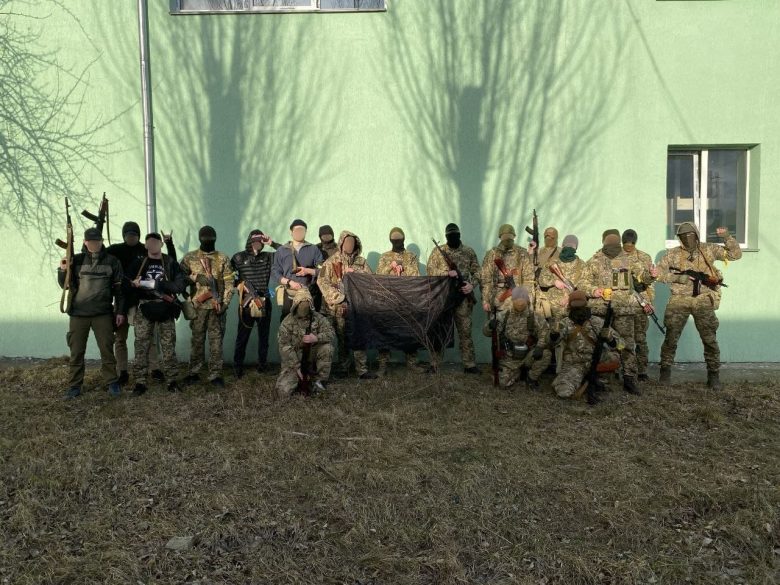
As The Ukrainian forces and their Western backers celebrate their recent military advance, the fate of ethnic Russians in the reclaimed territories looks bleak now that local and national leaders have declared a reckoning against those whom they consider to be collaborators and traitors.
It’s a policy that originates from the early stages of the conflict based on a law passed in March that threatened anyone who co-operated with the occupying Russian authorities with up to 15 years of imprisonment together with the confiscation of property. Hitherto there have been many arrests of those accused of pro-Russian collaboration, including the leader of Ukraine’s official parliamentary opposition Viktor Medvedchuk, and assassinations of officials such as Alexei Kovalev, deputy head of the military and civil administration in the Kherson region. But as the Ukrainian forces wrest back territory from Russia, a wide net is being cast against alleged collaborators that extends well beyond officials to include teachers, social media warriors and victims of unsubstantiated claims of snitches, shedding light on the intentions of Ukrainian authorities in the unlikely event of total victory.
Ukraine is a culturally heterogenous population in which linguistic affiliation is complex, being governed by both cultural and social situations. At least 17 per cent of Ukrainians claim Russian heritage, with about 14 per cent declaring Russian as their main language and a further 17 per cent Russo-Ukrainian bilingualism, with an unknown number opting to converse in a hybrid Surzhyk dialect. Russian speakers are overwhelmingly concentrated in the eastern and southern regions of the country. It’s a situation, moreover, that has reflected the electoral geography of the country of both parliamentary and presidential elections with the eastern and southern parts of the country exhibiting close affinities with Russia.
Starting as a reasonable initiative at nation-building that intended to correct the inequalities of institutional Russification of the Soviet era, language policy came to be weaponised by nationalist political forces that sought to use it to marginalise Russian culture. Although a cultural reset was inevitable after the collapse of the Soviet Union to redress years of Russification, its initial steps were measured, such as the Law of Languages of 1989, which extended legislative protections to Russian as well as other languages. For Ukraine’s increasingly influential nationalists, overwhelmingly located in the West of the country, the Law was intolerable and unsurprisingly fell victim to the Maidan coup of 2014, that replaced the Russophile President Viktor Yanukovich with Petro Poroshenko.
While its provisions were maintained by Ukraine’s subsequent leadership, following international condemnation of its revocation, the decision of the Constitutional Court to deem the Law unconstitutional was viewed by the Russian minority as a sign of a broader assault on Ukraine’s Russian heritage and served to fuel separatist sentiment in the Crimea and the Donbas. It also played into the hands of Vladimir Putin who could now claim to be the champion of Ukraine’s oppressed Russian speakers, by military means if necessary. Such fears were not unwarranted as in 2019 a new language law sought to end the hitherto ad hoc implementation of existing legislation and subject transgressors to severe fines. Poroshenko, who was campaigning for re-election, weaponised Ukraine’s language policy with his election slogan ‘Army, faith, language’, declaring that ‘the only opinion that we weren’t going to account for [in drafting the legislation] is the opinion of Moscow’. Salt was further rubbed into the wounds of the third of the country which rejected it by its being signed off by the Speaker of Parliament, Andrei Parubiy, a former activist in the neo-Nazi Social-National Party, who warned chillingly that ‘those people who try to revise the language law . . . will soon feel the whole anger of the Ukrainian people’. Remaining loopholes were filled in January 2022, just before Russia’s military incursion, which for instance compelled Russian language print media to produce Ukrainian translations for all publications in a move that de facto targeted Russian for discrimination.
To indigenous Russian speakers, such rhetoric marked the creation of an ethnic state in which they were not welcome. The escalation of the war in 2022 seemed to confirm their worst fears as not only did Russian become ‘the language of the enemy’ but things Russian, political parties, music, literature were officially shunned, banned or marginalised in a policy that hitherto had been executed only by the far right nationalists of Lviv City Council in West Ukraine. Whereas then the likes of Canadian and British ambassadors joined Moscow in condemning such action as ‘just plain dumb’ and intolerant, now such nationwide ‘de-Russification’ initiatives were met with silence.
International opinion recognised Ukraine’s language policy as conflict-bearing due to its increasingly divisive and discriminatory nature. The scrapping of minority language provisions by Ukraine’s Constitutional Court in 2014, for instance, raised concerns in the European Parliament which deemed it as ‘undermining any notions of justice, freedom, civilisation, progress and democracy’ and called for the EU Commission to ‘condemn the action of the Ukrainian Parliament and the nationalistic attacks on minority communities in Ukraine’. The 2019 law came under similar criticism from the Venice Commission, the Council of Europe’s advisory body on constitutional affairs, which declared that it threatened to become ‘a source of inter-ethnic tensions within Ukraine’. It reiterated its conclusion following the passing of the January 2022 Law, noting that ‘historical oppression of Ukrainian . . . may lead to the adoption of positive measures aimed at promoting Ukrainian, but this cannot justify depriving the Russian language and its speakers of the protection granted to other languages’.
Both the intra-parliamentary brawls and street standoffs between Ukrainian and Russian speakers during the passage of the language legislation were chilling portents of what was come. Although the escalation of the war in 2022 has seen some ethnic Ukrainian Russian speakers distance themselves from ‘the language of the enemy’ and embrace Ukrainian as their main language, it has also seen ethnic Russians fortify their Russian identity. While this in itself has demonstrated the complexity and malleability of identity in Ukraine, it has also reinforced pre-existing cultural fissures, leaving ethnic Russians with no option other than to embrace Mother Russia as their homeland.
While the conflict in the Donbas since 2014 rendered reconciliation between the Ukrainian authorities and the Russian minority problematic, as the failure of the Minsk agreement testifies, the escalation of the conflict has entrenched pre-war hatreds. With the national conversation decisively turning against the reintegration of Russian culture and language into Ukraine’s social fabric, it is difficult to see how a status quo ante bellum with even rudimentary cultural and linguistic protections for ethnic Russians is possible were the Ukrainian state reconstituted within its pre-war borders. In fact, everything points towards mass retribution and ethnic cleansing on a scale not witnessed in Europe since the Second World War, in a scenario that is likely to overshadow the grim events of the conflict itself. Ukraine’s Secretary of the National Security and Defence Council, certainly didn’t mince his words on a recent Ukrainian talk show in calling for the ‘complete disappearance of the Russian language from our land’ in what sounded like incitement to ethnic cleansing.
Nothwithstanding the difficulty such actions would present for social reconstruction, the questionable legality of extra-judicial killings of officials and political persecution of ‘collaborators’ threatens to draw attention to atrocities committed by Ukrainian paramilitary forces during the Second World War against Russians, Jews, Poles and other minorities. These crimes, together with the ritualistic celebrations by Ukraine’s highest political authorities of those who perpetrated them like nationalist leader and Nazi collaborator, Stepan Bandera, have been conveniently whitewashed so as to not tarnish the image of a virtuous Ukraine that has been carefully cultivated over the past few months. The sources which once regularly condemned Ukraine for not only celebrating wartime collaboration but also tolerating a revival of neo-Nazi paramilitarism now declare similar condemnation by Russia as hostile propaganda. A Ukraine seen to be persecuting minorities again would be a propaganda disaster for its Western backers.
Dividing Ukraine’s population into ‘the people’ and ‘the rest’ where the latter were made to feel subordinate in their ancestral lands to the former was always going to lead to conflict. Yet just as wise counsel of the likes of George Kennan, Henry Kissinger and Zbigniew Brzezinski warned of the grave risks of Nato’s expansion to Russia’s borders, so warnings came aplenty of the dangers of a divisive language policy. To Ukraine’s detriment, however, neither was heeded and now a reckoning against ‘the rest’ will be as useless in knitting back together shattered communities as the pre-war language policy was in solving peaceful coexistence between Russian and Ukrainian in a single public space.
US shuns limits on nuclear weapon use
Samizdat | October 28, 2022
The Pentagon revealed on Thursday in its long-awaited National Defense Strategy (NDS) report that given the growing national security threats posed against the US and its allies, Washington must leave the door open to such options as a nuclear first strike and use of nuclear weapons to prevent non-nuclear attacks. That conclusion was approved by the White House after the Pentagon’s thorough review of “no first use” and “sole purpose” nuclear policies.
“Those approaches would result in an unacceptable level of risk, in light of the range of non-nuclear capabilities being developed and fielded by competitors that could inflict strategic-level damage to the United States and its allies and partners,” the NDS said. “Some allies and partners are particularly vulnerable to attacks with non-nuclear means that could produce devastating effects.”
Biden pledged while running for president in 2020 that he would work to narrow the potential uses of America’s nuclear weaponry. “The sole purpose of the US nuclear arsenal should be deterring — and if necessary, retaliating against — a nuclear attack. As president, I will work to put that belief into practice, in consultation with our allies and military.”
The decision to instead reject limits on use of nuclear weapons comes amid rising tensions with Russia and China. Beijing is investing heavily in expansion and modernization of its nuclear capabilities, the Pentagon said. “By the 2030s, the United States will, for the first time in its history, face two major nuclear powers as strategic competitors and potential adversaries.”
Washington won’t use or threaten to use nuclear weapons against non-nuclear states that are party to the Treaty on the Non-Proliferation of Nuclear Weapons, according to the NDS report. “For all other states, there remains a narrow range of contingencies in which US nuclear weapons may still play a role in deterring attacks that have a strategic effect against the United States or its allies and partners.”
The report labeled China as the No. 1 national security threat against the US, despite rising tensions with Moscow over the Ukraine conflict. Secretary of Defense Lloyd Austin said China is “the only competitor out there with both the intent to reshape the international order and, increasingly, the power to do so.”
The US remains the only nation to have ever used nuclear weapons against another country – the atomic bombs dropped on Japan in August 1945.
The BBC’s Hurricane Unreality Checked
By Paul Homewood |October 26, 2022
I have collaborated with Net Zero Watch to produce this video on hurricanes.
The MSM’s cancer ‘cure’ stories are bio-firm hype, not hope
By Guy Hatchard | TCW Defending Freedom | October 26, 2022
GLOBALISED mainstream media equates not just with a uniform, poorly-informed world, but a manipulated world.
In Britain, the Times runs a story entitled: After centuries of cut, burn and poison, could a jab cure cancer? by Tom Whipple. Eleven thousand miles away in New Zealand, the same story appears in Stuff newspaper.
This is one of those ‘isn’t it wonderful?’ reassuring stories that unfortunately don’t look quite so rosy after close scrutiny, but like bad pennies are turning up everywhere. On the surface informative and exciting, underneath sadly lacking in that investigative depth we were expecting – and certainly over-hyped.
This particular story would not be out of place in a glossy brochure seeking investment funds for BioNTech. According to the Times article, RNA vaccine technology is rather like buying a piece of furniture from Ikea. Each person could very soon have their own personalised cancer vaccine off the shelf. What could possibly go wrong?
The tremendously hopeful note that the story strikes is based on a lot of over-simplified theory and the success (???) of the Pfizer Covid vaccine co-developed with BioNTech. It sounds reassuringly easy to design mRNA vaccines that rush to your aid and eliminate those nasty cancer cells.
Ugur Sahin and Ozlem Tureci, founders of BioNTech, are pictured in white coats, and are quoted promising: ‘We stimulate the immune system, do something magic, and the tumour disappears.’
Heady stuff, but the cited evidence is less than thin. A decorated cancer researcher who was diagnosed with pancreatic cancer in 2007, then tried all his innovative ideas out on himself, and died in 2011. In 2020, 16 patients with pancreatic cancer were treated by BioNTech. Eighteen months later, eight have died and eight are cancer-free after 18 months. The details are sadly lacking.
What stage were they at and how does that compare with their expected prognosis? The missing piece of the jigsaw is the article’s lack of scrutiny of the safety of BioNTech’s only commercialised mRNA vaccine product – the Pfizer Covid vaccine.
If you want to ask questions and also seek answers, you will need to turn to a completely different kind of journalism. Igor Chudov is a mathematician – like the Times author – but he writes on Substack and is therefore not constrained by any editorial policy or any no-go areas dictated by the newspaper owners, their advertisers, or subtly imposed government guidelines.
Chudov has published a very different cancer story, headlined: Cancer rates are Increasing and may get much worse. Wiped out immune systems take time to manifest.
According to the article, we are seeing the first ripple of a coming storm of cancer deaths. Chudov reports the work of the Ethical Skeptic (another Substack researcher) whose analysis of figures from the Centers for Disease Control and Prevention – the public health agency of the US – has shown that the rate of US cancer deaths accelerated in 2021 and 2022, coinciding with the rollout of the Pfizer/BioNTech mRNA Covid vaccine and other biotech vaccines.
It is the effect size that is surprising – 9 sigma. What does this mean? Well perhaps you can remember from your school maths lessons that for a Bell curve, two-thirds of data points lie within one standard deviation of the mean, that is known as 1 sigma. Ninety-five per cent lie within two standard deviations (2 sigma) and 99.7 per cent lie within 3 sigma.
I’m going to translate for you what the observed 9 sigma deviation from the prior pattern of cancer deaths probably implies in very simple layman terms:
1. A hugely statistically surprising number of people already infected with cancer have suffered a rapid progression of their condition to death. Covid vaccination reduced their likely longevity.
2. Some people who previously had no evidence of cancer, and possibly no lifetime expectation of cancer, are becoming ill and dying in the weeks and months following Covid vaccination. And it is not due to Covid infection – it didn’t happen in 2020.
Read Chudov’s article. It is a long read, but well worth the effort. In addition to the US data, he looks at the official UK cancer mortality data, which shows a similar increase. He also quotes another Substack author, A Midwestern Doctor, who analyses and references in detail what it is about mRNA vaccines that causes cancer. The approach is investigative, as we should expect it.
There are concerning issues that Whipple, author of the fawning Times article, chooses not to address. He failed to discuss questions that constitute the normal substance of scientific debate, but his piece was beamed around the world.
We expect the Times to ask questions, but it is not doing so. It has quietly rolled over and followed the biotech PR line. It is not alone – the mainstream media are collectively failing the sniff test.
We are being manipulated. If you want real journalism, it is flourishing elsewhere. GLOBE (the Campaign for Global Legislation Outlawing Biotechnology Experimentation) and other independents are asking vital questions that few are prepared to countenance.
Japan steps up its digital ID push, tells public they may lose health insurance if they don’t sign up
By Didi Rankovic | Reclaim The Net | October 27, 2022
There is a discernible and forceful push in many countries toward digitization and switching citizens’ key sensitive personal and financial data from “analog doldrums” to government-controlled (and easily accessible by multiple agencies) centralized databases.
Somewhat telling of how important this task is for those in power, is the fact they are increasingly either pulling all the stops or threatening to, prodding a reluctant population in the desired direction.
In Japan, those who are unsure about signing up for digital IDs – and reports say, those are many – are being told they risk losing their public health insurance, AP writes.
Japan’s Social Security Number-like scheme was launched back in 2016. It’s called My Number and consists of 12 digits given to all residents. But My Number has been far from a resounding success as many Japanese avoid using it, afraid their personal data and right to privacy could be compromised.
The Japanese society seems technologically savvy enough to understand the underlying risks and harms of some types of technology, which means that this otherwise hi-tech country to this day prefers to do business in person, use cash, stamping seals, and paper documents in administrative procedures – in other words, in all those areas that really matter.
Despite the fact the My Number scheme has not had wide adoption, Japan’s authorities are now apparently doubling down: they want to issue My Number cards with microchips in them to everyone, and those cards will also serve as photo ID since they will contain photographs of their carriers. Some of the information and services the cards are linked to are drivers licenses and public health insurance.
This is where the plot thickens since current health cards do not require photos – but those will be phased out by the end of 2024, meaning that residents who do not apply for My Number cards risk losing their health insurance.
An online petition is currently circulating, having gathered over 100,000 signatures in a matter of days, calling for continued use of the current form of health cards.
“If this was coming from a trustworthy leadership and the economy was thriving, maybe we would think about it, but not now,” Saeko Fujimori, who works in the music industry, told AP.
And there are dark overtones to the report.
Biden’s Bivalent Booster Blunder
Vinay Prasad’s Observations and Thoughts | October 26, 2022
The Biden administration has made a fool of themselves with their bivalent vaccine roll out. Pretty much all decisions were errors, and very likely these will hurt them politically. The only way for Biden to save himself from his terrible Covid policy is to fire all his advisors and rehire good ones. Let’s review the facts:
The Biden administration granted emergency use authorization to Pfizer and Moderna for a bivalent booster that targeted Wuhan and BA45. That vaccine received EUA based on mouse data (8-10 mice). There were no human data at the time of approval. (Please don’t confuse the BA4/5 with BA1 bivalent)
Since then, both companies have press released results, but do not specificify the numeric values of antibodies generated in people. No one has clinical data– i.e. is there a reduction in hospitalization? Severe disease? And if so, we don’t know which people (how old) have a further reduction in severe disease or hospitalization from this vaccine.
We also know breakthrough can occur. Rochelle Walensky herself received the vaccine and then had COVID one month later. Ironically, this is probably the peak vaccine efficacy (peak Ab). I don’t know what the vaccine effectiveness is, and neither does she, but my guess is it isn’t terrific.
The Biden administration said that we didn’t have time to wait for clinical trials in people. But each passing day reveals that is a lie. The uptake of this vaccine is abysmal. No one wants it. If no one was going to get it then why not take the time to run the proper studies?
A recent pre-print has shown that the bivalent booster is not better at generating BA45 antibodies than getting the old booster one more time. This is the failure of not generating human trial data.
You could have sorted this out pre-market. *Let’s be clear, these are not clinical data (living longer/better) but without better antibodies, clinical endpoints seem unlikely to be met*

Many universities are now requiring this vaccine for 20-year-old college students who have had three prior doses and Omicron. I think you have to be dropped on your head to actually believe a 20-year-old man in good health who’s gotten three doses and just had Omicron will derive any benefit from this bivalent booster. I have never met even one doctor who thinks that that is true. And yet that is the position of the Biden administration.
They are so hellbent on earning Pfizer money– I mean vaccinating people who just had covid —that they are willing to ignore the mountain of data that suggests that’s not what you should be spending your energy on.
More than a year ago, Marion Gruber and Philip Krause the number one and number two at the US FDA vaccine branch resigned, citing White House pressure to approve boosters for all ages. Their published remarks suggest that they wanted to do it only for the elderly and vulnerable. Their message was repeatedly ignored as the Biden administration rammed booster after booster through the US food and drug administration for ultra low risk populations.
They have actually said a 5-year-old who has had three doses and had covid should get this booster. It’s insane.
Their entire vaccine policy seems to be interested in giving Pfizer and Moderna a perpetual market share for a yearly vaccine. But seems to have no interest in generating credible randomized control trial evidence to inform the public. As such, they fail the American people.
I am concerned that after this White House stint: Ashish Jha, Rochelle Walensky, Vivek Murthy, and Peter Marks (post FDA) will work for or consult for Pfizer and Moderna. That would be devastating.
American people obviously do not want to receive a vaccine every year with non-trivial adverse events without knowing that it gives them some benefit. Benefit to third parties cannot be had because it cannot stop transmission.
Some misguided policy makers argue that even a small reduction in transmission is meaningful. That’s nonsense. The problem is that you can get COVID every single day of your life from now until the end of your life. Even changing the probability modestly won’t change the outcome. Because the probability you will get COVID is one over time. Think of it this way:
You can play Russian roulette with one bullet or three bullets. I would much rather play with one bullet, if I had to. But if you have to play a thousand times in a row, we all know how that game ends.
That’s COVID 19. It’s not going anywhere. You’re going to have to play over and over and over again. And that means you’re all going to get COVID. So the only question is how many doses minimize severe disease? And who needs that to be minimized?
Today in the governor’s debate of New York state, only the Republican candidate was opposed to children’s mandates. It’s amazing that the Democrats are clinging to a failed vaccine policy. Their covid-19 policy is going to lead to catastrophic losses.
They need to fire all their advisors and start new. That’s the only way to fix the situation.
West’s Policy Toward Other Countries ‘Dirty, Bloody,’ Denies Nations Right to Sovereignty: Putin
By Ilya Tsukanov – Samizdat – 27.10.2022
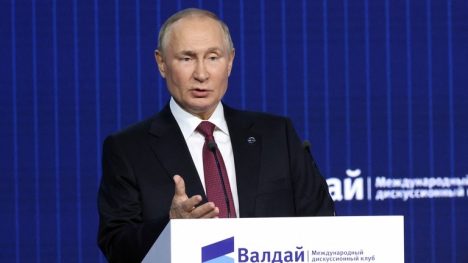
The West seeks to establish and maintain its control over the rest of the planet using “dirty” and “bloody” means, President Vladimir Putin has said.
“World domination is what the so-called West has staked in its game, but the game is unquestionably dangerous, bloody and I would say, dirty,” Putin said, speaking at the plenary meeting of the Valdai Discussion Forum on Thursday.
“It denies the sovereignty of nations and peoples, their identity and uniqueness, and has no regard whatsoever for other countries,” Putin added.
‘Rules-Based Order’ is an ‘Order With No Rules’
The Russian president also suggested that the so-called ‘rules-based’ international order declared by the US and its allies actually has only one “rule” – designed to give those who created it “the opportunity to live without any rules whatsoever” and enabling them to “get away with anything, no matter what they’ve done.”
Attempts to do away with cultural, social, political and civilizational diversity and to “erase any and all differences have become almost the essence of the modern West,” and is aimed at ensuring “the disappearance of the creative potential in the West itself and the desire to contain and block the free development of other civilizations. There is also a direct mercantile interest here, of course,” Putin said, pointing to the West’s efforts to impose its consumer culture values on others to expand their markets.
“It’s no coincidence that the West claims that its culture and worldview should be universal. Even if they don’t say so directly, they behave this way. In fact, their approach insists that these values be unconditionally accepted by all other participants in international communication,” the president said.
The origins of the current crisis have their roots in the destruction of the Soviet Union three decades ago, Putin said. “The collapse of the Soviet Union destroyed the balance of political forces. The West felt like a winner and proclaimed a unipolar world order in which only its will, its culture, its interests had the right to exist.”
Escalation
“The so-called West – I use this term conditionally of course, there is no unity there, it’s clear that this is a very complex conglomerate – has taken a number of steps in recent years and especially in recent months toward escalation,” Putin said, describing the state of affairs in the world today.
“They’re always trying to escalate…They’re fueling the war in Ukraine, organizing provocations around Taiwan, destabilizing the world food and energy markets,” Putin said.
Putin characterized last month’s terrorist attack against the Nord Stream gas pipeline network as an “outrageous” step, adding that unfortunately, “we are witnessing these sad events.”
Pointing to Western governments’ admission that they financed the events leading up to the 2014 Euromaidan coup in Kiev, which gave rise to the current crisis in relations between Russia and the West, Putin suggested that they’ve openly demonstrated their “loutish” nature.
Putin warned that the West’s confidence in its “infallibility” is a “very dangerous” delusion, with there only being “one step” between this self-confidence to the idea that “they can simply destroy those they do not like, or as they say, to ‘cancel’ them.”
But “history will put everything in its proper place and will not ‘cancel’ the works of the greatest and broadly recognized geniuses of world culture, but instead those who today have decided for some reason that they have the right to dispose of world culture at their own discretion. The self-conceit of these people is off the charts. But in a few years no one will remember them, while Dostoevsky, Tchaikovsky and Pushkin will live,” Putin assured.
The neo-liberal “American-style” model is experiencing a “doctrinal crisis,” according to the president, and has “nothing to offer the world except to preserve their dominance.”
Emphasizing that Russia is not a natural “enemy” of the West, Putin urged the West’s liberal leaders and elites to stop seeing “the hand of the Kremlin” behind all their internal domestic problems.
“In the conditions of the current tough conflict, I’ll say a few things directly: Russia, being an independent, distinct civilization, has never considered itself and does not consider itself an enemy of the West. Americanophobia, Anglophobia, Francophobia, Germanophobia are forms of racism, just like Russophobia and Anti-Semitism or any manifestation of xenophobia,” Putin stressed.
But there are “at least two Wests,” the president added, including the positive, traditional one with its immensely rich culture and the aggressive, neocolonial one, whose dictates Moscow will never accept. Russia has resisted Western hegemony and “its right to exist and develop freely,” and at the same time does not have any plans to itself “become some kind of new hegemony,” nor to impose its values on anyone or “interfere in someone else’s backyard,” Putin said.
Solutions
The Russian president suggested that amid the escalating economic, humanitarian, military and political crises plaguing the planet, it is unlikely that any country anywhere will be able to ‘sit things out’. Therefore, solutions of a global scale need to be reached, even if they are imperfect ones.
“The crisis has acquired a truly global character and affects everyone. There’s no need to harbor any illusions. There are essentially two paths for humanity: either to continue to accumulate the burden of problems which will inevitably crush us all, or to try to find solutions together, solutions which may not be ideal, but which work, and which are capable of making our world more stable and safer,” Putin said.
The Russian president emphasized that the West would need to start talking to rising alternative centers of power. “I have always believe and continue to believe in the power of common sense, and therefore am convinced that sooner or later both the new centers of a multipolar world order and the West will have to start a conversation based on equality about our common future. The sooner, the better, of course,” he said.
The “new world order” that replaces the current one “should be based on law, be free, original and fair. Thus, the world economy and trade should become more fair and open,” Putin said, benefiting the majority of nations and people, not individual corporations. At the same time, technology should reduce inequality, not increase it.
The president added that new international financial platforms are necessary which are outside the control of national jurisdictions, and which are “secure, depoliticized, automated and not dependent on any single control center.” Putin expressed confidence that such a system could be built.
Multipolarity is a necessity for the planet, including for Europe – to restore the latter’s political and economic agency, which is “very limited” today, according to Putin.
“We are standing on a historical frontier. Ahead of us is probably the most dangerous unpredictable and at the same time important decade since the end of the Second World War,” Putin said.
Ukraine
Commenting on Russia’s ongoing military operation in Ukraine, Putin said he thinks about the losses in life resulting from the conflict “all the time,” and that the crisis in Ukraine is a part of the “tectonic changes” taking place “in the entire world order.”
“Why was it necessary to carry out a coup d’etat in Ukraine in 2014?” Putin asked, recalling the origins of the current crisis. “[Ukrainian President Viktor] Yanukovych actually gave up power and agreed to hold early elections… Why was it necessary to carry out a bloody anti-constitutional coup under these conditions?”
The answer, Putin believes, is that the West wanted to “show” everyone “who’s the boss in the house. ‘Everyone (and ladies please excuse me for the expression) has to sit on their buttocks and not quack. It will be how we say it will be.’ I simply cannot explain these actions any other way,” Putin said.
Putin said Russia had no other choice but to recognize the Donbass republics in February and to come to their defense, and said that the unity of the Russian and Ukrainian people is an undisputable historical fact. Only Russia could guarantee Ukraine’s sovereignty, as Russia “created” Ukraine during the Soviet period, Putin said.
In the decades after the end of the Cold War, Russia’s consistent message to the West and NATO was “let’s all get along,” like in the Soviet children’s cartoon Leopold the Cat, but in almost all the main areas of potential cooperation, Moscow got the simple answer “No,” according to Putin.
Regarding the latest developments in the Ukrainian crisis and the concerning reports from Russian officials and military commanders that Kiev may be preparing to use a dirty bomb, Putin said he welcomes the International Atomic Energy Agency’s initiative to check Ukraine’s nuclear facilities.
“We are for it. This needs to be done as quickly as possible, as thoroughly as possible, because we know that right now the authorities in Kiev are doing everything possible to cover up the traces of these preparations,” Putin said.
The Russian president warned that it would be “easy” for Kiev to assemble a dirty bomb, and that Moscow has a rough idea about where it’s being created. Ukraine could use a Tochka U or another missile in its inventory to detonate the bomb somewhere and accuse Russia of launching a nuclear strike, Putin said.
Seventh Nuclear Test? How US and Its Asian Allies are Driving North Korea Into a Corner
By Ekaterina Blunova – Samizdat – 27.10.2022
The US, Japan, and South Korea vowed an “unparalleled” response to a potential seventh nuclear test by the Democratic People’s Republic of Korea (DPRK). However, the countries’ officials did not clarify precisely what measures they would take.
“This deterrence through threat of punishment by Washington and its allies is unlikely to succeed,” said Dr. Zhang Baohui, director of the Center for Asian Pacific Studies at Lingnan University in Hong Kong. “Pyongyang follows its own strategic logic when deciding whether to pursue new tests. A rise in tensions on the peninsula will only heighten North Korea’s insecurity, motivating it to continue to pursue the nuclear option.”
The US and its Asian allies reportedly fear that Pyongyang could be planning a nuclear bomb test for the first time since 2017. However, they have yet to provide details backing their concerns. Meanwhile, the US and South Korea have stepped up joint military drills in the region over the past several months.
Earlier, President Donald Trump’s White House tried to facilitate dialogue between Seoul and Pyongyang. These efforts were halted by President Joe Biden, who announced in May 2021 that he would not give DPRK leader Kim Jong-un “recognition” as the “legitimate” head of the state unless the latter denuclearized the country. Washington’s shift under Biden did not go unnoticed by the DPRK, and was followed by eight missile tests by Pyongyang in 2021.
The number of missile tests carried out by North Korea rose steeply in 2022, as Yoon Suk-yeol won the presidency in South Korea in March and declared Communist Pyongyang the “main enemy” of Seoul. Furthermore, the new South Korean president has openly flirted with the idea of a preemptive strike against his country’s northern neighbor.
In August 2022, Washington and Seoul kicked off their largest military exercises since 2018, with Yoon vowing to further boost “deterrence” against the DPRK. Earlier this month, Seoul also launched the 12-day Hoguk exercise with the participation of the Army, Navy, Air Force, Marine Corps, and the US military. The Hoguk drills will last until October 28.
Almost simultaneously, South Korea joined a US-led multinational exercise on cyber operations called Cyber Flag for the first time. According to the South Korean Defense Ministry, 18 personnel from the South Korean military are participating in the exercise, held from October 24 to 28 and which involves 25 countries.
Beijing has repeatedly warned Washington and Seoul against provoking Pyongyang and igniting instability on the Korean Peninsula. “All parties concerned should focus on the overall situation of peace and stability on the peninsula and prevent the situation from escalating,” Geng Shuang, China’s deputy permanent representative to the United Nations, told the international body on October 5. Geng highlighted that the recent bolstering of the US military alliance in the Asia-Pacific region has only increased the risk of military confrontation.
“Historical experience shows that dialogue and consultation are the only correct way to resolve the Korean Peninsula issue,” the Chinese official stressed.
Diplomatic Logjam Between North and South
However, if Pyongyang decides to conduct a seventh nuclear test, there is little if anything that the US and its Asian allies can do to prevent it, according to Zhang.
“Frankly, I don’t see what the three can do with North Korea’s seventh nuclear test,” the Chinese scholar said. “It is already under very systematic sanctions by the United Nations and it is hard to imagine that the US, South Korea, and Japan could pursue additional meaningful sanctions against Pyongyang. Current sanctions were adopted due to China and Russia’s support in 2017. Now, the strategic landscape has completely changed and it is now impossible to expect China and Russia supporting new sanction measures.”
The US and its Asian allies are likely to take a series of measures in response to the DPRK’s potential nuclear test, according to Michael Madden, nonresident fellow at the Stimson Center, leading contributing analyst to 38 North, and director and founder of NK Leadership Watch.
“The ‘unparalleled response’ line comes from remarks made by the Republic of Korea [South Korea] 1st Vice Foreign Minister following interactions with officials from the US and Japan,” said Madden. “The primary response will be an increase in military exercises in and around the Korean Peninsula.”
For its part, the US might also move certain military assets into the area as a warning to the DPRK, according to the analyst.
“There has already been a loose plan to continue some exercises and drills through the middle of November, albeit on a small scale,” he said. “In the event of the seventh nuclear test, the scope and equipment of those exercises will probably be expanded. From the ROK we might also see them scrap some of the agreements they made with the DPRK during the Moon Administration. The Yoon Administration has called attention to the North violating the 2018 inter-Korea military agreement so a seventh nuclear test raises the probability that both Koreas will discard that agreement.”
For its part, the North could launch or attempt to launch an intercontinental ballistic missile (ICBM) and additionally carry out intermediate-range ballistic missile (IRBM) drills, according to Madden.
“The North could very well declare itself on a wartime footing which they had done in 2013. If there are additional military exercises from the US, ROK and/or Japan, it is highly probable the DPRK will respond with their own drills and exercises. Of course, all of this activity would be an escalation,” the US analyst projected.
According to Madden, the unfolding situation “is a bit of a diplomatic logjam” between the South and North, as Pyongyang has already announced that it will not negotiate its nuclear weapons program or inventory, while the US, South Korea, and Japan urge it to denuclearize.
However, the analyst did not rule out that South and North Korea could have a meeting or interaction to reduce tensions if military engagement between the two escalates at the border. Another de-escalation scenario could involve another country, like China or Russia, brokering something between the two sides.
“In the current context of the re-rise of tension, a diplomatic option no longer exists,” argued Zhang. “The only viable alternative, as some have suggested in the US, is to accept North Korea’s nuclear status. That would remove a source of conflict between the US and North Korea simply by recognizing and accepting the status quo. However, Washington should not be expected to pursue this option.”
Featured Video

No Threat Can Force Iran’s Surrender /Trita Parsi & Lt Cl Daniel Davis
or go to
Aletho News Archives – Video-Images
From the Archives
What is the Israeli Lobby in Australia Doing in Interfaith Dialogue?
By Ali Kazak | Dissident Voice | October 11, 2015
For years Israel and its lobby around the world have been trying to normalise their relations with Arabs and Muslims without solving the Palestine Question.
One of the methods they resorted to in the last few years is using human rights and community organizations such as interfaith dialogue and Multiculturalism to achieve this objective and to: isolate the Palestinians, marginalise the Palestine question, end Israel’s isolation, and prevent criticism of Israel, knowing that these organisations will be the first to stand against Israel’s violations, racial and religious discrimination.
The group responsible for this task in Australia is The Australia/Israel & Jewish Affairs Council (AIJAC); its Director of International & Community Affairs, Jeremy Jones is in charge of lobbying religious community organizations, specifically Muslims and Christians. Consequently he convened the Faith Communities for Reconciliation, founding participant in the Australian Partnership of Religious Organisations and the Australian National Dialogue of Christians, Muslims & Jews.
AIJAC is a private political propaganda group. It is recognised as the main Israeli lobby in Australia. It coordinates its activities and works intimately with the Israeli embassy in Canberra and different institutions in Israel. It is privately funded by some Jewish businessmen. It monitors closely Australian politicians, the media, ethnic and religious groups, (especially Arabs and Muslims), unions and academics on their stands towards Israel and the Palestine question. … continue
Blog Roll
 Aletho News
- ‘Economic terrorism’: Steel facilities hit again in US-Israeli strike
- ‘War Crime’: Iran condemns attacks on Arak, Ardakan nuclear sites
- Two-thirds of Americans want quick end to Iran war even if goals unmet
- Trump to Give “Important Update on Iran” Wednesday in Prime-Time Speech
- Theodore Postol: Iran’s Missiles & Drones Were Underestimated
- Iran To Target Military Industrial-Tech Complex That Facilitated Gaza Genocide
- Collapsing Empire: The Resistance Disarms ‘Israel’
- Suicide Should Not Be a Government Service
- Rethinking America’s greatest threat: Iran vs. Israel-Firsters
- Iran accuses adversaries of false flags to strain Turkey ties
- If Americans Knew
- Ann Coulter Rips Into Fox News for Iran War Coverage
- Joe Kent Urges Americans To Call White House and Congress To Object To Sending Troops Into Iran
- DNC Resolution to Reject AIPAC Funding Puts Democratic Leaders in the Hot Seat
- Swedish foundation to build 400 schools as over 650,000 Gaza children remain without education for 2 years
- Israeli army admits photshopping image of slain Lebanese journalist
- This is how Israel is systematically killing health workers under the cover of war in Lebanon
- Carrying life under fire: Israeli invasion of Lebanon leaves pregnant women facing deadly risks
- Champagne all around for the new death penalty (for Palestinians) law – Not a ceasefire Day 172
- Why are Palestinian books struggling to be seen on Amazon?
- The Line Between Affinity and Conspiracy
- No Tricks Zone
- New Study Finds Warming Saves Lives…Cold Temperatures 12 Times More Deadly Than Excess Heat
- German Science Blog Accuses PIK Climate Institute Of Hallucinating Climate Tipping Points
- Devastating Assessment Of Comirnaty Vaccine By Former Senior Pfizer Europe Toxicologist
- New Study: CO2 Is ‘Effectively Negligible’ As An Explanatory Climate Change Factor Since 2000
- Former Pfizer Toxicologist Dr. Helmut Sterz Tells Bundestag Hearing Pfizer Vaccine Should Have Never Been Approved
- Energy Expert: Germany’s Nuclear Phaseout Was A “500 Billion Euro Mistake”
- New Research: South Australia’s Mid-Holocene Sea Surface Temperatures Were 4°C Warmer Than Today
- Storing Green Energy To Last Germany 10 Days Would Require A 60-Million Tonne Battery
- New Studies: UK Sea Levels Were 4 Meters Higher Than Today During The Mid-Holocene
- Destructive Green New Deal: German Energy And Metal Group Warns Of Drastic Crisis
 Aletho News