Iran reacts to uranium claim
RT | February 20, 2023
Tehran has rejected as misleading a Bloomberg report, which claimed that the International Atomic Energy Agency (IAEA) was investigating how the country enriched uranium “to levels just below that needed for a nuclear weapon.”
The news agency cited two anonymous diplomats, who alleged that the UN nuclear watchdog found uranium of 84% purity, or “just 6% below what’s needed for a weapon” in Iran, Bloomberg explained in its article, published on Sunday.
Responding on Monday, Behrouz Kamalvandi, spokesman for the Atomic Energy Organization of Iran (AEOI), said the piece was “slander and a distortion of the facts”.
“The presence of uranium particles above 60% during the enrichment process does not mean enrichment above 60% level,” he told IRNA news agency, claiming that in publishing the story, Bloomberg was serving as a tool of anti-Iran pressure.
Bloomberg did, however, acknowledge the possibility that the sample was found after unintended accumulation in an enrichment centrifuge cascade.
The IAEA has commented on the news by stating that it was “discussing with Iran the results of recent Agency verification activities” and would report the outcome to its board of governors when appropriate.
Iran agreed to impose restrictions on its nuclear industry, including enrichment activities, under a 2015 deal with world powers. The agreement was torpedoed by US President Donald Trump, who pulled out in 2018 to pursue a so-called “maximum pressure” campaign of sanctions.
Iran eventually started reneging on its commitments, and announced it was enriching uranium to 60% purity at its Natanz facility in 2021 and at the Fordo site in 2022.
The nuclear deal, known as the Joint Comprehensive Plan of Action, was touted as a way to prevent Iran from acquiring a nuclear weapon, an ambition that Tehran denies having.
Biden’s Visit To Kiev Is “Copium” To Distract The West From Disadvantageous Developments
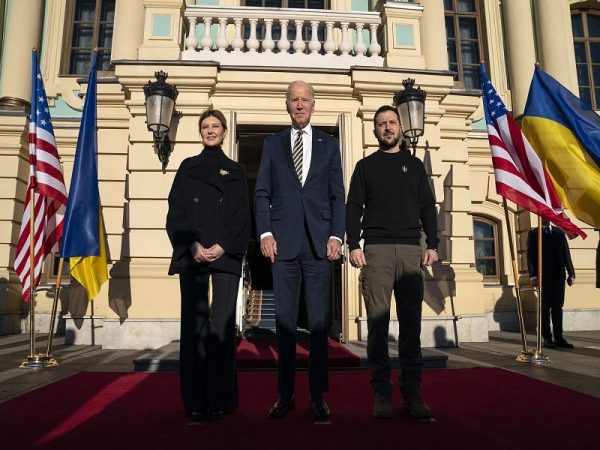
By Andrew Korybko | February 20, 2023
The whole reason why the Mainstream Media and allied accounts on social media are overdosing on this cheap “copium” is because they know very well that tougher days are ahead for their side considering NATO’s military-industrial crisis, the sanctions’ failure, and Russia’s likely capture of Artyomovsk/“Bakhmut”. Kiev’s supporters urgently need a proverbial shot in the arm to keep their morale alive amidst the series of impending setbacks that are poised to afflict the Golden Billion’s proxies in the coming future.
The term “copium” refers to an artificially manufactured narrative aimed at distracting a targeted audience from a disadvantageous development by convincing them that “everything is going according to plan”, which is why it’s a fitting description of the purpose behind Biden’s surprise visit to Kiev. His trip occurred against the context of the NATO chief finally admitting his bloc’s military-industrial crisis that risks depriving its Ukrainian vassals of the armed support they need to continue this proxy war.
Just the day before Biden arrived, Zelensky disclosed in an interview with Italian media that his forces might abandon Artyomovsk/“Bakhmut” if their casualties continue to climb, which represents a decisive reversal of the “official narrative” hitherto claiming that they’ll cling to it no matter the cost. On the topic of decisive narrative shifts, American and Polish officials spent the past month informing everyone that Kiev’s victory is no longer “inevitable”, which was meant to prepare them for impending setbacks.
Between the initiation of that newfound narrative trend and Biden’s trip, the New York Times reported that the West’s anti-Russian sanctions failed, after which Bloomberg proved that India had been working as the middleman for indirectly facilitating Russia’s oil exports to the West. Russian Foreign Minister Lavrov’s two practically back-to-back trips to Africa in recent weeks also confirmed that his country is far from isolated since it enjoys that geostrategic continent’s support.
The sequence of events that began at the start of this year were obviously disadvantageous for the US-led West’s Golden Billion since they discredited everything that this de facto New Cold War bloc’s perception managers had claimed up until that point. Russia continues gradually gaining ground in Donbass, neither its economy nor military collapsed under sanctions, and the global systemic transition to multipolarity has only accelerated since the start of its special operation a year ago.
It therefore makes perfect sense why the US was so desperate for a distraction, hence Biden’s visit to Kiev, which is being spun by the Mainstream Media (MSM) as supposedly representing one of the most symbolic moments since Russia was forced to initiate the latest phase of the Ukrainian Conflict. Nothing of tangible significance was achieved during his trip, though, and the comparatively miniscule armed aid that he announced on Monday obviously didn’t require him to be there in person.
The whole reason why the MSM and allied accounts on social media are overdosing on this cheap “copium” is because they know very well that tougher days are ahead for their side considering NATO’s military-industrial crisis, the sanctions’ failure, and Russia’s likely capture of Artyomovsk/“Bakhmut”. Kiev’s supporters urgently need a proverbial shot in the arm to keep their morale alive amidst the series of impending setbacks that are poised to afflict the Golden Billion’s proxies in the coming future.
The last thing that this de facto New Cold War bloc’s liberal-globalist elite needs is the masses losing hope in this post-modern crusade lest public pressure build to the point of complicating some NATO countries’ further dispatch of armed assistance to Kiev at the expense of their minimum security needs. The chain reaction of disadvantageous developments that was described in the present analysis and everything else that might thus follow if that unfolds could end up being a game-changer in this conflict.
The military-strategic dynamics are trending in Russia’s favor at this pivotal moment in the conflict, and even the economic ones too after the New York Times reported that the West’s sanctions failed, so there’s never been a more urgent time for a “copium” binge than now. Biden’s visit to Kiev won’t change the aforesaid, but it might very well succeed in temporarily distracting the Western masses from all this long enough for their elites to weaponize a new set of infowar narratives against them.
Munich Security Conference 2023: An Exercise in Western Self-Delusion
By Scott Ritter – Sputnik – 20.02.2023
Delegates from around the world assembled in Munich, Germany on February 17, 2023, to convene an eponymously named security conference that has, since its inception in 1963, operated under the motto “Peace through Dialogue.”
For three days, world leaders participated in what has become known as “the Davos of Defense” (a reference to the World Economic Forum held in Davos, Switzerland), discussing critical security issues of the day.
This year, not surprisingly, the Russian-Ukrainian conflict dominated the agenda. What was a surprise, however, was the emphasis that western participants placed on action over discussion when it came to formulating a collective strategy for achieving some sort of conflict termination. Indeed, the dominant theme at Munich was not simply how to provide more material to Ukraine’s military, but how to do so in a manner that escalates the conflict by challenging Russia’s so-called “red lines” – regarding western support to Ukraine.
For the first time since the 1990’s, Russia was not invited to attend the conference. Instead, prominent Russian opposition figures, including exiled oil tycoon Mikhail Khodorkovsky, chess champion Gary Kasparov, and Yulia Navalnaya, the wife of the imprisoned opposition leader Alexei Navalny, were invited. The chairman of the conference, Christoph Heusgen, explained this pointed deviation from the principle of promoting dialogue by declaring that he did not want to be seen as providing a platform for Russian propaganda.
Instead, it turned out, Heusgen turned the floor over to western propagandists.
The underlying theme in Munich went beyond an escalation of support for Ukraine, and instead embraced the outright provocation of Russia. Lithuanian President Gitanas Nauseda served as the pace-setter for this trend when, prior to the Munich Security Conference, he urged western leaders to consider providing Ukraine with “essential military aid” such as tanks, fighter aircraft, and long-range missiles, despite long-standing concerns by the west that the provision of such aid would be seen by Russia as evidence of direct participation by the providing parties in the conflict. “These red lines,” Nauseda declared, “must be crossed.”
On cue, Ukraine’s President Volodymyr Zelensky opened the conference with an appeal, delivered via video and designed to underscore a sense of urgency.
“We need to hurry up,” Zelensky declared. “We need speed—speed of our agreements, speed of our delivery, speed of decisions to limit Russian potential. There is no alternative to speed because it is the speed that the life depends on,” Zelensky said, concluding that there was “no alternative to a Ukrainian victory.”
But Zelensky’s exhortations for speed appeared to fall upon deaf ears when it came to two of Europe’s most important leaders. Both Germany’s Olaf Scholz and France’s Emmanuel Macron underscored that, from their perspective, the conflict in Ukraine would not be ending anytime soon. “I think it’s wise to prepare for a long war,” Scholz noted in his remarks to the conference, a sentiment Macron echoed by saying that Europe should prepare for a “prolonged conflict in Ukraine.”
Declaring that now was “not the time for dialogue,” Macron urged his fellow conference attendees to action. “We absolutely need to intensify our support and our effort to the resistance of the Ukrainian people and its army,” Macron said, and “help them to launch a counter-offensive which alone can allow credible negotiations, determined by Ukraine, its authorities and its people.”
There is a fundamental disconnect between the frenetic urgings of President Zelensky and the long-term approaches taken by Scholz and Macron that point to an overall atmosphere of self-delusion that seemed to dominate the Munich Security Conference.
While US Vice President Kamala Harris spoke of bringing Russian leaders “to justice” for alleged war crimes in Ukraine, the Ukrainian military is being systemically ground down on the battlefields of eastern Ukraine, soil that Russia now claims for its own. Current NATO military commander, Lieutenant General Christopher Cavoli, has described these battles as being “out of proportion” to NATO plans and capabilities in terms of the “scope and scale” of the violence being perpetrated on the ground by both parties to the conflict.
Rather than accept the inevitability of a Ukrainian military defeat, however, Cavoli briefed US lawmakers on the sidelines of the Munich Conference that, in his opinion, Ukraine should be provided with modern jet aircraft, including F-16 fighters, and long-range missiles capable of striking targets deep inside Russian territory. These weapons, Cavoli said, would enable Ukraine to fight what he termed “the deep fight”, shifting the emphasis from the deadly fighting at the point of direct engagement to a new war where Ukraine would disrupt the Russian war effort by striking headquarters and supply lines deep behind the frontlines.
In short, Cavoli was outlining an escalatory strategy brought to life by Lithuanian President Gitanas Nauseda’s earlier exhortations to cross all “red lines” when it came to supporting Ukraine.
But simple rhetoric cannot bridge the yawning gap that exists with reality. Words, especially in an environment like this year’s Munich Security Conference, where all pretense at dialogue has been forsaken in favor of the construction of a pro-western echo, resonate in a manner which promotes an artificial sense of substance. But unless these words are backed by concerted action, they carry no weight and will soon dissipate into nothingness.
This, in short, is the reality of the Munich Security Council—an exercise in self-delusion, similar in construct to the discussions around the conference table in the last days of the Battle of Berlin in 1945, in which Adolf Hitler moved imaginary armies around in a vain effort to seize victory from the inevitability of defeat.
The fact is, there are no tanks, no long-range missiles, no fighter aircraft available in any realistic time-frame that can help Ukraine reverse the deterioration of its military posture vis-à-vis Russia. Zelensky’s demands for urgency reflect a growing recognition on his part that, if left on the current trajectory, the war with Russia will be over soon—perhaps as early as August 2023. The inability and/or unwillingness on the part of the western military and civilian leadership to match their declarations of support with Zelensky’s timeline demonstrates an absolute divorce from reality on the part of those who were gathered in Munich, or else the cynicism of those who know the tragic fate that awaits those they claim to support only too well.
The harsh truth that the participants of the Munich Security Conference know, but cannot speak, is that there is no hope for a Ukrainian victory over Russia.
Chinese report decries US hegemony
RT | February 20, 2023
The US has been abusing its hegemonic position in the world for decades to reap benefits for itself and sow rivalry and instability in other nations, a report published on Monday on the Chinese Foreign Ministry’s official website claims.
The document seeks to draw international attention “to the perils of the US practices to world peace and stability and the well-being of all peoples.” It offers examples of Washington’s purported selfishness in the areas of politics, the military, the economy, technology and culture.
For a century, the US has treated Latin America as its backyard, where those who resist the US face “political interference, military intervention and regime subversion,” the text claims. Elsewhere, it creates divisive blocs under its influence, and fosters “color revolutions” against opponents. Lately Washington has posited the false dichotomy of “democracies vs. autocracies” and arbitrarily labels nations as members of one of the camps.
The use of force has been a feature of US expansionism since its independence, the document says. Since 2001 alone, wars launched by Washington “in the name of fighting terrorism have claimed over 900,000 lives with some 335,000 of them civilians.”
The Pentagon has used an array of “appalling methods” of war, from biological weapons in Korea to depleted uranium munitions in more recent times, “causing… countless civilian casualties and lasting environmental pollution,” the piece notes.
The US government has used the dollar’s status as the global reserve currency, and its influence on the international financial system, to quash competition and slap unilateral sanctions against opponents. Washington “is basically collecting ‘seigniorage’ from around the world,” and during the Covid-19 pandemic, disrupted the global economy by injecting trillions of dollars into it, the report says.
The report accuses the US of using its status as a leading technological power to conduct electronic surveillance and espionage, including against its closest allies, as well as cyberwarfare, noting that having the leverage of big tech companies allows the US government to censor speech online and push its narratives on a global scale, while silencing critics.
The document concludes that the US should do some “soul-searching” and change its approach, as “the historical trends of peace, development, cooperation, and mutual benefit are unstoppable.”
Munich Conference signals Western isolation, advent of multipolarity
By Drago Bosnic | February 20, 2023
Although it has been only 16 years since President Putin’s historical speech at the 2007 Munich Conference, that event now seems like a distant past of a long-lost world. Back then, Russia was warning the political West that further NATO aggression would inevitably lead to the revival of the Cold War.
However, Washington DC and Brussels seem to have wanted exactly that. The political West has tried to present the 2023 Munich Security Conference as some sort of a groundbreaking global event that “sent a strong signal” and showed “just how isolated” Russia is. However, nothing could be further from the truth, given the comments of some of the most prominent participants, including NATO and EU member states.
For instance, during a Saturday meeting with US State Secretary Anthony Blinken, China’s Foreign Minister Wang Yi stated that Beijing finds Washington DC’s attempts to threaten Sino-Russian relations completely unacceptable, emphasizing that the relationship between the two superpowers is their sovereign right and that it is not aimed against any third party.
“We will never accept the instructions of the United States and even threats to put pressure on Russian-Chinese relations,” Wang was quoted as saying in a statement published on Sunday by the Chinese Foreign Ministry. “The Sino-Russian relations of comprehensive partnership and strategic cooperation are based on non-alignment, non-confrontation and non-targeting against third parties. They are within the framework of the sovereignty of two independent states,” he added.
The comments were made in response to US accusations that China will “increase its support for Russia”. Wang also warned his American counterpart against the continued melodramatic reaction to the “balloon controversy”, which the US has been (ab)using lately to ensure detente between the two countries is virtually impossible. Beijing said that American high-altitude balloons have illegally entered China’s airspace many times over the last several decades, but the government chose not to cause panic and simply used existing diplomatic channels to communicate with their US counterparts.
“If the US continues to use this as an excuse, to promote further escalation and aggravate the situation, then China will definitely go to the very end. All the consequences of this will be borne by the American side,” Wang said.
China also called on the US to stop escalating the Ukrainian crisis and start promoting a peaceful settlement. Wang said that “Washington DC should stop adding fuel to the fire”. He noted that China’s position is constructive and called for the negotiation process to continue.
“Being a great power, the United States should contribute to the political settlement of the crisis, and not add fuel to the fire and look for opportunities to extract its own benefits,” Wang was quoted as saying.
Hungary also called for the de-escalation of the crisis and insisted on maintaining economic relations with Russia. During the traditional annual address to his fellow citizens, Prime Minister Viktor Orban stated that “the only way for Hungary to live peacefully is to stay out of the conflict, as it is not our war”.
“We will maintain our economic relations with Russia, and we advise the entire Western world to do the same, because without relations there will be no ceasefire or peace talks,” Orban said.
On the other hand, the European Union is doing exactly the opposite. The bloc’s top diplomat Josep Borrel called Russia “an existential threat” and urged all member states not to continue supporting the Kiev regime, but “help more”. He also insisted that “the EU should start an industrial techno-blitzkrieg to produce more weapons“, effectively nullifying the claim that the bloc was an economic union. Borrel added that member states will spend an additional €70 billion on defense by 2025.
“In the next two years, the EU countries intend to spend an additional €70 billion on defense. France will increase defense spending by 40%, while Poland will double it,” he stated.
Interestingly, India was also targeted. George Soros, a controversial oligarch infamous for providing financial backing for various groups responsible for destabilization and undermining of countries the political West sees as “uncooperative”, stated the following:
“India is an interesting case. It’s a democracy, but its leader Narendra Modi is no democrat. Inciting violence against Muslims was an important factor in his meteoric rise. Modi maintains close relations with both open and closed societies. India is a member of the Quad (which also includes Australia, the US, and Japan), but it buys a lot of Russian oil at a steep discount and makes a lot of money on it. […]
Modi and business tycoon Adani are close allies; their fate is intertwined. Adani Enterprises tried to raise funds in the stock market, but he failed. Adani is accused of stock manipulation and his stock collapsed like a house of cards. Modi is silent on the subject, but he will have to answer questions from foreign investors and in parliament. This will significantly weaken Modi’s stranglehold on India’s federal government and open the door to push for much-needed institutional reforms. I may be naive, but I expect a democratic revival in India.”
In response to the accusations, India’s Foreign Minister Subrahmanyam Jaishankar brushed Soros off and (quite accurately) described him as “old, rich, opinionated and dangerous”. Considering Soros has a history of Nazi collaboration, it can be argued that his attack could even be considered a compliment of sorts for Prime Minister Modi and India as a whole.
In essence, the Munich Conference not only failed to produce the desired results (Russia supposedly isolated), but it even strengthened the multipolar world, as neither India nor China proved malleable in any way, showing their sovereignty is untouched by the political West’s pressure. On the other hand, many Europeans are extremely unhappy by the EU’s militarization. According to varying estimates, the huge crowd of protesters in Munich numbered up to 50,000 people. In conclusion, while there are massive differences between Munich 2007 and Munich 2023, the latest conference is somewhat similar to the 1938 Munich Agreement between Nazi Germany and Western allies. Considering how that ended (along with any other invasion of Russia), the political West’s prospects against Moscow look rather grim, to say the least.
Drago Bosnic is an independent geopolitical and military analyst.
Australia’s Biggest Renewable Energy Project, Snowy 2.0, grinds to a halt, with a stuck bore
By Jo Nova | February 14, 2023
Complexity has a price, and a renewables grid is a bit like a 240 volt moving Rubiks cube. Here we see an unnecessary project hit by a random factor that in turn will affect all the others, blowing out other costs and schedules.
Australia’s breakneck energy transition, driven like a crash test dummy by government subsidies, depends on finishing the massive pumped hydro scheme called Snowy 2.0. However it has hit another delay no one apparently saw coming.
“Australia’s biggest renewable energy project” is the $6 – 10 billion plan to pump water uphill so it can run back down again to generate electricity every time the windmills and solar panels suffer a catastrophic failure, which is nearly every day. The entire project is superfluous in a grid with coal power — as we know from the last fifty years when we didn’t need it.
Unfortunately a 2,400 ton Tunnel Boring Machine called Florence is quite stuck under a cave-in. According to the ABC she started ten months ago, and is supposed to be digging her way through 15 kilometres (10 miles) of mountain. The stuck bore can’t go forwards, but she can’t go back the way she came in either. The team has installed concrete reinforcing behind Florence as she moved and the concrete reinforcing effectively locks her in. It’s meant to be a one way trip.
So we have the irony of a machine designed to carve through miles of rock trapped inside a pile of sand. But it gets worse.
Last month, the Snowy Hydro Corporation said it was monitoring a “surface depression” above the boring machine. So a local man decided to go looking for the hole. As he says “technically, [Florence] should be 9 kilometers in but I thought I’d start about 3 kilometers out and start walking my way back in,” Mr Anderson said.
He spent four days looking for the hole only to find it, wow, barely 150 meters from the entrance.
His big shock was not the hole, but that the tunnel borer had barely achieved anything at all. These machines are designed to travel 30 to 50 meters a day, so this short tunnel is effectively one week’s work. The Snowy 2.0 scheme is supposed to be finished by December 2026, (just revised a week ago to Dec 2027) but at the current rate of 60 centimeters (2ft) a day it will take about 70 years to finish.
Looks like we will need those old coal plants for a bit longer. This delay could affect the rollout of new renewables.
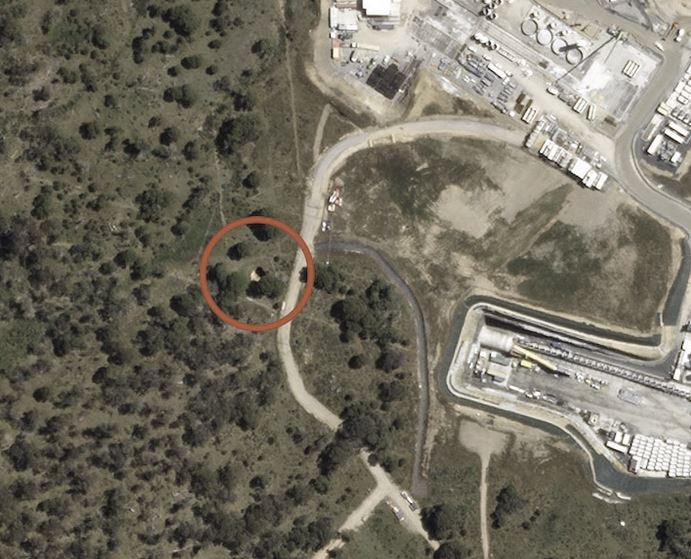
The hole is only 150m from the entrance.
Future options include jacking it up (described as “a huge task”) or disassembling Florence — all 143 meters and 2,400 tons — and extracting the machine in pieces. But if they do that, they will have to start the whole tunnel again. Still they hadn’t got very far…
You’d never know Australia was a top mining nation, eh?
Pumped Hydro is giant appliance that sucks electricity and gives you back some later. In a system with reliable baseload generators it is superfluous, redundant, and entirely unnecessary. It is an expense we don’t have to have, didn’t need, and don’t want to pay for. It can only make things more expensive than the system we used to have. Not only do we have to pay for the giant infrastructure, every day it operates we also throw away 20 – 30% of the electrons (so to speak) that go through it.
Snowy 2.0, is twice the cost, half the value, wastes a quarter of the energy, and wrecks the environment too
The mammoth pumped Hydro scheme is a $10 billion dollar disaster that will never pay for itself, is already being superseded by battery technology, and will scar the land, infect pristine alpine lakes, risk critically endangered species, damage fishing grounds, and breach the Biosecurity Act in a National park. (Where are the environmentalists, Tim Flannery? Does anyone care?)

Thanks to Steve Hunter
UPDATE: A net-zero grid (without nuclear power) needs 23 Snowy 2.0 schemes for storage:
Australian Financial Review, April 2022
The Australian Energy Market Operator estimates that by 2050, without coal power plants, the National Electricity Market will require 45 GW and 620 gigawatt-hours of storage in all its forms to manage variations in fast-growing wind and solar generation, and to keep the grid stable. The figure rises steeply the closer the grid gets to 100 per cent renewables.
Snowy chief commercial officer Gordon Wymer points to an old estimate from ITK Services that some 8000 GWh – 23 times the capacity of Snowy 2.0 – could be needed for a fully renewable NEM, while Snowy’s own estimates signal that three to five times the capacity of 2.0 is needed for a 50-60 per cent renewable grid. (ITK principal David Leitch says his estimate is out of date and refers back to AEMO’s estimates.)
Snowy 2.0 needs huge transmission line construction as well (Humelink and VNI West):
There’s another $6 billion in transmission lines that we didn’t need for a coal fired grid.
Australian Financial Review, April 2022
“The cost/benefit analyses undertaken by TransGrid and also by AEMO makes quite clear that HumeLink plus Snowy 2.0 – they go together, the one is useless without the other – will destroy the wealth of New South Wales electricity consumers and Australian taxpayers,” says Bruce Mountain, director of longstanding Snowy 2.0 critic, Victoria Energy Policy Centre at Victoria University.
He says findings by AEMO and TransGrid that HumeLink provides net benefits only get to that conclusion by ignoring the cost of Snowy 2.0.
Broad argues the new transmission was required as long as 10 years ago, pointing to the bottlenecks in the system that prevent even the existing Snowy hydropower output reaching Melbourne and Sydney during demand spikes on hot summer days. Lack of grid capacity is also crimping new wind and solar generation, he notes, saying the critics are “missing the point” and getting caught up in “the politics of who’s doing what”.
Broad fears the $3.3 billion HumeLink will slide into 2027, while the $3 billion VNI West, which three years ago was expected by 2028, is now pencilled in for July 2031 in AEMO’s latest draft grid blueprint but may slip into 2032.
East Palestine train wreck may have created largest dioxin plume in world history

BY ETHANH | CITIZENS NEWS | FEBRUARY 17, 2023
The situation in East Palestine, Ohio, is much worse than the media is letting on, particularly as it pertains to the widespread release of chemical dioxins.
The 14 some-odd tanker cars carrying vinyl chloride that were intentionally blown up released a massive plume of these deadly chemicals, which were spread far and wide, including up the eastern seaboard through Pennsylvania, New York and beyond. Tens of millions of people stand to be affected by this dioxin release, which by and large appears to be the most disastrous dioxin incident to have ever occurred in world history. Water supplies, food crops, city parks, state forests – all of them stand to become toxified with dioxins due to this disaster.
“Burning vinyl is the most serious source of dioxin in the environment – whether from trash incinerators, house fires or chemical spills,” explained Eric Coppolino, writing for Planet Waves FM – Chiron Return. “While vinyl chloride is a precursor chemical to making PVC, any time chlorinated compounds burn there will be dioxins created. And dioxin is a manufacturing byproduct of any manufacturing process involving chlorine, from ‘disinfectants’ to the bleaching of paper. There was plenty of dioxin in those tanker cars before they caught fire.”
Dioxins are a hormonal toxin that builds up in the food chain
One of the most concerning things about dioxins is their persistence. They do not biodegrade and tend to remain wherever they lodge themselves for years and years.
Most people are unaware of what dioxins even are because the media rarely talks about them. Back in the day, a small release of them led to the closure of Times Beach, Mo., which was leveled and had its zip code removed over a dioxin release much smaller than the one that just occurred in Ohio.
“It is one of the most serious environmental issues, but the background is not known by nearly anyone (and that’s partly why I have posted the history below),” Coppolino wrote.
So where do dioxins come from? They are generated when chlorinated chemicals like vinyl chloride burn, explode or degrade. They are never an end product but are rather a contaminant and degradation byproduct.
“They are directly related to PCBs, which are considered dioxin-like compounds,” Coppolino explained.
“Dioxins were the extremely toxic component in the Vietnam War-era defoliant Agent Orange. They were at the Love Canal in Niagara Falls. They were the toxin involved in the evacuation and dissolution of Times Beach, Missouri. They are the cause of toxic shock syndrome from bleached paper tampons.
“Dioxins are acute toxins on one level. There will be a lot of dead fish and animals in the path of the Ohio plume – and people will get very sick immediately. Kids are extremely sensitive due to their low body weight.”
Their persistence in the environment and hormonal toxicity makes dioxins a very serious problem, especially when released at high levels like what happened in Ohio. We have not even begun to see the effects of what just occurred, which will manifest in the months and years to come as animals, humans and nature suffer over time.
“I guess a new disease is going to be invented soon,” one commenter wrote about how the establishment will probably invent some new made-up disease to explain away all the future cases of dioxin poisoning caused by the controlled explosion. “And a new ‘virus’ will be invented, too. And new vaccines. And the shame. People being intoxicated being shamed because they can ‘infect’ people.”
JUDGE TELLS GUILTY JUST STOP OIL LOONS TO “FEEL PROUD” AND SAYS “YOU ARE ALL GOOD PEOPLE”
Gaia Fawkes | February 17, 2023
Seven Just Stop Oil eco-loons who were found guilty of raids on an Esso Fuel Terminal in Birmingham last year have been spared jail by a sympathetic judge in Wolverhampton Magistrates’ Court… and told by the very same judge they should “feel proud” that they “care” so much. “Thank you for opening my eyes”…
In his extraordinary closing statement at the trial, loony left Judge Wilkinson lavished the criminal activists with praise, claiming “it’s abundantly clear that [they] are all good people” and promising to go easy on them:
“It’s abundantly clear that you are all good people. You are intelligent, articulate and a pleasure to deal with. It’s unarguable that man-made global warming is real and we are facing a climate emergency. Your aims are admirable and it is accepted by me and the Crown Prosecution Service that your views are reasonable and genuinely held. Your fears are ably and genuinely articulated and are supported by the science.” […]
“No-one can criticise your motivations. You all gave evidence that was deeply moving. I certainly was moved. The tragedy is that good people have felt so much, without hope, that you feel you have to come into conflict with the criminal justice system. Thank you for opening my eyes to certain things. Most, I was acutely and depressingly aware of, but there were certain things.
“I say this and I mean this sadly, I have to convict you. You are good people and I will not issue a punitive sentence. Your arrests and loss of good character are sufficient. Good people doing the wrong thing cannot make the wrong thing right. I don’t say this, ever, but it has been a pleasure dealing with you.”
“You should feel guilty for nothing. You should feel proud that you care, have concern for the future. I urge you not to break the law again. Good luck to all of you.”
After hearing that glowing testimonial from the man expected to enforce the law on them, the seven protesters were eventually sentenced to a 12-month conditional discharge and made to pay a £22 surcharge each. Is it any wonder they’re not put off from making people’s lives miserable?
Potential Role of Spike Protein in Neurodegenerative Diseases
Long-term Exposure to Spike after COVID-19 Vaccines is Pathogenic
By Peter A. McCullough, MD, MPH | Courageous Discourse | February 18, 2023
The COVID-19 vaccination campaign was launched in late 2020 with no assurances on long-term safety and full liability protection to those involved with mass vaccination via the PREP Act and the National Childhood Vaccine Injury Act of 1986. There is now abundant evidence that the synthetic lipid nanoparticles travel into the brain and install the genetic code (mRNA or adenoviral DNA) for the SARS-CoV-2 Spike protein. As this protein is produced and accumulates in the brain, it can cause inflammation and also fold into an amyloid plaque. Thus, there is strong rationale for some vaccine recipients to develop mild cognitive dysfunction, Alzheimer’s like dementia, and other forms of neurocognitive decline. Because seniors were heavily vaccinated, many families and doctors will attribute clinical changes to advanced age and not the vaccine. They should understand in each and every case, that COVID-19 vaccination should be considered a determinant of cognitive decline in a previously healthy person.
Seneff and colleagues describe the pathophysiological rationale for COVID-19 vaccines in the development of neurocognitive disorders. Key features are: 1) CNS penetration of the vaccines, 2) neuroinflammation, 3) Spike protein activation of toll-like receptor-4, 4) folding of Spike protein into amyloid plaques, 5) cumulative exposure with multiple shots connotes enhanced risk.

Seneff S, Kyriakopoulos AM, Nigh G, McCullough PA. A Potential Role of the Spike Protein in Neurodegenerative Diseases: A Narrative Review. Cureus. 2023 Feb 11;15(2):e34872. doi: 10.7759/cureus.34872. PMID: 36788995; PMCID: PMC9922164.
For people in your family and social circles who are experiencing premature or a precipitous decline in mental function, have the doctors consider and document COVID-19 vaccination as a potential explanation. If a senior citizen is already confused or has cognitive decline, any further vaccination is contraindicated. In patients such as this, further booster shots are likely to worsen the condition and should be avoided.
Featured Video

The Most Important Bet You’ve Never Heard Of
or go to
Aletho News Archives – Video-Images
From the Archives
The Occupied Mentality Syndrome
Saudi Arabia on the American chessboard – Part 2
By B. J. Sabri | American Herald Tribune | April 19, 2016
Since the Korean War, but particularly since the Iranian Revolution of 1979 until today, the United States has been steadily escalating its military presence in the Persian Gulf. Taking advantage of many colossal events of the past 36 years, [1] the hyper-empire has institutionalized its massive presence on land and sea, and expanded its objectives to include the unambiguous physical control of the area, as well as the clear understanding that local Arab governments should abide by them. The pretext is always the same: in “defense” of the national interests and security of the United States. From observing how the United States has been interacting with the governments of the region, and by judging from the size of its expeditionary force, we could reach a basic conclusion. The United States is occupying, de facto, the entire Arabian Peninsula. (Yemen, devastated by Saudi and American jets is yet to be conquered. Oman? Britain returned not as colonial ruler but as a soft occupying power.)
Under this articulation, Saudi Arabia, Qatar, Kuwait, and the United Arab Emirates are virtually occupied countries. If we compare this type of occupation to the mandate and protectorate regimes of the past, the results might be identical—the nations affected by it lose sovereignty. When Arab governments comply with the objectives of a foreign power that station military forces on their national milieu, then that power controls them in multiple ways including how they react to policy deliberations and what decisions they intend to take on specific issues. A good method to verify the concept of effective occupation is this: take notice of what the United States says and wants, and then compare it to what the gulf rulers do in response. (I shall discuss this detail at some point in the upcoming parts.)
If the presence of US forces or other means of political pressure are a factor in Saudi Arabia’s interventionist Arab wars, then we need to debate this issue. However, from the history of resistance to colonialism, we learnt: if a powerful state imposes its order on a nation by military means or other forms of coercion, and if this nation does not resist that imposition, then a mental subordination to the powerful state will ensue. This is especially true in the case of Saudi Arabia. One single event, 9/11, has transformed it from a US “ally” into an instant political hostage of the American Empire. … continue
Blog Roll
 Aletho News
- Trump and the debris of Iran war
- IRGC hits US tech giant Oracle’s data center, computing site in UAE over new assassinations
- Bombing Iran Back Into the Stone Age /Lt Col Daniel Davis & Jim Jatras
- UAE rejects report claiming it is ready to join war on Iran to reopen Hormuz
- A New Resistance Front: How Does Syria Factor into the Regional War?
- Gulf states weigh pipeline expansion plans, hoping to bypass Hormuz
- Iran sets up ‘tollbooth’ system in Strait of Hormuz
- Wave 90: IRGC strikes US-linked industrial sites in Gulf
- Iran Says US-Israeli Claims of Its Military Strength Are Wrong
- Trump’s April Fools’ Address to the nation
- If Americans Knew
- ‘War crime’: Global condemnation as Israeli ministers celebrate death penalty law targeting Palestinian prisoners
- 7 Ways Israel Is Turning Lebanon Into Gaza
- World’s Leading Football Bodies Under Fire Over Israel Policies
- Experts warn of possible use of nukes against Iran
- Israeli invasion of Lebanon could be worse than 1982, warn European officials
- Passover: Liberation and collective punishment
- Trump says the quiet part out loud: (Israel’s) war on Iran > Americans’ health – Daily Update
- Gaza families reunite years after babies evacuated amid Israel’s war
- International Rescue Committee warns Gaza’s children face grave protection risks
- Iran’s Alleged 47-Year War on America: Debunking the 1,050 American Deaths Canard
- No Tricks Zone
- Low Intensity Tornado Wrecks Major Solar Farm, Creating A Potential Toxic Dump
- New Study Finds Warming Saves Lives…Cold Temperatures 12 Times More Deadly Than Excess Heat
- German Science Blog Accuses PIK Climate Institute Of Hallucinating Climate Tipping Points
- Devastating Assessment Of Comirnaty Vaccine By Former Senior Pfizer Europe Toxicologist
- New Study: CO2 Is ‘Effectively Negligible’ As An Explanatory Climate Change Factor Since 2000
- Former Pfizer Toxicologist Dr. Helmut Sterz Tells Bundestag Hearing Pfizer Vaccine Should Have Never Been Approved
- Energy Expert: Germany’s Nuclear Phaseout Was A “500 Billion Euro Mistake”
- New Research: South Australia’s Mid-Holocene Sea Surface Temperatures Were 4°C Warmer Than Today
- Storing Green Energy To Last Germany 10 Days Would Require A 60-Million Tonne Battery
- New Studies: UK Sea Levels Were 4 Meters Higher Than Today During The Mid-Holocene
 Aletho News