Large-scale Russian combat actions in Ukraine expected in February
By Lucas Leiroz | February 2, 2023
A new wave of activity is expected for the Russian special military operation during February. The recent changes in the command of the operation appear to have been carefully planned in order to elevate the combat to a new level and several of Moscow’s strategic objectives may soon be achieved, radically changing the course of the conflict.
According to information provided by Russian military, a major offensive is being prepared for the period between February and early March. The informants say that the objectives will be:
1. Reaching the borders of the regions recently reintegrated into the Russian Federation, pacifying the new oblasts;
2. capturing Nikolaev, Odessa, as well as the entire Black Sea coast, reaching Transnistria;
3. seizing Kiev, forcing a political capitulation of the neo-Nazi regime until early March.
The territory of Belarus will become the main springboard for the upcoming strike. Mobilized Russian servicemen are being trained in training camps in Belarus, where heavy military equipment and combat aircraft are concentrated. A large bombardment force is in readiness for action. Also, Russian forces in Belarus have been collecting strategic information on the location of Ukrainian units, mainly about Kiev’s air defense, gathering intelligence data that will be used to plan the attacks.
In parallel to Belarus, Zaporozhye and Lugansk are also key zones for the Russian strategy. It is expected that massive attacks will come from these regions during the offensive, destroying enemy units in a short period of time which will allow a rapid Russian advance on the battlefield, reaching the zones listed in the above-mentioned objectives.
Sources also report that for the offensive to be successful Russian forces will focus on blocking all enemy’s supply lines. The main route of arrival of supplies to Ukraine is the border with Poland, where there is the transit of NATO’s ammunition and military equipment.
In fact, the battlefield conditions seem favorable for these objectives to be achieved. The Ukrainian forces are currently exhausted and weak. On the other hand, the mobilized Russian soldiers are fully prepared to engage in high-intensity combats. In addition, Russian artillery positions in Belarus and in the liberated territories have a privileged location, which significantly increases the chances of victory in the coming offensive.
Valery Gerasimov, Chief of the General Staff of the Russian Armed Forces, was promoted to the position of Commander of the Joint Forces of the Russian Federation in the Special Military Operation Zone. Gerasimov’s arrival to power seems to have been a move towards the final stage of the special military operation.
His predecessor, General Surovikin played an important role while in command. A veteran of Chechnya and Syria and having extensive experience in counterterrorism, Surovikin was appointed to the post at a time when Ukrainian terrorist actions were on the rise. He fulfilled the goal of neutralizing the enemy’s offensive potential with his strong actions on the Ukrainian critical infrastructure, at the same time that he saved thousands of Russian lives with his policy of avoiding trench warfare and prioritizing long-distance bombing. Now, however, the special military operation needs a new direction.
And this was the main reason for the appointment of Valery Gerasimov. As Chief of the General Staff of the Russian Armed Forces, he is undoubtedly the most prestigious Russian officer and therefore the right man to lead the operation’s most decisive moves. The objective now is no longer to break the enemy’s offensive potential, but to force Kiev’s neo-Nazi regime into capitulation through a huge offensive.
After so many Russian attempts to negotiate a peaceful resolution, with the Ukrainian government ignoring them and insisting on an irresponsible military campaign, now there seems to be no other possible end to the conflict than a Russian offensive strong enough to liberate the entire Ukrainian coastline and capture Kiev.
Lucas Leiroz is a researcher in Social Sciences at the Rural Federal University of Rio de Janeiro; geopolitical consultant.
Peru’s Congress Refuses Early Elections, Heightening Tensions as Protests Rage
By Wyatt Reed – Sputnik – 02.02.2023
Peruvian legislators shot down any remaining chance of a peaceful resolution to protests that have already seen around 60 demonstrators killed by security forces.
The Congress of Peru voted down a proposal to move up presidential and legislative elections to 2023, complicating efforts to end the deadly crisis that has gripped Peru since ousted President Pedro Castillo was forced from power and jailed by security forces nearly two months ago.
With just 53 legislators in support, lawmakers fell far short of the 87 votes needed to advance the initiative after five hours of debate.
Legislators from elite-dominated parties reportedly insisted that early elections were “unconstitutional” and complained that members of Peru’s notoriously-unpopular Congress should be allowed to finish their term.
Demonstrators have been calling for the liberation of Castillo, a new constitution, and for Congress to be dissolved.
The lawmakers’ refusal to budge on the issue of early elections means demonstrators have little incentive to leave the streets. After seven weeks of daily protests, participants have so far shown little intention of packing up and leaving.
“There is no truce,” one Peruvian journalist wrote following the proposal’s rejection.
“The demonstrations against the government of Dina Boluarte continue in #Lima the same day that Congress denied the possibility of an advance of general elections.”
Widespread pushback against the newly-formed Peruvian regime of Dina Boluarte began on December 7, after Castillo was charged with rebellion over accusations that he attempted to “illegally” dissolve Congress, which holds an abysmal approval rating of just 7% per latest polls.
Boluarte herself isn’t faring much better. The most recent survey available shows just 21% of Peruvians approve of her performance and 63% want the unelected head of the regime to resign immediately.
Scholtz failed to secure support for Ukraine on his tour of South America
By Ahmed Adel | February 2, 2023
German Chancellor Olaf Scholz’s trip to Argentina, Brazil and Chile was with the aim of involving them in the Ukraine conflict and to create a regional counterweight to China’s growing influence. These are similar actions already made by the US in South America and one that we can also expect from other European powers.
Scholz’s visit is an attempt to restore influence in a region that has been empowered by China and Russia to forge an independent path that is not under the umbrella of the “Monroe Doctrine.” It is not a coincidence that the German Chancellor visited the region just days after the Summit of the Community of Latin American and Caribbean States (CELAC), at which member states sought to strengthen regional integration in the context of Western powers attempting to prevent Latin America from strengthening relations with Russia and China.
Behind Scholz’s visit was the fact that China has become very close to Latin America. Therefore, it is in Berlin’s interest to note this competition between the Great Powers in South America and follow the trends that are emerging in the region rather than just behave as Washington’s representative.
It cannot be overlooked that South America, especially Chile, has large lithium reserves. Scholz’s visit is a form of US and European effort to effectively make the Chilean economy work in their own interest, as was the case when the US installed Augusto Pinochet as dictator in 1973.
The West’s imperial attitude of previous centuries remains the same, but, now with China’s thirst for resources, South American countries are finding a way out from the grasp of US hegemony. It is reminded, for example, that Chile’s main copper export partner today is China and not the US.
Both Washington and Berlin want major Latin American countries, like Chile, to ratify commercial, diplomatic, and political relations with the West so that they are not absorbed into China’s sphere of influence. This is an endeavour that will take many years to undergo because China is already entrenched in the region, something that is problematic for Germany as they need immediate solutions to the self-imposed energy crisis caused by sanctions on Russia.
Germany’s own self-destructive policies made it show an interest in a region that it never traditionally did. If the war in Ukraine was not occurring, it is more than likely that Berlin would not be in a hurry to forge new relationships for alternative energy sources. The issue is that Germany wants to impose its own liberal ideology over Latin America as a condition for trade, which means a cut in trade and relations with China and Russia.
South America is not only an important source of resources, but is a major region that refuses to cut trade and diplomatic relations with Russia. Whatever anticipation or expectation Scholz had on his trip were quickly dashed as he did not find the response he was expecting from his Latin American counterparts. The positions of the leaders of Argentina, Brazil and Chile reflects the fact that these governments know how to distinguish economic cooperation from political dependence.
Involving Latin America in the Ukraine conflict is something that will face widespread rejection. For example, although new Brazilian President Luiz Inacio Lula da Silva “emphatically deplored Russia’s violation of Ukraine’s territorial integrity and annexation of parts of its territory as flagrant violations of international law” in a joint statement released with Scholtz on January 30, his government’s policies towards Russia have not deviated far from his predecessor Jair Bolsonaro.
However, Lula also confirmed that Brazil would not provide ammunition to Ukraine for German-made Gepard anti-aircraft guns, as reportedly requested by Berlin, and insinuated that Ukraine was not seeking peace. Effectively, Lula is happy to pay lip service to the West but will not take any concrete action in matters related to the war in Ukraine.
In the same light, Argentina and Chile’s leaders also ended any German hope that they might lend support for Ukraine despite the fact that they were happy to condemn Russia’s military operation as an “invasion”. On his Latin America tour, Scholz wanted to demonstrate that international unity against Russia extends beyond the Western World, but only managed to secure some statements that are unlikely to damage relations with Moscow.
For his part, Lula said Brazil will work with other countries to help achieve peace in Ukraine as his country has not taken sides – something objectively true despite some damning rhetoric. In fact, likely to the annoyance of the German Chancellor, Lula said that China has an important role to play in peace talks, which he said he will discuss on a planned visit to Beijing in March.
It can be said that although Scholz’s trip can serve as a foundation for German-South American relations, his main goals – to secure support for Ukraine and to make advances in the resource industry only found limited success. Although he secured some rhetoric against Russia, he could not secure any material support for Ukraine. At the same time, although Germany has pitched its entry into the resource market, there is no guarantee that it will come to fruition or even challenge China’s dominance in the region.
Ahmed Adel is a Cairo-based geopolitics and political economy researcher.
UK government used an Army unit to spy on citizens so it knew “how scared people were” during Covid

By Didi Rankovic | Reclaim The Net | January 31, 2023
The report, “Ministry of Truth: The Secretive Government Units Spying On Your Speech” – an extensive, over 100-page long deep dive into the subject matter, among other things analyzed how the UK government used the country’s military to glean “how scared people were” during Covid.
Read the report here.
This, the Big Brother Watch privacy and civil rights group – that says the report is based on Freedom of Information Act responses and whistleblower accounts – meant creating a facade of dealing with “fake news,” while in reality conducting “large-scale monitoring of the British public on social media.”
According to the newly released document, the unit involved was the British Army’s 77th Brigade (aka 77x), whose purpose is to conduct “information operations” – within the military – including audience analysis and spreading “counter-propaganda.”
Previous “clients” they targeted included the Taliban and al-Qaeda, but now, it was time to turn to Twitter users and suss out anything that the authorities might consider to be Covid “misinformation.”
In late 2020, we reported that the 77th Brigade was used as support for the Cabinet Office’s Rapid Response Unit (RRU) effort to push vaccination, but the Ministry of Defense insisted they were “not used against UK citizens” and that their focus was on the international arena.
The report, however, goes on to detail what kind of social media posts found their way into something called “The Disinformation Daily,” compiled by said unit.
In early June 2020, the Cabinet Office received one, and its contents concerned posts about the possibility of Covid being a vascular disease (based on a Lancet medical journal article), while two other items, dismissed as “disinformation” were videos – one that 77th Brigade claimed was a “conspiracy video” about UK laws, and another that accused the UK government of deliberately terrifying, threatening, and manipulating citizens during the pandemic.
The report also contains testimony from a whistleblower who shed light on how the brigade really carried out its work as a “disinformation force.”
Although the involvement of the military was justified by the need to fend off “foreign actors” apparently trying to frighten Britons, the whistleblower reveals that the monitored posts “did not contain information that was untrue or coordinated – it was simply fear and domestic dissent.”
And – “We learned from the feedback that the government were very keen on hearing what the public thought about their COVID-19 response and how scared people were.”
The whistleblower also spoke about the concern that the government was “so interested in individual Twitter posts that they devoted an entire unit to monitoring what scared and otherwise powerless people had to say,” adding – “and I regret that I was a part of it.”
MHRA Caught Not Doing Its Promised Vaccine Safety Monitoring (Again)
BY NICK DENIM | THE DAILY SCEPTIC | JANUARY 28, 2023
We all know, I hope, about the significant and sustained number of excess deaths since May 2022. Most recently, you probably saw Esther McVey MP asking if the Department of Health would commit to an urgent and thorough investigation.
Maria Caulfield MP, one of the health ministers, replied saying that it’s also happening elsewhere and there is a range of factors. Implicitly, she was refusing to investigate. Outrageous.
However, it actually reminded me that way back in February 2021, MHRA promised to do a whole range of routine population-level data analysis “to quickly detect a potential safety signal” for the Covid vaccines. It announced it here under the section “Rapid Cycle Analysis and Ecological Analysis“. It explains what it involves as follows:
[A]s COVID-19 vaccination records (i.e., those given outside of GP surgeries) begin to get updated within GP systems, the MHRA will implement a form of active surveillance known as ‘Rapid Cycle Analysis’. This method involves proactive, weekly analysis of a range of pre-defined events (theoretical side effects) to quickly identify safety signals – it again involves ‘observed vs expected’ analyses (i.e. comparing rates after vaccination to rates in unvaccinated comparator groups) but doesn’t rely on people directly reporting any concerns through the Yellow Card scheme. It is also a more robust way to quickly determine if rates are likely to be consistent with a coincidental association. It also uses the MaxSPRT approach with adjustments made for the expected delays in the recording of events presenting to and diagnosed in secondary care settings. The list of pre-defined events of special interest is not fixed and can be expanded at any time.The MHRA will also use the CPRD data to conduct ‘ecological analyses’. This involves monitoring trends in the rates of pre-defined events within given population cohorts, based on prioritisation groups for vaccine roll out, to see if they are occurring to a greater extent amongst those targeted for vaccination after it is deployed compared to historical rates from the pre-deployment period. Comparisons can also be made to trends seen in groups not targeted for vaccination at the same time. This approach is most useful when we see high vaccine uptake and is another way to quickly detect a potential safety signal.
So I had a poke around MHRA’s website to see how it is getting on with this. Not very well, it turns out.
One of MHRA’s five divisions is called Clinical Practice and Research Datalink (CPRD) and it maintains a bibliography of peer-reviewed research and reports which have used data provided by MHRA from NHS datasets for things like ICU, A&E, inpatients, outpatients, cancer registration and pregnancy. When I looked, the bibliography had been updated as recently as January 9th 2023. So well and truly up-to-date. So far, so good.
Imagine my surprise when I could only find two population-level studies relating to the Covid vaccines, both relating to thrombocytopenia (low blood platelet count), one from February 2022 and one from October. So just one type of adverse event has been put through MHRA’s promised ecological analysis in the last two years. It doesn’t say much for MHRA’s commitment to use population-level data “to quickly detect a potential safety signal”.
Imagine my further surprise that none of the datasets which MHRA’s CPRD Division provides for research contains data after June 2021.
So in conclusion, all about as useless as the other strand of Covid vaccine surveillance it promised, Targeted Active Monitoring, which I noted in a recent article it quietly dropped 15 months ago.
For me, there are only two possible conclusions: either the MHRA is not doing the Covid vaccine surveillance it promised, or it is doing it and not making the results publicly available. Either way, it’s high time that MPs, the Covid Inquiry and the media started asking MHRA some searching questions.
Until Nick retired a few years ago, he was a Senior Civil Servant in a Government Department.
Researchers bamboozling journalists with mythical comparison of vaccinated and unvaccinated
Where are the numbers? by Norman Fenton and Martin Neil | January 31, 2023
From: XXXXXX
Sent: 30 January 2023 12:33
To: Norman Fenton
Subject: Hart GroupDear Professor Fenton,
Apologies for any intrusion, but I’m contacting you directly since the Hart Group (which I understand you to be a member of), have not replied to my earlier emails – all very busy people, I do understand.
As a small group of individuals who between us have some journalistic and medical-science history, we are working on a presentation (with a further view to establishing a website), which aims to offer a wider range of information concerning Covid policies and treatment than, it appears, is usually available through current mainstream and social media.
Given that our aim is a balanced juxtaposition and presentation of arguments, hopefully allowing better-informed opinions to be arrived at, we do have a range of “issues” we’d love to understand better in order to present them fairly.
You are (I imagine) well-placed to comment on one specific matter, and I would be enormously grateful if you would spare a minute to advise, assuming this enquiry doesn’t create any conflict of interest or other problems for you:
The Times and other media recently reported on a QMUL study* which indicates that unvaccinated individuals with certain medical conditions are more likely to suffer “serious outcomes” than vaccinated individuals. I believe presenting this this demands careful attention to context and contrasting with other possible perspectives.
Dr Aseem Malhotra in a Twitter-hosted video makes reference to de-bunking claims about how this story has been reported, but makes no reference I can find to where such a de-bunking can be found; and sadly, he too seems unavailable to comment!
Probably, Dr Malhotra’s position is not an issue you are required in any way to comment on. However, in general, I do think that those who would like to see “better”, more balanced reporting on Covid should find time to speak to others, like us, who are trying to support exactly that cause – presumably it’s in everyone’s interest. But that’s just a peripheral observation on my part!
It would be truly helpful if you can find a moment to provide some pointers to help us present a balanced picture of the study referred to above.
Many thanks, and best wishes.
Your’s faithfully,
XXXXX
* Also reported on the QMUL website: https://www.qmul.ac.uk/media/news/2022/smd/unvaccinated-individuals-with-heart-problems-up-to-9-times-more-likely-to-die-or-suffer-serious-complications-from-covid-19.html
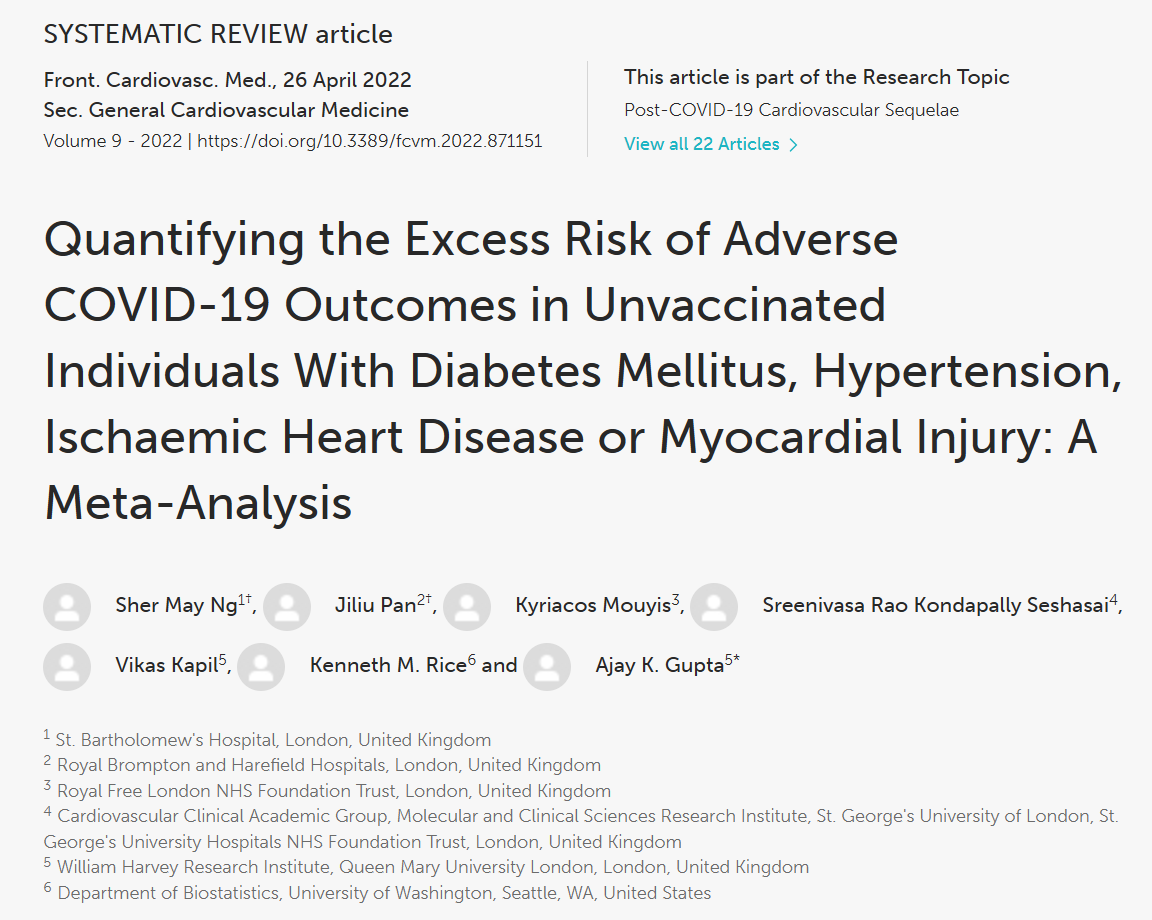
The study referred to is this one.
Here is my self-explanatory response:
Dear XXXXX
I should make it clear that, although I just briefly discussed this with one or two members of HART, my response below should certainty not be construed as ‘the HART response’.
The most important point to note about the QMUL study is that it certainly does not claim anything like what either you or The Times seem to think it claims, i.e it certainly does not show that “unvaccinated individuals with certain medical conditions are more likely to suffer serious outcomes than vaccinated individuals.” In fact, no comparison with a vaccinated cohort was undertaken.
All the study actually did was look at the outcomes for covid patients with pre-existing conditions like myocarditis. This is something very different to the later studies (such as those Aseem Malhotra referred to) which compared incidence of myocarditis occurring post-vaccination with the base rates for unvaccinated. So, all the study actually shows is that “that individuals with certain pre-existing medical conditions who get covid are more likely to suffer serious outcomes than those without such medical conditions who get covid.” That is hardly novel, since this has been widely known since March 2020.
In fact, the authors of the study are demonstrating a very clear bias by referring to the people in the study as ‘unvaccinated’. Of course, they were unvaccinated – it was a meta-analysis of 110 published studies between 1st Dec 2019 and 16th July 2020. There was, of course, no vaccinations anywhere during that period so referring to these people as ‘unvaccinated’ must have been done to fit a particular mischievous agenda. I am actually pleased you brought this study to my attention since it needs to be exposed for leading people like the Times and yourself to believe it was showing something that it wasn’t.
One major conclusion in the paper seems sensible – that having diabetes or hypertension or ischaemic heart disease predicts for poorer outcomes (although the same could be said for many other conditions so there is hardly anything novel in this). But the first part of the conclusion seems entirely wrong. Just because you see covid hospitalising a lot of people who had pre-existing cardiac comorbidity certainly does not mean that covid caused their comorbidity. It seems that this part of the conclusion may have been influenced by possible conflicts of interests (see below).
There are a number of other specific concerns about the study:
- They included studies published from 1st Dec 2019 – but that was before covid was formally accepted to exist, so how could any study published in Dec2019/Jan2020 have patients with suspected covid? Any study published pre-mid Jan 2020 should be excluded by default, since even the flawed confirmatory PCR test was not available until then. There would be no way of knowing if ‘is covid’ results was a mix of ‘not covid’, ‘possibly covid’ and ‘probably covid’.
- How is ‘suspected’ the same as ‘confirmed’? When the symptoms used for Covid marry to any number of other conditions that are common (and even endemic) then how can you say that suspected covid is even ‘a thing’?
- Someone hospitalised with exacerbation of an existing condition is NOT the same thing as someone who gets a new diagnosis OF that condition after vaccination.
- Including so many Chinese studies clearly biases the work – and using China and USA to predict for LMIC (in the Introduction) is strange to say the least.
A colleague also noted the link between Prof Gupta (the senior author) and the Bill and Melinda Gates Foundation and other potential conflicts of interest:
- In this report Gupta is acknowledged as having provided the statistical support for a report that seeks to help the Bill and Melinda Gates Foundation and the Clinton Foundation find new ways to support medical/health research in the UK. There are also a number of links between Gupta before he came to QMUL and functions (like some project called D3140 for the Rotary Club funded by BMGF in Mumbai, and research out of Imperial College) supported by the Gates Foundation. He is also heavily involved in Wellcome Trust AND the WHO – and is listed on the minutes of meetings between the two.
- Gupta and the lead author (Sher May Ng) are both on this study that was in part funded by the NIH (Grumbach acknowledges an NIH grant while at the UCal Nursing School. My colleague managed to find that she also has an NIH.GOV email address).
- Co-Author Kenneth Rice has worked on studies like this with staff from BMGF.
- Kenneth Rice and Gupta are two of the over 200 doctors who are part of a research collaborative called TOPMed – funded by the NIH with a combination of US Gov and BMGF money.
I hope this helps you.
Yours
Norman Fenton
For clarification of the potential conflict of interest with BMGF, Scott McLachlan has provided the following information:
Bill Gates is the world’s largest single shareholder of Covid-19 vaccine manufacturer stocks and therefore every time Pfizer, Moderna, Lilly (Eli), GSK, CureVac or even AstraZeneca (he had something like 8% in AstraZeneca shares at one point) sell a vaccine, that’s money back in his pocket. (see here)
And while fact checkers claimed Gates would not profit from Gilead (Remdesivir), he actually purchased a significant chunk of Gilead and 27,000 shares in Merck in 2018 in preparation. (Merck are one of the manufacturers who licensed to manufacture Remdesivir in their plants)
The thing that journalists get confused on is the idea that he, through his foundations, made ‘grants’ to Moderna et al. These were not ‘grants’ in the way we get grants from EPSRC or UKRI – they are grant investments. Various companies in control of the BMGF are shareholders in Pfizer and Moderna. In return for sinking $50mil+ into Moderna, Gates’s foundation took a large slice of Moderna’s shares.
Further, Gates sells access to “investment opportunities” through GAVI COVAX and AMC. The ‘investor’ (usually a rich western govt or pharma/healthcare company) gives money to GAVI in their rich country where they make profits and need a tax write-off… then, they get included in the contract with some LMIC govt to sell them vaccines. The whole model works by shifting where the pharma/healthcare company make their profits. Pharma companies ‘invest’ by subsidising vax initially and then, over time the contract shifts to the country’s govt paying extortionate rates for future vax.
As one of the links above says – as the world keeps getting sicker Gates keeps getting richer. He invested $555mil into COVID vax companies during 2019/20 and has made an estimated $4bil return. Nice work if you can get it.
We rightly mourn the dead, but mustn’t forget the disabled
Worrying data from the USA and UK
Health Advisory & Recovery Group | February 1, 2023
Much of the analysis around Covid 19 vaccine harms revolves around counts of deaths, and excess mortality. This is perfectly understandable since “excess deaths” is a “hard” measure in that most countries are able to count the number of their citizens who have died quite accurately so this does allow for some reasonably informative inferences and international comparisons.
The same is of course not the case for “covid deaths” which even the strongest proponents of the establishment covid narrative have had to admit are affected by differences between countries in classification, testing rates, and policies.
However, as well as many countries experiencing excess deaths, there is currently a second huge problem: marked increases in the numbers registering as long-term disabled.
Because registering as disabled is usually done for the purposes of receiving financial assistance or other support from the state, there is a built-in gatekeeping function which limits spurious claims, so we can be reasonably confident that any significant increases represent genuine medical issues.
Looking at the USA first, a group called Phinance recently published an analysis of the proportion of the US civilian labor force who are registered as disabled.
This graph shows the % of workers aged 16 to 64 with a disability against the total number of Covid vaccinations administered in the same age group.
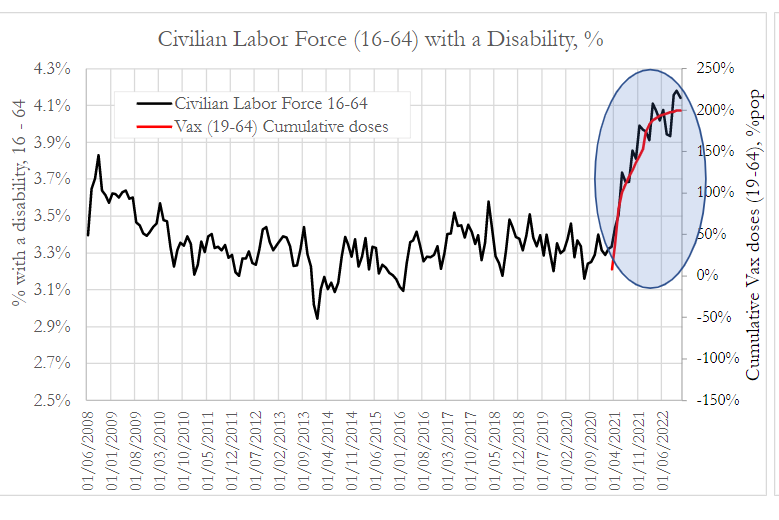
Phinance also published this graph which is a regression analysis showing a very strong correlation between the increase in the number disabled and the total number of doses given – something which actually is rather obvious from the above.
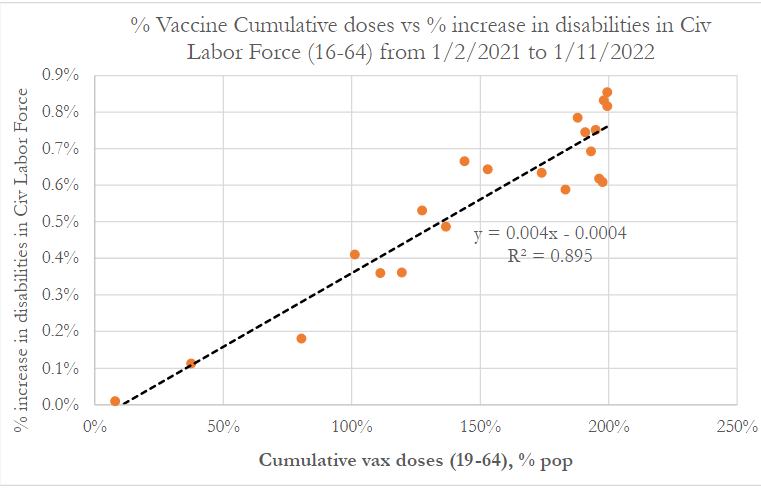
It is fair to point out that such a regression analysis should not in general be performed on cumulative series of data (ie total doses administered), but rather on discrete data (which in this case would be daily or weekly doses). If the measurements can only increase and not fall (as with cumulative data), this limits the significance of any correlation observed, as by default they will rise together.
This is less of a problem here in that only one of the 2 data points (vaccines) is cumulative (for the other axis they have used the increase in the number disabled). However, we wrote to the authors to ask why they didn’t use daily or weekly doses administered.
They responded with the not unreasonable point that because the adverse effects occur over a wide and variable period after dosing, a cumulative series is probably more informative. We agree. Just because fewer doses were given one week does not mean there were fewer people at risk of developing a post vaccination disability in that week.
The extremely experienced medical statistician who blogs as “John Dee” has performed further analysis on the US data above. The article is rather technical but in essence by applying a number of sophisticated statistical tools he concludes that using cumulative data may exaggerate but has not invalidated the findings, which should therefore be regarded as highly suggestive (though not in themselves proof of) a causal relationship.
However, the criticism of the statistical methodology was never really “on point” anyway. Science advances through testing hypotheses by questioning the available data.
The point of the analysis of the disability data was not to conclusively “prove” that the vaccines cause harm, but rather to answer the question: Is there a signal of potential concern which warrants further study? The answer to this appears to be “yes” and anyone finding excuses to not even look further should be regarded as willfully blind.
Of course, the link to vaccination could quite easily be further tested by ascertainment of the vaccination status of a representative sample of the disabled, with comparisons to disability rates in the unvaccinated. That this is not even being discussed must surely be regarded as a red flag.
When a potential signal of concern is replicated internationally, it increases the likelihood that we are dealing with a causal relationship. Not much quality data on disability rates is available from other countries, but one country which does publish some comparable data is the UK.
In the UK, if disabled, a state payment called a personal independence payment (PIP) can be claimed. An official UK government report states that there have been “unprecedented levels of new claims in recent quarters” (in England and Wales).
This has been reported by various news websites, including Yahoo’s article titled “The ‘astonishing’ rise in people claiming one key benefit”.
PIP data is actually downloadable from an official UK government website, and “John Dee” has performed some analysis on it which can be read here and here.
The new claims data plotted against cumulative doses administered looks like this (with thanks to John Dee for the graphs):
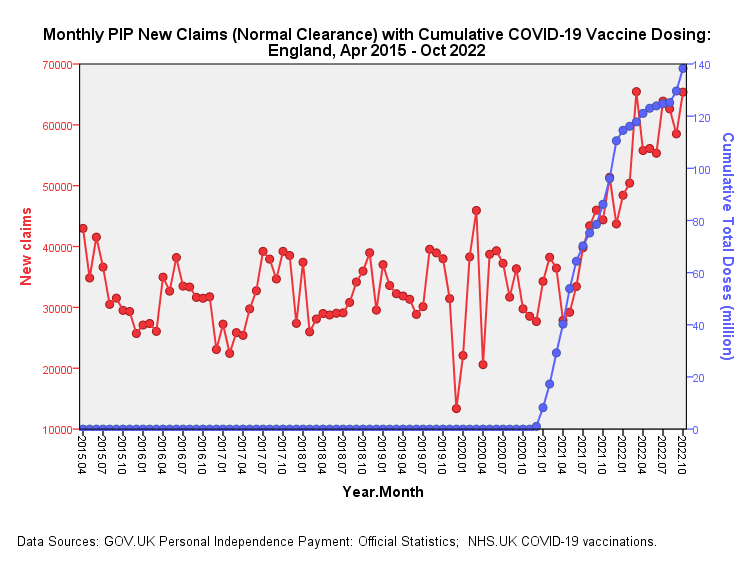
Clearly, this bears an uncanny resemblance to the US data above.
As he did with the US data, John has drilled deeper into the data, showing, for example that whilst claim rates in the pandemic period were similar to those in the pre-pandemic period, there is a huge uptick in the post-vaccine period, with the error bars (and statistical tests of significance) indicating that this is not just random variation.
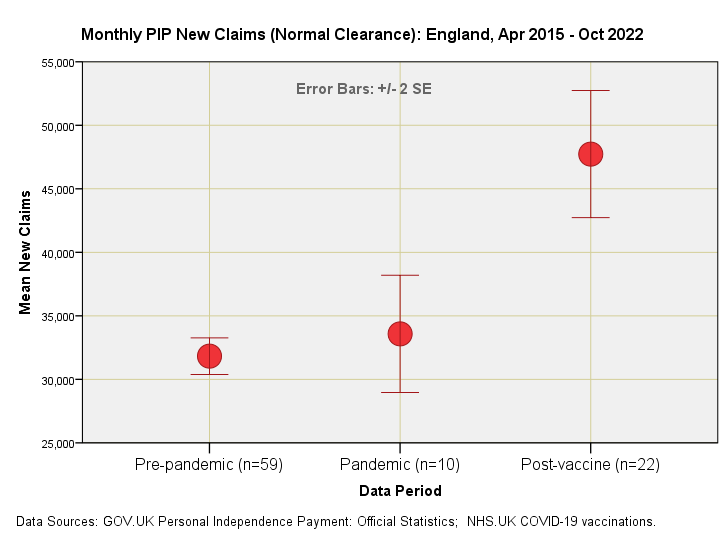
Moreover, he has used a technique called “cross-correlation” which strongly suggests that “the increase in the month-on-month changes in total administered doses is followed three months later by a rise in month-on-month changes in new cleared claims.”
This would appear to add plausibility to the causation argument, in that three months is the period required by the government as a minimum qualifying period before an application for PIP can be filed.
Overall, these datasets surely raise huge concerns, which could be assuaged by further more detailed examination of the data, especially including vaccination status. We urge governments to carry out such an analysis, which need only be performed on a representative sample in order to generate reliable conclusions.
FDA Adviser Inadvertently Confirms Pfizer is Doing Gain-of-Function Research
BY WILL JONES | THE DAILY SCEPTIC | FEBRUARY 1, 2023
They’re starting to come now – the ‘debunkings’ of the Pfizer undercover video sting, in which executive Jordon Trishton Walker, “Director of Research and Development – Strategic Operations and mRNA Scientific Planning”, tells his ‘date’ that Pfizer is looking to mutate the virus “so we could create preemptively developed new vaccines, right”.
Pfizer released a statement on Friday, which notably did not deny that Dr. Walker works for the company (a fact which has anyway been confirmed via internet searches). Now the latest ‘debunking’ effort comes from Medpage Today.
After making the odd claim that “it is currently unclear if the man in the video is actually an employee of Pfizer, and if that is his real name” (journalism isn’t what it used to be), writer Michael DePeau-Wilson notes that Pfizer’s statement “summarily debunk[ed] the claims made in the video”, as the company stated that it “has not conducted gain of function or directed evolution research” related to its “ongoing development of the Pfizer-BioNTech COVID-19 vaccine”.
While it is true that the statement does say this, it also says that “we have conducted research where the original SARS-CoV-2 virus has been used to express the spike protein from new variants of concern”. Furthermore, it admits that:
When a full virus does not contain any known gain of function mutations, such virus may be engineered to enable the assessment of antiviral activity in cells. In addition, in vitro resistance selection experiments are undertaken in cells incubated with SARS-CoV-2 and nirmatrelvir in our secure Biosafety level 3 (BSL3) laboratory to assess whether the main protease can mutate to yield resistant strains of the virus.
Despite the initial denial, then, what is being described here plainly is gain-of-function research – after all, the company is engineering the original virus to express the spike protein from new variants of concern, variants which are ‘of concern’ precisely because their spike protein has immune-evasive properties.
In case there is any doubt about this, FDA vaccine adviser Dr. Paul Offit inadvertently confirms it in the Medpage piece.
“Usually, when people talk about gaining function, they’re talking about making it so that the virus is either more deadly or more easily transmitted or that it now can jump species,” Dr. Offit says.
“[T]rying to make the virus more immune-evasive or more contagious… would be considered gain-of-function research,” he adds.
Right, so exactly what Pfizer has said it is doing – engineering “the original SARS-CoV-2 virus… to express the spike protein from new variants of concern”.
Offit tries to obfuscate, stressing that “Pfizer has been working with an mRNA platform that is coded for coronavirus spike proteins, not a whole virus”.
Yes, the vaccine does not use whole virus. But no one said it does. The matter at hand is what Pfizer is doing to the virus as part of its vaccine development research. And Pfizer is clear that it is engineering “the original SARS-CoV-2 virus… to express the spike protein from new variants of concern”. The whole virus, note.
Offit then implies that it isn’t gain-of-function research because the variant has already been created by “mother nature” and Pfizer is just reproducing what nature has already done.
If there was some evil hand back there that was trying to make the virus more immune-evasive or more contagious, that would be considered gain-of-function research, but it’s not happening. The evil hand is mother nature.
But even if the variant already exists in nature, that doesn’t mean it’s not gain-of-function research to engineer a virus to gain the immune-evasive mutation in the lab. Besides, how can you be sure you’re producing the exact same variant and not some subtly (or not-so-subtly) new and more immune-evasive variant?
Offit then appears to betray an ignorance of the process of making the vaccine, as he says the “remarkably effective” development involved sequencing SARS-CoV-2 in “a matter of months”. In fact, the virus was sequenced several times even in the last week of December 2019, and took a couple of days each time, not months.
Perhaps needing to restore his reputation with the politico-medical establishment after his criticism of the boosters last month (is this why he was given the job of defending Pfizer?), he is now effusive with praise for the mRNA vaccines. “This is the best medical achievement in my lifetime,” he says. “And my lifetime includes the development of the polio vaccine.”
Thus, despite the denials that what Pfizer is doing is gain-of-function research – denials which presumably take advantage of the fact that ‘gain-of-function’ is not rigorously defined – it’s clear that what Pfizer admits to doing falls squarely within the definition cited by Dr. Offit, namely the commonly accepted one, which includes making the virus more “immune-evasive”.
And they appear to tacitly acknowledge that, which is why they make their excuses. In Pfizer’s case, that it is “required by U.S. and global regulators for all antiviral products” and “carried out by many companies and academic institutions in the U.S. and around the world”. In Offit’s case that Pfizer was just copying “mother nature”.
In fact, though, as Dr. Robert Malone has pointed out, Pfizer has previously been upfront that it is doing this research, including in an August 2021 article in STAT News, and almost nothing in the undercover video is new. Why such a fuss was made about scrubbing it from the internet is therefore an interesting question – though this may be more linked to the sensation around it than the facts, which Pfizer’s response anyway did not deny. How could it, when those facts were already on public record?
Perhaps the main lesson, then, is that we all need to be paying more attention.
We also need to think hard about what kind of research should be allowed and what should be banned. The reaction to the Project Veritas video suggests a strong feeling that this kind of work should not be done – including when it is (supposedly) imitating what nature has already created. The fear in the public is real and justified, and relates to the folly of engineering viruses to make them worse. Can this ever be a good idea? My feeling is there’s no need to go beyond the viruses and variants nature already provides us with, and to stick to using real specimens, not engineered ones. But the current regulatory regime and scientific establishment clearly disagrees.
Whatever the right answer, we need to be able to talk about this properly. Not be subject to global, military grade censorship when someone tries to raise the topic as a matter of public concern, albeit in a sensational (and entertaining) way.
EU sanctions blocked Nord Stream repairs – company
RT | February 1, 2023
Norway’s Equinor on Wednesday revealed that it was the government in Oslo and EU sanctions that blocked it from responding to a request for assistance in dealing with the damage to Nord Stream pipelines. The Baltic Sea pipelines delivering Russian natural gas to Germany were damaged by sabotage in September, which Moscow blamed on the West.
“The Norwegian Ministry of Foreign Affairs has stated that work on the pipelines would be in breach of the Norwegian sanction regulations – and by extension the EU sanction regulations,” Equinor said a statement emailed to Reuters.
Equinor is the Norwegian oil company that administers the Pipeline Repair and Subsea Intervention (PRSI) Pool, established by Oslo to deal with leaks and ruptures. The Swiss-based operators for Nord Stream and Nord Stream 2 are among the 72 members of PRSI, and sent requests for assistance in October, shortly after both pipelines were damaged by undersea explosions.
Because PRSI “adheres to current legislation related to sanctions,” it “notified NS1 and NS2 (operators) that we were not able to do work as requested,” Equinor said in the statement.
Nord Stream 2 AG told Reuters that it had filed a request for support to inspect the damage, “as a full member of the PRSI Pool,” but was turned down. Its sister company, which operates the original Nord Stream, said in early October that the survey vessel it attempted to charter was waiting for permission from the Norwegian government.
The original Nord Stream was inaugurated in 2011, and supplied Russian natural gas to Germany and the rest of the EU while bypassing Ukraine and Poland. The second pipeline, which would have doubled the volume of gas deliveries, was finished in 2021 but Berlin refused to certify it for operations even before the conflict in Ukraine escalated. The US had sought to block the second pipeline’s construction with sanctions and vowed it would prevent it from becoming operational.
On September 26, 2022 both strings of NS1 and one string of NS2 were damaged in a series of powerful undersea explosions. As NS1 was pressurized at the time, a large quantity of gas was released into the Baltic Sea.
Washington insinuated that Moscow was behind the blasts, while Russia pointed the finger at the West for the “act of terrorism.” Sweden, Denmark and Germany launched an investigation into the explosion, but refused to share the results with Russia. Anonymous EU officials have since leaked to the US media that there was “no evidence” to suggest Moscow was behind the sabotage. Russia’s energy company Gazprom was allowed access to the site only once, in late October.
While the German gas company Uniper has estimated it would take 6-12 months to repair the pipelines, it is unclear whether Berlin even wants to do so.
White House continues to block energy sharing plan for Lebanon: French official
The Cradle | February 1, 2023
Pierre Duquesne, France’s envoy on international support to Lebanon, stated on 31 January that Egypt is still seeking assurances from Washington to start exporting gas to Lebanon via Syria.
“My Egyptian counterparts today told me, ‘we want something precise’ … There is a problem of exemption … and that concern should be dealt with not only on a political basis but on a legal basis,” Duquesne said during a visit to Cairo.
Alongside Egyptian gas, the US-orchestrated plan, announced in 2021, also calls for exporting electricity from Jordan via Syria, which could add up to 700 megawatts to Lebanon’s battered power grid.
Duquesne confirmed that all preparations for the energy-sharing plan had been completed, and there were no hold-ups over the pricing or quantity of gas. However, western sanctions on Syria prevent the Levantine nation from receiving the much-needed aid.
Moreover, Duquesne warned that Lebanon’s presidential vacuum is also working against the plan, which has yet to go to the World Bank board for a review of specific pre-conditions ahead of the release of a $300 million loan to finance the gas exports over 18 months.
The same day the French official made his comments, the US canceled a tripartite meeting between the US Ambassador Dorothy Shea, Minister of Energy Walid Fayyad, and World Bank representatives after refusing to grant Lebanon any exceptions to the sanctions imposed on Syria.
Lebanese power stations have gone almost entirely offline since the start of the manufactured crisis in 2019, while fuel subsidy cuts have caused the costs for private generators to skyrocket.
The energy sharing plan between Egypt, Jordan, Syria, and Lebanon was revealed soon after resistance movement Hezbollah launched a plan to import Iranian fuel in 2021.
Washington’s abuse of the energy crisis in Lebanon falls in line with recent remarks by US officials, who said Lebanon must be forced towards collapse as the only solution to deal with Hezbollah.
“[Collapse will enable] Lebanon to somehow be rebuilt from the ashes, and freed from the curse of Hezbollah,” US Assistant Secretary of State for Near Eastern Affairs, Barbara Leaf, said on 4 November.
IAEA head must visit Iran with ‘specific objective’, says Iran’s nuclear chief
Press TV – February 1, 2023
The chief of Iran’s nuclear agency says any visit by the head of the International Atomic Energy Agency (IAEA) to the country needs to have a “specific objective”, in an oblique reference to the UN nuclear watchdog’s political approach.
“This trip needs preparations and content and the aims and schedule of this trip should be determined,” Mohammad Eslami, who heads the Atomic Energy Organization of Iran (AEOI), said on the sidelines of a cabinet meeting in Tehran on Wednesday.
IAEA chief Rafael Grossi last week said he intends to go to Tehran in February for “much-needed dialogue” over Iran’s cooperation with the UN nuclear agency and to discuss outstanding issues.
Grossi claimed that the suspension of talks aimed at the revival of the Joint Comprehensive Plan of Action (JCPOA) and Iran’s recent measures to reduce its compliance with the 2015 deal meant that the IAEA could no longer effectively monitor the country’s nuclear program.
He also touched on IAEA’s so-called probe into what the agency claims are the presence of “undeclared uranium particles” at some nuclear sites in Iran.
Iran has already rejected the probe, saying it’s based on forged evidence provided to the IAEA by the Israeli regime, slamming the agency for adopting a political approach and forsaking its technical mandate.
Eslami said the West is waging a psychological warfare operation by accusing Iran of failing to honor its commitments under the JCPOA, while the fact remains that the Islamic Republic met all its commitments under the deal.
He reiterated that Iran is committed to its obligations under the 2015 nuclear deal and as the signatory of the Nuclear Non-Proliferation treaty (NPT), which is evident from numerous inspections of its nuclear facilities by the UN agency inspectors.
“The agency has carried out around two-thousand inspections [of countries’ nuclear facilities] between 2020 and 2022, and over these three years, five hundred inspections — that is one-quarter of all inspections — were conducted in Iran,” he said.
“They still feel concerned [about Iran’s nuclear work] and this shows their language is the one used by enemies and aimed at a sabotage operation, [but] we won’t be affected by them.”
He stressed that the Israeli regime’s influence over the UN nuclear agency and hostile moves against Iran over its nuclear work must end.
Iran rolled back its compliance with the 2015 nuclear accord after the US unilaterally withdrew from the pact and reimposed sanctions on Iran.
Tehran and the remaining signatories to the pact have held talks on reviving the accord since April 2021, after Joe Biden came to power in the US. But those talks have been stalled for months amid Washington’s procrastination and refusal to provide guarantees.
Iran says an agreement on the revival of the deal hinges on the settlement of issues between Tehran and the IAEA, as well as the removal of all US sanctions on the country.
Featured Video

Chinese jet fuel and the myth of energy independence
or go to
Aletho News Archives – Video-Images
Book Review
Former Insiders Criticize Iran Policy as U.S. Hegemony
By GARETH PORTER | CounterPunch | February 27, 2013
“Going to Tehran” arguably represents the most important work on the subject of U.S.-Iran relations to be published thus far.
Flynt Leverett and Hillary Mann Leverett tackle not only U.S. policy toward Iran but the broader context of Middle East policy with a systematic analytical perspective informed by personal experience, as well as very extensive documentation.
More importantly, however, their exposé required a degree of courage that may be unparalleled in the writing of former U.S. national security officials about issues on which they worked. They have chosen not just to criticise U.S. policy toward Iran but to analyse that policy as a problem of U.S. hegemony. … continue
Blog Roll
 Aletho News
- NATO’s Slow Fracture: How Trump’s Iran War Exposed the Instrument of Hegemony
- Chinese jet fuel and the myth of energy independence
- Ukraine Sea Drone Fired From Libya Hit Russian Tanker in Mediterranean
- IRGC: Iranian forces launched no attacks during ceasefire hours
- Trump Administration Moves To Automate U.S. Military Draft Registration
- Spain orders reopening of Tehran embassy, condemns Israel’s carpet bombing of Lebanon
- Israel faces ‘unsustainable’ strategic crisis following 40-day war against Iran: Analyst
- Iran restricts Hormuz access to 15 vessels per day under ceasefire terms: Report
- The ‘Opposition Party’ Has Done Nothing to Stop the Iran War and Much to Goad Trump Into Continuing It
- Moscow backs Tehran on status of Lebanon in US-Iran deal
- If Americans Knew
- Amnesty: Urgent – Protect Lebanese civilians from brutal escalation in Israeli attacks
- Is The War Against Iran Over?
- Inside the Israeli army’s propaganda wing
- Hundreds of Gaza Amputees Stranded in Legal Limbo
- The gallows law: Israel moves toward executing Palestinian children
- Tucker Carlson: The Path to Peace requires ending ‘special alliance’ with Israel
- This is ceasefire? Israel’s biggest massacre yet in Lebanon, another journalist killed in Gaza – Daily Update
- Tucker Carlson on Israel: This Is the Behavior of an Ally? Really?
- Gazans face a triple crisis: severe shortages of water and bread, healthcare in tatters
- NY Times reports how Netanyahu took the US into Iran War
- No Tricks Zone
- An Inconvenient Tree: Uncovered In Alps… Europe Much Warmer Than Today 6000 Years Ago
- New Study Reports A 60% Slowdown In Greenland’s Ice Loss Rate In The Last Decade
- Low Intensity Tornado Wrecks Major Solar Farm, Creating A Potential Toxic Dump
- New Study Finds Warming Saves Lives…Cold Temperatures 12 Times More Deadly Than Excess Heat
- German Science Blog Accuses PIK Climate Institute Of Hallucinating Climate Tipping Points
- Devastating Assessment Of Comirnaty Vaccine By Former Senior Pfizer Europe Toxicologist
- New Study: CO2 Is ‘Effectively Negligible’ As An Explanatory Climate Change Factor Since 2000
- Former Pfizer Toxicologist Dr. Helmut Sterz Tells Bundestag Hearing Pfizer Vaccine Should Have Never Been Approved
- Energy Expert: Germany’s Nuclear Phaseout Was A “500 Billion Euro Mistake”
- New Research: South Australia’s Mid-Holocene Sea Surface Temperatures Were 4°C Warmer Than Today
 Aletho News