An Earth Day Special in Defense of Climate Science and CO2
BY MATTHEW EHRET | APRIL 23, 2023
According to such modern climate experts as Bill Gates, Greta Thunberg, Michael Bloomberg, Mark Carney, Al Gore, Alexandria Ocasio Cortez, Prince Charles and Klaus Schwab, carbon dioxide must be stopped at all cost. Images of submerged cities, drowning polar bears and burning deserts taking over civilization flash before our eyes repeatedly in schools, mainstream media and films.
The Paris Climate Accords demand that all nations reduce their emissions to pre-industrial levels in order to save the world from boiling over and nations are strong armed into adapting to a new ‘green’ economic order of de-growth and depopulation.
But is CO2 really the existential threat it is being made out to be?
I would like to take a few moments to entertain the hypothesis that we may be drinking some poisonous Kool-Aid in a modern-day Jonestown cult and we are just minutes away from a hearty “bottoms up”.
While some of the questions and facts you are about to read are considered heretical in certain quarters, I think that history has shown that it is only by permitting the mind to question sacred cows at the risk of being denounced as “heretical” that any creative progress can made. With this thought in mind, I will venture the risk and only ask that you accompany me for this thought experiment with an open mind.
Back in November 17, 2009, a major scandal erupted when the 61 Mb of emails internally circulated among the directors and researchers at East Anglia University’s Climate Research Unit (CRU) were made public. To this day, it has not been verified if the scandal occurred via an internal leak or a hack, but what was verified throughout the hundreds of emails between director Phil Jones and the teams of climatologists staffing the CRU, was that vast scales of fraud were occurring. Jones himself was caught red handed[1] demanding that data sets be ignored and massaged in order to justify the climate models that had all been used to sell the idea that CO2 was driving startling rates of warming.
East Anglia’s CRU is the world’s foremost center of data set centralization and climate model generation which feed directly into the UN’s Independent Panel on Climate Change (IPCC) and which in turn feeds into every major NGO, school, corporation and government. The other central control point of data selection and model generation (for both climate change and covid-19 data sets) is an Oxford-based operation called “Our World In Data”, funded in large measure by the UK government and Bill Gates[2].
Climategate couldn’t have come at a worse time, as the COP15 Climate Summit was scheduled for December 2009 where the world’s first legally binding carbon reduction treaties were expected to finalize an end to sovereign nation states. The terrible publicity of climategate essentially caused the event to become a big goose egg, as Chinese and Indian delegates refused to play along, and ensured that all teeth were removed from any binding carbon caps[3].
In December 2009, former chief economic advisor to Putin, Dr. Andrei Illarionov stated that Russia had sent data to East Anglia’s CRU from 476 meteorological stations covering over 20% of the globe’s surface hosting a wide range of data from as far back as 1865 to 2005. Dr. Illarionov explained[4] that he was dismayed to see that Phil Jones and the CRU entirely ignored the data from all but 121 stations, and from those stations they did use, they artificially cherry-picked data that gave off the false result that temperatures between 1860-1965 were 0.67 degrees colder than they truly were while temperatures from 1965-2005 were made artificially high.
After being suspended for a few months, a UK review panel absolved Jones from his transgressions and re-installed him into his old position of carbon data gatekeeper at the CRU.
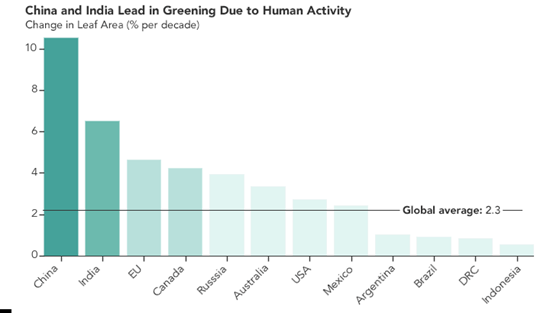
Many people were taken aback by the findings published by a team of scientists analyzing the results of Moderate Resolution Imaging Spectroradiometer (MODIS) instruments on NASA’s Terra and Aqua satellites. NASA’s website[5] described the findings (published on February 11, 2019[6]) in the following way: “The research team found that global green leaf area has increased by 5 percent since the early 2000s, an area equivalent to all of the Amazon rainforests. At least 25 percent of that gain came in China.”

Up until this study’s publication, scientists were not certain what role human economic activity played in this anomalous greening of the earth.
The NASA study demonstrated that this dramatic rate of greening between 2000-2017 was being driven largely by China and India’s combined efforts at eradicating poverty which involves both reforestation, desert greening efforts (see China’s Move South Water North megaproject[7]), agricultural innovation and also, general industrial growth policies. The later policies represent genuine efforts by Asian nations to wipe out poverty by investments into large scale infrastructure… a practice once used in the west before the days of “post-industrialism” induced a collective insanity of consumerism in the early 1970s.
A perplexed reader might now be heard to ask: but how can industrial growth have anything to do with greening of the planet?
One simple answer is: carbon dioxide.
As children, we are taught that CO2 is an integral part of our ecosystem and that plants love it.
The processes of photosynthesis which evolved over long spans of time with the advent of the chlorophyll molecule eons ago requires constant infusions of carbon dioxide that are broken down along with H2O, releasing oxygen back into the biosphere. Over time, free oxygen slowly formed the earth’s ozone layer and fueled the rise of ever higher life forms that relied on this “plant waste” for life.
Today, large amounts of carbon dioxide is regularly generated by biotic and abiotic activity from living animals, decaying biomass as well as volcanos which constantly emit CO2 and other greenhouse gases. A surprisingly small portion of that naturally occurring CO2 is caused by human economic activity.
Taking the entire composition of greenhouse gases together, water vapour makes up 95% of the bulk, carbon dioxide makes up 3.6%, nitrous oxide (0.9%), methane (0.3%), and aerosols about 0.07%.

Of the sum total of the 3.6% carbon dioxide released into the atmosphere, approximately 0.9% is caused by human activity. To restate this statistic: Human CO2 makes up less than 1% of the 3.6% of the total greenhouse gases influencing our climate.
During the mid-20th century, a belief began to emerge among some fringe climate scientists that the 400 parts per million (PPM) average carbon dioxide in the atmosphere is the “natural and ideal amount”, such that any upset of this mathematical average would supposedly result in destruction of biodiversity. These same mathematicians also presumed that the biosphere could be defined as closed systems such that rules of entropy were the natural organizing principles- ignoring the obvious fact that ecosystems are OPEN, connected to oceans of active cosmic radiations from other stars, galaxies, supernova and more while being mediated by nested arrays of electromagnetic fields.
As film maker Adam Curtis demonstrated in his All Watched Over By Machines of Love and Grace (2011)[8], this belief slowly moved from the fringe into mainstream thinking despite the fact that it is simply wrong.
Beyond the facts already presented above, another persuasive piece of evidence can be found in carbon dioxide generators which are commonly purchased by anyone managing a greenhouse[9]. These widely-used generators increase CO2 to amounts as high as 1,500 PPM. What is the effect of such increases? Healthier, happier, greener plants and vegetables.

Amidst the frantic alarms sounding daily over the impending climate emergency threatening the world, we often forget to ask if anyone ever actually proved the claim that CO2 drives the climate?
To begin to answer this question, let’s start with a graph showcasing the rise of human industrial CO2 from 1751-2015 broken down into various regions of the earth. What we can see is consistent increase from the mid 19th century until 1950, when a vast spike of emission rate increases can be viewed. This increase obviously accompanies world population growth and the correlated agro-industrial output.

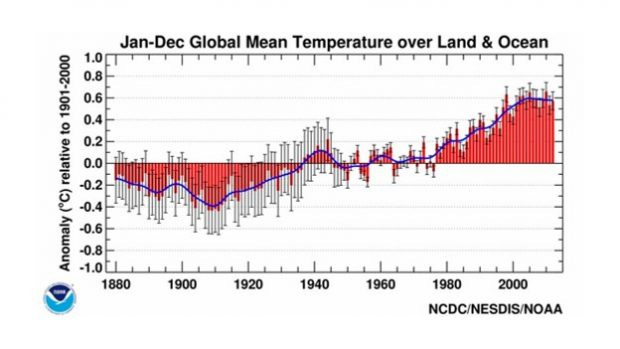
Next, let us look at the global mean temperature changes from 1880-present.
Here several anomalies strike the thinking mind.
For starters, absolutely no warming accompanies the period of intensive industrial growth of 1940-1977. In fact during this period, many climate scientists were ringing the alarm over an impending ice age![10]
Another anomaly: Since carbon dioxide emissions have increased continuously over the past 20 years, one would expect to see a correlated spike in warming trends. However, this expected correlation is entirely absent between the year 1998 and 2012 when warming tappers off to a near standstill sometimes called “the global warming pause” of 1998-2012[11]. This has been an embarrassment for all modellers whose scare-mongering predictions have fallen to pieces to the point that they can only pretend this pause doesn’t exist. Again, the question must be asked: why would this anomaly appear if CO2 drove temperature?
Let’s take one more anomaly from our temperature records before digging into the hard proof that CO2 does not cause temperature changes: The medieval warming period [see graph].

While certain proven fraudsters like Michael Mann[12] have attempted to erase this warming period from existence with things like the famous “hockey stick” model crafted with the help of East Anglia’s Phil Jones, the fact remains that from 1000-1350 A.D. global mean temperatures were significantly warmer than anything we are currently living through. The Vikings in Greenland had no coal plants or SUVs, and yet mean temperatures were still warmer than today by a long shot. Why?

Perhaps taking a wider look at the CO2:climate correlation might give us a better idea of what is actually happening.
Below we can see a chart taking 600,000 years of data into account. It is certainly the case that CO2 and temperature have a connection on these scales… but correlation is not causation, and as the author of How to Lie with Statistics[13] famously stated “a well-wrapped statistic is better than Hitler’s Big Lie; it misleads, yet it cannot be pinned on you.”
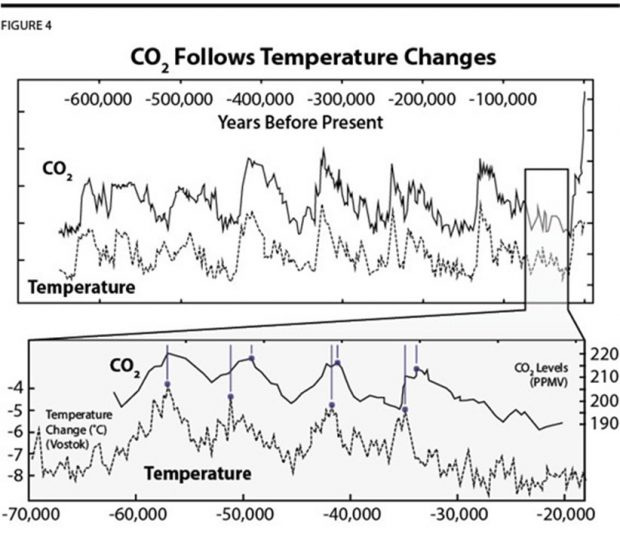
When a 70,000 year sampling is inspected, we find the slight of hand fully exposed by observing the peaks and troughs of temperature and CO2. If the later were truly the driving force as the Great Resetters of our day proclaim, then CO2 peaks and troughs would happen before temperature, but the evidence shows us the inverse. Let’s look at one more example of an 800 year CO2/temperature lag about 130,000 years ago…
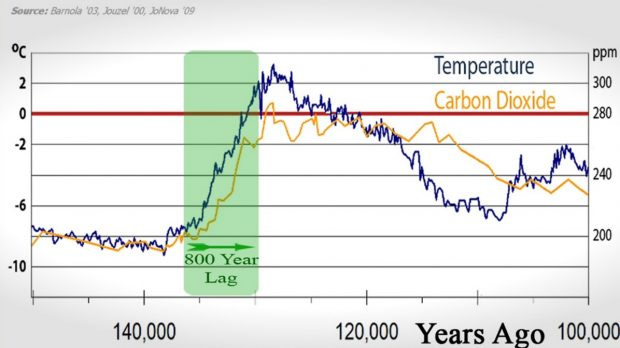
Going back even further into the climate records, it has been revealed that during many of the past ice ages, carbon dioxide had risen up to 800% higher than our current levels, despite the fact that human activity played zero role[14].
Technically, I could end right now and feel like any honest jury would conclude that CO2 has been falsely framed for murder. But I would like to introduce one more dramatic piece of evidence that gets us back on the path of a true science of climate change and ecosystems management: Astroclimatology.
The fact that the earth is but one of a multitude of spherical bodies in space speedily revolving around an incredibly active sun within the outskirts of a galaxy within a broader cluster of galaxies is often ignored by many computer modelling statisticians for a very simple reason. Anyone who has been conditioned to look at the universe through a filter of linear computer models is obsessed with control, and is incredibly uncomfortable with the unknown. The amount of actual factors shaping the weather, ice ages, and volcanism are so complex, vast and mostly undiscovered that computer modellers would prefer to simply pretend they don’t exist… or if they do acknowledge such celestial phenomena to have any function in climate change, it is often dismissed as “negligible”.
Despite this culture of laziness and dishonesty, the question is worth asking: WHY does evidence of climate change occur across so many other planets and moons of our solar system? Ice caps on Mars melt periodically[15] and have been melting at faster rates in recent years. Why is this happening? Could the sun’s coronal mass ejections, solar wind, or electromagnetic field be affecting climate change within the solar system as one unifying process?
Often Venus with its atmosphere of 96.5% CO2 is used as a warning for people on the earth what sort of terrible oven we will create by producing more CO2. It is hot after all with temperatures averaging 467 degrees Celsius (872 degrees Fahrenheit). However, if CO2 were truly to blame for the heating, then why is Mars so cold with temperatures averaging minus 125 degrees Celsius (-195 degrees Fahrenheit) despite the fact that it’s atmosphere is 95% CO2?
Similarly, what role does cosmic radiation play in driving climate change? Based on the recent discoveries of Heinrich Svensmark and his team in Denmark, strong correlations were found linking cloud formation, climate and cosmic radiation flux over time. Cosmic radiation flux into the earth is a continuous process mediated by the earth’s magnetic field as well as the oscillating magnetic field of the sun which shapes the entire solar system as we revolve around the galactic center of the Milky Way every 225-250 million years. Svensmark’s discovery was outlined beautifully in the 2011 documentary The Cloud Mystery.[16]
The point to re-emphasize is that the weather is, and always has been, a complex process shaped by galactic forces that have driven a miraculous system of life on the earth over hundreds of millions of years.
During this time amounting to approximately two revolutions around the galactic center, living matter has transformed from relatively boring (high entropy) single celled organisms, through a continuous process of increased complexity, and increased power of self-direction (low entropy). Up until now, there is no actual evidence that this process is a closed system and as such, that any fixed state of no change/heat death is controlling its behavior. While some might deny this claim, citing the redshifts of galaxies as proof that the universe is in fact dying (or inversely had a starting point “in time” 13.6 billion years ago before there was nothing), I refer you to the work of Halton Arp[17].
This process has been characterized by non-linear discontinuities of living matter emerging where only nonliving matter previously existed, followed later by conscious life having appeared where only non-conscious life had been found and most recently self-conscious life endowed with creative reason appearing onto the scene. While this process has been punctuated by sometimes violent mass-extinction cycles, the overall direction of life has not been shaped by randomness, chance or chaos, but rather improvement, perfectibility and harmony.

When humanity appeared onto the scene, a new phenomenon began expressing itself in a form which the great Russian academician Vladimir Vernadsky (1863-1945) described as the Noosphere (as opposed to the lithosphere and biosphere). Vernadsky understood this new geological force to be driven by human creative reason, and devoted his life to teaching the world that the law of humanity must accord with the law of nature stating:
“The noösphere is a new geological phenomenon on our planet. In it, for the first time, man becomes a large-scale geological force. He can, and must, rebuild the province of his life by his work and thought, rebuild it radically in comparison with the past. Wider and wider creative possibilities open before him. It may be that the generation of our grandchildren will approach their blossoming”.[18]
In Vernadsky’s mind, neither the noosphere, nor the biosphere obeyed a law of mathematical equilibrium or statis, but was rather governed by an asymmetrical harmony and progress from lower to higher states of organization. It was only by coming to understand the principles of nature that mankind became morally and intellectually fit to improve upon nature by turning deserts green, harnessing the power of the atom or applying scientific progress to health and agriculture. Some of his most important insights were published in his Scientific Thought as a Planetary Phenomena (1938), Evolution of Species and Living Matter (1928) Some Words About the Noosphere (1943), and The Transition of the Biosphere to the Noosphere (1938).[19]
Despite the lasting contributions made by Vernadsky to human knowledge, here we sit, 76 years after the end of WW2 tolerating an unscientific policy of mass decarbonization which threatens to radically undermine civilization for countless generations.
Is this change being forced upon humanity? Unlike the forces of fascism and imperialism of the past, today’s terrible self-implosion of civilization is occurring via the consent of those intended to perish under a Great Reset via the collective guilt for the crime of simply being human. It has become the norm for the majority of today’s children to think of themselves as belonging not to a beautiful species made in the image of a Creator, but rather to a parasitic race guilty for the crime of sinning against nature.
So let’s take this opportunity to re-introduce truth back into climate science, and let the social engineers drooling over a Great Reset scream and whine as nations choose a new open system paradigm of life and anti-entropy rather than a closed system world of decay and heat death. This positive new paradigm of cooperation, scientific and technological progress, and cultural optimism is getting stronger by the day led by Russia, China and other nations joining the international New Silk Road. Most importantly, let’s finally absolve CO2 of its accused sins, and celebrate this wonderful little molecule as our friend and ally.
—
[1] The Evidence of Climate Fraud, By Marc Sheppard, American Thinker Nov. 21, 2009
[2] https://ourworldindata.org/funding
[3] How do I know China wrecked the Copenhagen deal? I was in the room by Mark Lynas, London Guardian, Dec. 22, 2009
[4] ClimateGate Fallout: Russian Think Tank Says Temperature Data was ‘Cherry-Picked’, Media Research Center, December 2009
[5] China and India Lead the Way in Greening, NASA Earth Observatory, Feb. 12, 2019
[6] China and India lead in greening of the world through land-use management, Nature Sustainability, Feb. 11, 2019
[7] China’s South-to-North Water Diversion Project benefits 120 million people, CGTN, Dec. 13, 2020
[8] Watch full documentary here: https://watchdocumentaries.com/all-watched-over-by-machines-of-loving-grace/
[9] To examine one of many models of CO2 generators, visit: https://johnsonco2.com/co2-generators/
[10] The 1970s Ice Age Scare, by Steve Goddard, May 12, 2013
[11] https://wattsupwiththat.com/2020/09/28/study-global-warming-hiatus-aka-the-pause-was-real/
[12] Dr. Tim Ball Defeats Michael ‘Hockey Stick’ Mann’s Climate Lawsuit, Aug. 24, 2019, Climate Change Dispatch
[13] How to Lie with Statistics, by Darrell Huff, 1954 https://archive.org/details/how-to-lie-with-statistics-darrell-huff/page/23/mode/2up
[14] Ice age occurred when CO2 levels were 800 percent higher than now, IceAgeNow.info, July 23, 2016
[15] Mars is Melting, Science.nasa.gov, Aug 7, 2003
[16] To watch the full documentary, visit:
[17] A Look Into Halton Arp’s “Peculiar Galaxies” and its Implications for the World We Live In, by Matthew Ehret, Rising Tide Foundation https://risingtidefoundation.net/2020/10/13/a-look-into-arps-peculiar-galaxies/
[18] Some Words About the Noosphere by V.I. Vernadsky, 1943, republished in 21st Century Science and Technology, Spring 2005 TS5467.SP05 (21sci-tech.com)
[19] To access all of these referenced works by Vernadsky, visit: https://risingtidefoundation.net/vladimir-vernadsky/
UK minister calls for tech execs to be jailed if they ignore censorship demands
By Dan Frieth | Reclaim The Net | April 23, 2023
UK’s Technology and Science Secretary Michelle Donelan has recommended jail time for social media bosses who refuse to remove “harmful” content from their platforms. The proposal is part of the authoritarian Online Safety Bill.
The bill would give broadcasting regulator Ofcom regulatory authority over social media platforms. The platforms would be required to censor “all forms of expression which spread, incite, promote or justify hatred” based on protected characteristics like race, religion, gender, disability, and gender identity.
Citing the protection of children, Donelan said that social media executives who ignore the requirement and restrictions of the Online Safety Bill should go to jail, The Telegraph reported.
The measure would be used as a last resort for executives that “have consented or connived in ignoring enforceable requirements” to remove content such as “disinformation” by a foreign state.
Currently, the bill would see companies fined up to 10% of global turnover for failing to comply with the censorship demands.
Jewish Organizations Are Close To Legally Ending Free Speech On The Internet
By Joseph Jordan | National Justice Party | April 19, 2023
The Supreme Court is currently authoring its opinion on Section 230 of the 1996 Communications Decency Act, an enormously consequential decision that could radically change how we use the internet.
The decision, which could be released any time from now to July due to the complex and politically fraught nature of the case, has pit several Jewish organizations against a dwindling number of civil liberties groups willing to defend the Constitutional right to free speech.
The case combines Gonzalez v. Google LLC and Twitter, Inc. v. Taamneh, two lawsuits which assert that social media platforms are legally liable for acts of violence committed by groups or individuals that utilize their services to promote their ideas.
SCOTUS’ decision to grant certiorari to Gonzalez shows the immense political pull Zionist groups — foreign and domestic — have inside the American system.
Gonzalez is a brazen display of foreign interference by an Israeli NGO called Shurat HaDin, which seeks to challenge the standing of Section 230 in the name of Nohemi Gonzalez, a California exchange student who was killed during a 2015 ISIS terrorist attack in Paris.
Shurat HaDin has made strategic lawsuits seeking to undermine American laws protecting free speech its central cause, though previous attempts by the group to attack Section 230 have been dismissed or defeated in courts. The Supreme Court typically reserves certiorari for cases with mixed rulings, but they have made a special exception for Gonzalez, which was defeated in lower courts and beaten again in the Ninth Circuit Court of Appeals.
The argument in Taamneh is similar to Gonzalez, though this case is being argued in the name of a Jordanian national who was killed in a 2017 Islamic State attack in Turkey. Taamneh was able to achieve victory in the same Ninth Circuit court, which curiously ignored Section 230 in Twitter’s case and instead found them liable under the Anti-Terrorism Act. Twitter’s relative tolerance for free speech compared to the Jewish-owned Google monopoly in the biased Ninth Circuit is likely to have played a role in the creation of drastically different rulings on similar facts.
Amicus briefs in these Supreme Court proceedings have brought together a united Jewish front against the First Amendment. The Zionist Organization of America, which supports Gonzalez, is playing the role of “bad cop” on Google, while other Jewish groups like the Anti-Defamation League are staying “neutral” in the case, stating that any ruling should merely encourage the company to continue its good work engaging in strict censorious and editorializing practices against right-wing speech. Google put content moderation in the hands of the ADL as early as 2017, though the Zionist lobbyists have still complained that current technology is not thorough enough when it comes to censoring their political opponents on Youtube.
On the Twitter leg, the landscape is different, with Jewish litigants showing far less patience by unleashing a furious legal onslaught attacking the company.
The Zachor Legal Institute, American Association of Jewish Lawyers and Jurists, Simon Wiesenthal Center and others are arguing that Twitter and other social media companies deliberately and knowingly recruit for violent terrorists and are thus responsible for the harm caused by the activities of criminal users.
The ADL’s amicus brief reiterates many of these points, but with supplements generated through its questionable in-house data collection practices, where the Jews cite themselves as an authoritative source supporting the idea that Twitter and Youtube are co-conspirators in the financing and spread of terrorism. The filing goes after the real target of these lawsuits by emphasizing the supposed availability of “white supremacist” content on social media platforms to make its point.
The Electronic Frontier Foundation has filed in favor of leaving Section 230 untouched, explaining that even the most advanced algorithms can’t always distinguish between illegal calls to imminent violence and First Amendment protected content, thus opening up infinite possibilities for crippling litigation. In its public statement, the EFF wrote that “if the plaintiffs in these cases convince the Court to narrow the legal interpretation of Section 230 and increase platforms’ legal exposure for generally knowing harmful material is present on their services, the significant protections that Congress envisioned in enacting this law would be drastically eroded.”
So far, SCOTUS’ engagement with this case has exposed the limitations of having a small group of judges do work that is the responsibility of the US Congress. The consensus among legal observers on the oral argument phase of this case, which was streamed, is that the justices were flustered and confused. SCOTUS judges have even admitted that they are out of their depth, while previous supporters of altering Section 230 like Clarence Thomas appeared much more tepid on the question as of late.
Experts believe that the Supreme Court is leaning in favor of keeping Section 230, though this view should be questioned. If SCOTUS wants to keep the status quo, why did they agree to hear this case in the first place?
Watching First Amendment safeguards for online speech being debated, and thus threatened, could further encourage companies already engaging in widespread censorship. Virtually all major social media companies already have FBI operatives controlling their speech compliance departments, making the private-public distinctions being discussed farcical.
Even if big tech is able to escape from this case unscathed, the willingness of our judicial system to entertain repealing Section 230 will strongly accelerate the ongoing campaign to suppress journalists, erode free thought and interfere in the open exchange of ideas even further.
No matter what SCOTUS’ final verdict looks like, the era of unprecedented freedom to think, read and believe what we want that the internet once provided is never coming back.
How the Israeli regime covered up failed military mission in Jenin
By Robert Inlakesh | Press TV | April 23, 2023
Israeli regime forces covered up a failed mission to penetrate the Jenin refugee camp and arrest or kill a resistance fighter, sources in contact with the Jenin Brigades in the northern occupied West Bank revealed to the Press TV Website.
If true, this marks a significant failure that matches up with various other cases of botched Israeli military operations across the occupied territories.
On April 18, the Israeli occupation army hatched a plan to target two “most wanted” West Bank resistance fighters, connected to the Jenin Brigades armed group, inside the Jenin refugee camp.
The plot choreographed to apprehend them was significant as this was the first raid in months that sought to penetrate the refugee camp itself, an area that has become a fortress since late last year.
The Jenin Brigades was officially formed in September of 2021, after having operated unofficially as early as May of that year under the command of the Palestinian Islamic Jihad (PIJ) movement’s Jamil al-Amoudi.
Since its formation, the group has significantly grown in numbers and strength inside the Jenin refugee camp, referred to locally as the “Hornet’s Nest”, emerging initially with around a dozen fighters and now operating in the hundreds.
Since 2022, the Jenin Brigades fighters have set up effective roadblocks at the entrances to the camp, using what is known as Chechen hedgehogs to block the passage of Israeli military vehicles.
The roadblocks force Israeli occupation soldiers to exit their vehicles in order to remove the blockages, exposing them to the fire of resistance fighters.
Several other security precautions have been taken, like covering certain areas with tarps in order to prevent enemy drones from locating resistance fighters.
These tactics have also been extended to other areas in the Jenin governorate, and have proven successful in deterring the Israeli regime’s incursions into the hub of the resistance for some time.
On January 26, a massacre was committed against Palestinians from the Jenin refugee camp. Ten Palestinians were murdered by the occupying forces in cold blood, including an elderly woman.
However, this Israeli raid was not carried out inside the refugee camp itself but happened on the periphery. The reason for the avoidance of entering deep inside the camp is that an armed battle on that terrain poses an extreme risk of the loss of forces for Zionists.
Zionist forces botch Jenin raid
The first attempt was made this year to enter the camp itself, on Tuesday the 18th of April, but seemingly only sought to penetrate a perimeter close to the entrance of the camp.
The official narrative in the Zionist Hebrew press is that three Palestinians were arrested within minutes of the mission’s initiation after Israeli forces stationed themselves there for around an hour.
According to Tal Lev Ram, the chief military correspondent for the Zionist media outlet called Maariv, three Palestinians arrested were part of the Palestinian Islamic Jihad resistance movement and were planning to carry out an explosive attack.
Tal Lev Ram is a former spokesperson for the Zionist military’s Southern Command. He also formerly worked as a military correspondent for the official Israeli army radio station.
This context to the Zionist reporter is important because he peddles the line of the Zionist armed forces.
Two informed sources — one who is on the ground in Jenin and another who has direct contact with a resistance fighter from the Jenin Brigades inside the camp — disputed the Israeli narrative and claimed that the Zionist narrative is a cover-up.
The first source, who was in Jenin camp when the raid occurred, explained that key facts had been distorted or completely invented by Israelis.
The source said that an undercover Israeli unit stationed itself at the entrance to the Jenin refugee camp, traveling in a truck used for plumbing services.
Gunfire was heard, and they heard from camp residents that someone wanted by the Israelis had fled from al-Tawalbeh Mosque.
The source emphasized the claims that the occupation forces had actually penetrated the camp were wrong and that this would have resulted in a massive clash, asserting that they only operated at the entrance area, analyzing that this was likely a strategic decision.
Furthermore, the source spoke about the use of a woman as a human shield by one of the Israeli units, who used her in order to prevent Palestinian resistance fighters from shooting at them.
The second source, who had directly contacted a fighter in the Jenin Brigades to understand their take, gave details at length.
According to this source, only one of the three Palestinians arrested was a target for the Israelis and none of them was in the possession of any weapons.
The first two men arrested were Amjad and Ahmad Jaradat. While Ahmad was wanted by the Israelis and had an affiliation with PIJ, his brother Amjad was taken after being briefly interrogated inside a house at the camp’s entrance.
Amjad was not actually a target and it seemed as if Israeli forces had taken him out of anger.
The third Palestinian arrested was Abdul Kareem Abu Nasseh. He was also not wanted by Israeli forces and was allegedly picked up for being in the wrong place at the wrong time.
He is not part of the PIJ movement. Instead, he is part of Al-Aqsa Martyrs Brigades, an unofficial Fatah party-affiliated armed group.
This fact was carefully omitted from Zionist media reports that claimed that those arrested were all part of PIJ. Abu Nasseh has been detained by the Palestinian Authority security forces before, meaning that the Israelis knew he is not part of PIJ, as the PA shares intelligence and security information with the occupation army.
The source also claimed that a Palestinian fighter named Hamed Naaseh was the main target, but he had fled the scene of the al-Tawalbeh mosque and evaded capture. He is well known to the Zionist military, which seeks to capture or kill him.
If this account is to be believed, it means that out of three fighters who were kidnapped, only one was actually a target, with the main target getting away.
The source also stated that Israeli forces had positioned themselves in two vehicles, one at the entrance to the camp and another just outside the camp.
The Jenin Brigades had been monitoring one of the vehicles, identified as a minivan, that was stationary for around 50 minutes, opening fire at it as soon as Israeli soldiers exited the vehicle.
The occupation forces then called in reinforcements, deploying military bulldozers and a truck, after gunfire erupted.
The source revealed that the reinforcements sent had indicated that Israeli forces sought to set up a checkpoint and apply the pressure cooker tactic.
The pressure cooker tactic is to besiege resistance fighters inside a building from all angles and fire shoulder-mounted missiles at the structure, before eventually raiding it with special forces.
Despite bringing in the vehicles and troops necessary, the Israelis were unable to pull this off as their target had already fled.
Both sources agreed that if there was an imminent threat of a bombing attack emanating from Jenin camp, as suggested by the Israeli military, they would have surely seized explosives or weapons, yet they did not recover any weapons from those arrested.
Israelis oblivious to the truth
The old tactic of hiding military failures, along with the loss of troops, has become a well-documented feature of the Zionist entity, as noted by all close observers.
This has even cost Israeli rulers politically in the past, the most prominent case being when the Salah al-Deen brigades released a video showing a military operation they had conducted in February of 2018, months later in November of that year.
An Israeli undercover unit that had penetrated the Gaza Strip in 2018 was uncovered by the military wing of Hamas, the Qassam Brigades, thwarting a plot to kidnap one of its commanders, Nour Baraka.
The video released on Al-Mayadeen TV at the time showed a group of Israeli soldiers approaching the Gaza separation fence to pull down a Palestinian flag pole, which then exploded and killed a number of them.
The Israeli military had not revealed to its public that such a military operation had occurred back in February. The situation was so embarrassing that the then-Israeli minister of war, Avigdor Lieberman, was forced to resign from his position.
The Zionist armed forces also frequently claim to hit high-value Hamas resistance movement targets in Gaza, which frequently turn out to be open agricultural areas and empty training sites.
In the latest escalation between the resistance forces and the Israeli regime during Ramadan, Israeli Prime Minister Benjamin Netanyahu claimed to have hit targets belonging to Hezbollah and Hamas in southern Lebanon.
The reality was that the strikes only caused material damage and hit banana trees, provoking satirical reactions inside Lebanon, with some locals referring to the Israeli strikes as “Operation Banana Split”.
It is likely that the Israeli regime conceals its failures and military losses for fear of backlash from the Israeli public who interpret such failures as political weakness on the part of ruling coalitions.
A recent poll conducted by the Zionist ‘Channel 13 News channel indicated that 71 percent of Israeli respondents indicated that Netanyahu’s performance as prime minister was “not good”.
Taking into account his poll, the ruling far-right coalition led by Netanyahu, which is already facing an unprecedented existential crisis amid raging anti-regime protests, may be cautious in what information it lets surface about the failures of its military.
Robert Inlakesh is a journalist, writer and political analyst, who has lived in and reported from the occupied West Bank.
A Senior Pentagon Official Strongly Implied Impending “Mission Creep” In Sudan
BY ANDREW KORYBKO | APRIL 23, 2023
The US evacuated a little less than 100 of its diplomats, their families, and a “small number” of other countries’ diplomats from the Sudanese capital of Khartoum on Saturday. The mission was launched from a base in nearby Djibouti, refueled in neighboring Ethiopia, and then spent less than an hour on the ground before departing that war-torn country. That could have closed the book on the US’ military involvement in Sudan had a senior Pentagon official not told reporters about what’s being planned next.
CNN reported that Assistant Secretary of Defense for Special Operations and Low-Intensity Conflict Chris Maier said the following in a call with journalists sometime after the evacuation ended:
“In the coming days, we will continue to work with the State Department to help American citizens who may want to leave Sudan. One of those ways is to potentially make the overland routes out of Sudan potentially more viable.
[The Department of Defense] is at present considering action that may include use of intelligence, surveillance, and reconnaissance capabilities to be able to observe routes and detect threats.
Secondly, the employment of naval assets outside the port of Sudan to potentially help Americans who arrive at the port, and third, the establishment at the US Africa Command in Stuttgart deconfliction cell focused particularly on the overland route.”
Instead of washing its hands of this “deep state” war that risks turning into a civil and even international war, the US is getting drawn into “mission creep” on the pretext of evacuating its remaining citizens.
CNN mentioned in their report that “Officials told staffers (from the State Department) that there could be an estimated 16,000 Americans in Sudan, most of whom are dual nationals.” This means that foreign-born US citizens who returned to their homeland for whatever reason are being exploited as the “justification” for redirecting intelligence, surveillance, and reconnaissance (ISR) capabilities there, possibly deploying naval assets to its main port, and creating a “deconfliction cell” for managing events.
In simple English, the Pentagon will likely use a combination of drones, electronic means, and satellites to spy on the Sudanese Armed Forces’ (SAF) Rapid Support Forces (RSF) opponents, after which they’ll dispatch warships to Port Sudan that’ll be organized by AFRICOM’s newest (warfighting) “cell”. Those vessels can either carry armed aid (irrespective of whether it’s disguised as humanitarian aid) for the SAF and/or be capable of conducting their own offensive actions against the RSF under certain conditions.
The so-called “overland routes out of Sudan” that the Pentagon wants to “make… potentially more viable” could be sold to the public as a “humanitarian corridor” but will in reality function as a means for supplying the SAF. The “deconfliction” element of this equation purely refers to the contact that the US also has with the RSF, whom Undersecretary of State for Management John Bass said on Saturday “cooperated to the extent that they did not fire on our service members in the course of the operation.”
In the emerging context of “mission creep”, the Pentagon could simply warn the RSF not to impede the creation of these “overland routes out of Sudan” just like they stayed out of the way during Saturday’s evacuation under threat of being bombed on “humanitarian” pretexts if they don’t. The American public could easily be manipulated into supporting this action if they’re misled to believe that “Russian-/Wagner-backed insurgents/terrorists are holding approximately 16,000 US citizens hostage in Africa”.
Therein lies the importance of the latest narrative being pushed by the Mainstream Media (MSM) suggesting that this entire conflict is Russia’s fault, the false claims of which were reviewed and analyzed in this piece here. Basically, the US sees an opportunity to proverbially kill multiple birds with one stone on a Russophobic basis, which could ultimately result in them putting Moscow on the backfoot in Africa and securing a symbolic victory in this little-discussed but hugely significant New Cold War front.
Policymakers don’t truly care about those Americans that are stranded in Sudan, especially since the majority of them are thought to be dual nationals, but they see a chance to exploit the “humanitarian” optics as part of a larger power play against Russia. The first step was to safely evacuate US diplomats since it’s those citizens who lives are truly valued by the government after it invested a considerable sum in each of them over the course of their careers. Everyone else is expandable in their view.
Now that its “VIPs” are out of harm’s way, the US can up the ante in Sudan on a “humanitarian” pretext as part of its latest anti-Russian proxy war. There’s still the possibility that it’ll reconsider, but events are quickly moving in that direction as evidenced by what the earlier mentioned senior Pentagon official revealed to the media on Saturday about the US’ impending “mission creep”. If it goes ahead with this scenario, then precedent shows that Sudan might become the next Libya, or perhaps even worse.
West knows Ukraine weapons leaking to black market – Seymour Hersh
RT | April 23, 2023
Western-supplied arms are being sold by Ukrainian commanders to smugglers in Poland, Romania and other states, veteran American journalist Seymour Hersh has claimed.
The Pulitzer Prize winner, speaking to Afshin Rattansi on his program ‘Going Underground,’ said the West is aware of this black market trade, as some reports about missing arms shipments have even appeared in the US media.
Hersh claimed that, according to his data, almost immediately after the conflict broke out between Kiev and Moscow last February, “Poland, Romania, other countries on the border were being flooded with weapons we [the US and allies] were shipping for the war to Ukraine.”
“Often, it wasn’t generals, it was colonels and others, who were given shipments of some weapons, [who] would personally resell them… to the dark market,” he explained.
The journalist noted that there was concern in the West last year that some of the arms sent to Ukraine, such as Stinger shoulder-launched missiles, could be used to “shoot down an airplane at considerable height.”
As for Western-supplied weapons ending up on the black market, “CBS wrote a story about it that they were forced to retract,” Hersh said.
When asked about why the piece was retracted, the journalist said the media is supporting the stance of the US government that “we’re on the side of Ukraine. We all hate Russia.”
Hersh was likely referring to the documentary “Arming Ukraine,” which CBS aired last August. The promo for the film, which included a claim by the founder of pro-Ukraine NGO Blue-Yellow, Jonas Ohman, that only 30% of military aid actually reached the frontline, was removed, while the documentary itself and the story accompanying it were redacted.
Russian officials have on many occasions warned about Western-supplied arms being smuggled outside Ukraine, thus deteriorating the security situation elsewhere around the globe.
“NATO military supplies intended for the Kiev regime end up in the hands of terrorists, extremists and criminal groups in the Middle East, Central Africa, Southeast Asia,” Russia’s Foreign Ministry spokeswoman Maria Zakharova said in October. At the time, she estimated the black market turnover at $1billion per month.
An investigation by RT last summer also revealed how various weapons supplied to Kiev by the West were being sold on the dark net. The journalists were able to swiftly negotiate to the purchase of a US-made kamikaze drone with smugglers. However, it impossible to confirm whether the sellers actually had the weapons in stock, as the reporters did not complete the purchase.
The full version of Going Underground’s interview with Seymour Hersh will be aired on RT on Monday.
Orbán says the US cannot push Hungary into war – the rest of Europe would be wise to follow his policy
BY THOMAS BROOKE | REMIX NEWS | APRIL 20, 2023
The relentless criticism by the Biden administration towards the incumbent Hungarian government is entirely disproportionate and unjustified, and does little to separate the current U.S. regime from the malign superpowers it seeks to distance itself from. Hungary’s leader recognizes this and is putting his own country’s interests ahead of those of the United States, a stance that Europe would be wise to follow.
Despite pressure from the U.S., Hungarian Prime Minister Viktor Orbán said his country cannot be pushed into joining the war on the side of Ukraine.
“The United States has not given up its plan to squeeze everyone, including Hungary, into a war alliance, to go with the crowd,” Orbán told a press conference last week.
“But I have made it clear several times, and Hungarian diplomacy has also expressed this, that the will of the Hungarian people is clear, and our knowledge of history is quite solid, so we will not allow this.
“We will not allow them to squeeze us into a war. We will not send any weapons, and we will not be involved in a conflict that is not our war,” the Hungarian premier added.
Orbán made the remarks amid growing tension with the U.S. Recent disparaging remarks by David Pressman, Biden’s top diplomat in Budapest, have been dismissive of a country which, whilst remaining on many issues a conforming ally to the United States, has had the audacity to form its own view on matters unfolding on its doorstep, and opted not to become entirely subservient to U.S. interests when the two countries have vastly different worldviews and face inherently different geopolitical threats
“We have concerns about the continued eagerness of Hungarian leaders to expand and deepen ties with the Russian Federation, despite Russia’s ongoing brutal aggression against Ukraine and threat to transatlantic security,” Pressman told a news conference in Budapest last week after criticizing the Hungarian government for retaining its stake in Russia’s International Investment Bank (IBB) upon which the U.S. government imposed sanctions last week.
Hungarian Prime Minister Viktor Orbán berated the shortsightedness of the U.S. decision on state radio, explaining that the Russian-controlled financial institution based in Budapest “could have played a serious role in developing Central European economies,” and expressed concern that the United States simply doesn’t understand the geopolitical climate and should stop acting like it does.
US Ambassador Pressman would push Hungary into war
The intention of Joe Biden’s man in Budapest is to drag Hungary into the conflict in Ukraine, writes József K. Horváth for the Magyar Hírlap newspaper
The Hungarian government withdrew its membership of the IBB the day after the sanctions were imposed, with Orbán stating the U.S. action had rendered the bank’s operations impossible.
“It can’t serve its function,” Orbán said. “We decided that under these circumstances, Hungary’s participation in the bank’s further work has become pointless.”
It’s not the first time the Hungarian government has been frustrated by decisions made in far-away Washington without an understanding of the nuanced consequences for the region.
U.S. government officials have regularly criticized the Hungarian administration for not following suit with the U.S. approach to the conflict in Ukraine, criticism which the Hungarian premier considers to be misguided.
“When I hear about nuclear weapons, or that a Western European country is taking depleted uranium weapons to Ukraine, I think of Chernobyl,” Orbán said while referring to Britain’s decision to send depleted uranium tank ammunition to Ukrainian forces.
“An American would never think of this, but we know that if something happens in Ukraine it’s best if people don’t go out into the streets, so we know what happened then.
“Or if in America they hear that someone died on the Ukrainian-Russian front, they obviously sympathize because it’s a loss, but it is not the same feeling as ours, because I immediately think that the person who died could be a Hungarian person from Transcarpathia.
“Everything that happens there becomes a part of our lives that very day.
“The dimension of the Americans is quite different, so I say that we rightly expect the United States to take note of Hungary’s special situation, its proximity to Ukraine, and to understand that we are therefore on the side of peace and want to stay there.”
Given the continued animosity from the U.S. towards the Orbán administration, it could be assumed that Hungary was an active belligerent nation in the conflict, and yet Budapest has complied with every anti-Russian sanction approved by the European Union, despite voicing its opposition to these actions.
“We have never agreed with sanctions, but we do not dispute anyone’s right, including the United States to impose sanctions if they see fit. We acknowledge these sanctions and roll with them,” Orbán said recently.
Hungary has welcomed tens of thousands of Ukrainian refugees and provided humanitarian aid to Kyiv and the affected areas, and it has denounced the Russian invasion of Ukraine from day one.
As is its right, Budapest has maintained its neutrality with regard to military intervention and assistance, and has refused to change its stance despite U.S. protestations.
Orbán added that his administration is mature enough to retain the longstanding Hungarian-U.S. alliance despite a difference in approach to the conflict in Ukraine.
“The American-Hungarian friendship must endure this difference of opinion,” he stated last week.
Whether Joe Biden and his politically-appointed diplomat in Budapest is willing to accept a difference of opinion and move on remains to be seen.
However, if the recent anti-Russian poster campaigns dotted across Hungary with the support of the U.S. embassy are anything to go by, it is difficult to see a reconciliation in the immediate future between the two countries, at least not while Joe Biden’s Democrats remain in the White House.
Beware Perfidious Albion as Britain Takes Lead Role in War Provocation
By Finian Cunningham | Strategic Culture Foundation | April 23, 2023
The much-vaunted Anglo-American “special relationship” is gaining a new dubious meaning as Britain emerges as an adept agent provocateur for inciting a wider NATO war against Russia.
Warmongering British lawmakers are this week demanding a more robust NATO response over an alleged “act of war” by Russia involving a Royal Air Force spy plane and a Russian fighter jet.
Recent documents leaked from the Pentagon have indicated that a British recon plane was nearly shot down by a Su-27 over the Black Sea. Following the incident last September, the British Ministry of Defense played down the encounter as a “technical malfunction”.
It appears now, however, that the British RC-135 spy plane was fired on by the Russian jet, but that the missile missed. It may have been a deliberate warning shot as the British surveillance aircraft is understood to have been near the Russian territory of Crimea. The British and the Americans are supplying the Kiev regime forces with targeting information. So Russia is arguably entitled to take defensive measures against belligerents, as it did when an American MQ Reaper drone was intercepted last month over the Black Sea. The U.S. has reportedly restricted its surveillance flights in the area since that incident.
Now that it is being reported that a Russian missile was fired, some British politicians are demanding a response to “an act of war”.
This particular incident may well blow over. But it raises concern that British forces are playing an incendiary role in the NATO proxy war against Russia in Ukraine. With that country already pumped up with NATO weapons, and the Black Sea and Baltic region packed with NATO forces conducting massive war maneuvers over the next weeks and months, the danger is heightened for an accidental or even intended escalation. Given NATO’s common defense commitments, an incident involving one member of the military alliance would inevitably trigger the other 30 members into an all-out war-footing.
Britain’s treacherous role has recently taken on a routine, calculated character in Ukraine.
As NATO has stepped up arms supplies to Ukraine over the past year, it is London that seems to have upped the ante all the way. It was the British that broke the taboo over sending battlefield tanks when they announced earlier this year the supply of Challenger 2 tanks. That move then put the onus on Germany and the United States to accede to supplying the Leopard 2 and Abrams tanks.
The Brits then went a step further by announcing they would supply Ukrainian forces with depleted uranium artillery shells. Russia condemned that move for its known environmental contamination hazards as well as breaching the line for using radiological/nuclear weapons. Moscow and others contend that depleted uranium shells are a form of “dirty nuclear bomb”.
In any case, technical quibbling aside, the move to supply depleted uranium weapons by London is seen as a particularly gratuitous provocation toward Russia.
The recent Pentagon leaks, which appear to be authentic albeit distorted by U.S. media spin, also confirmed previous separate claims that NATO special forces are operating on the ground in Ukraine fighting against Russian military.
Significantly, it is the British who have deployed the biggest number of special forces compared with other NATO members. What these commandoes are doing in Ukraine is not clear. As the BBC reported:
“According to the document, dated 23 March, the UK has the largest contingent of special forces in Ukraine (50), followed by fellow Nato states Latvia (17), France (15), the U.S. (14) and the Netherlands (1). The document does not say where the forces are located or what they are doing.”
Without a hint of irony, the BBC added: “UK special forces are made up of several elite military units with distinct areas of expertise, and are regarded to be among the most capable in the world.”
Distinct areas of expertise, most capable, indeed! That’s classic British euphemism for you.
It is alleged that British operatives have been helping Ukrainian artillery hit the Zaporozhye Nuclear Power Plant – Europe’s largest civilian nuclear power plant – as a way to escalate the war.
It is also alleged by Moscow that it was members of the British Special Boat Service (SBS) that orchestrated the mass drone attack on Russian bases in Crimea last November. The air raid was thwarted by Russian defenses, but if it had succeeded the response from Russia would have been geopolitically explosive.
It should also be recalled that even before Russia launched its military intervention in Ukraine on February 24, 2022, there was a serious provocation involving a British warship in the Black Sea.
HMS Defender infringed on Russian territorial waters south of Crimea on June 23, 2021. After ignoring Russian verbal warnings, the British destroyer was fired on. A Russian Su-24 fighter jet dropped bombs in the ship’s path.
Similar to the more recent incident involving the Royal Air Force RC-135 spy plane, the British Ministry of Defense tried to play down the naval incident. But it later transpired from secret documents that London sought to deliberately provoke Russia in a show of support for Ukraine.
For the most part of the past century, the failed British empire was assigned the junior role as the butler to service the needs of the American empire. This special relationship involved London giving political and diplomatic cover for its American boss, as well as military services when required for one dirty war or another.
It is axiomatic that a dying empire is a dangerous beast, liable to lash out to salvage its waning power. The American empire has reached its death throes moment. But perhaps more dangerous than a dying imperial power is a dying imperial side-kick flunky.
Today, Britain is a broken-down impoverished de-industrialized wasteland whose shocking numbers of poor are like an army of living dead. It has long ago lost former colonies to parasite off. But there is one former colony – the United States – that might just be stupid enough to allow Perfidious Albion to manipulate a catastrophic war.
The tensions over the NATO proxy war in Ukraine with Russia are a powder-keg situation. And the British dirty-tricks brigade are the past masters that merit being closely watched.
Russia-China border region sees surge in investment
RT | April 23, 2023
Ukraine-related Western sanctions against Russia have failed to stop the flow of investment in the country’s far-eastern Khabarovsk Region, bordering on China, Governor Mikhail Degtyarev said this week.
According to the official, a total of 26 new investment projects worth 133 billion rubles ($1.6 billion) were launched in the area in 2022, including a large-scale infrastructure project to build the Pacific Railroad.
“It is comparable to the historical construction of the BAM (Baikal–Amur Mainline railway). It is the first private railroad in Russia to have a length of 500 kilometers. In a short period of time, we have already built 100 kilometers,” Degtyarev stated.
Local projects launched in 2022 include a mining and processing plant at the Kutyn gold deposit in the Tuguro-Chumikansky district, and also the Solnechnaya tin ore processing station. A copper and tin producing plant in the Solnechny district is also nearing completion. The region has also started the development of the Malmyzhsky copper deposit.
Degtyarev also noted that the region last year successfully introduced a simplified procedure for granting land to businesses without them having to bid for import substitution projects, particularly in agriculture, which also drew investors to the area. This year the opportunity was extended to individual entrepreneurs and legal entities involved in import substitution, who can buy a land plot for these purposes for the symbolic sum of 1 ruble.
In his earlier interview, Degtyarev noted that Khabarovsk has been actively boosting cooperation with neighboring China over the past several months, with trade between the region and the Asian powerhouse up 31%, and cargo turnover up by 106% year-on-year as of the end of 2022.
The region also continues working on the Russo-Chinese joint trans-border development territory on Bolshoi Ussuriysky Island, where both Russian and Chinese companies can be residents. They will receive significant benefits for export-import operations, making the territory a de facto free-trade zone.
“We are seeing a turn to the East. There is growth in cargo turnover, growth in industrial production as a whole, and growth in the gross regional product. The Eastern part of the country is now pulling the economy, because the Western regions, unfortunately, faced treacherous sanctions and the collapse of logistics chains,” the official stated.
Featured Video

America Racing to Strategic Defeat in Iran
or go to
Aletho News Archives – Video-Images
From the Archives
An Expert Military Analysis of War with China
Actually, None is Necessary
By Fred Reed • Unz Review • December 13, 2020
The Correlation of Armed Forces: U.S. goods and services trade with China totaled an estimated $634.8 billion in 2019. Exports were $163.0 billion; imports were $471.8 billion. The U.S. goods and services trade deficit with China was $308.8 billion in 2019. Trade in services with China (exports and imports) totaled an estimated $76.7 billion in 2019. Services exports were $56.5 billion; services imports were $20.1 billion. The U.S. services trade surplus with China was $36.4 billion in 2019.
There is talk within the Washingtoniat of a possible war with China. Steve Bannon, who apparently was dropped on his head as a child, actually favors such a war. We hear the usual shoo-the-boobs alarm about how the Chinese are doing something terrible and we must gird our loins and American values and show them what for, bow wow, woof. The danger is that the current game of who-blinks-first in Asian waters might actually provoke a shooting war. You know the kind of thing: One warship refuses to get out of the way of another, a collision ensues, some retard lieutenant who signed up on waivers opens fire, and we’re off and running. It is not a good idea to let children play with matches.
The said war is discussed either in emotional terms by idiots or in purely naval terms by those familiar with such things, so we hear of the First Island Chain and the Second Island Chain and whose missiles against the other’s missiles and so on. This would be appropriate if we were fighting World War Two again. Which we aren’t. Let’s take a quick-and-dirty look at how such a war might go.
To begin the war, America would overestimate itself and underestimate China. This is doctrine in the Pentagon. … continue
Blog Roll
 Aletho News
- Suicide Should Not Be a Government Service
- Rethinking America’s greatest threat: Iran vs. Israel-Firsters
- Iran accuses adversaries of false flags to strain Turkey ties
- Poland rules out sending Patriot missiles to US/Israel amid war on Iran
- Tehran approves new Hormuz plan with major restrictions
- No Threat Can Force Iran’s Surrender /Trita Parsi & Lt Cl Daniel Davis
- UK’s New Pandemic Plan Would Turn Big Tech Into a Mass Location Tracking Network
- Growing insecurity, soaring prices fuel protests in north as regime bans evacuation: Sources
- Iran denies responsibility for ‘depraved’ attack on Kuwait desalination plant
- Bring The Troops Back. End This War Now!
- If Americans Knew
- Carrying life under fire: Israeli invasion of Lebanon leaves pregnant women facing deadly risks
- Champagne all around for the new death penalty (for Palestinians) law – Not a ceasefire Day 172
- Why are Palestinian books struggling to be seen on Amazon?
- The Line Between Affinity and Conspiracy
- As Iran targets US military bases, will they be relocated to Israel? Not a ceasefire Day 171
- Will Trump Go Kamikaze?
- Is the University of Florida Shutting Down College Republicans over Israel Criticism?
- Jewish extremist arrested over alleged plot to firebomb Palestinian activist Nerdeen Kiswani’s home
- More than half of Palestinian child detainees have no charges
- The More Murderous Israel Gets, The More We Hear About “Antisemitism”
- No Tricks Zone
- New Study Finds Warming Saves Lives…Cold Temperatures 12 Times More Deadly Than Excess Heat
- German Science Blog Accuses PIK Climate Institute Of Hallucinating Climate Tipping Points
- Devastating Assessment Of Comirnaty Vaccine By Former Senior Pfizer Europe Toxicologist
- New Study: CO2 Is ‘Effectively Negligible’ As An Explanatory Climate Change Factor Since 2000
- Former Pfizer Toxicologist Dr. Helmut Sterz Tells Bundestag Hearing Pfizer Vaccine Should Have Never Been Approved
- Energy Expert: Germany’s Nuclear Phaseout Was A “500 Billion Euro Mistake”
- New Research: South Australia’s Mid-Holocene Sea Surface Temperatures Were 4°C Warmer Than Today
- Storing Green Energy To Last Germany 10 Days Would Require A 60-Million Tonne Battery
- New Studies: UK Sea Levels Were 4 Meters Higher Than Today During The Mid-Holocene
- Destructive Green New Deal: German Energy And Metal Group Warns Of Drastic Crisis
 Aletho News