Roles of Bromelain and Curcumin in Battling Recurrent SARS-CoV-2 Spike Protein Exposures
Natural Products have Strong Rationale for Use Post-COVID-19 and Vaccine Syndromes
By Peter A. McCullough, MD, MPH | Courageous Discourse | June 16, 2023
I find it interesting that a large group of post-COVID-19 acute sequalae are occurring in those who have taken failed COVID-19 vaccines. We are a long way off from definitive clinical trials of multidrug strategies for patients who have had multiple exposures to the SARS-CoV-2 Spike protein via vaccination or recurrent COVID-19.
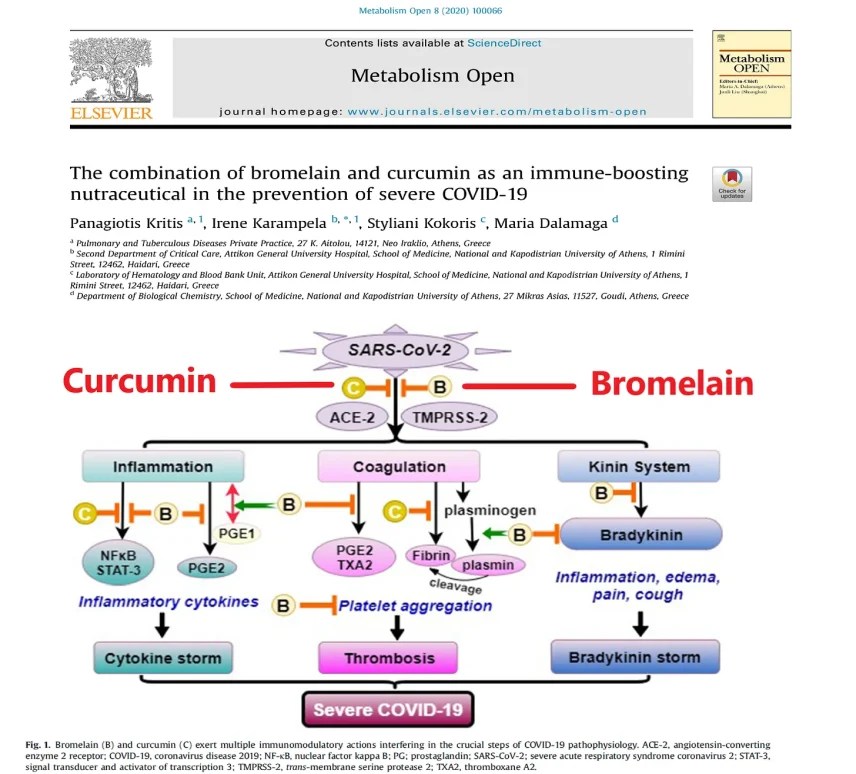
Kritis et al point out:
“Curcumin (diferuloylmethane) is a natural phenol found in turmeric (Curcuma longa), a member of the ginger family of plants [4]. Curcumin modulates inflammation preventing the subsequent cytokine storm by inhibiting multiple transcription factors such as nuclear factor kappa B (NF-kB) and signal transducer and activator of transcription 3 (STAT-3), and downregulating the proinflammatory cytokines, as this has been demonstrated in human macrophages after influenza virus infection [4,6]. Additionally, curcumin inhibits ACE modulating angiotensin II synthesis and downregulating inflammation, while it also promotes fibrinolysis and the anticoagulation process [4,6,7] (Fig. 1). The antiviral actions of curcumin against multiple viruses (influenza and hepatitis viruses, herpes viruses, human papilloma virus, human immunodeficiency virus, severe acute respiratory syndrome coronavirus and other coronaviruses), bacteria and fungi have been established by experimental evidence [8]. Remarkably, recent evidence from in silico studies has demonstrated that curcumin prevents SARS-CoV-2 entry into cells by blocking the viral binding sites and the cell ligands (spike protein, ACE-2 receptors and basigin), downregulating trans-membrane serine protease 2 (TMPRSS-2), and by interfering with viral replication through the interaction with various viral proteins [4]. However, the minimal absorption of curcumin following oral administration presents a major limitation in its bioavailability [6].
Bromelain is a cysteine protease, isolated from the pineapple stem (Ananas comosus) [9]. Traditionally, it has been used for its anti-inflammatory and healing effects in cases of arthritis and injury, while it has been approved in Europe for the debridement of burn wounds. Experimental studies have demonstrated that bromelain presents unique immunomodulatory actions: 1) downregulation of the pro-inflammatory prostaglandin E2 (PGE-2) through inhibition of NF-kB and cyclooxygenase 2 (COX-2); 2)upregulation of the anti-inflammatory PGE-1; 3) activation of inflammatory mediators (interleukin 1b, interleukin-6, tumor necrosis factor-a and interferon-g) as an acute response to cellular stress, but also inhibition of inflammatory mediators in states of overt cytokine production; 4) modulation of T cell responses in vitro and in vivo; and 5) enhancement of T-cell dependent antigenspecific B cell antibody responses [5,10e14]. Importantly, bromelain exerts dose-dependent anticoagulant effects: 1) downregulation of PGE-2 and thromboxane A2 (TXA2), thus leading to relative excess of prostacyclin; 2) promotion of fibrinolysis by stimulating the conversion of plasminogen to plasmin and prevention of platelet aggregation. Bromelain also hydrolyzes bradykinin and reduces kininogen and bradykinin levels in serum and tissues, improving inflammation and edema as shown in animal studies [15]. Notably, the latter action supports a potential role of bromelain in alleviating COVID-19 symptoms such as cough, fever and pain, and the more serious implications of inflammation, thrombosis and edema. The effect of bromelain on PGE-2 inhibition exceeds that of prednisone and aspirin, presenting very low toxicity and no major side effects. Interestingly, a recent experimental study demonstrated that bromelain inhibits infection of VeroE6 cells by SARS-CoV-2 through blocking the virus binding and entry into cells via downregulation of ACE-2 and TMPRSS2 expression, and cleavage of the SARS-CoV-2 spike protein, presenting a novel promising therapeutic option that warrants further investigation.”
In summary, the combination of curcumin and bromelain are well positioned as supplements in people who are getting repetitive COVID-19/Spike protein exposure. Future randomized trials will elucidate the clinical benefits in specific applications.
Kritis P, Karampela I, Kokoris S, Dalamaga M. The combination of bromelain and curcumin as an immune-boosting nutraceutical in the prevention of severe COVID-19. Metabol Open. 2020 Dec;8:100066. doi: 10.1016/j.metop.2020.100066. Epub 2020 Nov 13. PMID: 33205039; PMCID: PMC7661945.
Russia won’t let Ukraine be bleeding wound
BY M. K. BHADRAKUMAR | INDIAN PUNCHLINE | JUNE 17, 2023
With the Ukrainian offensive under way for a fortnight, all eyes are on the battlefields, and, crucially, Russia’s options ahead. In a little over three weeks from now, the NATO will be holding a summit in Vilnius and the West has choices to make too. We are arriving at a fork in the road.
The NATO expected the Ukrainian forces to punch through key Russian fortifications by now. In reality, they are struggling to get anywhere near the sprawling layered fortifications and in that desperate attempt, are taking massive losses, entrapped in minefields and taken to pieces by Russian artillery and missiles and the dreaded multi-role attack helicopters known as Alligator.
The signposts are best seen in Russian President Vladimir Putin’s Kremlin press conference on Tuesday, lasting over three hours, with war correspondents. In just a week’s time after Ukraine’s offensive began, “25–30 percent of the supplied equipment (from NATO) has been destroyed,” Putin said.
Putin underscored three things. First, the goals set for the special military operations are “fundamental for us” because “Ukraine is part of the effort to destabilise Russia.” What does that mean?
It means Russian operations will not end without realising the twin objectives of “demilitarising” Ukraine and uprooting the present neo-Nazi regime in Kiev. The security and welfare of the Russian population also remains a cardinal objective — no more pogroms. Putin said Russia is going about realising these objectives “gradually, methodically.”
Second, Putin flagged: “The Ukrainian defence industry will soon cease to exist altogether. What do they produce? Ammunition is delivered, equipment is delivered and weapons are delivered – everything is delivered. You won’t live long like that, you won’t last. So, the issue of demilitarisation is realised in very practical terms.”
Third, the Kremlin’s preference so far has been to continue to grind down the Ukrainian military, whilst giving “selective responses” whenever any red lines were crossed — eg., Russian strikes on Ukraine’s energy system, the destruction of the headquarters of the Ukrainian military intelligence. By the way, in that Kiev strike, Russia claims to have seriously injured Ukraine’s spy chief Kyrylo Budanov, the poster boy of western media.
Going forward, Putin said “everything will depend on the potential that is left at the end of this so-called counter-offensive. This is the key question.” After taking such “catastrophic losses,” it is up to the leadership in Kiev to rationally think about “what to do next,” Putin said.
He added, “We will wait and see what the situation is like and take further steps based on this understanding. Our plans may vary depending on the situation when we deem it necessary to move. That includes NATO equipment.”
Putin ridiculed the West’s grandiose talk about matching Russia’s vastly superior defence industrial capacity. He said: “And when they say they will start producing this or that: well, please go ahead. Things are not so simple during a recession… They are not as decisive as we are here in Russia. There is no passion there, these are fading nations; that’s the whole problem. But we have it. We will fight for our interests, and we will achieve our goals.”
Given these stark realities, Kiev should roll back the offensive. But that is not going to happen. Kiev is under immense pressure from Washington to claim some dramatic success. That said, the Ukrainian reserves are not infinite, either. Around 35,000 to 40,000 strong Ukrainian reserves are facing a massive Russian deployment manifold stronger in numbers (in hundreds of thousands) and advanced weaponry, and enjoying air superiority. There is a distinct possibility that at some point, the Russian forces may go on the offensive too.
Against this backdrop, the West claims that the NATO Allies are “looking at an array of options to signal that Ukraine is advancing in its relationship” with the alliance, to borrow the words of the US ambassador in Brussels Julianne Smith. Andres Rasmussen, former NATO chief and presently official advisor to Ukrainian President Zelensky, has threatened that a group of NATO countries may be willing to put troops on the ground in Ukraine if member states including the US do not provide tangible security guarantees to Kiev at the Vilnius summit.
Specifically, Rasmussen claimed that “Poles would seriously consider going in and assemble a coalition of the willing if Ukraine doesn’t get anything in Vilnius. We shouldn’t underestimate the Polish feelings, the Poles feel that for too long western Europe did not listen to their warnings.” The rhetoric took a heightened tone lately at the meeting of Heads of State and Government in the format “Weimar Triangle” (France-Poland-Germany) on June 12 in Paris where a consensus emerged that Ukraine should receive some security guarantees.
German Chancellor Olaf Scholz declared, “It is evident that we need something like this, and we need it in a very concrete form.” French President Emmanuel Macron also called for a rapid agreement on “tangible and credible security guarantees.”
Indeed, this is all bluster. The idea of Poland “putting boots on the ground” is so patently absurd. The Polish military it will wither away in a confrontation with Russia. But what such theatrics show is that nerves are on edge as the spectre of defeat in Ukraine is endangering NATO’s unity.
So, Jens Stoltenberg, NATO secretary-general, stepped in to inject some realism into the discussion, pointing out that for the present what matters most is that Ukraine survives as a nation. Stoltenberg stated: “I believe it’s not possible to give precise dates (for Ukraine’s admission as NATO member) when we are in the midst of a war… the most urgent task now is to ensure that Ukraine prevails as a sovereign, independent nation… because, unless Ukraine prevails, then there’s no membership to be discussed at all, because it’s only a sovereign, independent, democratic Ukraine that can become a NATO member.”
Stoltenberg took the cue from Washington. In fact, he was speaking while on a visit to Washington, in an interview with PBS.
Russia is not taking the eyes off the battlefield. In reality, Moscow is shoving down the western throat a historic strategic defeat. The choice for the West narrows down to negotiating with Russia on its terms, or to expect a military solution, which might mean the obliteration of Ukraine as a nation and the eviction of NATO.
Make no mistake, Russian offensive plans have been drawn up. There is talk among opinion makers in Moscow about creating new facts on the ground — a De-Militarised Zone along the Polish border. Now, that entails Russian forces crossing the Dnieper and liberating Kiev as well as liberate Kharkov and Odessa, two other Russian cities historically. Russia has no interest in annexing the western regions of Ukraine, which is hostile territory that Stalin annexed.
But western Ukraine has other neighbours — Poland included — who would have unfinished business of partition of their historical lands to settle. The unresolved nationality question is explosive, as Poles still remember the killings by the Ukrainian nationalists aligned with the Nazis. Historians say that more than 100,000 Poles, including women and even the smallest children, perished at the hands of their Ukrainian neighbours in a nationalist drive in areas that were then in southeastern Poland and are mostly in Ukraine now. To put it mildly, what remains of Ukraine under the weight of a crushing military defeat no one can predict.
The Kremlin will exercise its options depending on the exigencies of the situation. Moscow seems to have concluded that there is no real alternative to a military solution. It will not allow Ukraine to remain a chronic wound infected by the microbial species from the transatlantic universe. Cauterisation of the wound is necessary, albeit with potential risks.
Anglo-Saxons control collective West – Moscow
The US and the UK strong-arm their own followers, Russian FM Lavrov has said.
RT | June 16, 2023
London and Washington run the show in the “rules-based world order,” trying to dictate policy to their own allies as well as countries outside the West, Russian Foreign Minister Sergey Lavrov told RT on Friday.
Russia fully understands that building relations with other countries needs to be based on mutual benefits and equal partnerships, Lavrov said in an interview with RT at the St. Petersburg International Economic Forum (SPIEF).
“This is not what we see in the West these days. The Anglo-Saxons are basically running the show, controlling the rest of the collective West. They are using the current situation, which they created through Ukraine – this war against Russia – to remove competition,” Lavrov elaborated.
“They see us as a competitor, they see China as a competitor. Their doctrinal documents clearly state that. But they are also removing their competition in continental Europe. It’s obvious. The economic and social processes in Germany are grim. Other countries are not much better off,” the Russian foreign minister added.
The only Western state benefiting from the current situation is the US, Lavrov said, “and the UK is always somewhere around, helping America reach its selfish goals.”
According to Lavrov, the “Anglo-Saxons and their allies” are currently trying to pressure countries around the world to side with them against Russia, including the Arab world, using methods he can only describe as “rude.”
“You see, when they talk about these ‘rules’ on which the international order must be based, what they really mean is their diktat,” Lavrov told RT. “Colonial instincts – live at the expense of others. Nothing else.”
Lavrov took particular exception to Western proclamations that their support for Kiev is “defending democracy” and that Ukraine is fighting for “Western values” in the conflict with Russia.
“First of all, if they really see it that way, I cannot but be convinced that they are holding on to Nazi views. Because saying that Western values are being protected in Ukraine is the same as saying that Nazism is your mode of existence,” the diplomat told RT. As for democracy, he added, “they only speak about democracy when they teach others how to live,” but not when it comes to respecting the sovereign equality of other states, per the UN Charter.
Europe is shielding Israel under guise of combating anti-Semitism, new report finds
By Nasim Ahmed | MEMO | June 16, 2023
The chilling repercussions of the highly controversial International Holocaust Remembrance Alliance (IHRA) definition of anti-Semitism have been revealed in a recent report by the European Legal Support Centre (ELSC). Titled “Suppressing Palestinian Rights Advocacy through the IHRA Working Definition of Anti-Semitism”, the report by the independent Dutch-based organisation uncovered shocking examples of the IHRA’s weaponisation against critics of Israel and the suppression of free speech under the guise of combatting anti-Semitism.
Using dozens of case studies from across Europe, ELSC showed that the endorsement, adoption and implementation of the IHRA in the European Union, its member states and the UK, has led to widespread restrictions of the right of assembly and freedom of expression. Despite strong opposition and warning against its adoption by Jewish groups, experts on anti-Semitism, academics and activists, the controversial definition has been implemented by public and private bodies as if the IHRA is legally binding. Despite qualification by advocates of the IHRA that it is “non-legally binding”, a definition of anti-Semitism which conflates criticism of Israel with anti-Jewish racism has been placed at the centre of regulatory frameworks across Europe.
Some of the shocking findings include the following: Advocates of Palestinian rights who are targeted using the IHRA suffer a range of unjust and harmful consequences, including loss of employment and reputational damage; advocates of Israel routinely weaponise the IHRA to intimidate and silence people defending Palestinian rights; allegations of anti-Semitism that invoke the IHRA within the documented cases uncovered by the ELSC found that they are overwhelmingly used to target Palestinians and Jewish people opposed to Israel’s brutal occupation.
In one of the many remarkable findings, ELSC discovered that, not only was there a failure to carry out a risk assessment prior to IHRA’s adoption, the EU appeared to lie about the checks it had conducted. When asked if the Commission had conducted a risk assessment of the implications of the IHRA on fundamental rights, the EU Commissioner on anti-Semitism, Katharina von Schnurbein, affirmed that an assessment of the consequences had indeed been carried out. “Yes, we assessed“, said Schnurbein in a tweet on 23 November 2022, in response to critics who accused the Commission of failing to carry out basic due diligence.
However, responding on 9 December 2022 to a Freedom of Information request, the European Commission acknowledged it “has not conducted ‘any fundamental rights assessment or scrutiny (…) into the human rights implications of its endorsement and/or promotion of the IHRA Working Definition of Anti-Semitism.” Details of the misleading information by the Commissioner on anti-Semitism were covered at length by the advocacy group, Law for Palestine.
Misinformation about risk assessment is just one of the many examples of underhanded practices revealed by the ELSC report. The European Commission also failed to address and reflect the diversity of positions regarding definitions of anti-Semitism. The EC not only ignored that the IHRA is highly controversial and contested, it completely ignored less controversial definitions of anti-Semitism such as the Jerusalem Declaration on Anti-Semitism, and the Nexus Document. In contrast to the EU, the US has referenced other controversial definitions of anti-Semitism.
In sharp contrast to the IHRA definition, the Jerusalem Declaration states that, “Even if contentious, it is not anti-Semitic, in and of itself, to compare Israel with other historical cases, including settler-colonialism or apartheid.” The Nexus Document is equally explicit. It states that “Paying disproportionate attention to Israel and treating Israel differently than other countries is not prima facie proof of anti-Semitism.”
The US also appears to favour a less politicised definition that is not centred on shielding Israel and the political ideology of Zionism. In detailing its plan to combat the rise of anti-Jewish racism, the White House opted for the following definition: “Anti-Semitism is a stereotypical and negative perception of Jews, which may be expressed as hatred of Jews” said the strategy document, without mentioning Israel once. “It is prejudice, bias, hostility, discrimination or violence against Jews for being Jews or Jewish institutions or property for being Jewish or perceived as Jewish. Anti-Semitism can manifest as a form of racial, religious, national origin, and/or ethnic discrimination, bias, or hatred; or, a combination thereof. However, anti-Semitism is not simply a form of prejudice or hate. It is also a pernicious conspiracy theory that often features myths about Jewish power and control.”
Questions were also raised over why the EU adopted a definition that had been discarded because of its threat to fundamental rights to free expression. In 2004-2005, the European Monitoring Centre on Racism and Xenophobia (EUMC) published a “Working Definition of Anti-Semitism”. This definition, according to the ELSC report, featured “contemporary examples of anti-Semitism”, including examples relating to the State of Israel. The examples were criticised due to its conflation between opposition to Israel and anti-Semitism. The definition was abandoned by the EUMC’s successor body, the Fundamental Rights Agency (FRA), which removed it from its website in 2013. In its explanation for discarding the IHRA, FRA explained that it had “never been viewed as a valid definition of anti-Semitism; that the Agency was not aware of any official EU definition of anti-Semitism; and that the document was removed in a clear-out of non-official documents.”
The most serious bad-faith attempt to mislead the public in order to roll out the IHRA is the claim that the definition is “non-legally binding”. Despite promoting the IHRA as “non-legally binding”, most of the EU Member States have endorsed the IHRA as the authoritative instrument for addressing anti-Semitism which, according to the ELSC, has given the definition centred on shielding Israel and Zionism “soft law power”. EU statements and policies through which the IHRA is being applied, is said to show that it has gained law like force and impact.
“Hard-core advocates of the IHRA always intended it to have binding legal status and force” said ELSC. “The ‘non-legally binding’ provision was only added to secure its adoption by the IHRA Plenary in May 2016. Efforts have been made since, in some Member States to introduce the IHRA as a basis for legislation.
The real-life impact has been devastating for critics of Israel. The IHRA has been implemented in the UK, Austria and Germany by public and private bodies in ways that have led to widespread infringement of the fundamental rights to freedom of expression and assembly, ELSC found. Advocates of Palestinian rights, who are targeted, are said to suffer a range of unjust and harmful consequences, including loss of employment and reputational damage. IHRA is often found to be weaponised by pro-Israel advocates to intimidate and silence those advocating for Palestinian rights.
The good news is that, when challenged in court, most of the allegations of anti-Semitism based on the IHRA are found to be unsubstantiated and thrown out. Though this is a silver lining, the adoption of the IHRA has created a perverse situation which undermines democracy and the principal of “innocent until proven guilty”. In this toxic culture, some sections of the population are having to go to court to protect basic freedoms, like the right to free speech. According to the ELSC report, even though most challenges to the implementation of the IHRA were successful, the disciplinary procedures and litigation resulting from false allegations of anti-Semitism have produced a “chilling effect” on the freedom of expression and assembly.
US, Israel defense ministers discuss anti-Iran alliance
The Cradle | June 16, 2023
Israeli Defense Minister Yoav Gallant met with US Secretary of Defense Lloyd Austin on 15 June at the NATO summit in Brussels to discuss Iran and other important aspects of the US-Israel relationship, the Jerusalem Post reported.
Gallant discussed with Austin his claims that “Iran stimulates attacks against Israel using proxies in Syria, Lebanon, Gaza, and the West Bank, and reiterated Israel’s right to self-defense,” the Israeli paper said.
Before departing for Belgium, Gallant said he would discuss with Austin “the implementation of the joint commitment of both our countries to make sure Iran will never possess nuclear military capabilities.”
Israeli threats against Iran have intensified in recent months amid unconfirmed reports that Washington is close to reaching an interim or partial nuclear deal with Tehran through indirect talks in Oman.
Israel opposes a US nuclear deal with Iran, while Iranian officials have made clear they will only accept a full return to the nuclear deal signed with the Obama administration in 2015. The Trump administration withdrew from the deal, known as the Joint Comprehensive Plan of Action (JCPOA), unilaterally in 2018. The JCPOA placed limits on Iran’s nuclear program in exchange for sanctions relief.
Despite US negotiations with Iran, the US military has expanded military cooperation with Israel this year and carried out exercises viewed as veiled threats against Iran, such as the Juniper Oak exercise in January.
The exercise involved 7,900 personnel, 142 combat aircraft, twelve warships, and activities across all domains (sea, air, land, space, and cyber). The main goals of the exercise were to improve interoperability and to demonstrate the ability to surge forces into the region in the event of war with Iran.
Reports emerged that the exercise simulated strikes on Iranian nuclear facilities, though US officials denied this.
In March, Austin met with Gallant in Israel. At the time, Austin said that although the Biden administration “continues to believe in diplomacy,” it would “not allow Iran to acquire a nuclear weapon.”
Despite ongoing political differences between the Biden administration and the Israeli government regarding Prime Minister Benjamin Netanyahu’s proposed legislation to overhaul the Israeli judiciary, the military alliance between the two remains strong.
Austin said he “wanted to be here to make something very clear: America’s commitment to Israel’s security is ironclad, and it’s going to stay that way. As President [Joe] Biden said in his visit to Israel last year, ‘The connection between the Israeli people and the American people is bone deep.’ Israel is a major strategic partner for the US.”
US imposes fresh sanctions on North Korea despite Treasury warning
Press TV – June 15, 2023
The United States has imposed fresh punitive measures on North Korea, targeting the country’s missile program despite a recent warning from the Treasury that sanctions are pushing many countries to seek alternatives to the dollar for settlements.
The US Treasury Department issued the punitive action on Thursday after South Korea earlier said its neighbor fired two short-range missiles, Reuters reported.
The South Korean military said North Korea fired two short-range missiles off its east coast on Thursday after Pyongyang warned of an “inevitable” response to the military drills staged by several thousand South Korean and US troops on the Korean Peninsula.
The Treasury in a statement said it imposed sanctions on two North Korean nationals, accusing them of being involved in the procurement of equipment and materials for the country’s ballistic missile program.
“The United States is committed to targeting the regime’s illicit procurement networks that feed its weapons programs,” said the Treasury’s Under Secretary for Terrorism and Financial Intelligence, Brian Nelson.
The sanctions also targeted a Beijing-based representative for the Second Academy of Natural Sciences, which the US claimed is responsible for research and development for North Korea’s advanced weapons systems. His wife was hit with sanctions as well.
The Treasury in the statement said North Korea continues to use a network of representatives abroad to import components necessary for its nuclear and ballistic missile programs.
Earlier in the day, South Korean and US troops held joint live-fire exercises in the region. A total of 2,500 troops took part in the maneuvers in Pocheon, northeast of Seoul.
President Yoon Suk Yeol of South Korea personally watched the live-fire exercises. He said the drills were the largest of their kind ever held with the United States.
North Korea released a statement on Thursday, with a defense ministry spokesperson saying the exercises were “targeting the DPRK (North Korea) by massively mobilizing various types of offensive weapons and equipment.”
“Our response to this is inevitable,” said the statement, carried by the official Korean Central News Agency.
It said the drills were “escalating the military tension in the region.”
North Korea has been under harsh sanctions by the United States and the United Nations Security Council for years over its nuclear and ballistic-missile programs.
US Treasury Secretary Janet Yellen admitted during her annual appearance on Tuesday before the House Financial Services Committee that US sanctions were pushing many countries to seek alternatives to the dollar for settlements.
Asked about the risk of de-dollarization, Yellen acknowledged that the use of the dollar in the global economy is diminishing.
“It’s not surprising that countries that are fearing they can be affected by our sanctions are looking for alternatives to the dollar. It’s something that we simply have to expect,” she stated.
Putin: Kiev Has Lost 186 Tanks, 418 Armored Vehicles, Losses Mounting
By Ilya Tsukanov – Sputnik – 16.06.2023
Ukrainian forces launched a long-awaited counteroffensive earlier this month after stocking up on NATO weapons, including Leopard heavy tanks and Bradley fighting vehicles. The offensive has stalled after running into well-prepared Russian defensive lines, with even Kiev’s Western backers expressing concerns about Ukraine’s heavy losses.
Ukraine has failed to reach any strategic objectives amid its ongoing counteroffensive, losing 186 tanks and 418 armored vehicles to date as losses continue to mount, Russian President Vladimir Putin has said.
“In some places Ukrainian forces manage to reach the first line of defense, in some places not. That’s not the question,” Putin said, speaking to reporters during the plenary session of the St. Petersburg International Economic Forum on Friday.
“The question revolves around the fact that they are using their so-called strategic reserves, which consist of several components. The first is meant to be used to break [Russian] defenses, the second to use forces to entrench their foothold over territory. They have not reached their goals at a single section of the front. This is what is important,” he said.
“Their losses are indeed very large, even more than ten to one compared to the Russian army. This is a fact. In terms of equipment, losses are mounting daily. As of today, this includes 186 tanks lost and 418 armored vehicles of various classes,” Putin said.
Russia’s defense enterprises are working round-the-clock to supply the military with weapons, working double or even triple shifts, Putin said. “We have increased the output of military production by 2.7 times, and when it comes to the most needed equipment – by 10 times.”
As for Ukrainian forces, Putin predicted that “soon they will stop using its own equipment” entirely because it’s being systematically destroyed. “Everything they’re using to do battle, and everything they’re using is coming from abroad. One can’t fight that way for long,” he said.
Origins of Conflict
Putin also once again took the opportunity to delve into the root causes of the present crisis, saying “the war in Ukraine, in southeastern Ukraine, was started by the Kiev regime with the support of their Western sponsors in 2014. But everyone in the West tries not to speak about this. I am forced to remind them that aviation, tanks, artillery were used used against the Donbass [back then]. What is this if not a war?”
Kiev “refused” to entertain an end to the Donbass crisis using peaceful means, Putin said, “forcing us to use our armed forces to attempt to put an end to this war.”
It wasn’t Russia that led its Western partners “by the nose” between 2015 and 2022 by signing the Minsk peace deal for Donbass, “without any plans to implement it, as they publicly admitted recently,” he added, referring to recent revelations by the former Ukrainian, German and French leaders that they only signed the Minsk deal to give Kiev time to rearm and prepare for war with Russia.
Kiev pressuring Brazil to attend “Peace Summit”
By Lucas Leiroz | June 16, 2023
Kiev continues its work to attract supporters in its campaign against Russia. Now, an aide of president Vladimir Zelensky is pressuring Brazil to take part in the so-called “Global Peace Summit” – an event organized by the regime whose intention will be to unilaterally show the Ukrainian proposal for “peace”, without taking into account Russian interests.
The Head of the Office of the president of Ukraine Andrey Yermak has been speaking to Brazilians in recent days to talk about Ukrainian interest in Brasilia’s participation in a summit organized to promote Kiev’s “peace” proposal. On June 12th, the official spoke to Brazilian journalists linked to CNN and stated that he hopes that Brazil assumes a leadership role in the quest to achieve the “solution” suggested by the regime.
On the occasion, the head of office highlighted the importance of Brazil and other countries of the Global South in the current geopolitical situation and used this argument to suggest that the emerging powers participate actively in the peace dialogue. However, he highlighted what had already been said previously by Ukrainian authorities: no peace proposal that meets Russian interests will be considered by the regime, and it is necessary to unilaterally meet Ukrainian requirements in order to reach any agreement.
During the interview, Yermak also emphasized the role that Brazil plays in what concerns the environmental debate. According to the Ukrainian authorities, Russia is responsible for the (non-existent under international law) crime of “ecocide,” which is why it should be punished and isolated internationally. As evidence of this crime, they point to the recent attack on the Novaya Kakhovka dam, which, according to Ukrainians and Westerners was carried out by Russia. However, until now, nothing substantial has been presented to prove Russian responsibility for the attack, while on the other hand, the Ukrainian military had already stated, months before, that they were planning such an operation.
Two days after the controversial interview for CNN, the Ukrainian aide returned to dialogue with Brazilians, this time with Chief Advisor to the President of the Federal Republic of Brazil Celso Amorim. Both officials had already met before, when Amorim visited Kiev to propose to the Ukrainian authorities the creation of a “peace club” mediated by neutral countries, according to the plan of Brazilian President Lula da Silva. Dialogues around the creation of such group, however, did not develop since Ukraine is only interested in its own “proposals”.
In the telephone call with Amorim, Yermak resumed the points he had already discussed with CNN journalists and emphasized the importance of Brazilian participation in the summit, mainly taking into account environmental factors.
“Of course, we are extremely interested in Brazil’s participation in this summit. We are ready to talk, and it is very important for us to hear your opinion (…) Russia’s destruction of the Kakhovka hydroelectric power plant has shown the extreme relevance of the Ukrainian Peace Formula, in particular the security and environmental clauses”, – he said.
In fact, the Ukrainian attempt to attract support from Brazil and other countries of the Global South is part of a context of seeking legitimacy in the face of global public opinion. Recently, Ukraine’s international image has become increasingly negative, as the regime’s crimes against Russian civilians and undisputed zones of the Federation’s territory have become repeated and undisguised. In addition, the Ukrainian rejection of any attempt at negotiation also worsens the country’s image and makes it clear which side is bellicose and pro-war in this conflict.
With the creation of the “Global Peace Summit”, Kiev plans to show the world that it is really interested in peace and diplomacy. The problem is that obviously “peace” as proposed by the regime does not interest the Russians who will not even be invited to the event, which severely undermines the validity of the Ukrainian proposal. So, as an alternative to try to justify its proposals, Kiev is inviting Brazil and countries from the Global South, thus seeking to improve the acceptability of the event.
In the same sense, by using environmental rhetoric, the neo-Nazi regime is making even more efforts to bring Brazil into the summit, as the South American country has suffered strong international harassment because of the Amazon rainforest, which the US and Europe claim with no evidence that is being destroyed. Yermak hopes to get Brazilian support for the Ukrainian meeting through coercion using ecological arguments, but this plan may also fail.
In 2021, Russia prevented environmental rhetoric from being used against Brazil and other countries of the Global South by vetoing a UN resolution proposed by the West to consider climate change a security issue, which in practice would legitimize international interventions against countries that allegedly violate environmental norms. This would legitimize, for example, Brazil to suffer international intervention in the Amazon. So, in other words, Russia helped Brazil to protect its own sovereignty, making it unlikely that Brasilia will now act against Russia precisely using environmental rhetoric.
The “Peace Summit” is likely to take place, but its results will be insignificant. Peace can only be achieved through an agreement that reflects Russian interests. The countries of the Global South, even if they participate in the event, certainly will not endorse measures that do not attend Russia’s demands.
Pandemic and Panopticon: The Rise of the Biomedical Security State
By Janet Levy | American Thinker | April 20, 2023
The pandemic of 2020 saw the imposition of shocking restrictions. For the first time, healthy people were confined to their homes. Vaccines cleared for emergency use – meaning not rigorously tested – were forced on all citizens. Debate, even by scientists, was censored. Refusal to obey these arbitrary impositions could mean arrest, legal action, or, as Dr. Aaron Kheriaty found out, losing one’s job.
A psychiatry professor in good standing at the University of California at Irvine (UCI), Dr. Kheriaty became persona non grata when he demurred to the mandatory vaccine policy, claiming natural immunity as a Covid-recovered individual. Not caring for scientific debate, the university declared him a “threat to the health and safety of the community,” suspended him without pay, barred him from campus, and eventually fired him.
It did not matter that his psychiatry clerkship was the highest rated clinical course at UCI’s medical school; that he’d been chosen keynote speaker to address incoming medical students; and that when the pandemic broke out, he had risked his life to work long hours at the hospital, often uncompensated, while many colleagues stayed home in safety.
Uncowed, Dr. Kheriaty sued the university. In a more far-reaching action, he authored The New Abnormal: The Rise of the Biomedical Security State, a sober analysis and exposure of the tyranny of pandemic policies and the devastation they wrought. The book traces the roots of state interference in, and control of, the biomedical aspects of citizens’ lives to utilitarian ideas that began with Galton and Darwin, and trickled into eugenics, which he says is falsely viewed as entirely a creation of the Nazis when in fact American states were enforcing sterilization from the 1900s to the 1960s.
The core idea, he says, is this: the freedom of a citizen to make health and life decisions can be annulled by the state for the greater good, especially during emergencies. The questions it raises are: Who makes these decisions and on what basis? Who decides what is the greater good? Who is to be held responsible for errors of judgement? What checks and balances do we have, then, against the dictatorial inclinations of the powerful? Ancillary to the idea, he says, is the dangerous circular logic of the state of exception: those who declare an emergency in which citizens’ rights – including the right to question the declaration – stand suspended will believe that in that instance it is morally and politically justified!
We saw all that playing out during the pandemic. Kheriaty observes that the global elite and other political entities, in unbridled collaboration with intelligence and police powers, promoted the acceptance of biomedical surveillance. None of the extreme measures – lockdown, school closure, mandatory masking, vaccine mandates and passports – were subject to debate. No benchmarks were set to justify the emergency or identify when it would end. In fact, America continues to remain in a state of emergency (until May 11th).
Compliance was achieved through propaganda, policing, and surveillance. Guilt – Don’t Kill Granny – and Mao-style rousing – 15 Days to Stop the Spread – were deployed. Six-foot social distancing and curtailment of gatherings to no more than 10 people were imposed with no explanation of where these magic numbers came from. Human contact was redefined as a source of contagion. Exposure could build natural immunity, but this wasn’t acknowledged, for it would have potentially halved the profits of the $100 billion Covid vaccine industry.
Kheriaty identifies the characteristics of the biosecurity paradigm:
- a hypothetical risk, magnified to worst-case scenario to adduce grounds for maximum behaviorial control;
- systematic imposition of control on the entire citizenry, instead of vulnerable subsets;
- catastrophizing, in order to justify intrusive surveillance and the use of police and military action; and
- a merging of public health and the military-intelligence-industrial complex in developing and implementing tracking and data-mining capabilities.
Surveillance is the backbone of dictatorial regimes, and it was no different during the pandemic. In 2021, evidence emerged that the CIA had used digital surveillance to gather information on Americans sans judicial oversight or congressional approval. There were no safeguards to protect civil liberties. Such scenarios have long been envisioned – as far back as 1999, a possible smallpox outbreak was studied. Exercises such as Dark Winter, Atlantic Storm, Clade X, and Event 201 followed. They simulated imposition of martial law, detention of citizens, control of messaging, censoring dissent, enforcing mandates, and surveillance during public health crises. Recommendations to increase state power and use police or military intervention were subsequently embodied in the 2002 U.S. Public Health Security & Bioterrorism Preparedness & Response Act.
The religion of scientism took hold as Dr. Anthony Fauci, former chief medical advisor to the President, reframed the narrative on Covid, shifting the focus from the virus to viewing humanity as a vector. Fauci and a set of scientists and technocrats with broad powers arrogated to themselves a monopoly on knowledge and expertise. Lacking rational explanation, they used force, defamation of critics, and dubious promises of future outcomes to obtain public conformity to the security and surveillance measures.
The vast influence of Big Pharma over governments, the research establishment, and media, says Kheriaty, cannot be understated. Pfizer and Johnson & Johnson are wealthier than most countries, with vast sums available for lobbying. In 2020, 72 senators and 302 congressional representatives cashed campaign checks from the pharmaceutical industry. Biomedical researchers and medical journal editors receive payments from pharma. In a nine-year-period, two-thirds of all FDA reviewers took positions in the industry they regulated. The National Institute of Health, which owns half of the Moderna vaccine patent, chose to conduct internal testing of the vaccine rather than leave it to independent university-based researchers. Media acquiescence was achieved through $1 billion-worth of vaccine advertisements, paid for in taxpayer dollars!
Kheriaty goes so far as to assert that the lockdown was driven by an economic agenda disguised as public health protocol. It helped Big Pharma, multinationals, and the global elite who control them achieve the largest transfer of wealth in history by eliminating competition and spelling doom for small business.
The ultimate plan, devised by the global elite, is for a new world order, shifting government authority from sovereign states to powerful NGOs like the World Economic Forum (WEF), the International Monetary Fund (IMF), and the World Health Organization (WHO). Plans are afoot for a WHO-driven international pandemic treaty tied to a digital ID system, while IMF is promoting central bank digital currency (CBDC), which will allow complete tracking of monetary transactions. WEF chairman Klaus Schwab nurses transhumanist dreams, saying “we will not change what we do” but “who we are,” through gene- and bio-engineering.
The concluding chapter suggests ways of avoiding totalitarian emergencies and the abyss of the biomedical security state. He suggests strict limits on the declaration and control of emergencies, incorporating more checks and balances if necessary. He calls for substantive institutional reform that will eliminate the revolving door between Big Pharma and federal agencies. Besides, he says, the NIH monopoly must be broken, perhaps by distributing research grants to 50 state institutes of health that will focus on issues of local concern. Other ideas include provision of accurate, comprehensive information to allow people to give informed consent; allowing doctors to prescribe off-label or repurposed drugs and provide individualized care; holding Big Pharma accountable by bringing back product liability.
Freedom is at stake, as we discovered during the pandemic. Dr. Kheriaty lost his job, without a chance to defend himself, for daring to dissent. This – or much worse – can happen to any of us if we allow America to become the biomedical security state the global elite want to transform the world into.
Featured Video

America Racing to Strategic Defeat in Iran
or go to
Aletho News Archives – Video-Images
From the Archives
An Expert Military Analysis of War with China
Actually, None is Necessary
By Fred Reed • Unz Review • December 13, 2020
The Correlation of Armed Forces: U.S. goods and services trade with China totaled an estimated $634.8 billion in 2019. Exports were $163.0 billion; imports were $471.8 billion. The U.S. goods and services trade deficit with China was $308.8 billion in 2019. Trade in services with China (exports and imports) totaled an estimated $76.7 billion in 2019. Services exports were $56.5 billion; services imports were $20.1 billion. The U.S. services trade surplus with China was $36.4 billion in 2019.
There is talk within the Washingtoniat of a possible war with China. Steve Bannon, who apparently was dropped on his head as a child, actually favors such a war. We hear the usual shoo-the-boobs alarm about how the Chinese are doing something terrible and we must gird our loins and American values and show them what for, bow wow, woof. The danger is that the current game of who-blinks-first in Asian waters might actually provoke a shooting war. You know the kind of thing: One warship refuses to get out of the way of another, a collision ensues, some retard lieutenant who signed up on waivers opens fire, and we’re off and running. It is not a good idea to let children play with matches.
The said war is discussed either in emotional terms by idiots or in purely naval terms by those familiar with such things, so we hear of the First Island Chain and the Second Island Chain and whose missiles against the other’s missiles and so on. This would be appropriate if we were fighting World War Two again. Which we aren’t. Let’s take a quick-and-dirty look at how such a war might go.
To begin the war, America would overestimate itself and underestimate China. This is doctrine in the Pentagon. … continue
Blog Roll
 Aletho News
- Rethinking America’s greatest threat: Iran vs. Israel-Firsters
- Iran accuses adversaries of false flags to strain Turkey ties
- Poland rules out sending Patriot missiles to US/Israel amid war on Iran
- Tehran approves new Hormuz plan with major restrictions
- No Threat Can Force Iran’s Surrender /Trita Parsi & Lt Cl Daniel Davis
- UK’s New Pandemic Plan Would Turn Big Tech Into a Mass Location Tracking Network
- Growing insecurity, soaring prices fuel protests in north as regime bans evacuation: Sources
- Iran denies responsibility for ‘depraved’ attack on Kuwait desalination plant
- Bring The Troops Back. End This War Now!
- Can we please stop calling Israel the ‘only democracy in the Middle East’ now?
- If Americans Knew
- The Line Between Affinity and Conspiracy
- As Iran targets US military bases, will they be relocated to Israel? Not a ceasefire Day 171
- Will Trump Go Kamikaze?
- Is the University of Florida Shutting Down College Republicans over Israel Criticism?
- Jewish extremist arrested over alleged plot to firebomb Palestinian activist Nerdeen Kiswani’s home
- More than half of Palestinian child detainees have no charges
- The More Murderous Israel Gets, The More We Hear About “Antisemitism”
- Land Day and the Palestinian struggle after 30 months of genocide
- The Iran War Is About Palestine
- Israeli soldiers echo settler ideology, talk of revenge after targeting Palestinians and detaining CNN crew in the West Bank
- No Tricks Zone
- New Study Finds Warming Saves Lives…Cold Temperatures 12 Times More Deadly Than Excess Heat
- German Science Blog Accuses PIK Climate Institute Of Hallucinating Climate Tipping Points
- Devastating Assessment Of Comirnaty Vaccine By Former Senior Pfizer Europe Toxicologist
- New Study: CO2 Is ‘Effectively Negligible’ As An Explanatory Climate Change Factor Since 2000
- Former Pfizer Toxicologist Dr. Helmut Sterz Tells Bundestag Hearing Pfizer Vaccine Should Have Never Been Approved
- Energy Expert: Germany’s Nuclear Phaseout Was A “500 Billion Euro Mistake”
- New Research: South Australia’s Mid-Holocene Sea Surface Temperatures Were 4°C Warmer Than Today
- Storing Green Energy To Last Germany 10 Days Would Require A 60-Million Tonne Battery
- New Studies: UK Sea Levels Were 4 Meters Higher Than Today During The Mid-Holocene
- Destructive Green New Deal: German Energy And Metal Group Warns Of Drastic Crisis
 Aletho News