The character assassination of Robert F Kennedy Jr
By Niall McCrae | TCW Defending Freedom | July 3, 2023
Will there be another dead Kennedy? I hope not to tempt fate, but as a Democrat nomination candidate for the US presidential election next year, Robert F Kennedy Jr is making himself a target. He rejects the official narrative on Covid-19 and Ukraine, and he rails against Big Pharma, corrupt federal authorities and militaristic foreign policy. The Democratic Party wants to keep the octogenarian and cognitively suspect incumbent Joe Biden, whom many people see as a puppet of the Deep State, struggling to read from an autocue.
Already being RFK is being attacked, albeit by the pen rather than the sword. Liberal-progressive media are troubled by his rise in the polls. First they ignored him; then they ridiculed him; now they are desperately denouncing him as a harmful interference in ‘democracy’ (a term that means something different to the elite than to you and me). Among the latest hit jobs, the Washington Post argued that RFK should be running as a Republican, as that’s where the anti-vaccine constituency lies. A Daily Mail column described him as a serial misogynist (journalists are less concerned with the sitting president’s proclivity for fondling little girls and sniffing their hair).
A recent diatribe in the Los Angeles Times by Michael Hiltzik is so bad that it’s good. RFK had appeared on a 90-minute ‘town hall’ programme on the cable channel News Nation on June 27. Hiltzik wondered why. A similar format featuring Donald Trump on CNN was supposed to be taken by broadcasters as a clear message that nothing can be gained from giving a platform to bombasts and conspiracy theorists. Trump had played to the gallery and taken control of the debate, interrupting and haranguing the weak presenter. Fact-checking ‘quackery’ on a live show is futile.
Although RFK is up to around 20 per cent in polling as a challenger to Biden, Hiltzik belittled him as ‘a fringe candidate for the Democratic Party nomination’. He suggested ulterior motives: ‘perhaps News Nation is trying to assume the mantle of Fox News as a dispenser of right-wing twaddle, or (to be more charitable) of CNN as a sober neutral voice’. To regard (actually, to disregard) CNN as a fair, unbiased medium shows how once-trusted organs such as the Los Angeles Times have become polarised.
RFK performed in a controlled setting, before a small audience in Chicago, but Hiltzik complained that moderator Elizabeth Vargas was ‘ill-equipped to counter Kennedy’s elaborate web of misinformation about vaccines’. Actually, Vargas did not raise the topic of vaccines until near the end of the debate. This should have come first, Hiltzik averred, ‘because Kennedy’s anti-vaccination stance is a major element of his presidential campaign . . . that’s what makes him a public health hazard’.
As a business editor, Hiltzik is unlikely to have a fraction of the knowledge gained by RFK on vaccines over decades of research. But he felt qualified to rebut the claims of the Democrat pretender. After denying that he is ‘anti-vaccine’, Kennedy asserted that vaccines should be tested like other medicines, but ‘of 72 vaccine doses mandated for American children, not one has ever been subjected to a prelicensing placebo-controlled trial’. ‘Yes, they have,’ Vargas responded. But Hiltzik was exasperated by the host’s failure to ‘catch Kennedy’s deceptive sleight of hand’. RFK is wrong, according to Hiltzik, as a placebo such as an inert saline injection would be unethical; instead, a new product needs only to perform better than an existing vaccine, not by depriving study participants of potentially life-saving immunisation. Naïve to this Big Pharma stitch-up, Hiltzik believes the propaganda that vaccines have ‘all gone through phased trials mandated by the Food and Drug Administration to determine their safety and gauge their efficacy.’
Quite reasonably, RFK told the New Nation audience that vaccines should be properly tested for long-term risks. Hiltzik scoffed: ‘Does he mean one year? Five years? Thirty years? Some diseases take that long after exposure to manifest themselves. Is 30 years an appropriate period to wait?’
Kennedy focused on two specific vaccines. There is considerable evidence of the chickenpox vaccine, mandated for children in every state of the US, causing outbreaks of shingles in adulthood. Googling it, Hiltzik found the predictable array of pro-vaccine medical authorities denying any link between the vaccine and this painful rash.
The second vaccine of concern was for hepatitis B, a disease transmitted through sexual contact or bodily fluids. RFK asked why this is mandated for young children, but Hiltzik glibly explained that a mother of unknown infection could pass the virus to her newborn. There will always be a reason to jab kids against every known pathogen.
As Hiltzik explained, ‘while speaking deceptively, he [Kennedy] comes off as earnest — a skill that Donald Trump hasn’t mastered’. The lesson that the media must learn is that ‘there’s no way that even a determined interviewer can fight back against deception and deceit when it’s dispensed by the torrent’. Doing their duty for the establishment, influential broadcasters and newspapers are demanding censorship of presidential candidates: in a functioning democracy this would be so intolerable as to justify removal of their licences. When the establishment threw everything but the kitchen sink at Trump, this proved to his supporters that the system is rigged.
Although best known for his views on vaccines, RFK is causing most trouble through his opposition to the military-industrial complex, a term coined by Dwight Eisenhower in a warning to the American people three days before leaving the White House in 1961. His successor John F Kennedy (RFK’s uncle) delivered his ‘Peace Speech’ in June 1963, conveying his intent to end the arms race and build peaceful stability with Russia. Such outspoken resistance to the generals and CIA may have been the final straw that led to his assassination five months later in Dallas. The US and Nato empire have been waging wars ever since.
Hiltzik had little to say about Kennedy’s contrary views on Ukraine. It is hard to discredit pacifism as ‘disinformation’, never mind ‘dangerous’. But as shown by the ferocity of establishment attacks on Tucker Carlson and Donald Trump, the one topic that is definitely out of bounds is military interventionism. RFK is an imperfect but compassionate and conscientious man. It is grossly insensitive for journalists to describe the son of a murdered father and nephew of a murdered uncle as a mortal hazard.
Siemens Energy stocks fall 36% — turbines are degrading faster than expected
By Jo Nova | June 26, 2023
It’s a bloodbath in the wind industry.
Despite the wind being free, collecting it appears to cost a fortune. Siemens Energy lost a third of its stock price on Friday. Just like that, seven billion dollars in market value disappeared.
Only a month ago they were expecting to break even, as the Wall Street Journal reports, the executives appear to have been blindsided by the rapidly escalating maintenance costs. The problem is so bad, and perhaps fundamental, that shareholders in other turbine manufacturers are selling out. Vestas Wind fell 7% Friday.
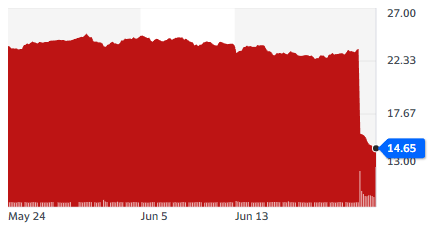
Siemens Energy Share Price, Yahoo Finance
The promise was that wind turbines would keep getting cheaper as they got bigger and better. Instead, issues are appearing now even in new installations, and people are starting to wonder if they’ve made the turbines too big too fast. The bearings and blades are wearing out, and the costs to fix them are crippling.
Clean Energy’s Latest Problem Is Creaky Wind Turbines
Carol Ryan, Wall Street Journal
Shares in Siemens Energy plunged by a third after it said turbine components are degrading faster than expected
The news isn’t just a blow for the company’s shareholders, but for all investors and policy makers betting on the rapid rollout of renewable power.
The creaky components, which affect 15% to 30% of the installed onshore fleet, will be expensive to fix. Management thinks the cost could run upward of €1 billion, equivalent to $1.09 billion, effectively wiping out more than a third of the profit the company is expected to make doing maintenance on wind turbines it has already installed, according to Bernstein analyst Nicholas Green.
These are not words CEO’s ever want to use: ” it’s much worse than even what I have thought possible”:
Siemens Energy Shares Plunge
Michelle Fitzpatrick, Barrons
In a call with reporters, Siemens Gamesa CEO Jochen Eickholt said “the quality problems go well beyond what had been known hitherto”.
“The result of the current review will be much worse than even what I would have thought possible,” he added.
In the call with reporters, Siemens Energy CEO Christian Bruch called the developments “bitter” and “a huge setback”.
The company has seen just “a handful of failures” across a fleet of several thousand turbines, he said, but it now had to assess “what to expect over the next 20 years” and which preventative measures to take.
To put it mildly – It’s either the rotor, the bearings “or the design” — could it be worse? It could — Siemens has already built 132 GW of wind plants — mostly onshore — and these new unforeseen problems may affect as many as 15 to 30% of their turbines. The maintenance costs to meet the warrantees they have already made are substantial. On top of that Siemens has “an order backlog of 34 billion euros”. This could be a very big hole…
Factbox: What are the issues with Siemens Gamesa’s wind turbines?
By Nina Chestney and Christoph Steitz, Reuters
On Friday, Siemens Gamesa said that while rotor blades and bearings were partly to blame for the turbine problems, it could not be ruled out that design issues also played a role. It said the problems could affect as many as 15-30% of its turbine fleet.
The company said quality problems “go beyond what we were previously aware of, and they are directly linked to selected components and a few, but important, suppliers”.
It’s a perfect storm of rising supply costs and unexpected maintenance costs:
The company was already being hit with issues such as the rising costs of steel and other key raw materials when the news of its wind turbine failures went public.
Chief executive, Christian Bruch has told reporters “Even though it should be clear to everyone, I would like to emphasise again how bitter this is for all of us”.
Laid Low by the COVID Vaccine, Now They’ve Got a Bad Case of Federal Unresponsiveness
By Christian Britschgi | RealClear Investigations | June 28, 2023
In April 2021, Adele Fox received a single shot of the Johnson & Johnson COVID-19 vaccine. Within a few hours, the 60-year-old resident of Portsmouth, New Hampshire, started feeling shooting pains in her legs, arms, and neck. The pain didn’t abate over the next few days. Instead, it got worse and was accompanied by nausea and debilitating fatigue.
Within a few weeks, neurologists affiliated with Massachusetts General Hospital diagnosed her with several serious conditions they say were a result of her COVID-19 vaccine, including small-fiber neuropathy (which causes a painful tingling in the extremities) and Sjögren’s Syndrome (which leaves patients pained and fatigued, and in extreme cases, can damage internal organs).
This shot, which was supposed to get Fox back to normal, instead left her with diminished ability to work and enjoy life. Persistent physical therapy and experimental treatments she’s taken since have done little to alleviate her symptoms.
“I used to do so much, and now it’s a struggle,” she says. “Sometimes you just get down.”
With her medical bills mounting and her condition not improving, Fox sought compensation for her damaged health. Federal liability protections prevent the vaccine-injured from directly suing vaccine manufacturers like Johnson & Johnson. Instead, claimants have to go to the federal government for compensation.
But as Fox would soon learn, the government has two starkly different injury programs for vaccines. One operates like a civil court with a neutral judge, lawyers on both sides, and a guaranteed right of appeal. In recent decades, it has approved about 75% of claims and pays out hundreds of millions of dollars per year.
The other, which handles COVID-19 vaccines, has rejected almost every claim brought to it, awarding less than $10,000 since the pandemic. And in a nation nearly numb to the pandemic’s toll and its scandals, the program is adding seething frustration atop lasting injury to Fox and people like her in a little reported aftermath to the government’s much criticized performance on vaccines – ranging from erratic booster advice to broad-brush vaccine mandates that cost people their jobs.
Fox filed her claim two years ago, submitting hundreds of pages of medical documents about her condition and diagnoses. She’s nevertheless one of the 10,887 people still waiting on a decision. “You’re not even hearing anything from the organization that’s supposed be helping you,” she says. “The phone keeps ringing, no one is emailing, nobody is doing anything.”
The federal agency overseeing the program, the Health Resources and Services Administration, said in a statement to RealClearInvestigations that the current number of claims “significantly exceeds the previous volume in the program” and that the program has “hired additional staff to address this growth in claims, and the President’s budget requests additional funding to support the additional staffing needed to process claims.”
Tale of Two Compensation Programs
The government’s two contrasting vaccine compensation programs are similarly named and thus easily confused. The first, Vaccine Injury Compensation Program (VICP) was created in the 1980s and covers most routine vaccines. The second, the Countermeasures Injury Compensation Program (CICP), is a result of war-on-terror legislation in 2005 and now covers COVID-19 vaccines. Their bureaucratic differences help explain why a nation that has spent trillions of dollars on COVID relief programs has provided almost no assistance to people harmed by the vaccines that the government encouraged, and sometimes required, them to take.
The earlier program was supposed to shore up pharmaceutical companies’ willingness to make childhood vaccines in the face of persistent vaccine injury lawsuits, while also giving the vaccine-injured a fair and expedited process for compensation.
The vaccine-injured would not sue pharmaceutical companies. Instead, they’d petition the government in Federal Claims Court, where special masters (judges) would decide cases. Compensation came from a government-administered trust fund paid for by excise taxes levied on vaccine manufacturers.
Between 2006 and 2021, this court adjudicated cases from 10,602 petitioners and issued compensation to 7,618 of them. The compensation trust fund sits at $4 billion and pays out about $200 million in compensation and attorneys’ fees each year.
This earlier program bears little resemblance to the Countermeasures Injury Compensation Program, where the COVID-vaccine cases of Fox and many others are languishing.
It was meant to incentivize pharmaceutical companies to be part of the federal response to one-off, one-in-a-million events like a bioweapon attack or an outbreak of a deadly pandemic. Although almost one billion doses of COVID-19 vaccines have been administered in the United States, and health authorities say boosters could become as common as the annual flu shot, it remains the only way people harmed by the shot can receive compensation.
It’s far from guaranteed they’ll get it.
Before the pandemic, this program received a little over 500 claims and had paid out compensation to only 30 people – mostly for H1N1 (swine flu) vaccine injuries. In just the past two years, it has been asked to make decisions on over 10,000 injury claims related to COVID countermeasures.
As of June, it made decisions on just 919 of these COVID-related claims and rejected 894 of them. It has so far paid out only $8,593 in compensation to just four people who were injured by a COVID vaccine. The program has deemed another 20 people eligible for compensation, but has yet to pay them.
It’s not a judicial process either. Rather, it’s an administrative process overseen by Health Resources and Services Administration, which is housed within Department of Health and Human Services (HHS). People file a claim and government medical reviewers decide whether to pay out or not. That’s an awkward arrangement, given that HHS is deciding whether to pay for damages caused by products it approved and in some cases mandated.
Because it’s an administrative process, there’s no right to counsel and no neutral arbitrator. A denied claimant can file for reconsideration with HRSA, but otherwise has no right to appeal.
Unlike the earlier program, the CICP offers no compensation for pain and suffering and doesn’t pay attorneys’ fees. Most successful claimants have received compensation totaling a few hundred dollars or a few thousand dollars. The highest award for a COVID-19 vaccine injury sufferer was $3,957.66 to a person who got myocarditis (a heart condition) from a vaccine.
It also has shorter filing deadlines. People have to file a claim within one year of vaccination, a much shorter window than the earlier program’s standard of three years from the onset of symptoms. Of the 894 claims that CICP has rejected, 444 of them were for missing the filing deadline.
CICP also only awards compensation in cases where there’s “compelling, reliable, valid, medical, and scientific evidence” that someone’s injury is linked to a covered countermeasure. HRSA describes this as “a high evidentiary standard.” Renée Gentry, a practicing vaccine injury lawyer who directs the Vaccine Injury Litigation Clinic at George Washington University, says it’s a much higher bar than what the earlier vaccine injury compensation program requires, which contributes to a much lower rate of successful claims.
The Countermeasures Injury Compensation Program’s nature as a small emergency program has seen its capacity strained by a flood of COVID-related injury claims. Of the 11,806 COVID-related claims filed, 10,887 are still pending. Those four cases where COVID compensation was paid out didn’t come until after April 2023, over two years since the first vaccines were administered.
Pain and Suffering
The shortcomings of CICP are all too apparent for the people who are forced to wade through it. Even folks who seem to have done everything right are left waiting or disappointed by the program.
Fox filed her claim in May 2021, which was relatively early in the immunization campaign. She also had clear diagnoses from well-credentialed doctors linking her conditions to her COVID-19 vaccination. Fox says she provided the program with no shortage of documentation as well.
After filing all that paperwork, she hasn’t been idle either. After months of not hearing anything back from CICP, Fox started to reach out repeatedly to anyone she thought might be able to move the needle. She spoke repeatedly with representatives from Sen. Jeanne Shaheen’s and Rep. Chris Pappas’ offices. She also kept calling program administrators, trying to figure out what was taking so long.
“I’m sure they saw my number, and said ‘Ah, Fox, oh no, not her [again]’,” she jokes.
Her congressional representatives did reach out to CICP on her behalf. That was at least effective at getting program administrators to call Fox personally twice, once in July 2022 and again in June 2023. But each time, they could only offer her reassurance that her paperwork had been received. On both calls, Fox says she was told that the program was vastly overburdened by the flood of COVID-19 claims it had received. She, like thousands of others, would have to wait.
The few decisions on COVID-19 claims that have trickled out haven’t offered much relief to the people who’ve received them. That includes Cody Flint, one of the 894 people who’ve had their COVID-related claims rejected.
Flint was vaccinated in February 2021, when he received a single Pfizer dose. He says that he started to feel headaches and had affected vision within 30 minutes of the shot. He was still experiencing symptoms two days later when he headed to his job as a crop-dusting pilot.
While flying that day, he started to experience extreme tunnel vision, followed by a sensation he describes as “a bomb [going] off in my head.” He barely managed to get his plane back to his runway, where his coworkers found him slumped over his controls and shaking.
He was diagnosed with perilymphatic fistula (or tear of the inner ear) caused by elevated intracranial pressure – which could only be relieved through repeated draining of his spinal fluid. Given the timing of his symptoms and the fact that he’d passed a flight physical just a couple weeks prior, his doctors said his condition was almost certainly caused by the vaccine. His injury prevented him from returning to work as a pilot, and his mounting medical bills saw him draw down all of his savings.
In April 2021, Flint filed a claim. In May 2022 – just a few weeks after Sen. Cindy Hyde-Smith asked HHS Secretary Xavier Becerra about his case specifically in a committee hearing – Flint’s claim was rejected. The program’s medical reviewers told Flint that it was more likely his injuries were caused by barotrauma from flying a plane.
He petitioned for a reconsideration of his case. His doctors argued that there was no way he’d have experienced barotrauma from flying just a few hundred feet off the ground. Commercial airliners, they noted, are pressurized at 6,000 to 8,000 feet of elevation. Flint’s lawyers also submitted recent studies linking the symptoms he’d experienced to COVID-19 vaccinations.
Nevertheless, a separate medical reviewer at HRSA upheld the CICP’s initial denial in January 2023. That letter succinctly stated that HHS has “no appeals process beyond this reconsideration” and “there is no judicial review of a final action concerning CICP eligibility.”
Efforts at Reform
The federal government’s liability protections for COVID-19 vaccines aren’t scheduled to expire until the end of 2024. Once they do, those claiming a vaccine injury will be able to pursue claims against vaccine manufacturers in state courts.
While liability protections remain in effect, the federal program is injured claimants’ only potential source of compensation.
Whether or not the HRSA succeeds in boosting staffing in line with its statement to RCI, those seeking compensation have started to get organized. They’ve formed the group React19, which is dedicated to advocating for additional research into the side effects of COVID-19 vaccines. It’s grown into a network of tens of thousands of people who say they suffered adverse injuries from the shot. Flint, the pilot, is on its board of directors.
“It’s a very pro-vaccine community,” says Christopher Dreisbach, the group’s legal affairs director. “You say anything about vaccine injuries, you’re branded as anti-vaxxers. We are pro-science, we are not political. We’re just dealing with a very politicized issue.”
He says the politicization of vaccines has made their efforts at compensation reform a challenge.
When the CICP, and the 2005 Pandemic Response and Emergency Preparedness (PREP) Act that created it, were first being debated, Republican lawmakers were its main advocates, while its main critics were Democrats. The partisan politics of the program and liability protections for pharmaceutical companies has done a 180 since COVID.
In 2005, Rep. Sheila Jackson Lee argued during the House floor debate on the PREP Act that the law’s liability shield would leave injured healthcare workers with little protection or chance of compensation. Come 2023, she would return to the floor of the House to argue in favor of mandating those same healthcare workers receive a vaccine covered by the PREP Act’s liability shield.
The PREP Act’s harshest critics during COVID, meanwhile, have mostly been Republicans.
“I call the PREP Act medical malpractice martial law,” says Rep. Thomas Massie, who complains that its liability shield is both incredibly broad and improperly preempts state law. “I think it’s sort of anathema to the way our government is set up. I found it hard to believe that Congress would pass something, much less that a Republican president would invoke it.”
In March 2022, Sen. Mike Lee introduced a bill that would have amended CICP to give claimants the same framework for pursuing compensation as the VICP. They could file in Federal Claims Court and receive an expedited, judicial adjudication of their injury claim.
Gentry argues that it would be far simpler to just move the COVID-19 vaccines into the VICP program, which already has a successful track record of adjudicating injury claims. In order for that to happen under the law that created the VICP, the CDC needs to recommend the vaccines for routine administration to children (which has already happened) and vaccine manufacturers would have to start paying excise taxes. That latter condition will require action from Congress.
VICP needs a number of updates as well, says Gentry, including expanding the number of special masters to handle the backlog of cases and increasing the available levels of compensation (which haven’t been updated since the 1980s).
Increasing the number of special masters is particularly important if the VICP program is going to be expected to process tens of thousands of COVID claims, she says. But she argues it’s the best way of getting the vaccine injured out of CICP and into a program that will work for them. “If you’re taking away someone’s constitutional right to sue, you really have to give them a reasonable and meaningful alternative and that’s what this program is, for all of its faults,” says Gentry.
While efforts at reform in Washington lumber on, React19 has started a privately funded compensation program that’s thus far paid out $552,000.
“Is that making a meaningful difference to all the vaccine injured everywhere? No, that’s not enough,” says Dreisbach, but he notes that it’s far more than what CICP has paid out. “That should be pretty embarrassing to the federal government.”
Government Contracts With COVID Vaccine Makers Let Federal Agencies Bypass Normal Regulatory Process: FOIA Docs
By Brenda Baletti, Ph.D. | The Defender | June 30, 2023
A little-known federal agency called BARDA dedicated to countering “health security threats” was responsible for conducting the quality review of every COVID-19 vaccine dose administered in the U.S., Sasha Latypova reported on her Substack.
But BARDA, the Biomedical Advanced Research and Development Authority, which has a “militarized” purpose according to Latypova, is not subject to the same regulations as typical pharmaceutical manufacturers, distributors or regulatory agencies.
Distribution through BARDA was part of the “bait and switch” the federal government subjected the American people to with the COVID-19 vaccines, Latypova — a former pharmaceutical industry executive who now exposes fraud in COVID-19 countermeasures — told The Defender in an interview.
“The public was told these vaccines are made by Pfizer and Moderna and rigorously approved by the FDA.” That, she said, would mean that the “consumer protections we expect from pharmaceutical products, medical devices and even food — which are huge and extensive — we expect them to be in place.”
But in fact, countermeasures contracts made available through Freedom of Information Act (FOIA) requests by various parties and U.S. Securities and Exchange Commission disclosures show the U.S. Department of Defense (DOD) and BARDA contracts with the pharmaceutical companies were structured such that these protections weren’t required, according to Latypova.
The contracts also specified that manufacturers and federal agencies were protected by the Public Readiness and Emergency Preparedness (PREP) Act, which shields “covered persons” — such as pharmaceutical companies, or the DOD/BARDA — from liability for injuries sustained from “countermeasures,” such as vaccines and medications administered during a public health emergency.
Latypova posted a video of a November 2022 presentation during which BARDA’s then-director of Regulatory and Quality Affairs (RQA) Tremel Faison bragged that before the U.S. government could purchase and release any COVID-19 product, the RQA team had to perform a review and acceptance.
“I thought it was very strange, given that this is technically the FDA’s [U.S. Food and Drug Administration] job,” Latypova wrote, so she investigated BARDA.
BARDA is housed within the U.S. Department of Health and Human Services, but its purpose is “to develop medical countermeasures that address the public health and medical consequences of chemical, biological, radiological, and nuclear (CBRN) accidents, incidents and attacks, pandemic influenza, and emerging infectious diseases.”
BARDA now functions as part of the Office of the Assistant Secretary for Pandemic Preparedness and Response, elevated by the Biden administration in 2022 to coordinate the nation’s response to health emergencies.
BARDA reports that it has 77 products on the market.
This is concerning, Latypova said, because typically pharmaceutical products are subject to regulations that govern the clinical trial and manufacturing process and then the licensed pharmacy distribution system monitors for consumer safety.
They are subject to “cGxP” regulations, a suite of “current good practice” processes and procedures with the “x” standing in for a variety of life sciences areas, including manufacturing, laboratory, clinical and distribution.
Those regulations create tight control over pharmaceutical products ensuring, for example, that labeling is accurate, dosage is accurate, there are no impurities, and the active ingredients are active and present in the proper amounts.
The regulations also establish supply chain regulations so the products are tracked during transportation and distribution and are traceable, and they protect consumers from drugs being counterfeit, stolen, contaminated or otherwise harmful.
According to Latypova, the fact that BARDA receives and quality checks the vaccines means the vaccines and COVID-19 countermeasures are subject to different protocols than typical FDA-approved or FDA-authorized products.
According to BARDA’s Standard Operating Procedure (SOP) documents outlining its procedures for receiving and inspecting medical countermeasure products, which Children’s Health Defense obtained through a FOIA request, materials ordered by BARDA have their own process of approval.
Products are shipped from the manufacturer to BARDA. Prior to delivery, BARDA receives the lot number and a certification from the producer that says the product meets its established specifications and contains other technical information such as lot number, etc.
BARDA’s RQA team then receives sealed trucks, makes sure documentation is in order and temperature control is maintained, watches the unloading, and “conducts a cursory examination of obvious physical damage.”
BARDA does not test or verify the contents of the vials it receives. It simply accepts the claims in the manufacturers’ paperwork.
And the products from BARDA, according to the SOP, go into storage at a Strategic National Stockpile site, which, unlike typical pharmaceutical storage sites, is also not subject to regulations.
Pharmacy distribution is licensed on a state-by-state basis. Those regulations are typically extensive as seen, for example, in the Pharmacy Lawbook for the state of California that Latypova posted.
It was previously known that the FDA exempted COVID-19 countermeasures from many of these requirements, justifying that exemption based on the public health emergency.
In May, the FDA extended that exemption beyond the May 11 end of the COVID-19 public health emergency.
But the BARDA documents reveal how limited the oversight provided for the receipt and inspection of countermeasures is in practice.
Brenda Baletti Ph.D. is a reporter for The Defender. She wrote and taught about capitalism and politics for 10 years in the writing program at Duke University. She holds a Ph.D. in human geography from the University of North Carolina at Chapel Hill and a master’s from the University of Texas at Austin.
This article was originally published by The Defender — Children’s Health Defense’s News & Views Website under Creative Commons license CC BY-NC-ND 4.0. Please consider subscribing to The Defender or donating to Children’s Health Defense.
Tulsi Gabbard warns Biden pushing world toward nuclear war
Press TV – July 2, 2023
Former US presidential contender and ex-lawmaker Tulsi Gabbard has slammed US President Joe Biden over his war-mongering, accusing the octogenarian leader of pushing the world towards a nuclear war over Ukraine.
Speaking on Saturday at a meeting in a university in Centennial in the US state of Colorado, Gabbard said the Biden administration’s war-mongering policy was shoving the world on the brink of nuclear disaster.
“We are faced with the reality. Now, President Biden’s actions and policies have pushed us to the brink of nuclear war,” she said.
The former Democratic lawmaker from Hawaii warned that the US-led proxy war against Russia posed an “existential crisis”, threatening the very existence of humanity.
“This is an existential crisis, not only for us here but the world. This proxy war against Russia using the Ukrainian people’s lives continues to escalate,” Gabbard said in her speech which was broadcast on her social media.
She insisted that it was time for a reality check to see if Biden and his lackeys had any awareness of the risk and dangers of delivering more and deadlier weapons to Ukraine, saying it would “only increase the likelihood” of a possible direct confrontation between the US-led NATO forces and Russia.
“Now if you hear President Biden and his administration … talk about this, they talk about World War III and nuclear war as though it is just another war, just another conflict … it is so far removed from the reality … they are not being honest with the American people what the cost and consequences of these wars would look like,” Gabbard added.
Age of Gender Dysphoria Diagnosis Dropping
Indoctrination Working to Besiege Younger Persons with Gender Crisis
By Peter A. McCullough, MD, MPH | Courageous Discourse | July 2, 2023
A physician e-mail from Medscape highlighted a paper by Sun et al on the dropping age of gender dysphoria in publicly available data. If gender dysphoria was an organic psychiatric illness, it would have steady epidemiological parameters. The enormous campaign for transgender acceptance, hypersexuality, and pornography introduced into schools appears to be working. As the data show, gender dysphoria is still largely a post-pubertal issue, however, the curves are reaching down to the pre-pubertal age groups.
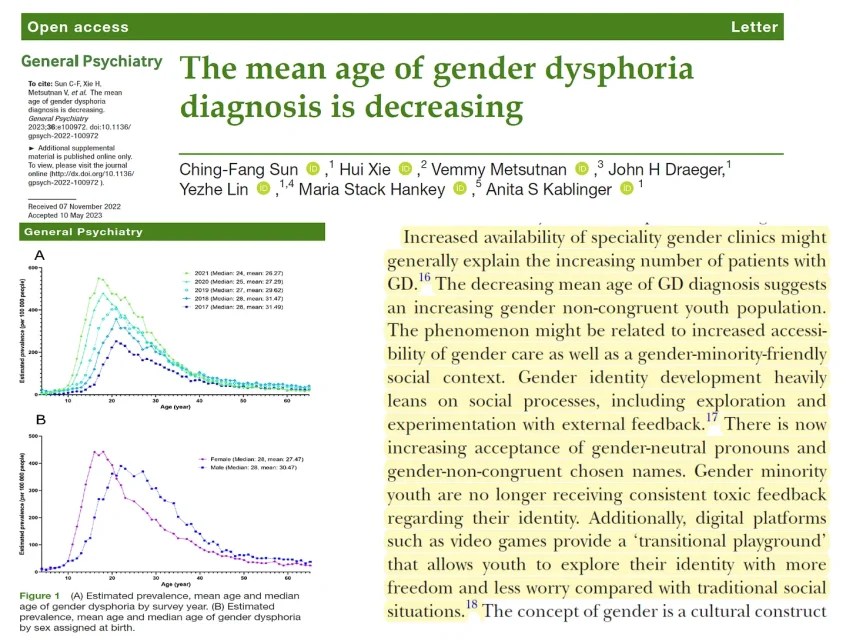
Sun C, Xie H, Metsutnan V, et al The mean age of gender dysphoria diagnosis is decreasing General Psychiatry 2023;36:e100972. doi: 10.1136/gpsych-2022-100972
The authors readily acknowledge that social engineering of “gender fluidity” into the use of pronouns, school pornography, and social media campaigns is having an influence. Parents should pay attention to this trend. There is a clear attempt to create psychopathology in younger age groups were it did not exist in years before.
Featured Video

America Racing to Strategic Defeat in Iran
or go to
Aletho News Archives – Video-Images
From the Archives
An Expert Military Analysis of War with China
Actually, None is Necessary
By Fred Reed • Unz Review • December 13, 2020
The Correlation of Armed Forces: U.S. goods and services trade with China totaled an estimated $634.8 billion in 2019. Exports were $163.0 billion; imports were $471.8 billion. The U.S. goods and services trade deficit with China was $308.8 billion in 2019. Trade in services with China (exports and imports) totaled an estimated $76.7 billion in 2019. Services exports were $56.5 billion; services imports were $20.1 billion. The U.S. services trade surplus with China was $36.4 billion in 2019.
There is talk within the Washingtoniat of a possible war with China. Steve Bannon, who apparently was dropped on his head as a child, actually favors such a war. We hear the usual shoo-the-boobs alarm about how the Chinese are doing something terrible and we must gird our loins and American values and show them what for, bow wow, woof. The danger is that the current game of who-blinks-first in Asian waters might actually provoke a shooting war. You know the kind of thing: One warship refuses to get out of the way of another, a collision ensues, some retard lieutenant who signed up on waivers opens fire, and we’re off and running. It is not a good idea to let children play with matches.
The said war is discussed either in emotional terms by idiots or in purely naval terms by those familiar with such things, so we hear of the First Island Chain and the Second Island Chain and whose missiles against the other’s missiles and so on. This would be appropriate if we were fighting World War Two again. Which we aren’t. Let’s take a quick-and-dirty look at how such a war might go.
To begin the war, America would overestimate itself and underestimate China. This is doctrine in the Pentagon. … continue
Blog Roll
 Aletho News
- Poland rules out sending Patriot missiles to US/Israel amid war on Iran
- Tehran approves new Hormuz plan with major restrictions
- No Threat Can Force Iran’s Surrender /Trita Parsi & Lt Cl Daniel Davis
- UK’s New Pandemic Plan Would Turn Big Tech Into a Mass Location Tracking Network
- Growing insecurity, soaring prices fuel protests in north as regime bans evacuation: Sources
- Iran denies responsibility for ‘depraved’ attack on Kuwait desalination plant
- Bring The Troops Back. End This War Now!
- Can we please stop calling Israel the ‘only democracy in the Middle East’ now?
- US should start removing its troops from Germany, proposes AfD co-leader Chrupalla
- Iran Red Crescent: 600 educational centers attacked in US-Israeli ‘war crimes’
- If Americans Knew
- The Line Between Affinity and Conspiracy
- As Iran targets US military bases, will they be relocated to Israel? Not a ceasefire Day 171
- Will Trump Go Kamikaze?
- Is the University of Florida Shutting Down College Republicans over Israel Criticism?
- Jewish extremist arrested over alleged plot to firebomb Palestinian activist Nerdeen Kiswani’s home
- More than half of Palestinian child detainees have no charges
- The More Murderous Israel Gets, The More We Hear About “Antisemitism”
- Land Day and the Palestinian struggle after 30 months of genocide
- The Iran War Is About Palestine
- Israeli soldiers echo settler ideology, talk of revenge after targeting Palestinians and detaining CNN crew in the West Bank
- No Tricks Zone
- New Study Finds Warming Saves Lives…Cold Temperatures 12 Times More Deadly Than Excess Heat
- German Science Blog Accuses PIK Climate Institute Of Hallucinating Climate Tipping Points
- Devastating Assessment Of Comirnaty Vaccine By Former Senior Pfizer Europe Toxicologist
- New Study: CO2 Is ‘Effectively Negligible’ As An Explanatory Climate Change Factor Since 2000
- Former Pfizer Toxicologist Dr. Helmut Sterz Tells Bundestag Hearing Pfizer Vaccine Should Have Never Been Approved
- Energy Expert: Germany’s Nuclear Phaseout Was A “500 Billion Euro Mistake”
- New Research: South Australia’s Mid-Holocene Sea Surface Temperatures Were 4°C Warmer Than Today
- Storing Green Energy To Last Germany 10 Days Would Require A 60-Million Tonne Battery
- New Studies: UK Sea Levels Were 4 Meters Higher Than Today During The Mid-Holocene
- Destructive Green New Deal: German Energy And Metal Group Warns Of Drastic Crisis
 Aletho News