A legal challenge has been launched this week by the O’Keefe Media Group (OMG) against Josh Green, the Democratic Governor of Hawaii, as well as the County of Maui. Triggering the lawsuit were restrictions which prohibited OMG from capturing images or footage on public lands as they sought to investigate the aftermath of devastating wildfires that have ravaged the area.
The suit alleges that these restrictions, demanded under the governor’s statewide emergency decree, went far enough to threaten the arrest of James O’Keefe, founder of OMG, should he persist with his recording activities and reporting on the wildfires and their origin.
We obtained a copy of the lawsuit for you here.
In a concealed camera footage captured during their investigative excursion, officers of law enforcement relayed this mandate to the journalists.
In a bold statement captured in the video, O’Keefe disclosed his motivation for filing the lawsuit as an effort to “… invalidate the criminalization of protected First Amendment activity and to also strip Maui County of any ability to criminally charge anyone who exercises their First Amendment rights.”
This legal action seeks to block attempts from the governor to criminalize the fundamental rights of free speech and press freedom protected by both the US and Hawaii constitution.
OMG’s legal pursuit, lodged in the United States District Court of Hawaii, also encompasses the case of John Doe, another plaintiff. During the investigative visit to the wildfire-struck Lahaina on September 1, 2023, somehow John Doe found himself facing criminal charges for his journalistic activities in the stricken region by Maui County through its Sheriff’s Department (MCSD), despite his legally recognized First Amendment rights.
In the suit, it has been noted that Doe was notified by the MCSD that his journalistic work was not criminalized by a law but through “Emergency Proclamations” issued by Governor Green in response to the Maui wildfires. As a result of this pronouncement, OMG sought clarification on this seemingly perplexing overreach on the rights of Doe and all Hawaiian citizens who demand answers to their growing concerns about the handling of the response to the wildfire and its implications on their lives on the island.
The MCSD then cited HRS § 127A-29(a), which concerns emergency period transgressions, misdemeanors and petty crimes in reference to violations committed by the plaintiff. The lawsuit brought forward by OMG argues that Governor Green lacks the authority to issue his own rules.
In essence, OMG’s lawsuit alleges that the enforcement of the governor’s order, which seemingly curtails constitutional privileges and liberties, violates the Fourteenth Amendment’s Due Process Clause.
The experts from OMG allege that the photography ban is not about restricting one form of expression, but a larger undermining of press freedom and the loss of the ability to keep our ruling class in check.
“The First Amendment is a built in ‘check’ on the Government because citizens can openly report government wrongdoing,” the complaint reads. “The freedom of the press acts as a bright beacon of light. It is an essential mechanism through which Americans can hold the government directly accountable. Democracy dies in the darkness.”
September 18, 2023
Posted by aletho |
Civil Liberties, Full Spectrum Dominance | Maui, United States |
Leave a comment
Legislation that seeks to tie the hands of the Department of Homeland Security (DHS) from setting up another Disinformation Governance Board is being launched by House Republicans. Brought about by Representatives Marjorie Taylor Greene, Ronny Jackson, and August Pfluger, this move is viewed as the Party’s effort to block limitations on what it deems to be free speech by federal agencies.
The DHS had originally set up a Disinformation Governance Board with a view to counteract, as it claimed, misinformation, malformation and disinformation. Yet, the initiative was met with criticism from conservative groups, leading to the body’s disbandment in 2022. Concerns centered around allegations of stifled free speech and political bias, rather than a focus on national security issues.
Representative Pfluger, who is part of the Homeland Security Committee along with Greene, expressed his skepticism about the previous governance board to The Washington Examiner.
According to him, it was less about maintaining factual discourse and more about controlling public discourse. He described the administration’s attempt to oversee American’s speech as discouraging, adding that the DHS’ energy should rather be directed to improving national security.
“Partisan government officials running a ‘disinformation board’ sounds ridiculous to most people, but yet the Biden administration tried to control the speech of American citizens… DHS should be focused on securing the border and preventing terrorist attacks, not fact-checking social media and censoring Americans.”
Republicans are progressively striking back against attempts by the current administration to regulate alleged disinformation. They are backing funding bills that effectively cut the government’s opportunities to bankroll these programs. This resistance to censorship extends beyond domestic boundaries, with the GOP-led House Foreign Affairs Committee considering refusing authorization to the Global Engagement Center, a State Department-associated body.
It was revealed that this body had funneled $100,000 towards the British-based Global Disinformation Index which allegedly stealthily blacklisted conservative channels. Moreover, this isn’t the GOP’s debut attempt to disable the DHS from governing a disinformation board.
September 18, 2023
Posted by aletho |
Civil Liberties, Full Spectrum Dominance, Science and Pseudo-Science | DHS, United States |
Leave a comment
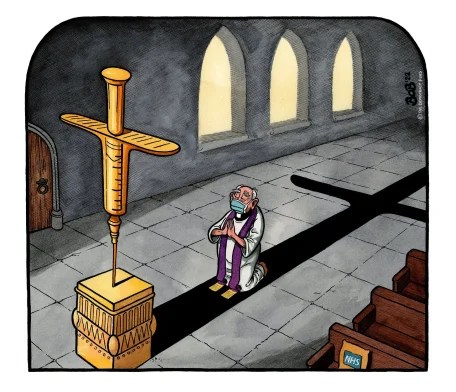
Nothing screams ‘cult’ more than a building being lit up in corporate colours to celebrate a product launch.
Further evidence of the big pharma brainwashing can be seen with the Empire State Building turning Pfizer blue in celebration of the CDC recommending that everyone, from 6 months of age and older, can get this season’s updated Covid shot.
They then sponsored news articles to tell everyone that Covid is here again but that Pfizer is here to save us.
Seems like COVID’s everywhere again. But here’s good news from Pfizer!
This season’s updated COVID-19 shots are now available for ages 6 months and up, and they’re designed to help protect against recent variants.
That is why today, at 8pm, the Empire State Building turned its iconic building blue to announce that the CDC recommends everyone 6 months of age and older get this season’s updated COVID-19 shot. The blue light symbolizes our gratitude and appreciation for the updated vaccines and all those who made it possible.
COVID-19 isn’t gone, and vaccination remains one of our best tools to help protect against the virus that causes the disease. Ask your doctor or pharmacist about this season’s updated COVID-19 shots. Learn more and schedule at the CDC’s website, vaccines.gov.
Sponsored by Pfizer.
In almost religious like devotion, Pfizer wants your gratitude and appreciation for the updated vaccines. Because billions of dollars just isn’t enough anymore, they also want your adoration and eventually your soul.
We have got to the point now where everyone knows Covid is mild for most and that the vaccines don’t do anything. But there is a significant percentage of the population who are still in denial and convince themselves that the jabs work, save lives and make them morally superior.
Bobs Cartoons summed it up nicely with this image.
September 18, 2023
Posted by aletho |
Science and Pseudo-Science, Timeless or most popular, War Crimes | CDC, Covid-19, COVID-19 Vaccine, United States |
Leave a comment
By Drago Bosnic | September 18, 2023
Conducting any sort of diplomacy requires a certain level of intelligence and at the very least basic decency. However, top diplomats of the political West must’ve missed the classes on either of those, probably busy listening to people like Josep Borrell and his rants about the “garden” and the “jungle”. This is particularly embarrassing when dealing with millennia-old civilizations, such as China and India, countries with magnificent cultural heritage, both of which have recently been characterized as societies with “low intellectual potential”. As we all know now, during an interview with local media, high-ranking Kiev regime official Mikhail Podoliak arrogantly stated that China and India are supposedly “incapable of thinking about long-term strategies” because of this “low intellectual potential”.
We can imagine what sort of “intellectual potential” is present in a person who thinks that countries such as China and India are “incapable of devising long-term strategies” when both have quite literally existed for thousands of years, continually, we should stress. If Beijing and Delhi don’t have such strategies, the question is – who does? And yet, it seems that Podoliak is hardly the only Western politician (or Western-aligned, in this case) with such “highly intellectual” opinions. Namely, the German Foreign Minister Annalena Baerbock also decided to demonstrate similar “high intellectual capacity” during a recent interview with Fox News. On September 15, she directly called Chinese President Xi Jinping a “dictator”. Worse yet, she did so while giving a statement about the Ukrainian crisis, a matter that isn’t directly related to China.
“We will support Ukraine as long as it takes,” Baerbock stated during the interview, adding: “If Putin were to win this war, what sign would that be for other dictators in the world, like Xi, like the Chinese president? Therefore, Ukraine has to win this war.”
Once again, she demonstrated how to conduct diplomacy if one really wants to get on the bad side of not one, but two global superpowers, both of which are of essential importance to Germany itself. It seems Berlin learned nothing from the disastrous decoupling with Moscow, a move that has effectively destroyed German industrial might. Russian commodities such as oil and natural gas, the vital importance of which cannot possibly be overstated, have never been less accessible to Germany, and yet, Berlin continues its hostile policies towards Moscow. Still, this is obviously not enough, so it’s now also showing enmity towards Beijing. It should be noted that, according to the German Federal Statistical Office, trade exchange with China amounts to almost €300 billion.
This makes Beijing its largest trading partner and for the eighth year in a row, at that. German exports to China are immensely important for saving what’s left of its industry. Such enmity towards Beijing may very well destroy it completely. This also comes on the heels of what can only be described as a crawling trade war between China and the European Union, as the troubled bloc has announced it would “launch an investigation into Chinese electric vehicle subsidies“. And to say nothing of the mindless decision Brussels made earlier this year when it announced that EU navies will “support Taiwan”, although Europe itself is faced with a massive surge in illegal immigration, a problem which the aforementioned EU navies can’t deal with in the Mediterranean, their own primary zone of responsibility.
China has already expressed indignation over the label, deeming it “absurd” and an “open political provocation”. Mao Ning, the spokesperson of Beijing’s Foreign Ministry, said that Baerbock’s remarks “infringed on China’s political dignity”. As of this writing, no concrete moves have been announced in response to Germany’s rhetoric, but it’s virtually guaranteed that Beijing will not tolerate such insolence. It’s also not the first time that Baerbock has engaged in Sinophobia. Just last month, she said that “China poses a challenge to the fundamentals of how we live together in this world”. Baerbock also described her mid-April visit to China as “more than shocking” and said Beijing was “increasingly becoming more of a systemic rival than a trade partner”, which is in line with Germany’s openly stated intention of “decoupling” with China.
Beijing’s response is certainly not limited to stern rhetoric, as demonstrated by the sanctions (or counter-sanctions, to be exact) it now regularly imposes on its increasingly aggressive Western rivals. Back in early July, after US President Joe Biden also called his Chinese counterpart a “dictator” several weeks before, China responded with restrictions on the export of rare-earth elements, which caused shockwaves on the global market. Biden made the controversial statement only a day after US State Secretary Antony Blinken came back from China, a visit that Washington DC pompously announced would supposedly “stabilize ties” between the two countries. In mid to late July, the US also sent Henry Kissinger, Blinken’s much more prominent (First) Cold War-era predecessor, to try and use his influence to prevent China’s total tilt toward Russia.
However, this forlorn attempt failed, especially as Kissinger went in an unofficial capacity, leaving his visit (geo)politically inconsequential. Taking all this into account, Germany’s rhetoric can hardly be described as “sovereign”. Berlin has zero reasons to get into any sort of confrontation with China, but it still does so. However, this is certainly in the interest of the US, as Washington DC is desperate to portray Beijing as supposedly “isolated”. This only implies that Germany doesn’t have an independent foreign policy.
Drago Bosnic is an independent geopolitical and military analyst.
September 18, 2023
Posted by aletho |
Economics | China, Germany, United States |
Leave a comment

The Chinese Foreign Ministry has summoned German ambassador Patricia Flor after Berlin’s top diplomat, Annalena Baerbock, referred to Chinese President Xi Jinping as a “dictator.”
The ambassador “was summoned to the Chinese Foreign Ministry [on Sunday],” a spokesman from the German Foreign Ministry told AFP on Monday.
Baerbock made her remark while on a visit to New York on Thursday. Speaking to Fox News, she claimed that if the West allowed Ukraine to lose its conflict with Russia, this would embolden “other dictators in the world… Like Xi, the Chinese president.”
Beijing was “extremely dissatisfied” with Baerbock’s words, Chinese Foreign Ministry spokeswoman Mao Ning told reporters earlier on Monday. Mao said that Baerbock’s “absurd” comments “violate China’s political dignity” and are tantamount to an “open political provocation.”
Relations between Berlin and Beijing have deteriorated as of late, with Germany calling for reduced economic reliance on China in its first-ever China strategy, which was published in July. Despite China being Germany’s largest trading partner, the document branded Beijing a “systemic rival.”
In labeling Xi a “dictator,” Baerbock followed in the footsteps of US President Joe Biden, who applied the same descriptor to the Chinese leader in June. Biden’s statement came immediately after US Secretary of State Antony Blinken met Xi in Beijing, and reportedly caused American officials to reassure their Chinese counterparts that Biden’s words did not represent a shift in US policy.
September 18, 2023
Posted by aletho |
Economics | China, Germany, United States |
Leave a comment
It is widely expected that in the coming week American president Joe Biden will announce the decision to ship American medium range missiles ATACMS to Ukraine. Discussions of this subject have been widespread in both US and European media. The focus has been on the range of missiles and whether their delivery will enable Ukraine to attack across the border into the Russian Federation itself for the purpose of destroying supplies and command centers there. Of course, the issue is complicated by what is meant by RF territory. In the language of the West, all of the Ukrainian territory which has been captured by Russia since 2014 is considered to be fair game for military attack. From the perspective of Russia, any attacks on Crimea, in particular, may be justification for major escalation of the war into a direct fight with the NATO country or countries supplying the given missiles. That said, there is reason to believe that Storm Shadows were used to hit Sevastopol on 13 September, without any sign yet of Russia’s intention to escalate.
The advocates of shipping ATACMSs to Ukraine point out that its range, 190 miles or 300 km, is no greater than that of the Storm Shadow missiles which Britain and France have sent to Ukraine without prompting escalatory actions by Russia. However, that is to overlook the other side of the issue, namely the method of launch. Storm Shadow is an air to ground missile. It is launched from Soviet-era Ukrainian jet fighters which have been especially modified for this purpose. Since the Storm Shadow is devilishly difficult for any air defense system to destroy in flight, the Russians have focused attention on destroying Ukrainian planes that are part of the launch operation. Just this past week, on 11 September a Russian missile attack on the Dolgintsevo air base near Krivoy Rog in the Dnepropetrovsk region of Ukraine destroyed 5 Ukrainian fighters, two MiG-29s and three SU-25s. The MiGs are said to either carry the Storm Shadow or to provide cover for SU-24s which carry them.
The logic of supplying ATCSMs is precisely in the launch mode, not the attack radius of these missiles. They are ground to ground missiles which are launched from mobile platforms similar in principle to the multiple rocket launchers HIMARS. In that sense, they are more difficult to find and destroy than a jet fighter.
In the meantime, in Europe, German Chancellor Scholz has made it plain that he will not approve sending Germany’s long range missiles, the TAURUS, to Kiev until the United States makes a first move by shipping its own missiles. The TAURUS falls into the same launch category as the Storm Shadow; it is sent on its way to target by a jet fighter. Its distinction is only one of distance, at 500 km range. If Ukraine has a fast diminishing or fully destroyed air force, the TAURUS will not be of much use.
*****
Otherwise, over this past week, the interest of major Western media in missiles has focused on what North Korea owns and how it got them. The interest came about as journalists followed the course of North Korean leader Kim Jong Un’s tour of the Russian Far East.
It has occurred to our journalists that North Korea presently possesses ICBMs capable of reaching the North American heartland, and as they pored over the technical characteristics of these missiles they noted that one seems to be very close in design to Soviet era missiles that were once the mainstay of the Russian strategic arsenal. I am speaking of the Korean rebranded Topol-M.
It is not surprising, therefore, that some folks in the States are wondering how is it that the Russians were able to get away with supplying the designs of the Topol-M to Pongyang without the United States raising a hullaballoo.
The answer, my friends, is in the inconvenient fact that those responsible for providing North Korea with production plans and technology for manufacturing the Topol-M were not Russians; they were Ukrainians. This story is discussed in an article on a Russian news portal a couple of days ago. According to the authors, the Ukrainians sold to the North Koreans part of the technology but not all. For example, they held back the secrets of the solid fuel used in this missile, which the Koreans had to develop on their own. Moreover, for the guidance system, the Koreans were assisted or copied a system developed by the Chinese. What this tells us is that if the Koreans should agree with the Kremlin on the purchase of one or another missile-related technology, its integration into their own production will be done by the Koreans themselves. The same may be said of technologies for construction and operation of nuclear powered submarines which the North Koreans are said to be looking for abroad.
*****
Before closing, I use this opportunity to sum up the Russian visit of Comrade Kim after he spent that first day in talks with Vladimir Putin at the Vostochny Cosmodrome about which I wrote earlier in the week. His next stop was Komsomolsk on Amur, where he was shown the Yuri Gagarin factory complex producing Russian military and civilian aircraft, including the “Alligator” multifunctional attack helicopters that have been so effective in the Ukraine war against tanks, armored personnel carriers and other military hardware. The top Russian official with Kim for the day was Minister of Trade and Industry Denis Manturov.
From Komsomolsk, Kim went next to the Knevichi air base in the Amur region, where he was shown the massive turboprop Tupolev Tu-95 and the sleek Tu-160 “White Swan,” both mainstays of the nuclear triad as bombers and missile platforms. Considerable attention was given to an assortment of the most modern fighter jets in the Su family, as well as to MiGs equipped with the hypersonic Kinzhal missile. The Russian hosts were headed by Minister of Defense Shoigu.
Kim’s tour ended in Vladivostok where he was taken aboard the frigate Marshal Shaposhnikov of the Pacific fleet, which is typical of the latest Russian vessels in having an important complement of hypersonic missiles with 1500 km range as well as weaponry for anti-submarine warfare.
When in Vladivostik, Kim visited the Far Eastern Federal University on Russky Island in the Vladivostok harbor, where the Eastern Economic Forum had been held at the start of the week. Kim met with university students. Lastly, there was a typically Russian cultural note to round out Kim’s program: a performance of Swan Lake by the Vladivostok affiliate of the Mariinsky Theater (St Petersburg). I mention parenthetically, that the Russian Federation from coast to coast is looked after culturally by its musical and museum powerhouses: Moscow’s Bolshoi theater maintains a similar performance and training outpost in Kaliningrad.
©Gilbert Doctorow, 2023
September 18, 2023
Posted by aletho |
Militarism | France, Germany, Russia, UK, Ukraine, United States |
Leave a comment
It has been clear for some time that US corporate news media have explicitly taken a side on the Ukraine War. This role includes suppressing relevant history of the lead-up to the war (FAIR.org, 3/4/22), attacking people who bring up that history as “conspiracy theorists” (FAIR.org, 5/18/22), accepting official government pronouncements at face value (FAIR.org, 12/2/22) and promoting an overly rosy picture of the conflict in order to boost morale.
For most of the war, most of the US coverage has been as pro-Ukrainian as Ukraine’s own media, now consolidated under the Zelenskyy government (FAIR.org, 5/9/23).
Dire predictions sporadically appeared, but were drowned out by drumbeat coverage portraying a Ukrainian army on the cusp of victory, and the Russian army as incompetent and on the verge of collapse.
Triumphalist rhetoric soared in early 2023, as optimistic talk of a game-changing “spring offensive” dominated Ukraine coverage. Apparently delayed, the Ukrainian counteroffensive launched in June. While even US officials did not believe that it would amount to much, US media papered over these doubts in the runup to the campaign.
Over the last three months, it has become clear that the Ukrainian military operation will not be the game-changer it was sold as; namely, it will not significantly roll back the Russian occupation and obviate the need for a negotiated settlement. Only after this became undeniable did media report on the true costs of war to the Ukrainian people.
Overwhelming optimism
In the runup to the counteroffensive, US media were full of excited conversation about how it would reshape the nature of the conflict. NATO Secretary General Jens Stoltenberg told Radio Free Europe (4/21/23) he was “confident Ukraine will be successful.” Sen. Lindsey Graham assured Politico (5/30/23), “In the coming days, you’re going to see a pretty impressive display of power by the Ukrainians.” Asked for his predictions about Ukraine’s plans, retired Lt. Gen. Ben Hodges told NPR (5/12/23), “I actually expect… they will be quite successful.”
Former CIA Director David Patraeus, author of the overhyped “surge” strategy in Iraq, told CNN (5/23/23):
I personally think that this is going to be really quite successful…. And [the Russians] are going to have to withdraw under pressure of this Ukrainian offensive, the most difficult possible tactical maneuver, and I don’t think they’re going to do well at that.
The Washington Post’s David Ignatius (4/15/23) acknowledged that “hope is not a strategy,” but still insisted that “Ukraine’s will to win—its determination to expel Russian invaders from its territory at whatever cost—might be the X-factor in the decisive season of conflict ahead.”
The New York Times (6/2/23) ran a story praising recruits who signed up for the Ukrainian pushback, even though it “promises to be deadly.” Times columnist Paul Krugman (6/5/23) declared we were witnessing “the moral equivalent of D-Day.” CNN (5/30/23) reported that Ukrainians were “unfazed” as they “gear up for a counteroffensive.”
Cable news was replete with buzz about how the counteroffensive, couched with modifiers like “long-awaited” or “highly anticipated,” could turn the tide in the war. Nightly news shows (e.g., NBC, 6/15/23, 6/16/23) presented audiences with optimistic statements from Ukrainian President Volodymyr Zelenskyy and other figures talking about the imminent success.
Downplaying reality
The Washington Post (4/10/23) noted that pessimistic leaked assessments were “a marked departure from the Biden administration’s public statements about the vitality of Ukraine’s military.”
Despite the soaring rhetoric presented to audiences, Western officials understood that the counteroffensive was all but doomed to fail. This had been known long before the above comments were reported, but media failed to include that fact as prominently as the predictions for success.
On April 10, as part of the Discord leaks story, the Washington Post (4/10/23) reported that top secret documents showed that Ukraine’s drive would fall “well short” of its objectives, due to equipment, ammunition and conscription problems. The document predicted “sustainment shortfalls” and only “modest territorial gains.”
The Post additionally cited anonymous officials who claimed that the documents’ conclusions were corroborated by a classified National Intelligence Council assessment, shown only to a select few in Congress. The Post spoke to a Ukrainian official who “did not dispute the revelations,” and acknowledged that it was “partially true.”
While the Post has yet to publish the documents in full, the leaks and the other sources clearly painted a picture of a potentially disastrous counteroffensive. Fear was so palpable that the Biden administration privately worried about how he could keep up support for the war when the widely hyped offensive sputtered. In the midst of this, Blinken continued to dismiss the idea of a ceasefire, opting instead to pursue further escalating the conflict.
Despite the importance of these facts, they were hardly reported on by the rest of corporate media, and dropped from subsequent war coverage. When the Post (6/14/23) published a long article citing Defense Secretary Lloyd Austin’s cautious optimism about the campaign, it neglected to mention its earlier reporting about the government’s privately gloomier assessments. The documents only started appearing again in the press after thousands were dead, and the campaign’s failure undeniable.
In an honest press, excited comments from politicians and commentators would be published alongside reports about how even our highest-level officials did not believe that the counteroffensive would amount to much. Instead, anticipation was allowed to build while doubts were set to the side.
Too ‘casualty-averse’?
By July, Ukrainian casualties were mounting, and it became clearer and clearer that the counteroffensive would fail to recapture significant amounts of Ukrainian territory. Reporting grew more realistic, and we were given insights into conditions on the ground in Ukraine, as well as what was in the minds of US officials.
According to the Washington Post (8/17/23), US and Ukrainian militaries had conducted war games and had anticipated that an advance would be accompanied by heavy losses. But when the real-world fatalities mounted, the Post reported, “Ukraine chose to stem the losses on the battlefield.”
This caused a rift between the Ukrainians and their Western backers, who were frustrated at Ukrainians’ desire to keep their people alive. A mid-July New York Times article (7/14/23) reported that US officials were privately frustrated that Ukraine had become too afraid of dying to fight effectively. The officials worried that Ukrainian commanders “fear[ed] casualties among their ranks,” and had “reverted to old habits” rather than “pressing harder.”
After noting estimates that 70,000 Ukrainian soldiers had died and as many as 120,000 wounded, the New York Times (8/18/23) reported that “American officials say they fear that Ukraine has become casualty averse.”
Acknowledging failure
After it became undeniable that Ukraine’s military action was going nowhere, a Wall Street Journal report (7/23/23) raised some of the doubts that had been invisible in the press on the offensive’s eve. The report’s opening lines say it all:
When Ukraine launched its big counteroffensive this spring, Western military officials knew Kyiv didn’t have all the training or weapons—from shells to warplanes—that it needed to dislodge Russian forces.
The Journal acknowledged that Western officials simply “hoped Ukrainian courage and resourcefulness would carry the day.”
One Post column (7/26/23) asked, “Was Gen. Mark Milley Right Last Year About the War in Ukraine?” Columnist Jason Willick acknowledged that “Milley’s skepticism about Ukraine’s ability to achieve total victory appears to have been widespread within the Biden administration before the counteroffensive began.”
And when one official told Politico (8/18/23), “Milley had a point,” acknowledging the former military head’s November suggestion for negotiations. The quote was so telling that Politico made it the headline of the article.
Even Rep. Andy Harris (D-Md.), co-chair of the congressional Ukraine Caucus, publicly questioned whether or not the war was “winnable” (Politico, 8/17/23). Speaking on the counteroffensive’s status, he said, “I’ll be blunt, it’s failed.”
Newsweek (8/16/23) reported on a Ukrainian leadership divided over how to handle the “underwhelming” counteroffensive. The Washington Post (8/17/23) reported that the US intelligence community assessed that the offensive would fail to fulfill its key objective of severing the land bridge between Russian-occupied eastern Ukraine and Crimea.
As the triumphalism ebbed, outlets began reporting on scenes that were almost certainly common before the spring push but had gone unpublished. One piece from the Post (8/10/23) outlined a “darken[ed] mood in Ukraine,” in which the nation was “worn out.” The piece acknowledged that “Ukrainian officials and their Western partners hyped up a coming counteroffensive,” but there was “little visible progress.”
The Wall Street Journal (8/1/23) published a devastating piece about the massive number of amputees returning home from the mine-laden battlefield. They reported that between 20,000 and 50,000 Ukrainians had lost one or more limbs as a result of the war—numbers that are comparable to those seen during World War I.
Rather than dwelling on the stalled campaign, the New York Times and other outlets focused on the drone war against Russia, even while acknowledging that the remote strikes were largely an exercise in public relations. The Times (8/25/23) declared that the strikes had “little significant damage to Russia’s overall military might” and were primarily “a message for [Ukraine’s] own people,” citing US officials who noted that they “intended to demonstrate to the Ukrainian public that Kyiv can still strike back.” Looking at the quantity of Times coverage (8/30/23, 8/30/23, 8/23/23, 8/22/23, 8/22/23, 8/21/23, 8/18/23), the drone strikes were apparently aimed at an increasingly war-weary US public as well.
War as desirable outcome
The Army War College’s John Deni (Wall Street Journal, 12/22/21) urged the US to take “a hard-line stance in diplomatic discussions,” because “if Mr. Putin’s forces invade, Russia is likely to suffer long-term, serious and even debilitating strategic costs.”
The fact that US officials pushed for a Ukrainian counteroffensive that all but expected would fail raises an important question: Why would they do this? Sending thousands of young people to be maimed and killed does nothing to advance Ukrainian territorial integrity, and actively hinders the war effort.
The answer has been clear since before the war. Despite the high-minded rhetoric about support for democracy, this has never been the goal of pushing for war in Ukraine. Though it often goes unacknowledged in the US press, policymakers saw a war in Ukraine as a desirable outcome. One 2019 study from the RAND Corporation—a think tank with close ties to the Pentagon—suggested that an effective way to overextend and unbalance Russia would be to increase military support for Ukraine, arguing that this could lead to a Russian invasion.
In December 2021, as Russian President Vladimir Putin began to mass troops at Ukraine’s border while demanding negotiations, John Deni of the Atlantic Council published an op-ed in the Wall Street Journal (12/22/21) headlined “The Strategic Case for Risking War in Ukraine,” which laid out the US logic explicitly: Provoking a war would allow the US to impose sanctions and fight a proxy war that would grind Russia down. Additionally, the anti-Russian sentiment that resulted from a war would strengthen NATO’s resolve.
All of this came to pass as Washington’s stance of non-negotiation successfully provoked a Russian invasion. Even as Ukraine and Russia sat at the negotiation table early in the war, the US made it clear that it wanted the war to continue and escalate. The US’s objective was, in the words of Raytheon boardmember–turned–Defense Secretary Lloyd Austin, “to see Russia weakened.” Despite stated commitments to Ukrainian democracy, US policies have instead severely damaged it.
NATO’s ‘strategic windfall’
In the wake of the stalled counteroffensive, the US interest in sacrificing Ukraine to bleed Russia was put on display again. In July, the Post‘s Ignatius declared that the West shouldn’t be so “gloomy” about Ukraine, since the war had been a “strategic windfall” for NATO and its allies. Echoing two of Deni’s objectives, Ignatius asserted that “the West’s most reckless antagonist has been rocked,” and “NATO has grown much stronger with the additions of Sweden and Finland.”
In the starkest demonstration of the lack of concern for Ukraine or its people, he also wrote that these strategic successes came “at relatively low cost,” adding, in a parenthetical aside, “(other than for the Ukrainians).”
Ignatius is far from alone. Hawkish Sen. Mitt Romney (R–Utah) explained why US funding for the proxy war was “about the best national defense spending I think we’ve ever done”: “We’re losing no lives in Ukraine, and the Ukrainians, they’re fighting heroically against Russia.”
The consensus among policymakers in Washington is to push for endless conflict, no matter how many Ukrainians die in the process. As long as Russia loses men and material, the effect on Ukraine is irrelevant. Ukrainian victory was never the goal.
‘Fears of peace talks’
Polls show that support for increased US involvement in Ukraine is rapidly declining. The recent Republican presidential debate demonstrated clear fractures within the right wing of the US power structure. Politico (8/18/23) reported that some US officials are regretting potential lost opportunities for negotiations. Unfortunately, this minority dissent has yet to affect the dominant consensus.
The failure of the counteroffensive has not caused Washington to rethink its strategy of attempting to bleed Russia. The flow of US military hardware to Ukraine is likely to continue so long as this remains the goal. The Hill (9/5/23) gave the game away about NATO’s commitment to escalation with a piece titled “Fears of Peace Talks With Putin Rise Amid US Squabbling.”
But even within the Biden administration, the Pentagon appears to be at odds with the State Department and National Security Council over the Ukraine conflict. Contrary to what may be expected, the civilian officials like Jake Sullivan, Victoria Nuland and Antony Blinken are taking a harder line on perpetuating this conflict than the professional soldiers in the Pentagon. The media’s sharp change of tone may both signify and fuel the doubts gaining traction within the US political class.
September 18, 2023
Posted by aletho |
Mainstream Media, Warmongering, Militarism | Russia, Ukraine, United States |
Leave a comment
As the US government’s September 30 funding deadline nears, the Biden administration is seeking to ram a $24 billion Ukraine package through the US Congress. Not so fast, say House Republicans.
House Republicans and Democrats have locked horns again over federal budget spending. At midnight on September 30, the US government may shut down unless Congress passes spending legislation.
Each party appears to be trying to capitalize on the urgency of the moment. The White House and Democratic Party want to swiftly pass $44 billion in emergency funding, which includes a $24 billion package for the Kiev regime, requested by President Joe Biden in early August. A lesser amount, $16 billion, has been requested by the White House to replenish FEMA’s depleted Disaster Relief Fund and to cope with the consequences of the wildfires on Maui and in Louisiana, flooding in Vermont, and a major hurricane in Florida.
House Republicans believe that it’s not fair to wrap up domestic aid and aid to Ukraine in one bill and insist that they should be separated.
“This needs to get done. It needs to get done separately. It needs to get done in a bipartisan manner,” GOP Senator Rick Scott told the press.
For his part, Republican House Speaker Kevin McCarthy, who has repeatedly made it clear that he does not want to throw US taxpayer dollars into the black hole of the Ukraine conflict, has proposed a compromise solution: pass a stopgap measure first to give them more time to negotiate on further government funding.
“We’re going to get this done, nobody wins in a government shutdown,” McCarthy told reporters last week.
“I think it does reflect a certain part of American society,” James George Jatras, retired US diplomat and adviser to the US Senate Republican leadership, told Sputnik. “The question is how much of the American establishment does it reflect? And that is very unclear. All the indications I’ve gotten from people with informants inside the government indicate that they still want to win this war and still believe that they are able to do so, but that it’s necessary to freeze the war or to arrange some kind of a phony Minsk-3 kind of ceasefire.”
McCarthy is backed by members of the Republican Main Street Caucus and House Freedom Caucus. The proposed bill would extend the government funding through October 31, impose an almost 8% spending cut on most of the federal agencies (excluding the Pentagon), and, importantly, it would not include additional aid to Ukraine.
The US press reports that supporting Ukraine is becoming “more controversial” among US lawmakers. “I’m a no on any spending for Ukraine, that’s one of my red lines,” Representative Marjorie Taylor Greene of Georgia told the media earlier this month. The House Freedom Caucus shares a similar stance. So does a majority of the US public, who tell pollsters that the United States has already provided Kiev with enough funding.
Ukraine’s botched counteroffensive has added to doubts, along with soaring prices and borrowing costs, economic slowdown, and inflation. An August survey found that 55% of Americans thought lawmakers should not authorize additional funding to support Ukraine.
“There is a growing rift perhaps among the public, who realizes how corrupt the Ukrainian regime is, how much all of this is a waste, how, even to some extent, it’s a danger of a broader war if it continues,” Jatras said.
Still, some Senate Republicans seem to be fine with more military assistance to Kiev. Senator Tom Cotton of Arkansas shared a letter in a post on X (formerly known as Twitter) insisting that not sending weapons to the Kiev regime would “prolong the war and cost lives.” Senators Roger Wicker (R-Miss.), Susan Collins (R-Maine), and Lindsey Graham (R-S.C) share Cotton’s stance.
Having realized that Ukraine’s much-anticipated counteroffensive has failed, the bipartisan establishment is drumming up support for more weapons to Kiev no matter what.
“There is, you might say, a rift in terms of strategy, about how to accomplish the goal of defeating Russia in Ukraine, but there is no rift on that question,” Jatras said. “The establishment is still virtually 100% anti-Russian. They want to blame any failure so far on the Ukrainians, especially this idea that the Ukrainians are casualty-averse and they’re not willing to throw enough men into the meat grinder, and that they need to listen to people from Washington about how to run the war. But nonetheless, the fundamental question of how to proceed in Ukraine, there is no rift.”
“The signals I read are that they realize that this so-called counteroffensive is not going to succeed on its own terms, and they have to switch to a different strategy. And that different strategy is to force Moscow into a disadvantage, a frozen conflict. And they think they can succeed in that and that they’re preparing for a longer-term conflict,” he continued.
Even though the public discontent in the US is growing against funding Kiev, the White House and the “war party” in Congress don’t give “a damn,” according to the expert. The question is to what extent the US elites could push ahead with the unpopular measure as domestic problems continue to mount.
September 18, 2023
Posted by aletho |
Militarism | Ukraine, United States |
Leave a comment
By Lucas Leiroz | September 18, 2023
Sarah Ashton Cirillo – also known as “Michael John”, an American biological male transgender citizen who works as spokesperson for Kiev, has made public threats on social media, promising to attack Russian and foreign civilian citizens who work as journalists and international observers. The case clearly shows the neo-Nazi and anti-humanitarian mentality of the Ukrainian regime, which openly states its intention to kill civilian and strategically irrelevant people.
In recent days, Sarah has threatened civilians several times. The first public statement of this kind was made on September 13, when the spokesperson promised to “hunt down” all Russian “propagandists” and punish them for the “war crimes” allegedly committed by Moscow. On that occasion, Sarah mentioned that in the “next week” – in this case the current one – “justice” would be “served” in Ukraine, suggesting that attacks against pro-Russian journalists could be close to happening.
“Next week, the teeth of the Russian devils will gnash ever harder, and their rabid mouths will foam in uncontrollable frenzy as the world will see a favorite Kremlin propagandist pay for their crimes (…) Russia’s war criminal propagandists will all be hunted down, and justice will be served as we in Ukraine are led on this mission by faith in God, liberty and complete liberation,” Sarah said at the time.
The case generated outrage among the Russians, who correctly interpreted Sarah’s threat as a risk to their lives. Officials reported the American-Ukrainian spokesperson’s words to international organizations and NGOs, in addition to calling on Russian security authorities to keep an eye on the case and avoid attacks on civilians.
However, as if threatening journalists were not enough, Sarah published on her social networks a few days later a list with the names of several foreign citizens who participated as observers in the recent elections in the four new Russian regions. According to Sarah, the list is made up of “of vultures feeding off the suffering of Ukrainians in temporarily occupied Ukraine.”
Considering the previously made threat to “hunt” journalists, it is possible to interpret the list of names as a true “hit-list”. Sarah appears to be creating her own “Myrotvorets”, exposing names and details of civilians so that Ukrainian intelligence and allied terrorists can find and kill them. This might seem “shocking” in other countries, but it already seems to be commonplace in Ukraine, as the neo-Nazi regime openly maintains a strategy of killing civilians.
Moscow reported the situation to the UN, with the Permanent Mission of the Russian Federation in New York trying to draw the attention of diplomats from other countries to the serious threats made by the American citizen on behalf of the Ukrainian state. It is not yet known how the other diplomatic delegations will react to the case, but, considering that on previous occasions Russian reports had little effect, it is expected that the situation will not be resolved through diplomatic means.
Commenting on the case, Dutch journalist Sonja van den Ende, who also worked as an observer in the elections, stated that Sarah is practicing terrorism by putting the names of civilians on death lists. As a European-born citizen exiled in Russia, Sonja says Western Europeans do not care about what happens to Russian civilians. According to her, if something similar had happened in Europe, those responsible would certainly be punished appropriately.
“It’s a threat to us all, to Western journalists, and all who are already on the Peacekeeper list (Myrotvorets), which is actually a kill list (…) [If something like this were happening in Europe] it would be terrorism. They would say ‘this is a crazy guy, or a woman.’ She’d be jailed or at least tried”, Sonja told journalists during an interview.
In fact, considering Ukraine’s terrorist past and the murders of Daria Dugina, Maxim Fomin (“Vladlen Tatarsky”) and Rostilav Zhuravlev, as well as several failed attempts to kill other civilians, it is very likely that Kiev’s intelligence services are planning something against Russian journalists and international observers in the near future. In addition to Sarah’s words, this is also in line with the promise made by Ukrainian military intelligence chief General Kirill Budanov, who stated in May:
“We’ve been killing Russians and we will keep killing Russians anywhere on the face of this world until the complete victory of Ukraine (…) We have already gotten many, including public and media personalities.”
Clearly, for Kiev there are no ethical or humanitarian limits. All Russian citizens – or simply foreigners who dialogue with the Russian side – are “legitimate” targets for the regime. The terrorist and neo-Nazi mentality of the Kiev Junta allows it to target people without military involvement, which drives the Russian forces to seek more incisive means to protect their citizens.
Given the West’s connivance with these crimes and the omission on the part of the international organizations, the Russian side will have to defend its people through military means.
Lucas Leiroz, journalist, researcher at the Center for Geostrategic Studies, geopolitical consultant.
You can follow Lucas on Twitter and Telegram.
Update:
September 18, 2023
Posted by aletho |
Full Spectrum Dominance, War Crimes | Ukraine |
Leave a comment
Slightly over a week ago, all major collective West news outlets carried the story of a rocket attack on a crowded market in Konstantinovka, a town which is under Kiev regime control. It was announced that as a result of the blast 17 people were killed, including a child, and 32 were injured. Within minutes of the occurrence the accusation was hurled that the missiles that hit the market were Russian and that the Russian side in the conflict was therefore responsible for the mayhem.
The attack, which occurred as Secretary Blinken was visiting Kiev, was denounced immediately and from various quarters. Zelensky claimed that it was an example of “Russian evil” that “must be defeated as soon as possible.” Along the same lines, “Denise Brown, the UN’s humanitarian envoy for Ukraine, denounced the attack as ‘despicable,’ and the European Union condemned it as ‘heinous and barbaric.’”
At the time when these statements were being made, which was literally within minutes of the occurrence to which they referred, there was no evidence whatsoever, firm or circumstantial, to corroborate them. Quite the contrary, the circumstantial evidence pointed in the opposite direction. Amateur videos from the scene posted on social networks portrayed shoppers who heard the sound of incoming projectiles turning their heads to look in the direction away from where the missiles would have come from, if they had been Russian. That strongly suggested that the missiles were launched from territory under the control of the Ukrainian military.
So far, almost ten days after the widely publicised event, no forensic investigation with verifiable data is reported to have been performed, under anybody’s auspices, Ukrainian or international. As a result, each and every statement made about the blast by Ukrainian or Western officials is unsupported by evidence and is purely conjectural.
Even more suspicious than that is the fact that initially lively and unabashedly accusatory media coverage of the Konstantinovka market blast, which vividly recalled a similar false flag market incident contrived in Sarajevo during the Bosnian war, suddenly went silent. That happened literally from one day to the next. The day of the blast, September 6, and before any reliable information could have been available, a Wikipedia article accusing Russia for the incident in Konstantinovka was hastily posted. (Ludicrously, in deference to Kiev regime’s linguistic edicts Wikipedia refers to the town as “Kostiantynivka,” to stress its non-Russian character.) By Googling “Konstantinovka attack” one gets a long series of videos and articles all contending unanimously, as in the Reuters report, that “Russian attack kills 17 in east Ukraine as Blinken visits Kyiv, officials say”. But every single one of these reports is dated September 6 or 7, 2023, and from then on, as if by magic, all references to the crime cease. Hard as one may look, after September 7 there is no mention of the event that just the day before provoked such enormous indignation and, in the opinion of the highest officials, merited the use of dramatic expressions such as “evil,” “heinous,” and “barbaric.”
Why was there no follow-up? Why was such an initially promising false flag operation, which cost the lives of more than a few innocent individuals, suddenly dropped?
One can only speculate about the reasons. As we explained in our original piece on this subject, historically there is a very strong correlation between false flag operations and specific political events that are meant to be exploited by the falsely directed emotions that the event was provoked to generate. In this case, that is obviously Secretary Blinken’s visit, into which the Kiev regime had invested enormous hopes in terms of additional material assistance and support. However, based on everything we now know about the results of that visit, the regime received very disappointing news about its Western sponsors’ readiness to maintain their support at the expected level. In light of these realities, the regime may have concluded that further fanfare about the Konstantinovka market blasts would be unproductive. Western sponsors, on the other hand, may have decided to cut off media coverage which would have enhanced the victim image of their proxies that they are slowly preparing to ditch, generating moral pressure to continue to back them with the same intensity. Without the logistical support of the Western propaganda machine no other outcome was conceivable and the Konstantinovka story could only die a natural death. That is exactly what happened.
We must remember, however, that besides the propaganda story there are sixteen or seventeen, by various counts, innocent people who are also dead.
Their violent death was cynically arranged by the Kiev Nazi regime to try to improve its political position as its fortunes deteriorate on every front. The victims of this outrage in Konstantinovka, as well as the victims of similar false flags in Bucha and Kramatorsk, deserve justice. The perpetrators must be punished.
As we have repeatedly argued, it is necessary to consider without delay the issue of putting in place serious and effective legal mechanisms to identify and punish perpetrators of crimes against humanity such as we have just witnessed in Konstantinovka. The criminals may be beyond the reach of justice at the present moment, but that is bound to change soon. When that happens, justice must be ready to spring into action.
The Konstantinovka incident demonstrates once again the need for Russia to declare universal jurisdiction over all crimes against humanity committed in the context of the conflict which began in 2014, reserving the right to prosecute related crimes which may have been committed anywhere on the territory of rump Ukraine, the Russian Federation, or in any other location. Since Konstantinovka happens to be in the Ukrainian-occupied portion of Donetsk Region, a territory which has been legally incorporated into the Russian Federation, no special jurisdiction is required to prosecute parties suspected to be guilty of this market massacre, on the basis of individual, command, or joint criminal enterprise modes of criminal liability. But elsewhere the situation may not be as simple. Bucha is an example that comes to mind immediately of a similar crime where additional jurisdictional powers would be required to prosecute.
Let us hope that the Konstantinovka false flag murder operation will be a clarion call to action to close off every remaining avenue of impunity that could be used to shield the perpetrators of such disgusting acts.
September 18, 2023
Posted by aletho |
Fake News, False Flag Terrorism, Mainstream Media, Warmongering, War Crimes | Ukraine, United States |
Leave a comment
After shunning COVID vaccines during the early pandemic response, Tanzania became a natural experiment for all-cause mortality rates. Compared to large U.S. states like Texas and California, Tanzania, with one of the lowest COVID vaccination rates in the world, succeeded in having one of the lowest all-cause mortality rates on earth, through the worst of the pandemic.
The Highwire with Del Bigtree | September 14, 2023
Citing a public health emergency, New Mexico governor Michelle Grisham revoked the 2nd amendment rights of residents of her state this week. After citing that constitutional rights and oaths taken by public officials were not “absolute”, she was quickly condemned by some of the highest officials in the state.
September 18, 2023
Posted by aletho |
Civil Liberties, Science and Pseudo-Science, Video, War Crimes | Africa, Covid-19, COVID-19 Vaccine, United States |
Leave a comment



 Aletho News