Rewriting Resolution 1701: Hochstein’s diplomatic cover for Israeli expansion
By Anis Raiss | The Cradle | October 25, 2024
On 21 October, Amos Hochstein, born in Israel in 1973 and once an Israeli tank crewman, returned to Lebanon as a US envoy, not to protect peace but to redefine it on Tel Aviv’s terms.
The irony is undeniable: Israel, having lost 28 tanks in almost as many days during its latest invasion attempt, now sends one of its former tank crew members, not in battle, but in diplomacy – to achieve through words what military force could not secure: control over Lebanon through revisions to UN Resolution 1701.
Hochstein’s mission may appear to be an act of diplomacy, but is it really about fostering peace? Or is he aligning with Israeli policy to reframe control while eroding Lebanon’s sovereignty? The diplomatic veneer only thinly conceals the underlying agenda of control.
From Oslo to 1701: Reinterpreting peace for control
The Israeli playbook of manipulating peace processes is nothing new. In a 2001 leaked video, Israeli Prime Minister Benjamin Netanyahu boasted about his manipulation of the Oslo Accords, using vague phrases like “military facilities” to tighten Israeli control over contested areas.
Netanyahu openly stated, “America is something that you can easily maneuver,” hinting at the ease with which Israeli influence shapes US diplomacy – a dynamic that is evident today in Hochstein’s actions.
The Israeli army veteran’s push for amendments to Resolution 1701 is a clear continuation of this strategy: advancing the occupation state’s interests under the guise of diplomacy from Washington. Just as Netanyahu reinterpreted the Oslo Accords to solidify Israeli control, Hochstein’s proposed changes to 1701 seek to turn it into a tool for extending Tel Aviv’s influence. This is not diplomacy for peace; it is diplomacy for power.
1701: Israel’s unfinished battle
Resolution 1701, passed by the UN Security Council on 11 August 2006, marked a critical point for Israel, which found itself unable to defeat Hezbollah during the July War despite its advanced military capabilities.
Brokered by then-US Secretary of State Condoleezza Rice, the ceasefire allowed Israel a face-saving exit under the guise of diplomacy rather than face a prolonged, unwinnable battle. But the resolution has since been a point of ongoing contention – one Israel has repeatedly violated.
One notable violation is Israel’s continued occupation of Shebaa Farms, which contravenes both Resolution 1701 and the earlier Resolution 425. Hezbollah’s decision to remain armed, often criticized internationally and in some quarters domestically, becomes a logical and legally justified response under international law, given Israel’s occupation of Lebanese land. The ongoing presence of Israeli forces undermines the very peace that Resolution 1701 aimed to establish.
Tel Aviv’s disregard for the resolution extends beyond territorial occupation. Since 2013, Israel has repeatedly violated Lebanese airspace to conduct strikes on Syria, treating Lebanon’s skies like an unguarded backdoor for foreign interventions.
This belligerent behavior is akin to a trespasser using a neighbor’s yard to attack another – an act that undermines Lebanon’s sovereignty entirely. In August 2019, a significant escalation occurred when Israel launched a drone strike in Beirut, which then-president Michel Aoun condemned as a “declaration of war.”
Moreover, Israel’s occupation of the northern part of Ghajar village further violates both the Blue Line and Resolution 1701. Despite UNIFIL and the Lebanese Armed Forces deploying south of the Litani River, Israel’s persistent refusal to withdraw ensures that peace remains elusive, leaving Lebanon under the constant threat of Israeli aggression.
Rewriting 1701
The amendments proposed by Hochstein to Resolution 1701 reveal Israel’s broader strategy of using international mechanisms to further its objectives. These changes would extend UNIFIL’s jurisdiction two kilometers north of the Litani River, allowing international forces to conduct searches, patrols, and inspections without requiring approval from Lebanese authorities. These inspections can include searching vehicles, private properties, and suspected weapons sites.
Effectively, this is a demand for Lebanon to cede control over its own territory – a clear infringement on its sovereignty. Under the guise of peacekeeping, this would grant Israel indirect control over Lebanon’s internal security dynamics, especially since intelligence for these operations may be influenced by, or even originate from, Israeli sources.
Eyes on the south
Hochstein’s proposal raises critical concerns about intelligence oversight: Who will guide these operations, and how might covert Israeli interests be served? The potential involvement of Israeli tech companies like Toka, co-founded by former prime minister Ehud Barak, is telling.
Toka specializes in advanced surveillance technologies that can hack into and manipulate live or recorded video feeds from public and private security cameras, including those in ports, airports, and border crossings.
If Toka’s technology is deployed in southern Lebanon, it could potentially compromise the very systems used by UNIFIL. This technology, which leaves no trace, could be exploited to monitor Hezbollah and Lebanese military movements, all under the guise of international peacekeeping operations. The consequences would be profound: a complete erosion of Lebanon’s security, replaced by a surveillance network manipulated by Israel to serve its own strategic interests.
Israel’s covert surveillance approach can be seen in how it handles Beirut’s southern suburbs. The infamous Dahiya Doctrine advocates for overwhelming destruction of civilian areas to target Hezbollah strongholds, yet Israel seems to avoid fully enacting this policy – possibly due to its desire to preserve infrastructure that supports covert operations.
Technologies like Toka’s suggest a more calculated plan, enabling 24/7 monitoring of Hezbollah-controlled areas south of the Litani River. Armed with precise intelligence, Israel could execute targeted strikes or assassinations akin to those witnessed during the 2006 war, turning southern Lebanon into a zone of perpetual surveillance and intermittent violence – all under the pretense of adhering to Resolution 1701.
Berri’s rejection
Nabih Berri, long-time leader of the Amal Movement and a staunch ally of Hezbollah, immediately opposed Hochstein’s proposed amendments. As Speaker of Parliament since 1992, Berri has been a key figure in resisting Israeli encroachments and defending Lebanese sovereignty.
His longstanding relationship with Hezbollah and the broader Shia political movement positions him as a critical figure in Lebanon’s struggle against foreign intervention. Upon receiving Hochstein’s proposals, Berri recognized them for what they were: an attempt to undermine Lebanese sovereignty under the guise of enhanced peacekeeping.
While Hochstein framed these amendments as necessary for stability, Berri’s response was clear: the real issue is not a lack of oversight but Israel’s continued violations of Lebanese airspace and territory. As Berri emphasized, any genuine pursuit of peace must begin with holding Israel accountable for its aggression and ensuring it abides by existing UN resolutions.
He also announced that “the consensus among the Lebanese on Resolution 1701 is a rare consensus, and we are committed to it,” adding, “We reject any amendments to Resolution 1701, whether by increase or decrease.”
In an interview with Al Arabiya TV, Berri also stated, “I have been mandated by Hezbollah since 2006, and it agrees to 1701.”
Resolution 1701, meant to establish peace, is being reshaped into a surveillance tool – a mechanism for Israel to achieve what it could not through military means. The use of sophisticated surveillance technology, the selective enforcement of ceasefire terms, and the involvement of international forces all serve to undermine Lebanon’s sovereignty, rendering “peace” a hollow word.
AIPAC’s massive spending in US elections exposed in new report
Al Mayadeen | October 25, 2024
The Intercept published on Friday an investigation into the American Israel Public Affairs Committee’s (AIPAC) unprecedented spending strategy in US congressional elections.
This investigation reveals that AIPAC, a historically influential pro-“Israel” lobby, has transformed its tactics from traditional behind-the-scenes lobbying to direct financial involvement in political campaigns.
Ahead of the 2024 cycle, AIPAC announced plans to spend an astonishing $100 million to shape the congressional landscape, making it one of the most influential spenders in US elections.
According to The Intercept’s findings, AIPAC’s newly formed political action committees have injected millions of dollars into over 80% of congressional races in 2024, targeting both Republican and Democratic candidates.
The group’s total involvement includes over $17 million for Republicans and $28 million for Democrats, thus ensuring that pro-“Israel” voices dominate both sides of the aisle.
In the lead-up to the 2022 midterms, AIPAC’s spending marked a new chapter for the organization, which had previously steered clear of direct campaign contributions in favor of issue-based lobbying.
Now, AIPAC’s super PAC, United Democracy Project, has fueled independent expenditures to the tune of $41.9 million, strategically deploying funds through high-impact ads and get-out-the-vote efforts.
While AIPAC has supported candidates across party lines, it has also poured millions into defeating progressive candidates who are critical of US-“Israel” relations, particularly within the Democratic Party.
For instance, AIPAC directed $11.7 million to one race in Missouri against Rep. Cori Bush (D-Mo.), a prominent critic, making it one of the most expensive campaigns AIPAC has backed. This financial reach indicates AIPAC’s evolving strategy of reshaping the electoral landscape to stifle critiques of “Israel.”
The PAC has concentrated resources on high-stakes races like those of Reps. Cori Bush (D-Mo) and Jamaal Bowman (D-NY), leading to some of the most expensive Democratic primaries in recent history.
Together, AIPAC’s funds for these high-profile races exceeded $30 million, intensifying its campaign against progressive members of Congress. In a notable victory, AIPAC-backed candidates prevailed over several progressive incumbents who had called for greater scrutiny of US aid to “Israel.”
The Intercept’s investigation further highlights how AIPAC has also partnered with other pro-“Israel” groups, like the Democratic Majority for Israel, and is backed by prominent billionaire donors, some of whom have previously supported former President Donald Trump.
In one example of the far-reaching impact, AIPAC spent $5.1 million against a single congressional candidate in California — a considerable investment, particularly as “Israel” was barely a topic in the race.
The piece concludes that AIPAC’s recent involvement could reshape not only future congressional races but also the larger discourse on US policy in the Middle East, sparking further debate over the role of big money in American politics and the growing influence of special interest groups in shaping foreign policy.
“AIPAC — like every other corporate super PAC — represents the most broken parts of our campaign finance system that gives a handful of billionaires a vehicle to advance their interests at the expense of millions of everyday people,” Usamah Andrabi, a spokesperson for Justice Democrats, which has recruited and backed candidates against AIPAC, told The Intercept.
“If we want to stop rising costs, protect our communities, and prevent another endless war abroad then we need to take big money out of politics once and for all.”
Russia to seize income from frozen Western assets – finance minister
RT | October 24, 2024
Russia will respond in kind to the West’s use of the income generated by its frozen central-bank reserves, Finance Minister Anton Siluanov has said.
The US and its allies have blocked an estimated $300 billion in assets belonging to the Russian central bank since the escalation of the Ukraine conflict in February 2022. The bulk of the funds, around €197 billion ($213 billion), are being held at the Brussels-based clearinghouse Euroclear. On Wednesday, Washington announced a decision to use the proceeds from the frozen assets to repay a multibillion-dollar loan to Kiev.
“If Western countries have begun utilizing the income from the frozen Russian reserves, we will do exactly the same,” Siluanov told reporters on Thursday. “We have frozen money from ‘unfriendly’ companies and organizations. We keep this money in our accounts in the same way and will use the income from these assets similarly,” he elaborated.
The income from these funds will be allocated to “the needs of the economy, the needs of the constituent entities of the Russian Federation,” the minister added, noting that the corresponding decisions have already been made.
The US said on Wednesday that it will provide Kiev with a $20 billion loan as part of a broader $50 billion G7 package. The use of windfall profits from the blocked Russian assets will provide Ukraine assistance “without burdening taxpayers,” US President Joe Biden stated.
A day earlier, the European Parliament backed allocating a loan of up to €35 billion ($38 billion) for Kiev using the immobilized Russian assets as collateral for the repayments. According to Euroclear, the frozen funds had generated €3.4 billion ($3.6 billion) in interest as of mid-July.
Russia has repeatedly warned that seizing its assets would amount to “theft” and would violate international law and undermine reserve currencies, the global financial system, and the world economy.
The International Monetary Fund has also been raising concerns that such actions could undermine trust in the Western financial system. Siluanov earlier warned that global players are closely following the story involving the Russian assets and are drawing their own conclusions.
While the finance minister did not elaborate on the amount of Western assets currently held in Russia, previous calculations by RIA Novosti put the figure at roughly equal the size of the Russian funds frozen abroad. The news agency reported that total foreign direct investments in the Russian economy by the EU, G7, Australia, and Switzerland amounted to $288 billion as of the end of 2022.
How Zionists Invented ‘Terrorism’
By Kit Klarenberg | Global Delinquents | October 25, 2024
Since the Zionist entity’s 21st century Holocaust in Gaza began, Israeli officials, pundits, journalists, and their Western opposite numbers have endlessly invoked the sinister spectre of “terrorism” to justify the industrial-scale slaughter of Palestinians. It is because of “terrorism”, twice-failed US Presidential candidate Hillary Clinton representatively wrote for The Atlantic in November 2023, “Hamas must be permanently erased.” Destroyed hospitals and schools and civilians killed en masse are reasonable “collateral damage.” Such is the unparalleled evil of “terrorists.”
Yet, the relentless stream of heart-rending clips documenting the Israeli Occupation Force (IOF) Holocaust deluging social media feeds the world over, and the ever-ratcheting child death toll has compelled countless citizens to ask, “if Hamas are terrorists, then what are Zionists?”. Similar questions were posed during the Empire’s long-running “War on Terror”. Then, the purported global threat of “terrorism” was exploited throughout the West to savage civil liberties and demonise Muslims at home, while waging relentless criminal “interventions” abroad.
Mainstream usage of the term precipitously plummeted thereafter. It is only now regaining popular currency due to the Gaza genocide. This is no accident. As we shall see, Zionists – specifically Israel’s veteran leader Benjamin Netanyahu – were fundamental to concocting mainstream conceptions of “terrorism”, explicitly to delegitimize anti-imperial struggles, while validating Western state violence directed at oppressed peoples across the Global South. The impact of this informational assault can be felt in every corner of the world today – not least Gaza.

Usage of the term ‘terrorism’ 1960 – 2020, per Google
‘First Strike’
In fact, one might reasonably conclude the specific foundations of Nakba 2.0, which continues to unfold in grisly real-time right now, were laid decades ago, as a result of the connivances of Netanyahu, the international Zionist lobby, and US Central Intelligence Agency. What follows is the little-known history of how “terrorism” came to be. A majority of the world’s population – the Palestinian people in particular – live with the monstrous consequences every day.
Our story starts in 1976, at the peak of détente between the US and Soviet Union. After two-and-a-half decades of bitter enmity, the two superpowers had resolved to peaceful coexistence at the start of the decade. They collaborated to systematically dismantle structures and doctrines that defined the immediate post-World War II era, such as Mutually Assured Destruction (M.A.D.).
In May that year, the CIA produced its annual National Intelligence Estimate (NIE), a comprehensive report combining data from various intelligence agencies, intended to be a basis for crafting foreign policy. In keeping with the past five years, it concluded the Soviets were in severe economic decline, favoured diplomacy over conflict, and desperately sought an end to the Cold War. Such findings lay behind Washington’s push for détente, and Moscow’s eager acceptance of major disarmament and arms control treaties.
However, newly-appointed CIA director George H. W. Bush categorically rejected these conclusions. He sought a second opinion, so constructed an independent intelligence cell to review the NIE. Known as Team B, it was composed of hardcore Cold Warriors, defence industry-funded hawks, and rabid anti-Communists. Among them were several individuals who would later become leading figures in the neoconservative movement, such as Paul Wolfowitz. Also present were infamous CIA and Pentagon dark arts specialists who had been professionally ostracised due to détente.
Team B duly reviewed the NIE, and rubbished each and every one of the Agency’s findings. Rather than dilapidated, impoverished and teetering on total collapse, the Soviet Union was, in fact, more deadly and dangerous than ever, having constructed a vast array of “first strike” capabilities right under the CIA’s nose. To reach these bombshell conclusions, Team B relied on a confounding hodgepodge of peculiar logical fallacy, paranoid theorising, crazed conspiratorial conjecture, unsupported value judgments, and amateurish circular reasoning.

An explainer on Team B authored by one of its members, in a Zionist rag
For example, Team B repeatedly assessed that a lack of evidence Moscow possessed weapons systems, military technology, or surveillance capabilities comparable or superior to Washington’s own was inverse proof the Soviets, in fact, did. Moscow’s innovations were just so sophisticated and innovative, Team B concluded, they couldn’t be detected or even comprehended by the West. Team B’s analysis was confirmed to be a total fantasy after the USSR collapsed. Yet, its methods informed all subsequent NIEs throughout the Cold War, and likely endure today.
On June 27th of that year, mere weeks after Team B was set to work on reigniting the Cold War, Air France Flight 139, en route to Paris from Tel Aviv, was hijacked by members of the Popular Front for the Liberation of Palestine. Redirected to a Ugandan airport, the plane was greeted on the runway by Idi Amin’s military, who ushered the passengers – the majority being Jewish or Israeli – into the terminal, watched over by scores of soldiers, intended to prevent their escape or rescue.
The hijackers relayed a demand to the government of Israel. Unless a ransom of $5 million was paid to them and 53 Palestinian prisoners were released from jail, the hostages would be executed. In response, 100 elite IOF commandos launched an audacious action to free the hostages. Their mission – known as the Entebbe Raid – was a stunning success. All but four hostages were rescued alive, and the IOF lost just one commander – Yonatan (Jonathan) Netanyahu, the older brother of Israel’s current Prime Minister, Benjamin Netanyahu.
For years by that point, Israeli officials had been attempting to popularise the term “terrorism” to explain the motivations and actions of Palestinian freedom fighters. That way, their righteous fury at repression could be reframed as a destructive ideology of violence for violence’s sake without rationale, and Zionist colonial tyranny as warranted self-defence. This effort became turbocharged in September 1972, when the kidnapping of 11 Israeli athletes at that year’s Olympics in Munich by Palestinian militants ended with all hostages murdered.
This particularly public bloodshed centred world attention on Israel, and left Western citizens wondering what could’ve possibly inspired such violence. Zionists had hitherto managed to largely conceal their systematic, state-enforced repression and displacement of Palestinians from the outside world. Journalists were kept well away from the scenes of major crimes. At the same time, Amnesty International’s Israeli branch was secretly financed and directed by Tel Aviv’s Ministry of Foreign Affairs to whitewash facts on the ground.
For the Netanyahu family, the Entebbe raid was a tragedy – but also an ideal opportunity to validate and internationalise the concept of “terrorism,” as espoused by Zionists. In 1979, Benjamin Netanyahu founded the Jonathan Institute, in honour of his slain brother. Its purpose, he said, was:
“To focus public attention on the grave threat that international terrorism poses to all democratic societies, to study the real nature of today’s terrorism, and to propose measures for combating and defeating the international terror movements.”
In July that year, the Institute convened the Jerusalem Conference on International Terrorism (JCIT) in Jerusalem’s Hilton Hotel. It gathered together a 700-strong mob of Israeli government officials, US lawmakers, intelligence operatives from across the ‘Five Eyes’ global spying network, and Western foreign policy apparatchiks. Perhaps unsurprisingly, many representatives of Team B were in attendance. Over four days and seven separate sessions, speaker after speaker painted a disturbing picture of the worldwide phenomenon of “terrorism.”
They unanimously declared that all “terrorists” constituted a single, organised political movement that was being secretly financed, armed, trained, and directed by the Soviet Union. This devilish nexus, it was claimed, posed a mortal threat to Western democracy, freedom, and security, requiring a coordinated response. Eerily, as academic Diana Ralph later observed, the JCIT’s collective prescription for tackling this purported menace was precisely what transpired just over two decades later during the “War on Terror”:
“[This included] pre-emptive attacks on states alleged to support ‘terrorists’; an elaborate intelligence system apparatus; slashed civil liberties, particularly for Palestinians targeted as potential terrorists, including detention without charge, and torture; and propaganda to dehumanize ‘terrorists’ in the eyes of the public.”
Israel’s then-Prime Minister Menachem Begin addressed the JCIT’s opening session. He set the tone by claiming Western state violence was ultimately “a fight for freedom or liberation” and, therefore, fundamentally opposed to “terrorism.” He concluded his remarks by imploring the assembled throng to go forth and promote the conference’s message once it was over. Which they did.
‘Insufficient Evidence’
Among JCIT’s attendees was American author and journalist Claire Sterling, who cut her teeth as a reporter decades earlier at the Overseas News Agency, an MI6 propaganda operation seeking to boost US public support for entering World War II. Following the conference, she frequently amplified the claims of JCIT speakers in articles for prominent newspapers, leading to an epic March 1981 front-page exposé in The New York Times – Terrorism: Tracing The International Network.
A book published later that year, The Terror Network, expanded significantly on Sterling’s oeuvre, and firmly cemented the notion of Moscow as a grand spider sat in the middle of a vast, globe-spanning web of deadly political violence in the Western public mind. It caused a sensation upon release, receiving rave reviews from major news outlets, being translated into 22 languages, and becoming a bestseller in several countries.

The Terror Network had a particularly potent impact on newly-inaugurated President Ronald Reagan and his CIA chief William Casey. Committed anti-Communists, they entered office desperately seeking a pretext for brutally crushing left-wing, nationalist opposition to US imperialism in Latin America. Sterling’s work provided ample ammunition for achieving that bloodsoaked objective and was key to the White House decisively shattering détente, a process begun by Team B five years earlier.
Consequently, “The Terror Network” was circulated among US lawmakers and heavily promoted overseas on the Reagan administration’s dime. Casey furthermore tasked his Agency with verifying its thesis. They quickly assessed Sterling’s work to be irredeemable garbage, ironically enough, as it was heavily influenced by CIA black propaganda. Enraged, Casey demanded the evaluation be revised. An updated appraisal was less scathing but nonetheless stressed the book was “uneven and the reliability of its sources varies widely,” while “significant portions” were “incorrect.”
Still dissatisfied, Casey asked a CIA “senior review panel” charged with scrutinising Langley’s formal estimates to write their own report on the subject. They concluded the Soviets did offer limited financial, material and practical assistance to a handful of anti-imperial Global South liberation movements, some of which were labelled “terrorists” by Western powers. But there was “insufficient evidence” of Muscovite culpability for the entire global phenomenon of “terrorism,” let alone funding and directing such entities as dedicated policy.
Undeterred, when Casey personally delivered the report to Reagan, he allegedly said of its findings, “of course, Mr. President, you and I know better.” So it was CIA-backed death squads ran roughshod across Washington’s “backyard” throughout the 1980s, in the name of neutralising alleged Soviet influence in the region. Their actions were heavily informed by the Agency’s guerrilla warfare manual, which encouraged assassinations of government officials and civilian leaders and deadly attacks on “soft targets” such as schools and hospitals. “Terrorism”, in other words.
‘We Are All Palestinians’
Another example of Reagan’s “terrorism” was sponsoring Afghanistan’s Mujahideen resistance fighters in their battle with – ironically enough – the Soviet Red Army. This policy endured after the “Evil Empire” was vanquished. The same militants were transported by the CIA and MI6 to Bosnia and Kosovo in the 1990s, to aid and abet Yugoslavia’s painful, forced death.
When these covert actions produced [MIHOP or LIHOP] “blowback” in the form of the 9/11 attacks, several individuals who attended the JCIT, and their acolytes, were elevated to the Bush administration due to their supposed “terrorism” expertise. Meanwhile, with public and state-level fears of “terrorism” ramping up significantly the world over, many Western countries turned to Israel for advice and guidance on how to tackle the issue. As Nentyahu bragged in 2008:
“We are benefiting from one thing, and that is the attack on the Twin Towers and Pentagon, and the American struggle in Iraq.”
This was not only because 9/11 “swung American public opinion in [Israel’s] favour.” In a blink, Zionist repression and slaughter were transformed from a source of international embarrassment and obloquy into a compelling sales pitch and unique selling point for Tel Aviv’s welter of “defence” and “security” firms. The Occupied Territories became laboratories, their inhabitants test subjects, upon whom new weaponry, surveillance methods, and pacification techniques could be trialled by the IOF, then marketed and sold overseas.
It is not for nothing that graphic videos showcasing IOF “surgical strikes” on Palestinians, their homes, schools, and hospitals are proudly displayed at international arms fairs, while private demonstrations of invasive surveillance tools such as Pegasus routinely wow repressive foreign security and intelligence agencies behind-closed-doors.
On top of a significant financial benefit, there is a diplomatic dividend too. Israel secures invaluable censure-stifling goodwill from customers, therefore permitting the Zionist project of permanently purging Palestine of its indigenous inhabitants to persist untrammelled. While the streets of almost every major Western city have regularly teemed with pro-Palestine fervour ever since the entity’s attack on Gaza began in October 2023, protesters’ elected representatives are at best silent, at worst actively complicit.
Impassioned chants of “We are all Palestinians!” have been a frequent fixture at these events. This rallying call is highly apposite, for in addition to expressing sympathy and solidarity with the Palestinian people, it is urgently incumbent upon us all to reflect upon how the very same techniques and technologies of control and oppression to which they have been so cruelly subjected daily for decades are now firmly trained on us as well, as a result of Israel’s invention of “terrorism.” It is no exaggeration to say Palestinians are canaries in the coalmine of humanity.
Russia Changes Nuclear Doctrine & Prepares for War
Sergey Karaganov, Alexander Mercouris & Glenn Diesen
By Glenn Diesen | October 23, 2024
I had a conversation with Professor Sergey Karaganov and Alexander Mercouris about Russia changing its nuclear doctrine. Karaganov was an advisor to Brezhnev, Gorbachev, Yeltsin and Putin. He has been the main proponent of lowering Russia’s nuclear threshold. Putin had previously told Karaganov that Russia was not prepared to change the nuclear doctrine, however Putin has reversed his position and is now changing the nuclear doctrine according to Karaganov’s recommendations.
Nuclear weapons are the ultimate deterrent and can therefore be a source of stability and peace by making war between the great powers unacceptable. The irony of the nuclear deterrent is that the immensely destructive power of nuclear weapons, possibly ending human civilisation, can reduce the credibility that an opponent would use them. The nuclear peace therefore requires communicating a credible readiness to destroy the world.
NATO’s escalations in the Ukraine War have convinced the Kremlin that its nuclear deterrent has been severely weakened and must be restored. For example, Biden initially warned against sending F-16s as it would likely trigger World War 3, but then decided later to approve supplying F-16s to Ukraine while NATO countries dismissed Russia’s nuclear deterrence as unacceptable “nuclear blackmail”. On the third year of the war, Ukraine invaded Kursk with NATO weapons and likely US intelligence – which was met with Western support and exuberance.
The dilemma for how Russia can respond has been: 1) retaliate against NATO and risk uncontrolled escalation possibly resulting in nuclear war, or 2) do not to retaliate but then embolden NATO to escalate further and thus risk nuclear war. The plan by the US and UK to supply Ukraine with long-range precision missiles became the final straw for Moscow. This would be considered a direct attack on Russia since these missiles would need to be operated by American or British soldiers and guided by their satellites.
The changes primarily entail 1) allowing the use of nuclear weapons if attacked by a non-nuclear state supported by a nuclear state (to address war through proxy), 2) placing Belarus under the Russian nuclear umbrella to address the possibility of a NATO nuclear attack on Belarus as a step up the escalation ladder. Obama’s national-security team secretly staged a war game in 2016 in which it was recommended to respond to a Russian use of nuclear weapon with a NATO nuclear attack on Belarus – “a nation that had played no role whatsoever in the invasion of the NATO ally but had the misfortune of being a Russian ally”.
Changing the nuclear doctrine does not suggest Russia is planning a nuclear strike as there are still further steps on the escalation ladder:
- Confront and destroy NATO reconnaissance drones over the Black Sea that provide targets to Ukraine
- Use conventional weapons to attack NATO’s military targets that are used to put a blockade on Kaliningrad (if the decision is made)
- Destroy NATO satellites used to guide missiles that attack Russian territory
- Destroy NATO’s critical infrastructure such as underwater cables or through cyber attacks
- Destroy Ukrainian warplanes stationed in Poland and Romania
- Destroy military logistics centres on NATO territory for weapons being sent to Ukraine
- Attacks on US military bases abroad, either through proxies or direct attacks
However, once any of these retaliatory actions are taken against NATO, both sides could lose control of the situation and rapidly head up the escalation ladder.
The Duran | October 21, 2024
“Israel” Is Top Suspect in Turkish Terror Attack
By Kevin Barrett with extensive translated quotes from Al-Jazeera Arabic | October 24, 2024
Who was behind Wednesday’s terrorist attack on Turkey’s leading aerospace company? According to reports, at least five people were killed, and 22 others wounded, when two terrorists attacked the facility with explosives and gunfire before being “neutralized.”
First clue: Turkish president Erdogan “was holding talks in Russia with Vladimir Putin at the time of the attack.” That suggests that one or more members of the “collective West”—in other words, the Zionist-occupied US empire—probably orchestrated the attack as a rebuke or warning to Turkey and Erdogan. And by targeting Turkey’s leading aerospace facility, someone was presumably sending a message of disapproval regarding activities related to that facility: “We know what you’re up to, so don’t even think about it.”
The attack was not only timed to coincide with Erdogan’s meeting with Putin, but also came during the apparent lead-up to an Israeli attack on Iran that is expected to ignite a major regional war. The Turkish government, like its close ally Qatar, is a major supporter of Hamas, whose leaders Yahya Sinwar and Ismail Haniyeh have been martyred by the Zionists, kindling even stronger global support for the resistance group. At the same time, Israel exercises covert influence in Turkey due to its penetration of the deep state and armed forces with Donmeh (satanic Jewish) traitors.
Israel, which has probably conducted more terror attacks (against both allies and enemies) than all of the world’s other 190+ nations put together, is obviously the leading suspect in the Ankara slaughter. Everyone familiar with the region knows this, but most only say so with hints and whispers for fear of being next on the Zionist terror target list. And though Al-Jazeera English has ignored the elephant in the room, Al-Jazeera Arabic has published an interesting analysis by Saeed al-Haj that discretely echoes the consensus of regional experts. Highlights:
The terrorist attack on the Aerospace Industries Company in Ankara came at a sensitive time in Turkish domestic politics, as well as regional developments, especially the possibility of expanding the “Israeli” aggression in the region, which carries many implications and refers to political, military and security messages to Ankara from several parties.
… the Turkish president has been talking for weeks about the need to “strengthen the internal front” to protect Turkey from external dangers that have begun to threaten it with “Israel’s expansionist policies in the region”, as he put it, and the increasing possibility of a regional war according to Foreign Minister Hakan Fidan.
… The attack targeted the largest aircraft manufacturing company in Turkey, owned by the Turkish Armed Forces and the government, which is working on developing the first domestically-made fighter jet, in addition to other projects.
… We recall Erdogan’s statement about the necessity of Turkey strengthening itself in the field of defense industries “so that Israel cannot do what it is doing now,” recalling his country’s military contribution to both Libya and the South Caucasus, and the possibility of repeating this in Palestine, a statement to which the occupation’s foreign minister responded by threatening Erdogan with “the fate of Saddam Hussein.”
This external dimension is also reinforced by the timing of the attack, which coincided with the Turkish president’s participation in the BRICS summit in Kazan, which many view as an economic bloc competing with or alternative to the G7, as it includes countries such as Russia, China and India, which Ankara recently announced its quest for membership. It is important to note the similarity between the name of the city hosting the summit (Kazan) and the Ankara suburb where the targeted company is located (Kazan), regardless of the degree of deliberateness or coincidence in that. (Emphasis mine -KB).
Because Turkey’s pursuit of BRICS membership, in addition to membership in the Shanghai Cooperation Organization, comes in the context of unstable relations with the West, in light of the stagnation of EU accession negotiations and US sanctions due to the Russian S-400 defense system deal and Washington’s procrastination in completing arms export deals (recently F-16 fighters), Turkish-Western tension over the war on Gaza, and Turkey’s apprehension about the role of Greece and Cyprus in any scenario of this kind, this revives the debate about “Ankara changing its direction from the West to the East.

Publicly, Erdogan has blamed the Kurdish separatist terror group PKK and ordered his air force to bomb PKK sites in Syria and Iraq in response to the terror attack. But what most Americans don’t realize is that Turkey is bombing US-Israeli proxies! The PKK-linked Syrian Defense Forces (SDF), directly controlled by the Washington-Tel Aviv axis, controls a quarter of Syria, including its most agriculturally productive and oil-rich regions. Likewise the YPG in Iraq is a Zio-American mercenary force. Both “Kurdish” Israeli-American occupations ship oil to Israel against the wishes of the governments and peoples of Iraq and Syria, and reap massive profits that rightly belong to the legitimate Syrian and Iraqi governments (both of which have ordered US occupation forces to leave).
So Turkey just bombed an American-Israeli occupation army, killing 12 people in Syria and a still-unknown number in Iraq. It is not known whether the Turkish bombings targeting the occupiers of Syria and Iraq killed any of the American or Zionist occupiers.
Conclusion: The likely US-Israeli attack on the Turkish aerospace facility, and the Turkish retaliation against US-Israeli proxies in Iraq and Syria, suggests that when Israel ignites a massive regional war by attacking Iran, Turkey will side with Iran (and Palestine, Iraq, Syria, Yemen, Lebanon, and indeed the people of the region). But whether it will do so boldly and openly, or in a more subtle and covert manner, remains to be seen.
Israeli bombing kills, wounds dozens in Gaza refugee center massacre
Al Mayadeen | October 24, 2024
The Israeli occupation’s indiscriminate and violent bombardment of Gaza continues, with 17 Palestinians, including 9 children, killed Thursday after airstrikes targeted the Martyrs of Nuseirat School in the Nuseirat refugee camp in central Gaza, an Al Mayadeen correspondent reported.
The school was sheltering displaced civilians fleeing the Israeli onslaught on the besieged Strip. The attack also left 52 others injured, many critically.
In another incident, Israeli artillery bombarded the eastern part of al-Bureij refugee camp, also located in central Gaza. In northern Gaza, the Israeli occupation forces intensified their attacks on civilians, including airstrikes on the al-Zeitoun neighborhood, southeast of Gaza City, and refugee tents at Abu Hussein School in Jabalia refugee camp.
These intensive attacks come amid a 19-day-long siege on northern Gaza, further devastating the population deprived of basic necessities, such as food and medicine.
Israeli drone fires missile on Civil Defense team
The Palestinian Civil Defense reported that its teams were targeted on Wednesday in Beit Lahia, northern Gaza, as part of what they described as an Israeli campaign to forcibly displace residents and block humanitarian aid.
“Yesterday evening, we were surprised by Israeli drone activity in the area, warning our teams and medical staff to immediately abandon their vehicles and proceed to the Indonesian Hospital, where Israeli forces are stationed, and access is only allowed after inspection,” the Directorate of Civil Defense said in a statement.
As the crews attempted to evacuate, an Israeli drone fired a missile directly at them, wounding three personnel. The only fire truck available to serve the northern region was also hit by artillery shells, completely destroying it and rendering firefighting efforts impossible in the area. The Directorate of Civil Defense announced that its operations in northern Gaza had been halted entirely.
Meanwhile, in southern Gaza, several civilians were injured when an Israeli airstrike targeted a motorcycle in the al-Tanour area, east of Rafah. In another strike, three Palestinians were killed and others were wounded when Israeli forces bombed a house in the Ma’an area, east of Khan Younis.
According to the Palestinian Ministry of Health’s daily report, Israeli forces committed four massacres against families in Gaza within the last 24 hours, resulting in 55 martyrs and 132 injuries arriving at hospitals.
The Israeli occupation forces have been relentlessly bombarding Gaza for over a year, an ongoing aggression has killed 42,847 Palestinians and wounded 100,544 others, mostly women and children, with thousands still missing under the rubble.
IOF besiege Jabalia for the 20th consecutive day
Al Mayadeen’s correspondent in northern Gaza reported that occupation forces opened fire from helicopters on the Jabalia camp, resulting in injuries among several civilians in the area. Meanwhile, Israeli artillery and drones targeted the streets of the Beit Lahia project.
According to our correspondent, displaced individuals were also injured in Jabalia al-Nazla due to an Israeli bombardment that targeted them.
The occupation forces continued their raids on homes in the northern Gaza Strip, targeting them with machine guns, artillery, and drone strikes. They also attacked shelters while blocking the entry of humanitarian aid, forcing families to flee the area.
Following the famine in the northern Gaza Strip, our correspondent reported a similar situation in the central and southern regions, highlighting the ongoing Israeli blockade and the depletion of all goods, including flour.
IOF prevent Civil Sefense from working
Meanwhile, Gaza’s Civil Defense announced a complete suspension of its services in northern Gaza, highlighting that Israeli occupation forces detained five of its members in the Sheikh Zayed area and abducted them to an unknown location. Additionally, the occupation has detained at least 200 Palestinians from Jabalia camp.
The Civil Defense stated that its operations had completely halted in the northern governorate due to the disastrous situation, leaving citizens in the North without any humanitarian services.
In this context, the Civil Defense announced that its crews were directly targeted on Wednesday in the Beit Lahia Project area. This attack is seen as part of an Israeli strategy to empty northern areas from citizens and to obstruct all efforts to secure humanitarian or medical assistance.
Israeli drones were hovering over the area where Civil Defense and medical services teams were stationed in the Beit Lahia Project, demanding that they vacate their vehicles immediately and proceed to the Indonesian Hospital. The occupation army is stationed there and only allows passage after thorough inspection and search.
The statement noted that as the crews attempted to evacuate the area, an Israeli aircraft fired a missile directly at them, injuring three members with various wounds. Additionally, the only fire truck providing services in the northern areas was targeted with artillery shells.
UN rapporteur: Incitement against six journalists in Gaza sounds like a death sentence
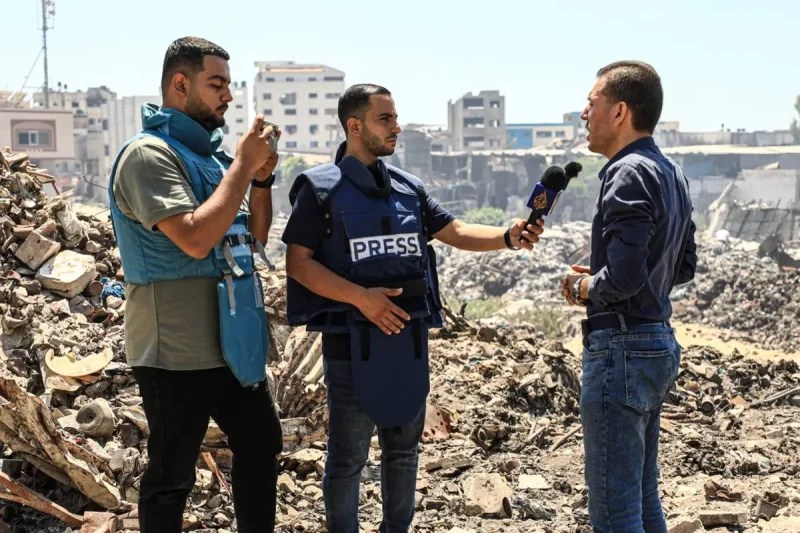
Gaza correspondent Enes al-Sharif, who is targeted by Israeli Army Spokesperson Avichay Adraee, reports in Gaza City, Gaza on August 13, 2024. [Dawoud Abo Alkas – Anadolu Agency]
Palestinian Information Center – October 24, 2024
Francesca Albanese, the UN special rapporteur on the situation of human rights in the occupied Palestinian territory, has condemned the Israeli occupation army’s direct incitement against six Palestinian journalists in Gaza.
Albanese said in a statement on Thursday that Israel’s declaration that six Al-Jazeera journalists are members of Hamas or Islamic Jihad “sounds like a death sentence.”
“These six Palestinians are among the last journalists surviving Israel’s onslaught in Gaza,” the UN rapporteur added.
The Israeli occupation forces (IOF) claimed on Wednesday that the six journalists working for Al-Jazeera in Gaza Strip are “terrorists” affiliated with Hamas and Islamic Jihad.
The accused journalists are Anas Al-Sharif, Alaa Salama, Hussam Shabat, Ashraf Al-Sarraj, Ismail Abu Omar, and Talal Al-Urouqi. Most of them have already been targeted and attacked by the IOF over the past months.
For its part, Al-Jazeera confirmed that the Israeli accusations are “fabricated” and “part of a broader pattern of hostility” against the channel, stressing that “these allegations represent a blatant attempt to silence the few remaining journalists in Gaza to hide the harsh reality of the brutal war going on in the besieged Strip.”
Israel attacks al-Mayadeen’s office in Beirut
Press TV – October 23, 2024
The Israeli regime has carried out an airstrike against the office of Lebanon’s al-Mayadeen television network in the country’s capital Beirut.
The attack struck the building in the city’s Jnah neighborhood on Wednesday, killing one person and wounding five others, including a child, according to Lebanon’s health ministry.
The network said it had fortunately evacuated the building last October after the regime notably escalated its deadly attacks against Lebanon.
Reacting to the attack, al-Mayadeen denounced the regime for targeting a well-known media outlet, but stressed that it would continue to report the truth amid the escalation.
Mahmoud al-Mardawi, a senior official with the Palestinian resistance movement Hamas, also condemned the atrocity, hailing the network’s “pioneering work in revealing the truth.”
“Al-Mayadeen, which dismantles the narrative of Zionist sympathizers, is a fighter channel in confronting the enemy, which seeks to cover up the truth and present misleading narratives,” he added.
The Palestinian resistance Mujahideen Movement also condemend the attack, considering it to be “part of the systematic Zionist campaign targeting honorable free media outlets.”
The attack “is clear evidence that the channel is on the right path, and it stands as a badge of honor and pride for this resistance channel,” it noed.
“Despite the unlimited support the Zionist narrative receives from Western media machinery, the enemy has failed to suppress or obscure the voice and image of truth.”
As part of its campaign against the outspoken network, the regime ordered suspension of its operations in the occupied Palestinian territories last November, identifying it as a “threat to Israel’s security.”
In August, the regime renewed the ban and ordered confiscation of the network’s equipment and blocking of its websites.
Since October 7 last year, when it launched a genocidal war against Palestinians in the Gaza Strip and intensified its deadly aggression on Lebanon, the regime has been pursuing a policy of blocking media coverage that could expose its atrocities.
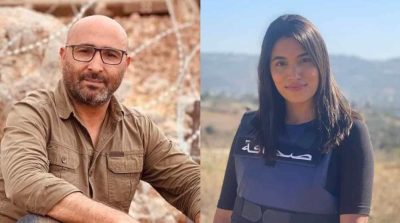
Ever since, it has killed more than 170 journalists in the coastal sliver and Lebanon, including al-Mayadeen correspondent Farah Omar and cameraman Rabih Me’mari.
The duo were killed in an Israeli bombing moments after completing a live broadcast in southern Lebanon.
Last month, the network also announced the death of its journalist Hadi al-Sayyed in an Israeli airstrike that had targeted his home in southern Lebanon.

In January, the Committee to Protect Journalists, a human rights and press freedom group, said the war on Gaza “is more deadly to journalists than any previous war.”
It said the brutal military onslaught had, until that month, “damaged or destroyed an estimated 48 media facilities” in the coastal sliver.
Reporters Without Borders has also denounced the regime for intentionally targeting Palestinian and Lebanese journalists.
Bolivia denies Israel accusations of hosting Iran, Hezbollah bases
MEMO | October 23, 2024
Bolivia has denied accusations that it is hosting Iranian and Hezbollah bases within its borders, urging South American nations not to fall for such allegations and become divided.
In a virtual press conference on Monday, Israel’s Ambassador to Costa Rica, Mijal Gur Aryeh, stated that there are “other countries in the region that have Iranian and Hezbollah bases, particularly Venezuela and Bolivia”, without providing evidence or specific details on such an allegation.
Bolivia’s Foreign Ministry yesterday denied those accusations, however, saying in a statement that “Bolivia is a pacifist state that promotes the culture of peace, which is why it has constitutionally assumed the prohibition of installing foreign military bases in its territory.”
Calling Aryeh’s words “irresponsible, unfounded, and self-serving”, the Ministry called on other South American countries “not to fall into these provocations that seek to affect the relations of brotherhood between states and peoples of the region.”
It asserted that the Ambassador’s comments ”seek to generate confrontation between Latin American states, governments and peoples, against the objective outlined in the Community of Latin American and Caribbean States (CELAC) of consolidating Latin America and the Caribbean as a zone of peace”.
The impact of vaccine mandates to healthcare workers in Canada
By Eleftherios Gkioulekas | October 20, 2024
A recent paper by Professor Claudia Chaufan and colleagues reported the results of a cross-sectional survey of 468 Canadian healthcare workers examining the impact of COVID-19 vaccination decisions and the impacts of vaccine mandates. The sample used in the study is interesting because it consists predominantly of nurses and other supporting disciplines but very few medical doctors. The study provides only descriptive statistics; however, the reported results are astounding.
Here are some highlights: 75% of respondents that received the COVID-19 vaccine reported that the reason for taking the injectable product was employer vaccine mandates. Only 22% of vaccinated respondents reported no adverse events. Moderate adverse events were reported by 35.6% of respondents and severe adverse reactions were reported by 29.8% of respondents. Out of the 87 respondents that received the COVID-19 vaccine, 1 reported a life-threatening adverse reaction. Interestingly, only 4.3% of respondents were trained on how to report post-vaccination adverse events and only 4.5% of respondents reported that they were encouraged to report adverse events after vaccination.
From the entire sample of both vaccinated and unvaccinated healthcare workers, 74.6% reported anxiety and/or depression and 18.3% reported experiencing suicidal thoughts due to employer vaccination requirements (agree and strongly agree responses). Although 40% reported willingness to return to their previous role if vaccine mandates were dropped, another 42.5% reported an intention to leave their occupation or the healthcare industry as a result of their experience with vaccine mandates (agree and strongly agree responses). 85% reported that employers did not offer alternatives to vaccination to satisfy their vaccine mandate, with only 1 out of 468 respondents reporting that their employer was willing to accept proof of natural immunity, even though 75% of respondents reported that they worked with COVID-19 patients prior to the availability of the COVID-19 vaccines. Only 9.5% reported being offered regular testing as an alternative to vaccination.
59% of respondents reported that they were not provided with any written information about the vaccines, necessary for informed consent, and only 2.4% of respondents were provided with the package insert from the vaccine manufacturer.
Finally, only 16.1% of vaccinated respondents reported being happy with their choice to get vaccinated, whereas 92.6% of unvaccinated respondents reported being happy with their decision to not get vaccinated (agree and strongly agree). Furthermore, 70.3% observed differential treatment of patients based on their vaccine status and only 4.1% report that they are confident that the current healthcare system will provide adequate and quality care while respecting personal preferences and values (agree and strongly agree).
For more details, you will have to read the paper.
Here’s the paper’s conclusion:
In 2021 the Organization for Economic Cooperation and Development (OECD) announced six evaluation criteria that jointly provide “a normative framework (…) to determine the merit or worth of an intervention”- a policy, a strategy, or an activity (42). The first criterion is “relevance”, i.e., to what extent a policy is responsive to beneficiaries, meaning those who “benefit directly or indirectly from the policy”. The second criterion is “coherence”, i.e., to what extent a policy is compatible with other policies in a given setting. The third is “effectiveness”, i.e., to what extent a policy has achieved or is expected to achieve its objectives. The fourth criterion is “efficiency”, to what extent a policy converts inputs into outputs in the “most cost-effective way possible, as compared to feasible alternatives in the context” and within a reasonable timeframe. The fifth criterion is “impact”, i.e., to what extent a policy “has generated or is expected to generate significant positive or negative, intended or unintended”, effects. The sixth and last criterion is “sustainability”, i.e., whether benefits are likely to last (42).
If our findings indicate a trend in the health care sector in Ontario, Canada, they suggest that by these criteria the policy of mandated vaccination for HCWs in the province has failed in its purported goal of promoting safer healthcare environments and achieving better care. Concerning “relevance”, the intended beneficiaries, whether HCWs, patients, or communities at large, have been harmed by exacerbated staff shortages, intimidating work environments, and health professionals coerced into acting against their best clinical judgment. Concerning “coherence”, the policy has proven to be at odds with other policies within health settings, such as the imperative to maintain adequate staffing levels or to respect informed consent and bodily autonomy, not only for HCWs but for those patients who, for whatever reason, decline vaccination. As to “effectiveness”, there is no evidence that the policy has improved patient care-as suggested by our findings, it has likely worsened it.
Concerning “efficiency”, there is no evidence that the policy has been more cost-effective than comparable alternatives, such as relying on the superiority of naturally acquired immunity over artificial immunity (23,43-45), acquired by most HCWs during 2020 as they treated patients in critical need, and for this reason were celebrated as heroes by the media and the authorities (46,47). Notably, naturally acquired immunity, achieved through recovery from a prior infection, was not recognized by healthcare employers in Canada. In fact, there is no evidence that such (then unvaccinated) workers were deemed a threat to patient safety and disciplined for that reason. Concerning “impact”, our findings also suggest that the overall impact of the policy on the well-being of HCWs and the sustainability of health systems has also been negative. Finally, concerning “sustainability”, with close to half of our sample of highly trained and experienced HCWs intending to leave the health professions, we see no evidence for any net benefits, either current or future. We conclude that if, by the OECD criteria, the policy of mandated vaccination for HCWs has failed, this failure, along with the contested efficacy and safety of COVID-19 vaccines, their negative impact on HCWs’ wellbeing, staffing levels, and patient care, and the threat that mandates represent to longstanding bioethical principles such as informed consent and bodily autonomy (48,49), negates any basis-policy, scientific, or ethical-to continue with the practice.

References
C. Chaufan and N. Hemsing and R. Moncrieffe, “COVID-19 vaccination decisions and impacts of vaccine mandates: a cross sectional survey of healthcare workers in Ontario, Canada”, Journal of Public Health and Emergency (2024), Online First, https://jphe.amegroups.org/article/view/10313
Featured Video
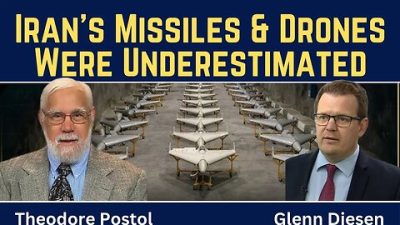
Theodore Postol: Iran’s Missiles & Drones Were Underestimated
or go to
Aletho News Archives – Video-Images
From the Archives
What is the Israeli Lobby in Australia Doing in Interfaith Dialogue?
By Ali Kazak | Dissident Voice | October 11, 2015
For years Israel and its lobby around the world have been trying to normalise their relations with Arabs and Muslims without solving the Palestine Question.
One of the methods they resorted to in the last few years is using human rights and community organizations such as interfaith dialogue and Multiculturalism to achieve this objective and to: isolate the Palestinians, marginalise the Palestine question, end Israel’s isolation, and prevent criticism of Israel, knowing that these organisations will be the first to stand against Israel’s violations, racial and religious discrimination.
The group responsible for this task in Australia is The Australia/Israel & Jewish Affairs Council (AIJAC); its Director of International & Community Affairs, Jeremy Jones is in charge of lobbying religious community organizations, specifically Muslims and Christians. Consequently he convened the Faith Communities for Reconciliation, founding participant in the Australian Partnership of Religious Organisations and the Australian National Dialogue of Christians, Muslims & Jews.
AIJAC is a private political propaganda group. It is recognised as the main Israeli lobby in Australia. It coordinates its activities and works intimately with the Israeli embassy in Canberra and different institutions in Israel. It is privately funded by some Jewish businessmen. It monitors closely Australian politicians, the media, ethnic and religious groups, (especially Arabs and Muslims), unions and academics on their stands towards Israel and the Palestine question. … continue
Blog Roll
 Aletho News
- The Most Important Bet You’ve Never Heard Of
- The killing of three Indonesian soldiers in Lebanon should remind Jakarta that Israel does not want peace
- Defeated and delusional: Netanyahu’s remarks reveal $80bn war failure, says analyst
- Iran’s friends are about to make life much more difficult for Israel and the US
- The war of liberation of the Arab and Islamic peoples expands across the Gulf
- Envoy warns UN on Trump’s threat to ‘obliterate’ Iran’s civilian infrastructure
- The Larak Corridor: Iran’s Rial Gate With No US, No Israel, and No Way Around
- ‘Economic terrorism’: Steel facilities hit again in US-Israeli strike
- ‘War Crime’: Iran condemns attacks on Arak, Ardakan nuclear sites
- Two-thirds of Americans want quick end to Iran war even if goals unmet
- If Americans Knew
- Gaza families reunite years after babies evacuated amid Israel’s war
- International Rescue Committee warns Gaza’s children face grave protection risks
- Iran’s Alleged 47-Year War on America: Debunking the 1,050 American Deaths Canard
- Israel wants US to bomb more of Iran’s civilian structures (113,000 is not enough) – Not a ceasefire Day 173
- Ann Coulter Rips Into Fox News for Iran War Coverage
- Joe Kent Urges Americans To Call White House and Congress To Object To Sending Troops Into Iran
- DNC Resolution to Reject AIPAC Funding Puts Democratic Leaders in the Hot Seat
- Swedish foundation to build 400 schools as over 650,000 Gaza children remain without education for 2 years
- Israeli army admits photshopping image of slain Lebanese journalist
- This is how Israel is systematically killing health workers under the cover of war in Lebanon
- No Tricks Zone
- New Study Finds Warming Saves Lives…Cold Temperatures 12 Times More Deadly Than Excess Heat
- German Science Blog Accuses PIK Climate Institute Of Hallucinating Climate Tipping Points
- Devastating Assessment Of Comirnaty Vaccine By Former Senior Pfizer Europe Toxicologist
- New Study: CO2 Is ‘Effectively Negligible’ As An Explanatory Climate Change Factor Since 2000
- Former Pfizer Toxicologist Dr. Helmut Sterz Tells Bundestag Hearing Pfizer Vaccine Should Have Never Been Approved
- Energy Expert: Germany’s Nuclear Phaseout Was A “500 Billion Euro Mistake”
- New Research: South Australia’s Mid-Holocene Sea Surface Temperatures Were 4°C Warmer Than Today
- Storing Green Energy To Last Germany 10 Days Would Require A 60-Million Tonne Battery
- New Studies: UK Sea Levels Were 4 Meters Higher Than Today During The Mid-Holocene
- Destructive Green New Deal: German Energy And Metal Group Warns Of Drastic Crisis
 Aletho News