Did Trump Halt Aid to Ukraine?
By Larry C. Johnson | SONAR 21 | January 24, 2025
Yesterday, there were a number of “headlines” in the US media claiming all foreign aid was stopped—except for Israel and Egypt. But the Pentagon weighed in today denying that it affects Ukraine:
“A Pentagon official confirmed that Trump’s executive order freezing foreign aid applies only to development programs, not security assistance to Ukraine.” -VOA
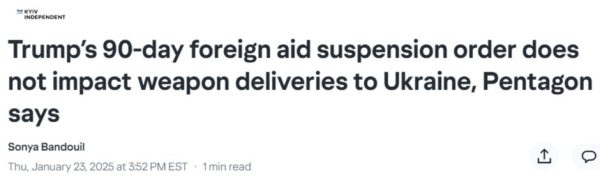
When I spoke with Judge Napolitano and Nima today, I had not seen these reports. However, while Trump’s order does not curtail security assistance (i.e., weapons, vehicles and ammunition) already in the pipeline, it does freeze the assistance funds that flow through State Department channels:
The Trump administration has reportedly frozen USAID projects as part of its foreign assistance audit
The Trump administration has frozen projects in Ukraine that were funded through the US Agency for International Development, Reuter reported on Friday, citing a USAID official.
The official told the news agency that USAID officers responsible for projects in Ukraine were told to stop all work. The projects that were frozen reportedly include support for schools and healthcare, including maternal care and the vaccination of children.
So part of the Ukrainian grift machine is shut down for the next three months. That is a start in the right direction.
Even if the US under the Trump administration continues to funnel weapons to Ukraine, this does not solve Ukraine’s fundamental weakness — i.e., the lack of trained soldiers. The New York Times published a bizarre piece of illogical nonsense today under the title, Ukraine Is Losing Fewer Soldiers Than Russia — but It’s Still Losing the War. This is simply a pile of fetid horse manure. I am not even going to waste time deconstructing the lies the permeate this piece of propaganda. Let’s deal with facts:
- Russia has at least an 8:1 advantage in artillery shells since 2022.
- Russia has air supremacy and is able to drop massive glide bombs on Ukrainian positions, while Ukraine has not comparable capability.
- Russia has more drones and has deployed drones guided by fiber optic cable and artificial intelligence. Ukraine has no such capability.
- Russia has more tanks and armored personnel carriers.
But we also have hard numbers from Ukrainian sources about a Ukrainian / Russian exchange of dead soldiers. Check out this graphic:

Yes, you are reading that correctly. Russia received the bodies of 49 soldiers and, in turn, delivered the remains of 757 Ukrainian troops. In other words, for every dead Russian soldier there were 15 dead Ukrainians. That data tells you everything you need to know about the true extent of Ukrainian losses and exposes the prevarication of the New York Times reporters.
However, the Times makes one damning admission:
Western intelligence agencies have been reluctant to disclose their internal calculations of Ukrainian casualties for fear of undermining an ally. American officials have previously said that Kyiv withholds this information from even the closest allies.
Yes, the CIA and the Defense Intelligence Agency are not reporting the real Ukrainian losses because of politics. Just one more example of the politicization of intelligence. … Full article
Israeli forces fatally shoot 2-year-old Palestinian girl in the head near Jenin

Laila Mohammad Ayman Khatib, two, was shot and killed by Israeli forces while she ate dinner with her family near Jenin on January 25. (Photo: Courtesy of the Khatib family)
Defense for Children Palestine | January 26, 2025
Ramallah — Israeli forces shot and killed a Palestinian toddler near Jenin last night.
Laila Mohammad Ayman Khatib, two, was shot and killed by Israeli forces around 8:30 p.m. on January 25 while she was in the living room in her family’s home in the Palestinian town of Muthallath Al-Shuhada, south of Jenin in the northern occupied West Bank, according to documentation collected by Defense for Children International – Palestine. Laila was having dinner with her mother, grandparents, and aunts when sudden Israeli gunfire erupted without warning. Israeli forces fired four bullets through the living room window, one of which struck Laila in the back of the head. Laila’s grandfather carried her out of the house and brought her to Al-Razi Hospital in Jenin, where she received emergency surgery. Laila was pronounced dead around 10 p.m.
“Israeli forces regularly and routinely carry out military operations with complete contempt for Palestinian life,” said Ayed Abu Eqtaish, accountability program director at DCIP. “Little Laila was having dinner with her family when Israeli forces, unprompted, fired live ammunition into their living room, killing her. It is outrageous that the Israeli military has been permitted by world leaders to kill Palestinian children with impunity in flagrant violations of international law.”
Laila’s mother and aunt sustained injuries from shrapnel during the attack, according to information collected by DCIP.
When Laila’s grandfather exited the house carrying her, he saw Israeli snipers stationed in a Palestinian home across the street from their house. No residents of Muthallath Al-Shuhada were aware of an Israeli military presence at the time of the attack, and later learned that Israeli special forces had infiltrated the Palestinian home. Israeli forces remained in the town until about 11 p.m.
Jenin, its refugee camp, and the surrounding villages have been under an ongoing Israeli military attack dubbed “Operation Iron Wall” since January 21, 2025.
Since the beginning of Operation Iron Wall, 16 Palestinians have been killed, including Laila and 16-year-old Motaz Abu Tabeekh. This operation has also been accompanied by Israeli drone strikes, widespread destruction of infrastructure and homes in the Jenin refugee camp, and the bulldozing of roads. Additionally, hundreds of Palestinians families have been forcibly displaced from their homes due to the continued military assault.
Israeli forces have killed eight Palestinian children in the occupied West Bank in 2025, according to documentation collected by DCIP. Five children were killed by Israeli drone strikes and three children were shot and killed with live ammunition.
Iran’s hard choice on FATF conundrum
Press TV – January 26, 2025
The issue of Iran’s membership in Paris-based Financial Action Taskforce (FATF) is one of the hotly disputed topics, with proponents and opponents each ardently sticking to their respective positions.
Supporters argue that Iran’s continued inclusion in the FATF blacklist has become a major challenge for the economy and a problem for the Iranian policy-making system for many years.
For years, economic and trade activists and entrepreneurs have accused decision-makers of indifference to financial transaction problems resulting from Iran’s disconnection from the global payments network SWIFT.
They cite the high cost of trade, economic and financial transactions due to the use of unconventional and obsolete methods such as exchange offices and commodity barter which has led the growth of dealership and rent-seeking activity, corruption, and a shadow economy, calling for legal and policy measures to remove Iran from the FATF blacklist.
In 2016, Iran under the administration of president Hassan Rouhani agreed to an FATF action plan to move from the blacklist to the gray list, accepting 37 of the Western watchdog’s 41 recommendations and introducing relevant legislation to implement them.
By 2020, however, the FATF reinstated the country on its blacklist due to what it called Iran’s failure to complete the process.
The dispute centers around the Palermo Convention on combating transnational organized crime and the CFT Act on fighting the financing of terrorism, which the Iranian parliament approved in 2018, but the Guardian Council rejected due to their conflicts with “resistance economy guidelines”, national security policies, and “contradiction with the Sharia”.
Opponents of the FATF membership believe that with multiple US sanctions imposed on Iran over the years, the approval of Palermo Convention and the CFT Act and a subsequent removal from the blacklist would not improve trade and transaction for the Islamic Republic.
The 39-nation FATF, established by the Group of Seven (G7) largest developed economies at a Paris summit in 1989, is billed as a global body that aims to develop policies to combat money laundering and terrorist financing, thus protecting the integrity of the international financial system.
Its founders praise it for its global standards. However, global standards consist of a standard setter and a standard user. The standard setter influences independent organizations and standard users to adopt standards based on the expert knowledge that is suitable for the standard setters’ logic of appropriateness.
Scholars say FATF primarily reflects the preferences of power countries and is a tool for the US and Europeans to force those preferences on other jurisdictions.
FATF’s core agenda reflects consensus among the US and EU member states to paint non-compliant jurisdictions as rogue, unreliable players, thereby scaring off would-be investors.
According to IMF data, the world economy had a gross domestic product (GDP) of $105 trillion in 2023, some $90 trillion of which belonged to FATF members. The sum included about $5.2 trillion in laundered money, most of which belong to major economies.
As for terrorist financing, the FATF has never subjected the US and the Europeans to its anti-terrorism standards for supporting the Mujahedin Khalq Organization (MKO) which until recently was on their list of terrorist organizations. Ironically, Paris hosts the annual meetings of the MKO which has a history of bombings, terrorist attacks, horrific murders like burning, decapitation, dismemberment, as well as money laundering and heist from banks.
The proponents of the FAFT still have a case. They argue that without membership, the development of economic relations with neighbors will face serious challenges and costs since they are all members of the group.
The dossier is before the Guardian Council amid fears and hopes since the country’s national interests are at stake. Ultimately, maximum care should be taken to ensure that any decision would improve the country’s situation and not lead to any self-imposed sanctions and not shoot the country in the foot.
Trump calls for ethnic cleansing of Gaza’s population to Egypt, Jordan
The Cradle | January 26, 2025
While flying on Air Force One on 26 January, US President Donald Trump told reporters that the residents of Gaza should be “cleaned out” and ethnically cleansed to neighboring Arab countries after Israel’s US-backed bombing campaign turned the enclave into a “demolition site.”
“I’d like Egypt to take people, and I’d like Jordan to take people. You’re talking about a million and a half people, and we can just clean out the whole thing,” Trump said.
“You know, over the centuries, it’s had many, many conflicts. And I don’t know, something has to happen. It’s literally a demolition site, almost everything is demolished, and people are dying there, so I’d rather get involved with some of the Arab nations and build housing at a different location where they can maybe live in peace for a change,” the president added.
“I said to [the Jordanian King], I’d love you to take on more because I’m looking at the whole Gaza Strip right now, and it’s a mess, it’s a real mess. I’d like him to take people … I’d like Egypt to take people [from Gaza],” Trump continued, saying he would discuss it with Egyptian President Abdel Fattah el-Sisi.
The Palestinian Islamic Jihad (PIJ) movement condemned the inflammatory comments in an official statement: “Trump’s statements are consistent with the worst of the agenda of the extreme Israeli right and a continuation of the denial of the existence of our people … We call on all countries, especially the Egyptian and Jordanian governments, to reject Trump’s plan, and we affirm that our people will thwart this scheme.”
The US president’s son-in-law and powerful businessman, Jared Kushner, has previously advocated developing new communities in Gaza due to its prime location and beaches on the Mediterranean Sea.
Israeli businessmen close to Israeli Prime Minister Benjamin Netanyahu have advocated for the development of Gaza as a modern residential community and tax-free business and manufacturing zone, presumably to be built after all or most Palestinians have been expelled.
In the wake of a ceasefire between Hamas and Israel that took effect on 19 January, hundreds of thousands of displaced Palestinians are seeking to return to their homes, or what is left of them.
It is unclear whether the ceasefire will hold or whether Israel will seek to resume the war, as Prime Minister Benjamin Netanyahu has stated he will.
Trump’s comments, including his claim that he wants to save Palestinian lives, echoed the recommendations of a leaked Israeli Ministry of Information report issued on 13 October 2023, just a week after Hamas’s Operation Al-Aqsa Flood and the beginning of Israel’s massive bombing campaign that has now left Gaza largely uninhabitable.
The plan recommended the ethnic cleansing of Gaza using humanitarian justifications. The document recommends beginning a dedicated campaign that will “motivate” Gazans “to agree to the plan,” and make them give up their land.
Gazans should be convinced that “Allah made sure that you lost this land because of the leadership of Hamas – there is no choice but to move to another place with the help of Your Muslim brothers,” the document reads.
Further, the plan states the government must launch a public relations campaign that will promote the transfer of Palestinians to Arab and western states in a way that does not promote hostility to Israel or damage its reputation.
The deportation of the population from Gaza must be presented as a necessary humanitarian measure to receive international support. Such a deportation could be justified if it will lead to “fewer casualties among the civilian population compared to the expected number of casualties if they remain,” the document says.
The document also states that the US should be leveraged to pressure Egypt to take in the residents of Gaza and to encourage other European countries, and in particular Greece, Spain, and Canada, to help take in and settle the refugees who will be evacuated from Gaza.
Finally, the document claims that if the population of Gaza remains, there will be “many Arab deaths” during the expected occupation of Gaza by the Israeli army, and this will damage Israel’s international image even more than the deportation of the population. For all these reasons, the recommendation of the Ministry of Intelligence is to promote the transfer of all Palestinians in Gaza to the Sinai permanently.
Swiss police arrest director of Electronic Intifada news outlet
Al Mayadeen | January 26, 2025
Swiss authorities have detained Ali Abunimah, a Palestinian-American journalist and co-founder of the pro-Palestine news outlet The Electronic Intifada (EI).
Abunimah was reportedly questioned by Swiss police for an hour upon his arrival at Zurich airport on Friday before being granted entry into the city.
Reports suggest he was arrested the following day, ahead of a scheduled speaking event.
“Abunimah’s arrest appears to be part of a growing backlash from Western governments against expressions of solidarity with the Palestinian people,” the Electronic Intifada said.
The Chicago-based independent publication voiced its solidarity with Abunimah, stating, “Speaking out against injustice in Palestine is not a crime. Journalism is not a crime.”
In posts on his X account, the journalist condemned the Israeli genocidal assault on the Gaza Strip and expressed support for the Palestinian resistance against the occupation.
His latest article, published on The Electronic Intifada on January 18, was titled “How Gaza’s Resistance Defeated Israel.”
The American-Arab Anti-Discrimination Committee (ADC) emphasized that Abunimah has been a consistent advocate against “Israel’s” injustices in Palestine, highlighting that his arrest appears to be a direct result of his outspoken activism.
“Abunimah’s arrest is a stark reminder of the increasing attempts to stifle voices calling for justice and accountability,” it pointed out.
Belgian-Lebanese activist Dyab Abou Jahjah, founder of the Hind Rajab Foundation, described Abunimah as a “political prisoner” and demanded his immediate release.
Last year, British police raided the home of Asa Winstanley, an associate editor with EI, and seized his computers and phones.
Iran War Hawks Getting Wrecked In Trump Personnel Fight
By Ryan Grim | Drop Site News | January 24, 2025
A major whisper campaign is underway, led by neoconservatives in Washington panicked at President Donald Trump’s elevation of a string of foreign policy advisers who have spoken out against war with Iran. The first whack to the wounded war-hawk wing came when Mike Pompeo was blocked from a position in the White House, followed yesterday by the stripping of his security detail. That followed similar snubs to John Bolton and Iran hawk Brian Hook, both of which lost their security and have been kept out of the administration.
Hook’s firing was a comical display of Trumpian humiliation. Trump, on Truth Social, said that his
Presidential Personnel Office is actively in the process of identifying and removing over a thousand Presidential Appointees from the previous Administration, who are not aligned with our vision to Make America Great Again.
Jose Andres from the President’s Council on Sports, Fitness and Nutrition, Mark Milley from the National Infrastructure Advisory Council, Brian Hook from the Wilson Center for Scholars, and Keisha Lance Bottoms from the President’s Export Council—YOU’RE FIRED!
What’s so amusing about Trump’s description of Hook as a member of the “previous Administration,” and his being lumped in with Democrats and a hated figure like Milley, is that Hook was named by Trump in November to chair the State Department transition. Anti-war Republicans vowed at the time to make sure he never got a job himself in the second Trump administration and sources tell me that Trump fired him after learning about his long record of criticizing Trump and his bellicose war rhetoric. Now he’s out, and is privately leading the rearguard fight against Trump’s nominees.
Much of that fight is leaking out into the pages of the magazine Jewish Insider. If you followed the effort by AIPAC to shape Democratic primaries in 2022 and 2024 by blocking critics of Israel, you already know that JI was the place to go to learn where AIPAC would be spending money. Articles warned that pro-Israel groups were “alarmed” at the rise of this or that candidate, often for entirely innocuous statements—or sometimes for just being related to somebody they didn’t like.
The same playbook is being rolled out against Trump’s nominees. In an article headlined, “Rumored for a Trump posting, Elbridge Colby’s dovish views on Iran stand out,” JI warned that Colby “has notably opposed direct military action against Iran.” He got the posting anyway, and is now one of the top officials at the Pentagon. This week, Trump rolled out more than a dozen more top appointments, without a single neocon in the list, raising the alarm in JI again. (Read our profile of Colby.)
JI panicked about Michael DiMino, who previously worked for the CIA and the Pentagon, and was named to be deputy assistant secretary of defense for the Middle East. “Last year, [DiMino] dismissed Iran’s second ballistic missile attack on Israel as a ‘fairly moderate’ response and urged against bombing the Houthis in Yemen, instead calling for U.S. pressure on Israel to tamp down regional conflict,” JI warned. The paper also expressed concern that Dan Caldwell, another conservative veteran skeptical of war with Iran, seemed to be playing a role in getting like-minded people into the Pentagon: “A leading opponent of traditional Republican foreign policy who advocates for a vastly reduced U.S. presence in the Middle East has been quietly involved in the transition process at the Defense Department, according to four people familiar with the matter, underscoring a distinct ideological shift in the Pentagon as President Donald Trump builds his new administration.”
The fight over Trump’s nominees is directly connected to the potential strength of the “ceasefire” in Gaza. Trump is expected to tap his Mideast envoy and real estate buddy Steve Witkoff, who browbeat Netanyahu into agreeing to the ceasefire, to negotiate with Iran. In order to get Saudi-Israel normalization and a nuclear deal with Iran, Trump needs the genocide in Gaza to end, which connects the three issues, and is why Israel is deeply hostile to Witkoff’s expanding portfolio. Trump created confusion about Witkoff’s growing role in comments to the press that JI eagerly but inaccurately reported as a rebuke of Witkoff.
Meanwhile, 11 Americans on a medical mission are being blocked by Israel from leaving northern Gaza despite having completed their scheduled mission. “This is not just about us–it’s about accountability,” Shehzad Batliwala, an ophthalmologist based in Dallas, told me. “The principle at stake is whether the Israeli military can arbitrarily detain U.S. citizens engaged in humanitarian work without even as much as giving a legitimate reason.” Two senior Trump officials, including Witkoff, have raised the issue with the Israeli government, according to sources involved.
The team is on a mission with Rahma Worldwide, Dr. Batliwala said. “Many of us have critical responsibilities back home, including U.S. patients awaiting urgent care. For example, I have over 40 cataract surgeries scheduled next week.” A request for comment sent to the Israeli military by Drop Site has yet to be returned.
Who is Mohammed al-Tous, longest-serving Palestinian prisoner released by Israel?
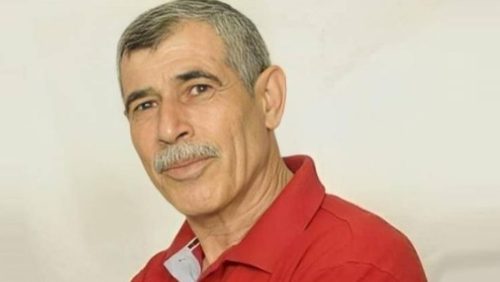
Longest-serving Palestinian prisoner Mohammed al-Tous (Photo via social media)
Press TV – January 25, 2025
Israel has freed the longest-serving Palestinian prisoner, Mohammed al-Tous, among the 200 inmates released as part of the second phase of a prisoner exchange deal with the Hamas resistance movement under the Gaza ceasefire.
In exchange for the prisoners, Hamas earlier on Saturday released four female Israeli soldiers, who were held in Gaza since October 7, 2023.
Tous, who had been in detention for nearly four decades, is a member of the Fatah movement founded by late Palestinian leader Yasser Arafat.
He joined Fatah in 1970 when he was only 14, and took part in several operations targeting Israeli forces and settlements between 1983 and 1985.
His activism led to multiple arrests, with his first imprisonment happening in 1970. After escaping from prison in 1975, he became a “wanted man” by Israel and was re-arrested four more times by 1985. An Israeli military court sentenced him to multiple life sentences.
Tous had been behind bars ever since.
While in prison, Tous emerged as a leader among inmates, advocating for the rights of Palestinian prisoners and participating in hunger strikes to protest against Israeli prison policies.
His resilience and commitment to the Palestinian cause have made him a symbol of resistance in the eyes of the Palestinian people.
Tous is also an accomplished author. His first book, Eye of the Mountain (2021), details his life, resistance activities, and perspectives on the Palestinian struggle. His latest work, Sweetness and Bitterness (2023), chronicles his ordeals in prison, offering insight into the challenges faced by Palestinians incarcerated in Israeli jails.
According to the Palestinian Prisoners’ Club advocacy group, the 69-year-old is recognized as the “dean” of prisoners in the occupied West Bank.
Tous was on the list of seventy detainees who were deported to Egypt on Saturday and who have not been able to meet their relatives in Gaza.
Several high-profile Palestinian fighters including Mohammad al-Ardah, who was part of a jailbreak in 2021, were also among them.
They are expected to be transferred from Egypt to countries such as Algeria, Tunisia, and Turkey.
Separately, a total of 114 inmates arrived in Ramallah and received a heroes’ welcome.
Masses of people congregated in the occupied West Bank city and celebrated the return of the released Palestinian prisoners.
The large crowd included people hoisting Palestinian flags, shouting slogans and documenting the scene with their phones. They surrounded a convoy of buses carrying the freed prisoners.
Moreover, sixteen freed Palestinian prisoners arrived in the Gaza Strip through the Karem Abu Salem crossing.
The released Palestinian prisoners were transferred to the European Gaza Hospital in Khan Younis, which is situated in the south of the Gaza Strip.
Israel has released a list of more than 700 Palestinian prisoners, who are to be released under the deal. More than 230 prisoners are serving life sentences and will be permanently sent to exile upon their release.
Hamas said in a statement on Saturday that Israel was forced to “open the doors of his cells to our heroic prisoners,” after more than 14 months of “unprecedented brutal aggression that targeted every inch of Gaza in its barbarity.”
Israel Is Blocking 11 American Doctors and Nurses From Leaving Gaza

The group of doctors trapped in Gaza. Photo courtesy of Rahma.
By Prem Thakker | Zeteo | January 25, 2025
Only days into Israel’s ceasefire with Hamas, 11 American doctors and nurses say the Israeli government is blocking them from leaving Gaza and returning to the United States.
The doctors, who entered Gaza on Jan. 9 with authorization and clearance from the Israeli government, were set to leave the enclave on Wednesday. But Israel denied their planned exit, telling the group they couldn’t leave due to an unspecified “incident” at a security checkpoint, affected doctors and a colleague in the US told Zeteo.
It’s unclear what incident Israel was referring to. COGAT, the Israeli agency that coordinates humanitarian aid entering Gaza, did not immediately answer specific questions about the group. One doctor said the only major incident the group was aware of involved Israeli forces firing on Palestinians returning to their homes in Rafah.
The group, part of the humanitarian organization Rahma, is currently stuck in northern Gaza and was also told by Israel they cannot even move to the south to leave the Strip “due to certain operational considerations that are currently in consideration regarding the activities on these days.”
Shehzad Batliwala, one of the trapped doctors, told Zeteo that many in the group are “needed to provide critical care to US citizens and others back home.”
The doctors and nurses hope they can leave in the coming days. After the delay, Batliwala said Israel initially told the group they wouldn’t be able to leave until next Tuesday, but has since suggested they may be able to leave on Sunday. In any case, the doctors and their advocates said they would remain skeptical until they’ve successfully left Gaza.
Another Team Prevented From Entering
At the same time, the doctors say Israel is also preventing another Rahma team of doctors, who are part of a larger convoy of health workers, from entering Gaza. They were also told that an “incident” occurred near the Kerem Shalom crossing on the Gaza-Israel border, leaving it closed for both entry and exit. They were forced to leave Israel and return to Jordan. It’s unclear if and when they may be allowed to enter.
“Denying entry to humanitarian workers, especially during a ceasefire period, makes no sense given the dire healthcare and humanitarian needs on the ground,” Batliwala said. “As someone currently in Gaza, I can confirm that there are patients urgently awaiting follow-up and surgical intervention, none of which is happening due to these restrictions.”
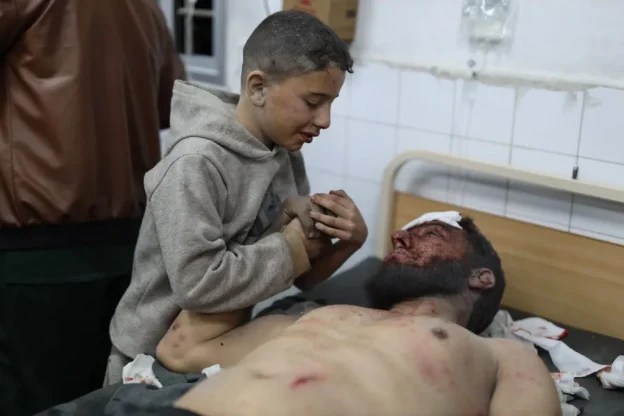
A young boy holds the hand of an injured man at the al-Ahli Baptist Hospital after an Israeli attack in Gaza on Jan. 16, 2025. Photo by Abdalrahman T. A. Abusalama/Anadolu via Getty Images
Dr. Adam Hamawy, a US Army combat surgeon veteran – whom Sen. Tammy Duckworth credits with saving her life after she was wounded two decades ago during the Iraq War – is among the convoy of medical professionals trying to enter Gaza. Hamawy, who was also among a team of doctors temporarily barred from leaving Gaza in May, told Zeteo that Israel has “continued to hinder entry and exit of medical and humanitarian workers since the beginning of this genocide.”
The convoy, led by the UN and Rahma, includes some 50 people. At least 14 are American, Hamawy said.
Test for Trump
Israel’s decision to block the groups underscores the fragility of the first phase of a long-awaited ceasefire agreement, the first test for newly-elected President Donald Trump in the region. While the bombs have largely stopped in Gaza, Israeli forces have still continued its killing – particularly in the West Bank. Among the tens of thousands of people Israeli forces have killed, hundreds have been medical workers and volunteers – including American World Central Kitchen worker Jacob Flickinger.
Israel’s actions also renew concerns about the US government’s commitment to ensuring the Israeli government protects Americans in both Gaza and the West Bank. In the last year, the US continued to send billions in US military aid and provide diplomatic cover despite Israel’s actions against US citizens, including the killing of 26-year-old American Ayşenur Ezgi Eygi, who was shot dead by an Israeli soldier in the occupied West Bank last September.
The State Department and White House did not respond to a request for comment. Zeteo also reached out to the offices of senators representing the states where the doctors trapped in Gaza hail, including Texas’ Ted Cruz and John Cornyn, California’s Alex Padilla and Adam Schiff, Florida’s Rick Scott and Ashley Moody, Colorado’s Michael Bennet and John Hickenlooper, Ohio’s Bernie Moreno, and Arizona’s Mark Kelly and Ruben Gallego.
Only Hickenlooper’s office responded, saying they are “in contact with a Colorado doctor in Gaza as well as with the US Embassy.”
South Korean president indicted
RT | January 26, 2025
South Korean prosecutors have formally indicted President Yoon Suk Yeol on charges of leading an insurrection during his brief imposition of martial law last month, local media reported on Sunday. Yoon, who was impeached on December 14, faces accusations of abusing power and undermining democratic institutions.
Yoon declared emergency martial law on December 3, claiming the opposition was plotting a “rebellion” and accusing it of sympathizing with North Korea. The controversial measure was overturned within days, leading to his impeachment by the National Assembly. Yoon’s arrest on January 15 sparked violent protests by his supporters, who stormed the Seoul Western District Court.
“After comprehensively reviewing the evidence from the accomplice cases investigated so far… and the evidence from cases referred to the police and investigated, we determined that it was appropriate (valid) to indict [Yoon],” the prosecution said in a statement, as cited by Yonhap news agency.
The prosecutors indicted Yoon without further investigation, citing sufficient evidence already collected and concerns that he could destroy evidence of his alleged crimes unless formally charged. Prosecutors have alleged that his martial law decree was part of a broader plan to seize control of state functions.
Insurrection is among the few charges for which a South Korean president does not have immunity. If convicted, Yoon could face life imprisonment or the death penalty.
Yoon’s legal team has dismissed the charges against him as politically motivated, describing the martial law declaration as a necessary measure to counter legislative gridlock and opposition-led impeachments of his cabinet members. Yoon, who remains in custody, previously vowed to “fight alongside” his supporters “to the very end to protect this nation.”
The country’s Constitutional Court is currently deliberating whether to permanently remove Yoon from office. A decision must be made within 180 days. Yoon’s presidential powers were suspended following his impeachment, and Prime Minister Han Duck-soo is serving as acting president.
Yoon is the first sitting South Korean president to face criminal charges while in office.
Christian church to change name in bid to fight off EU state’s crackdown
RT | January 26, 2025
The Estonian Orthodox Church (EOC) will change its name in response to the pressure from the authorities to sever its historical ties with Russia.
The announcement comes after the Estonian government approved draft legislation requiring religious organizations to cut ties with foreign leaders and entities whose actions could be deemed a threat to national security. “There should be no connection to entities that support military aggression,” Interior Minister Lauri Laanemets said on Thursday.
The EOC is a self-governing church that has maintained canonical ties to the Russian Orthodox Church. In a statement on Friday, EOC said that it will change its name to the Estonian Christian Orthodox Church.
“The government-approved bill violates the freedom of religion and is directed against our church,” Bishop Daniel of Tartu said, adding that, if made into law, the legislation could “significantly restrict the activities of our church.”
He argued that the new name would “further highlight the church’s local identity and demonstrate that we are acting in accordance with the law and, at the same time, we are respecting the church canons.”
Most Estonians are not religious. Around 16% of the population are Orthodox Christians, and 8% are Lutherans, according to the government statistics. Estonia was part of the Soviet Union from 1940 to 1991. Around 27% of the country’s population are Russian-speakers.
Earlier this week, Laanemets branded EOC “the most important instrument of influence for Russia and the Kremlin in Estonia.”
Last year, the minister threatened to shut down monasteries that refuse to cut ties with the Moscow Patriarchate and even threatened to classify the Russian Orthodox Church as a terrorist organization.
Moscow Patriarchate spokesman Vladimir Legoyda has slammed Laanemets’ comments as a “witch hunt,” suggesting that the Estonian government was using the crackdown on the church to distract the taxpayers from “real issues.”
In August 2024, the EOC revised its charter and removed the mention of the Moscow Patriarchate from its official name, although Laanemets has insisted that the measure was insufficient.
EU officials have criticized the Russian Orthodox Church for its support of the Russian troops in Ukraine. In 2022, the UK imposed sanctions on the church’s head, Patriarch Kirill of Moscow.
Featured Video

No Threat Can Force Iran’s Surrender /Trita Parsi & Lt Cl Daniel Davis
or go to
Aletho News Archives – Video-Images
From the Archives
An Expert Military Analysis of War with China
Actually, None is Necessary
By Fred Reed • Unz Review • December 13, 2020
The Correlation of Armed Forces: U.S. goods and services trade with China totaled an estimated $634.8 billion in 2019. Exports were $163.0 billion; imports were $471.8 billion. The U.S. goods and services trade deficit with China was $308.8 billion in 2019. Trade in services with China (exports and imports) totaled an estimated $76.7 billion in 2019. Services exports were $56.5 billion; services imports were $20.1 billion. The U.S. services trade surplus with China was $36.4 billion in 2019.
There is talk within the Washingtoniat of a possible war with China. Steve Bannon, who apparently was dropped on his head as a child, actually favors such a war. We hear the usual shoo-the-boobs alarm about how the Chinese are doing something terrible and we must gird our loins and American values and show them what for, bow wow, woof. The danger is that the current game of who-blinks-first in Asian waters might actually provoke a shooting war. You know the kind of thing: One warship refuses to get out of the way of another, a collision ensues, some retard lieutenant who signed up on waivers opens fire, and we’re off and running. It is not a good idea to let children play with matches.
The said war is discussed either in emotional terms by idiots or in purely naval terms by those familiar with such things, so we hear of the First Island Chain and the Second Island Chain and whose missiles against the other’s missiles and so on. This would be appropriate if we were fighting World War Two again. Which we aren’t. Let’s take a quick-and-dirty look at how such a war might go.
To begin the war, America would overestimate itself and underestimate China. This is doctrine in the Pentagon. … continue
Blog Roll
 Aletho News
- Iran To Target Military Industrial-Tech Complex That Facilitated Gaza Genocide
- Collapsing Empire: The Resistance Disarms ‘Israel’
- Suicide Should Not Be a Government Service
- Rethinking America’s greatest threat: Iran vs. Israel-Firsters
- Iran accuses adversaries of false flags to strain Turkey ties
- Poland rules out sending Patriot missiles to US/Israel amid war on Iran
- Tehran approves new Hormuz plan with major restrictions
- No Threat Can Force Iran’s Surrender /Trita Parsi & Lt Cl Daniel Davis
- UK’s New Pandemic Plan Would Turn Big Tech Into a Mass Location Tracking Network
- Growing insecurity, soaring prices fuel protests in north as regime bans evacuation: Sources
- If Americans Knew
- Joe Kent Urges Americans To Call White House and Congress To Object To Sending Troops Into Iran
- DNC Resolution to Reject AIPAC Funding Puts Democratic Leaders in the Hot Seat
- Swedish foundation to build 400 schools as over 650,000 Gaza children remain without education for 2 years
- Israeli army admits photshopping image of slain Lebanese journalist
- This is how Israel is systematically killing health workers under the cover of war in Lebanon
- Carrying life under fire: Israeli invasion of Lebanon leaves pregnant women facing deadly risks
- Champagne all around for the new death penalty (for Palestinians) law – Not a ceasefire Day 172
- Why are Palestinian books struggling to be seen on Amazon?
- The Line Between Affinity and Conspiracy
- As Iran targets US military bases, will they be relocated to Israel? Not a ceasefire Day 171
- No Tricks Zone
- New Study Finds Warming Saves Lives…Cold Temperatures 12 Times More Deadly Than Excess Heat
- German Science Blog Accuses PIK Climate Institute Of Hallucinating Climate Tipping Points
- Devastating Assessment Of Comirnaty Vaccine By Former Senior Pfizer Europe Toxicologist
- New Study: CO2 Is ‘Effectively Negligible’ As An Explanatory Climate Change Factor Since 2000
- Former Pfizer Toxicologist Dr. Helmut Sterz Tells Bundestag Hearing Pfizer Vaccine Should Have Never Been Approved
- Energy Expert: Germany’s Nuclear Phaseout Was A “500 Billion Euro Mistake”
- New Research: South Australia’s Mid-Holocene Sea Surface Temperatures Were 4°C Warmer Than Today
- Storing Green Energy To Last Germany 10 Days Would Require A 60-Million Tonne Battery
- New Studies: UK Sea Levels Were 4 Meters Higher Than Today During The Mid-Holocene
- Destructive Green New Deal: German Energy And Metal Group Warns Of Drastic Crisis
 Aletho News