NATO boss issues warning to Putin
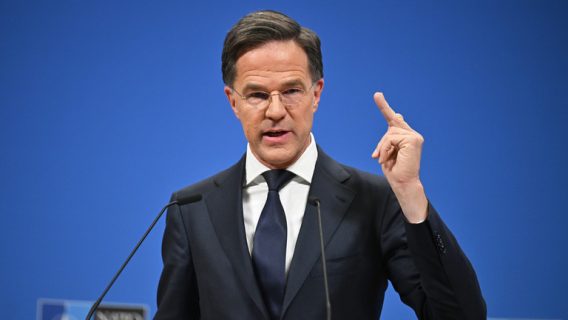
NATO Secretary-General Mark Rutte at NATO headquarters in Brussels, Belgium on February 12, 2025. © Dursun Aydemir / Anadolu via Getty Images
RT | February 12, 2025
NATO Secretary-General Mark Rutte warned Russian President Vladimir Putin on Wednesday that the US-led military bloc would deal a crushing blow to Moscow if it attacks any of its member states.
In recent years, senior officials from European NATO member states, including Rutte, have alleged that Russia is harboring aggressive plans toward the military bloc. Putin has repeatedly dismissed this speculation, calling it “nonsense” and a ruse to justify increased military spending.
Answering reporters’ questions at a press conference in Brussels on Wednesday, Rutte said, “At the moment, if Putin would attack NATO, the reaction will be devastating. He will lose. So, let him not try it, and he knows this. The deterrence and defense is very strong.” However, NATO needs to spend more on defense to be able to defend itself four or five years from now, he added.
Rutte urged member states to make “some difficult decisions this year about… defense spending, doing much, much more than the 2% we pledged.” He went on to say that while the West has “fantastic” arms manufacturers, “they are not producing enough,” which needs to be urgently addressed.
The question regarding supposed Russian aggression was prompted by a report issued by Denmark’s Defense Intelligence Service on Tuesday. According to the document, within five years of ending or freezing the Ukraine conflict, Moscow would be ready to conduct a large-scale onslaught on Europe, based on the assumption that NATO’s defense spending remains at the current level.
“Russia is likely to be more willing to use military force … if it perceives NATO as militarily weakened or politically divided,” the intelligence agency claimed, adding that “this is particularly true if Russia assesses that the US cannot or will not support the European NATO countries in a war.”
Last month, Rutte similarly urged NATO member states to “shift to a wartime mindset” to “prevent war.”
Those who refuse to spend more on defense might as well “get out your Russian language courses or go to New Zealand,” the NATO secretary-general warned at the time.
In December, Rutte suggested that European member states should redirect some of the funds they currently spend on welfare toward their militaries.
On Tuesday, Russia’s Foreign Intelligence Service (SVR) claimed that the Ukrainian special services, with Western support, were preparing a false-flag provocation in the Baltic Sea involving Russian-made naval mines, in the hope of dragging NATO into a direct military confrontation with Moscow.
Leaked documents expose US interference projects in Iran
By Kit Klarenberg | The Cradle | February 11, 2025
A bombshell leak reviewed by The Cradle exposes the depths of Washington’s long-running campaign to destabilize the Islamic Republic.
For years, the US State Department’s Near East Regional Democracy fund (NERD) has funneled hundreds of millions of dollars into covert operations aimed at toppling Tehran’s government – without success. Details on where this money goes and who benefits are typically concealed. However, this leak provides a rare glimpse into NERD’s latest regime-change blueprint.
Covert funding for Iran’s opposition
The document in question is a classified US State Department invitation for bids from private contractors and intelligence-linked entities such as the National Endowment for Democracy (NED) and USAID.
Circulated discreetly in August 2023, it solicited proposals to “support Iranian civil society, civic advocates, and all Iranian people in exercising their civil and political rights during and beyond” the next year’s electoral period, “in order to increase viable avenues for democratic participation.”
NERD summoned applicants to “propose activities” that would “strengthen civil society’s efforts to organize around issues of importance to the Iranian people during the election period and hold elected and unelected leaders accountable to citizen demands.”
The State Department also wished to educate citizens on purported “flaws of Iranian electoral processes.” Submissions were to “pay special attention to developing strategies and activities that increase women’s participation in civil society, advocacy, rule of law, and good governance efforts.”
The document is filled with lofty, euphemistic language. NERD claims to champion “participatory governance, economic reform, and educational advancement,” aiming to cultivate “a more responsive and responsible Iranian government that is internally stable and externally a peaceful and productive member of the community of nations.” In other words, another compliant western client state that serves imperial interests in West Asia rather than challenging them.
NERD envisaged successful applicants coordinating with “governments, civil society organizations, community leaders, youth and women activists, and private sector groups” in these grand plans.
State Department financing would produce “increased diversity of uncensored media” in Iran, while expanding “access to digital media through the use of secure communications infrastructure, tools, and techniques.” This would, it was forecast, improve the “ability of civil society to organize and advocate for citizens’ interests.”
‘Human subjects’
NERD viewed Iran’s 2024 election cycle and the campaigning period as “opportunities” for civil society infiltration. The plan envisioned a network of “civic actors” engaged in electoral strategies ranging from “electoral participation” to “electoral non-participation” – in other words, either mobilizing voters or undermining turnout.
Meanwhile, “technical support and training” would be offered to aspiring female, youth, and ethnic minority leaders at all levels of governance – though no “currently serving” Iranian government official was eligible for assistance.
Once in place, this network of Iranian regime change operatives would, it was hoped, organize “mock national referendums” and other “unofficial” political action outside the Islamic Republic’s formal structures to highlight the alleged disparity between government action and public will.
Iranians would also be assisted in drafting “manifestos” on the local population’s “unmet needs and priorities.” Reference to how crippling US and EU imposed sanctions contribute significantly to public discontent in Tehran was predictably absent. Instead, it stated:
“Activities should be nonpartisan and open to participation from a broad range of groups in order to encourage diverse actors to organize around common interests … All proposed activities must clearly demonstrate an impact upon citizens and civil society groups inside Iran. Support may be provided in-country, through third-country activities with Iranian participants, or virtually through online channels, but the applicant must demonstrate a direct link to civil society actors inside Iran and the ability to engage with these individuals safely and effectively.”
Curiously, certain expenditures were explicitly prohibited, including support for “individual political parties or attempts to advance a particular political agenda in Iran,” US-based activities, academic research, social welfare programs, commercial ventures, cultural festivals, and even “entertainment costs,” such as “receptions, social activities, ceremonies, alcoholic beverages [and] guided tours.”
Most strikingly, the embargo extended to “medical and psychological research or clinical studies using human subjects.” This raises unsettling questions about past NERD-funded projects: Have there been proposals involving human experimentation on Iranian or other foreign citizens? Were efforts to use alcohol as a destabilization tool previously entertained?
‘Rising protests’
It remains unknown which groups ultimately secured NERD funding for these regime-change efforts. The mainstream media maintains that such information is classified ostensibly due to “the risk activists face from Iran.” However, Washington’s secrecy may have less to do with security concerns and more with obscuring the questionable nature of these covert operations.
Tehran long ago wisely banned the meddlesome, subversive activities of US government agencies and intelligence fronts on its soil. However, Washington continued to support multiple western-based Iranian “exile” and diaspora groups, and associated NGOs, civil society groups, and propaganda platforms abroad.
While US officials have publicly acknowledged these efforts, the details – including the identities of sponsored groups and individuals – are systematically concealed.
For example, since-deleted public records show NED alone invested at least $4.6 million in 51 separate counter-revolutionary efforts in Iran between 2016 and 2021. This included financing labor unions, “strengthening independent journalism,” creating a legal publication to encourage “lawyers, law students, and clerics” to agitate for “democratic” reforms, and multiple initiatives concerned with “empowering Iranian women” in business, politics, and society.
The organization charged with delivering a specific initiative was named in just seven cases – that being the DC-based Abdorrahman Boroumand Center.
The identities of the remaining 44 recipients remain unknown. Another erased NED entry reveals that in the year leading up to the September 2022 protests in Iran, the agency spent nearly $1 million on undisclosed projects focused on “human rights” advocacy.
Not a single participating organization was named. For instance, tens of thousands of US dollars were pumped into an anonymous entity to “monitor, document, and report on human rights violations.” The organization would, moreover:
“Work closely with its network of human rights activists [in Iran] to build their capacity in reporting, advocacy, and digital security.”
Foreign influence and the hijacking of Iran’s protests
It’s unclear whether this windfall in any way influenced the September 2022 mass unrest in Iran, but NED was markedly keeping an extremely close eye on events locally from an early stage. One week after demonstrations commenced, the Endowment encouraged anyone interested in “coverage of the rising protests” to follow its aforementioned repeat grant recipient, the Abdorrahman Boroumand Center. While Iranian protests initially generated blanket western media coverage, they fizzled out as rapidly and abruptly as they began.
In a bitter irony, protesters’ energies were significantly dampened due to the brazen exploitation of the upheaval by western actors. Embittered activists openly complained their cause had been “hijacked” by foreign elements.
The most prominent of these US-based agitators is Masih Alinejad, an Iranian exile who has reaped hundreds of thousands of dollars from US government agencies for anti-Tehran propaganda operations. Falsely proclaiming herself to be “leading” the protest movement in the Islamic Republic was, it seems, sufficient to deter further action by locals on the ground.
This reveals the core reason why Washington conceals the recipients of its regime-change funding: Iran’s history of resisting western meddling makes its citizens deeply suspicious of foreign influence. Covert US backing erodes the legitimacy of opposition movements and fuels nationalist pushback.
Ironically, the Washington Post recently reported that many Iranians, across ideological lines, viewed US President Donald Trump’s administration’s freeze on regime-change funding as an opportunity for meaningful political evolution.
In former US president Joe Biden’s final year in office, the White House requested an additional $65 million for NERD’s operations, as outlined in the leaked tender. However, with this funding now in limbo, Iran’s western-backed opposition – largely dependent on foreign subsidies – finds itself in a state of paralysis.
As a result, a significant impediment to genuine diplomatic engagement between Washington and Tehran may have been removed. The coming months could reveal whether this shift opens new avenues for dialogue – or simply marks a temporary pause in America’s longstanding quest for regime change in Iran.
Lawyer visits Dr. Abu Safiya, reveals his exposure to torture and abuse

Palestinian Information Center – February 12, 2025
GAZA – Al-Mezan Center for Human Rights said its lawyer was able on Tuesday to visit Dr. Hussam Abu Safiya for the first time since he was kidnaped from the Gaza Strip 47 days ago.
“Around 3:00 p.m. today, al-Mezan’s lawyer visited Dr. Abu Safiya in Ofer prison, located in the unlawfully occupied West Bank. During the visit, Dr. Abu Safiya detailed the various forms of torture and abuse to which he has been subjected both during his unlawful arrest and throughout his arbitrary detention by Israeli forces and authorities,” al-Mezan explained in a statement on Tuesday.
“When he was captured from Gaza and transferred to the Sde Teiman military detention camp, he was subjected to various forms of torture and inhuman and degrading treatment — methods that are emblematic of Israeli mass arrest operations in Gaza,” al-Mezan said.
Dr. Abu Safiya told the lawyer that he was being forcibly stripped, having his hands tightly shackled, and being made to sit on sharp gravel for approximately five hours by Israeli forces.
He was also subjected to severe physical abuse, including beatings with batons and electric shock sticks, as well as repeated blows to the chest, according to the lawyer.
“In Ofer prison, where he was transferred on January 9, 2025, he was held in solitary confinement for 25 days — a period so prolonged as to constitute a form of torture in itself. During this time, he endured nearly continuous interrogation for 10 days. At one point, he lost consciousness in his cell due to severe breathing difficulties,” the lawyer said.
“During interrogation, Dr. Abu Safiya was confronted with accusations that he firmly denied, stressing that he is a doctor whose sole duty is to provide medical care to patients and the wounded,” the lawyer added.
The detained doctor also reported a severe decline in his health, with his weight dropping from 96 kilograms to 84 kilograms, a 12-kilogram loss in less than two months — further evidence of Israel’s systematic starvation policies against Palestinian prisoners and detainees.
Additionally, Abu Safiya disclosed that he suffers from heart muscle enlargement. Despite repeatedly requesting medical attention from Israeli authorities, he has been systematically denied access to a specialist examination and deprived of essential care, further endangering his already deteriorating condition.
Al-Mezan has unequivocally condemned “the torture and other grave human rights abuses inflicted upon Dr. Abu Safiya by Israeli forces and authorities.”
Al-Mezan has urged the international community, particularly Israel’s allies, to take immediate action to demand the immediate and unconditional release of Dr. Abu Safiya, as well as of all Palestinians who have been unlawfully and arbitrarily detained by Israeli authorities, including hundreds of healthcare workers.
Gaza ceasefire in peril as Israel’s non-compliance sparks diplomatic crisis with Qatar
MEMO | February 12, 2025
Qatar has issued a stark warning to Israel that Prime Minister Benjamin Netanyahu’s conduct is jeopardising the current hostage deal, as mounting evidence reveals multiple violations of the ceasefire by the occupation state.
According to Haaretz, Qatar has conveyed “angry messages” to Israel after Netanyahu’s controversial statements about ethnically cleansing Palestinians from the Gaza Strip and his failure to send a high-level delegation to Doha for negotiations. The Qataris emphasised that their role is guarantors of the agreement and they are not merely intermediaries between Israel and Hamas.
Israel’s violations of the ceasefire terms are extensive and well-documented. The agreed humanitarian aid target of 12,000 trucks has fallen dramatically short, with only 8,500 reaching Gaza. The shelter crisis continues as Israel has delivered just 10 per cent of the promised 200,000 tents, while none of the pledged 60,000 mobile homes have materialised.
The medical evacuation programme has largely failed, with only 120 patients permitted to leave Gaza instead of the anticipated 1,000. Gaza’s Health Ministry reports ongoing Palestinian casualties during the ceasefire period, while Israel continues to block both the return of displaced persons to northern Gaza and the entry of essential equipment needed for the removal of debris and the recovery of dead bodies. At least 48,000 Palestinians have been killed by Israel, mainly women and children, and thousands more are missing, believed dead, under the rubble.
Israel’s violations of the ceasefire agreement have been confirmed by three Israeli officials and two mediators. Speaking anonymously to the New York Times they said that Hamas’s claims about Israel’s non-compliance with the agreement terms were accurate.
Qatar’s Foreign Ministry has taken the unusual step of publicly condemning Netanyahu’s recent television interview proposing the transfer of Gaza’s Palestinian population to Saudi Arabia, describing it as “a flagrant violation of international law.” The diplomatic crisis deepens as Hamas threatens to pause the implementation of the agreement which in turn has been met with threats by US President Donald Trump and Netanyahu.
US Middle East Envoy Steve Witkoff is scheduled to visit the region, including stops in Israel and Doha, to assess the deteriorating situation first hand. Sources suggest that without swift progress in negotiations for the second stage, further delays in hostage releases could lead to a complete collapse of the agreement’s first phase.
Gaza Under Siege: Aid Cut off as US President Trump’s Remarks Threaten Ceasefire
Al-Manar | February 11, 2025
As the drained Gaza Strip faces severe restrictions on humanitarian aid, including the blocking of vital fuel supplies, US President Donald Trump’s recent statements add further tension to an already volatile situation.
An article in the Israeli Haaretz newspaper describes Trump’s recent statements and interventions as ‘tempting fate’, warning that they could derail the ceasefire agreement in Gaza and disrupt the prisoner exchange process.
Zionist analyst Amos Harel, writing for Haaretz, refers to Trump as an “unpredictable force” whose actions risk intensifying the crisis. Trump’s call for the release of prisoners in a single batch, diverging from the previously agreed incremental approach, represents a radical shift in negotiations that could have dangerous consequences.
While many in the Zionist entity, particularly those supporting the prisoner exchange deal, had placed their hopes on Trump, Harel notes that they now share the “painful frustration” previously felt by critics, especially those from the right-wing factions.
Rising Right-Wing Optimism and Potential Fallout
The article further highlights how right-wing factions in the Zionist entity have embraced Trump’s remarks, seeing them as an opening for Zionist Prime Minister Netanyahu to retract his commitments and take military action against Hamas. However, Harel cautions that such action could lead to the deaths of dozens of prisoners still held in Gaza.
In conclusion, Harel dismisses the right-wing optimism surrounding Trump’s intervention, stressing that military force is unlikely to change Hamas’s stance, particularly as the group has nothing left to lose.
He suggests that Trump’s motivations may include securing a significant regional achievement, such as ending the Gaza conflict, facilitating normalization with the Israeli enemy’s regional neighbors, or even securing a Nobel Peace Prize.
Limited Aid and Severe Shortages
In a blatant escalation of restrictions, Israeli occupation forces have blocked the entry of commercial fuel into Gaza, despite clear stipulations in the humanitarian protocol.
Sources within Gaza confirmed to Al-Jazeera that the occupation has also halted the supply of fuel for essential services, including civil defense and municipal vehicles required for crucial road repairs and debris removal.
Additionally, no commercial fuel has been allowed to enter the enclave, exacerbating the ongoing humanitarian crisis.
The same sources revealed that only around 53,000 tents have been allowed into Gaza out of the agreed 200,000, and none of the 60,000 caravans required for shelter have been delivered. They also noted that only 4 heavy vehicles have been permitted to enter for debris removal and body retrieval, despite the sector’s need for 500 such vehicles.
In addition, the Israeli occupation has prevented the entry of construction materials needed for rebuilding hospitals and civil defense centers. Gaza’s Rashid Street remains closed to vehicles, and crossing checks continue on Salah Al-Din Street following the expiration of the 22-day deadline. No power station equipment has been allowed to enter, hindering repairs and the restoration of the power grid.
Featured Video

America Racing to Strategic Defeat in Iran
or go to
Aletho News Archives – Video-Images
From the Archives
Should Europeans ‘Thank’ the Americans for Destroying Nord Stream?
By Robert Bridge | Strategic Culture Foundation | September 29, 2022
With an investigation continuing into the destruction of the Nord Stream gas pipeline that provided energy supplies to Europe from Russia, there appears to be just one prime suspect, and that should surprise nobody.
Following the sabotage of the Nord Stream 1 and 2 gas pipelines, former Polish Foreign Minister Radoslaw Sikorski already seemed to know the identity of the perpetrator when he tweeted out: “Thank you, USA.”
At first glance, it seemed that Sikorski was speaking sarcastically, berating Washington for carrying out an attack that will have severe repercussions for the people of Europe. After all, how could anyone see any good coming from the termination of Europe’s primary source of gas reserves with winter just around the corner? It was Sikorski’s homeland of Poland, after all, that urged its citizens to collect firewood in the face of dwindling gas reserves.
In fact, the Polish diplomat was speaking one-hundred percent literally… continue
Blog Roll
 Aletho News
- Growing insecurity, soaring prices fuel protests in north as regime bans evacuation: Sources
- Iran denies responsibility for ‘depraved’ attack on Kuwait desalination plant
- Bring The Troops Back. End This War Now!
- Can we please stop calling Israel the ‘only democracy in the Middle East’ now?
- US should start removing its troops from Germany, proposes AfD co-leader Chrupalla
- Iran Red Crescent: 600 educational centers attacked in US-Israeli ‘war crimes’
- Russian Oil Tanker Arrives in Cuba Amid U.S. Blockade
- America Racing to Strategic Defeat in Iran: Lt Col Daniel Davis
- FTC Warns Visa, Mastercard, PayPal, Stripe Over Political Debanking
- Russian tanker approaches Cuba despite US oil blockade
- If Americans Knew
- As Iran targets US military bases, will they be relocated to Israel? Not a ceasefire Day 171
- Will Trump Go Kamikaze?
- Is the University of Florida Shutting Down College Republicans over Israel Criticism?
- Jewish extremist arrested over alleged plot to firebomb Palestinian activist Nerdeen Kiswani’s home
- More than half of Palestinian child detainees have no charges
- The More Murderous Israel Gets, The More We Hear About “Antisemitism”
- Land Day and the Palestinian struggle after 30 months of genocide
- The Iran War Is About Palestine
- Israeli soldiers echo settler ideology, talk of revenge after targeting Palestinians and detaining CNN crew in the West Bank
- Israeli Policies Threaten Future of Christian Schools in Jerusalem
- No Tricks Zone
- New Study Finds Warming Saves Lives…Cold Temperatures 12 Times More Deadly Than Excess Heat
- German Science Blog Accuses PIK Climate Institute Of Hallucinating Climate Tipping Points
- Devastating Assessment Of Comirnaty Vaccine By Former Senior Pfizer Europe Toxicologist
- New Study: CO2 Is ‘Effectively Negligible’ As An Explanatory Climate Change Factor Since 2000
- Former Pfizer Toxicologist Dr. Helmut Sterz Tells Bundestag Hearing Pfizer Vaccine Should Have Never Been Approved
- Energy Expert: Germany’s Nuclear Phaseout Was A “500 Billion Euro Mistake”
- New Research: South Australia’s Mid-Holocene Sea Surface Temperatures Were 4°C Warmer Than Today
- Storing Green Energy To Last Germany 10 Days Would Require A 60-Million Tonne Battery
- New Studies: UK Sea Levels Were 4 Meters Higher Than Today During The Mid-Holocene
- Destructive Green New Deal: German Energy And Metal Group Warns Of Drastic Crisis
 Aletho News