Germany’s AFD seeks ‘very good relations’ with Russia
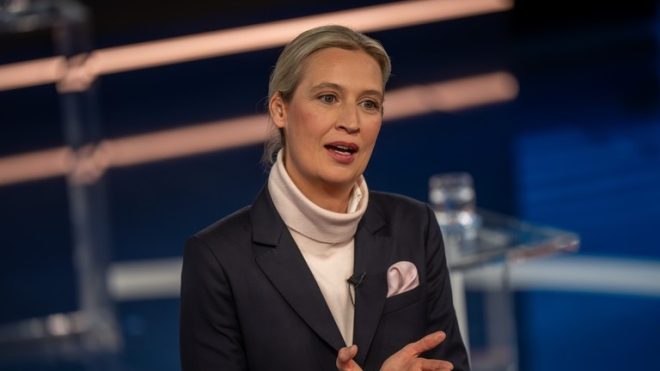
Co-leader of the Alternative for Germany (AfD) party, Alice Weidel © Global Look Press / Michael Kappeler
RT | February 16, 2025
Berlin needs to restore relations with Moscow for the sake of the nation’s economic well-being, Alice Weidel, co-leader of the right-wing Alternative for Germany (AfD) party, has said. Antagonizing Russia has brought the country nothing but trouble, she told Bild tabloid in an interview published on Sunday.
The AfD wants Germany to have “very good relations with our European neighbors” and with great powers as well, the politician said, adding that “it includes Russia.”
“Until two years ago, we sourced cheap natural gas from Russia through the Nord Stream,” Weidel said, referring to the Russian undersea pipelines delivering natural gas to Germany that were sabotaged via a series of explosions in autumn 2022.
Berlin has since taken steps to put an end to Russian energy imports as part of its EU sanctions policy, which is linked to the Ukraine conflict.
According to Weidel, the introduction of restrictions was a mistake since it primarily damaged the German economy. “What we want is to put an end to the sanctions policy,” the politician said, claiming her country currently has “the highest energy prices in the world,” which make the nation “no longer competitive.”
According to the Statista online data aggregator, Germany had the fifth highest electricity prices for households in the world as of March 2024, behind Italy, Ireland, Denmark and Belgium.
When repeatedly pressed by Bild on whether her party wants to restore “good relations” with a nation that supposedly threatens Germany, Weidel replied that Berlin has also been aggressive towards Moscow in its rhetoric over the past years.
The German government was climbing up “the escalation spiral,” the politician said, adding that Berlin’s politicians used belligerent rhetoric and provided weapons to Kiev during its conflict against Moscow.
“German tanks have been rolling against Russia again” for the first time since World War II, she said, referring to the heavy armor supplied to Ukraine as part of the country’s military assistance.
When asked about why she refrains from criticizing Russia’s role in the conflict, Weidel said that Berlin and Moscow should “sit down at the negotiating table” instead. “You have to talk to each other,” she stated, adding that her party was calling on Germany to join the peace negotiations to end the Ukraine conflict. That would be the “only serious policy,” she added.
The AfD has been gaining popular support over the past months despite being ostracized by the other major German political forces, which accuse it of being “far-right.” The party enjoys the backing of between 20% and 21% of the population a week ahead of the snap parliamentary elections, and is projected to come in second behind only the conservative Christian Democratic Union, this week’s polls suggest.
Secret terror blueprints for US NSC to ‘help Ukraine resist’ exposed
By Kit Klarenberg | The Grayzone | February 16, 2025
Newly-leaked documents reveal a crew of military academics pitching the US National Security Council a series of extreme strategies for Ukraine, from IED’s inspired by Iraqi insurgents to sabotaging Russia’s infrastructure to propaganda “from ISIS’ playbook.”
Conceived under the auspices of the UK’s University of St. Andrews, the plans were outsourced through third parties to ensure “plausible deniability.”
Explosive leaked documents reviewed by The Grayzone show how a shady transatlantic collective of academics and military-intelligence operatives conceived schemes which would lead to the US “helping Ukraine resist,” to “prolong” the proxy war “by virtually any means short of American and NATO forces deploying to Ukraine or attacking Russia.”
The operatives assembled their war plans immediately in the wake of Russia’s invasion of Ukraine in February 2022, and delivered them directly to the highest-ranking relevant US National Security Council official in the Biden administration.
Proposed operations ranged from covert military options to jihadist-style psychological operations against Russian civilians, with the authors insisting, “we need to take a page from ISIS’ playbook.”
ISIS was not the only militant outfit upheld as a model for Ukraine’s military. The intelligence cabal also proposed modernizing IEDs, like those staged by Iraqi insurgents against occupying US troops, for a potential stay-behind guerrilla army in Russia, which would attack rail lines, power plants and other civilian targets.
Many of the cabal’s recommendations were subsequently enacted by the Biden administration, dangerously escalating the conflict and repeatedly crossing Russia’s clearly-stated red lines.
Included among the proposals were providing extensive training to “Ukrainian expatriates” in using Javelin and Stinger missiles, enabling “cyberattacks on Russia by ‘patriotic hackers’ with deniability,” and flooding Kiev with “unmanned combat air vehicles.” It was also foreseen that “replacement fighter aircraft” would be provided by “many sources,” and that “non-Ukrainian volunteer pilots and ground crews” would be recruited to fight air battles in the manner of the Flying Tigers, a World War II-era force composed of American Air Force pilots, which was formed in April 1941 to help the Chinese oppose Japan’s invasion before Washington’s formal entry into the conflict.
The document was written and cosigned by a quartet of academic armchair warriors with colorful pasts. They included historian Andrew Orr, the director of the University of Kansas Institute for Military History. His recent academic contributions include a chapter in an obscure academic volume entitled, “Who is a Soldier? Using Trans Theory to Rethink French Women’s Military Identity in World War II.”
Joining him was Ash Rossiter, assistant professor of international security at the United Arab Emirates’ Khalifa University, and described as “ex-British Army Intelligence Corps.” Also participating was Marcel Plichta, then a doctoral candidate at St. Andrews. He’s described as a veteran of the US Defense Intelligence Agency, and his LinkedIn profile indicates he interned at NATO before working in roles with Pentagon contractors, then joined the DIA as an intelligence analyst. Along the way, Plichta claims to have “[nominated] known or suspected terrorists to the national watchlisting and screening community.”
Also involved in the academic cabal was Zachary Kallenborn, a self-styled US Army “mad scientist” currently pursuing his PhD in War Studies at King’s College London, with a focus on drones, WMD, and other edgy forms of modern warfare. Kallenborn, who has moonlighted at the DC-based Center for Strategic and International Studies, contributed to the Ukraine war planning by offering proposals for Iraqi insurgent-style “smart” IED attacks on Russian targets, and planting bombs on Russian trains and railways.

St. Andrews University senior lecturer Marc Devore
The cabal appears to have been led by Marc R. DeVore, a senior lecturer at Britain’s St. Andrews University. Little about his personal or professional background can be ascertained online, although his most recent academic publications discuss military strategy. Around the time the secret proposal document was being drafted, he published an article with Orr for the Pentagon’s in-house Military Review journal entitled “Winning by Outlasting: The United States and Ukrainian Resistance to Russia.” Moreover, he is a fellow at the elite Royal Navy Strategic Studies Centre, a Ministry of Defence-run “think tank.”
Emails show DeVore passed the group’s handiwork directly to Col. Tim Wright, who was the Director for Russia in the Biden administration’s National Security Council (NSC) at the time the emails were sent, according to his LinkedIn profile. Since July 2022, Wright has been the Assistant Head for Research and Experimentation in the Futures Directorate of the British Army.
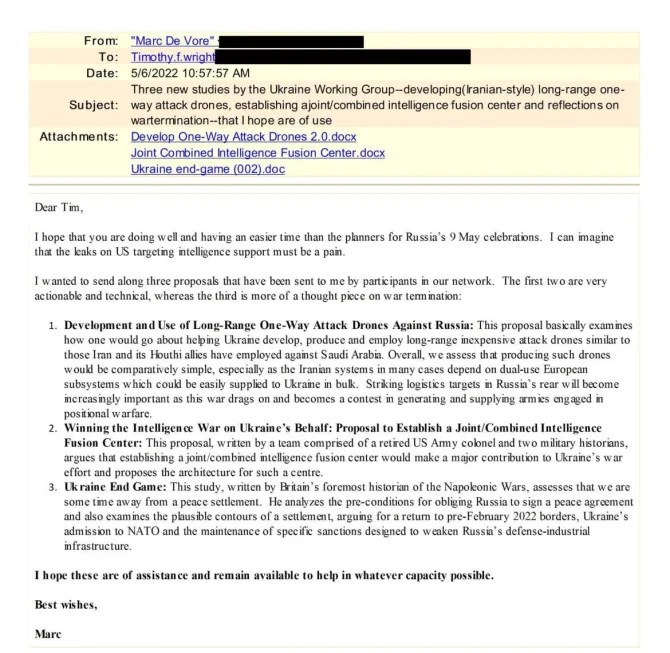
The Grayzone attempted to contact Orr, Rossiter, and Devore by phone and email in order to solicit comment about their role in proxy war scheme, and about whether St. Andrews University was aware it was being used as a base for planning terror attacks against Russia. None have responded to our requests.
Surging the Ukrainian diaspora to the front
Once the Ukraine proxy war erupted with full force in February 2022, the cabal of military academics quickly laid out what they described as “ideas of varying practicality that may not have been considered that Western states can collectively take to strengthen Ukraine’s ability to resist and hopefully preserve its independence.” Dedicated sections spelled out five suggestions, along with “background for such action and possible avenues for implementing them.” They boasted that the “fastest proposals” in the document were “executable in little over a week.”
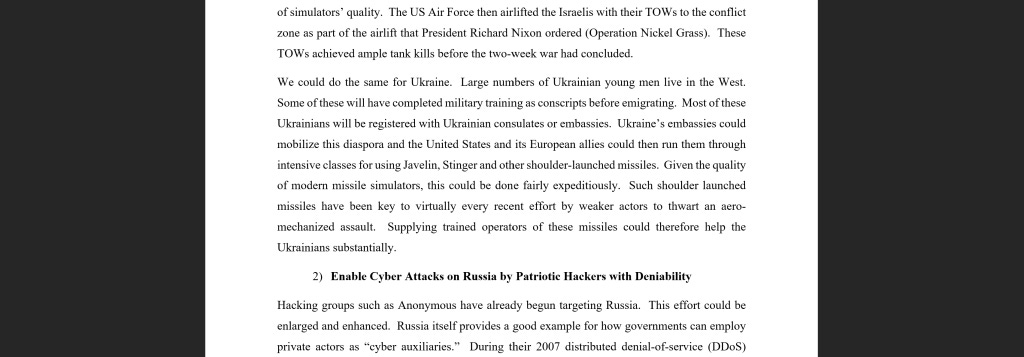
First on the list was arming Ukrainian emigres with anti-tank and anti-aircraft missiles, due to Kiev’s lack of “trained crews to operate the large numbers of missiles” being shipped to them by the West. They cited the little-known October 1973 Operation Nickel Grass as a means of “providing trained crews along with the hardware.” Under that mission’s auspices, Tel Aviv’s embassy in Washington “mobilized Israeli students studying at American universities,” who were then “rushed… through a rapid training program” by the US military.
This included teaching the conscripts how to use weapons similar to Javelin and Stinger missiles. The Israelis were then airdropped onto the frontlines of the 1973 Yom Kippur War against Syria and Egypt, where they “achieved ample tank kills before the two-week war had concluded.” The academics proposed doing “the same for Ukraine,” due to “large numbers of Ukrainian young men” living in the West, some of whom would have completed compulsory military training before emigrating.
This diaspora, it was believed, could easily be identified and recruited due to their registration with Ukrainian “consulates or embassies” in the West, then given “intensive classes” in using “shoulder-launched missiles” before being dispatched to Kiev.
“Volunteer cyber warriors” conceal state hacking
The quartet’s plans extended into the realm of cyberware, calling for “Western intelligence agencies” to “provide cyber tools and suggestions” to “volunteer hackers who want to strike their blow for Ukrainian independence, while also warning them what targets we do not want attacked.”
A “major task for these volunteer cyber warriors,” the four wrote, “could be to make certain that videos of Russian indiscriminate attacks, the use of objectionable weapons such as thermobarics, Ukrainian civilian casualties, Russian casualties and poor befuddled captured Russian conscripts” were made available to Russian audiences. Simultaneously, “patriotic hackers” could seek to bombard Russians with propaganda “about domestic opposition to the war.”
The intelligence cabal made clear they aimed to achieve the same psychological impact as the world’s most notorious terrorist organization, declaring, “we need to take a page from ISIS’ playbook in agilely communicating our message to Russians.”
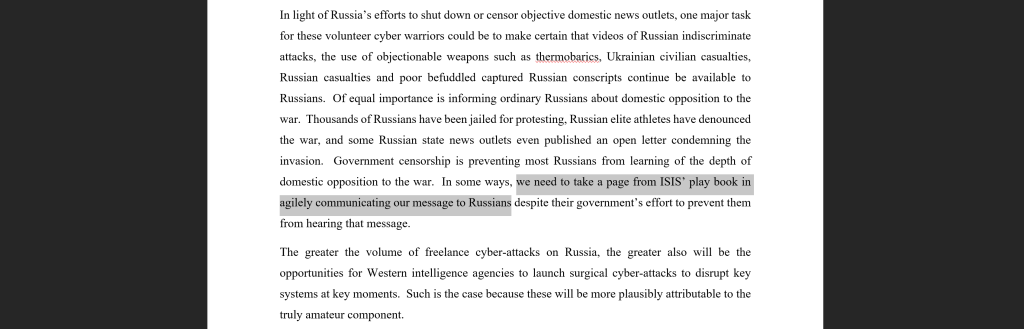
The activities of these “volunteer cyber warriors” were designed to provide cover for more formal, state-level hack attacks on Russian cyber infrastructure. “The greater the volume of freelance cyber-attacks on Russia, the greater also will be the opportunities for Western intelligence agencies to launch surgical cyber-attacks to disrupt key systems at key moments… because these will be more plausibly attributable to the truly amateur component,” the four academics evangelized.
The description offered strongly resembles the so-called “IT Army of Ukraine,” a volunteer cyber militia propped up in the days after Russia’s invasion. Since then, it’s been overseen by Mikhailo Federov, the Ukrainian digital czar credited by the BBC with pressuring Samsung and Nvidia to cease operations in Moscow, and getting PayPal to de-bank all its Russian clients.
Ukraine’s cyber army collaborates closely with Anonymous, the once-countercultural online hacker collective whose work now tracks closely with the objectives of the CIA. The authors of the proposal to the NSC hinted at the relationship, writing, “Hacking groups such as Anonymous have already begun targeting Russia. This effort could be enlarged and enhanced.”
The Ukrainian cyber army has taken credit for various acts of online vandalism. However, it also appears to have been involved in hacks targeting Russia’s power grids and railways. An attack on Russian taxi service Yandex that caused a large September 2022 traffic jam in Moscow was jointly attributed to both Ukraine’s ‘IT Army’ and Anonymous.

US Army “mad scientist” and self-proclaimed “war doctor in training” Zak Kallenborn
“Modern” IEDs for blowing up Russian infrastructure
The academic cabal’s plans for attacking Russia through unconventional means extended explicitly into the realm of terrorism. A series of detailed recommendations for attacking Russian railway systems and roads with improvised explosive devices was put forward by Zachary Kallenborn, a self-described “PhD Student in War Studies at King’s College London researching risk analysis, perception, management, and theories with topical focuses in global catastrophe, drone warfare, WMD, extreme terrorism, and critical infrastructure.”
“Fuel tanks for diesel locomotives are typically on the bottom, underneath the engine,” Kallenborn wrote. “It wouldn’t be very difficult to plant and disguise small explosives between the wooden slats of the railway then detonate when the locomotive is above it… Ideally, guerrillas operating behind Russian lines would place the anti-locomotive lines.”
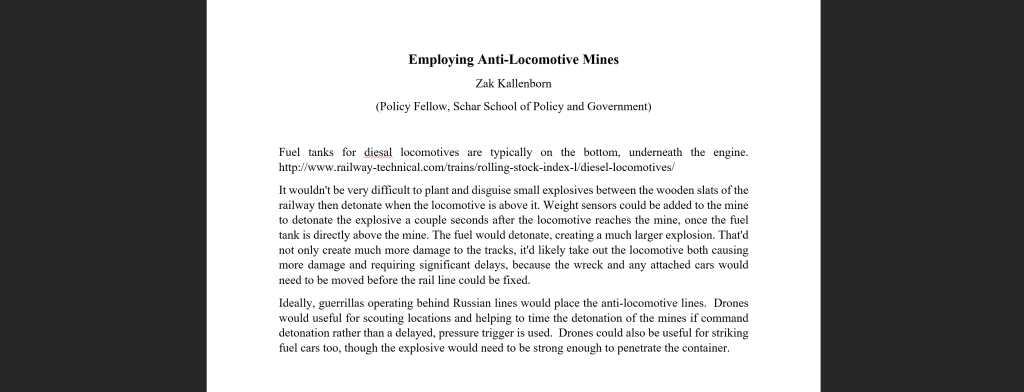
Throughout 2023, a group of self-described Russian and Belarussian anarchists conducted a series of attacks on railways, cell towers, and infrastructure inside Russia. Calling themselves BOAK, or the Combat Organization of Anarcho-Communists, the group of radical saboteurs earned glowing promotion in Western media. It is unclear if it received any outside assistance, however.
Kallenborn’s proposal, drafted in conjunction with the US War Department’s Joint IED Defeat Organization, suggested the US and its allies could “draw upon the lessons they painfully learned in Iraq and Afghanistan to help Ukraine orchestrate an IED campaign behind Russia’s lines.”
With the Taliban and Iraqi insurgents as models, Kallenborn proposed two technologies, “public-private key ring cryptography and ‘smart’ IEDs… to greatly increase the effectiveness of such a campaign.”
To wreak havoc inside Russia, Kallenborn envisioned a modern “stay behind” force similar to those unleashed onto Europe during Cold War era Operation Gladio, when the CIA and NATO organized fascist gangs and mafiosi to conduct anti-communist terrorist attacks.
Meanwhile, “smart” IEDs with “modern components” such as “microcontrollers,” which are now “abundant and cheap,” would allow Ukrainian attackers to “exercise additional discretion, reducing potential for collateral damage,” and “detonate the IED regardless of what the targets do.”
“The circuitry of microcontrollers can internalize most of the circuitry that would originally have been hard-wired into IED initiation switches,” Kallenborn wrote. “All microcontrollers have multiple inputs and outputs allowing multiple inputs, all while controlling multiple devices. Because microcontrollers are programmable, attackers can automate complicated algorithms to maximize an IEDs effects, and reduce collateral damage. Microcontrollers can even, relatively easily, circumvent many common countermeasures.”

Secretly employing contractors to pilot drones
While taking inspiration from non-state actors like ISIS and the Taliban, the Western academics plotting on the Ukrainian government’s behalf had elaborate plans for conventional warfare as well.
They assessed that drones had already “proven effective thus far” in the proxy war, so they urged greater deliveries of Turkish-made Bayraktar TB2s, which they said were “virtually the only airborne platform with which Ukraine is successfully striking Russian ground forces.” They proposed flooding Kiev with “additional TB2s,” pointing out that since Ukraine was already openly using them, and “had more on order before the conflict began,” Turkey’s role in supplying yet further drones could be concealed, leaving its neutrality publicly intact.
Ankara “could potentially transfer significant numbers of TB2s rapidly” from a variety of sources, the academics assumed, and fly them using local “private sector contractors.” If Turkey was unwilling or unable to go along with this plan, alternatives could be sought. “Given how commonly UCAVs are operated by private sector contractors, these could all be remotely piloted by private sector personnel employed by Ukraine, rather than uniformed members of NATO armed forces,” they noted.
Since drones can be operated “from considerable distances away from the frontline (potentially with pilots operating from neighboring countries),” they offered the further “advantage” over contract pilots, in that they would “be comparatively safe and certainly unlikely to be captured and paraded in front of Russian cameras.” While US-produced unmanned systems such as Predators and Reapers were an option, and could be provided “in large numbers,” they “would appear the most provocative” from Russia’s perspective, and make active US involvement too obvious.
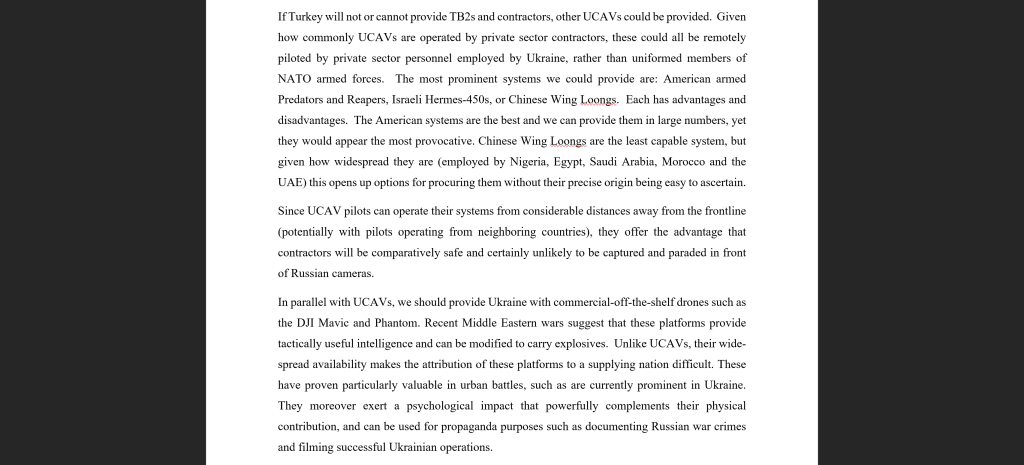
Prophetically, the paper noted Ukraine could be provided instead with “commercial-off-the-shelf drones such as the DJI Mavic and Phantom,” which not only had recording equipment capable of producing “tactically useful intelligence,” but could “be modified to carry explosives.” Moreover, “their wide-spread availability” made “attribution of these platforms to a supplying nation difficult.” It is surely no coincidence that ever since, both drones have been deployed extensively by Kiev to slow Russian advances and swarm military and civilian infrastructure.
By contrast, despite alleged initial successes, Bayraktar TB2s quickly vanished from the skies of Donbass. As several Ukrainian officials have admitted, Russian innovation in air defense and electronic warfare rendered the drones effectively useless. Conversely, the paper noted that while Ukraine’s Air Force was still conducting missions, Kiev would soon “run out of aircraft.” The prescribed remedy was to re-equip the country with Soviet-produced MiG-29 fighters, which “Ukrainian pilots know how to operate” already.
This plan, however, required a number of countries to hand over their ancient fleets of MiG-29s. The academics expressed concern that Central and Eastern European states might be “reticent” due to the risk of “Russian retaliation,” which could be circumvented by “promising gifts” to them, such as weapon upgrades. A year later, in March 2023, Slovakia granted Kiev its entire squadron of thirteen MiG-29s in exchange for a US promise of twelve Bell AH-1Z attack choppers equipped with Hellfire missiles.
Poland initially promised to match Slovakia’s splurge, but only wound up delivering a token amount. The deal has remained on hold since Krakow’s August 2024 announcement that it wouldn’t provide any further MiG-29s until it received a fleet of F-35s, which aren’t expected to arrive until 2026. Peru, likewise tapped by the academics as a potential source for the aircraft, reportedly initially greenlit supply of its MiG-29s to Ukraine, but then reneged. Latin American governments more widely have refused to dispatch any arms whatsoever to Ukraine, despite US pressure.
Air wars waged against Russia by “non-Ukrainian” pilots
Perhaps the most disquieting passage of the document is its last, in which its authors survey historical examples of air forces employing foreign pilots in major conflicts. The paper notes that the aforementioned Flying Tigers “were discharged from the US armed forces” to fight Japan in China, “with the clear understanding that they would be welcomed back thereafter.” Also cited was Finland’s employment of an “entirely” foreign squadron in its 1940 war with Moscow, as well as Zionist settlers’ reliance on an air force “comprised almost entirely of foreign volunteers” during their military campaign against indigenous Palestinian and Arab forces in 1948.
The academics wished to apply these precedents to the Ukraine proxy conflict, creating “volunteer fighter groups today to bolster Ukraine’s air defense” composed of “a reasonable number of Western pilots.” They wrote that these airmen “might volunteer if their national armed forces offered leaves of absence” – as might their civilian counterparts, if US commercial airlines could be “pressured into allowing their pilots, who are fighter-qualified Air Force Reserve or Air National Guard pilots, to take such leaves of absence.” The document boasted that “volunteer fighter groups could substantially disjoint Russia’s air campaign.”
F-16s were considered “the most logical option” due to “the number of NATO members that use F-16s,” including Poland. Accordingly, “Polish spare parts could be trucked into Ukraine comparatively quickly,” with the US “airlifting replacements” to Warsaw. From almost the first day of the proxy war, its most hawkish supporters have demanded that Kiev be provided with these fighter jets, referring to the planes as a “game changer” which would tip the conflict’s scales decisively in favor of Ukraine.
Despite much initial fanfare, when F-16s finally arrived in Kiev in late July of 2024, President Volodomyr Zelensky almost immediately complained the country had only received a handful of jets, and did not have enough pilots trained to fly them. The panic spread to Washington, where Sen. Lindsey Graham publicly urged any “retired F-16 pilot… looking to fight for freedom” to sign up. By the month’s end, the first of F-16s had crashed in uncertain circumstances.
While references to Ukraine’s “game changing” use of F-16s have all but disappeared from the media in the months since, the leaked proposal’s contents raise serious questions on how many supposedly Ukrainian strikes deep inside Russia were actually perpetrated by Western military operatives, acting at the behest of, and with material assistance from, NATO and the US.
“Western European and American fighter pilots tend to fly substantially more hours and train more realistically than their Russian or Ukrainian counterparts,” the academics claimed, meaning they were ideal candidates for conducting “combat missions” against Moscow’s positions, forces, and territory. However, the academics cautioned against Western pilots flying close to the frontline, for fear that “foreign volunteers fall into Russian custody, where an example could be made of them, or they could be paraded in front of the camera.” This was perhaps a nod to CIA pilots Gary Powers and Eugene Hassenfus, whose capture by the Soviet Union and Nicaragua, respectively, humiliated US intelligence.
It’s still unclear how much these proposals determined the course of operations by Ukrainian forces against their Russian foes. But the leaks reviewed by The Grayzone reveal for the first time how, in just a matter of weeks, a small cabal of academics secretly furnished some fairly unconventional war plans on a platter for the CIA and MI6.
Just as Britain did with its Project Alchemy, the Biden administration appears to have outsourced responsibility for crafting its battlefield strategy in Ukraine to a nexus of pinheads with dubious backgrounds, situated thousands of miles from the frontline and its gruesome realities. Almost three years later, with a generation of Ukrainians lost to the proxy war’s meat grinder, the authors of these battle plans are likely still pecking away at their laptops somewhere in the musty halls of academia.
Macron calls emergency summit amid Ukraine peace talks – Warsaw
RT | February 16, 2025
French President Emmanuel Macron has called an emergency summit of European leaders after Moscow and Washington agreed to hold Ukraine peace talks in Saudi Arabia, sidelining the EU.
US President Donald Trump and Russian President Vladimir Putin spoke by phone on Wednesday, marking their first known direct conversation since the escalation of the Ukraine conflict in February 2022.
On Saturday, the countries’ top diplomats followed up with a call to discuss “preparations for a potential high-level Russian-American summit.” Later that day, US Special Envoy Keith Kellogg stated that the EU nations would not be included in the negotiations.
Speaking at the Munich Security Conference, Polish Foreign Minister Radoslaw Sikorski welcomed Macron’s initiative and confirmed that the summit will take place in France on Monday.
“I’m very glad that President Macron has called our leaders to Paris,” Sikorski said, as quoted by Politico, adding that he expects European leaders to discuss “in a very serious fashion” the challenges posed by Trump.
According to Sikorski, Polish Prime Minister Donald Tusk has accepted the invitation and will travel to France next week to “show our strength and unity.”
While the list of invitees was not revealed, The Guardian has reported that UK Prime Minister Keir Starmer will also be attending.
Macron has previously insisted on EU involvement in negotiations, telling the Financial Times that Ukraine must lead discussions on its own sovereignty, but Brussels has a key role in discussing “security guarantees and, more broadly, the security framework for the entire region.”
Meanwhile, Ukrainian President Vladimir Zelensky, who previously banned his government from engaging in direct negotiations with Putin, admitted that Kiev’s representatives were not invited to discussions in Saudi Arabia either. “Maybe there is something at the table, but not on our table,” he told journalists on the sidelines of the Munich Security Conference.
Neither a French government spokesperson nor Foreign Minister Jean-Noel Barrot immediately responded to a request for comment when approached by Politico.
Eruption In “BleachBit,” “Wipe Hard Drive,” “Offshore Bank” Searches In DC Suggest Deep State Panic Mode

By Tyler Durden | Zero Hedge | February 16, 2025
Internet search trends in the Washington, DC, metro area have been nothing short of stunning in recent weeks, reflecting what appears to be growing panic within the federal bureaucracy as President Trump and Elon Musk’s Department of Government Efficiency (DOGE) root out corruption in non-governmental organizations (NGO) and federal agencies.
Earlier this week, internet search trends for “Criminal Defense Lawyer” and “RICO Laws” went viral on X, fueling speculation that Washington’s political elites were in panic mode. The searches coincided with DOGE’s efforts to neuter USAID’s funding of NGOs that propped up a shadow government, as well as begin cutting tens of thousands of workers from various federal agencies.
Now, more suspicious search trends have erupted among DC residents as DOGE efforts went into beast mode at the end of the week.
“Washington DC searches soar for “Swiss bank” (yellow), “offshore bank” (green), “wire money” (red) and “IBAN” (blue),” WikiLeaks wrote on X late Thursday.

Search terms “Wipe” (blue) and “Erase” (red) also moved higher in recent weeks. Wipe hard drives?

Well, yes, the search term “wipe hard drive” across the DC metro has gone absolutely parabolic.

And “BleachBit” too!

Searches for “lawyers” have jumped.
“Statute of limitations” also soared.
Why on Earth would some DC residents panic-search keywords that suggest they are trying to cover up a crime?
Well, just take a look at this!
The accountability sheriff: Trump & DOGE are in town – and the Deep State criminals who have been misappropriating taxpayer funds for years are in panic mode.
Hence this…
Now DOGE’s “Big Balls” member, Edward Coristine, now listed as a “senior adviser” at the State Department’s Bureau of Diplomatic Technology, should focus efforts on those outbound ACH transfers >$1 million in the past few months…
End of the American Empire?
Professor Glenn Diesen with Colonel Douglas Macgregor
Glenn Diesen | February 14, 2025
I had a conversation with Colonel Douglas Macgregor about the state of the US empire and what Trump attempts to do to reverse the relative decline of the US. Trump has been very aggressive against the deep state, which has become wasteful and ideological over the past decades. Trump is making huge moves to get the US out of Ukraine, which will also enable the US to get out of Europe. The greatest weakness in Trump’s foreign policy appears to be his approach to the Middle East, where he risks unleashing a major regional war. Trump’s tactic of bluster and noise to disrupt the status quo and create greater room for manoeuvre will trigger huge movements in the region that cannot be controlled.
The Hidden Renewable Energy in Central Asia

By Brenda Shaffer and Svante Cornell | Real Clear Energy | January 22, 2025
One of the biggest threats to human health, and a major source of air pollution, is regularly hidden in statistical reports as “renewable energy:” the burning of dung, wood, and lump coal. While most of the world receives its energy from fossil fuels, over two billion people on the globe do not have regular access to modern energy and rely on traditional burning of gathered materials. The great majority of the people without access to regular energy live in sub-Saharan Africa. However, in many states, the access to energy is highly differentiated between the main urban centers and the rural population. Central Asia is a region with such a split: it has a high level of human development and electricity access is universal in major cities, but up to a third of the population continues to rely on traditional energy, due either to a lack of reliable access to heat and electricity or due to the latter’s prohibitive cost. One of the top development priorities in Central Asia and globally should be enabling access to modern energy, specifically natural gas, which will in turn vastly improve human health and lower air pollution.
All humans need energy to perform basic functions. Without access to modern energy sources, people burn biomass and other materials they can gather for free or very cheaply. For the first time since World War II, global access to electricity declined in 2022, and likely remained flat in 2023. This left more people relying on traditional energy sources, which leads to increased health threats and rising air pollution.
The extent of people relying on traditional energy is often hidden in the formal statistics on energy use, or goes underreported. Some organizations, such as the International Energy Agency, have begun to categorize traditional burning as renewable energy. The IEA has been able to show an increase in renewable energy consumption by this reporting and an increase in “women in the energy workforce” by classifying women who gather dung and sticks as “energy workers.” In some places, there is general underreporting of traditional energy use, since most of it does not involve traded or taxed goods or formal employment.
Central Asia is a case where despite high or very high levels of human development in all but one of the states of the region, and widespread electricity access, rates of traditional energy use are still very high. In Kazakhstan, 30% of households reported burning coal or wood for heat. Residential burning of coal is one of the main sources of air pollution in Kazakhstan, especially in the winter. The situation in Kyrgyzstan is even worse, with half of the country’s households burning lump coal or dung for winter heat. Due to this indoor air pollution, mortality rates from lung diseases are the highest in the world in Kyrgyzstan. In Tajikistan, many households rely on burning coal, dung and wood for winter heating, albeit precise data on the percentage of households is lacking.
While funding is available from the World Bank and foreign aid donors for renewable energy, few funds are offered to help countries move from health threatening energy use to cleaner fuels, such as natural gas. This is because the World Bank and the G-7 countries in 2021 stopped all funding for fossil fuel energy. Other sources of renewable energy are not a realistic option to provide a serious portion of the energy needs of Central Asia, due to the extreme cold climate of most parts of the region. Kazakhstan is among the world’s coldest countries, with winters lasting for six months. In Kazakhstan and most of Central Asia, reliable and affordable access to heat is necessary for basic survival.
The wealthy countries in the West believe that by denying access to fossil fuels, they can force people to adopt renewable energy. However, the case of Central Asia shows that people will expose themselves to the dangers of traditional energy, without access to safer forms of energy, when renewable energy is expensive, unreliable or not able to meet their geographic needs, such as for heat in the winter.
An IEA report on traditional heating in Kazakhstan suggested that heat pumps could help the population access cleaner energy. This illustrates the disconnect of many of these First World energy institutions from the real life of people. Many people in Central Asia that have access to electricity continue to burn lump coal or wood in their homes, despite the health risks, because it is cheaper and more reliable than electricity. While people in wealthy countries like the United States and the UK have installed heat pumps at a very low rate, poor people in Central Asia can’t even dream of expenses of this nature.
Yet Central Asia has significant resources of natural gas, which Western well-wishers would rather leave in the ground. But increased utilization of natural gas is the only practical option that can help Central Asians lower their dependency on traditional energy. Natural gas supplies have the potential of being both reliable and affordable. Access to new gas supplies will contribute significantly to improving public health and reducing pollution in Central Asia.
The Central Asian example illustrates the unintended consequences of the West’s blanket ban on supporting fossil fuel development, and its lumping together of cleaner natural gas with more polluting fuels like coal and oil. It also serves as a reminder that “renewable” energy does not always mean healthy energy. For many, such as in Central Asia, lack of funding for gas will not drive people to a world powered by wind or solar, but will leave them dependent on burning coal and dung.
Brenda Shaffer is a faculty member of the U.S. Naval Postgraduate School.
Svante E. Cornell is a co-founder and Director of the Institute for Security and Development Policy. He is the Director of the Central Asia-Caucasus Institute & Silk Road Studies Program, the Joint Center operated by ISDP in cooperation with the American Foreign Policy Council (AFPC).
Pete Hegseth & J.D. Vance Tell Europe’s Leaders to Grow Up
By John Leake | Focal Points | February 15, 2025
Growing up is the often painful process of coming to terms with the reality of one’s own limitations, and recognizing that it’s impossible to gain anything in life without hard work and sacrifice. Wisdom lies in recognizing that—as the economist Thomas Sowell would put it—getting what we want often requires a tradeoff. Children, particularly the children of indulgent parents, struggle to recognize this. They want everything NOW and they don’t want to give up anything to get it.
For some time now I have perceived that the European Union—both the supranational entity and the constituent nations—are governed by childish people with childish ideas about what is best for their countries. This has been very painful for me to watch, because I love Europe and spent the happiest years of my life living there.
Especially distressing has been the ruin of Germany with stupid “green energy” initiatives that have wrecked it’s brilliant manufacturing sector, and with its bizarre welcoming of young males from the Arabic-speaking world.
The objective of these policies is apparently to destroy the 1). Economic security of young German men who had long enjoyed great, skilled labor jobs, and 2). the physical security of young German women.
The entire “green energy” hoax completely ignores the laws of thermodynamics, while allowing millions of young Arabic men into Germany ignores the basic reality that most of them have nothing to do in Germany but hang out and chase cute German girls. Any grownup man with a shred of common sense instantly recognizes the folly of these polices.
Equally idiotic has been the willingness of Germany’s so-called leaders to wreck the the excellent relationship that former German Chancellor Gerhard Schroeder forged with Russian President Vladimir Putin.
This relationship—expressed by the construction of the NordStream Pipeline—was built on the essential facts that Germany needed Russia’s plentiful and cheap gas, while Russia (which has an economy smaller than that of Texas) needed a market in which to sell it.
Under the baleful influence of the equally moronic Neocons in Washington, German officials decided to wreck this relationship by playing along with the U.S. fantasy of dominating Ukraine, even if it meant destabilizing the balance of power in Europe and wrecking Germany’s fruitful relationship with Russia.
In the last few days, Secretary of Defense Pete Hegseth and Vice President J.D. Vance have been in Europe, with Hegseth giving talks to NATO officials in Brussels and Vance giving a talk at the Munich Security Conference.
In stark contrast with the creepy weirdos in the Biden administration, the youthful and handsome Hegseth and Vance cut fine figures at their respective talks, which were the most incisive I’ve heard in years. Compared to Kamala Harris’s mealy-mouthed and jarring ramble at the 2022 Munich Security Council—which was apparently designed to insult Russia and dismiss its legitimate security concerns—Vance’s talk was elegant and crystal clear.
The message of both Hegseth and Vance to Europe’s leaders was essentially the same—namely, it’s time for them to grow up and recognize the hard facts of life. Just as the U.S. can no longer afford to indulge its own “regime change” fantasies all over the world, Europe can no longer afford to wreck itself with inane, virtue-signaling fantasies about green energy, mass migration, and Ukraine.
Vance also pointed out the sheer nonsense of claiming to be dedicated to democracy while at the same time persecuting popular parties and even trying to nullify election results. The overheated rhetoric about the rise of conservative populist parties being “far right” and “Nazi” has gotten so tired that no one outside of privileged political and leftist circles believes it.
Hegseth made the following clear:
- NATO membership for Ukraine is not a realistic outcome of a negotiated settlement
- As part of any [postwar] security guarantee, there will not be US troops deployed to Ukraine
- A return to Ukraine’s 1991 borders, an official Ukrainian war aim, is “an unrealistic objective.”
- Stark strategic realities prevent the United States of America from being primarily focused on the security of Europe.
- The United States will no longer tolerate an imbalanced relationship which encourages dependency.
In other words, the U.S. will no longer pursue an antagonistic relationship with Russia in Europe, especially in Ukraine, but will seek a negotiated settlement. If the Europeans want to persist in having an antagonistic relationship with Russia, they are on their own and will have to pay for it.
Hegseth was criticized for what appeared to be making concessions to Russia before President Trump had even commenced negotiations with Russia. The (Neocon) National Review gave him a hard time for this, and an equally hard time for apparently walking back some of these remarks the following day, which made him seem amateurish.
And yet, let’s face it— a return to Ukraine’s 1991 borders is “an unrealistic objective” at this point.
Is a single American, English, German, or Austrian reader of this post willing to die fighting Russia in order to ensure that Ukraine’s 1991 borders are restored?
If you, dear reader, are too old to fight in Ukraine, would you be willing to sacrifice one of your children to restore Ukraine’s 1991 borders?
Samuel Johnson famously remarked:
When a man knows he is to be hanged in a fortnight, it concentrates his mind wonderfully.
Likewise, when a man knows that either he or his young sons are going to be sent abroad to die to maintain Ukraine’s 1991 borders, it concentrates his mind wonderfully. In light of this, I believe it is high time for the Neocon armchair warriors in Washington to quit talking and start enlisting.
Join the army, get into shape, and get your asses over to Ukraine. On the flight over, you may take heart in reading Kipling’s poem to a “Young British Soldier,” which concludes with this heart-rousing stanza:
When you're wounded and left on Afghanistan's plains,
And the women come out to cut up what remains,
Jest roll to your rifle and blow out your brains
       An' go to your Gawd like a soldier.
              Go, go, go like a soldier,
              Go, go, go like a soldier,
              Go, go, go like a soldier,
                  So-oldier of the Queen!
Neocons, go to your Gawd like a soldier!
Medvedev applauds Vance’s ‘humiliating rebuke’ of Europe
RT | February 15, 2025
The deputy chairman of Russia’s Security Council, Dmitry Medvedev, has hailed US Vice President J.D. Vance’s speech at the Munich Security Conference, calling it a rare moment of American honesty about Europe’s weaknesses and Vance himself “a brave guy.”
In his speech on Friday, Vance touched on the migration crisis, security, freedom of speech, and apparent democratic backsliding on the continent.
Medvedev said Vance “unexpectedly lit up” the conference, calling his remarks a harsh but truthful indictment of modern Europe.
“Everyone expected to hear the usual partner-like curtseys to Europe and comments on Donald Trump’s words about the end of the Ukrainian conflict. But he went and harshly scolded the Europeans who have completely lost themselves in recent years: your democracy is weak, your elections are crap, your rules that violate normal human morality are crap,” Medvedev wrote.
He added that the Europeans would retaliate against him if he did not hold such a high post. “However, they will forgive him; they will begrudgingly accept the humiliating rebuke from their senior partner with resentment,” Medvedev concluded.
Vance was particularly severe in his indictment of European democracy. He voiced concerns over the erosion of democratic values in Europe, drawing attention to the annulment of the presidential election in Romania. The first round in November saw right-wing anti-establishment candidate Calin Georgescu come out on top with 22.94%, beating liberal leftist and social democrat candidates. Romania’s top court cited intelligence documents alleging “irregularities” in his campaign performance in making their ruling, although the validity of that evidence has been questioned.
The US vice president also cautioned against rising censorship in the region, told European member-states to take greater responsibility for their own defense, and raised the alarm over mass migration.
US President Donald Trump praised Vance’s speech as “brilliant.” However, some European officials were not so keen on the address. Estonian Prime Minister Kaja Kallas warned that it signaled growing transatlantic tension. German Defense Minister Boris Pistorius meanwhile, blasted the remarks, calling them “not acceptable.”
On the other hand, Russian Senator Alexander Shenderyuk-Zhidkov described Vance’s statements as a “cold shower” for European Russophobes.
Russia’s Lavrov and US’ Rubio Hold Phone Talks
Sputnik – 15.02.2025
Russian and US foreign ministers have held a phone conversation at the initiative of Washington, a source in the Russian Foreign Ministry told Sputnik.
Over the course of this conversation, Lavrov and Rubio:
- Agreed to maintain a communication channel to address accumulated issues in Russian-American relations. This effort aims to remove unilateral barriers inherited from the previous administration that have hindered mutually beneficial trade, economic, and investment cooperation.
- Expressed a mutual commitment to engage on pressing international issues, including the settlement of the situation around Ukraine, developments concerning Palestine, and broader issues in the Middle East and other regional matters.
- Exchanged views on ways to promptly end the policy initiated by the Obama administration in 2016, which significantly tightened conditions for the functioning of Russian diplomatic missions in the US, prompting reciprocal measures.
- Agreed to organize an expert meeting in the near future to coordinate concrete steps for the mutual removal of obstacles to the operations of Russian and US diplomatic missions abroad.
- Reaffirmed their readiness to work together on restoring a respectful intergovernmental dialogue in line with the tone set by the presidents.
- Agreed to maintain regular contacts, including for the preparation of a high-level Russian-American meeting.
Judge Pauses Murthy v. Missouri Amid Trump’s Free Speech Order
By Dan Frieth | Reclaim The Net | February 13, 2025
A federal judge has temporarily halted proceedings in Murthy v. Missouri, a case central to efforts aimed at curbing government involvement in online censorship, following a Supreme Court decision that declined to address the case’s core arguments.
On Tuesday, US District Judge Terry Doughty approved a motion from the defendants — former President Joe Biden and key administration officials — to stay the case. According to Jenin Younes, litigation counsel for the New Civil Liberties Alliance, the pause was granted in light of former President Donald Trump’s recent executive order titled “Restoring Freedom of Speech and Ending Federal Censorship.”
We obtained a copy of the order for you here.
“The government suggested that we move to stay discovery,” Younes told The Federalist. “They want to put in a statement about what effect they think the executive order has. I’m guessing they’re going to say it makes the case moot.”
If the judge agrees, the case could be dismissed as moot after President Trump’s new order. While plaintiffs went along with the stay to allow the judge time to review, Younes noted that the broader concern over government-driven censorship remains a live issue.
“We haven’t staked out our position yet, but there are arguments against mootness,” she said. “Especially if there’s a chance that could happen again and the executive order won’t necessarily be binding on a subsequent administration.”
Initially known as Missouri v. Biden, the lawsuit—brought by the states of Missouri and Louisiana—accused Biden administration officials of working with Big Tech to suppress online speech. The case unearthed extensive evidence showing how federal agencies collaborated with private platforms to censor topics ranging from The New York Post’s Hunter Biden laptop story to alternative viewpoints on the COVID-19 vaccine.
Geneva rejects amnesty grants to nationals fighting in Ukraine
Al Mayadeen | February 15, 2025
Switzerland’s parliament on Friday upheld its ban on citizens joining foreign military conflicts by rejecting a proposal to grant amnesty to those who fought in Ukraine. This decision comes after the country confirmed its first combatant casualty in the war.
Earlier, the Legal Affairs Commission of the National Council had opposed the initiative, which was introduced by Social Democratic Party deputy Jon Pult to exempt Swiss nationals fighting in Ukraine from prosecution.
“The prohibition of participating as a volunteer in combat led by foreign forces is a fundamental principle of Swiss law. Granting amnesty or proceeding with rehabilitations in ongoing conflicts would constitute an undesirable political recognition of mercenarism,” the commission said in a publication on the Swiss Parliament’s website.
The commission emphasized that Swiss law strictly forbids nationals from joining foreign militaries, reaffirming the country’s commitment to neutrality. Consequently, Swiss citizens involved in such conflicts will still face legal consequences upon their return.
Earlier this week, the Swiss Federal Department of Foreign Affairs (FDFA) confirmed the death of a Swiss national who had joined Ukraine’s Armed Forces (AFU)—the first officially acknowledged case since the conflict escalated. The AFU had previously notified the Swiss embassy in Kiev of the individual’s likely death in combat, though details about their unit or deployment remain undisclosed.
30 out of 57 Swiss nationals reportedly died while fighting in Ukraine, according to the Russian Defense Ministry, although the exact number of Swiss mercenaries in Ukraine remains unclear. According to Swiss military justice authorities, 13 investigations were ongoing last year into nationals suspected of mercenary activities.
How is Ukraine handling dissertations and losses?
Since the war with Moscow escalated in 2022, Ukraine has actively recruited foreign fighters to counter battlefield losses and desertions.
The Ukrainian government adopted sweeping mobilization measures and intensified efforts to enforce conscription. These measures include stricter penalties for draft evasion, prompting an increase in attempts to flee the country illegally.
The Ukrainian military, which has been grappling with acute shortages of soldiers, has lowered the mobilization age and intensified recruitment efforts.
President Volodymyr Zelensky’s measures also included severe penalties for draft evaders, including the seizure of property and freezing of bank accounts.
Efforts to escape conscription have led to tragic consequences, with reports of Ukrainian men drowning in attempts to cross into neighboring countries like Romania.
The challenges of evasion are compounded by border restrictions and heightened surveillance.
In response to mounting evasion attempts, Ukrainian authorities have cracked down on corruption within the conscription process, dismissing regional military recruitment chiefs implicated in bribery scandals.
Featured Video
American Military Failure in Afghanistan
or go to
Aletho News Archives – Video-Images
Frlom the Archives
The Fiction of the Jewish History in Palestine
By Hasan Afif El-Hasan | The Palestine Chronicle | April 8, 2011
Prime Minister Benjamin Netanyahu told NNC Pierce Morgan on March 18, 2011 that he might agree to a Palestinian state through negotiations. And he added, “We will make territorial concessions although it is very painful to do that in our ancestral land.” Netanyahu was not talking about Poland where his ancestors lived. He was talking about Palestine where generations of its indigenous population ancestors lived, cultivated the land and are buried.
By the end of the nineteenth century, Zionism created a new Jewish identity of blood and soil. To mobilize their followers and supporters and appeal to their emotions, the Zionists created myths. Zionism started as a tribal religion without god, but in order to fulfill its function as a unifying force, Zionism required external religious and race symbols, not inner content. Its leaders regarded metaphysical religious belief and purity of race as having value in itself. They created a divine paradisiacal state of merger with the gods. Despite his non-religious ideology, Herzl’s writings were replete with religious references. The Jews should settle in Palestine because, in his words, “the Temple will be visible from long distance, for it is only our ancient faith that has kept us together”.
The Zionists and their supporters have invested tremendous financial and scholarly resources to work within the Hebrew Bible historical narratives to affirm the links between the intrusive Zionist population and the ancient Israelite past, and by doing so assert the right of that population to the land. The political end-game shaped the investigation and the outcome. Tracing the roots of Israel’s ethnic state in biblical antiquity is effectively to silence the indigenous Palestinian claim to the past and therefore to the land. The Biblical scholarship employs a bewildering array of terms for the region: “the Holy Land”, “the Land of the Bible”, “Eretz Israel”, “the Land of Israel”, or “Judah and Samaria.” To the casual reader these names appear interchangeable, but they all imply connection to ancient Israel.
Biblical narratives or poems that cannot be supported by archeology and common sense are treated by the Zionists and their supporters as historical language. … continue
Blog Roll
 Aletho News
- Hezbollah Returns: It Didn’t Start a War, It Is Ending One
- EU states seek ‘talks’ with Iran for access to Strait of Hormuz: Report
- Trump on Hormuz: “Others must take care of it” after US falters
- Who Is closer to collapse?
- A War that Backfired: Why the US-Israeli Campaign Is Strengthening Iran
- How Zionist Control Is Hurting US Interests
- Iran warns it may target US missile launch sites in UAE cities
- American Military Failure in Afghanistan
- Friendly Skies of Georgia: Are Israeli-Linked Drones Launching False Flags from Georgian Territory?
- The Three Big Lies about Mammography Screening
- If Americans Knew
- No let-up in attacks on Gaza as Israel takes on Iran, Lebanon – Not a ceasefire Day 155
- ‘Of Course’: IDF Drops Case Against Soldiers Accused of Raping Palestinian Prisoner
- Don’t Fall for the Regime Change Talk. Israel Is ‘Mowing the Lawn’ in Iran
- Will Israel and the US wreck the Gulf States along with Iran?
- US so far burned through ‘years’ of munitions in Iran war: Report
- How the Israeli Tail Wags the American Dog
- Outdated intel likely led to deadly U.S. strike on Iranian elementary school, sources say
- Pentagon insider says high U.S official Douglas Feith reported to Netanyahu
- In fond memory of Walid Khalidi, the historian of Palestine
- 6 more Americans killed, as Israel ‘mows the lawn’ in Iran – Not a ceasefire Day 154
- No Tricks Zone
- Storing Green Energy To Last Germany 10 Days Would Require A 60-Million Tonne Battery
- New Studies: UK Sea Levels Were 4 Meters Higher Than Today During The Mid-Holocene
- Destructive Green New Deal: German Energy And Metal Group Warns Of Drastic Crisis
- New Study Documents A 20-Year Pause In Arctic Sea Ice Decline – Driven By Internal Variability
- Wake-up Call: Survey Shows Majority Of Germans Now Favor Postponing Climate Targets!
- Televised! Leading German Political Candidate Tells Schoolchildren CO2 Makes Sun Hotter!
- New Study: A Century Warming Of 1.1°C Is ‘Commonplace’ And ‘Not Unusual’ During This Interglacial
- New Study: ‘Internal Noise’ And Volcanic Forcing Can Trigger 10-15°C Warming Within Decades
- Glaciers Worldwide Are Suddendly Surging, Experts Blame Warming!
- Surprising Discovery: Sahara Is Greening…Billions Of Trees Where Once Thought To Be Barren
 Aletho News