West’s ‘project Ukraine’ should never have started – ex-US Army officer
RT | February 13, 2025
Russia and the US are “starting to make headway” in resolving the Ukraine conflict by resuming direct communication between their leaders, retired US Army Lieutenant Colonel and international security consultant Earl Rasmussen has told RT. The West’s “project Ukraine should never have started,” he added.
Rasmussen’s comments follow a phone conversation between US President Donald Trump and his Russian counterpart, Vladimir Putin, on Wednesday – the first direct talks between the leaders of the two powers since 2022. Trump said they agreed to have their teams start negotiations to resolve the Ukraine conflict “immediately.” Both Moscow and Washington have indicated that the two leaders will meet face-to-face in the near future.
“We actually have a dialogue between the two leaders… This is a major step forward, considering the previous administration, which almost did a cancel culture attempt on Russia,” Rasmussen said on Thursday.
Rasmussen also commented on Trump’s post-talk statements in which he indicated that Washington will not support Ukrainian accession to NATO as part of a peace deal with Moscow. This signifies Trump’s commitment to ending the conflict as soon as possible, he believes.
“Realistically, Ukraine, I just can never picture it being part of NATO. And I think for the Ukrainian nation and Europe and Russia… neutrality is the best place,” he said, noting that Trump’s acceptance of this fact is “a step forward and a recognition of reality.”
“I think it’s good. I think both leaders want to end the violence and the killing. But you need to recognize Russia’s valid security concerns and their reality on the ground,” he added.
Moscow has cited Kiev’s NATO aspirations and the bloc’s expansion toward its borders as root causes of the conflict, demanding that any settlement include Ukrainian neutrality and demilitarization. It also insists that Kiev recognize the new territorial realities and drop its claims to former Ukrainian regions that chose to join Russia.
Rasmussen suggested that the next step forward is to get Kiev on board with the peace plans. He indicated, however, that this process could be tricky with Vladimir Zelensky at the helm, and suggested that “maybe that’s why we’re pushing for elections” in Ukraine – “to have a transition” of power. Zelensky’s presidential term expired in May last year, but he has refused to hold elections, citing martial law.
Rasmussen also warned that there may be “issues with the political hierarchy in Ukraine,” along with “some pushback from the European leaders” regarding a resolution to the conflict, but said this can be overcome as the global public supports the idea of peace.
End of war in Ukraine near as Poland and Europe fear explosion of Ukrainian crime activity
By Uriel Araujo | February 13, 2025
Even a peace deal will not put an end to problems in the region or tensions in Europe. US-funded Ukrainian radical nationalism will not just go away overnight. Likewise, there is no easy way out of Ukraine’s structural problems with endemic corruption and criminality. When it comes to the Ukrainian crisis, unfortunately, the end is not the end.
The Polish, and the rest of Europe for that matter, are bracing themselves for an explosion of cross-border organized crime activity with the end of the conflict in Ukraine (which now seems closer than ever). Poland’s President Andrzej Duda is warning about such an “explosion” of crime within Ukraine with the end of the war, and is calling on Kyiv’s allies to provide it with “massive support”. Moreover, Duda is worried, as he said in an interview to the Financial Times, that this could spill across the border into his own country, and also affect the rest of Europe and even the United States, with migration waves and transnational mob activity.
The situation reminds the Polish leader of Russia in the early nineties, after Soviet collapse, when organized crime gangs of the so-called “Vor” subculture were able to recruit veterans of the Soviet campaign in Afghanistan. The Ukrainian soldiers, in the present situation, would go back home to find a ruined economy. “Just recall the times when the Soviet Union collapsed and how much the organised crime rate went up in western Europe, but also in the US”, said Duda.
Duda should be taken seriously: The Ukrainian mafia gangs are major players in international crime including the dope trade, prostitution and weapons trafficking. In addition to that, Transparency International ranked Ukraine at 104 out of 180 countries in its 2023 corruption index. Ukraine’s level of corruption is similar to what one may find in Uganda, for instance.
There is another reason why Duda’s warning makes sense: it implies that the end of the conflict could be near enough so that Poland (and Europe) should start taking measures to prepare for such a scenario. There are of course two main ways the war can come to an end: via a Ukrainian victory or via a Russian one. The former is tremendously unlikely as of now unless something extraordinarý were to happen. The latter is obviously what Duda must have in mind.
Poland, despite occasional tensions, has been a steady ally of Kyiv, but even the Polish authorities in Warsaw are saying that they have no intention of deploying their troops in the neighboring country (to help it against Russia). Other European leaders feel similarly about this – with his proposals about deploying troops in Ukraine, France’s President Emmanuel Macron is to become a lone voice.
The situation has obviously changed, largely due to Trump’s election. Even if Ukraine were to somehow obtain victory now through military or diplomatic means, the heavily armed and radicalized nationalists in the country (who can be found in the military and a number of militias) would not simply disappear and would in fact feel empowered in such an unlikely scenario, thus planting the seed for further conflicts with Russia in the future and with other neighbors, including Poland. Again this does not even seem like a possibility at all right now.
A third scenario would be some kind of negotiated peace with Russia still being most plausible. This in fact is thus just a variation of the Russian victory scenario. Here is why such victory today (more than ever) is the most likely scenario to take place pretty soon:
1. The first reason has to do with the Trump factor. The US President, in a clear departure from the previous administration’s foreign policy, has just announced that Washington-Moscow talks on ending the war are to begin “immediately.” It actually makes sense for the US to take the initiative because the whole matter has to a large degree been an American proxy attrition war against Russia.
US Defense Secretary Pete Hegseth has already made Washington’s new stance clear during a meeting at the NATO headquarters in Brussels: he said it would not be realistic for Ukraine to expect to reclaim its pre-2014 borders and there is no point in seeking such an “illusionary goal” and thereby “prolonging” the war. Hegseth also ruled out the possibility of Ukraine becoming a NATO member.
Partly “withdrawing” from Europe (albeit still eyeing Greenland) is in any case in line with Trump’s neo-Monroeism. While focusing on the border and on Panama and other issues, Trump also has to face pressing issues with regard to the crisis in Palestine and Israeli demands. Ukraine is just not his priority, it seems.
2. One can argue that Trump’s call for peace in Ukraine could be only for show and would actually be a way of shifting the Ukrainian “burden” onto Europe. The problem is that it remains unclear whether Europe right now would be capable or willing to play this role. As Zelensky himself told European leaders last month, Europe simply cannot protect Ukraine without American help. The European members of NATO in fact face one concrete threat of aggression against a European ally today, and that comes from Washington itself, which is quite an ironic development. The US President, amazingly enough, has refused to rule out military action to conquer Greenland, which is part of the Kingdom of Denmark.
In other words, a Russian victory, perhaps by a negotiated peace, cannot be taken for granted (nothing can) but is increasingly likely. It would in any case put an end to an unfortunate conflict which has been tremendously costly in a number of ways, including in terms of the humanitarian crisis.
The last two years of the conflict should be always seen as part of the longer one-decade crisis which started in 2014. One may be critical of Vladimir Putin’s decision to launch a military campaign in 2022. The fact remains that the current crisis has been largely driven by American interference, by pushing NATO expansion and supporting the coup d’etat which overthrew President Viktor Yanukovych, as well as backing the subsequent ultra-nationalist Maidan revolution. Washington funded and armed the Ukrainian far-right militias as well which have been integrated into the country’s military and security forces as the case of the infamous Azov regiment.
Ukrainian chauvinism (US funded or not) has in turn fueled tensions – and not only with Russia but also with other neighbors, as I wrote before. The Ukrainian far-right would be empowered even by a Russian victory, because it could promote a revengeful narrative or denounce Zelensky’s “betrayal”.
The ultra-nationalists are not the only ones who can cause problems in the aftermath of today’s crisis – mobsters are another force in itself, as mentioned. With regards to Duda’s concern about a boom in mafia activity, the truth is that Polish-Ukrainian first steps taken towards a confederacy risk blowing back and fueling anti-Ukrainian feelings in Poland, as Poland has issues with its own strand of radical nationalism. Polish ultra-nationalists in fact could also claim parts of neighboring Ukraine with the end of the war, as I’ve written.
It is said one cannot uncook an egg. Be as it may, even if Ukraine and Russia reach a peace deal, this will not put an end to problems in the region or even to tensions in Europe, more broadly. US-funded Ukrainian radical nationalism (which has roots in the new independent state of Ukraine and its attempt at nation-building since the nineties) will not just go away overnight. Likewise, there is no easy way out of Ukraine’s structural problems with endemic corruption and criminality. When it comes to the Ukrainian crisis, unfortunately, the end is not the end.
Uriel Araujo, PhD, is an anthropology researcher with a focus on international and ethnic conflicts.
Panic Grips European Leaders as EU Left Out of Trump-Putin Call
By Svetlana Ekimenko – Sputnik – 13.02.2025
Russian President Vladimir Putin and his US counterpart Donald Trump discussed Ukraine, the Middle East, energy issues, and the exchange of citizens in a telephone call that lasted for one and a half hours, Kremlin Spokesman Dmitry Peskov revealed.
The phone conversation between Vladimir Putin and Donald Trump has triggered a litany of reactions from European politicians.
Britain’s Foreign Secretary David Lammy posted a joined statement by several European states that read: “Our shared objectives should be to put Ukraine in a position of strength. Ukraine and Europe must be part of any negotiations.”
UK Defense Secretary John Healey claimed that no peace talks could be done “about Ukraine without Ukraine.”
Boris Pistorius, Germany’s defense chief, lamented the development as “regrettable” arguing that the Trump administration had made “concessions” to Russia, while asserting that “it would have been better to speak about a possible NATO membership for Ukraine or possible losses of territory at the negotiating table.”
Joining the bandwagon, Germany Foreign Minister Annalena Baerbock added that “peace can only be achieved together. And that means: with Ukraine and with the Europeans.”
In addition, Polish Prime Minister Donald Tusk declared that “All we need is peace… Ukraine, Europe and the United States should work on this together.”
For his part, French top diplomat Jean-Noel Barrot insisted that “There will be no just and durable peace in Ukraine without Europeans.”
Meanwhile, Estonian Defense Minister Hanno Pevkur chimed in, saying: “Europe is investing in Ukrainian defense, and Europe is rebuilding Ukraine with European Union money, with our bilateral aid – so we have to be there.”
And finally, NATO Secretary General Mark Rutte called for turbo-charging defense production among member states, adding: “We have to make sure that Ukraine is in a position of strength.”
NATO boss issues warning to Putin
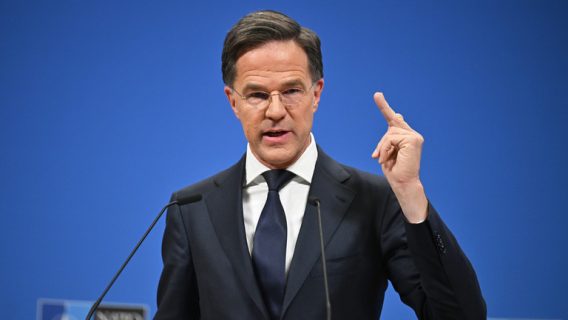
NATO Secretary-General Mark Rutte at NATO headquarters in Brussels, Belgium on February 12, 2025. © Dursun Aydemir / Anadolu via Getty Images
RT | February 12, 2025
NATO Secretary-General Mark Rutte warned Russian President Vladimir Putin on Wednesday that the US-led military bloc would deal a crushing blow to Moscow if it attacks any of its member states.
In recent years, senior officials from European NATO member states, including Rutte, have alleged that Russia is harboring aggressive plans toward the military bloc. Putin has repeatedly dismissed this speculation, calling it “nonsense” and a ruse to justify increased military spending.
Answering reporters’ questions at a press conference in Brussels on Wednesday, Rutte said, “At the moment, if Putin would attack NATO, the reaction will be devastating. He will lose. So, let him not try it, and he knows this. The deterrence and defense is very strong.” However, NATO needs to spend more on defense to be able to defend itself four or five years from now, he added.
Rutte urged member states to make “some difficult decisions this year about… defense spending, doing much, much more than the 2% we pledged.” He went on to say that while the West has “fantastic” arms manufacturers, “they are not producing enough,” which needs to be urgently addressed.
The question regarding supposed Russian aggression was prompted by a report issued by Denmark’s Defense Intelligence Service on Tuesday. According to the document, within five years of ending or freezing the Ukraine conflict, Moscow would be ready to conduct a large-scale onslaught on Europe, based on the assumption that NATO’s defense spending remains at the current level.
“Russia is likely to be more willing to use military force … if it perceives NATO as militarily weakened or politically divided,” the intelligence agency claimed, adding that “this is particularly true if Russia assesses that the US cannot or will not support the European NATO countries in a war.”
Last month, Rutte similarly urged NATO member states to “shift to a wartime mindset” to “prevent war.”
Those who refuse to spend more on defense might as well “get out your Russian language courses or go to New Zealand,” the NATO secretary-general warned at the time.
In December, Rutte suggested that European member states should redirect some of the funds they currently spend on welfare toward their militaries.
On Tuesday, Russia’s Foreign Intelligence Service (SVR) claimed that the Ukrainian special services, with Western support, were preparing a false-flag provocation in the Baltic Sea involving Russian-made naval mines, in the hope of dragging NATO into a direct military confrontation with Moscow.
Leaked documents expose US interference projects in Iran
By Kit Klarenberg | The Cradle | February 11, 2025
A bombshell leak reviewed by The Cradle exposes the depths of Washington’s long-running campaign to destabilize the Islamic Republic.
For years, the US State Department’s Near East Regional Democracy fund (NERD) has funneled hundreds of millions of dollars into covert operations aimed at toppling Tehran’s government – without success. Details on where this money goes and who benefits are typically concealed. However, this leak provides a rare glimpse into NERD’s latest regime-change blueprint.
Covert funding for Iran’s opposition
The document in question is a classified US State Department invitation for bids from private contractors and intelligence-linked entities such as the National Endowment for Democracy (NED) and USAID.
Circulated discreetly in August 2023, it solicited proposals to “support Iranian civil society, civic advocates, and all Iranian people in exercising their civil and political rights during and beyond” the next year’s electoral period, “in order to increase viable avenues for democratic participation.”
NERD summoned applicants to “propose activities” that would “strengthen civil society’s efforts to organize around issues of importance to the Iranian people during the election period and hold elected and unelected leaders accountable to citizen demands.”
The State Department also wished to educate citizens on purported “flaws of Iranian electoral processes.” Submissions were to “pay special attention to developing strategies and activities that increase women’s participation in civil society, advocacy, rule of law, and good governance efforts.”
The document is filled with lofty, euphemistic language. NERD claims to champion “participatory governance, economic reform, and educational advancement,” aiming to cultivate “a more responsive and responsible Iranian government that is internally stable and externally a peaceful and productive member of the community of nations.” In other words, another compliant western client state that serves imperial interests in West Asia rather than challenging them.
NERD envisaged successful applicants coordinating with “governments, civil society organizations, community leaders, youth and women activists, and private sector groups” in these grand plans.
State Department financing would produce “increased diversity of uncensored media” in Iran, while expanding “access to digital media through the use of secure communications infrastructure, tools, and techniques.” This would, it was forecast, improve the “ability of civil society to organize and advocate for citizens’ interests.”
‘Human subjects’
NERD viewed Iran’s 2024 election cycle and the campaigning period as “opportunities” for civil society infiltration. The plan envisioned a network of “civic actors” engaged in electoral strategies ranging from “electoral participation” to “electoral non-participation” – in other words, either mobilizing voters or undermining turnout.
Meanwhile, “technical support and training” would be offered to aspiring female, youth, and ethnic minority leaders at all levels of governance – though no “currently serving” Iranian government official was eligible for assistance.
Once in place, this network of Iranian regime change operatives would, it was hoped, organize “mock national referendums” and other “unofficial” political action outside the Islamic Republic’s formal structures to highlight the alleged disparity between government action and public will.
Iranians would also be assisted in drafting “manifestos” on the local population’s “unmet needs and priorities.” Reference to how crippling US and EU imposed sanctions contribute significantly to public discontent in Tehran was predictably absent. Instead, it stated:
“Activities should be nonpartisan and open to participation from a broad range of groups in order to encourage diverse actors to organize around common interests … All proposed activities must clearly demonstrate an impact upon citizens and civil society groups inside Iran. Support may be provided in-country, through third-country activities with Iranian participants, or virtually through online channels, but the applicant must demonstrate a direct link to civil society actors inside Iran and the ability to engage with these individuals safely and effectively.”
Curiously, certain expenditures were explicitly prohibited, including support for “individual political parties or attempts to advance a particular political agenda in Iran,” US-based activities, academic research, social welfare programs, commercial ventures, cultural festivals, and even “entertainment costs,” such as “receptions, social activities, ceremonies, alcoholic beverages [and] guided tours.”
Most strikingly, the embargo extended to “medical and psychological research or clinical studies using human subjects.” This raises unsettling questions about past NERD-funded projects: Have there been proposals involving human experimentation on Iranian or other foreign citizens? Were efforts to use alcohol as a destabilization tool previously entertained?
‘Rising protests’
It remains unknown which groups ultimately secured NERD funding for these regime-change efforts. The mainstream media maintains that such information is classified ostensibly due to “the risk activists face from Iran.” However, Washington’s secrecy may have less to do with security concerns and more with obscuring the questionable nature of these covert operations.
Tehran long ago wisely banned the meddlesome, subversive activities of US government agencies and intelligence fronts on its soil. However, Washington continued to support multiple western-based Iranian “exile” and diaspora groups, and associated NGOs, civil society groups, and propaganda platforms abroad.
While US officials have publicly acknowledged these efforts, the details – including the identities of sponsored groups and individuals – are systematically concealed.
For example, since-deleted public records show NED alone invested at least $4.6 million in 51 separate counter-revolutionary efforts in Iran between 2016 and 2021. This included financing labor unions, “strengthening independent journalism,” creating a legal publication to encourage “lawyers, law students, and clerics” to agitate for “democratic” reforms, and multiple initiatives concerned with “empowering Iranian women” in business, politics, and society.
The organization charged with delivering a specific initiative was named in just seven cases – that being the DC-based Abdorrahman Boroumand Center.
The identities of the remaining 44 recipients remain unknown. Another erased NED entry reveals that in the year leading up to the September 2022 protests in Iran, the agency spent nearly $1 million on undisclosed projects focused on “human rights” advocacy.
Not a single participating organization was named. For instance, tens of thousands of US dollars were pumped into an anonymous entity to “monitor, document, and report on human rights violations.” The organization would, moreover:
“Work closely with its network of human rights activists [in Iran] to build their capacity in reporting, advocacy, and digital security.”
Foreign influence and the hijacking of Iran’s protests
It’s unclear whether this windfall in any way influenced the September 2022 mass unrest in Iran, but NED was markedly keeping an extremely close eye on events locally from an early stage. One week after demonstrations commenced, the Endowment encouraged anyone interested in “coverage of the rising protests” to follow its aforementioned repeat grant recipient, the Abdorrahman Boroumand Center. While Iranian protests initially generated blanket western media coverage, they fizzled out as rapidly and abruptly as they began.
In a bitter irony, protesters’ energies were significantly dampened due to the brazen exploitation of the upheaval by western actors. Embittered activists openly complained their cause had been “hijacked” by foreign elements.
The most prominent of these US-based agitators is Masih Alinejad, an Iranian exile who has reaped hundreds of thousands of dollars from US government agencies for anti-Tehran propaganda operations. Falsely proclaiming herself to be “leading” the protest movement in the Islamic Republic was, it seems, sufficient to deter further action by locals on the ground.
This reveals the core reason why Washington conceals the recipients of its regime-change funding: Iran’s history of resisting western meddling makes its citizens deeply suspicious of foreign influence. Covert US backing erodes the legitimacy of opposition movements and fuels nationalist pushback.
Ironically, the Washington Post recently reported that many Iranians, across ideological lines, viewed US President Donald Trump’s administration’s freeze on regime-change funding as an opportunity for meaningful political evolution.
In former US president Joe Biden’s final year in office, the White House requested an additional $65 million for NERD’s operations, as outlined in the leaked tender. However, with this funding now in limbo, Iran’s western-backed opposition – largely dependent on foreign subsidies – finds itself in a state of paralysis.
As a result, a significant impediment to genuine diplomatic engagement between Washington and Tehran may have been removed. The coming months could reveal whether this shift opens new avenues for dialogue – or simply marks a temporary pause in America’s longstanding quest for regime change in Iran.
Lawyer visits Dr. Abu Safiya, reveals his exposure to torture and abuse

Palestinian Information Center – February 12, 2025
GAZA – Al-Mezan Center for Human Rights said its lawyer was able on Tuesday to visit Dr. Hussam Abu Safiya for the first time since he was kidnaped from the Gaza Strip 47 days ago.
“Around 3:00 p.m. today, al-Mezan’s lawyer visited Dr. Abu Safiya in Ofer prison, located in the unlawfully occupied West Bank. During the visit, Dr. Abu Safiya detailed the various forms of torture and abuse to which he has been subjected both during his unlawful arrest and throughout his arbitrary detention by Israeli forces and authorities,” al-Mezan explained in a statement on Tuesday.
“When he was captured from Gaza and transferred to the Sde Teiman military detention camp, he was subjected to various forms of torture and inhuman and degrading treatment — methods that are emblematic of Israeli mass arrest operations in Gaza,” al-Mezan said.
Dr. Abu Safiya told the lawyer that he was being forcibly stripped, having his hands tightly shackled, and being made to sit on sharp gravel for approximately five hours by Israeli forces.
He was also subjected to severe physical abuse, including beatings with batons and electric shock sticks, as well as repeated blows to the chest, according to the lawyer.
“In Ofer prison, where he was transferred on January 9, 2025, he was held in solitary confinement for 25 days — a period so prolonged as to constitute a form of torture in itself. During this time, he endured nearly continuous interrogation for 10 days. At one point, he lost consciousness in his cell due to severe breathing difficulties,” the lawyer said.
“During interrogation, Dr. Abu Safiya was confronted with accusations that he firmly denied, stressing that he is a doctor whose sole duty is to provide medical care to patients and the wounded,” the lawyer added.
The detained doctor also reported a severe decline in his health, with his weight dropping from 96 kilograms to 84 kilograms, a 12-kilogram loss in less than two months — further evidence of Israel’s systematic starvation policies against Palestinian prisoners and detainees.
Additionally, Abu Safiya disclosed that he suffers from heart muscle enlargement. Despite repeatedly requesting medical attention from Israeli authorities, he has been systematically denied access to a specialist examination and deprived of essential care, further endangering his already deteriorating condition.
Al-Mezan has unequivocally condemned “the torture and other grave human rights abuses inflicted upon Dr. Abu Safiya by Israeli forces and authorities.”
Al-Mezan has urged the international community, particularly Israel’s allies, to take immediate action to demand the immediate and unconditional release of Dr. Abu Safiya, as well as of all Palestinians who have been unlawfully and arbitrarily detained by Israeli authorities, including hundreds of healthcare workers.
Gaza ceasefire in peril as Israel’s non-compliance sparks diplomatic crisis with Qatar
MEMO | February 12, 2025
Qatar has issued a stark warning to Israel that Prime Minister Benjamin Netanyahu’s conduct is jeopardising the current hostage deal, as mounting evidence reveals multiple violations of the ceasefire by the occupation state.
According to Haaretz, Qatar has conveyed “angry messages” to Israel after Netanyahu’s controversial statements about ethnically cleansing Palestinians from the Gaza Strip and his failure to send a high-level delegation to Doha for negotiations. The Qataris emphasised that their role is guarantors of the agreement and they are not merely intermediaries between Israel and Hamas.
Israel’s violations of the ceasefire terms are extensive and well-documented. The agreed humanitarian aid target of 12,000 trucks has fallen dramatically short, with only 8,500 reaching Gaza. The shelter crisis continues as Israel has delivered just 10 per cent of the promised 200,000 tents, while none of the pledged 60,000 mobile homes have materialised.
The medical evacuation programme has largely failed, with only 120 patients permitted to leave Gaza instead of the anticipated 1,000. Gaza’s Health Ministry reports ongoing Palestinian casualties during the ceasefire period, while Israel continues to block both the return of displaced persons to northern Gaza and the entry of essential equipment needed for the removal of debris and the recovery of dead bodies. At least 48,000 Palestinians have been killed by Israel, mainly women and children, and thousands more are missing, believed dead, under the rubble.
Israel’s violations of the ceasefire agreement have been confirmed by three Israeli officials and two mediators. Speaking anonymously to the New York Times they said that Hamas’s claims about Israel’s non-compliance with the agreement terms were accurate.
Qatar’s Foreign Ministry has taken the unusual step of publicly condemning Netanyahu’s recent television interview proposing the transfer of Gaza’s Palestinian population to Saudi Arabia, describing it as “a flagrant violation of international law.” The diplomatic crisis deepens as Hamas threatens to pause the implementation of the agreement which in turn has been met with threats by US President Donald Trump and Netanyahu.
US Middle East Envoy Steve Witkoff is scheduled to visit the region, including stops in Israel and Doha, to assess the deteriorating situation first hand. Sources suggest that without swift progress in negotiations for the second stage, further delays in hostage releases could lead to a complete collapse of the agreement’s first phase.
Gaza Under Siege: Aid Cut off as US President Trump’s Remarks Threaten Ceasefire
Al-Manar | February 11, 2025
As the drained Gaza Strip faces severe restrictions on humanitarian aid, including the blocking of vital fuel supplies, US President Donald Trump’s recent statements add further tension to an already volatile situation.
An article in the Israeli Haaretz newspaper describes Trump’s recent statements and interventions as ‘tempting fate’, warning that they could derail the ceasefire agreement in Gaza and disrupt the prisoner exchange process.
Zionist analyst Amos Harel, writing for Haaretz, refers to Trump as an “unpredictable force” whose actions risk intensifying the crisis. Trump’s call for the release of prisoners in a single batch, diverging from the previously agreed incremental approach, represents a radical shift in negotiations that could have dangerous consequences.
While many in the Zionist entity, particularly those supporting the prisoner exchange deal, had placed their hopes on Trump, Harel notes that they now share the “painful frustration” previously felt by critics, especially those from the right-wing factions.
Rising Right-Wing Optimism and Potential Fallout
The article further highlights how right-wing factions in the Zionist entity have embraced Trump’s remarks, seeing them as an opening for Zionist Prime Minister Netanyahu to retract his commitments and take military action against Hamas. However, Harel cautions that such action could lead to the deaths of dozens of prisoners still held in Gaza.
In conclusion, Harel dismisses the right-wing optimism surrounding Trump’s intervention, stressing that military force is unlikely to change Hamas’s stance, particularly as the group has nothing left to lose.
He suggests that Trump’s motivations may include securing a significant regional achievement, such as ending the Gaza conflict, facilitating normalization with the Israeli enemy’s regional neighbors, or even securing a Nobel Peace Prize.
Limited Aid and Severe Shortages
In a blatant escalation of restrictions, Israeli occupation forces have blocked the entry of commercial fuel into Gaza, despite clear stipulations in the humanitarian protocol.
Sources within Gaza confirmed to Al-Jazeera that the occupation has also halted the supply of fuel for essential services, including civil defense and municipal vehicles required for crucial road repairs and debris removal.
Additionally, no commercial fuel has been allowed to enter the enclave, exacerbating the ongoing humanitarian crisis.
The same sources revealed that only around 53,000 tents have been allowed into Gaza out of the agreed 200,000, and none of the 60,000 caravans required for shelter have been delivered. They also noted that only 4 heavy vehicles have been permitted to enter for debris removal and body retrieval, despite the sector’s need for 500 such vehicles.
In addition, the Israeli occupation has prevented the entry of construction materials needed for rebuilding hospitals and civil defense centers. Gaza’s Rashid Street remains closed to vehicles, and crossing checks continue on Salah Al-Din Street following the expiration of the 22-day deadline. No power station equipment has been allowed to enter, hindering repairs and the restoration of the power grid.
BBC Rides to the Rescue as Scientists Inconveniently Find the Gulf Stream Isn’t Getting Weaker

By Chris Morrison | The Daily Sceptic | February 6, 2025
Last month a group of scientists published a paper in Nature stating that the Atlantic Meridional Overturning Circulation (AMOC) had shown no decline in strength since the 1960s. Helped by publicity in the Daily Sceptic, the story went viral on social media, although it was largely ignored in narrative-driven mainstream publications. The collapse of the Gulf Stream, a key component of the AMOC, is an important ‘tipping point’ story used to induce mass climate psychosis and make it easier to impose the Net Zero fantasy on increasingly resentful and questioning populations. Obviously, reinforcements to back up such an important weaponised scare needed to be rushed to the front and the BBC has risen to the challenge. The AMOC “appears to be getting weaker” state BBC activists Simon King and Mark Poynting. Their long article is a classic of its kind in trying to deflect scientific findings that blow holes in the ‘settled’ narrative.
In the Nature paper, three scientists working out of the Woods Hole Oceanographic Institution stated that they came to their conclusion showing the stability of the AMOC after examining heat transfers between the sea and the atmosphere. It was noted that the AMOC had not weakened from 1963 to 2017, “although substantial variability exists at all latitudes”. This variability is the basis for much of the Gulf Stream fear-mongering. The BBC notes that the presence of larger grains of sediment on the ocean floor suggests the existence of stronger currents, pointing to a “cold blob” in the Atlantic that appears to have cooled of late. Thin pickings, it might be thought, to run an article titled ‘Could the UK actually get colder with global warming?’ The Woods Hole scientists note that records “are not long enough to differentiate between low frequency variability and long-term trends”.
The Nature story is not the only recent scientific finding that suggests the Day After Tomorrow alarm about the AMOC is a tad overdone. In 2023, Georgina Rannard of the BBC reported that “scientists say” a weakening Gulf Stream could collapse as early as 2025. There was no later reporting, needless to say, of subsequent work from a group of scientists at the US weather service NOAA that discovered the huge flow of Gulf Stream tropical water through the Florida Straits had remained “remarkably stable” for over 40 years.
Of course the BBC, along with most of the legacy media, has form as long as your arm when it comes to producing deflective copy seemingly designed to head off inconvenient scientific findings. The Great Barrier Reef (GBR) is the largest and best observed collection of tropical coral in the world. Any sign of ill health is a boon for green propogandists who argue that warming measured in tenths of a degree centigrade will destroy an organism that has survived for millions of years in temperatures between 24-32°C. For the last three years, coral on the GBR has hit recent record levels with scarcely a mention in mainstream media. Days before last year’s record was announced, the places where journalism goes to die were full of stories from a paper that conveniently noted climate change posed an “existential threat” to the reef. “The science tells us that the GBR is in danger and we should be guided by the science,” Professor Helen McGregor from the University of Wollongong told Victoria Gill of BBC News. Professor McGregor’s statement was an opinion readily broadcast by the BBC, a courtesy that does not appear to have been extended to the fact that coral on the GBR was at its highest level since detailed observations began.
It beggars belief that the BBC and all its fellow alarmists can run this stuff with a straight face knowing that crucial scientific information is missing from their reports. Important findings from reputable sources emerge about the current stability of the Gulf Stream and the response is to blow more smoke around that raises wholly unnecessary fears.
The main concern is that the AMOC “could suddenly switch off”, state King and Poynting. To back up their statement and provide the inevitable political message they note the comment of Matthew England, Professor of Oceanography at the University of South Wales: “We’re playing a bit of a Russian roulette game. The more we stack up the atmosphere with greenhouse gases, the more we warm the system, the more chance we have of an AMOC slowdown and collapse.” Now look what you plebs have done with your steak chomping, gas-guzzling central heating and naff holidays in Benidorm, is an unpleasant subtext here.
Of course, keen and dedicated followers of climate alarmists will note a master craftsman at work. In 2023, aided by 35 million computer hours and using an improbable rise in temperature of up to 4°C in less than 80 years, Professor Matthews suggested that there was a dramatic slowdown in deep Antarctica ocean currents. Melting Antarctica ice could lead to a 40% slowdown in just 30 years. The fact that Antarctica has barely warmed in 70 years is ignored.
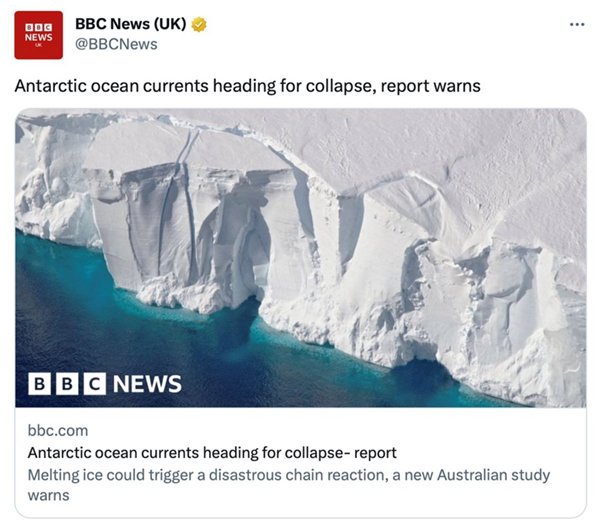
Who needs Hollywood sci-fi blockbusters when we have the BBC.
Ohio Northern Sues Professor Scott Gerber for Defending His Rights in Court
By Ben Squires | Reclaim The Net | February 9, 2025
Ohio Northern University (ONU) is facing legal battles on multiple fronts after firing Professor Scott Gerber following his outspoken opposition to the school’s diversity, equity, and inclusion (DEI) policies. The controversy has now escalated into a federal lawsuit, with the university suing Gerber after he took legal action to challenge his dismissal.
Gerber, a tenured professor and longtime critic of ONU’s DEI initiatives, became the subject of an administrative investigation in January 2023. Despite repeated requests, ONU refused to disclose the specific accusations against him. When he was finally informed of his alleged failure to maintain “collegiality,” free speech advocacy group FIRE argued that this charge resembled retaliation for his views on DEI, potentially violating ONU’s commitment to academic freedom.
In April 2023, ONU ordered campus police to remove Gerber from his classroom and escort him to the dean’s office, where he was pressured to resign immediately. Gerber refused, and the university terminated his employment. A state judge later criticized ONU’s “callous disregard for due process” and allowed Gerber’s breach of contract case to proceed to trial, citing the school’s “troubling” lack of justification for his termination.
Instead of addressing concerns raised in court, ONU responded by suing Gerber in federal court on Jan. 20, alleging that his lawsuit was a “perverted” effort to “unleash political retribution” against the university. The lawsuit accuses Gerber of attempting to “manufacture outrage” and claims his legal challenge constitutes an unlawful “abuse of process.”
A key aspect of ONU’s complaint is Gerber’s public statements regarding his firing. The university objects to his writings in The Wall Street Journal and a press release from his attorneys at America First Legal, dismissing them as a “manufactured narrative.” However, Gerber and his legal team maintain that their statements rely on ONU’s own records and policies, which the state court has deemed sufficient to warrant trial.
Critics have condemned ONU’s lawsuit as a classic example of a Strategic Lawsuit Against Public Participation (SLAPP)—a legal tactic intended to silence dissent by burdening individuals with costly litigation. By forcing Gerber to defend himself in federal court while preparing for his state trial, ONU’s actions raise broader concerns about the use of legal intimidation against faculty members.
“Professors should not have to go to court to defend their right to free speech,” said a spokesperson for FIRE. “And universities should not be using litigation to silence their critics.”
The Foundation for Individual Rights and Expression (FIRE) notes:
“Disturbingly, the crux of ONU’s complaint rests on Gerber’s protected speech. The university faults Gerber for expressing accurate information about his ordeal in the Wall Street Journal and through a press release published by his attorneys at America First Legal, maligned by ONU as a “manufactured narrative” designed to “manufacture outrage.” Yet Gerber and America First Legal cite the university’s own words and policies to make his case, which a state court has allowed to proceed by rejecting ONU’s efforts to dismiss his claims.”
Featured Video
American Military Failure in Afghanistan
or go to
Aletho News Archives – Video-Images
Frlom the Archives
The Fiction of the Jewish History in Palestine
By Hasan Afif El-Hasan | The Palestine Chronicle | April 8, 2011
Prime Minister Benjamin Netanyahu told NNC Pierce Morgan on March 18, 2011 that he might agree to a Palestinian state through negotiations. And he added, “We will make territorial concessions although it is very painful to do that in our ancestral land.” Netanyahu was not talking about Poland where his ancestors lived. He was talking about Palestine where generations of its indigenous population ancestors lived, cultivated the land and are buried.
By the end of the nineteenth century, Zionism created a new Jewish identity of blood and soil. To mobilize their followers and supporters and appeal to their emotions, the Zionists created myths. Zionism started as a tribal religion without god, but in order to fulfill its function as a unifying force, Zionism required external religious and race symbols, not inner content. Its leaders regarded metaphysical religious belief and purity of race as having value in itself. They created a divine paradisiacal state of merger with the gods. Despite his non-religious ideology, Herzl’s writings were replete with religious references. The Jews should settle in Palestine because, in his words, “the Temple will be visible from long distance, for it is only our ancient faith that has kept us together”.
The Zionists and their supporters have invested tremendous financial and scholarly resources to work within the Hebrew Bible historical narratives to affirm the links between the intrusive Zionist population and the ancient Israelite past, and by doing so assert the right of that population to the land. The political end-game shaped the investigation and the outcome. Tracing the roots of Israel’s ethnic state in biblical antiquity is effectively to silence the indigenous Palestinian claim to the past and therefore to the land. The Biblical scholarship employs a bewildering array of terms for the region: “the Holy Land”, “the Land of the Bible”, “Eretz Israel”, “the Land of Israel”, or “Judah and Samaria.” To the casual reader these names appear interchangeable, but they all imply connection to ancient Israel.
Biblical narratives or poems that cannot be supported by archeology and common sense are treated by the Zionists and their supporters as historical language. … continue
Blog Roll
 Aletho News
- Lawyers’ groups demand end to British military bases in Cyprus
- CIA Assessment: The Resistance Cannot Be Crushed
- Hezbollah Returns: It Didn’t Start a War, It Is Ending One
- EU states seek ‘talks’ with Iran for access to Strait of Hormuz: Report
- Trump on Hormuz: “Others must take care of it” after US falters
- Who Is closer to collapse?
- A War that Backfired: Why the US-Israeli Campaign Is Strengthening Iran
- How Zionist Control Is Hurting US Interests
- Iran warns it may target US missile launch sites in UAE cities
- American Military Failure in Afghanistan
- If Americans Knew
- As US-Israel war on Iran rages, Gaza faces massive dust storm – Not a ceasefire Day 156
- No let-up in attacks on Gaza as Israel takes on Iran, Lebanon – Not a ceasefire Day 155
- ‘Of Course’: IDF Drops Case Against Soldiers Accused of Raping Palestinian Prisoner
- Don’t Fall for the Regime Change Talk. Israel Is ‘Mowing the Lawn’ in Iran
- Will Israel and the US wreck the Gulf States along with Iran?
- US so far burned through ‘years’ of munitions in Iran war: Report
- How the Israeli Tail Wags the American Dog
- Outdated intel likely led to deadly U.S. strike on Iranian elementary school, sources say
- Pentagon insider says high U.S official Douglas Feith reported to Netanyahu
- In fond memory of Walid Khalidi, the historian of Palestine
- No Tricks Zone
- Storing Green Energy To Last Germany 10 Days Would Require A 60-Million Tonne Battery
- New Studies: UK Sea Levels Were 4 Meters Higher Than Today During The Mid-Holocene
- Destructive Green New Deal: German Energy And Metal Group Warns Of Drastic Crisis
- New Study Documents A 20-Year Pause In Arctic Sea Ice Decline – Driven By Internal Variability
- Wake-up Call: Survey Shows Majority Of Germans Now Favor Postponing Climate Targets!
- Televised! Leading German Political Candidate Tells Schoolchildren CO2 Makes Sun Hotter!
- New Study: A Century Warming Of 1.1°C Is ‘Commonplace’ And ‘Not Unusual’ During This Interglacial
- New Study: ‘Internal Noise’ And Volcanic Forcing Can Trigger 10-15°C Warming Within Decades
- Glaciers Worldwide Are Suddendly Surging, Experts Blame Warming!
- Surprising Discovery: Sahara Is Greening…Billions Of Trees Where Once Thought To Be Barren
 Aletho News