Rick Sanchez “threatened with prison” over work with RT
RT | March 18, 2025
Former RT host and longtime television journalist Rick Sanchez has spoken about his experience with the Russian broadcaster in a newly released interview with Tucker Carlson. Once one of RT’s highest-rated anchors, Sanchez revealed that he was forced out of his job last summer under pressure from the administration of former US President Joe Biden, which he says even threatened him with prison over ties with RT. He also revealed that his departure was foreshadowed by an unexpected phone call from an “old friend,” a warning which he described as a case study in the decline of free speech in the US.
Press freedom in the US
Sanchez has criticized the state of press freedom in the US, particularly under the Biden administration. The veteran journalist expressed concerns over increasing restrictions on alternative media voices, arguing that journalists who deviate from government-approved narratives often face professional consequences. He described a growing atmosphere of intolerance for dissenting perspectives, particularly regarding coverage of international conflicts.
Sanchez claimed that mainstream media outlets have become overly aligned with government interests, limiting diverse viewpoints and discouraging critical journalism. “If you don’t toe the line, if you don’t say what they want you to say, you’re out,” he said, emphasizing the pressures faced by journalists covering global affairs, especially those related to Russia and Ukraine. He suggested that reporters are under immense pressure to conform to prevailing narratives or risk retaliation.
Experience working for RT
Reflecting on his time at the Russian news network RT, Sanchez described it as an unexpectedly positive experience. He recalled initially joining the network with some hesitation but soon realizing that he was given considerable editorial freedom.
Sanchez noted that, unlike in many Western outlets, he was not instructed on what to say or how to frame his reports. He characterized his time at RT as “almost nirvana” in terms of journalistic independence, a stark contrast to his experience in US media. However, he also acknowledged that working for a Russian-backed network came with significant scrutiny, particularly from American authorities.
Mysterious phone call from an “old friend”
Sanchez also revealed that he had received a cryptic telephone call from an “old friend” shortly before he was forced to cut ties with RT. He described the conversation as unsettling, with the caller warning him that the people at the government agency he now works for “don’t necessarily like some of the things that you’re saying.”
While he did not disclose the caller’s identity, Sanchez suggested that the person had inside knowledge of actions being taken against him and that the call was meant to intimidate him into resigning before more severe repercussions followed.
Threats of prison
Expanding on the pressures he faced, Sanchez stated that he was not only forced to leave RT but also threatened with legal action. He alleged that US authorities made it clear that his association with the network could result in imprisonment.
“They were like, no, you violate the order and you’re going to prison,” Sanchez revealed, emphasizing the seriousness of the threats. While he did not specify the exact nature of the charges he was warned about, he argued that such actions demonstrate how far the US government is willing to go to suppress dissenting voices.
US tendency to create a villain
One of the central themes of Sanchez’s interview was the American tendency to create a villain in political discourse. He observed that the US media frequently needs an adversary to rally public opinion against, whether it be Russia, China, or a domestic political figure.
Sanchez warned that this pattern stifles critical thinking and forces audiences into a black-and-white worldview where certain countries or individuals are portrayed as purely evil while others are beyond reproach. He argued that this mindset contributes to unnecessary conflicts and prevents meaningful diplomatic engagement.
Sanchez’s perspective on the state of US media
Sanchez offered a harsh critique of American journalism, claiming that many mainstream outlets have abandoned their role as independent watchdogs. He accused the media of prioritizing corporate and political interests over factual reporting, resulting in a narrow and often misleading portrayal of global events.
He further claimed that media consolidation has contributed to the problem, as a handful of powerful companies control most of the news Americans consume. This, according to Sanchez, has led to an environment where only certain viewpoints are allowed airtime, while dissenting opinions are marginalized or outright censored.
Pinning hopes on Trump to reverse trend
Looking ahead, Sanchez expressed hope that US President Donald Trump could lead to a reversal of sanctions imposed on RT and other alternative media sources. He suggested that Trump, who has had a contentious relationship with mainstream US media, might be more inclined to allow greater media pluralism.
“The Trump administration will undo this because things are moving and there’s negotiations now with Russia,” Sanchez said. “And I understand the Trump administration is trying to remove some of the silly sanctions that we have on them that are just ridiculous.”
Sanchez argued that lifting restrictions on foreign-backed outlets would be a step toward restoring genuine press freedom and allowing Americans access to a broader range of perspectives. He concluded that, regardless of political affiliations, the suppression of alternative voices ultimately harms democracy.
Tensions escalate on Syria-Lebanon border as EU/NATO-backed massacres of minorities continue
By Drago Bosnic | March 18, 2025
Ever since the destruction of sovereign Syria, the situation on the ground keeps deteriorating. The EU/NATO-backed terrorist “government” is resorting to extreme violence in an attempt to establish control over areas primarily populated by minorities, particularly Alawites and Christians. Thousands have been brutally murdered as a result of this terrorist takeover, with the new “government” sending its forces (composed of Al Qaeda-affiliated armed personnel) to crush any opposition. This issue is now slowly becoming transnational as armed clashes are reported on the Syria-Lebanon border. Namely, the Hayat Tahrir al-Sham (HTS) terrorists (now posing as the “new Syrian military”) are shelling and launching rockets at Lebanese border towns.
Beirut sent military forces to respond to these attacks. Over the weekend, local sources reported that “the Beqaa Valley has been under continuous shelling for three hours with rockets and artillery coming from Syrian territory”. The new terrorist “government” occupying Syria since early December also regularly launches armed drones into Lebanese territory, while several rockets launched from the Qusayr countryside (administratively part of the Homs Governorate) hit the Lebanese border town of Qasr. Local sources report that “heavy shelling is ongoing”, resulting in “civilian casualties on the Lebanese side, including at least one child”. Citing military data, the traditionally pro-terrorist Al Jazeera reports that “eight members of the Syrian Ministry of Defense were killed in the clashes”.
It should be noted that the “Syrian Ministry of Defense” in this case refers to one controlled by the unelected EU/NATO-backed terrorist “government”. The fighting supposedly “began several hours after three HTS fighters were found dead inside Lebanese territory” and “were handed over to the new ‘government’ by Lebanese Armed Forces (LAF) and the Red Cross”. The HTS-run “Defense Ministry’s” media office told former Syrian state media outlet SANA that “the Hezbollah militia kidnapped the three fighters on the border, took them to Lebanese territory and executed them on the spot”. Other sources report that the three HTS terrorists “were already in Lebanese territory when they were killed”. These clashes seem to have been in retribution to the new terrorist “government’s” actions.
Namely, local sources report that the HTS killed several citizens of Lebanon. According to Annahar, “on Monday, two Lebanese youths were found dead in the Matraba area near the border”. They were reportedly kidnapped from their homes inside Lebanon by the new terrorist “government’s” security forces and subsequently killed.
The EU/NATO-backed puppets in Damascus claim they’re “fighting Hezbollah on the border”, although the Lebanese Shia organization regularly denies involvement in recent events in occupied Syria. There are claims that “a Syrian photographer and journalist were injured by retaliatory rocket fire launched from Lebanon on Sunday”. On the other hand, Beirut reports that “Lebanese villages and towns in the region were subjected to shelling from Syrian territory”.
The Lebanese military sent “units [that] responded to the sources of fire with appropriate weapons, reinforced their deployment, and maintained security” and reported that “contacts continue between the army command and the Syrian authorities to maintain security and stability in the border area”. The new terrorist “government” in Damascus also reportedly sent reinforcements to the border area.
The incidents come over a month after fighting was reported between the HTS-run forces and Lebanese tribesmen back in early February. At the time, the former sent troops to “set up checkpoints in an attempt to thwart smuggling”. The fighting stopped after Beirut and local tribes came to an agreement that resulted in the latter’s withdrawal from the border.
It should be noted that the security situation in western parts of Syria deteriorated dramatically after the new terrorist “government” started a genocidal campaign against the locals, murdering even Sunnis who offered shelter to their Alawite and Christian compatriots. The Russian military in the area continues to house thousands of refugees, with more coming in daily. New footage confirms that gruesome atrocities by the HTS-run “security forces” continue unabated, while the EU/NATO keep supporting and even financing the terrorists.
Namely, Germany just pledged an additional €300 million ($326 million) in “foreign aid” for the new terrorist “government”. Its Foreign Minister Annalena Baerbock insists that “over half of it will bypass the interim government of Jolani, to be distributed through NGOs and UN agencies”.
“As Europeans, we stand together for the people of Syria, for a free and peaceful Syria,” Baerbock declared without even mentioning the ongoing massacres.
The assertion that the terrorist Jolani regime “will be bypassed” is beyond laughable as recent revelations about the USAID and its illegal activities around the world show that around $15 billion were funneled into Syria precisely through the USAID. This money ended up in the pockets of various terrorist groups that took over Syria and are now killing civilians across the occupied country. Estimates vary, ranging from over a thousand to as many as 10-15,000 casualties.
The areas populated by minorities (particularly Alawites and Christians) are disproportionately affected, meaning that the new terrorist “government” is determined to eradicate any and all groups deemed “infidels”. Locals are subjected to brutal torture and then murdered by the EU/NATO-backed Islamic radicals.
Worse yet, Brussels is now even condemning the victims for fighting back, calling them “pro-Assad forces” and accusing them of “destabilizing Syria”. On the other hand, somewhat astonishingly and unexpectedly, the US is condemning the jihadists after decades of supporting them. Both Donald Trump and JD Vance have criticized not only the terrorists, but also the preceding US governments, even admitting their policies led to the eradication of ancient Christian communities in the Middle East.
Even some (now former) Democrats, such as the former congressman Dennis Kucinich slammed this foreign policy approach, asking rhetorically: “Why would America champion policies that lead to the killing of Christians, the destruction of churches, the massacre of Alawites and the rise of radical jihadists?”
“Why did our leaders knowingly aid those who murdered the very people America claimed to want to protect? The answer lies in a corrupt, immoral foreign policy dictated not by ethics, human rights, or even national security, but by the interests of the military-industrial complex and strategists who view human lives as pawns in a geopolitical chess game,” he concluded.
Maersk AGM to vote on Israel arms transport amid Gaza war
MEMO | March 18, 2025
Owners of shipping giant Maersk MAERSKb.CO will vote today on a shareholder proposal to halt any shipments of arms to Israel for as long as there is a war on Gaza, a proposition the Danish company has so far dismissed, Reuters reports.
United Nations experts have called on countries to impose sanctions and an arms embargo on Israel, arguing that Israel’s military campaign in Gaza since 7 October 2023, in which Gaza health officials say more than 48,000 Palestinians have been killed, amounted to genocide.
Israel has strongly rejected the UN report.
The proposal to ban Maersk from shipping arms to Israel, which was put forward by Danish shareholder group Kritiske Aktionærer, is on the agenda for today’s annual general meeting (AGM).
Maersk said the company’s board did not support the proposal.
“The premise of the proposal is not correct, as the company is not transporting arms to Israel,” Maersk said.
Activist group Eko in a separate proposal called for Maersk to enact greater transparency in its human rights processes, particularly focusing on high-risk areas including arms shipments.
Maersk’s board said it also did not support Eko’s proposal.
Eko said in a statement the company’s denial of arms shipments came despite Danish media pointing to the contrary.
Investigative media outlet Danwatch and Danish tabloid Ekstra Bladet have reported bills of ladings from Maersk, which showed it had shipped armoured combat vehicles and other military hardware to Israel.
Denmark, where Maersk is headquartered, does not currently have an arms embargo and has not imposed any restrictions on sending weapons to Israel.
Bankrolling genocide: The biggest donors to AIPAC, America’s leading Zionist lobby group
By Ivan Kesic | Press TV | March 18, 2025
The most recently published list of donors to the American Israel Public Affairs Committee (AIPAC), the notorious Zionist lobby group in the US, includes some well-known and some lesser-known figures from the American corporate community.
On March 13, the anti-Zionist advocacy group TrackAIPAC published on its X platform the latest list of major donors to AIPAC and its allies through 2023-2024.
The list includes 231 names, mostly billionaires and corporate executives, as well as companies, who donated a total of $75,762,055 to the pro-Israel lobby group, the biggest in the US.
Fifteen of them donated over $1 million, thirteen over half a million, and about two hundred of the remaining over $100,000, which is the lower limit for inclusion on the top donor list.
Million- and multimillion-dollar donors collectively contributed about $35.4 million, or almost half of all those on the list, as examined by the Press TV website.
TrackAIPAC is an anti-Zionist group dedicated to systematically documenting the Israeli lobby, their financial contributions to US federal officials, and their anti-democratic influence on the United States.
We list out the major donors to the AIPAC, who are directly complicit in the Israeli genocide of Palestinians in the besieged Gaza Strip, which continues to claim innocent lives.
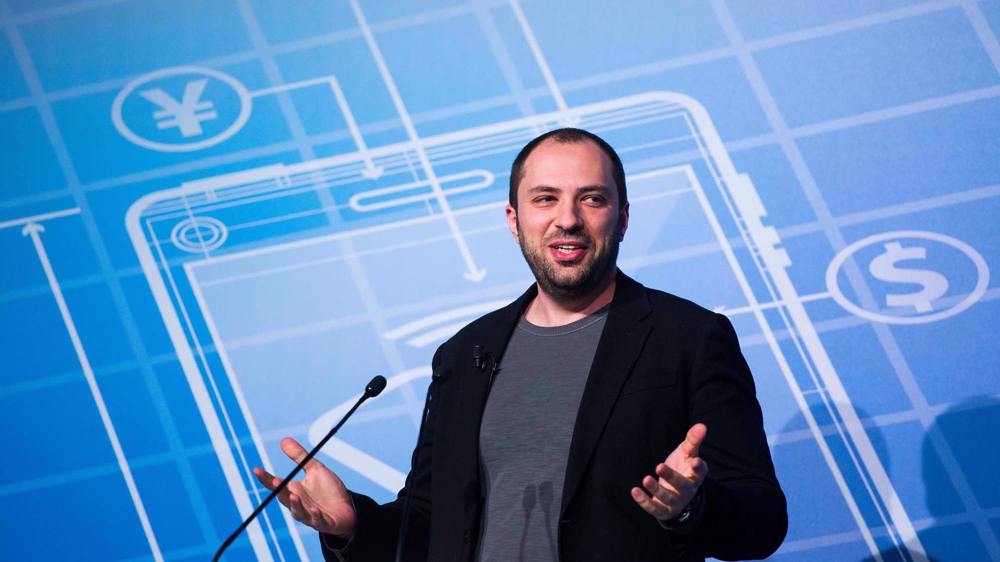
1. Jan Koum
With a total of $7,432,880 in grants, the largest donor to AIPAC and its allies is Jan Koum, a Ukrainian-American entrepreneur and computer programmer best known as the co-founder and former CEO of WhatsApp, a popular messaging app.
Born in Kiev to a Jewish family, he immigrated to the United States with his mother and pursued a career in tech, joining Yahoo as an infrastructure engineer and working there for nearly a decade
After leaving Yahoo, Koum and his former Yahoo colleague Brian Acton founded WhatsApp, which grew rapidly, reaching 400 million active users in five years.
In 2014, Facebook (now Meta) acquired WhatsApp for $19 billion, one of the largest tech acquisitions at the time. Koum stayed on as CEO four more years when he stepped down.
His net worth, largely from the WhatsApp sale, has been estimated at around $15 billion, making him one of the wealthiest tech entrepreneurs in the world.
Despite keeping a low public profile, Koum is known for his intimate ties to the Israeli regime and its lobby groups and shells out generous donations to Zionist causes. Through the Koum Family Foundation, he has contributed tens of millions of dollars to Israel-related organizations.
Between 2019 and 2020, his foundation donated approximately $140 million to around 70 Jewish organizations, many of which operate in the occupied territories or support Israeli causes.
Specific examples include $6 million to Friends of Ir David, the US fundraising arm of Elad, a Neo-Zionist organization focused on expanding illegal settlements in occupied East al-Quds.
Another significant donation was to Friends of the Israeli military (FIDF), a New York-based Zionist lobby group that supports Israeli soldiers and veterans, to which he gave $5.3 million.
He gave $600,000 to the Maccabee Task Force, founded by Sheldon Adelson to promote Zionist advocacy on college campuses, and $175,000 to the Central Fund of Israel, a Neo-Zionist association linked to supporting illegal settler groups in the West Bank.
Jan Koum
Koum has also supported Israeli healthcare, donating over $13 million by 2020, including $7.7 million to Shaare Zedek Hospital in occupied al-Quds, affiliated with Hebrew University.
His ties also intersect with his political engagement. in 2022, he donated $2 million to AIPAC’s United Democracy Project (UDP), a super PAC supporting pro-Israeli candidates in US Democratic primaries, marking him as its largest individual donor at the time.
A year later, he contributed $10 million to a super PAC backing Nikki Haley’s 2023 presidential campaign, influenced by his connection with Miriam Adelson, a major Zionist donor, suggesting a deepening alignment with pro-Israeli political networks.
Beyond donations, Koum has publicly expressed Zionist views. On his Facebook page, which had nearly 90,000 followers before he stopped posting, he shared content celebrating the Israeli regime.
He also shared propaganda content from StandWithUs, a right-wing Zionist organization that works closely with the Israeli foreign ministry and has obtained funding directly from the Israeli Prime Ministers office, directed against the Boycott, Divestment and Sanctions (BDS) movement.
Koum has no known direct business or residential ties to Israel, however, his financial support and public statements reflect a strong personal affinity and a commitment to Israeli settler-colonialism.
Due to Koum’s and Mark Zuckerberg’s staunch pro-Zionist stance, there continues to be deep collaboration between Meta group and the Israeli occupation regime.
Meta reportedly provides Israeli intelligence services with an unobstructed installation of spyware on WhatsApp, used for monitoring anti-Zionist journalists, pro-Palestinian activists, and prominent Palestinian individuals themselves.
2. Miriam Adelson
Israeli-American Miriam Adelson, widely known as the biggest donor to the Republican Party, comes in second on the list with $5,000,000 donated to AIPAC, all of which went to the affiliated Republican Jewish Coalition (RJC).
According to a report filed with the Federal Election Commission in October last year, Adelson donated $100 million to a campaign committee supporting the candidacy of Donald Trump.
The widow of Sheldon Adelson who was known for his empire of casinos and resort hotels across the US, Miriam is a Zionist settler who was born and raised in the occupied Palestinian territories and has championed the cause of settler-colonialism.
Miriam mostly kept a low profile, leaving Sheldon in the foreground of their political and donor activities, until his death in 2021, when she stepped forward as his successor.
Last year, Forbes estimated her net worth at over $35 billion. She has recently been spending more time in the Zionist entity than in the United States.
Her political views represent the most radical form of Zionism, extreme even concerning the American Jewish mainstream and the Zionist entity itself.

Miriam Adelson
She is associated with the right-wing ideology of Neo-Zionism, which advocates not only the retention of occupied territories but also the further expansion of the occupation and annexation of Palestine and neighboring countries.
Adelson is a major donor to illegal Israeli settlements in the occupied West Bank, and the couple gave $25 million to the internationally boycotted Ariel University, located in one such Israeli settlement in the occupied West Bank.
The Adelson Family Foundation is a large financial contributor to the Taglit-Birthright Foundation, giving more than $500 million to the organization in a 15-year period.
The couple also got heavily involved in the campaign against the Boycott, Divestment and Sanctions (BDS) movement, launching the counter Maccabee Task Force (MTF) in a closed-door meeting.
This $50 million initiative was set to become America’s largest pro-Israeli campus program, and the MTF later expanded its activities to Europe and beyond.
Adelson is also associated with financing various Zionist groups that have played a significant role in the production and dissemination of Islamophobic propaganda in the West.
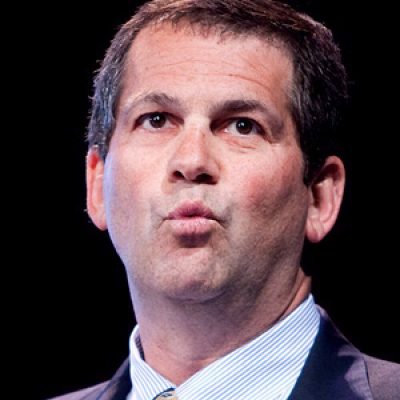
3. Jonathon Jacobson
Third on the list of major donors to AIPAC with $4,575,000 in donated money is Jim Harris, an American financier and investor, best known as the founder of HighSage Ventures and the co-founder of Highfields Capital Management.
His career began as an options trader, followed by stints at Merrill Lynch and Lehman Brothers. In 1990, he joined Harvard Management Company, where he managed investments for the university’s endowment.
In 1998, Jacobson co-founded Highfields with Richard Grubman, starting with $1.5 billion in assets, a third of which came from Harvard Management Company.
Highfields grew into a prominent hedge fund, managing over $12 billion at its peak and achieving annualized net returns exceeding 10 percent over two decades.
The fund was notable for its investments in companies like Microsoft, Genworth Financial, and SLM Corporation, as well as a high-profile bet against Enron before its 2001 collapse.
Jacobson led Highfields until 2018, when he announced the fund would return outside capital and transition into a family office, citing a desire for a less demanding lifestyle after 35 years in the industry.
In 2019, he founded HighSage Ventures, a private investment firm managing his family’s assets and those of the One8 Foundation, where he serves as non-executive chairman.
Jacobson has leveraged his wealth and influence to engage with causes tied to the Israeli regime, primarily through his donor activities, political contributions, and leadership roles in organizations supportive of Zionist interests.
One of his most direct connections is his role as Chairman of the International Board of Trustees of the Israeli Institute for National Security Studies (INSS), a think tank based in Tel Aviv focused on strategic, military, and security policy research.
This position reflects a significant commitment to Israeli occupation discourse and aligns him with influential figures in Israeli and global policy circles.
Jonathon Jacobson
Jacobson and his wife Joanna oversee the One8 Foundation (formerly the Jacobson Family Foundation), which explicitly prioritizes “Jewish causes and Israel” among its focus areas.
The foundation aims to promote “a thriving and democratic Jewish state by increasing understanding among Americans and by strengthening a diverse Israeli society,” as stated on the website.
While specific grant details are not fully transparent, past giving has included support for Zionist organizations, alongside education and community initiatives in Massachusetts.
Additionally, Jacobson has served as a trustee of the Birthright Israel Foundation, which facilitates trips for young Jewish Americans to the occupied Palestinian territories to strengthen their cultural and personal ties to the Zionist entity.
Politically, Jacobson has made substantial donations to pro-Israeli advocacy in the US, donating millions in the 2024 election cycle to AIPAC’s UDP, making him one of its largest individual donors at that time.
This funding supports candidates who align with AIPAC’s pro-Israeli agenda, underscoring Jacobson’s influence in shaping US policy toward the Tel Aviv regime.
His political giving also intersects with figures like Miriam Adelson, with whom he shares connections through mutual support for causes like Nikki Haley’s 2023 presidential campaign.
While Jacobson’s professional career in finance does not appear to involve direct business dealings with the Israeli regime, he is one of the leading individuals engaged in Zionist causes through donations and advocacy.
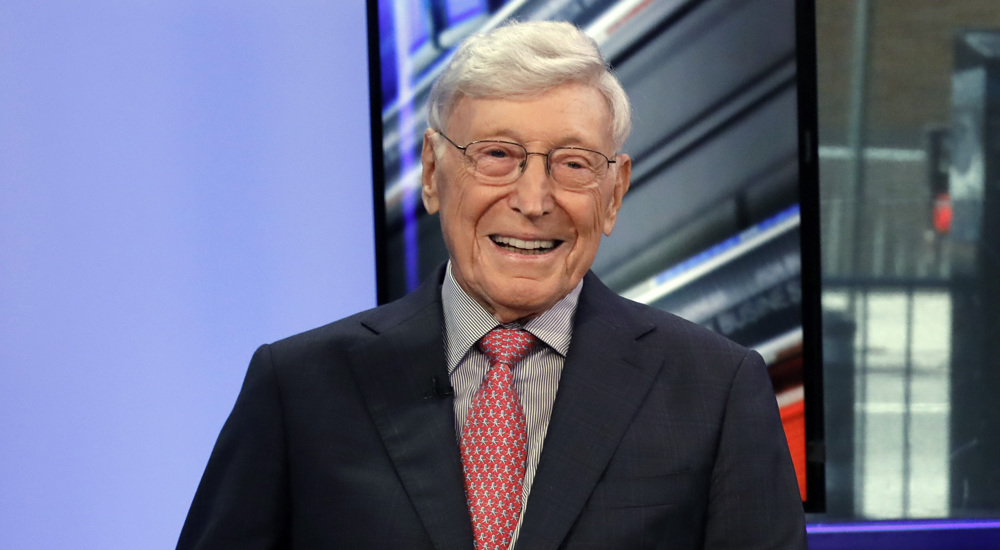
4. Bernard Marcus and family
With $3,000,000 in donated funds, fourth on the list is Bernard Marcus, an American billionaire businessman, best known as the co-founder of The Home Depot, the world’s largest home improvement retailer, who died in November last year.
The first stores opened in Atlanta in 1979, and under Marcus’s leadership as the first CEO (until 1997) and chairman (until his retirement in 2002), the company grew into a retail giant with over 2,300 stores and a market valuation nearing $400 billion by 2024.
His wealth, derived largely from Home Depot stock, was estimated at $11 billion by Forbes at the time of his death in November 2024.
A vocal Republican, Marcus donated millions to conservative candidates, including Donald Trump ($7 million in 2016 and 2020), John McCain, and Ron DeSantis, and was outspoken on political issues, particularly supporting free-market principles.
As a first-generation American born to Russian Jewish immigrants, Marcus maintained a strong connection to Jewish identity and Zionist causes, including those benefiting the Israeli regime.
Bernard Marcus
With his wife, Billi, he founded The Marcus Foundation in 1989, which has donated over $2.7 billion to causes including Jewish and Zionist initiatives, medical research, veterans, and free enterprise.
One of the most notable contributions was a $20 million donation in 2006 to Magen David Adom (MDA), Israeli medical service, which funded the Marcus National Blood Services Center in Ramla.
The $135 million state-of-the-art facility is designed to protect Israeli strategic blood reserves from missile, chemical and biological attacks.
Beyond MDA, The Marcus Foundation supported numerous Israeli-related organizations, including grants to aforementioned FIDF and Birthright.
Marcus also backed the Israel Democracy Institute, a think tank focused on strengthening Israeli occupation and apartheid, donating millions over the years to advance its research and programs.
His giving often aligned with Zionist priorities, such as supporting Israeli settler society, though exact figures for some contributions remain less publicized due to the foundation’s private nature.
The Marcus Foundation continues these pro-Zionist activities even after his death, under the leadership of Billi Marcus and other family members.
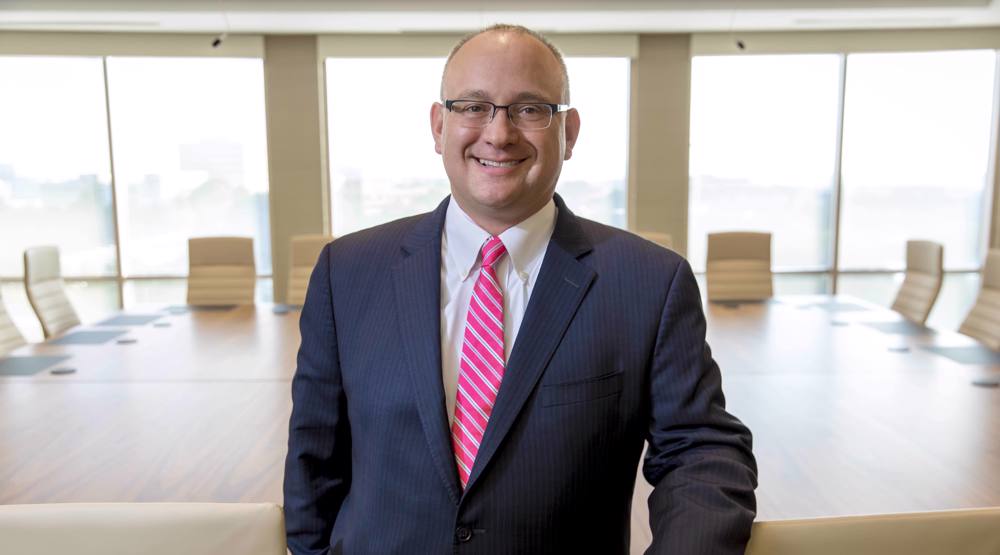
5. David Zalik
Fifth on the list is David Zalik, an Israeli-American entrepreneur and financier, who donated $2,000,000, the same amount as the next three donors individually.
Born in the occupied Palestinian territories, Zalik immigrated to the US with his family as a boy, where he launched his entrepreneurial career by founding MicroTech Information Systems, Phoenix, and Outweb.
He is best known as the co-founder and former CEO of GreenSky, a financial technology company which provided a platform for instant point-of-sale loans, primarily for home improvement projects, partnering with banks and merchants.
Under his leadership, GreenSky facilitated over $30 billion in loans, went public in 2018, and was acquired by Goldman Sachs in 2022 for $2.24 billion in an all-stock deal, after which Zalik joined Goldman as a partner.
In 2023, Goldman sold GreenSky for roughly $500 million, ending Zalik’s direct involvement. Zalik’s net worth has been estimated at around $2.3 billion as of 2024, reflecting his stakes in GreenSky and other investments.
Zalik has maintained a relatively low public profile regarding direct involvement with the Zionist entity since emigrating as a child, but his business ventures do appear to have direct operational ties to it.
David Zalik
Through The Zalik Foundation, co-founded with Helen in 2018, he’s donated over $100 million, focusing on education, mental health, and Jewish Zionist initiatives in the US and the Zionist entity.
While specific grants are not always itemized publicly due to the foundation’s private nature, it has funded organizations with ties to the Israeli regime.
The foundation’s emphasis on “Jewish causes” mirrors efforts by other donors, often encompassing support for programs like Birthright Israel, though Zalik’s exact beneficiaries are less publicized.
In Atlanta, where he resides, The Zalik Foundation has supported local Zionist organizations, such as the Jewish Federation of Greater Atlanta, which frequently collaborates with Israeli counterparts on education and community-building projects.
A notable donation includes $5 million in 2022 to Technion-Israel Institute of Technology’s American fundraising arm to establish the Zalik Accelerator Hub on its New York campus, aimed at fostering tech entrepreneurship.
Zalik rarely gives interviews or speaks publicly about his ties to the Zionist regime.
6. Paul Singer
Two million dollars were donated to AIPAC by Paul Elliott Singer, an American billionaire hedge fund manager and activist investor, known as the founder, president, and co-CEO of Elliott Management Corporation.
He pioneered “vulture capitalism,” buying distressed sovereign bonds, such as those of Argentina and Peru, at steep discounts and pursuing full repayment through litigation, earning both massive profits and criticism.
Known for his strict approach, Singer built Elliott into one of the world’s most formidable hedge funds, managing $72 billion in assets by 2025. As of 2024, Forbes pegged his net worth at $6.1 billion, though it likely grew with Elliott’s expansion.
Through The Paul E. Singer Foundation, he’s donated roughly $300 million since 2010, with a significant portion supporting Jewish organizations and Israeli regime-related initiatives.
Singer has been a major benefactor of groups like FIDF and Birthright. He has also supported United Hatzalah, an Israeli volunteer EMS organization, and has been linked to donations for Jewish schools and welfare programs that benefit Israeli settlers.
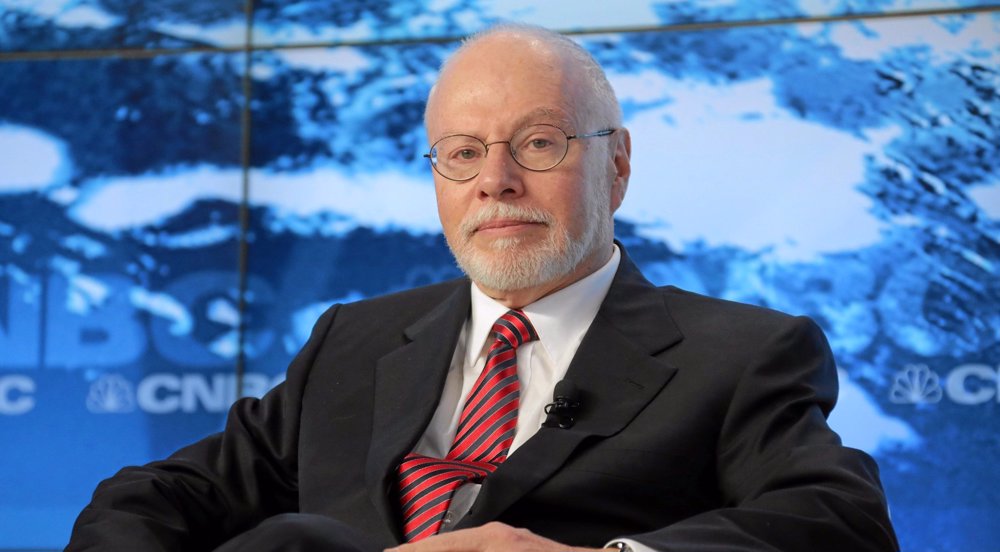
Paul Singer
He co-founded Start-Up Nation Central to connect Israeli tech ecosystem globally, and has personally invested in Israeli tech firms, including cybersecurity company Cybereason, via Elliott Management’s private equity arm, Evergreen Coast Capital.
Singer is a staunch political supporter of the Israeli regime, channeling his influence as a top Republican donor to bolster American-Israeli ties.
With over $40 million donated to political causes since 2010, he backed figures like Marco Rubio, Mitt Romney, and, after initial opposition, Donald Trump.
He has contributed millions to pro-Israel groups like the RJC (where he sits on the board) and AIPAC-aligned efforts, backing candidates who prioritize Zionist policies.
He co-founded the Philos Project to foster Christian support for the Israeli regime.
Singer’s funding of neoconservative think tanks, such as the Foundation for Defense of Democracies (FDD), also promotes hawkish policies aligned with Israeli interests, particularly against Iran.
7. Haim Saban
Haim Saban, an Israeli-American media mogul and investor, best known for creating Saban Entertainment, also donated two million dollars to AIPAC.
After partnering with Fox, his company generated over $6 billion in merchandise sales. He later sold Fox Family Worldwide to Disney for $5.3 billion, netting him $1.6 billion personally.
Saban re-entered media, acquiring Univision for $13.7 billion with partners, selling it in 2020. His Saban Capital Group now manages investments in entertainment, real estate, and tech, with his net worth estimated at $2.8 billion by Forbes in 2024.
A major Democratic donor, Saban has given over $30 million to US political causes, backing Bill and Hillary Clinton, Barack Obama, and Joe Biden, while fiercely advocating for the Israeli regime.
Through the Saban Family Foundation, co-founded with his wife Cheryl in 1999, he’s donated over $500 million to Jewish and Zionist causes.
He’s also given millions to FIDF, including a record-breaking $16.5 million pledge in 2019, to support the Israeli military.
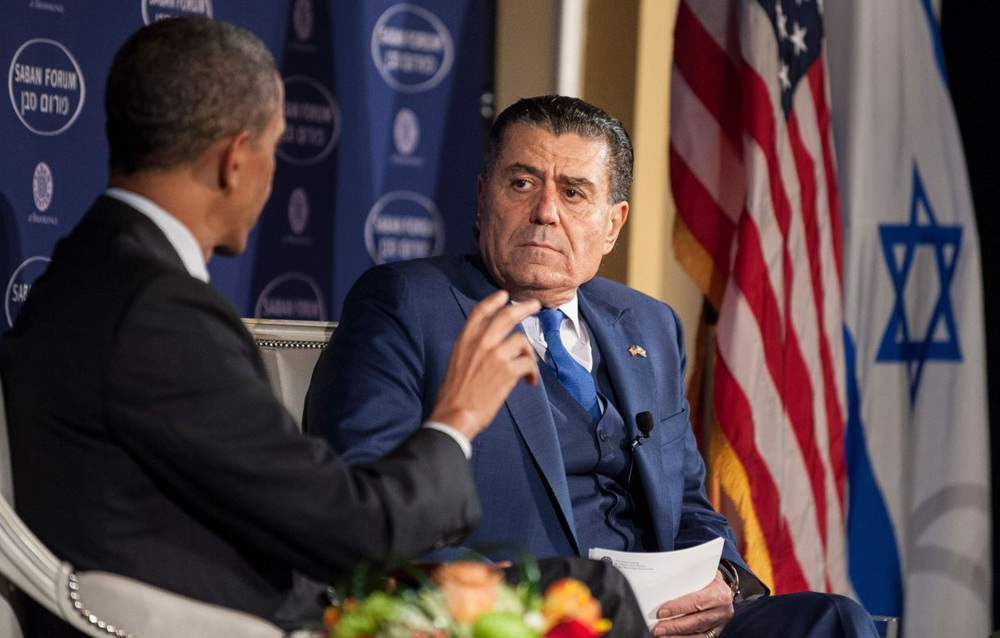
Haim Saban with Barack Obama
One of his flagship contributions is the Saban Center for Middle East Policy at the Brookings Institution, launched in 2002 with a $13 million gift, aimed at shaping US policy toward Palestine and the region.
Saban has funded healthcare and education in the Zionist entity directly, notably donating $50 million in 2018 to the Soroka Medical Center in Be’er Sheva for a new emergency facility, one of the largest private gifts to an Israeli hospital.
His support extends to the American Friends of the Hebrew University and other institutions, bolstering Israeli academic and social infrastructure. His giving often targets the Negev region, reflecting a desire to strengthen Israeli periphery.
Saban has lobbied against policies he sees as threats, like Iran nuclear deal (which he called a “disaster” for the Israeli regime), and has funded efforts to counter the BDS movement, including through the Israel on Campus Coalition.
8. Helaine Lerner
Along with the three listed above, the positions from fifth to eighth are also shared by Helaine Lerner, an American environmental activist and the widow of Sid Lerner who died in 2021.
Her wealth, derived from Sid’s advertising success and their joint investments, remains private, but their combined giving exceeds hundreds of millions.
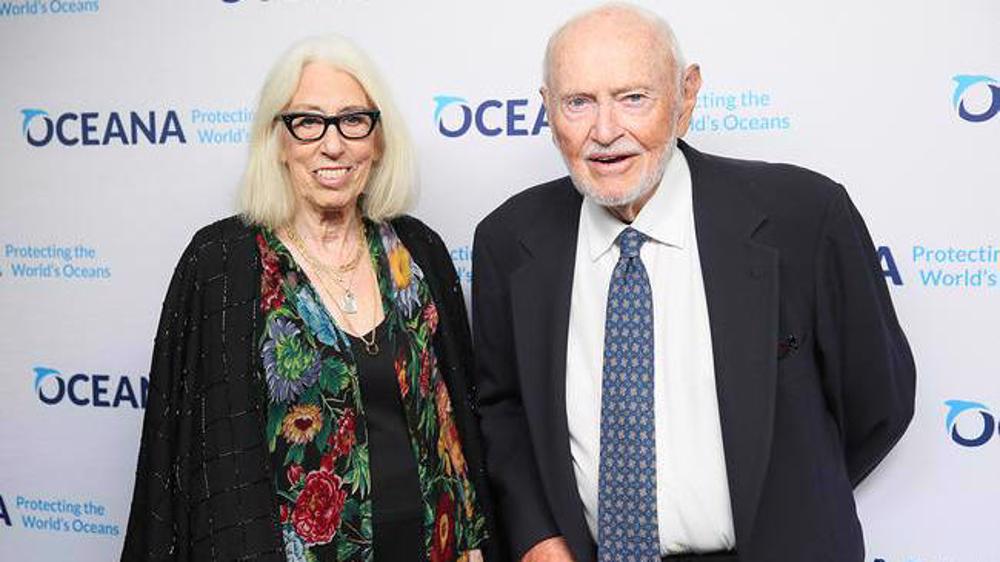
Helaine Lerner with husband Sid Lerner
Sid, born to Jewish immigrants, was a staunch Zionist and a significant donor to Jewish Zionist organizations, including the American Jewish Committee (AJC).
Helaine shared this Jewish identity, and like her husband and other billionaire donors, she is also prominently documented as having direct, personal involvement with Israeli-centric initiatives.
Kremlin releases Putin-Trump phone call summary (FULL STATEMENT)
RT | March 18, 2025
Russian President Vladimir Putin and his US counterpart Donald Trump have held a phone conversation lasting over two hours, discussing a peaceful resolution to the Ukraine conflict.
The Kremlin reported that the two leaders spoke about a suggested 30-day ceasefire, a prisoner exchange, and maritime security, with Putin responding positively to Trump’s proposals. Both leaders expressed interest in normalizing US-Russia relations, agreeing to continue discussions on global security, economic cooperation, and even cultural exchanges like NHL-KHL hockey matches.
The Kremlin has published a summary on the outcome of the call:
A phone conversation between Vladimir Putin and US President Donald Trump took place on March 18, 2025.
Reaffirming his commitment to a peaceful resolution of the conflict, President Putin expressed readiness to work closely with American partners on a thorough and comprehensive settlement. He emphasized that any agreement must be sustainable and long-term, addressing the root causes of the crisis while considering Russia’s legitimate security interests.
Regarding President Trump’s initiative for a 30-day ceasefire, the Russian side highlighted key concerns, including effective monitoring of the ceasefire across the entire front line, halting forced mobilization in Ukraine, and stopping the rearmament of its military. Russia also noted serious risks due to Kiev’s history of undermining previous agreements and drew attention to terrorist attacks carried out by Ukrainian militants against civilians in the Kursk region.
It was emphasized that a crucial condition for preventing further escalation and working toward a political-diplomatic resolution is the complete cessation of foreign military aid and intelligence sharing with Ukraine.
In response to Trump’s recent request to ensure the safety of Ukrainian troops encircled in Kursk Region, Putin confirmed that Russia is guided by humanitarian considerations. He assured his counterpart that Ukrainian soldiers who surrender will be granted safety and treated in accordance with Russian laws and international humanitarian norms.
During the conversation, Trump proposed a mutual agreement between both sides to refrain from striking energy infrastructure for 30 days. Putin welcomed the initiative and immediately instructed the Russian military to comply.
Putin also responded constructively to Trump’s proposal regarding maritime security in the Black Sea, and both leaders agreed to initiate negotiations to further refine the details of such an arrangement.
Putin informed Trump that on March 19, Russia and Ukraine would conduct a prisoner exchange involving 175 detainees from each side. Additionally, as a goodwill gesture, Russia will transfer 23 severely wounded Ukrainian soldiers who are currently receiving medical treatment in Russian hospitals.
Both leaders reaffirmed their commitment to continuing efforts toward resolving the Ukraine conflict bilaterally, incorporating the proposals discussed. To facilitate this, Russian and American expert groups will be established.
Putin and Trump also discussed broader international issues, including the situation in the Middle East and the Red Sea region. They agreed to coordinate efforts to stabilize crisis areas and enhance cooperation on nuclear non-proliferation and global security, which, in turn, would improve the overall state of US-Russia relations. A positive example of such cooperation was their joint vote at the United Nations on a resolution regarding the Ukraine conflict.
Both leaders expressed mutual interest in normalizing bilateral relations, recognizing the shared responsibility of Russia and the United States in ensuring global security and stability. In this context, they explored various areas for potential cooperation, including discussions on mutually beneficial economic and energy partnerships.
Trump supported Putin’s idea of organizing hockey matches in the US and Russia between players from the NHL and KHL.
The presidents agreed to remain in contact on all discussed matters.
Trump, Putin agree on ‘energy and infrastructure ceasefire’ – White House
RT | March 18, 2025
US President Donald Trump and Russian President Vladimir Putin have agreed that the first step towards ending the Ukraine conflict should be an “energy and infrastructure ceasefire,” White House Press Secretary Karoline Leavitt has revealed. The leaders reached the agreement during a 2.5 hour phone conversation on Tuesday.
According to the readout of the phone call published on X by Leavitt on Tuesday, both leaders concur that the conflict must conclude with a lasting peace. They also emphasized the importance of strengthening bilateral relations.
“The leaders agreed that the movement to peace will begin with an energy and infrastructure ceasefire, as well as technical negotiations on implementation of a maritime ceasefire in the Black Sea, full ceasefire and permanent peace,” the transcript reads.
The Kremlin has confirmed that Putin supported Trump’s proposal for Russia and Ukraine to halt strikes on energy infrastructure for 30 days, and instructed his military accordingly.
According to the readout, Moscow and Washington have agreed to hold relevant negotiations “immediately in the Middle East.”
Aside from Ukraine, the two heads of state are said to have discussed the situation in the Middle East as well as potential cooperation with a view to preventing future conflicts in the region.
Another topic high on the two leaders’ agenda was the “need to stop proliferation of strategic weapons” globally, according to the White House press secretary.
“The two leaders agreed that a future with an improved bilateral relationship between the United States and Russia has huge upside,” including but not limited to “enormous economic deals and geopolitical stability,” the readout concludes.
Gaza government officials martyred along with families in renewed Israeli aggression
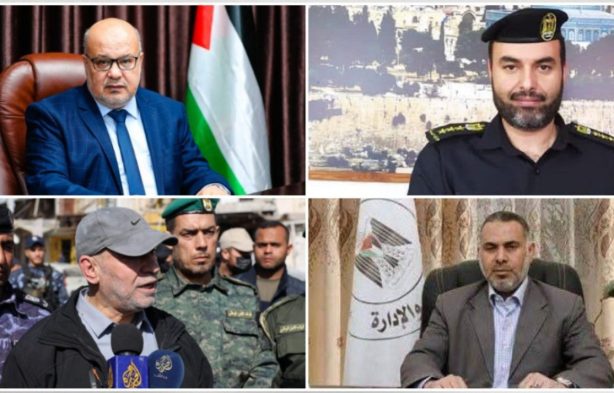
Senior Hamas officials killed in Israel’s airstrikes on Gaza on March 18, 2025
Press TV – March 18, 2025
The Palestinian resistance movement Hamas says several of its senior members have been assassinated after being directly targeted by Israel’s military forces on Tuesday.
Gaza’s fragile ceasefire was shattered early Tuesday as the Israeli military launched deadly airstrikes across the Palestinian territory, killing more than 400 Palestinians, including children.
The resistance group said in a statement that “a number of government and emergency committee leaders were martyred in the Gaza Strip as a result of the brutal and sudden aggression on the Gaza Strip at dawn today.”
“These leaders, along with their families, were martyred after being directly targeted by the Zionist occupation forces’ aircraft.”
The head of the Hamas government, Essam al-Dali, interior ministry head Mahmud Abu Watfa and Bahjat Abu Sultan, director-general of the internal security service, are among the martyrs, Hamas said.
These leaders, according to Hamas, were responsible for “distributing aid, preventing “thieves” and “bandits” (in reality, collaborators with the Zionist regime), protecting the security of the Palestinian people, and ensuring fairness and social cohesion amid the most difficult of circumstances.”
“They are being assassinated in an attempt to create chaos, famine and internal conflict.”
In a separate statement, Gaza Government Media Office said two top police officers were among those assassinated.
These leaders, it said, “worked tirelessly since the beginning of this genocidal war to alleviate the suffering of their people and who fulfilled their responsibilities with dedication and sacrifice.”
Hamas also reiterated that the resistance will stand “firm with our nation against this brutal aggression.”
‘Israel’ reneged on Gaza ceasefire, US complicit in genocide: Hamas
Al Mayadeen | March 18, 2025
“Israel” has reneged on the ceasefire agreement, evading its obligations, and continues to commit massacres against the Palestinian people in Gaza, amid a shameful international silence, Hamas affirmed on Tuesday.
After a fragile ceasefire that lasted roughly two months, “Israel” has resumed its aggression on Gaza with intense airstrikes, resulting in an initial toll of 404 martyrs, according to the enclave’s Health Ministry.
In a statement, Hamas said, “The claims made by the [Israeli] occupation regarding preparations by the Resistance to launch an attack on its forces are baseless and are merely false pretexts to justify its return to war and escalate its bloody aggression.”
The Palestinian group accused “Israel” of “attempting to mislead public opinion and fabricate false justifications to cover up its premeditated decision to resume its genocidal campaign against defenseless civilians, disregarding any commitments it made.”
“Hamas adhered to the agreement until the very last moment and was committed to its continuation,” the statement stressed, adding that Israeli Prime Minister Benjamin Netanyahu, “seeking a way out of his internal crises, preferred to reignite the war at the cost of our people’s blood.”
In a separate statement, Hamas considered that the US administration’s admission that it was previously informed about the resumed Israeli aggression “confirms its direct partnership in the genocide” against the Palestinian people.
US President Donald Trump greenlit “Israel’s” renewed war on Gaza after Hamas refused to release more captives, The Wall Street Journal reported, citing an Israeli official.
White House Press Secretary Karoline Leavitt said in a Fox News interview that “Israel” consulted with the administration of President Donald Trump before launching a series of large-scale airstrikes on Gaza early Tuesday.
This acknowledgment once again exposes the “blatant complicity and bias” of the US in favor of the occupation and reveals the falsehood of its claims about prioritizing de-escalation, the group pointed out.
It emphasized that by providing unlimited political and military support to the occupation, Washington “bears full responsibility for the massacres and the killing of women and children in Gaza.”
Hamas urged the international community to take immediate action to hold the occupation and its supporters accountable for these crimes against humanity.
“Our Palestinian people will not retreat from their legitimate struggle until the occupation is ended and their rights are fully restored,” the group underscored.
Kazakhstan to audit USAID programs – media
RT | March 18, 2025
The Kazakh government is planning to audit all programs being implemented in the Central Asian nation under the auspices of the US Agency for International Development (USAID), local media outlet Orda.kz has reported.
Washington’s primary agency for funding political projects abroad found itself in the crosshairs of President Donald Trump shortly after he assumed office in January. The new administration imposed a 90-day funding freeze on USAID pending a review, citing concerns of corruption and inefficiency.
In an article on Tuesday, Orda.kz, citing Economy Minister Serik Zhumangarin’s response to a parliamentary inquiry, claimed that a special working group was set up within Kazakhstan’s Foreign Ministry last year, which is tasked with scrutinizing USAID’s activities in the country.
The publication quoted the official as clarifying that a “detailed analysis of funded projects and programs will be conducted, including an assessment of their alignment with stated goals and actual results.”
Moreover, the US agency’s “relationships with other organizations, including governmental and non-governmental” as well as its financial flows will reportedly be put under the auditors’ microscope to check for “possible cover-up schemes, inconsistencies in spending, and conflicts of interest.”
According to the Kazakh Foreign Ministry, throughout 2024, USAID had 28 long-term programs running in the country, encompassing the economy, energy, healthcare, civil society, and media sectors. The activities of some of those extended beyond Kazakhstan, targeting the broader Central Asian region.
The total funding allocated for Kazakhstan in 2023–2024 stood at $26.5 million.
Last month, the Indian Express reported that USAID’s allocation of $21 million, which had been frozen by Elon Musk’s Department of Government Efficiency (DOGE) and was presumably meant to foster “voter turnout in India,” was earmarked for neighboring Bangladesh.
Last August, Bangladeshi Prime Minister Sheikh Hasina was forced to step down following massive student-led protests.
In an interview with Tucker Carlson in February, Mike Benz, a former State Department official, alleged that USAID had funded last year’s regime change in the South Asian nation because of Hasina’s opposition to a US military base in the region. The US Department of State previously dismissed similar claims made by the deposed prime minister as “laughable.”
Amid reports of USAID’s involvement in India’s political processes, the Foreign Ministry in New Delhi stated that authorities were looking into the “deeply troubling” information.
What Do Trump and Putin Really Have in Common?
By Glenn Diesen | March 18, 2025
There are many rational and pragmatic reasons for ending the conflict in Ukraine as the proxy war has effectively already been lost, further escalation could result in nuclear war, and Russia is aligning itself ever closer with China. However, is a personal affinity with Putin contributing to Trump’s desire to end the war and improve US-Russia ties?
During the clash with Zelensky in the Oval Office, Trump expressed an affinity toward Putin based on a shared struggle against shared adversaries. Trump argued that “Putin went through a hell of a lot with me. He went through a phony witch hunt, where they used him and Russia. Russia, Russia, Russia, you ever hear of that deal? … It was a Democrat scam. He had to go through it. And he did go through it”. Trump argued that if Putin broke any deals, then it was with Obama and Biden, as Putin never broke any deals with him due to mutual respect.
It is reasonable to deduce from Trump’s statements that he feels he shares something with Putin. Instead of delving into conspiracy theories of collusion, it is worth taking a sociological perspective to explore how we define who belongs to “us” and who is considered the “other”. Human beings are social animals that instinctively organise into groups, in which the in-group “us” is usually defined by the mirror image of the out-group “other” as the diametrically opposite. What defines “us” versus “them” is often constructed to ensure group solidarity and is thus typically presented as good versus evil or superior versus inferior.
Russia has historically been assigned the role of Europe’s “other”, which makes it difficult to find compromise as Russia’s otherness and negative identity reaffirms Europe’s own positive identity. The relationship has historically been framed as the West versus the East, the civilised versus the barbarian, the European versus the Asiatic, and during the Cold War it was the capitalist versus the communist. When it was decided to revive the dividing lines in Europe after the Cold War by expanding NATO, the “us” versus “them” was recast as liberal democracies versus authoritarian. Every aspect of relations must be interpreted through this lens, in which the West can take the role of the good guys versus Russia as the perpetual bad guy.
Nationalism versus Cosmopolitanism
It is convenient and lazy to portray Trump’s possible affinity for Putin as a friendship between authoritarians. The argument is that Trump is not part of the free world, and his authoritarian tendencies allegedly explain his affinity to Putin. This is a poor analysis, but it exposes how human beings instinctively preserve group solidarity by punishing individuals who stray from the group, and efforts to reach out to the other side and move beyond the stereotypes that define “us” and “them” are met with suspicion and accusations of treason. The free world versus the alliance of authoritarians is a framing that serves the purpose of demonising Trump and Putin and also reaffirming “our” good values. To borrow the language of Bush, they hate us because of our freedoms.
This is a deeply flawed framing, as Trump (or Putin) does not define himself and his in-group (“us”) in the unfavourable terms of authoritarianism versus freedom. Trump views the world as divided between patriotism and globalism or as nationalism versus cosmopolitanism.
The liberal identity as the foundation for the collective identity of a unified Political West after the Cold War contributed to creating a schism within the liberal nation-state. The excesses of liberalism under globalisation and an identity relying excessively on liberalism created a split between liberalism and nationalism that laid the foundation for the liberal nation-state. Over the past decades, liberalism began divorcing itself from the nation-state as the idea of unity through common history, traditions, faith and culture was rejected. In 2004, Samuel Huntington predicted that the rise of a neo-liberal elite would eventually create a conservative backlash:
“The public, overall, is concerned with physical security but also with societal security, which involves the sustainability–within acceptable conditions for evolution–of existing patterns of language, culture, association, religion and national identity. For many elites, these concerns are secondary to participating in the global economy, supporting international trade and migration, strengthening international institutions, promoting American values abroad, and encouraging minority identities and cultures at home. The central distinction between the public and elites is not isolationism versus internationalism, but nationalism versus cosmopolitanism”.[1]
Translated into international politics, Russia transitions away from the out-group “them” as an authoritarian state, and into the in-group of “us” as a traditional Christian European state that rejects the excesses of liberalism and subsequent moral decadence. It is also evident that Trump sees himself as having much in common with Viktor Orban of Hungary, who defines Europe by its traditional Christian-cultural heritage. In contrast, there is a contempt for the German definition of Europe, which relies excessively on liberal and post-national ideals that translate into woke ideology, open borders, globalism and cosmopolitan identity to the extent they are not capable of defending basic national interests. Europe’s identity as liberal nation-states used to accommodate both nationalism and liberalism, yet liberalism has to a large extent liberated itself from the nation. Consequently, the liberals and the nationalists see each other as their respective out-group, threatening the in-group. This is now influencing the relations between the great powers.
Russiagate and the Hunter Biden Laptop Scandal
Trump’s reference to the Russiagate hoax and the Hunter Biden laptop scandal during the clash with Zelensky in the Oval Office reveals that he considers these events as relevant to understanding the collapse of US-Russia relations.
There has been very little if any reflection on how the Russiagate hoax damaged US-Russia relations, which is why understanding is absent for Trump’s argument. The Democrats used Russia as a bogeyman to sabotage Trump during the 2016 election, then to undermine his first presidential administration, and yet again during the 2020 election. The actual collusion revealed was between the Democratic Party, the intelligence agencies and the media.
The US embraced a new anti-Russian McCarthyism to cleanse its opposition, in which everyone had to castigate Russia as an ideological enemy of the US. Trump’s desire to improve relations between the US and Russia was treated as a threat to the envisioned liberal democratic-authoritarian divide of the world that sustains NATO, and it was treated as a smoking gun that delegitimised his entire political platform. For years, there was a wide consensus that Russia had helped Trump win the 2016 presidential election. During the presidential race in 2020, the scandal of the Hunter Biden laptop was censored by the media following false accusations that it was a Russian disinformation campaign on behalf of Trump. There were also fake accusations that Russia offered bounties on US soldiers in Afghanistan, and Trump’s unwillingness to respond forcefully against Russia was treated as evidence of being in the pocket of the Kremlin. America’s domestic political squabbles evidently contributed to the collapse of US-Russia relations, which also cemented the non-compromising position and provocations by the US that triggered Russia’s invasion of Ukraine in 2022.
Should we be surprised that Trump considers himself and Putin to have faced many of the same enemies to the extent it shaped his view of the in-group versus out-group? Russiagate was intended to sell a worldview of authoritarians at home and abroad conspiring against freedom. This narrative has been debunked as it was based on fraudulent evidence, yet the Democrats and the Europeans still hold on to the narrative to preserve their assigned identity as the good guy and their opponents as the bad guy. From the viewpoint of Trump, this was an attack by the Democrats on democracy and the political system that also devastated relations with Russia and undermined peace in the world.
Can we blame Trump for seeing the world as divided between pragmatic and rational nationalists seeking to put their countries first, versus a cosmopolitan and globalist elite that undermines national interests, democracy and international peace?
German version of the article: “Was Trump und Putin verbindet” in De Weltwoche.
Europe’s Provocation: Interview with Russia’s Deputy FM Alexander Grushko on Potential Escalation in Ukraine
“The conflict has reached a stage where the West suffers a strategic defeat”
Izvestia | March 17, 2025
Kirill Fenin’s interview with Deputy Foreign Minister of Russia Alexander Grushko on security guarantees from NATO, prospects for dialogue with the EU, and the future of the OSCE:
Q: In December 2021, Russia put forward a proposal to the US and NATO on security guarantees. Is it relevant for us to receive these guarantees now? Is the return of NATO infrastructure to the 1997 borders being discussed in the current negotiations with Washington?
Grushko: In 2021, the Russian Federation put forward two initiatives. One was addressed to the United States, the other to NATO countries. But they were not supported. We realized that our so-called partners were not ready to engage in a dialogue on the merits. It became clear that the nature of the alliance’s military construction and the US military preparations were aimed at achieving superiority over the Russian Federation. Moreover, Ukraine was chosen as the main battlefield, the theatre of military operations against Russia.
If we talk about a peaceful resolution of the conflict in Ukraine, then, of course, it will have an external outline. We will demand that cast-iron security guarantees become part of this agreement. Since only through their formation will it be possible to achieve lasting peace in Ukraine and, in general, strengthen regional security. Part of these guarantees should be the neutral status of Ukraine, the refusal of NATO countries to accept it as a member of the alliance. In fact, this is precisely the provision that was recorded in the drafts of the aforementioned agreements. As for discussions, of course, they are not being conducted today, since there are no negotiations.
Q: There are reports in the media that the Donald Trump administration is considering the possibility of reducing its military presence in the Baltics. Is this issue currently being discussed with the US?
Grushko: Diplomats and military personnel do not feed on rumors. We soberly assess the situation. If we look at the strategic concepts approved by NATO and developed in the European Union, as well as the nature of NATO deployments along our borders, we will see that we are talking about long-term plans that the West is not trying to adapt in any way to a future peace agreement. And we will proceed from this in terms of our policy and in the sphere of military development.
If we compare the current situation with 2019, the number of NATO military contingents on the eastern flank, primarily in Poland, the Baltic states, Bulgaria and Romania, has increased by 2.5 times. The amount of heavy equipment has increased by about the same amount. The so-called military Schengen (free movement zone for military personnel – Ed.) is being implemented. The airfield and port networks are being strengthened and expanded. NATO is creating new rapid response units and increasing maneuverability. We are seeing how the density and scale of exercises are increasing. They are becoming more aggressive, aimed at military operations against a comparable adversary. By this we mean the Russian Federation. This is the reality that we have to reckon with. And until there are real changes in the policies and military development of NATO countries, we will proceed from the existence of significant threats to Russia from the West.
Q: As is known, the dialogue on security guarantees was conducted not only between Russia and the United States but also along the Russia-NATO line. The last time a meeting in this format took place was in January 2022. Against the backdrop of the intensification of dialogue with Washington, are negotiations between Russia and NATO possible?
Grushko: I don’t see any prospects at the moment. Of course, you can’t say never, but what can we talk about if NATO countries refused to consider Russia as a partner even in those areas where our interests objectively coincided, for example, in the fight against terrorism. Today they have designated Russia as a direct and immediate threat to NATO countries, and they are conducting their military policy and the process of military development in such a way as to achieve superiority over us in all theaters of military operations, in all, as they say, operational environments: in space, in the air, on land, at sea, in cyberspace.
We see that they are turning the previously most peaceful region of Europe in military terms – the Baltic – into a zone of military confrontation. I will only say that 32 military facilities have been allocated for the deployment of American military forces in Sweden and Finland. All this is a new reality that contradicts everything that was laid down in the Russia-NATO Founding Act and other documents that were intended to unite efforts to counter common threats and at the same time deal with the consequences of the Cold War. The Western countries made a different choice. Our representation in NATO was closed, since NATO made its further functioning impossible. And now there is only a hotline with NATO headquarters, which is provided on our part by the Embassy of the Russian Federation in Belgium. It has not yet been activated, but we have officially notified the leadership of the alliance about it. They know where to call if necessary.
Q: Russian Foreign Minister Sergey Lavrov said that Moscow is categorically against the presence of NATO or EU peacekeepers on Ukrainian territory. Does Russia allow the option of deploying peacekeepers under the auspices of the UN? What conditions must be met for this?
Grushko: Peacekeeping and NATO are incompatible things. They brag a lot that it is a defensive alliance, but the real history of the alliance consists of military operations, a series of aggressions without any reason, just to once again emphasize its hegemony in world and regional affairs. Therefore, all this talk is absolutely inappropriate and absurd. And I think that even the average Westerner understands the real price of such penetrations. Secondly — President Vladimir Putin and Minister Sergey Lavrov talked about this — we absolutely do not care under what label NATO contingents can be deployed on the territory of Ukraine: be it the European Union, NATO, or in their national capacity. In any case, if they appear there, it means that they are deployed in a conflict zone with all the consequences for these contingents as parties to the conflict.
Moreover, the very talk of peacekeeping is an attempt to put the cart before the horse. The question of some kind of international support for the agreement can only be approached when this agreement is worked out. And if the parties come to the understanding that the “peace package” needs international support, then the subject of discussion appears. This could include unarmed observers, a civilian mission that would monitor the implementation of individual aspects of this agreement, or guarantee mechanisms. But for now, it’s just hot air.
Q: What is Russia’s attitude to the possible deployment of peacekeepers to Ukraine under the auspices of the OSCE?
Grushko: There are two points that need to be kept in mind. Firstly, the OSCE does not have armed potential, it does not have an “armed hand”, unlike the UN. In particular, it does not have the competence, the staff committee, the structures that could manage such contingents. Secondly, even the OSCE Special Monitoring Mission, which was deployed there, failed to cope with its tasks. In fact, it was used by NATO to gain unilateral advantages for the Kyiv regime. Now it has become known that some employees of this mission, who were supposed to be neutral and ensure strict implementation of the mandate, in fact worked in the interests of Kyiv. And it is no secret that many residents of Donbass said: “OSCE observers drove by – expect shelling”. Therefore, we have an extremely skeptical attitude towards the involvement of the OSCE, even theoretically.
It is impossible not to see that the purpose of these rumors about the deployment of Western contingents on Ukrainian territory is to prepare public opinion for the most radical scenarios, part of a campaign to whip up military psychosis and demonize Russia. Let me remind you that just a few months ago, such a prospect was denied by all NATO member states, and the Secretary General repeatedly stated that under no circumstances would the Alliance’s soldiers appear there.
Q: This week, the OSCE Secretary General came to Moscow. How do you assess the results of the talks with him? Are any further contacts possible through this organization?
Grushko: There will be contacts, of course. It is good that the Secretary-General came. For two years, the OSCE leadership has not visited Moscow. The main problem of the OSCE is that the organization, as a result of the West’s actions, has effectively been pushed to the sidelines of political processes. Its main purpose as an instrument of reconciliation between East and West, of mitigating contradictions, has been lost. At that time, this was generally called “détente.”
Almost nothing remains of this legacy.
The OSCE is currently at a crossroads. This summer will mark the 50th anniversary of the Helsinki Accords. It depends only on the member states themselves whether this platform will be in demand for some unifying purposes or whether the current crisis state of the organization will become terminal.
Q: Against the backdrop of the dialogue between Moscow and Washington, is a similar negotiating track with Brussels possible?
Grushko: Such a track is possible. But, firstly, the European Union is isolating itself from Russia. It has broken off all political contacts. It is difficult for me to even say with which international structure there was a closer dialogue. Two meetings a year at the highest level, an annual meeting of the government of the Russian Federation and the European Commission. Also more than 20 permanent partnership councils, including the umbrella foreign policy one. Everything has stopped.
In any case, if there are finally signals that Brussels is ready to enter into some kind of dialogue with us, we will not be against it. But today such a prospect is not in sight – on the contrary, the European Union continues to follow the suicidal path of introducing sanctions. If in 2013 the volume of trade between Russia and the European Union was €417 billion, then in 2024 it was at the level of €60 billion.
As for the EU’s insistent demands to sit down at the negotiating table on the Ukrainian conflict, I don’t even know how to characterize this in diplomatic terms. The EU was at these negotiations and was at the center of events starting with the Maidan, where three EU countries acted as guarantors of the agreement between Viktor Yanukovych and the “opposition.” And what did they do to implement the Minsk agreements? Absolutely nothing, on the contrary, they encouraged Kyiv to sabotage them. And when they (the Minsk agreements – Ed.) collapsed, when it became clear that Kyiv was leading the matter to a military solution, a conflict, which, in fact, became the trigger for the decision to conduct a special military operation, Angela Merkel and Francois Hollande stated that they had no intention of implementing the Minsk agreements. A respite was needed to pump Kyiv with weapons and prepare it for a direct clash with Russia. Against this background, it is not very clear what role the Europeans can play.
Q: Can the EU take a more constructive position towards Russia in the future?
Grushko: If we look at their current positions, they do not in any way suggest any constructive participation in the negotiation process. The statements from the camp of the political elites of the European Union are quite clear. Point 1 — do not let the conflict end quickly, it must continue until 2030, because if it ends quickly, then “Russia will immediately attack the Baltic countries and Poland.” Point 2 — we must achieve the strategic defeat of Russia. And we know what is meant by this. Point 3 — seek guarantees of Ukraine’s security.
In fact, the conflict has reached a stage where the West suffers a strategic defeat. Because in all three components that are counted on – military defeat on the battlefield, economic collapse and, ultimately, as they say, regime change – the result is exactly the opposite. If we look at the economic side, our economy has grown by 4%, in the European Union – approximately 0.1% to 1%, close to the statistical error. And the situation on the battlefield is well known.
One of the most important elements for us is the security interests of Russia. And Europe should understand that if strong international legal guarantees for Russia’s security are created, which will exclude Ukraine’s membership in NATO and the possibility of deploying foreign military contingents on its territory or using it to exert military pressure on Russia, then the security of Ukraine and the entire region in a broader sense will be ensured, since one of the root causes of the conflict will be eliminated.
Q: One of the main initiators of the idea of sending European peacekeepers to Ukraine is French President Emmanuel Macron. In your opinion, what is the reason for the desire to aggravate the situation and lead to a direct clash between Russia and NATO?
Grushko: I think that two factors play a role here. First, France itself is not doing so well in the economic, social and all other spheres. The country is going through a serious crisis, it is being shaken by demonstrations, Emmanuel Macron and the political forces that support him are not in a very strong position. Governments are changing. Therefore, the introduction of such a loud topic as sending a military contingent is intended, among other things, to distract public attention from domestic problems.
Secondly, this is an attempt by France to lead the war party within the EU, thereby emphasizing its leadership in the union. France’s influence has been weakening lately. The link between Germany and France no longer works for many reasons, and Macron has apparently decided to use the military theme to once again bring his country to the epicenter of European politics, abandoning French foreign policy traditions.
In the traditions established by General de Gaulle, France played a balancing role. Its significance and political weight lay precisely in this: France proposed initiatives that united rather than divided. Now France, unfortunately, is becoming more radical than the Russophobic camp consisting of the Baltic countries and Poland.
Q: The head of the European Commission recently came up with an initiative for an €800 billion EU rearmament program. Does Russia see risks in connection with the emergence of this program?
Grushko: We see the risks, they are absolutely obvious. The fact is that the military and political subordination of the European Union to NATO has occurred; this follows not only from the practice of cooperation between NATO and the EU, but also from the documents they adopt. The NATO-EU Joint Declaration quite clearly states the EU’s own aim to become a European support for NATO. The Alliance views Russia as a direct and immediate threat. This postulate has also crept into the EU’s political documents. And we see that the plans to create the so-called autonomous military support for the European Union today are aimed at creating threats primarily to Russia.
Large-scale armament programs have been drawn up: over five years, the growth of arms imports to the EU has increased by 2.5 times, with 64% of military equipment purchased in the United States. At the same time, such systems are being purchased — including, in particular, F-35 aircraft — which are not intended for use in some local crisis situations, but for achieving superiority over a comparable enemy, that is, the Russian Federation. The rearmament program is aimed at preparing Europe for a military clash with Russia. US President Donald Trump is demanding an increase in military spending in the EU countries from 2% to 5%. Many have already stated that they will move in this direction. This is a very significant increase. Today, the amount of military spending by the European Union is several times greater than the military spending of the Russian Federation.
Q: The Dutch parliament has already voted against the country’s participation in the EU rearmament program. Is Europe capable of finding the funds for such a large-scale project?
Grushko: Mario Draghi, former Prime Minister of Italy and President of the European Central Bank, recently published a report on the economic state of the EU. The report is quite frank and tough; its main conclusion is that if the EU wants to become prosperous in the new global architecture, it needs to find €800 billion annually to invest in industry, new technologies, the “green transition” and other projects. The President of the European Commission, Ursula von der Leyen, added €800 billion to this, which are needed to further arm the European Union.
Let’s not forget that, according to the most conservative estimates, the losses from the sanctions that the EU imposed on Russia and the losses from the refusal to cooperate with us, including in the energy sector, amount to €1.5 trillion. More than €200 billion went to military and other support for the Kyiv regime. If we add up these figures, we get a financial hole of at least €3 trillion. They need to be found somewhere. This is a colossal amount of money – more than two annual military budgets of all NATO countries. It is clear that the money will be scraped from the pockets of taxpayers, cutting spending on education, medicine, science, and so on.
It is difficult for me to say whether this project will withstand such a financial challenge. If we remember that the total public debt of all EU countries will soon approach 100% of GDP – which means that the EU countries must work for a year and spend nothing – then the prospects for implementing all these plans are rather vague.
Q: What measures can Russia take to counter these threats?
I will note once again: we cannot relax. We have drafted military planning documents that are designed to reliably ensure the security of our country and its defense capability in all areas. As the president emphasized, we will not get involved in an arms race. And it is good that our military capabilities allow us to reliably mitigate threats without spending crazy amounts of money on them and taking them out of the development sphere.
It is obvious that the negative trends that are being imposed today by both NATO and the European Union are very stable, and we must be prepared for a variety of scenarios. The events in Ukraine have shown that NATO and the European Union underestimated our capabilities and our determination and, by betting on inflicting a strategic defeat on us, made a big mistake.
Featured Video

America Racing to Strategic Defeat in Iran
or go to
Aletho News Archives – Video-Images
From the Archives
Should Europeans ‘Thank’ the Americans for Destroying Nord Stream?
By Robert Bridge | Strategic Culture Foundation | September 29, 2022
With an investigation continuing into the destruction of the Nord Stream gas pipeline that provided energy supplies to Europe from Russia, there appears to be just one prime suspect, and that should surprise nobody.
Following the sabotage of the Nord Stream 1 and 2 gas pipelines, former Polish Foreign Minister Radoslaw Sikorski already seemed to know the identity of the perpetrator when he tweeted out: “Thank you, USA.”
At first glance, it seemed that Sikorski was speaking sarcastically, berating Washington for carrying out an attack that will have severe repercussions for the people of Europe. After all, how could anyone see any good coming from the termination of Europe’s primary source of gas reserves with winter just around the corner? It was Sikorski’s homeland of Poland, after all, that urged its citizens to collect firewood in the face of dwindling gas reserves.
In fact, the Polish diplomat was speaking one-hundred percent literally… continue
Blog Roll
 Aletho News
- Growing insecurity, soaring prices fuel protests in north as regime bans evacuation: Sources
- Iran denies responsibility for ‘depraved’ attack on Kuwait desalination plant
- Bring The Troops Back. End This War Now!
- Can we please stop calling Israel the ‘only democracy in the Middle East’ now?
- US should start removing its troops for Germany, proposes AfD co-leader Chrupalla
- Iran Red Crescent: 600 educational centers attacked in US-Israeli ‘war crimes’
- Russian Oil Tanker Arrives in Cuba Amid U.S. Blockade
- America Racing to Strategic Defeat in Iran: Lt Col Daniel Davis
- FTC Warns Visa, Mastercard, PayPal, Stripe Over Political Debanking
- Russian tanker approaches Cuba despite US oil blockade
- If Americans Knew
- Israeli police block Catholic cardinal from entering Church of the Holy Sepulchre on Palm Sunday
- Israel is assassinating journalists again, more than any other nation, anywhere, ever – Not a ceasefire Day 170
- Over 300 US service members wounded, majority have brain injuries – Not a ceasefire Day 169
- Researchers at Human Rights Watch Resign Over Blocked Report on Palestinian Refugee Return
- Jewish Groups Are Backing a War Americans Don’t Want
- Eric Fingerhut Thinks He’s the President of the Jews
- Top Jewish Philanthropists, Rabbis Urge Israeli President to Take Action Against ‘Jewish Extremists’
- Don’t Be Fooled. Zionist Leaders Have Always Wanted to Control Southern Lebanon
- Israel’s widespread use of torture is a core element of its genocide against the Palestinian people
- In Israel’s War on Iran, Many Middle East US Bases Rendered “All But Uninhabitable”
- No Tricks Zone
- New Study Finds Warming Saves Lives…Cold Temperatures 12 Times More Deadly Than Excess Heat
- German Science Blog Accuses PIK Climate Institute Of Hallucinating Climate Tipping Points
- Devastating Assessment Of Comirnaty Vaccine By Former Senior Pfizer Europe Toxicologist
- New Study: CO2 Is ‘Effectively Negligible’ As An Explanatory Climate Change Factor Since 2000
- Former Pfizer Toxicologist Dr. Helmut Sterz Tells Bundestag Hearing Pfizer Vaccine Should Have Never Been Approved
- Energy Expert: Germany’s Nuclear Phaseout Was A “500 Billion Euro Mistake”
- New Research: South Australia’s Mid-Holocene Sea Surface Temperatures Were 4°C Warmer Than Today
- Storing Green Energy To Last Germany 10 Days Would Require A 60-Million Tonne Battery
- New Studies: UK Sea Levels Were 4 Meters Higher Than Today During The Mid-Holocene
- Destructive Green New Deal: German Energy And Metal Group Warns Of Drastic Crisis
 Aletho News