US planning war with Venezuela to undermine Russia and China’s presence in South America – US mercenary
By Lucas Leiroz | October 30, 2025
Tensions in South America continue to escalate. Washington is promoting a naval siege of Venezuela, sending several military vessels—including aircraft-carriers and nuclear-capable submarines—to the Caribbean Sea. Furthermore, bombings of Venezuelan boats arbitrarily classified as belonging to drug traffickers have become frequent, resulting in the death of several Venezuelan citizens whose identities are still unknown.
There are many concerns about the future of this escalation. Some experts believe there will be an all-out war in South America, with US troops invading Venezuela in amphibious and aerial assaults, leading to a large-scale armed conflict. Other analysts believe that US President Donald Trump is simply bluffing and that no war will occur—or that there will be only a moderate conflict, with small-scale bombings.
Information from sources familiar with American military affairs seems to indicate an actual American willingness to attack the South American country. Jordan Goudreau, a well-known American mercenary and founder of Silvercorp PMC, recently stated that the US is interested in overthrowing the Venezuelan government to undermine “Moscow and Beijing’s influence” in the Americas.
Goudreau disagrees with analysts who emphasize the economic issue. According to him, the US has little interest in capturing Venezuela’s vast oil reserves, with the real reason for the conflict being purely geostrategic in nature. The American mercenary asserts that the US does not want to allow its main geopolitical rivals, Russia and China, to have a strong partner country in the Americas, as this would give them an advantage in a hypothetical conflict scenario with Washington.
In this sense, for Goudreau, Washington will simply attempt to overthrow the government to gain political and territorial control of Venezuela, preventing it from continuing to engage in partnerships with Russia and China. He stated that there will be no improvement in the country if the Western-backed opposition takes power. He made it clear that the well-being of Venezuelans is not a concern for Washington, whose focus is on neutralizing Venezuela’s geostrategic potential for powers like Russia and China.
It is important to remember that Goudreau became globally known for his involvement in a previous regime change attempt in Venezuela. He revealed that in 2020 he signed a contract between his PMC and the Venezuelan opposition to launch a military operation against President Nicolás Maduro. At the time, American, Colombian, and Venezuelan expatriate mercenaries orchestrated the so-called “Operation Gideon,” launching an amphibious assault on the Macuto Bay region. The operation was a failure, with several mercenaries being killed or arrested by Venezuelan authorities, and the entire plan behind the assault—including the direct involvement of American authorities under the first Trump administration—became public.
Furthermore, Goudreau is also a prominent public figure on American military affairs in South America, particularly in Colombia—a country that, despite its current stance of solidarity with Venezuela, is historically aligned with the US and home to several American bases and PMCs. Goudreau is a military instructor in Colombia and leads a private security project for schools in the Cartagena region. This demonstrates his familiarity with American military affairs in South America. He certainly has access to strategically valuable information about Washington’s decision-making process in that region.
There’s another issue that few analysts are commenting on: the “compensatory” factor in Trump’s foreign policy. The American president was elected on a pacifist platform, promising to end the conflicts in which the US was involved, especially in Ukraine and the Middle East. Obviously, peace in Ukraine won’t be achieved so easily, as it involves factors that go far beyond the American president’s political will. However, he has been able to act as a mediator in other arenas, such as the Middle East, where Trump brokered an agreement between Hamas and Israel.
As well known, the military-industrial complex is one of the main lobbying groups in the US and exerts profound influence on Washington’s domestic and foreign policy. It is therefore normal that, given the de-escalation in some regions, domestic lobbyists are pressuring Trump to launch a new military campaign. Furthermore, Trump also claims a kind of US “right” to control political processes on the American continent, as a way to compensate for his policy of reducing the US’ global presence. Therefore, it is possible that Trump is artificially inflaming the crisis in Venezuela to “compensate” for his less aggressive stance in other regions.
However, starting a conflict in Venezuela could be a nightmare for the US. Venezuela’s geography makes it extremely difficult for military operations. The country is situated between the Caribbean and the Amazon rainforest. Ground operations would be nearly impossible in much of the Venezuelan territory. The US would have to rely almost exclusively on bombings from ships and fighter jets, as well as moderate amphibious raids. This could cause profound damage to Venezuela, but it would not be enough to neutralize local military—which include not only the armed forces and the Bolivarian Guard, but also a popular militia of millions of armed civilians.
Furthermore, Russia and China would not stop cooperating with Venezuela in all the sectors in which they already cooperate, including economic, technological, and military. Moscow and Beijing would obviously not intervene directly in the war, but they would not stop supporting Caracas—which is why the plan to neutralize Russian-Chinese “influence” would fail.
The best the US can do is de-escalate while there is still time and acknowledge that sovereign countries in the Americas have the right to cooperate with any power they choose.
Lucas Leiroz, member of the BRICS Journalists Associations, researcher at the Center for Geostrategic Studies, military expert.
You can follow Lucas on X (formerly Twitter) and Telegram.
Iran needs up to $180bn to meet oil production targets: Official
Press TV – October 29, 2025
An Iranian Oil Ministry official says that the country requires up to $180 billion in investment to increase its oil production by at least 1 million barrels per day (bpd) by 2028, as outlined in its national development plan.
Nasrollah Zarei, who serves as CEO of Petroleum Engineering and Development Company, said on Wednesday that Iran’s Seventh National Development Plan targets an output of 4.8 million bpd within three years.
However, Zarei said that the target may be out of reach due to financial constraints caused by foreign sanctions.
He said that even a more modest target of 4.5 million bpd would require $170 to $180 billion in investment, of which the government can only allocate $10 billion. He called for an immediate revision of funding schemes for oil projects in Iran, saying the country’s sovereign wealth fund could play a larger role in financing such projects.
Despite stringent US sanctions that restrict oil sales and reinvestment, Iran has maintained its production at approximately 3.5 million bpd in recent years. Nearly 2 million bpd are exported, with the remainder used for domestic fuel and petrochemical production.
While Iran has faced challenges in meeting its oil output targets, it has achieved significant breakthroughs in the production of natural gas. The country is now the world’s third-largest gas producer, with a daily output of nearly 1 billion cubic meters, which experts believe is equivalent to approximately 6.3 million barrels of oil.
This solidifies Iran’s position as a leading hydrocarbon supplier, whose petroleum industry has a key role to play in global energy markets.
Chairman of Iran’s Geological Society, Mansour Ghorbani, said on Wednesday that the country holds some 36 trillion cubic meters of gas, representing 16% of global reserves, adding that the figure could rise to 50 trillion cubic meters with new discoveries.
Ghorbani also said that Iran’s oil reserves are estimated at 157 billion barrels, ranking among the world’s largest.
Eurasian Integration as an Anti-Hegemonic Economic System
By Prof. Glenn Diesen | October 30, 2025
We are living in an era of economic disruptions as US-centric globalisation is replaced by a more decentralised format of globalisation spearheaded by the Greater Eurasian continent. The consequence of these disruptions during this transition period is instability in economics, politics, and international security, as economic coercion escalates into war.
The disruptions to the international economy were predictable—and indeed predicted—for decades. When immense economic power is concentrated in a hegemon, the hegemon has incentives to build trust in an economic architecture under its administration. This translates into an open international economic system with access to technologies, industries, energy, food, physical transportation corridors, banks, currencies, and payment systems. This is referred to as a benign hegemon, as building trust in an open system ensures that alternatives are not developed and the world becomes immensely dependent on the hegemon. Subsequently, globalisation meant Americanisation.
Hegemons are, however, inherently temporary. Over the years, the US economy became excessively rent-seeking, financialised, and debt-ridden as its competitive edge declined. A hegemon makes mistakes and fails to prioritise strategically, as it can absorb the costs—until it reaches a breaking point. Around the world, other countries climbed up global value chains and grew concerned about the fiscal irresponsibility and unsustainability of the hegemonic system.
A declining hegemon will predictably behave very differently. It will use its administrative control over the global economy to prevent the rise of rival centres of power. Economic coercion is the new normal—for example, restricting China’s access to key technologies, seizing Iranian tankers and preparing the establishment of maritime choke points, stealing Russia’s sovereign funds, etc. Trust collapses, and efforts to create a more decentralised international economic system only intensify.
The declining hegemon will also attempt to divide rival centres of power: Germany must be severed from Russia, Russia must be split from China, China should be kept at a distance from India, India should reduce its economic connectivity with Iran, Iran should not resolve its disputes with the Gulf States etc. Markets are captured as the declining hegemon, for example, pushes Europe to reduce cooperation with Chinese technology and Russian energy. As the Europeans and other allies develop excessive reliance on the US, economic and industrial power can be transferred to the US. Eventually, Japan, South Korea, Taiwan, and Europe will recognise that hitching their wagon to a declining hegemon to preserve a unipolar order that is already gone, is inherently destructive. The option is to either diversify their economic connectivity for prosperity and political autonomy, or become captured markets that can be cannibalised by the declining hegemon.
The declining hegemon has—much like its adversaries and allies—strong incentives to embrace multipolar realities. New political forces within the declining hegemon will recognise that pursuing hegemonic policies under a multipolar international distribution of power will be punished by the international system. Exhausting its remaining resources and incentivising the rest of the world to collectively balance against the declining hegemon is unsustainable. The ideal strategy for the declining hegemon is to accept a more modest role in the international system as one among many great powers, reducing collective balancing and enabling socio-economic recovery to rebuild former strength.
The rise of Eurasia marks the end of 500 years of Western leadership and dominance in the world, since European maritime powers began connecting the world in the early 16th century. While some panic in the West is therefore understandable, there are nonetheless great opportunities.
Adam Smith famously wrote: “The discovery of America, and that of a passage to the East Indies by the Cape of Good Hope, are the two greatest and most important events recorded in the history of mankind… By uniting, in some measure, the most distant parts of the world, by enabling them to relieve one another’s wants, to increase one another’s enjoyments, and to encourage one another’s industry, their general tendency would seem to be beneficial”.
However, Adam Smith also recognised the problems of the skewed power distribution between the Europeans and the rest of the world. Adam Smith wrote: “To the natives however, both of the East and West Indies, all the commercial benefits which can have resulted from those events have been sunk and lost in the dreadful misfortunes which they have occasioned… At the particular time when these discoveries were made, the superiority of force happened to be so great on the side of the Europeans that they were enabled to commit with impunity every sort of injustice in those remote countries”.
Adam Smith argued that a more even distribution of power could create a more harmonious international economy: “Hereafter, perhaps, the natives of those countries may grow stronger, or those of Europe may grow weaker, and the inhabitants of all the different quarters of the world may arrive at that equality of courage and force which, by inspiring mutual fear, can alone overawe the injustice of independent nations into some sort of respect for the rights of one another. But nothing seems more likely to establish this equality of force than that mutual communication of knowledge and of all sorts of improvements which an extensive commerce from all countries to all countries naturally, or rather necessarily, carries along with it”.
I conclude that the aspiration of Eurasian integration should be to make it anti-hegemonic but not anti-Western by descending into bloc politics.
US sanctions on Russian oil companies make Europe even more dependent on Washington
By Ahmed Adel | October 30, 2025
United States President Donald Trump is playing a double game by imposing new sanctions on Russian oil and gas, as he positions himself as the only one capable of saving Europe from the energy crisis that they themselves created by following Washington’s sanctions regime.
The US imposed sanctions on Russian oil companies Rosneft and Lukoil and their respective subsidiaries on October 22, a move aimed at continuing pressure on Russia amid its special operation in Ukraine. The measure, however, had serious side effects for countries allied with Washington, especially Germany.
Berlin began a frantic race against time to exempt Rosneft subsidiaries in the country that have been under German state administration since 2022, including refineries, an action denounced as illegal by the Russian controlling group. Germany argued to the Trump administration that Rosneft’s German subsidiaries are independent of the Russian parent company.
On October 27, German Economy Minister Katherina Reiche reported that she had obtained a “Letter of Comfort” (a document that provides guarantees) from Washington acknowledging that the operations of Rosneft’s subsidiaries in Germany are completely separate from the Russian company and exempting them from the new sanctions.
“The US has confirmed in writing that the assets in Germany are completely separate from Russia,” Reiche emphasized.
This case once again exposes the energy crisis affecting Europe, which depends on imported gas and oil for power generation and has entered an economic crisis since suspending Russian supplies of these resources and aligning itself with the White House’s sanctions policy. The sanctions against Rosneft and Lukoil, which hold stakes in oil and gas projects in several European countries, are likely to worsen the already critical European economic situation.
A potential closure of Rosneft and Lukoil subsidiaries in Europe will further increase energy prices on the continent, which are already impacted by the replacement of Russian gas with American gas and by high winter demand. The heating of homes, the energy used by industries, and the increased costs of these processes will lead to an inflationary crisis in European prices, in a situation that is already not very favorable to these countries.
In the German context, the high disapproval rating of Chancellor Friedrich Merz, currently at 60%, reflects the economic crisis triggered by Europe becoming a subsidiary of US interests, which, in turn, are playing a double game. By sanctioning Russia and exacerbating the crisis in Europe, Europeans are forced to turn to the Americans. The US becomes the only possible savior of Europe within this crisis scenario that they themselves created.
By replacing Russia, which supplied these fuels at relatively low cost via long-range pipelines from Russia to Central Europe, there is now a much more expensive, much more inefficient form of supply via ships.
Furthermore, shifting energy dependence from Russia to the US leaves Europe vulnerable to market whims, since Russian contracts came with prearranged prices, while American imports are priced at market rates. And in recent days, with these sanctions, prices there have risen by 5% to 6% in a single week. The Europeans are facing a rather critical situation, and this crisis should not be considered only in the short term. It is likely to extend over the coming years and decades if this distancing from Russia is not reversed.
Although it has granted exemptions to Rosneft’s subsidiaries under German control, Germany is not among the White House’s concerns. Trump understands that the multipolarization of the international system is already a reality and is now seeking to regain Washington’s lost power. To this end, unlike past US leaders, he has abandoned Europe. Trump even thinks that Europeans should organize themselves and a European bloc leadership should emerge, because the US will no longer play that role.
The Germans are being seriously affected by embarking on the complete delirium of believing that Russian President Vladimir Putin has a project to conquer Western Europe. This led Germany to join the US sanctions and to abandon the purchase of petroleum products from Russia. Many German companies could not handle the energy price hikes and went bankrupt, while the strongest ones moved to the US. As a result, the German economy sank, with a very high unemployment rate and deindustrialization.
Even in the face of economic deterioration, Europeans remain determined to confront Russia because, at this point, they have no way to retreat, having created a mystique that Ukraine would be Russia’s first obstacle to a supposed plan of military expansion on the continent. Due to this ludicrous belief, Europe spent enormously, exhausted its weapons stockpile, followed Washington in this, and now finds itself alone, watching Trump negotiate directly with Putin, in which the latest US sanctions package is a part of.
Ahmed Adel is a Cairo-based geopolitics and political economy researcher.
‘External attack’ could explain blast at Hungarian refinery using Russian crude – Orban
RT | October 30, 2025
An “external attack” may have been the cause of an explosion at Hungary’s largest oil refinery last week, Prime Minister Viktor Orban said on Thursday.
Writing on Facebook, Orban cited a report he received from investigators on the explosion and fire at the facility located in Szazhalombatta, saying the probe was still underway.
”We do not yet know whether it was an accident, malfunction or external attack,” Orban said, noting that “the Sazhalombatta refinery is one of the five most important strategic industrial plants in Hungary.”
“The Polish foreign minister advised Ukrainians to blow up the Druzhba oil pipeline. Let’s hope this isn’t the case,” he added.
The Szazhalombatta facility, also known as the Danube refinery, was built to process crude received via the Druzhba pipeline from Russia. Polish Foreign Minister Radoslaw Sikorski expressed hope that the link would be destroyed in an online spat last week with his Hungarian counterpart, Peter Szijjarto.
Orban said in his update that his government is negotiating with the refinery’s owner, MOL Group, to reign in rising petrol prices, which jumped following the incident.
The Hungarian leader is a longtime critic of the European Union’s response to the Ukraine conflict, particularly sanctions on Russia that he argues have caused significant damage to members of the bloc. Budapest insists that Russian energy is crucial for Hungary’s economic wellbeing and has accused Brussels of ignoring its concerns, including about Kiev’s attacks on the Druzhba pipeline.
The Sazhalombatta blast coincided with a similar incident at a Druzhba-connected oil facility in Ploiesti in southern Romania.
Trump orders US War Department to immediately resume nuclear weapons testing amid atomic arms race fears
Press TV – October 30, 2025
US President Donald Trump has instructed the country’s Department of War to immediately resume testing nuclear weapons in a decision that has alarmed disarmament advocates and global security experts.
Posting on his Truth Social platform on Thursday, Trump said he had issued the order “because of other countries testing programs.”
“That process will begin immediately,” he added.
The US president described Russia and China as respectively the second and third biggest nuclear armed powers in the world, alleging that if Washington did not resume the testing, the countries would catch up with it “within five years.”
The testing process is expected to provide data on how new warheads function and whether aging stockpiles remained reliable.
Trump’s remarks marked the most direct US call for renewed nuclear testing since Washington conducted its last live detonation in 1992.
Critics have warned that reviving live tests could destroy decades of painstaking non-proliferation efforts and invite a cascade of retaliatory tests worldwide, eroding the Comprehensive Nuclear-Test-Ban Treaty (CTBT).
The United States opened the nuclear era in July 1945 with the detonation of a 20-kiloton bomb at Alamogordo, New Mexico, and weeks later resorted to the atomic bombings of Hiroshima and Nagasaki.
The latter catastrophe has etched Washington’s name in history as the only party in the world to ever actually deploy the non-conventional arms.
Observers say Trump’s Thursday move threatens to undo efforts by generations of global leaders to ensure the tragedy would never be repeated.
They have also warned about potential efforts by the Israeli regime, the US’s closest ally in West Asia and the only possessor of nuclear arms in the region, to try to justify further enhancing its deadly nuclear arsenal using the knowhow, which is to be acquired by Washington from the tests.
Trump, however, alleged that he “HATED” to issue the order “because of the tremendous destructive power,” but “had no choice!” because of his self-proclaimed fear of other nuclear armed powers’ catching up with Washington.
Last year, a report revealed that the United States planned to spend hundreds of billions of dollars on modernizing its nuclear arsenal.
Kremlin vows response if US violates nuclear moratorium
RT | October 30, 2025
Russia will respond “accordingly” if the US violates a moratorium on testing nuclear weapons, Kremlin spokesman Dmitry Peskov has said.
On Thursday, US President Donald Trump said he had ordered the Pentagon to resume nuclear weapons testing, citing strategic competition with Russia and China. “That process will begin immediately” in response to “other countries’ testing programs,” he said.
When asked about the issue by journalists later in the day, Peskov noted “the statement by [Russian President Vladimir] Putin, which has been repeated many times, that, of course, if someone abandons the moratorium [on nuclear testing], then Russia will act accordingly.”
“The US is a sovereign country and has every right to make sovereign decisions,” he stressed.
Responding to Trump’s claims of other countries carrying out nuclear tests, Peskov said “we are so far not aware of this.”
“If it is about Burevestnik, then it is not a nuclear test,” he insisted. “All nations are developing their defense systems, but this is not a nuclear test.”
The Burevestnik is a new Russian state-of-the-art nuclear-capable cruise missile, powered by a small nuclear reactor that gives it a virtually unlimited range. The Russian military successfully tested the missile last week.
Washington test-fired an unarmed, nuclear-capable Minuteman III intercontinental ballistic missile in February and launched four Trident II missiles from a submarine in September.
Russia last tested a nuclear weapon during the Soviet period in 1990. The US halted its testing in 1992 under a Congress-mandated moratorium.
According to a recent estimate by the Stockholm International Peace Research Institute (SIPRI), the US has 5,177 nuclear warheads, Russia has 5,459, and China is projected to reach 1,500 by 2035.
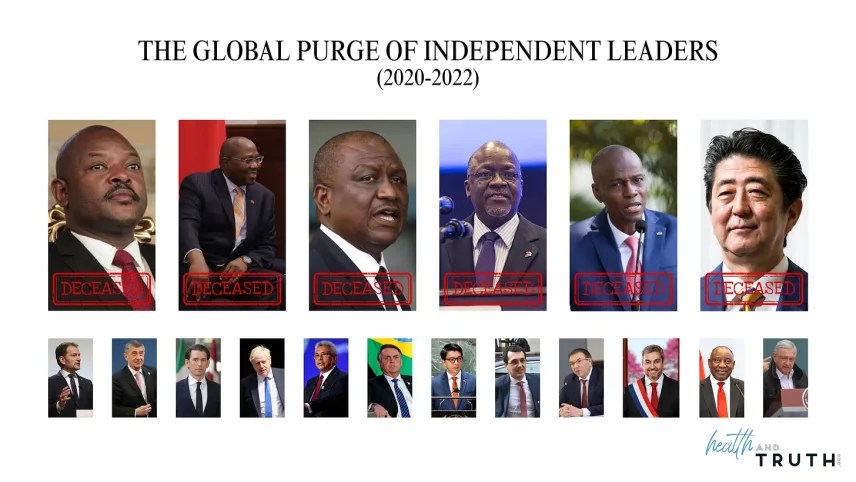
The Global Purge Of Independent Leaders (2020-2022)
A chronological overview of leadership changes and the policy pivots that followed
Health And Truth and Mark Stronge | October 28, 2025
From early 2020 onward, a repeating script unfolded: a head of state voiced skepticism of lockdowns, PCR testing, or experimental mRNA vaccines; international agencies scolded them; chaos or “illness” struck; and within weeks new officials delivered full compliance and suddenly unlocked frozen aid money. The alignment was worldwide—different cultures, same choreography.
1. Burundi – Pierre Nkurunziza
In Burundi, President Pierre Nkurunziza expelled the World Health Organization from his country in May 2020, saying foreign interference was undermining national sovereignty. He kept the nation open while neighboring states imposed severe restrictions. Merely two weeks after that decision he was dead, officially of a “heart attack,” though associates described him as being in vibrant health. His successor, Évariste Ndayishimiye, reversed course immediately, reopened WHO offices, and signed new vaccine and funding arrangements that brought Burundi back into the international fold.
- Backdrop: In spring 2020 the government halted WHO field work, accusing it of interfering with domestic affairs. Burundi rejected external pandemic restrictions and held public gatherings normally.
- Event: Nkurunziza died suddenly 8 June 2020 while still in office; official cause – cardiac arrest.
- Immediate shift: Successor Évariste Ndayishimiye re‑opened WHO offices, declared COVID‑19 a “national priority,” invited vaccine partnerships, and received roughly $24 million in rapid IMF assistance.
- Result: Burundi signed onto COVAX distribution in 2021 after having been one of the continent’s last hold‑outs.
2. Eswatini – Ambrose Dlamini
In Eswatini (formerly Swaziland), Prime Minister Ambrose Dlamini resisted extreme lockdown policies, insisting that starving citizens to stop a virus was immoral. In December 2020 he was taken to South Africa “for observation” and declared dead soon afterward. The royal government that replaced him moved quickly to impose strict curfews, accept COVAX vaccines, and collect foreign emergency aid.
- Backdrop: The businessman‑turned‑PM favoured balanced restrictions, warning that closing trade would worsen poverty.
- Event: Tested positive for SARS‑CoV‑2, transferred to South Africa, and died 13 Dec 2020.
- Aftermath: King Mswati III and his cabinet adopted curfews, mandatory masking, and joined regional COVAX planning.
- Economic follow‑up: The African Development Bank confirmed a $10 million grant under the COVID‑19 Response Support Programme in early 2021.
3. Ivory Coast – Hamed Bakayoko
A similar disappearance occurred in Ivory Coast. Hamed Bakayoko, the charismatic prime minister, had publicly encouraged herbal treatments and questioned the accuracy of PCR diagnostics. In March 2021 he died in Germany of “cancer,” barely eight months after his predecessor suffered a similar fate. His passing removed the last voice questioning WHO dependence. President Alassane Ouattara’s administration proceeded to import AstraZeneca doses through COVAX, and by summer the country was being praised for its “responsible leadership.”
- Backdrop: The popular Prime Minister promoted herbal remedies and localized treatment efforts while maintaining open borders for trade.
- Event: Died 3 Mar 2021 in Germany where he was under cancer treatment; preceded by the death of previous PM Amadou Gon Coulibaly eight months earlier.
- Aftermath: President Alassane Ouattara named Patrick Achi acting PM; by May, 504 000 AstraZeneca doses had been deployed through COVAX.
- Funding: World Bank approved $300 million for emergency health and education programmes that quarter.
4. Tanzania – John Magufuli
The next to fall was Tanzania’s John Magufuli, Africa’s most outspoken skeptic of mass testing and vaccines. He mocked the system by demonstrating that fruit and goats tested positive for COVID. After vanishing from public view in March 2021, the vice‑president announced that he had died of heart failure. His replacement, Samia Suluhu Hassan, promptly reversed every one of his policies, accepted a $600 million IMF “emergency” loan, reopened the gates to foreign pharmaceutical programs, and declared a massive vaccination drive before year’s end.
- Backdrop: Highly skeptical of PCR testing accuracy and mass vaccination; prioritized economic continuity.
- Event: Absent from view in March 2021 for two weeks; Vice President Samia Suluhu Hassan announced his death 17 March (heart failure).
- Aftermath: New administration reinstated public health briefings, reopened WHO cooperation, applied for IMF Rapid Credit Facility ($600 million approved Sept 2021).
- Policy transformation: Vaccine programmes, mask campaigns, and international data reporting began within ninety days.
5. Haiti – Jovenel Moïse
Then came Haiti, where Jovenel Moïse had rejected donated vaccine shipments, explaining that the country faced deeper issues of water and poverty. On July 7 2021, he was executed in his home by an armed team whose origins remain murky. Within three weeks, Haiti received half a million Moderna doses from COVAX and enjoyed renewed flows of Inter‑American Development Bank and USAID funding. The national policy flipped overnight.
- Backdrop: Refused early COVAX vaccine delivery, arguing sanitation and nutrition were greater priorities.
- Event: Assassinated 7 Jul 2021 by a commando team; political motives still contested.
- Aftermath: First COVAX shipment of 500 000 Moderna doses landed 14 July 2021.
- Financial context: Inter‑American Development Bank and USAID re‑released more than $60 million in suspended grants under the “COVID‑19 Recovery Program.”
6. Japan – Shinzo Abe → Yoshihide Suga → Fumio Kishida
In Japan, Prime Minister Shinzo Abe avoided harsh lockdowns and refused to make vaccination compulsory. In August 2020 he resigned citing chronic illness, a convenient exit for global interests irritated by Japan’s autonomy. His successor Yoshihide Suga approved emergency authorization for the Pfizer vaccine within weeks, and after political struggles Fumio Kishida continued the same line, expanding booster programs and digital health passes. When Abe, now a private citizen and public skeptic of global centralization, was assassinated in July 2022, the last independent conservative bastion in Japan’s establishment disappeared. The current government invested ¥4.5 trillion—about $40 billion—in mRNA infrastructure partnerships with Western firms.
- Backdrop: Abe resisted extreme lockdowns and mandatory passes; preferred voluntary distancing.
- Resignation: Aug 2020 due to chronic illness; Suga took over and immediately authorized Pfizer vaccine imports (Feb 2021).
- Transition: Kishida succeeded Suga Oct 2021 after election; expanded booster campaigns and health‑pass apps.
- Abe’s assassination: 8 Jul 2022 in Nara; investigation officially attributed to a personal grudge.
- Post‑event: Japan pledged ¥4.5 trillion (≈ $40 billion) in bio‑innovation investment partly for mRNA research.
7. Slovakia – Igor Matovič
Slovakia followed the pattern in March 2021 when Igor Matovič, who had attempted to purchase Russia’s Sputnik V vaccine outside the European Union’s centralized supply, was forced out after furious criticism from Brussels. His successor Eduard Heger rejoined the EU’s procurement framework and in return unlocked €6.3 billion in recovery funds.
- Backdrop: Purchased Sputnik V without EU approval to widen supply options.
- Event: Coalition crisis culminated March 2021 in his resignation.
- Aftermath: New PM Eduard Heger froze Sputnik imports, conformed to EU purchasing pool, and unlocked €6.3 billion EU Recovery Funds.
8. Czech Republic – Andrej Babiš
Nearby, the Czech Republic saw Prime Minister Andrej Babiš lose power at the end of 2021 after refusing to maintain endless pandemic states of emergency. His replacement Petr Fiala implemented vaccine passports and mass‑testing decrees soon afterward, bringing the nation into perfect accord with EU directives.
- Backdrop: Initially resisted heavy lockdowns, favored voluntary vaccination.
- Event: Lost October 2021 election amid strong pro‑mandate media push.
- Aftermath: Petr Fiala government mandated digital health passes (“Tečka” app) and extended state‑support contracts with Pfizer/Moderna.
9. Austria – Sebastian Kurz
Austria lost Sebastian Kurz the same year. Once a rising star who had questioned perpetual lockdowns, Kurz resigned under the weight of a corruption scandal in October 2021. Within days his successor announced Europe’s first universal vaccine mandate and qualified the country for €4.5 billion in European Stability Mechanism funding.
- Backdrop: Pushed for reopening and questioned perpetual emergency powers.
- Event: October 2021 resignation after prosecution alleged misuse of party funds.
- Aftermath: Successor Alexander Schallenberg announced universal vaccination January 2022; European Stability Mechanism distributed ≈ €4.5 billion in recovery funding.
10. United Kingdom – Boris Johnson
In the United Kingdom, Boris Johnson’s government had ended restrictions in mid‑2021 and refused to make vaccine passports a permanent condition of daily life. The press then exploded with “Partygate” scandals over gatherings during lockdown. Johnson resigned in 2022, replaced by Rishi Sunak, who restored Britain to full WHO cooperation and financed a £2 billion digital‑health‑ID system intended to prevent “misinformation.”
- Backdrop: Repealed many restrictions July 2021 (“Freedom Day”), angering zero‑COVID advocates.
- Event: Forced resignation mid‑2022 after “Partygate.”
- Aftermath: Rishi Sunak government supported the WHO pandemic‑treaty process and invested £2 billion in NHS digital ID infrastructure through Palantir‑backed data platforms. Within weeks of taking office, Downing Street announced negotiations with Moderna to establish a permanent mRNA‑manufacturing base — a 10‑year “strategic partnership” followed with construction of a mRNA vaccine research, development, and manufacturing centre in Harwell Science Park (Oxfordshire), projected to produce up to 250 million doses a year in a future outbreak. This collaboration was framed as part of the UK’s “100‑Day Mission” to deliver vaccines within 100 days of identifying a new pathogen; the mission itself originated from G7 and G20 pandemic‑preparedness pledges.
11. Sri Lanka – Gotabaya Rajapaksa
Half a world away in Sri Lanka, President Gotabaya Rajapaksa argued that global supply sabotage and debt were worse problems than COVID. By mid‑2022 coordinated protests and economic chaos forced him to flee abroad. Within weeks, the IMF approved a $3 billion bailout that required health‑security reforms and the adoption of digital‑surveillance frameworks under WHO supervision.
- Backdrop: Advocated reopening, claimed economic sabotage larger threat than virus.
- Event: Mass protests July 2022 amid fuel and food shortages.
- Aftermath: New interim government signed a $3 billion IMF agreement mandating fiscal reform and health‑security modernization.
12. Brazil – Jair Bolsonaro
Brazil completed the second‑wave phase of this storyline. President Jair Bolsonaro ridiculed mask mandates, called lockdowns a luxury for the rich, and questioned vaccine safety. After two furious years of constant hostility from media conglomerates and international NGOs, he lost the 2022 election. Lula da Silva took office, rejoined WHO initiatives, and secured a $1.2 billion World Bank “preparedness” loan.
- Backdrop: Dismissed lockdowns as “hysteria,” resisted vaccine coercion.
- Event: Lost 2022 election to Lula da Silva after two years of hostile media coverage.
- Aftermath: Brazil re‑entered WHO initiatives, COVAX procurement, and secured World Bank Preparedness Loan ($1.2 billion).
13. Madagascar – Andry Rajoelina
Along the African coast to Madagascar, President Andry Rajoelina had introduced his own herbal remedy, COVID‑Organics, and rejected Western pharmacology. In 2021 an attempted coup shook the island, and under global pressure Rajoelina signed new agreements restoring WHO cooperation that same year so donor funding could return.
- Backdrop: Promoted herbal tonic “COVID‑Organics” (artemisia‑based), claiming national self‑reliance.
- Event: July 2021 coup attempt; several senior officers arrested.
- Aftermath: Rajoelina accepted WHO cooperation and external medical aid later that year, restoring aid flows suspended in 2020.
14. Romania – Vlad Voiculescu Minister of Health
Appointed in December 2020 under Prime Minister Florin Cîțu, Voiculescu quickly became one of Eastern Europe’s most outspoken advocates for data transparency within the vaccine‑procurement process.
He questioned:
- why the European Commission’s contracts with Pfizer/BioNTech and Moderna were heavily redacted;
- the procedure for reporting adverse events and hospital bed usage;
- and financial allocation for Romania’s “Green Certificate” system.
In April 2021, Voiculescu alleged irregularities in the way national statistics on Covid mortality were reported (he said hospital figures were being “massaged” to fit EU targets).
Within 48 hours, Prime Minister Cîțu dismissed him (14 April 2021). That dismissal fractured the ruling coalition and was widely interpreted as pressure from Brussels and Bucharest business lobbies to restore “credibility” with EU health authorities.
- Backdrop: In 2021 Romanian minister objected to secrecy of EU vaccine contracts.
- Event: Dismissal and cabinet reshuffle.
- Aftermath:
- Florin Cîțu — Prime Minister (National Liberal Party), an economist trained in the US and a former banker, had emphasized cooperation with the European Commission’s Recovery Facility.
- Immediately after Voiculescu’s removal, Cîțu approved the formal implementation of the EU Digital COVID Certificate
- He signed Romania’s Recovery and Resilience Facility plan for €29 billion (approved September 2021).
- Cîțu later lost internal party support and was replaced by Nicolae Ciucă (2021 December).
- Raed Arafat — Secretary of State, Chief of the Department for Emergency Situations, a longtime figure in Romanian health management (specialist of Palestinian background), spearheaded the nationwide lockdown operations.
- He became polarizing — praised for emergency coordination but criticized for advocating strict curfews and mandatory digital passes.
- Through his influence, Romania aligned with EU Civil Protection Mechanisms and WHO technical advisories.
- Government enforced EU Digital COVID Certificates.
- Brussels released tranches of Recovery and Resilience Facility funds (€29 billion total plan).
- Florin Cîțu — Prime Minister (National Liberal Party), an economist trained in the US and a former banker, had emphasized cooperation with the European Commission’s Recovery Facility.
15. Bulgaria – Kostadin Angov
Appointed during the closing months of Prime Minister Boyko Borisov’s third administration, acting Health Minister Kostadin Angov (2020 – 2021) faced severe criticism from Brussels for Bulgaria’s slow vaccine rollout and limited transparency regarding distribution data. Angov and Borisov’s cabinet were accused of delaying orders through the EU’s joint procurement scheme, preferring to wait for additional safety results before committing to large Pfizer/Moderna contracts.
By late March 2021, Bulgaria had one of the lowest vaccination rates in the European Union and was publicly rebuked by the European Commission for “failure to utilize allocated supply quotas.”
Backdrop: By early 2021, Bulgaria’s center‑right government under Boyko Borisov had lost support amid apparent corruption scandals unrelated to health policy but amplified by public anger over uneven lockdown enforcement and vaccine delays. Multiple cabinet ministers, including acting Health Minister Angov, were called before parliamentary committees to justify the government’s refusal to impose stricter green‑pass rules or to publish full statistics on vaccine deliveries.
Event: In April 2021, Borisov’s GERB party failed to form a coalition following a general election; the president appointed Stefan Yanev as caretaker prime minister, and Stoycho Katsarov — a former deputy minister and health‑reform activist — assumed the health portfolio. Katsarov announced immediate compliance with EU digital pass protocols and promised rapid adoption of the COVID Certificates system, stating that “communication with Brussels must be restored through transparency and vaccination.”
Aftermath: Within three months of the caretaker cabinet’s installation, Bulgaria joined the EU Digital Green Certificate scheme (July 2021), issued its own national app, and implemented tightened entry controls for public venues. The European Commission then approved Bulgaria’s €6 billion Recovery and Resilience Facility allocation (approved December 2021) after earlier postponements linked to “governance deficiencies.”
Katsarov and Yanev argued the shift was strictly technocratic, yet domestic media framed it as the price of unlocking EU funds frozen under Borisov. Moreover, WHO country officers held joint press briefings in Sofia throughout autumn 2021, publicly graduating Bulgaria from a “non‑compliant” to a “fully aligned EU‑health partner.” Later that year a second caretaker cabinet retained the same policies to preserve continued Brussels cooperation.
Government Outcome: By the end of 2021 Bulgaria had moved from partial defiance to complete compliance with EU and WHO health requirements. The turnover of Borisov’s administration and replacement with technocratic caretaker officials effectively cleared the way for release of European recovery funds for health‑system modernization and digital infrastructure projects.
Summary of Sequence
- Initial reluctance to join EU vaccine mandates and delays in accepting digital certificate standards.
- Electoral defeat of incumbent government after months of European pressure and domestic unrest.
- Caretaker administration’s rapid embrace of EU and WHO frameworks.
- Approval of €6 billion in Recovery Funds and re‑establishment of good standing with Brussels.
16. Paraguay – Mario Abdo Benítez
Paraguay’s experience exemplifies how smaller Latin American economies were forced to align pandemic policies with international credit conditions. President Mario Abdo Benítez’s government initially emphasized economic stability over draconian lockdowns, warning that strict restrictions would devastate informal workers who make up more than 60% of the labour market. However, as domestic protests intensified and foreign creditors tightened lending conditions, the administration conceded to the IMF’s stipulations that pandemic‑response financing be tied to specific “public‑health governance commitments.” Once those commitments were accepted, loan disbursements resumed, showing how financial contingency mechanisms coerced health‑policy conformity.
- Backdrop: Through 2020 and early 2021 Paraguay maintained one of South America’s least restrictive lockdown regimes. The government was reluctant to mandate vaccinations or fully close borders with Brazil and Argentina.
- Event: In March 2021 mass protests erupted in Asunción over shortages of medical supplies and alleged corruption in procurement; opposition parties launched a failed impeachment attempt against President Abdo Benítez.
- Aftermath: To restore credit stability, the finance ministry agreed to conditions attached to an IMF Rapid Financing Instrument (≈ $274 million) earmarked for health expenditure auditing and expansion of surveillance systems. By late 2021 Paraguay was fully aligned with WHO and Pan American Health Organization recommendations.
- Outcome: Government stability was restored after external financing resumed, but policy autonomy remained limited by credit conditionality.
17. South Africa – Cyril Ramaphosa
South Africa began as a reluctant participant in strict global pandemic protocols. President Cyril Ramaphosa voiced concerns that extended lockdowns could fuel unrest and economic collapse, and he pushed for Africa‑wide vaccine intellectual‑property waivers rather than Western purchases. Nevertheless, as international ratings agencies threatened downgrades and IMF/World Bank assistance was made contingent on “strengthened public‑health governance,” South Africa shifted its course, introducing some of the continent’s strictest workplace vaccine rules.
- Backdrop: From early 2020 to mid‑2021 Ramaphosa’s cabinet clashed with business unions and community organizations over the cost of lockdowns versus public‑health benefit. Debt pressures soared following a 10% GDP contraction in 2020.
- Event: The National Treasury secured a $4.3 billion IMF loan (July 2020) and a World Bank loan of $750 million (Jan 2022) containing performance benchmarks for pandemic containment and “human capital protection”.
- Aftermath: By December 2021 South Africa announced mandatory vaccination for public‑sector employees and participation in the WHO vaccine passport initiative. Foreign aid disbursement and sovereign bond ratings stabilized only after these steps.
- Outcome: Policy alignment improved credit access but deepened domestic inequality and led to significant civil‑liberty litigation and ongoing parliamentary inquiries into procurement transparency.
18. Mexico – Andrés Manuel López Obrador
Mexico under Andrés Manuel López Obrador (AMLO) presented one of the last major cases of gradual capitulation to WHO and multilateral financial pressures. Initially AMLO resisted mandatory lockdowns and booster campaigns, insisting that national public‑health policy should focus on nutrition and poverty reduction. However, a combination of supply‑chain disruption, dollar liquidity concerns, and lobbying from international philanthropic networks (CEPI, GAVI, and the Gates Foundation) eventually pushed Mexico toward full policy compliance by 2022.
- Backdrop: Throughout 2020 Mexico’s Health Secretary Jorge Alcocer and Under‑secretary Hugo López‑Gatell advocated moderate restrictions and non‑coercive vaccine rollout. The country’s mortality surged during mid‑2021, provoking foreign and domestic pressure for a policy shift.
- Event: Facing threat of credit downgrades, the Finance Ministry began talks with the World Bank and IMF for infrastructure loans linked to public‑health reform. In December 2021 Mexico signed a joint memorandum of understanding with WHO and CEPI for “bio‑pharmaceutical collaboration and vaccine development capacity”.
- Aftermath: Through 2022 Mexico aligned its vaccine certification systems with the COVAX framework and expanded digital health records for the Ministry of Health, unlocking up to $1 billion in World Bank Covid‑response financing.
- Outcome: By 2023 Mexico was publicly touted by WHO offices as a “model for integrated pandemic response,” demonstrating how international credit leverage transformed a once‑independent policy line into strict adherence with global health‑security standards.
Summary of Observable Trends
- Chronology: Deaths of Nkurunziza, Dlamini, Bakayoko, Magufuli, and Moïse opened the sequence (Jun 2020 – Jul 2021). Political collapses in Europe, Asia, and the Americas followed through 2022.
- Policy effect: Every successor endorsed WHO recommendations and entered international funding arrangements that had been unavailable under predecessors.
- Financial trigger: Aid packages—IMF Rapid Credit, World Bank preparedness loans, EU Recovery mechanisms—were routinely disbursed within 30–90 days of the leadership change.
Key Takeaway
From 2020 to 2022, the result was unmistakable: national autonomy collapsed beneath a synchronized agenda linking public‑health compliance to economic salvation. Countries that resisted early, especially in Africa, suffered the hardest blows—five sitting leaders dead in one year. More powerful nations experienced subtler coups through scandal, protest, or economic blackmail, all producing the same end state.
What emerged from these parallel crises was not medical harmony but political homogenization. Each successor declared a “renewed partnership with science,” welcomed new funding from the IMF, World Bank, or GAVI, and ushered in digital‑compliance systems that now define post‑pandemic governance.
By the end of 2022 nearly every government on Earth—rich or poor, democratic or autocratic—had been brought into alignment. Differing flags, languages, and histories no longer prevented one shared choreography: resistance punished, obedience financed, and sovereignty quietly exchanged for a coordinated global script.
- IMF Press Release – Rapid Credit Facility for Burundi (June 2020).
- Reuters / AP Report – Death of Eswatini Prime Minister (Dec 2020).
- African Development Bank – COVID‑19 Response Support Programme (2021).
- World Bank – Ivory Coast Emergency Support Project (2021).
- IMF Press Release No. 21/210 – Tanzania RFI (Sept 2021).
- Associated Press – “President of Haiti Assassinated at Home” (July 2021).
- IDB Official Statement on Haiti Relief Funding (2021).
- Japan Cabinet Office – Resignation of PM Abe (Aug 2020).
- Nikkei Asia – “Japan Invests in mRNA Manufacturing” (2022).
- 1European Commission – Next Generation EU Fund Allocation to Slovakia (2021).
- Czech News Agency – Election Results and Policy Changes (2021).
- Austrian Prosecution Service – Kurz Investigation Report (2021).
- EU Council Press Release – Austria ESM Allocation (2022).
- UK Parliamentary Record – Digital Health Infrastructure Funding (2022).
- IMF Staff Report – Sri Lanka Extended Fund Facility (March 2023).
- World Bank – Brazil Pandemic Preparedness Loan (2022).
- WHO Madagascar Country Office – Cooperation Agreement (2021).
- European Commission – Romania RRF Approval (2021).
- European Commission – Bulgaria RRF Approval (2021).
- IMF Country Report – Paraguay Pandemic Financing (2021).
- IMF Country Report – South Africa Fiscal Support Arrangements (2021).
- WHO / CEPI Press Release – Mexico Cooperation Agreement (2022).
- IMF Country Report – Paraguay Rapid Financing Instrument 2021.
- BBC News Latin America – “Protests Rock Paraguay Over Pandemic Supplies,” March 2021.
- Finance Ministry of Paraguay – Press Release on IMF Commitments April 2021.
- South African Reserve Bank Annual Report 2021.
- IMF Press Release No. 20/315 – South Africa Loan Approval; World Bank Loan Press Brief 2022.
- Reuters – “South Africa Adopts Mandatory Public‑Sector Vaccination Policy,” December 2021.
- El Universal – “López‑Gatell Sabemos que no habrá vacunación obligatoria,” 2020.
- WHO / CEPI – Memorandum on Mexico Vaccine Collaboration, December 2021.
- World Bank – “Mexico COVID‑19 Emergency Response Project,” 2022.
Russia reacts to NATO state minister’s threat to ‘wipe Moscow off the map’
RT | October 29, 2025
Russia has accused Belgian Defense Minister Theo Francken of irresponsible rhetoric after he suggested that NATO could “wipe Moscow off the map.”
In an interview with De Morgen newspaper published on Monday, Francken brushed off concerns that the currently shelved delivery of US-made Tomahawk missiles to Ukraine could trigger an all-out war between Russia and NATO. He argued that Russian President Vladimir Putin would not use nuclear weapons because the US-led alliance “will wipe Moscow off the map.” Francken added that he did not fear a conventional attack on Brussels since it would result in Moscow getting “flattened.”
Russian Deputy Foreign Minister Aleksandr Grushko told the Russian daily RBC on Wednesday that Francken’s words were in line with “the atmosphere of military psychosis” prevalent in Western Europe.
The Russian Embassy in Belgium condemned Francken’s “provocative and irresponsible” statements as “sheer absurdity and total disconnect from reality.”
“Francken’s escapades are the most glaring manifestation of the militarist frenzy that is increasingly consuming the European war party,” the embassy said. It added that EU officials like Francken are “posing a threat to the continent’s future and [are] capable of plunging it into a new war.”
Moscow has repeatedly stated that the flooding of Ukraine with Western weapons would not stop its troops but only cause further escalation.
NYPD Commissioner Jessica Tisch is Turning New York City into a Surveillance Colony
By Matt Wolfson | The Libertarian Institute | October 29, 2025
In a recent report for the Libertarian Institute, I investigated Zionists’ role in creating the crisis point at which New York City now finds itself: caught between a colonial elite which has commandeered government and a progressive-socialist backlash to that elite which proposes to expand government. In this report, I will trace how, in response to the progressive-socialist threat to their power, Zionists and their allies are expanding government in new and frightening directions. The leading player in this operation, like in all good intelligence ops, is not a colorful or charismatic character. But she has all of the subtler qualities—connections, management prowess, presentational understatement—that the city’s minders look for in those who hold actual power.
Jessica Tisch, the New York Police Department Commissioner since 2024 who will definitely stay on if either Zohran Mamdani or Andrew Cuomo wins the mayoralty according to public statements made by both men, is the third generation of the billionaire Zionist family that has had prominent roles in shaping the city since the 1980s. Her grandfather, Laurence Tisch, bought CBS in the 1980s not long before his brother Robert bought the New York Giants, establishing the family, which had started in hotels and movie theaters, as the owner of two of the city’s landmark organizations. In the 1990s, Laurence Tisch was a member of The Study Group, the informal philanthropic Zionist gathering co-founded by Leslie Wexner and Charles Bronfman, which led directly and indirectly to the foundation of Taglit Birthright, the Foundation for Defense of Democracies, and various other projects for Zionist continuity. Laurence’s son and Jessica’s father, James Tisch, is the chairman of the Board of Leows Corporation, the family’s flagship business. James’ wife and Jessica’s mother, Merryl, was the chancellor of the New York State Board of Regents, responsible for supervising all educational activities in the state; and is the chair of the State University of New York Board of Trustees, responsible for supervising the state university system.
Within this context of a family involved in media, finance, philanthropy, and part-time politics, Jessica Tisch, who is now 44, charted her own specific path: from security to administration to the cusp of politics with the backing of money. She started in the NYPD in the decade of the September 11 attacks; continued in the department in the 2010s; moved in the first half of the 2020s to the Sanitation Department, arguably New York’s most important after police and fire. She has returned in the mid-2020s to the NYPD as its commissioner, while also widely being considered a potential future mayor. Like Mamdani, Tisch is a product, this time a direct one, of the decades of Zionist influence that preceded her rise. Like Mamdani, rewinding Tisch’s career shows how she is the capstone to a project of military policing that began in the 1990s and 2000s but that has sharpened under pressure into a full-blown project of social control.
That project began when crime rose in New York in the 1980s and 1990s in response to displacement and homelessness facilitated by WASPs, Zionists, and their allies co-opting city government to the benefit of finance and real estate. In response, Eric Breindel, the neoconservative Zionist editor of the New York Post who had extensive connections to Wall Street, arranged for the Post to back the then-longshot Rudolph W. Guiliani as a tough-on-crime candidate, delivering him Staten Island and so the city.
At the same time, Michael Steinhardt, the Zionist financier who was integral in the reinvention of Wall Street in the 1980s, became the major donor for the Democratic Leadership Council (DLC), which in turn was the major backer of President Bill Clinton, who shepherded to passage in Congress as his main legislative priority the Violent Crime Control and Law Enforcement Act. This act provided newly elected Mayor Giuliani and his police commissioner William Bratton federal funds for law enforcement, with certain conditions attached that increased local spending on policing as well as the size of the NYPD. The NYPD’s budget increased from $1.7 billion to $3.1 billion between 1993 and 2000, also leading to increased city spending, since, under the terms of the Clinton crime legislation, to receive federal funds the city had to spend funds of its own.
During this period, “crime”—defined as everything from murder to unlicensed street vending—fell in response to across-the-board enforcement. After 2001, Raymond Kelly, Mayor Michael Bloomberg’s police commissioner, pushed this practice to its limit with the aggressive practice of “stop and frisk” in minority neighborhoods: a daily distillation of the broader disenfranchisement the black and Latino communities of New York had been experiencing since the 1970s.
Kelly also made sure that the NYPD would benefit from post-9/11 funding of counter-terrorism measures, measures which hinged heavily on techniques for surveillance. And it was by channeling this new priority for social control that Jessica Tisch made her career beginning in 2000s. Fresh out of Harvard, she took “an analyst position available in what was then the counterterrorism bureau” of the NYPD. According to a recent profile in The New York Times:
“Kelly…did not normally meet with applicants for such entry-level jobs, but he ended up interviewing her. ‘Probably because she was a Tisch,’ he said, adding that he had been impressed with her three Harvard degrees.”
“Probably because she was a Tisch” seems like a fair assessment of why the supervisor of 55,000 employees took the time to meet a twenty-something about an entry-level position. But Kelly and Tisch also shared the promising ground of a professional focus: Kelly was committed to surveillance-as-policing, and Tisch’s main interest was data and surveillance. At the NYPD, she began “developing the Domain Awareness System, one of the world’s largest networks of security cameras, including handling contracts to build and expand it.” According to a description of this work in a recent profile of Tisch in New York Magazine, she was Domain’s driving force and Domain her career-maker:
“… Tisch, 27, was tasked with figuring out what to do with more than $100 million in unspent grant money from the federal Department of Homeland Security, which had just built a surveillance network to prevent another terror attack downtown. What if, she asked, the Domain Awareness System went citywide? And what if, instead of trying to stop a suicide bomber, the system tried to spot all kinds of crooks? What if it included the NYPD’s trove of arrest reports and criminal histories? When Tisch sent the privacy guidelines for the system to the lawyers at the New York Civil Liberties Union, they retched…The bosses had the opposite reaction: ‘No, you’ve made it. Congratulations,’ the former colleague recalls them saying.”
Based on an initial grant of $350 million from the Department of Homeland Security and developed with Microsoft technology, the System consists today of “a surveillance network of more than 18,000 interconnected cameras—including those in the private sector—as well as law-enforcement databases.” The system, in one description, “assimilates data from several surveillance tools—license plate readers, closed-circuit television streams, facial recognition software and phone call histories—and uses it to identify people.” As these descriptions suggest, private corporations and nonprofits, for example Rockefeller University in Midtown East Manhattan, can buy in: providing their own cameras then linking them to the surveillance system run out of the NYPD. “And,” according to one report, “when Microsoft turns around and sells the technology to other cities, New York gets a cut.”
Tisch was not only one of the developers, if not the developer, of the system; she also so impressed Kelly with her tenacity dealing with the various technology sub-vendors put in play by the project that he moved her up through the ranks. (She also may have impressed Kelly with her access to funds; the nonprofit the New York Police Foundation, which her uncle chaired and where two of her family members still sit on the board, provided some of the early contributions for testing her surveillance system.) Within a decade, “she became the city’s first information technology commissioner… and within months she was in the midst of the coronavirus pandemic, struggling to create a contact tracing system and then a vaccine distribution system.” Throughout this time, Tisch was working with at least one like-minded colleague from a similar background. This was fellow Harvard graduate Rebecca Ulam Weiner, the granddaughter of the Zionist nuclear scientist Stanislav Ulam of the Manhattan Project, whose view of her grandfather’s work is instructive:
“As someone whose job it is to keep secrets, I often wonder whether such an experiment [as the Manhattan Project] would be possible today, scientifically or socially.”
Fast forward to November 2024, and an embattled Mayor Eric Adams, whose allies in the black community have increasingly moved away from him even as powerful Zionists have edged closer, appointed Tisch Commissioner. He did this despite vocal concerns from civil liberties advocates that, in the words of one, “It’s really alarming to see a commissioner who built her career on the infrastructure of mass surveillance.” Weiner is Tisch’s deputy commissioner of intelligence and counterterrorism, and has let it be known that her department “relies on a mind-boggling suite of assets that Americans might otherwise assume are controlled by the CIA, FBI, DHS, Secret Service, or other agencies.” These include:
“… a legion of intelligence analysts, counterassault and dignitary-protection teams, a flotilla of boats…surveillance aircraft, the nation’s biggest bomb squad, a counter-drone unit, a remote contingent of NYPD detectives… and a network of multilingual undercover operatives…”
Among this “remote contingent” is NYPD Detective Charlie Benaim, “[whose] office could be any squad room in Brooklyn, but for years [has been] an Israeli police station near Tel Aviv,” where “Benaim’s been feeding an endless stream of information, in real time, to his bosses back at One Police Plaza.” According to Weiner, Benaim’s function is “asking the New York question, when something is happening, what would it look like it if it were to happen in New York City, and more importantly than that, how do you prevent it?” A new model for Benaim in answering these questions, apparently, is the Hamas uprising of October 7. This suggests either that the NYPD expects a coordinated attack from foreign operators; or that New York’s security leaders see the city as potentially under siege by its own displaced and ghettoized underclass and plan to respond accordingly.
Telling in this regard is the fact that Tisch’s top priority as commissioner is “doubling down on data-driven policing and surveillance,” an aim which has “sparked fierce criticism from watchdog groups that New Yorkers are living in a surveillance state.” According to New York Magazine, Tisch’s proposed reforms fall along four lines. First, she wants to expand actual surveillance capacities by expanding the city’s camera network “to include more privately owned cameras.” Second, she wants to extend the contract of one of Domain’s less reliable components, “the ShotSpotter gunshot-detection system” which “may result in confirmed shootings only less than 15 percent of the time, according to the comptroller’s office,” a fact which Tisch dismisses, “arguing that something is better than nothing.” Third, she wants to use data collected “to surge police resources down to a single block,” allowing for the department to deploy overwhelming force to tackle individual incidents in small areas. (This means essentially treating city policing as counterinsurgency warfare, and it’s not too different than the LAPD tactics that led to the abuse of Rodney King and the fallout that followed.) Finally, “perhaps the biggest change is that she wants to use those same systems and processes to fight ‘chaos,’ not just crime,” meaning that minor noise disturbances or unusual behavior could qualify for police enforcement via surveillance and surges. (Again, this is a retread of the 1990s: “Giuliani-style crackdowns, only with better gear.”)
More instructively still, she feels this way despite at least one recent controversy suggesting that her policies have adverse effects on the very communities historically at the blunt end of militarized policing. According to The New York Times, in an August report, the NYPD used Domain Awareness System’s facial recognition software to identify and arrest for indecent exposure in April a 230 pound 6-foot-2 black man, Trevis Williams. The arrest was made even though a witness said that the offender was about 160 pounds and 5-foot-6 and even though “location data from [Williams’s] phone put him about 12 miles away at the time.” According to the Times, the fact that “a facial recognition program plucked his image from an array of mug shots and the woman identified him as the flasher was enough to land Williams in jail.” This is despite the fact that “other police departments… require investigators to gather more facts before putting a suspect identified by facial recognition into a photo lineup,” and despite advocacy from groups like the American Civil Liberties Union to “ban… the use of facial recognition by the police because of the risk of misidentification.”
“In the blink of an eye, your whole life could change,” Williams told the Times about his experience, adding that he still gets panic attacks since his April arrest and subsequent imprisonment. The Times investigation did not report asking for a comment from the NYPD or its Commissioner. Nor did it report that, as early as 2019, 11,000 cases per year were being investigated by the NYPD with the help of facial recognition software.
Despite collateral damage from her policies, positive media profiles of “Commish Tisch” and her subordinates have been plentiful since her accession. In an April 2025 report in The News section of The New York Times, the paper had the following to say about her: She has “an unlikely and remarkable career”; is “the daughter and granddaughter of two strong women, neither of whom came from money”; “learned hard work by example”; is “talkative and purposeful, but circumspect”; is a “no-nonsense technocrat” and “incredibly competent”; commands “a huge amount of respect”; is “very businesslike,” “[takes] no guff,” and should run for mayor. New York Magazine, the city’s go-to venue for fashion and culture commentary, had run an equally complimentary profile in March of 2025 that included the same political prediction.
And, the month before New York Magazine’s profile of Tisch, Vanity Fair ran a profile of Tisch’s deputy Weiner titled “NYPD Confidential.” Headed by a black-and-white photo of Weiner flanked by members of her squad that seemed ripped from a promotional poster of Captain America, the article’s text gave its subject an equally marquee treatment, describing her as “laser focused,” “unfazed,” “poised, cultivated, pin-sharp, convivial, boundlessly curious, charmingly profane,” and “a lightning-quick study” who had “a wicked sense of humor.” All three of these profiles also emphasized, as The New York Times’ editorial board regularly emphasizes, a recent rise in crime in the city without honing in on its obvious causes: financialization, gentrification, and displacement.
The Times is owned by the Sulzberger Family, whose members are ambivalent about Zionism but who have deep connections to Zionists. (Their executive editor, Joseph Kahn, is the son of a committed Zionist corporatist and runs in the billionaire Zionist milieu; their editorial page is dominated by Jewish Zionists of all political persuasions; and the former head of the Sulzberger family wealth office now heads Bill Ackman’s.) Vanity Fair is still owned by the Newhouse Family, which, as I reported in my recent investigation on the rise of Zionist power in New York, was vital to that project thanks to its ownership of Conde Nast. New York Magazine is dependent for its scoops on access to the city’s financial and philanthropic elite, many of them Zionists—its recent profile subjects include not just Jessica Tisch but Barry Diller and Diane Von Furstenberg and Bill Ackman. The message from these media venues seems clear: the Zionist financial powers of New York are squarely behind Jessica Tisch, and want their readers to know it.
It is not, in this context, a coincidence that the Times ran an article soon after Zohran Mamdani’s victory in the Democratic mayoral primary citing anonymous sources to report that Mamdani was being urged to keep Tisch on if he wins the mayoralty as a “steady pair of hands.” It is also not a coincidence that this story came during a period when Dan Loeb and Bill Ackman, younger Zionist financial-philanthropic operators, were attacking Mamdani as soft-on-crime almost daily and shifting their funding focus to Mamdani’s Independent mayoral competitor, Mayor Eric Adams, to the point of personally vetting Adams’s campaign manager before the position was filled. What this suggested at the time was a pincer movement, in which attacks by Loeb and Ackman pressured Mamdani into keeping Tisch on as a sign of faith in the establishment and détente with Zionism.
And, in late October, with Mamdani still attacked by connected Zionist players for purportedly making Jews feel unsafe despite the fact that he has attracted significant Jewish support, this is exactly what occurred. On October 22, Mamdani announced, four days after Andrew Cuomo had announced the same, that he would ask Tisch to stay on should he win the election. The reported terms on which this “ask” was made are not encouraging when it comes to Mamdani’s leverage over Tisch if he is elected mayor. Details in The New York Times painted a scenario in which Mamdani had publicly (and factually erroneously) made Tisch the poster child for safety in the city without extracting any concessions from her camp in return. According to the Times,
“… Mr. Mamdani confirmed his decision during the final televised debate before the Nov. 4 election. ‘Commissioner Tisch took on a broken status quo, started to deliver accountability, rooting out corruption and reducing crime across the five boroughs,’ Mr. Mamdani said at the debate. “I’ve said time and again that my litmus test for that position will be excellence’… Ms. Tisch’s allies have signaled for months that she would want to stay in the job regardless of the election’s outcome. [Mamdani] campaign officials declined to detail any conversations between the candidate and the commissioner, but said they were confident she would accept. Delaney Kempner, a spokeswoman for Ms. Tisch, referred a reporter back to an earlier statement from the commissioner stressing that ‘it is not appropriate for the police commissioner to be directly involved or to seem to be involved in electoral politics.’”
Tisch’s strategic mix of aggressive behind-the-scenes lobbying and Olympian public detachment sends a message: as New York Magazine put it less than twenty-four hours after Mamdani made the announcement, she is “the Heiress Who Could Make or Break the Socialist Mayor.” Not long after this article ran, Hakeem Jeffries, the New York Democratic leader of the U.S. House of Representatives, ended five months of ostentatious non-endorsement of Mamdani with a statement endorsing Mamdani—specifically praising his willingness to keep on Tisch. Already, then, thanks to a series of private maneuvers and public feints, Tisch has been placed in the driver’s seat: the establishment’s cooperation with Mamdani is clearly conditioned on Mamdani’s continued acceptance of her.
One difficulty of critiquing moves like these is that the conflation of “Jewish power” and New York is an old trope, in part because New York has been since the early twentieth century a Jewish city. So it should be emphasized, as I have emphasized in my previous report on this topic, that New York’s problem is not a problem of Jewish power. It is a problem of government-tied financialization at the hands of a small number of WASPs and then a small number of Zionists, and it has come at the expense of the people who live in the city, among them many Jews. Now, with a direct threat to Zionists’ influence in the person of Zohran Mamdani, the operation is out front. Zionist financiers have sent one of their own to occupy the most powerful security position in the city, and they are intent on keeping her there. If they fail to install their ally Andrew Cuomo in the mayoralty, which will give Tisch carte blanche, the prospect of them working to sabotage a Mamdani mayoralty in the lead-up to a Tisch For Mayor campaign in 2029 is a very real one.
They will likely do this much like they managed the securance of Jessica Tisch’s job: with media attacks meant to maximize pressure on Mamdani; followed by private assurances to Mamdani that the attacks will stop if concessions follow. These public-private feints, in turn, will push Mamdani into concessions which will make him lose face with his base, isolating him between an unfriendly establishment and a disillusioned electorate. (This trend is already occurring, albeit at the edges, after Mamdani’s public commitment to keeping Tisch, whom many Mamdani voters see as a threat to civil liberties.) Tisch’s allies will manage these plays with the help of The New York Times and other organs of influence (the Conde Nast publications, New York Magazine, the New York Post) which by their own admission are pining for technocratic government predicated on what they call “effective management.”
But there is another equally bad outcome that could accrue should Mamdani win the mayoralty and Tisch stay on as police commissioner. This is the fusion of the most dangerous potential aspect of socialism, total government direction of the economy, with the most dangerous potential aspect of Zionism: total techno-military colonial control. It doesn’t take a great deal of imagination to see how, under a de facto power-sharing agreement between Mamdani and Tisch (Mamdani in charge of domestic welfare, Tisch in charge of security) the worst impulses of both systems will merge to create a city government which is totalistically involved in every aspect of its citizens’ lives, Singapore transfused with Sweden. This outcome for a city which for a century has been read as a triumph of American individualism would be, to understate the case, a seismic shift.
A New Low: Western Media Promotes ISIS-Linked Gangsters In Gaza
By Robert Inlakesh | Palestine Chronicle | October 29, 2025
Al-Natour is the embodiment of the archetypal Palestinian collaborator. A man who portrays himself as a victim uses his own experience as a Palestinian to whitewash Israeli genocide.
On October 27, the Washington Post published an article entitled “The ceasefire created two Gazas. One will consume the other.” The author argues that “My Gaza is ready for peace” and that “Hamas is trying to destroy it”, promoting the fictitious Israeli narrative that a utopian Gaza is being made possible inside the portion of the enclave where the occupation forces remain, behind the so-called “Yellow Line”.
The article works to promote the Israeli scheme in Gaza, which has been openly endorsed by US officials, and argues in favor of only allowing reconstruction in the territory operated by Israel, alongside four primary ISIS-linked militias.
Evidently, the article makes no mention of the Israeli armed and controlled Palestinian death squads – composed of convicted drug traffickers, rapists, murderers, ISIS-linked Salafists and aid looters.
The piece is purportedly written by one Moumen al-Natour, which makes even more sense out of why there is no mention of the ISIS-linked death squads, because he himself is an armed member of one such death squad.
Al-Natour is the embodiment of the archetypal Palestinian collaborator. A man who portrays himself as a victim uses his own experience as a Palestinian to whitewash Israeli genocide and lies about every detail to turn himself into a “peace activist” opposed to armed resistance, while simultaneously partaking in activities designed to further the extermination of his own people.
Take, for example, the following excerpt from the ISIS-linked death squad collaborator’s alleged opinion piece:
“My Gaza, where I wish to live, exists between Israel and the yellow line. There, the war is over and change buzzes in the air. People have access to food, medicine and electricity. And other signs of normality are beginning to return, such as some children going back to school. This is the Gaza that is waiting with anticipation to work with a new civil administration and an international protection force that will keep the peace as Israel withdraws. Few there speak of Hamas with any warmth or positivity. For once they no longer have to.”
The territory spoken of here is the area of Gaza where Israel and four ISIS-linked collaborator gangs operate; the only civilians there are the families of the death squads. Any other Palestinians attempting to reach their homes inside this area are bombed or gunned down by Israeli forces.
This territory, on the other side of Israel’s “Yellow Line,” is supposed to be 53% of Gaza, yet in reality is anywhere between 54-58% of the territory, due to Israel violating the ceasefire agreement and operating deeper than agreed upon inside the supposed withdrawal zone.
In addition to this, Israel continues its daily demolition operations against the remaining Palestinian civilian infrastructure inside the territory, again in violation of the ceasefire agreement. The proof of this has been openly published by Israeli soldiers who post videos of their demolition work on social media.
As for access to food, medicine, and electricity, these are provided to the collaborator gangs by Israel and are something they have not lacked during the war. While the people of Gaza were being starved for three months straight earlier this year, al-Natour’s militia friends were living lives of relative luxury.
Not only were al-Natour’s collaborator gang not starved, the so-called “Popular Forces” that he is part of, led by ISIS-linked convicted drug trafficker Yasser Abu Shabab, were living off of the supplies they stole from humanitarian aid trucks and looted from Gaza’s civilian population.
That is what these militant organizations began receiving Israeli backing to do – before being repurposed, armed and given direct combat missions by the IDF and Shin Bet – to rob humanitarian aid trucks and help enforce Israel’s starvation policy in Gaza. All of these collaborator gangs were tasked with involvement in such activities, and many of their militants continue to loot.
Meanwhile, in the Western corporate media and its allied Arab publications, al-Natour and his ilk are portrayed as the peace activists opposed to Hamas tyranny. For al-Natour’s part, he was one of the founders of the “We Want To Live” movement, which claimed its mission was to improve living conditions inside the besieged coastal enclave, described by UN experts as “unlivable” back in 2020.
As an activist, he was accused of working on behalf of Israel and spreading a message critical of Hamas, leading to his arrest. Whether he was a collaborator back then is under dispute, yet, during the genocide, he and his anti-Hamas message were picked up by a media outlet called Jasoor News.
This media outlet’s editor-in-chief is a Washington based journalist, named Hadeel Oueis, who routinely shares anti-Hamas content, including from the Center for Peace Communications (CPC). Oueis also expresses support for the current Syrian leadership of Ahmed al-Shara’a.
The CPC has received considerable donations from the Adelson Family Foundation of Israel’s richest billionaire and top Trump campaign donor, Miriam Adelson. For Jasoor News’ part, it is explicitly anti-Hamas, anti-Hezbollah, anti-Ansarallah, while publishing pieces in favor of the United Arab Emirates and Saudi Arabia.
Western Media Support For ISIS-linked Groups
The recent propaganda opinion piece published by the Washington Post comes as little surprise, as it was the first Western publication to publish an interview with ISIS-linked militia leader Yasser Abu Shabab in November of 2024, when Israel began to give the aid looting gang a facelift and begin promoting them as a “grassroots” anti-Hamas resistance force.
In that WP piece, Abu Shabab claims victim status and that he looted aid out of necessity, expressing that “Hamas has left us with nothing”, despite his gang of collaborators clearly being the only group of Gazans who actually did have something during the genocide. Abu Shabab was used to do Israel’s bidding, blocking the flow of aid to civilians and lived under the protection of the Israeli military while doing so.
Back in July, the Wall Street Journal then published an opinion piece entitled “Gazans are finished with Hamas”, which it claimed was written by Yasser Abu Shabab himself. This was despite the fact that local sources in Gaza attest to Abu Shabab not only being unable to write in English, but also being illiterate and incapable of writing such a piece in Arabic too.
According to anonymous sources belonging to Palestinian journalist Muhammad Shehada, the latest Washington Post piece was published as explicit Israeli propaganda. “Journalists told me a pro-Israeli PR firm in DC is the one that pushed for this propaganda article to be published,” he wrote on X [formerly Twitter], adding that “my sources said there’s a chance the firm is the one that even wrote the op-ed”.
All of this works as part of an Israeli propaganda campaign aimed at legitimizing the agenda to create two separate systems of rule in Gaza, through spreading lies about Hamas and egregiously exaggerating the brutality of its Security Force crackdown on collaborators.
Israel is currently violating the Gaza ceasefire, not only through its daily bombings and sniping of civilians, but also through its refusal to allow sufficient aid to reach the civilian population. The Israelis had committed to allowing 400 aid trucks into Gaza for the first five days of the ceasefire before an unlimited amount afterward, later committing to permit 600 a day to enter, yet have allowed in a daily average of less than 90.
The idea, endorsed by the United States, is to deploy an international invasion force in the Gaza Strip, which will work alongside the ISIS-linked death squads to disarm Hamas. Once the Israelis withhold construction materials and equipment from entering the populated areas of the territory, where Hamas remains in power, they will then offer the civilian population a choice between entering their version of Gaza under occupation, or remaining where they are to starve and rot.
Hamas, along with all the other Palestinian factions, has agreed to hand Gaza over to an interim administration of technocratic governance, but will not disarm until the creation of a Palestinian State. Israel will not allow for this and instead uses its collaborators to fight for its own agenda, depending on its propaganda that is being prominently spread by its Palestinian media allies as a means of justifying this approach.
Inside Gaza, these ISIS-linked gangsters have no popular support. In fact, the vast preponderance of the population supports the Security Forces campaign to stamp out these groups. Despite the propagandists and militia members claiming that they are fighting a tyrannical regime that is killing its own people, the population of Gaza do not believe this narrative and hence will not support such a scheme.
The current round of propaganda against Hamas mirrors the regime change rhetoric used to overthrow countless governments in the region, beginning with Iraq. For example, during the campaign to justify the overthrow of former Iraqi President Saddam Hussein, Western governments and Washington-based think-tanks paid Iraqi “experts” and “peace activists” to justify the invasion of their own country.
Every time, the regime change script is the same. Except in this case, it is unlikely to succeed due to the grievances of Gazans with Hamas not matching those of their regional neighbors. This, however, will not stop the constant chorus of lies, exaggerations, and distortions from Washington and Tel Aviv’s “peace activists” who turn out to be armed members of ISIS-linked gangs and “Palestinian analysts” who just so happen to work for Zionist think-tanks.
These individuals speak with the language of “peace”, “reconciliation,” and “forgiving Israel”, but are ultimately soulless propagandists who weaponize their identity to serve an agenda aimed at destroying their own people. They value nothing more than status, power, and financial gain.
In the pro-genocide Western corporate media, these voices will continue to be elevated and their claims will never be fact-checked, because these outlets function as stenographers for the US and Israeli governments.
Francesca Albanese names over 60 states complicit in Gaza genocide
The Cradle | October 29, 2025
The UN special rapporteur for the occupied Palestinian territories, Francesca Albanese, told the General Assembly on 28 October that 63 countries, including key western and Arab states, have fueled or were complicit in “Israel’s genocidal machinery” in Gaza.
Speaking remotely from the Desmond and Leah Tutu Legacy Foundation in Cape Town, Albanese presented her 24-page report, ‘Gaza Genocide: A Collective Crime,’ which she said documents how states armed, financed, and politically protected Tel Aviv as Gaza’s population was “bombed, starved, and erased” for over two years.
Her findings place the US at the center of Israel’s war economy, accounting for two-thirds of its weapons imports and providing diplomatic cover through seven UN Security Council vetoes.
The report cited Germany, Britain, and a number of other European powers for continuing arms transfers “even as evidence of genocide mounted,” and condemned the EU for sanctioning Russia over the war in Ukraine while remaining Israel’s top trading partner.
Albanese accused global powers of having “harmed, founded, and shielded Israel’s militarized apartheid,” allowing its settler-colonial project “to metastasize into genocide – the ultimate crime against the indigenous people of Palestine.”
She said the genocide was enabled through “diplomatic protection in international fora meant to preserve peace,” military cooperation that “fed the genocidal machinery,” and the “unchallenged weaponization of aid.”
The report also identified complicity among Arab states, including the UAE, Egypt, Bahrain, and Morocco, which normalized ties with Tel Aviv.
Egypt, she noted, maintained “significant security and economic relations with Israel, including energy cooperation and the closing of the Rafah crossing,” tightening the siege on Gaza’s last humanitarian route.
Albanese warned that the international system now stands “on a knife-edge between the collapse of the rule of law and hope for renewal,” urging states to suspend all military and trade agreements with Tel Aviv and build “a living framework of rights and dignity, not for the few, but for the many.”
Her presentation provoked an outburst from Israel’s envoy Danny Danon, who called her a “wicked witch.”
Frascnesca fired back, saying, “If the worst thing you can accuse me of is witchcraft, I’ll take it. But if I had the power to make spells, I would use it to stop your crimes once and for all and to ensure those responsible end up behind bars.”
Human rights experts described the report as the UN’s most damning indictment yet of Israel’s ongoing genocide in Gaza.
Albanese had previously been sanctioned by the US in July, after releasing a report that exposed western corporations profiting from Israel’s genocide in Gaza.
The 27-page report, ‘From Economy of Occupation to Economy of Genocide,’ named over 60 companies, including Lockheed Martin, Caterpillar, Microsoft, Palantir, and Hyundai, for aiding and profiting from Israel’s settlements and military operations, and called for their prosecution at the International Criminal Court (ICC).
US Secretary of State Marco Rubio accused Albanese of waging a “campaign of political and economic warfare against the United States and Israel,” announcing the sanctions as part of Washington’s effort to counter what he called “lawfare.”
The move drew sharp condemnation from UN officials and rights groups, who warned that it threatened global accountability mechanisms.
Featured Video

Meet The Ellisons: Zionists, Technocrats, Moguls
or go to
Aletho News Archives – Video-Images
Frlom the Archives
With apparently fabricated nuclear documents, Netanyahu pushed the US towards war with Iran
By Gareth Porter | The Grayzone | April 29, 2020
President Donald Trump scrapped the nuclear deal with Iran and continued to risk war with Iran based on Israeli Prime Minister Benjamin Netanyahu’s claim to have proven definitively that Iran was determined to manufacture nuclear weapons. Netanyahu not only spun Trump but much of the corporate media as well, duping them with the public unveiling of what he claimed was the entire secret Iranian “nuclear archive.”
In early April 2018, Netanyahu briefed Trump privately on the supposed Iranian nuclear archive and secured his promise to leave the Joint Comprehensive Plan of Action (JCPOA). That April 30, Netanyahu took the briefing to the public in a characteristically dramatic live performance in which he claimed Israel’s Mossad intelligence services had stolen Iran’s entire nuclear archive from Tehran. “You may well know that Iran’s leaders repeatedly deny ever pursuing nuclear weapons…” Netanyahu declared. “Well, tonight, I’m here to tell you one thing: Iran lied. Big time.”
However, an investigation of the supposed Iranian nuclear documents by The Grayzone reveals them to be the product of an Israeli disinformation operation that helped trigger the most serious threat of war since the conflict with Iran began nearly four decades ago. This investigation found multiple indications that the story of Mossad’s heist of 50,000 pages of secret nuclear files from Tehran was very likely an elaborate fiction and that the documents were fabricated by the Mossad itself. … continue
Blog Roll
 Aletho News
- Meet The Ellisons: Zionists, Technocrats, Moguls
- US failures in Iran reveal Russia is key to South Korea’s strategic security
- ‘All ports in Persian Gulf will be legitimate targets if Iranian ports are attacked’
- 40 Years of Endless War, Data Point by Data Point
- Department of War Using Palantir AI to Pick Targets in Iran
- American bases do not protect – they attack the peoples of the Persian Gulf
- ‘We’ve Obliterated Their Missiles’
- Syrian president vows ‘absolute support’ to disarm Hezbollah
- Ukraine attacking Russian gas pipeline to stop deliveries to Europe – Defense Ministry
- ‘Heinous crime’: Iran denounces Israeli assassination of 4 Iranian diplomats in Lebanon
- If Americans Knew
- Israeli strategic plans to “remake the Middle East” from the 1950s and since
- Honoring Gaza’s women who refused to let the world look away
- 97% of victims of war on Iran are Iranian, 98% of victims in war on Gaza are Gazans – Not a ceasefire Day 152
- Early Iran strikes cost $5.6 billion in munitions, Pentagon estimates
- Israel Decided the War, But Trump’s America Fights and Pays the Bill
- Conscientious Objector Group: Phone ‘Ringing Off Hook’ As Huge Mobilization Underway
- U.S. support for Israel continues to plummet, despite media’s best efforts
- Threats and missiles fly, death tolls soar in Iran, Lebanon, Gaza – Not a ceasefire Day 151
- Lebanon: Israel’s White Phosphorous Use Risks Civilian Harm
- Corporate Media Go All Out To Support The US-Israeli War On Iran
- No Tricks Zone
- Destructive Green New Deal: German Energy And Metal Group Warns Of Drastic Crisis
- New Study Documents A 20-Year Pause In Arctic Sea Ice Decline – Driven By Internal Variability
- Wake-up Call: Survey Shows Majority Of Germans Now Favor Postponing Climate Targets!
- Televised! Leading German Political Candidate Tells Schoolchildren CO2 Makes Sun Hotter!
- New Study: A Century Warming Of 1.1°C Is ‘Commonplace’ And ‘Not Unusual’ During This Interglacial
- New Study: ‘Internal Noise’ And Volcanic Forcing Can Trigger 10-15°C Warming Within Decades
- Glaciers Worldwide Are Suddendly Surging, Experts Blame Warming!
- Surprising Discovery: Sahara Is Greening…Billions Of Trees Where Once Thought To Be Barren
- New Research Reaffirms Clouds, Aerosols, And Surface Solar Radiation Are ‘Driving The Climate System’
- Germany: Electric Car Catches Fire At Charging Station, Sets Off Local “Inferno”, Widespread Damage
 Aletho News