Four foreign activists injured by illegal Israeli settlers’ attack in occupied West Bank
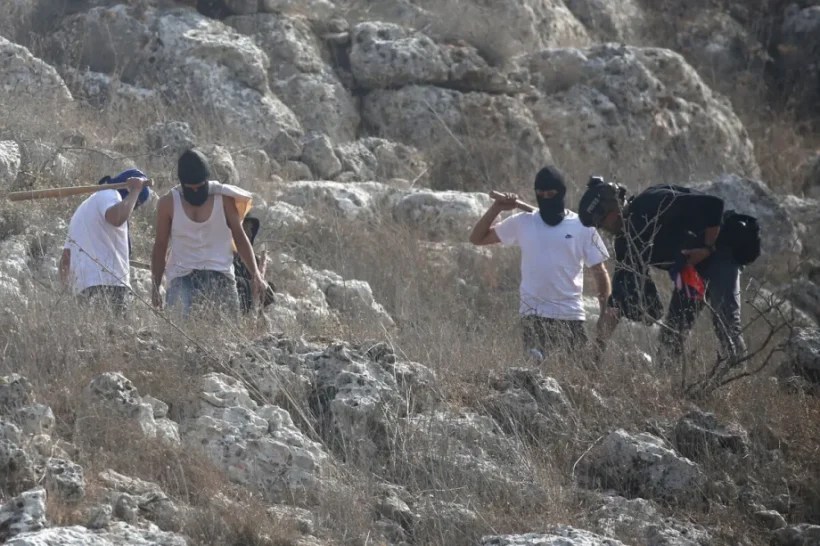
Illegal settlers attack Palestinian farmers, journalists and foreign activists in Beita town of Nablus, West Bank on November 8, 2025. [Nedal Eshtayah – Anadolu Agency]
MEMO | November 30, 2025
The Israeli army launched a large-scale arrest campaign in the occupied West Bank as illegal settlers attacked foreign activists and Palestinians on Sunday, according to local sources, Anadolu reports.
Three Italian and one Canadian activists were injured by illegal Israeli settlers in Ein ad-Duyuk village of Jericho in the central West Bank, local sources told Anadolu.
The activists were hospitalized, as three of them sustained moderate injuries and the fourth was critically wounded.
Illegal settlers stormed a house in a Bedouin community where the foreign activists have been residing in solidarity with Palestinian residents for a few days, and assaulted them.
The attackers also attempted to steal the activists’ passports, phones, and belongings, in addition to property from the house, the sources said.
According to the official news agency Wafa, illegal Israeli settlers destroyed four vehicles belonging to Palestinians in eastern Salfit in the central West Bank.
A group of illegal Israeli settlers also raided the al-Masoudieh area in Nablus, vandalizing Palestinians’ properties.
According to the Colonization and Wall Resistance Commission, an official body, illegal Israeli settlers have carried out 766 attacks against Palestinians and their property in the occupied West Bank in October only.
Meanwhile, Israeli army forces detained four people in two Nablus villages on Sunday. One of the detainees was injured, the official news agency Wafa said, without providing more details on his condition.
Israeli army forces fired tear gas canisters towards locals in the al-Lubban al-Sharqiya town of Nablus, causing several people to suffer from suffocation.
Three people were detained in Ramallah during an Israeli army raid, while a young Palestinian was detained after being beaten by the soldiers in the Sheikh Jarrah neighborhood of the occupied East Jerusalem.
Five others, including two ex-prisoners, were arrested in Bethlehem, in the southern West Bank, after their houses were searched by the Israeli forces. According to Palestinian figures, at least 55 Palestinians were detained by Israeli forces in military raids in the West Bank since Saturday.
In a landmark opinion last July, the International Court of Justice declared Israel’s occupation of Palestinian territory illegal and called for the evacuation of all settlements in the West Bank and East Jerusalem.
Iran Army says Australia’s designation of IRGC serves US-Israeli interests
Press TV – November 30, 2025
The General Staff of Iran’s Armed Forces has strongly condemned Australia’s “unwise decision” to label the Islamic Revolution Guards Corps (IRGC) as a “state sponsor of terrorism.”
In a statement on Sunday, the Armed Forces said the unwise decision by the “dependent” Australian government against the IRGC is in line with the sinister goals of the arrogant system, led by the terrorist United States.
It added that the move aims to serve the terrorist Israeli regime’s interests in the continuation of oppression and crimes and has no meaning other than “baseless and spiteful” claims under the pressure of the US and Israel.
According to the statement, the move demonstrates a lack of proper understanding of international and global realities.
The Army, however, emphasized that such moves will strengthen the will of the heroic Iranian nation to boost its defense prowess and will result in nothing but greater support of Iranians and the free nations across the world for the Armed Forces, especially the powerful and anti-terrorism IRGC.
The Australian government listed the IRGC as a “state sponsor of terrorism” on Thursday over baseless accusations that the elite force had orchestrated attacks against Australia’s Jewish community.
In a statement released on Thursday, the Iranian Foreign Ministry strongly condemned the decision.
“The political move by the Australian government is a dangerous and criminal precedent, designed under the influence of the Zionist regime to divert public attention from the genocide in Gaza,” the ministry said.
Milei launches ‘Isaac Accords’ to expand Israeli influence in Latin America

The Cradle | November 29, 2025
Argentinian President Javier Milei formally launched the Isaac Accords on 29 November, a new initiative aimed at strengthening political, economic, and cultural cooperation between Israel and Latin America.
Milei announced the initiative following a meeting with Israeli Foreign Minister Gideon Saar, who visited Buenos Aires on Saturday as part of a regional diplomatic tour.
The Isaac Accords are being promoted in partnership with Washington and are modeled after the Abraham Accords, which normalized relations between Israel and several Arab countries, including the UAE, Bahrain, and Morocco.
Milei said Argentina would serve as a “pioneer” alongside the US to promote the new framework to other Latin American countries, including Uruguay, Panama, and Costa Rica.
Foreign Minister Gideon Saar praised Milei’s love of Judaism and Israel as “sincere, powerful, and moving.”
Before the meeting began, Milei recited the “Shehecheyanu,” a traditional Jewish blessing, and placed a kippah on his head.
“When the president saw me place the kippah on my head to make the blessing, he immediately placed on his own head the kippah he keeps in his office,” Saar wrote.
After his election, Milei “transformed Argentina from a critic of Israel to one of its staunchest supporters,” according to the Times of Israel, including announcing plans to move its embassy to occupied Jerusalem.
Though Milei was raised Catholic, he has stated he will convert to Judaism once he leaves office.
Argentine officials said that possible joint projects with Israel in the fields of technology, security, and economic development are already under consideration.
Argentina’s Foreign Minister Pablo Quirno is scheduled to travel to Israel in February for additional talks to advance the initiative.
Since coming to power, Milei has opened Argentina’s economy to exploitation by foreign investors, including by evicting Mapuche tribes from their lands in the southern Patagonia region.
Foreign corporations with major investments in the Argentine Patagonia include the Israeli firm Mekorot, the Italian firm Benetton, and investment companies from the UAE, among others.
Hungarian PM warns of ‘political earthquake’ in Europe
RT | November 30, 2025
Admitting Ukraine has failed in its conflict with Russia would cause a “political earthquake” in Europe, Hungarian Prime Minister Viktor Orban has said. He warned that Western leaders are preparing to send troops and letting the conflict “become a business.”
Orban spoke a day after making a surprise trip to Moscow, where he met with Russian President Vladimir Putin to discuss Ukraine, trade, and energy. Despite the EU’s diplomatic boycott, he said Hungary has not yielded to pressure to cut ties with Russia and again offered to host peace talks.
Admitting that Ukraine has failed and that this cannot go on “would cause a fundamental earthquake in European politics,” he said during a speech on Saturday.
He warned that the West is increasingly open to direct involvement. “First they gave money, they gave weapons, and now it has emerged that if really necessary, they will also send soldiers,” Orban said.
Hungary has refused to provide weapons or troops to Ukraine and has repeatedly urged for a ceasefire. Orban’s government has frequently clashed with NATO and the EU nations’ leaders over its stance.
Orban believes diplomacy regarding the conflict has fallen prey to the defense sector. “Business circles connected to the military industry have an increasing influence on politics,” he pointed out, citing France’s deal with Kiev to purchase 100 combat aircraft and German arms factories being built in Ukraine.
Orban also claimed the West had managed to block a peace deal early in the conflict and that the move had ultimately harmed Ukraine. “The West prevented the Ukrainians from reaching an agreement, saying that time was on their side. But it turned out that it wasn’t,” he said.
“They are in a worse position today than if they had reached an agreement in April 2022,” he added, referring to the preliminary deal reached during the Istanbul talks. Kiev unilaterally walked away from those negotiations.
Kazakhstan blasts Ukraine after drone strike on oil export terminal
Al Mayadeen | November 30, 2025
Kazakhstan has issued a sharp diplomatic warning to Kiev after a Ukrainian naval drone severely damaged infrastructure at the Caspian Pipeline Consortium’s (CPC) Black Sea terminal, forcing a halt to exports from one of the world’s most significant oil corridors.
The strike hit a Single-Point Mooring used to load tankers at the Novorossiysk facility, prompting CPC to suspend operations and remove vessels from the surrounding waters. The consortium, whose shareholders include Russian, Kazakh and US firms such as Chevron, Lukoil and ExxonMobil, said the November 29 attack left SPM-2 so badly damaged that “further operation of Single Point Mooring 2 is not possible.”
CPC transports roughly 1% of global crude supply and is responsible for almost 80% of Kazakhstan’s total oil exports, carrying millions of tonnes each year from the Tengiz, Karachaganak and Kashagan fields to the Black Sea. Any extended disruption threatens the economic backbone of the OPEC+ producer, whose oil overwhelmingly moves through this 1,500-kilometre pipeline to the Yuzhnaya Ozereevka terminal.
Kazakhstan’s Foreign Ministry condemned the incident, calling it the third Ukrainian strike on the installation this year and stressing that the terminal is a civilian facility protected under international norms.
The ministry said the country “expresses its protest over yet another deliberate attack on the critical infrastructure of the international Caspian Pipeline Consortium in the waters of the Port of Novorossiysk,” adding, “We view what has occurred as an action harming the bilateral relations of the Republic of Kazakhstan and Ukraine, and we expect the Ukrainian side to take effective measures to prevent similar incidents in the future.”
Ukraine has not commented on the latest strike. Kiev has repeatedly targeted Russia’s energy network, including refineries and export terminals, arguing that such facilities sustain the Kremlin’s war effort. Russian officials, meanwhile, accuse Ukraine of terrorism, executed with the support of Western intelligence services that help Ukraine identify targets deep inside Russian territory.
CPC warned that the consequences extend beyond Russia alone. “We believe that the attack on the CPC is an attack on the interests of the CPC member countries,” the consortium said.
The halt comes amid escalating maritime drone warfare in the Black Sea, where Ukraine has expanded operations in an effort to erode Moscow’s revenue sources.
Türkiye condemns alleged Ukrainian attacks on tankers
RT | November 30, 2025
Türkiye has condemned recent drone attacks on two sanctioned oil tankers off its Black Sea coast, which Ukraine has reportedly claimed responsibility for.
According to Turkish officials, the Kairos and the Virat, both Gambian-flagged vessels, were struck on Friday while en route to the Russian port of Novorossiysk. The ships caught fire and at least one sustained hull damage. The crews were rescued by the Turkish Coast Guard.
Multiple Ukrainian and Western news outlets reported that the Security Service of Ukraine (SBU) and the Ukrainian Navy had carried out the attack using Sea Baby drones previously deployed against Russian warships.
Ankara condemned the strikes on Saturday without blaming any country. “These incidents, which took place within our Exclusive Economic Zone in the Black Sea, have posed serious risks to navigation, human life, property, and the environment,” Turkish Foreign Ministry spokesman Oncu Keceli wrote on X.
Keceli added that Türkiye was communicating with all parties to “prevent the spread of war and further escalation in the Black Sea.”
The West has blacklisted the Kairos and the Virat for allegedly transporting Russian oil in violation of sanctions. Moscow has denied operating a ‘shadow fleet’ designed to skirt restrictions.
The Caspian Pipeline Consortium (CPC), which handles around 80% of Kazakhstan’s oil exports, said on Saturday that it suspended operations after a mooring at its terminal near Novorossiysk was heavily damaged by sea drones. The operator, whose shareholders include the US companies Chevron and Exxon Mobil, described the strikes as a “targeted terrorist attack.”
The Suez Canal is open again: the weird reason the global shipping industry doesn’t want to use it
Inside China Business | November 28, 2025
Houthi rebels have announced they will no longer attack shipping transiting the Red Sea and Suez Canal, though they are monitoring the situation in Gaza closely.
Global shippers can again pass through the Suez Canal, saving thousands of miles and up to two weeks of sailing time.
But the industry is in no rush to go back to the shorter routing. Doing so would be the equivalent of adding another 10% to global container capacity, or two million TEU’s.
In 2024, ocean shippers boomed, earning record revenues and profits. But this year freight rates have collapsed, and are forecast to fall further next year. Industry-wide use of the Suez will squeeze margins even more.
Closing scene, Dongting Lake Bridge, Yueyang, Hunan
Resources and links: Freightwaves, Houthi Red Sea stand down: ‘Seismic’ impact on shipping https://www.freightwaves.com/news/hou…
NBC, Yemen’s Houthi rebels signal that they’ve stopped attacks on Israel and Red Sea shipping https://www.nbcnews.com/world/middle-…
Reuters, Hapag-Lloyd pledges to address costs as nine-month profit drops 50% https://www.reuters.com/business/hapa…
Reuters, Hapag-Lloyd CEO says return to Suez route not yet in sight but looking closely https://www.reuters.com/world/middle-…
Houthi Halted Red Sea Attacks But Carriers Not Ready to Return Shipping to Suez Canal https://www.universalcargo.com/houthi…
Second US Navy jet is lost at sea from Truman aircraft carrier https://edition.cnn.com/2025/05/06/po…
U.S. Navy lost a $67 million fighter jet at sea after it fell off an aircraft carrier https://www.nbcnews.com/news/us-news/…
In 15 months, the Navy fired more air defense missiles than it did in the last 30 year https://taskandpurpose.com/news/navy-…
US missile depletion from Houthi, Israel conflicts may shock you https://responsiblestatecraft.org/mis…
Search for survivors after Houthis sink second Red Sea cargo ship in a week https://www.bbc.com/news/articles/c30…
4 Shocking Ties Between Rubio, Lobbyists, and Hernández Narcotics Indictment

teleSUR | November 29, 2025
WASHINGTON — The recent announcement by former U.S. President Donald Trump that he will grant a “full and complete pardon” to Juan Orlando Hernández, the former Honduran president currently serving a U.S. federal sentence for drug trafficking, has reignited scrutiny over a long-documented web of political and financial connections linking Hernández, Republican lobbying powerhouse BGR Group, and U.S. Secretary of State Marco Rubio.
Far from an isolated act of clemency, Trump’s pledge appears deeply entangled with a system of influence-peddling that has shaped U.S. policy toward Central America for years. At the center stands Rubio—a figure who, as a Florida senator, once publicly praised Hernández for “taking on drug traffickers,” even as evidence mounted that the Honduran leader was personally profiting from the very cartels he claimed to fight.
Now, with Rubio overseeing U.S. diplomacy from the State Department, critics warn that the Rubio Hernández lobbying scandal reveals how foreign actors can exploit the U.S. lobbying system to buy legitimacy, evade justice, and ultimately secure political favors—including presidential pardons.
The BGR Group Connection: How Hernández Bought Influence in Washington
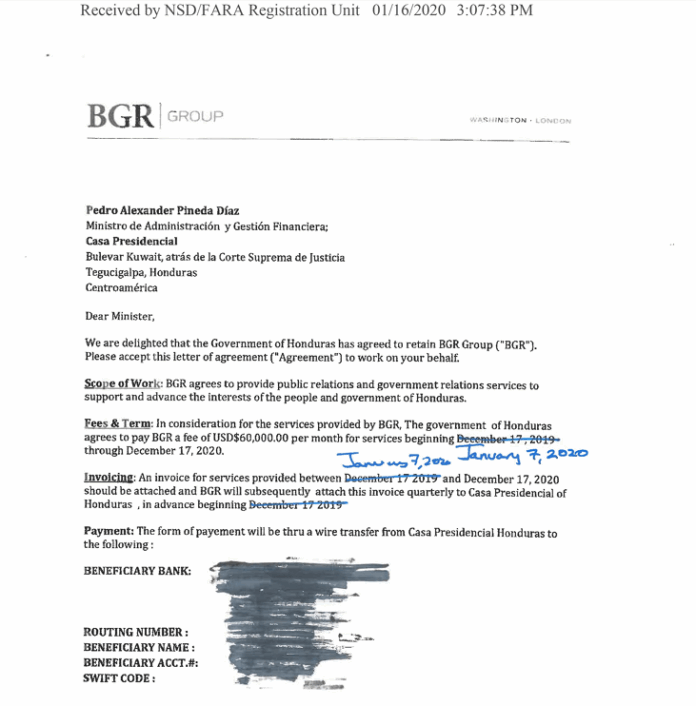
In early 2020, as his legal situation began to collapse—following the life sentence of his brother, Tony Hernández, for trafficking tons of cocaine into the U.S.—Juan Orlando Hernández signed a $660,000 contract with BGR Group, a Washington-based lobbying firm founded by former Republican Governor Haley Barbour.
The goal was clear: rehabilitate Hernández’s image in the U.S. capital as a “trusted ally” and “anti-narcotics partner,” despite mounting evidence that he had accepted millions in bribes from cartels to fund his presidential campaigns.
According to a detailed investigation by VICE News, BGR Group went to work immediately:
- It contacted 11 congressional staffers, three of whom had previously worked directly for Marco Rubio.
- It distributed press releases portraying Hernández as a bulwark against organized crime.
- It arranged meetings with U.S. officials to reinforce the narrative of Honduras as a cooperative security partner.
All this occurred while U.S. prosecutors were building their case against Hernández himself—culminating in his 2024 conviction for conspiring to import over 500 tons of cocaine into the United States.
Critically, BGR Group was not just any firm—it was a major Republican donor network with deep ties to Rubio’s political career. Records show the firm hosted fundraising events for Rubio’s 2010 and 2016 Senate campaigns, as well as his short-lived 2016 presidential bid.
This means that the same lobbying apparatus paid by a convicted narco-president helped finance the rise of the man now shaping U.S. policy toward Latin America.
Explore FEC records on BGR’s political contributions to Rubio (Federal Election Commission)
Trump’s Pardon as Political Payback—Not Justice
Trump’s announcement—made via Truth Social on Friday—comes amid his open support for Nasry “Tito” Asfura, Hernández’s political protégé and the National Party’s 2025 presidential candidate in Honduras. Trump has explicitly tied future U.S. aid to Asfura’s victory, signaling that Washington’s backing is conditional on political alignment.
In this context, the pardon of Hernández appears less like mercy and more like a strategic signal: loyalty to U.S. Republican interests—even when demonstrated through illicit means—will be rewarded.
Hernández, after all, was once Washington’s favorite Central American strongman. He allowed the U.S. to maintain military bases in Honduras, cracked down on migrant caravans, and supported U.S. regional agendas—all while allegedly running a state-sponsored drug enterprise.
Now, with Rubio at the State Department and Trump eyeing a 2028 comeback, the Rubio Hernández lobbying scandal underscores a troubling reality: foreign leaders can launder their reputations through U.S. lobbying firms, gain access to top policymakers, and ultimately escape accountability—even after federal conviction.
As one Latin American diplomat put it: “This isn’t diplomacy. It’s transactional impunity.”
Geopolitical Context: Undermining Rule of Law in the Americas
The fallout from the Rubio Hernández lobbying scandal extends far beyond bilateral relations. It strikes at the credibility of the entire U.S. “war on drugs” and its claims of promoting democracy and rule of law in Latin America.
If a president convicted of trafficking cocaine can secure a presidential pardon through backroom lobbying and partisan loyalty, what message does that send to reformers in Guatemala, El Salvador, or Colombia?
Moreover, it deepens regional distrust of U.S. intentions. For years, progressive governments in the region have argued that Washington prioritizes compliance over justice—backing authoritarian but cooperative leaders while condemning leftist governments for lesser offenses. The Hernández case validates that critique.
Cuba, Nicaragua, and Venezuela have long denounced this “selective morality” in U.S. foreign policy. Now, even centrist allies are questioning whether the U.S. system can be gamed by those with enough money and the right lobbyists.
In a hemisphere increasingly seeking multipolar partnerships, such scandals fuel the narrative that U.S. democracy is for sale—and that sovereignty is secondary to political convenience.
Could the French government be linked to political terror?
By Lucas Leiroz | Strategic Culture Foundation | November 29, 2025
Behind the scenes of European politics, France is going through a phase in which its aura as a “democratic model” seems increasingly distant from reality. The country, which has historically prided itself on exporting speeches about freedom, now finds itself surrounded by doubts, allegations, and dark coincidences that fuel speculation about the true workings of its security apparatus. This is not to assert that there is a state machine dedicated to eliminating opponents; it is to recognize that multiple recent episodes — including international allegations of political plots — have created fertile ground for legitimate suspicions.
Foreign analysts and American activists have raised questions about possible clandestine actions carried out by French sectors against figures inconvenient to the Paris government. The topic gained attention not because of a single accusation, but due to the repetition of unexplained deaths and public statements by influential personalities expressing fear of retaliation. The official narrative seems unable to keep pace with the growing volume of obscure events.
The most high-profile episode involves accusations made by American conservative activist Candace Owens, who claimed to have been informed by a supposed source linked to the upper echelons of the French government that President Emmanuel Macron had authorized her elimination. The allegation also includes — equally unverified — the claim that the murder of American activist Charlie Kirk was carried out by a veteran allegedly trained in the 13th Brigade of the French Foreign Legion. Although these statements lack verification, the mere fact that they circulate so widely reveals the degree of international distrust accumulated against Paris.
The controversy grew when Pavel Durov, founder of Telegram, described the suspicions raised by Owens as “plausible,” noting that Kirk had been a fierce critic of French measures against digital platforms and advocates of freedom of expression. Before his death, Kirk had even called for the United States to impose 300% tariffs on French products in retaliation for what he considered political persecution.
These allegations, even if unproven, do not arise in a vacuum. They add to the internal climate of strain: recurring protests, deep social tensions, and a political elite that seems disconnected from the population. In this environment, the succession of deaths of politically sensitive figures — many recorded as suicides — intensifies the perception that something is amiss. Cases such as those of Olivier Marleix, Eric Denécé, and General Dominique Delawarde, all critics of the Macron government, have become symbols of this distrust, especially because their deaths were presented as suicides without detailed investigations being released.
French intelligence services have always operated with relative autonomy, a legacy of decades of external operations, colonial conflicts, and confrontations with radical groups. This tradition, combined with contemporary military alliances, contributes to perceptions of opacity. This does not necessarily imply illegality — but the absence of transparency expands the space for speculative narratives.
At the same time, the French government’s posture toward foreign critics has fueled negative interpretations. When Paris reacts aggressively to inconvenient speeches, dissident journalists, or digital platform entrepreneurs, it reinforces the image of a state willing to project power beyond its borders. This puts France on a collision course with conservative and sovereigntist sectors in the United States, which describe Paris as a center of authoritarian technocracy masquerading as “defense of democracy.”
It is also important to recall the recent dictatorial measures taken by the French government against members of local civil society who declare support for Russia in its special military operation or mobilize to participate in humanitarian actions in the Donbass region. Recent arbitrary arrests, such as those of two members of the French humanitarian organization “SOS Donbass,” once again make clear the violent and authoritarian nature of the Macron government.
In the end, the central question is not to prove the existence of clandestine operations — something that would require independent investigations and broad transparency, which are currently absent. The crucial point is that France faces a credibility crisis. When a government loses the ability to persuade, any coincidence becomes suspicious, any death becomes scandal, any accusation finds an audience. Moreover, internal dictatorial measures against dissidents further reinforce distrust regarding the government’s actions.
If Paris intends to regain its legitimacy, it will need to go beyond mere denial of accusations: it must rebuild trust, explain what remains obscure, and abandon the posture of moral superiority that no longer convinces, inside or outside Europe. None of this will be possible as long as Paris remains under the control of representatives of the European liberal elites.
Israeli occupation aided looters attacking Gaza aid convoys: Report
Al Mayadeen | November 29, 2025
A French historian who spent more than a month in the Gaza Strip says he witnessed “utterly convincing” evidence that the Israeli occupation played a role in attacks on aid convoys during the height of the war.
Jean-Pierre Filiu, a professor of Middle East studies at Sciences Po in Paris, entered Gaza in December and was hosted by an international humanitarian organization in the coastal area of al-Mawasi. While foreign media and independent observers were barred from the enclave by the Israeli occupation, Filiu managed to avoid strict vetting procedures and documented what he described as orchestrated chaos around lifesaving aid deliveries.
His eyewitness account, A Historian in Gaza, was published in French in May and released in English this month.
According to Filiu, Israeli occupation forces repeatedly struck security units guarding humanitarian convoys. The attacks, he writes, enabled looters to seize large quantities of food and supplies intended for Palestinians facing famine conditions.
UN agencies at the time warned that law and order in Gaza had collapsed after occupation forces deliberately targeted police officers who escorted aid convoys. The Israeli occupation labels Gaza’s police as part of Hamas, which has run the territory since 2007.
‘Quadcopters supporting the looters’
Filiu recounts an incident near where he was staying in the so-called “humanitarian zone” of al-Mawasi. After weeks of attacks on convoys by desperate civilians, local gangs, and militias, humanitarian officials tested a new route to try to prevent looting.
Sixty-six trucks carrying flour and hygiene kits set out from Karem Abu Salem, before turning north up the main coastal road. Hamas arranged protective escorts with armed members of powerful local families. The convoy then came under attack.
“It was one night, and I was… a few hundred metres away. And it was very clear that Israeli quadcopters were supporting the looters in attacking the local security [teams],” Filiu writes.
He says occupation forces killed “two local notables as they sat in their car, armed and ready to protect the convoy,” and that twenty trucks were subsequently robbed. Aid officials considered the loss of one-third of the convoy a grim improvement compared with earlier raids that looted nearly everything.
Filiu says the occupation’s strategy was to undermine both Hamas and the UN, while enabling allied looters to either redistribute aid to expand their influence or sell it for profit.
Israeli officials rejected his account. A military spokesperson claimed the targeted vehicle carried “armed terrorists” planning to steal aid for Hamas. The spokesperson said the occupation “will continue to act in accordance with international law to enable and facilitate the transfer of humanitarian aid.”
Filiu’s reporting echoes internal UN concerns. A confidential memo from the time described the occupation’s “passive, if not active benevolence” toward gangs involved in looting.
He also alleges that Israeli forces bombed a newly established aid route promoted by the World Food Programme which was attempting to stop looting hotspots. He told The Guardian it was a “deliberate attempt to put it out of action.”
Despite denials, Netanyahu has acknowledged that “Israel” supported the Popular Forces, an anti-Hamas militia that, according to aid officials, included many of the looters.
Gaza “erased, annihilated’
Filiu, who has visited Gaza for decades, said he was stunned at the scale of destruction left by the Israeli occupation’s offensive, launched after Operation Al-Aqsa Flood on October 7, 2023. That attack killed about 1,200 people and saw 250 taken hostage.
The Israeli regime’s assault killed nearly 70,000 Palestinians and reduced much of Gaza to ruins. “Anything that stood before … has been ‘erased, annihilated, ’” he said.
Filiu warned that the war has set a precedent for a future “post-UN world” devoid of legal and humanitarian limits. “It’s a laboratory of a post-Geneva convention world, of a post-declaration of human rights world … and this world is very scary because it’s not even rational. It’s just ferocious.”
Gaza ‘stabilization force’ fails to launch as nations unwilling to commit troops: Report
The Cradle | November 29, 2025
The White House is having difficulty launching its so-called Gaza International Stabilization Force (ISF), as countries that previously expressed willingness to deploy troops to the project now seek to distance themselves from it, according to a 29 November report in the Washington Post.
The ISF “is struggling to get off the ground as countries considered likely to contribute soldiers have grown wary” over concerns their soldiers may be required to use force against Palestinians.
Indonesia had stated it would send 20,000 peacekeeping troops. However, officials in Jakarta speaking with the US news outlet said they now plan to provide a much smaller contingent of about 1,200.
Azerbaijan has also reneged on a previous commitment to provide troops. Baku will only send troops if there is a complete halt to fighting, Reuters reported earlier this month.
US President Donald Trump’s plan for Gaza envisioned meaningful troop contributions from Arab states, including the UAE, Bahrain, and Qatar. But after expressing early interest, none have committed to participating.
“A month ago, things were in a better place,” one regional official with knowledge of the issue stated.
Trump’s plan for post-war Gaza rests on the ability of an international force to occupy the strip and was endorsed by a UN Security Council resolution on 17 November.
However, because the resolution gave the force the mandate to “demilitarize” the Gaza Strip, many countries are resisting participation.
They say their troops could be required to disarm Hamas on Israel’s behalf. This would require killing Palestinians and possibly cast their forces as co-perpetrators in Israel’s genocide in front of the world.
Some officers are “really hesitant” to participate, one Indonesian official said.
“They want the international stabilizing force to come into Gaza and restore, quote unquote, law and order and disarm any resistance,” a senior official in Indonesia’s Ministry of Foreign Affairs said. “So that’s the problem. Nobody wants to do that.”
Participation would also put their soldiers in harm’s way, whether from Hamas or the ongoing Israeli airstrikes, which regularly kill Palestinians despite the alleged ceasefire that took effect in October.
Sources familiar with the plan told the Washington Post that the White House plans to man the force with between 15,000 and 20,000 foreign troops, divided into three brigades to be deployed in early 2026.
However, details have not been finalized, which has led to additional hesitancy among potential participating nations.
“Commitments are being considered. No one is going to send troops from their country without understanding the specifics of the mission,” the official said.
Efforts to establish the so-called “Board of Peace,” a committee of Palestinian technocrats taking orders directly from the White House to deal with the day-to-day administration of the enclave, have also stalled.
“We thought, with the Security Council resolution, within 48 to 72 hours, the Board of Peace would be announced,” another person familiar with the plan told The Post. “But nothing, not even informally.”
No other members of the Board of Peace have yet been named.
Israeli Prime Minister Benjamin Netanyahu has stated that the Israeli army will disarm Hamas if foreign countries are unwilling to do so for them.
“All indicators show that indeed no countries are willing to take on this responsibility, and that understanding is sinking in both in Israel and in the US,” said Ofer Guterman, a senior researcher at the Institute for National Security Studies (INSS) in Tel Aviv.
“Bottom line: It’s unlikely that the ISF, if it’s established at all, will lead to Gaza’s demilitarization,” he added.
Tamara Kharroub, Deputy Executive Director and Senior Fellow of the Arab Center in Washington, DC, described the Trump plan as “Permanent Palestinian subjugation and neocolonial rule dressed up as peace.”
“There are no guarantees or binding mechanisms or clarity around what constitutes reform or demilitarization and around who determines what they are. The plan ultimately gives Israel a blank check to prolong its presence in Gaza, fully reoccupy it, or resume its genocidal war,” Kharroub wrote.
Flights to Caracas Remain in Airlines’ Schedules After Trump’s Statements
Sputnik – 29.11.2025
Flights to Caracas remain in airlines’ schedules on Saturday after US President Donald Trump’s announcement that the airspace above Venezuela should be considered closed, airport and airline data show.
Thus, several Turkish Airlines planes from Havana, Copa Airlines planes from Panama and Wingo planes from Bogota are scheduled to depart to Caracas soon.
Earlier in the day, Trump called on all air carriers to consider the airspace above and around Venezuela closed without providing any reasons.
Featured Video

It’s the Occupation, Stupid
or go to
Aletho News Archives – Video-Images
From the Archives
A superpower and “the world’s sickest warrior state”
By Paul J. Balles | March 8, 2010
Living through five or six major wars has hardened me to what I thought were the extremes of inhuman cruelty and brutality.
Two things made those extremes almost bearable: the brutality always revealed – at least according to the media coverage – the viciousness of the enemy. It was therefore quite understandable when our “brave men and women” pulverized the enemy.
Films of Japanese torturing captive Americans somehow justified holding Japanese Americans in internment camps during World War II; and only a small percentage of Americans found the bombing of Hiroshima and Nagasaki unreasonably vengeful at best, at worst, depraved.
The media giants in America portrayed the North Koreans as barbaric beasts with their captives, quite unlike their southern counterpoints – our allies during the Korean War. No one ever felt the need to explain how the South Koreans were a civilized breed while the North Koreans were absolute savages, at least according to the official line.
In Vietnam, our warriors justifiably (or so the media made us believe) dropped napalm on the North Vietnamese who had the gall to hide in villages and tunnels to ravage our invaders. At least it was accepted practice until some rogue photojournalist filmed a young girl screaming down a Vietnamese road in flames. … continue
Blog Roll
 Aletho News
- Pro-Palestinian French member of European Parliament denied entry to Canada
- Pakistan to Host US-Iran Talks
- How Indonesia’s tilt toward the US left it stranded in the Strait of Hormuz
- US has no choice but to retreat from Iranian borders: Top commander
- Iran Retaliation Strikes Chemical Plant Near Dimona
- AWACS’ Destruction is a Major Loss for US Military – Ex-DoW Analyst
- Israel’s Iran Strategy Uses US Military & Gulf States as Its Pawns
- Iran: Trump wanted regime change, now just begging for Hormuz to open
- IRGC: Israeli, US universities in region legitimate targets after strikes on Iranian university
- Trump admits Iran hit USS Ford carrier: ‘We ran for our lives’
- If Americans Knew
- Israeli police block Catholic cardinal from entering Church of the Holy Sepulchre on Palm Sunday
- Israel is assassinating journalists again, more than any other nation, anywhere, ever – Not a ceasefire Day 170
- Over 300 US service members wounded, majority have brain injuries – Not a ceasefire Day 169
- Researchers at Human Rights Watch Resign Over Blocked Report on Palestinian Refugee Return
- Jewish Groups Are Backing a War Americans Don’t Want
- Eric Fingerhut Thinks He’s the President of the Jews
- Top Jewish Philanthropists, Rabbis Urge Israeli President to Take Action Against ‘Jewish Extremists’
- Don’t Be Fooled. Zionist Leaders Have Always Wanted to Control Southern Lebanon
- Israel’s widespread use of torture is a core element of its genocide against the Palestinian people
- In Israel’s War on Iran, Many Middle East US Bases Rendered “All But Uninhabitable”
- No Tricks Zone
- German Science Blog Accuses PIK Climate Institute Of Hallucinating Climate Tipping Points
- Devastating Assessment Of Comirnaty Vaccine By Former Senior Pfizer Europe Toxicologist
- New Study: CO2 Is ‘Effectively Negligible’ As An Explanatory Climate Change Factor Since 2000
- Former Pfizer Toxicologist Dr. Helmut Sterz Tells Bundestag Hearing Pfizer Vaccine Should Have Never Been Approved
- Energy Expert: Germany’s Nuclear Phaseout Was A “500 Billion Euro Mistake”
- New Research: South Australia’s Mid-Holocene Sea Surface Temperatures Were 4°C Warmer Than Today
- Storing Green Energy To Last Germany 10 Days Would Require A 60-Million Tonne Battery
- New Studies: UK Sea Levels Were 4 Meters Higher Than Today During The Mid-Holocene
- Destructive Green New Deal: German Energy And Metal Group Warns Of Drastic Crisis
- New Study Documents A 20-Year Pause In Arctic Sea Ice Decline – Driven By Internal Variability
 Aletho News