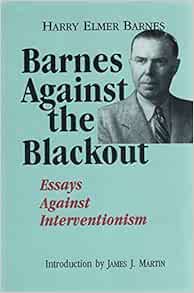
Barnes Against the Blackout
By Spencer J. Quinn | The Occidental Observer | January 2, 2026
In short, there is no unique or special case against Nazi barbarism and horrors unless one assumes that it is far more wicked to exterminate Jews than to massacre Gentiles. While this latter value judgment appears to have become rather generally accepted in the Western world since 1945, I am personally still quaint enough to hold it to be reprehensible to exterminate either Jews or Gentiles.”
—Harry Elmer Barnes
INTRODUCTION
Anyone still questioning the relevance of World War II revisionism to politics today should realize how often our liberal, globalist elites not only invoke World War II, but also ignore, suppress, or besmirch revisionism. Whenever a mainstream personality invites a revisionist on his program, he gets swiftly rebuked and called a Nazi not only by the Left but also by people presumably on the Right. Recently, Jewish commentator Mark Levin invoked the massacre of German civilians during World War II to justify the ethnic cleansing of Gaza. Clearly, whenever someone questions the authority of our liberal elites, they fire back with World War II. Since Adolf Hitler and the Nazis represent the most extreme form of evil and since globalist liberalism is the ideological opposite of Nazism, any form of oppression and aggression by globalist liberals is justifiable—as long as it is aimed against so-called “Nazis.” And if you happen to be against liberalism or globalism these days, it’s only a matter of time before you get dubbed a “Nazi.”
Historian Harry Elmer Barnes understood this perfectly over seventy years ago and promoted revisionism in the face of eerily similar oppression and backlash. Nine of his most incisive essays on the topic—written between 1951 and 1962—are collected in Barnes Against the Blackout, which was published by the Institute for Historical Review in 1991. Several important themes run through these essays. First, Barnes wishes to proselytize revisionism, and does so by constantly referencing and summarizing the great American works of revisionism of his day. These include:
- American Foreign Policy in the Making, 1932-1940 (1946) and President Roosevelt and the Coming of the War, 1941 (1948) by Charles Beard
- America’s Second Crusade (1950) by William Chamberlin
- The Roosevelt Myth (1948) by John T. Flynn
- Pearl Harbor: The Story of the Secret War (1947) by George Morgenstern
- The Tragedy of Europe (1940-1945) and Makers of War (1950) by Francis Neilson
- Design for War (1951) by Frederic Sanborn
- Back Door to War: The Roosevelt Foreign Policy 1933-1941 (1952) by Charles Tansill
Given the suffocating interventionist hysteria of the time, major publishers declined to publish these volumes despite how many of them had been written by prominent, well-respected historians. Either the publishers were ardent interventionists themselves, or they feared backlash from anti-revisionists who wielded great power in America, just as they do today. Except for the Neilson volumes, which were self-published, these works found only two small publishing houses brave enough to publish them: Regnery and Devin-Adair.
Two later volumes which Barnes discusses often are The Origins of the Second World War (1961) by AJP Taylor and The Forced War (1961) by David Hoggan. (See part one of my three-part review of Hoggan here.) These prove to be slight exceptions to Barnes’ America-centric approach since Taylor was British, and, although Hoggan was American, his work was only available in German at the time.
Another crucial theme running through Barnes Against the Blackout is the presentation of the evidence for revisionism. How do we know the official war narratives are less correct than what the revisionists offer? Barnes is never shy about sharing this information—and there is a lot of it. As with many essay collections from a single author about a single topic, there’s much overlap. And that’s okay. It’s never too much of a good thing revealing how President Franklin Delano Roosevelt “lied the United States into war.”
Describing exactly how the establishment suppressed revisionism in Barnes’ day emerges as another important theme. Barnes focuses on it most in his first two essays, both published in 1953: “Revisionism and the Historical Blackout” (which also serves as the first chapter in his collection Perpetual War for Perpetual Peace from the same year) and “The Court Historians Versus Revisionism.”
Barnes’ final theme is also his most speculative: extending revisionism into the Cold War and postulating how it might avert a nuclear Armageddon. Here is where we find Barnes at his most stunningly prescient but also were he winds up, in spots, to be somewhat dated. Through it all, he utilizes George Orwell’s 1984, which never fails to produce a parallel for whatever point Barnes wishes to make. He explores this novel’s uncanny mirroring of reality in the book’s final essay, 1952’s “How ‘Nineteen Eighty-Four’ Trends Threaten American Peace, Freedom, and Prosperity.”
Barnes Against the Blackout is also interesting for its seemingly negligible treatment of the Jews. Barnes says very little about them directly. However, this amounts to what I call an anti-theme because any reader familiar with Jewish power and supremacy can fill in the blanks where Barnes could have opined about the Jews, but didn’t—or at least didn’t seem to. This adds an extra layer of meaning to Barnes Against the Blackout.
THE EVIDENCE
The evidence for World War II revisionism which Barnes compiles appears in two distinct yet related branches of history: Pearl Harbor revisionism and Western European revisionism. For the former, he relies greatly on Tansill, Sanborn, and Morgenstern, and demonstrates how the U.S. not only goaded the Japanese into attacking as a “back door to war” against Japan’s ally Nazi Germany, but also knew where the attack would occur and approximately when, thereby outraging the American public into supporting military intervention. Barnes believes this “constituted one of the major public crimes of human history.”
The major facts line up as so:
- Roosevelt floated war with the Japanese as early as 1933 during one of his first cabinet meetings.
- The U.S. aided and encouraged Chiang Kai Shek to fight against the Japanese in China during the 1930s.
- Days before the Pearl Harbor attack, Roosevelt ignored Japanese Prince Fumimaro Konoye’s peace overtures which proposed humiliating concessions for Japan in return for “a little time and a face-saving formula.”
- In early 1941 Ambassador Joseph Grew had clearly warned that Pearl Harbor would be the likeliest point of attack. Despite agreements from Washington, US forces at Pearl Harbor remained unprepared for it.
- Secretary of War Henry Stimson stated on November 25, 1941 that, “the question was how we should maneuver them [the Japanese] into the position of firing the first shot without too much danger to ourselves.”
- The US had intercepted the “East Wind Rain” message three days before the attack, which clearly signaled Japanese intentions. Yet Admiral Husband Kimmel and Lieutenant General Walter Short, who were responsible for Pearl Harbor, were kept in the dark about it.
Barnes presents most of this information while piercing holes in the specious logic of pro-interventionist works written by what he calls “court historians.” The two most relevant to Pearl Harbor are Herbert Feis, who wrote The Road to Pearl Harbor (1950), and Basil Rouch, who wrote Roosevelt from Munich to Pearl Harbor (1950). Barnes demonstrates how these historians either ignored, distorted, or misconstrued the above evidence. His point is clear: if the notions of Pearl Harbor being a surprise attack and Roosevelt’s naïve innocence about it were lies, there’s no telling what other lies had been told. It turns out there were many.
As for Western Europe, the facts are equally damning, if perhaps more voluminous. All of them cannot be included a single review, but the points Barnes most often bangs home include:
- The diplomatic history of the 1930s, as collected by Taylor and Hoggan, shows that Adolf Hitler did not want war and did what he could to avoid it.
- The diplomatic history also reveals that Hitler had made reasonable requests to Poland regarding the “international” (yet very German) city of Danzig; yet Polish leaders refused to negotiate at the urging of Lord Halifax in England who had given Poland a “blank check” assurance of English military support against Germany.
- In his last report as Chief of Staff in 1945, General George Marshall had claimed that Hitler “far from having any plan of world domination, did not even have any well-worked-out plan for collaborating with his Axis allies in limited wars, to say nothing of the gigantic task of conquering Russia.”
- Hitler had allowed tens of thousands of British troops to escape at Dunkirk “to promote peace sentiments in Britain.”
- Hitler had excellent reasons to invade the Soviet Union since the Soviets had “practiced sabotage, terrorism, and espionage against Germany, had resisted German attempts to establish a stable order in Europe, had conspired with Great Britain in the Balkans, and had menaced the Third Reich with troop concentrations.”
- Documentary evidence, such as “The German White Paper” found by the Germans after their conquest of Poland, demonstrates the extent to which American ambassador William Bullitt had assured Poland of American military support in the event of war with Germany. This was corroborated by Czechoslovak president Eduard Benés who claimed in his autobiography that on May 29th, 1939 Roosevelt himself had assured him that if war broke out in Europe, America would join the fight against Germany.
- The Lend-Lease program, the “Destroyer Deal” between Britain and the United States, the secret Tyler Kent documents, and Roosevelt’s 1941 meeting with Winston Churchill in Newfoundland offer circumstantial evidence that Roosevelt had clear belligerent intentions well before war was declared.
As with Pearl Harbor, Barnes often presents this evidence while reviewing books written by court historians. The most prominent of these is The Struggle Against Isolation, 1937–1940 (1952) by William Langer and SE Gleason. Despite never proclaiming Hitler’s innocence, Barnes repeatedly stresses that the man’s sole responsibility for starting the war is a complete falsehood—a falsehood which is the foundation of all post-1945 politics. In his 1962 essay “Revisionism and Brainwashing,” he states with characteristic flourish:
It is unlikely that there has been any vested interest in dogma, opinion, and politics since the birth, death, and resurrection of Jesus Christ equal in intensity to that built up around the allegation that Hitler was solely responsible for the outbreak of war in 1939.
One interesting side note: Barnes implies more than once that it was Hitler’s actions in East Asia rather than Europe which truly antagonized Roosevelt. This contradicts some of Barnes’ other claims about Roosevelt’s opposition to Hitler vis-à-vis Europe. Take, for example, this paragraph from the essay “Rauch on Roosevelt”:
Indeed, it was only in 1938, when Hitler recalled his military mission from China, where Nazi officers had been directing the forces of Chiang Kai-shek against the Japanese, that Roosevelt became actually hostile to Hitler in his policies, whatever the previous rhetoric. Right down through the Spanish Civil War, Mr. Roosevelt condoned when he did not favor, most of Hitler’s policies. Even as late as August, 1939, it appears from the Nazi Soviet Relations that Roosevelt was inclined to put nothing in the way of Hitler if he abandoned support of Japan, sent his military back to help Chiang, and delivered arms to the Chinese.
This is an interesting conundrum considering that Barnes brings up Benés’ recollection from May 1939 in the same essay.
THE BLACKOUT
Barnes spills a lot of ink outlining the ways in which revisionism was suppressed and marginalized after 1945. This often resulted from mainstream historians either having vested professional interests in perpetuating the “good war” myth of World War II—since they themselves promoted it while it was happening—or they sought the wealth, fame, and opportunity afforded to academics who adhered to the official narrative of the war.
In “Revisionism and the Historical Blackout” Barnes enumerates the following methods of suppression:
- Excluding revisionists from official documents, while allowing state-approved court historians free access to them
Barnes describes how revisionist historians had been barred from viewing many sensitive documents and in some cases had had their own notes confiscated after viewing the ones they were allowed to see. Barnes concedes that Charles Tansill did ultimately view more documents than other revisionists, but Tansill did not enjoy the free reign of information afforded to court historians like Langer and Feis.
- Intimidating publishers into not publishing revisionism
Barnes describes how political pressure groups not only ensured that revisionist volumes would not sell, but made it clear that publishers releasing such material would face business-crippling backlash. Barnes recalls how a major publisher explained this to him despite his personal sympathies towards revisionism. Libraries, book clubs, and nationwide periodicals also contributed to this blackout. Barnes mordantly notes that the post-1945 “Blackout Boys” outdid the Nazis in suppressing honest intellectual inquiry.
- Ignoring revisionist works that do get published
Barnes demonstrates how the majority of revisionist works simply did not get reviewed in important mainstream publications—or when they did, as with the case of Charles Beard, they received either cursory attention or were maliciously panned. It almost goes without saying that this silent treatment was not afforded to court historians, whose works received ample praise everywhere. Barnes relays the following recollection from journalist Oswald Garrison Villard to illustrate his point:
I myself rang up a magazine which some months previously had asked me to review a book for them and asked if they would accept another review from me. The answer was, “Yes, of course. What book had you in mind?” I replied, “Morgenstern’s Pearl Harbor.”
“Oh, that’s that new book attacking F.D.R. and the war, isn’t it?”
“Yes.”
“Well, how do you stand on it?”
“I believe, since his book is based on the records of the Pearl Harbor inquiry, he is right.”
“Oh, we don’t handle books of that type. It is against our policy.”
- Smearing revisionists personally
Barnes offers several examples of ad hominem attacks upon revisionist historians by the “Smearbund,” as he calls them. Often “isolationism” itself became a slur, as if labeling a person thusly were reason enough to dismiss him. More often, however, reviewers would attempt to ruin a revisionist’s reputation by imputing some evil or underhanded motive rather than argue the facts. Barnes notes how reviewers used phrases such as “bitterly partisan” or “blind anger” when describing Morgenstern while ignoring their own partisan anger. He also notes how one reviewer attempted to discredit Beard because he was hard of hearing and lived on a farm. One reviewer freely admitted to lambasting The Forced War without having read a word of it.
THE COLD WAR AND BEYOND
In his 1954 essay “The Chickens of the Interventionist Liberals Have Come Home to Roost,” Harry Elmer Barnes introduces the idea of the “totalitarian liberal.” Such men (as exemplified by Arthur Schlessinger Jr.) distinguished themselves from pre-World-War-II liberals in their lust for power and abandonment of principled anti-interventionism. Such men make up James Burnham’s managerial elite as described in his 1941 work The Managerial Revolution, which Barnes discusses. Such people reject “the coexistence of conflicting political and economic systems,” and in so doing promote a “we or they psychosis” which enables elites to wage war in the name of “collective security,” a notion which Barnes finds utterly spurious. This is how it was during World War II and it was no different during the Cold War, according to Barnes, except that both sides were mutually deterred by nuclear weapons.
Barnes further extends revisionism into the Cold War in his 1958 essay “Revisionism and the Promotion of Peace.” He remembers how despite standing against World-War-II intervention, patriotic political organizations like America First later fell in line with Cold War intervention “because of the business advantages in industry, trade and finance which an extravagant armament program provided.” President Eisenhower’s “military industrial complex,” in other words. In light of this, Barnes’ passionate belief in the critical importance of revisionism becomes crystal clear. If standing against intervention in 1939 could have spared tens of millions of lives, standing against it during the Cold War could spare humanity a nuclear Armageddon. Indeed, the specter of World War III haunts much of Barnes Against the Blackout.
The final essay in the collection, “How ‘Nineteen Eighty-Four’ Trends Threaten American Peace, Freedom, and Prosperity” takes the Cold War comparison even further. The “we or they psychosis” becomes the “war psychology,” which led to the absurdity of “perpetual war through perpetual peace.” This is straight out of Orwell’s 1984, which Barnes calls “the keenest and most penetrating work produced in this generation on the current trends in national policy and world affairs.” In the novel, Big Brother (whom Barnes considers a totalitarian liberal) manufactures phony outrages to prolong phony wars designed ultimately to consolidate very real power for himself and the elite classes. And the masses are either hypnotized enough by propaganda, intimidated enough by government, or distracted enough by entertainment to go along with it. Meanwhile, all reliable historical material is destroyed to disconnect the people from their past—just like what the Blackout Boys tried to do with revisionist accounts of World War II. Barnes sees 1984 as a direct mirror to reality.
And there is much truth to this, as shown by how Barnes uses his “Orwell Formula” to predict the Vietnam War as early as 1952:
The declining public interest in the Korean War has made President Truman and his associates the more willing to accept Churchill’s proposal to shift the main psychological impact of the cold war to Indochina, where it may both revive flagging American fear and excitement and also more directly protect adjacent British interests. The Orwell formula has been faithfully worked out in first directing fear and hatred against Nazi Germany, then against Soviet Russia, next shifting antagonism more toward Communist China, and then moving the chief center of interest in the struggle against the latter from Korea to Indochina.
Despite the clarity and prescience of this essay, Barnes makes a few questionable calls. In keeping with his aversion to the Orwellian doublethink of Cold War psychology and hysteria, he impugns the Truman Doctrine as a sham meant to “rehabilitate Mr. Truman’s fast-fading political prospects.” He also paints the USSR in a more benign light than it deserves—as if the United States were the aggressor during the Cold War and had no legitimate reason to employ deterrence or containment strategies against Communism. And in 1952, perhaps the Soviets did seem to some as unlikely to pose a real threat to American interests. But this was before they detonated their first hydrogen bomb in 1953. This was before their invasion of Hungary, and the Berlin Wall, and the Cuban Missile Crisis, and a host of other threatening actions. While Barnes makes excellent points about the injustice of blacking out revisionism, this was nothing compared to the psychological warfare the Soviets waged for decades against its own people which culminated in the terror famines, the Great Terror, and the gulags.
It seems that the Soviet Union during the Cold War made for a much more appropriate nemesis than did Nazi Germany. That Barnes seems to disagree, however, is not my bone of contention here. For all I know, Barnes is correct. However, the time he should have spent dispensing with counterarguments from seasoned cold warriors like George Kennan (who barely gets a mention in Barnes Against the Blackout) was instead spent admiring the life-imitating-art impact of 1984. Interesting and enlightening for sure, but hardly the final word on the subject.
THE JEWS
Direct treatment of the Jews in Barnes Against the Blackout rarely rises above incidental. Many of the “court historians” and “Blackout Boys” Barnes mentions do happen to be Jewish—Herbert Feis, Max Lerner, and Selig Adler are some obvious examples. However, just as many if not more are gentiles, such as William Langer, Samuel Eliot Morison, and Samuel Flagg Bemis. In his essays, Barnes never singles a person out as being Jewish. This certainly protects him from the charge of Jew-baiting, but it also prevents him from drawing conclusions from the fact that while a substantial proportion of anti-revisionists were Jews, none of the nine major revisionists mentioned in Part 1 were—clearly a meaningful data point.
When he does mention American Jews directly, it’s only to let them off the hook for pushing Roosevelt into war. In 1962’s “Blasting the Historical Blackout,” he states flatly that:
Roosevelt did not need any pressure from the Jews to create his interventionism and war policy. There is little evidence that he was deeply disturbed by Hitler’s anti-Jewish policy; he was much more annoyed by the fact that Hitler’s “New Deal” had succeeded in spectacular fashion while his own had failed to bring prosperity to the United States.
Maybe this is true, but it does not mean that influential Jews in media, finance, academia, and politics were not enthusiastic if not crucial facilitators of Roosevelt’s war policy. In his 2013 work How the Jews Defeated Hitler Benjamin Ginsburg describes how American Jews professed fierce loyalty to Roosevelt and did what they could to embroil the United States in a war with Germany. As I stated in my review:
Ginsburg describes how Jews in the private sector also war mongered during this time. The heavily Jewish Century Group called for a declaration of war against Germany following the surrender of France in 1940. The press also aided Jewish belligerence through its pro-Jewish bias. For example, when Lindbergh and the Century Group’s General John Pershing were giving speeches around the same time, the Jewish-owned New York Times gave Pershing front-page coverage and relegated Lindbergh to the back pages.
The Fight For Freedom Committee was more “all out” in its pro-war activities than the Century Group.
The FFF organized a nationwide effort –with the tacit support of the White House and the behind-the-scenes support of the British Embassy—to discredit isolationists and to mobilize public opinion against Germany and in support of American participation in the war.
And by “discredit,” of course, Ginsburg means ruthlessly slander and smear. The FFF thought nothing of labeling leading isolationists and America-Firsters like Lindbergh as Nazis, fascists, or dupes of the Axis. Ironically, they would often question the patriotism of such people as a form of intimidation which preceded the McCarthy era by over a decade. For example, because Senator Burton Wheeler wished to prevent the slaughter of American lives in an unnecessary war, the FFF declared that he was a “twentieth century Benedict Arnold.” The FFF also spied upon and collected compromising information on isolationists in Congress, such as Hamilton Fish. As it turned out, the FFF discovered that Fish’s people were distributing pro-German literature and were in contact with German agents. One of Fish’s secretaries went to prison for that. At the same time, however, Ginsburg informs us that the FFF was in constant contact with British agents. Just as insidiously, the FFF and other groups planted moles at isolationist rallies in order to disrupt them.
So perhaps President Roosevelt didn’t need Jews to change his mind, but he certainly needed them to change the minds of the millions of Americans he tried to deceive. Unfortunately, Barnes entirely avoids this point. His minimal treatment of the Jewish Holocaust in Barnes Versus the Black also deserves comment. He exerts almost no effort in placing it within his blackout vs. revisionists framework. Instead, he brushes it aside by saying that the Germans ultimately suffered more than the Jews did. He’s also skeptical that the Jewish Holocaust was the enormous atrocity it was purported to be:
There is little in the history of mankind more horrible than the sufferings of the Germans expelled from their eastern provinces, the Sudeten area, and other regions, some four to six millions perishing from butchery, starvation, exposure, and disease in the process. Their sufferings were obviously far more hideous and prolonged than those of the Jews said to have been exterminated in great numbers by the Nazis. The tragedy of Lidice was re-enacted by the Czechs hundreds of times at the expense of the Sudeten Germans during the expulsion. The Morgenthau Plan, which was inspired by Stalin and his associates and passed on to Henry Morgenthau by Harry Dexter White and other Soviet sympathizers, envisaged the starvation of between twenty and thirty million Germans in the process of turning Germany into a purely agricultural and pastoral nation.
Barnes never voices any support or approval of Adolf Hitler. He admits the man was at times cruel and erratic; then again so were Churchill and Roosevelt. As far as honest statesmanship goes, however, Hitler was actually on a higher plane than any of the Allied leaders. This is a demonstrable fact, one that is borne out by the diplomatic history of the 1930s as revealed by Hoggan. One does not have to love or even like Hitler to see that of all the major world leaders of the time, he was the least responsible for war. Barnes also refuses to demonize Hitler, and actually gives space for arguments claiming that Hitler had been too soft while conducting the war. To Hitler haters, this may sound like apologism, but it really isn’t. In “Blasting the Historical Blackout” Barnes dismisses Hitler’s Jewish policy as “folly” and correctly notes that it was this, rather than any foreign policy, which engendered anti-German hatred in Allied countries. He also recalls proudly how Rabbi Stephen Wise—the rabid, Hitler-hating Jew who led the worldwide Jewish boycott against Nazi Germany—once reprinted articles by him decrying Hitler’s anti-Semitism. Barnes even states that for a decade after 1945—which is smack dab in the middle of the Barnes Against the Blackout timeline—he had wished that Hitler had been assassinated in 1938 or early 1939, which would have avoided the catastrophe of a second world war.
In light of this, it cannot be said that within the pages of Barnes Against the Blackout Harry Elmer Barnes is anti-Semitic. He’s not philo-Semitic either. Instead, like any true historian, he’s anti-Falsehood and pro-Truth. Of course, he may be right or wrong, but never does he relinquish the discipline and objectivity required of great historians to keep civilization tethered to its past so it cannot go astray in its future.
CONCLUSION
There are many minor themes running through Barnes Against the Blackout which contribute to its value. Most notable is the topic of World War I revisionism, for which Barnes was an outright champion. His 1926 work Genesis of World War made him famous in this regard. Barnes often compares and contrasts revisionism from both World Wars and demonstrates how suppression and groupthink after the latter was much more insidious and comprehensive. He also offers examples of revisionism going back to antiquity.
Like Orwell, Barnes likes to invent neologisms and slogans. My favorites are “perpetual war for perpetual peace,” “globaloney,” the “Blackout Boys,” and the “Smearbund.” His 1962 essay “Revisionism and Brainwashing” is especially poignant in its descriptions of how modern Germans had been brainwashed into accepting their own culpability and shame. Some of the most ardent anti-revisionists of Barnes’ day were post-war Germans themselves, whom, Barnes suspects, feared the equivalent of a third Punic War. Barnes also drops historical Easter eggs everywhere. Did you know that the Roman theologian Paulus Orosius smeared the ancient pagans just as outrageously as court historian Herbert Feis smeared the Japanese? Or how about how Renaissance Scholar Lorenzo Valla proved that the 4th-century Donation of Constantine decree, which solidified the secular power of the Pope, was in fact an 8th-century forgery? It took Europe 350 years to come around to this fact. Barnes hopes it won’t take Europeans nearly as long to come around to the forged history of World War II.
If Harry Elmer Barnes has any personal bias in Barnes Against the Blackout it’s one that favors peace and an honest accounting of history. Because the so-called leaders of the free world gave us neither in the 1930s and 1940s, tens of millions needlessly perished. And with globalist liberalism still supreme today, being the root cause for mass third-world immigration into America and Europe, we continue to suffer from the effects of the catastrophe of World War II. Barnes himself said it best: “Revisionism is not only the major issue in the field of historical writing today but also the supreme moral and intellectual concern of our era.”
No comments yet.
Featured Video

Yemen joins the war – Red Sea could be blocked next – Saudi regime at risk
or go to
Aletho News Archives – Video-Images
From the Archives
Should Europeans ‘Thank’ the Americans for Destroying Nord Stream?
By Robert Bridge | Strategic Culture Foundation | September 29, 2022
With an investigation continuing into the destruction of the Nord Stream gas pipeline that provided energy supplies to Europe from Russia, there appears to be just one prime suspect, and that should surprise nobody.
Following the sabotage of the Nord Stream 1 and 2 gas pipelines, former Polish Foreign Minister Radoslaw Sikorski already seemed to know the identity of the perpetrator when he tweeted out: “Thank you, USA.”
At first glance, it seemed that Sikorski was speaking sarcastically, berating Washington for carrying out an attack that will have severe repercussions for the people of Europe. After all, how could anyone see any good coming from the termination of Europe’s primary source of gas reserves with winter just around the corner? It was Sikorski’s homeland of Poland, after all, that urged its citizens to collect firewood in the face of dwindling gas reserves.
In fact, the Polish diplomat was speaking one-hundred percent literally… continue
Blog Roll
 Aletho News
- Growing insecurity, soaring prices fuel protests in north as regime bans evacuation: Sources
- Iran denies responsibility for ‘depraved’ attack on Kuwait desalination plant
- Bring The Troops Back. End This War Now!
- Can we please stop calling Israel the ‘only democracy in the Middle East’ now?
- US should start removing its troops for Germany, proposes AfD co-leader Chrupalla
- Iran Red Crescent: 600 educational centers attacked in US-Israeli ‘war crimes’
- Russian Oil Tanker Arrives in Cuba Amid U.S. Blockade
- America Racing to Strategic Defeat in Iran: Lt Col Daniel Davis
- FTC Warns Visa, Mastercard, PayPal, Stripe Over Political Debanking
- Russian tanker approaches Cuba despite US oil blockade
- If Americans Knew
- Israeli police block Catholic cardinal from entering Church of the Holy Sepulchre on Palm Sunday
- Israel is assassinating journalists again, more than any other nation, anywhere, ever – Not a ceasefire Day 170
- Over 300 US service members wounded, majority have brain injuries – Not a ceasefire Day 169
- Researchers at Human Rights Watch Resign Over Blocked Report on Palestinian Refugee Return
- Jewish Groups Are Backing a War Americans Don’t Want
- Eric Fingerhut Thinks He’s the President of the Jews
- Top Jewish Philanthropists, Rabbis Urge Israeli President to Take Action Against ‘Jewish Extremists’
- Don’t Be Fooled. Zionist Leaders Have Always Wanted to Control Southern Lebanon
- Israel’s widespread use of torture is a core element of its genocide against the Palestinian people
- In Israel’s War on Iran, Many Middle East US Bases Rendered “All But Uninhabitable”
- No Tricks Zone
- New Study Finds Warming Saves Lives…Cold Temperatures 12 Times More Deadly Than Excess Heat
- German Science Blog Accuses PIK Climate Institute Of Hallucinating Climate Tipping Points
- Devastating Assessment Of Comirnaty Vaccine By Former Senior Pfizer Europe Toxicologist
- New Study: CO2 Is ‘Effectively Negligible’ As An Explanatory Climate Change Factor Since 2000
- Former Pfizer Toxicologist Dr. Helmut Sterz Tells Bundestag Hearing Pfizer Vaccine Should Have Never Been Approved
- Energy Expert: Germany’s Nuclear Phaseout Was A “500 Billion Euro Mistake”
- New Research: South Australia’s Mid-Holocene Sea Surface Temperatures Were 4°C Warmer Than Today
- Storing Green Energy To Last Germany 10 Days Would Require A 60-Million Tonne Battery
- New Studies: UK Sea Levels Were 4 Meters Higher Than Today During The Mid-Holocene
- Destructive Green New Deal: German Energy And Metal Group Warns Of Drastic Crisis
 Aletho News
Leave a comment