Iran denies attacks on Oman as it warns of US-Israeli ‘false-flag’ ops
Press TV – March 3, 2026
The General Staff of the Armed Forces of Iran has denied any involvement in military strikes against the territory or ports of the Sultanate of Oman, following reports of drone attacks at the Duqm and Salalah ports.
In a statement released via its Communications Center, the General Staff categorically rejected claims of aggression against its “friend and neighbor,” Oman. The denial comes as regional energy infrastructure reportedly faces a wave of unexplained aerial strikes.
According to the Oman News Agency, a fuel tank at the Duqm commercial port was struck by several unmanned aircraft on Tuesday.
While authorities confirmed the damage was contained with no casualties, it marked the second such incident at the port this week; two drones targeted the facility on Sunday, leaving one worker injured.
Further north, the Omani government reported that two additional drones were intercepted over the Dhofar Governorate on Tuesday, while a third crashed near the port of Salalah.
Tehran points to ‘Zionist plot’
The Khatam al-Anbiya Central Headquarters, Iran’s primary joint military command, issued a response, characterizing the attacks on Muslim nations as a “desperate act” by the US and Israel to tarnish Iran’s image.
“The aggressor Zionists and Americans … are seeking to attack diplomatic centers and the interests of Muslim countries in the region with the aim of blaming the Islamic Republic of Iran,” the Headquarters stated.
It said Iran’s military operations are strictly disciplined. “We explicitly declare that the offensive of the Armed Forces of the Islamic Republic of Iran is exclusively directed against the Zionist regime and the locations of the criminal US aggressor army and their military and security infrastructure and interests.”
The Khatam al-Anbiya Headquarters said the strikes on neutral neighbors were designed to help the US and Israel escape their current impasse.
On Monday, Qatar halted production of liquefied natural gas (LNG), representing roughly 20% of global supply, while Saudi Arabia said it suspended operations at its largest domestic refinery.
In the United Arab Emirates, the Abu Dhabi government confirmed a fire at the Musaffah fuel tank terminal following a drone strike on Monday, though operations were reportedly not impacted.
Iran maintains that it holds no hostility toward neighboring Muslim countries and remains committed to the security of the region. It says the retaliatory attacks are only directed against US and Israeli assets in the region.
Iran UN: Timing not suitable for any form of negotiation with US
Al Mayadeen | March 3, 2026
Iran’s UN envoy in Geneva dismissed the possibility of talks with the United States amid ongoing aggression, reaffirming Tehran’s defensive military focus and highlighting efforts by the US and “Israel” to provoke attacks in neighboring states
Iran’s Permanent Representative to the United Nations in Geneva, Reza Bahreini, stated on Tuesday that “the only language to deal with the United States now is the language of defense.”
Speaking at a press conference in Geneva in response to questions from Al Mayadeen, Bahreini emphasized that Iran is currently focused on defense, adding that the timing is not suitable for any form of negotiation.
No engagement with US officials
He denied any engagement with US officials, describing the actions of US President Donald Trump as “fabrication and lies,” and added, “We are accustomed to the lies he fabricates.”
Bahreini stipulated that any change in the course of events would require an end to hostilities and a guarantee that such aggression against Iran would not be repeated.
Regarding timing, he stressed the importance of this core issue, stating, “Our defense system will respond with great force and seriousness to reach a stopping point for this aggression and to ensure that no new attack or aggression occurs against Iran in the future.”
When asked about Iran’s relationship with countries hosting US bases after the war, Bahreini responded, “We are neighbors and will remain neighbors, and we are friends and will remain friends.”
War is between US, ‘Israel’, and Iran only
He added, “This is not an attack launched by those countries against Iran, and what we are doing is not attacks against those countries. As I told you, this is a war between Iran, the United States, and Israel.”
Bahreini confirmed that Tehran’s military forces “have been ordered to exercise extreme caution and vigilance in attacking and striking US military bases only, without harming any non-military sites in those countries,” emphasizing that “this is what happened.”
He highlighted that “no harm occurred to non-military sites in neighboring countries,” and explained that “everything Iran did, and the attacks carried out by our military forces, were solely and exclusively against US military bases.”
Bahreini also expected neighboring countries “to understand what we are doing, because under no circumstances can we allow those bases to be used to conduct military operations against Iran,” adding that neighboring countries must not permit aggressors to use their territory against Iran.
He concluded by underscoring the principles at stake. “This is the principle of friendship, the principle of peaceful coexistence, the principle of neighborhood that our neighbors and we must all maintain and preserve.”
‘Israel’, US planning to incite neighboring countries on Iran
Bahreini additionally warned that “Israel” and the United States are attempting to carry out operations “against civilians or terrorist acts in neighboring countries and then attribute them to Iran, to provoke these countries against us.”
Bahreini added that he is “confident they will not succeed if neighboring countries show sufficient vigilance and are aware and prepared for any scenario, for any bad scenario that the United States and Israel may execute.”
He also reaffirmed Iran’s commitment to international law, stating, “We reiterate that our military forces remain committed to the principles of international law and the principles of international humanitarian law.”
Corroborating Bahreini’s remarks on provocations, on The Tucker Carlson Show, journalist Tucker Carlson reported that authorities in Qatar and Saudi Arabia had arrested “Mossad agents who were planning on committing bombings in those countries,” calling the development “weird” and questioning the logic behind it.
“Why would the Israelis be committing bombings in two Gulf countries, which are also being attacked by Iran? Aren’t they on the same side?” Carlson asked, before answering himself: “Israel wants to hurt Iran and Qatar and UAE and Saudi and Bahrain and Oman and Kuwait.”
Iran no longer has any reason for restraint
By Samuel Geddes | Al Mayadeen | March 3, 2026
Tehran may well refuse US-Israeli pleas for a ceasefire until the region is transformed.
Both Trump and Netanyahu find themselves in an extraordinarily vulnerable position. They have given their greatest ideological opponent the means and the justification to extract maximum damage from them, as well as ceasefire conditions that would truly make this conflict a turning point in modern history.
President Trump clearly believed, at Netanyahu’s encouragement, that assassinating Iran’s Leader would pressure it to soften its negotiating position on the nuclear file. What he did instead was to shatter nearly a decade of Iranian restraint in the face of relentless provocation.
Trump has rendered both Washington and Tel Aviv more desperate for an end to the war than Iran. In addition to retribution for the assassination of the Leader of the Revolution, Tehran is calling in the debts of Trump’s “maximum pressure strategy” in full.
Ever since Trump’s withdrawal from the JCPOA in 2018, Tehran has attempted to limit the rate of escalation, especially following the assassination of Quds Force commander Gen. Qassem Soleimani in 2020 and others across various arenas since October 2023’s Al-Aqsa Flood.
Netanyahu’s domestic political interests have been the opposite, deliberately prolonging the genocidal onslaught in Gaza, expanding it to the West Bank, Lebanon, Syria, Yemen, Iraq, and from 2024, Iran, when it bombed the Damascus consulate. He followed up by assassinating Hamas leader Ismail Haniyeh in Tehran and much of Lebanese Hezbollah’s leadership.
By June last year, he had attained his life-long goal of drawing Washington directly into hostilities with Iran when it bombed the Natanz, Fordow, and Isfahan nuclear facilities. Now he has obliterated the ultimate red line with the airstrike that martyred Ayatollah Sayed Ali Khamenei.
As US and Israeli military sources themselves acknowledged, even before the outbreak of war, stockpiles of missile defense munitions were critically low. The 12 days of direct war between Iran and “Israel” last year cut deeply into the regime’s Iron Dome, Arrow and David’s Sling systems before Washington stepped in to impose a ceasefire.
Now that Iran and Hezbollah are unleashing their arsenal, the ability of Israel, US forces and GCC states to avoid catastrophic blows is being measured in days rather than weeks. The global supply of these munitions has been further strained by shipments sent to Ukraine and will be insufficient to resupply the West Asian theatre well before the end of this week. This will critically expose western assets not just in the region but globally, for years to come.
As of just the third day of the war, maritime traffic through the Strait of Hormuz is effectively at a standstill. In Saudi Arabia, Ras Tanura, the most crucial oil refinery in the world, has sustained impact from drones and halted operations.
Even without direct hits on regional energy infrastructure, GCC oil producers will be forced to halt production within three weeks due to a lack of storage capacity. President Trump’s favorite metric of economic performance, the stock market, is staring down the barrel of an energy shock unseen since 1973, and which may well exceed that crisis. The frail state of the US economy, combined with the global blowback to its tariff policy, could easily tip into recession or even depression. This would be shattering to the petrodollar system as well as the very status of the US Dollar as the global reserve currency.
Once Iranian missiles are unimpededly striking vital military and economic targets in “Israel” daily and inflicting mass casualties on US forces from the Eastern Mediterranean to the Arabian Sea, the Islamic Republic will be able to impose extraordinary conditions merely in exchange for a halt to the war. It will plausibly be able to demand the unconditional lifting of all Western sanctions, not just against itself, but against Yemen, Lebanon, and Gaza. It will also be able to dictate the end of Netanyahu’s regional escalation spree, forcing “Israel’s” withdrawal from Gaza, Lebanese and Syrian territories, and re-establishing a balance of terror that ensures an indefinite calm, even if a limited one.
Alternatively, it could, in emulation of Ansar Allah in early 2025, agree a separate ceasefire with Washington, leaving them a free hand to continue full-scale bombardment of “Israel”.
Assuming the intensity of hostilities doesn’t achieve this first, it could also demand the definitive withdrawal of US forces from the Persian Gulf, ending America’s hegemony over the region and the world by extension.
US ‘stonewalls’ Gulf calls for more interceptors as supplies quickly run out: Report
The Cradle | March 3, 2026
Washington has been “stonewalling” its Gulf allies’ requests for a replenishment of air defense missiles, Middle East Eye (MEE) reported, coinciding with intensifying Iranian attacks on US bases and assets across the region.
“At least one Gulf state that has come under attack from Iran asked US officials about replenishing supplies that have been depleted since the joint US-Israeli attack on Iran, but was brushed off,” a former US official familiar with the matter told MEE.
The former official said a separate Gulf state “responded to US requests to use air bases in their country with enquiries about the US’s commitment to their air defense systems,” and added that Washington’s Arab allies will “be left wanting if they expect new supplies of interceptors.”
“Whatever munitions were produced in the last couple of months, we have shot several years’ worth of production in the last few days,” the source went on to say.
The report also says pressure is growing on Arab states to join Israel and the US in their war against Iran.
Kelly Grieco at the Stimson Center think tank said, “The UAE has now burned through a significant chunk of an interceptor stockpile that took years to build.”
“US defenses focus on Israel … There is a sense of disappointment in the Gulf with our ally and partner, if we are describing that correctly, which focuses on Israel security and stability of Israel without attention to defending the Gulf states which are being subjected to Iranian attacks,” Saudi political analyst Suleiman al-Aqili told Al Jazeera.
Iranian missile and drone attacks against Israel, US military bases across the region, and major energy assets in the Gulf and Iraqi Kurdistan have not stopped since the start of the US-Israeli war. The Strait of Hormuz has also been closed.
The US Navy’s Fifth Fleet base, in particular, is among the targets being relentlessly pounded. Six US soldiers have been killed over the past few days [as per US sources].
Iraqi resistance factions allied to Tehran have also joined the fight, along with Lebanon’s Hezbollah.
Despite the mass buildup of US defenses and Israel’s sophisticated network of interceptor systems, Iranian missiles continue to make direct hits on Israeli targets.
US running out of stand-off munitions, copies Iranian drones to compensate
By Drago Bosnic | March 3, 2026
The American and Western style of warfare relies heavily on achieving complete air dominance, followed by devastating bombing attacks designed to cripple the military infrastructure of a targeted country. If that doesn’t work, the US/NATO then resorts to unadulterated terrorism, targeting noncombatants and civilian infrastructure. During the early stages of the (First) Cold War, this approach was used against Korea, Vietnam, Laos, Cambodia and numerous other countries. However, it never resulted in a strategic victory. On the contrary, it only galvanized the resistance of the local populace, strengthening their resolve in the face of American/Western terror bombing strategy.
This military doctrine suffered a failure over Indochina, where the heroic resistance of the Vietnamese people resulted in a crushing and humiliating defeat for the invading Americans. With the help of Russia, which sent thousands of military advisors and the most advanced air defense systems of the time, the Vietnamese military managed to shoot down approximately 12,000 US aircraft, saving millions of lives in the process. Just like in Korea, Washington DC employed an indiscriminate terror bombing of Vietnamese cities. The estimates for the total number of casualties go upwards of 5 million for Indochina, as American occupation forces heavily bombed the entire region.
This is particularly true for Laos, which suffered devastation on 98% of its territory. From 1964 to 1973, the USAF launched nearly 600,000 sorties, dropping well over 2,000,000 tons of ordnance on the unfortunate country. This equates to one aircraft load every eight minutes, 24/7 for 9 years, making Laos the most heavily bombed country in history. Laos formally wasn’t even a party to the US-orchestrated conflict, but the Pentagon still dropped more bombs on it than on Germany and Japan during WWII, combined! With a population of only 3 million at the time, this equated to roughly one ton of bombs per person. This terror campaign left more than 80 million unexploded cluster munitions and other ordnance.
Needless to say, these American weapons kill civilians to this very day, well over half a century later. In addition, much of the land remains unusable, contributing to poverty in affected regions. The only reason the situation wasn’t as bad for Vietnam is that it had Russian-made SAM (surface-to-air missile) systems and fought back with unrelenting resolve. The US aggression on Indochina resulted in a change of tactics and doctrine, with the Pentagon placing all of its bets on precision warfare in subsequent conflicts. By the end of the (First) Cold War and afterwards, the US launched dozens of truly unprovoked wars of aggression, using this to great strategic effect.
However, even after adopting the new strategy, civilian casualties kept piling up. Tens of thousands were killed in US aggression on Serbia/Yugoslavia in the 1990s, culminating with the 1999 bombing. One would expect fewer civilian casualties as military technologies became more advanced, but this actually got worse in the Middle East, where US wars of aggression killed at least five million people from 2001 to 2021. The latest American war is no less bloody, with the USAF killing up to 200 Iranian schoolgirls on the first day of aggression on Iran. However, this resulted in yet another “Vietnam effect”, with the Iranian people demonstrating resolve to fight back and defend their country.
The USAF lost at least three “invincible” F-15 jets, while the Iranian military continues pounding American bases all across the Middle East. The Pentagon is already worried that it will soon run out of costly stand-off munitions, which were designed for “shock & awe” wars that would knock out a country in days or weeks. However, it’s perfectly clear now that’s not going to happen, so Washington DC is looking for alternatives to maintain a prolonged war. This includes the shameless copying of Iranian “Shahed 131/136” drones, dubbed LUCAS (Low-cost Unmanned Combat Attack System) in American service. These will be used to replace the exorbitantly expensive “Tomahawk” cruise missiles and similar weapons.
Much unlike the US, Russia and Iran jointly upgraded the latter’s “Shahed” designs, with Moscow providing significantly enhanced guidance systems, electronic warfare (EW) countermeasures, larger warheads, etc. The Kremlin is now also using this experience to improve its own long-range precision-strike capabilities, including with new cruise missiles that are more affordable than current munitions. Iran is also likely to receive such technologies from Russia, aiding its resistance efforts against US aggression. The stakes are high, especially for Donald Trump, whose political “skin” is in the game, particularly in a midterm election year.
Drago Bosnic is an independent geopolitical and military analyst.
War on Iran shifts to attrition phase: Bloomberg
Al Mayadeen | March 3, 2026
An analysis published by Bloomberg on Tuesday suggests that only days after open hostilities began, the confrontation between the United States and Iran has shifted into a prolonged war on attrition.
According to the report, waves of Iranian drones, particularly the Shahed-136, have continued targeting US military installations and infrastructure across the Gulf following the initial strikes launched by Washington and Tel Aviv. While Gulf officials claim interception rates exceeding 90% through US-supplied Patriot missile batteries, the economic imbalance of the battlefield tells a different story. Each PAC-3 interceptor costs millions of dollars, dramatically outweighing the comparatively modest cost of the drones they attempt to neutralize.
The disparity recalls lessons from previous conflicts, including the 12-day aggression on Iran in June 2025, where sustained barrages exposed the limits of even advanced air defense architectures. High-end Western interceptor systems can be placed under strain when deployed continuously against lower-cost aerial platforms. Analysts say this dynamic creates mounting financial and logistical pressure on US regional partners, raising persistent questions about the long-term sustainability of such defensive operations.
A strategic response to escalation
Observers cited in the report argue that Iran’s approach reflects deliberate operational planning rather than improvised escalation. By relying heavily on drones and calibrated missile deployments, Tehran appears to be managing its resources while imposing steady costs on foreign forces operating near its borders.
Kelly Grieco of the Stimson Center noted that an attritional approach “makes operational sense from Iran’s perspective,” suggesting Tehran is calculating that defensive stocks among US allies could be depleted while political pressure mounts across Gulf capitals.
Iran is believed to retain substantial reserves of ballistic missiles and loitering munitions. Reports indicate more than 1,200 projectiles have been launched since hostilities began, though heavier systems may be preserved for prolonged engagement. Analysts view this as evidence that Tehran is pacing its response rather than exhausting its capabilities prematurely.
Logistical Questions on Both Sides
Bloomberg also noted that Patriot interceptor supplies in some Gulf states, including Qatar, could last only days at the current rate of usage, prompting behind-the-scenes diplomatic engagement to prevent further escalation. Production of PAC-3 interceptors remains limited, while the more advanced THAAD systems operated by Saudi Arabia and the UAE are generally reserved for high-speed ballistic threats and involve even greater financial cost.
These concerns echo remarks made separately to CNN by Shashank Joshi, defense editor at The Economist, who warned that high-intensity exchanges could quickly expose vulnerabilities in advanced interceptor stockpiles.
“But my supposition is that, after about sort of another week of this, we would begin to see very, very serious shortages, particularly of the most high-end interceptor munitions,” Joshi said.
Joshi further indicated that a sustained campaign would likely extend beyond intercepting incoming projectiles to targeting missile production networks and supply chains inside Iran, an approach designed to degrade long-term replenishment capacity rather than merely blunt immediate attacks.
US Secretary of War Pete Hegseth sought to limit expectations about an extended campaign, stating: “This is not Iraq, this is not endless.”
Meanwhile, Iranian Foreign Minister Abbas Araghchi suggested that military units were operating under standing strategic directives. “Our military units are now in fact independent and somehow isolated and they are acting based on instructions, general instructions given to them in advance,” he told reporters.
If exchanges continue at the current intensity, both offensive and defensive arsenals could begin thinning within weeks.
Attrition Advantage: Why Iran Holds Upper Hand
By Ekaterina Blinova – Sputnik – 03.03.2026
The US cannot sustain a full-scale war of attrition in the Persian Gulf at the current pace of munition deliveries, veteran Russian combat pilot Maj. Gen. Vladimir Popov tells Sputnik.
“The Americans are operating ‘off the truck,’ [and are heavily dependent] ‘on resupply,'” veteran Russian combat pilot Maj. Gen. Vladimir Popov tells Sputnik. “This involves massive logistics—lengthy and time-consuming processes. And it’s far from easy to sustain that across an ocean from the American continent.”
The existing stockpiles in warehouses and arsenals of air and naval US bases across the region, including Israel, contain a limited number of shells, bombs and drones, according to the pundit.
- “Without regular resupply from the US mainland—from the main weapons storage bases—their current stockpile would last roughly two weeks, no more than that”
- Rotating troops could turn into a major headache for the Americans
- Next comes the logistics of maintenance and rear-line support for supplying weapons to the region—extremely costly processes
“I think the advantage will clearly be on Iran’s side,” Popov says. “The calculations might suggest the Americans are in a far worse position than Iran. It’s also worth noting that the Israelis sparked this conflict—and their arsenal is similarly limited and unlikely to last long.”
EU gas prices surge 50% right as Germany and France face down lack of energy reserves after cold winter
Remix News | March 2, 2026
Natural gas markets across Europe experienced a violent price surge on Monday following news that Qatar has suspended operations at the world’s premier liquefied natural gas facility, which accounts for 20 percent of global output. EU leaders are reportedly preparing for a crisis scenario if the war drags on due to already low gas reserves in the biggest member states, particularly Germany and France.
Prices went as high as 50 percent before settling back down to the current level of 45 percent at the time of publication, resulting in the current price of €46 per megawatt-hour. Similar price jumps were seen in the United Kingdom’s NBP benchmark index.
Adding to a potential crisis, EU storage levels have dropped below 30 percent capacity at the end of the winter season, significantly lower than the 40 percent recorded at this time last year. However, some of the biggest countries are facing the lowest levels of gas. Gas Infrastructure Europe shows German storage at 20.5 percent and French reserves at 21 percent. These low inventories leave the bloc increasingly susceptible to price swings and supply shortages if an LNG crunch worsens.
Now, the EU is already considering scenarios where the war could drag on for a long period of time, including up to years. While President Donald Trump has cited the figure of “four weeks” in regard to wrapping up the war, it remains unclear how long the war could go on.
Politico reports that the EU’s efforts to wean itself off of Russian gas and oil have created a “panic moment.”
“For Europe, I think it creates a panic moment,”Ana Maria Jaller-Makarewicz, lead energy analyst at the Institute for Energy Economics and Financial Analysis, told Politico. “Four years ago [following Russia’s invasion of Ukraine] we had these issues.” But this time, she said, “We are not just now concerned about Russia, but about Qatar, the U.S. … so I think now since we have increased dependencies on other sources, we have also increased our vulnerability.”
Noting Qatar’s role as the second-largest supplier of LNG in the world, she noted that if Qatar cannot deliver natural gas efficiently and on time, “Russia could be the big beneficiary.”
“We could also see Russian energy flowing to other countries. There could be an opportunity for Russia if this Qatar LNG is stopped,” said the analyst.
QatarEnergy has not disclosed extent of damage
The energy crisis intensified after U.S. and Israeli military strikes on Iran escalated regional instability. In response to an attack on its infrastructure, QatarEnergy confirmed it had halted production linked to the North Field gas reservoir. While the company acknowledged the suspension, it gave no further details about the state of the fields and the company’s operations.
The world is currently focusing its attention on the Strait of Hormuz, a vital maritime chokepoint largely under Iranian influence.
Following the recent strikes, Iran has moved to obstruct traffic through the narrow passage, which serves as a primary artery for Qatari LNG and global oil, the vast majority of which is destined for Asian markets. However, energy is a global market, and a bottleneck in one location leads to a surge in prices everywhere.
The price surge may be only temporary, but experts warn that any prolonged closure of the strait could lead to a long-term surge in energy prices. Some have even warned of oil surging to $120 a barrel, while most believe prices within the range of $80 to $90 are a realistic possibility.
Israel launches Bible study program targeting US evangelicals
The new initiative features Israeli soldiers, West Bank settlers, and a pastor of Messianic Judaism as key voices
By Nick Cleveland-Stout and Connor Echols | Responsible Statecraft | February 28, 2026
An Israeli-funded firm is hoping to boost evangelical support for Israel through a guided Bible study program that features interviews with Israel Defense Forces soldiers, theologians, and West Bank settlers, according to a new website uncovered by RS.
The firm, California-based Show Faith by Works, is launching a new initiative called “Hear from us,” featuring an eight-part series of lessons that mix typical Bible study prompts with stories about the importance of modern Israel.
Show Faith by Works previously sparked outrage among some evangelical communities after proposing a campaign to geofence churchgoers’ phones during worship hours to deliver pro-Israel advertisements. Since September, the Israeli government has invested over $3 million in the firm.
Republican strategist Chad Schnitger, who is overseeing the influence operation, hopes his initiative will shore up Gen Z support for Israel. While 70% of evangelicals over age 60 support Israel, only 39% of evangelicals between 18 and 29 do, according to a Marquette University Law School survey from late last year.
Schnitger says his funders at the Israeli Foreign Ministry want him to focus narrowly on religious issues. “They’ve not asked me to talk about politics, they’re not asking me to talk that much about the war,” Schnitger said. “This is here to be a champion for the Christian church and take the message to the American Southwest.”
But the materials on his website, reported here for the first time, suggest a blurry division between religion and politics. A sample booklet, for example, denies that “Hear from us” represents a “political movement” but appears to embrace controversial views on the Israeli-Palestinian conflict. For instance, the pamphlet displays a map of Israel that shows full Israeli control over the Palestinian territories and the Golan Heights, which are internationally recognized as Syrian land.
The booklet’s release comes amid rising concern over possible expansion of Israel’s territorial claims. Just last week, U.S. Ambassador to Israel Mike Huckabee told Tucker Carlson that “it would be fine” for Israel to take control of territories belonging to Arab states, including the West Bank and Gaza. Asked about the remarks, Israeli opposition leader Yair Lapid said that Israel’s borders should be “as broad as possible.”
Schnitger did not respond to a request for comment from RS.
‘GAZANS GOTTA GO’
Hear from us’ guided Bible study features interviews with several speakers whose views are controversial, both within Israel and among critics of its conduct in Gaza. One such interviewee is Chaim Malespin, an IDF Sergeant Major who runs an organization that helps Jewish immigrants move to Israel and “provides essential support” to Israeli soldiers.
Malespin has long faced criticism from anti-missionary groups in Israel, who have alleged that he seeks to evangelize Jews and convert them to Messianic Judaism, which follows some Jewish traditions but considers Jesus the Messiah. He drew criticism in 2022 for his viral claim that Lapid’s wife is secretly a Messianic Jew, which he later apologized for. On another occasion, the Jewish Agency cut its partnership with Malespin’s organization for having “created the perception” that it evangelizes.
Since October 7, Malespin has posted daily updates on the Gaza War. In one video posted after the United Kingdom recognized Palestine, Malespin said Palestinians “don’t want to do anything but destroy Israel.” Another video, titled “Cleanup on Aisle Palestine,” featured Malespin reacting to what sounded like Israeli bombing of Gaza. “Wow, loud explosions huh?” said Malespin, standing in front of an Israeli armored vehicle.
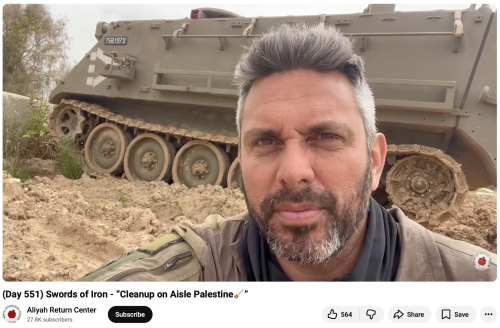
Perhaps most inflammatory are the views of Yishai Fleisher, who joins the program for a study session that carries “the story [of Israel] forward,” according to the sample booklet. Fleisher is among the most prominent advocates of Israeli annexation of the West Bank and Gaza, a policy that he has championed as the spokesperson for the settler community in the segregated West Bank city of Hebron.
Fleisher has long railed against the idea of a two-state solution, arguing that Israel should have full control of the area between the Mediterranean Sea and the Jordan River and that Palestinians should have limited rights. In a recent video posted on his popular YouTube channel, Fleisher said that Carlson, in his interview with Huckabee, was “spitting on the God of Israel,” adding that the American political commentator “needs to be taken down” like the Biblical Goliath.
The prominent settler is also a frequent commentator on U.S. policy toward Israel. He has referred to the American Israel Public Affairs Committee’s annual conference as the “Fourth Pilgrimage Holiday,” after the traditional Jewish holidays of Sukkot, Shavuot and Passover. In a podcast episode entitled “GAZANS GOTTA GO,” he advocated for the ethnic cleansing of Gaza and likened pro-ceasefire protestors on American college campuses to the Amalekites, who were massacred by the army of Saul, according to the Bible.
“Amalekites come for the Jews because they know that Jews represent civilization,” he said. “That’s what we’re seeing with the Jihadis on campus in the United States.”
Another interviewee is Messianic Jewish Pastor Avner Boskey. The preacher has written lengthy criticisms of Islam, warning in one pamphlet that “paganism and demonic worship are the spiritual matrix out of which Allah was elevated.” And, when Zohran Mamdani was elected mayor of New York City last year, Boskey wrote a piece with the subheading, “When The Upper West Side Turns Into The Lower West Bank.”
Destiny Magnett, Programs and Outreach Manager at Churches for Middle East Peace, told RS that the initiative contributes to the erasure of Palestinian culture, heritage, and history. Much of the sample booklet, for example, promotes a controversial new archaeological site called the Pilgrimage Road that cuts through a Palestinian neighborhood in Israeli-occupied East Jerusalem and has caused structural damages to local homes.
“Pilgrimages to this land simply don’t exist in a vacuum detached from the everyday realities of people on the ground,” said Magnett. “Acknowledging that should be part of the responsibility undertaken by anyone working at the intersections of faith and Israel/Palestine.”
Shifting strategies
Show Faith by Works’ initial plan, filed under the Foreign Agents Registration Act (FARA), indicated that the firm would “geofence” the physical boundaries of major churches in the American Southwest during worship times in order to “track attendees and continue to target [them] with ads” on behalf of Israel.
But the campaign was met with backlash from many congregations. The Christian Life Commission of Baptist General Convention of Texas urged church leaders to sign a letter calling on Attorney General Pam Bondi to prohibit foreign government use of tracking technologies at churches. A campaign and website called “show mercy and do likewise” was created as an interfaith project to support Christians being targeted by the campaign. Timothy Feldman, an attendee of one of the churches listed, told RS, “It was a strange feeling to see my local church directly targeted by a foreign country committing a genocide on the other side of the world.”
Show Faith by Works responded to the concerns by defending the geofencing campaign. Schnitger, the founder of the firm, told RS in an email at the time that “irresponsible” media outlets had “sensationalized” the firm’s use of geofencing. “It is a very common marketing tool that literally every person with a smartphone in America has experienced in one way or the other,” Schnitger explained. He later revealed that he was scrapping the geofencing campaign “due to security concerns.”
It is unclear whether this pivot will help Schnitger and the Israeli government win more support among Evangelicals. Uriesou Brito, presiding minister of counsel for the Communion of Reformed Evangelical Churches and senior pastor of Providence Church in Pensacola, told World — a media outlet that says it is “grounded in facts and biblical truth” — that he disagrees with Show Faith by Works’ approach. “My general principle has been that we should always be cautious when any government funds religious or theological outreach,” said Brito. “The concern in my estimation is not unique to Israel.”
Nick Cleveland-Stout is a Research Associate in the Democratizing Foreign Policy program at the Quincy Institute. Previously, Nick conducted research on U.S.-Brazil relations as a 2023 Fulbright fellow at the Federal University of Santa Catarina.
UK Government Secretly Tracked 25 Million People as Potential EV Owners
By Cindy Harper | Reclaim The Net | March 2, 2026
The UK government spent two years tracking 25 million mobile devices to build a picture of who drives electric cars. Not suspects or criminals. Just ordinary people whose browsing history mentioned EVs often enough to flag them as worth following.
The Department for Transport paid telecoms company O2 £600,000 ($809,000) to run the operation. According to the Telegraph, O2 trawled through its customers’ web browsing histories and app records, flagging anyone who visited an EV-related site at least once a month across two or more months.
That pool extended beyond O2’s own customers to include people on Tesco Mobile, GiffGaff, and Virgin Mobile, networks that run on O2’s infrastructure and whose users had no idea their data was being packaged and sold to a government agency.
Once flagged as a “potential EV owner,” your physical movements were traced across the country. London, the North-West, and the East of England received particular attention.
The techniques are standard in serious organized crime investigations. The DfT applied them to people buying environmentally friendly cars.
Andy Palmer, former executive at Nissan and Aston Martin, put it plainly: “I’m told it’s anonymized and aggregated, and that may well satisfy legal thresholds. But legality and legitimacy are not the same thing.” He added: “If you erode public trust in how that data is gathered, you undermine the very transition you are trying to accelerate.”
The idea of “anonymized” data means very little.
The surveillance ran for two years before the DfT quietly admitted defeat in April 2024, conceding that “mobile data cannot directly be used to provide information around charging behaviour or travel time.”
The program ended not because anyone questioned whether mass tracking of innocent people was appropriate, but because the data turned out to be useless for its stated purpose.
Civil servants from the DfT and Treasury were simultaneously exploring new EV taxes to replace fuel duty revenue. The people being surveilled were doing exactly what government policy encouraged them to do.
Conservative MP Sir David Davis drew the obvious conclusion: “It’s an object lesson in why you can’t trust the state with unfettered access to people’s information, because they’ve obviously taken this information without people’s permission with the objective of disadvantaging them, either by tax or other policy matters. If they’ll do it on this, with people who are doing what the government wants in policy terms, namely, pursuing green policies, what on Earth will they do elsewhere?”
The EV surveillance program wasn’t a one-off. During the earlier days of the COVID saga, the government ran a parallel operation, this time tracking people who showed up to get vaccinated.
Researchers funded through the Scientific Pandemic Influenza Group on Behaviors used mobile phone location data covering one in ten British people, without their knowledge or consent, to analyze behavioral changes after vaccination.
From that pool, they selected over 4,200 vaccinated individuals and tracked their movements through call data records, analyzing how far they traveled on vaccination day and whether they went straight home afterward.
The government was monitoring where citizens went after receiving a government-administered medical intervention, and chose not to tell anyone.
Moscow warns of worrying NATO buildup in Arctic
RT | March 2, 2026
NATO is attempting to curb Russia’s freedom of navigation in the Arctic, Moscow’s ambassador to Norway, Nikolay Korchunov, has said.
In an interview with Izvestia on Monday, Korchunov argued that Norway was seeking to squeeze Moscow out of the Spitsbergen archipelago, where Russia – the only country besides Norway to have carried out economic activity there for decades – has no intention of scaling back its operations.
A Norwegian territory, Spitsbergen has a Russian presence in the form of the Arktikugol mining company and the mining community of Barentsburg. Russia enjoys an equal right to engage in commercial activities on the archipelago alongside 13 other nations in accordance with the 1920 Svalbard Treaty, which also made the territory a demilitarized free-trade zone while recognizing Norway’s sovereignty over it.
Korchunov said Oslo was deliberately hindering Arktikugol operations and curbing movement and economic activity in parts of the archipelago, while pointing to a NATO-driven military buildup marked by more frequent visits from Norwegian aircraft and warships. He warned that bloc members “possess significant naval capabilities” and had shown a readiness to use them to curb freedom of navigation in breach of international law.
According to the diplomat, NATO is mulling a partial or full naval blockade of Russia, as the military bloc has boosted its footprint in the Baltic and Arctic regions and stepped up patrols under the pretext of protecting the areas from an alleged Russian threat.
Korchunov accused NATO of escalating tensions and fueling a “confrontational frenzy” in the Arctic, insisting that Russia poses no threat and has no interest in conflict with Norway or other NATO members, but warning that Moscow “will not leave threats created for us without an adequate response.”
He said NATO, including Norway, had in recent years “rapidly increased” its military presence and operational activity in the north, arguing that under the “frankly far-fetched pretext” of a Russian threat, new command structures and bases were multiplying across the Nordic region “like mushrooms after the rain.”
The development comes as Denmark has bolstered its military presence in and around Greenland since the start of the year, deploying additional ships, aircraft, and personnel as Arctic security tensions mount. The strains followed threats by US President Donald Trump to seize the autonomous Danish territory.
Russia’s Foreign Ministry says NATO’s expanding Arctic footprint is destabilizing and poses a direct threat to national security.
Featured Video

Death Spikes & Rising Cancer In Our Youth Explained
or go to
Aletho News Archives – Video-Images
From the Archives
Politicians lie
By Mazin Qumsiyeh | Popular Resistance | August 18, 2013
There is no way to say this truth nicely: Politicians lie. That includes Japanese, American, Egyptian, Israeli, and Palestinian politicians! Is there something more common sense than that? Yet, so many citizens around the world believe their own politicians or wistfully acknowledge lies but think it is part of the job needed to run things. They believe even when politicians contradict themselves blatantly. This phenomenon is rather remarkable. It is a dissonance and disconnect from reality that many seem oblivious to. It is very dangerous because it can lead to accepting rationales for going to war. These can be deadly wars that lead to millions of lives lost as happened in what was called World War 1 and WW2. Even when incredible and declassified evidence abound, politicians continue to lie and old mythologies refuse to die. Here are just a few of the countless lies told to us over the past few decades… continue
Blog Roll
 Aletho News
- From Unipolar Universalism to Multipolar Civilizational Distinctiveness
- RSF military group defects, joins Sudanese army: State media
- Ireland goalkeeper refuses to play ‘Israel’ as squad weighs boycott
- China pushes back against US on Cuba, Iran
- Ukrainian Soldiers, Potential Mercenaries: Have Gun, Will Travel!
- Burnham’s UN debut… A masterclass in British disinformation
- Iran flights continue despite US aviation sanctions
- Global Tipping Points Lead the World Into a State of Entropy
- The day-after at the White House: USA and Xi Jinping
- The Geopolitical Balance in the Red Sea: The UAE Being Displaced by New Players
- If Americans Knew
- Deconstructing Netanyahu’s pants-on-fire UN rant – Daily Update
- Trump betrayed voters with his campaign lies and prioritized a foreign country once he took office
- Netanyahu calls Israel’s war in Gaza ‘opposite of genocide’ in UN speech to near-empty hall
- Settler Kidnappings: Torture, Sexual Abuse and Terrorisation of Palestinian Abductees as Israel Deepens Annexation of West Bank
- Gaza winter nears as 162,000 tents become unusable, raising fears of humanitarian crisis
- Netanyahu says, “It’s the opposite of genocide”; UN says Gaza economy is world’s ‘most severe crisis on record’ – Daily Update
- Israel’s US-Backed Assault on Gaza Has Created the ‘World’s Most Severe Economic Crisis on Record’: UN
- ‘Protecting U.S. Citizens’… From Israel
- ‘This is where I live now, the back of a truck’: a day in the life of a grandmother in Gaza
- In UN Speech, Iran’s President Displays Pictures of Children Killed by US, Brings Attention to Israel’s Nuclear Arsenal
- No Tricks Zone
- New Study: Earth And Venus Surface Warmth Largely Explained By Convection And Lapse Rate, Not CO2 Or Radiation
- 2025 Nature Paper Claiming Worsening Global Drought Gets RETRACTED …Heavily Flawed
- New Study: ‘Global Drought Shows No Detectable Recent Acceleration Under Climate Warming’
- Economic Masterminds: German Socialists Suggest Taxing Productivity Gains Stemming From Using AI
- The South China Sea Has Not Been Cooperating With The Climate Change Narrative
- Energy Crisis: Germany Enters Heating Season With Historically Low Gas Reserve Fill Levels
- New Study: The Antarctic Ice Sheet Gained Mass From 2020-2024 Due To Staggering Snow And Ice Accumulation
- Study: Ocean Heating Rates From Thousands Of Years Ago ‘Dwarf’ Modern Ocean Heating Rates
- Climate Extremists Target, Attack Large-Scale Power Grid Infrastructure In Germany!
- New Study: Antarctic Ice Melt Has Contributed Less Than 1 Centimeter To Sea Level Rise In The Last 30 Years

